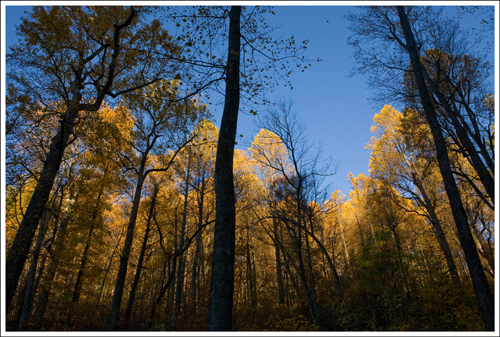
South River Falls

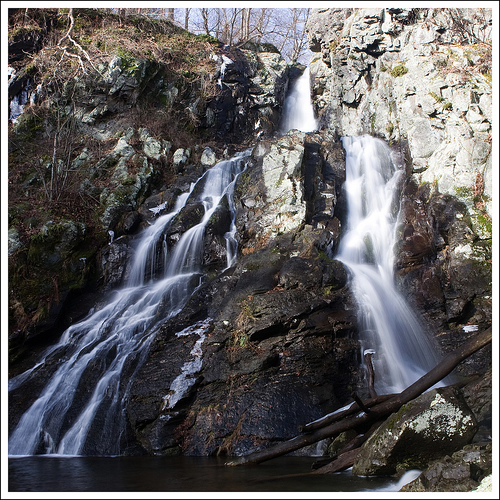
This 4.6 mile hike leads you along the South River to an impressive waterfall that plunges deep into a canyon.  When the park has experienced lots of rain, this waterfall hike is one of the nicest Shenandoah has to offer.
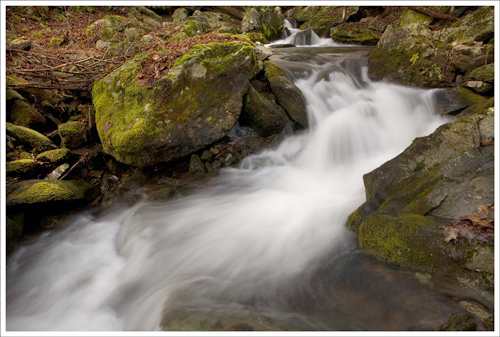
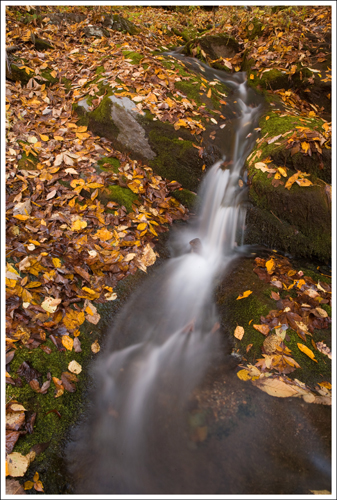
Cascades along the South River
The South River is impressive in times of heavy rain.

Adam Says…

We have kept with a tradition the last few years of doing a hike on Thanksgiving morning.  It’s a great way to appreciate nature and try to do something active before a big meal.  This year, we decided to break the tradition of having a huge Thanksgiving meal with turkey and all the trimmings.  We decided to have an easier meal that we would both enjoy – homemade pizza.

We’ve hiked South River Falls before, but we’ve never had as much water in the falls before.  We thought it would be impressive, since we could hear rushing water through the South River a lot earlier than normal.  Waterfall hikes in Shenandoah National Park tend to be fairly tough ones.  Since you park on Skyline Drive at a high elevation, you have to hike down to the valleys where the falls are created.  What makes it difficult, at least psychologically, is that you get to the payoff fairly easily and then have to do the hard work on your way back to your vehicle.

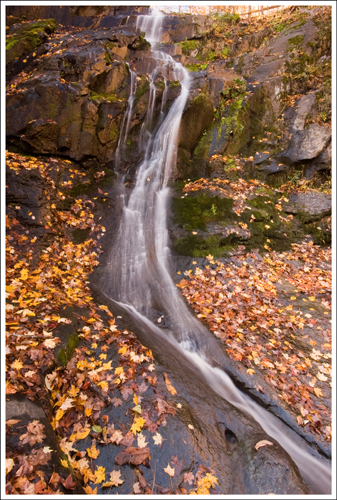
The South River right at the crest of the waterfall.
The beauty of the South River is found mostly in its small details. The cascades and little falls leading the large waterfall are prettier than the main waterfall.  Pictured below: South River Falls from the overlook at the top of the canyon; the falls from the base.  You’ll see neither vantage point of the waterfall is terribly photogenic (especially after the leaves have come down). Both of the small photos below are from another date.  This time, the falls were much bigger – but it was too sunny to photograph them.

The view from the top of the canyon. The view from the base of the falls

The hike begins at the South River Picnic Area.  Look for the large sign about the hike on the northeastern side of the picnic area.   At slightly over .1 mile, you will cross the Appalachian Trail.  You will continue your descent and around 1 mile, you will rock-hop across a small creek that drains into the South River.  Usually this is not much of a challenge due to the water, but we found the water was higher than normal this time.  At 1.3 miles, you will come to a nice overlook for the South River Falls.  You really get a great view of the 83 foot waterfall.  It plunges to a rocky ledge and splits in two about half of the length of the waterfall.  If you continue on the trail for another .2 miles, you will arrive at a cement post and join a spur to the South River Fire Road.  If you continue on for another .2 miles, you will descend even further and arrive at another cement post.  Following the path from the cement post for another .1 mile, you will arrive at the base of the falls.  For any adventurous shutterbugs, there are ample opportunities near the base of the falls for long-exposure photography. Make sure you have your strength up, because you have 2.2 miles to hike at a steady incline back to your vehicle.

To follow the trail as a loop as we did, once you make your return from the base of the falls, go .7 miles until you reach the cement post and the junction with the South River Falls Trail. Stay on the fire road instead and after .4 miles more, you will reach the yellow-blazed South River Fire Road.  Take a left on the road.  In about a mile, you will reach the junction with the Appalachian Trail.  Take a left on the white-blazed AT, heading south for about .4 miles.  You will then reach the junction with the South River Falls Trail and only have about .1 mile to reach the picnic ground.

The hike was a tough one, but it was nice to get some exercise.  The thought of carving into our pizza helped us muster the energy to make it back.

Christine Says…

This was a great trail to burn off Thanksgiving calories!  The terrain is rugged and the return arm of the loop is nothing but steady, tough uphill climbing.  Even Wookie, who is normally a bundle of boundless energy, got quite tired on this hike.  By the time we got to the Appalachian Trail junction, his corkscrew tail was completely unfurled.   Even though there are some hikes in the park with more elevation gain, I think the 1300+ feet on the South River trail provides some of the park’s tougher climbing.   Anyone looking for an easier version of this hike should consider doing the short loop (3.2 miles) that returns after the overlook at the top of the falls.  By taking that route, you reduce the elevation gain to a very manageable 850 feet.

Despite the hard work required to get there, I really enjoyed seeing the South River and its namesake falls so flush with water.  The Shenandoah area has had over five inches of rain in the month of November – more than double the normal amount.  All of the park’s streams, rivers and waterfalls are flowing beautifully right now.  It’s a great time to get out and enjoy the scenery and the less-crowded conditions in the park.

Cascades along the South River
There are many small, but beautiful, waterfalls along the trail. Pictured below: Another pretty spot along the river.

Cascades along the South River

I had hoped to get some photo opportunities along the river on our Thanksgiving hike.  I did take a few shots, but the weather was less than cooperative.  It was too sunny to take shots of the moving water. Every now and then, I found a shady spot down in a deep ravine.  I did a bit of bushwhacking to get to a few pretty spots, but overall I don’t feel like I came home with any special photos.

Honestly, while South River falls is probably the park’s most impressive waterfall, it is not one that translates nicely on film.   The falls plunge into an enormous natural amphitheater.  The sheer rock walls are amazing, but they aren’t photogenic.  I’ve seen a few nice shots of South River Falls in the spring, when the water is flowing and the falls are surrounded by the lush new green of the trees and plants.  In the late fall and winter, the falls are really scrubby and barren looking.

I think some of the prettiest and most dramatic places along the South River come at the bottom of the falls.  In the last .1 mile of the trail, leading to the base of the falls, the water tumbles over a hundred feet down over giant boulders.  There are many small, beautiful waterfalls to enjoy before you get to work climbing back up to your car.

When we got home from our hike, we found several TICKS!  Can you believe it – ticks in late November; ticks after the mountains have had snow and temperatures at night are regularly below freezing?  These were tiny ticks – about the size of a pinhead.  We pulled one off Adam’s sweatshirt and two off of Wookie.  I hate having to watch for ticks year round, but it seems that we must.

Wookie Says...Wookie Says…
Hey all of you fellow hiking dogs.  It’s been a while since I’ve been hiking, so I’m going to let you know what I thought of the trail.  I enjoy getting the chance to get in the outdoors and I usually run laps around the house when my masters ask,  “Would you like to go on a car ride?”

The hike on South River Falls was pretty fun for the most part.  I enjoyed going downhill until I reached the stream to try and rock-hop.  I’ve done this hike before with my masters, but there was a lot of water this time around.  I don’t really like to get my feet wet and when I see any water on the hike, I try to take the driest option.  After Adam crossed the creek, I really didn’t want to follow him.  Only after Christine gave me a little nudge with her trekking poles, did I take the plunge and hop across the rocks.
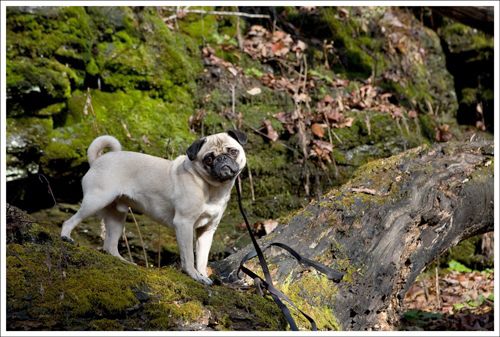
Wookie Enjoyed the Hike
Wookie enjoyed the hike, but was exhausted the rest of the day.

All the rushing water on the trail, really made me need to go to the bathroom.  I tried to make my mark as much as possible to let all my fellow canines know that Wookie was here.  The hike back from the falls was pretty brutal for a small dog like me.  My tail was down a lot of the trip back, because it was exhausting.  At least I got some pizza scraps and a taste of sausage instead of turkey scraps this year.  For that, I was truly thankful.

Trail Notes

  • Distance – 4.6 miles – loop.
    (Check out the stats from MapMyHike – added 5/16/15)
  • Elevation Change –1315 feet.
  • Difficulty – 3. The return arm of the circuit climbs steeply uphill along a fire road for two straight miles.
  • Trail Conditions – 4. The trail is in great shape.
  • Views –0. You are deep in the woods for the entire hike.
  • Waterfalls/streams –4. In times of heavy rain, the South River is an impressive stream.
  • Wildlife – 0. We didn’t see *anything*, but over the summer there was a bear with three cubs in the area.
  • Ease to Navigate – 4. Trails are clearly marked.
  • Solitude – 2. This trail’s proximity to a park entrance makes it a popular hike.

Directions to trailhead:
From Skyline Drive, follow the drive to the South River Picnic Area (near mile marker 62).  The trailhead is located at the back end of the picnic grounds, across from the restroom facilities.
Big Run Loop

Big Run is a pretty (almost) six mile walk along one of the park’s less-trafficked trails.   Although this hike does not offer any grand scenery, it offers plenty of solitude and nice options for backcountry camping.

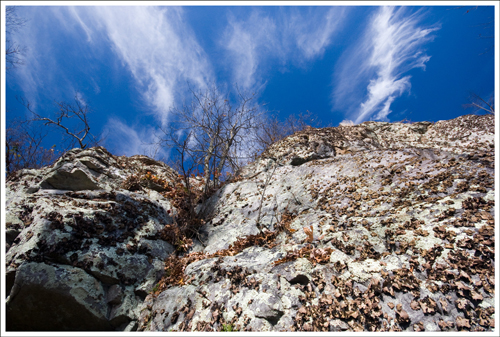
Cliffs along the Appalachian Trail
These lichen covered cliffs are found along the Appalachian Trail segment of the Big Run Loop.

Christine Says…

We said we were going to take a weekend off of hiking so we could catch up on yardwork and housework, but the weekend was far too beautiful to spend it being productive adults.  We decided to have breakfast at Big Meadows before hitting the trail.  Most of the park facilities closed for the season on Sunday, and the remainder will close the last weekend in November. It was nice to have one final round of pancakes and sausage in the lodge dining room.

After our big meal, we headed south on Skyline Drive to hike the Big Run Loop.  Last time we did this trail, it was in the midst of an August heat wave.  It was in the nineties and we had to rest and drink water every ten minutes.  This time, the weather was considerably cooler – but still unusually warm for November.  I couldn’t believe it, but there were actually swarms of bugs pestering me every time I stood still.  I even got a giant mosquito bite on my collarbone.  It’s not supposed to be buggy in November!

The trail was covered with dry, brown leaves.
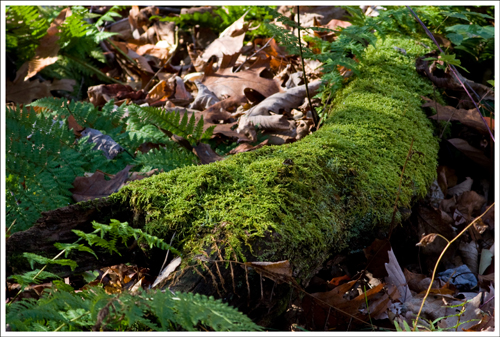
The trail was covered with dry, brown leaves. Pictured below: The only color left in the woods was from moss and a few hardy ferns.

Fern in Shenandoah National Park Moss on the Big Run Trail

The trail started off with a couple miles of steady downhill.  The trees had completely shed their fall foliage, so the trail was covered with a thick blanket of crispy fallen leaves.  As we crunched along the trail, I remarked to Adam that we would certainly not be sneaking up on any wildlife on this hike.  The leaves made it hard to see obstacles on the trail, and we both stumbled over rocks and branches hidden under the leaf layer.

At around the two mile mark, we reached Big Run.  The water was very low and the stream was mostly obscured by several newly fallen trees.  Although the trail is named for this stream, I think Big Run is fairly unremarkable.  We didn’t stay long at this spot.

Big Run was prettier last summer.
Big Run was prettier last summer. Since this photo was taken, several large trees have fallen across the stream where the trail crosses.

Shortly after the stream, the trail took a distinct uphill turn.  For about a mile and half, we climbed steadily uphill.  Some parts were rather steep, but overall it’s really not too bad of a climb.  I used my trekking poles on this hike and they made the ascent markedly easier.  I think the poles help me hike more efficiently and take pressure off my knees.  Whenever I use them I feel like I have extra magical energy.

We eventually came to a four-way trail junction at the top of the ridge.  The remainder of the hike followed the Big Run Loop trail until it joined the Appalachian Trail.  The last segment along the AT took us past some impressive granite cliffs and crossed the Doyles River Overlook on Skyline Drive.  After about a mile and a half along the AT, we completed the loop and returned to our car.

Adam Says…

Doyles River Overlook

We were debating a few different options for our hike today, but we decided to do Big Run.  One of the reasons that we chose this hike is due to the challenge of trying to find one of Hiking Upward’s hiking sticks.  A few hand-carved hiking sticks are placed along the trails that are up for grabs to whoever can find them.  They provide GPS coordinates for any geocachers out there.  I wasn’t able to find one, I believe due to a typo on the website.

Buck in the rutting season.
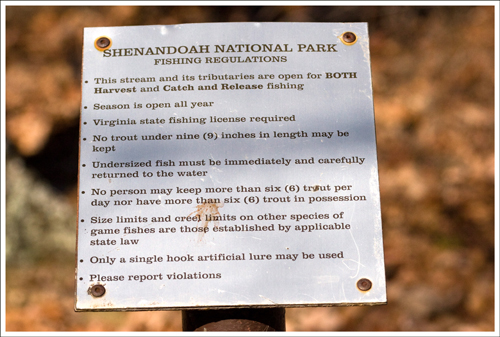
Buck in the rutting season. Pictured Below: Most places in the park allow catch and release fishing. Big Run actually allows fish to be harvested.

Fishing regulations

Due to all of the leaves falling, the hike was a little more challenging than normal.  We started the trail going downhill fairly quickly and the leaves made it for tricky footing.  The swoosh of the leaves with every step drowned out our own voices and everything else.  We had to stop to hear each other when we wanted to talk along the hike.

The blue-blazed trail descends about 1500 feet in 2.2 miles when you reach the branch of Big Run.  The water was still and barely more than a trickle this time.  After rock-hopping the stream, you will come to a cement post.  Take the left branch of the fork.  The trail is now marked by yellow blazes and starts a steep ascent.  You will gain about 1000 feet of elevation in a little over a mile.  At 3.5 miles, you will come to another cement post.  Turn left, heading east, to continue on the Big Run Loop Trail, which is now marked by blue blazes again.  While you still are going uphill for most of the rest of the hike, it is definitely more manageable.  At 4.2 miles, you will reach the junction with the Appalachian Trail.  You will take a left, heading north, to follow this white-blazed trail.  At 4.5 miles, you will cross Skyline Drive, to stay on the AT.  At 4.7 miles, you will reach the Doyles River Overlook, which provide you the best views on the hike.  The AT continues on the north side of the parking lot.  You will stay on this trail for another mile.  When you reach the cement post at 5.7 miles, you will take a left which will take you back to your car at the Doyles River Parking Lot only about 30 yards away.

While this hike is not spectacular for streams or views (until you reach the Doyles River Overlook), it was still an enjoyable walk through the woods.  As I mentioned earlier, the leaves led to some difficulty with seeing the trail.  At one point on the AT, I slipped on a rock hidden by the leaves and went tumbling down.  Luckily, I was unscathed and more importantly, I was able to protect Christine’s camera gear I was lugging on my back.

Trail Notes

  • Distance – 5.8 miles
  • Elevation Change – 1400 feet
  • Difficulty – 3.5.  There is a mile and a half of steady uphill shortly after crossing Big Run stream.
  • Trail Conditions – 4.  The trail is in great shape.  It was a little trickier than it should have been with all the downed leaves covering the trail.  Footing was tough at times because we couldn’t see rock and branches on the trail.
  • Views –1.5. You get one nice view when the Appalachian Trail crosses the Doyles River Overlook.  If you hike when leaves are down, you get some other glimpses of views along the way.
  • Waterfalls/streams – 1. Big Run is not as impressive as it sounds.  It’s not big and it doesn’t really run much either.  🙂
  • Wildlife – 2. We saw deer and lots of different kinds of birds.
  • Ease to Navigate – 4. Although there are turns, this trail is very well marked.
  • Solitude – 4. Because this trail lacks grand views and waterfalls, it tends to be more lightly trafficked than other Shenandoah trails.  The area is popular with backcountry campers.

Directions to trailhead:
Follow Skyline Drive to the Doyles River Trail Parking area near mile marker 81.  Cross the drive and begin your hike on the western side of the road.  The hike departs from the Big Run Overlook.  There may be room for a car or two at the overlook, but we recommend parking in the larger Doyles River parking area.

South Valley Trail

The South Valley Trail is a part of the 35 miles of hiking trails in Prince William Forest Park.  It is a nice stroll that takes you along the Quantico Creek.

Quantico Creek in the fall.
Even though the foliage was past peak on our hike, there were still some pretty spots along Quantico Creek.

Adam Says…

We went up this past weekend to visit Christine’s parents.  Her dad’s birthday is on Halloween and he usually likes to do something active to help celebrate.  He suggested a possible bike and hike in Prince William Forest Park.  We were expecting a lot of rain that weekend, so we decided to just do a hike.  While it was raining a little before we got there, we managed to do the hike with only a light drizzle at the end of the hike.

The sign marking the South Valley Trail
The South Valley Trail runs in a large loop around the park.  Pictured below: The hike starts off on Mawavi Road; A bridge over Quantico Creek;  Adam checks out evidence of beaver activity.

Walking down Mawavi Road The arched bridge at the end of the lake Evidence of beaver activity in the area.

Many people do not realize that Prince William Forest Park is part of the National Park Service.  The land was given this protection to find a new use for the land under Franklin D. Roosevelt’s New Deal.  It was used as a training school for the military during World War II, but was turned back over to the Park Service in 1946.

While the overall South Valley Trail is about nine miles, we decided to do the portion that highlighted the South Fork of Quantico Creek.  Her dad dropped a bike off at parking lot “I” and then we proceeded to lot “G” to start our trip.  Christine’s father used the bike as a shuttle at the end of the hike.  Upon reaching lot “I” at the end of the hike, he biked back to the car and then returned to pick the rest of us up.

We began by walking on Mawavi Road.  In about .4 mile, it intersects with the South Valley Trail.  We took a left on this trail.  The trail runs along Quantico Creek for the majority of the rest of this hike.  Shortly after joining the South Valley Trail, you will see a very narrow lake.  There are a couple of cabin camps on the opposite side of the lake, which are often used by Boy Scouts.  In 1.6 miles from the start, you will reach a junction with the High Meadows Trail.  Continue straight on the South Valley Trail until you reach the Scenic Drive.  Take a right and head down the road to your other vehicle at parking lot I, just about a tenth of a mile ahead.

Quantico Creek was dammed to create a lake.
Part of Quantico Creek has been dammed to create a lake. There is a group camp on the lakeshore.

We were expecting to see more color in the leaves this year, but it seems that things near the creek were a little past peak.  We did see lots of signs of beavers in the area, but we didn’t see any actual beavers.  The bridge and lake were interesting to view along the way, but this was more of a nice stroll through the woods than a momentous hike.  The grade during this hike was a mix of hills and flats, so most people could attempt this hike without much difficulty.  What amazes me most about this area is that it doesn’t seem to be heavily used.  You would think with the proximity to D.C. and the hordes of Northern Virginians, that it would be crawling with people.  But, we’ve been here several times and there doesn’t seem to be that many visitors.

Christine Says…

I’ve hiked along the South Valley trail many times over the years.  When I was a Girl Scout, we camped in the park frequently.  We took many day hikes along this trail.  As an adult, we’ve hiked it as a family several times.  In fact, it was the first trail we hiked after my younger brother returned from his first tour of duty in Iraq.   Like Adam said,  the South Valley trail is nothing spectacular.  There are no grand vistas or thundering waterfalls.  Instead, it’s simply a place to enjoy a quiet and peaceful walk through the woods.

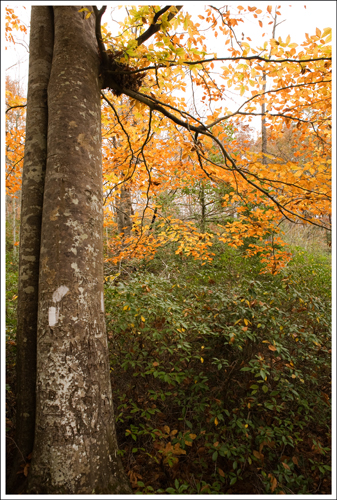
There wasn't much foliage left, but this tree was pretty.
There wasn’t much colorful foliage left on the hike.  Pictured below: A pretty spot along the creek.

Quantico Creek in the fall.

The foliage was about a week or two past peak when we hiked this year.  There were a few ginkgo and beech trees still holding onto golden leaves, but most of the trees were bare or brown.  The last time I hiked this area was fall of 2007.   Even though it was much later in the season, the color lingered until almost December that year.  The photos below were taken on November 17, 2007.   I guess this is even more evidence that fall came and went early this year.

The foliage along this hike was much prettier in 2007.
The foliage along this hike was much prettier in 2007. Pictured below: A couple more shots from fall 2007.

The foliage along this hike was much prettier in 2007. The foliage along this hike was much prettier in 2007.

The terrain of this hike is very easy.  Since Prince William County doesn’t really have mountains, the park lacks tough grades and long climbs.  I would describe the trail as crossing rolling terrains.  You’re almost always walking uphill or downhill, but ascents and descents are never steep or long.  Quantico Creek is a lovely and lazy waterway along the trail.  There are a few places where the water forms small rapids and cascades, but most of the time it’s just a quiet, smooth ribbon of water through the woods.

The morning in Prince William Forest was a nice way to spend some time as a family.

Trail Notes

  • Distance – 3.1 miles
  • Elevation Change – Negligible
  • Difficulty – 1.  Not much uphill the way we traveled.
  • Trail Conditions – 4.  The trail is narrow, but in great condition.
  • Views –0. No views to really see.
  • Waterfalls/streams – 3. You will constantly get views of the stream nearby, but the water is usually fairly still.
  • Wildlife – 1. You’re likely to only see deer around here.  However, gnawed trees lead to the belief that there are beavers in the area.
  • Ease to Navigate – 3.5. A few turns, but easy to follow.
  • Solitude – 3. It’s Northern Virginia, so expect some people, but you should still have decent solitude.

Directions to trailhead:
From I-95, take exit 150 on to 619 heading west.  The Prince William Forest Park entrance is on the right.  Once you pass the gate, take a left at the first fork.  Once you pass parking lot C, take your next left.  To do the trail as a shuttle as we did, leave a vehicle or bike at lot I and then proceed to lot G.  Walk down the Mawavi Road to start the trip.

Doyles River-Jones Run

The Doyles River-Jones Run loop is a nice six-mile hike that takes you past three sizable waterfalls and a lot of beautiful stream scenery.

Lower Doyles River Falls didn't have much water, but was surrounded by foliage.
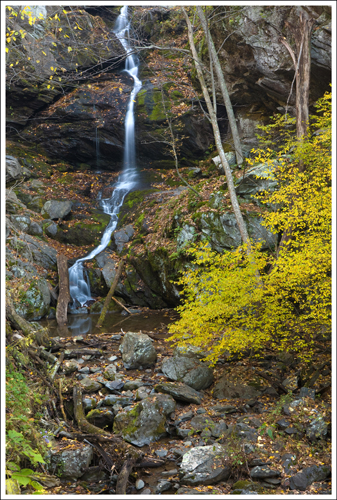
There are three significant waterfalls along the Doyles River – Jones Run trail.

Christine Says…

Although, the wind, rain and (yes!) snow stripped the fall color from Shenandoah rather early this year, Adam and I still wanted to get out and hike on at least one glorious, sunny autumn day.  There was still a little bit of colorful foliage hanging on in the south district of Shenandoah National Park, so we decided to hike the Doyles River- Jones Run loop on Sunday morning.

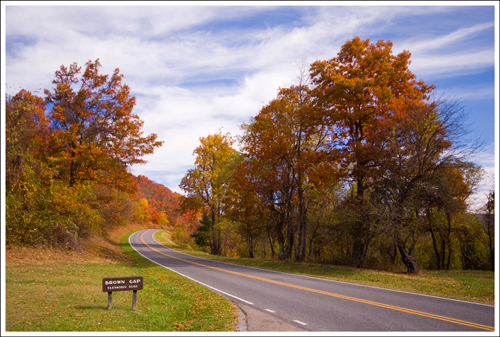
Park at the Brown Gap lot
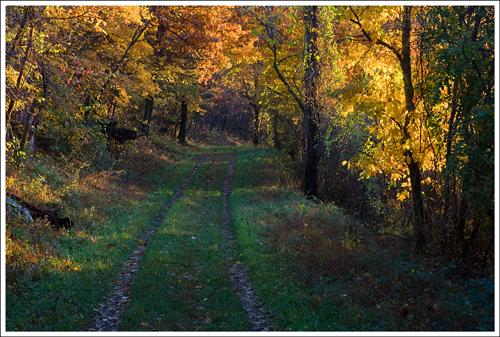
Parking is available at Brown Gap. Pictured Below: The fire road leading down from the parking lot is one of the prettiest in the park; the Shenandoah area has tons of Civil War history. We passed the grave of confederate solder, William Howard, along the way.

We started the hike along the Brown Gap fire road. William Howard, a confederate soldier, is buried along the Brown Gap fire road.

We got to the trailhead at Brown Gap right as the sun was coming up.  It was f-f-freezing and windy.  I carelessly left my hat and gloves at home, so I flipped up the collar of my fleece and retracted my hands into my sleeves.  We set out down the Brown Gap fire road, which is one of Shenandoah’s prettier fire roads.  It’s also where I used to ride my horse, “Friday”, whenever we trailed to the park.  The morning sun was filtering through the golden leaves, and soon the activity of walking warmed me up enough that I didn’t miss my gloves at all.  The fire road was really muddy, so I took that as a good sign that there would be plenty of water flowing in the three waterfalls we’d be passing along the route.

In fact, I was so sure that the waterfalls would be impressive, that I carried all the “big guns” in my photography arsenal – two camera bodies, three lenses, a shutter remote, a collection of neutral density and polarizing filters, extra batteries, memory card and my tripod (the one that feels like it weighs close to 100 pounds when I carry it on long hikes).  I also brought my new tripod bag (by Kinesis) that allows me to carry the tripod backpack style – evenly centering the weight on my back.  The sling style carrier I’ve been using for the past few years twists my neck and shoulders, so I try not to carry it on long hikes.  The new bag was really nice, but it perfectly lined up the camera mount lock lever with my butt.   Every step I took, the lever poked me quite rudely.  I ended up giving the tripod to Adam.  He’s taller, so he escaped the constant prodding.  I ended up carrying the bag with the rest of the gear.  It was much heavier, but still more comfortable.

When we reached the bridge at the junction of the fire road and the Doyles River trail, I groaned in dismay at the dry stream before us.  We walked along the river, or at least where the river should have been for another .3 miles to get to the base of Upper Doyles River Falls.  Normally, there are pretty little cascades leading down to the main double-terraced waterfall.  This time the waterfall was barely a trickle.  We ate our breakfast at the base of “Disappointment Falls” and headed on to the lower falls.

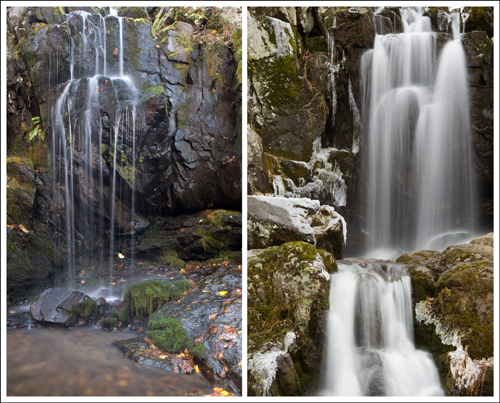
The water is Upper Doyles Falls was low - compare January 2009 to October 2009.
The photo above shows Upper Doyles Falls is October 2009 (left) compared to January 2009 (right).

Surprisingly, the lower falls were running quite a bit more than the upper falls.  I think narrower chasm through the rocks allows the second falls to hold onto more water flow.  The second falls is thin and almost chute-like.   Even though the second waterfall had more water, it still wasn’t anything spectacular.  When you’re a photographer hiking with 40+ pounds of gear and realizing the shots you had planned aren’t going to happen, the gear instantly feels twice as heavy.  I think this is the point that I started to feel like Atlas with the world resting on my shoulders.  🙂

Adam perches on a rock along lower Doyles River Falls.
Lower Doyles Falls was a bit nicer than the upper falls.

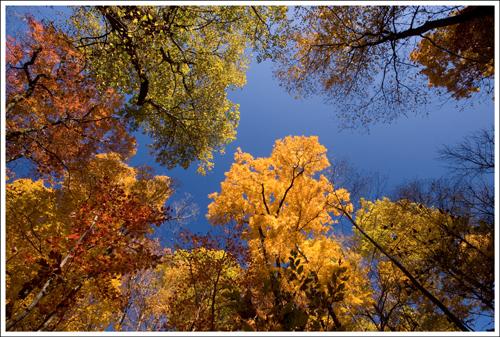
Leaving the lower falls, the trail became incredibly beautiful.  It followed a babbling brook through near-peak foliage.  The trees were a spectacular mix of gold, orange and red – all set off by the brilliant blue sky above.   This was, without a doubt, my favorite section of the trail.

So far, the hike had been relatively easy – just gentle up-and-down grades along the stream.  At the junction of the Jones Run Trail, the real work started.  In just under 2 miles, we picked up most of the elevation gain on the whole hike.  It was steep, hard climbing to reach Jones Run Falls.

The trees above displayed beautiful fall colors
The foliage along the Jones Run Trail was spectacular. Pictured Below:  Jones Run and Jones Run Falls.

Jones Run is a beautiful stream The water was low in Jones Run Falls

The waterfall on Jones Run was running low, but it was still really pretty.  From the waterfall back up to Skyline Drive, the grade of the trail moderates a bit.  It’s still a lot of uphill mixed with periods of flat terrain.  Eventually, you reach the junction with the Appalachian trail and follow it north for a little over a mile back to the Brown’s Gap parking lot.  This section of the AT follows closely to the road, so you constantly hear cars and smell exhaust.  The walk along this section is easy, but rather uneventful.

Overall, I think this was a great hike.  I’m so glad we had a chance to be outdoors on a beautiful fall day, but I wish the waterfalls had been nicer.  We’ll have to try hiking it again in the spring after heavier, more sustained rains.

Adam Says…

While we’ve hiked Doyles River a number of times, this was the first time that we had made a loop of the hike and added Jones Run.   When we have done this before, we parked at the Doyles River parking lot around mile marker 81.  We would normally hike down to both of the falls and then head back.

On this hike, we parked around mile marker 83 at the Brown Gap lot.  We crossed the road and headed down the Brown Gap fire road.  At about .4 miles, you see a short path leading up to the gravesite pictured above.  In about 1.7 miles you will reach the junction with the Doyles River Trail.  Take a right on this trail.   After about two tenths of a mile, you will reach the Upper Doyles River Falls.  There is a short spur path to lead down to the base of the falls.  Once you rejoin the trail, you will then see the Lower Doyles River Falls after a tenth of the mile.  Don’t try to blaze down off the trail to reach the falls.  The trail loops around to bring you closer to the falls.  When you reach near the base of the falls, there is a short, treacherous climb down to the base of these falls.  When you join back to the trail, continue south down the Doyles River Trail.  You will reach the Junction with the Jones Run Trail in about .6 miles from leaving the Lower Doyles River Falls.  You begin your hike up to the Jones Run Falls and will reach them about .7 miles on this trail.  After the falls, you will have a 1.2 mile hike up to the Jones Run Parking lot.  Before you enter the parking lot, there will be a junction with the Appalachian Trail.  Take a right on the AT, heading north until you reach the Brown Gap parking lot.  The AT portion is about 1.3 miles back to your car, leading you to this overall hike of 6 miles.

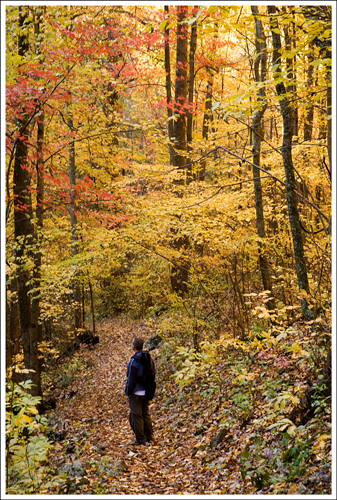
The woods on the Doyles River - Jones Run trail were gold and red.
The woods were very colorful at the lower elevations. Pictured Below: One downed tree we came across was so large that Adam could climb inside.

This fallen tree was big enough for Adam to crawl into.

The hike is not that long being only six miles, but there is a lot of elevation gain from the base of the Doyles River Trail, leading up to the Jones Run Parking lot.  Christine felt that it may be better to do this hike in reverse, but based on contours, I think either hike has a tough trip back at the end.

The waterfalls along the way on normal days are really some of the nicer waterfalls in Shenandoah National Park.   The water flow didn’t allow us to see them at their best today, but we enjoyed them nonetheless.  The Upper Doyles River Falls stands at 28 feet;  the Lower Doyles River Falls plummets 63 feet.; the Jones Run Falls plunges 42 feet.  If you’re looking for a hike to see multiple falls, this is the best one to do in Shenandoah.

The morning light made the trees glow golden.
More golden foliage along the trail.

On our way back to the car on the AT, we ran into a woman doing the trail in the opposite way.  She had two pugs with her on the hike, named Titan and Zoot.  They were eager to greet us, since they must have known we had three pugs of our own.  They were very energetic to begin their hike to the falls, but we wondered how they fared on the steep way back.  We wish we had taken some pictures of these boys, because they looked like they were ready for a great adventure that day.

Cars waiting to get into Shenandoah National Park
There was a very long line of cars waiting to get into Shenandoah National Park

The foliage was just slightly after peak today.  We decided to exit the south entrance of the park to reward ourselves with some frozen treats from Sonic.  On our way out, we saw the longest line of cars we’ve ever witnessed trying to enter the park at the south gate.  Cars were at a stand-still all the way down to the interstate.  Three rangers were walking down the line, handing out information to make the fee stations handle things quickly.  I guess everyone felt that it would be a nice day to see color in the park and hopefully they weren’t too disappointed in the color.

Trail Notes

  • Distance – 6 miles – loop.
  • Elevation Change –1875 feet
  • Difficulty – 4. The climb up from the bottom of Jones Run is tough!
  • Trail Conditions – 3.5 The trail is well-maintained and traveled.
  • Views –0. You might get a few glimpses of vistas through the woods along the fire road.
  • Waterfalls/streams –4. The waterfalls and streams along this trail are beautiful, especially when there is plenty of rain.
  • Wildlife – 1. Just a couple deer.
  • Ease to Navigate – 4. Trails are well marked and easy to follow.
  • Solitude – 3. You will likely see several other groups of hikers along the way, but it’s not as heavily trafficked as other waterfall trails in the park.

Directions to trailhead:
From Skyline Drive, follow the drive to Brown Gap (near mile marker 83).  The parking lot is on the west side of the drive.  To begin the hike, walk across Skyline Drive and follow the Brown Gap fire road downhill.