The drive to the trailhead is probably tougher than the actual hike, but this 2.4 mile out-and-back in the Canaan Backcountry has spectacular views and is well worth the bumpy ride to get to the trail’s start!
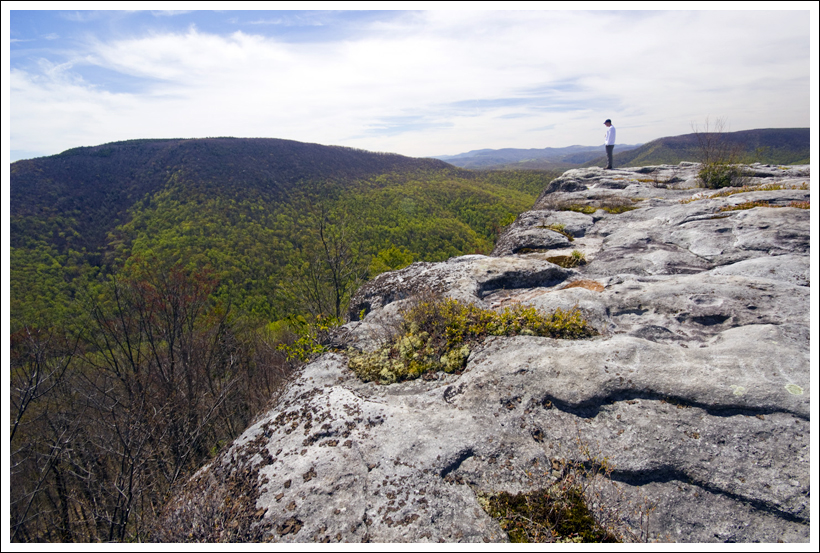
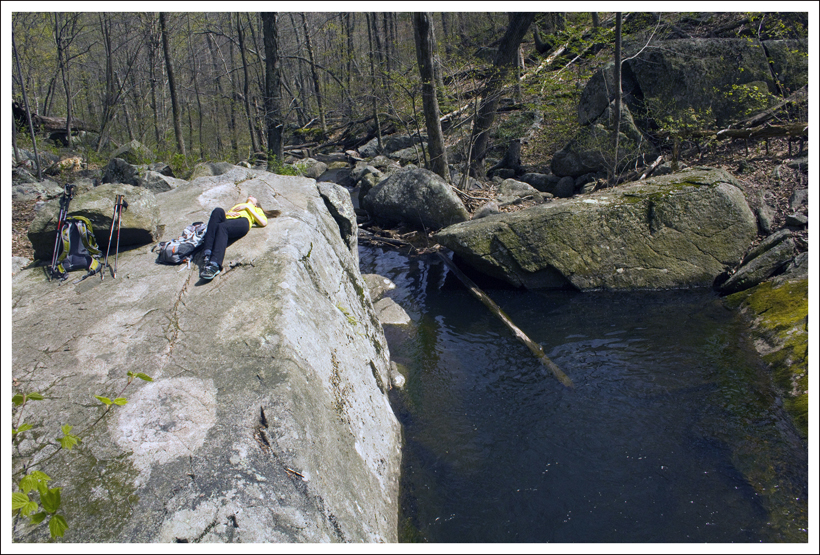
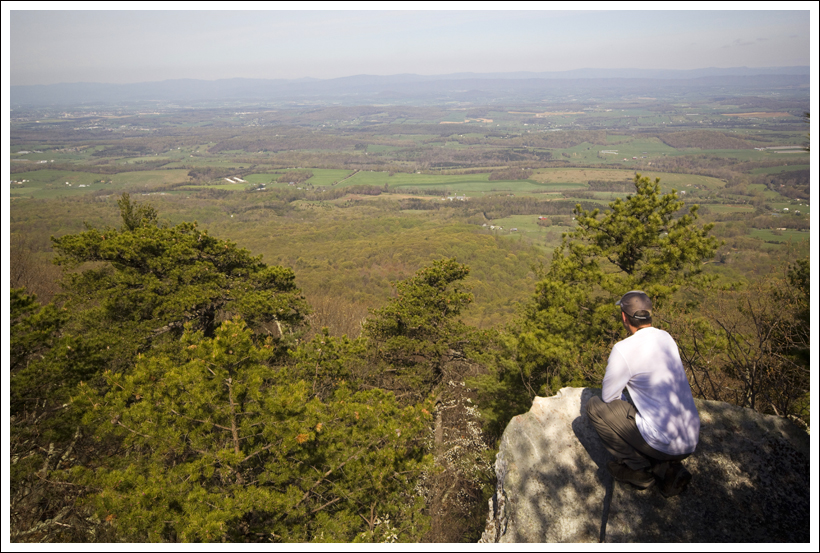
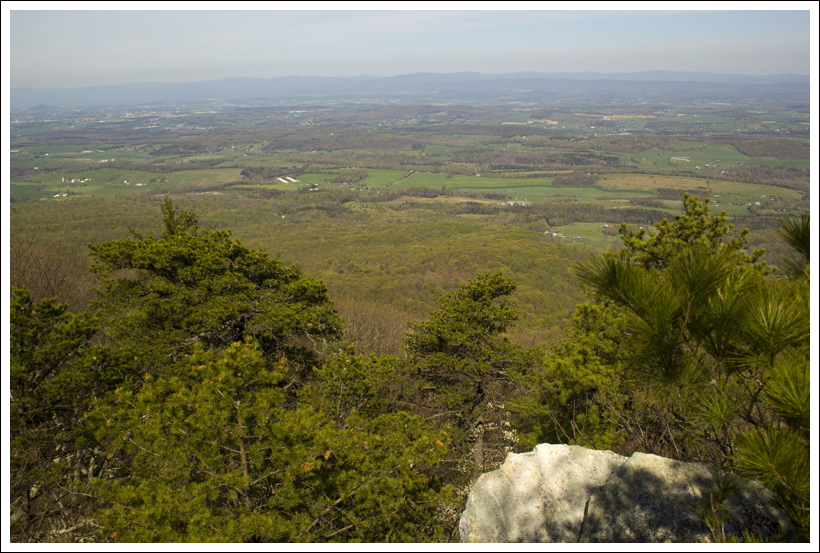
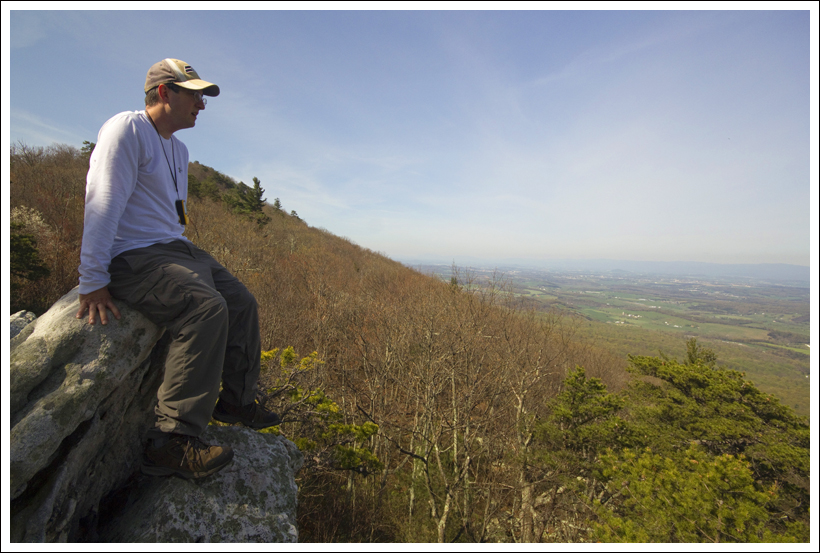
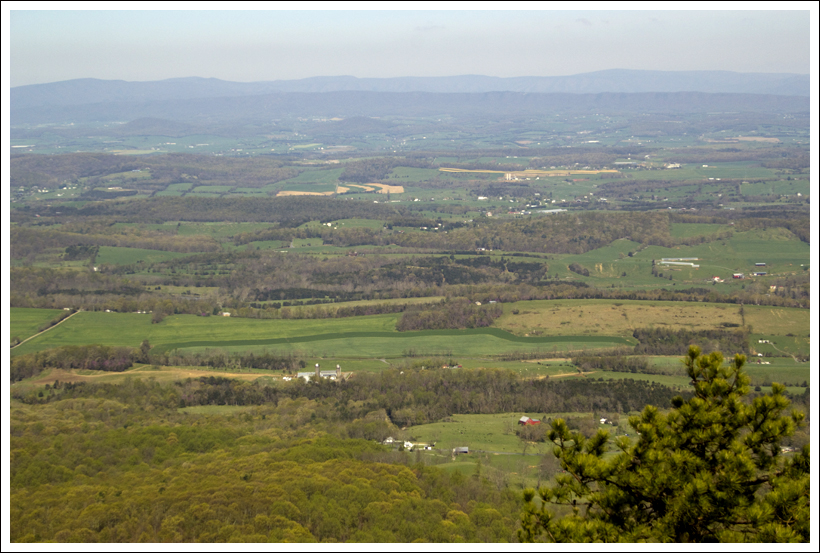
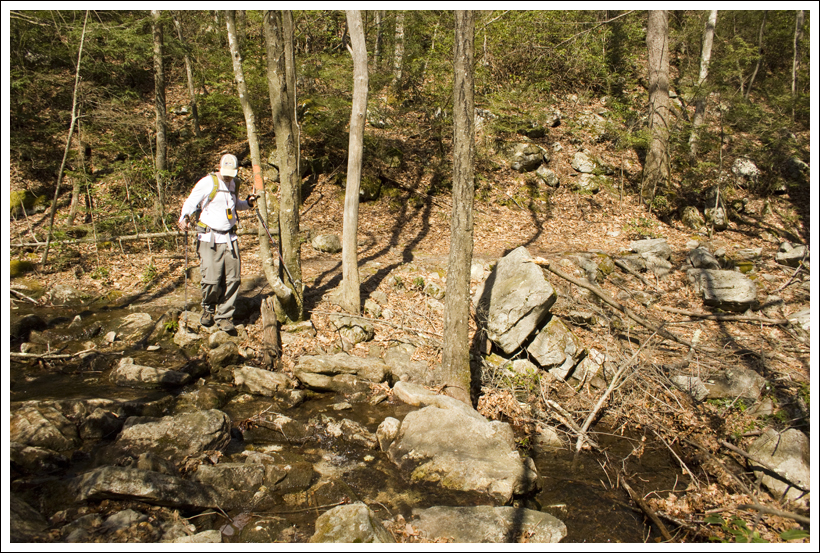
Table Rock has great views of the valley. Below: When the weather has been wet, there are several muddy sections to cross (it was quite dry when we visited); Later this summer, the rocks will be covered with blueberries.
Adam Says…
This hike was definitely one of those pleasant surprises you find once in a while. We have been going to Canaan Valley for years (my wife has been going since she was a kid) and we never knew about this great place for hiking that was just a short distance from where we always stay. I’ve driven by the Canaan Loop Road and thought to myself, “I wonder where that road goes.” If I had known earlier that it led to this area of hiking, we would have tried this out a long time ago.
We had picked up the Day & Overnight Hikes: West Virginia’s Monongahela National Forest book a couple of years ago and have done a few of the hikes before. This one led us right to the Canaan Loop Road for this great out-and-back hike. When we started on the road, we passed by a few houses on the gravel, pothole-laden road and then quickly came upon a school bus parked in the middle of the road, blocking any traffic. I thought this was odd (and possibly a little like the start to a horror movie), but I didn’t see anyone inside. I walked up and saw a man about halfway down the bus that was straightening some things up. I asked if he was moving and he darted up front, started the bus, and gunned it down the road. We followed the bus for a while, but it was quickly leaving us in the dust kicked up from the gravel road. After a few miles, we came upon the bus again as it was parking for a scouting group that looked like they were packing up after a large picnic. We continued past the group on a very bumpy and narrow road that has some precarious edges that you just pray that another car doesn’t come the other way. We only came across one other vehicle on the road, but I would warn you to be cautious as you make your way along the road and drive slowly.
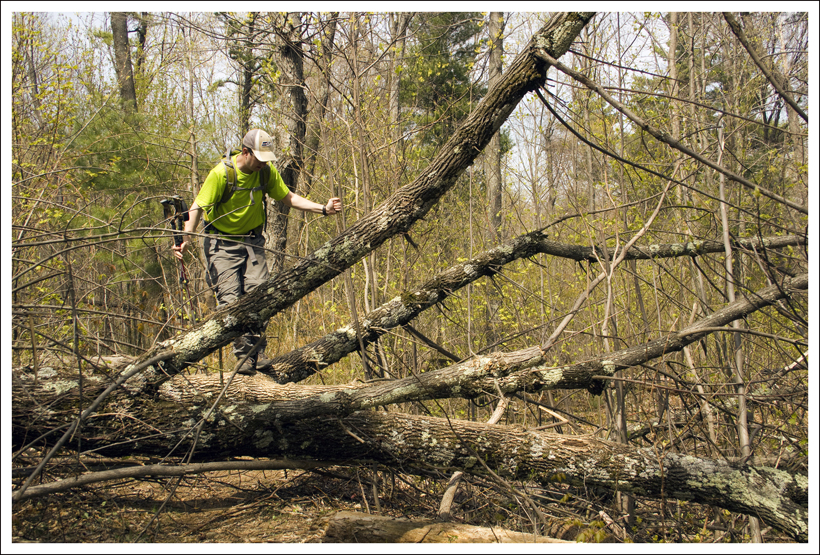
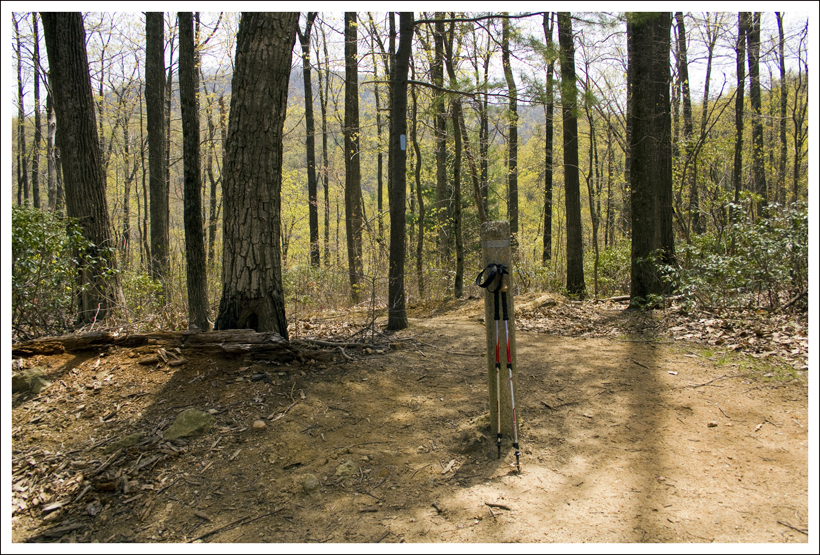
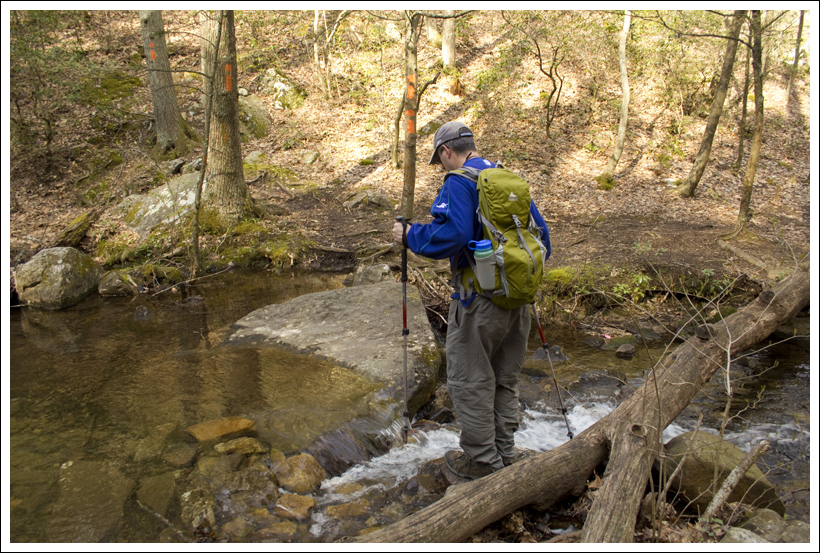
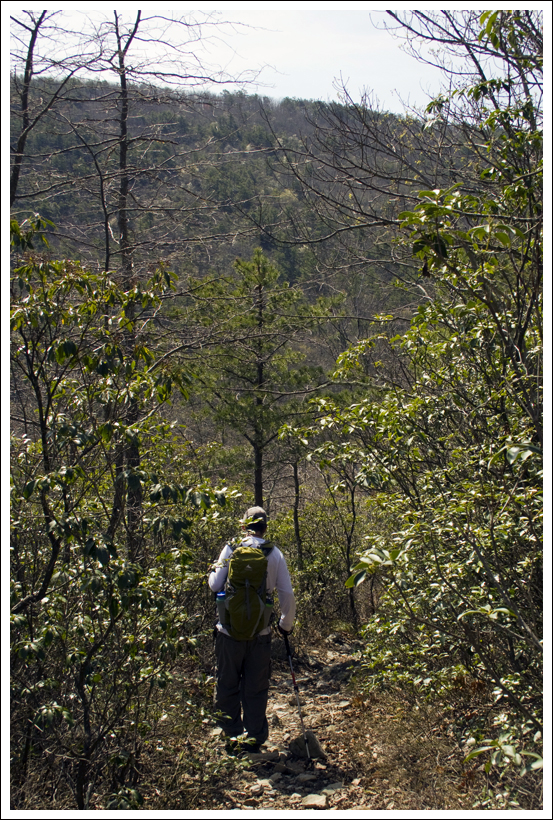
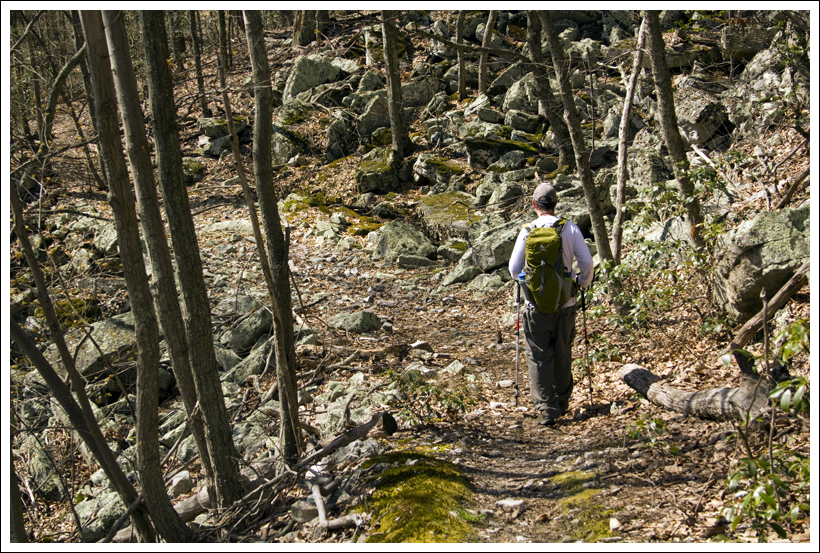
The rhododendron along this trail was thick and jungle-like. There were lots of buds, so it should be a pretty bloom this year! Below: Trails are not typically well-marked in the Canaan backcountry; Adam walks through open forest; Crossing another muddy section.
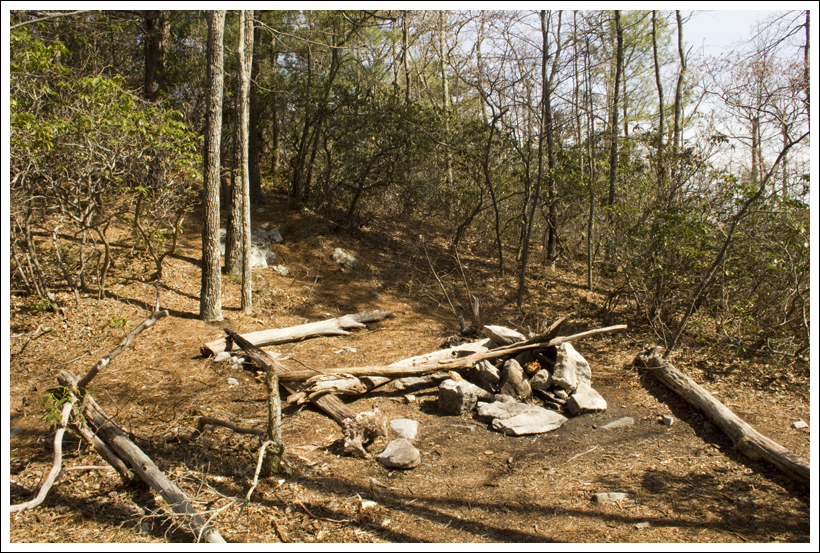
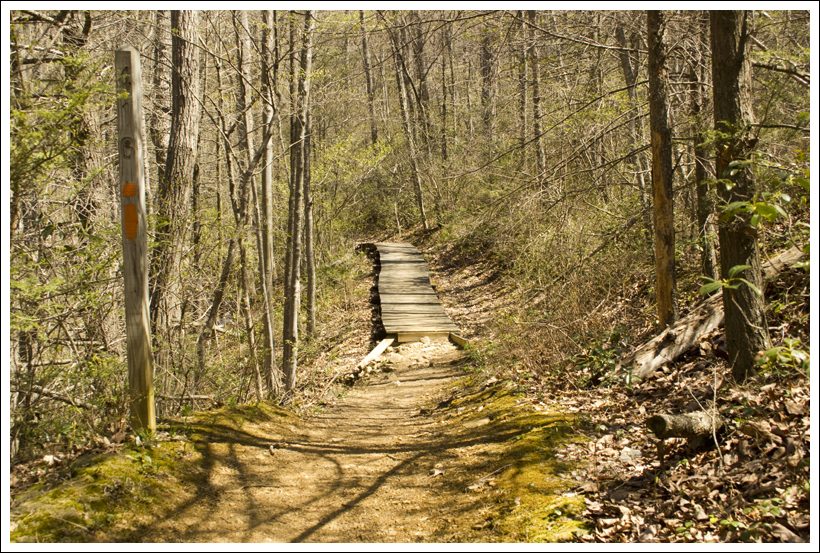
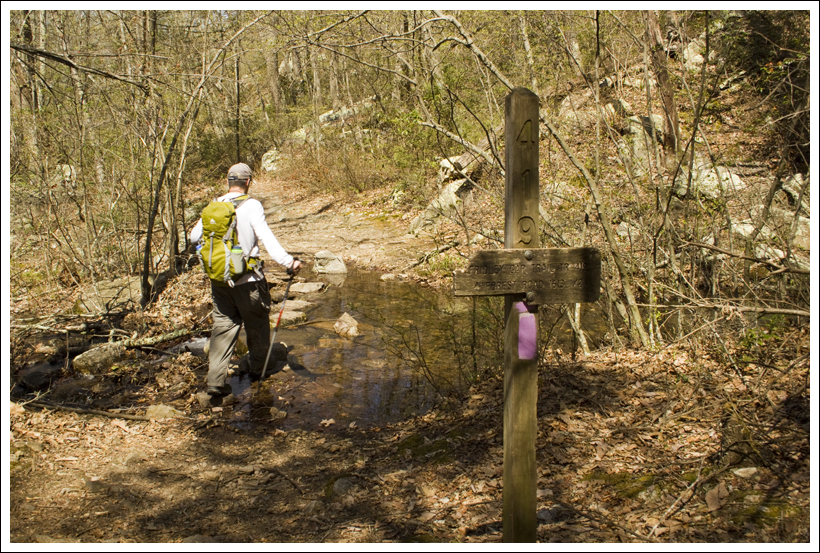
After driving for exactly 10 miles on the Canaan Loop Road, we came to the parking area to the left for Table Rock. We started down the trail. The trail is technically blue-blazed, but you will likely only see a few of these blazes on the trees. The trail is fairly obvious, but I can imagine after the leaves first fall, it could be a little tough to find your way. The trail starts almost in a jungle of rhododendron, but that quickly opens up to an open forest of larger beech, maple, and birch trees. The trail stays relatively flat the entire way and there are a few areas of mucky ground or pools. Rocks and logs have been placed over in some of these to help you traverse, but in some areas after a good rain, you will likely need to get your shoes wet. After about 1.1 miles, you come across a campsite. Just ahead is Table Rock.
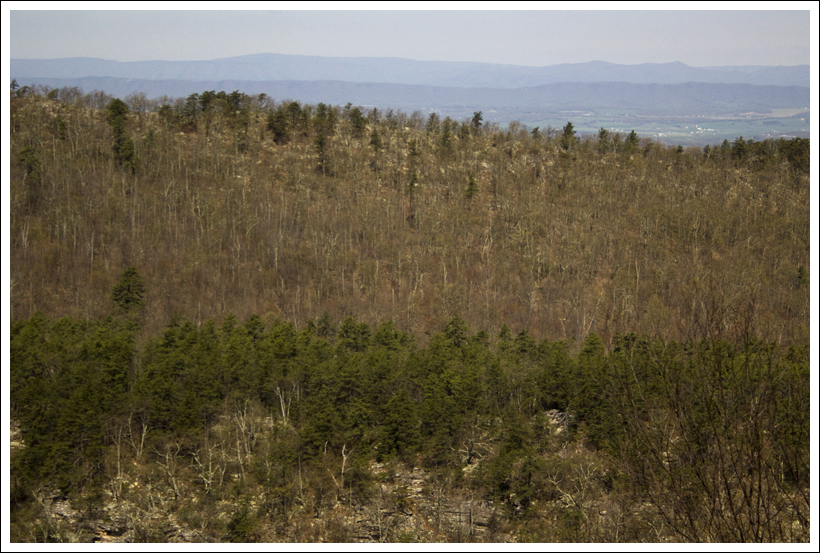
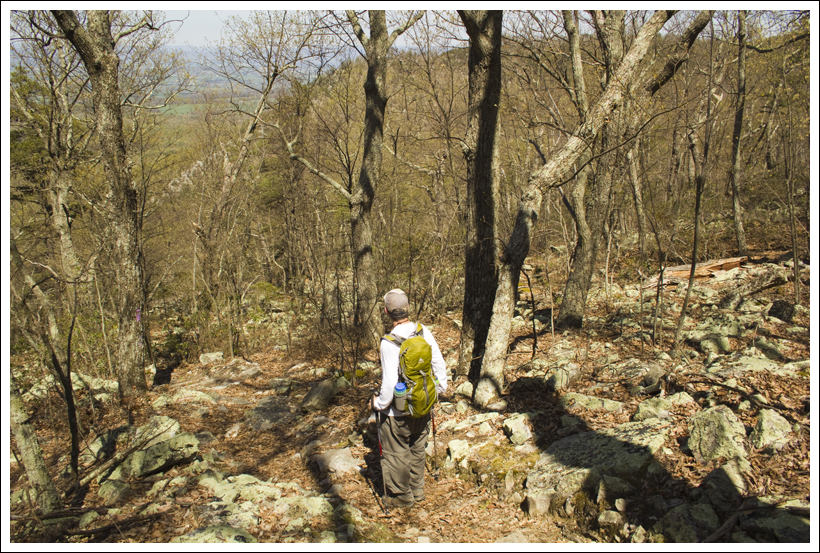
The outcropping has phenomenal views. The rocks have crevasses that can be quite deep, so watch where you are stepping and be careful around the edges since there are huge drops below. Since this place isn’t visited often except by locals, this will be a great off-the-beaten path hike that you can likely enjoy the views all by yourself. The spruce-covered mountain across the gorge is Green Mountain. Since this trail is flat, almost anyone could enjoy this hike.
It was quite breezy at the top and I had to hold my hat a few times as the wind picked up. You can tell that this area does get a lot of wind that funnels quickly through the gorge. We look forward to coming back to this area sometime soon and visit some of the other trails that crisscross around the Canaan Loop Road.
Christine Says…
Normally when we visit the Canaan Valley area, it’s all about hiking and nature and waterfalls! This visit was all about… cleaning. Adam and I agreed to take care of the annual spring cleaning of my parents’ rental property in the area. In the three days we were there, we scrubbed, scoured, swept and probably did more than 20 loads of laundry. It wasn’t a fun trip, but we did manage to get out for one short, nearby hike.
I have no idea how the trails off the Canaan Loop Road escaped our notice. I guess when you’re close to Dolly Sods, Seneca Rocks, and Spruce Knob, other trails fall a bit by the wayside. But, I’m really glad we took the time to drive the ten bumpy miles to this trailhead.
I love watching green creep up the mountainsides each spring. Below: Lovely trillium, A couple views of Table Rock.
The hike to Table Rock was short, but had a spectacular payoff in terms of views and solitude. The path led through gorgeous forest, alternating between dense stands of rhododendron and open, mossy forest. The whole route is flat and easy, so in about 20-30 minutes, you’re already at the overlook. The rocky shelf stands over a magnificent, undeveloped valley. When we visited in mid-spring, the emergence of leaves created the effect of green creeping up the mountainsides. So beautiful! There were tons of blooming blueberry bushes in the area, too. It would be nice to visit in August and pick berries!
I also enjoyed the Painted Trillium along the trail. Most of the trillium I see along the trails in Shenandoah is plain white or pink, so seeing a different variety was a nice change of pace. We were there a little too early to see the rhododendron bloom, but most of the plants were abundant with buds. It should be really pretty when they finally open!
Difficulty – 1. This trail is very flat, so just about anyone could enjoy it.
Trail Conditions – 3.5. The trail isn’t that well-used, but it was still a worn path. You may have to do a little rock-hopping to make it across some of the larger puddles.
Views – 4. Breathtaking views are clear from this point. We enjoy not being able to see houses from great viewpoints and you shouldn’t see many signs of civilization from this outcropping.
Waterfalls/streams – 0. Non-existent.
Wildlife – 2. Other than a few birds, we didn’t see anything on the trail.
Ease to Navigate – 3. There is only one trail on this hike, so there shouldn’t be any confusion. The only reason to downgrade this is because it is not blazed often at all and in the fall it could be a little challenging to follow the path.
Solitude – 5. We didn’t see anyone on a beautiful weekend day in the afternoon.
Directions to trailhead:
From Davis, WV, head south on WV 32. In 3.2 miles, turn right on to Canaan Loop Road (Forest Service Road 13). Follow the road for exactly 10 miles. The parking area is on the left and there is a wooden sign that shows the beginning of the trailhead.
* MapMyHike is not necessarily accurate, as the GPS signal fades in and out – but it still provides some fun and interesting information.
Hazel Falls are not terribly high, but they sit in a beautiful gorge. Below: Adam at the Meadow Spring trailhead; Little wildflowers grew abundantly along the trail; A great place to enjoy the sun.
Christine Says…
Every time I think we’re running out of nearby hikes to complete, we seem to stumble across something that has escaped our notice for one reason or another. That was just the case with this beautiful, easy walk to Hazel Falls! Typically, when you think of Shenandoah’s waterfalls, you think of Dark Hollow, White Oak Canyon or Doyles River-Jones Run. It’s not very common to see photos or hear people talking about Hazel Falls. After being there in person, I’m not really sure why. It was a great hike! Although the falls are not high, I found them to be nicer than some of the park’s more popular falls – I’m looking at you Lewis Springs Falls! It’s probably spring’s higher water flow, but this small waterfall was much more impressive than some of the park’s larger falls.
The trail was mostly wide and gentle. Below: Adam negotiates the largest blow down on the hike; The junction of the steep rock trail that leads down to the falls/caves; Rock walls tower above the falls.
The hike mostly consisted of pleasant, gentle walking through pretty forest. The last time we hiked in this area was a few years ago when we went on our very first overnight backpacking trip with PATC. That trip made a loop of Hazel Mountain and Catlett Mountain. It’s funny – I remembered the trail being a lot steeper than it seemed this time. I guess I had a heavier pack and wasn’t in very good condition on that trip.
On this particular spring day, I enjoyed seeing all the early season wildflowers blooming along the side of the trail. We had perfect weather – sunny, crisp blue skies and a nice breeze. It was ideal for hiking, but not so ideal for waterfall photography. When we finally got down to the falls, I did the best I could to capture a few decent shots under the bright mid-day sun. It didn’t go that well.
I also really enjoyed the little caves adjacent to the falls and sunning on the big flat rock next to the smaller falls. It was a gorgeous spot and I’ll look forward to visiting again.
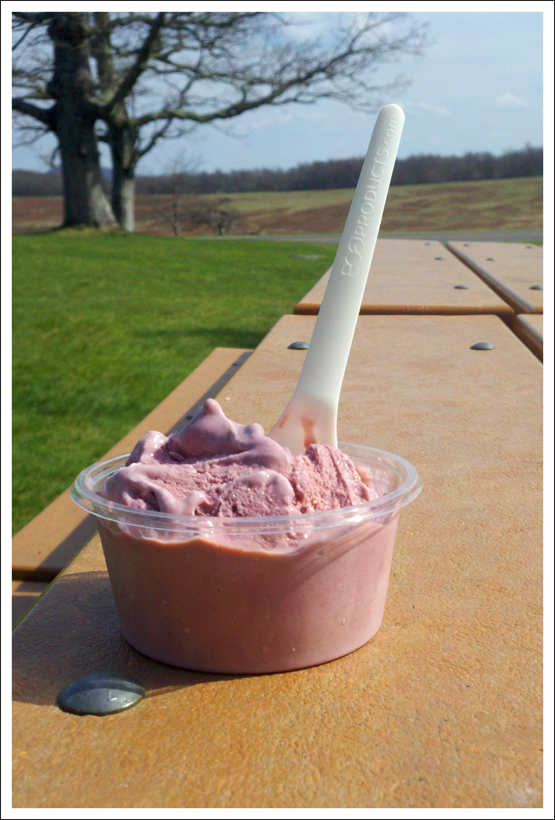
After our hike, we decided to stop by Big Meadows for Shenandoah’s famous blackberry ice cream. Even though the park has a new concessionaire for food/gift shops, the ice cream was just as good as it’s always been!
Adam Says…
The hike to Hazel Falls was a pleasant surprise. When looking for hiking suggestions, we typically peruse our hiking guides, study maps, and explore the internet for ideas. The 2000 edition of the Falcon Guide for Hiking Shenandoah National Park didn’t include Hazel Falls in the book, but the updated 2012 edition does cover it. So, we have to give thanks to Bert & Jane Gildert, the authors, for including this one for us to explore. As Christine said, I feel that this is a great waterfall that really allows you to sit down and take in the beauty of the setting around you.
Adam enjoys the falls. Below: Adam makes his way down the steepest part of the trail; Pretty cascades leading away from the falls; Christine at the lower falls, Another view of Hazel Falls.
The trail starts off from the Meadow Spring Trail parking lot. This is a popular parking spot for many hikes and overnight backpackers; we have rarely seen this lot not packed with vehicles. If you are going with a larger group, try to carpool to minimize the number of parking spots you may need. The good news is that most of the cars will likely be heading down to Buck Hollow or doing larger loops around Hazel and Catlett Mountains. The trail goes just a few feet before you reach a junction with the Buck Hollow Trail. Instead of branching off, just stay straight on the trail and walk down the wide path. The trail is mostly a slight downhill grade with some flatter sections. At 1.5 miles, you will reach a junction with the White Rocks Trail on the left. Take the White Rocks Trail. At 2.4 miles, you will reach a junction post that will direct you to take the trail to the right for the falls. Climb down the steep trail and you should reach the first, small waterfall at the bottom. Continue along the path over the rocks and you will reach the larger Hazel Falls and see the cave to the right. Make your way back the way you came to get back to your vehicle.
Adam checks out the cave near Hazel Falls. Below: Making the steep climb back up; Blackberry ice cream at Big Meadows wayside
Because of the uncomplicated, mostly gentle terrain, this might be a great hike to do with older children. The only strenuous part of the hike was hiking the last .2 miles (the climb down will challenge your knees and the climb back up will get the blood pumping). You can tell a lot of great trail work has been done to create the stone steps that allow you to climb down without it being too slippery. The picturesque setting of the falls will encourage you to take some time to relax, eat a snack, and enjoy the sound of rushing water. The pool at the larger falls could also be one to wade into fairly easily if you like getting your feet wet.
While Christine was busy taking a lot of photos, I enjoyed peeking inside the larger cave near the falls. Christine took some coaxing to go in, since she was worried that bats would fly out. I didn’t see any bats inside or guano on the ground, but I wouldn’t be surprised if a couple of them took refuge in the top of the cave on occasion. At the falls there is also a path that leads to a small rock opening that you can climb around to get closer to the falls. As I was climbing around there, I saw a bird’s nest tucked in the top of the rocks. Sure enough, within a few minutes, I saw a bird (I believe a sparrow of some sort) fly into the nest. I hope too many people don’t disturb the nest and it is able to raise some cute chicks.
I imagine we will go back to Hazel Falls many times in the future. If you haven’t been here before, this is a waterfall that is worth checking out.
Difficulty – 2. The final .2 mile descent (and climb back out) into the stream gorge is very steep, but the rest of the hike is flat or very gently graded.
Trail Conditions – 3.5. There were a few blow downs that required navigation, but most of the trail is smooth, easy footing. The descent to the waterfall showcases the great work trail maintainers do in the park. They turned a extremely steep piece of terrain into a giant staircase with a series of well-placed rocks.
Views – 0. In the winter and early spring, you may catch some glimpses of mountainsides through the trees. Otherwise, this walk takes place exclusively in the woods.
Waterfalls/streams – 4. Though the waterfall is not tall, it’s it a lovely setting surrounded by towering rock walls and small caves.
Wildlife – 2. We didn’t see anything on this trip, but we have spotted bears and deer in the vicinity on past trips.
Ease to Navigate – 4. Trail directions are clearly marked at junctions with cement markers.
Solitude – 2.5. The parking lot was jam-packed on a pretty, sunny Saturday afternoon, but there are lots of trail options in this area. We saw about 15 people over the course of the hike.
Directions to trailhead:
From Skyline Drive proceed to mile 33.5. Parking is on the east side of the drive at the Meadow Spring parking area. The trail descends from the south end of the parking lot.
* MapMyHike is not necessarily accurate, as the GPS signal fades in and out – but it still provides some fun and interesting information.
This six-mile loop hike in the Fridley Gap area of George Washington National Forest has everything – views, waterfalls, beautiful stream scenery, rugged climbing and great backcountry camping. It’s a perfect hike to get away from the crowds in Shenandoah National Park.
If you miss spotting the faint side trail behind one of the many backcountry campsites along this loop, you’ll miss the best view of the hike! Below: Adam crosses the stream; A small waterfall on the stream; This loop has many choices for backcountry camp sites.
Adam Says…
Last year, we made an attempt to do this Fridley Gap loop hike, but we had trouble finding one of the trails. We bushwhacked for a while, but finally gave up. This time when we returned, we had better directions and the blazes had recently been repainted on much of the loop.
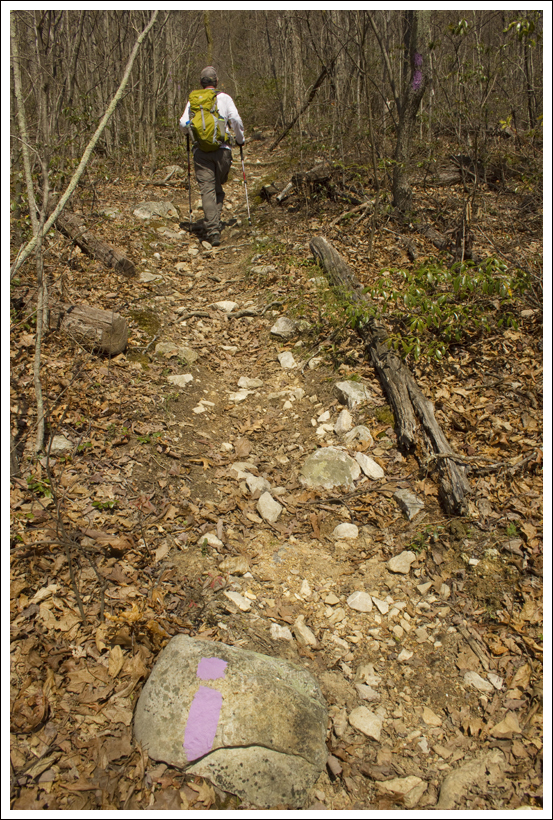
From the top end of the parking lot, we started on the trail. We saw both purple and blue blazes early on, and started to worry. (Fortunately, it turned out that this was the only section of the trail that hadn’t been recently re-blazed.) Early parts of the trail traverse large rocks, and it’s sometimes tough to see exactly which way the trail goes. We saw faded red Xs painted on the surface of some of the rocks which let us know that we were going the right way. The trail is uphill but not too steep. In .2 miles, you come to a fire road. Take a right here and continue on the fire road. You will pass by some small falls and Mountain Run to the right and a large boulder slide to the left. The trail actually follows the streambed, and you will need to rock-hop to continue on. At .45 miles, you will reach another falls area and you will cross over Mountain Run until you see the trail junction cement post. This is also the point that Mountain Run and Fridley Run join. It was at this point that we failed last time trying to find the orange-blazed Massanutten South trail. Looking at the cement post as you approached it, look back around 4:00. You will see the orange blazes on the Massanutten South trail as you will cross the water again (this time it is Fridley Run) and climb up the hillside. These weren’t painted on the trees before (they look fresh now), so you should be able to find your way more easily.
Early in the hike, the trail traverses the streambed. There are plenty of rocks, so it’s fairly easy to hop from spot to spot and avoid getting your feet wet. Below: Adam climbs up the trail shortly after the parking lot; A rockslide early on the hike; Blooming redbuds.
The climb up the Massanutten South trail is quite steep and you may need to stop a few times along the way to catch your breath. This trail is also narrow and you may have to cross over a few blown-down trees, but the trail wasn’t too hard to navigate with the recent re-blazing. At 1.85 miles, you will reach a campsite area. Look closely and you will see a path that leads to a rock outcropping called Grubbs Knob Overlook. Take this path up to the overlook to get the best views along the hike. You will see the top of Grubbs Knob to the left from the overlook and views to the west. After taking in the view, go back to the campsite and continue along the Massanutten South trail. At 2.05 miles, the trail reaches its peak and then you will start to descend, as the trail takes a steep turn to the left. You will make your way back down this very narrow path and cross Fridley Run at 2.70 miles.
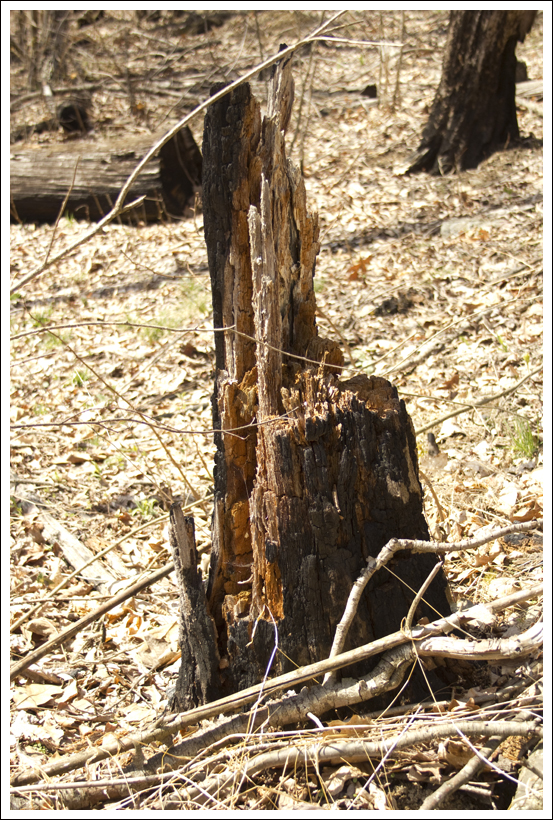
After crossing Fridley Run, you will begin to ascend on the trail again (turning again into a wider fire road) until you reach a rocky slide that gives you views of Fridley Gap and North Mountain at 3.25 miles. Continue to ascend as you walk around part of Third Mountain. The fire road stops ascending at 3.5 miles. The trail then descends and you reach another cement junction post at 3.84 miles. Take a left on the purple-blazed Fridley Gap trail, which follow another wide fire road. You will likely see lots of burned trees from a fire in 2010 that covered a big portion of this area. At 4.5 miles, you will reach another junction. The purple-blazed Fridley Gap trail ascends to the left and continues through the woods. Take this trail and begin a steep ascent across some switchbacks. At 4.85 miles, you will reach the top of your climb and there are a few stones that you can rest on for a few minutes if you need to catch your breath.
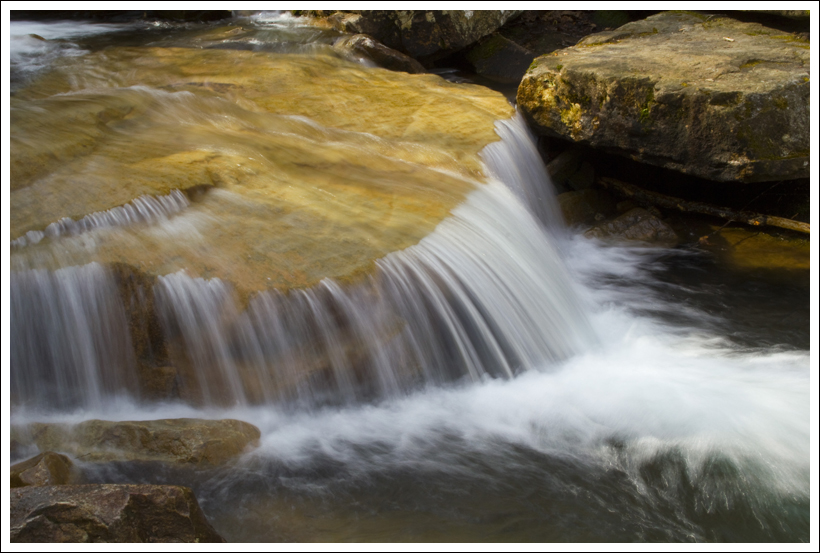
This small waterfall feeds one of the most popular swimming holes in the area. Below: More pretty cascades.
The trail now begins to descend very steeply. We were so glad we had our trekking poles since the rocks under the leaves were often loose and it helped to lower ourselves down the steep steps. We were also glad we did this hike this direction rather than the clockwise version of the loop. At 5.5 miles, we reached another junction with the Massanutten South trail. Take a left on the orange and purple-blazed fire road (don’t go the way that crosses the bridge) and you will reach the junction that closes the loop at 5.65 miles. Take a right here, crossing Mountain Run again and make your way back down the fire road. Be sure to catch the rocky path at 5.8 miles that leads back to the parking lot at 6 miles.
A funny moment happened along the hike. Christine had programmed her phone to use the MapMyHike app. In a recent upgrade, it now includes some vocal updates along the way, usually at the mile increments. One time, we heard the voice say “Don’t stop now. Walgreen’s is behind you.” (Walgreen’s is now advertising on MapMyHike.) While this is meant to be a word of encouragement to keep hiking strong, I was thinking of it as “Walgreen’s is chasing us.” As I sometimes do, I started thinking of a parody song to the tune of the Road Runner Show TV theme song. So for your enjoyment, here are my lyrics: “Fridley hiker, Walgreen’s is after you. Fridley hiker, if he catches you, you’re through. That Walgreen’s is really a crazy store. They have pharmaceuticals, toiletries, and so much more. Fridley hiker, never, never, never slow down. Fridley hiker. Walgreen’s is after you. Fridley hiker. If he catches you, you’re through.”
There is one geocache along the trail, Fridley’s Cache, a normal-sized cache near the swimming hole.
It is always a good feeling to know that we redeemed ourselves by covering a hike that we had previously failed to navigate. If you are looking for good views of streams or a swimming hole, along with a challenging hike to get some views, this may be a great hike to try out some time.
The rocks at Grubbs Overlook might trick people into thinking there isn’t an open view. Below: Views from Grubbs Overlook and the campsite that sits adjacent to the overlook.
Christine Says…
Hallelujah for freshly painted blazes! I was so frustrated last year when our attempt to hike the Fridley Gap Loop ended in failure. The failure was mostly my fault. I tried to map out the hike based on a course I saw on someone’s Runkeeper page. There were no directions, just the route overlaid on a rudimentary map of the area. I thought we’d be able to figure things out on our own with a NatGeo map of the area. It turns out that faded blazes and a large group of people camping in the middle of the trail are insurmountable challenges to my ability to navigate. We’ll let bygones be bygones and get on to the successful version of our Fridley Gap hike.
Let me start by saying, I loved this hike! It was even better than I expected. The stream was running beautifully, the views of the valley ‘greening up’ below were lovely and the weather was perfect (sunny, cool and breezy enough to keep the bugs away). I really enjoyed the little rock-hop as the trail followed the stream bed. The small waterfall and swimming hole were so pretty.
The climb up the Massanutten South trail to Grubbs Knob was steep enough to be challenging, but not so steep that we had to stop for a breather. On the way up, we could see all the little signs of spring creeping back into the forest – tiny buds on trees, tightly curled ferns and the occasional early season wildflower poking up through the leaves. The overlook at Grubbs Knob is rather easy to miss. It lies at the top of a faint footpath above a campsite. When you first climb to the top of the footpath, vertical, spine-like plates of rock obstruct any possibility for a view. But if you climb along the rocks, eventually you come to a few footholds that allow you to scramble to the top of the rocks. Once you’re there, the valley below spreads out as far as the eye can see – farms dotted with red barns; small country towns; and wide, green fields make up most of the vista.
The climb downhill after Grubbs Knob takes you through dense mountain laurel. The harsh light makes for an ugly photo… but you get the idea. Below: Adam approaches the stream; Crossing Fridley Run.
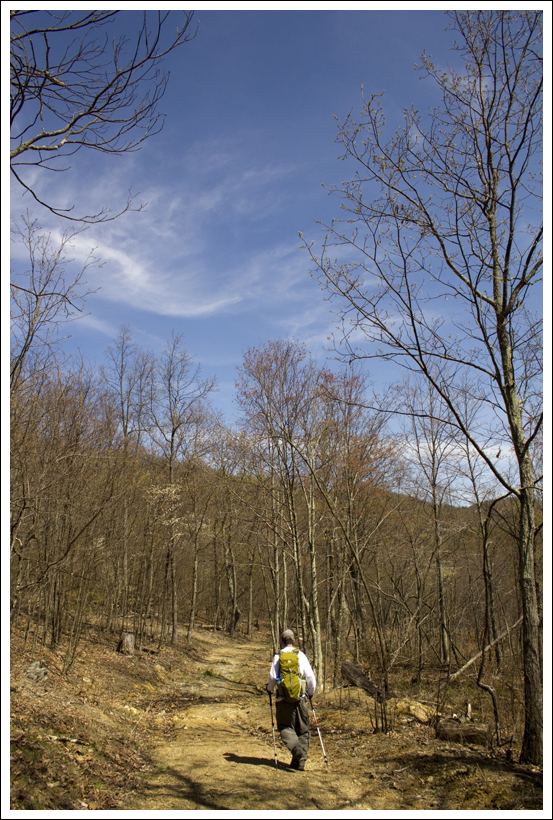
After leaving the Grubbs Overlook, we ascended a few more moments before taking a sharp downhill turn. The trail passed through dense mountain laurel, with occasional peeks toward the next ridgeline. Eventually, we heard the sound of water again. For a short way, the trail followed Fridley Run. But soon, we had to cross the stream and head back uphill along a wide fire road. From the fire road, we caught our second open viewpoint of the hike. It was a nice view, but nowhere nearly as lovely as the one from Grubbs Overlook. It’s one thing to slog uphill and come to a magnificent rocky outcropping with a sweeping vista to appreciate. It’s a little less stirring to stop along a roadside and take in a view of a couple mountain ridges.
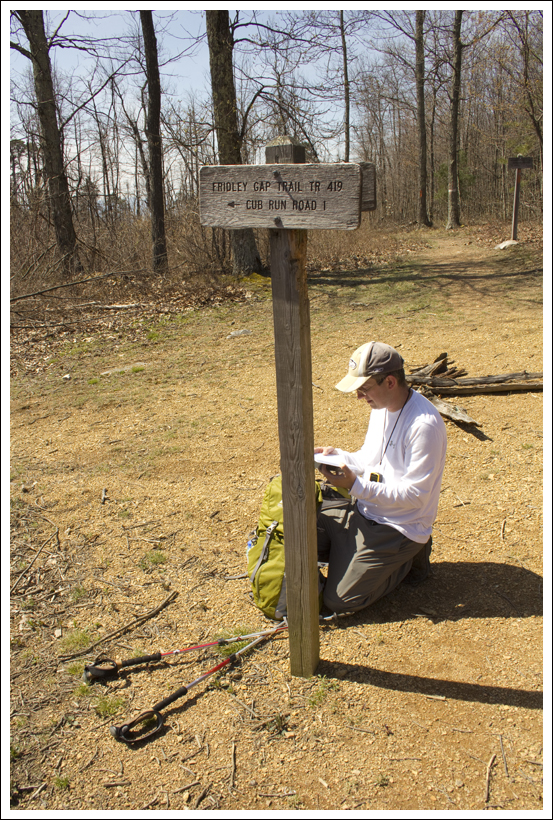
Eventually, the fire road met up at a four-way trail junction. One direction headed toward the Boones Run shelter, another toward Cub Run Road, another continued along the Fridley Gap trail in the direction of Martins Bottom, and of course the fourth headed back in the direction from which we arrived. Seeing this junction made me think of all the different ways these trails cross and connect. There are definitely multiple possibilities for overnight backpacking loops in this area.
The second overlooks comes at a spot along the fire road. Below: Adam checks out the map at this four-way trail junction; Continuing along the fire road before our climb up Third Mountain; Charred trees from the 2010 fire.
We followed the fire road to another junction. Heading straight would have taken us toward Martins Bottom, but to stay on course we turned left and started very steeply uphill along the purple-blazed Fridley Gap trail. By this point of the hike, I was pretty hungry and my energy was starting to flag. If I were smarter, I would have eaten a snack before tackling the climb. But I’m not smart, so I spent most of the climb complaining that I was hungry!
After a short break (and snack) atop the tree-covered peak of Third Mountain, we began a crazy-steep descent. For three-quarters of a mile, we carefully picked our way down the craggy, leaf covered mountainside. Through the trees, we could see some really fascinating rock formations on the shoulder of the next mountain over. I kept trying to appreciate the view, but every time I did, I lost my footing a bit. This climb down definitely makes the case for paying attention and using your trekking poles.
The ascent of Third Mountain may not look steep in this photo, but it is! Below: Descending Third Mountain – you can see rock formations through the trees; A bridge not taken on the Massanutten trail; Adam once again crosses the stream we crossed early in our hike.
At the bottom of Third Mountain, we had just a short walk back to our original junction – the one where everything went wrong when we tried to hike Fridley Gap last year! I was quite pleased to see that marker again and be 100% certain that we had actually found our way successfully this time around. From the last junction, we retraced our steps through the streambed, past the rockslide and back to our car.
Difficulty – 3.5. The trail goes up and down several times.
Trail Conditions – 3. The trail had blowdowns, loose conditions, and narrowness, but there were also sections that followed a fireroad. It gets an overall average rating.
Views – 3. The views from the Grubbs Knob overlook are the best on the trail, but if you miss the path from the campsite you’ll miss the best view on the loop. The views along the path at 3.25 miles are nice, but not remarkable.
Waterfalls/streams – 4. The trail goes along (and through) Mountain Run and Fridley Run on several occasions. The small falls and swimming hole gives it a bonus.
Wildlife – 2. This may be a good hike for bird watching. We saw a peregrine falcon soaring above at the Grubbs Knob overlook and enjoyed hearing the song of the eastern towhee along the way.
Ease to Navigate – 2. If we got lost before, we have to give this a low rating. The path to start the trail from the parking lot could be better blazed and there are several turns to make.
Solitude – 4. You may see some people at the swimming hole or camping alongside the junction with Mountain Run and Fridley Run. However, we only saw one other group after this point on a nice spring weekend day.
Directions to trailhead:
From Harrisonburg, VA, head east on 33. Take a left onto VA-620 North/Indian trail Road and continue for 1.7 miles. The road will turn into Rt. 717. Go 3.4 miles and take a right on Minie Ball Ln. Go 1.1 miles. At this point, the road will turn back into Rt. 620. Go 2.7 miles and take a right, continuing on 620 for about half a mile. Take a right onto Armentrout Path. Take the first left onto Airey Ln. Parking is a lot at the end of this gravel lane. If you pass the lot, you are on private property. The directions to this trailhead are a little confusing, and we recommend putting the coordinates on the map below into your phone/GPS.
* MapMyHike is not necessarily accurate, as the GPS signal fades in and out – but it still provides some fun and interesting information.
This 5.75 mile hike takes you to an old fire tower sitting atop a high peak on the border of West Virginia and Virginia. After visiting the tower, you can either head back to the parking area (which would cut the distance and make this a 3 mile total round-trip hike), or continue to explore the Shenandoah Mountain trail with a walk over to Hoover Ridge.
SPECIAL NOTES: Please be conscientious and respectful when hiking in this area. Hiking trails near High Knob are adjacent to private land. Please honor posted ‘no trespassing’ signs and stay on official forest service trails. Please do not tamper with posted private land signage.
The High Knob Fire Tower provides panoramic views into both Virginia and West Virginia. Below: Adam looks at trail information in the kiosk in the parking area; The Shenandoah Mountain Trail is often lined with dense mountain laurel; Trail junction – one way climbs up the fire tower, another continues on the Shenandoah Mountain trail, and the third descends to the Brandywine Recreation area.
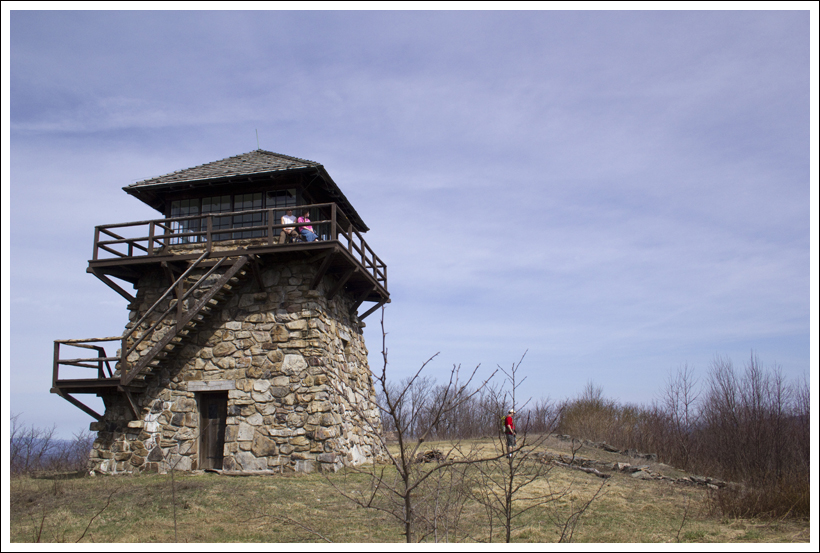
First of all, I’m not sure whether to call this a Virginia hike or a West Virginia hike. While you park in West Virginia, the Shenandoah Mountain trail meanders right along the states’ borderline. I believe the High Knob fire tower sits on the Virginia side of the line, but views look out into both states. This is definitely a hike worth doing!
Our first attempt to hike High Knob was on April 7th, 2013. That hike started off well enough, but within the first half mile the trail turned into a veritable luge track. It was a smooth, slick, well-polished chute of ice! Had we planned more extensively, we would have packed Yaktrax, but after a week of warm, sunny weather, we simply didn’t expect to see so much ice! We watched a couple on the trail ahead of us falling down, over and over and over again. The girl literally fell ten times in about two minutes. She couldn’t make a single step of forward progress. Adam and I looked at each other and said ‘Nah… we’ll come back and do this some other time.”
Fetterbush is blooming! Below: Trails are marked with a double yellow blaze; Occasionally views opened up through the trees.
The very next weekend, we headed back and ended up with much better hiking conditions. The trail to High Knob is pretty basic – it follows the Shenandoah Mountain trail until a junction with a spur trail that leads directly to the tower. The way is well marked with double yellow blazes and has nice footing. The path passes through dense stands of mountain laurel. From the number of flower buds on the laurel, it looks like it’s going to be a spectacular bloom this year!
About .8 mile into the hike, we reached the junction – hikers can turn uphill and take the spur trail to the fire tower, continue on the Shenandoah Mountain trail, or head downhill to the Brandywine Recreation Area. We decided to visit the fire tower first, mainly because it was early and we wanted to avoid Sunday afternoon hiking crowds. The spur to the High Knob tower is probably the steepest climbing of the entire hike. While the section is steep, it’s also fairly short. At the top of the climb, the trail comes out on a fire road that leads pretty much the rest of the way up to the tower. We were surprised how heavily the area was marked with ‘Private Land – No Trespassing’ warnings. There were dozens of signs and trees spray-painted red. I’m guessing the public land abuts private land that is heavily used for hunting, and the landowners are trying to protect hikers/bikers from getting shot. Regardless, the area is very thoroughly and clearly marked – you shall not pass!
As we arrived at the fire tower, we passed a foursome of hikers headed down. We had the tower all to ourselves for about twenty minutes. We enjoyed the views in every direction! I especially enjoyed looking down on Switzer Lake. It brought back lots of memories from my days as a college student at JMU. On warm spring days, my sorority would load up in cars and make the drive to Switzer for an afternoon of swimming (and perhaps some beverage consumption). Swimming is no longer allowed in the lake (maybe it was never allowed?), as it’s used as a public water source. Even though you can’t swim in the lake, it’s still a great place for scenery and birding. A friend of mine has even seen bald eagles at Switzer!
Adam makes the steep climb between the Shenandoah Mountain trail and the fire road that leads to the High Knob Fire Tower. Below: Private land in the area is very thoroughly and clearly marked. A bird’s eye view of the private land from the fire tower. I think those might be hunting camps/blinds.
After enjoying the views and eating a snack, we climbed back down to the junction. It was around 11:15 a.m. and we were torn – do we continue to explore Shenandoah Mountain or do we call it a day and get a nice lunch in Harrisonburg? We didn’t have a coin, so Adam flipped his pass-case – card side up, we hike on – card side down, we go home. The pass-case dictated a longer hike.
We followed the Shenandoah Mountain trail over to Hoover Ridge. If I were to make a recommendation, I would tell people to skip this part of the hike. In the end, the views weren’t worth the climb. The trail is narrow – too narrow to ever be level. You hike most of the way with your uphill foot much higher than your downhill foot. It’s also covered with tons of loose stone and slate that shifts under every step. On the early spring day we hiked, the trail was still under a foot of dry leaves. The footing was treacherous. I was so glad for my trekking poles.
There are several steep climbs on the way to Hoover Ridge. Once the trail meets the ridge walking along is pretty pleasant. The terrain is open and grassy and there are obstructed views of mountains in every direction. You can even catch a glimpse of the fire tower off in the distance. On Hoover Ridge, we decided we’d hiked enough for the day and turned back to make our return to the parking area.
Since it was mostly downhill, the walk went quickly. We were back at our car by 1:15 and back in Harrisonburg for lunch a half hour later. It was a great day to be out hiking after such a cold and snowy March! We’ll definitely make a return hike to the fire tower… Hoover Ridge, not so much.
Adam Says…
As Christine mentioned, this was a second attempt at High Knob, since it was too ice-covered to walk up previously. We hate having to bail on a hike, but we want to feel that it is something we can accomplish and still enjoy. We’re glad that we waited for the snow to melt to enjoy this trek up to the fire tower. Our friends at Hiking Upward covered this hike from the Brandywine Recreation Area, but this is a shorter way to accomplish the hike up to the top. If you’ve purchased National Geographic’s Staunton/Shenandoah Mountain Trails Illustrated Map 791, you will see High Knob Fire Tower on the cover.
Views from the fire tower look out in every direction. Below: You can see Switzer Lake from the fire tower; More views; Adam enjoys a snack (Trader Joe’s Monkey Business trail mix) on the fire tower.
From the parking lot on 33, we took off down the stone steps. The parking lot and surrounding areas has a lot of trash thrown around, so if you can, bring a trashbag and help to carry out some of the litter. Once you join the Shenandoah Mountain trail at the bottom of the stone steps, the trail will be clear of litter. The trail starts off fairly level and then gradually ascends up the mountain. In .85 miles, you do reach a large junction that includes the spur trail to the High Knob Tower. Take this spur trail up the mountain. At about 1.1 miles, you will reach a forest road. Take a right on the road (taking a left will put you on private land) and continue to follow the signs to the High Knob Tower. Continue your ascent up the fire road until you reach the High Knob Tower at 1.4 miles.
We retraced our steps until we returned back to the junction of the Shenandoah Mountain Trail and High Knob Trail at 2.0 miles. At this point, we took a left to get back on the Shenandoah Mountain trail. This part of the trail was not well-maintained and we were constantly worried about turning our ankles on loose rocks that were hidden underneath the leaf-covered trail, crossing over tree blowdowns, or catching ourselves from falling off the narrow trail with our trekking poles. The trail in most places along this section felt more like a narrow animal path than an actual trail. The rough trail and the steepness in some sections really made us question how far we were going and if it was worth it. We made our way a little further uphill but we weren’t fighting rough terrain the whole way. We reached the crest of Hoover Ridge at 3.5 miles, which gave us some obstructed views of the areas to the south. After taking a few minutes to explore the open fields and campsites on Hoover Ridge, we made our way back.
One of the few tricky spots on the Shenandoah Mountain trail. The cairn indicates that hikers should take the lower trail, and not follow the trail partially blocked by branches. Below: Sign on Hoover Ridge
As Christine stated, I would agree that I probably wouldn’t add on Hoover Ridge to this hike unless you would like to get some extra hiking accomplished. However, this was also the area that we saw the best wildlife. We saw a deer in the distance take off when we were spotted and a grouse jumped out of some brush when we were walking by that caused us both to nearly jump out of our hiking shoes.
The hike up to High Knob is one that I think would be a perfect hike if your goal was to see great views from all directions. On a clear day, you should be able to see several layers of mountain ranges. I’m sure the foliage scenery in the fall is breathtaking. I can see this being a great hike to take some out-of-town visitors to show the splendor of the rolling Virginia and West Virginia mountains.
Trail Notes
Distance – About 5.75 miles
Elevation Change – 1168 ft
Difficulty – 3.5. This is a moderate hike in terms of elevation change. On the day we hiked, the Shenandoah Mountain trail was still covered with deep, slick leaves and quite a few fallen trees. These challenges increased the difficulty level somewhat.
Trail Conditions – 3. The trail to High Knob is in great shape, but the Shenandoah Mountain trail is narrow and rocky.
Views – 5. Views from the High Knob fire tower are spectacular and panoramic. Views from Hoover Ridge are obstructed.
Waterfalls/streams – 0. There are no streams on this hike.
Wildlife – 2. We saw a deer and a grouse, but I think hunters scare off most wildlife in this area.
Ease to Navigate –3. Trails are generally well-marked/blazed, but there are a few mildly confusing spots on the walk to Hoover Ridge. There were a few worn paths in the woods that looked like old trails or animal paths. As long as you still to the most well-worn pathway, you should be fine. Take care to observe posted signs for private land.
Solitude –2. You will likely see quite a few people on the walk to the fire tower, but few along the way to Hoover Ridge.
Directions to trailhead:
Head on 33 West from Harrisonburg, VA. In about 10 miles, you will enter into George Washington National Forest. In 12 more miles, you will reach the parking lot on the left right after you see the “Welcome to West Virginia” sign. A large kiosk with a map of the area gives some general information and you will see a break in the girders that will lead down to start your hike.
* MapMyHike is not necessarily accurate, as the GPS signal fades in and out – but it still provides some fun and interesting information.
This 8 mile hike is one that very few people would ever dare to undertake. Up the stairs you will climb until you reach a tunnel.
Scenery along the way!
Christine Says…
Last week, we did a trip to Ohio and Adam made the mistake of leaving his wedding ring in the hotel room. So, we decided to go back and reclaim the ring in order for him to stay out of the doghouse for a while.
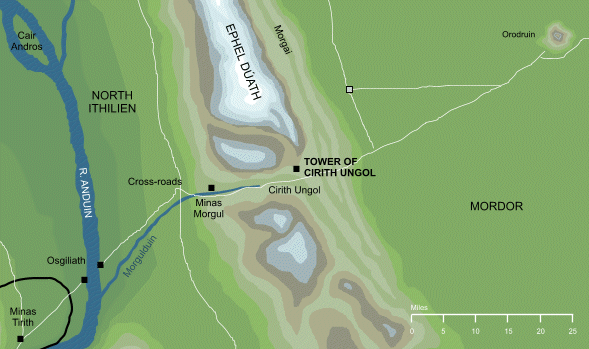
The morning was quite gloomy and there was a fell stench upon the air. We talked to a few people about the quickest way to Ohio and they suggested that we take the pass of Cirith Ungol. After reading about the stairs that lead to the pathway, we thought we would undertake it. We had a great breakfast at the Inn of the Prancing Pony and then a couple of oranges for second breakfast, but we didn’t pack anything other than lembas bread for elevensies, lunch, or afternoon tea.
Adam Says…
I felt like an idiot for leaving my precious in the land of Ohio, where the shadows lie. I threw on my backpack, with a few links of sausage tied to the top and we made our way.
Scenery along the way!
The beginning of the hike was harrowing as we had a huge number of stairs to climb. There was a heavy, dark storm cloud above us, but luckily I had packed my Star of Elendil to help light the way. We climbed up, up, up the stairs for about 3 miles until it reached a tunnel. The tunnel was a labyrinth filled with spider webs. We suggest at the junctions, you go left, left, right, left, left, circle, square, circle, L1, R1, select to make your way through. The spiders there were larger than ourselves, but Christine made it through OK. I got wrapped in some spider threads and ended up looking like I was wrapped in Ramen noodles for a while, but Christine pulled me out of the webs and we made our way.
Scenery along the way!
Eagles carried us back to our vehicle when everything was done.
Trail Notes
Distance –8 miles.
Elevation Change – 1000 feet
Difficulty –5. The trail is extremely steep and slippery up the stairs.
Trail Conditions – 1. Only fools travel here.
Views – 3. There would be nice views, but based on the evil that lies nearby, it was too dark to see much of anything.
Waterfalls/streams – 0. None
Wildlife – 4. We found some very large spiders in the tunnel.
Ease to Navigate –1. The tunnel is very hard to navigate.
Solitude –5. Like I said, nobody would do this that didn’t have to.
Directions to trailhead:
Park at Minas Morgul and you will see the stairs directly across from the parking lot.
If you’re looking for a great place to enjoy snowshoeing or cross-country skiing in the mid-Atlantic, don’t miss a visit to White Grass! Their extensive network of trails offer something for every skill level. Their terrain is beautifully groomed and the people who run the resort are so friendly and helpful.
If you don’t own snowshoes/cross-country skis, White Grass has them available to rent!
Christine enjoys the view from Bald Knob. Below: The morning started off cloudy; Learning about winter trees with the naturalist; Lots of old cross country skis.
Adam Says…
It has been over a year since we went snowshoeing. Our area of Virginia was robbed of any meaningful snow for the past two years, so we decided to cross the border to West Virginia to catch the elusive snow. Christine’s parents had bought us each a pair of Tubbs Frontier snowshoes for Christmas over a year ago, but it wasn’t until now that we were able to break them in. We were both very pleased with how they felt on our feet. They felt lighter than many I had tried before and were a little more sleek than some others I had tried. This enabled me to not feel too fatigued using them and I also didn’t feel like I had to walk like a cowboy in fear they would cross over and cause me to trip.
We had heard great things about White Grass from other friends of ours that had been there for cross-country skiing. White Grass maintains a great website where they will post weather conditions, snowfall, pictures, and trail maps. Check it out to get the best up-to-date information. They will typically be open December-early March to access their 40km of trails.
When we first arrived at White Grass, we checked in at the lodge. They informed us they were having a naturalist from the Canaan Valley Wildlife Refuge take a group out in about five minutes for a free snowshoe trail talk. We grabbed our shoes and met up with him. We were part of a small group of about 7 (including two little children). The goal of the walk was to teach us about the different trees that can be found in Canaan Valley, how to identify them, and threats to their future. We spent about an hour walking. The naturalist did a great job of teaching us many things about trees that I didn’t know before. After the walk, we decided to make make our way over to Hellbender Burritos for two Gendarme burrito bowls to power us up for our big snowshoe trip in the afternoon.
We started out along the Springer Orchard Trail. Below: Trail junction; Warming huts along the trail; Adam snowshoes along groomed trails.
We returned to White Grass and paid our $20 trail use fee. We asked the woman in the shop for some trail suggestions, and she kindly mapped out a route that would take us to the top of Bald Knob. The trails criss-cross often and the maps, posted at each junction, a little confusing. We found ourselves asking other skiers and snowshoers where they had been to help us navigate through the labyrinth of junctions. We left the lodge and started on the Springer Orchard Trail, on the opposite side of the large Weiss Knob Slope that heads directly down the mountain. We stayed on this trail for about .35 miles, passing the Plum Orchard trail, until we reached the Highland View trail. We took a left on this trail and continued upward, crossing past several other confusing junctions. We stayed on the Highland View Trail for about .35 miles, until we made it up to its end at the Sawmill Flats shelter at .8 miles. The shelter was a small warming hut. There were a few ammo boxes that included snacks and there were some containers of bird seed that you could throw out to chickadees. From this point we made our way following the signs for the Double Trouble trail. We reached the junction at 1.0 miles, took a right, and headed up the Double Trouble trail. At 1.3 miles, we reached the Weiss Knob Ascent trail, took another right and made our way to the Roundtop shelter.
The shelter here was also filled with snacks and bird seed. The birds here were more accustomed to people and would actually eat the seed out of your hand if you wait patiently. We were also told that someone had left a Gatorade bottle of moonshine at the shelter. I picked it up and saw some stuff floating in the bottle and decided to pass. I find it is a good rule of thumb to at least know the person that has made the moonshine for you. There’s no need to go blind without anyone to blame. 🙂
Christine and Adam at Roundtop Hut. Below: Adam feeds a chickadee; Deeper snow as we climb upward; Snow draped on evergreens.
We continued from this point following the signs to Bald Knob. You will cross a Boundary trail and then make a right on the Bald Knob Trail to wind up the mountain. The trail then takes a sharp right and a junction where you can continue to hike up the Bald Knob Trail. We reached the summit at around 2.1 miles. The scenery was breathtaking and you could see skiers on the Canaan Valley Ski slopes and mountains off in the distance covered in snow. The wind is strong here at the top, so we didn’t stay incredibly long, but made our way back down. We returned down the Bald Knob Trail to the Roundtop shelter and back down the Double Trouble trail. However, instead of heading back to the Sawmill Flats shelter, we followed Double Trouble until it led us to the Lift Shack, crossing over the Weiss Knob slope. Right behind the Lift Shack, we then took the Barton’s Bend Trail until we reached the Falls Overlook trail. We took a left on the Falls Overlook Trail and then a left on the Three Mile Trail until it brought us back to the White Grass lodge. Our return trip was around 2 miles, taking our snowshoe hike to be around 4.2 miles.
I had three big highlights on this trail. Feeding birds out of my hand, the peaceful scenery through the spruce on the Bald Knob trail leading to great views, and looking back and seeing my wife smile. I told her that her face was going to be sore from all the smiling she was doing. We really had a wonderful time at White Grass and we can’t wait to return. We will probably take the Three Mile Trail all the way up to the Roundtop Shelter next time.
Christine Says…
I love some parts of winter – the snow (too bad there can’t be snow without cold), the potential for workplace closures, and most of all snowshoeing! For Christmas of 2011, my parents bought us snowshoes. And well… many of you will remember winter of 2011-12 as ‘the winter that never happened’ in Virginia. The only measureable snow we had was in October. The rest of the season passed – mostly warm and sunny – leaving our snowshoes to gather dust in the garage. This winter hasn’t been much better, but thankfully we live just a couple hours from Canaan Valley. Even though the areas lies less than 90 miles away as the crow flies, they have vastly different weather. It’s almost like a small chunk of Canada dropped into a bowl located in the mid-Atlantic.
Christine feeds a chickadee.
We got up early on a Sunday morning and drove over to White Grass – one of the only big Nordic centers in our region. The entire drive, we saw nothing but bare grass and muddy fields. I’ll admit that I was a little worried that we were driving over for nothing. But as we grew closer, bare fields gave way to a dusting of snow and then smooth, billowing drifts. On the final drive up to White Grass, the road was not even cleared. As we pulled in to the parking area, an exuberant, bearded man gesticulated dramatically, guiding us to a parking spot. Every employee of the resort that we talked to during the day was super friendly and full of information happily shared about the area.
We headed into the lodge to get information and pay our trail use fees. The lodge is warm, cluttered and cozy, lacking the slick, commercial feel of most ski operations. Even though it wasn’t yet 10:00 a.m., it was packed with people chatting and enjoying hot beverages. The woman at the cash register told us we had arrived just in time to go on a free snowshoe walk with a naturalist. We had about five minutes to gear up and meet the group. She told us to run on ahead and to pay our trail fee later on. We ran back to the car, grabbed our snowshoes/poles, put on our layers, got the camera gear packed up and made it back just in time for the walk. The walk was more talking than active snowshoeing, but I enjoyed learning more about the areas fragile ecosystem.
The snowshoe walk finished up a little after 11:00, so we decided to drive into Davis for an early lunch before our longer snowshoe trek. At lunch, we learned something interesting – you can’t buy a beer in West Virginia on Sunday until 1:00 p.m. The restaurant was pretty crowded, and I don’t think I saw a single table not try to order a beer. I guess everyone was visiting from out of town and didn’t know the law.
Christine snowshoes uphill. Below: Approaching Bald Knob, Bald Knob View, Enjoying the Summit
After lunch, we headed back to Whitegrass. With our trail feed paid and our route mapped out, we headed up the trail. When I heard that we were walking up to the summit of Bald Knob, I was a little hesitant at first. Hiking up to the summit of Bald Knob didn’t necessarily conjure pleasant feelings; rather I remembered the last time I attempted to climb that peak. It was probably about 15 years ago when I was not a regular hiker and generally quite out of shape. Adam and I had hiked Bald Knob from the Canaan Valley Ski Resort side. We made it to the top, but it involved tears and suffering on my part. I remember the trail being unbearably steep and thought it was going to kill me.
However, this time, I found the terrain easy, pleasant and totally manageable – even on snowshoes! One of the nice things about White Grass is that the trail grooming takes some of the exertion out of snowshoeing. When you snowshoe on fresh, unpacked powder, the shoes do keep you aloft on the snow — but only to a degree. In fresh powder, you sink down and a certain level of ‘slogging’ is required. At White Grass, most of the trails are packed and machine-groomed. There are usually a pair of cross-country ski tracks worn into the snow, and then smooth packed trail alongside. As snowshoers, we’re careful to stay off of the ski tracks, as the blades on the bottom of shoes can easily chew up the established tracks.
Walking the trail system at White Grass was so fun! As Adam mentioned, I smiled the entire way! I loved chatting with other people we met along the way. I was enthralled by the gorgeous, snow-draped scenery. I had a blast hand-feeding the chickadees at the warming up. I have a slight phobia of flying things (bad experience with a bat and several moths over the years), so at first I looked away and closed my eyes as the chickadees fluttered down. But after a few landings, I opened my eyes and watched the birds perch. When they land, they are weightless; the only thing you feel is a slight pinch from their gripping feet. One chickadee sat on my hand long enough to eat several seeds. So fun!
When we made it to the summit of Bald Knob, I stood in awe of the beautiful, snowy valley laid out before me. The wind was whipping and clouds were moving in, so we didn’t stay long. The walk down went by so quickly — all downhill. We were back at the main lodge within an hour.
Even though Whitegrass is popular and heavily used, you never feel like it’s crowded. Below: Adam checks out the old, abandoned ski lift apparatus; Adam says hello to a friendly Whitegrass dog.
I’m hoping that we’ll get another chance to visit White Grass one more time this season. If we do get to go again, I definitely want to plan a meal at the White Grass Cafe. The food people were eating in the lodge looked amazing! We would have eaten there, but we already had plans to eat at another local favorite – Sirianni’s. We love their pizza and can’t visit the area without going there to eat.
If we make a return trip, I’ll also be sure to take a few photos of the actual facilities – the lodge, the cafe, etc. In the rush to meet the naturalist on time and my eagerness to spend as much time as possible on the trail, I neglected to take any photos of the facilities. They are really cute, so I feel bad that I forgot.
Trail Notes
Distance – 4.2 miles. This is approximate. It was hard to gauge mileage when the trails crossed each other so frequently and were labeled on the maps in kilometers.
Elevation Change – 973 feet
Difficulty – 2. The trail did go uphill most of the way up, but the grade was only seriously steep in a few spots.
Trail Conditions – 4. The trail was in excellent shape. They spend a lot of time grooming the trails, so it was fine to have both snowshoeing and cross-country skiing on the same trails.
Views – 4. The views from Bald Knob are some of the best you’ll see of Canaan Valley.
Waterfalls/streams – 1. Only a few streams that you pass on the trail.
Wildlife – 2. Red squirrels, Chickadees, and pileated woodpeckers were spotted.
Ease to Navigate –1.5. You have to pay very close attention to the trails and maps at the junctions to keep your bearings.
Solitude –2. The trails in this area are heavily trafficked, so expect to see others. We still felt that we had plenty of room for ourselves though as people are spread across all the distance of trails.
Directions to trailhead: The best directions can be found here. From Route 32 at Canaan Valley, take Freeland Road. Follow the signs to White Grass.
This 4.7 mile hike makes a wide circle around the entire Loft Mountain complex. It starts at the wayside and makes use of three different trails in the area – the campground path, the Appalachian Trail and the Frazier Discovery Trail.
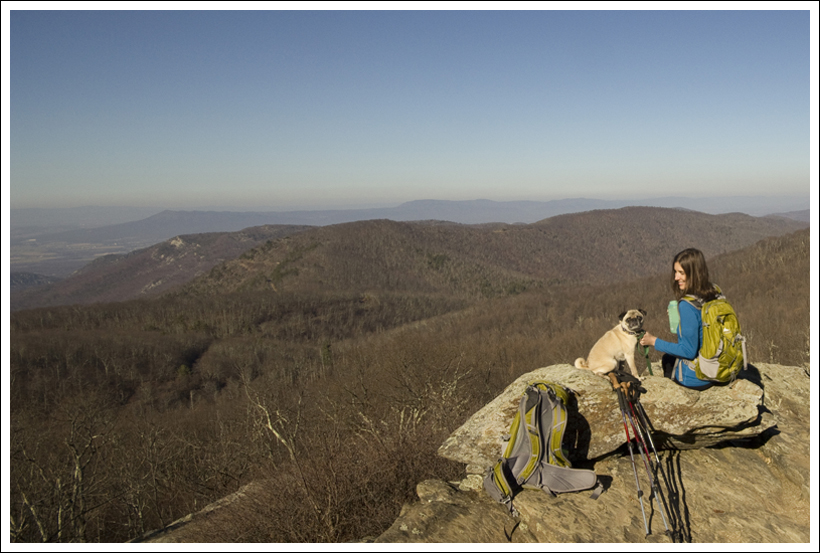
Christine and Wookie enjoy a view along the AT. Below: Wookie enjoyed his outing.
Christine Says…
So… it’s been a while since our last post. We’ve been sitting on photos and information about our Thanksgiving hike for over two months now. Things got a bit chaotic with the holidays (travel/family obligations), I was sick for a full six weeks, and worst of all we lost one of our pugs (13-year old Mojo) after a short, tough, twelve-week battle with cancer. Things finally feel like they’re getting back to normal again, and we’re hoping to spend some more time on the trail this winter. Maybe even a snowshoeing trip?
Thanksgiving this year was a warm, delightful, sunny day. I was at the tail end of being sick , so I waffled back and forth – relax on the couch watching the parade and dog show; or get up, get dressed and go for a hike. In the end, the beauty of the day pushed me in the direction of Shenandoah National Park. I wanted a shorter/easier hike without much climbing, so we settled on the Big Flat Mountain Loop. This loop encircles the Loft Mountain complex. Here’s a bit of trivia – the campground complex is not actually on Loft Mountain – it’s on Big Flat Mountain – hence the name we’ve given this hike. It’s also the same hike I chose for my annual Father’s Day hike last June.
We started off at the wayside and made our way up the crumbling, but still (technically) paved, campground path. The path parallels the road, about 10-15 feet into the woods. There were lots of downed trees and branches across the path that had fallen recently. Wookie enjoyed getting his leash tangled in just about every obstacle.
The camp store stands quiet during the off season. Below: The view from behind the amphitheater; The Loft Mountain Campground Amphitheater.
We eventually came up to the camp store/laundry, which was closed for the season. We let Wookie eat some snow and took a few minutes to consult our map to make a few more route decisions. From there, we crossed the road and made our way toward the amphitheater. The amphitheater has a fabulous view of the valley below. It’s definitely worth a short stop along the way.
Near the amphitheater, we picked up the access trail for the AT. After a short walk, we turned onto the Appalachian Trail, heading north. The trail makes its way behind the Loft Mountain campground. There are wonderful cliff-side views to the east and several spur trails lead to campsites and the camp store. After passing the campground, there is a short downhill followed by the one semi-steep climb of the loop. This climb, which normally would have been quite easy, almost killed me with my diminished aerobic capacity It always amazes me how quickly one can get out of shape!
At the top of the climb, you’ll pass the first junction of the Frazier Discovery Trail. If you take this junction, you miss two of the nicest views on the hike. Continue a short way north, passing two spectacular views to the west. The prominent sloping peak in the distance is Massanutten. At the last view, you’ll see the other arm of the Frazier Discovery Trail. Follow this trail (unless you have a dog with you!) back to the bottom of the mountain and the wayside. If you do have a dog with you, you should continue north on the Appalachian Trail for almost another mile until you reach the spur trail to the Ivy Creek maintenance hut. Follow that trail back down to the road/wayside.
I bring the issue of dogs up primarily because we got in trouble for using a short section of the Frazier Discovery Trail on the return arm of the loop. The trail was marked ‘no pets’ – but only at the bottom of the mountain. The spot we entered, at the top of the mountain – along the ridge, was not marked. A ranger stopped us in the wayside parking lot and gave us a warning.
It was a nice way to spend the holiday!
Adam Says…
Christine and I both handle our festivities for Thanksgiving differently than most people. We don’t do a large Thanksgiving dinner with the huge bird, cranberry sauce, stuffing, and all the other side dishes. There is no pumpkin pie or a pulling of a ceremonial wishbone. Instead, we have homemade pizza. Christine isn’t a huge fan of turkey, so we have decided to have something that we both enjoy. We also have started the tradition the last few years of starting the day off with a hike. I definitely feel the touch of a higher presence when I’m communing with nature and there is no better setting to reflect on what I am thankful for in my life.
There were quite a few trees fallen across the trail. Below: Adam walks along the Appalachian Trail; Views along the hike.
With pug in tow, we parked at the Lost Mountain wayside and restaurant. There were only a few cars up here, which is typical of Thanksgiving and some of the colder months, so we knew we were in for a quiet hike. We crossed the road and on the northern end of the parking lot and made our way on the paved walk . After .1 mile, you reach a junction with the Frazier Discovery Trail, but stay on the paved walk. The path is mostly paved or gravel. We did have to hurdle or duck under a few blown trees across the path. Around 1.6 miles, you reach the Loft Mountain Camp Store. From here, we crossed the road and continued on the walkway for .1 mile to reach the Amphitheater. They really picked a gorgeous spot for this structure, since you’ll have marvelous views. I can only imagine watching the sunset during a ranger program for all the people camping overnight.
From the Amphitheater, the path begins to go downhill. At 2.1 miles, you’ll reach a junction with the white-blazed Appalachian Trail. Head left (going north) from this junction, going uphill along the AT. At 2.4 miles, the AT begins to level out somewhat as you will navigate around the Loft Mountain campground. You may smell hotdogs cooking and see glimpses of people and tents through the trees. You will pass a few spur trails that serve as access for campers to the AT, but stay on the trail. The trail stays fairly level for a while. At 3.6 miles, you will reach the first junction with the Frazier Discovery Trail. Stay straight on the AT and you will come to your first great view past the junction. Continue on the AT and at 3.8 miles, you will reach the second junction with the Frazier Discovery Trail. Take a left on this trail and you will immediately come up to another view. Follow this steep downhill path and at 4.6 miles, you will reach the junction again with the paved walk. Take a right and you will return to your vehicle at 4.7 miles.
Thanksgiving day view in Shenandoah National Park. Below: Cliffside on the Frazier Discovery Trail.
So, as we were hiking along, we typically like to reflect with one another for what we are thankful for. We both were reflecting how thankful we were for each other, our family, our dogs, our jobs, our health, and our ability to share our love for the outdoors together. Our hearts were a little more somber this day, since we had just recently received the bad prognosis for Mojo. We’ve had him for most of the time we’ve been married and we give so much love to our pets, that are key members of our family. We have lost Mojo since then, but he is forever in our hearts and we know he is in a more pleasant place now. Hiking is a large metaphor for life, as you have some steps that are harder than others and stumbles along the way. We have our love in our hearts to serve as our trekking poles to keep us balanced and help us reach the vistas along the way.
Wookie Says…
I have to say… this was not one of my better hikes. I accidentally broke SNP’s rules, and I feel really bad about it. But, in my defense, if the park doesn’t want dogs on a certain trail, they really should mark it ‘No Pets’ at both the start and the end of the trail. Because I entered the Frazier Discovery from the AT, I had no idea I wasn’t allowed to be there. The only sign indicating the rules was posted at the bottom of the mountain – way at the other end of the trail. Thankfully, the park ranger at the Loft Mountain wayside let me go with a warning. I also came home with THIRTEEN ticks, even though I use a preventative. Hopefully, I won’t get Lyme disease again. Despite the challenges and pitfalls, I still enjoyed being out on the trail.
Trail Notes
Distance – 4.7 miles.
Elevation Change – 675 feet
Difficulty – 1.5. The trail is gentle and rolling with only a couple very moderate climbs and descents.
Trail Conditions – 4. The trail was in excellent shape. There was a little snow still on the ground in a few spots, but nothing that caused us trouble.
Views – 4. There are many excellent views to both the east and west along this hike.
Waterfalls/streams – 0. None
Wildlife – 3. We didn’t see anything on this hike, but there are bears, deer, birds and other small creatures in the vicinity.
Ease to Navigate –3. You’ll have several different options for turns on this loop, but as long as you don’t go south instead of north on the Appalachian Trail, you shouldn’t get lost.
Solitude –2. The trails in this area are heavily trafficked, so expect to see other hikers.
Directions to trailhead:
Park at the Loft Mountain Wayside at Skyline Drive mile marker 79.5. Walk north along the drive for a 150 yard and then cross the drive to pick up the fire road. The trailhead is almost directly across the drive from the Patterson Ridge trail.
* MapMyHike is not necessarily accurate, as the GPS signal fades in and out – but it still provides some fun and interesting information.






















 Wookie Says…
 Virginia Trail Guide