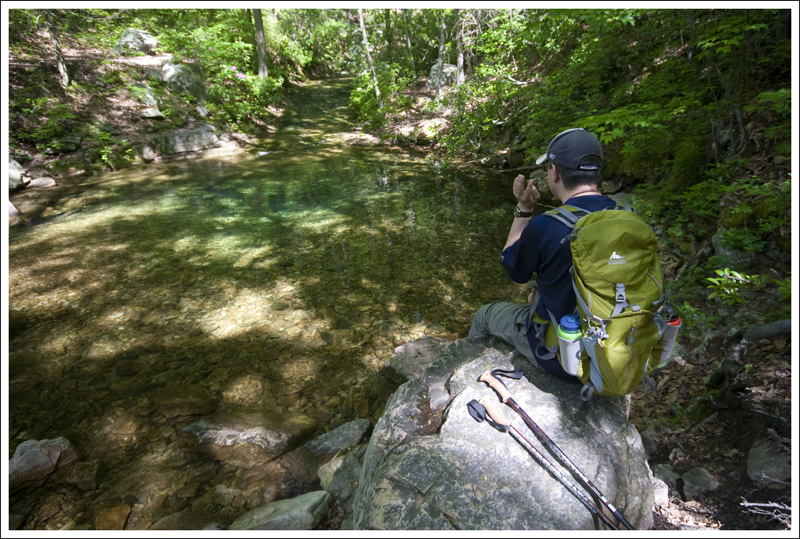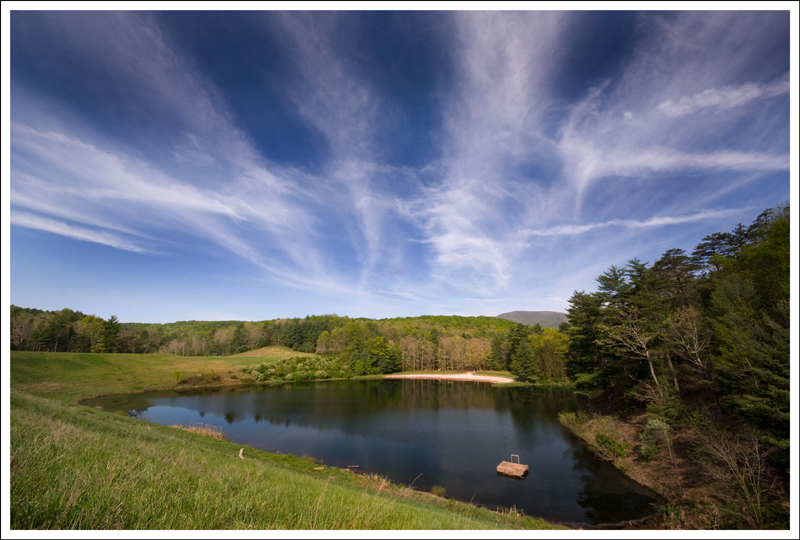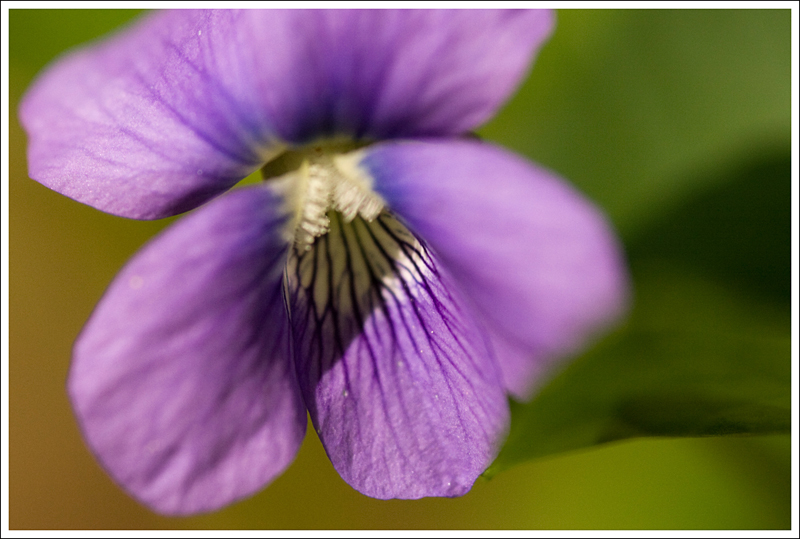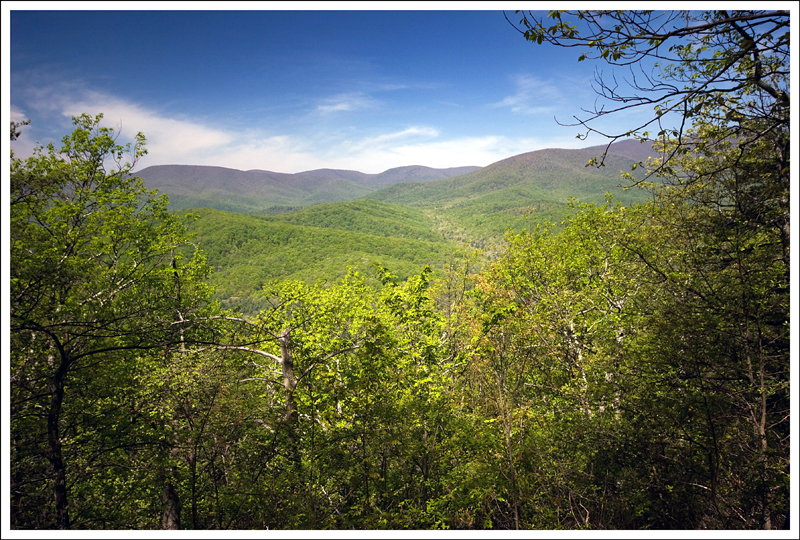
Traveling Circus in New Hampshire!

Special: New Hampshire Edition

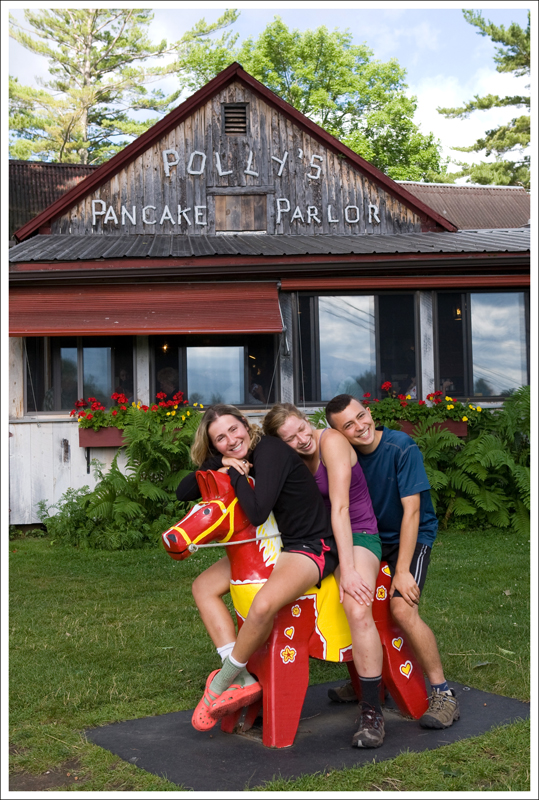
Polly's Pancake Parlor with the Traveling Circus
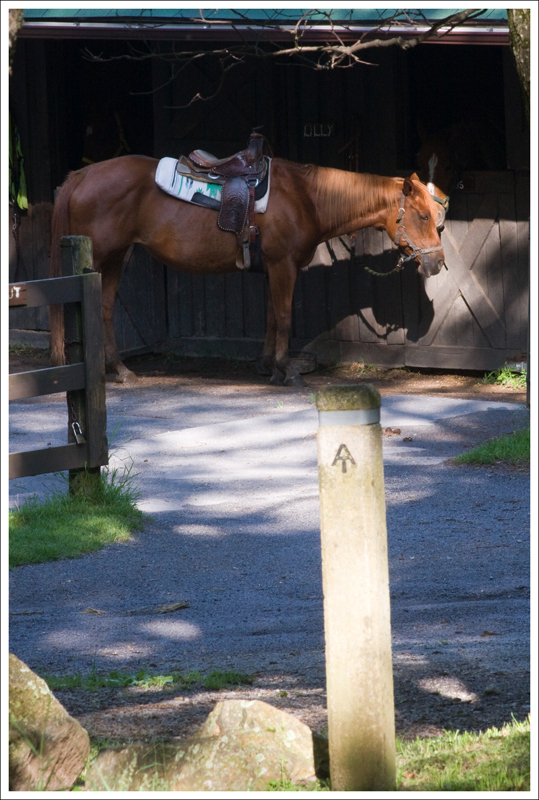
Posing on the wooden horse outside Polly’s is somewhat of a tradition.

Back in May, we met and hosted a group of three Appalachian Trail thru-hikers collectively known as the Traveling Circus.  We’ve been reading their blog all summer long and following their progress.  As luck would have it, our paths crossed again in Lincoln, New Hampshire a few days ago.  It was exciting to see them again as they near the end of their journey.  We picked them up in Lincoln, and went for breakfast together at Polly’s Pancake Parlor in Sugar Hill, NH.  Polly’s is a local favorite.  They have amazing food and a lovely view.  After breakfast, we dropped them back off at the trail and wished them luck for the rest of their hike.

Kate (Ringleader), Emily (Lightning) and Brandon (Monkey) looked happy and healthy – although they all claimed to be exhausted.  They’re scheduled to summit Mt. Katahdin sometime between August 10-12.

Tibbet Knob

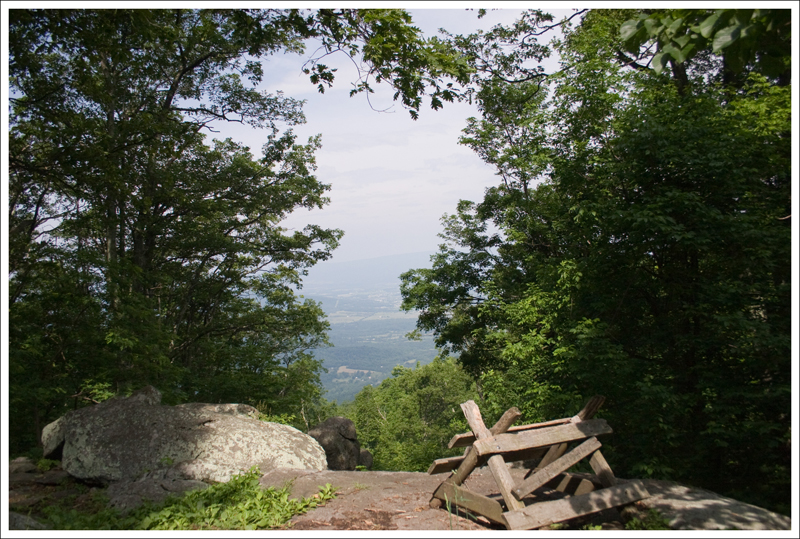
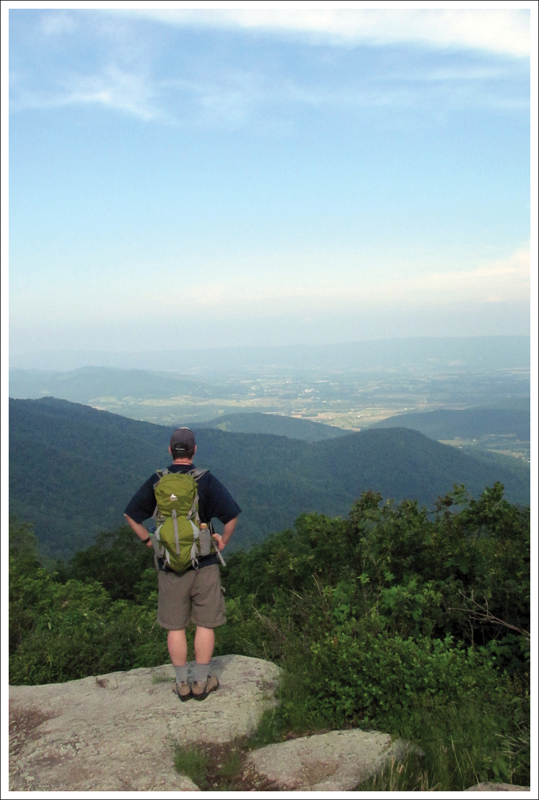
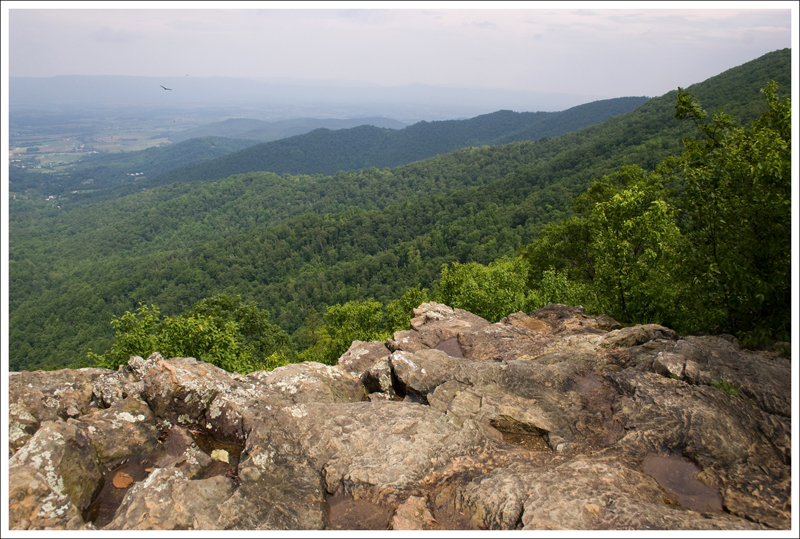
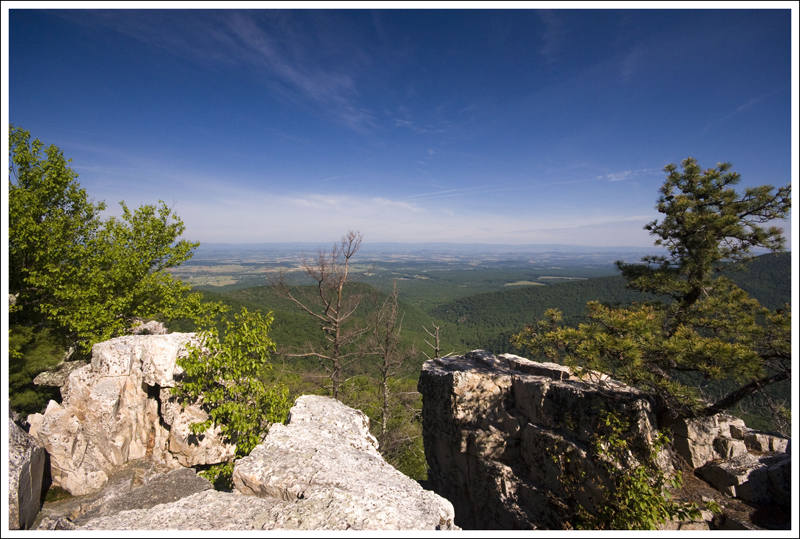
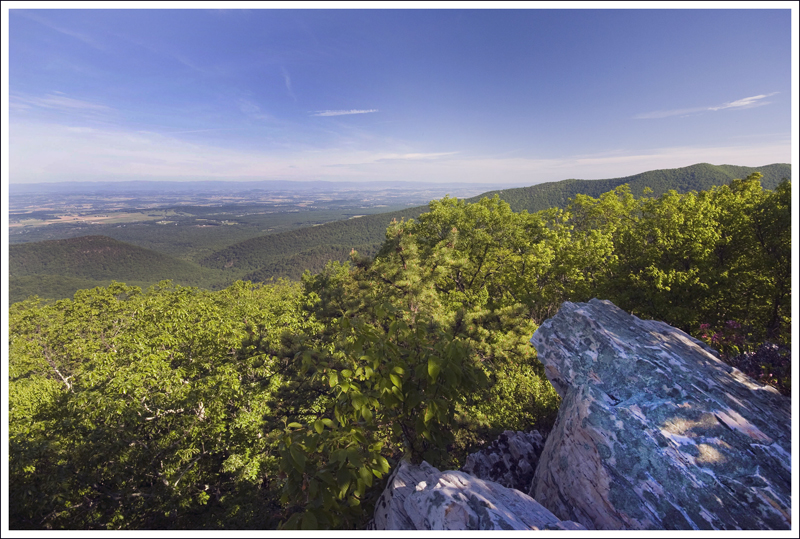
Tibbet Knob is a short, but steep, hike that leads to a beautiful, rocky outcropping that overlooks both Virginia and West Virginia.  It’s considered the sister hike to Big Schloss.

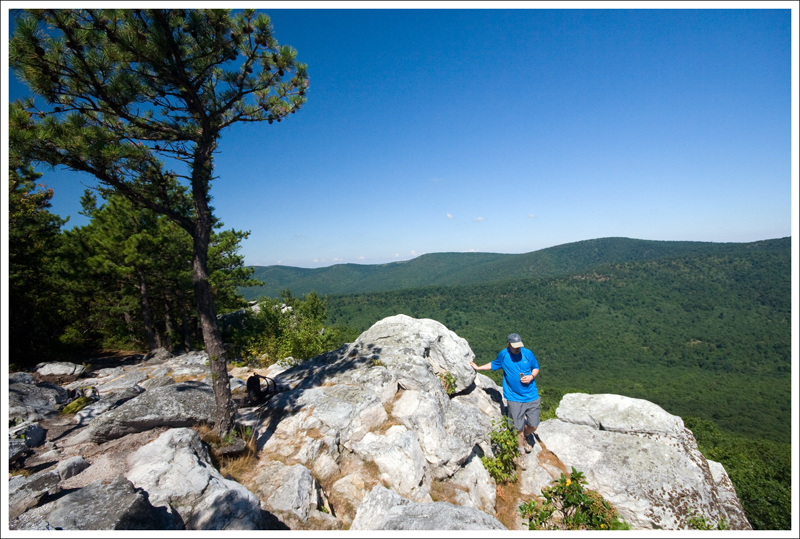
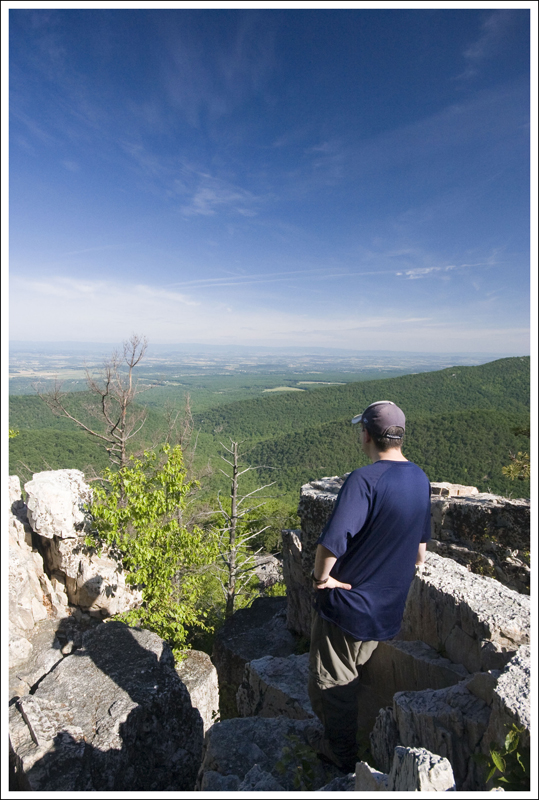
Tibbet Knob Summit
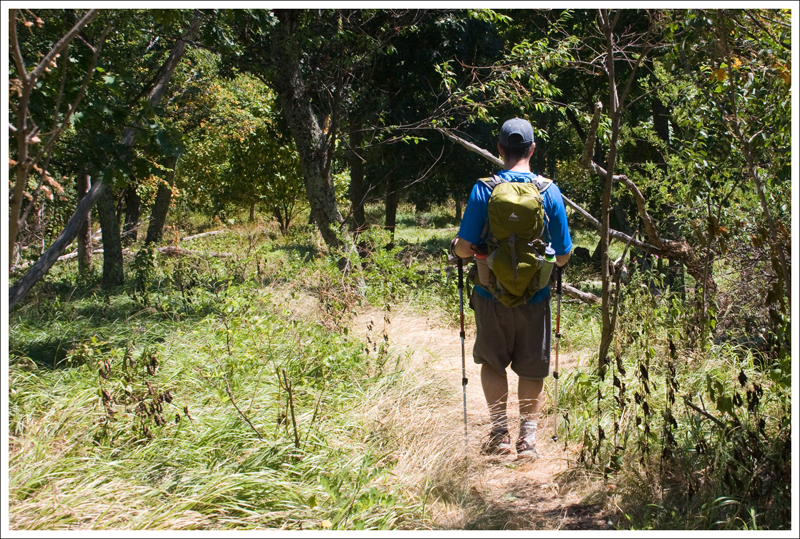
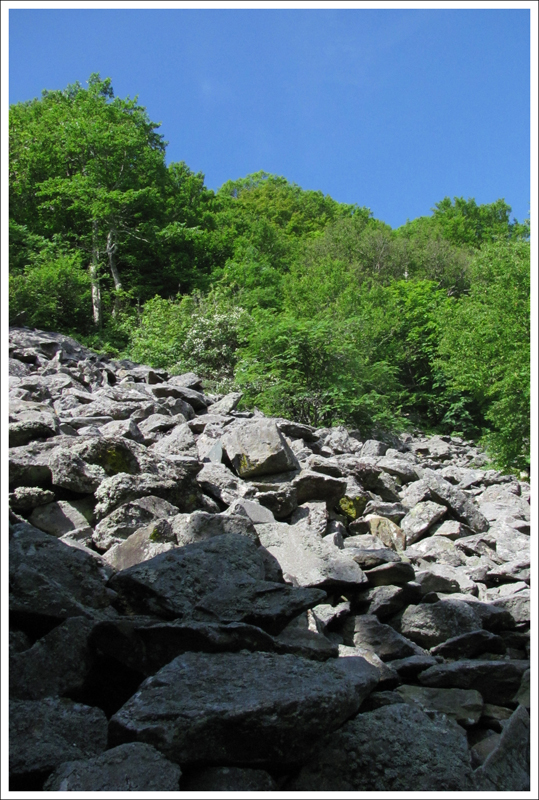
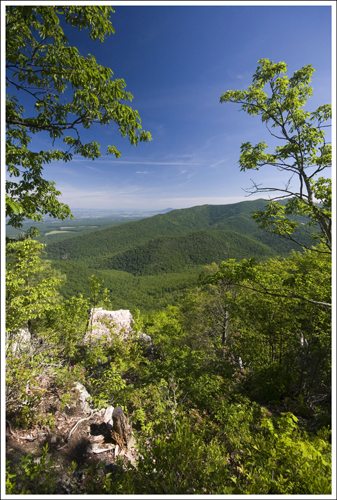
The yellow-blazed Tibbet Knob trail offers spectacular views. Below: The first overlook on the trail comes within the first few tenths of a mile;  The footing along most of the trail is extremely rocky.

First View Hiking Over Rocks

Christine Says…

After a string of eight 90-100+ degree days, we finally got a break in the heat and humidity!  We picked a shorter, easier hike to celebrate the cooler weather – Tibbet Knob.  We’ve found we’re doing lots of longer hikes lately – partly because we’ve simply run out of shorter hikes.

I don’t know how Tibbet Knob escaped our notice for so long, because it’s a beautiful hike.  Tibbet seems to play second fiddle to its sister hike, Big Schloss – though I’m not really sure why.  The views are nearly as spectacular and the crowds are much thinner.  The terrain is definitely steeper and rockier, but not so much so it would scare hikers off.

We started our morning with breakfast at Cracker Barrel in Woodstock (worst/slowest service ever *and* they burned the bacon!)  We finally made it to the trailhead a little after 9:00 a.m.  At the very beginning, the trail passes through several lovely, primitive campsites.  One even has a picnic table that someone dragged a couple tenths of a mile into the woods.  The ascent starts almost immediately and follows a steady, but gradual, uphill to the first open view of the valley below.  This overlook is pretty, but pales in comparison to the summit of Tibbet Knob.

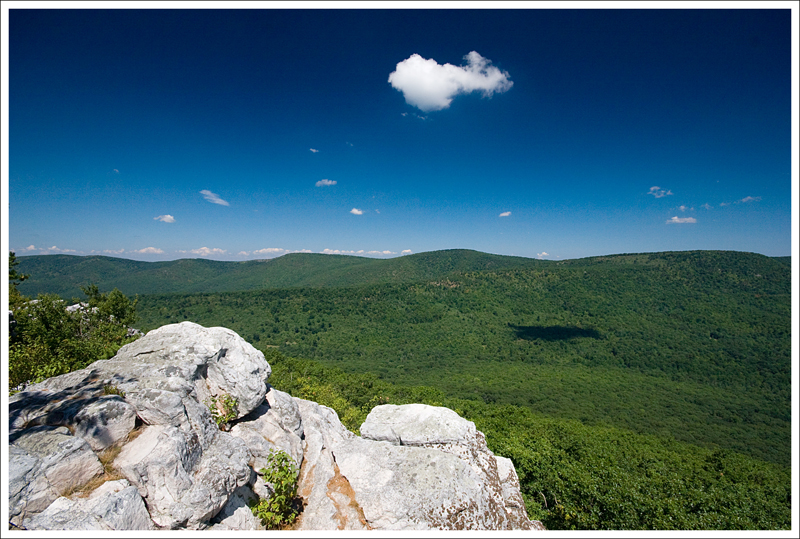
Looking Toward Big Schloss
You can see Big Schloss way off in the distance (circled in yellow).  Below:  Adam enjoys his perch on the summit; The trail was often open and out in the sun; There is a lovely (but dry) campsite about 10 yards from the rocky ledge at the summit.

Adam on the Summit Open Trail Campsite at the Summit

From the first vista, the trail drops gently into a saddle.  The footing becomes increasingly rocky from this point on.  Through some sections, it’s like walking on a dry riverbed of basketball-sized stones – some smooth, some pointy.  The last .8 of a mile is very steep and rocky.  There are two short rock scrambles.  At the first one, I abandoned my trekking poles because they were seriously getting in the way.  I can telescope them shorter, but I decided it was just as well to leave them stashed along the trail to retrieve on my way down.

Shortly after the second scramble, we arrived at the summit.  We stayed at the top for quite a long while.  Normally, we’re not the lingering type, but the morning was so pleasant that we spent at least half an hour sitting on the rocky outcropping.  It was cool and breezy.  The sky was crystal clear and blue and the scent of pine trees was all around.  There were several rocks to recline on, so I laid back and closed my eyes while Adam hunted for his geocache.  We didn’t see another soul on the entire hike.  I love having a beautiful summit all to myself.

The return trip was more downhill than uphill, so it went by quickly and we were back at the car within 45 minutes.

Adam Says…

We had been meaning to try out Tibbet Knob for some time now, since we’ve been several times to do the Big Schloss hike, but this was our first experience on this hike.  The hike takes off from Wolf Gap campground.  This campground is a great area for camping and has a lot of established campsites.  We always see plenty of cars in the campground and usually many of the sites are taken, but you should be able to find a spot for overnight camping.  We definitely plan on doing a camping trip in the future since this site provides access to some great hiking trails.

As soon as you begin the yellow-blazed trail, you will come across several other campsites alongside the trail – one even had a picnic table near the firepit.  At about .6 miles you come to a nice overlook with a decent viewpoint to the south.  If you look closely, you can even see cars on the road below you.  You descend from this overlook for a short distance, but then you begin your climb.  At some points along the ascent, the terrain opens up to larger grassland areas.  You will also pass by several blueberry bushes along the trail, which reminded us of our hikes in New England.  Due to the already hot and arid summer, the blueberries were already past their peak so we weren’t able to pick any on the trail.  The terrain does get quite steep towards the end of the trail.  You don’t have to quite crawl up the slope, but it is almost that steep.  Once you get pass the two steep areas, you are very close to the summit.  The views from the top were gorgeous and I believe give you a little better view than Big Schloss, since you get a better perspective of the valley with mountains around you.  To the east, you can see the side of the Big Schloss hike.   There is also a primitive campsite near the top of the overlook if you wanted to camp at the top, but there is no nearby water source.

Signs of Fall?
Signs of Fall?  Maybe… but more likely evidence of the drought we’ve been having lately.  We saw lots of patches of red trees in the distant mountains, too.  Below:  The only wildlife we saw was a toad; Adam looked for, but did not find, the geocache; It was a beautiful, breezy, blue-sky day; the trailhead starts across the road from the Wolf Gap campground.

Trail Toad Looking for the Geocache
Tibbet Knob Summit Trail Sign

The trail does continue on from the overlook, but it just leads to SR 671 after about .7 miles.  You can actually approach this hike from SR 671 for a shorter, less steep option to give you a 1.5 mile out-and-back hike.  We stayed up at the top for a while to soak in the views and for me to look for a geocache.  I wasn’t able to find this one, but there is an alleged geocache here:

We really enjoyed the peaceful hike for the day.  We had the entire hike to ourselves on a day that was in the 70s and we even had the bonus of not having any bugs buzzing around our face.  This is a great short hike that provides enough challenge to get the blood pumping and marvelous views at the top.

Trail Notes

  • Distance – 3.1 miles out-and-back. Add another .1 mile to get to your car.
  • Elevation Change –830 feet
  • Difficulty 3. There are two significant climbs on this hike.  The first ascent gains several hundred feet in elevation and is pretty easy.  After a short, gentle series of ups and downs, the second ascent is significantly steeper/longer and includes two short rock scrambles.
  • Trail Conditions 2. The trail is extremely rocky.
  • Views –4. The view are beautiful and expansive – a little more than 180 degrees of mountains and valleys.
  • Waterfalls/streams 0. Non-existent.
  • Wildlife 0. The only creature we saw was a toad.
  • Ease to Navigate 4. Just follow the yellow blazes. There are no turns or trail junctions.
  • Solitude4. Tibbet Knob is less popular than its sister hike, Big Schloss. You may see a few hikers, but you probably won’t see large groups.

Directions to trailhead:
From I-81, take exit 279. Follow Rte. 675 until it meets Route 42. Turn right on 42 and then take almost an immediate left on 675 (Wolf Gap Road). Follow Wolf Gap Road until you come to the Wolf Gap Campground (right on the Hardy County Line.) The trailhead is across the road from the campground.

Backpacking Gear Review – 2010 Edition

Gear ReviewFinding good backpacking gear seems to be an exercise in trial and error.  Preferences are wildly varied and highly subjective, so we thought it would be fun and informative to share our gear assessments as we go along.

This backpacking trip was the first time we field tested our new gear, and (thankfully) most of it worked out really nicely!

Backpacks:

Adam – I’m a big fan of the Gregory Z65.  My back tends to give me a lot of problems due to my long torso.  I feel that the Z65 gives me good back support with the extra padding.  My back also tends to be the part that sweats the most, so I like the air flow that is created between the pack and my back.  It definitely holds a good amount of gear that could last for a weeklong trip.  Even though we will not be doing a lot of long backpacking trips, this pack has a lot of ability to tighten around the gear you have, making it versatile for smaller trips.  The only two cons I would have is that it doesn’t have a pocket to slide some easily accessible stash in the front and the pockets for water bottles are a little hard to reach personally.  It does have a sleeve for a hydration bladder.    For daytrips, I use the Gregory Z30.  It has all the benefits listed above for the Z65, but of course doesn’t hold as much.  It holds enough that you could possibly use it for an overnight trip also.

Christine – I chose the Gregory Z55.  I liked the air flow channel between my back and the pack.  It kept me nice and cool, despite the hot weather.  I was easily able to fit 28 pounds of gear inside the bag, with lots of room to spare.  I wish the pack had water bottle holsters built in, but it does have a sleeve for a hydration bladder.  Gregory makes a women’s model (the Jade 50/60) that is similar to the Z55.  I ended up going with the men’s model pack because I have wider shoulders than the average woman.  The men’s shoulder straps just seemed to fit me better. I’m not sure the frame is exactly the perfect size for me, but it’s close.  I fall sort of between a small and medium in Gregory’s sizing.

Tent:

Adam – We chose the Mountain Hardware Drifter 3 tent.  We decided to go with a three-person tent to give us a little extra room.  We had more than enough room in our tent for our bags, with plenty of space on either side and the foot and head for essential gear storage.  The tent is easy to set up and is about a typical weight of 6 lbs.  I carried the tent, fly, and footprint and had Christine carry the stakes to split up the weight a little.

Christine – I love the design of the Mountain Hardware Drifter 3.  It felt a bit bigger than a queen size bed inside.  It was easy to pitch and the mesh allowed plenty of air circulation.  What I didn’t like was that the rainfly seemed to have few seams that were not sealed well.  When we had a thunderstorm roll through in the late afternoon, the tent dripped slowly at several places where hooks attach the fly to the tent frame.

Sleeping Bags:

Adam – I can sleep fairly easily.  I went with a Sierra Design Tomichi 35 degree (discontinued) sleeping bag.  Being down-filled, it is extremely light and is quite warm.  The mummy-style bag does work for me.  I found a great price on it at Sierra Trading Post.   During the summer, it is too hot to sleep in but does provide good padding underneath you.  It also has straps that you can fit your sleeping pad underneath to keep your bag from sliding around on top.

Christine – I tend to be an active sleeper.  I roll around a lot and don’t like to have my feet bound together, so I wanted to avoid a narrow mummy-style bag.  I also preferred the lighter weight and compressibility of a down bag.  It was really hard to find a bag that met both of these specifications, but I came across a nice semi-rectangular bag at L.L. Bean.  Most of the night, I slept on top my bag because it was so hot and humid.  I crawled inside for a little while, in the hour right before dawn.  I found the bag to be soft and just spacious enough to not make me feel claustrophobic.  The zipper ran very smoothly and didn’t catch at all.  It packs down nicely in a stuff sack and weighs in at just over two pounds.  Not bad!

Sleeping Pads:

Adam – Christine coaxed me to get the Big Agnes Insulated Air Core pad.  It does give you a good amount of padding between the ground and your body.  I never once felt like I felt anything sticking into me.  Inflating and deflating the pad was easy and it compacts down to a very small size.  I have heard these aren’t the best in cold weather, since the amount of air in this pad can get cold, but I think this is great for three-season camping.

Christine – I thought the Big Agnes pad was very comfortable.  I could roll from my back to my stomach to my side without feeling even the slightest hint of hard ground under me.  The pad does require you inflate it manually, but this really wasn’t a big deal.   It took less than five minutes of puffing to fill the pad completely.

Water Purification:

Adam – We decided to get the Katadyn Hiker Pro pump filter.  It does have a good filter system and packs down fairly well.  You can clean out the filter and it includes an adapter so you can pump directly into a Nalgene bottle.

Christine – Personally, I’m still undecided on the Katadyn Hiker Pro pump filter.  I don’t think there’s anything wrong with it per say… I’m just still not completely reconciled to the idea of drinking stream water.  I’m sure I’ll get over it in time, but I still feel the urge to treat my water with multiple methods of purification – boiling, SteriPen, Micropur tablets and then filtering.

Hydration:

Adam – Right now, I’m just using water bottles, but I plan on picking up a CamelBak or Platypus reservoir soon.

Christine – A few days before our trip, I picked up a CamelBak 3 Liter reservoir.  I give this item two big thumbs up!  Instead of hassling with water bottles, I could sip water as I walked.  I stayed hydrated much more easily than usual on this hike.  The full reservoir added about seven pounds to my pack weight, but it was well worth it.  The water stayed surprisingly cold all day long, too.

Trekking Poles:

Adam – I use the Trail Ergo Cork trekking poles from Black Diamond.  The cork grip keeps your hands dry and from slipping and the locking mechanism keeps the poles from moving.  I can’t believe that I hiked without them before.

Christine – I got a pair of Komperdell Mountain Explorer poles about a year ago, and they’ve become indispensable.  I used to think hikers with trekking poles were just gadget-hounds who bought into a bunch of hype.  But now that I’ve used them, I can say with certainty that they conserve energy and take a lot of strain off the knees.  I hike farther and faster when I use poles.

Shoes/Boots:

Adam – For backpacking trips, I will definitely bring along my Oboz Sawtooth boots.  Comfort on the bottom of my foot is key since I suffer from plantar fasciitis, but these didn’t make my feet hurt at all.  They are waterproof, provide great ankle support,  and also felt quite light compared to leather boot options.

Christine – When we started the Backpacking 101, a couple of the instructors swore up and down that everyone needed tall, leather boots with a steel shank and Vibram sole.  I took their advice, and chose a pair of Garmont Sitka boots.  They’re comfortable, but they are also hot, heavy and make my ankles feel stiff and immobile.   Since the class ended, I’ve been paying attention to the footwear used by other backpackers and thru-hikers.  I noticed that most of them use trail runners and hiking shoes over traditional boots.  This is the footwear I have always hiked in, so I decided to go back to it for our backpacking trip.  I went with a pair of Columbias on this most recent trip, but also have shoes by Merrell and Vasque. They worked out great!  My feet stayed cool, light and comfortable the whole trip.

Other Bits & Pieces

Adam –

  • For hiking, navigating, and geocaching, I use the Garmin eTrex Venture hand-held GPS.  It does have some limits, but is a good basic GPS to find your way.
  • A big hit at camp were the REI mugs we brought.  They are clear and insulated and have measuring amounts on the size, which make it great for scooping.
  • For good dental hygiene on the trail, pick up some mini Colgate Wisps.  These are easy to pack, provide a tooth pick, and are easier to carry than the standard toothbrush/toothpaste.

Christine –

  • I *hated* my Crocs.  Apparently, a lot of people think they make great camp shows.  I thought they were uncomfortable and allowed the mosquitoes to feast on my toes (and they’re ugly!).  I’ll try them one more time, but with socks. I’ll be the biggest dork in the forest, but I suppose it’s worth a try.
  • Using a stuff sack as a pillow didn’t really work out for me.  The slippery fabric allowed my head to slide all over the place.  I tried wrapping the sack in my hiking pants, but that wasn’t much better.  One person in our party had two nice camp pillows – one by Slumberjack and one by Thermarest.  I’ll definitely be adding a pillow to my gear before I head out again.
  • In the warm summer months, I decided that I don’t necessarily want to carry a sleeping bag.  I’m going to ask my mom to sew a sheet for my Big Agnes pad and carry a lightweight blanket.  I think that will be a lot more comfortable in the heat.
  • I decided that I don’t really like and probably don’t need sock liners.  I hiked one day with them and one day without them, and I found I definitely prefer the soft, looped pile inside my merino wool socks to the slick, silky material of the liners.
  • Next time, I’ll bring a spare bandanna.  It looked silly on me, but it did a great job keeping the sweat from dripping into my eyes.

Appalachian Trail – Skyland to Big Meadows

This pleasant section 7.9 mile hike along the Appalachian Trail takes you between Shenandoah National Park’s two large, historic lodges.  You can eat breakfast at Skyland, do the hike, and then have lunch at Big Meadows.
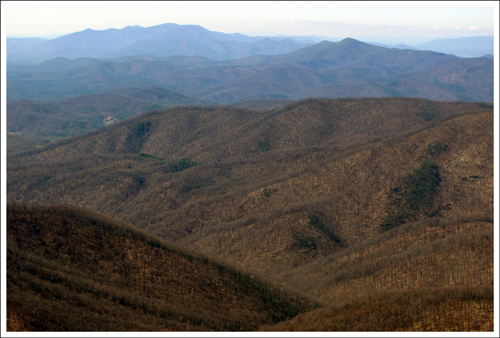
View from Timber Ridge
This hike offers a great mix of open views and passages through deep, fern-carpeted woods. Below: Hikers pass three talus slopes on Hawksbill Mountain; The forest floor was covered with abundant ferns; The trail is clear and well-maintained, but can be rocky.

Talus Slope on Hawksbill Ferns Christine on the Trail

Christine Says…

Most popular hikes in Shenandoah National Park lead away from the Appalachian Trail – down into the hollows or up to Shenandoah’s taller peaks.  The AT is usually relegated to being used as a connector trail or the return arm of a loop hike.  Many hikes on our blog include segments along the AT, but we’ve never posted a hike exclusively along the trail.  We decided it was time to change that.

On Saturday, we decided to do a “lodge-to-lodge” section hike – taking the Appalachian Trail from Skyland to Big Meadows.  It’s a 7.9 mile section, with an optional .2 mile spur trail to visit the Rock Spring Cabin and Hut.  Our original plan was to eat breakfast at Skyland, do our hike, and then eat lunch at the Big Meadows Wayside. But, we woke up hungry and ended up having bagels and fruit before we left the house in the morning.

We left one car parked at the Big Meadows amphitheater and proceeded to the Stony Man parking area at the north entrance of Skyland to set out on our hike. The trail initially cuts through the patch of forest between Skyline Drive and the lodge.  Recently, we’ve been seeing a bear with three new cubs along the road running parallel to this patch, so we were hoping we would come across the family.  No such luck.

After about a half-mile, we crossed the road at the south entrance of Skyland (you could also park here and cut a small amount of distance off the hike).  The trail passes the Skyland Stables and descends into the woods.

The terrain along the Appalachian Trail is varied and diverse.  Some sections are smooth dirt, others are jagged and rocky.  The vegetation along the trail is beautiful – alternating between lush expanses of fern, thick stands of mountain laurel and majestic groves of trees.  Occasionally, the trail passes beneath a scenic overlook on Skyline Drive.   Uphill from the trail, you can see families taking in park scenery from the comfort of their cars.  Most of them never even notice us hiking below.  I always wonder how many people visit the park and never leave the scenic byway.  The best of Shenandoah is off the road, and so many people miss that.

Rock Spring Hut
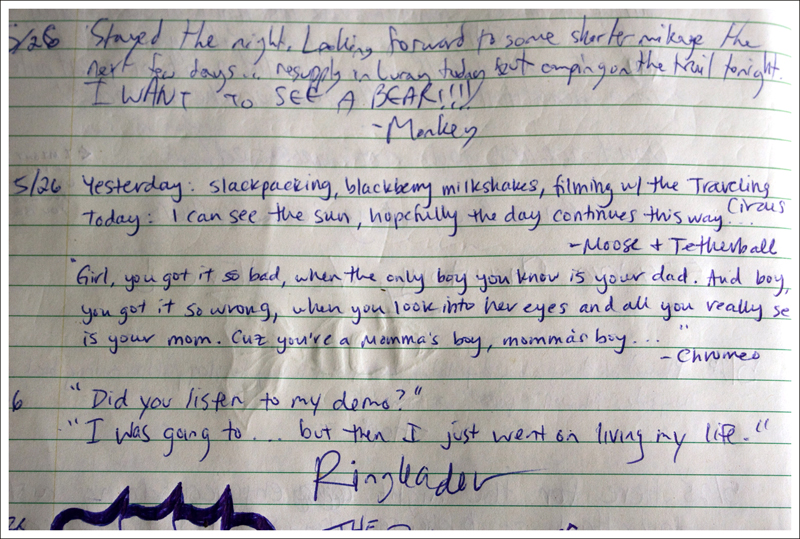
We took the short spur trail off the Appalachian Trail that leads to the Rock Spring Hut and the Rock Spring Cabin. Below: The view of the valley from the front porch of the Rock Spring Cabin; We checked out the journal in the hut and found entries from the thru-hikers we met a couple weeks ago;  Although we didn’t see any fawns on the hike, we saw a few on the ride back to pick up our second car.

View from the Rock Spring Cabin Rock Spring Hut Trail Journal Newborn Fawn

The trail skirts around the western side of Hawksbill Mountain – Shenandoah’s tallest.  Shortly after passing Hawksbill, a spur trail leads .1 miles down to two structures maintained by the Potomac Appalachian Trail Club (PATC).  The Rock Spring Cabin is rented out by the PATC and is available to the general public.  The cabin has a beautiful view of the valley beyond.  We were lucky to run into a woman renting the cabin for the weekend, and she was kind enough to let us take a peek inside.  The cabin was quite cozy and well equipped.  The other structure in the area is the Rock Spring Hut.  It’s a three-sided building with an elevated sleeping platform.  A spring for fresh water and a privy are located close by.  The hut was put in place to provide shelter to thru-hikers and section hikers along the Appalachian Trail.  We took a few minutes to check out the journal at the shelter, and were able to find entries from the thru-hikers we met a few weeks ago.

After leaving the Rock Spring area, we saw a HUGE increase in traffic along the trail – Boy Scout troops, a busload of day hikers out for a leg-stretcher and various other parties. There are lots of easy access points to the trail in this area, so the traffic wasn’t completely surprising.  This stretch of trail passes several nice overlooks from rocky ledges.  By this point of the trail, clouds had really started to roll in.  The weather was really odd on this hike.  Skies went from perfect blue to stormy very quickly and the winds varied from dead calm to very brisk.  The temperature stayed pleasantly cool – in the low 70’s, even though it was close to 90 in the valley below.

After walking across the Fisher’s Gap Overlook, the trail takes a distinct uphill turn toward the Big Meadows area.  In the last mile, hikers ascend almost 700 feet in elevation.  It’s the only tougher climb on the entire hike – most other ascents and descents are 200 feet or less.  Near the end of the climb, the trail passes very close to the Big Meadows Campground.  We were literally 25 feet or less from people’s tents and campers.  After passing the campground, the trail levels out for the last few tenths of a mile before arriving back at the amphitheater.

It was a fun hike, and really quite easy for an 8-miler!  We were also lucky to finish our hike before the thunderstorms roared across the mountains.

Adam Says…

Since Saturday was National Trails Day, we felt it was absolutely necessary to do a hike in one of our favorite places to hike – Shenandoah National Park.  Since we’ve recently met a few thru-hikers, Christine suggested hiking the Appalachian Trail from Skyland to Big Meadows.  June is a heavy month to encounter Appalachian Trail thru-hikers in Shenandoah National Park, since most start their trip in March or April.  We ended up seeing nine thru-hikers on their way North to Maine.  The few that we spoke to were looking forward to a big breakfast at the Skyland Lodge.  Christine mentioned how crowded the trail was this day.  This was mostly due to thru-hikers, boy scout groups, and tour groups.  The boy scout group consisted of several parents that were along for the trip.  The parents looked much more miserable than the scouts did themselves.  In the bus group, one lady whispered to us as she passed, “I envy your freedom”, meaning that she wasn’t enjoying hiking in such a large group.  As you near the Big Meadows Lodge and campground, you will likely see lots of people that are going for a hike, so travel on the AT nearby is one of the closest options for a hike.  There was another pair of couples that were doing the lodge-to-lodge hike heading northwards, but I feel going from Skyland to Big Meadows does save you a little on the elevation gain (though the southbound route does save your largest uphill climb for last).

One of my highlights on the trail was walking along the talus slopes near the Hawksbill parking lot.  We had completed a hike through the same area almost exactly one year ago to Hawksbill summit.  It is impressive to view the talus slopes and watch out for peregrine falcons.  We saw several swooping overhead from this point and we also saw some from the Franklin Cliffs overlook.  If you are a bird lover, you will likely see some of the closest views of peregrine falcons in Virginia from here.

Due to the big storms we have had in the last few days, there was running water in a few spots on the trail.  I wouldn’t expect this normally, but it could give some people an opportunity to fill up water bottles and treat the water if you are running low.

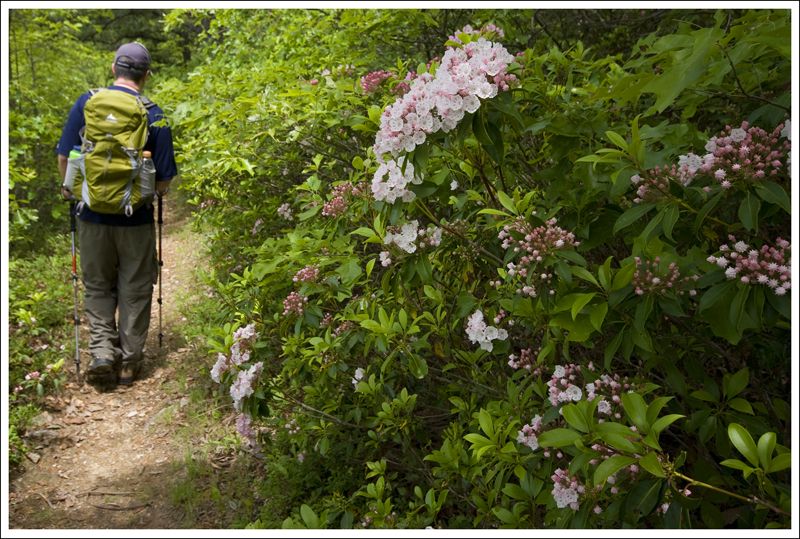
Mountain Laurel
Mountain Laurel was still abundant all along the trail.  Below: The Appalachian Trail passes right by the Skyland Stables; Adam enjoys the view from Timber Hollow; There is quite a bit of construction going on along Skyline Drive and the AT has been marked with warning signs; There are several nice rocky ledges along the trail a couple miles north of Big Meadows.

Timber Ridge Construction Along the Trail View Along the Trail

We ended the trip by stopping at the Big Meadows wayside for lunch.  It was the most crowded I have seen the dining room in a while.  We topped our lunch off with a dish of blackberry ice cream.  This is something most thru-hikers have heard about and they can’t wait to try (especially the blackberry milkshakes).  We then went over to talk to the volunteers at National Trails Day.  There was an exhibition on two-person lumber sawing, information on safety, gear demonstrations and sign-ups for guided hikes.  We talked to a few of the leaders from the Backpacking 101 course that were there on behalf of the Potomac Appalachian Trail Club.  We had signed up to join the PATC last year at Trails Day.  We were able to talk to our leaders for next weekend’s backpacking trip, so we were able to find out where we are going next week for our first backpacking trip.  We’re quite excited! (more about that later)

On our way home, we saw a few fawns with their mothers.  Most of the deer give birth in late May/early June, so they are quite tiny at this point in their lives.  You will likely see hordes of photographers in Big Meadows trying to get pictures of the fawns, but I encourage people not to harass the wildlife by approaching too closely.

While this wasn’t the entire Appalachian Trail distance of 2175 miles, we enjoyed our small portion of the trail.  We are hoping that we can hike the entire 105 miles of the AT that runs through Shenandoah National Park next summer.

Trail Notes

  • Distance – 7.9 miles as a shuttle trail.
  • Elevation Change – Constant ups and downs, but the longest uphill climb is about 650 vertical feet at the very end of the hike.
  • Difficulty – 2. This is an easy hike for eight miles.  The Appalachian Trail in Shenandoah is never very steep.
  • Trail Conditions – 3. There are some rocky sections, but overall the trail is in great shape.
  • Views3.5 – There are nice views from Timber Hollow, Hawksbill, Spitler Knob, and Franklin Cliffs.
  • Waterfalls/streams – 0.
  • Wildlife – 2. We know there is a lot of wildlife in this area, but we only saw the peregrine falcons soaring over Hawksbill Mountain.
  • Ease to Navigate – 4.5.  As long as you’re following the white blazes, you can’t go wrong.
  • Solitude –1. We hiked this trail on a pleasant June morning.  We saw *many* people – literally dozens and dozens.

Directions to trailhead:
On Skyline Drive, park at the Stony Man trailhead (located at the northern entrance to Skyland – near mile marker 42).  You will see an Appalachian trail marker near the parking lot.  You will see two AT cement posts, but the one that starts the trail is further away from Skyline Drive.  Follow the trail south from this point.

Riprap Trail

This 9.8 mile circuit hike offers all the best of Shenandoah – panoramic views,  bubbling streams, a swimming hole and even a nice final stretch along the Appalachian Trail.  It comes close to our 10 mile limit for a day hike, but it’s definitely well worth the effort.

Chimney Rock View
The view from Chimney Rock is very pretty on a clear day.

Christine Says…

The Riprap trail has long been on my list of hikes to tackle in Shenandoah National Park.  Last Friday, we finally got around to it. I have to admit, the nearly ten-mile length and over 2,300 feet of elevation gain intimidated me just a little. The hikes we’ve completed that are close to that length (i.e. McAfee Knob or Mount Rogers) both have substantially less elevation gain. But, we had a free day and beautiful weather, so we decided to go for it. I’m so glad we went because the scenery on this trail showcased everything I love about Shenandoah. And, honestly… hiking 9.8 miles really wasn’t that hard.

We started the hike from the Riprap parking area at mile marker 90. We turned right at the end of the parking lot and followed the Appalachian Trail uphill for about a third of a mile. At the intersection with the Riprap trail, we turned left. The trail went alternately downhill and uphill for about three-quarters of a mile. We passed around a talus slope and came out to a viewpoint near Calvary Rocks. This was a great place to pause and take in the panoramic scene of the valley below. About a third of a mile downhill past Calvary Rocks, we arrived at Chimney Rock. I found this to be the prettier of the two views – but they were both very nice. The trail was especially pretty in late May because of all the blooming mountain laurel, wild azaleas and rhododendron. There were some sections that were so lush, I felt like I was walking through a tunnel of flowers.

Wild Azaleas, Rhododendron and Mountain Laurel
Wild Azaleas, Rhododendron and Mountain Laurel.  Below: The view near Calvary Rocks; Adam taking in the view from Chimney Rock.

View Near Calvary Rock Adam Takes in the Chimney Rock View

From Chimney Rock, the trail follows a ridge for a while, with many nice views between the trees. There is still quite a bit of evidence of forest fire damage from the late 1990’s in this area. The mountainside is still rather barren and charred stumps are visible. Slowly, the trail descends into Cold Springs Hollow. We passed through some of the densest mountain laurel along this section. We saw and heard so many beautiful birds – everything from American Redstarts to Rose-Breasted Grosbeaks.

Near the bottom of the hollow, we started to pick up the stream. It started off as a trickle, gaining volume and speed as we climbed continually downward. There were a few small, unremarkable waterfalls in the gorge, but we didn’t stop walking until the first stream crossing. Adam and I sat on a couple big boulders in the middle of the stream and ate a few handfuls of trail mix.

Swimming Hole with Fish and Rhododendron Reflection
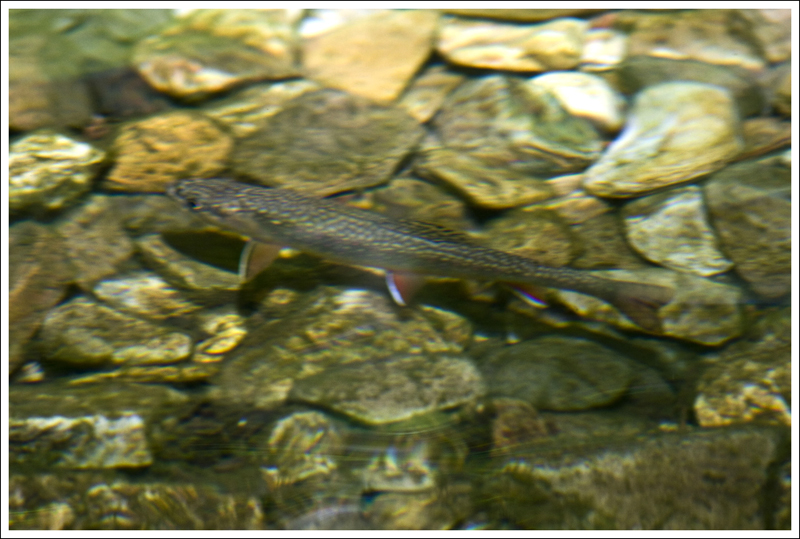
The swimming hole displayed beautiful rhododendron reflections and was full of brook trout. Below: The trout were hard to photograph through the water, but you get the point.

Brook Trout

We stopped again just a couple tenths of a mile later at my very favorite spot along the trail – a wide, green swimming hole shaded by the forest canopy. We sat along the pool for a long while. We watched colorful brook trout lolling in the water. Every now and then, one would splash up and break the quiet surface of the water. The water was so clear. We could see reflections of the rhododendron on the surface and big, round stones at the bottom of the pool. The spot is made even more beautiful by the gentle slide waterfall that cascades down and fills the pool.

After leaving the pool, we had almost about three-quarters of a mile of level walking and a couple more stream crossings. A post marks the intersection with the Wildcat Ridge Trail. We turned left, and enjoyed our last little bit of flat walking for a while. We decided to stop and eat lunch before the big uphill climb began. We had ham and cheese on crackers, chips and some candy – perfect to give us lots of energy!

Climbing along Wildcat Ridge is a steady uphill for almost three miles, but the grade is generally moderate. There were several more decent views through the trees along this section of trail. And of course, more mountain laurel! I think I must have said “This is SO PRETTY!” to Adam a dozen times as we walked through the flowers. This section is where we saw our only other hikers of the day – a young couple hiking the loop in the opposite direction. We got to the junction with the Appalachian Trail faster than we thought we would. We were anticipating another .7 miles of uphill climbing when we reached the marker post. It’s always such a pleasant surprise when an uphill climb ends earlier than you thought it would.

Adam on the AT
Adam and I both enjoyed the more level terrain along the Appalachian Trail.

We took a left onto the AT for the final 2.8 miles of the hike. This section was typical Appalachian Trail in Shenandoah – rolling hills, nothing too steep. We saw a brief glimpse of a bear diving into the mountain laurel about a mile into this stretch. After about an hour of walking on the AT, we arrived back at our car. My feet were a little sore and tired, but other than that I still felt pretty energetic. Riprap now claims the spot for the longest hike I’ve ever done in a day! The 9.8 mile circuit took us just under six hours – including our very frequent snack and photography stops. On the way home, we stopped and rewarded ourselves with Lime Cream Slushes from Sonic – my favorite post-hike treat.

Adam Says…

This may also be the longest hike I have done but it was well worth it!  This hike really does have it all and we hit it at a great time of year.  The mountain laurel and rhododendron were at peak on this trail and we often felt like we were in some type of fantasy land while being surrounded by pink flowers.

The views from Calvary Rocks and Chimney Rock give you some great 180 degree views to the north of the mountains.  I was a little worried that the payoff for this hike was going to be over in the first couple of miles of the hike, but I was glad to be wrong.  After we continued the descent from Chimney Rock, there were still some open views along the way.  Once we reached the bottom of Cold Springs Hollow, we saw a glimpse of a waterfall along the way.  Shortly after the falls and after crossing the stream you come to the beautiful swimming hole that Christine mentioned above.  This was a great spot to relax and enjoy seeing the fish, or you could take a quick, refreshing dip.

View Along the Riprap Ridge
View Along the Riprap Ridge. Below:  The swimming hole is such a beautiful place – even though we constantly had to bat the bugs away.  Note the slide falls coming down to the pool.

Swimming Hole

Once we were done with relaxing, we took the hike up the Wildcat Ridge Trail.  This is a constant uphill for about three miles and does include a couple of switchbacks on the trail.  However, we felt that the terrain wasn’t too steep.  You continue to observe nice views as it hugs closely to the side of the mountain.  Once we met up with the AT, the trail didn’t have a lot of elevation gain/loss.  I do suffer from plantar fasciitis, so my feet were quite sore on the rocks of this section of the trail.

Butterfly on Mountain Laurel
Butterfly on Mountain Laurel.  Below: Adam hikes through the mountain laurel along the Appalachian Trail.

Adam hiking the AT

For those interested in geocaching, I did place an earthcache at the overlook for Calvary Rocks.  This is a way to learn about the geology of the area and there are a few steps to get credit for the cache:

I definitely enjoyed my first trip of the Riprap trail, but I know it won’t be my last.  This would also be a great place to do a backpacking trip, since there is a reliable water source at the bottom of the trail.  We really felt like it was one of the prettiest trails we have done in all of Shenandoah National Park.  Part of that largely is due to the abundance of blooming wildflowers, but another part was the views.  The Riprap trail really has it all!

Trail Notes

  • Distance – 9.8 miles
  • Elevation Change – Around 2300 feet.  The hike is a mix of uphill and downhill, with one long, steady uphill stretch of about three miles.
  • Difficulty – 4.5 While the elevation gain is substantial, the trail is rarely steep.  Grades are moderate.  We scored the hike a 4.5 mainly due to the length.
  • Trail Conditions – 4 Nice trail to walk along!  The stream crossings are easy.
  • Views4.  You get the best views from the Chimney Rocks and Calvary Rocks overlooks.
  • Waterfalls/streams – 3 The stream was on the low side when we hiked, but was still pretty.  The swimming hole at the bottom of the hollow is very beautiful.
  • Wildlife – 4 We saw lots of brook trout, a little toad, many bird species and we even caught a glimpse of a black bear’s rear end diving into the laurel thicket.
  • Ease to Navigate – 2 A few turns to make along the way.  There are a few false trails leading away from the main trail and also one tricky turn after a creek crossing.
  • Solitude – 3 We saw only two other people on the entire loop.  We hiked it on a beautiful Friday in late spring.  I imagine the trail is much more crowded on weekends.  It’s a very popular short backpack loop.

Directions to trailhead:
From Skyline Drive, park on the western side at mile marker 90.  There is a parking lot specifically for Riprap hikers.

The Traveling Circus Comes to Town

Most of our posts are about local trails and day hiking. But today, we’re excited to bring you a “special edition” post.  We met a trio of Appalachian Trail thru-hikers online.  Lightning, Monkey and Ringleader, collectively known as The Traveling Circus, came off the trail and spent some time with us.

The Traveling Circus - Lightning, Monkey and Ringleader
The Traveling Circus – Lightning, Monkey and Ringleader.  Below: The group gets started on their 17 miles; everyone carried a nearly empty pack on this day; two more thru-hikers (Moose and Tetherball) took up our offer to offload gear.

The trio is hiking the AT and shooting a documentary along the way.  The film is going to focus primarily on the community and social aspects of the trail.  We can’t wait to see the finished project.  The hikers we’ve met are fascinating, so an entire documentary about the people should be quite compelling.

During their visit, there was lots of food and fun conversation.  They all got to take hot showers, do some laundry, check the internet, and sleep in a bed.  We even had time to watch a movie.  Christine made a big breakfast before driving them back up to the trail.

We offered to hold onto their heavy gear for the day and meet them at Big Meadows later in the evening.  When we dropped them off in the morning, they ran into a couple AT friends.  We ended up stowing their gear for the day, too.  I’ve never seen hikers look happier.  One exclaimed that he felt like he could fly without his pack.

When we met them near Big Meadows in the afternoon, they arrived right on time.  It’s amazing that they can hike 17 miles, and predict within a few minutes when they’ll arrive at a given spot.  Most people aren’t that punctual with watches, cellphones and cars.  Apparently, after three months of hiking, you get pretty good at gauging your speed. All five hikers said they had a beautiful day of hiking – great weather and pretty scenery.

We made it to the Big Meadows Wayside in time for them to order the famous Shenandoah National Park blackberry milkshakes. We had a little time to chat with Moose and Tetherball (the thru-hikers we met when we dropped The Traveling Circus off).  They were both really nice and seemed to be loving every minute of their time on the trail.

We offered everyone a ride a little further down the trail, but they decided to walk their miles.  Moose  said “If you cheat the trail, she’ll make you pay for it later!”

Kate (Ringleader), Brandon (Monkey) and Emily (Lightning) are such nice people – they smile and laugh constantly. They were full of great stories and tales about what hiking the AT is really like.  They were all so fit and strong and had positive outlooks, even after months on the trail.  We have no doubt they’ll be climbing Katahdin in a few months.

Trimble Mountain

Trimble Mountain is a lovely, wooded trail through the North River Ranger District of George Washington National Forest.  The hike begins near Todd Lake. It climbs the mountain, follows the ridge across two summits and then descends back to the start point.

Trimble Mountain from the Todd Lake Dam
A View of Trimble Mountain from the Todd Lake Dam. Below: Todd Lake has a nice campground with flush toilets and hot showers. The lake is open to swimmers.

Todd Lake Trail Sign

Christine Says…

Well, this entry should have been part four in the Backpacking 101 series, but sadly my sprained ankle forced us to bail out on the trip.  The weight of a pack on my sore ankle is still too painful.  Fortunately, I was cleared to do some light day-hiking again. So, on Saturday morning, Adam and I headed out to George Washington National Forest.

Trimble Mountain fit the bill for a light and easy hike. The four-mile trail isn’t too rocky and follows a gentle grade both up and down the mountain.  We parked along the road near Todd Lake.  Before hitting the trail, we climbed up the backside of the dam and enjoyed the lake view.  The top of the dam also provides a great look at Trimble Mountain. The sky was absolutely gorgeous – a real photographer’s dream.  It was the prettiest I’ve ever seen Todd Lake look.

Shortly thereafter, we were on our way up the Trimble Mountain trail.  Within a tenth of a mile, we reached a “Y” in the trail.  We took the left branch, following Hiking Upward‘s advice that it was the gentler, more gradual grade.  For about a mile and a quarter, we climbed steadily upward.  It was never tough climbing, but it was consistent.  The trail was really narrow and carved into the mountainside.  A lot of places, one foot was always laterally uphill from the other, and there was barely room for placement of my trekking poles.  It was also an unusually warm day for early May, so the bugs were out in full force.

Trimble Mountain actually has two summits with a saddle between.  Once you gain the ridge, the terrain consists of both uphill and downhill hiking.  There really aren’t any views to speak of at the summit.  Every now and then, we could see glimpses of the mountains through the trees, but there was never a sweeping, panoramic view along this hike.

Wild Iris
There were so many different kinds of wildflowers growing along the trail.

Dogwood Wildflower

Wildflower Wildflower

The remainder of the hike went by quickly and was all downhill.  I stopped many times along the way to photograph the abundant wildflowers on the forest floor.  I also spotted a few little tree frogs.  They were so tiny and fast that I had a hard time getting photos.  They were the only wildlife we saw on the trail.

By the time we got back to the car, my ankle was quite sore again.  The downhill walking really seems to strain it.  I hope that little by little it will feel better and become stronger. Hopefully when it’s healed, we can make up that backpacking trip.

A tiny frog
This little frog was about the size of a fingernail.

Adam Says…

We had been to the Todd Lake area before of George Washington National Forest, but this was our first time hiking Trimble Mountain.  Todd Lake receives a lot of campers and local visitors that want to enjoy swimming and basking.  The Trimble Mountain trail that is nearby doesn’t seem to get a lot of traffic.  We had the entire hike to ourselves on a beautiful day outside.  The bugs helped us realize that the warm weather is here.  One thing that is different about hiking national forest trails is that there isn’t a lot of maintenance to the trails.  There were a couple of trees spread across the trail and the trail was becoming a little more overgrown in parts.  We had heard that there were good views on this trail, but we were disappointed to find that most of the views are obstructed.  The only views you will see is in break in the trees.  The winter would probably lead to more views of the mountainside, but after the leaves fall this will look a lot more dull.  We enjoyed getting out to hike and the wildflower variety was definitely a highlight of the trail.

One of the few openings in the trees
One of the few openings in the trees that provided a view. Below: Trees blocked most of the view; the trail is marked with double yellow blazes.

Adam takes in the view Double Yellow Blazes

There is one geocache on the trail and a few at the nearby Todd Lake area.  The first you can find along this hiking trail.  The other trail would involve hiking along the Todd Lake Trail which you can reach from the opposite side of the road from the Trimble Mountain trail.  The Todd Lake Trail is a little less than a mile and takes you around the entire Todd Lake area.  Since the day that we did the hike was the 10th Anniversary of geocaching, I felt I needed to do a couple of these to celebrate the hobby.

Trail Notes

  • Distance – 4 miles – loop
  • Elevation Change –around 1,050 feet
  • Difficulty – 2 This climb on this hike is about two miles, but is very moderate.
  • Trail Conditions – 3. The trail is narrow and little bit overgrown.
  • Views –1. There are some nice glimpses of the mountains through the trees, but nothing remarkable.  Views might be nicer in the winter when trees are bare.
  • Waterfalls/streams –1. In times of heavy rain, you’ll find several small streams along the trail.  Most of the year, these streams are dry.
  • Wildlife – 1. The national forest is used by hunters, so animals tend to stay hidden.  We saw quite a few frogs and toads along the trail.
  • Ease to Navigate – 5. The trail is well-marked and easy to follow.
  • Solitude – 4. We didn’t see a soul.

Directions to trailhead: From Bridgewater, Virginia head south on Rte. 42 for about three miles, following signs to Natural Chimneys regional park.  Take a right on 613 and in less than one mile, take a left on state route 747.   Take a right .75 miles after Natural Chimneys to the intersection with 731.  Take a right heading north.  In about a mile, take a left on to State Route 730/North River Road.  This comes to an end and take a right on to state route 718.  In another mile, you will take a left on to Forest Road 95, entering George Washington National Forest (you will see signs directing you to Todd Lake).   The trailhead is about 3.5 miles on the left.  You can park on the side of the road right near a trailer dump station.   The trailhead is on the opposite side.  (There is a trail on the same side of the dump station that leads to the top of Todd Lake if you are interested.)

Part 3: Backpacking 101 with the PATC

Christine Says…

I can’t think of any other class where it would be acceptable for an instructor to say “Now imagine me with my pants pulled down.”  But Backpacking 101 is quite different from other classes.

Prince William Forest Park
Prince William Forest Park was the location for Backpacking 101’s weekend-long field class.

The third day of instruction also took place at Prince William Forest Park.  Adam and I showed up for class freshly showered, warm and well-rested.  We were among the few students who opted out of the group camping experience.  We would have liked to camp, but my parents live too close to the park to not pay them a visit for the weekend.  It was probably good that we had a place to go escape the pollen.  It was the worst pollen I’d ever seen – you could see it raining down from the sky and everyone’s shoes and pant-legs were coated with a thick, yellow dust.

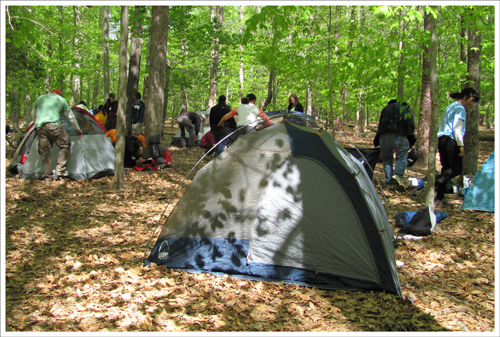
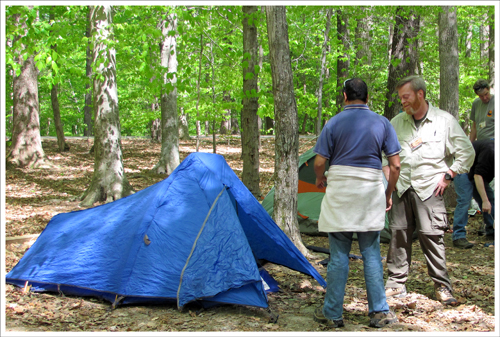
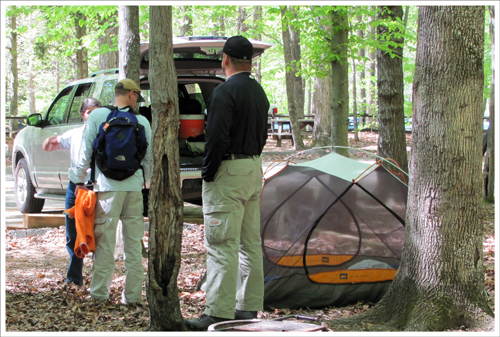
The morning started off with an explanation of the different brands and styles of tents used for backpacking.  We walked around the group campsite, looking at about ten different models owned by class participants.  I really liked a particular REI tent and also one from Sierra Designs.  We’ll likely be purchasing a three-person tent so we have room to keep little gear inside.  I was amazed by the miniscule size of most two-person tents.  They left me wondering… what two people?… Lilliputians, leprechauns, pygmies?

Camp was set up with a variety of tents.

Tents We liked this tent

After tents, we had a thorough discussion of water filtration/purification methods.  I found this to be the most fascinating part of the day.  Access to clean, safe water is probably one of the things I find most worrisome about backpacking.  We saw demonstrations of a Katadyn Filter system, iodine tablets, AquaMira and talked about boiling.  A couple of the instructors seemed to favor SteriPen systems, but we didn’t see a demo of one in action.   I think the pump filter system looked like the fastest and easiest of the methods, but I think I might use some AquaMira or Micropur as a second layer of protection for my personal drinking water.  I figure that an extra layer of prevention is a good idea, especially when the consequence could be explosive diarrhea.

After water, we moved on to campsite selection.   This included discussion of where to pitch tents, set up the “kitchen”, where to place your bear hang and how to designate a bathroom area.  This session provided the perfect segue to the other part of backpacking that I sort of dread… catholes.  In short, I simply do not want to poop in the woods.  I am a princess about these things … but I suppose I have to get over it because poop happens.  I think most of you will have figured out that the opening quote for this blog posted was pulled directly from the cathole session.  I won’t go into all the gory details, but I will share one prophetic term and leave the rest to your imagination – “Poop Soup”.  Beyond that, I am not going there.  As one person in the class put it “I don’t think I’ll be able to look any of you in the eyes again after this trip.”  I guess nobody really likes pooping in the woods.

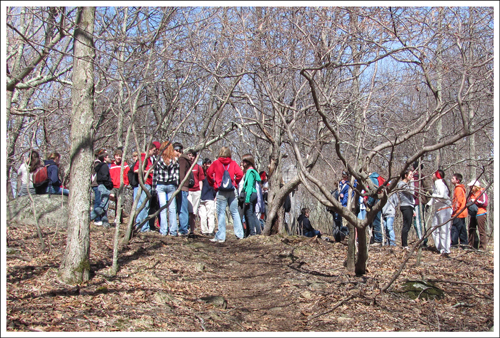
The last sessions of the day covered personal hygiene, flora and fauna (poison ivy, ticks, bears and snakes) and Leave No Trace principles. At the conclusion of the class session, the class broke into outing groups.  We had the option of easier or moderate – with easier groups covering about four miles a day and the moderate groups covering six miles a day. We chose the easier group because at this point, I’m still not sure if my sprained ankle will be healed in time.

The class split just about in half between the moderate and easier groups.  Adam is one of only three males in the easier group.  I’m dragging him down to my level.  🙂

Honestly, we’re both THRILLED to be in the easier group, because we get to go to Dolly Sods for our outing.  Our group leaders (Dave, Jen and Dave) chose Dolly Sods because it’s an easier place to accommodate a large backpacking group than Shenandoah National Park.  There are eleven people in our group.  We’ll hike and have meals together, but split into two groups for camping. We love the people in our group.  Everyone seems to be nice and so many group members have a great sense of humor.

Now everyone needs to stay tuned for the actual post from the outing (coming sometime in May.)  I will say that we’re really excited about the trip.  The PATC Backpacking 101 Workshop gave us exactly the information we were looking for.  I feel like we’re kicking off our backpacking experience the right way, and that’s given me a lot of confidence and hope that I actually can do this.

Part 1: Backpacking 101 with the PATC

Christine Says…

(instead of doing both a Christine Says and an Adam Says section for this series, we’ll be taking turns with writing.  We’ll be back to team blogging when we hit the trails again)

Anyone who has read the About section of our website already knows that we’re not backcountry campers/backpackers.  Although I grew up camping with my family, we were always strictly “frontcountry.”  We had a pop-up camper and spent a lot of vacations in developed campgrounds with electricity, playgrounds and hot showers.  Adam definitely has more experience roughing it than I do.  He did a lot of primitive camping in high school and college.

PATC Headquarters
The first session of Backpacking 101 was held at the Potomac Appalachian Trail Club’s headquarters in Vienna, Virginia.

My only backpacking experience came when I was ten years old and attending summer camp with the National Wildlife Federation (Ranger Rick Wildlife Camp).  We did a couple one-night backpack trips in the woods of western North Carolina.  I don’t remember anything from those trips other than the poison ivy.  Our hippie camp counselor encouraged us to walk barefoot through the forest to “be one with nature.”  That was one of the worst ideas ever.

The last time I camped in any way, shape or form was in the mid 90’s.  Adam and I had just started dating, and decided to go camping on one of our first trips together.  The weather was supposed to be nice, but we ended up having freak storms with torrential downpour.  Our tent leaked, we couldn’t get a fire going, Adam got hypothermia – basically everything went wrong.  We ended up bailing out and sleeping in the car.  The next day, we broke camp and moved back into the great indoors. I’ve never looked back, because honestly… I love a soft mattress, a hot bath and access to a microwave.

Recently, I’ve decided to give sleeping outdoors another chance.  I’ve been on so many hikes with places that I’ve stopped and thought “Wow – I’d love to wake up right here and see the sunrise!”  So, when we got a Potomac Appalachian Trail Club (PATC) newsletter, we were intrigued by a workshop called Backpacking 101.  It’s an adult class for backpacking newbies.  I’m hoping that their expert instructors will be able to show us how to backpack and camp in a way that makes it safe, fun and comfortable.

Last Monday, we had our first class meeting to go over course expectations, physical conditioning and how to choose boots.  The class has 28 participants – all very diverse in age, gender, experience and fitness level.  We’ll be spending the next two class sessions doing field learning – everything from how to purify water to how to load your backpack properly to how to choose a campsite.  The class will conclude with a weekend-long backpack trip to put everything we learn into practice.   At this point, my ankle sprain is still too painful to hike. I’m really hoping it will be healed enough by May for the weekend trip.  Keep your fingers crossed for me!

We’ll be blogging about each of the sessions… so stay tuned!  Maybe we’ll become backpackers yet!

Mount Pleasant

This 5.4 mile loop hike takes you to the beautiful double summit of Mount Pleasant, across Pompey Mountain and then back down to your car.

NOTE (2/26/17): A recent hiker reported that the fall forest fire in this area did severe damage to this trail system.  He reports that many of the blazes have been destroyed and the trail is hard to follow.

Adam enjoys the vista from the west summit of Mount Pleasant. Below:  Moss was still the only greenery along the trail.  Leaves are still a few weeks away;  The sign at the trailhead marks the loop at 5.2 miles.  Our GPS marked it at 5.75, so we’ll split the difference in mileage for this blog post.

Trailhead Sign

Christine Says…

When we hiked the Cole Mountain trail last fall, we made a mental note to return to the area sometime to do the Mount Pleasant hike.   We’re so glad we did.  The hike up Mount Pleasant provides gorgeous views from both its east and west summits.  We had a crystal clear day and could see for miles in every direction.

We started out on our hike a couple hours later than we normally do.  The delayed start turned out to be quite fortuitous.  As we drove down Wiggins Spring Rd toward the trailhead, we saw 15-20 cars parked near the AT crossing and Cole Mountain trail.  We assumed that they were a group camping and hiking on the Cole Mountain trail and were thankful not to sharing trail with such a large crowd.  A little further down the road, the Mount Pleasant parking lot was empty with the exception of one frost-covered car that had obviously been left there overnight.

We started down the trail.  It was icy and muddy, but pleasantly flat for the first mile.  After we crossed a small stream, the upward climb began in earnest.  It wasn’t terribly difficult or steep climbing, but it was constant for the rest of the way to the summit.  Much of the trail was wet/soupy and covered with a thick layer of leaves.  There were several places that the trail was tough to follow, but I imagine that once more hikers pass this way, the trail will become clear again.

These could be the poster children for the defiance of Leave No Trace principles.  This was just a portion of the group we encountered.

At around the 1.5 mile mark, we started hearing distant voices in the woods – lots of distant voices.  I looked at Adam and said “I don’t think all those people are on Cole Mountain after all.” At 1.9 miles we came to a trail junction being used as a rendezvous point for about 30 kids on a church youth group trip. I have never heard people being so loud in the woods.  One group of three boys thought it was hilarious to repeatedly scream “NINKOMPOOP” at the top of their lungs as they headed down the trail.

After we cut through the crowd, we took a right turn and followed the spur trail up to the mountain top.  On the way up, we passed about 20 more hikers from the same youth group.  As I mentioned earlier, it was lucky we started our hike late, or else we might have been sharing the beautiful mountaintop with 50 shrieking kids.  As it turned out, we had the view all to ourselves.

At the summit, there was a small sign with arrows pointing to the east summit and the west summit.  We headed west first.  The west summit is on a dramatic outcropping of rocks.  It provides an expansive, layered mountain vista, including a great look at the bald summit of Cole Mountain.  The east summit is also lovely, albeit a little less dramatic.  The view is mostly valley and farmland.

We stayed at both summits longer than we normally would.  We wanted to put some time and distance between ourselves and the youth group.  We took in the view, had a snack and a drink and took a few photos.

The hike back down from the summit brings you back to the trail junction, where instead of turning left to hike back down the way you came up, you continue straight on the Henry Lanum Loop Trail.  This trail will almost immediately begin to climb upward again – over the summit of Pompey Mountain.  There are no views from this mountain.  After reaching the peak of Pompey, there is a short, but steep downhill.    The trail from this point on is a mix of uphill and downhill walking until you’re eventually returned to your car.   On this loop, you definitely spend more time hiking uphill than you do hiking downhill.  If you want less climbing, I recommend hiking this as an out-and-back.  It won’t make the hike much shorter, but will significantly cut down on the climbing.

Adam Says…

The summit provides a beautiful view of distant mountains. Below: A telephoto shot of the Cole Mountain summit from the west side of Mt. Pleasant; The eastern summit is beautiful, albeit a bit less dramatic.

View of Cole Mountain The East Summit

The hike up Mount Pleasant is one of the better hikes for views in Virginia.  If you have a few days to spend in this area, I would also recommend doing this and the Cole/Cold Mountain hike.  This area has some gorgeous mountains around you and the reason for the town nearby to be named Buena Vista.   When you combine both views from the two overlooks at Mount Pleasant, you get nearly a full view of the area around you.

The hike was not too difficult.  I would recommend that if just want to see the views, complete this hike as an out-and-back hike.  When we did this hike as a loop, we added on the trip up Pompey Mountain, but there are not any scenic views or much of note on the way back.

One interesting note about this trail is that you may see some remnants of fallen American chestnut trees throughout your hike.  They once covered this area until a fungal blight wiped out their population.   It is interesting to think how different these views would have looked in a canopy of chestnuts.

To know which way to start the hike can be a little tricky.  There are lots of paths away from the parking lot, including two blue-blazed trails marking the Henry Lanum Trail.  You will start the hike at the blue-blazed trail that starts off very flat.  The other blue-blazed trail looks clearly uphill and is the path that you will return. We felt this trail was a little hard to follow at times and could have used a few more blue blazes painted.  There were times we were unsure if we were still on the correct trail.

The trail starts off relatively flat or going downhill for about the first 1.5 miles.  Around 1.3 miles, you see a wooden sign that reads “Trail”, but other than that it is fairly easy to follow.  Keep following the blue blazes and you will eventually need to cross a couple of areas that may include small streams.   We didn’t have any trouble hopping across and I’m guessing that most of the year, it is relatively dry.  After you cross the stream, the trail will lead to the climb up to the summit.  Around 2.0 miles you will reach a junction sign that shows the Mount Pleasant Summit Spur Trail to the right.  This summit trail continues for about .4 miles until you reach the saddle.  A sign at the junction here shows there are overlooks to the West and East.  The western summit takes about .1 mile to reach and you will need to climb up the rock outcropping for the great views.  The eastern summit is closer and doesn’t require any climbing, but we were both more impressed with the views from the western summit.  Once you take some time to soak in the views, go back the way you came to reach the junction sign for the Summit Spur Trail.   If you want to continue the loop back to your car, you will continue straight on the Henry Lanum Trail.  This leads you through the forest for some more uphill climbs over Pompey Mountain.    From the junction sign, it is about 1.9 miles back to your vehicle.

Luckily, we were able to avoid the crowds of screaming teenagers that clearly don’t understand Leave No Trace principles.   Once more of the leaves start spreading their leaves, the summit overlooks will give you absolutely amazing views.

Trail Notes

  • Distance – 5.4 miles – loop.
  • Elevation Change –1350 feet.
  • Difficulty – 3.5 This loop has long, moderate uphills and shorter, steeper downhills.  It’s one of those trails that makes you feel like you’re always walking uphill.
  • Trail Conditions – 3. The trail is in decent shape.  There was a lot of mud when we hiked.
  • Views –5. The east/west double summit of Mount Pleasant is magnificent
  • Waterfalls/streams –1. There is a small stream in the woods on the departing arm of the loop.
  • Wildlife – 0. Nothing, but doubtlessly the large church group scared any wildlife away.  We did see lots of juncos along the trail.
  • Ease to Navigate – 2.5. In several spots, the trail was hard to find under thick leaves and blowdowns.  Some blazes are starting to wear away and it might be easy to miss turns.  I think ease of navigation will improve as spring/summer approach and hikers wear the path down.
  • Solitude – 3 . For today, we had a 0 for solitude, but we just had a bit of poor timing.  Being the namesake hike for this area, you will likely run into some other people on the hike.

Directions to trailhead:
Follow I-81 to Buena Vista (exit 188A).  After passing through the town of Buena Vista, follow US60/Midland Trail for 9.5 miles.  Take a left on Coffeytown Rd.  Follow Coffeytown for just under two miles.  Take a right on Wiggins Spring Rd. Follow Wiggins Spring for 3 miles.  This road will turn to a rugged gravel road.  Follow the signs for the Mt. Pleasant trailhead.  There is a small parking lot at the trailhead.