Dobie Mountain

This 6.2 mile hike includes an overlook, a great AT overnight hut, and plane wreckage.

Glass Hollow Overlook
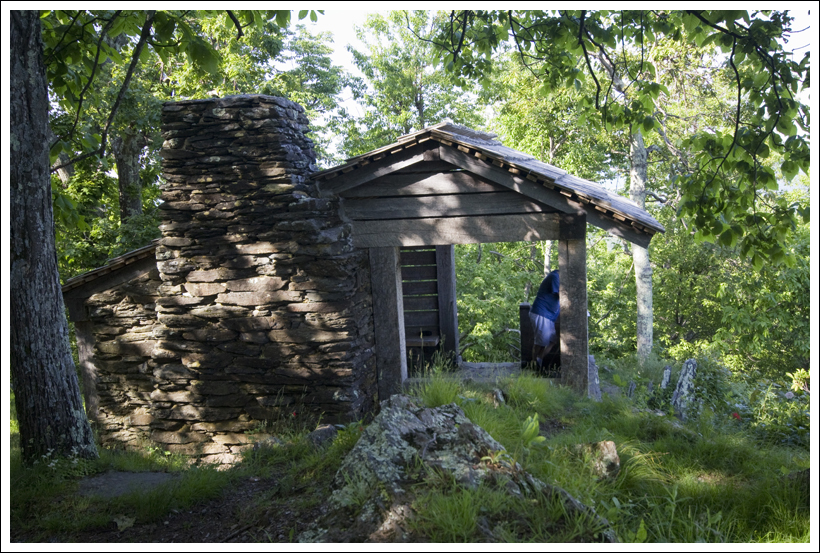
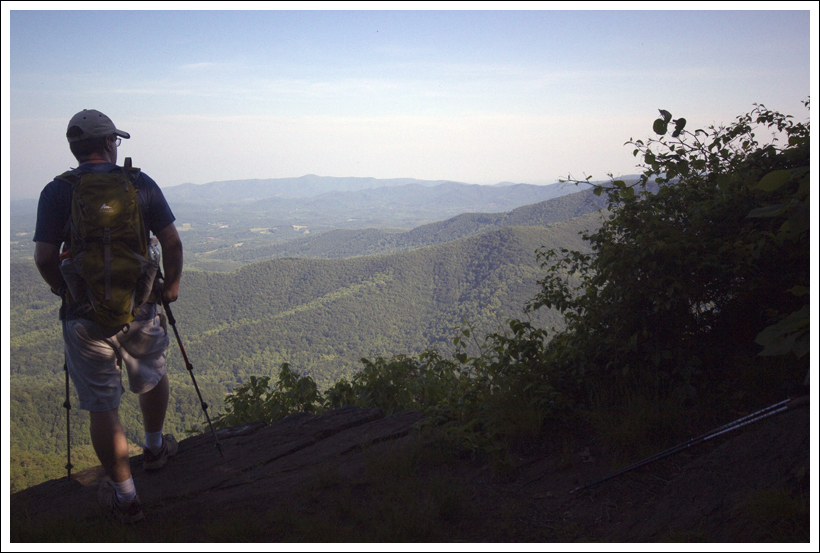
Taking in the view from the Glass Hollow Overlook.  It was really hazy and we were facing the sun, so the photos aren’t great.  But, it was still really colorful and pretty.  Below:  Adam takes the turn onto the Appalachian Trail; The Paul C. Wolfe Shelter; Adam walks along the Albright Trail.

Trail Junction Paul C. Wolfe Shelter Albright Trail

Adam Says…

Today was our 14th wedding anniversary, so we decided to take the day off of work and go for a nice hike together.   It is a good sign that it doesn’t seem like 14 years and that time has flown.  I’ve seen a card that said on the outside “Thank you for five wonderful years of marriage” and on the inside it said “Happy 25th Anniversary”.  We’ve had some great years together.  It was wonderful to pick a beautiful fall day to experience together.

While Humpback Rocks is the more popular hike that departs from this spot, we thought it would be a good idea to talk about this other hike that takes off from the Humpback Rock parking lot.  So, if you’re interested in hiking but not tons of people, this may be an option for you. The views are better from Humpback Rock, but you do get some benefits on this hike also.

After parking in the lot, you will see a picnic table adjacent to the first parking spot.  There are two trails that take off from this spot.  Take the blue-blazed trail to the right of the picnic table that descends into the woods (you’ll return from the loop by the Albright Loop Trail on the left).   The trail descends gradually and at .25 miles, you reach an intersection with the Appalachian Trail.  Take a left on the white-blazed AT heading north.  The trail at this point is relatively flat or downhill.  At mile 1.1, you reach an intersection with a small blue-blazed trail that veers off to the right pointing to the Glass Hollow Overlook.  The trail to the overlook is just about .2 mile and is worth the walk.  At the overlook, there is a backcountry campsite for those that would like to camp and take in the views of the sunrise from the overlook.  Go back on the spur trail the way you came and join the AT again, taking a right and continuing north on the trail taking your mileage to 1.3 miles.   At mile 1.6 and 1.7, you come across intersections with the Albright Loop trail.  Just continue on the Appalachian Trail.

Inside the Shelter
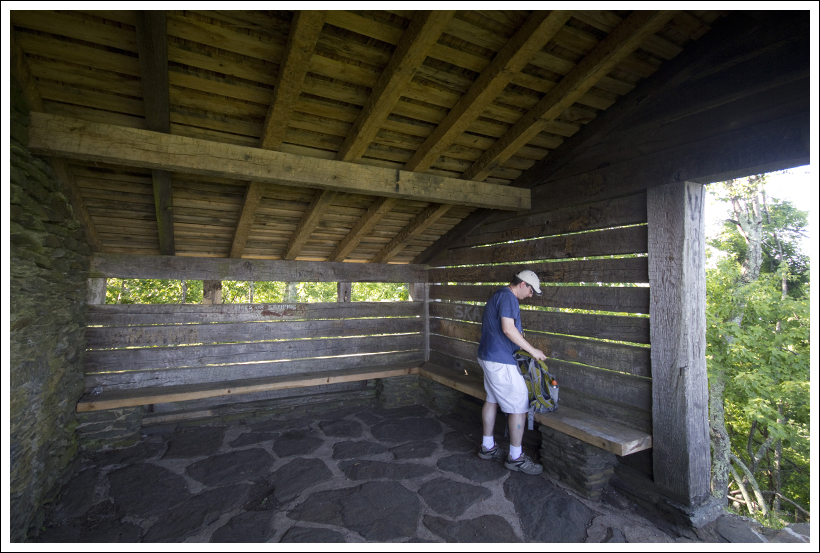
Adam checks out the shelter log in the Paul C. Wolfe shelter. Below: Past campers debate (in graffiti) the philosophy of Christopher McCandless from ‘Into the Wild’; We found a name we knew in the shelter log; On the hike back up from the shelter, we got an open view of Bears Den Mountain in Shenandoah National Park.  You can’t tell in this photo, but there are radio towers atop the mountain in the distance.

Quote - Into the Wild  Log Book Looking Toward Shenandoah

The trail begins to descend for the next 1.3 miles through a long series of switchbacks.  At mile 3.0, we rock-hopped across Mill Creek and reached the Paul C. Wolfe Shelter.  We took some time to rest here before we returned the way we came on the Appalachian Trail.  We climbed back up the Appalachian Trail from the shelter heading south this time and back up the switchbacks we had just experienced.  We were both glad that these took off some of the difficulty of the elevation climb.  At mile 4.2, we reached the first junction with the blue-blazed Albright Loop Trail.  Take a right here and you will follow this trail 2 miles back to the parking lot.  The hike on the Albright Loop trail starts off very manageable, but ends up being the most difficult part of the hike since there is quite an ascent up through some switchbacks.

On the return on the Albright Loop Trail, immediately after the second switchback, look up the hillside to see the wreckage of a Beechcraft Bonanza plane.  On the trail it was marked with a cairn to show where you can leave the trail.  The plane crashed back in 1963.  Please respect the wreckage and leave it as it is.

Plane Wreckage
Plane Wreckage along the Albright Trail. Below: Adam checks out another section of the plane.

Plane Wreckage

The Paul C. Wolfe Memorial shelter was built by the Old Dominion Appalachian Trail Club in 1991.  According to their website, “it took approximately 30 people every weekend for two months to complete the shelter.  Materials were hauled two miles by hand and tractor.”  This is one of the nicest huts on the AT, according to a lot of the thru-hikers.  It really has nice construction and a beautiful location.

After our hike, we made a quick trip down to Sonic for a snack (tots and creamslushes!).  We didn’t want to spoil our anniversary dinner though, since we had reservations at The Local Chop & Grill House in Harrisonburg, VA.   It always feels good to have a guilt-free dinner when you have burned off a lot of calories on a hike.

Christine says…

What a great anniversary hike!  I love being out on the trail during the peak of fall foliage season.  All during the hike, the sun was filtering through the trees above – making a gorgeous canopy of gold.  There were also plenty of brilliant red maples tucked into the understory.  What was even better — no crowds!  Hiking on a weekday on a less well-known trail made this hike especially enjoyable.

I had new boots to try out on this hike. Right out of the box, my Oboz Sawtooth boots were perfectly comfortable.  They’re the first taller pair of boots I’ve ever worn.  I was skeptical about that, but they felt great the whole six+ miles.
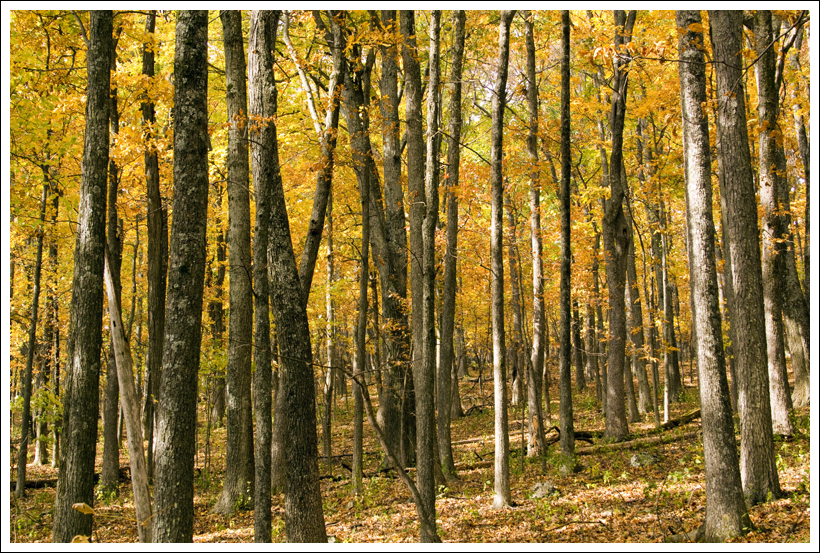
Golden Forest
A golden canopy of forest.  Below: New boots on the Glass Hollow Overlook; Adam crosses Mill Creek; A small cascade on the stream.

New Boots Crossing Mill Creek Mill Creek

Since Adam has already talked about the trail specifics, I’ll just share a few of my highlights. One of my favorite stops was at the Paul C. Wolfe shelter.  It really is one of the nicest backpacking shelters I’ve ever seen – two levels, plexiglass windows, hooks to hang backpacks and a deep, well-sheltered porch, so you always stay dry when you’re sleeping.  The structure is set uphill, overlooking a wonderful, babbling stream.  Even the privy is unique at this shelter.  With it’s half-door, I can’t say you’ll ever get true privacy, but at least you know when it’s occupied and the ventilation couldn’t be better!

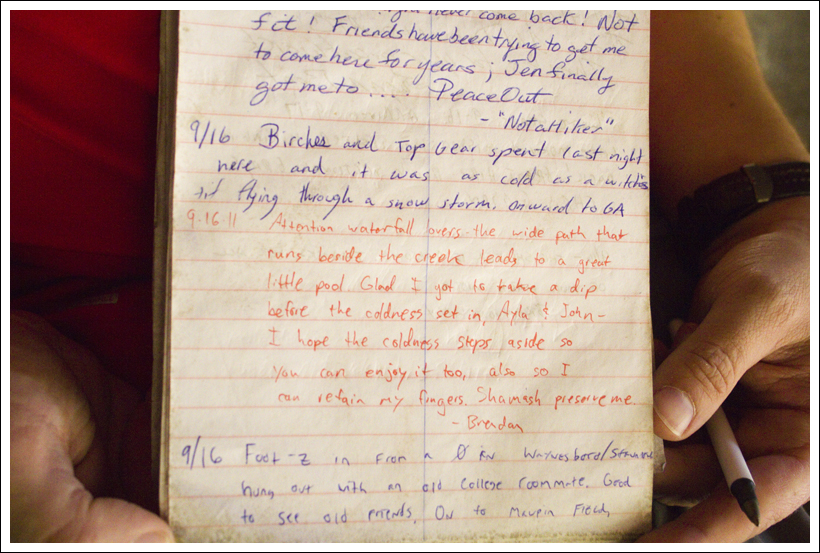
While we were taking our break at the shelter, we took a few minutes to flip through the log book.  We noticed the entry from one of the backpackers we met in September at the Pinefield Hut.  It was kind of neat to see a name we knew.

I also took some time to explore and photograph the stream.  Along the bank of the stream, there is a marble bench placed in memory of John Donovan.  He was an experienced hiker and a member of the Old Dominion Appalachian Trail Club. He died on his attempt to thru-hike the Pacific Crest Trail in 2005.  The bench gave me enough information to Google his name so I could learn more about what happened.  As it turns out, Backpacker Magazine published a long feature story about John Donovan’s disappearance and death in a 2006 issue.  It was a fascinating read!  The tragedy that befell Donovan turned into a miracle that saved two other lives.

John Donovan Bench
A bench is placed in memory of John Donovan. Below: The privy has a half door!

Half Door Privy

The plane crash was an interesting stop, too.  I expected the plane wreckage to be a lot rustier after close to fifty years in the woods, but it was still completely recognizable as an aircraft.  I couldn’t find anything more about the crash other than the year it happened and the type of plane.

After leaving the plane site, we finished out stint on the Albright Trail and made our way back to the car.  The parking lot was really full, but pretty much everyone else was on the Humpback Rocks trail.  I’m really glad we took the time to explore this trail – it turned out to be a perfect way to celebrate our anniversary.

Trail Notes

  • Distance 6.2 miles
  • Elevation Change – 1500 feet.
  • Difficulty – 3.  There is a good amount of uphill climbing.  The steepest section is along the Albright Loop Trail.
  • Trail Conditions – 4.  The trail is nicely maintained.  During the fall season, be sure to watch your footing if the trail is covered with leaves.  There are loose rocks underneath a good portion of the trail.
  • Views –3.  The best unobstructed views are from the Glass Hollow Overlook.
  • Streams/Waterfalls – 3.  Mill Creek was moving nicely near the shelter.  According to a journal entry from an AT hiker, there is a small waterfall and pool shortly downstream.
  • Wildlife – 1.  We didn’t see anything beyond birds, chipmunks and squirrels.
  • Ease to Navigate – 3.5.  There are a few intersections, but there are also signs at each of the intersections.
  • Solitude – 3.  You will likely run into a few others on the trail, due to the proximity of Humpback Rocks.

Directions to trailhead: The trail is located on the Blue Ridge Parkway at Mile Marker 8. The hike begins on the blue-blazed trail to the right of the picnic table.
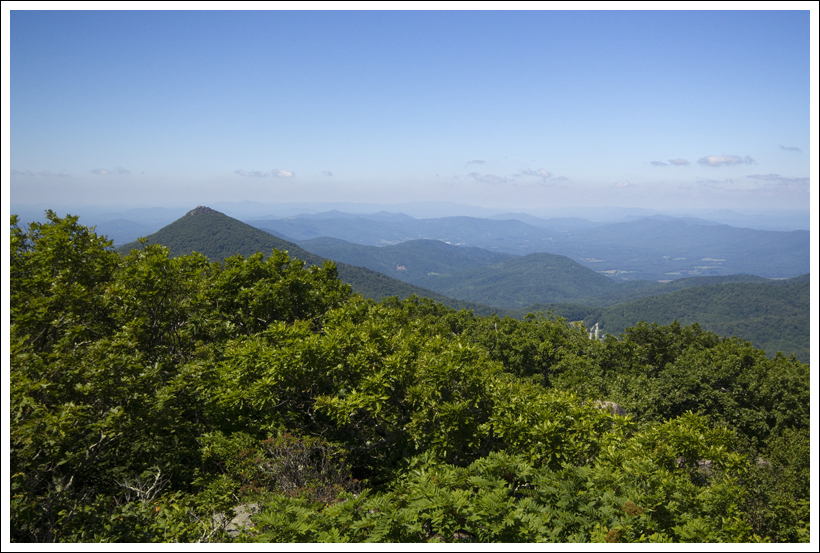
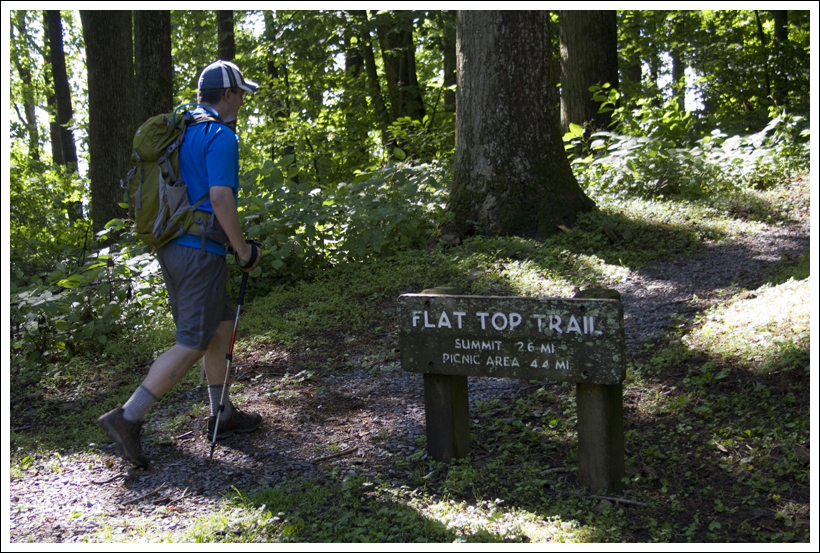
Flat Top

Flat Top is one of the two ‘Peaks of Otter’.  While not as popular as the other peak (Sharp Top), this 5.4 mile hike to Flat Top’s summit offers some nice views of the area.

A View of Sharp Top from Flat Top
A view of Sharp Top from just below the Flat Top summit. Below: Starting out on the Flat Top trail; The trailhead was decorated with lilies; The junction of the trail down to Cross Rock is right at the Pinnacle.

Flat Top Trail  Day Lily Cross Rock Junction

Christine Says…

Last week, we were home on a week long ‘staycation’.  Most of the week, we relaxed at home, sleeping in and watching movies.  When Wednesday turned out to be cool and breezy with low humidity, we decided to get up early and go for a day hike in the Peaks of Otter area of the Blue Ridge Parkway.  We’ve hiked Sharp Top many times, but I had never really considered hiking the companion peak.  Adam had always described the hike up Flat Top as steep and lacking any spectacular views.  But, we’d read a few more positive descriptions of the views, so we decided to give the trail a shot.

When we got to the trailhead, it was almost chilly.  Personally, I think chilly weather is always welcome in the middle of summer!  The hike was all uphill, passing hillsides of ferns, giant boulders and patches of red columbine.  The first point of interest we came to was the Pinnacle.  It offered panoramic views of the valley.  We could even see the Blue Ridge Parkway snaking through the mountains across the valley.

View from the Pinnacle
A view from the Pinnacle. Below: The trail was often lined with ferns; There were many giant boulders along the trail; Cross Rock was underwhelming.

Ferns Along the Trail Giant Boulders Along the Trail Cross Rock

At the Pinnacle, there is sign marking a side trail down to Cross Rock.  We assumed Cross Rock would be another outcropping with nice views.  We were quite wrong. Instead, it was a brutally steep descent to a rock formation in the shape of a cross.  Others might find Cross Rock to be fascinating, but I think I would have passed on the side trail if I had known I was just going to look at some rocks.

From the Cross Rock junction, the trail became steeper and rockier.  We continued climbing for the last half mile to the summit of Flat Top.  At first, we were a little confused because the summit marker was buried in the trees.  Our hiking book had described the views from the top as panoramic and majestic.  We eventually found a little path through the brush leading to a rocky outcropping with views.  It was a little below the actual summit.  The views from that point were nice, but I wouldn’t describe them as generously as our hiking guide did.  If you climbed out to the edge, stood and peered beyond the trees, you could see Sharp Top.  Overall, I think the view from the Pinnacle was much nicer than the view from the summit.

We relaxed on the rocks for a while, then made our way down the trail.  The trail going down was really slick from the thunderstorms the night before.  On one steep section, I slipped and fell hard on my left knee.  At first, I was really worried I may have banged it up badly enough to jeopardize our planned backpacking trip.  Fortunately, I was able to walk it off and only suffered a bruise.

The downhill hike seemed endless at times after I hurt my knee, but we got back to the car in less than an hour. Afterwards, we enjoyed a delicious lunch at the Peakview Dining Room in the Peaks of Otter lodge.

Adam Says…

The Peaks of Otter place has a special place in my heart, since this was where my family would often visit for a picnic.  I have hiked up the sister peak, Sharp Top, countless times, but I have only been up Flat Top a few times.  The times that I had approached the peak of Flat Top, we had started out from the trailhead from the Peaks of Otter picnic area.  I remember that path being very steep and forested, with views that were mostly through the trees.  After consulting our Falcon Guide of Hiking the Blue Ridge Parkway, it mentioned great views and starting from the actual Blue Ridge Parkway to shave off some of the elevation gain.  We decided to check out this path instead of the way I had experienced.

View Just Below the Flat Top Summit
View just below the Flat Top summit. Below: The actual summit of Flat Top is in the trees; Adam took a photo of Christine with the camera’s manual settings customized for a sunny landscape shot – oops!; Inside the Peaks of Otter lodge.

The actual summit of Flat Top Christine in Motion Peak View Dining Room

The start of this trail begins around mile marker 83.5 on the Blue Ridge Parkway, north of the Peaks of Otter Lodge.   There is a parking lot on the eastern side and you will see a brown sign denoting the beginning of the Flat Top trail. The trail starts off by slowly elevating through the forest in more of a gradual ascent.  Around .6 miles, the trail turns sharply to the left and you begin a series of switchbacks that last until you reach the junction with the Cross Rock trail at 2.1 miles.  At this junction you reach what is termed the pinnacle.  If you crawl out on the outcropping of rocks near you, you are at the Pinnacle, which provides the best views on this hike.  You have the option of climbing down to Cross Rock, but this is not a great viewpoint, just an interesting rock formation.  Follow the signs up the last .5 miles to reach the Flat Top summit at 4,001 feet.  You will see the summit marker in the middle of the woods.  Continue past the summit marker slightly for a short sidepath onto a rock outcropping that will give you some nice views.  Continue back the way you came.

This path up Flat Top was better than my memories of hiking up from the picnic area.  The views from the Pinnacle are gorgeous and you would miss out on this if you did the hike from the picnic area.  The hike back down from the summit felt steeper than going up and there were loose rocks that required you to keep an eye on your footing.  Take trekking poles to help secure your footing.  There is one geocache on the hike, but I forgot to plug in the coordinates before we left:

The one thing that Flat Top has over the Sharp Top hike is more solitude. Sometimes it seems that Sharp Top is crawling with large groups of hikers, but you will likely only see a few people on the Flat Top hike.  Sharp Top does have better viewpoints, but this is a nice hike to do if you have more time to spend in the area.  If you are interested and not too exhausted, you can also cross the road from the parking lot for a short 1.6 mile hike to Fallingwater Cascades.

Trail Notes

  • Distance 5.4 miles (including the optional .2 mile side trail to Cross Rock)
  • Elevation Change – 1391 feet
  • Difficulty – 3.  The hike is steady uphill climbing and get rockier the higher you climb.
  • Trail Conditions – 2.  The trail is very rocky and is rather overgrown in places.
  • Views –3.5  The view from the Pinnacle is beautiful, but views from the summit are somewhat obstructed.
  • Wildlife – 0.  We didn’t see anything.
  • Ease to Navigate – 3.5.  The trail itself is easy to follow, but at the summit there is no clear pointer to the best overlook.  The technical summit is buried in the woods, but by following community trails you can climb onto rocky outcroppings to gain a view.
  • Solitude – 2.5.  Compared to Sharp Top, this trail is lightly traveled.  But due to the popularity of the Peaks of Otter area, you will likely see other hikers.

Directions to trailhead: At mile marker 83.5 on the Blue Ridge Parkway, north of the Peaks of Otter Lodge.   Park in the lot on the eastern side and a brown sign denotes the beginning of the Flat Top trail.

Rocky Knob

This short ‘lollipop loop’ hike takes you across high cow pastures offering great views of the valley below.  Eventually you climb to the summit of Rocky Knob and enjoy visiting a former Appalachian Trail hut.  The views from the hut and the rocky outcropping on the summit are excellent!

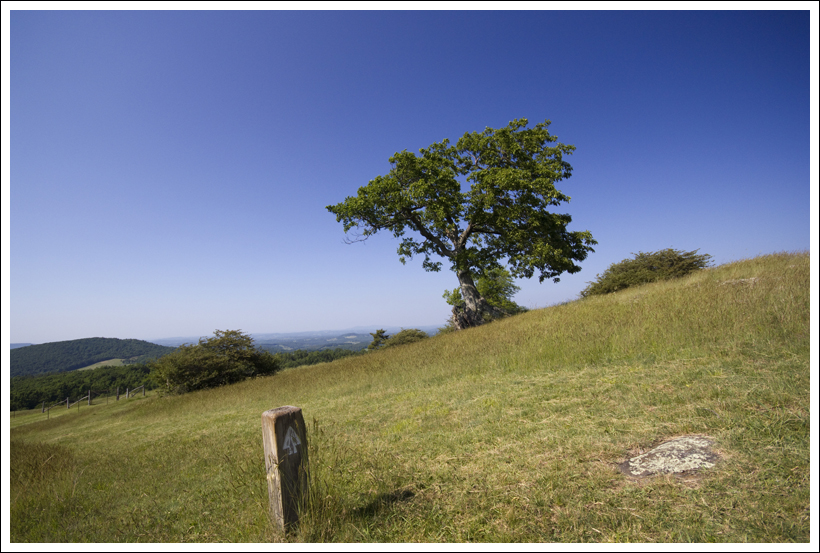
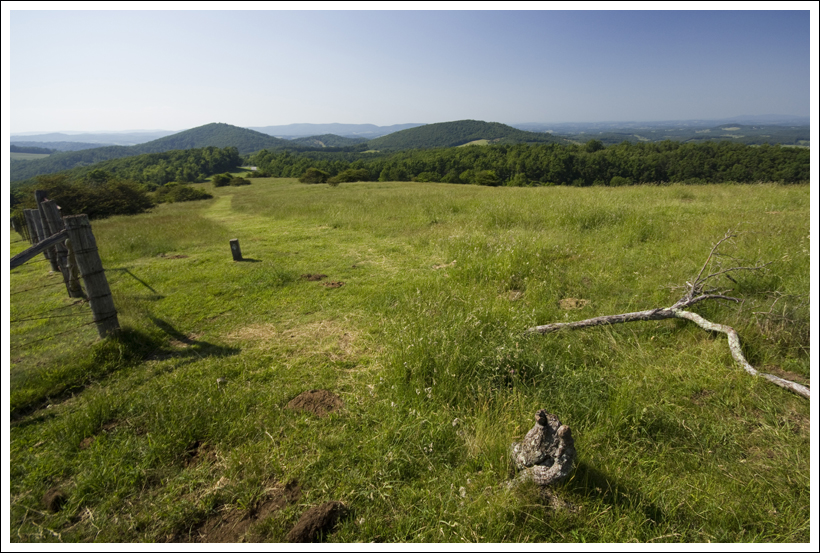
Open Meadow and Trail Marker
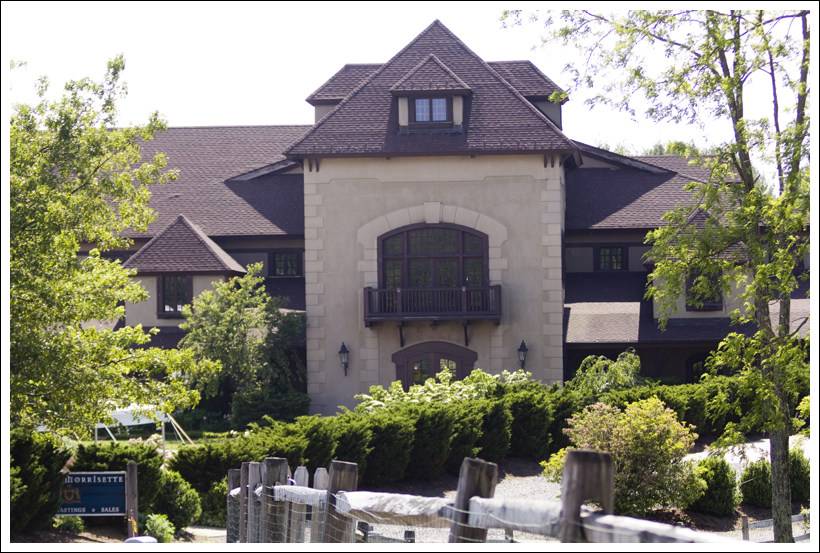
The trail climbs up across open meadow. Below:  We sampled fourteen different wines at Chateau Morrisette; Hiking in open pasture;  The hike takes you across the Saddle Overlook.

Chateau Morrisette  Hiking in Open Pasture  Saddle Overlook

Christine Says…

A couple years ago we visited the Virginia Highlands area and did some hiking at Hungry Mother, biked the Virginia Creeper and climbed Mount Rogers.  We had such a great time, that we decided a return trip was in order. We stayed in the small town of Hillsville – right off I-77.  It was the perfect spot to use as a base for a number of activities in the area.

The first thing we decided to do was head up to the Meadows of Dan to explore that area of the Blue Ridge Parkway.  We settled on a visit to Chateau Morrisette to sample wine, a short hike in the Rocky Knob area and a photo shoot at Mabry Mill.

Normally, I wouldn’t drink a bunch of wine before hiking in 95 degree weather, but it was the only way the schedule would allow us to fit everything into one evening.  So… off I went to drink fourteen different kinds of vino!  Chateau Morisette was such a great place!  Their winery is right off the Blue Ridge Parkway, nestled into the rolling Virginia countryside.  They have a large tasting room with a friendly staff.  A variety of adorable and friendly dogs hang out and roam freely around the winery.  Outside, there are pavilions and gazebos where people can lounge and enjoy their wine. I enjoyed every single wine I tasted – especially their Chambourcin.  I also like that they donate part of the profit from their Liberty wine to support the training and placement of service dogs.  We spent about an hour at the winery, purchased some bottles of the wines I liked best and headed on our way to the Rocky Knob area – just a few miles north on the Parkway.

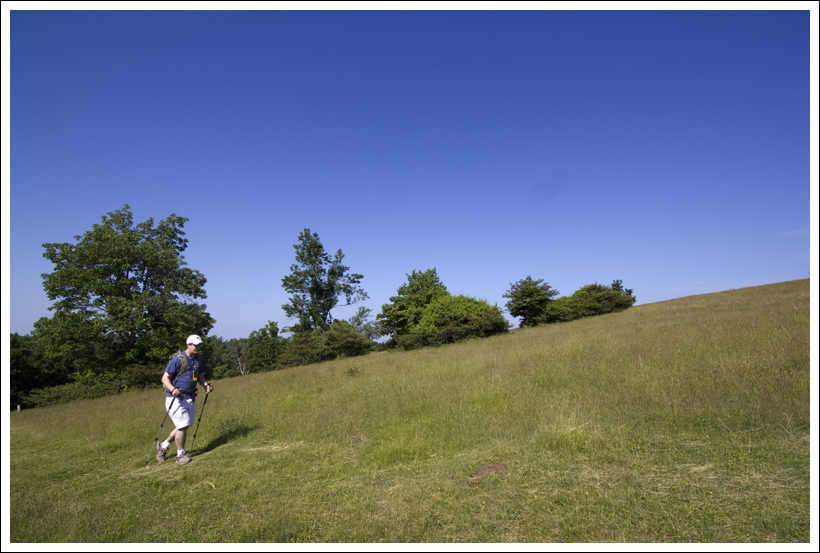
We parked at the Rocky Knob campground and crossed the road to find the trailhead.  To access the trail, you can either go through the gate or squeeze through the zig-zag.  The first part of the trail climbs across open meadow,  The views were amazing… rolling mountains in every direction.  The sun was really beating down on us.  I was so hot and thirsty (probably from the wine!) that I drank nearly two liters of water in the first half hour of hiking.

View from Rocky Knob
The view from Rocky Knob.  Below: The shelter sits on a hillside above a rocky outcropping; A better view of the shelter, outside and inside.

Rocky Knob Hut Rocky Knob Hut Sideview Inside the Hut

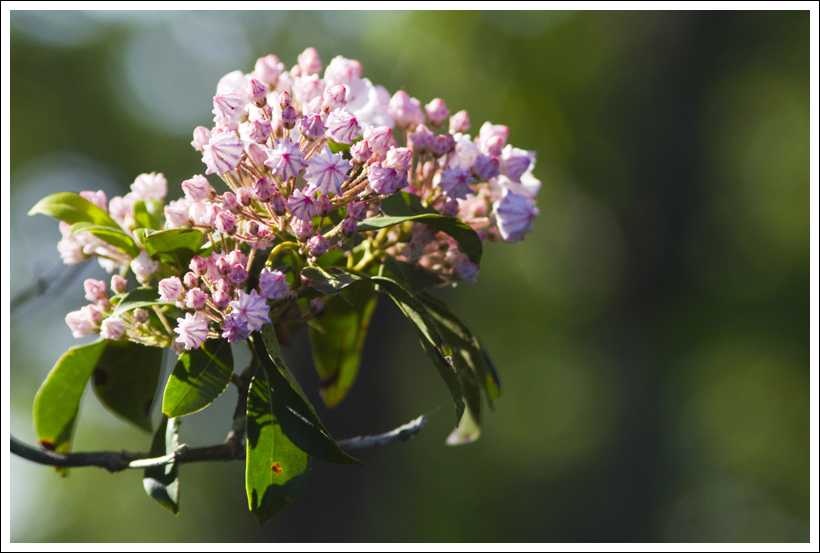
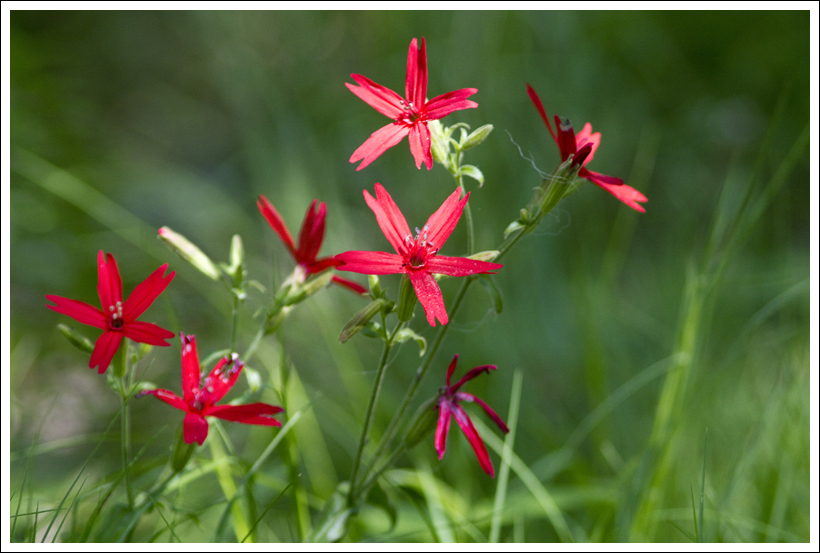
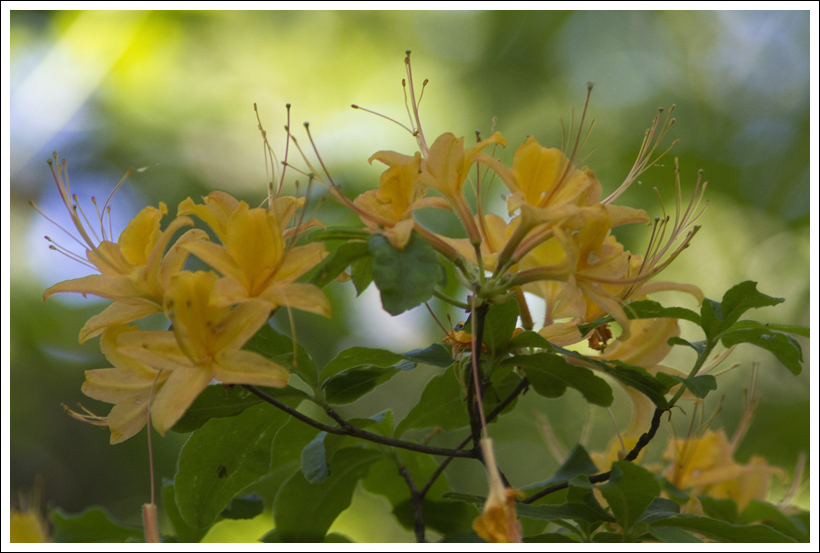
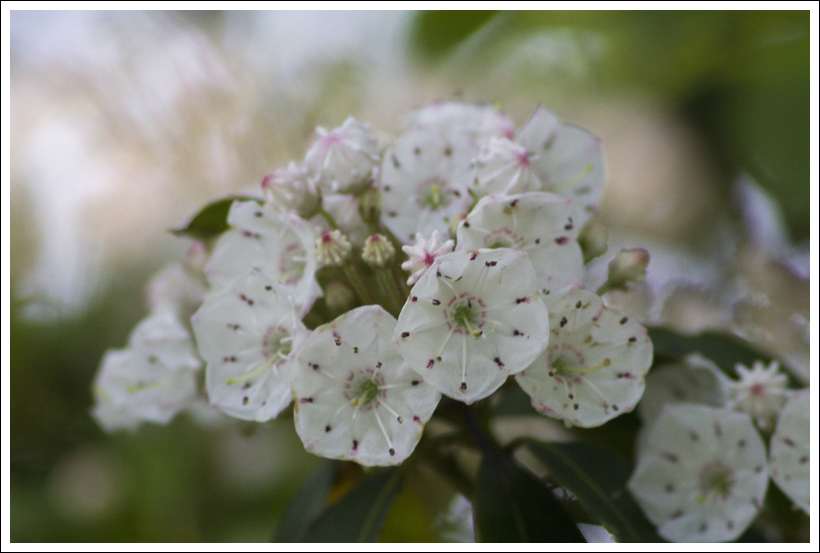
At the crest of the hill, we passed through another zig-zag fence opening and entered the woods.  The forest was full of wildflowers, azaleas and mountain laurel.  Some of the flowers were different than anything we have in the Shenandoah, and the azaleas were predominantly orange (instead of the pink ones we have near us).  In the shade, it was much cooler and more comfortable for hiking.

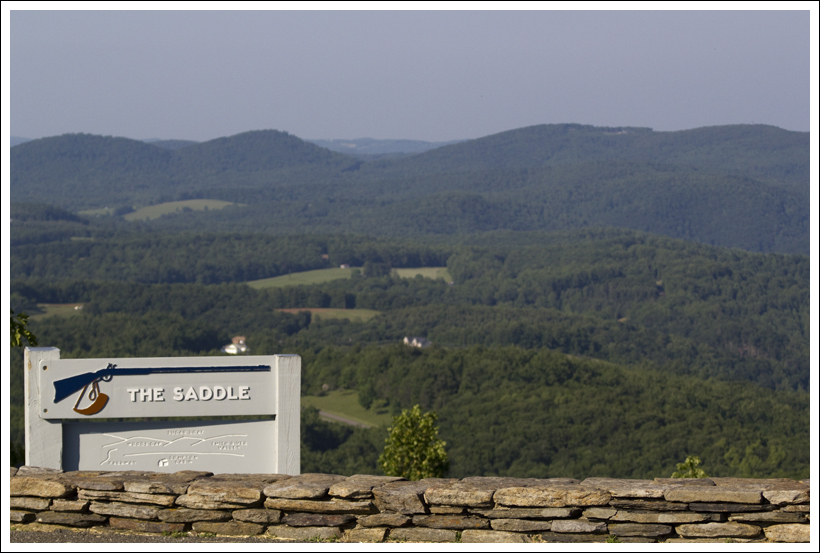
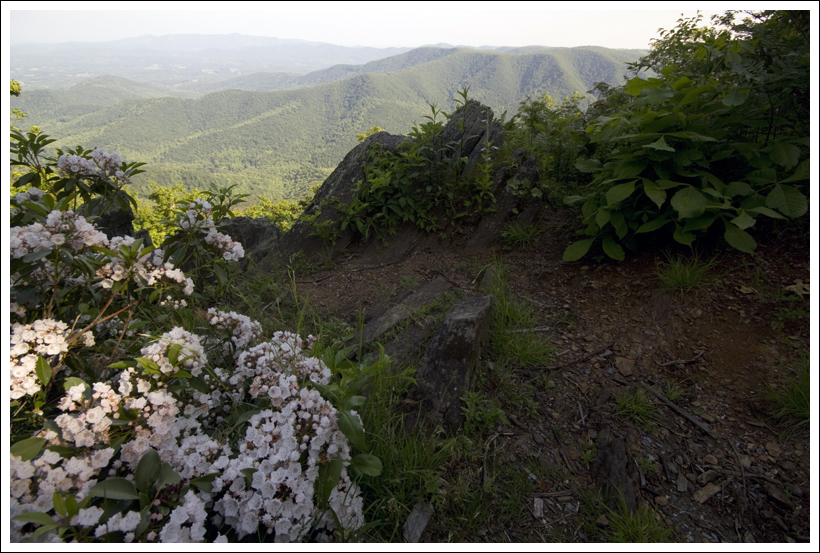
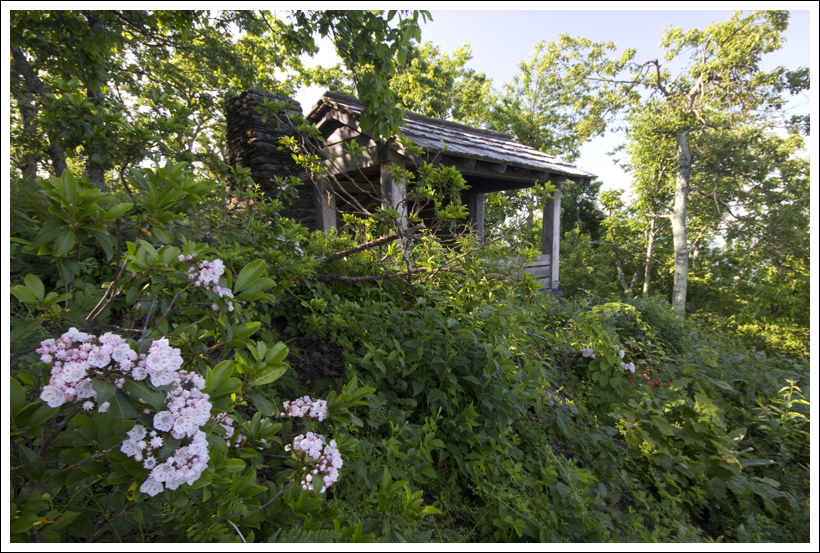
We passed out of the woods briefly to cross the parking lot at the Saddle Overlook.  At the south end of the overlook, we entered the woods again and began an uphill climb.  At the trail junction, we followed the right arm of the loop and ascended to the Rocky Knob Shelter.  The shelter used to sit along the Appalachian Trail and served as an overnight stop for thru-hikers.  The AT was re-routed much further west a long time ago, but the shelter was left intact.  In front of the building, a small descent takes you down to a rocky ledge with a spectacular view (the view is almost as good from the shelter itself.)  The hillside was covered with mountain laurel – so gorgeous.

We hiked a little bit past the shelter.  There was one more nice view, but after that the trail started to descend toward the picnic area, so we turned around.  The return trip follows the steeper arm of the loop downhill.  As we walked back, the views from the trail were even prettier.  The sun was dropping in the sky, making the light softer and warmer.

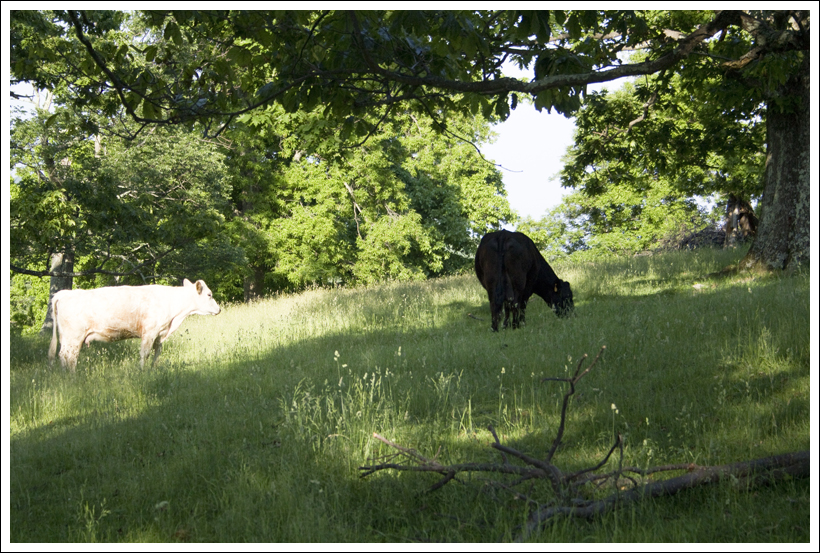
When we got back to the pasture area, the cattle had come out from the shady areas they had been hiding.  They looked at us curiously and trotted off when we got too close.  We made it back to the car a good while before sunset, but early enough that I had enough time to shoot Mabry Mill.

It was a great, short hike!  I wish it hadn’t been so hot, but it was otherwise a perfect evening.

Adam Says…

We got checked in around 2:00PM and decided that we should try and make the best of the afternoon.  Christine has been wanting to photograph Mabry Mill on the Blue Ridge Parkway for a while, so we thought it would be best to hit that closer to sunset.  We decided to try and squeeze in a hike beforehand.  We debated about going to Fairy Stone State Park, but opted for this short hike on the Blue Ridge Parkway, just north of Mabry Mill.  We drove past Mabry Mill and saw the signs for Chateau Morrisette winery.  After Christine went through a quick wine-tasting, we made our way up to the Rocky Knob trail.

Mountain Laurel
The mountain laurel was spectacular! Below: More wildflowers, azaleas and mountain laurel.

Wildflowers Azaleas More Mountain Laurel

There are many ways to approach this hike.  We consulted our Falcon Guide, which just got us confused on which was the best way to go.  They list about three different hikes for this one, but don’t really provide appropriate directions for all three.

We started the trail, by parking our vehicle right outside the Rocky Knob campground.  Directly across the parkway road from the campground entrance, there is a fat-man squeeze leading in to a field.  This is to keep the cows that occupy this field , so don’t try to open any gates.  After crossing through, head right following the blazed posts through the grassy fields.  You will slowly ascend this hillside.  At .6 miles, the trail leads to another fat-man squeeze that leads into the woods.  At .75 miles, you will come out of the woods and reach the Saddle Overlook area.  Keep going straight and go back into the woods.  At .83 miles, you will reach a junction.  This is the beginning of the lollipop loop section of the trail.  Take the right branch.  Just about another 150 feet, you will reach another junction.  Take the left to start the red-blazed trail.  This trail leads uphill fairly steeply with a switchback.  At 1.0 miles, you will reach the end of this trail, which leads to the Rocky Knob shelter and joins back with the blue-blazed Rock Castle Gorge Trail.  Head up the trail (north) just about 150 feet up the trail and you will come to the Rocky Knob overlook.  Backtrack and go back to the cabin to enjoy the views and explore the cabin.  Head down the Rock Castle Gorge Trail (south), passing by the Saddle Overlook and making your way back to your vehicle.

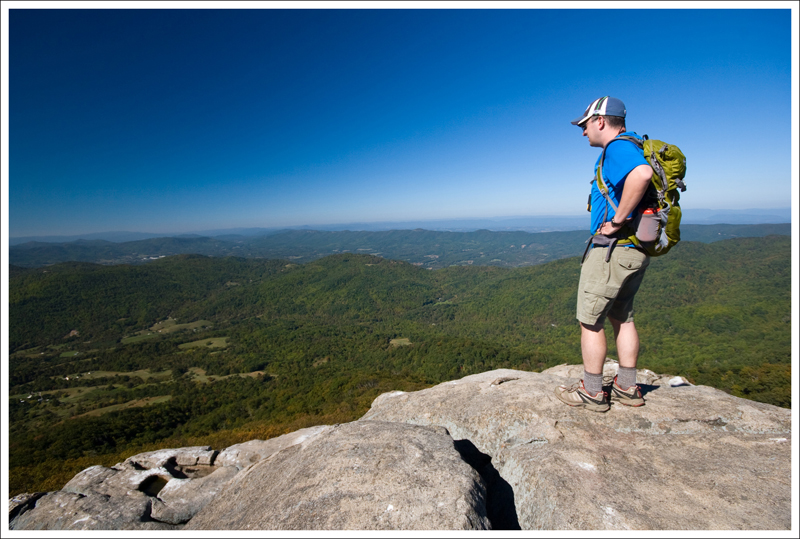
Adam takes in the view
Adam takes in the view from the second view, past the shelter. Below: Cows were grazing in the pasture on our return hike; A last view across the open meadows.

Cows Open Views

The temperature for the day was over 90 degrees and the sun was beating down on us relentlessly, but the views that you get from the field, the Saddle Overlook, and the shelter were truly breathtaking.  It was a clear day, with no threat of rain, and even in the haze we felt like we could see for fifty miles around us.  The shelter was impressive too.  The Appalachian Trail used to run through this area and this was once used by thru-hikers.  I can just imagine how wonderful of a shelter this would be – the sunrise from this spot must have been amazing.

Christine and I were both impressed with the landscape along the way.  There is a longer 10.6 mile hike through the Rock Castle Gorge that will be something to add to our “must hike” list on a day when we have more time.

Trail Notes

  • Distance 2.3 miles
  • Elevation Change – 480 feet
  • Difficulty – 2.  The uphill is nice and gradual.
  • Trail Conditions – 4.  The trail is nicely maintained with a few rocky spots.
  • Views – 4.5.  The views from the meadow and the Rocky Knob summit were beautiful!
  • Waterfalls/Streams – 0.  None
  • Wildlife – 1.  Maybe the cows count?
  • Ease to Navigate – 3.5.  Some of the maps and descriptions are a little confusing.
  • Solitude – 3.  It’s hard to judge this.  We visited on a weekday evening.  I assume this area is heavily trafficked on weekends.

Directions to trailhead: The Rocky Knob campground is located around mile 168 on the Blue Ridge Parkway.  Park your car just outside the campground, cross the parkway, and begin the hike by going through the fat-man squeeze and going right up the meadow.

Sharp Top

This 3.4-mile hike leads to gorgeous views from the summit of Sharp Top.  You will be treated with gorgeous views of the area around you.

View of Abbot Lake from Sharp Top Summit
The view from the Sharp Top Summit is gorgeous!  Below:  Adam walks by some of the huge boulders along the Sharp Top trail; The trail is very rocky; A set of stone steps leads you to the summit; Looking back on Sharp Top mountain from Buzzard’s Roost.

Adam Walking by Giant Boulders The trail is rocky Arriving at the summit Looking back on Sharp Top from Buzzards Roost

Adam Says…

Sharp Top has such a special place in my heart.  I grew up in nearby Lynchburg and I couldn’t even tell you the number of times I have hiked this trail.  I went with family, friends, church groups, and scouts.  My family used to regularly have picnic lunches at Peaks of Otter, so this is a place I’ve been visiting all of my life.  On one hike with a friend I had growing up, we spotted some trail runners.  Trail runners are common on Sharp Top most mornings.  My friend had said he wanted to try and be in that good of shape, so we took weekly hikes up during one summer.  We never made it up to the intensity of running the mountain, but it was some good exercise.  Lately, Christine and I have made this hike a nearly annual fall tradition.  I’ve brought my older brother a few times over the last few years.  Each year, he seems proud to know that he can still “climb up that hill.”  He was working the day we hiked it this year, so he didn’t get to make the trip.  I’ll try to get him to haul his cookies up the mountain again next year.

Peaks of Otter Nature Center
The Peaks of Otter Nature Center is the start point for this hike.  Below: The trailhead sign; The Sharp Top bus takes riders close to the summit and is a great option for those not physically able to do the full hike; The trail starts off smooth and gentle – things soon change!

Trailhead Sign The Sharp Top Bus Lower Trail

You start up the trail near the nature center.  There is a plaque there that mentions that Sharp Top was once believed to be the tallest mountain in Virginia and that a stone from this mountain was used to build the Washington Monument.  On the stone in the monument, it is inscribed “From Otter’s Summit, Virginia’s Loftiest Peak, To Crown a Monument to Virginia’s Noblest Son.”  It is hard to believe that this was thought to be the highest summit.  According to official elevations, this Sharp Top doesn’t even make the top 50 list. (another mountain, also named Sharp Top, is #42)

For those that don’t feel the need to hike all the way to the summit, you can take a bus ride that brings you closer to the summit.  More information is available on the Peaks website (http://www.peaksofotter.com/Sharp-Top-Shuttle.aspx)

This is an extremely popular hike for families and larger groups, but it definitely has some steep sections.  However, most people should be able to accomplish this hike since it is only a three-mile round trip (the side trip to Buzzards Roost adds .4 miles).  The trail starts off with a slow but steady climb and then crosses the bus summit road at .25 miles.  Continue to climb up the trail which includes some sections of stairs.  At 1.2 miles, you reach a junction.  Continue left on the trail to the summit.  The remaining .3 miles to the summit starts off relatively flat, but there are more sections of rock stairs along the way.  You will see a day-use only cabin at the summit and stairs to different platforms to soak in the views.  You will see the Peaks of Otter Lodge and Abbott Lake to the North.  To the South, you will see Turtle Rock (which some of the adventurous will find a way to climb up it) near the roof of the cabin.  Go back the way you came.  When you reach the junction .3 miles from the summit, I would highly recommend adding .2 miles (.4 miles round trip) to check out Buzzard’s Roost.  The trail is relatively flat with minimal elevation difference.  You will get more great views from here and can actually get some nice views of the summit of Sharp Top.  Buzzards Roost does require some rock scrambling and carefully navigating around large rocks, so it isn’t for the faint of heart.  Once you leave the Roost, go back to the junction and take a left down the trail to make your way back to the car.

There are lots of places to perch on Sharp Top
There are lots of places to perch on Sharp Top.  Below: Adam makes his way up the trail; The trail has many stairs built into the rock; Adam on Turtle Rock.

Adam making his way up the trail The trail has quite a few stairs Adam on Turtle Rock

As I mentioned above, there are a lot of great places nearby for a picnic or you can dine at the Peaks of Otter Lodge.  There is also a gift shop that sells sweatshirts inside that say “I Survived Sharp Top”.  While I personally don’t think it is that difficult, I can understand some people feeling that way.  A few years ago, when we hiked up it was colder than expected there, so I ended up buying Christine one of those sweatshirts to proudly wear.

Christine Says…

I’m so glad Adam introduced me to this hike.  It’s a tough little climb, but the summit is spectacular.  It’s covered with boulders the size of houses and has a view that rivals any Virginia hike.  The one downside to Sharp Top is the crowd of people you’ll be almost guaranteed to see.  It is indeed a popular place!

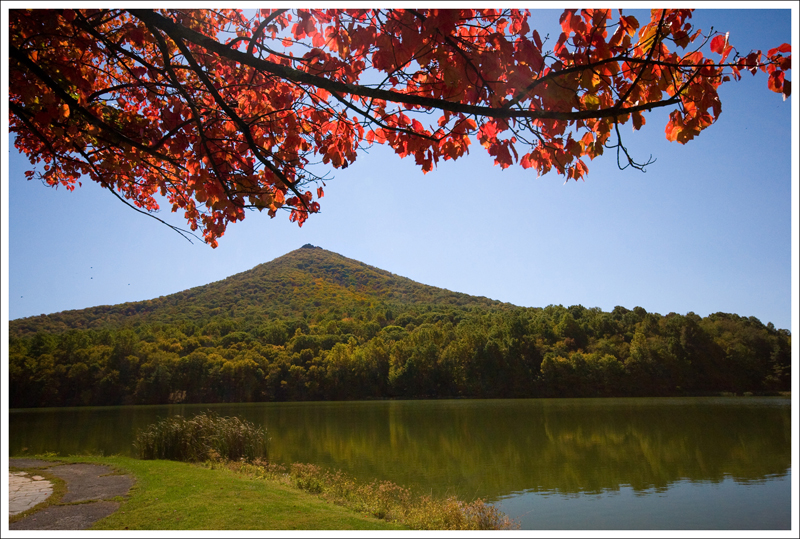
View of Sharp Top from Abbot Lake
A view of the mountain from the lodge at the bottom. Below: A sign lets you know you’ve arrived at the summit; At this point you can turn and go to Buzzard’s Roost or continue to the Sharp Top Summit; Another beautiful summit view.

Arriving at the Summit Trail Junction Another Summit View

I always thought Peaks of Otter was an odd name for a place, so I did a little research and found some information about the origin of the name on the nearby lodge’s website:

There are three opinions on how the Peaks of Otter got their name. The name may come from the Cherokee Indian word, “ottari,” which means “high places.” The Peaks may have been named after the Otter River, which has its headwaters in the area. Finally, Scottish settlers may have named the Peaks after Ben Otter, a mountain in their homeland that resembles Sharp Top.

We got a really early start on our morning, and were headed up the trail by 9:30 or so.  It was cool and brilliantly sunny.  Even though it was the second weekend of October, the leaves were still mostly green.  That was a little disappointing – I had hoped to hike Sharp Top at the peak of fall color.  We’ve done that in past years, and the foliage makes the view even nicer!  As we hiked up the trail, we passed several downhill hikers on their way back from watching sunrise atop the summit.  Other than that, we had the trail mostly to ourselves.

The uphill grade starts of gently, on a mostly smooth and wide trail.  For some reason, this is always the only part of the Sharp Top trail I remember.  I don’t know why, but I always seem to block the steep and rocky parts out of my mind.  After you cross the bus road, the path gets a lot tougher.  It’s fairly relentless uphill for a while.  Periodically, there are reprieves where the grade moderates and you get a chance to catch your breath.  But after each little flat spot, you’re guaranteed to have more climbing.  As the summit draws near, you’ll find yourself hiking between and around gigantic boulders.  The rock formations on this mountain are impressive!  Near the end of the trail, there are quite a few stone stairs to climb.  Almost immediately upon reaching the summit, you’ll pass the cabin.  The inside is an empty room – concrete floor, fireplace and small windows that look out to the view beyond.  It apparently used to be a concession stand.  I’m glad someone thought better of the idea and closed the place down – do we really need hot dogs and ice cream for sale on mountain summits?

Adam looking out the building window
The empty building on the Sharp Top summit. Below: Inside the summit house; A boulder jumble at the summit; View of mountains in the distance.

Inside the Building Boulder jumble Another Summit View

After passing the building, the path winds between the stones up to the highest spot.  All over the summit, there are small alcoves and large rocks to perch upon to take in the view.  Unless you started very early, the mountain will be crawling with people who took the bus ride to the top.  You can usually spot the bus crowd easily – they’re never sweaty and are often wearing dressier clothing and insensible shoes.  🙂 Hikers seem to enjoy quietly referring to the bus riders as “cheaters”.  I think it’s great that a bus ride is available for people who aren’t physically able to hike up, but I see lots of young families that I wish would give hiking a chance.

On the way down, Adam and I took the side trail to visit the Buzzard’s Roost.  For some reason, this was the first time I’ve taken the option.  The roost had amazing views, but I did not enjoy climbing up the rock.  I had an inner ear virus a few years ago, and have suffered serious bouts of vertigo ever since.  Anytime I climb places with uneven footing and precipitous, open drops I get an awful spinning sensation. It’s like the feel of my feet doesn’t match what my eyes are seeing.  It’s a very strange sensation.  Sometimes I start to panic, but I’ve found that if I stay low to the ground and go very slow, I can always manage to get where I want to go.  But needless to say… you’ll never find me doing any serious rock climbing!

Adam on Buzzard's Roost
Adam takes in the view from Buzzard’s Roost. Below: Another view from Buzzard’s Roost.

Another view from Buzzard's Roost

After the stop at Buzzard’s Roost, we started our final climb down.  I was so glad to have my trekking poles on the steep, uneven ground.  So many upwards hikers commented on them!  Everything from “We thought you were skiing down!” to “Why do you have two hiking sticks?” to “Darn… I wish I remembered to bring my trekking poles!”.  I was surprised so many people had never seen trekking poles before, but I suppose Sharp Top has a very high percentage of people who aren’t regular hikers.  Personally, after using trekking poles for a while now, I don’t know how I ever hiked without them!

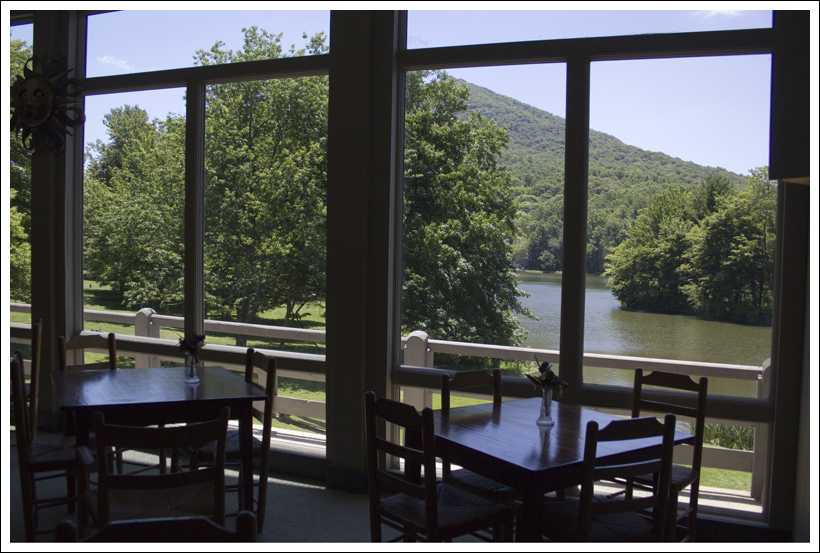
The hike down was over pretty quickly and we were off to lunch!  Typically, we pack a picnic – but this time we decided to try the restaurant at the Peaks of Otter Lodge.  They had a buffet option, but it was really expensive and there was no way I could have eaten my money’s worth.  But I have to admit… that mountain of fried chicken on the buffet table looked very compelling! We settled for sandwiches instead.

After lunch, we walked along the water and did a bit of people watching.  I even saw (allegedly) an otter swimming across the lake.

Trail Notes

  • Distance – 3.4 miles.  You can make it just 3.0 miles if you don’t do the Buzzards Roost side hike.
  • Elevation Change –  1340 feet
  • Difficulty – 3. The hike is fairly steep most of the way, with a number of stairs to climb towards the middle and end of the trail.  The hike to Buzzards Roast does not have much elevation change.
  • Trail Conditions –3. The trail is well-maintained, but there are a number of sharp rocks that can make footing tricky.
  • Views5. Amazing 360 degree views from the summit give you some of the best views in Virginia.  Go up on a clear day and you will see for miles.
  • Waterfalls/streams – 0. Non-existent.
  • Wildlife –1.5. Due to the popularity, you will likely only see birds.  You may spot soaring hawks at the top.
  • Ease to Navigate – 5. Trails are well-labeled, so you shouldn’t have much difficulty navigating the area.
  • Solitude – 0. This is one of the most popular hikes in Virginia.  To escape the crowds, go up early in the morning.

Directions to trailhead: The trail begins near mile marker 86 on the Blue Ridge Parkway.  The trailhead is to the left of the nature center, which is directly across from the Peaks of Otter Visitor Center.

Humpback Rock

Humpback Rock is a steep, but popular trail in the northern section of the Blue Ridge Parkway with great views.

The summit of Humpback is always crowded.

Adam Says…

This was the third of our three hikes in one day, with Crabtree Falls and The Priest making up the earlier hikes.  We both were quite exhausted.  Christine definitely didn’t want to do this when we arrived.  She blamed me for tweeting about it earlier, since she felt the tweet had publicly committed us to finishing all three hikes.  So, I think I’ll not be allowed to tweet for a while.  We were both low on energy, but we relied on each other to get ourselves up to the top.

It is surprising to see all of the different people that hike this trail and what they choose to wear.  We saw people with serious hiking gear and trekking poles.  We saw elderly people with business shoes and teenage girls wearing party dresses.  This is a steep trail through most of the hike, so be prepared and wear appropriate shoes/clothes or you may end up on a future blog.  As much as you will huff-and-puff on the way up, you will likely have a sadistic smile on the way down as you witness the effort on the faces of those ascending, knowing your work is behind you. We heard a lot of music when we were hiking up and couldn’t place it.  It turns out there was a bluegrass concert at the Humpback Rocks visitor center.

You can extend the hike an extra mile by taking off from the Humpback Rocks Visitor Center parking lot and taking the Mountain Farm Trail.  This takes you through a re-creation of an 1890s farm with lots of buildings you can inspect and think about a farming time long ago.  For us, we didn’t have any fuel left in our tanks to walk the extra mile and the concert was taking place at the farm.

You can see a little snip of the Blue Ridge Parkway from the summit.

The views from the top are quite remarkable and you will have some gorgeous views of the Parkway and the Blue Ridge Mountains.  Take some time to soak in the beauty of the area.

Christine Says…

Let’s see here – what do I remember more about Humpback Rock… the pain or the suffering? Really it’s so close; I’m going to have to call it a draw. All kidding aside, Humpback Rock is actually a fun and scenic hike. This isn’t the first time we’ve hiked it, and we normally enjoy the hike quite a bit. However, it was probably rather ill-advised for us to hike it as the final leg of our trifecta of hikes along the Blue Ridge Parkway. We hadn’t eaten anything in over eight hours (except for that half donut on the summit of The Priest). We were both really hungry and thirsty, but stupidly mused “How bad can one more mile of uphill really be?”

As we learned, it can be quite bad! Along the way, Adam and I moaned at every moment that someone else wasn’t in earshot. We took turns declaring that we should turn around, go back to the car and just get lunch at Sonic. At one point, I said to Adam “Here… take this blasted camera and go up to the top and take photos for me. I’ll wait here.” A few minutes later, I turned around and saw Adam sitting on a rock about thirty feet back. He told me that he didn’t think his feet would move – not even one more step. Basically, we were a big, stinking heap of melodrama.

Last time we hiked up to Humpback Rock was April of 2008. Sometime since then, the trail has been re-routed. The first half of the climb still follows a steep, but wide and smooth, pathway up the mountainside. In the past, the second half of the trail climbed up the backside of the rock. The terrain was more like a scramble than a trail, but it was fun. Now, in order to reach the top, hikers must climb around and under the rock and then follow a trail up the side to reach the summit.

By the time we got to the top, we were beat!

If you hit Humpback Rock on a nice, clear day – the views are beautiful and panoramic. The rock ledges at the top are fun to climb on and there are lots of places to sit and enjoy the view. The trail is exceedingly popular with central Virginians, so it’s not the kind of place you’ll find peace and solitude. On the beautiful Sunday afternoon we hiked the trail, we saw at least 50 other hikers.

Trail Notes

  • Distance – 2.0 miles out-and-back
  • Elevation Change – 800 feet
  • Difficulty – 3.5. This is short but fairly strenuous.
  • Trail Conditions – 3.5. There are some pointy rocks later on in the trail, but there is a lot of sections that are covered in gravel.
  • Views – 3.5. Nice views from the top.
  • Waterfalls/streams – 0. Non-existent
  • Wildlife – .5. I don’t think you’ll see much wildlife due to all the people.
  • Ease to Navigate – 3.5. The trail is not hard to follow.
  • Solitude – .5. If you do this during any normal day hours on a nice day, it will be tough to not have people in your view.

Directions to trailhead: The trail is located on the Blue Ridge Parkway between mile markers 5 & 6… although you can hike to the rocks via slightly longer routes from either the picnic grounds or visitors center.  For the route described above, there is a large parking lot with a information board near the trailhead.

Crabtree Falls

Crabtree Falls is probably Virginia’s best-known waterfall hike. The hike is located a short distance from the Blue Ridge Parkway. The trail climbs alongside the falls and ends at an overlook of the Tye River Valley.

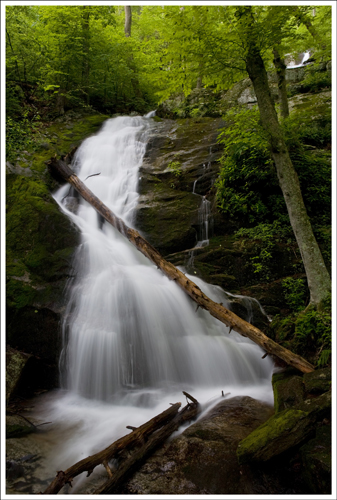
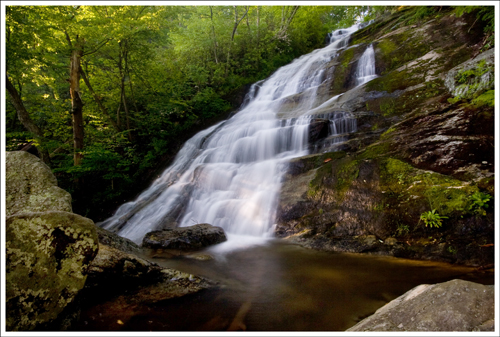
This is the first large cascade you'll encounter on the hike.
This is the first large cascade you’ll encounter on the hike.

Christine Says…

Crabtree Falls, located in George Washington National Forest’s Glenwood & Pedlar Ranger Districts, is one of the classic “must-hike” Virginia trails. When the area is experiencing good amount of rainfall, the 1,200 foot series of falls can be truly impressive.

Adam and I left our house at 5:45 a.m. on the morning of this hike. I wanted to get to the area before the sun started shining into the gorge. Sunny days usually mean crappy waterfall photos. On the morning of our hike, the area was forecast to have quite a bit of fog. I was really excited and had visions of the falls – cascading through the mist, lined with lush, blooming mountain laurel. Unfortunately, it was not to be. When we arrived, the fog was gone, the sun was already high in the sky and the laurel had mostly gone to seed. Nonetheless, I was still able to find a few shady spots along the way to take photographs.

The beautiful arched bridge over the Tye River.

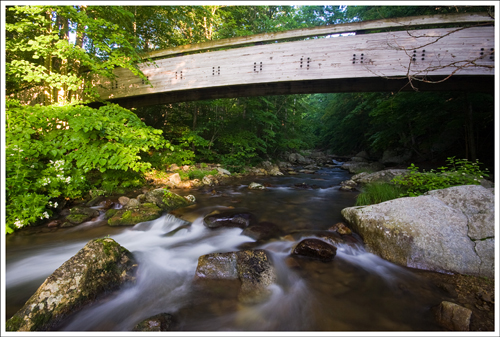
The trailhead is located at the upper parking lot of the Crabtree Falls area. There is a $3.00 fee to use this area. Even though the trail starts from the upper lot, don’t miss walking down to the lower lot to take a walk across the beautiful laminated wooden arch bridge that crosses the Tye River. It was delivered to the area in a single piece and has graced the spot since 1978. Crossing the bridge used to be part of the hike, but improvements to the area expanded parking, added restrooms and shortened the trail.

As you start the hike, don’t neglect reading the bulletin board at the trailhead. It provides many cautionary tales concerning the waterfall’s deadly terrain.  As of June 2015, 29 people have fallen to their deaths at Crabtree Falls – most of them teenagers and young adults. The rocks surrounding the stream are coated with transparent algae. It doesn’t look wet or slippery, but it’s honestly as slick as grease in some spots. The forest service is always warning hikers to stay off waterfalls – but they really mean it at Crabtree.

Adam climbs the steps along the Crabtree Trail.

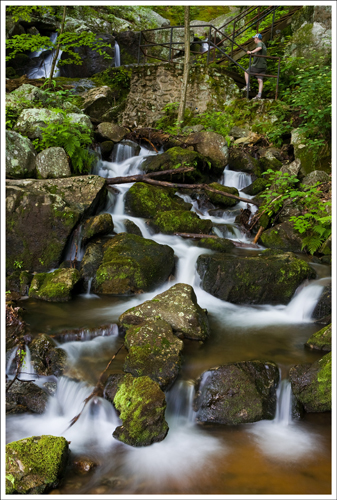
The first impressive cascade is at the very bottom of the trail and is accessible along a level, paved walkway. The trail to the summit starts on the right side of the paved path, and climbs quickly upward. The trail makes use of steps, railings, wooden walkways and switchbacks to traverse the steep terrain. Some of the switchbacks meander quite a distance from Crabtree Stream, but the sound of rushing water is ever present in the woods. You never move so far from the stream that you can not hear the sound of the waterfall. It’s such a soothing sound. There are five major cascades (and many smaller ones) that make up Crabtree Falls.

The trail is mostly well-graded and maintained. There are a few rocky sections, and some of the rocks may be loose or slippery. On the day we hiked, the trail was really muddy from all the recent rain, but it was still easily passable. I think most of the pretty sections of the falls are within the first three-quarters of the hike. The big, dome-shaped cascade at the top is impressive to see, but it just doesn’t photograph well. At the Tye Valley overlook at the top, you can’t see the falls below you at all. If you hadn’t just walked along the waterfall on your hike, you might not even believe it’s there. The view from the top is just so-so – mostly just tree-covered mountainsides. It pales in comparison to the waterfall views. Most hikers choose to turn around at this point, but you also have the option to continue the hike along the stream, ending up at Crabtree Meadows.

There are discrepancies about the length of this hike. On the internet, I’ve seen it listed everywhere from 2.2 to 4 miles. The on-site plaque at the base of the falls says the hike is two miles to the top, for a total 4 mile out-and-back. Our Blue Ridge Parkway hiking guide lists the hike at 3.4 miles, out-and-back. It seems like the happy medium distance, so we’ll go with that measure.

Adam Says…

The hike along Crabtree Falls is one of the best waterfall hikes, since you hike along the falls for most of the way.  I haven’t experienced any other hike in Virginia that allows you to walk along such an impressive series of falls.

Another beautiful section of falls along the trail.

This was our second trip to Crabtree Falls.  We were hoping to go in the late spring or early summer for views of mountain laurel along the stream.  It looks like in this area, we just missed the peak by about two weeks or the laurel didn’t bloom as well this year.  When you reach the top of the falls after a 1.7 mile hike, there is a stone platform at the top that provides you with nice views of the Blue Ridge Mountains.

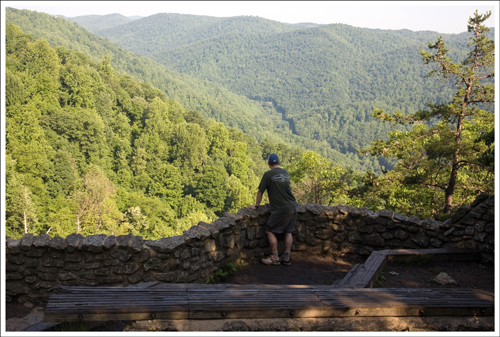
The view from the top.

Near the entrance to the paved trail you will see a small family cemetery.  These are actually distant relatives of mine.  My great grandmother was a Fitzgerald and owned the farm next to the McCormick Farm.  My mother used to visit that farm often when she was little.  If you are interested in history, the McCormick Farm is open to visitors and has lots of exhibits showing the early farming techniques.  Cyrus McCormick was the inventor of the mechanical reaper which revolutionized farming.

This is a great hike that a lot of families do before picnicking at one of the tables near the lot entrance.  I know we will visit this location time and again.

Trail Notes

  • Distance 3.4miles out-and-back.
  • Elevation Change – 1000 feet
  • Difficulty – 3. This is a fairly steep trail with plenty of switchbacks.  However, most people will stop along the way to enjoy the falls, so it breaks up the pace.
  • Trail Conditions – 3. There are lots of pointy rocks along part of the trail, but there are some sections that are very nice.  The view to the lower falls is even paved for wheelchair access.
  • Views – 2. At the top of the falls, you get a decent view of the Tye River Valley
  • Waterfalls/streams – 4.5. This is one of the best waterfalls in the Central Virginia area.
  • Wildlife – .5. You probably won’t see anything here other than people.
  • Ease to Navigate – 4.5. Just stay on the trail.
  • Solitude –1. This is an extremely popular hike, so you will surely see people along the way.

Directions to trailhead: If you are approaching from I-81, take exit 205 towards Steeles Tavern.  Take a left on to Rte. 11 and then a quick right on to VA-56 heading east.  Follow this past the Blue Ridge Parkway (near BRP Mile Marker 30).  After a few more miles, you will see the signs for the parking area of Crabtree Falls on your right.  The parking lot loops around and you will see the trailhead and map near the restroom facilities.