Gorham Mountain to The Bowl – Acadia National Park (ME)

Special: Acadia Edition

This route combines one of our favorite short Acadia hikes to the summit of Gorham Mountain followed by a visit to a beautiful glacial pond called The Bowl, and a return walk along the Ocean Path, passing famous landmarks – Sand Beach and Thunder Hole.
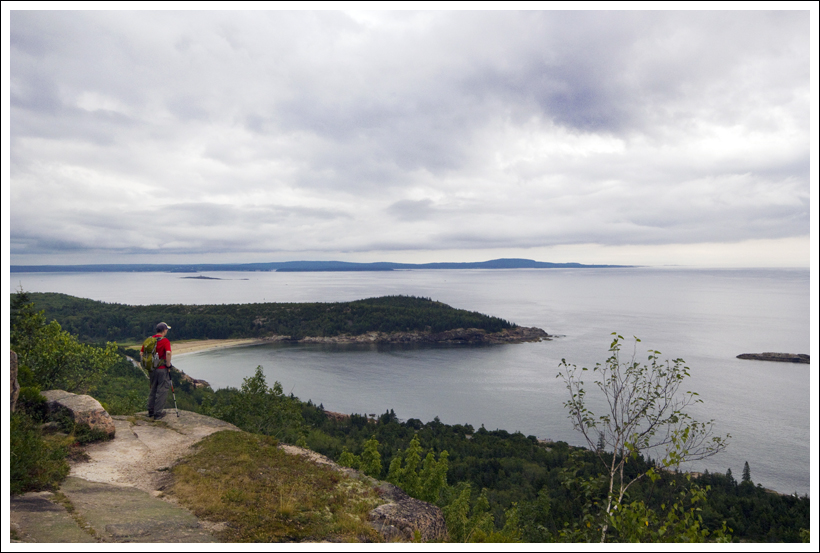
Overlooking Sand Beach
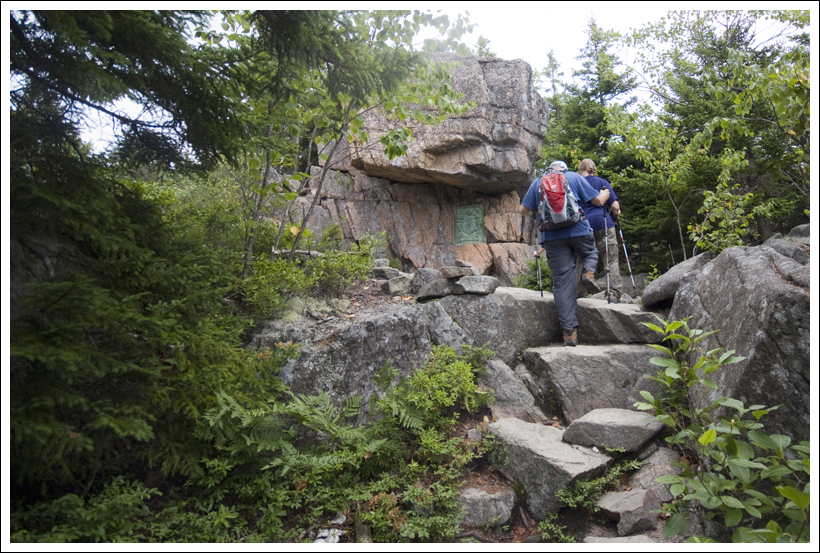
Overlooking Sand Beach from Gorham Mountain. Below: Christine’s parents climb the Gorham Mountain Trail; Adam enjoys clearing skies and a view of the Bowl; Ocean scenery is spectacular along the Ocean Path.

Christine's Parents Hiking Adam Checks out the Bowl Walking the Ocean Path

Christine Says…

Even before I was an avid hiker, Gorham Mountain was always a hike I enjoyed.  By itself, the hike to the summit and back is less than two miles, requires very little climbing and offers magnificent views of the ocean, the rocky Maine coast and Sand Beach below.  If you walk the trail in late July or August, wild blueberries are abundant!

We decided to hike Gorham Mountain with my parents one morning during vacation.  We ate breakfast early and got to the trailhead before the crowds.  I really can’t stress enough how crowded Acadia trails get during the peak hours of 10:00 a.m. until 2:00 p.m.  I always suggest that people hike early or late, or rely on the Island Explorer bus (it’s FREE!) for transportation around the island.

On this particular trip, we actually drove separately from my parents because we wanted to extend our hike beyond the Gorham summit, and they did not.  The day before this hike had been overcast and a little drizzly and unfortunately, some of the gloomy weather was still lingering for our hike.  I was a little disappointed, because the lack of sunshine and blue skies always makes the ocean vista a little less colorful and sparkly.  I always prefer to hike Gorham on a ‘perfect Maine day’.   I would define ‘perfect’ as a sunny, 75 degree day with wispy or puffy clouds sitting in a deep blue sky.  There would be a light breeze and I would hear gulls crying and the sound of lobster boat motors in the distance.  There is nothing I love more than hiking Gorham on a day like this.

Even with the heavy clouds, the hike was still lovely and I enjoyed the company.  We hiked alongside my parents until we came to the junction of the Cadillac Cliffs trail.  At this point, hikers can choose to stay on the easier Gorham trail, or take a little extra challenge and scramble along the boulder-strewn cliff trail.  There aren’t any views from the Cadillac Cliffs trail, but climbing through caves and over enormous boulders is pretty fun.

Cadillac Cliffs
Cadillac Cliffs.  Below: Scenes along the Cadillac Cliffs Trail.

Cadillac Cliffs Boulders Cadillac Cliffs Cave Cadillac Cliffs Trail Christine Climbing Back up to Re-Meet Gorham

We met back up with my parents a few tenths of a mile later and made our final climb to the summit.  The views are spectacular all along this section of trail.  In fact, the views right before the summit are probably nicer than the actual summit.

We enjoyed the summit as a group for a while before Adam and I continued on our own.  The Gorham Mountain trail climbs downward, passing some interesting cliffs, before eventually joining The Bowl trail.   The Bowl trail climbs rather steeply uphill to a beautiful mountain lake.    The lake is surrounded by boardwalks and benches, and is one of the few bodies of water in Acadia where you can swim.  Many of the larger bodies of water are used for drinking water and swimming is prohibited.

There were a fair number of people sitting alongside the lake when we arrived.  We sat on a bench and almost immediately heard a child cry “Ohhh… that’s an eagle!”  Sure enough, we arrived just in time to see a bald eagle go gliding across the lake’s surface.  Talk about great timing!
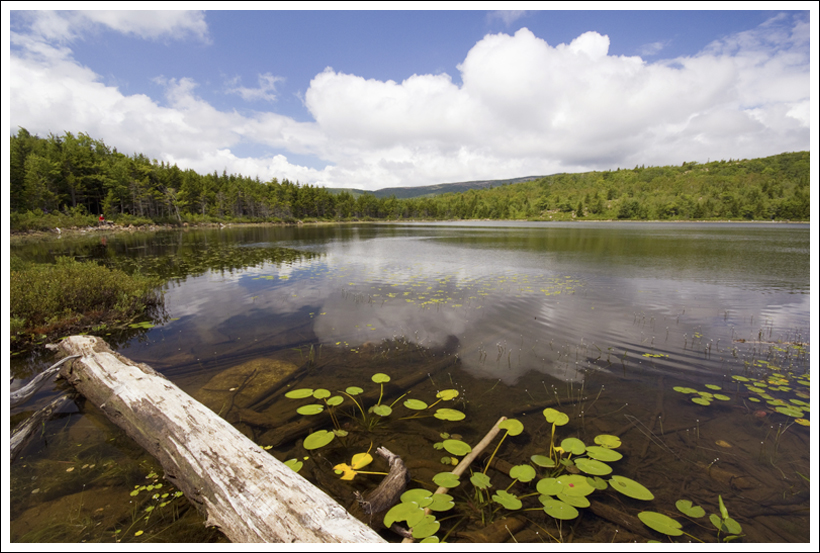
The Bowl
The Bowl is a beautiful glacial pond you’ll pass along this hike. Below: Christine checks out the interesting cliff face on the hike down from the Gorham Mountain summit; Trail marker at the junction for the Bowl trail; Thick crowds at Thunder Hole.

Cliff on hike down Bowl Junction Crowds at Thunder Hole

While we sat at the lake, the clouds really cleared off quickly and the day turned into that perfect Maine day I described a few paragraphs ago.  So beautiful!

We hiked back down the Bowl Trail, past the junction to the Beehive trail and down to the Park Loop Road.  The trail comes out right above Sand Beach, which is a great place to pick up the Ocean Path.  The Ocean Path is a flat walking trail that runs between the ocean and the road.  It’s very crowded almost all the time, and if you’re a faster hiker, you’ll have to dodge slowpokes.

From the Ocean Path, there are a ton of small side trails that lead down to the rocky coastline.  There are so many places to sit and enjoy the view!  The walk along the path goes on for about 1.3 miles and eventually passes by Thunder Hole.

When we passed Thunder Hole, it was so crowded we couldn’t even get down to the viewing platform without waiting in line.  We’ve seen Thunder Hole so many times so we didn’t stay long.  Besides, it wasn’t thundering at all.  The tide was so high that the sea cave stayed full of water regardless of the wave action.  There just wasn’t any force to create the sound the spot is named for.

The Gorham Mountain parking lot is just a tenth of a mile or so past Thunder Hole, so we were back at the car after a few more minutes of walking.  We headed straight to lunch in town – lobster rolls at the Portside Grill!

Adam Says…

Whenever we talk about going to Maine, one of the things we plan on every trip is a hike up Gorham Mountain.  In fact, a few years ago when we came up to the park and knew we had a whole week of rain ahead, we quickly got in a hike up Gorham.  As Christine mentioned, just going up Gorham Mountain is a short hike, so it is easy to fit in when you have a break in the weather.
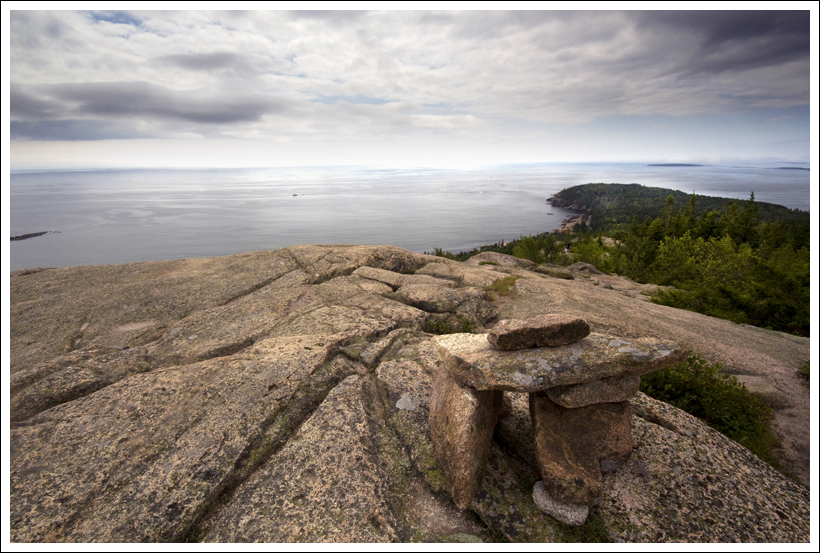
View from the Gorham Summit
The View from the Gorham Summit looking toward Otter Point. Below: Christine’s parents enjoy the view; The rock pile marks the summit of Gorham Mountain.

Christine's parents enjoy the view Rock Pile at the Gorham Summit

You can find the parking lot to the trailhead on the right shortly after the Thunder Hole parking lot.  The trail starts off with lots of roots and granite to navigate and can be a little slippery if a storm has recently come through.  The trail consists of a gradual uphill climb and is a popular trail for people of all hiking levels.  At .2 miles, you reach the junction with the southern part of the Cadillac Cliffs trail.  This is definitely a more challenging side trail, that includes some rock scrambling.   If you want to try the Cadillac Cliffs trail, do it on the way up since it could be more treacherous going down.  The Cadillac Cliffs trail doesn’t really provide any great views, but it does have a small cave to go through and some interesting rocks to scramble.  By the time you reach the northern junction at .5 miles, you will likely need to catch your breath.  Rejoin the Gorham Mountain trail by taking a right at this junction.  You will continue to climb upward and will see lots of places to take in the views along the way.  At .9 miles, you will reach the 525 foot Gorham Mountain summit.  On the way up the mountain, you typically get views of Sand Beach and Great Head, but from the summit, you can also see Otter Cove, Day Mountain, Pemetic Mountain, and Cadillac Mountain.  We continued on the trail from the summit.  At 1.5 miles, you reach a junction with The Bowl Trail.  Take a left and climb up the steep terrain through the woods until you reach The Bowl at 2.0 miles.  From The Bowl, you can also see close glimpses of the summit of The Beehive and there is a trail that connects with it.  We took in the views around the lake and then went back down The Bowl Trail, towards the Park Loop Road.  At 3.2 miles you will reach the Park Loop Road.  Cross the road and proceed on the Ocean Path, heading past Sand Beach.  You will likely see tons of cars and people along the road between this point and Thunder Hole.  You should reach the Gorham Mountain parking lot around 4.4 miles.
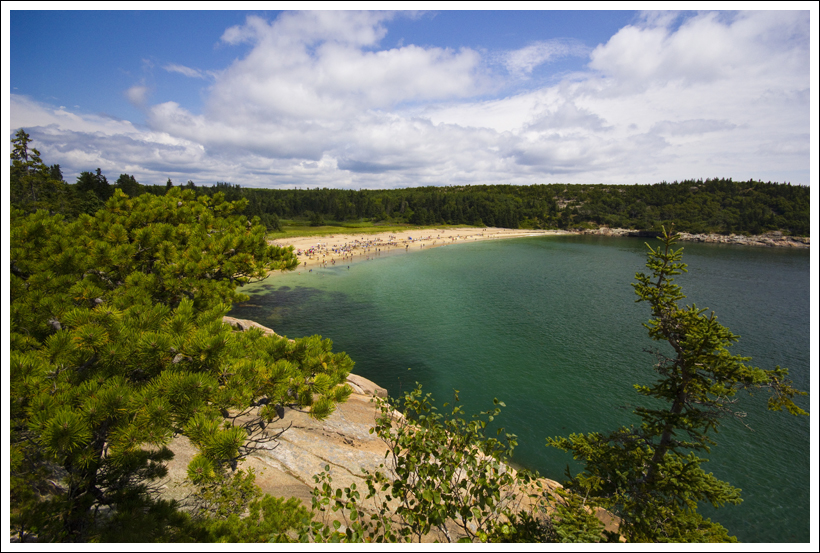
Sand Beach from the Ocean Path
Sand Beach from the Ocean Path. Below: If you look at the larger version of the Beehive photo below, you will see the long queue of people climbing the mountain; Adam enjoys the bench at the Bowl.

The Beehive Adam Sitting at the Bowl

We had a funny moment when we first started the hike.  A family was coming back from the summit and spotted us with their trekking poles.  One little girl was asking why we were all using two ‘canes’ to walk.  The parents had responded that we were “professional hikers”.  We got a few laughs out of that.  If only we could get paid to go hiking (or at least pay for some of our hiking gear).

There are many things about this hike that make it one of our favorites.  The blueberries are ripe during July and August and are plentiful on this trail.  I think I picked the largest, juiciest blueberry ever during this hike.  We always enjoy looking over Sand Beach.  You can see the dots of people on the beach, but not many in the water due to the temperature.  Walking back on the Ocean Path, you could hear the screams of children as they were being hit by the freezing waves.  You can also count on being able to see a lobster boats in the area, bringing up traps, or a large sailboat rounding the harbor.  You may also be able to catch a little rumbling from Thunder Hole, but the largest rumblings typically occur in the fall after a storm.

This area has also been where two recent movies have been filmed.  You can see Sand Beach in The Cider House Rules and nearby Otter Cliffs was used in Shutter Island.

Trail Notes

  • Distance4.4 miles
  • Elevation Change – 500 feet to the summit of Gorham and another shorter climb to the Bowl
  • Difficulty – 2. This is an easy family hike, suitable for most fitness levels.
  • Trail Conditions – 3. Trails in Acadia are always rocky and rooty and can be slick when wet.
  • Views – 5.  Breathtaking!
  • Waterfalls/Streams/Lakes – 4. The Bowl is a beautiful glacial pond.
  • Wildlife – 3.  We saw an eagle – that counts for something!  We’ve heard that people occasionally see whales off in the distance, but we never have.
  • Ease to Navigate – 4. Pay attention to the cairns and markers at trail junctions, and it’s hard to get lost.
  • Solitude – 0.  This is an extremely popular area.  No matter when you hike it, you will see people.

Directions to trailhead: The trailhead is located in the Gorham Mountain parking lot on the Park Loop Road in Acadia National Park.   The parking lot is about .5 mile south of Thunder Hole.
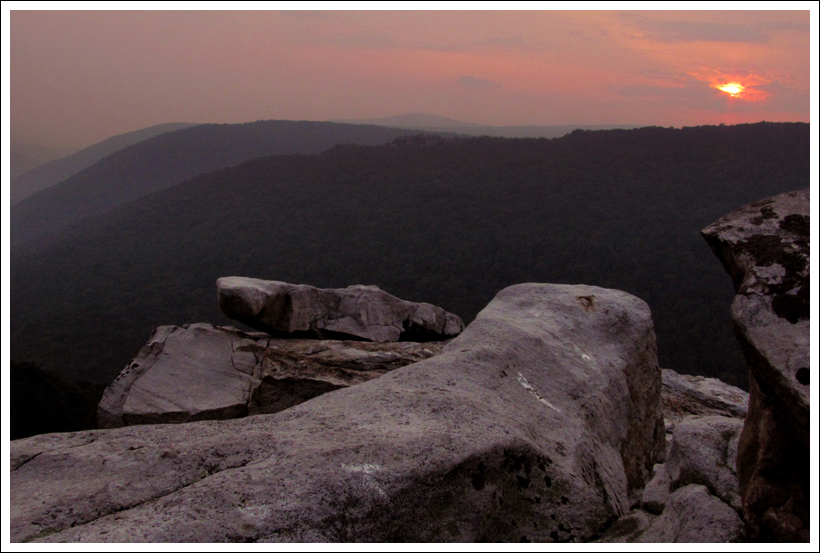
Fisher Springs Run/Rohrbaugh Plains – Dolly Sods (WV)

The Fisher Springs Run – Rohrbaugh Plains hike is a five mile out-and-back that leads to spectacular wilderness views from a cliffside.

Rohrbaugh Cliffs at Sunset
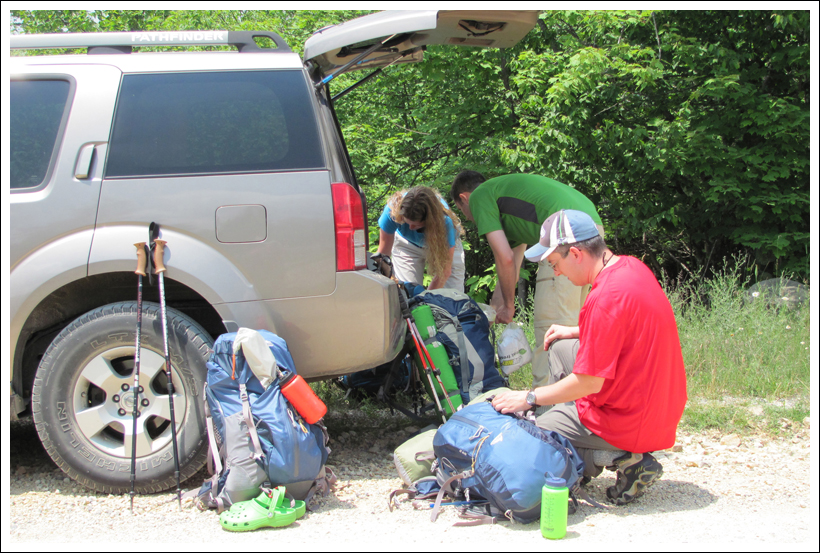
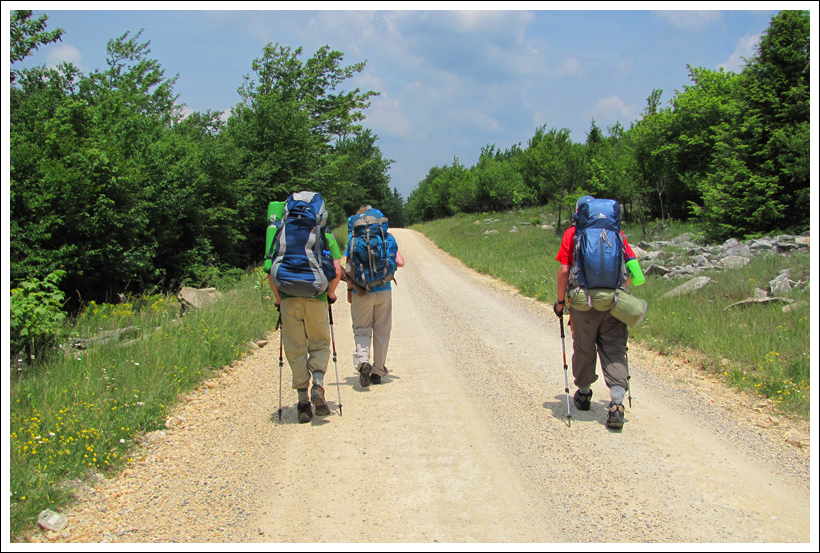
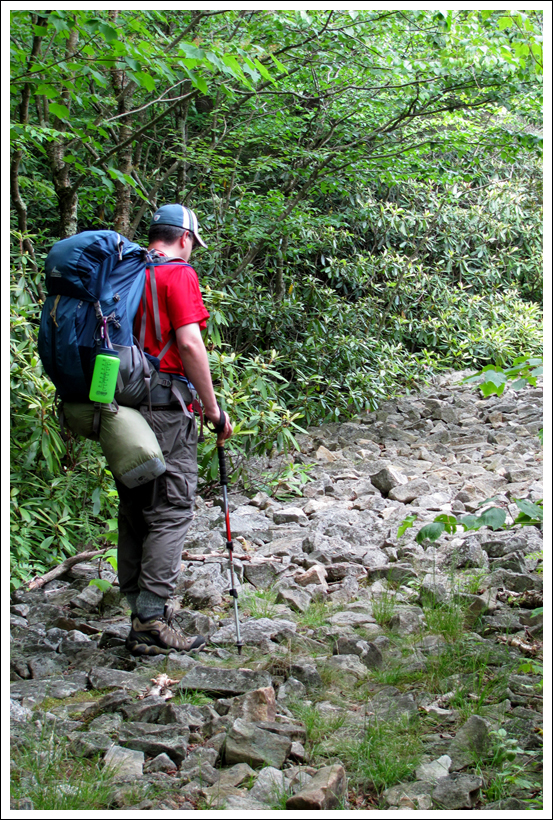
Rohrbaugh Cliffs at Sunset. Below: Gearing up at the car before starting the hike;  Making the short walk down Forest Road 75; Adam points out our route on the trail sign.

Gearing Up Forest Road 75 Trail Sign

Christine and Adam Say…

For this particular post, we decided to team up and write one massive post, instead of the normal ‘He Says, She Says’ versions. Enjoy!)

Last year, we participated in a Potomac Appalachian Trail Club workshop called Backpacking 101 (read part one, part two, and part three).  Initially, we were scheduled to do an overnight trip to the Dolly Sods Wilderness as a ‘graduation’ from our class.  Sadly, we ended up missing that trip because Christine’s ankle sprain still hadn’t healed enough for the rigors of backpacking.  While the make-up trip we eventually did to Hazel Mountain in Shenandoah National Park was great, we still wanted to do an overnight trip in Dolly Sods.

Dolly Sods is such a unique area for the mid-Atlantic region. It’s the only area close to us with a sub-Arctic tundra climate – loaded with heath barrens, blueberry bushes, acidic bogs and coniferous forest.  You feel like you’re somewhere far north of West Virginia when you visit this wilderness area.

The route we chose through Dolly Sods was of a length and difficulty we would typically choose for an easy day hike.  (5 miles with 900 feet of elevation change)  But we decided it would be fun to do an easy hike and enjoy camping at one of the most beautiful sites in the entire Monongahela National Forest’s wilderness area.

We also were lucky to have some awesome company for this trip.  In Backpacking 101, we met a nice couple – Suzanne and Anthony.  We enjoyed hanging out with them on our class trip to Hazel Mountain and had stayed in touch with them ever since.  We tried planning trips together a couple times, but until this trip our schedules just hadn’t matched up.  We were thrilled when plans finally came together for this Fourth of July weekend trip.

Day One:

Suzanne and Anthony drove down to our house on Friday night so we would have time to go through all our gear before getting an early(ish) start on Saturday morning.  We spent most of the evening fiddling with our packs, splitting up shared gear and contemplating how many Clif bars we truly needed to survive our expedition. That evening, it looked like an REI store exploded in our basement.  We laughed about how much stuff we had to pack for just one night of camping.  We ran through our checklist to make sure we had everything – stove, tent, sleeping bag, clothes, food, emergency kit, etc.

On Saturday, we had a big breakfast and were out the door a little after 9:30.  We didn’t make it to the trailhead until after 1:00.  We made a stop at Seneca Rocks Visitor’s Center and ended up buying another trail guide and a new map for West Virginia hiking.  (Not for use on this trip, but just to have for the future.) We also stopped at the Subway in Franklin, WV to grab sandwiches to have for lunch on the trail.

When we got to the Fisher Springs Run trailhead, the parking lot was overflowing with cars.  A couple people had decided to park sideways in the lot instead of straight-on, so they took up space that could have accommodated five or six more cars.  It was a little annoying and worrisome – would we get out to Rohrbaugh Cliffs and find all the prime campsites already occupied?  We ended up parking a short distance down Forest Road 75, in a patch of dirt just wide enough to get our car off the road.

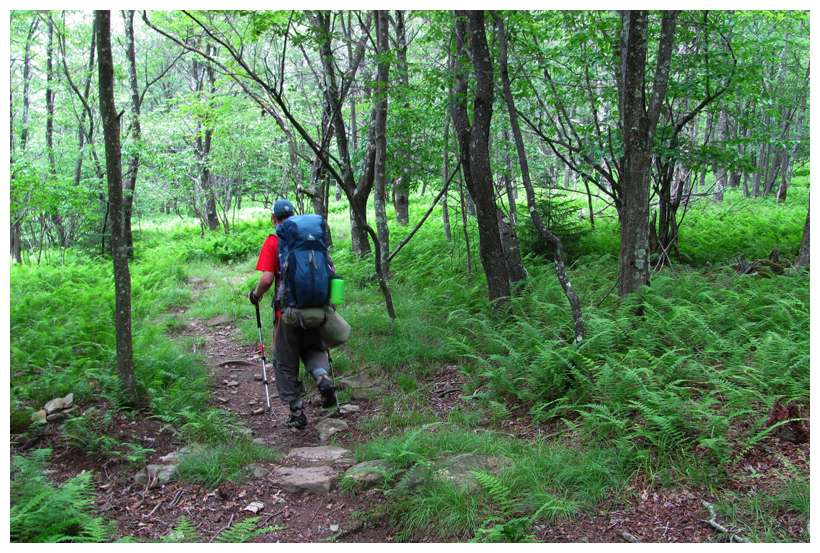
Sea of Ferns
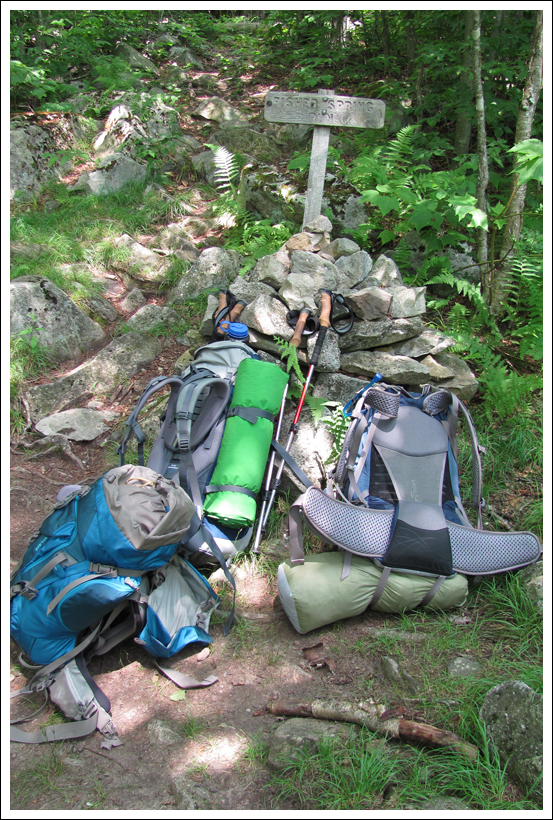
The forest floor was a sea of ferns.  Below: Adam hikes along the Fisher Springs Run Trail; The trail junction of Fisher Springs and Rohrbaugh Plains; Subway for lunch;  Our huge pile of packs; Adam traverses a rocky section of trail, Suzanne crosses a small stream.

Adam hiking Junction of Fisher Springs Run and Rohrbaugh Plains Trails
Lunch break
Stack of packs Rocky trail Crossing the stream

We found space to shove the sandwiches into Suzanne’s pack, slathered ourselves with sunscreen and bug spray, and got to the business of walking.  Almost immediately after stepping off the dusty, gravel forest road onto the trail, we found ourselves ensconced in a cool, lush, green forest.  Ferns spread across the ground for as far as the eye could see.  The trail descended gradually, occasionally crossing small, mostly dry streams.  The trail got rockier as we followed it for a little over a mile to its junction with the Rohrbaugh Plains trail.  We stopped at the trail junction and ate our lunch.  We chatted with a passing backpacker who was doing a 19-mile loop through Dolly Sods.  She was on a solo trip and told us she was headed down into the Red Creek basin.  We asked her if she had noticed many camps set up near the cliffs.  She said she hadn’t seen anyone, so we took that as a hopeful sign.

After lunch, we took a left onto the Rohrbaugh Plains trail.  The trail at this point was all rocks.  They almost looked fitted together like a jigsaw puzzle.  Almost immediately after the rocky patch, we dipped deeply into a ravine with a pretty flowing stream.  It was a perfect water source for backpacking. We figured that in the worst case scenario, we could hike back to this point to fetch water for cooking and cleaning at camp.

The last 1.2 miles to our campsite ascended ever so slightly, winding past giant mossy boulders and through dense thickets of rhododendron.  With about a half mile to go, we passed another trail junction with the Wildlife Trail.  Taking the Wildlife Trail to the Rohrbaugh Plains trail is probably the most popular route for day hikers to reach Rohrbaugh Cliffs.  After this trail junction, we crossed a swampy, muddy area and walked across a grassy meadow.  A couple tenths of a mile past the meadow, we came to a beautiful clearing where we ended up making camp.

Crossing the meadow
Crossing the meadow. Below:  Christine and Adam’s camp; Adam collects water for cooking and cleaning; Anthony and Suzanne’s camp.

Camp Anderson Fetching water Camp Suzanne and Anthony

There were so many soft, flat spots that were perfect for our tents!  We chose a couple spots located out of sight of the trail.  We had a fire pit, a nice place for cooking, a view and shady trees.  It was nothing short of perfect.

It felt great to shed our packs and get to work setting up camp.  Our Mountain Hardwear tent (the Drifter 3) is super-simple and was pitched in just a few moments.  While Adam worked on staking the tent, Christine inflated our Big Agnes pads.  We put them in the tent along with our sleeping bags, so they’d have some time to re-fluff after being compressed in stuff sacks all day.

On this backpacking trip, we had a few new and exciting ‘creature comforts’.  Since our last backpacking trip, we acquired Alite camp chairs.  They’re so comfortable and lightweight!  We also both got the large Thermarest pillows.  They’re really bulky and take up a ton of pack space, but they’re very lightweight and make a world’s difference for getting comfortable at night.  Christine also brought a fitted sheet for her sleeping pad.  Even though the sheet is made by Thermarest, it fits the Big Agnes pad perfectly.  A sheet is not a necessity, but it definitely improves the texture and breathability of your sleeping pad.  Christine especially hates feeling clammy or slippery when she’s trying to sleep, so having the sheet made a huge difference.  Neither of us actually sleep inside our sleeping bag unless it’s freezing cold.  We prefer to open our bags up and use them like quilts.

After we finished setting up our tent, we carried our cooking stuff down to our kitchen area.  We also pulled out all our ‘smellables’ and set them aside so they could easily be stowed away in our hanging bear bag.  Christine found a couple branch stubs to hang our trekking poles and our packs. We both covered our packs with garbage bags in case it rained overnight.

Anthony and Suzanne were still working on getting there camp set up, so we decided to go on a water run.  We hadn’t passed a better water source after the stream near the trail junction, so we took our collapsible bucket and headed back down the trail.  Filling up was easy, but getting two gallons of water in a soft-sided bucket back to camp without spilling anything over a 1.2 mile distance was substantially trickier!  We were very thankful we went as a pair to get water, because it was nice to trade off carrying the bucket. We joked that it was like being in a challenge on some adventure reality show.  We made it back without much spillage at all!  (Note: We hiked this trail as a dayhike in 2014 and found a closer water source just a few hundred yards past where we stopped to camp… so you don’t have to hike back like we did!)

When we got back, Anthony and Suzanne were all set up, so we decided to walk a few hundred feet further down the trail to explore the cliffs.  Rohrbaugh Cliffs were spectacular.  The view into the valley below was all wilderness – not a single road or farm or house – just mountains and streams for as far as the eye could see.

Adam on rohrbaugh cliffs
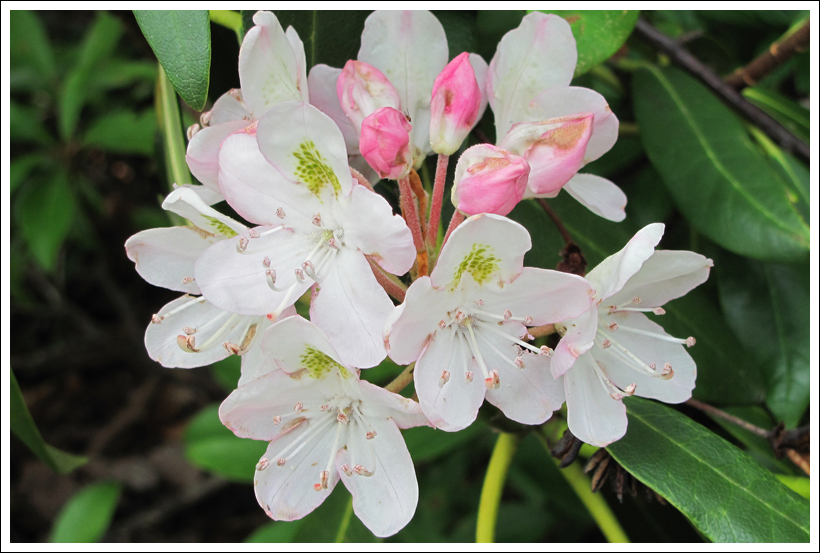
Adam on Rohrbaugh Cliffs. Below: Wild, ripe blueberries; A cute frog that visited our camp; Rosebay Rhododendron were in bloom; Our group on Rohrbaugh Cliffs; A couple more views of the cliffside.

Wild blueberries Frog Rosebay rhododendron
The groupView from Rohrbaugh Cliffs Cliffside

We visited the area at a truly beautiful time of year.  The Rosebay Rhododendrons were just starting to bloom.  The mountain laurel was a bit past peak, but there were still plenty of flowers to enjoy.  And best of all WILD BLUEBERRIES were everywhere along the cliffs!  Suzanne and Christine were significantly more excited about the berries than the guys and spent a lot of time searching for ripe berries tucked into the bushes.

Most of the late afternoon was spent relaxing near camp and getting dinner ready.  Around 5:30, Adam got out the JetBoil and boiled water for all of our dinners.  We had wanted to come up with some homemade backpacking recipes, but never got our act together.  Adam and Christine ended up eating Backpacker’s Pantry Chicken Risotto with Mocha Mousse Pie for dessert.  It was satisfying and very filling!  Anthony and Suzanne had macaroni and cheese and blueberry cobbler from some backpacking meal company (AlpineAire) none of us had heard of before.  They were pretty happy with their dinner, too.

Chef adam
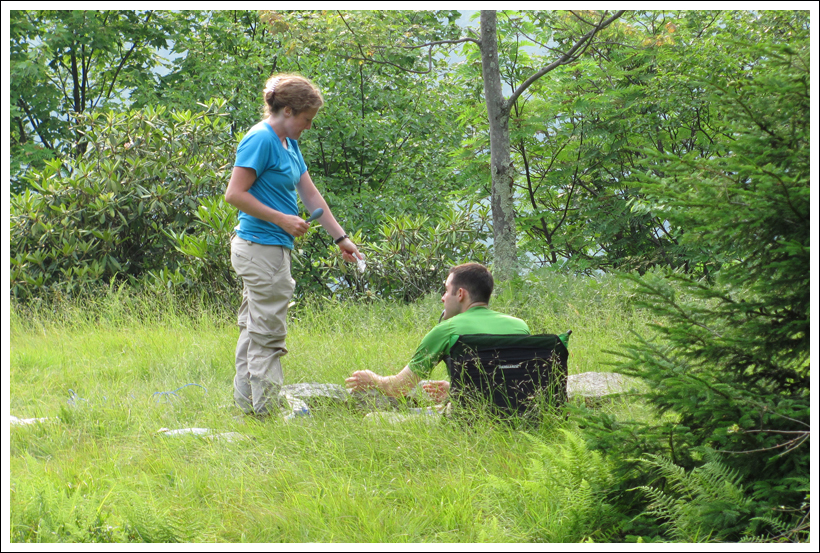
Chef Adam filters and boils water for dinner. Below: Chicken Risotto for dinner; Anthony and Suzanne relax after dinner; Playing Monopoly on the cliffs; Hanging our bear bag.

Chicken risotto Relaxing after dinner and dessert Monopoly Bear Hang

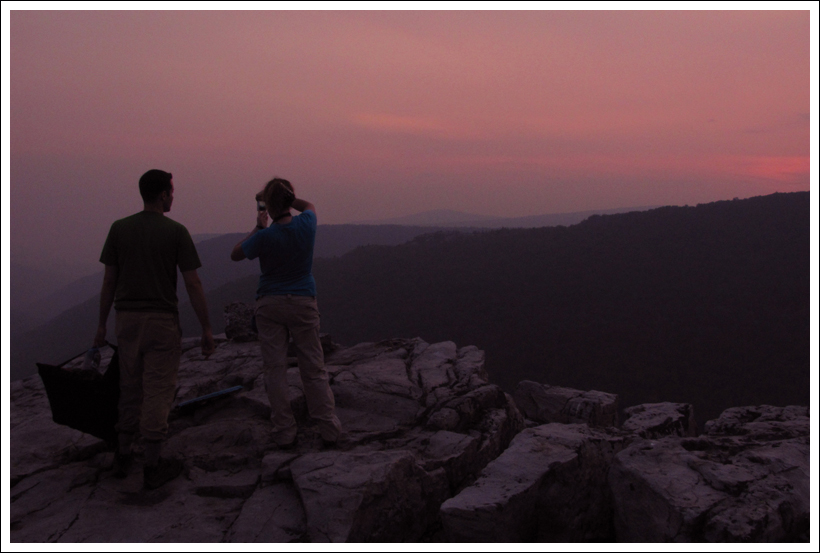
We cleaned up our dishes, brushed our teeth (We love Colgate Wisps for backpacking) and hoisted our bear bag into the highest, safest tree we could find.  We decided to play cards and watch sunset from the cliffs.  We found a big flat rock near the edge and played the card version of Monopoly. The game took a long time, and Adam eventually won.  The sky turned to hues of pink and soft purple and the sun dipped down behind the mountains.  It was so beautiful!

Shortly before full dark, a couple more groups of backpackers showed up – maybe five people and two dogs.  They set up their camps down the trail from us.  So even though we weren’t the only people up there, we still felt like we had a good measure of solitude.  It definitely was not the situation we feared when we saw the packed parking lot at the trailhead. We’re guessing most of the other backpackers ended up along Red Creek.

Once the sun was down, we all retreated to our tents.  Christine listened to a book on her iPod for a while.  By the light of his headlamp, Adam enjoyed reading some of his book by John Muir.  He’s been reading this book exclusively on backpacking trips.  It’s a nice tribute to read something by the ultimate outdoorsman while having our own experience with nature.

Christine started getting really sleepy, so she stowed her iPod away and dozed off, only to be woken almost immediately by the sound of fireworks in the valley below.  We think we heard fireworks shows from three different locations, because there were definitely three distinct grand finales.  The booming sounds and bursts of light in the sky came from different directions, too.  We contemplated leaving our tent and going back out to the cliffs to see if we could see the fireworks from above, but we ended up staying put. Christine didn’t feel like getting dressed again. When all was said and done, we kind of regretted not going back out to see the fireworks.

Eventually the fireworks drew to a close, and Christine drifted back to sleep.  Unfortunately, Adam did not sleep that well on this trip.  He was physically comfortable, but he just wasn’t tired enough to sleep soundly.  Going to bed shortly after sunset just isn’t what his body is used to, so he did a lot of tossing and turning during the night.

Our sunset card game
Our sunset card game.  Below:  Layers of mountains frame the Red Creek Valley; We had a pretty sunset; Suzanne takes a few final photos of the evening sky.

Mountain Layers Dramatic sky Taking one last photo

Around 2:30 a.m., Adam shook Christine awake to close the rainfly on the tent – a storm was approaching.  Christine stumbled and grumbled and totally failed at closing the fly.  Adam had to crawl over her to get both sides of the tent closed.  Christine completely lacks dexterity when she’s half asleep. The storm never really materialized beyond some lightning and wind.  We both fell back to sleep and didn’t wake up again until about 6:15.  Christine said it was the best night of sleep she’s ever had in a tent.

Day Two

Shortly after sunrise, we got out of the tent and took a walk over to the cliffs.  Christine thought there might be some pretty morning light, but it was completely cloudy.  Back at camp, we started breaking down our tent, deflating our sleeping pads and re-stuffing our sleeping bags.  We got the bear bag down and got everything ready to cook breakfast.

Christine tried Starbuck’s instant coffee, Via, for the first time.  It was surprisingly delicious.  Once she added sweetener and powdered Coffeemate, it tasted almost identical to a cup of brewed coffee.  In addition to coffee, we had boxes of apple-grape juice and instant maple-brown sugar oatmeal.  We figured that would be plenty of food to give us energy for the short hike out.

After everyone was done with breakfast, we finished packing up and cleaning up our camp area.  We were back on the trail by 8:45.  Our exit route simply retraced the trail we had hiked in.  We were back at the car by 10:15.

Breaking camp
Breaking camp in the morning.  Below:  Fat Boy’s Pork Palace for lunch!

Fat Boys Pork Palace

On the way home, we stopped at Fat Boy’s Pork Palace (now permanently closed) for lunch.  With a name like that, you know it’s going to have perfect options for a post-backpacking calorie splurge!  We enjoyed BBQ sandwiches with coleslaw and French fries.  Suzanne got breakfast and Anthony got a burger.  It was all delicious!

Once we were back at our house, we split up our group gear and saw Anthony and Suzanne on their way.  Christine said her post-backpacking shower might have been one of the best showers of her entire life.  It always feels awesome to wash away DEET, sunscreen and sweat!

We all had a great time on the trip. We’re already trying to plan our next backpacking adventure for some time in September!  Although, it’s going to be hard to top the scenery at Dolly Sods!

Trail Notes

  • Distance 5.2 miles total
  • Elevation Change – 900 feet.  The Fisher Springs Run trail descends about 500 feet and the Rohraugh Plains ascends about 400 feet.
  • Difficulty – 2.  The hike was not that difficult, even with 35 pounds on my back.
  • Trail Conditions –2.5The Fisher Spring Run trail was well-maintained, but there are lots of rocky spots on the Rohrbaugh trail where you could turn your ankle.
  • Views –5.  The views from Rohrbaugh cliffs were quite spectacular and it was nice to see the sun disappear over the mountains.
  • Wildlife – 1.  We were expecting to see some wildlife up here, but we didn’t see anything other than squirrels, frogs and some birds.  We did wake up to the sounds of dark-eyed juncos in the morning.
  • Ease to Navigate – 3.5.  There are not any blazes on trails at Dolly Sods, but the trails are very well-defined and signs are in place to mark junctions.  Stay on the trail as much as possible and you won’t have any trouble.  I can imagine that when leaves fall and cover the trail in the fall, it would be more challenging to find the trail.
  • Solitude –4.  On a nice day, you may see some people at the overlook. 

Directions to trailhead:  From Seneca Rocks, go North on WV 28 for 12 miles.  Take a left on Jordan Run Road.  Go one mile up Jordan Run Road and take a left on to Forest Road 19.  In 6 miles, Forest Road 19 comes to a T on to Forest Road 75.  Take a right, heading north on Forest Road 75.  Drive for three miles until reaching the small parking lot and the trailhead for Fisher Springs Run.

Flat Top

Flat Top is one of the two ‘Peaks of Otter’.  While not as popular as the other peak (Sharp Top), this 5.4 mile hike to Flat Top’s summit offers some nice views of the area.

A View of Sharp Top from Flat Top
A view of Sharp Top from just below the Flat Top summit. Below: Starting out on the Flat Top trail; The trailhead was decorated with lilies; The junction of the trail down to Cross Rock is right at the Pinnacle.

Flat Top Trail  Day Lily Cross Rock Junction

Christine Says…

Last week, we were home on a week long ‘staycation’.  Most of the week, we relaxed at home, sleeping in and watching movies.  When Wednesday turned out to be cool and breezy with low humidity, we decided to get up early and go for a day hike in the Peaks of Otter area of the Blue Ridge Parkway.  We’ve hiked Sharp Top many times, but I had never really considered hiking the companion peak.  Adam had always described the hike up Flat Top as steep and lacking any spectacular views.  But, we’d read a few more positive descriptions of the views, so we decided to give the trail a shot.

When we got to the trailhead, it was almost chilly.  Personally, I think chilly weather is always welcome in the middle of summer!  The hike was all uphill, passing hillsides of ferns, giant boulders and patches of red columbine.  The first point of interest we came to was the Pinnacle.  It offered panoramic views of the valley.  We could even see the Blue Ridge Parkway snaking through the mountains across the valley.

View from the Pinnacle
A view from the Pinnacle. Below: The trail was often lined with ferns; There were many giant boulders along the trail; Cross Rock was underwhelming.

Ferns Along the Trail Giant Boulders Along the Trail Cross Rock

At the Pinnacle, there is sign marking a side trail down to Cross Rock.  We assumed Cross Rock would be another outcropping with nice views.  We were quite wrong. Instead, it was a brutally steep descent to a rock formation in the shape of a cross.  Others might find Cross Rock to be fascinating, but I think I would have passed on the side trail if I had known I was just going to look at some rocks.

From the Cross Rock junction, the trail became steeper and rockier.  We continued climbing for the last half mile to the summit of Flat Top.  At first, we were a little confused because the summit marker was buried in the trees.  Our hiking book had described the views from the top as panoramic and majestic.  We eventually found a little path through the brush leading to a rocky outcropping with views.  It was a little below the actual summit.  The views from that point were nice, but I wouldn’t describe them as generously as our hiking guide did.  If you climbed out to the edge, stood and peered beyond the trees, you could see Sharp Top.  Overall, I think the view from the Pinnacle was much nicer than the view from the summit.

We relaxed on the rocks for a while, then made our way down the trail.  The trail going down was really slick from the thunderstorms the night before.  On one steep section, I slipped and fell hard on my left knee.  At first, I was really worried I may have banged it up badly enough to jeopardize our planned backpacking trip.  Fortunately, I was able to walk it off and only suffered a bruise.

The downhill hike seemed endless at times after I hurt my knee, but we got back to the car in less than an hour. Afterwards, we enjoyed a delicious lunch at the Peakview Dining Room in the Peaks of Otter lodge.

Adam Says…

The Peaks of Otter place has a special place in my heart, since this was where my family would often visit for a picnic.  I have hiked up the sister peak, Sharp Top, countless times, but I have only been up Flat Top a few times.  The times that I had approached the peak of Flat Top, we had started out from the trailhead from the Peaks of Otter picnic area.  I remember that path being very steep and forested, with views that were mostly through the trees.  After consulting our Falcon Guide of Hiking the Blue Ridge Parkway, it mentioned great views and starting from the actual Blue Ridge Parkway to shave off some of the elevation gain.  We decided to check out this path instead of the way I had experienced.

View Just Below the Flat Top Summit
View just below the Flat Top summit. Below: The actual summit of Flat Top is in the trees; Adam took a photo of Christine with the camera’s manual settings customized for a sunny landscape shot – oops!; Inside the Peaks of Otter lodge.

The actual summit of Flat Top Christine in Motion Peak View Dining Room

The start of this trail begins around mile marker 83.5 on the Blue Ridge Parkway, north of the Peaks of Otter Lodge.   There is a parking lot on the eastern side and you will see a brown sign denoting the beginning of the Flat Top trail. The trail starts off by slowly elevating through the forest in more of a gradual ascent.  Around .6 miles, the trail turns sharply to the left and you begin a series of switchbacks that last until you reach the junction with the Cross Rock trail at 2.1 miles.  At this junction you reach what is termed the pinnacle.  If you crawl out on the outcropping of rocks near you, you are at the Pinnacle, which provides the best views on this hike.  You have the option of climbing down to Cross Rock, but this is not a great viewpoint, just an interesting rock formation.  Follow the signs up the last .5 miles to reach the Flat Top summit at 4,001 feet.  You will see the summit marker in the middle of the woods.  Continue past the summit marker slightly for a short sidepath onto a rock outcropping that will give you some nice views.  Continue back the way you came.

This path up Flat Top was better than my memories of hiking up from the picnic area.  The views from the Pinnacle are gorgeous and you would miss out on this if you did the hike from the picnic area.  The hike back down from the summit felt steeper than going up and there were loose rocks that required you to keep an eye on your footing.  Take trekking poles to help secure your footing.  There is one geocache on the hike, but I forgot to plug in the coordinates before we left:

The one thing that Flat Top has over the Sharp Top hike is more solitude. Sometimes it seems that Sharp Top is crawling with large groups of hikers, but you will likely only see a few people on the Flat Top hike.  Sharp Top does have better viewpoints, but this is a nice hike to do if you have more time to spend in the area.  If you are interested and not too exhausted, you can also cross the road from the parking lot for a short 1.6 mile hike to Fallingwater Cascades.

Trail Notes

  • Distance 5.4 miles (including the optional .2 mile side trail to Cross Rock)
  • Elevation Change – 1391 feet
  • Difficulty – 3.  The hike is steady uphill climbing and get rockier the higher you climb.
  • Trail Conditions – 2.  The trail is very rocky and is rather overgrown in places.
  • Views –3.5  The view from the Pinnacle is beautiful, but views from the summit are somewhat obstructed.
  • Wildlife – 0.  We didn’t see anything.
  • Ease to Navigate – 3.5.  The trail itself is easy to follow, but at the summit there is no clear pointer to the best overlook.  The technical summit is buried in the woods, but by following community trails you can climb onto rocky outcroppings to gain a view.
  • Solitude – 2.5.  Compared to Sharp Top, this trail is lightly traveled.  But due to the popularity of the Peaks of Otter area, you will likely see other hikers.

Directions to trailhead: At mile marker 83.5 on the Blue Ridge Parkway, north of the Peaks of Otter Lodge.   Park in the lot on the eastern side and a brown sign denotes the beginning of the Flat Top trail.

Sky Meadows Loop

This 5.5 mile loop through Sky Meadows State Park offers spectacular valley views and the opportunity to hike in high, open meadows.

Adam Takes in the View from the Piedmont Overlook
Adam takes in the view from the Piedmont Overlook.  Below: Mt. Bleak House was built in 1843 and is open for tours; An Appalachian Trail Thru-Hiker makes his way down the trail (he is in the far left of the photo, beyond the dogwood trees); A cute village in the valley below.

Mt. Bleak House AT Thruhiker Cute Town in the Valley Below

Adam Says…

This hike was amazing!  I can’t believe that we had never been to Sky Meadows State Park until now.  Each year, Christine and I pull a list of hikes together that we want to try and cover.  When I was looking through the Falcon Guide Hiking Virginia book, they mentioned under “other hikes” to try the Sky Meadows State Park.  I am shocked that the authors didn’t feature a trail through this area rather than leaving it as a footnote.  I think this is one of the best hikes in Virginia for views.  I would liken the scenery and open views to those you would find at Cole Mountain or Grayson Highlands/Mount Rogers.  Put this on your list of “must hikes” – you won’t regret it!

Across from the Visitor Center, you will see the Park Office on the hillside.  Walk past the large board showing the map of hiking trails and walk up the gravel path that leads into the woods.  Once you reach the fork, take a left and continue down the gravel Boston Mill road.  Continue on this road, passing by the junction with the Gap Run trail, until you come to the junction with the South Ridge trail at .45 miles.

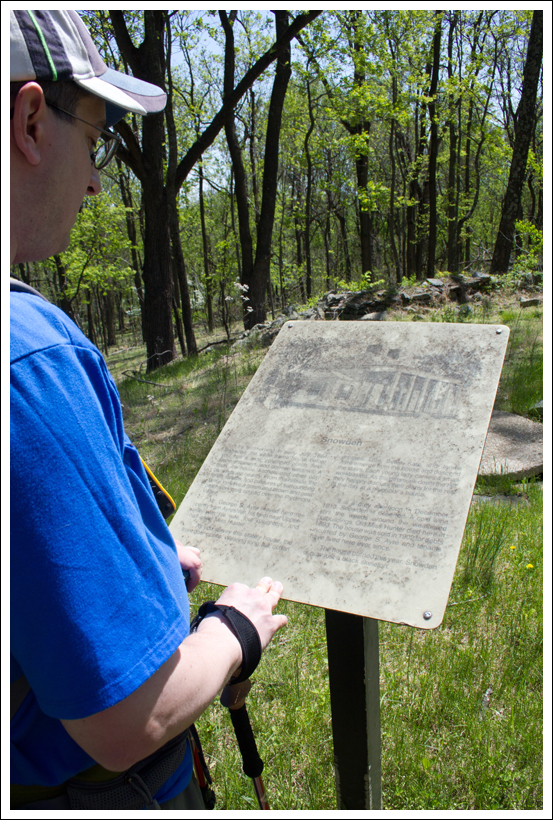
The Chimney at the Snowden Ruins
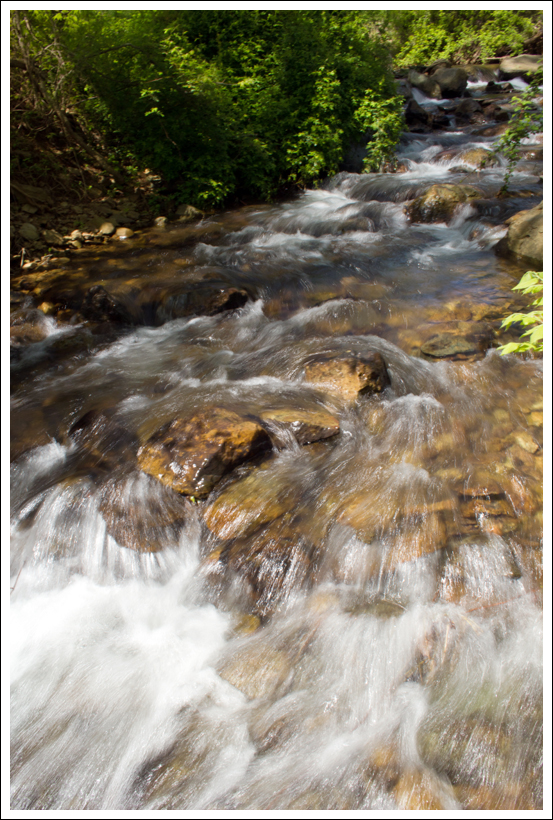
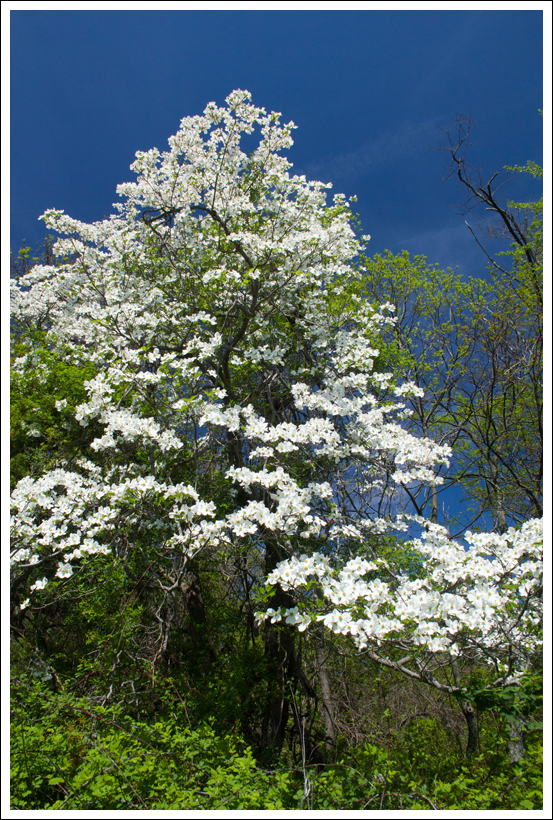
The Snowden House ruins. Below: We crossed this small stream early in the hike.  It’s probably dry most of the year;  Adam makes his way up the South Ridge Trail; Adam reads information about Snowden; Dogwoods were at their peak.

Stream South Ridge Trail Snowden Ruins Sign Big Dogwood

Take a right on to the yellow-blazed South Ridge Trail.  The trail begins to quickly climb up the steep hillside.  At .5 miles, there is a short spur trail to a nice view.  At .58 miles, you will come to the Snowden Ruins.  You’ll see the foundation of the old homestead along with what is left of a stone chimney.  Further up the trail, you will come to the South Ridge overlook which sits under a dogwood tree.  Continue along the trail which tends to ascend most of the way.  At 2.2 miles, you will reach a junction with the North Ridge trail.  Take a left up the blue-blazed North Ridge Trail.  At 2.6 miles, you will reach a junction with the white-blazed Appalachian trail.  Take a right, heading north on the Appalachian Trail.  At 3.5 miles, you will come to a fork.

Take a right at the fork to go on to the light blue-blazed Ambassador Whitehouse trail.  At 3.9 miles, you will come to the Paris overlook viewpoint, which also provides gorgeous panoramic views.  After this viewpoint, the trail descends back through the woods.  At 4.53 take a left back on to the North Ridge trail, but in just a few feet you will take a left up the red Piedmont Overlook trail.

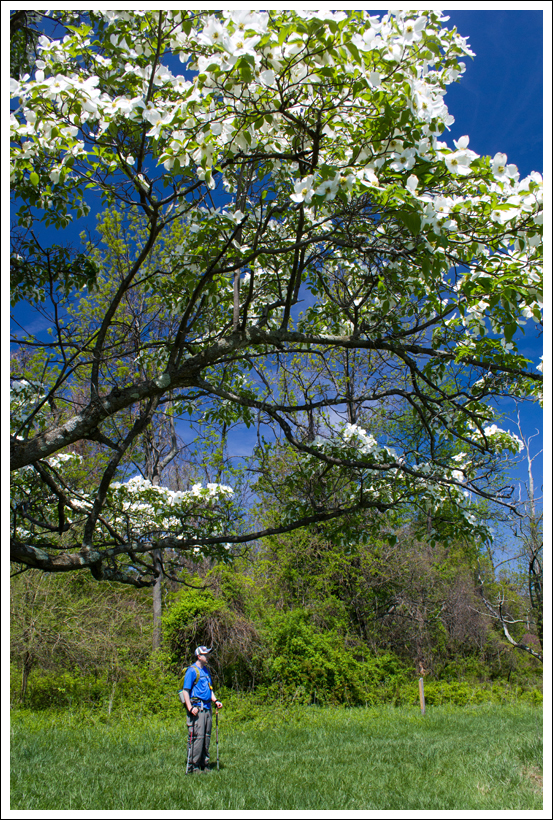
Adam under the Dogwoods
Adam under the Dogwoods. Below: Hepatica; Tiger Swallowtail; Mayapple Flower

Hepatica Tiger Swallowtail Mayapple

The trail ascends through a steep section here, but you will climb up a few stairs and then reach a wider trail that leads to a few benches and the Upper Piedmont Overlook.  Enjoy the views here and as you climb down to the Lower Piedmont Overlook.  After passing by an old farm building, you will climb over a few stairs and then down until you come back to the Boston Mill Road at mile 5.1.   Take a left on the road and you should be making your way back to your vehicle and the Visitor Center.

The land that became Sky Meadows State Park was donated by Paul Mellon (son of Andrew Mellon – U.S. Secretary of State from 1921-1932), a famous philanthropist, art collector, and Kentucky Derby-winning horse owner.   He donated 1132 acres of the land in 1975 and later more donations (including the land for the Appalachian Trail) have taken it up to the current 1862 acres.  The history of the land also dates back to Lord Fairfax and previous owners had ties to Belle Grove.

This really was a perfect day to do this hike!  We started off the day with a trip through Shenandoah National Park to view some early morning wildlife and to take in some breakfast at Skyland.  We then made our way to Front Royal and headed to Sky Meadows State Park.  The weather was perfect for hiking with highs in the 70s and a breeze throughout.  The sky was very clear with a few clouds, but no threat of rain.  The views were extraordinary and I can’t wait to come back some time.

Adam find the Hiking Upward Cache
Adam find the Hiking Upward Cache.  Below:  Lunch on the trail; Turning onto the AT; Making our way across the high meadows.

Lunch High Meadows

If you are interested in geocaching, there are several geocaches to find on this loop:

Christine Says…

Last Saturday was a perfect spring day.  We got up before sunrise and drove through the central and north districts of Shenandoah National park en route to Sky Meadows State Park for a day of hiking. (Passing through Shenandoah, we saw a bear and had a good breakfast at Skyland!)

Sky Meadows was established in the early 1980s and is home to a beautiful restored Civil-war era farm and twelve miles of hiking trails – including a little snip of the Appalachian Trail.  Sky Meadows is unique in that its campground has no car access.  Anyone wishing to stay overnight has to hike in to their campsite.

We parked at Mt. Bleak House.  From there, we hiked down a gravel path leading to the park’s network of trails.  Finding the trail we wanted to start on was a little tricky, because park maps were not to scale.  After a little fumbling around, we were on our way up the South Ridge Trail.  The trail climbed slowly and steadily uphill, past the ruins of Snowden – another old farm within the park’s boundary.  All that’s left standing of Snowden is a crumbling chimney and a number of foundations from outbuildings.  The site has a plaque describing the house and the people that lived there many years ago.

From Snowden, the path ascended continually passing through open meadows and pretty forest.  The dogwoods and redbuds were all near their peak of spring glory.  The flowers on the trees were truly spectacular against the perfect blue sky.  The breeze kept bugs (and sweating) at bay!  It really was ideal weather to be outdoors.

Leaning Redbud
A Beautiful Redbud along the trail. Below: A view into the valley from the Piedmont Overlook;  More Views; A spectacular dogwood.

Piedmont Overlooks Piedmont Overlook Beautiful Dogwood

For a while, the trail was pretty level as it passed through thicker woods.  We startled a turkey and watched it fly off, chortling and gobbling in dismay at being disturbed.  I must say… turkeys look really funny in flight.  The trail in this area was lined with lots of tiny wildflowers – mostly violets and hepatica.

Eventually, we started climbing again and came to the junction of the North Ridge and South Ridge trails.  We contemplated stopping for lunch at this point, but decided to press on, following the North Ridge trail to where it meets Appalachian Trail.  Another nice thing about Sky Meadows… there are benches at most trail junctions and overlooks.  It’s nice to have a comfortable place to sit and eat lunch – away from ticks, poison ivy and other crawly things.  We ended up using the bench along the Appalachian Trail for our picnic spot.

For lunch, we feasted on sandwiches, brownies, grapes and cheese.   Adam was eating his cheese and looking especially contemplative, when he turned and asked me “What kind of cheese is this?”  I responded “It’s mozzarella and cheddar twisted together.  You don’t like it?”  He said “No, it’s really GOOD… it sort of tastes like lobster dipped in melted butter!”  It’s weird, but he was actually kind of right – something about the texture of warmish mozzarella blended with the flavor of sharper cheddar ended up tasting remarkably like lobster. We’ve taken to calling this particular cheese snack ‘Lobster Cheese’.

While we ate lunch, we watched several other groups of hikers pass by.  No one really seemed to know where they were going.  Someone asked us if Harper’s Ferry was where the Appalachian Trail began.  Someone asked if they were already in Shenandoah National Park.  Two guys with cigarettes, sodas and no hiking gear contemplated aloud to one another “Should we go to Shenandoah or Harper’s Ferry?” (they were 20+ miles from either destination.)

After lunch, we headed north along the Appalachian Trail for a short while.  Along the ridge, the forest completely opened up to high meadows with amazing views into the valley below.  We were walking along the trail, chatting, when a fast hiker snuck up and passed us from behind.  He turned out to be the first AT thru-hiker we’ve seen in Virginia this year.   He’s definitely ahead of the pack!

Old Barn
We passed this old farm building on the hike down the Piedmont Overlook Trail. Below: A pretty lone tree; Adam stands in the middle of a huge four-trunked tree.

Lone Tree  Giant Four Trunk Tree

We really enjoyed walking across the open meadow terrain.  Most hikes we do are through thick forest, so this was a welcome change of pace.

At the junction of the Ambassador House Trail, the Appalachian Trail continued north and we turned right to make our way across more meadows and downhill to the Piedmont Overlook Trail.  We dipped back into forested area and passed a really cool four-trunked tree.  It was big enough for Adam to stand inside between all the trunks.

We took the optional arm of the trail uphill to get to the actual Piedmont Overlook, which was beautiful!  I loved seeing all the little houses and farms below in the valley.  From the overlook, the remainder of the hike was steeply downhill across open meadow.

Mt. Bleak House Grounds
Mt. Bleak House Grounds.  Below: A couple other shots from the Mt. Bleak grounds.

Summer Kitchen Barn on Mt. Bleak Farm

We arrived back on the gravel road and made our way back to the Mt. Bleak House area.  We stopped in the gift shop and chatted with the ranger.  We overheard her asking everyone walking in “Did you hike today?” and pretty much everyone answered “No – we’re just here to picnic!”  So, I made a point to tell her that we had hiked, had a great time and thought the park’s trail system was fantastic and very nicely maintained.  Adam got his passport book stamped and got credit for finding the state park’s official geocache.  We took a few minutes to poke around the farm and talk to two historical interpreters – one of them in a wonderful Zouave uniform.

We enjoyed our day in Sky Meadows very much.  It’s definitely a park we’ll visit again.

On our way home, we stopped briefly in Linden, Va to buy apple butter-cinnamon donuts from the Apple House.  If you’re in the area – you should do the same – they’re delicious!

Trail Notes

  • Distance5.5 miles.
  • Elevation Change – 1100 feet with one large climb in the beginning of the hike.  It’s mostly downhill or flat afterwards.
  • Difficulty –2.5. The beginning section is the toughest and is not for every person, but if you take it slow most people will be fine.
  • Trail Conditions – 4. It is very well-maintained.  The only rocky section was the .3 mile section on the North Ridge Trail.  The trail is wide in most places for two people to walk side-by-side.  Some sections you are even walking on soft grass.
  • Views5. You have lots of views along this hike of the valley and farm below.  On a clear day, you can see for miles!
  • Waterfalls/streams – 1. You cross one small stream in the beginning. It’s probably dry most of the year.
  • Wildlife – 2. We only saw one wild turkey and some other birds (there are bluebird boxes along the road).  They have spotted golden eagles in the area recently.
  • Ease to Navigate – 3. There are many options and junctions with other trails and the trails are not that well marked along the way.  While I don’t think a lot of people get lost up here, I do think some people take wrong turns before deciding they may have not gone the best way.
  • Solitude – 2. You will likely see people along the trail.  However, I think most of these people will be within a mile of the visitor’s center.  While we did see several people, you should be able to find your peace along the trail to soak in the views.

Directions to trailhead: From Route 17, turn on to Edmonds Lane as you see the sign for Sky Meadows State Park.  Follow this road until you reach the parking lot in front of Mt. Bleak House.  Park your car here and then walk past the large billboard with hiking trails on the small gravel path near the Park Office House.  All of the hiking trails start once you reach the junction on the edge of the woods.  Take a left to start your hike.

Appalachian Trail – Beagle Gap to Rockfish Gap

The section of the Appalachian Trail from Beagle Gap to Rockfish Gap gives you nice, open views of the mountains and farmland surrounding the city of Waynesboro.

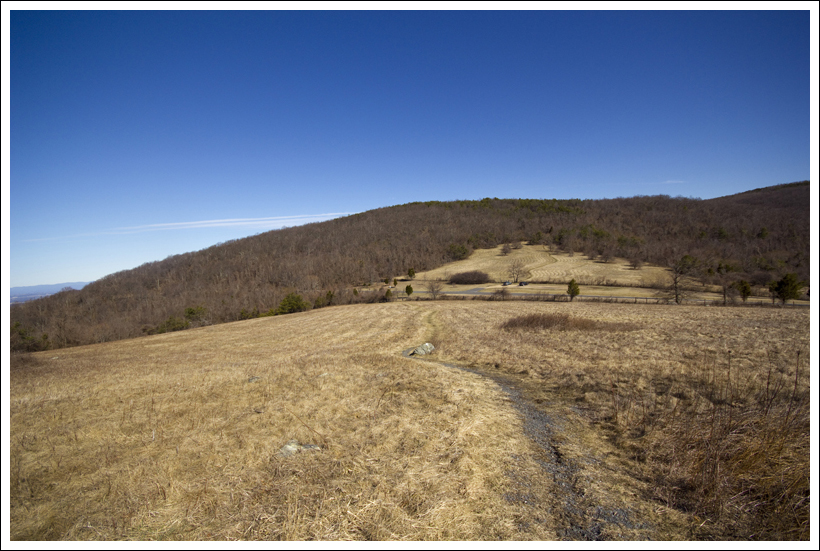
Walking up to Bear's Den Mountain
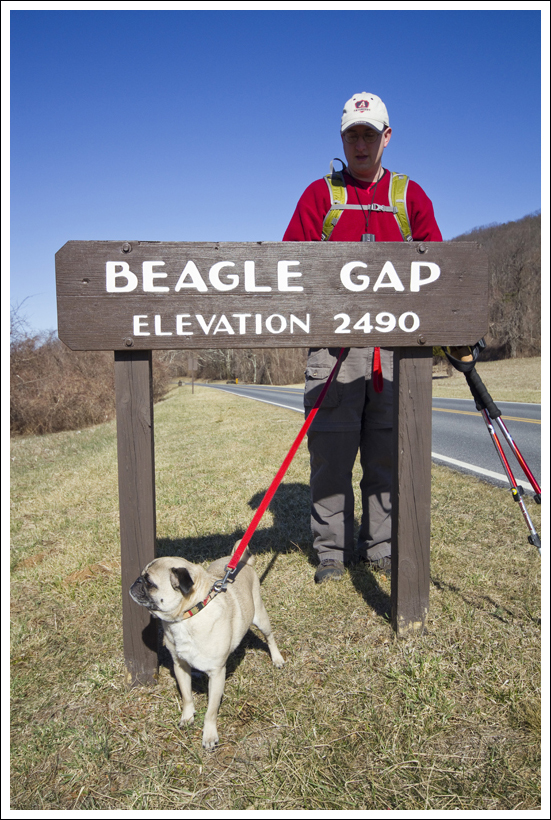
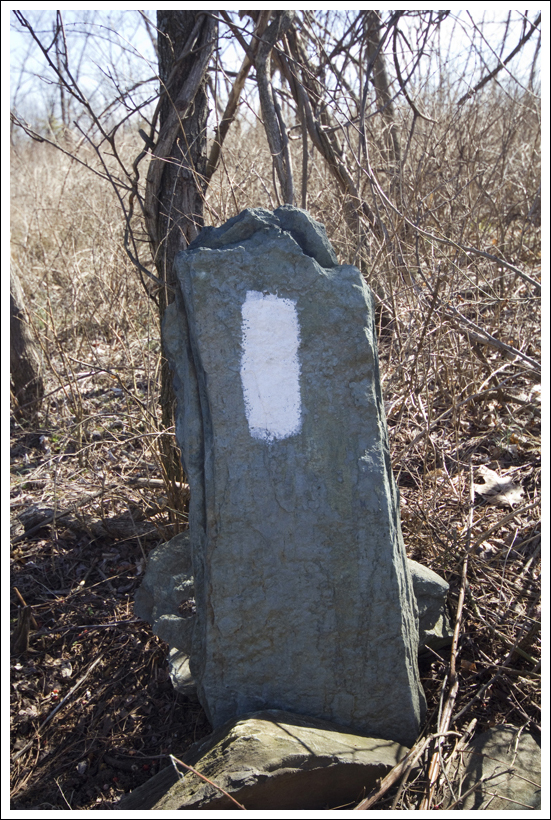
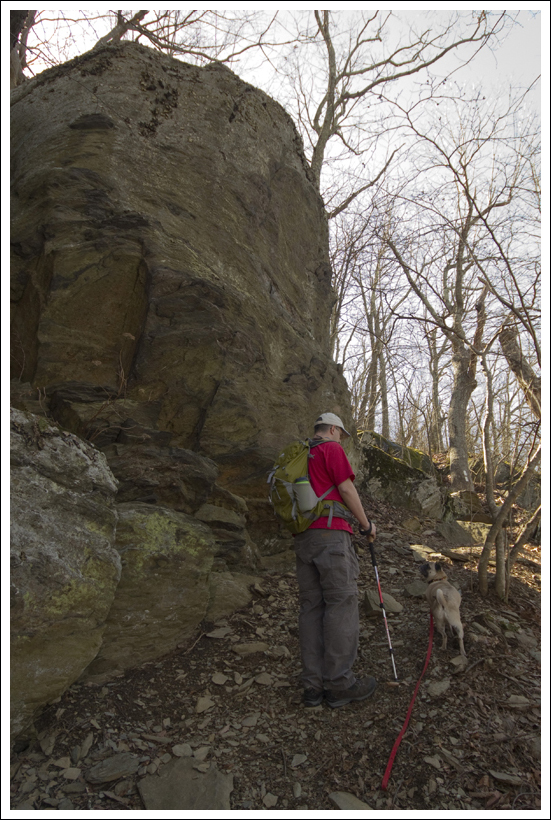
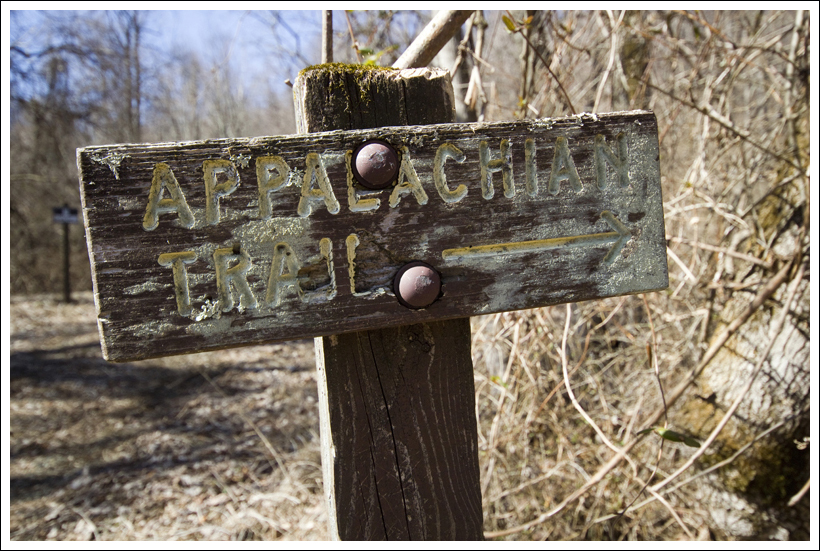
Adam makes his way along the Appalachian Trail up to the top of Bear’s Den Mountain.  Below: Adam and Wookie pose at the Beagle Gap sign;  This white blaze looked like it was painted on a headstone; Adam passes some giant rocks along the trail.

Beagle Gap Trail Sign White Blaze Large Rocks

Adam Says…

Those that have been following our blog may know that we have been working on hiking the Appalachian Trail through Shenandoah National Park in smaller sections.  On this day, we decided to handle the stretch between Beagle Gap to Rockfish Gap in the south district.  We left one vehicle at the junction of I-64 before the pay station at the park’s south entrance.  We then drove into the park and parked at the Beagle Gap parking area (not the Beagle Gap overlook).

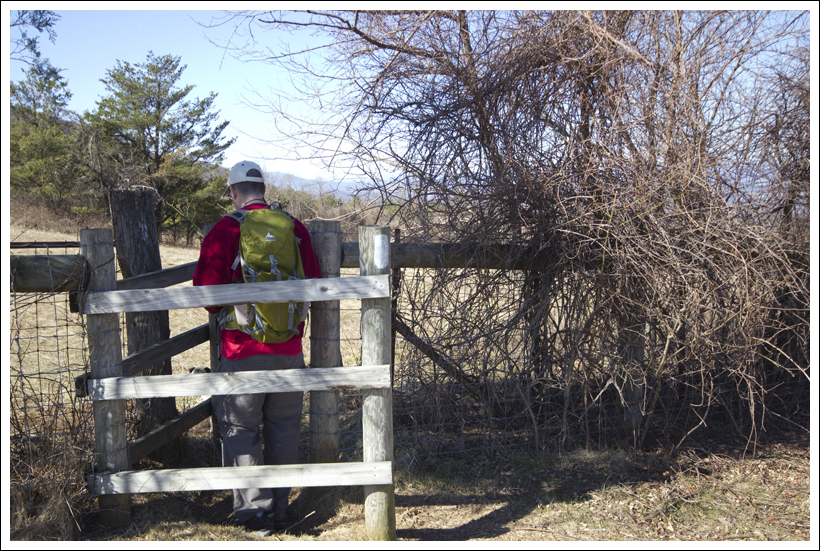
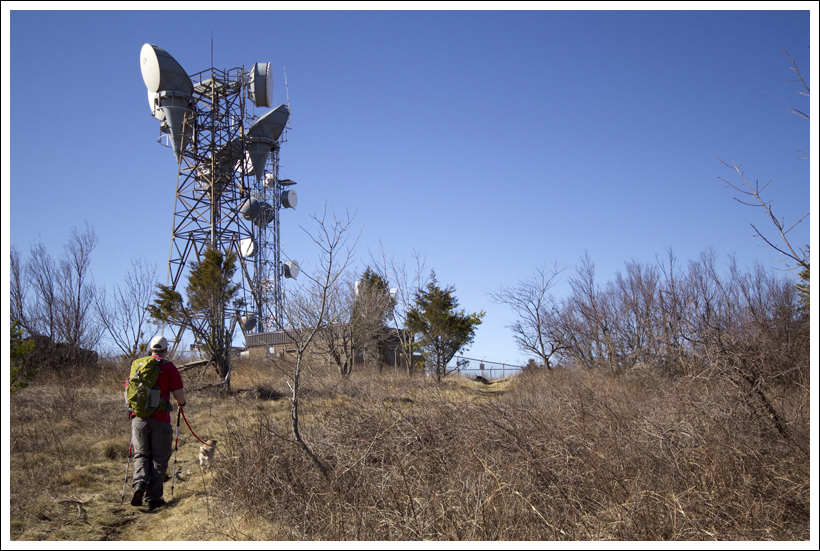
The Appalachian Trail crosses the road at this gravel parking lot.  We crossed the road from the parking lot and headed through the gate.   Take a left as soon as you go through the gate and walk through the field .  The south-bound AT then climbs rather steeply through some open areas and crosses over a fire road early on the trail.  At .5 miles, you reach a communication tower and some old tractor seats.  I’m sure that many AT thru-hikers have enjoyed taking a brief rest on these seats.  At one point, I’m sure these seats provided a nice place to view the western sunset, but now the trees in front have blocked some of the scenery from view.  Continue past this area and keep following the white blazes to stay on the trail.  At the one-mile marker, you will come to another communication tower.  Stay on the white-blazed AT and the trail begins to descend.  At 2.0 miles, the trail reaches McCormick Gap and crosses Skyline Drive.  Cross the road and you will come to a small ladder stile that will lead you on to private land.

This part of the trail is on private land, but hiking on the AT is allowed.  As soon as you cross over the stile, you will see a weathered sign pointing the way to continue on the Appalachian Trail.  This section of the AT is very steep as it winds up Scott Mountain.  At 2.4 miles, the trail levels off and you will begin to enjoy some obstructed views (probably very limited during the spring and summer months) of Waynesboro and the farmlands around the city.  At 3.0 miles, you will begin several miles of very gradual descent (with some uphills thrown in) until you come out onto Skyline Drive.  Continue to follow the road for a brief walk back to your car, crossing a bridge over I-64 before reaching your vehicle.

AT Crossing the Meadow
This is one of the few open, meadow-like sections of the Appalachian Trail in Shenandoah National Park. Below: This section of the trail uses an easement on private land; Some colorful dried plants on the mountainside; An open and barren view from Bear’s Den Mountain.

Fence Pretty and Colorful Still barren in early spring

The hike from Beagle Gap to Rockfish Gap was an interesting section of the AT.  The way up to the communication towers included some of the more open areas of the park.  Most hikes in Shenandoah National Park involve hiking through the woods, but this first two-mile section gives you nice views around.  When we got to the communication tower, it was interesting to think of what would have been here before these towers existed.  I can just imagine people in the 1950s hiking up from the road to view the sunset and perhaps having a picnic at the top.  You can also read an interesting history on the area on PATC’s website here which explains the use of Rockfish Gap during the Revolutionary War.   I’m glad we did this hike before Spring hit, since many of the views through the woods would have been obstructed with leaves on the trees.

Christine Says…

Well, winter is over and we didn’t meet our goal of finishing the entire AT through Shenandoah.  In fact, we’re still less than a quarter of the way there.  The road through the park was closed so often this winter, that it was really tough for us to get to the sections we needed to hike.  The section we hiked most recently, Beagle Gap to Rockfish Gap was a shorter segment than we usually like to hike.  Adam’s knee was bothering him, we wanted to take Wookie and we had a limited amount of time, so the 5.7 mile segment ended up being perfect for the day.

Tractor Seats on Bear's Den Mountain
Old tractor seats are planted in the ground next to the radio towers on Bear’s Den Mountain. Below: The radio towers; Wookie enjoys relaxing on a tractor seat.

Radio Towers Wookie on a tractor seat

The day was so pretty and warm!  The skies were crystal clear and blue, but there weren’t really any signs of spring in the mountains yet.  I led Wookie on his leash – which was a little bit tricky to do with my trekking poles.  He kept yanking them slightly forward or to the side, especially on uphills and downhills.  Wookie is actually really well-mannered on a leash – but he likes to walk up and down hill much faster than I do!  I envy his energy.

We took a short break atop Bear’s Den Mountain to enjoy the open views.  The radio towers are a distraction from the natural beauty of the area, but I suppose they’re necessary.  Upon leaving the summit, the trail was actually a little bit confusing.  There were some unmarked side trails that crossed the path.  The fire road that runs alongside the trail was also somewhat misleading.  Luckily, the AT through Shenandoah is generously marked with white blazes and even when we took the wrong path, we were quickly able to notice the lack of blazes and set ourselves right.

Climbing the Stile
Adam climbs the stile heading south out of McCormick Gap. Below: A beat up old AT sign; Wookie and Adam share some trail mix; The PATC does a great job maintaining trails and shelters along the AT in Shenandoah.

Beat up AT sign Wookie Begging for Trail Mix End of the Park

I noticed that this section of Appalachian Trail was a bit more up and down than typical for the park.  The climb down and up through McCormick Gap is actually quite steep – especially the southbound climb up leaving Skyline Drive.  That was really the only tough section of this hike.

Once we were out of McCormick Gap, the remainder of the hike was a gentle series of rolling ups and downs (mostly).  We passed a lot of giant boulders, had a snack, crossed a shallow stream, and enjoyed the views looking down into Waynesboro.  We passed a couple other hikers headed north and saw one southbound backpacker. Soon, Skyline Drive and the distant interstate came into view and we were back at the car.

Wookie Says...Wookie Says…

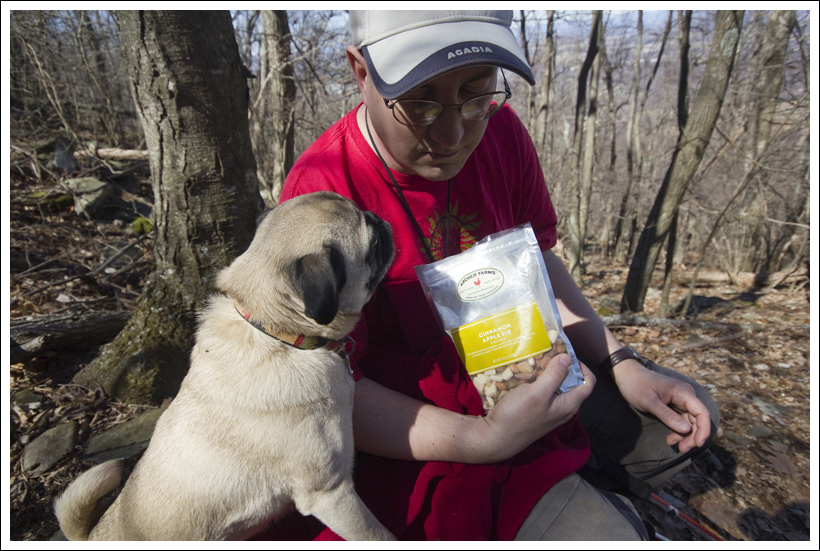
When I heard Christine and Adam talking about hiking from Beagle Gap, I knew I had to come along.  I was assuming that this was an area that beagles gathered, so I thought it would be great.  But alas, there were no beagles around.  We hiked up to the communication towers and I got to sit on the old tractor seats.  I was a little skeptical at first, but I found a good seat to enjoy the views and relax a little.  I had two big highlights on the hike.  The first was meeting Winnie.  Winnie was another pug that I met on the trail.  Her master was a PATC member that actually maintains this section of the trail.  It was impressive to learn that Winnie’s master also backpacked the entire Shenandoah National Park over ten days for her 70th birthday!  I’m always a little nervous meeting new dogs on the trail, but it’s nice to see some other hiking pugs out there.  My second highlight had to be the snack that I had.  Adam gave me a few bites of Cinnamon Apple Pie trail mix which included some dehydrated apple bits, cinammon-covered yogurt, and pecans.  It was a great boost to give me some energy to finish the hike.  Overall, the trail wasn’t too tough for me.  There are a few steep sections in the beginning and from McCormick Gap up to Scott Mountain, but by the end I was proudly leading the way.

Trail Notes

  • Distance – 5.7 miles
  • Elevation Change 800 feet
  • Difficulty –2.5. There are a few uphill steep sections heading southbound, but the longest stretch of them is .3 miles.
  • Trail Conditions –4. The trail is well-maintained and the footing was great.
  • Views – 3.5. The best views are during the beginning of the trail before you reach the communication towers.  There are obstructed views towards the second half of the trail.
  • Waterfalls/streams 0. Non-existent.
  • Wildlife – 1. Other than birds, we didn’t see much wildlife here.
  • Ease to Navigate –3. The only tricky section was around the communication towers.  You just want to be sure you follow the white-blazed trail.  I believe the other trails from the communication towers will still bring you the same way, but I would stick to the white blazes.
  • Solitude– 3. We only ran into a few people on this trail. During the summer, the hike from Beagle Gap to the summit of Bear’s Den Mountain is quite popular, though.

Directions to trailhead: On Skyline Drive, park at mile 99.5 at the Beagle Gap gravel parking lot on the eastern side of the road.  The trail begins across the road on the western side and through the gate.

Saddleback Mountain Loop

The Saddleback Mountain Loop is a hike for people that are looking for a convenient day hike of moderate length – about six miles.  There aren’t any great views, but it is an enjoyable walk.

Gnarled Tree on the Saddleback Trail
Adam walks under a fallen, gnarled tree on the Saddleback Trail.

Adam Says…

Sorry it has been awhile everyone.  We’ve had a crazy fall and haven’t been able to get out as much as we had hoped.

We have had a plan this winter to try and do sections of the Appalachian Trail through Shenandoah National Park.  We thought we would start with a shuttle trip to cover the section from Swift Run Gap to Lewis Mountain.  We made our way up to the Swift Run Gap entrance to Shenandoah Park and talked to the ranger at the gate.  He told us that the entire drive was closed, but we could do some day hikes around the area.  He said there was snow and ice on the road and they were also worried about more bad weather moving into the area later that night.  Boooo!  We went back to the car, upset that our plans couldn’t work out the way we wanted.  Rather than admitting total defeat, we decided to try a loop hike that included Saddleback Mountain.  It was close enough to the entrance gate that we could walk into the park from Route 33.

Skyline Drive Closed for Snow
Skyline Drive Closed for Snow.  Below:  The trailhead had a small amount of snow; The trees overhead were all bare; We saw a little bit of milkweed still hanging on.

Snow at the Trailhead Bare Trees Milkweed

Throughout the hike we got a few glimpses of Skyline Drive through the woods and we never saw any snow.  I talked to a friend of mine who is married to a ranger and he said that often they close the road because they don’t want to have people get trapped up there.  Then, the rangers have to deal with them, since they typically close during hunting season at 5PM.  I also found out they send one ranger north to inspect the Central section and one ranger drives up from Waynesboro to view the Southern section.  We found out later that the Southern section ended up remaining open all day, so we could have done a different hike.  Oh well, at least we were able to cover something we hadn’t done yet for the blog.

The hike starts where the Appalachian Trail crosses the road at the border between the Southern and Central Districts of Shenandoah National Park.  Heading north up the white-blazed trail, the trail ascends steadily.  After a few tenths of a mile, you will see an unmarked path to the right that leads to an old family cemetery.  It was nice to pay some respects to the families that lived and died here on the mountain.  Continuing back on the AT, the trail continued to slowly ascend.  At 1.4 miles, you reach a junction with the blue-blazed Saddleback Mountain Trail.  Take a right on this trail to make this hike a loop.  The Saddleback Mountain Trail goes around the mountain, which was a nice break from climbing uphill.  We saw a few nice icy formations and some heavier patches of snow on this shadowy side of the mountain.  At 2.6 miles, you will come to a PATC maintenance hut.  These huts are scattered throughout the park that serve as places where PATC volunteers can have access to some tools to help repair sections of the trail.  There is an open outhouse here and a spring nearby, but we found that the spring was mostly dry.  We continued past the PATC maintenance hut for .2 miles on a fire road until we met the junction with the AT.  Head south on the AT and you will have 2.7 miles until you reach the original trailhead.  As I mentioned before, the Saddleback Mountain goes around the mountain, so when you start the trail you will again be heading uphill until you reach the summit.  The summit was not marked, but it was nice to have a downhill trip back to the car.

Snow on the Trail
The shady side of the mountain had a little snow.  Below:  We took a short side trail to take a look at an old cemetery; Even though there was a little snow on the ground, the morning temps were well above freezing; We saw some recent bear scat and scratches along the trail.

Cemetery Not Cold Bear Scratches

On our way back downhill, we ran into two hikers that were there hoping to catch up to the Valley Hikers group that were evidently doing that hike to South River Falls.  They got a late start but said there was a note on a car telling them where they went.  We talked to the couple for a while before parting ways.  When I got back home, I checked my email and it looks like the Valley Hikers changed their itinerary completely and were not doing the South River Falls after all.  I hope the couple didn’t get too discouraged on their trip.  Valley Hikers is a great group to join if you are interested in meeting up with some other people in the Shenandoah Valley that enjoy hiking.  Members are of all skill levels and they do a good variety of hikes and an occasional backpacking trip.  I do belong to the group, but I have yet to meet up with them to do a hike.

When Skyline Drive is open, you can also do a shorter version of the Saddleback trail, starting from the South River Falls picnic area.  From that direction, you would have just a few tenths of a mile of an uphill hike to the summit area.

I’m glad we were able to get out and do a hike after our hiatus.  Even though this trail doesn’t have a lot of great views, it is a nice walk in the woods and it was good to get some exercise outdoors on a cool winter day.

Christine Says…

With our original plans foiled, we sat in the car for a few minutes and deliberated our options – go home or figure out an alternate hike route that allowed us to walk into the park from outside the pay station.  I’m really glad we decided to go for the latter, because the hike (while rather uneventful) turned out to be a pleasant way to spend the morning.  It was great to get back out on the trail after a month of sloth (the flu and three weekends of art shows severely limit the ability to hike!)

PATC Maintenance Building
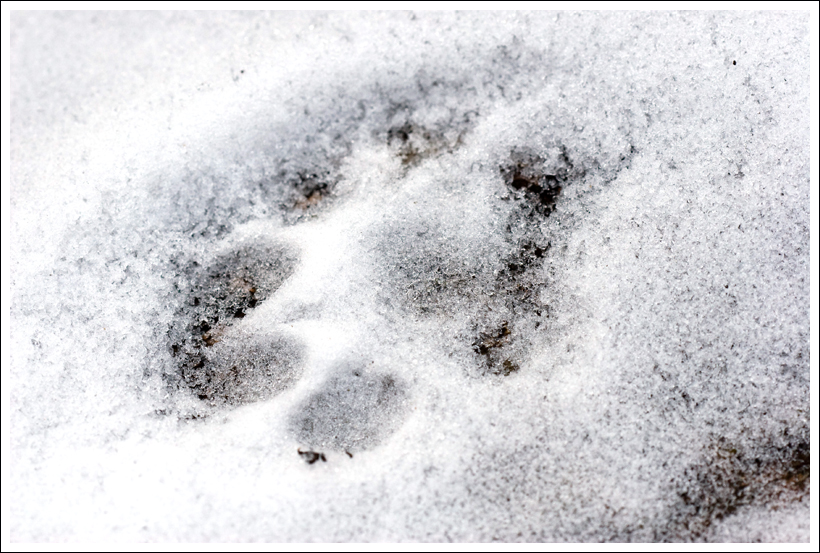
PATC Maintenance Building.  Below: Adam checks out the map at the first trail intersection; Someone left pennies on top of each of the cement trail marker posts; We saw some pawprints in the snow – maybe a fox or bobcat – they were too smudged to determine for sure.

Adam checks out the map Penny Pawprints in the snow

As we started up the Appalachian Trail, I couldn’t help but remember that this was the exact spot we met our friends from The Traveling Circus back in May.  The trail looks pretty different now than it did back then – bare trees and fallen leaves instead of a lush tunnel of green.  While the woods might be prettier in the spring, summer and fall, there is still something I really enjoy about winter hiking.  I like the lack of bugs, the fact that I don’t get sweaty, the solitude and the glimpses of views through the trees that you miss the rest of the year.

A few tenths of a mile up the trail, we took a short spur to take a look at an old cemetery.  Headstones we saw dated back to the turn of the twentieth century.  Many of the people buried here lived in the park throughout the 1800’s up until they were forcibly removed in the early 1900’s by the US Government.  I think there were many older unmarked graves as well, but we took a few minutes to read each of the headstones still left standing.

After leaving the cemetery, the trail climbed gently, but endlessly, uphill to the junction of the Saddleback Mountain Trail.  There really wasn’t anything remarkable about the trail to this point – no amazing scenery, just the occasional peek through the trees at the valley and Skyline Drive below.  Adam and I laughed at how bare of the snow the drive was every time it came into view.  We really don’t understand why it was closed at all.

We turned onto the Saddleback Trail and enjoyed a relatively flat walk skirting around the shoulder of the mountain.  Near the end of the trail, we passed a PATC maintenance cabin and a pit toilet.

We stopped to rest a few minutes.  I noticed a thermometer on the hearth outside the cabin and saw that it read 40 degrees – pretty balmy for a winter hike!  The morning we hiked, a bit of a southerly air flow arrived.  The warmer air came in aloft, creating the rare phenomenon that it was much warmer in the mountains than it was down in the valley.

From the PATC cabin, we passed the South River spring (a boxed spring intended as a water supply) and headed up a short fire road to meet back up with the Appalachian Trail.  We turned south, and walked along the AT, climbing up to the summit of Saddleback Mountain.  The summit of Saddleback is covered with trees and does not offer a view.

After crossing the summit, the hike was an easy, all-downhill stroll back to the car.  Even though we didn’t get to hike the route we originally planned, this Saddleback loop made a great substitute and we had a fun morning.

Trail Notes

  • Distance5.9 miles
    (Check out the stats from Map My Hike)*
  • Elevation Change – about 1080 feet
  • Difficulty – 2 There is some steady uphill, but it is manageable.
  • Trail Conditions – 3.5. Since most is on the AT, the trail is very well-maintained, but rocky and steep in spots.
  • Views1. We only had a few views through the trees, that I’m sure would not be there when leaves are on the trees.
  • Waterfalls/streams – 1. Two springs near the shelter.
  • Wildlife – 3.5. We did see deer and heard the echoing sounds of a pileated woodpecker.  There was also fresh bear scat in the area and possible tracks in the snow.
  • Ease to Navigate –4. This is fairly easy to follow if you read the concrete posts at the junctions.
  • Solitude –4. You may see some hikers on the AT due to the proximity to the South River picnic area.

MapMyHike is not necessarily accurate, as the GPS signal fades in and out – but it still provides some fun and interesting information.

Directions to trailhead: Once you go through the Swift Run Gap entrance station, park your car across the street from the stop sign.  The Appalachian Trail sign is straight ahead and head north.

Duncan Knob

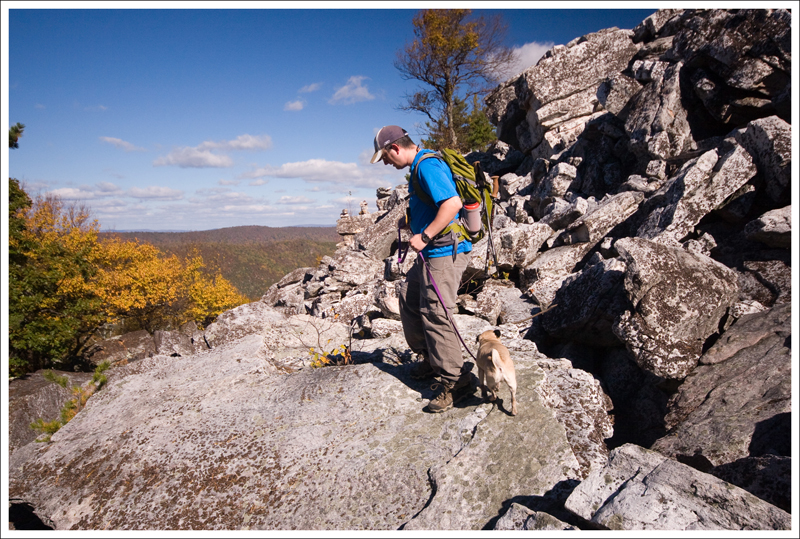
Duncan Knob is a great 3.4 mile hike in George Washington National Forest, located near Kennedy Peak and Strickler Knob.  Reaching the summit requires negotiating a Class III rock scramble.

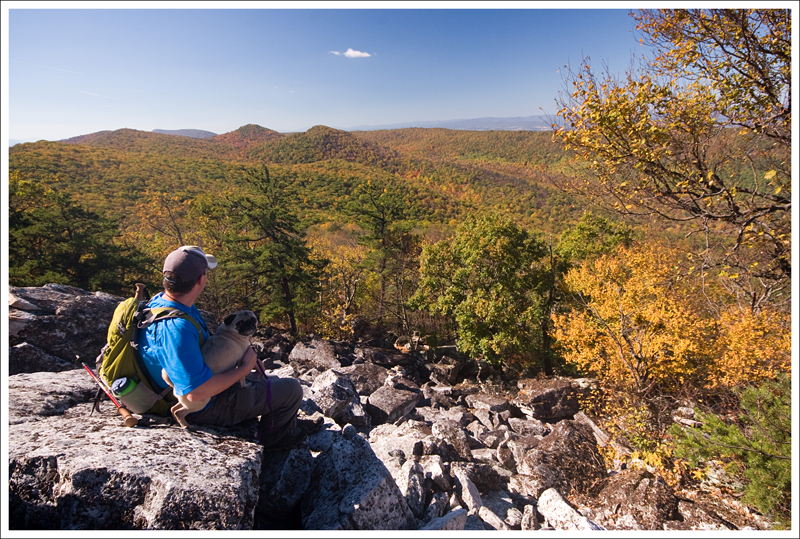
Wookie Enjoys the View from Duncan Knob
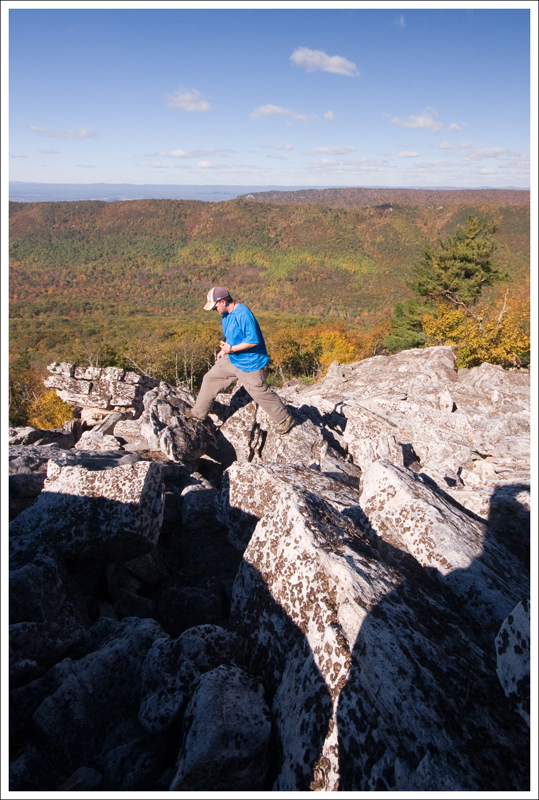
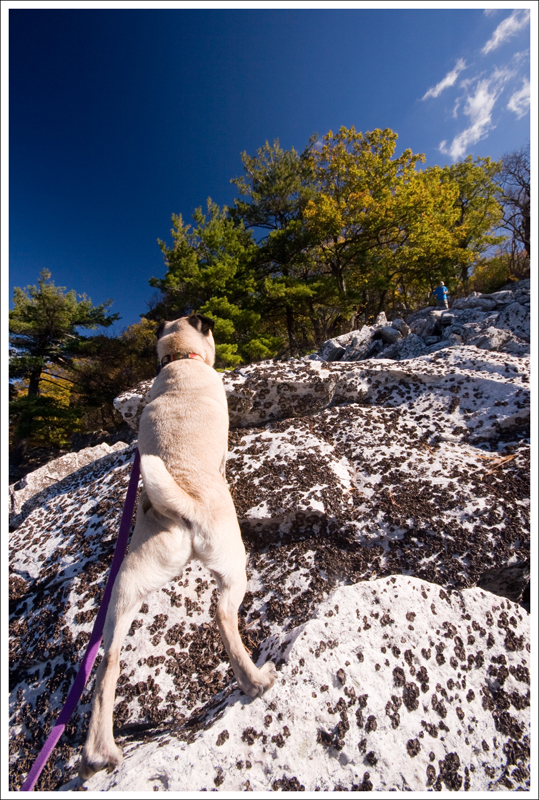
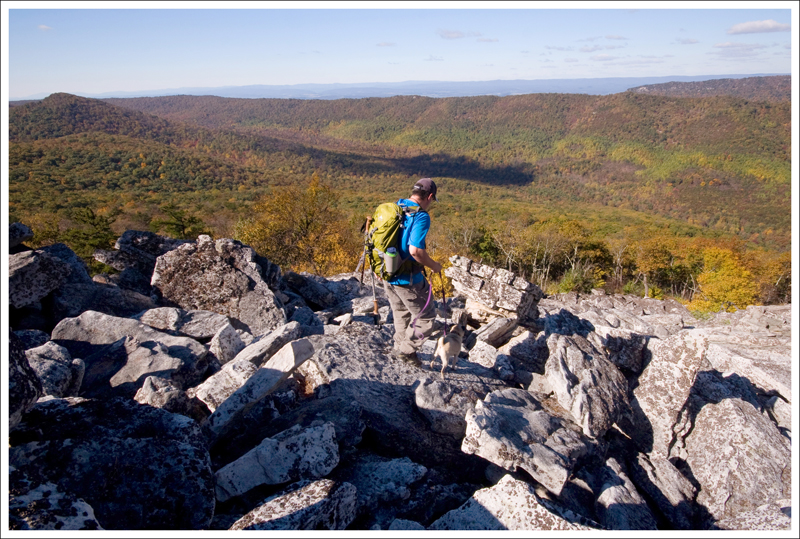
Wookie Enjoys the View from Duncan Knob.  Below: The foliage along the trail was pretty;  The scramble is a foreboding pile of boulders; Adam and Wookie make their way up the scramble.

Rocky Trail View of the Scramble from the Bottom Scrambling with Wookie

Christine Says…

On Friday, Adam and I both took a vacation day from work to get in some fall hiking. We decided Duncan Knob suited our plans perfectly.  We wanted to avoid hikes in the national park (the crowds are dreadful this time of year) and we didn’t want to drive more than an hour. We did a little online research to look at our route options, and found pretty much everyone did the hike as an 8.7 mile loop.  The common route passes by just one spot with a view and includes significant uphill climbs on both the outgoing and return arms of the loop.

We decided to look at our maps to see if there was a more direct route to Duncan Knob.  I know lots of people primarily hike for the exercise. They love anything that makes the trail longer, steeper and more challenging.  I am not one of those people.  I don’t mind distance or elevation as long as there is a payoff for it.  But if there’s a more direct route to get the same view, I usually opt to take it.  Needless to say, we were pleased to find a 3.4 mile, out-and-back route that involved just 900 feet of elevation gain.

Blue Blazed Trail Gap Creek Trail
The Blue Blazed Trail Gap Creek Trail.  Below: The Gap Creek trail is well-marked;  Near the beginning of the trail you cross a small stream; Wookie enjoyed running back and forth across the bridge.

Gap Creek Sign Trail Sign Small Stream Wookie Running Across Bridge

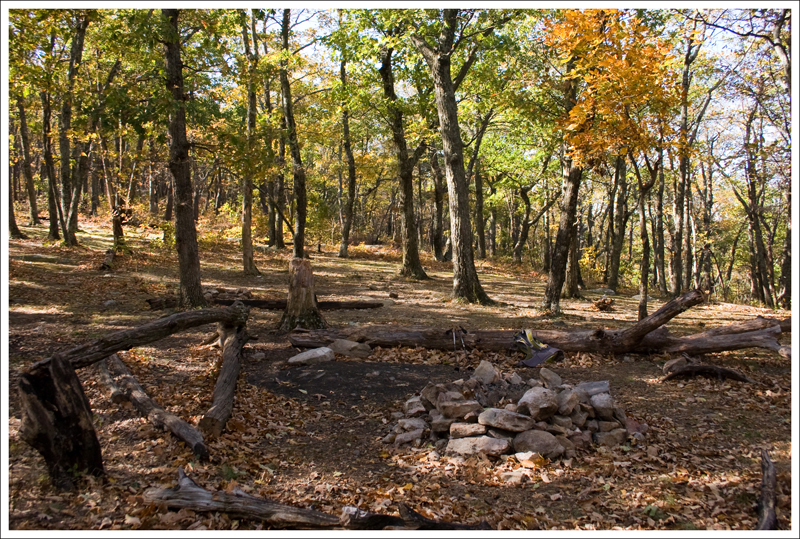
The hike starts at the Gap Creek trailhead on Crisman Hollow Road.  You’ll walk a short way up a blue-blazed fire road until you see a campsite on the left side of the road.  The road continues uphill from this point, but you’ll want to cut through the campsite and cross the small bridge over the stream.  After crossing the bridge, the trail climbs steadily uphill.  For the first mile, the elevation gain is very gentle and is punctuated by flat stretches.  The trail is extremely rocky the entire way.  At mile 1.2, the blue-blazed Gap Creek trail intersects the yellow-blazed Scothorn Gap trail.  Continue on the blue-blazed trail until you reach a level place near the top of the ridge at 1.5 miles.  There’s a great campsite at this spot.  It has a big stone fire pit ringed by log benches.  There are lots of flat places to pitch tents, too.

Directly across from the campsite, the Duncan Knob spur trail begins.  The trail is blazed white and climbs steeply uphill to the summit.  As you walk along, you’ll notice the rocks on the trail are getting larger and more abundant.  Eventually, you step out of the woods and find yourself facing an enormous pyramid-shaped summit of jumbled rocks and boulders.

More Scrambling
Wookie and Adam scramble upward.  Below: The trail becomes progressively rockier; Adam explore the boulders; Wookie spots Adam climbing back down from the geocache.

Trail gets even rockier Adam scrambles Wookie sees Adam

Climb the rock scramble any number of ways (we followed a rather informal series of cairns along the left side of the rock pile) and you’ll be treated to sweeping views in almost every direction.  The scrambling was fun and not difficult at all.  I found a nice rock “chair” to sit on while Adam found a geocache hidden at the summit.  It was freezing cold and blustery sitting on the rocks, so we didn’t stay too long.

On the way down, we stopped back by the campsite and had some water and a snack.  We even gave our dog, Wookie, some graham crackers and marshmallows from our trail mix.  He did a great job on the rock scramble – especially considering how small he is.  The hike back down was pretty uneventful and just retraced our steps.  What a great hike!  I told Adam it’s been one of my favorite recent hikes.

Adam Says…

Ever since we did the Strickler Knob hike (actually our very first post!), I had been hearing that Duncan Knob also had amazing views.  I believe we put off this hike for a while due to the long 8.7 mile length, combined with lots of elevation gain.  So, I pulled out my map of the area to see if there was a different way.  Sure enough, you can easily get up to Duncan Knob by just sticking to the Gap Creek Trail.  The hike may have a little steeper of an elevation than approaching it from the Scothorn Gap Trail, but the hike up the Gap Creek Trail is much shorter and you aren’t missing much scenery.

The trail does include a few switchbacks once you start the trail over the bridge which takes the pressure of the elevation off your leg muscles.  The hike is almost all uphill, but before you know it you’ve reached the ridge where the campsite is.  We took a break here to see if there was anything else to see along the ridge, before proceeding up the white-blazed trail to the summit of Duncan Knob.  This white-blazed trail is slightly overgrown and some of the white blazes are quite faded, but it wasn’t too hard to navigate.  After only about .2 miles on this trail, we saw the looming rock scramble in front of us.  We decided to approach the rock scramble on the left-hand side.  Once you begin to climb up a few rocks, the views really begin to open up around you.  The rocks weren’t too tough to navigate, but it was harder to help navigate a small dog on a leash.  From the top, you will have great views of Middle Mountain, Waterfall Mountain, Strickler Knob, and Kerns Mountain.  The color was very nice and we took some time to soak in the scenery.

Adam enjoys the view
Adam takes in the view from Duncan Knob.  Below: A nice campsite on the ridge; Adam and Wookie take a break on the climb down;  Wookie did surprisingly well on the scramble, but occasionally he had to be carried.

Nice Campsite View on the Way Down Climbing Down

I left Christine to keep climbing up to the summit of the rock scramble and found the Duncan Knob Geocache.  A few people before me were not able to find it before me, so the owner had taken the posting offline until he had time to investigate.  I’m glad I was able to save the owner a hike back.  This was my 499th find, so I need to do something special for my 500th geocache.

If you haven’t done any hiking off Crisman Hollow Road, I would highly recommend making this a stop in the near future.  With the Massanutten Story Book Trail, Strickler Knob, and Duncan Knob hikes all off this road, I feel this road leads to some amazing hiking gems that are unknown to many.

Wookie Says...Wookie Says…

I’m so glad that I finally got invited to go hiking again!  I really enjoyed most of this trail because there wasn’t any water for me to cross.  When we first started the trail, I did a few runs across the wooden bridge with my masters on both sides.  I was feeling frisky and I was ready to get moving.  We made our way up the trail and I felt it wasn’t as bad as I was expecting.  When we got to the final rock scramble, I was a little worried.  I really enjoy climbing up on rocks, but I wouldn’t recommend it to my less-agile canine friends.  There were a couple of moments where I had to perform an iron cross and pull myself up some rocks, but Adam helped navigate me the right way through the maze of boulders.

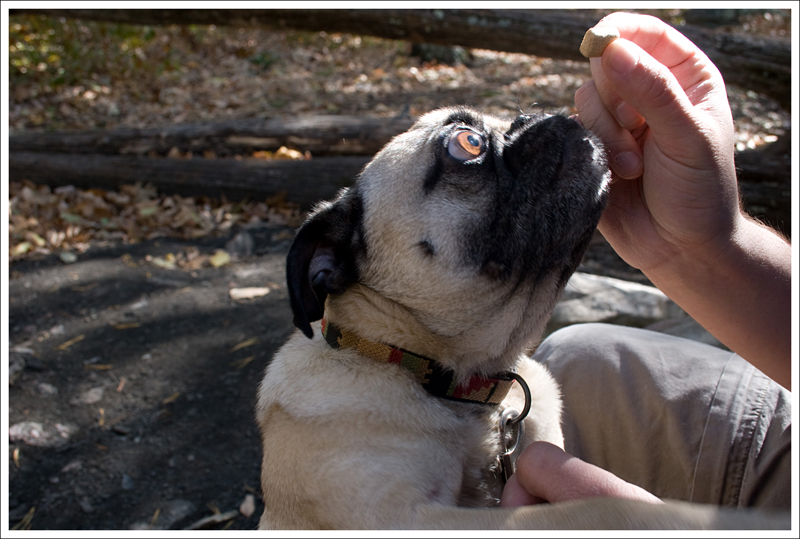
Begging for Treats
Wookie enjoys trailmix!

The way down was a little more challenging, so Adam tucked me under his arm for most of the way down to make sure I didn’t get hurt.  I really enjoyed the views from the top of Duncan Knob and I enjoyed sniffing the air around me.  After our hike back down, my masters even let me sample a few pieces of trail mix.  I really liked the marshmallows best!  One time I dropped a marshmallow and when I picked it up again the dirt from the ground made it look like cookies and cream.  I look forward to my next time hiking and I’ll be sure to put on my pitiful, pleading face the next time Adam and Christine get ready to head out for a hike.

Trail Notes

  • Distance – 3.4 miles
    (Check out the stats from Map My Hike)*
  • Elevation Change –  900 feet
  • Difficulty – 2.5. The hike is squarely moderate – even with the rock scramble.
  • Trail Conditions –3. The trail is in good shape.  The rock scramble is not formally marked and there are some unbalanced rocks.
  • Views5. Beautiful views of the Massanutten Mountain area. The view looking toward Strickler Knob is awesome!
  • Waterfalls/streams –2. The stream is seasonal and may be dry part of the year.  When the stream is running, the area is popular with fishers.
  • Wildlife – 1.5. The area is popular with hunters, so animals tend to be reclusive.  We’ve heard of people spotting bears and deer in the general area, but we’ve never seen larger animals.
  • Ease to Navigate – 3.5. Trails are clearly blazed, but turns are not labeled and signed like they are in the national park.  It’s a good idea to have a map for this hike.
  • Solitude – 4.5. On a beautiful fall day, we saw just one other couple of hikers.

Download a trail map (PDF)

Directions to trailhead: From New Market, take 211 east.  In about 3 miles, take a left on Crisman Hollow Road. The road starts off paved, but turns to gravel.  At about 4.5 miles, park on the right at the Gap Creek trail.  Follow the fire road until you reach the first campsite on the left.  The trail starts behind the campsite at a wooden bridge.

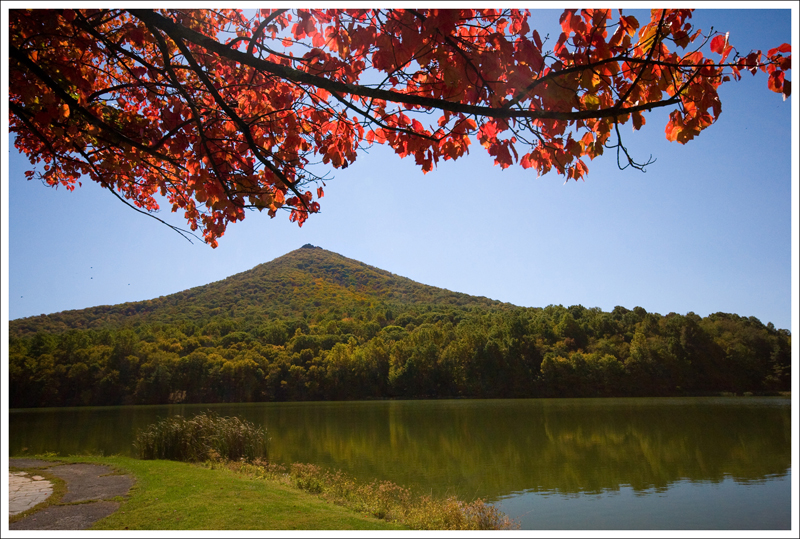
Sharp Top

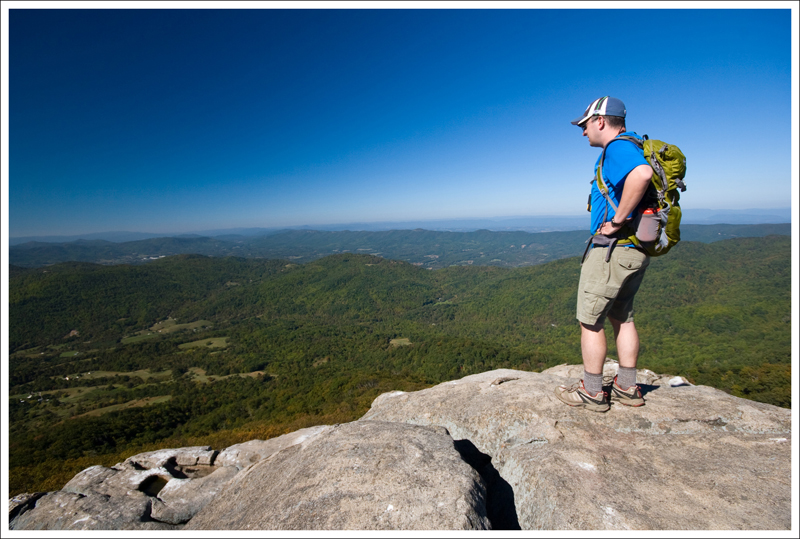
This 3.4-mile hike leads to gorgeous views from the summit of Sharp Top.  You will be treated with gorgeous views of the area around you.

View of Abbot Lake from Sharp Top Summit
The view from the Sharp Top Summit is gorgeous!  Below:  Adam walks by some of the huge boulders along the Sharp Top trail; The trail is very rocky; A set of stone steps leads you to the summit; Looking back on Sharp Top mountain from Buzzard’s Roost.

Adam Walking by Giant Boulders The trail is rocky Arriving at the summit Looking back on Sharp Top from Buzzards Roost

Adam Says…

Sharp Top has such a special place in my heart.  I grew up in nearby Lynchburg and I couldn’t even tell you the number of times I have hiked this trail.  I went with family, friends, church groups, and scouts.  My family used to regularly have picnic lunches at Peaks of Otter, so this is a place I’ve been visiting all of my life.  On one hike with a friend I had growing up, we spotted some trail runners.  Trail runners are common on Sharp Top most mornings.  My friend had said he wanted to try and be in that good of shape, so we took weekly hikes up during one summer.  We never made it up to the intensity of running the mountain, but it was some good exercise.  Lately, Christine and I have made this hike a nearly annual fall tradition.  I’ve brought my older brother a few times over the last few years.  Each year, he seems proud to know that he can still “climb up that hill.”  He was working the day we hiked it this year, so he didn’t get to make the trip.  I’ll try to get him to haul his cookies up the mountain again next year.

Peaks of Otter Nature Center
The Peaks of Otter Nature Center is the start point for this hike.  Below: The trailhead sign; The Sharp Top bus takes riders close to the summit and is a great option for those not physically able to do the full hike; The trail starts off smooth and gentle – things soon change!

Trailhead Sign The Sharp Top Bus Lower Trail

You start up the trail near the nature center.  There is a plaque there that mentions that Sharp Top was once believed to be the tallest mountain in Virginia and that a stone from this mountain was used to build the Washington Monument.  On the stone in the monument, it is inscribed “From Otter’s Summit, Virginia’s Loftiest Peak, To Crown a Monument to Virginia’s Noblest Son.”  It is hard to believe that this was thought to be the highest summit.  According to official elevations, this Sharp Top doesn’t even make the top 50 list. (another mountain, also named Sharp Top, is #42)

For those that don’t feel the need to hike all the way to the summit, you can take a bus ride that brings you closer to the summit.  More information is available on the Peaks website (http://www.peaksofotter.com/Sharp-Top-Shuttle.aspx)

This is an extremely popular hike for families and larger groups, but it definitely has some steep sections.  However, most people should be able to accomplish this hike since it is only a three-mile round trip (the side trip to Buzzards Roost adds .4 miles).  The trail starts off with a slow but steady climb and then crosses the bus summit road at .25 miles.  Continue to climb up the trail which includes some sections of stairs.  At 1.2 miles, you reach a junction.  Continue left on the trail to the summit.  The remaining .3 miles to the summit starts off relatively flat, but there are more sections of rock stairs along the way.  You will see a day-use only cabin at the summit and stairs to different platforms to soak in the views.  You will see the Peaks of Otter Lodge and Abbott Lake to the North.  To the South, you will see Turtle Rock (which some of the adventurous will find a way to climb up it) near the roof of the cabin.  Go back the way you came.  When you reach the junction .3 miles from the summit, I would highly recommend adding .2 miles (.4 miles round trip) to check out Buzzard’s Roost.  The trail is relatively flat with minimal elevation difference.  You will get more great views from here and can actually get some nice views of the summit of Sharp Top.  Buzzards Roost does require some rock scrambling and carefully navigating around large rocks, so it isn’t for the faint of heart.  Once you leave the Roost, go back to the junction and take a left down the trail to make your way back to the car.

There are lots of places to perch on Sharp Top
There are lots of places to perch on Sharp Top.  Below: Adam makes his way up the trail; The trail has many stairs built into the rock; Adam on Turtle Rock.

Adam making his way up the trail The trail has quite a few stairs Adam on Turtle Rock

As I mentioned above, there are a lot of great places nearby for a picnic or you can dine at the Peaks of Otter Lodge.  There is also a gift shop that sells sweatshirts inside that say “I Survived Sharp Top”.  While I personally don’t think it is that difficult, I can understand some people feeling that way.  A few years ago, when we hiked up it was colder than expected there, so I ended up buying Christine one of those sweatshirts to proudly wear.

Christine Says…

I’m so glad Adam introduced me to this hike.  It’s a tough little climb, but the summit is spectacular.  It’s covered with boulders the size of houses and has a view that rivals any Virginia hike.  The one downside to Sharp Top is the crowd of people you’ll be almost guaranteed to see.  It is indeed a popular place!

View of Sharp Top from Abbot Lake
A view of the mountain from the lodge at the bottom. Below: A sign lets you know you’ve arrived at the summit; At this point you can turn and go to Buzzard’s Roost or continue to the Sharp Top Summit; Another beautiful summit view.

Arriving at the Summit Trail Junction Another Summit View

I always thought Peaks of Otter was an odd name for a place, so I did a little research and found some information about the origin of the name on the nearby lodge’s website:

There are three opinions on how the Peaks of Otter got their name. The name may come from the Cherokee Indian word, “ottari,” which means “high places.” The Peaks may have been named after the Otter River, which has its headwaters in the area. Finally, Scottish settlers may have named the Peaks after Ben Otter, a mountain in their homeland that resembles Sharp Top.

We got a really early start on our morning, and were headed up the trail by 9:30 or so.  It was cool and brilliantly sunny.  Even though it was the second weekend of October, the leaves were still mostly green.  That was a little disappointing – I had hoped to hike Sharp Top at the peak of fall color.  We’ve done that in past years, and the foliage makes the view even nicer!  As we hiked up the trail, we passed several downhill hikers on their way back from watching sunrise atop the summit.  Other than that, we had the trail mostly to ourselves.

The uphill grade starts of gently, on a mostly smooth and wide trail.  For some reason, this is always the only part of the Sharp Top trail I remember.  I don’t know why, but I always seem to block the steep and rocky parts out of my mind.  After you cross the bus road, the path gets a lot tougher.  It’s fairly relentless uphill for a while.  Periodically, there are reprieves where the grade moderates and you get a chance to catch your breath.  But after each little flat spot, you’re guaranteed to have more climbing.  As the summit draws near, you’ll find yourself hiking between and around gigantic boulders.  The rock formations on this mountain are impressive!  Near the end of the trail, there are quite a few stone stairs to climb.  Almost immediately upon reaching the summit, you’ll pass the cabin.  The inside is an empty room – concrete floor, fireplace and small windows that look out to the view beyond.  It apparently used to be a concession stand.  I’m glad someone thought better of the idea and closed the place down – do we really need hot dogs and ice cream for sale on mountain summits?

Adam looking out the building window
The empty building on the Sharp Top summit. Below: Inside the summit house; A boulder jumble at the summit; View of mountains in the distance.

Inside the Building Boulder jumble Another Summit View

After passing the building, the path winds between the stones up to the highest spot.  All over the summit, there are small alcoves and large rocks to perch upon to take in the view.  Unless you started very early, the mountain will be crawling with people who took the bus ride to the top.  You can usually spot the bus crowd easily – they’re never sweaty and are often wearing dressier clothing and insensible shoes.  🙂 Hikers seem to enjoy quietly referring to the bus riders as “cheaters”.  I think it’s great that a bus ride is available for people who aren’t physically able to hike up, but I see lots of young families that I wish would give hiking a chance.

On the way down, Adam and I took the side trail to visit the Buzzard’s Roost.  For some reason, this was the first time I’ve taken the option.  The roost had amazing views, but I did not enjoy climbing up the rock.  I had an inner ear virus a few years ago, and have suffered serious bouts of vertigo ever since.  Anytime I climb places with uneven footing and precipitous, open drops I get an awful spinning sensation. It’s like the feel of my feet doesn’t match what my eyes are seeing.  It’s a very strange sensation.  Sometimes I start to panic, but I’ve found that if I stay low to the ground and go very slow, I can always manage to get where I want to go.  But needless to say… you’ll never find me doing any serious rock climbing!

Adam on Buzzard's Roost
Adam takes in the view from Buzzard’s Roost. Below: Another view from Buzzard’s Roost.

Another view from Buzzard's Roost

After the stop at Buzzard’s Roost, we started our final climb down.  I was so glad to have my trekking poles on the steep, uneven ground.  So many upwards hikers commented on them!  Everything from “We thought you were skiing down!” to “Why do you have two hiking sticks?” to “Darn… I wish I remembered to bring my trekking poles!”.  I was surprised so many people had never seen trekking poles before, but I suppose Sharp Top has a very high percentage of people who aren’t regular hikers.  Personally, after using trekking poles for a while now, I don’t know how I ever hiked without them!

The hike down was over pretty quickly and we were off to lunch!  Typically, we pack a picnic – but this time we decided to try the restaurant at the Peaks of Otter Lodge.  They had a buffet option, but it was really expensive and there was no way I could have eaten my money’s worth.  But I have to admit… that mountain of fried chicken on the buffet table looked very compelling! We settled for sandwiches instead.

After lunch, we walked along the water and did a bit of people watching.  I even saw (allegedly) an otter swimming across the lake.

Trail Notes

  • Distance – 3.4 miles.  You can make it just 3.0 miles if you don’t do the Buzzards Roost side hike.
  • Elevation Change –  1340 feet
  • Difficulty – 3. The hike is fairly steep most of the way, with a number of stairs to climb towards the middle and end of the trail.  The hike to Buzzards Roast does not have much elevation change.
  • Trail Conditions –3. The trail is well-maintained, but there are a number of sharp rocks that can make footing tricky.
  • Views5. Amazing 360 degree views from the summit give you some of the best views in Virginia.  Go up on a clear day and you will see for miles.
  • Waterfalls/streams – 0. Non-existent.
  • Wildlife –1.5. Due to the popularity, you will likely only see birds.  You may spot soaring hawks at the top.
  • Ease to Navigate – 5. Trails are well-labeled, so you shouldn’t have much difficulty navigating the area.
  • Solitude – 0. This is one of the most popular hikes in Virginia.  To escape the crowds, go up early in the morning.

Directions to trailhead: The trail begins near mile marker 86 on the Blue Ridge Parkway.  The trailhead is to the left of the nature center, which is directly across from the Peaks of Otter Visitor Center.

Snead Farm

This 3-mile hike leads to the old Snead Farm.  It’s one of the few hikes in the park that really shows off what life at the turn of the twentieth century must have been like for the people who made their homes where the park now stands.

Snead Farm - Barn and Cistern
The barn at the old Snead Farm is still in good shape. Most of the other structures are gone, only foundations left.  Below: There is a view from the fire road before you follow the final fork to the farm.

View from Snead Farm Fire Road

Christine Says…

The walk to Snead Farm is really easy and perfect for families.  Much of the trail is level and follows a fire road.  There are a couple of route options, too. If you start from the visitor’s center, you’ll walk .8 miles on the Dickey Ridge trail before reaching Snead Farm Road.  This ends up making a three-mile route, and is the route we followed.  You can also start from Skyline Drive, directly on the Snead Farm road.  This cuts the route to a mere 1.4 mile out-and-back.  Just be sure to follow the correct forks in the road, or you’ll find yourself on a walk to nowhere (like we did… more about that later).  Whatever route you choose, the going is easy and relatively level.

As far as I know, Snead Farm has the only remaining barn left standing in the park.  In fact, it’s one of the few non-park structures of any kind left standing within the boundaries. The doors are barred closed, so you can’t go inside – but you can peek through windows and gaps in the doors to see the old hayloft up top and animal stalls on the lower level.

Behind a tangle of vines, you can still climb down into the root cellar located behind the barn. The cellar is deep and lined with sturdy shelves, which undoubtedly held stores of food for the farm.  The main house’s foundation and several sets of stairs still stand slightly uphill from the barn.  The boxwoods that stood on either side of the front door are still there.  They have grown tall and wild!  The cistern is still there as well.  The farm was occupied until the early 1950’s, so the site doesn’t feel as old as some other places in the park, like Pocosin Mission.

Adam Says…

Our hike to Snead Farm ended up being longer than we were expecting.  We were using our Falcon Guide Shenandoah National Park book as a guideline and there was misleading information in the book.  I’ll try to set things straight with our own directions.  From the Dickey Ridge Visitor Center, cross Skyline Drive and walk to the flagpole.  Take a right at the plaque with hike information.  In .2 miles, you will come to the intersection with the Dickey Ridge Trail.  Take a right here and proceed for about .3 miles until you reach a fire road (Snead Farm Road).  Take a left on the fire road.  In another .2 miles, you will reach a fork on the trail.  Stay to the left.  In another short distance, you will come to another fork where you will see a concrete post.  Go to the right, heading uphill.  You will continue this trail for about .5 miles until you reach Snead Farm.  You will begin to see the barn through the trees.

We did misinterpret the information in the book since it told us to take a left at the last fork.  Since we were going a different way than the book, we ended up second-guessing ourselves.  When we thought we had gone far enough, we decided to turn around and take a different fork.  When the other fork came to a dead-end at a utility building, we realized we had been going the right way.  We went back the way we came, took the correct fork, and made our way to the farm.  We ended up adding only an extra mile to our hike, but after doing a couple of other hikes that day, we weren’t in the mood for more miles.

The Snead Farm Fire Road is pleasant walking.
The Snead Farm Fire Road is pleasant walking.  Below: The old root cellar is still standing; Another view of the barn.

Snead Farm Root Cellar Another view of Snead Barn

Christine and I marveled at how well-maintained the barn looks.  Since it was abandoned in the 50s, it is clear that the park service has kept up with maintaining the barn and even painting it.  I wonder if this will be a permanent part of the hike or if the park service will one day let this building fall prey to the elements and the woods.

Overall, this hike was a decent leg-stretcher and a good family hike.

Trail Notes

  • Distance – 3 miles
  • Elevation Change – 300 feet
  • Difficulty – 1.5 An easy walk down a mostly level trail.
  • Trail Conditions –3.5. Half of the trail followed the Dickey Ridge trail which was well-maintained and the rest is on fire roads.
  • Views1.5 Some views are seen from the final fork to get to Snead Farm.
  • Waterfalls/streams – 0. Non-existent.
  • Wildlife – 2. You may run into some of the usual park animals like deer and birds.
  • Ease to Navigate – 2.5. The turns did us wrong, so we’re marking it down.
  • Solitude – 2.5. This is a popular hike due to the proximity to the Northern entrance to Shenandoah National Park and the short distance.

Directions to trailhead: Follow Skyline Drive to the Dickey Ridge Visitors Center (around mile marker 4.6) Park at the visitors center. The trail begins on the east side of the drive, across from the center.

Buck Hollow – Buck Ridge

The Buck Hollow – Buck Ridge Trail is a steep hike in the Central District of Shenandoah National Park.  It takes a deep plunge along the Buck Hollow stream and a steep hike back up the Buck Ridge trail.

I've never seen so many different kinds of mushrooms/fungus along a trail in Shenandoah.
I’ve never seen so many different kinds of mushrooms/fungus along a trail in Shenandoah.  Below: When we hiked Buck Hollow in August of 2008, we saw two yearling bear cubs; the stream running through Buck Hollow is rather small and overgrown.

Bear

Adam Says…

I have to be honest – we have been putting off doing this trail for a while.  We first did this hike a few years ago and the memories of how tough a hike it was kept us from wanting to do it again.  Christine and I both weren’t feeling well the day we attempted it last time, but we were more pleased doing this hike this time.
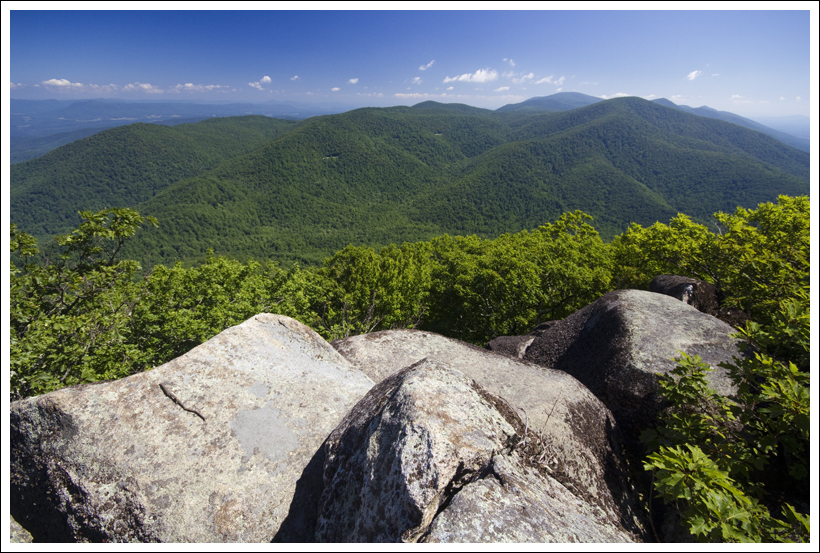
The trail starts off from the Meadow Springs parking area.  After about 20 feet down the trail, you see a post marking the Buck Hollow trail.  Take a left to go down this trail.  The trail seems to constantly descend and is rather steep in many portions.  There are loose rocks and if you attempt this after a heavy rain, you should expect some mud and slick soil on the trail.  Along the side for much of the trail, you will see the Buck Hollow stream.  Around mile 1.75, you will make a few rock-hops across the stream.  The trail continues to descend and then finally seems to just parallel the stream.  At mile 2.8, you will reach a cement post, pointing you to take a right on to the Buck Ridge Trail.  You cross the stream again and then you will quickly come up to the dreaded stairs.

For any Lord of the Rings fans, these stairs remind me of the stairs of Cirith Ungol.  “Up, up, up, up the stairs we go.”  They are unrelenting and seem to last forever, but they last less than .3 miles.  Of course, you do gain over 400 feet of elevation in this short distance.  These stairs didn’t exist the last time we did the hike; the last time, we just had a steep section of loose soil to traverse.  The stairs help make this hike more manageable, so I do thank the workers that accomplished this laborious task!

Nice Camping Spot
At the bottom of Buck Hollow, there is a beautiful camping spot with flat, open forest and easy access to water. Below: The trail starts out at the Meadow Springs Parking Area; A trail through a small slot in the rocks leads hikers to the only open view on the trail.

Trail Marker Side Trail to Viewpoing

After the stairs, the trail continues to go uphill, but it is at a much more manageable grade.  Once you are high enough on the ridge, you are treated with views of Skyline Drive and mountain views around you (including Mary’s Rock).  We found a small crevasse bisecting a large rock formation that we were able to easily climb up to get some unobstructed views.  After mile 5.2, you do come up to another concrete post.  Take a right and you will reach the parking lot in a little over .3 miles.

One interesting note that I remember from our first hike of this loop trail was near the bottom of Buck Hollow.  We were hiking along and all of a sudden we startled two yearling bears.  One of them quickly climbed a tree and the other took off up the mountain.  We kept our distance, and the one that climbed the tree climbed back down and took off in the opposite direction.  As I looked to see where the bear went, I spotted a buck and a pileated woodpecker in the same direction.  I felt that I could have taken a picture that would have looked like a wildlife mural that you often see on brochures or placemats.

We were tired after we finished the hike, but this trip we definitely felt that it was more enjoyable than the first time we attempted it.

Christine Says…
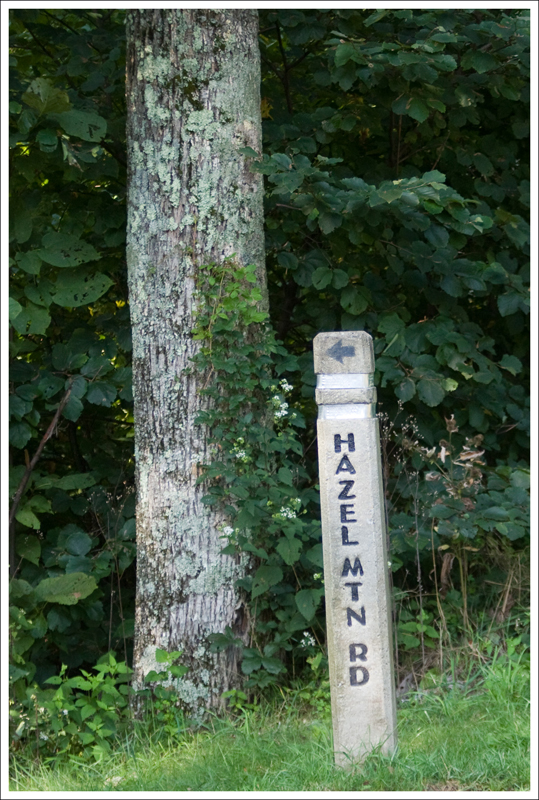
When we woke up to cool, pretty weather on Saturday morning, we decided to end our hiking hiatus a week earlier than initially planned.  I had to be at an art show by 1:00, so we needed to find a hike that was relatively short and sort of close to home.  We’ve pretty much hiked and blogged about everything in the central district of Shenandoah National Park already… with the exception of the dreaded Buck Hollow-Buck Ridge hike.

Why dreaded?  As Adam mentioned, last time we did this hike we were both fighting colds and had zero energy.  And while Buck Hollow is not the longest or hardest hike we’ve done, it certainly felt like it the last time we were there.  We ran out of water, we were fatigued, the trail felt endless and daunting as soon as we started the uphill climb.  Other than seeing the two yearling bears, the Buck Hollow hike didn’t carry a single pleasant memory.  It just made me think of exhaustion, suffering and thirst.  🙂

When I mentioned to Adam that we should probably hike it again for the blog, he looked at me with incredulity and told me that he didn’t ever want to hike there again.  Somehow he was convinced to relent, and off we went!

This time, the hike was a lot more fun!  It was still a long, steep downhill –  but I really enjoyed marveling at the huge variety of mushrooms and fungi growing along the trail.  I don’t know if there is a name for people who collect/catalog fungus, but if such people exist – this is the trail for them.  We also happened to notice a beautiful backcountry campsite at the bottom of the hollow, where the trail leveled out.  Along with easy access to water, there was a wide, flat expanse under the shade of the trees.  The forest floor in this area was open with very little undergrowth.  There were also several huge piles of rocks – maybe from old stone walls or foundations in the area.  It was a great place to take a break and have a snack.

Stairs
Although the stairs don’t look steep in this photo, they ascend nearly 400 feet in just over two-tenths of a mile.  Below: The Buck Ridge trail is lined with dense mountain laurel; The only (mostly) open view comes from atop a rock along Buck Ridge.

Dense Mountain Laurel View from the Rock

The flat terrain at the bottom of the hollow doesn’t last long.  Shortly after passing the cement post marking the Buck Hollow – Buck Ridge junction, you’ll encounter what I think is the toughest, steepest section of climbing in all of Shenandoah National Park.  Indeed, it’s a short climb – but wow… it’s STEEP.  The terrain along this little section is the equivalent of gaining 2000 feet in elevation over a mile.  I think most hikers will agree — that’s TOUGH climbing.

The Potomac Appalachian Trail Club published a review of this hike in their October 2010 newsletter.  In it they say “Steep, does not begin to describe the trail ahead.”  They also call it scary and compare it to a descent into hell.  🙂 We concur!

I was quite glad when the terrain moderated, because the steep stair climb really exhausted my legs!

Butterflies
Butterflies were everywhere along the trail. Below: The PATC trail overseer clearly loves this area.

Plate

We also noticed the nice view from atop the rock that we had missed last time we hiked.  It’s funny how being fatigued and thirsty makes you miss the best things along a trail sometimes.  The last section of the trail along Buck Ridge passes through dense mountain laurel and through patches of blueberry and raspberry bushes.  I really thought we’d see more signs of bears (and maybe some actual bears!), but we really only saw one old pile of scat this time.

The Buck Ridge trail eventually meets up with Hazel Mountain Road for the last third of a mile.  This section of trail was quite familiar, since we hiked it just a couple months ago on our backpacking trip to Catlett Mountain.  When we arrived back at the parking lot, we noticed the PATC overseer’s car was in the lot – complete with a “BCKHLW” license plate.  Clearly, the overseer loves this section of the park and does a great job maintaining the trail.

It was a fun hike – one I enjoyed far more than I expected to!

Trail Notes

  • Distance – 5.6 miles loop hike
  • Elevation Change – 1750 feet
  • Difficulty – 4. The trail is steep at the start going down and once you reach the halfway point includes a steep uphill.  Not recommended for those with knee or ankle issues.
  • Trail Conditions –3. The Buck Hollow Trail is rocky and steep, so you have to watch your footing.  The Buck Ridge Trail had better trail conditions.
  • Views – 2. The views you get are from the Buck Ridge Trail portion.  While most of these are through the obstruction of trees, there is a nice place to climb on top of a rock for a view.
  • Waterfalls/streams 1.5. You do walk along the Buck Hollow stream, but there aren’t a lot of nice views of falling water.
  • Wildlife –3.5. There are signs of bear scat around.  The first time we went on this trail, we saw two yearling bears and a buck.  Both times we have spotted pileated woodpeckers and many typical woodland birds.
  • Ease to Navigate –4. Not too many turns, just read the concrete posts.
  • Solitude –3.5. We did see a number of people on the trail that seemed to be in a group, but this isn’t overly popular.  Some people will hike up from Rte 211 to Mary’s Rock, so you’re likely to only find people on the Buck Hollow portion of the trail.

Directions to trailhead:
At mile 33.5 on Skyline Drive.  Park at the parking lot on the eastern side of the road and the trail starts from the southern end of the parking lot.