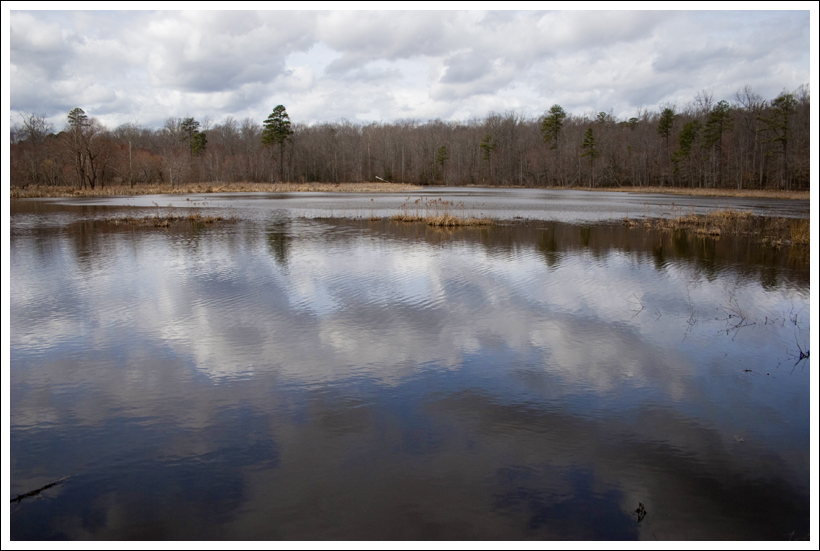
The Beaver Lake trail is a 2.5 mile loop around a 24 acre (and shrinking) lake in Pocahontas State Park.
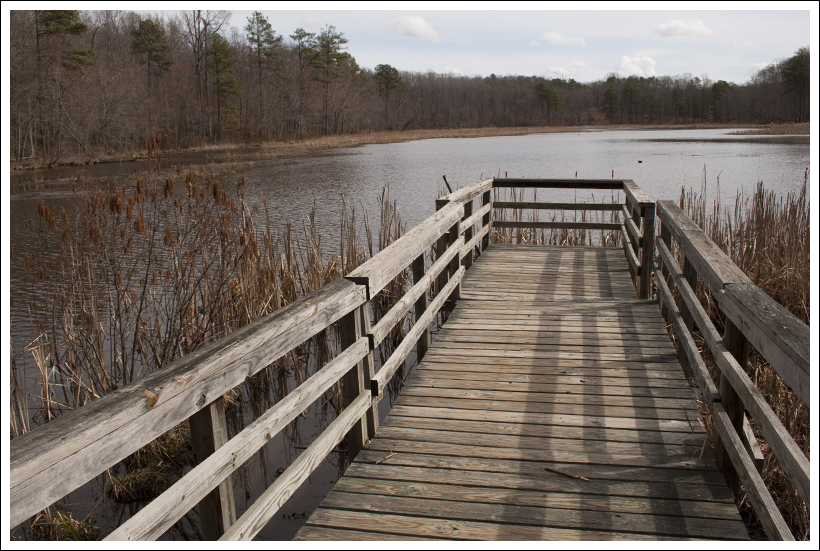
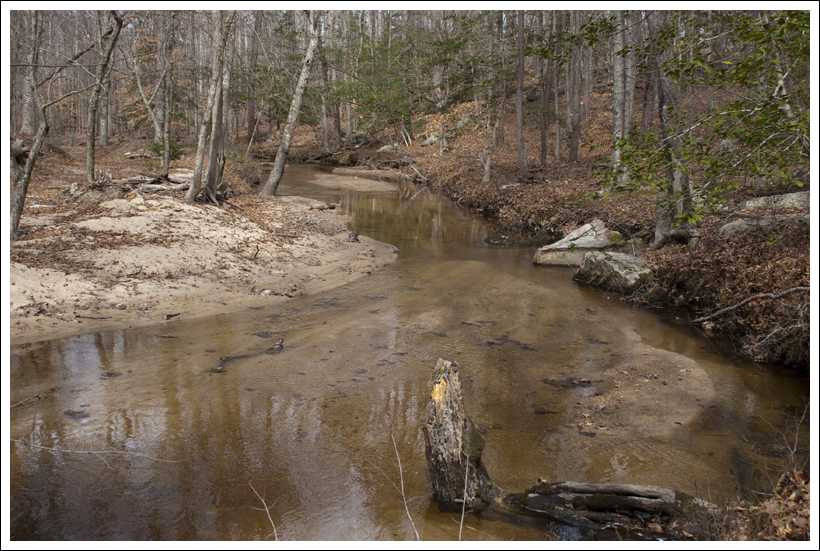
Reflections on Beaver Lake. Below: Some of the trail around the lake is traversed by boardwalks; Two docks overlook the lake; a shallow stream feeds the lake.
Christine Says…
We happened to be in Richmond for the CAA Men’s Basketball Tournament (JMU lost in the first round – Boooooooo!) last weekend. Since we had some free time on Saturday morning, we headed over to Pocahontas State Park for a short leg-stretcher hike. It was a warm, but cloudy, day – spring is definitely in the air. On our way to the park, we even saw some cherry trees starting to flower.
I was surprised by how big Pocahontas State Park is – especially so close to Richmond. As it turns out, Pocahontas is actually Virginia’s largest state park. After paying our $5.00 parking fee, we headed over to the CCC Museum and Nature Center area, where our trail began.
The hike traces the perimeter of Beaver Lake, using a series of gentle paths and boardwalks. We followed the trail counterclockwise. The near side of the path was relatively flat, while the far side climbed up a small ridge and followed a series of easy ups and downs.
Adam finds a geocache. Below: Trails in the park are clearly marked; Fallen trees have been carved into chairs; An abandoned beaver dam.
Beaver Lake is slowly being consumed by the landscape around. Erosion and plants are reclaiming the water, and turning the area into a freshwater marsh. There wasn’t much growing when we visited, but in the spring and summer, the area is covered with water lilies, cattails, and other aquatic plants. We saw a few buffleheads on the water, but they were too far off to get a decent photo. We also saw evidence of beavers – an old dam and lots of gnawed trees. Though, I doubt any beavers still live in the lake. It’s probably too shallow.
One of the things I really liked along the trail were the tree stumps that had been sawed into chairs. What a clever way to make use of a fallen tree!
The hike was short and easy, so we were done within the hour. I’m really looking forward to nicer weather, longer hikes and hopefully several overnight backpacking trips. On the way back to the hotel, we even got the chance to stop by REI! That was a real treat for us because we only have one very small outdoor store in our area. We were able to pick up some new backpacking gadgets and I got a new pair of hiking shoes. I can’t wait to try them out!
Adam Says…
When we were thinking about checking out the CAA Men’s Basketball Tournament, I suggested that we try to find a hike in the area. I had been a few years ago to Pocahontas State Park and thought it would be a great place to start.
It is great that Richmond has a nice park just about 20 minutes away in Chester, VA. This park is quite popular with people trying to get outdoors without having to drive too far. This park is definitely a multi-use area. We saw lots of mountain bikers through the park and we saw several trail runners on the Beaver Lake Trail. The footing is perfect for trail running and only has a few hills, making it great exercise or cross-country training.
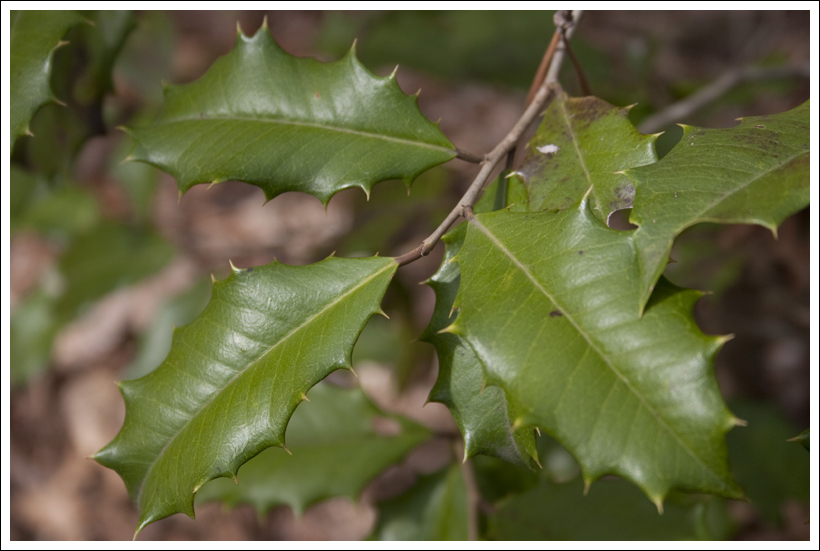
Buffleheads on the lake. Below: The park has a lot of holly growing; The first buds of spring; The trails are popular with bikers.
We parked at the nature center and found the signs for the blue-blazed Beaver Lake trail. The trail passed by an old furnace and then descended until you reach the lake. At the lake, there is a nice pier to view the water and do some birdwatching. We then took the trail counter-clockwise, which went around the lake. During most of the beginning of the trail, the lake was in view. We were serenaded by frogs in the lake, which reminded us both of the sounds of didgeridoos. Along this northern part of the lake, there are a couple of places to get close-up views of the lake. After about .75 miles, the lake shows evidence of being shrunk from what it once was as a boardwalk leads you across the swampy, marshy remains of the lake. I can only imagine the mosquitoes along the marsh during the summer.
After reaching the halfway point, the trail begins to climb up the hillside, being rather steep in some sections. The trail winds around and crosses a small stream at 1.5 miles. The trail then climbs up the hillside until views of the lake are seen again around 1.75 miles. You will then descend for a short distance and continue the trail walking along the southern side of the lake. Around 2.1 miles, you will come to a nice view of a dam at the lake. After crossing the bridge at the bottom of the dam, you will take a short ascent. You can either make your way back to the pier at this point or take the orange-blazed spillway trail back up, passing by the CCC museum, before reaching your vehicle.
There is a dam and spillway at the end of the lake.
For any geocachers, there were two geocaches to find along this trail:
The Death of Beaver Lake – an earthcache that explains the geological features of the lake succession
Piglet’s Cache – a nice geocache in honor of someone’s pet
I enjoyed our trip to Pocahontas State Park. If you’re ever in the area and want a decent leg-stretcher, try out the Beaver Lake Trail.
Trail Notes
Distance – 2.5 miles
Elevation Change – Maybe 150-200 feet
Difficulty – 1.5. There are several easy climbs on the ridge side of the lake.
Trail Conditions – 4. The trail is very well-maintained and easy to walk on.
Views – 3 The lake views were lovely.
Waterfalls/streams –3. The stream through the woods was pretty and the dam creates a nice waterfall at the end of the lake.
Wildlife –3. This seems to be a good place to see water birds.
Ease to Navigate –5. The trail is a well-marked loop.
Solitude –1. This park is located next to densely populated Richmond. We saw lots of trail runners, hikers, bikers and dog-walkers.
Directions to trailhead: From Route 10/Iron Bridge Road in Chester, VA turn on to Beach Road/State Route 655 (near shopping center). Continue on this road following the signs for Pocahontas State Park. Enter the main entrance on State Park Road. Pay the parking fee ($5 on weekends) and park at the nature center. You should be able to start seeing signs from the parking lot to the Beaver Lake Trail.
This 8+ mile segment along the Appalachian trail offers a couple nice views, a visit to an old cemetery and the opportunity to cross over one of the park’s most fun rock scrambles.
Adam hikes through the snow covering the Hazeltop Mountain summit.
Christine Says…
This winter, we planned to hike the 100+ miles of the Appalachian Trail leading through Shenandoah National Park. Sadly, our grand plans have been foiled by frequent closures of Skyline Drive. As mentioned in our last post, the road through the park closes if there is even a slight threat of a dusting of snow. So, this is the first section of AT that we’ve hiked since our Skyland to Big Meadows hike last spring.
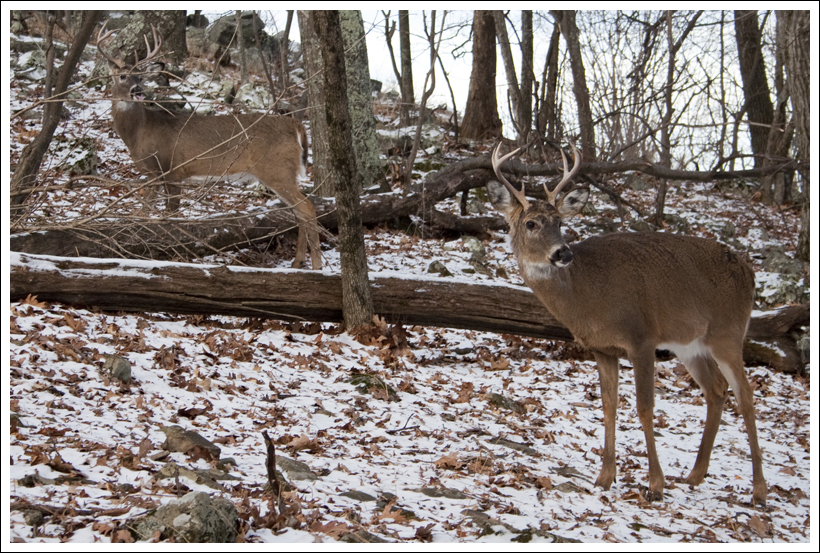
This majestic buck watched us as we started our hike. Below: He ended up leaping off into the woods with another buck friend; they continued to watch us; we parked near the campground check-in station.
We started out at the Big Meadows campground, leaving one car parked there and our other car parked at the southern terminus of our hiking route. The no-fee weekend made doing this segment hike logistically easier. We’d actually been planning to buy a second park pass to accommodate our need for two cars to do these segment hikes. The Big Meadows area was covered with a thin dusting of snow. The whole area was eerily quiet – no campers, no cars, the lodge and restaurants closed for the season. We saw so many bucks hanging out together in small groups – friends again after the animosity of mating season. One especially majestic buck greeted us at the trailhead. He watched us quizzically for a few moments before bounding back into the woods.
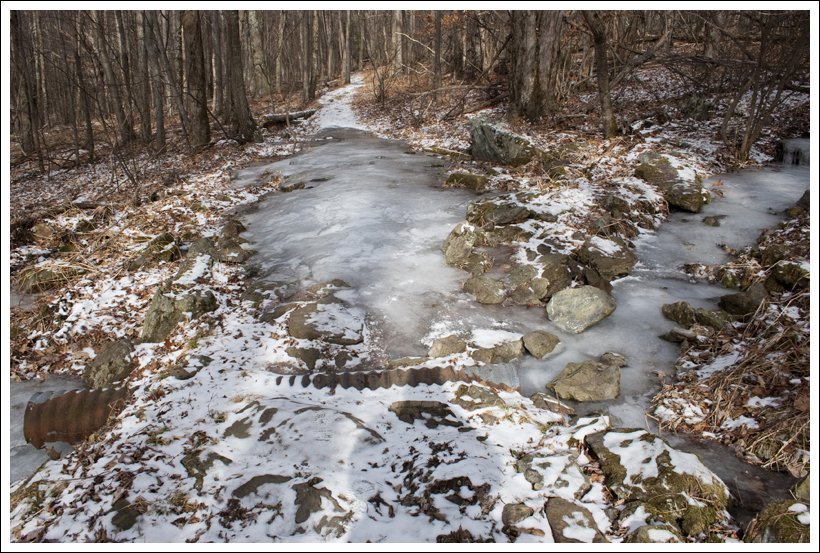
The trail was frosted with snow, and our footprints were (in many places) the first human ones set into the path. We saw lots of animal tracks along the way – deer, coyote, turkey, rabbit and bobcat. It took about the first half-mile of walking for me to warm up enough to be comfortable. Within the first mile, we passed two of the three viewpoints on our eight mile route. Both lookouts are directly behind the Big Meadows lodge area, and look into the western valley. I’m always struck by how barren winter is in our area when I get a sweeping view on a January hike. As far as the eye can see, everything is brown and faded – bare trees and a pale winter sky. Winter in places with lots of evergreens is so much prettier!
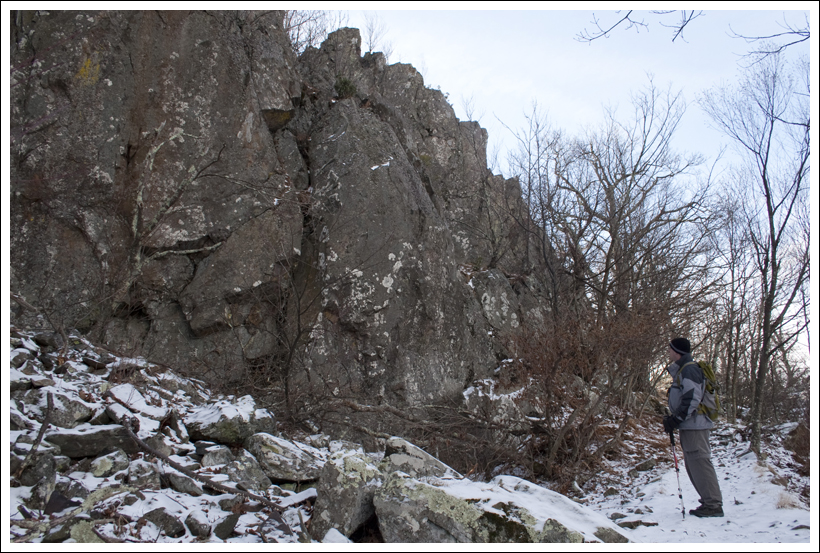
Winters are so bleak and pale in the Shenandoahs. Below: Adam takes in the view; A look at the rocks that make up the Blackrock viewpoint from below; The back of Big Meadows Lodge is visible from the trail.
After a couple miles of hiking, we reached a cemetery – the largest I’ve seen within park boundaries. There were lots of people with the last name “Meadows” buried in this one. One tombstone was engraved with the name “Fairy Meadows” – a woman who lived in the early part of the twentieth century. What a neat name!
After leaving the cemetery, we made our way toward Milam Gap. We encountered a hiker dressed all in camouflage. He had a camera with a long lens and was headed in the direction of the cemetery. We could see his footprints in the snow. They were the only human prints in the snow coming from the opposite direction. The odd thing is… they disappeared abruptly and were replaced by dog tracks. There was no trail junction or other place he could have come onto the trail where the boot prints changed to dog prints. So… here’s my theory — werewolf of Shenandoah! I’m all for starting a new myth or legend. 🙂
This cemetery is the largest weve seen within park boundaries. It sits along a park access road not generally open to the public. Below: The trail was icy between the cemetery and Milam Gap; the old split rail fence borders the parking area at Milam Gap; an interesting headstone in the cemetery.
I knew we were getting close to Milam Gap when we started seeing wizened, old apples in the snow. The area around the gap has many apple trees from an old orchard before the area was incorporated into the park. At the Milam Gap parking lot, we took a break to drink some water, stretch and look at our map. After a short rest, we crossed Skyline Drive and began the long climb up Hazeltop Mountain.
Along the way up we passed a few people at a backcountry campsite. In fact, we saw a couple groups of people on winter backpacking trips. I guess that camping in the snow could be fun, but I’ll just have to take their word for it. You can’t even have a fire in the backcountry in the park. It seems awfully bleak to go out and sleep in the snow without a campfire. I think I’ll stick to fair-weather backpacking.
The snow got sort of deep near the summit of Hazeltop Mountain. It was hard work climbing uphill in the snow. This summit has no view or marker. In fact, the only reason you know you’ve reached it is that the uphill climbing ends.
After the descent from Hazeltop, the hike continues on mostly flat terrain for a while until you get to Bearfence Mountain. For this stretch of of the hike, you’ll be pretty close to Skyline Drive. The road is often in view from the trail. You’ll climb a moderately steep slope until meeting up with the Bearfence Trail junction. If you have the time and energy, it’s worth taking the Bearfence trail loop across the rock scramble. You’ll get a third, beautiful, panoramic view from the scramble. The Bearfence trail crosses the AT again on the opposite side of the scramble, so taking this option doesn’t really add any mileage. Because of the snow on the ground, we opted to skip the scramble and stick to the AT. It was probably a good choice, because we found the trail across Bearfence mountain to be very icy. The ice was concealed by snow and was extremely slippery. I had a startling moment along this stretch of trail when I encountered a dead skunk wrapped around a tree branch. At first I thought it was a live skunk and I was about to be sprayed, but I was soon left wondering how on earth a dead skunk ended up there. Could a hawk have swooped it up and then dropped it? I really have no idea…
From this point, the trail meanders away from Skyline Drive, making the hike longer than you would expect it to be at this point. From Bearfence, the trail zig-zags down via a series of switchbacks. This section of trail is lined by rhododendrons, mountain laurels and hemlocks. It was really the only greenery we saw along the way. Eventually, the trail empties out into the parking lot marking the end of this section of Appalachian Trail.
It was a fun day and great to be out hiking again! The thing that has struck me so far with our two trail segments is how easy to moderate the AT is through Shenandoah. I’ve always heard thru-hikers remark that Shenandoah is “flat” and “all the mountain summits require more than 200 feet of climbing”. Those claims are a bit of a stretch, but walking the AT through Shenandoah is definitely much easier than hiking the blue and yellow blazed trails in the park.
Adam Says…
With Shenandoah National Park having a free weekend, we took advantage and drove two cars up so we could do a shuttle hike to cover more ground. We dropped off our first vehicle at the small parking lot near the Bearfence Mountain Hut at mile 56.8 on the western side. Keep in mind, this is not the main Bearfence Trail parking, which is around mile marker 56.4. We then combined into one car and drove to the Big Meadows Campground. The campground was closed, so we had to walk through the parking lot at the picnic area until we made it to the short spur trail that leads to the Appalachian Trail. We started on the trail heading south to make it back to the car. The Appalachian Trail is always marked with white blazes. The trail at this point is relatively flat. You’ll begin to see the lodge to the left and in about .3 miles, you’ll reach a junction with the Lewis Springs Falls Trail. Just continue on the AT. Around .5 miles, you will start seeing some lovely views of the valley below. There is a short path on the left side of the trail that is marked with a post for a view from Blackrock. This trail is often closed due to the nesting of peregrine falcons. If you decide to add this overlook, it is an uphill .2 miles to the view. The trail shortly begins to descend about 300 feet over the next mile.
At 1.7 miles, you will reach the Tanners Ridge Administrative Road. You will see to your right a large family cemetery. It is nice that families that once lived on the mountain are still allowed to be buried here. I can’t think of a more restful spot than being placed in a national park. Pick up the AT directly across the road and continue south. At mile 2.7, you will come to the Milam Gap parking lot. You will cross Skyline Drive from here to continue on the AT. The trail begins a gradual climb that will gain about 550 feet of elevation over 2 miles. At mile 4.7, you will reach the summit of Hazeltop Mountain. We did not see a marker for the summit, but you will know that you have passed it when you start descending again. The descent is more severe as you lose about 600 feet of elevation in .6 miles. At 5.3 miles, you will reach the junction with Bootens Gap (a parking lot and a horse trail).
I knew we were close to Bearfence when we saw this tree. Its very distinctive. Below: We stopped for a snack of Clif Bars along the way; A view of the Bearfence rock scramble from below.
The trail ascends again and at 6.8 miles, you will reach the junction with the Bearfence Mountain Trail. Stay on the AT heading south. After the junction, you reach the steepest and slickest ascent over the rock-covered trail. Passing the Bearfence rock scramble on your left, you will continue to rise for another . 4 miles. At mile 7.3, you will begin to descend and it is less than a mile back to the parking lot and your vehicle.
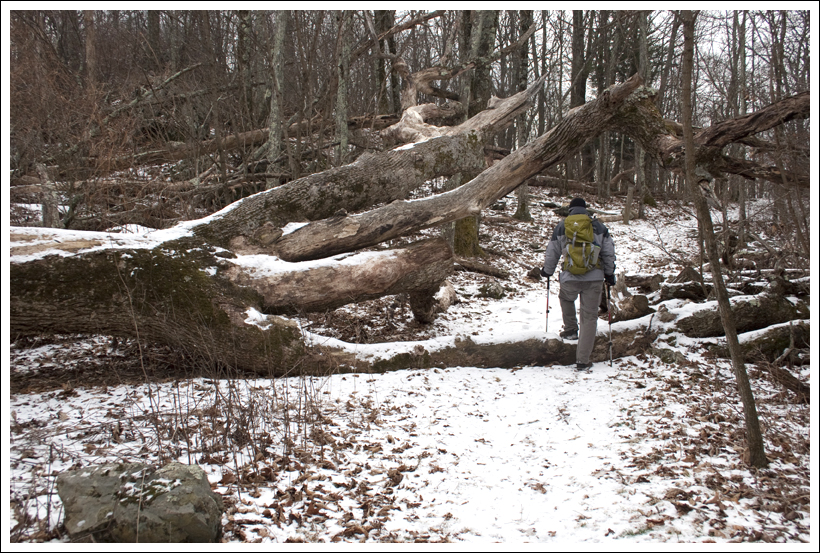
The trail was more difficult than I was expecting. I had first thought that we should do about 10 miles of the trail, but snow on the trail made for harder work. The most snow was up on Hazeltop Mountain, which we saw some remains of snowshoe tracks. While our feet didn’t sink deeply in the snow at any point, it made for tricky footing and sometimes you had to lift your legs up a little higher than normal. At some point, I slipped through some frosty areas and wrenched my knee slightly. Hiking up and down Bearfence was quite tough for me, but I’m glad we didn’t do an extra two miles.
The section of trail descending Bearfence was lined with mountain laurels, rhododendrons and hemlocks.
One aspect of the trail that I thoroughly enjoyed was being able to see coyote tracks on the trail. We’ve seen a coyote up in this area frequently during the fall. While some local farmers hate the nearby coyotes for their predatory habits, I enjoy seeing them in the protected park area. I also enjoyed seeing several bucks along the trail that greeted us at the beginning of our hike and followed nearby for the first mile of the trail.
The one regret I had during our hike was that I forgot to pack my Jetboil stove. I would have liked to have paused and had some hot chocolate along the way in the snow.
Trail Notes
Distance – 8.25 miles
Elevation Change – about 1000 feet
Difficulty – 2.5. There are several climbs of 500-600 feet, but the trail is mostly easy walking.
Trail Conditions – 4. Since most is on the AT, the trail is very well-maintained.
Views – 2.5 We enjoyed the western views near Big Meadows.
Waterfalls/streams –0. Non-existent.
Wildlife –3.5. We saw lots of impressive bucks and saw coyote tracks in the snow.
Ease to Navigate –5. Just follow the white blazes!
Solitude –3.5. You may see some hikers on the AT due to the proximity to Big Meadows. Bearfence is also a popular hike, so you’ll likely see people in that area as well.
Directions to trailhead: We left one vehicle at mile 56.8 in the small parking lot on the western side of Skyline Drive. We then drove to Big Meadows and followed the signs to the Big Meadows campground. Normally, you can drive right up to the trailhead. It is on the westernmost side of the parking lot of the picnic area at the campground.
The Saddleback Mountain Loop is a hike for people that are looking for a convenient day hike of moderate length – about six miles. There aren’t any great views, but it is an enjoyable walk.
Adam walks under a fallen, gnarled tree on the Saddleback Trail.
Adam Says…
Sorry it has been awhile everyone. We’ve had a crazy fall and haven’t been able to get out as much as we had hoped.
We have had a plan this winter to try and do sections of the Appalachian Trail through Shenandoah National Park. We thought we would start with a shuttle trip to cover the section from Swift Run Gap to Lewis Mountain. We made our way up to the Swift Run Gap entrance to Shenandoah Park and talked to the ranger at the gate. He told us that the entire drive was closed, but we could do some day hikes around the area. He said there was snow and ice on the road and they were also worried about more bad weather moving into the area later that night. Boooo! We went back to the car, upset that our plans couldn’t work out the way we wanted. Rather than admitting total defeat, we decided to try a loop hike that included Saddleback Mountain. It was close enough to the entrance gate that we could walk into the park from Route 33.
Skyline Drive Closed for Snow. Below: The trailhead had a small amount of snow; The trees overhead were all bare; We saw a little bit of milkweed still hanging on.
Throughout the hike we got a few glimpses of Skyline Drive through the woods and we never saw any snow. I talked to a friend of mine who is married to a ranger and he said that often they close the road because they don’t want to have people get trapped up there. Then, the rangers have to deal with them, since they typically close during hunting season at 5PM. I also found out they send one ranger north to inspect the Central section and one ranger drives up from Waynesboro to view the Southern section. We found out later that the Southern section ended up remaining open all day, so we could have done a different hike. Oh well, at least we were able to cover something we hadn’t done yet for the blog.
The hike starts where the Appalachian Trail crosses the road at the border between the Southern and Central Districts of Shenandoah National Park. Heading north up the white-blazed trail, the trail ascends steadily. After a few tenths of a mile, you will see an unmarked path to the right that leads to an old family cemetery. It was nice to pay some respects to the families that lived and died here on the mountain. Continuing back on the AT, the trail continued to slowly ascend. At 1.4 miles, you reach a junction with the blue-blazed Saddleback Mountain Trail. Take a right on this trail to make this hike a loop. The Saddleback Mountain Trail goes around the mountain, which was a nice break from climbing uphill. We saw a few nice icy formations and some heavier patches of snow on this shadowy side of the mountain. At 2.6 miles, you will come to a PATC maintenance hut. These huts are scattered throughout the park that serve as places where PATC volunteers can have access to some tools to help repair sections of the trail. There is an open outhouse here and a spring nearby, but we found that the spring was mostly dry. We continued past the PATC maintenance hut for .2 miles on a fire road until we met the junction with the AT. Head south on the AT and you will have 2.7 miles until you reach the original trailhead. As I mentioned before, the Saddleback Mountain goes around the mountain, so when you start the trail you will again be heading uphill until you reach the summit. The summit was not marked, but it was nice to have a downhill trip back to the car.
The shady side of the mountain had a little snow. Below: We took a short side trail to take a look at an old cemetery; Even though there was a little snow on the ground, the morning temps were well above freezing; We saw some recent bear scat and scratches along the trail.
On our way back downhill, we ran into two hikers that were there hoping to catch up to the Valley Hikers group that were evidently doing that hike to South River Falls. They got a late start but said there was a note on a car telling them where they went. We talked to the couple for a while before parting ways. When I got back home, I checked my email and it looks like the Valley Hikers changed their itinerary completely and were not doing the South River Falls after all. I hope the couple didn’t get too discouraged on their trip. Valley Hikers is a great group to join if you are interested in meeting up with some other people in the Shenandoah Valley that enjoy hiking. Members are of all skill levels and they do a good variety of hikes and an occasional backpacking trip. I do belong to the group, but I have yet to meet up with them to do a hike.
When Skyline Drive is open, you can also do a shorter version of the Saddleback trail, starting from the South River Falls picnic area. From that direction, you would have just a few tenths of a mile of an uphill hike to the summit area.
I’m glad we were able to get out and do a hike after our hiatus. Even though this trail doesn’t have a lot of great views, it is a nice walk in the woods and it was good to get some exercise outdoors on a cool winter day.
Christine Says…
With our original plans foiled, we sat in the car for a few minutes and deliberated our options – go home or figure out an alternate hike route that allowed us to walk into the park from outside the pay station. I’m really glad we decided to go for the latter, because the hike (while rather uneventful) turned out to be a pleasant way to spend the morning. It was great to get back out on the trail after a month of sloth (the flu and three weekends of art shows severely limit the ability to hike!)
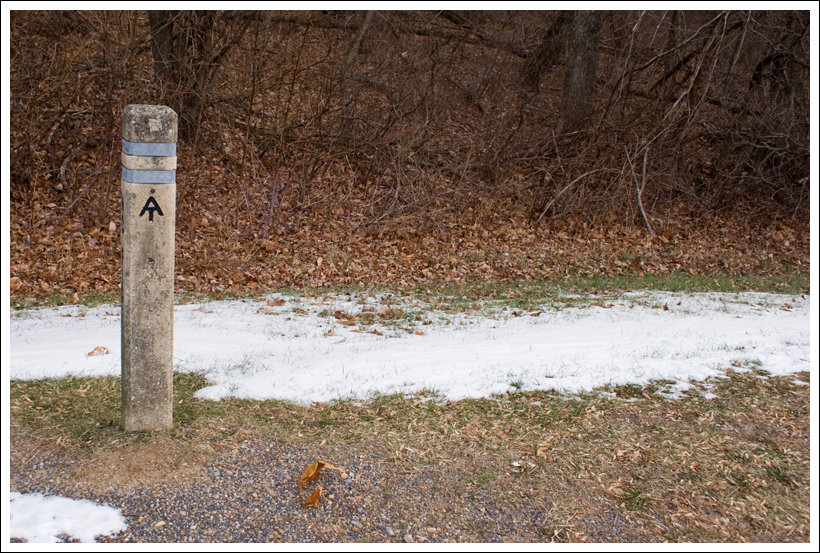
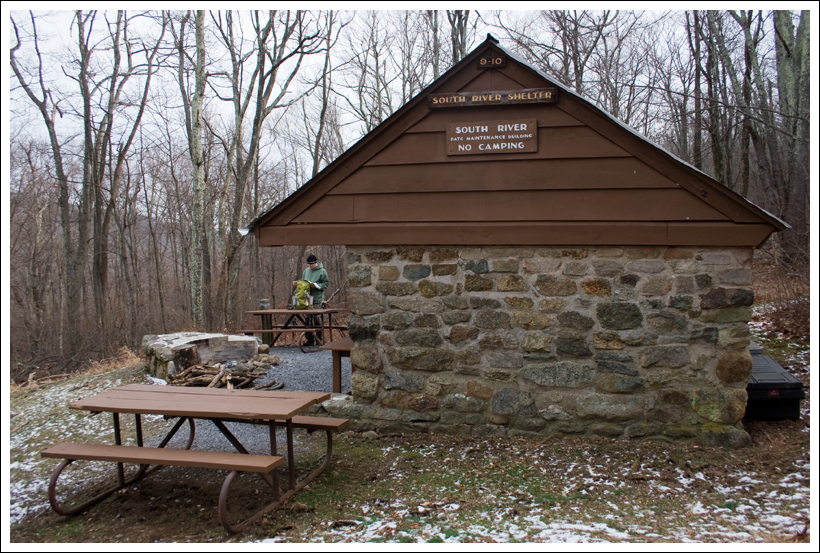
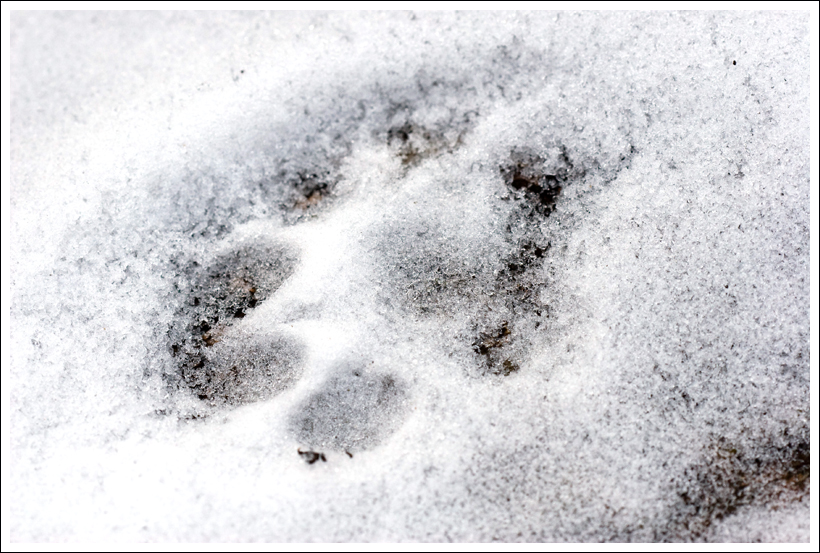
PATC Maintenance Building. Below: Adam checks out the map at the first trail intersection; Someone left pennies on top of each of the cement trail marker posts; We saw some pawprints in the snow – maybe a fox or bobcat – they were too smudged to determine for sure.
As we started up the Appalachian Trail, I couldn’t help but remember that this was the exact spot we met our friends from The Traveling Circus back in May. The trail looks pretty different now than it did back then – bare trees and fallen leaves instead of a lush tunnel of green. While the woods might be prettier in the spring, summer and fall, there is still something I really enjoy about winter hiking. I like the lack of bugs, the fact that I don’t get sweaty, the solitude and the glimpses of views through the trees that you miss the rest of the year.
A few tenths of a mile up the trail, we took a short spur to take a look at an old cemetery. Headstones we saw dated back to the turn of the twentieth century. Many of the people buried here lived in the park throughout the 1800’s up until they were forcibly removed in the early 1900’s by the US Government. I think there were many older unmarked graves as well, but we took a few minutes to read each of the headstones still left standing.
After leaving the cemetery, the trail climbed gently, but endlessly, uphill to the junction of the Saddleback Mountain Trail. There really wasn’t anything remarkable about the trail to this point – no amazing scenery, just the occasional peek through the trees at the valley and Skyline Drive below. Adam and I laughed at how bare of the snow the drive was every time it came into view. We really don’t understand why it was closed at all.
We turned onto the Saddleback Trail and enjoyed a relatively flat walk skirting around the shoulder of the mountain. Near the end of the trail, we passed a PATC maintenance cabin and a pit toilet.
We stopped to rest a few minutes. I noticed a thermometer on the hearth outside the cabin and saw that it read 40 degrees – pretty balmy for a winter hike! The morning we hiked, a bit of a southerly air flow arrived. The warmer air came in aloft, creating the rare phenomenon that it was much warmer in the mountains than it was down in the valley.
From the PATC cabin, we passed the South River spring (a boxed spring intended as a water supply) and headed up a short fire road to meet back up with the Appalachian Trail. We turned south, and walked along the AT, climbing up to the summit of Saddleback Mountain. The summit of Saddleback is covered with trees and does not offer a view.
After crossing the summit, the hike was an easy, all-downhill stroll back to the car. Even though we didn’t get to hike the route we originally planned, this Saddleback loop made a great substitute and we had a fun morning.
Difficulty – 2 There is some steady uphill, but it is manageable.
Trail Conditions – 3.5. Since most is on the AT, the trail is very well-maintained, but rocky and steep in spots.
Views – 1. We only had a few views through the trees, that I’m sure would not be there when leaves are on the trees.
Waterfalls/streams – 1. Two springs near the shelter.
Wildlife –3.5. We did see deer and heard the echoing sounds of a pileated woodpecker. There was also fresh bear scat in the area and possible tracks in the snow.
Ease to Navigate –4. This is fairly easy to follow if you read the concrete posts at the junctions.
Solitude –4. You may see some hikers on the AT due to the proximity to the South River picnic area.
* MapMyHike is not necessarily accurate, as the GPS signal fades in and out – but it still provides some fun and interesting information.
Directions to trailhead: Once you go through the Swift Run Gap entrance station, park your car across the street from the stop sign. The Appalachian Trail sign is straight ahead and head north.
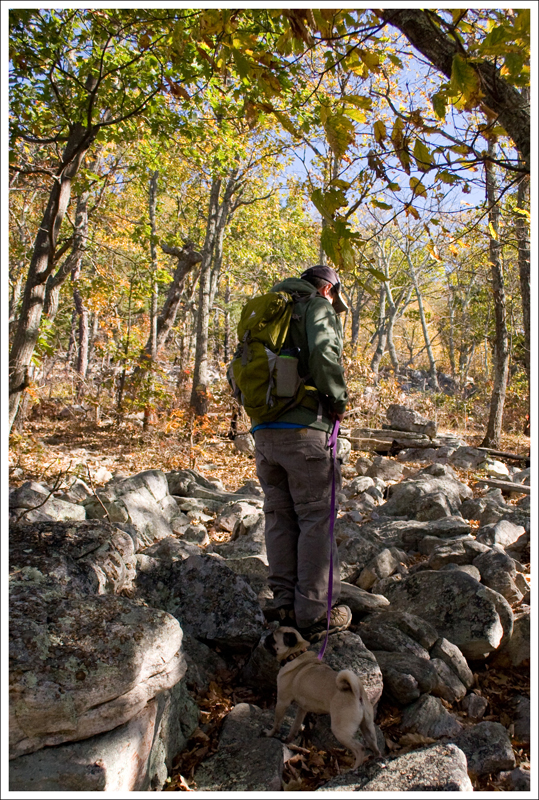
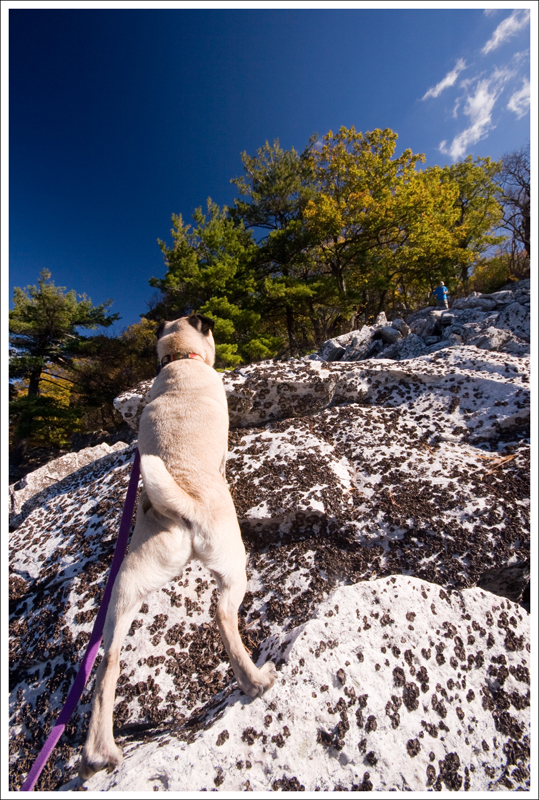
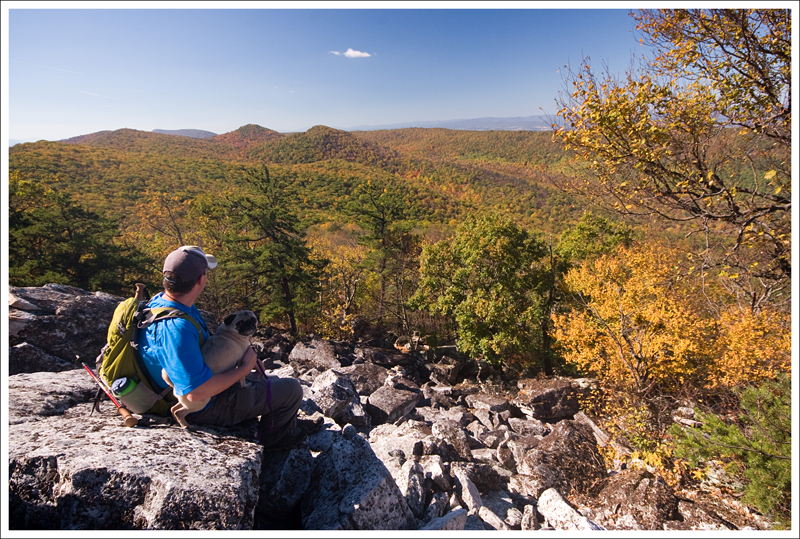
Wookie Enjoys the View from Duncan Knob. Below: The foliage along the trail was pretty; The scramble is a foreboding pile of boulders; Adam and Wookie make their way up the scramble.
Christine Says…
On Friday, Adam and I both took a vacation day from work to get in some fall hiking. We decided Duncan Knob suited our plans perfectly. We wanted to avoid hikes in the national park (the crowds are dreadful this time of year) and we didn’t want to drive more than an hour. We did a little online research to look at our route options, and found pretty much everyone did the hike as an 8.7 mile loop. The common route passes by just one spot with a view and includes significant uphill climbs on both the outgoing and return arms of the loop.
We decided to look at our maps to see if there was a more direct route to Duncan Knob. I know lots of people primarily hike for the exercise. They love anything that makes the trail longer, steeper and more challenging. I am not one of those people. I don’t mind distance or elevation as long as there is a payoff for it. But if there’s a more direct route to get the same view, I usually opt to take it. Needless to say, we were pleased to find a 3.4 mile, out-and-back route that involved just 900 feet of elevation gain.
The Blue Blazed Trail Gap Creek Trail. Below: The Gap Creek trail is well-marked; Near the beginning of the trail you cross a small stream; Wookie enjoyed running back and forth across the bridge.
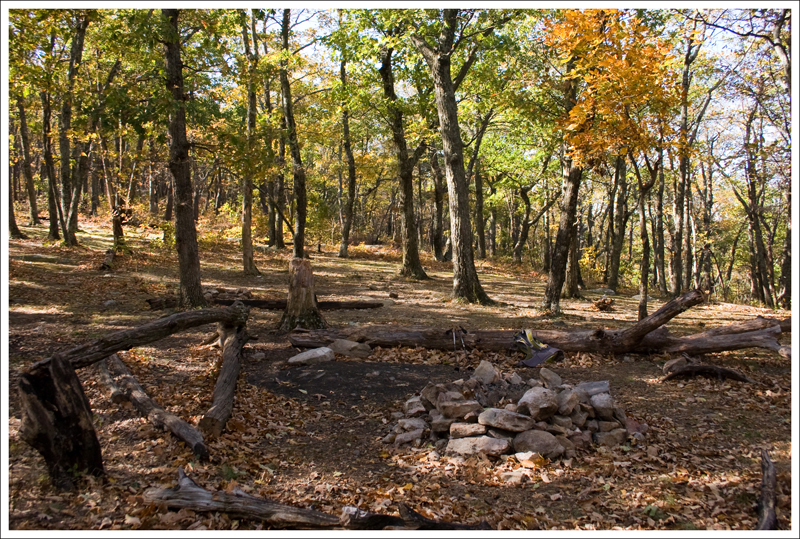
The hike starts at the Gap Creek trailhead on Crisman Hollow Road. You’ll walk a short way up a blue-blazed fire road until you see a campsite on the left side of the road. The road continues uphill from this point, but you’ll want to cut through the campsite and cross the small bridge over the stream. After crossing the bridge, the trail climbs steadily uphill. For the first mile, the elevation gain is very gentle and is punctuated by flat stretches. The trail is extremely rocky the entire way. At mile 1.2, the blue-blazed Gap Creek trail intersects the yellow-blazed Scothorn Gap trail. Continue on the blue-blazed trail until you reach a level place near the top of the ridge at 1.5 miles. There’s a great campsite at this spot. It has a big stone fire pit ringed by log benches. There are lots of flat places to pitch tents, too.
Directly across from the campsite, the Duncan Knob spur trail begins. The trail is blazed white and climbs steeply uphill to the summit. As you walk along, you’ll notice the rocks on the trail are getting larger and more abundant. Eventually, you step out of the woods and find yourself facing an enormous pyramid-shaped summit of jumbled rocks and boulders.
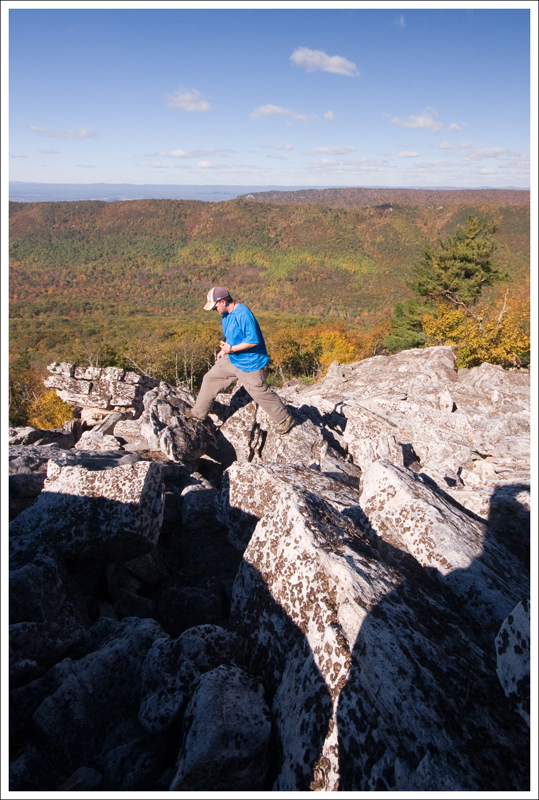
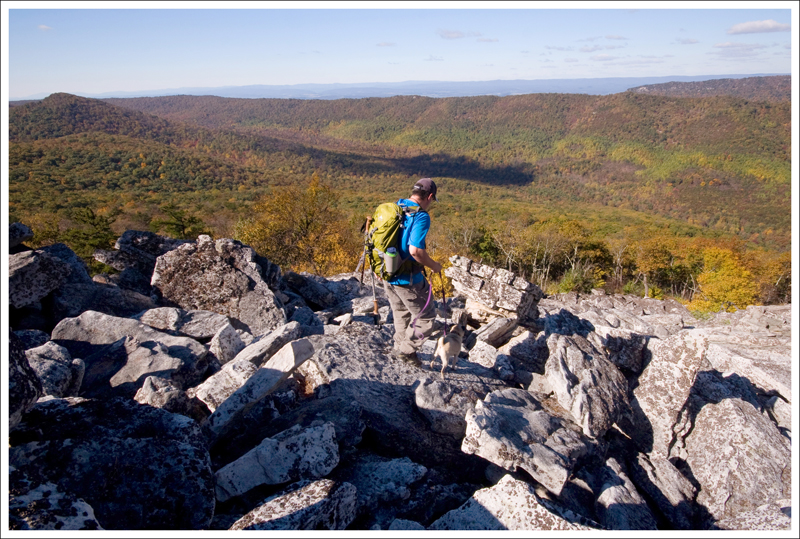
Wookie and Adam scramble upward. Below: The trail becomes progressively rockier; Adam explore the boulders; Wookie spots Adam climbing back down from the geocache.
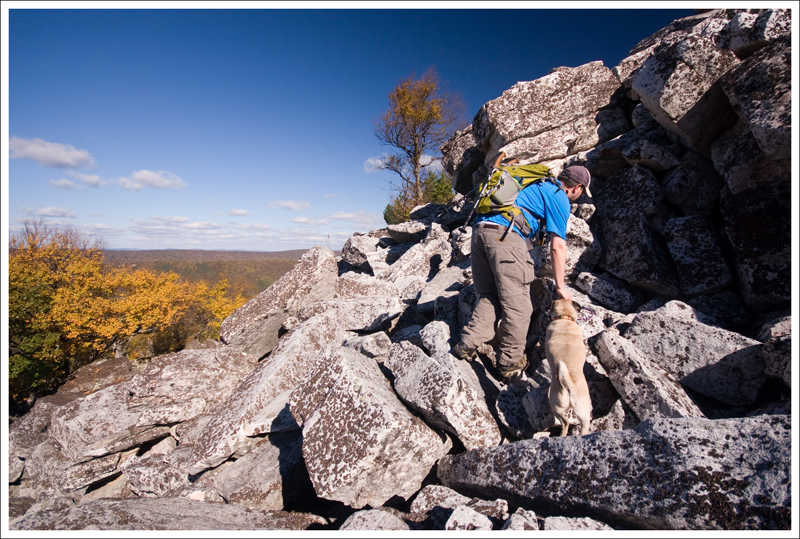
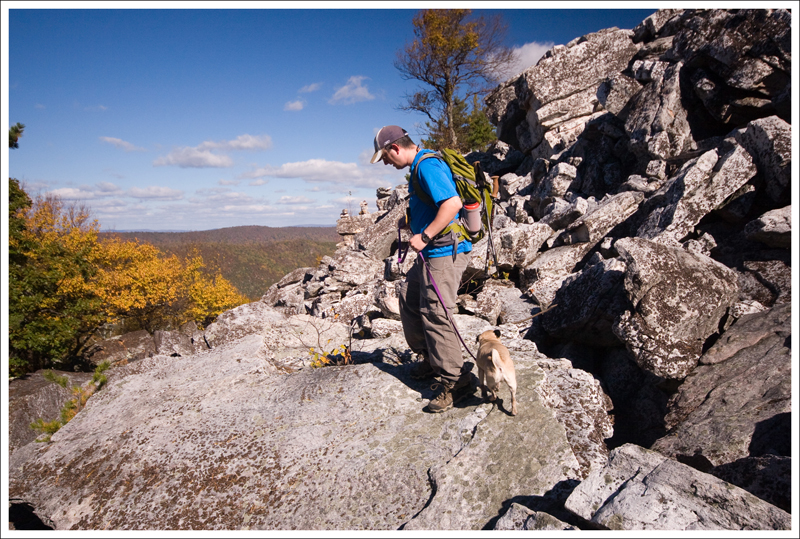
Climb the rock scramble any number of ways (we followed a rather informal series of cairns along the left side of the rock pile) and you’ll be treated to sweeping views in almost every direction. The scrambling was fun and not difficult at all. I found a nice rock “chair” to sit on while Adam found a geocache hidden at the summit. It was freezing cold and blustery sitting on the rocks, so we didn’t stay too long.
On the way down, we stopped back by the campsite and had some water and a snack. We even gave our dog, Wookie, some graham crackers and marshmallows from our trail mix. He did a great job on the rock scramble – especially considering how small he is. The hike back down was pretty uneventful and just retraced our steps. What a great hike! I told Adam it’s been one of my favorite recent hikes.
Adam Says…
Ever since we did the Strickler Knob hike (actually our very first post!), I had been hearing that Duncan Knob also had amazing views. I believe we put off this hike for a while due to the long 8.7 mile length, combined with lots of elevation gain. So, I pulled out my map of the area to see if there was a different way. Sure enough, you can easily get up to Duncan Knob by just sticking to the Gap Creek Trail. The hike may have a little steeper of an elevation than approaching it from the Scothorn Gap Trail, but the hike up the Gap Creek Trail is much shorter and you aren’t missing much scenery.
The trail does include a few switchbacks once you start the trail over the bridge which takes the pressure of the elevation off your leg muscles. The hike is almost all uphill, but before you know it you’ve reached the ridge where the campsite is. We took a break here to see if there was anything else to see along the ridge, before proceeding up the white-blazed trail to the summit of Duncan Knob. This white-blazed trail is slightly overgrown and some of the white blazes are quite faded, but it wasn’t too hard to navigate. After only about .2 miles on this trail, we saw the looming rock scramble in front of us. We decided to approach the rock scramble on the left-hand side. Once you begin to climb up a few rocks, the views really begin to open up around you. The rocks weren’t too tough to navigate, but it was harder to help navigate a small dog on a leash. From the top, you will have great views of Middle Mountain, Waterfall Mountain, Strickler Knob, and Kerns Mountain. The color was very nice and we took some time to soak in the scenery.
Adam takes in the view from Duncan Knob. Below: A nice campsite on the ridge; Adam and Wookie take a break on the climb down; Wookie did surprisingly well on the scramble, but occasionally he had to be carried.
I left Christine to keep climbing up to the summit of the rock scramble and found the Duncan Knob Geocache. A few people before me were not able to find it before me, so the owner had taken the posting offline until he had time to investigate. I’m glad I was able to save the owner a hike back. This was my 499th find, so I need to do something special for my 500th geocache.
If you haven’t done any hiking off Crisman Hollow Road, I would highly recommend making this a stop in the near future. With the Massanutten Story Book Trail, Strickler Knob, and Duncan Knob hikes all off this road, I feel this road leads to some amazing hiking gems that are unknown to many.
Wookie Says…
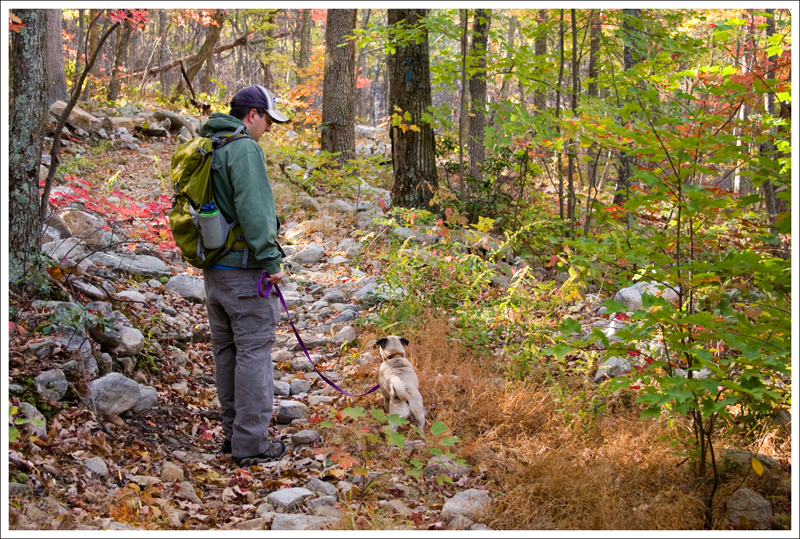
I’m so glad that I finally got invited to go hiking again! I really enjoyed most of this trail because there wasn’t any water for me to cross. When we first started the trail, I did a few runs across the wooden bridge with my masters on both sides. I was feeling frisky and I was ready to get moving. We made our way up the trail and I felt it wasn’t as bad as I was expecting. When we got to the final rock scramble, I was a little worried. I really enjoy climbing up on rocks, but I wouldn’t recommend it to my less-agile canine friends. There were a couple of moments where I had to perform an iron cross and pull myself up some rocks, but Adam helped navigate me the right way through the maze of boulders.
Wookie enjoys trailmix!
The way down was a little more challenging, so Adam tucked me under his arm for most of the way down to make sure I didn’t get hurt. I really enjoyed the views from the top of Duncan Knob and I enjoyed sniffing the air around me. After our hike back down, my masters even let me sample a few pieces of trail mix. I really liked the marshmallows best! One time I dropped a marshmallow and when I picked it up again the dirt from the ground made it look like cookies and cream. I look forward to my next time hiking and I’ll be sure to put on my pitiful, pleading face the next time Adam and Christine get ready to head out for a hike.
Trail Notes
Distance – 3.4 miles (Check out the stats from Map My Hike)*
Elevation Change – 900 feet
Difficulty – 2.5. The hike is squarely moderate – even with the rock scramble.
Trail Conditions –3. The trail is in good shape. The rock scramble is not formally marked and there are some unbalanced rocks.
Views – 5. Beautiful views of the Massanutten Mountain area. The view looking toward Strickler Knob is awesome!
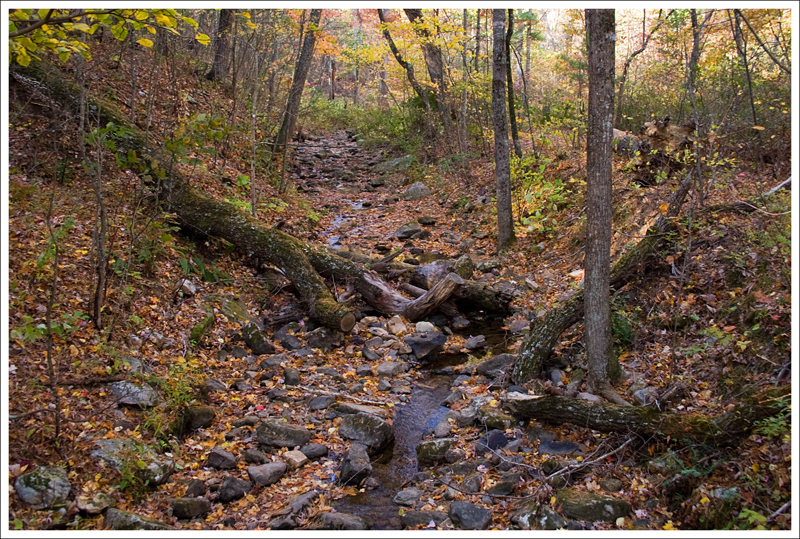
Waterfalls/streams –2. The stream is seasonal and may be dry part of the year. When the stream is running, the area is popular with fishers.
Wildlife –1.5. The area is popular with hunters, so animals tend to be reclusive. We’ve heard of people spotting bears and deer in the general area, but we’ve never seen larger animals.
Ease to Navigate – 3.5. Trails are clearly blazed, but turns are not labeled and signed like they are in the national park. It’s a good idea to have a map for this hike.
Solitude – 4.5. On a beautiful fall day, we saw just one other couple of hikers.
Directions to trailhead: From New Market, take 211 east. In about 3 miles, take a left on Crisman Hollow Road. The road starts off paved, but turns to gravel. At about 4.5 miles, park on the right at the Gap Creek trail. Follow the fire road until you reach the first campsite on the left. The trail starts behind the campsite at a wooden bridge.
This 3.4-mile hike leads to gorgeous views from the summit of Sharp Top. You will be treated with gorgeous views of the area around you.
The view from the Sharp Top Summit is gorgeous! Below: Adam walks by some of the huge boulders along the Sharp Top trail; The trail is very rocky; A set of stone steps leads you to the summit; Looking back on Sharp Top mountain from Buzzard’s Roost.
Adam Says…
Sharp Top has such a special place in my heart. I grew up in nearby Lynchburg and I couldn’t even tell you the number of times I have hiked this trail. I went with family, friends, church groups, and scouts. My family used to regularly have picnic lunches at Peaks of Otter, so this is a place I’ve been visiting all of my life. On one hike with a friend I had growing up, we spotted some trail runners. Trail runners are common on Sharp Top most mornings. My friend had said he wanted to try and be in that good of shape, so we took weekly hikes up during one summer. We never made it up to the intensity of running the mountain, but it was some good exercise. Lately, Christine and I have made this hike a nearly annual fall tradition. I’ve brought my older brother a few times over the last few years. Each year, he seems proud to know that he can still “climb up that hill.” He was working the day we hiked it this year, so he didn’t get to make the trip. I’ll try to get him to haul his cookies up the mountain again next year.
The Peaks of Otter Nature Center is the start point for this hike. Below: The trailhead sign; The Sharp Top bus takes riders close to the summit and is a great option for those not physically able to do the full hike; The trail starts off smooth and gentle – things soon change!
You start up the trail near the nature center. There is a plaque there that mentions that Sharp Top was once believed to be the tallest mountain in Virginia and that a stone from this mountain was used to build the Washington Monument. On the stone in the monument, it is inscribed “From Otter’s Summit, Virginia’s Loftiest Peak, To Crown a Monument to Virginia’s Noblest Son.” It is hard to believe that this was thought to be the highest summit. According to official elevations, this Sharp Top doesn’t even make the top 50 list. (another mountain, also named Sharp Top, is #42)
For those that don’t feel the need to hike all the way to the summit, you can take a bus ride that brings you closer to the summit. More information is available on the Peaks website (http://www.peaksofotter.com/Sharp-Top-Shuttle.aspx)
This is an extremely popular hike for families and larger groups, but it definitely has some steep sections. However, most people should be able to accomplish this hike since it is only a three-mile round trip (the side trip to Buzzards Roost adds .4 miles). The trail starts off with a slow but steady climb and then crosses the bus summit road at .25 miles. Continue to climb up the trail which includes some sections of stairs. At 1.2 miles, you reach a junction. Continue left on the trail to the summit. The remaining .3 miles to the summit starts off relatively flat, but there are more sections of rock stairs along the way. You will see a day-use only cabin at the summit and stairs to different platforms to soak in the views. You will see the Peaks of Otter Lodge and Abbott Lake to the North. To the South, you will see Turtle Rock (which some of the adventurous will find a way to climb up it) near the roof of the cabin. Go back the way you came. When you reach the junction .3 miles from the summit, I would highly recommend adding .2 miles (.4 miles round trip) to check out Buzzard’s Roost. The trail is relatively flat with minimal elevation difference. You will get more great views from here and can actually get some nice views of the summit of Sharp Top. Buzzards Roost does require some rock scrambling and carefully navigating around large rocks, so it isn’t for the faint of heart. Once you leave the Roost, go back to the junction and take a left down the trail to make your way back to the car.
There are lots of places to perch on Sharp Top. Below: Adam makes his way up the trail; The trail has many stairs built into the rock; Adam on Turtle Rock.
As I mentioned above, there are a lot of great places nearby for a picnic or you can dine at the Peaks of Otter Lodge. There is also a gift shop that sells sweatshirts inside that say “I Survived Sharp Top”. While I personally don’t think it is that difficult, I can understand some people feeling that way. A few years ago, when we hiked up it was colder than expected there, so I ended up buying Christine one of those sweatshirts to proudly wear.
Christine Says…
I’m so glad Adam introduced me to this hike. It’s a tough little climb, but the summit is spectacular. It’s covered with boulders the size of houses and has a view that rivals any Virginia hike. The one downside to Sharp Top is the crowd of people you’ll be almost guaranteed to see. It is indeed a popular place!
A view of the mountain from the lodge at the bottom. Below: A sign lets you know you’ve arrived at the summit; At this point you can turn and go to Buzzard’s Roost or continue to the Sharp Top Summit; Another beautiful summit view.
I always thought Peaks of Otter was an odd name for a place, so I did a little research and found some information about the origin of the name on the nearby lodge’s website:
“There are three opinions on how the Peaks of Otter got their name. The name may come from the Cherokee Indian word, “ottari,” which means “high places.” The Peaks may have been named after the Otter River, which has its headwaters in the area. Finally, Scottish settlers may have named the Peaks after Ben Otter, a mountain in their homeland that resembles Sharp Top.“
We got a really early start on our morning, and were headed up the trail by 9:30 or so. It was cool and brilliantly sunny. Even though it was the second weekend of October, the leaves were still mostly green. That was a little disappointing – I had hoped to hike Sharp Top at the peak of fall color. We’ve done that in past years, and the foliage makes the view even nicer! As we hiked up the trail, we passed several downhill hikers on their way back from watching sunrise atop the summit. Other than that, we had the trail mostly to ourselves.
The uphill grade starts of gently, on a mostly smooth and wide trail. For some reason, this is always the only part of the Sharp Top trail I remember. I don’t know why, but I always seem to block the steep and rocky parts out of my mind. After you cross the bus road, the path gets a lot tougher. It’s fairly relentless uphill for a while. Periodically, there are reprieves where the grade moderates and you get a chance to catch your breath. But after each little flat spot, you’re guaranteed to have more climbing. As the summit draws near, you’ll find yourself hiking between and around gigantic boulders. The rock formations on this mountain are impressive! Near the end of the trail, there are quite a few stone stairs to climb. Almost immediately upon reaching the summit, you’ll pass the cabin. The inside is an empty room – concrete floor, fireplace and small windows that look out to the view beyond. It apparently used to be a concession stand. I’m glad someone thought better of the idea and closed the place down – do we really need hot dogs and ice cream for sale on mountain summits?
The empty building on the Sharp Top summit. Below: Inside the summit house; A boulder jumble at the summit; View of mountains in the distance.
After passing the building, the path winds between the stones up to the highest spot. All over the summit, there are small alcoves and large rocks to perch upon to take in the view. Unless you started very early, the mountain will be crawling with people who took the bus ride to the top. You can usually spot the bus crowd easily – they’re never sweaty and are often wearing dressier clothing and insensible shoes. 🙂 Hikers seem to enjoy quietly referring to the bus riders as “cheaters”. I think it’s great that a bus ride is available for people who aren’t physically able to hike up, but I see lots of young families that I wish would give hiking a chance.
On the way down, Adam and I took the side trail to visit the Buzzard’s Roost. For some reason, this was the first time I’ve taken the option. The roost had amazing views, but I did not enjoy climbing up the rock. I had an inner ear virus a few years ago, and have suffered serious bouts of vertigo ever since. Anytime I climb places with uneven footing and precipitous, open drops I get an awful spinning sensation. It’s like the feel of my feet doesn’t match what my eyes are seeing. It’s a very strange sensation. Sometimes I start to panic, but I’ve found that if I stay low to the ground and go very slow, I can always manage to get where I want to go. But needless to say… you’ll never find me doing any serious rock climbing!
Adam takes in the view from Buzzard’s Roost. Below: Another view from Buzzard’s Roost.
After the stop at Buzzard’s Roost, we started our final climb down. I was so glad to have my trekking poles on the steep, uneven ground. So many upwards hikers commented on them! Everything from “We thought you were skiing down!” to “Why do you have two hiking sticks?” to “Darn… I wish I remembered to bring my trekking poles!”. I was surprised so many people had never seen trekking poles before, but I suppose Sharp Top has a very high percentage of people who aren’t regular hikers. Personally, after using trekking poles for a while now, I don’t know how I ever hiked without them!
The hike down was over pretty quickly and we were off to lunch! Typically, we pack a picnic – but this time we decided to try the restaurant at the Peaks of Otter Lodge. They had a buffet option, but it was really expensive and there was no way I could have eaten my money’s worth. But I have to admit… that mountain of fried chicken on the buffet table looked very compelling! We settled for sandwiches instead.
After lunch, we walked along the water and did a bit of people watching. I even saw (allegedly) an otter swimming across the lake.
Trail Notes
Distance – 3.4 miles. You can make it just 3.0 miles if you don’t do the Buzzards Roost side hike.
Elevation Change – 1340 feet
Difficulty – 3. The hike is fairly steep most of the way, with a number of stairs to climb towards the middle and end of the trail. The hike to Buzzards Roast does not have much elevation change.
Trail Conditions –3. The trail is well-maintained, but there are a number of sharp rocks that can make footing tricky.
Views – 5. Amazing 360 degree views from the summit give you some of the best views in Virginia. Go up on a clear day and you will see for miles.
Waterfalls/streams –0. Non-existent.
Wildlife –1.5. Due to the popularity, you will likely only see birds. You may spot soaring hawks at the top.
Ease to Navigate – 5. Trails are well-labeled, so you shouldn’t have much difficulty navigating the area.
Solitude – 0. This is one of the most popular hikes in Virginia. To escape the crowds, go up early in the morning.
Directions to trailhead: The trail begins near mile marker 86 on the Blue Ridge Parkway. The trailhead is to the left of the nature center, which is directly across from the Peaks of Otter Visitor Center.
Fox Hollow Loop is a short, interpretive hike near the Dickey Ridge Visitor Center that gives you glimpses of life on the mountain.
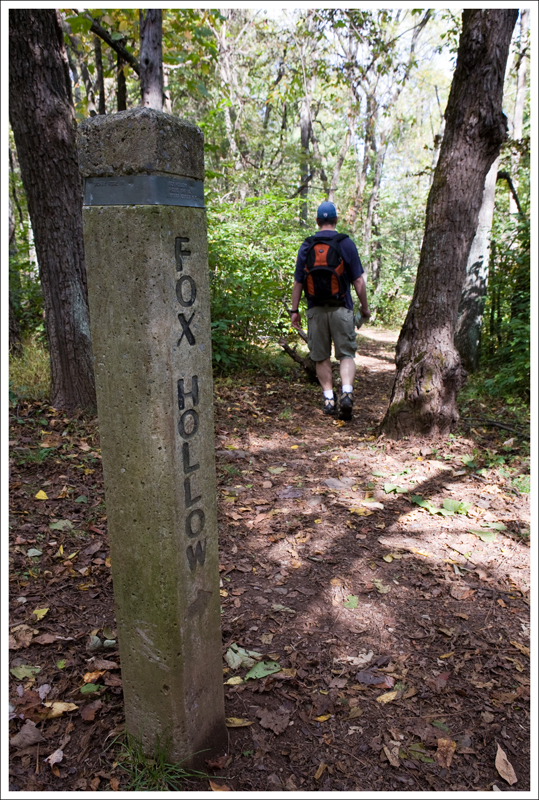
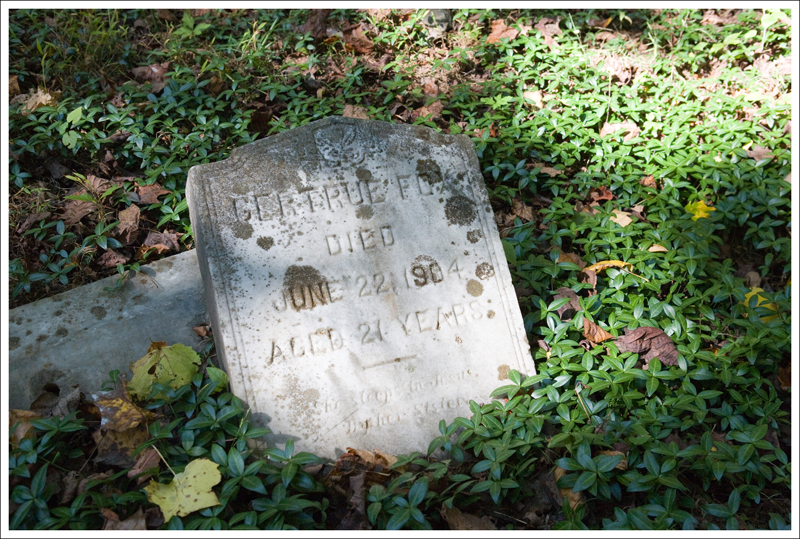
This hike takes you past an old cemetery. Generations of Foxes are buried in this hollow. Below: The trail starts near the Dickey Ridge Visitor Center; The trailhead has a sign marking different hike options in the area.
Adam Says…
After we finished our hike to Lands Run Falls, we decided to add another hike – the Fox Hollow Loop. There is a path, starting near the flagpole, that takes you across Skyline Drive from the Dickey Ridge Visitor Center. You will see a plaque displaying the hike information and a box where you can purchase a $1 guide to to the hike. The guide is useful in helping you locate some of the interesting sights along the way. I would recommend picking this up since it does give a little history of the area and insight into the flora around you on the trail.
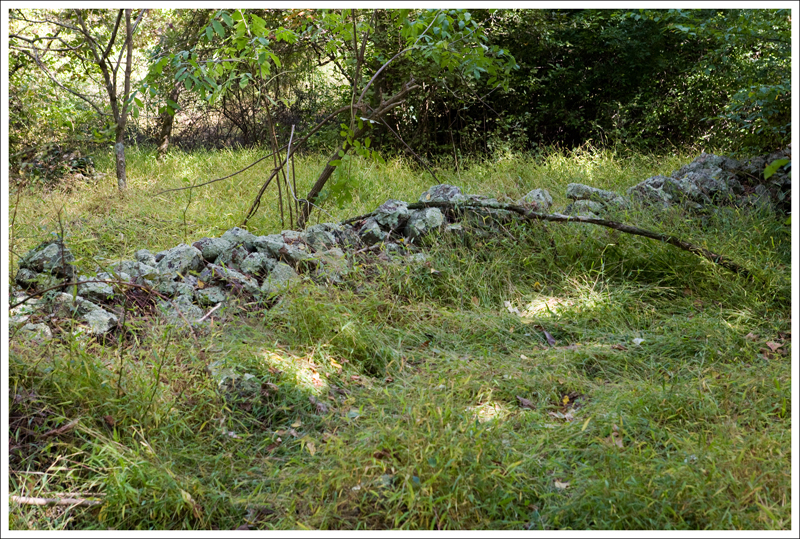
From the sign, head to the left. You will quickly come up to a concrete post where the trail intersects with the blue-blazed Dickey Ridge Trail. Take a left at the post to join the Dickey Ridge Trail. At the next concrete post at .3 miles, you will take a right to join the no-blazed Fox Hollow Trail. The trail descends at this point as you go through the Fox homesite. You will shortly come across a few rockpiles, created by the Fox family to clear the cornfield. At .5 miles, you will reach the Fox family cemetery on the left of the trail. After leaving the cemetery, continue on the trail. Keep your eyes peeled for a millstone that is hidden in the brush on the side of the trail. It takes a sharp turn to the right and begins a climb up on a path that used to serve as a road used by the Fox family to get to Front Royal. At the one mile marker, you will reach another concrete post that intersects with the Dickey Ridge Trail. Continue straight past the post to reach the Visitor Center at 1.2 miles.
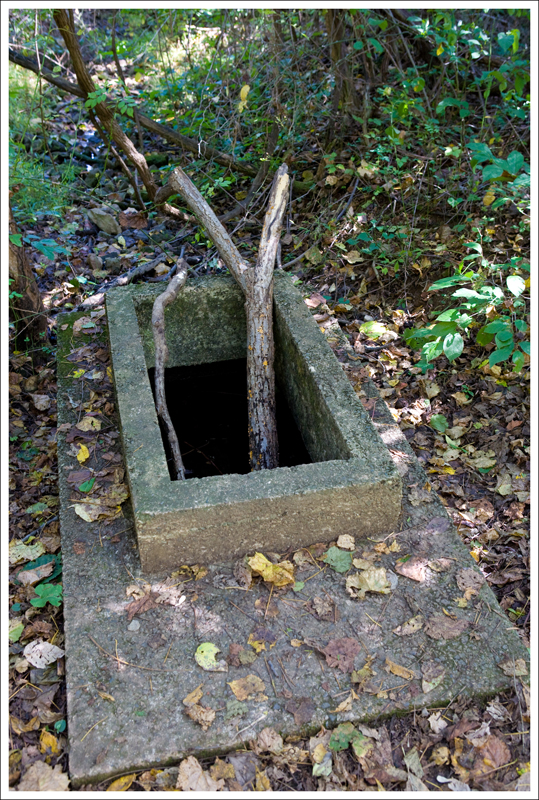
The Fox Hollow Trail is well marked by cement posts. Below: The old box spring used to be the water supply for Dickey Ridge.
This hike will attract many visitors as it is one of the first opportunities to hike if approaching from the Front Royal entrance to Shenandoah National Park. The short distance and mild elevation gain will also attract a lot of people. It is interesting to think of what life would be like for the Fox family. Thomas and Martha Fox started farming here in 1856 and the family stayed here until the 1930s. Most of the trees have been formed since the 1930s, so it is interesting to think of this area as plowed pastures for corn, wheat and bluegrass.
Christine Says…
The Fox Hollow Loop was the second hike we completed on our beautiful fall morning in the park. The hike started off with a nice view looking toward the valley to the east. The open meadow was blanketed with dry grasses and ragweed, so it looked golden under the fall sun.
The trail quickly descended into the woods. The path was lined with dogwoods covered with their bright red seed berries. Along the trail, we saw piles of stones and old walls sinking back into the forest floor.
There are many old stone walls in Fox Hollow.
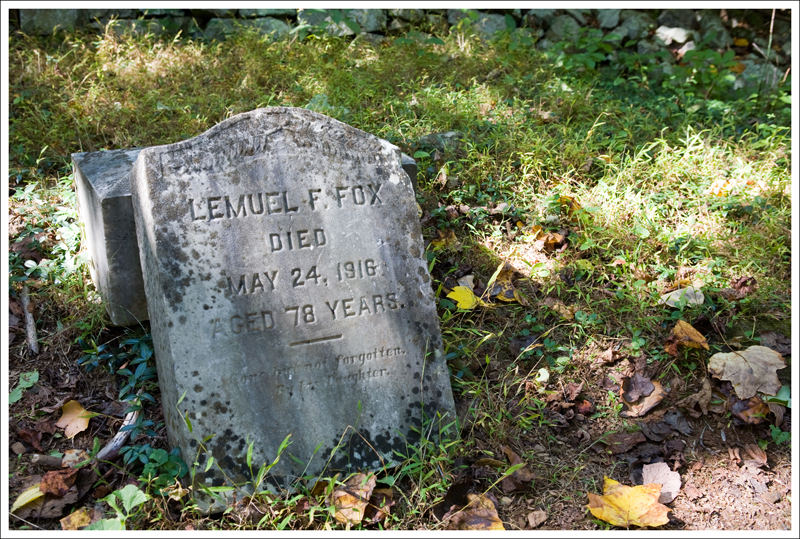
We soon passed an old cemetery, where generations of the Fox family have been buried. Most of the headstones have toppled or have disappeared, but two markers (Lemuel Fox and Gertrue Fox) are still in good shape. It’s compelling to imagine how different this hollow must have looked in 1900. Back then, this would have been open farmland – fields, cherry trees, barns, houses, stone walls and a road meandering over to the neighboring hollow. It must have been a lovely, idyllic place to live.
After leaving the cemetery, we continued downhill and found an old boxed spring. Apparently, when the park was new, this spring supplied water to the Dickey Ridge lodge. We passed over a small marshy area and saw more stone walls in an opening off the trail. There was supposed to a mill stone along the trail, but we never saw it. We also didn’t see the old barbed wire fencing that was supposedly along the trail. We weren’t the only hikers to miss spotting the artifacts. We ran into a group of four women standing in the middle of the trail. They asked if we had seen either the stone or fence. I think they were contemplating going back, but we pressed on.
The rest of the trail was a nice walk through the woods and we soon came back to where we had started.
Trail Notes
Distance – 1.2 miles
Elevation Change – 310 feet
Difficulty – 1. The trail should be quite easy for most people.
Trail Conditions –4. The trail is well-maintained and easy to walk on. It could be muddy in parts after lots of rain.
Views – 1.5. You do get some nice views from the plaque of mountains in the distance, but you won’t see much on the trail.
Waterfalls/streams –0. Non-existent.
Wildlife –2. This is a busy trail, so many animals will stay away, but you may see deer around the area. The fields near the plaque would be good for bird watching.
Ease to Navigate – 3.5. The trail only has a couple of turns near cement posts. If you read the directions on the posts, you shouldn’t have any problem.
Solitude – 2. This is a popular trail for people of all abilities, so you will likely see others on the trail.
Directions to trailhead: Follow Skyline Drive to the Dickey Ridge Visitors Center (around mile marker 4.6) Park at the visitors center. The trail begins on the east side of the drive, across from the center.
The hike to Lands Run Falls is a fairly easy 1.6 mile walk down an old park road. The waterfall is not terribly large or impressive, but it’s definitely worth a look if you’re in the mood for a short leg-stretcher.
Adam sits alongside Lands Run Falls. The falls were still a little on the low side despite five inches of recent rain.
Christine Says…
We planned to do a long hike on Saturday, but Adam was having knee trouble. Instead, we waited until Sunday and decided to try doing a few short, gentle hikes in the north district of Shenandoah National Park. It’s been several years since I ventured as far north in the park as Lands Run Falls, so it was a nice change of pace.
The walk to the waterfall stays on a wide gravel road the entire time, so the footing is easy and there is absolutely no place you can possibly take a wrong turn. The only place you might go wrong is by hiking across the top of the waterfall and missing it completely. The falls aren’t marked and they’re really not visible from the trail. You’ll know you’ve reached the falls when you pass over a small stream and culvert. You can also follow the sounds of falling water!
To get a good look at the falls, you’ll need to follow a worn path through the woods down into the ravine. It’s a fairly well-worn path, and the rocks in the ravine sort of form big steps. Be careful on the rocks immediately around the waterfall. They’re very slick and covered with moss and algae.
The last time I visited Lands Run Falls it was winter and there had been quite a bit more rain.
If you hit Lands Run Falls when there has been lots of rain, you’ll be treated to a pretty waterfall with three small, but distinct drops. The first drop of about 20 feet is the most accessible and the most photogenic. The other two drops are mostly obscured by blow-downs and underbrush. If the weather has been dry, Lands Run Falls probably is not worth your time. It frequently dries up completely in the summer.
In Henry Heatwole’s well-known Guide to Shenandoah National Park and Skyline Drive, he stated “This [Lands Run Falls] is an unrewarding experience for most people… This is for the very few hikers who are willing to go to a lot of trouble to find solitude beside a pool on a mountain stream.”
I wouldn’t characterize Lands Run Falls quite so grimly. I mean, it’s not spectacular – but it is definitely worth seeing if the water flow has been nice.
Adam Says…
We started off with this as our first of three short hikes for the day. I was battling some knee issues and Christine thought we should turn around because I was limping the first few steps. I felt I could make it though and luckily my knee felt better on the trip back up from the falls.
You descend 310 feet during this walk down the fire road. While it doesn’t seem quite as noticeable on the way down, you will feel the elevation change on the way back up. Most people should be able to do this hike, but you may need to take your time if the steepness gets to you.
Once you reach the area of the falls, to get the views that we did, you do need to climb down a steep section off the trail that can be slippery. I was able to do it on a bad knee, but you do have to watch your feet carefully. The fire road continues further for another 1.4 miles past the falls, but that only leads to a park boundary and there is nothing of interest to see.
The day was quite brisk with temperatures in the upper 40s. I initially wished that I had brought a fleece along, but once the blood got pumping I was fine in my T-shirt and shorts. The leaves were just starting to turn color – I think we’re still two weeks before peak season on Skyline Drive and higher elevations.
The Lands Run Fire Road descends about 300 vertical feet over .6 of a mile to the falls.
The trail was a nice quick view to a waterfall. I believe it is a somewhat popular trail, but that is largely due to the number of people that are driving down from Northern Virginia and are looking for a close waterfall hike. The falls themselves are pretty but they are not as impressive as many others in the park.
Trail Notes
Distance – 1.6 miles out and back
Elevation Change – Around 300 feet
Difficulty – 2. Relatively easy, but definitely uphill on the return trip
Trail Conditions – 4.5 The trail is a well-maintained fire road
Views – 0. The trail stays in the woods and does not offer any panoramic views
Waterfalls/streams –3. Lands Run Falls is small but pretty. It does dry up when there hasn’t been much rain
Wildlife – 2. You’ll likely see the usual park specimens along this trail – birds, squirrels and deer
Ease to Navigate – 4. The fire road doesn’t have any turns. Be careful not to miss the falls – you walk over a small stream and the waterfall cascades below the trail.
Solitude – 3. We saw a couple groups, but for a beautiful fall day, the traffic was light.
Directions to trailhead: Follow Skyline Drive to mile marker 9.2. Park in the lot on the west side of the drive. The hike starts at the south end of the lot.
The view from the Massanutten Story Book Trail involves a short quarter-mile walk down a paved pathway.
The view from the Story Book trail overlooks 211 and the Page Valley. Below: The trailhead is marked by a large sign; Along the path, there is a series of interpretive signs that describe the geology and flora of the area.
Christine Says…
The Massanutten Story Book Trail is one of those ridiculously short path-walks that we personally wouldn’t consider a hike. Nonetheless, it goes to one of the nicer viewpoints in the Shenandoah Valley. Sure… you can see the Battle Creek Landfill and a distant Walmart, but you can also see the mountains that make up Shenandoah National Park and pretty much all of the Page Valley. It’s a beautiful spot.
To get to the view, just stroll down the level pathway for a quarter mile. At the end of the paved trail, you’ll come to an observation platform. It’s railed in and has several benches to rest upon. But, for an even better view, don’t miss following a rocky footpath to the right of the platform. It leads to a rock shelf overlooking the valley. The rocks that make up the ledge have the most fascinating texture.
One of the beautiful curved, wooden walkways. Below: At the end of the paved pathway, there is a platform from which to take in the view; Christine’s Mom and Dad take in the view (You can see our shadows, too!).
It looks like a lot of work/money has gone into cleaning up the Story Book Trail recently. The interpretive signs that had faded or been covered with graffiti have been replaced (although new graffiti is already showing up – seriously people, stop crapping up the outdoors… it’s disrespectful and stupid). The path looked like it had been repaved not too long ago. But, best of all, someone cleaned all the paint off the rock ledges that lie off the trail.
Adam Says…
Christine’s parents came down on a Sunday to meet up with us. We decided to take them on a couple of short hikes with great views. The first we did was Woodstock Tower and we finished it off with the Massanutten Story Book Trail. This trail is one of the easiest you will find, since the path is paved most of the way, with some beautiful wooden walkways in a few parts. Since it is also wheelchair accessible, just about anyone should be able to enjoy the views you will find here.
Adam enjoys the view from the ledge. Below: The path is paved; Some sections are traversed by beautiful curved bridges.
The trail also works as an interpretive trail, with many plaques to read along the way that give a great description of the geologic forces that have created the mountains in this area. There are two geocaches along this trail and one of these requires answers from the signs along the way.
Christine and I often say that some of the areas of George Washington National Forest lead to better views than you get through hikes in Shenandoah National Park and this trail is great evidence of this statement. If you haven’t done this one before and enjoy great views with little effort, this is a trail for you.
Trail Notes
Distance – .5 miles out and back
Elevation Change – negligible
Difficulty – 1. This trail is for everyone – paved for strollers and handicap accessible.
Trail Conditions – 5. The official trail is paved. You can leave the trail and scramble on the rocks for another view.
Views –5. Amazing views!
Waterfalls/streams – 0. No streams/waterfalls.
Wildlife – 0. The trail is too populous to really attract wildlife.
Ease to Navigate – 5. Just straight down a paved path and back.
Solitude – 0. You’ll see many people along this trail.
Directions to trailhead:
Reach the trailhead by turning on to Crisman Hollow Road (FD 274) off of 211 near Luray. Continue on this road for about a mile and park in a small lot off to the right. A wooden footbridge and trail marker will signify the start of the trail.
The Woodstock Tower hike is a fairly easy hike in the Lee Ranger District of George Washington National Forest that leads to a fire tower with 360-degree views of the surrounding area.
The view from the Woodstock Tower is panoramic - offering views of the valley, river and distant mountains. Below: A wider view includes the mountains; It really wasn't the best time of day to photograph the actual tower -- I had to shoot right into the sun; The inside of the tower is covered with graffiti.
Adam Says…
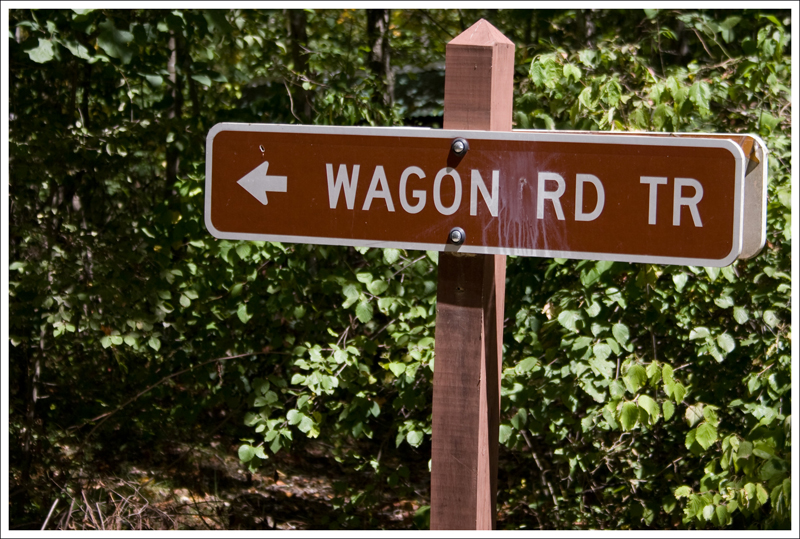
After parking in the Little Fort Campground area, we headed up for our hike to Woodstock Tower. The white-blazed Wagon Road/Nature Trail starts off as a rough fire road and after .1 mile, intersects with Peters Mill Run. Peters Mill Run is an ATV/OHV trail, so look both ways before crossing this popular trail for ATVs and motorcycles. Continue straight across Peters Mill Run to connect to the trail again. The trail does go steadily up with a few switchbacks, but the switchbacks really make the trail easier of a climb. The first switchback comes in around .25 miles and the second switchback comes around .5 miles. After the second switchback, the trail does become steeper, but it ends after just a couple tenths of a mile. At .7 miles, take a left on the pink-blazed Tower Trail. It is only about .2 miles to reach the tower on a fairly level trail.
The Woodstock Tower. Below: A little bit of fall color was already showing; We took a break for water where the short trail meets up with the longer trail; Looking up through the Woodstock Tower.
When we reached the tower, we climbed up the metal stairs to reach the top. I’m not a big fan of heights, but I’m especially nervous when it involves man-made things. The tower did seem quite sturdy, but it makes some noises when railings move slightly, so I was more eager to get down from the tower than the rest of Christine’s family. The views are nice, but the area is quite crowded. Unless you went up early in the morning, I fear that it would be hard to have a moment’s peace at the top. There aren’t any signs posted for maximum number of people on the tower and you may have to hug the side of a platform as people pass in opposite directions.
This was the second time I’ve been to the Woodstock Tower. Last time I was there was several years ago in mid-October. I remember the fall foliage being amazing from atop the tower. This time, the foliage had just the slightest hint of change, but the day was crystal clear and sunny – not a bit of haze – so the view was extra nice.
There are shorter ways to get to the view. In fact, you can practically drive right up to it. However, we chose to hike up from the Little Fort campground instead. The slightly longer route gave my mom a chance to try out her new hiking boots.
The area has lots of ATV and dirt bike trails. Below: All the roads and trails in this area are well-marked.
Because the day was so beautiful, we had to share the tower with crowds of people. At times, there was actually a line of people waiting to get to the top. We even saw a person trying to coax their pit bull up the open, metal stairs. That didn’t go so well, and they had to turn back about halfway to the top. The inside of the tower is covered with graffiti and the area is littered with broken beer bottles and empty soda cans – a very unfortunate side effect of its popularity.
Despite the tower’s less-than-pristine nature, it still offers one of the best views of the mountains in the area. It’s well worth the short walk.
Trail Notes
Distance –2 miles
Elevation Change – about 500 feet
Difficulty –2. While you would think that going up 500 feet in one mile would be steep, the trail up seems to take off a lot of the steep terrain.
Trail Conditions – 3. The trail had some loose ground in a few areas (especially in the first .1 mile), but overall was well-maintained.
Views – 4.5. It does have 360-degree views, but we always enjoy views from natural surroundings like rock outcrops over man-made towers.
Waterfalls/streams –0. Non-existent.
Wildlife – 2. Too many people to see anything other than people. May be good for hawk spotting or some other woodland birds.
Ease to Navigate – 4. Not too many turns on this one and trails are well-labeled.
Solitude– 1. You will see lots of people on this trail during a nice day.
Directions to trailhead:
We approached this from I-81. There are other ways to the east to approach this, but here is the most common way for anyone traveling via interstate. Take exit 283 on I-81, heading east on 42. Stay on 42 until it intersects with US 11. Take a left on US 11, heading north through the town of Woodstock. As soon as you pass the Woodstock Shopping Center, take a right on S.R. 665/Mill Road. Take this until it ends at S.R. 758/Woodstock Tower Road. Take a left here and continue to follow S.R. 758 up and down the mountain (this area can be scary when passing other vehicles – there are no guardrails in most spots). Be sure to stay on S.R. 758 until you reach Little Fort Campground. Turn into the campground area. There are campsites and parking spots along the road here. The trailhead is located on the right-hand side of the road near a campsite right before you reach the outdoor restrooms.
The Story of the Forest Trail is an easy family walk in the Big Meadows area of Shenandoah National Park. The entire loop is 1.8 miles and half of the trail is paved.
Whitetail Deer are a common sight along the Story of the Forest Trail. Below: No pets or bikes are allowed on the trail; The return arm of the loop follows a paved path along the road.
Christine Says…
The first weekend of September was spectacular – simply perfect weather to be outside. Adam and I decided to take a picnic dinner up to the park. The Big Meadows area has a 1.8-mile nature trail, called “Story of the Forest”, that joins the wayside and the campground. We decided that a pleasant pre-dinner stroll sounded ideal.
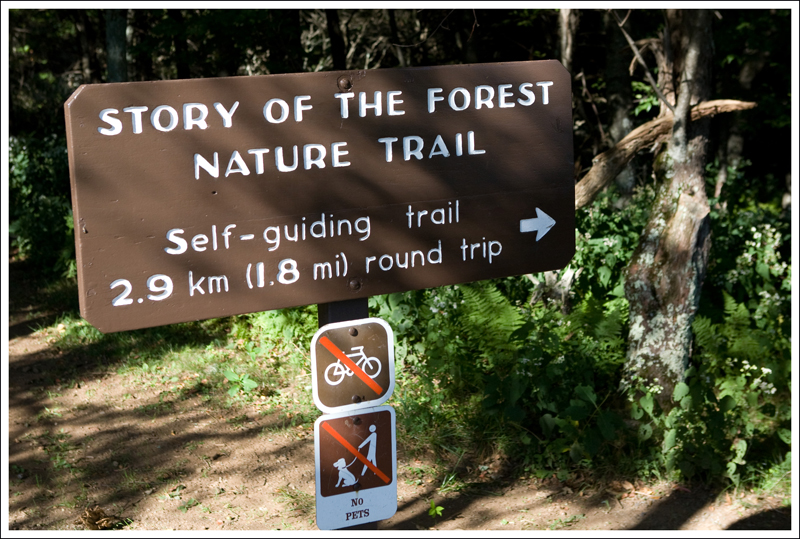
We parked at the Byrd Visitor’s Center, and set out from the north end of the lot. The trailhead is marked by a sign that also indicates that dogs and bikes are prohibited on this path.
The trail was lined with these small white wildflowers. Below: The Big Meadows-Skyland horse trail crosses the path.
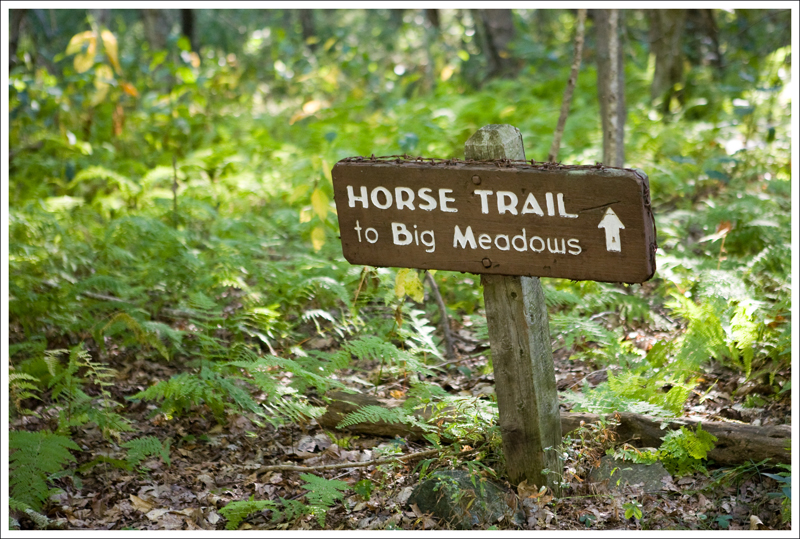
The trail starts off gently downhill – passing through an area lush with ferns and wildflowers. After crossing a small footbridge over a stream that feeds Dark Hollow Falls, the trail bears left and heads deeper into the woods. You’ll pass over the Big Meadows-Skyland horse trail. After that, you’ll pass communication towers that are part of the lodging complex. Eventually, the campground will come into view. To make the hike into a loop, turn left when you see the campground. This will lead you back out to a paved bike path running parallel to the road through Big Meadows. The paved path will lead you back to the wayside and visitor’s center.
The Story of the Forest doesn’t offer anything especially unique , but it is a nice walk for anyone visiting the Big Meadows area.
Adam Says…
I think this was actually the first time I have done the Story of the Forest Trail. It is a very easy hike, so it is perfect for families with small children. You can also use this trail to connect to Dark Hollow Falls to create a longer hike. The trail is a nice walk in the woods, passing by some impressive trees and ferns. I was expecting a guide that would possibly tell the “story of the forest”, but there isn’t a hike brochure like there is at the Stony Man Trail.
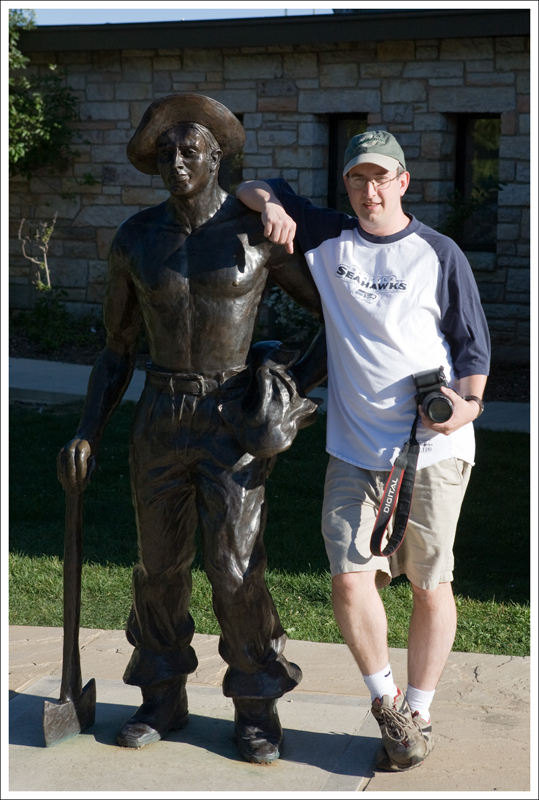
There are a few turns that form this loop. The trail is marked on the cement posts as “nature trail”. Once you start the trail, you will go through the forest until you reach a couple of bridges that go over the Hogcamp Branch. In .2 miles, take a left at the junction to stay on the trail. In .4 miles, the trail will intersect with a horse trail – just go straight and don’t turn on the horse trail. In .8 miles, you will begin to see the Big Meadows campground. Take a left on the paved path to follow this back to the Big Meadows wayside, which is next to the Visitor Center. Grab a blackberry shake from the wayside and take a picture with the CCC statue at the visitor center to round out the experience.
This small footbridge crosses a stream that feeds Dark Hollow Falls. Below: When you pass the visitor’s center near the end of the loop, stop to pose with the CCC statue.
I’m surprised that Christine didn’t tell the story, but we passed a family that were slowly making their way along the trail. A girl hoisted on the shoulders of her father was soooo excited to see a deer. She said to us as we passed, “Take a picture of the deer.” We went a little further up the trail and saw a different deer. I stopped to take some pictures and the deer wasn’t being cooperative. When the deer got startled and bolted off, I said a curse word. I heard far off through the woods, the same girl say, “That man said a bad word.” I felt bad about that and Christine hasn’t let me live it down. I like to think that I was reinforcing her education rather than being a bad influence. If she hadn’t heard the word before, she wouldn’t know it was bad. At least that’s how I’m trying to justify it.
Trail Notes
Distance – 1.8 miles loop hike
Elevation Change – Negligible
Difficulty – 1. This trail is suitable for everyone.
Trail Conditions –4.5. The trail is very well-graded and easy to walk on. The return arm of the loop is a paved bike path.
Views – 0. None.
Waterfalls/streams – .5. In wet weather, you’ll cross a small stream that feeds Dark Hollow Falls.
Wildlife –3. There should be plenty of deer. Many folks have also spotted bears on this trail.
Ease to Navigate –4. Easy to follow, just look for the Nature Trail marked on cement posts.
Solitude–1. You’ll see many people on this trail, as it connects the Big Meadows campground to the wayside and visitor’s center.
Directions to trailhead:
Park at Big Meadows near the Harry S. Byrd Sr. Visitor Center (mile 51 on Skyline Drive). The trailhead starts across from the northern end of the Visitor Center parking lot.

























 Wookie Says…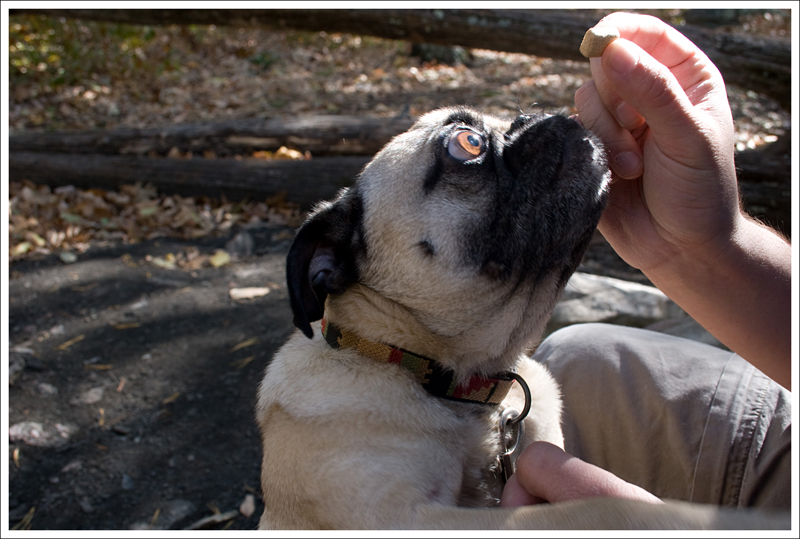


















 Virginia Trail Guide