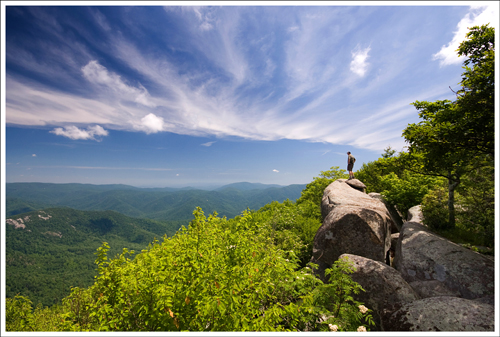
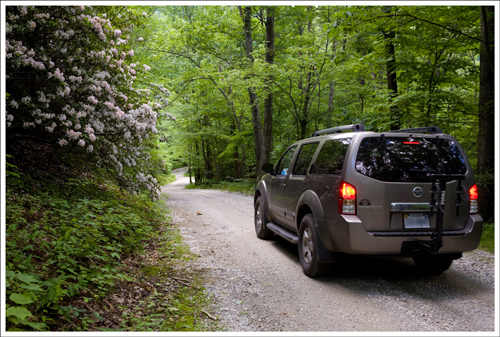
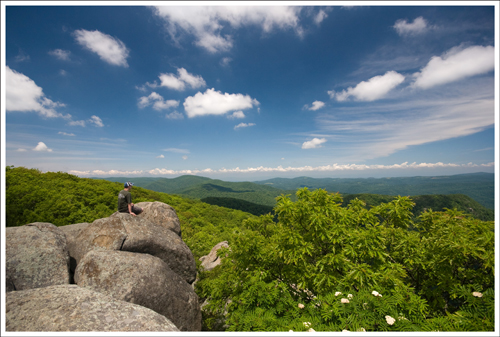
White Oak Canyon

White Oak Canyon is one of Shenandoah’s most popular waterfall hikes.  The trail begins directly across Skyline Drive from Skyland Resort.

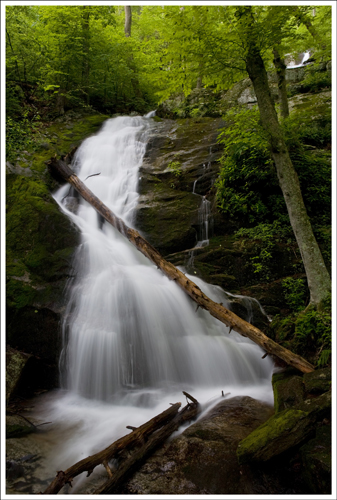
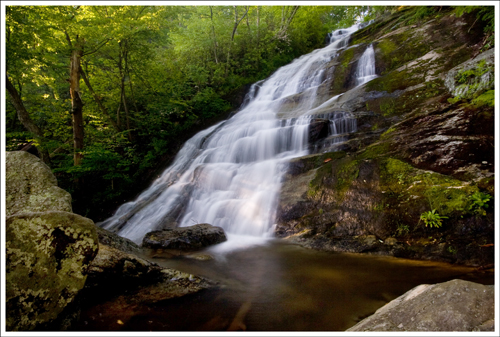
Upper Falls of White Oak Canyon
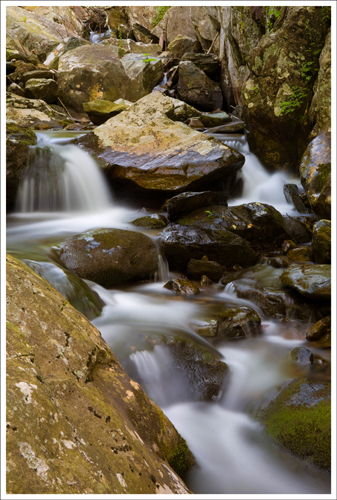
The upper falls of White Oak Canyon plunge 86 feet to a pool below.

Christine Says…

Adam and I set out early on Saturday morning to hike the White Oak Canyon trail.  Our primary goal was to avoid the holiday crowds, so we were quite pleased to arrive at 7:30 and find just one other car in the parking lot.
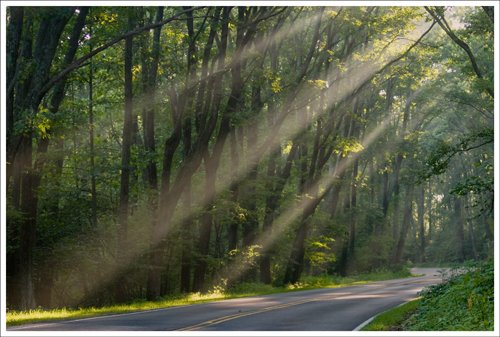
The park is always quiet and beautiful in the early morning.

The morning was almost chilly – sunny, no humidity and a crisp breeze blowing.  It felt more like mid-May than the Fourth of July.  I don’t know about you, but I always associate the 4th with sultry, hazy, buggy weather.  Since I’m not a fan of typical Virginia summer weather, I thought the conditions were perfect for our hike.  The only thing I wasn’t thrilled about was the bright sun shining up above in the sky.  Sunny weather is great for hiking and enjoying the outdoors, but it complicates opportunities for waterfall and forest photography.  The strong overhead light makes it nearly impossible to properly expose images.  I was kind of bummed about that, but decided I was just going to enjoy the hike and not worry about getting good photos.
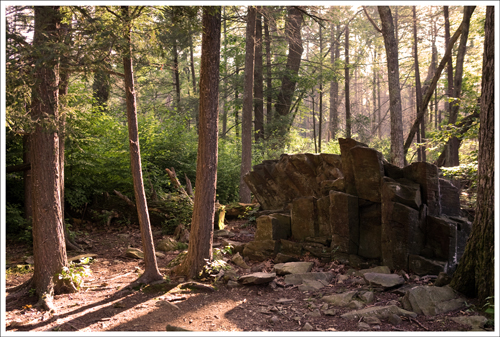
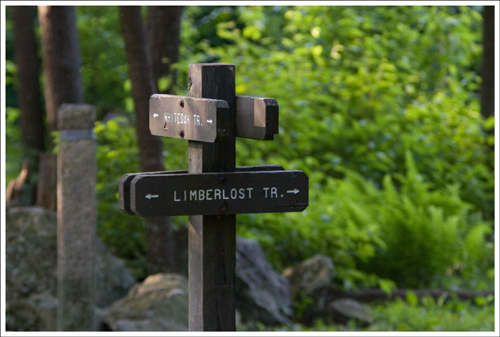
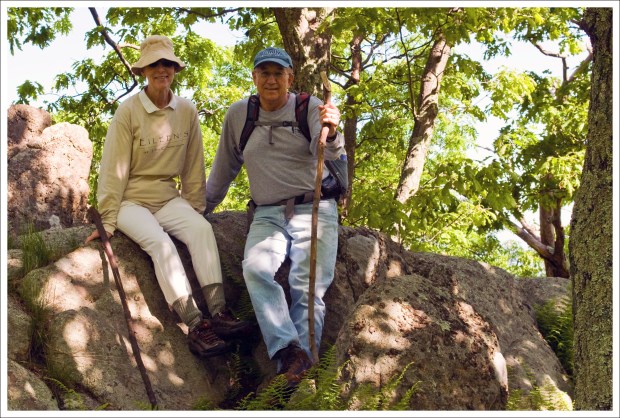
This rock formation sits at the junction of the Limberlost and the White Oak Canyon trail.
This rock formation sits at the junction of the Limberlost and the White Oak Canyon trail. Pictured below: the trail junction.

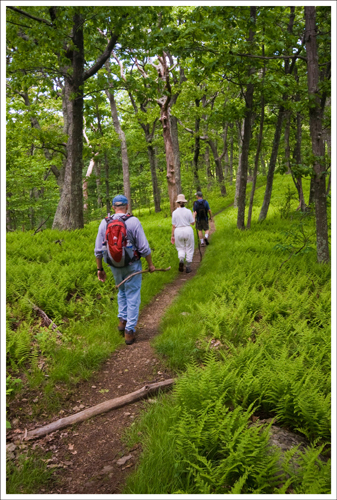
The trail makes its way down from the parking lot, crossing the Limberlost Trail twice.  After leaving the remains of the hemlock forest around Limberlost, the trail quickly descends into White Oak Canyon.  Ship-sized boulders start coming into view as you approach the stream.  The stream starts off as a trickle, but quickly picks up energy as little rivulets of run-off join the flow.  There are many small falls along the stream.  In places, the sheer canyon walls soar upward from the water.  The canyon is a rugged and wild place.

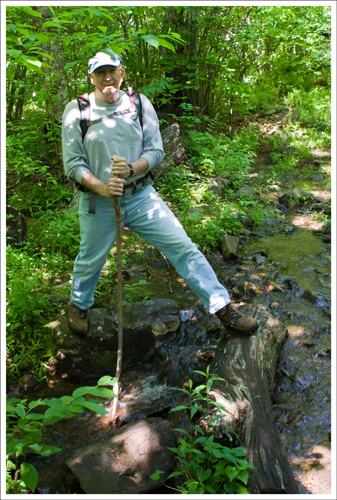
A pool along the White Oak Canyon stream.
A pool along the White Oak Canyon stream. Pictured below:  the stream passes through a narrow, rocky slot.

As you approach the upper falls, the sound of running water becomes increasingly audible in the woods.  There are two footbridges to cross before you come to the viewpoint of the upper falls.  This view is beautiful, but with a little extra effort you can reach the base of the waterfall and have an even nicer view.  On warm days, the pool at the base of the falls is a popular swimming spot.

A footbridge across the stream.

Luckily, the weather decided to throw a favor my way.  Just as we reached the falls, a large band of clouds passed over the area.  It literally went from crystal clear blue skies to thick overcast in the span of five minutes.  I was able to photograph several spots along the waterfall before the clouds blew out as quickly as they appeared.  I even got knee-deep in the water at one spot to get the composition I wanted.  It was so slimy and slippery, so I used my tripod as a crutch.  I saw lots of brook trout darting in the pool.  They’re so pretty and colorful.  They almost look like autumn leaves swimming in the water.
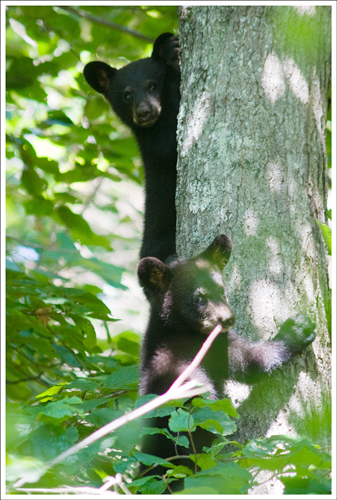
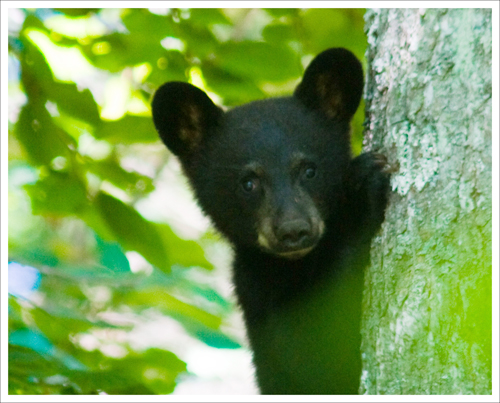
Cubs on the White Oak Canyon Trail.
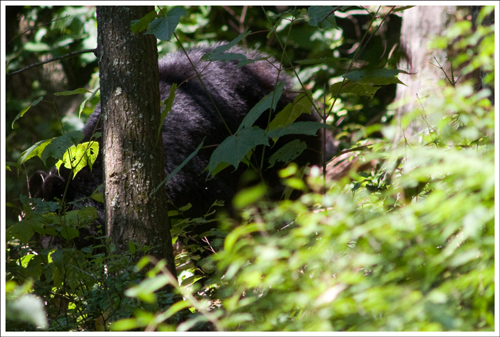
Cubs on the White Oak Canyon Trail. Pictured below: another shot of one cub and a view of momma bear’s back.

cub_2

On the hike back, I stopped to take a water break.  As I was sitting on a trail-side rock, I noticed a glossy, black shape moving quietly through the woods about 50 feet uphill from the trail.  I mouthed “BEAR!” to Adam.   A moment later, the sow and her two young cubs came into clear view.  We sat and watched the family for about ten minutes.  The momma bear moved parallel to the trail, turning over rocks looking for food.  The cubs bounced along behind her.  When they finally noticed us watching them, the cubs darted up a tree and watched us curiously.  Momma bear glanced up a few times, but mostly continued feeding along the way.  She soon ambled uphill and away from the trail.  With just a quick look over her shoulder, she called the cubs to her.  The cubs slid down the tree and scampered off into the woods with their mother.  Seeing the bears was the highlight of the hike.

As we continued our return trip, we passed dozens of hikers.  When we got back up to the Limberlost, there was even a church group hiking with 40+ members, lawn chairs, musical instruments.  I’m so glad we hiked the trail early and were able to enjoy the solitude.  You really can’t beat having a gorgeous waterfall and a great bear sighting all to yourselves!

Adam Says…

The White Oak Canyon trail is a great hike if you’re into streams and waterfalls.  This hike and Dark Hollow Falls are probably the two most popular trails in all of Shenandoah National Park.  Since this trail is so close to Skyland, it appeals to a lot of people.  There is a reason why the parking lot for this trail is so large.  This was the first time that we had hiked this trail from Skyline Drive.  Typically, we have visited the lower section of falls and approached the hike from State Road 600 near Syria, VA and Graves Mountain.  Going from the lower falls to the upper falls is quite steep, so if you want an easier day hike, I would recommend doing either the hike to the upper falls or the hike to the lower falls (instead of the full 8.2 mile loop).
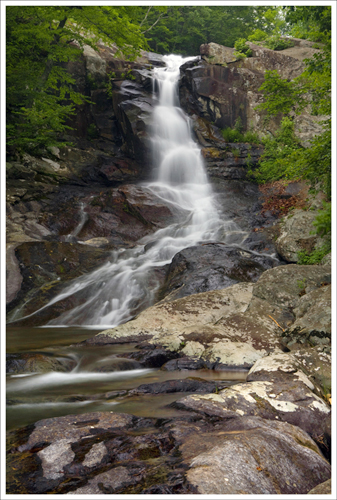
Upper Falls of White Oak Canyon

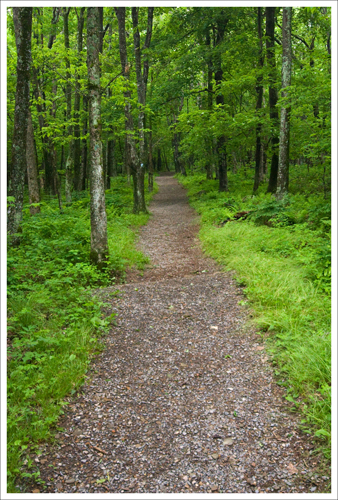
Taking off from the parking lot on Skyline Drive, the trail is very well-traveled and smooth until you start seeing the water to your side.  At .3 miles, you will cross the Limberlost Trail which you could add to your trip if you desire.  The trail then presents more rocky conditions and you do have to watch your feet.  As you hike along the water, you will see several spots to pause and admire the rushing water.  At 2.2 miles, you will reach the top of the Upper Falls.  There is a horse trail that cuts the trail perpendicularly and you will notice the hitch posts for horses on the trail.  The water looks very peaceful here, but it soon rushes down into a deep chasm.
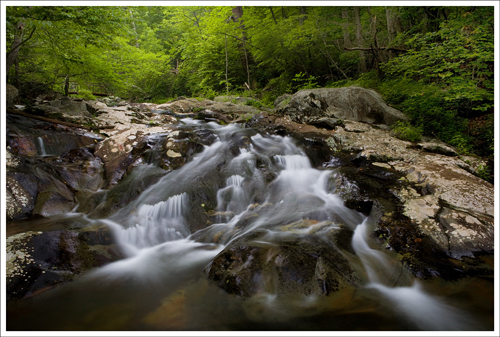
Scenery near the top of the first falls.

The viewpoint at 2.4 miles has some great views of the falls from above and the canyon cutting through the forest below.  You will also see some dead hemlocks standing along the gorge.  I can just imagine how magnificent this would have looked with the hemlocks still there.  From the viewpoint, continue on the trail for another .3 miles.  This is a sharp descent, but it will lead to the view from the base of the falls.  You will come to a cement post which lets you know you are .2 miles from the next set of falls.  This is also the marker that states you’ve reached the base of the falls.  I think the park has abandoned an official trail to the pool at the bottom of the Upper Falls, but if you make your way along the rocks heading north from the cement marker, you will shortly come to a “No Camping” sign.  Continue a little further and you will be able to see the impressive falls from the base, which includes the pool where the waterfall plunges.  This is definitely worth taking the time to view.

The pool at the base of the falls is a perfect swimming hole.

We headed back from this point, since the other falls are not quite as impressive.  This made for about a 5.4 mile hike.  I have a feeling that a lot of people continue to do the whole hike without planning ahead.  There is even a sign at the base of the Upper Falls warning hikers not to overestimate their hiking skills.  Once you pass the upper falls, the continuation of the hike down is quite steep.  The phrase in hiking, “What goes down, must come up” definitely applies here.  The hike back up would be a steady uphill climb that would likely exhaust people who haven’t planned appropriately.

We both enjoyed seeing the momma bear and two cubs frolicking near the trail.  We were able to show/warn two other hikers about the bears presence.   I could tell they really enjoyed the viewing, too.  The bear wisely moved away from the trail, probably sensing that many more hikers were headed in her direction.

Trail Notes

  • Distance – Anywhere from 4.6 to 8.2 miles (we hiked about 5.4 miles)
  • Elevation Change – Around 1200 feet. (2450 if you do the entire 8.2 miles)
  • Difficulty 3.  The route we hiked was moderate.
  • Trail Conditions 4.  The trail is well-traveled and well-maintained.
  • Views –0. No views – the entire hike is down in the woods.
  • Waterfalls/streams 4. One of the park’s nicest waterfall hikes.  If you do the shorter out-and-back, you’ll see one large waterfall and many smaller ones.  If you hike the full loop, there are six waterfalls.
  • Wildlife 4. We saw a bear with her cubs, lots of chipmunks and a rabbit.
  • Ease to Navigate 4.  The trail is easy to follow and marked with blue blazes.
  • Solitude0. Unless you hike this trail very early in the morning, expect to see substantial crowds. It’s one of the most popular hikes in the park.

Directions to trailhead:

Follow Skyline Drive to the Skyland Resort area.  The parking lot for White Oak Canyon is on the east side of the drive between mile markers 42 and 43.  It’s almost directly across the drive from the south entrance to Skyland.
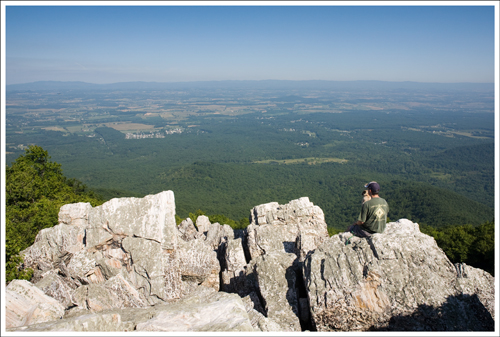
Turk Mountain

Turk Mountain is a 2.2 mile hike of moderate difficulty.  The trail is located at the far southern end of the park, and is less-traveled than many of the park’s other hikes.

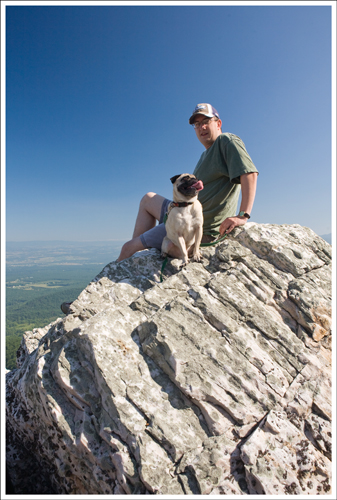
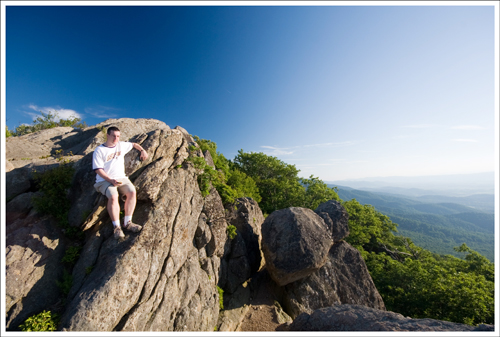
Wookie and Adam enjoy the summit of Turk Mountain.

Adam Says…

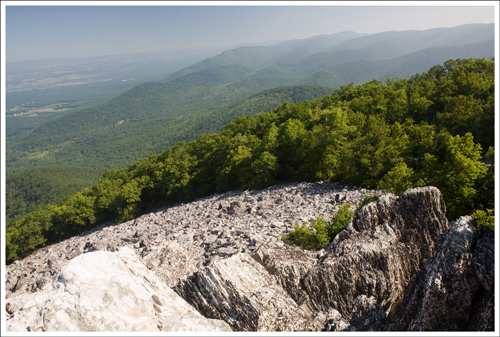
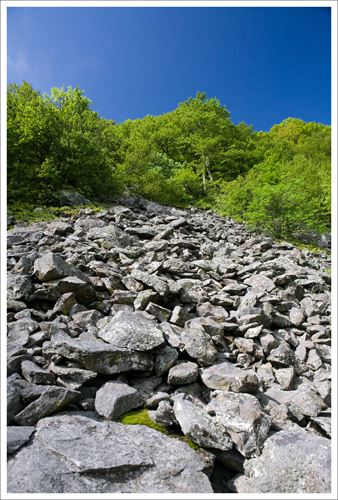
We weren’t feeling terribly energetic on Saturday, so we decided to do a short hike in the southern district of Shenandoah National Park.  Since it was cool, we even got to bring our pug, Wookie, along.  The Turk Mountain trail is only 2.2 miles long, but it seems a bit longer due to the uphill portion.  When you start, you will be on the Appalachian Trail for .2 miles. Then you will split off to join the Turk Mountain trail (marked by blue blazes).  The last half of a mile is all uphill.  During the climb, the side of the mountain blocks all breezes. We recommend hiking this on a cooler day with low humidity.  Most of the times we have hiked this trail, it has been hot and humid, and when the breeze is blocked it feels stifling.  There are some views to the east at about .9 miles into your hike at the last switchback, but the views are much better ahead.  When you reach the summit, the breeze will instantly greet you again.  Continue just past the marker to climb onto the summit rocks.  You will get some great views of a large talus slope and the valley below to the west.

The talus slope below the summit is expansive and impressive.

This is a fun hike that a lot of people try due to the shortness in distance and close proximity to the southern entrance to Shenandoah National Park.

Christine Says…

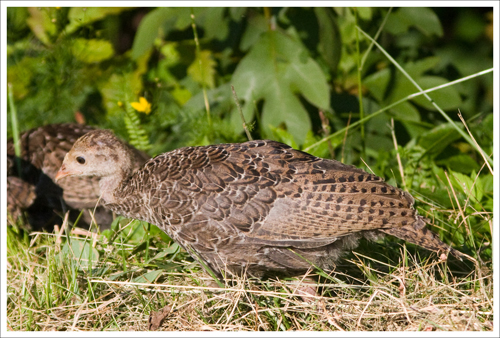
As we entered the park on Saturday morning, I was telling Adam that I don’t feel like we see as much wildlife in the southern district as we do elsewhere in the park.  Wouldn’t you know, as soon as the words finished coming out of my mouth, we passed a huge bear sitting right on the side of the road.  I like to think he was serving as the park’s official greeter that day.  A little later we passed a doe and fawn and a turkey with her brood of babies.  What are baby turkeys called  – turklings? turklets?

Baby Turkey? Turkling? Turklet?

I digress… and now onto the hike!  Turk Mountain is a fun, short hike that we’ve done several times in the past year.  It’s a hike I choose a lot when I want an excuse to go to Sonic (this hike is near the Waynesboro park entrance.  That town is home to our area’s only Sonic).  I just love their coconut creme pie milkshakes.  🙂

Wow, I digress again.  We had beautiful weather for this trip along the Turk Mountain trail.  For the first half of the hike, we enjoyed cool, pleasant, breezy weather. The conditions were ideal for hiking, and I started wondering if we’d made a mistake in not selecting a longer hike.  By the time we passed through the saddle and started our uphill climb, I was glad we’d decided to keep things short.  The uphill portion of Turk Mountain isn’t terribly steep, I think I was just a bit tired from my busy week.

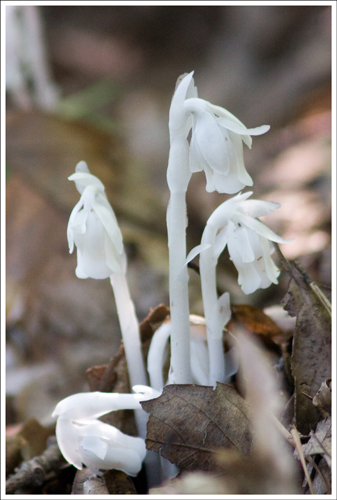
Indian Pipes along the trail.
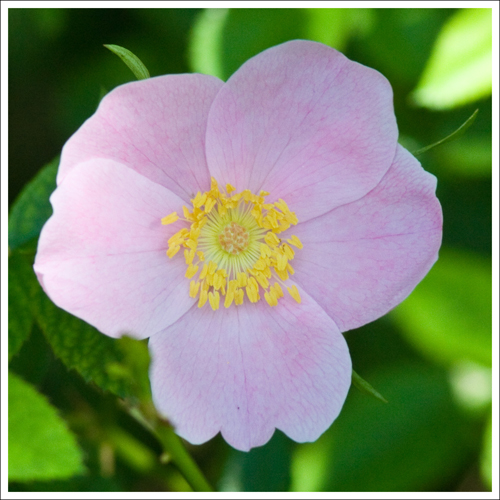
Indian Pipes along the trail.  Pictured below:  Butterflies and other wildflowers were also seen along the trail.

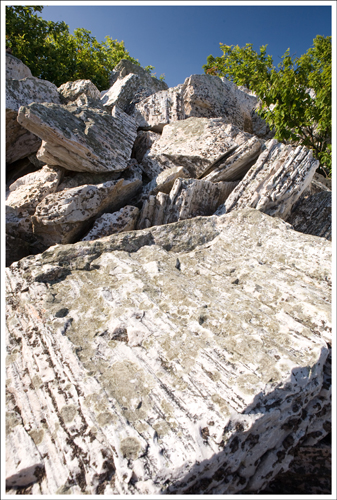
When we arrived at the summit of Turk Mountain, we had the entire rocky jumble all to ourselves.  We climbed around on the rocks and enjoyed the crisp, gentle wind. The rocks at the summit of Turk Mountain are somewhat different looking than other rocks in the park.  I don’t know much about geology, but the color seems to have more pink and gray undertones than other summits.  Because this summit receives less foot-traffic than other SNP hikes, the rocks are in better shape – still covered with lichen and other plants.  When you visit more popular summits like Old Rag or Stony Man, be sure to notice barren the rocks are.

The rocks on the Turk Mountain summit are different.

Wookie was so cute climbing around like a tiny mountain goat.  I’m always amazed by how confident and agile he is on rock scrambles.  The view from the top was a bit hazy, so I didn’t get any great photos.  But it was still a fun hike and a very pleasant morning in the park.

wookieWookie Says…

It’s been a while since I’ve gotten to accompany my masters on a hike.  The last hike I did with them was the Dry Run Falls hike and I got a lot of ticks that day.  Since the temperature was cool for late June, I was allowed to come along.  This hike had a few things that I like – scrambling over rocks and views.  I’m really good at climbing over rocks, so I was able to do this pretty well.  I wouldn’t recommend all dogs to attempt this hike, since you really have to watch your paws or you could hurt yourself.  Adam had to carry me over a few precarious rocks because I have short legs.  However, I was able to confidently go back quicker than he could.  On the way back down from the summit, I ran across a couple hiking up.  For some reason, the woman cowered behind her husband and didn’t want to be near me.  I tried to sniff her leg and she jerked it back quickly.  I guess she thought I was really scary or vicious.  Or maybe she was intimidated by my colorful Aztec-pattern collar.  The bonus for the day is that I didn’t get any ticks on me.

Trail Notes

  • Distance –2.2 miles out-and-back
  • Elevation Change – 690 feet
  • Difficulty 3.  This hike has some nice flat parts to it, but the elevation change is over a short distance, making this a strong uphill for a portion.
  • Trail Conditions 3.  Some of the trail is very smooth, but other parts are covered by sharp, pointy rocks.
  • Views –3. There are some nice views from the top, but there are better hikes with more expansive views.  The talus slope makes for some interesting scenery to add to the view.
  • Waterfalls/streams 0. Non-existent.
  • Wildlife 1. You likely won’t see a lot here due to the steepness of the trail.  The summit does provide for nice hawk and bird viewing.
  • Ease to Navigate 4.  Just one turn from the AT on to the Turk Mountain Trail.
  • Solitude3. There aren’t as many visitors to the southern section as other areas of SNP, but it is fairly popular.  The summit rocks don’t lead to a lot of room to get views, so you may be sharing the beauty with others during mid-day hikes.

Directions to trailhead:

Follow Skyline Drive to mile 94.1.  Park at the Turk Gap parking lot.  Cross the drive and pick up the trail.

Mary’s Rock

This hike to Mary’s Rock starts from Jewell Hollow.  The route follows the Appalachian Trail for roughly three miles to Mary’s Rock.  After spending some time enjoying the views, simply retrace your steps back to Jewell Hollow for a total hike of roughly six miles.  There are other ways to reach the summit, but in our opinion, this route offers the best scenery and the most pleasant trail conditions.

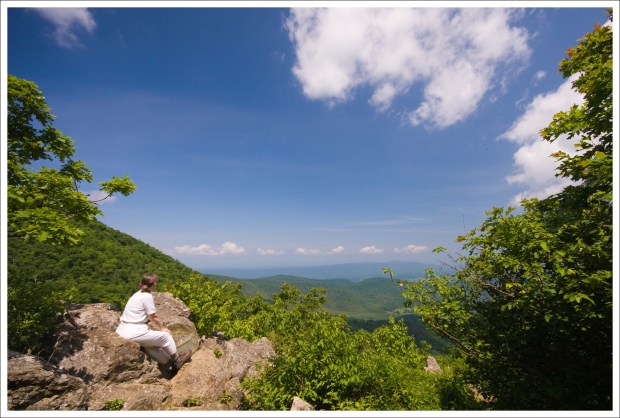
Adam enjoys the view from Mary's Rock.
Adam enjoys the view from Mary’s Rock. Below: Check out this photo from one of our website visitors, Martine Zimmer.  She spotted a rock on the Mary’s Rock summit that looked like a bear!  It really does!

Adam Says…

Mary’s Rock is a great view hike on the Appalachian Trail.  There are many theories on how the summit got its name, but my favorite one is that Francis Thornton’s daughter Mary climbed up to the rock and came back down carrying a bear cub under each arm.   Francis Thornton III owned a lot of land to the east of the Blue Ridge Mountains and Thornton Gap is named for him.

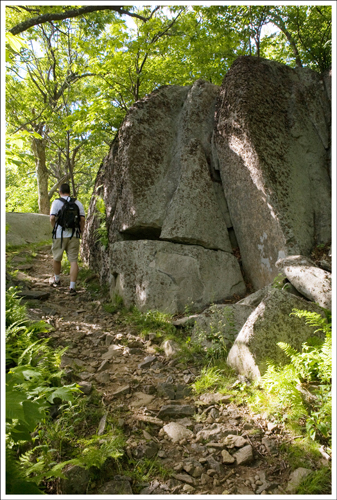
The trail is rocky and passes many large boulders.

We have hiked to Mary’s Rock numerous times in the traditional way, from the trailhead at Panorama, but the trail from Jewell Hollow is not one to be missed.  In my opinion, this is definitely one of the best hikes to do in the park for scenery.  In the fall, you will be able to see great colorful views looking into the western valley below.

The trail is probably roughest during the first .75 miles, but then the rocks tend to give way to easier footing.  There are great places to take in the views at .85 miles at the Pinnacle and at another overlook at 2.0 miles.  You will also pass a AT hiker hut (Byrd’s Nest #3) about halfway through the trip.

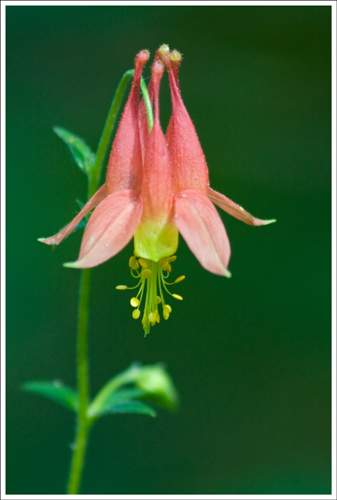
The columbine is starting to bloom all over the park. We saw tons of it along the trail.

Despite the fact that we had to rush to make it back to the car by sunset, we really enjoyed this trail.  We saw a bear on the trail going up and probably the same one again coming back.   On the way back, I was probably only 75 feet away when the bear crossed our path, but he quickly took off as soon as he realized we were nearby.  We also encountered two large bucks on the trail, too.  When we saw the first one, we were coming downhill and it appeared that the buck wanted to stand his ground and approach us.  So, we yelled at him and shooed him back into the forest.

The Byrd's Nest #3 Shelter is a popular camping spot for backpackers.
The Byrd’s Nest #3 Shelter is a popular camping spot for backpackers.  The shelter was day-use only until 2008.  It has since been remodeled for overnighters.

There is a geocache at the top of Mary’s Rock requiring you to identify dates on the USGS markers.  You will have to climb up on the steep rocks to find them, but if you feel comfortable scrambling on rocks, this isn’t too tough.

Christine Says…
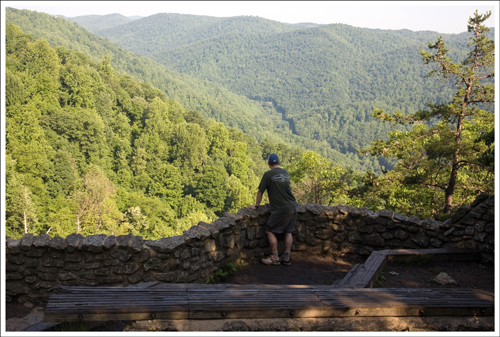
What can I say… we didn’t do a very good job using the distance scale on our map for this hike! I would have sworn that our PATC map made the hike look like 3.5 – 4 miles total, rather than the 6 miles it actually turned out to be. Normally, that wouldn’t be a big deal, but we didn’t start walking until 5:45 p.m.

This was the first time we’ve accessed Mary’s Rock via the Appalachian Trail. In the past, we’ve always gone by-the-book, and followed the designated Mary’s Rock trail. That trail begins at the Panorama parking lot, and makes its way up the mountain via a series of switchbacks. The Mary’s Rock trail is fine, but it’s really quite boring in way of scenery and views. The hike we did along the AT is longer, but it’s also flatter and tremendously more scenic.

The Pinnacle offers spectacular views.

The trail we hiked primarily follows the ridgeline, making one dip down through a saddle between the mountains. The trail is lined with ferns, mountain laurels and rhododendrons. There are many truck-sized boulders along the trail. They kind of look like graveyard headstones for giants. At the .85 mile mark, hikers are treated to an absolutely spectacular view from the Pinnacles, which is the highest point in Rappahannock County. The craggy, boulder-strewn mountains sweep down into the valley, hawks soar below and you get a nice look at Mary’s Rock way off in the distance. As I was enjoying the Pinnacles view, I said to Adam “You know… Mary’s Rock still looks pretty far off. Are you sure we got the distance right? We’re not going to be hiking back in the dark, are we?” He responded “Nah, we’re fine! You need to trust my map reading skills.”

A while later, we passed the Byrd’s Nest #3 Shelter, which was close to the halfway point of the walk up to Mary’s Rock. Time was passing quickly, and I was getting the distinct feeling that the hike was longer than the mileage we estimated. I started to get a bit squirrely at this point. We didn’t have headlamps or a flashlight, and I seriously did not want to get stuck out on the trail after sun down. A lot of the trail’s footing is made up of loose rocky terrain that twists its way through dense mountain laurel thickets. Also, there was a bear lurking in the area – we had heard him crashing through the woods and seen his rounded ears peeking up through the brush.

A back view of Mary's Rock.
A back view of Mary’s Rock.

After passing the shelter, we started almost jogging the trail to make sure we’d have ample daylight for the return trip. We got to the summit around 7:20, just a little over an hour before sunset. Mary’s Rock is an impressive rock outcropping that overlooks both the Shenandoah Valley and a little bit of the eastern Piedmont. In the late afternoon, the light is so warm and lovely on the rock. We enjoyed the vista for a couple minutes, and then promptly began our return trip. Along the way back, we crossed paths with about a half dozen thru-hikers. Many of them were setting up camp at the Byrd’s Nest shelter. We hiked the entire return trip very quickly, and made it back to our car just about ten minutes before the sun set.  As we stepped off the trail onto Skyline Drive, I noticed a bear with cubs in the woods on the other side of the road.  It was nice to see the bear family as a grand finale for our hike.

We saw this adorable cub and his mother right as we finished the hike.

Under normal, non-rushed circumstances, I’d have to say this is one of the prettiest and most pleasant hikes I’ve ever done in the park. I’d love to go back and re-hike it in the fall. I think the views along the way would offer some amazing places to photograph the fall foliage. And from now on, we’re not hiking anything over three miles in the evening.

Trail Notes

  • Distance – 6 miles total,  out-and-back
    (Check out the stats from MapMyHike)*
  • Elevation Change – About 800 ft.
  • Difficulty – 2. Nice and mostly level, with only a few very moderate climbs.
  • Trail Conditions – 3. There are some loose and pointy rocks along several sections of the trail.  If you don’t pay attention, this trail can be an ankle-turner.  But overall the trail is smooth and well-maintained.
  • Views – 4. On a clear day – the views are amazing!
  • Waterfalls/streams – 0. Non-existent
  • Wildlife – 5. Bears, bucks, chipmunks, rabbits, squirrels and many species of birds.  It was a great trail to see animals.
  • Ease to Navigate – 4. After a very brief walk on the Leading Ridge trail, you follow the AT all the way up to Mary’s Rock.  You will not see signs for Mary’s Rock until the cement marker post at the Meadow Springs trail junction.
  • Solitude – 3. You probably won’t see many hikers between Jewell Hollow and the Meadow Springs Trail junction (with the exception of AT hikers in June).  However, the officially designated Mary’s Rock is very popular.  It is likely you will see many people in the last mile before reaching Mary’s Rock.

Directions to trailhead: The trail is located on Skyline Drive at mile marker 37.  Park at the Jewell Hollow Overlook.  Walk 50 yards north on Skyline Drive.  You’ll see a cement marker for the Leading Ridge trail on the west side of the drive.  Follow the Leading Ridge trail for .1 of a mile to a junction with the AT.  Turn right and proceed from there.

* MapMyHike is not necessarily accurate, as the GPS signal fades in and out – but it still provides some fun and interesting information.

Stony Man and Little Stony Man

This hike is an easy, 2.9 mile walk along (mostly) the Appalachian Trail to the summit of Shenandoah’s second highest peak. The two main vantage points along the way provide nice views of Skyline Drive and Skyland Resort below.

Little Stony Man Cliffs

Christine Says…
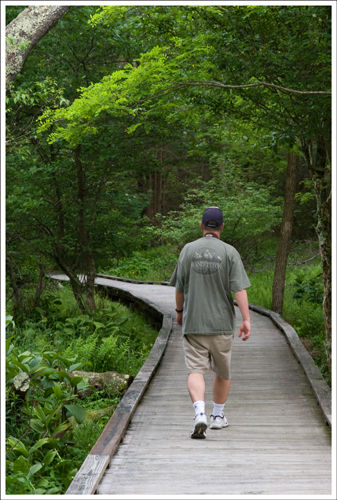
We chose this hike for a quick evening trip to the park. Before I get started on the trail description, let me share what an amazing night we had for wildlife watching. We saw eleven bears (four of them were young cubs), a couple pairs of twin fawns, many large bucks and a beautiful barred owl. No matter how many times we visit Shenandoah, the park always has something new to offer in form of scenery or wildlife.

Now, onto the hike! We started out at the Little Stony Man Cliffs parking area, a few miles north of Skyland Resort. The route is all uphill with 750 feet of elevation gain. For that bit of climbing, you get to enjoy the views from Little Stony Man Cliffs, which (in my opinion) are far prettier than the Stony Man summit. I love the way Skyline Drive looks winding through the woods from the cliffs’ vantage point. In autumn, the afternoon light sets the foliage ablaze at this spot. If the sky is clear, you get a beautiful view of the Page Valley. The lake you see down on the valley floor is Lake Arrowhead. We had a lot of haze on our trip, which was no surprise – thick, milky skies are the norm during Virginia summers. Until this week, we had been lucky and had been enjoying unseasonably clear skies (on the days it wasn’t raining, at least). 🙂

The haze seen from Stony Man Summit was so milky and thick.

There are several trail junctions along this route, so pay attention to the cement trail markers. If you keep following the arrows for the Stony Man summit, you can’t get lost. The climb to Little Stony Man Cliffs is short – less than a half mile of the hike. After crossing the cliffs, the grade of the trail moderates. At around the 1.3 mark, the Appalachian Trail crosses the blue-blazed Stony Man loop trail. You can take either arm of the loop at this point. We usually follow the right side of the loop up and take the other side back down. This section of the hike includes an interpretive nature trail. If you pick up a brochure at Skyland, you can read information coinciding with a series of numbered markers along the way.

When we got to the summit of Stony Man, it was cloudy, chilly and exceedingly windy. I could hardly take a photo without feeling like I was going to blow off the mountainside. We could still see all the cabins and main lodge of Skyland, but most of the valley view was completely obscured by the haze. We noticed that one small section of the cliff-side was closed for peregrine falcon activity. We didn’t stay long at the summit because sundown was rapidly approaching and I didn’t want to hike in the dark. On our way down, we crossed paths with a doe and her twin fawns. They were very cute, but quite skittish. They darted off into the woods before I could manage any photos. The entire walk back to the car was easy and downhill, and retraced the same route we had taken up.

These twin fawns quickly disappeared into the woods.

Adam Says…
This was a great hike to get big view payoffs with minimal effort.  We were able to do this after dinner in a little over an hour.

Stony Man is the highest point on the AT in Shenandoah.

The Little Stony Man Cliffs are a popular spot for Virginia rock climbing.   The cliffs provide several different paths to climb and rappel off the cliffs.  We once ran into a group of college students from The College of William & Mary that were learning rock climbing skills.

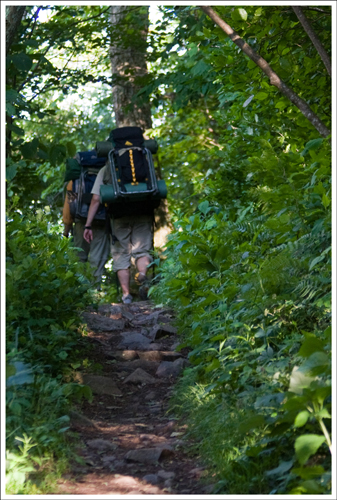
We encountered a pair of hikers as soon as we got to the first junction.  The two hikers shown below were from Louisiana and they were taking seven days to hike the entire stretch of the Appalachian Trail that goes through Shenandoah National Park.  They were averaging about 15-16 miles per day and were on their way to Skyland.  Their backpacks were quite heavy, since they were packing for their entire trip.  They told us they weren’t regular hikers, so we wondered afterward what compelled them to do this trip.  It sounds like a fun trip!

We met two guys who were hiking the 105 miles of the AT through Shenandoah.

From Little Stony Man Cliffs, you can get a good look at the “stony man”.  If you look to the south from the overlook, you can see the profile of what looks like a face.  The Appalachian Mountains are some of the oldest mountains on the planet.   The volcanic activity that occurred when tectonic plates moved against each other formed these mountains.  Once you can picture the nose of Stony Man, you can quickly see the forehead, eye, mouth, and beard.

Stony Man from Skyline Drive - Can you see the face?
Stony Man from Skyline Drive – Can you see the face?

If you are interested in geocaching, there is a geocache through the Little Stony Man trail that gives you a lot of information about the geology of the area.

Trail Notes

  • Distance – 2.9 miles for the round-trip
  • Elevation Change – 750 feet
  • Difficulty – 2. This is a relatively easy walk with a little moderate uphill walking.
  • Trail Conditions – 3.5. There are some rocky sections and a little rock scrambling at viewpoints, but the trail is well-maintained.
  • Views – 3.5. Pretty views of the drive, Skyland Resort and the Page Valley
  • Waterfalls/streams – 0. None.
  • Wildlife – 2.5. Maybe some deer and birds.  There are a lot of bears around Skyland, but we’ve never seen them along the Stony Man trail.
  • Ease to Navigate – 3.5. Pay attention at the cement markers. As long as you follow the arrows pointing to Stony Man, you won’t get lost.
  • Solitude – 1. This trail is one of the park’s most popular short hikes. If you want to avoid crowds, hike it on a weekday or very early on a weekend morning.

Directions to trailhead: The trail starts at the Little Stony Man Cliffs parking area along Skyline Drive. The lot is near mile marker 39.

Humpback Rock

Humpback Rock is a steep, but popular trail in the northern section of the Blue Ridge Parkway with great views.

The summit of Humpback is always crowded.

Adam Says…
This was the third of our three hikes in one day, with Crabtree Falls and The Priest making up the earlier hikes.  We both were quite exhausted.  Christine definitely didn’t want to do this when we arrived.  She blamed me for tweeting about it earlier, since she felt the tweet had publicly committed us to finishing all three hikes.  So, I think I’ll not be allowed to tweet for a while.  We were both low on energy, but we relied on each other to get ourselves up to the top.

It is surprising to see all of the different people that hike this trail and what they choose to wear.  We saw people with serious hiking gear and trekking poles.  We saw elderly people with business shoes and teenage girls wearing party dresses.  This is a steep trail through most of the hike, so be prepared and wear appropriate shoes/clothes or you may end up on a future blog.  As much as you will huff-and-puff on the way up, you will likely have a sadistic smile on the way down as you witness the effort on the faces of those ascending, knowing your work is behind you. We heard a lot of music when we were hiking up and couldn’t place it.  It turns out there was a bluegrass concert at the Humpback Rocks visitor center.

You can extend the hike an extra mile by taking off from the Humpback Rocks Visitor Center parking lot and taking the Mountain Farm Trail.  This takes you through a re-creation of an 1890s farm with lots of buildings you can inspect and think about a farming time long ago.  For us, we didn’t have any fuel left in our tanks to walk the extra mile and the concert was taking place at the farm.

You can see a little snip of the Blue Ridge Parkway from the summit.

The views from the top are quite remarkable and you will have some gorgeous views of the Parkway and the Blue Ridge Mountains.  Take some time to soak in the beauty of the area.

Christine Says…
Let’s see here – what do I remember more about Humpback Rock… the pain or the suffering? Really it’s so close; I’m going to have to call it a draw. All kidding aside, Humpback Rock is actually a fun and scenic hike. This isn’t the first time we’ve hiked it, and we normally enjoy the hike quite a bit. However, it was probably rather ill-advised for us to hike it as the final leg of our trifecta of hikes along the Blue Ridge Parkway. We hadn’t eaten anything in over eight hours (except for that half donut on the summit of The Priest). We were both really hungry and thirsty, but stupidly mused “How bad can one more mile of uphill really be?”

As we learned, it can be quite bad! Along the way, Adam and I moaned at every moment that someone else wasn’t in earshot. We took turns declaring that we should turn around, go back to the car and just get lunch at Sonic. At one point, I said to Adam “Here… take this blasted camera and go up to the top and take photos for me. I’ll wait here.” A few minutes later, I turned around and saw Adam sitting on a rock about thirty feet back. He told me that he didn’t think his feet would move – not even one more step. Basically, we were a big, stinking heap of melodrama.

Last time we hiked up to Humpback Rock was April of 2008. Sometime since then, the trail has been re-routed. The first half of the climb still follows a steep, but wide and smooth, pathway up the mountainside. In the past, the second half of the trail climbed up the backside of the rock. The terrain was more like a scramble than a trail, but it was fun. Now, in order to reach the top, hikers must climb around and under the rock and then follow a trail up the side to reach the summit.

By the time we got to the top, we were beat!

If you hit Humpback Rock on a nice, clear day – the views are beautiful and panoramic. The rock ledges at the top are fun to climb on and there are lots of places to sit and enjoy the view. The trail is exceedingly popular with central Virginians, so it’s not the kind of place you’ll find peace and solitude. On the beautiful Sunday afternoon we hiked the trail, we saw at least 50 other hikers.

Trail Notes

  • Distance – 2.0 miles out-and-back
  • Elevation Change – 800 feet
  • Difficulty – 3.5. This is short but fairly strenuous.
  • Trail Conditions – 3.5. There are some pointy rocks later on in the trail, but there is a lot of sections that are covered in gravel.
  • Views – 3.5. Nice views from the top.
  • Waterfalls/streams – 0. Non-existent
  • Wildlife – .5. I don’t think you’ll see much wildlife due to all the people.
  • Ease to Navigate – 3.5. The trail is not hard to follow.
  • Solitude – .5. If you do this during any normal day hours on a nice day, it will be tough to not have people in your view.

Directions to trailhead: The trail is located on the Blue Ridge Parkway between mile markers 5 & 6… although you can hike to the rocks via slightly longer routes from either the picnic grounds or visitors center.  For the route described above, there is a large parking lot with a information board near the trailhead.

The Priest

The Priest is a wonderful segment hike along the Appalachian Trail in the George Washington National Forest’s Glenwood & Pedlar Ranger District.  The northbound trail access may be a little tough for some people to reach (4WD vehicles are strongly recommended), but if you can get there, you’ll be treated to magnificent views of the Tye River Valley.

Adam enjoys the view from The Priest

Adam Says…
This was hike number two for us on a three-hike-day.  This was our first trip up The Priest, and it was well-worth the bumpy drive to get to the trail.   See the directions to trailhead (below) for some special precautions to take when approaching the trailhead.  On route 826, we decided to go a little further than  Crabtree Meadows, but didn’t make it all the way up by car to the AT junction.  We ended up parking at a campsite and hiking up the fire road for .3 miles.  Many people will want to park at Crabtree Meadows, but that will add one mile to the overall distance.  Route 826 can be quite steep. In fact, some sections of the road are much steeper than anything you’ll see on the actual trail.  We saw a Jeep brigade coming down the steepest section of road, but they looked like seasoned off-roaders.

Route 826 gets progressively rougher.
Route 826 gets progressively rougher. Pictured below: A group of off-roaders make their way down the road.

When you reach the junction (you’ll see painted rocks indicating north/south) of the Appalachian trail, head north (left).  You will come across the Priest Wilderness sign and trail map. When I was telling someone earlier about doing this trail today, they were wondering about the origin of the name “The Priest”.  The true origin is unknown, but there are a few myths.  The first is that it was named after the DuPriest family that lived in the area.  The second is that a minister in the area gave some of these nearby mountains religious names.  The Cardinal and The Friar are both close to The Priest.

Adam enjoys reading the journal at the AT shelter.
Adam enjoys reading the journal at the AT shelter.  Pictured Below: Some of the entries are funny, some divulge a little bit too much information.

journal_3

We found that the trail was a steady incline, but nothing too strenuous.  There was supposed to be a side trail to The Little Priest at .7 miles, but we didn’t see it (but we weren’t looking too hard).  At .9 miles, you will see a blue-blazed spur trail to an Appalachian Trail shelter.  We definitely recommend taking the extra .2 mile round trip to visit the shelter.  These shelters are a great place for all of the AT hikers to get together and have a roof over their head for a night.  At most of the shelters, you can find a journal in which the hikers will write about their day or plans, leave notes for other hikers, etc.  Since this hike is The Priest, the theme of this logbook was to make a confession.  It was a lot of fun to read through the journal entries.  These confessions ranged from eating two Poptarts, to taking drugs, to not paying for supplies.  If you happen to be hiking the trail in June when most of the AT thru-hikers are passing through, consider bringing along some treats to share.  It’s a form of “trail magic” and is always appreciated.  (read the guidelines – there are some tips for dispensing good magic on the Appalachian Trail Conservancy Site)  We did see a few thru-hikers on the trail today, but we hadn’t thought ahead to bring anything.

Around 1.3 miles, you will see some overhanging rocks to the north that lead to some marvelous views.  Take some time to enjoy the views.  The summit is only .1 mile further, but there are no views at the summit.  We really enjoyed this hike and hope to do this one again as well as the nearby Spy Rock.

Christine Says…

The Priest was probably my favorite of the three hikes we did on this particular day. Discovering a new hike is always a real treat, especially when it turns out to be as nice as this one.

There are actually two different ways to access the summit of The Priest. The southbound ascent is longer and much tougher – it follows the AT along a series of forty switchbacks with just over 3000 feet of elevation gain. It might be the hike with the most elevation gain in all of Virginia. One hiker remarked in the journal that the southbound climb “made him realize that he’s not the man he thought he was.” I guess that’s one way of saying that the hike was a long, tough haul!

We chose the northbound ascent primarily based on our limited time. The hike was listed in our book as strenuous, but I did not find it to be tough at all. The uphill grade was constant, but gentle. Adam and I were easily able to carry on conversation without any huffing and puffing uphill.

The terrain on this hike was so pretty! Along the first part of the trail, forest floor was blanketed with lush ferns. Every now and then, we could catch glimpses through the trees of the valley below. The summit of The Priest is 4,063 feet, so we were pretty high up (by Virginia standards, anyhow).

This appeared to be a popular campsite.

When we finally gained the ridge, there was a perfect (and obviously popular) campsite. Encircling the area was a collection of huge boulders arranged in an almost Zen-like natural sculpture. Amidst the boulders, there was a fire pit and a large smooth, open place to set up tents. If I were to spend a night along the trail, this would be my ideal kind of campsite.

Shortly after the campsite, the trail split. One arm headed down to the shelter and the other continued along the AT up to the summit of The Priest. This section of trail was lined with mountain laurels and wild azaleas in full bloom. Several places along the trail were covered with a carpet of pink and white flower petals that had been blown from the bushes. It was almost dreamlike to walk through all the flowers. In the tree tops, we heard the constant sweet sound of warblers singing. We even caught a few glimpses of the birds. The ridge is fairly level, so this walking was very easy and pleasant.

Wild Azalea flowers carpeted the forest floor.
Wild Azalea flowers carpeted the forest floor. Pictured below: Many of the azaleas and mountain laurels were still in full bloom.

I had read that the summit of The Priest was a lovely shady place, but didn’t offer much in the way of panoramic views. So, it was much to my surprise and delight to find a worn path through the woods that led to an amazing outcropping of rocks with spectacular views of the entire valley below. Even though it was close to high noon, I loved photographing this spot along the trail. The sky conditions were a photographer’s dream – cerulean blue punctuated with both swishes and puffs of white cloud.

The summit was spectacular.

Adam and I sat on this spot for a good, long while. We shared a chocolate donut and some water, watched the hawks soar below and took in the valley view. Afterwards, we made the short walk to the actual summit. There was a fat toad sitting right along the trail at the summit. I like to think of him as the official summit marker.

This toad was our summit marker.

The hike back down to the car was fun – all downhill – just the way I like it!

Trail Notes

  • Distance – 2.8 miles out-and-back. We also recommend adding the .2 mile trail down to the AT shelter. If you park at Crabtree Meadows, add a mile on to the trail’s total length.
  • Elevation Change – 1,000 feet
  • Difficulty – 2. While the trail does have a moderate elevation change, the uphill is not too tough.  If you have to hike up the fire road from Crabtree Meadows to get to the trailhead, that will be much tougher than anything along the AT.
  • Trail Conditions – 4. Like most of the AT in Virginia, this section is nicely maintained.
  • Views – 4. Gorgeous views of about 150 degrees of views out into the Tye River Valley
  • Waterfalls/streams – 0. None, but there is a small spring-fed water source near the shelter.
  • Wildlife – 1.5. We didn’t see much, but this is wilderness area.  There are lots of nice birds for any ornithologists.  We saw a cerulean warbler, which has such a gorgeous song.
  • Ease to Navigate – 4.5. Just stay on the AT.
  • Solitude –4. Since it is difficult to get to, you may run across some backpackers or AT thru-hikers, but not many others.

Directions to trailhead: The best access to this trail is via VA-826.  If you are approaching from I-81, take exit 205 towards Steeles Tavern.  Take a left on to Rte. 11 and then a quick right on to VA-56 heading east.  Follow this past the Blue Ridge Parkway (near BRP Mile Marker 30) and then take a right shortly after the Fish Hatchery on to VA-826.  There is a sign at the entrance that you need to have four-wheel drive to travel on this road.  It is a bumpy gravel road where you have to cross several small streams.  Once you reach Crabtree Meadows, it is .5 mile before you can reach the AT trailhead to start The Priest trail.  Many cars should be able to get up to Crabtree Meadows, but the last .5 mile should be taken cautiously and done only if you have a confident driver and appropriate vehicle.

Crabtree Falls

Crabtree Falls is probably Virginia’s best-known waterfall hike. The hike is located a short distance from the Blue Ridge Parkway. The trail climbs alongside the falls and ends at an overlook of the Tye River Valley.

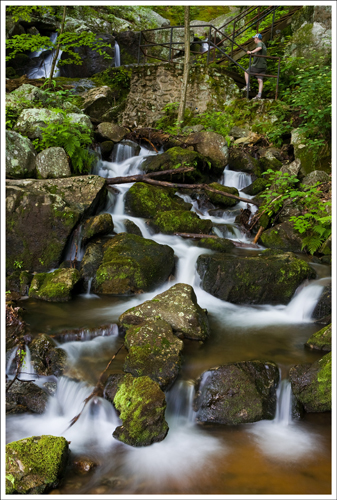
This is the first large cascade you'll encounter on the hike.
This is the first large cascade you’ll encounter on the hike.

Christine Says…

Crabtree Falls, located in George Washington National Forest’s Glenwood & Pedlar Ranger Districts, is one of the classic “must-hike” Virginia trails. When the area is experiencing good amount of rainfall, the 1,200 foot series of falls can be truly impressive.

Adam and I left our house at 5:45 a.m. on the morning of this hike. I wanted to get to the area before the sun started shining into the gorge. Sunny days usually mean crappy waterfall photos. On the morning of our hike, the area was forecast to have quite a bit of fog. I was really excited and had visions of the falls – cascading through the mist, lined with lush, blooming mountain laurel. Unfortunately, it was not to be. When we arrived, the fog was gone, the sun was already high in the sky and the laurel had mostly gone to seed. Nonetheless, I was still able to find a few shady spots along the way to take photographs.

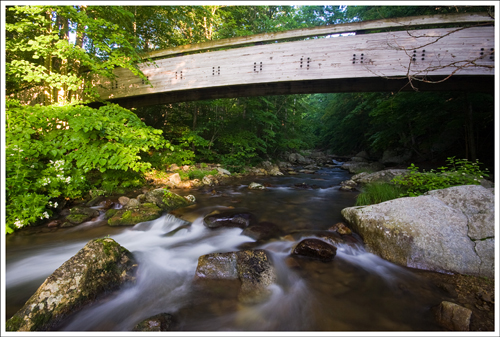
The beautiful arched bridge over the Tye River.

The trailhead is located at the upper parking lot of the Crabtree Falls area. There is a $3.00 fee to use this area. Even though the trail starts from the upper lot, don’t miss walking down to the lower lot to take a walk across the beautiful laminated wooden arch bridge that crosses the Tye River. It was delivered to the area in a single piece and has graced the spot since 1978. Crossing the bridge used to be part of the hike, but improvements to the area expanded parking, added restrooms and shortened the trail.

As you start the hike, don’t neglect reading the bulletin board at the trailhead. It provides many cautionary tales concerning the waterfall’s deadly terrain.  As of June 2015, 29 people have fallen to their deaths at Crabtree Falls – most of them teenagers and young adults. The rocks surrounding the stream are coated with transparent algae. It doesn’t look wet or slippery, but it’s honestly as slick as grease in some spots. The forest service is always warning hikers to stay off waterfalls – but they really mean it at Crabtree.

Adam climbs the steps along the Crabtree Trail.

The first impressive cascade is at the very bottom of the trail and is accessible along a level, paved walkway. The trail to the summit starts on the right side of the paved path, and climbs quickly upward. The trail makes use of steps, railings, wooden walkways and switchbacks to traverse the steep terrain. Some of the switchbacks meander quite a distance from Crabtree Stream, but the sound of rushing water is ever present in the woods. You never move so far from the stream that you can not hear the sound of the waterfall. It’s such a soothing sound. There are five major cascades (and many smaller ones) that make up Crabtree Falls.

The trail is mostly well-graded and maintained. There are a few rocky sections, and some of the rocks may be loose or slippery. On the day we hiked, the trail was really muddy from all the recent rain, but it was still easily passable. I think most of the pretty sections of the falls are within the first three-quarters of the hike. The big, dome-shaped cascade at the top is impressive to see, but it just doesn’t photograph well. At the Tye Valley overlook at the top, you can’t see the falls below you at all. If you hadn’t just walked along the waterfall on your hike, you might not even believe it’s there. The view from the top is just so-so – mostly just tree-covered mountainsides. It pales in comparison to the waterfall views. Most hikers choose to turn around at this point, but you also have the option to continue the hike along the stream, ending up at Crabtree Meadows.

There are discrepancies about the length of this hike. On the internet, I’ve seen it listed everywhere from 2.2 to 4 miles. The on-site plaque at the base of the falls says the hike is two miles to the top, for a total 4 mile out-and-back. Our Blue Ridge Parkway hiking guide lists the hike at 3.4 miles, out-and-back. It seems like the happy medium distance, so we’ll go with that measure.

Adam Says…

The hike along Crabtree Falls is one of the best waterfall hikes, since you hike along the falls for most of the way.  I haven’t experienced any other hike in Virginia that allows you to walk along such an impressive series of falls.

Another beautiful section of falls along the trail.

This was our second trip to Crabtree Falls.  We were hoping to go in the late spring or early summer for views of mountain laurel along the stream.  It looks like in this area, we just missed the peak by about two weeks or the laurel didn’t bloom as well this year.  When you reach the top of the falls after a 1.7 mile hike, there is a stone platform at the top that provides you with nice views of the Blue Ridge Mountains.

The view from the top.

Near the entrance to the paved trail you will see a small family cemetery.  These are actually distant relatives of mine.  My great grandmother was a Fitzgerald and owned the farm next to the McCormick Farm.  My mother used to visit that farm often when she was little.  If you are interested in history, the McCormick Farm is open to visitors and has lots of exhibits showing the early farming techniques.  Cyrus McCormick was the inventor of the mechanical reaper which revolutionized farming.

This is a great hike that a lot of families do before picnicking at one of the tables near the lot entrance.  I know we will visit this location time and again.

Trail Notes

  • Distance 3.4miles out-and-back.
  • Elevation Change – 1000 feet
  • Difficulty – 3. This is a fairly steep trail with plenty of switchbacks.  However, most people will stop along the way to enjoy the falls, so it breaks up the pace.
  • Trail Conditions – 3. There are lots of pointy rocks along part of the trail, but there are some sections that are very nice.  The view to the lower falls is even paved for wheelchair access.
  • Views – 2. At the top of the falls, you get a decent view of the Tye River Valley
  • Waterfalls/streams – 4.5. This is one of the best waterfalls in the Central Virginia area.
  • Wildlife – .5. You probably won’t see anything here other than people.
  • Ease to Navigate – 4.5. Just stay on the trail.
  • Solitude –1. This is an extremely popular hike, so you will surely see people along the way.

Directions to trailhead: If you are approaching from I-81, take exit 205 towards Steeles Tavern.  Take a left on to Rte. 11 and then a quick right on to VA-56 heading east.  Follow this past the Blue Ridge Parkway (near BRP Mile Marker 30).  After a few more miles, you will see the signs for the parking area of Crabtree Falls on your right.  The parking lot loops around and you will see the trailhead and map near the restroom facilities.

Limberlost Trail

The Limberlost Trail is a very short loop through a once beautiful area of Shenandoah National Park.

Part of the Limberlost Trail is along a boardwalk.

Adam Says…

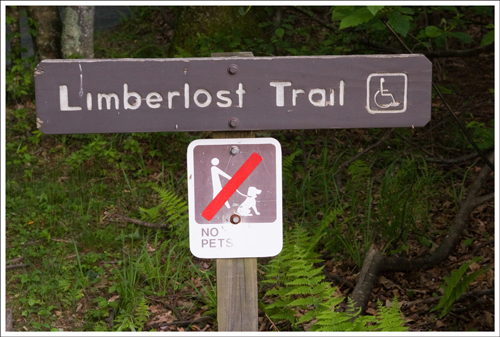
This is a trail that absolutely anyone should be able to do.  I would actually classify this as a walk rather than a hike.  It’s a flat, gravel trail with basically no change in elevation.  Pets and bikes aren’t allowed here, so leave them at home.  Camping is also not permitted.

No dogs allowed! What a bummer.

The trail is probably best known for its views of trees, birds, and other wildlife. The trail crosses the White Oak Canyon trail in case you would like to branch off and combine that for  a longer hike.

This trail has a little history to it.  Addie Pollack bought 100 of the large hemlock trees in the area for $1000 to help preserve this land in 1920 from logging.  Her husband named it the Limberlost Forest after the novel A Girl of the Limberlost.  The Pollocks were responsible for establishing Skyland as a resort destination.  The large hemlock trees are now gone (killed by an accidentally imported insect – the  hemlock wooly adelgid), but there are still some large spruce trees in the area.

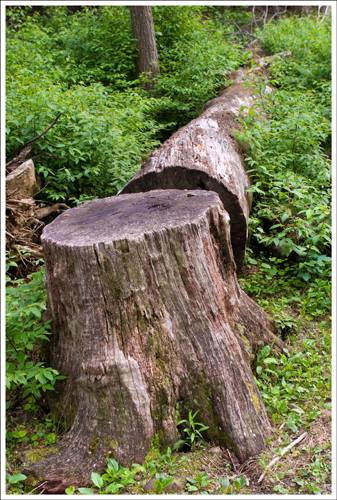
There are many fallen hemlocks along this trail. They used to be the giants of the forest.

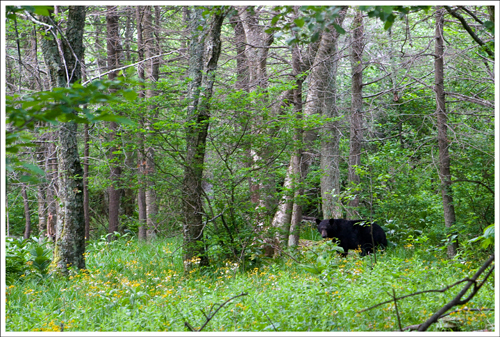
Since we live near Shenandoah National Park, we decided to go up in the evening after dinner to explore for wildlife and try a quick hike.  We didn’t spot any bears along the way, and got to the trail around 7:00PM.  While Christine was taking a photo of me on the boardwalk, I rounded a corner and saw a huge black bear about 100 feet away from me.  We’ve heard that lots of people have seen a bear in the Limberlost area, but this was the first time we spotted him.  I exclaimed “Bear!” to Christine, but she didn’t believe me because she couldn’t see him due to the trees around us.  The bear looked at me for a few seconds and then turned away.  We stood around the same area, hoping he would circle around and pose for some good photos, but he wasn’t feeling too photogenic that night and slowly moved along deeper into the woods.  We also saw four rabbits along the trail.  They are so used to people that they let you get within a few feet before hopping away.  As we were getting further along the trail, I paused because I thought I heard something in the woods.  There was a big crash in the bushes.  Christine was quite startled after seeing the bear, but this crash turned out to only be a doe.

The bear as about 100 feet off the trailside.
The bear at about 100 feet off the trailside. Unfortunately, I just had my wide angle landscape lens when we saw the bear.

Christine Says…

I remember the Limberlost of my youth being a very different place than it is now.  When I was a kid, the hemlocks still towered over the trail, making a cool, green umbrella of shade over the path.  There was very little undergrowth and the area always felt quiet and sylvan.

Although I still really enjoy a stroll along Limberlost, I must admit that the area makes me feel a little sad for the loss of what once was.

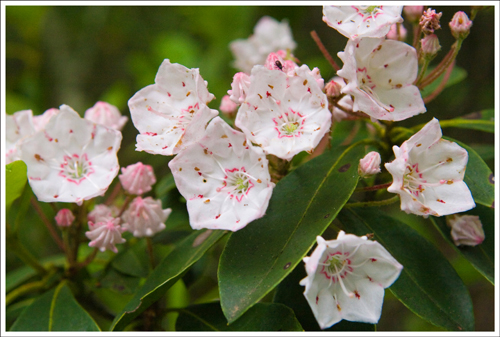
Although the hemlocks are gone, the trail is still lined by beautiful mountain laurel.

The best part about our walk last night was all the wildlife we saw along the short walk.  I totally didn’t believe Adam at first when he saw the bear.  He jokes about stuff a lot, and he said “Bear” in such a dramatic fashion, that I was sure he was kidding.  I don’t really feel nervous or scared when we encounter bears on hikes, but I still jumped when we heard that second crash in the woods.  I guess I’m comfortable with the bears I can see, but I don’t want one to come bursting out of the underbrush right into our path.  That would be scary!

Unlike mystery crashes in the woods, bunnies are not scary.

Trail Notes

  • Distance – 1.3 miles loop trail
  • Elevation Change – insignificant
  • Difficulty – 0.5. This is about as easy of a hike as anyone could do.  The trail is completely covered by gravel and you could even push a wheelchair through the area.
  • Trail Conditions – 5. The trail is in great shape.
  • Views – 1. Only views are of birds, trees, and wildlife.
  • Waterfalls/streams – 0. Non-existent
  • Wildlife – 4. I would suggest going early in the morning or near dusk for the best wildlife.  We saw deer, a bear, rabbits, and lots of different bird species from pileated woodpeckers to eastern towhees.
  • Ease to Navigate – 4.5. Just follow the gravel.
  • Solitude – 1.5. Expect to see people due to the short distance and proximity to Skyland Resort.

Directions to trailhead: The parking lot is located around mile marker 43 in the central section of Shenandoah National Park.  The trail is a loop that starts at the end of the parking lot.  It’s a loop with no elevation difference, so it doesn’t matter which way you proceed.

Sugarloaf – Keyser Run – Hogback Mountain Loop

The Sugarloaf-Keyser Run-Hogback Mountain Loop is a lovely 4.9 mile hike through classic Virginia forest.  It passes by several nice panoramic viewpoints and makes use of the Appalachian Trail, a couple SNP trails and a fire road.

Mom on the Little Hogback Summit

Christine says…

We hiked this trail with my parents to celebrate a combination of (belated) Mother’s Day and (early) Father’s Day.  My parents are fit, active, outdoorsy people, so we knew they would enjoy a day of wildlife watching, hiking and picnicking in Shenandoah.

My Wonderful Mom & Dad

We picked the Sugarloaf-Keyser Run-Hogback Mountain Loop because it sounded like the perfect length and difficulty for the whole group.  For some reason, my mom had a hard time remembering the name of the hike, and kept referring to it as “Hogland.”  I chuckle every time I think of a hiking trail being called Hogland; it sounds like the name of a porcine-themed amusement park.

It definitely turned out to be a suitable hike for the whole group.  The first 3.5 miles were really easy going. The AT and Sugarloaf segments were both especially pretty. The section along the Keyser Run Fire Road was boring, as fire roads always are.  My mom and I agreed that fire roads are always a little dull compared to “real” trails. We saw a couple hikers coming out of the Little Devil’s Stairs area on Keyser Run Road.  They looked exhausted and sweat-drenched.  The day turned out to be a lot warmer than had been forecast.

The view from the summit of Hogback Mountain (the highest point on the trail) was a little underwhelming for me.  The valley vista was lovely, but it was hazy and the view was ruined by power lines and an obstructive radio tower.  The views from Little Hogback are definitely nicer, even though the vantage point isn’t as lofty in elevation. The saddle between Little Hogback and Hogback also has one especially beautiful view spot.

The saddle between Little Hogback and Hogback is very pretty

The whole hike only took us a couple hours to complete, even with water and snack breaks along the way.  Afterwards, we shared a delicious picnic lunch at Pinnacles and headed home tired and stuffed full of chocolate chip cookies and fried chicken.  It was a really fun day.

Adam says…

Since there are a lot of trails and options in this area, here are the trail directions we used.  After crossing Skyline Drive from the parking lot and proceeding .3 miles, you will come to a concrete post.  Take a right and follow the blue blazes down the Sugarloaf Trail.  Hike for 1.1 miles until you come to the next marker.  Take a left onto the Pole Bridge Link Trail.  Continue for .5 miles and then take a left on to the Keyser Run fire road.  Follow this for 1.1 miles, crossing Skyline Drive.  When you reach the AT junction, take a left heading south on the AT.  Keep on the south AT, going up Little Hogback and then Hogback Mountain.  You will cross Skyline Drive one more time on your descent.  Follow the south AT until you reach the parking lot.

The stream crossings were shallow and easy

This hike had some very pretty spots on the trail.  The fern-covered forest floor near the beginning of the trail and again near Hogback Mountain was really quite gorgeous.  I felt this trail was very easy and most people could handle it.  The only challenging portion was the brief half-mile set of switchbacks climbing up to the Hogback Summit.  Last year, a ranger told us this was the best hike in Shenandoah National Park.  I would disagree, but it was still an enjoyable hike and our first time on this particular route.

One of the prettiest section of trail was the Appalachian Trail crossing Hogback Mountain
One of the prettiest sections of trail was the Appalachian Trail crossing Hogback Mountain

We ran into our AT thru-hiker for a third time!  When we stopped to talk to him, I told him, “I promise we’re not stalking you.”  He laughed and asked “Don’t you guys ever go home?”  Quite funny that we’ve seen him so many times in a park that encompasses 196,000 acres!

Trail Notes

  • Distance – 4.9 mile loop.
  • Elevation Change – 700 ft.  Most of this is during the climb up to Hogback Mountain.
  • Difficulty – 1.5.  For most of the trail, the trail is level or slightly downhill.  There is a steep set of switchbacks to the summit of Hogback Mountain.
  • Trail Conditions – 4. The AT is well-maintained.  You also travel on the Keyser Run fire road for a little over a mile.
  • Views – 3.  The view from the summit of Little Hogback was the nicest unobstructed view.
  • Waterfalls/streams  – 1.  A couple of very small stream crossings, but not photo-worthy.
  • Wildlife – 2. Some signs of bears in the area, but you’re more likely to see some deer along the way.
  • Ease to Navigate – 4.   There are a couple turns, but the directions are well-marked on cement posts.
  • Solitude4.  Likely to see AT hikers mostly during June, but we didn’t really see many others.

Directions to trailhead:

Park just south of the Hogback Overlook, in the parking lot located at mile marker 21 on Skyline Drive.  At the south end of the lot, you will find the AT marker.  You will cross the drive here, go slightly uphill, and then start the descent.

Hawksbill Summit Loop

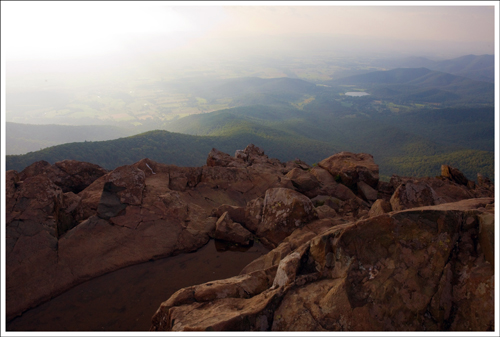
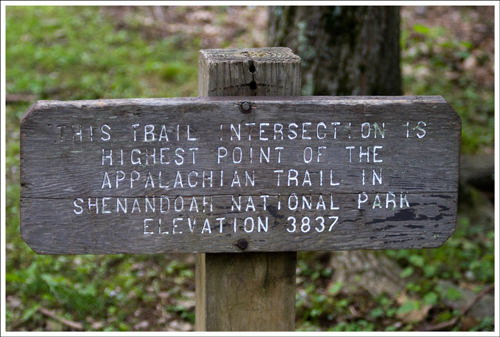
The Hawksbill Summit is a fairly easy, 2.9 mile trail that takes you to the highest peak of Shenandoah National Park at 4,049 feet.

This is the first of the four summit views you'll come to along the Hawksbill Loop Trail.
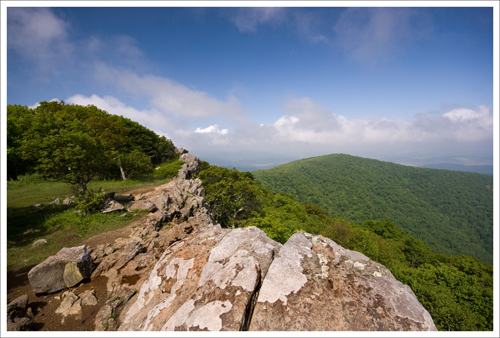
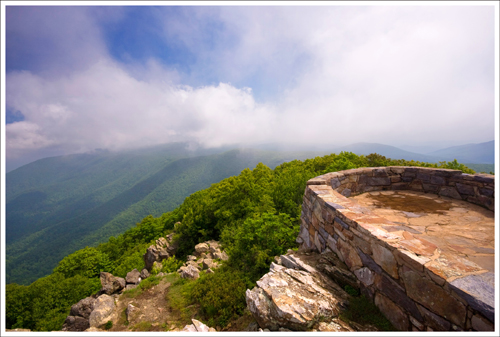
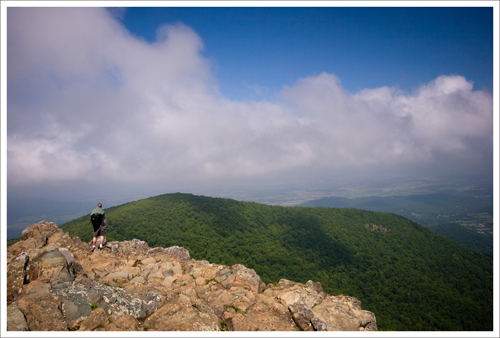
This is the first of the four summit views you’ll come to along the Hawksbill Loop Trail. Pictured below (left to right): The third viewpoint – the hack box for the falcon chicks is along this rock shelf; The CCC constructed summit; Adam climbing around the rock jumble at the summit.

Hawksbill Summit Hawksbill Summit - Shenandoah National Park Adam on Summit

Adam Says…

We really had one of those almost perfect days in Shenandoah National Park.  We made it up to the park before 7AM.  There was a lot of fog on the mountains that made for tough visibility, so we decided to grab breakfast at Skyland Resort before setting out on our hike.  While we were eating breakfast, our waitress pointed out a black bear right outside the dining room window.  It stayed out there for several minutes while people photographed it (they got really close – within 10-15 feet of the bear). While Christine made an attempt to grab her camera from the car for her own photo opportunity (which she missed), I noticed the AT thru-hiker we met on the Loft Mountain Loop had just sat down to dive into a hearty breakfast.  I talked to him about how we were thinking about him braving the thunderstorms the last few days.  He said that the Tuesday night storms had indeed been brutal.

After breakfast, we drove south from Skyland to start our hike on Hawksbill Summit.  The posted trail board listed an out-and-back hike of 1.7 miles and a loop hike of 2.8 miles.  We decided to do the loop and were very glad that we did!

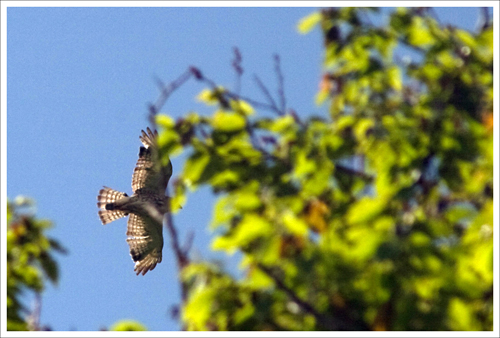
Peregrine Falcons are such fast flyers. Adam took this shot and felt lucky to have even part of the bird, in-focus and in the frame.
Hawksbill Mountain is a great place to watch birds of prey.  While I was photographing the scenery, Adam took this shot of a bird soaring overhead. He felt pretty lucky to have even part of the bird, in-focus and in the frame.  He sometimes feels overwhelmed by all the controls on the dSLR, but I think he does a great job whenever he takes photos.

At around the half mile mark, we heard some screeching up ahead and above.  We came up to the first of three talus slopes and sure enough there were a pair of peregrine falcons swooping around.  We tried to get some pictures of them flying, but they swooped by way too quickly for the camera to lock focus.  When we came to the second talus slope, one of the falcons had landed about 15 feet in front of me, gave me a quick cry, and darted off at eye level from us.  We’ve never had an opportunity to see these birds up close.  We usually vacation in Acadia National Park every summer.  The park’s Precipice Trail is a great place to view falcons; however, this trail is closed off during much of the summer for falcon nesting and we have had to resort to viewing them through binoculars.

The Byrd's Nest #2 Shelter is available for day use only. It's a three-sided structure.
The Byrd’s Nest #2 Shelter is available for day use only. It’s a three-sided structure.

Once we arrived at the Byrd’s Nest Day Shelter near the summit, we ran into a SNP Volunteer who has been monitoring falcon activity in the area.  Shenandoah National Park has been working with the College of William & Mary’s Center for Conservation Biology to help reintroduce these birds to the park ecosystem.  It was fascinating to learn about these birds of prey. He pointed out the cliff-side hack box that currently houses six falcon chicks.  Students find falcons nesting around Williamsburg and Norfolk, grab the babies when they’re a few weeks old and deliver them to SNP for rehoming.

The volunteer feeds the falcon chicks twice per day, giving the birds quail through a slot door in the hack box. The chicks never actually see the person.  The goal is to keep the chicks completely unaware of the human intervention.

The feeder told us a funny story about his time on the mountainside. He was on his way to feed the birds that morning when he was charged by a deer.  He reached for a slingshot he had in his pocket, but the deer was too close.  He ended up using the slingshot as a club and thumping the doe lightly on the head.  It just stared at him like he was crazy.  He realized as he looked down that he had almost stepped on her newborn fawn.

The volunteer told us that there was a belief that the peregrine falcon pair that we saw was moving over from their established nest site on Old Rag.   They have been observing the Old Rag falcons for a while, and are hoping they stay put.  If the Old Rag falcons relocate to Hawksbill, the hack box holding the chicks will have to be moved to a new location.  The volunteer was trying to read numbers on the bands of the falcons swooping by to see if he could identify them as the same pair from Old Rag.

After a bit more chatting, we left the volunteer and proceeded on to the summit.  When we came back to the shelter, we noticed that there were now three falcons swooping around near the summit.  We found the volunteer and told him.  He told us that seeing the three falcons might help prove that these birds might not be the pair from Old Rag.  We felt proud to have been able to provide some useful information for their research.

Christine Says…

It’s kind of ironic, but Adam really didn’t want to go to the park at all on this particular morning.  He thought the trails would be sloppy-muddy from all the rain.  Also, he was longing for a morning of sleeping in, followed by loafing on the couch and possibly even some video games.  But, being the insanely cruel morning person I am, I dragged him out of bed and told him that I wanted to hike Hawksbill.  After all was said and done, he ended up declaring this to be “one of our best days in the park ever!”

At the trailhead, Adam lobbied for the shorter out-and-back, but I really wanted to do the longer loop.  It’s more scenic and there are many more opportunities to see wildlife along the way.  Besides, the out and back is a tough, boring, uphill climb – straight up the side of Hawksbill Mountain.  You don’t see anything special – you just climb.

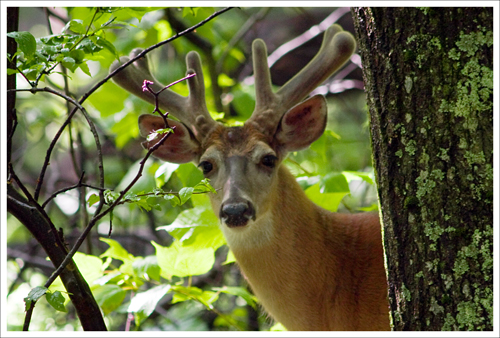
I bet this magnificent buck gets a lot of female attention in the fall.
I bet this magnificent buck gets a lot of female attention in the fall. The photo below is another of the bucks from the group.

Buck

A quarter mile into the hike, we saw three impressive bucks.  Even this early in the season, these guys were already displaying large, velvety racks of antlers. During the summer months, it’s not uncommon to see groups of big bucks hanging out in mini-herds like this.  I think they’re planning strategies on how to get the girls in the fall.  🙂  They were completely indifferent to our presence, so we stayed and watched them for a few moments.  I wish it hadn’t been so dark in the forest.  I would have loved to get some better photos of these handsome guys.

This is the talus slope where we first spotted the peregrine falcons.

Seeing the falcons near the talus slopes was simply amazing.  I’ve never seen peregrines so close in the wild before.  They’re truly expert aerial acrobats.  I also really liked talking to the naturalist at the summit.  No matter how much time I spend in the park, I still feel like I see and learn new things on every visit.

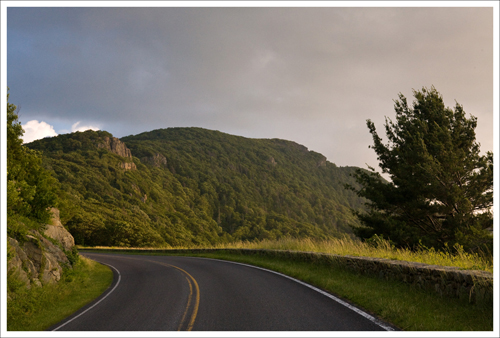
Our view at the CCC-established summit was largely obscured by clouds and fog, but it was still a beautiful, breezy day.  Hawksbill gives full views in every direction.  You get a nice look at Skyline Drive winding its way through the forest and a wonderful, distant view of magnificent Old Rag Mountain.  Hawksbill Mountain actually has four excellent viewpoints along the summit. You only see two on the out and back hike.  Typically you can see all four on the loop hike, but on this particular day one viewpoint was closed off for the falcons.

Although you can't tell in the photo, the trail back down Hawksbill Mountain is quite steep.
Although it’s relatively level here, the trail back down Hawksbill Mountain is quite steep.

The hike back down is pretty steep, but the trail is well-maintained and covered with gravel.  My knees always ache climbing down Hawksbill – there are no switchbacks to gentle the grade.  It’s straight down the mountainside.  Hikers should be careful to follow the correct trail back down the mountain!  There are trails leading back to Upper Hawksbill and Lower Hawksbill parking lots.  There is also a fire road.  If you don’t pay attention to the cement marking posts, you may end up on the wrong trail and have an extra mile or so of hiking to do along Skyline Drive to make it back to your car.  We saw a couple who had made that exact mistake walking along the road when we finished our hike.  They didn’t look too happy.

Trail Notes

  • Distance – 2.9 mile loop.  A 1.7 mile strenuous out-and-back is one option, but the loop is recommended for it’s scenic beauty and wildlife viewing potential.
  • Elevation Change – 800 ft
  • Difficulty – 1.5.  If you do the loop.  The out and back may be shorter, but it’s more strenuous.
  • Trail Conditions – 4. The AT portion is well-maintained.  The trail down from the summit is covered with small gravel.
  • Views – 4.  The view from the summit is impressive on a clear day.
  • Waterfalls/streams  – 0.  No streams on this trail.
  • Wildlife – 4. We did hit some great luck this day, but we saw several deer including three bucks and you have some decent chances of spotting peregrine falcons in the summer.
  • Ease to Navigate – 3.   There are a couple turns,  but the directions are well-marked on cement posts. Pay attention on your way back down the mountain.  There are several descents to choose from.
  • Solitude2.  The hike is fairly popular and featured often with SNP handouts, but we never seem to run into many people up there.  I hear the summit gets very crowded on pleasant weekend afternoons.

Directions to trailhead:

Park at the Hawksbill Gap parking lot which is located around mile marker 45.6 in the Central Section of Skyline Drive.  The trail can be done as an out-and-back hike taking a steep trail to the summit, but we recommend that instead of going straight up to the summit,  take the spur trail to the Appalachian Trail and follow the signs to the Hawksbill Summit.