Tibbet Knob

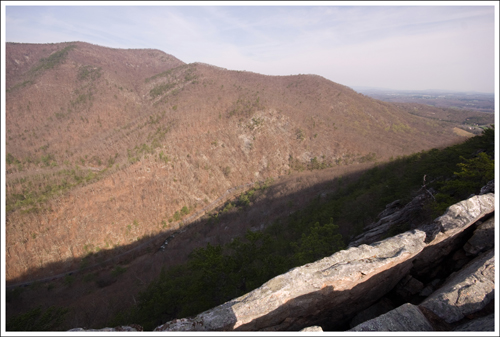
Tibbet Knob is a short, but steep, hike that leads to a beautiful, rocky outcropping that overlooks both Virginia and West Virginia.  It’s considered the sister hike to Big Schloss.

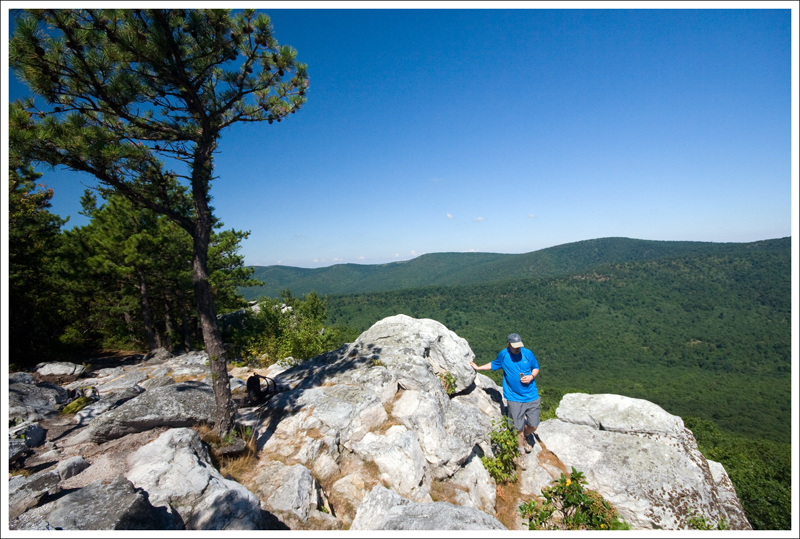
Tibbet Knob Summit
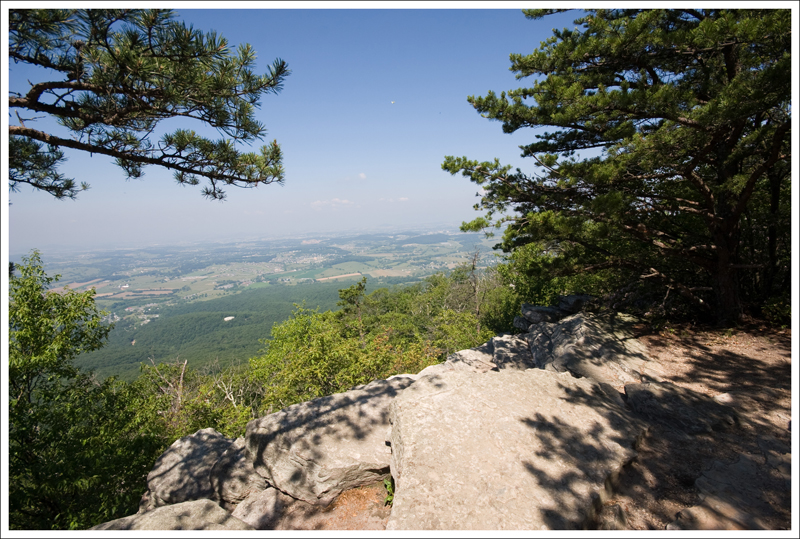
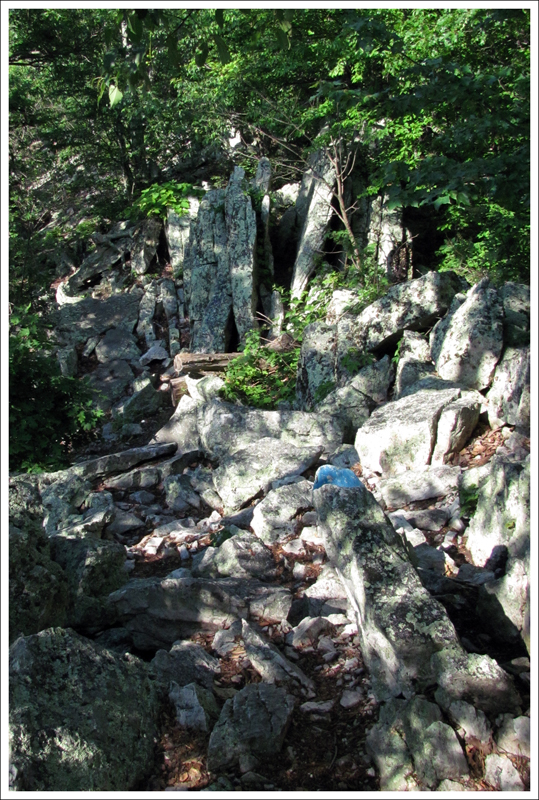
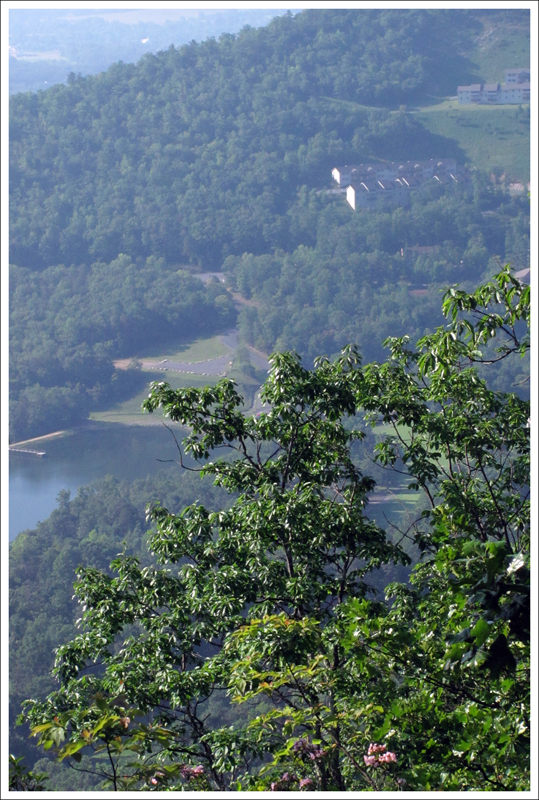
The yellow-blazed Tibbet Knob trail offers spectacular views. Below: The first overlook on the trail comes within the first few tenths of a mile;  The footing along most of the trail is extremely rocky.

First View Hiking Over Rocks

Christine Says…

After a string of eight 90-100+ degree days, we finally got a break in the heat and humidity!  We picked a shorter, easier hike to celebrate the cooler weather – Tibbet Knob.  We’ve found we’re doing lots of longer hikes lately – partly because we’ve simply run out of shorter hikes.

I don’t know how Tibbet Knob escaped our notice for so long, because it’s a beautiful hike.  Tibbet seems to play second fiddle to its sister hike, Big Schloss – though I’m not really sure why.  The views are nearly as spectacular and the crowds are much thinner.  The terrain is definitely steeper and rockier, but not so much so it would scare hikers off.

We started our morning with breakfast at Cracker Barrel in Woodstock (worst/slowest service ever *and* they burned the bacon!)  We finally made it to the trailhead a little after 9:00 a.m.  At the very beginning, the trail passes through several lovely, primitive campsites.  One even has a picnic table that someone dragged a couple tenths of a mile into the woods.  The ascent starts almost immediately and follows a steady, but gradual, uphill to the first open view of the valley below.  This overlook is pretty, but pales in comparison to the summit of Tibbet Knob.

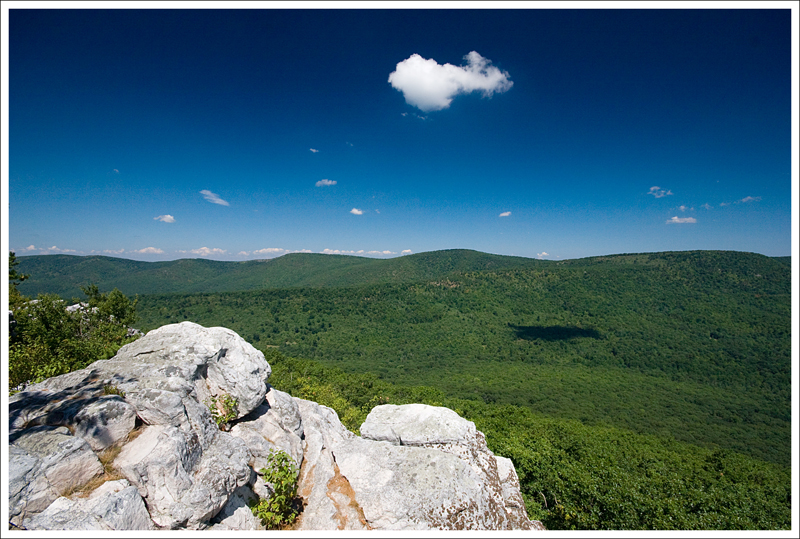
Looking Toward Big Schloss
You can see Big Schloss way off in the distance (circled in yellow).  Below:  Adam enjoys his perch on the summit; The trail was often open and out in the sun; There is a lovely (but dry) campsite about 10 yards from the rocky ledge at the summit.

Adam on the Summit Open Trail Campsite at the Summit

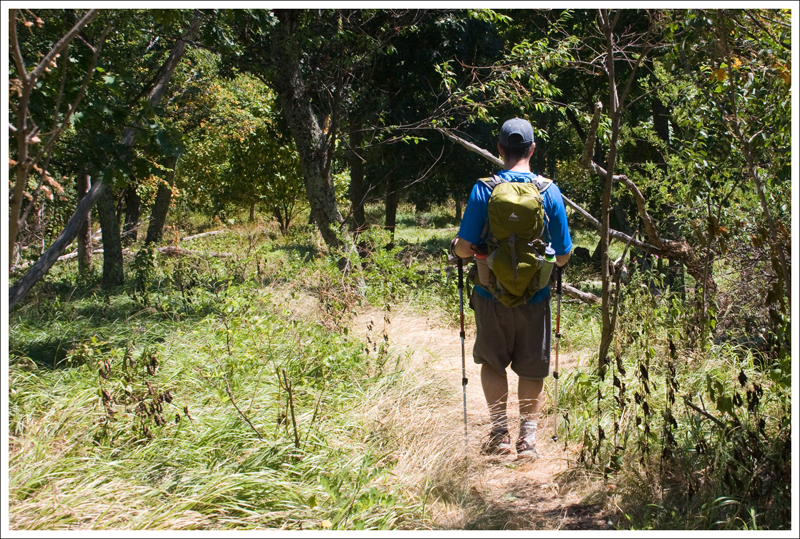
From the first vista, the trail drops gently into a saddle.  The footing becomes increasingly rocky from this point on.  Through some sections, it’s like walking on a dry riverbed of basketball-sized stones – some smooth, some pointy.  The last .8 of a mile is very steep and rocky.  There are two short rock scrambles.  At the first one, I abandoned my trekking poles because they were seriously getting in the way.  I can telescope them shorter, but I decided it was just as well to leave them stashed along the trail to retrieve on my way down.

Shortly after the second scramble, we arrived at the summit.  We stayed at the top for quite a long while.  Normally, we’re not the lingering type, but the morning was so pleasant that we spent at least half an hour sitting on the rocky outcropping.  It was cool and breezy.  The sky was crystal clear and blue and the scent of pine trees was all around.  There were several rocks to recline on, so I laid back and closed my eyes while Adam hunted for his geocache.  We didn’t see another soul on the entire hike.  I love having a beautiful summit all to myself.

The return trip was more downhill than uphill, so it went by quickly and we were back at the car within 45 minutes.

Adam Says…

We had been meaning to try out Tibbet Knob for some time now, since we’ve been several times to do the Big Schloss hike, but this was our first experience on this hike.  The hike takes off from Wolf Gap campground.  This campground is a great area for camping and has a lot of established campsites.  We always see plenty of cars in the campground and usually many of the sites are taken, but you should be able to find a spot for overnight camping.  We definitely plan on doing a camping trip in the future since this site provides access to some great hiking trails.

As soon as you begin the yellow-blazed trail, you will come across several other campsites alongside the trail – one even had a picnic table near the firepit.  At about .6 miles you come to a nice overlook with a decent viewpoint to the south.  If you look closely, you can even see cars on the road below you.  You descend from this overlook for a short distance, but then you begin your climb.  At some points along the ascent, the terrain opens up to larger grassland areas.  You will also pass by several blueberry bushes along the trail, which reminded us of our hikes in New England.  Due to the already hot and arid summer, the blueberries were already past their peak so we weren’t able to pick any on the trail.  The terrain does get quite steep towards the end of the trail.  You don’t have to quite crawl up the slope, but it is almost that steep.  Once you get pass the two steep areas, you are very close to the summit.  The views from the top were gorgeous and I believe give you a little better view than Big Schloss, since you get a better perspective of the valley with mountains around you.  To the east, you can see the side of the Big Schloss hike.   There is also a primitive campsite near the top of the overlook if you wanted to camp at the top, but there is no nearby water source.

Signs of Fall?
Signs of Fall?  Maybe… but more likely evidence of the drought we’ve been having lately.  We saw lots of patches of red trees in the distant mountains, too.  Below:  The only wildlife we saw was a toad; Adam looked for, but did not find, the geocache; It was a beautiful, breezy, blue-sky day; the trailhead starts across the road from the Wolf Gap campground.

Trail Toad Looking for the Geocache
Tibbet Knob Summit Trail Sign

The trail does continue on from the overlook, but it just leads to SR 671 after about .7 miles.  You can actually approach this hike from SR 671 for a shorter, less steep option to give you a 1.5 mile out-and-back hike.  We stayed up at the top for a while to soak in the views and for me to look for a geocache.  I wasn’t able to find this one, but there is an alleged geocache here:

We really enjoyed the peaceful hike for the day.  We had the entire hike to ourselves on a day that was in the 70s and we even had the bonus of not having any bugs buzzing around our face.  This is a great short hike that provides enough challenge to get the blood pumping and marvelous views at the top.

Trail Notes

  • Distance – 3.1 miles out-and-back. Add another .1 mile to get to your car.
  • Elevation Change –830 feet
  • Difficulty 3. There are two significant climbs on this hike.  The first ascent gains several hundred feet in elevation and is pretty easy.  After a short, gentle series of ups and downs, the second ascent is significantly steeper/longer and includes two short rock scrambles.
  • Trail Conditions 2. The trail is extremely rocky.
  • Views –4. The view are beautiful and expansive – a little more than 180 degrees of mountains and valleys.
  • Waterfalls/streams 0. Non-existent.
  • Wildlife 0. The only creature we saw was a toad.
  • Ease to Navigate 4. Just follow the yellow blazes. There are no turns or trail junctions.
  • Solitude4. Tibbet Knob is less popular than its sister hike, Big Schloss. You may see a few hikers, but you probably won’t see large groups.

Directions to trailhead:
From I-81, take exit 279. Follow Rte. 675 until it meets Route 42. Turn right on 42 and then take almost an immediate left on 675 (Wolf Gap Road). Follow Wolf Gap Road until you come to the Wolf Gap Campground (right on the Hardy County Line.) The trailhead is across the road from the campground.

Massanutten Ridge Trail

The Massanutten Ridge Trail is part of the network of trails on resort property. This hike departs from the overlook at the top of Del Webb Dr. in Massanutten Resort.   The hike is extremely rocky, but offers superb views from an outcropping above the ski lifts.

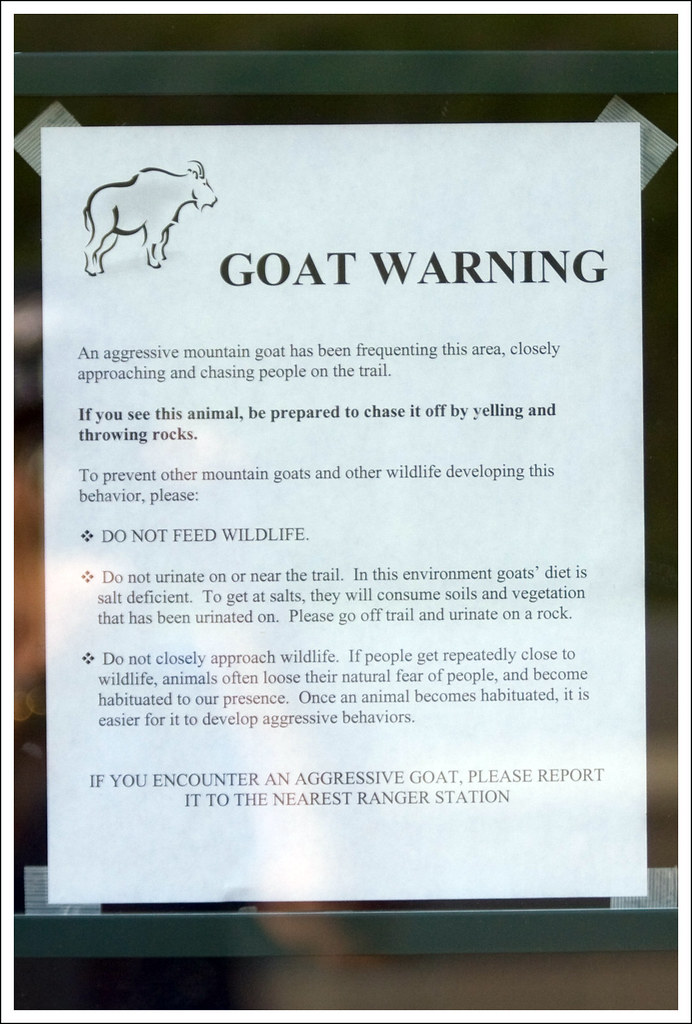
Update 6/6/2016:  As far as we’ve heard, no one has seen goats on this hike for quite a while, so they may no longer be there.  Also… watch out for snakes along the rocky scramble.  While there have been no reported sightings of goats, we have heard about multiple rattlesnake sightings.  Timber rattlesnakes are generally reclusive and non-aggressive. They would prefer to stay hidden and not bite, so be respectful of their space, but don’t be unduly afraid. 🙂

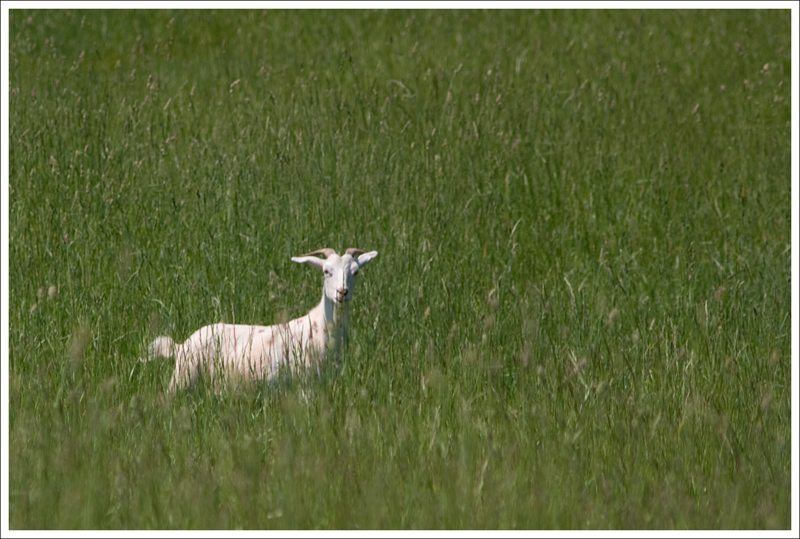
Chased by Goats
The friendly goats were the highlight of the Massanutten Ridge Trail. Below: The hike also provided beautiful views of the valley below; blueberries (not ripe yet) were abundant along the trail; The goats used us like human salt licks; When we tried to walk on, the goat chased us down the mountain.

View From Trail into Valley Blueberries The goats chased us on the trail

Adam Says…

If I could have a movie made about this hike it would be called “The Men Who Are Licked by Goats”.  Who would have thought that there would be feral goats on the top of Massanutten?

An online hiking group I had joined, Valley Hikers, completed the Massanutten Ridge Trail Hike recently, but I was unable to attend.  While we have been up to the beginning of this trail before, we hadn’t completed the entire hike before.  We recently did the Kaylor Knob hike, so we thought we would also take care of the other hike from the top of the Massanutten overlook.

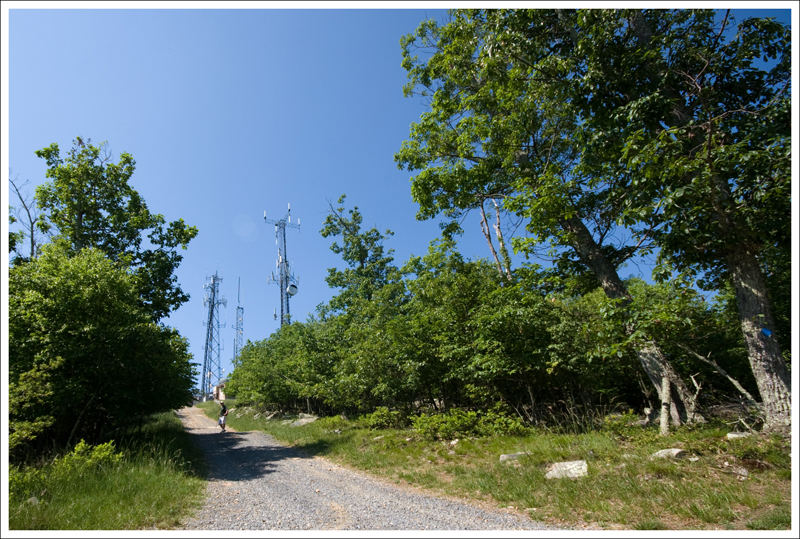
We parked one car at the Massanutten General Store near the ski slopes and then drove to start our hike at the overlook at the top of Del Webb Drive.  At the parking lot, you are treated to views of the ski slopes and mountains around.  You start the trail by climbing up a staircase to get to the level ridge.  The blue-blazed trail starts with a fairly well-trodden wide path.  There are spots along the way to peak through to see some views along the first .25 mile.  Around the .5 mile marker, the trail becomes much rockier.  You will need to constantly look where your feet are stepping or you could easily sprain an ankle.  This rocky, difficult portion continues for about 1.5 miles.  At mile 1.25 on the trail, you come to a nice overlook on the right side of the trail to see some views to the North.  At 2.25 miles, the trail eventually joins a gravel road.  You will see some blue blazes directly across the road, but there is not a trail there.  Simply take a right at this junction and climb the gravel road to reach the cellphone towers at the top.  The trail picks back up just to the right of the highest cellphone tower.  As soon as you rejoin this trail, you will come to the best views on the trail at some rocky overlooks.  At mile 3.0, you will also see a hang-gliding ramp.  It is insane to think of people just running and jumping off of this.  To your left, you will be able to see the ski lift drop-off for the top of the Diamond Jim and ParaDice ski trails.  During the ski season, the lift area is blocked off (maybe to keep people from illegally jumping on the ski trails).  There was a rope blocking it off still, but the cordoned area does not completely block access to the trail.  Continuing past the hang-gliding area, the trail continues and you start your descent.  At mile 3.25, the trail leads to an opportunity to walk down the ski slope.  You could continue further on the actual trail, but we were unsure how close it would return us to our car.  We jumped on to the slopes to take a steep descent back to our car at 4.0 miles.  During this last .75 miles, you descend about 1000 feet of elevation.  I highly recommend taking trekking poles to help keep your balance as you navigate the steep terrain.

The hike followed the ridge and provided many views of Massanutten Resort and the valley on both the eastern and western sides. Below: The middle two miles of the hike was extremely rocky and required quite a bit of rock scrambling; A view of a pond at Massanutten resort; Eastern Fence Lizards in a mating dance; We even stumbled across a Box Turtle on the trail.

Rocky Footing View of Pond Eastern Fence Lizards Box Turtle

The highlight of the trip definitely had to be the goats that we saw at the top of the ski slopes.  As soon as they saw us, they came running toward us to lick the sweat off of us.  It reminded me of a sign that we saw during our trip to Olympic National Park, warning us not to urinate in public or goats would come.  They love salt and were quite eager to lick the salt off of us.  So, beware if you are not into that thing, but I thought it was funny.  The goats were extremely friendly and followed us around for a while at the higher elevations.

There are a couple of geocaches that you could do from this hike:

This hike was tough due to the trail conditions, but it was great to see the views and the wildlife on the trail.

Christine Says…

I had art shows to work over the weekend, so we needed to find a short hike that was located really close to our home.  The Massanutten Ridge Trail seemed to perfectly suit our needs. I thought the hike would be a piece of cake because the ridgeline has very little elevation change overall.  So, I was rather surprised to find that it was a real hike with challenging terrain.  The middle section had a lot of tricky footing and rock scrambling.  It was a constant up-and-down, resembling a small scale roller coaster. Normally, it would be the type of terrain I really enjoy, but I was fighting off a cold all weekend.  My stuffiness and fatigue made this squarely moderate hike feel a lot tougher than it typically would.  There were definitely a few scrambles where I would have been happy to hang-glide right off the side of the mountain just to avoid climbing over anymore rocks!

Goat -
The Goats were fun! Below: The cell towers on top of Massanutten are a real eyesore; trail markers along the trail are blue and show mileage; for the brave – there is a hang-gliding launch on top Massanutten; the sign shows gliding regulations and disclaimers; the mountain laurel was in full bloom along the trail; at the summit there were many vultures soaring.

Ridge Trail Marker Hanggliding Lauch Ramp
Trail Sign at Peak Mountain Laurel Vulture

My favorite part of the hike was the unexpected amount of wildlife we saw along the way.  It started off with a cute Box Turtle walking along the trail. Then we saw numerous Eastern Fence Lizards – two were even participating in a courtship dance.  There were lots of butterflies fluttering about and at the overlooks we saw plenty of vultures soaring on the thermals.  But the best part was seeing the two goats living at the top of Diamond Jim.  I spotted them first through an opening in the woods, and squealed “GOATS!”  I couldn’t stop laughing at the way they licked.  They went nuts for the salty sweat.  We decided to name the goats.  “Diamond” – the white goat – is shy.  She follows the other goat everywhere, but does not participate in the vigorous licking.  The red and white goat, we decided to name “Salt Lick”.  I think the basis of that name is pretty self-evident.

All in all, the Massanutten Ridge Trail was a pleasant surprise.  The views and the wildlife both far exceeded anything I expected.

Trail Notes

  • Distance – 4.0 miles as a shuttle trail or 6 miles out and back. (If you do this as an out and back, you will not be walking on the ski slopes and will likely miss the goats)
    (Check out the stats from MapMyHike – for the out-and-back – added 4/4/15)
  • Elevation Change – 1000 feet
  • Difficulty – 4. The elevation doesn’t change a lot initially, but the terrain will make it hard work and slow going.
  • Trail Conditions – 1.5. About 1.5 miles of the trail is rocky and then a very steep downhill at the end requires trekking poles to be safest.
  • Views4.  You get some different views along the way, but the best views are from near the cellphone towers and hang-gliding platform.
  • Waterfalls/streams – 0.
  • Wildlife – 4. There aren’t many places you get to see free-ranging goats and I think most people see them here.  We also saw lizards and a turtle.
  • Ease to Navigate – 3.5.  There was a couple of spots where it was a little difficult to see which way the trail goes, but since you’re on the narrow ridge, it is not hard to just stay on that ridge.
  • Solitude –3.5. We didn’t see anyone there, but you do typically see a lot of people on the initial trail.  The people you see will generally be during the first .5 mile.  Not many people continue on this trail after that.

Directions to trailhead:
From Harrisonburg, head east on US 33 for about 10 miles. Turn left at the Exxon on the left and head on SR 644, Resort Drive.  Follow this road and take a left on Massanutten Drive.  You will reach a guard house.  Let the guard know that you are here to hike and they will give you a guest pass.  After about 3 miles, take a right on Del Webb Drive. Follow Del Webb Drive for about two miles until you begin to drive up to the ridge, where there is a parking lot on the left.  The trail begins up the small, wooden set of stairs leaving the parking lot.

Trimble Mountain

Trimble Mountain is a lovely, wooded trail through the North River Ranger District of George Washington National Forest.  The hike begins near Todd Lake. It climbs the mountain, follows the ridge across two summits and then descends back to the start point.

Trimble Mountain from the Todd Lake Dam
A View of Trimble Mountain from the Todd Lake Dam. Below: Todd Lake has a nice campground with flush toilets and hot showers. The lake is open to swimmers.

Todd Lake Trail Sign

Christine Says…

Well, this entry should have been part four in the Backpacking 101 series, but sadly my sprained ankle forced us to bail out on the trip.  The weight of a pack on my sore ankle is still too painful.  Fortunately, I was cleared to do some light day-hiking again. So, on Saturday morning, Adam and I headed out to George Washington National Forest.

Trimble Mountain fit the bill for a light and easy hike. The four-mile trail isn’t too rocky and follows a gentle grade both up and down the mountain.  We parked along the road near Todd Lake.  Before hitting the trail, we climbed up the backside of the dam and enjoyed the lake view.  The top of the dam also provides a great look at Trimble Mountain. The sky was absolutely gorgeous – a real photographer’s dream.  It was the prettiest I’ve ever seen Todd Lake look.

Shortly thereafter, we were on our way up the Trimble Mountain trail.  Within a tenth of a mile, we reached a “Y” in the trail.  We took the left branch, following Hiking Upward‘s advice that it was the gentler, more gradual grade.  For about a mile and a quarter, we climbed steadily upward.  It was never tough climbing, but it was consistent.  The trail was really narrow and carved into the mountainside.  A lot of places, one foot was always laterally uphill from the other, and there was barely room for placement of my trekking poles.  It was also an unusually warm day for early May, so the bugs were out in full force.

Trimble Mountain actually has two summits with a saddle between.  Once you gain the ridge, the terrain consists of both uphill and downhill hiking.  There really aren’t any views to speak of at the summit.  Every now and then, we could see glimpses of the mountains through the trees, but there was never a sweeping, panoramic view along this hike.

Wild Iris
There were so many different kinds of wildflowers growing along the trail.

Dogwood Wildflower

Wildflower Wildflower

The remainder of the hike went by quickly and was all downhill.  I stopped many times along the way to photograph the abundant wildflowers on the forest floor.  I also spotted a few little tree frogs.  They were so tiny and fast that I had a hard time getting photos.  They were the only wildlife we saw on the trail.

By the time we got back to the car, my ankle was quite sore again.  The downhill walking really seems to strain it.  I hope that little by little it will feel better and become stronger. Hopefully when it’s healed, we can make up that backpacking trip.

A tiny frog
This little frog was about the size of a fingernail.

Adam Says…

We had been to the Todd Lake area before of George Washington National Forest, but this was our first time hiking Trimble Mountain.  Todd Lake receives a lot of campers and local visitors that want to enjoy swimming and basking.  The Trimble Mountain trail that is nearby doesn’t seem to get a lot of traffic.  We had the entire hike to ourselves on a beautiful day outside.  The bugs helped us realize that the warm weather is here.  One thing that is different about hiking national forest trails is that there isn’t a lot of maintenance to the trails.  There were a couple of trees spread across the trail and the trail was becoming a little more overgrown in parts.  We had heard that there were good views on this trail, but we were disappointed to find that most of the views are obstructed.  The only views you will see is in break in the trees.  The winter would probably lead to more views of the mountainside, but after the leaves fall this will look a lot more dull.  We enjoyed getting out to hike and the wildflower variety was definitely a highlight of the trail.

One of the few openings in the trees
One of the few openings in the trees that provided a view. Below: Trees blocked most of the view; the trail is marked with double yellow blazes.

Adam takes in the view Double Yellow Blazes

There is one geocache on the trail and a few at the nearby Todd Lake area.  The first you can find along this hiking trail.  The other trail would involve hiking along the Todd Lake Trail which you can reach from the opposite side of the road from the Trimble Mountain trail.  The Todd Lake Trail is a little less than a mile and takes you around the entire Todd Lake area.  Since the day that we did the hike was the 10th Anniversary of geocaching, I felt I needed to do a couple of these to celebrate the hobby.

Trail Notes

  • Distance – 4 miles – loop
  • Elevation Change –around 1,050 feet
  • Difficulty – 2 This climb on this hike is about two miles, but is very moderate.
  • Trail Conditions – 3. The trail is narrow and little bit overgrown.
  • Views –1. There are some nice glimpses of the mountains through the trees, but nothing remarkable.  Views might be nicer in the winter when trees are bare.
  • Waterfalls/streams –1. In times of heavy rain, you’ll find several small streams along the trail.  Most of the year, these streams are dry.
  • Wildlife – 1. The national forest is used by hunters, so animals tend to stay hidden.  We saw quite a few frogs and toads along the trail.
  • Ease to Navigate – 5. The trail is well-marked and easy to follow.
  • Solitude – 4. We didn’t see a soul.

Directions to trailhead: From Bridgewater, Virginia head south on Rte. 42 for about three miles, following signs to Natural Chimneys regional park.  Take a right on 613 and in less than one mile, take a left on state route 747.   Take a right .75 miles after Natural Chimneys to the intersection with 731.  Take a right heading north.  In about a mile, take a left on to State Route 730/North River Road.  This comes to an end and take a right on to state route 718.  In another mile, you will take a left on to Forest Road 95, entering George Washington National Forest (you will see signs directing you to Todd Lake).   The trailhead is about 3.5 miles on the left.  You can park on the side of the road right near a trailer dump station.   The trailhead is on the opposite side.  (There is a trail on the same side of the dump station that leads to the top of Todd Lake if you are interested.)

Kaylor Knob

Kaylor Knob is a fairly easy 3.5 mile ridge hike offering nice (but slightly obstructed) views.  The summit is the highest point on Second Mountain.

Adam Says…

For those that regularly follow our blog, you may know that Christine sprained her ankle badly during our hike up Buzzard Rock.  While she was healing, we participated in a Backpacking 101 course through PATC. The workshop concludes with an overnight backpacking trip scheduled for the first weekend in May.  We decided to test out the ankle with some extra weight to see if going on the backpacking trip would even be possible.  So, we got our gear together and decided to do a short hike to Kaylor Knob after work last Friday.

While you can approach this summit from Cub Run, we decided to try the shorter approach,  taking off from the overlook at Massanutten Resort.  The hike starts across the road from the parking lot at the top of the overlook.  We have hiked this trail several times to the first overlook where a geocache is hidden, but this was the first time that we took the hike to the summit. 

Since the last time we did this hike, someone has improved the trail markings.  You simply follow the blue-blazed trail along the way (some points also have blue signs marked with a “K.K.” and the mileage).  At around .5 miles, you will come to a junction with another trail that is marked with pink blazes.  Just stay to the right and continue on the blue-blazed trail.  At .75 miles, you will come to a small rock outcropping that has a nice view to the west. 

If you continue up the hill past this outcropping, you will continue to walk along the ridge.  You will see views to the west and east through the trees that will open up at different spots.  At 1.75 miles, you will come to the summit, which is marked with a larger outcropping and nice views toward Shenandoah National Park. After taking some time to enjoy the views head back the way you came.

Adam tries out the backpack.

I do think the views to the east are better than the views to the west on this hike.  If you wanted to see a nice sunrise, you should get up early to make it to the summit by sunrise. 

This is a great short hike to do if you’re visiting the Massanutten area.

Christine Says…

Adam and I have a backpacking trip coming up, so I needed to get out there and give the ankle a good test drive.  Our original plan was to hike somewhere in Shenandoah on Saturday and then spend the night camping in our backyard.  However, the weather took a turn for the worse, and we ended up just squeezing in a quick hike to Kaylor Knob on Friday evening. (we also skipped the tent in the backyard  and slept in our nice, plush bed instead.)

I managed to load about 25 pounds of gear into our backpack for the “dress rehearsal”.  My ankle felt completely fine for the entire hike – stable and painless.  The pack was easy to carry and comfortable.  It did make the hills a little tougher, but I still felt really good.  I know our packs for the trip will be a little heavier, but this was still a decent test.

The Kaylor Knob hike is not particularly remarkable.  It’s pretty and peaceful and has two nice viewpoints along the way.  There are definitely more impressive trails in our area, but this one is a five minute drive from the house, so it was perfect for a quick after-work hike.

Note: If you have a couple days in the area, be sure to check out the Massanutten Ridge Trail!

Trail Notes

  • Distance – 3.5 miles out-and-back
    (Check out the stats from Map My Hike)*
  • Elevation Change – about 450 feet
  • Difficulty –1.5 Most people should be able to do this.
  • Trail Conditions – 3. While the trail is used often, it contains lots of pointy rocks.
  • Waterfalls/streams – 0. Non-existent.
  • Views – 2.5. Pretty, but not terribly open or panoramic.
  • Wildlife –1.5 There isn’t much room for wildlife on the top of this ridge.  Expect to see birds of prey soaring in view as well as many of the local birds in the thickets.
  • Ease to Navigate –4.5. If you stay on the blue-blazes, you’ll be fine.
  • Solitude –3. You may see some people due to its popularity with vacationers, but you should still have mostly solitude.

Download a trail map (PDF)

Directions to trailhead: From Harrisonburg, head east on US 33 for about 10 miles. Turn left at the Exxon on the left and head on SR 644, Resort Drive.  Follow this road and take a left on Massanutten Drive.  You will reach a guard house.  Let the guard know that you are here to hike and they will give you a guest pass.  After about 3 miles, take a right on Del Webb Drive. Follow Del Webb Drive for about two miles until you begin to drive up to the ridge, where there is a parking lot on the left.  After you park here, cross the road.  At the end of the guard rail you will begin the Kaylor Knob trail.

Buzzard Rock

This 4 mile out-and-back hike takes you to a ridge walk with views of Fort Valley below.

Adam on Buzzard Rock
From Buzzard Rock, you get a great view of Passage Creek and Fort Valley below. Below: The view below from this vantage point; Scrabbly pines are the predominant tree at the summit

View of Fort Valley

Adam Says…

This was the first time that we had done this hike.  The hike seems to be very popular for people from nearby Front Royal, Winchester and Northern Virginia.  It is not too difficult of a hike, which makes it a great hikes for families and newbie hikers.

You start the trail from the parking lot and you’ll follow the double white blazes for the entire trip.  You begin walking through a piney area that will smell nice if the area has been warmed up in the spring/summer sun.  The trail has some hills to go up and down and a few small streams to cross.  Around 1.0 miles, you will arrive at a frequently-used campsite.  Just cross the campsite and continue up the trail for about another .75 miles until you reach the first overlook.  You will continue up the hill to reach the ridgeline.  Continue to hike across the ridge to take in the views from different angles.  Once you feel that you have seen all that you would like, you can return the way you came.

Trail Sign
The trail is well-marked and connects to other local GWNF trails. Below: Lots of stuff along the trail is in bloom now; the rocks at the top are covered in lichen.

Blossoms Flowering Trees Lichen

For any of those people that are interested in geocaching, you can grab three easy ones along the trail.  All of them are normal-sized containers and have some things to trade.  One of these was placed by our inspiration for a lot of hikes, Hiking Upward.

Unfortunately, this trip was marred for us since my wife sprained her ankle very badly at the top of the ridge.  She somehow managed to hike back down under her own power despite my offerings to carry her down – quite a trooper!  We definitely will do this hike another time.

Christine Says…

Buzzard Rock was a beautiful hike for a beautiful spring day.   The summit offers a great scenic payoff with minimal effort.  The elevation gain of 650 feet is very gradual with the exception of one very short, steep climb to the ridgeline.

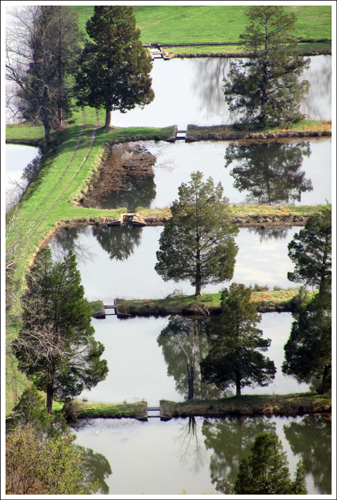
The early part of the hike passes close to civilization, so the sound of cars and glimpses of houses are always in sight.  However, within a half a mile, the trail leads away from everything and passes through a pretty stretch of open woods with very little undergrowth.  In early spring, the forest floor is covered with tiny wildflowers peeking out from under the brown leaves. The view from the trail eventually opens up and provides a nice view of the Front Royal Fish Hatchery and the surrounding valley below.

The view of the valley below is beautiful! Below: The Front Royal Fish Hatchery; A view of the Buzzard Rock “spine”

From this point on the trail is extremely uneven and rocky – big slabs of stone, angle up out of the ground like jagged teeth… more about that later.  The view from the top is not as dramatic as other Virginia hikes, mostly because you can’t see many distant layers of ridges.  What you do see is a deep, narrow valley below with Fort Valley Road and Passage Creek winding their way through.  Because of all the recent rain, we could hear creek’s roar even hundreds of feet above.

We enjoyed the view, had some trail mix and then headed back down the mountain.  I stopped along to way to photograph some flowering trees.  When I turned to rejoin Adam, I moved a bit too hastily and carelessly.  The toe of my boot got caught between two of the “jagged teeth” on the ridge.  My toe stopped dead, but my ankle kept moving.  It completely rolled to the side, resulting in a bad Grade 2 ankle sprain.

I was extremely glad to get back to parking lot so I could stop walking on my injured ankle. Below: My bruised and deformed ankle.

My ankle immediately started to bruise and swell, but I had no choice but to hike myself out.  Adam found a makeshift walking stick in the woods, and that helped offset weight on my injured foot.  Nonetheless, it was a long two miles back down to the car. I’ll be off the trails for several weeks to come while my ankle heals and rehabs.  I’m hoping it won’t take as long as the doctor predicted.  I hate to waste three (or more) weeks of this fantastic spring hiking weather.

Wookie Says...Wookie Says…

This was a great first hike of the year for me!  It wasn’t very steep, and I love to scramble on rocks.  What I liked less were all the small stream crossings on this trail.  I hate to get my paws wet and muddy, but that’s exactly what I ended up doing on this hike.  I actually acted quite brave, and on the return trip I crossed all the streams with confidence.  Maybe I’ll be a water loving dog yet!

Wookie on the Trail
Wookie had a great time on the hike.

I really enjoyed the breezy overlook atop Buzzard Rock.  I liked sniffing the air and feeling the sun on my back.  I even got to enjoy a few graham crackers from my masters’ trail mix.  I also got some water from my portable dog dish.

It was a great day, but I have a feeling I’m getting a bath when I get home.

Trail Notes

  • Distance – 4 miles – out-and-back
  • Elevation Change –around 650 feet
  • Difficulty – 2 This trail isn’t too steep and most people should be able to make it up to the top.
  • Trail Conditions – 3. The trail is in decent shape.  There are some muddy spots and a lot of jagged rocks on the ridge.
  • Views –3.5. There are great views along the entire ridge.  We would have liked it better if we couldn’t see a road below.
  • Waterfalls/streams –1. There are a few rock-hops across some streams, but nothing photo-worthy.
  • Wildlife – 1. This is a better bird-watching trip than a trip for spotting any mammals.  We were glad we saw a buzzard at the top since it is their rock.
  • Ease to Navigate – 4.5. The trail is well-marked with a white double blaze.
  • Solitude – 2 . This is a popular trail for local families and also rock climbers.

Directions to trailhead: From I-66, take 340 South Exit. Take a right on 55 – Strasburg Road. Take a left onto 678 – Fort Valley Road. Take a left onto Mountain Rd., Route 619, towards fish hatchery. Parking lot is on the right-hand side. If you are arriving from the south, go up 340 (following directions for Front Royal Airport) until you reach 619-Rivermont Drive. After a few miles, Rivermont Drive becomes Mountain Rd (At sharp right bend ~1/2 mile past Fire Dept.). Parking lot is on the left-hand side just past Massanutten Farms Rd. If you reach the fish hatchery or Fort Valley Road you have gone too far.

Mount Pleasant

This 5.4 mile loop hike takes you to the beautiful double summit of Mount Pleasant, across Pompey Mountain and then back down to your car.

NOTE (2/26/17): A recent hiker reported that the fall forest fire in this area did severe damage to this trail system.  He reports that many of the blazes have been destroyed and the trail is hard to follow.

Adam enjoys the vista from the west summit of Mount Pleasant. Below:  Moss was still the only greenery along the trail.  Leaves are still a few weeks away;  The sign at the trailhead marks the loop at 5.2 miles.  Our GPS marked it at 5.75, so we’ll split the difference in mileage for this blog post.

Trailhead Sign

Christine Says…

When we hiked the Cole Mountain trail last fall, we made a mental note to return to the area sometime to do the Mount Pleasant hike.   We’re so glad we did.  The hike up Mount Pleasant provides gorgeous views from both its east and west summits.  We had a crystal clear day and could see for miles in every direction.

We started out on our hike a couple hours later than we normally do.  The delayed start turned out to be quite fortuitous.  As we drove down Wiggins Spring Rd toward the trailhead, we saw 15-20 cars parked near the AT crossing and Cole Mountain trail.  We assumed that they were a group camping and hiking on the Cole Mountain trail and were thankful not to sharing trail with such a large crowd.  A little further down the road, the Mount Pleasant parking lot was empty with the exception of one frost-covered car that had obviously been left there overnight.

We started down the trail.  It was icy and muddy, but pleasantly flat for the first mile.  After we crossed a small stream, the upward climb began in earnest.  It wasn’t terribly difficult or steep climbing, but it was constant for the rest of the way to the summit.  Much of the trail was wet/soupy and covered with a thick layer of leaves.  There were several places that the trail was tough to follow, but I imagine that once more hikers pass this way, the trail will become clear again.

These could be the poster children for the defiance of Leave No Trace principles.  This was just a portion of the group we encountered.

At around the 1.5 mile mark, we started hearing distant voices in the woods – lots of distant voices.  I looked at Adam and said “I don’t think all those people are on Cole Mountain after all.” At 1.9 miles we came to a trail junction being used as a rendezvous point for about 30 kids on a church youth group trip. I have never heard people being so loud in the woods.  One group of three boys thought it was hilarious to repeatedly scream “NINKOMPOOP” at the top of their lungs as they headed down the trail.

After we cut through the crowd, we took a right turn and followed the spur trail up to the mountain top.  On the way up, we passed about 20 more hikers from the same youth group.  As I mentioned earlier, it was lucky we started our hike late, or else we might have been sharing the beautiful mountaintop with 50 shrieking kids.  As it turned out, we had the view all to ourselves.

At the summit, there was a small sign with arrows pointing to the east summit and the west summit.  We headed west first.  The west summit is on a dramatic outcropping of rocks.  It provides an expansive, layered mountain vista, including a great look at the bald summit of Cole Mountain.  The east summit is also lovely, albeit a little less dramatic.  The view is mostly valley and farmland.

We stayed at both summits longer than we normally would.  We wanted to put some time and distance between ourselves and the youth group.  We took in the view, had a snack and a drink and took a few photos.

The hike back down from the summit brings you back to the trail junction, where instead of turning left to hike back down the way you came up, you continue straight on the Henry Lanum Loop Trail.  This trail will almost immediately begin to climb upward again – over the summit of Pompey Mountain.  There are no views from this mountain.  After reaching the peak of Pompey, there is a short, but steep downhill.    The trail from this point on is a mix of uphill and downhill walking until you’re eventually returned to your car.   On this loop, you definitely spend more time hiking uphill than you do hiking downhill.  If you want less climbing, I recommend hiking this as an out-and-back.  It won’t make the hike much shorter, but will significantly cut down on the climbing.

Adam Says…

The summit provides a beautiful view of distant mountains. Below: A telephoto shot of the Cole Mountain summit from the west side of Mt. Pleasant; The eastern summit is beautiful, albeit a bit less dramatic.

View of Cole Mountain The East Summit

The hike up Mount Pleasant is one of the better hikes for views in Virginia.  If you have a few days to spend in this area, I would also recommend doing this and the Cole/Cold Mountain hike.  This area has some gorgeous mountains around you and the reason for the town nearby to be named Buena Vista.   When you combine both views from the two overlooks at Mount Pleasant, you get nearly a full view of the area around you.

The hike was not too difficult.  I would recommend that if just want to see the views, complete this hike as an out-and-back hike.  When we did this hike as a loop, we added on the trip up Pompey Mountain, but there are not any scenic views or much of note on the way back.

One interesting note about this trail is that you may see some remnants of fallen American chestnut trees throughout your hike.  They once covered this area until a fungal blight wiped out their population.   It is interesting to think how different these views would have looked in a canopy of chestnuts.

To know which way to start the hike can be a little tricky.  There are lots of paths away from the parking lot, including two blue-blazed trails marking the Henry Lanum Trail.  You will start the hike at the blue-blazed trail that starts off very flat.  The other blue-blazed trail looks clearly uphill and is the path that you will return. We felt this trail was a little hard to follow at times and could have used a few more blue blazes painted.  There were times we were unsure if we were still on the correct trail.

The trail starts off relatively flat or going downhill for about the first 1.5 miles.  Around 1.3 miles, you see a wooden sign that reads “Trail”, but other than that it is fairly easy to follow.  Keep following the blue blazes and you will eventually need to cross a couple of areas that may include small streams.   We didn’t have any trouble hopping across and I’m guessing that most of the year, it is relatively dry.  After you cross the stream, the trail will lead to the climb up to the summit.  Around 2.0 miles you will reach a junction sign that shows the Mount Pleasant Summit Spur Trail to the right.  This summit trail continues for about .4 miles until you reach the saddle.  A sign at the junction here shows there are overlooks to the West and East.  The western summit takes about .1 mile to reach and you will need to climb up the rock outcropping for the great views.  The eastern summit is closer and doesn’t require any climbing, but we were both more impressed with the views from the western summit.  Once you take some time to soak in the views, go back the way you came to reach the junction sign for the Summit Spur Trail.   If you want to continue the loop back to your car, you will continue straight on the Henry Lanum Trail.  This leads you through the forest for some more uphill climbs over Pompey Mountain.    From the junction sign, it is about 1.9 miles back to your vehicle.

Luckily, we were able to avoid the crowds of screaming teenagers that clearly don’t understand Leave No Trace principles.   Once more of the leaves start spreading their leaves, the summit overlooks will give you absolutely amazing views.

Trail Notes

  • Distance – 5.4 miles – loop.
  • Elevation Change –1350 feet.
  • Difficulty – 3.5 This loop has long, moderate uphills and shorter, steeper downhills.  It’s one of those trails that makes you feel like you’re always walking uphill.
  • Trail Conditions – 3. The trail is in decent shape.  There was a lot of mud when we hiked.
  • Views –5. The east/west double summit of Mount Pleasant is magnificent
  • Waterfalls/streams –1. There is a small stream in the woods on the departing arm of the loop.
  • Wildlife – 0. Nothing, but doubtlessly the large church group scared any wildlife away.  We did see lots of juncos along the trail.
  • Ease to Navigate – 2.5. In several spots, the trail was hard to find under thick leaves and blowdowns.  Some blazes are starting to wear away and it might be easy to miss turns.  I think ease of navigation will improve as spring/summer approach and hikers wear the path down.
  • Solitude – 3 . For today, we had a 0 for solitude, but we just had a bit of poor timing.  Being the namesake hike for this area, you will likely run into some other people on the hike.

Directions to trailhead:
Follow I-81 to Buena Vista (exit 188A).  After passing through the town of Buena Vista, follow US60/Midland Trail for 9.5 miles.  Take a left on Coffeytown Rd.  Follow Coffeytown for just under two miles.  Take a right on Wiggins Spring Rd. Follow Wiggins Spring for 3 miles.  This road will turn to a rugged gravel road.  Follow the signs for the Mt. Pleasant trailhead.  There is a small parking lot at the trailhead.

Corbin Cabin – Nicholson Hollow

This 4.2 mile hike leads you to a PATC cabin as well as a cabin once owned by a family from the mountain.

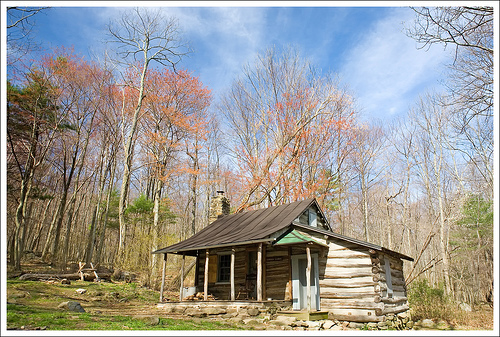
The Corbin Cabin sits alongside the Hughes River in what used to be known as Freestate Hollow.

Adam Says…

It was great to finally get out and do some hiking after the harsh winter!  I think it had been since November since we were able to actually enjoy a hike.  After some debating on which trail would be “less muddy”, we decided to try this hike.  We were surprised that the ground was actually in good shape and not muddy like we were expecting. The hike’s main draw is the historical interest.  The Corbins and Nicholsons were two families that lived in this area since the end of the Revolutionary War until the park authorities made them leave.

You begin the trail from the cement post across from the parking lot.  You start the trail walking through an area of mountain laurel that will bloom nicely in the Spring.  The trail descends through an elevation loss of 1500 feet over 1.4 miles.  Around the first half of a mile, you will begin to see a stream off to your left.  At .9 miles, you will come across some of the remnants of the families that inhabited this hollow through views of a rock wall to your right.  Downhill to the left you will see ruins of John “Russ” Nicholson’s cabin.  At 1.4 miles, you will hear the rushing of the Hughes River and see the ruins of an old cabin to the right that belonged to John T. Nicholson.  You can walk over to this area and peek inside to see the small one-room dwelling.  There is lots of glass and rusty metal, so be careful if you inspect this area.  You will see the Corbin cabin across the river.  You will need to rock-hop across the river, which is usually not too difficult.  This time, the water was higher than normal and we only had to partially put our feet in the water to get across.

The Corbin cabin is available to rent from the Potomac Appalachian Trail Club.  There are access points here to connect to Old Rag.  We plan on trying that out in the future sometime for a weekend of living like mountain folk.

The Nicholson Cabin
The Nicholson Cabin is across the river from Corbin Cabin. It’s slowly sinking back into the forest.

After you cross the creek to the cabin, take a right to join the Nicholson Hollow Trail.  After a short distance, you will have to do a little more rock-hopping as it crosses Indian Run.  You will start your steep ascent back up to Skyline Drive and at 3.6 miles you will reach the road.  When you come to Skyline Drive, take a left, heading south for about 75 yards.  You will cross the road and join a short spur trail.  After less than .1 mile, you will come across an intersecting trail with a cement post.  This is the Appalachian Trail.  Take a right, heading North on the Appalachian trail, you will descend and ascend for another .6 miles until you reach the parking lot.

Christine Says…

While this hike doesn’t offer any waterfalls or sweeping views, it does provide one of the park’s best peeks into area history.  The trail begins steeply downhill for about a mile until you reach the bottom of the hollow.  It’s a big drainage area with many small streams that pour into the Hughes River.

I love seeing all the remnants of old homesteads tucked into the woods. The main homesite, which lies on both sides of the Hughes River is such a perfect and idyllic spot.  If I were to choose anywhere in the park to build a home, I think it would be right here.  I can understand why John Nicholson was so heartbroken to leave.  I love to imagine what it would be like to go to bed each night listening to the bubbling sounds of the river and see the sun rise each morning between the mountain folds visible from the front porch.

We had the homesite to ourselves for a little while.  Fifteen minutes later, a couple guys with fishing poles arrived and we were on our way.  The long arm of the loop starts from Corbin Cabin and climbs steadily uphill for about two miles.  Most of it is moderate uphill climbing, but one section that passes through a thicket of mountain laurel is quite steep.  The final .6 miles of the hike follows the Appalachian Trail.

On the AT, we encountered a lost beagle.  She leapt out of the woods at us, probably expecting to see her people.   She had a collar, an identification tag and the remnants of a broken/frayed leash.  As soon as she realized she didn’t know us, she darted back into the woods.

We love dogs, and there was no way we were going to leave the beagle behind.  We tried to corral her in, using low voices and lots of “Good dog!” calls.  However, she was obviously terrified of strangers and started howling pitifully.  Bit by bit, we were able to get closer and closer to her.  We were just about to catch her when heard voices shouting down the trail, and the dog sprinted away.  Thankfully, this time she was running toward the call of her owners.  They were all happily reunited.  It turns out the dog broke her leash four hours earlier when she chased something away from camp.

I guess even when they’re leashed, dogs can get into trouble in the park.  I’m always surprised how many dogs we see running free with hikers.  It’s both good practice and park policy to keep dogs leashed on park trails.

Since this was our first real hike of the season, we were both pretty tired at the end.  We’re definitely looking forward to hitting the trails more regularly now that the weather is turning warmer.

Trail Notes

  • Distance – 4.2 miles – loop.
  • Elevation Change –1500 feet.
  • Difficulty – 3.5 The hike descends and ascends fairly steeply.
  • Trail Conditions – 4. The trail is in good shape.  There were a few blown-down trees covering the trail due to the winter.  Leaves on the trail make for a slick surface when going downhill.
  • Views –0. You are deep in the woods for the entire hike.
  • Waterfalls/streams –2. Near the cabins, you have a nice opportunity to see the Hughes River.
  • Wildlife – 1. We didn’t see anything alive, but found remnants of deer that didn’t survive the winter.  Expect to possibly see bear in the area.  Heard pileated woodpeckers and saw juncos.
  • Ease to Navigate – 4. Trails are clearly marked.
  • Solitude – 3. This trail isn’t the most popular due to the steep terrain, so you should likely only encounter people around the cabin and river.

Directions to trailhead:
From Skyline Drive, park on the western side at mile marker 37.9. Cross the road.  The trailhead begins at the cement post across from the parking lot.

South River Falls

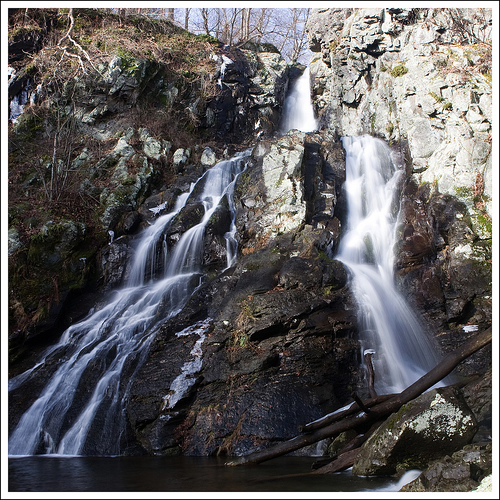
This 4.6 mile hike leads you along the South River to an impressive waterfall that plunges deep into a canyon.  When the park has experienced lots of rain, this waterfall hike is one of the nicest Shenandoah has to offer.

Cascades along the South River
The South River is impressive in times of heavy rain.

Adam Says…

We have kept with a tradition the last few years of doing a hike on Thanksgiving morning.  It’s a great way to appreciate nature and try to do something active before a big meal.  This year, we decided to break the tradition of having a huge Thanksgiving meal with turkey and all the trimmings.  We decided to have an easier meal that we would both enjoy – homemade pizza.

We’ve hiked South River Falls before, but we’ve never had as much water in the falls before.  We thought it would be impressive, since we could hear rushing water through the South River a lot earlier than normal.  Waterfall hikes in Shenandoah National Park tend to be fairly tough ones.  Since you park on Skyline Drive at a high elevation, you have to hike down to the valleys where the falls are created.  What makes it difficult, at least psychologically, is that you get to the payoff fairly easily and then have to do the hard work on your way back to your vehicle.

The South River right at the crest of the waterfall.
The beauty of the South River is found mostly in its small details. The cascades and little falls leading the large waterfall are prettier than the main waterfall.  Pictured below: South River Falls from the overlook at the top of the canyon; the falls from the base.  You’ll see neither vantage point of the waterfall is terribly photogenic (especially after the leaves have come down). Both of the small photos below are from another date.  This time, the falls were much bigger – but it was too sunny to photograph them.

The view from the top of the canyon. The view from the base of the falls

The hike begins at the South River Picnic Area.  Look for the large sign about the hike on the northeastern side of the picnic area.   At slightly over .1 mile, you will cross the Appalachian Trail.  You will continue your descent and around 1 mile, you will rock-hop across a small creek that drains into the South River.  Usually this is not much of a challenge due to the water, but we found the water was higher than normal this time.  At 1.3 miles, you will come to a nice overlook for the South River Falls.  You really get a great view of the 83 foot waterfall.  It plunges to a rocky ledge and splits in two about half of the length of the waterfall.  If you continue on the trail for another .2 miles, you will arrive at a cement post and join a spur to the South River Fire Road.  If you continue on for another .2 miles, you will descend even further and arrive at another cement post.  Following the path from the cement post for another .1 mile, you will arrive at the base of the falls.  For any adventurous shutterbugs, there are ample opportunities near the base of the falls for long-exposure photography. Make sure you have your strength up, because you have 2.2 miles to hike at a steady incline back to your vehicle.

To follow the trail as a loop as we did, once you make your return from the base of the falls, go .7 miles until you reach the cement post and the junction with the South River Falls Trail. Stay on the fire road instead and after .4 miles more, you will reach the yellow-blazed South River Fire Road.  Take a left on the road.  In about a mile, you will reach the junction with the Appalachian Trail.  Take a left on the white-blazed AT, heading south for about .4 miles.  You will then reach the junction with the South River Falls Trail and only have about .1 mile to reach the picnic ground.

The hike was a tough one, but it was nice to get some exercise.  The thought of carving into our pizza helped us muster the energy to make it back.

Christine Says…

This was a great trail to burn off Thanksgiving calories!  The terrain is rugged and the return arm of the loop is nothing but steady, tough uphill climbing.  Even Wookie, who is normally a bundle of boundless energy, got quite tired on this hike.  By the time we got to the Appalachian Trail junction, his corkscrew tail was completely unfurled.   Even though there are some hikes in the park with more elevation gain, I think the 1300+ feet on the South River trail provides some of the park’s tougher climbing.   Anyone looking for an easier version of this hike should consider doing the short loop (3.2 miles) that returns after the overlook at the top of the falls.  By taking that route, you reduce the elevation gain to a very manageable 850 feet.

Despite the hard work required to get there, I really enjoyed seeing the South River and its namesake falls so flush with water.  The Shenandoah area has had over five inches of rain in the month of November – more than double the normal amount.  All of the park’s streams, rivers and waterfalls are flowing beautifully right now.  It’s a great time to get out and enjoy the scenery and the less-crowded conditions in the park.

Cascades along the South River
There are many small, but beautiful, waterfalls along the trail. Pictured below: Another pretty spot along the river.

Cascades along the South River

I had hoped to get some photo opportunities along the river on our Thanksgiving hike.  I did take a few shots, but the weather was less than cooperative.  It was too sunny to take shots of the moving water. Every now and then, I found a shady spot down in a deep ravine.  I did a bit of bushwhacking to get to a few pretty spots, but overall I don’t feel like I came home with any special photos.

Honestly, while South River falls is probably the park’s most impressive waterfall, it is not one that translates nicely on film.   The falls plunge into an enormous natural amphitheater.  The sheer rock walls are amazing, but they aren’t photogenic.  I’ve seen a few nice shots of South River Falls in the spring, when the water is flowing and the falls are surrounded by the lush new green of the trees and plants.  In the late fall and winter, the falls are really scrubby and barren looking.

I think some of the prettiest and most dramatic places along the South River come at the bottom of the falls.  In the last .1 mile of the trail, leading to the base of the falls, the water tumbles over a hundred feet down over giant boulders.  There are many small, beautiful waterfalls to enjoy before you get to work climbing back up to your car.

When we got home from our hike, we found several TICKS!  Can you believe it – ticks in late November; ticks after the mountains have had snow and temperatures at night are regularly below freezing?  These were tiny ticks – about the size of a pinhead.  We pulled one off Adam’s sweatshirt and two off of Wookie.  I hate having to watch for ticks year round, but it seems that we must.

Wookie Says...Wookie Says…
Hey all of you fellow hiking dogs.  It’s been a while since I’ve been hiking, so I’m going to let you know what I thought of the trail.  I enjoy getting the chance to get in the outdoors and I usually run laps around the house when my masters ask,  “Would you like to go on a car ride?”

The hike on South River Falls was pretty fun for the most part.  I enjoyed going downhill until I reached the stream to try and rock-hop.  I’ve done this hike before with my masters, but there was a lot of water this time around.  I don’t really like to get my feet wet and when I see any water on the hike, I try to take the driest option.  After Adam crossed the creek, I really didn’t want to follow him.  Only after Christine gave me a little nudge with her trekking poles, did I take the plunge and hop across the rocks.
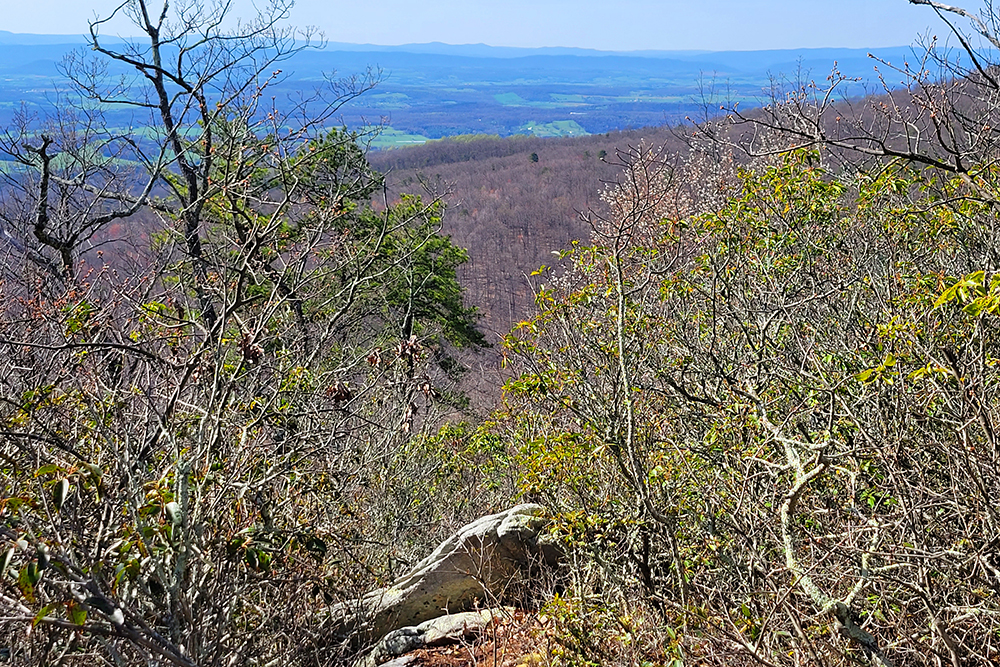
Wookie Enjoyed the Hike
Wookie enjoyed the hike, but was exhausted the rest of the day.

All the rushing water on the trail, really made me need to go to the bathroom.  I tried to make my mark as much as possible to let all my fellow canines know that Wookie was here.  The hike back from the falls was pretty brutal for a small dog like me.  My tail was down a lot of the trip back, because it was exhausting.  At least I got some pizza scraps and a taste of sausage instead of turkey scraps this year.  For that, I was truly thankful.

Trail Notes

  • Distance – 4.6 miles – loop.
    (Check out the stats from MapMyHike – added 5/16/15)
  • Elevation Change –1315 feet.
  • Difficulty – 3. The return arm of the circuit climbs steeply uphill along a fire road for two straight miles.
  • Trail Conditions – 4. The trail is in great shape.
  • Views –0. You are deep in the woods for the entire hike.
  • Waterfalls/streams –4. In times of heavy rain, the South River is an impressive stream.
  • Wildlife – 0. We didn’t see *anything*, but over the summer there was a bear with three cubs in the area.
  • Ease to Navigate – 4. Trails are clearly marked.
  • Solitude – 2. This trail’s proximity to a park entrance makes it a popular hike.

Directions to trailhead:
From Skyline Drive, follow the drive to the South River Picnic Area (near mile marker 62).  The trailhead is located at the back end of the picnic grounds, across from the restroom facilities.

Big Run Loop

Big Run is a pretty (almost) six mile walk along one of the park’s less-trafficked trails.   Although this hike does not offer any grand scenery, it offers plenty of solitude and nice options for backcountry camping.

Cliffs along the Appalachian Trail
These lichen covered cliffs are found along the Appalachian Trail segment of the Big Run Loop.

Christine Says…
We said we were going to take a weekend off of hiking so we could catch up on yardwork and housework, but the weekend was far too beautiful to spend it being productive adults.  We decided to have breakfast at Big Meadows before hitting the trail.  Most of the park facilities closed for the season on Sunday, and the remainder will close the last weekend in November. It was nice to have one final round of pancakes and sausage in the lodge dining room.

After our big meal, we headed south on Skyline Drive to hike the Big Run Loop.  Last time we did this trail, it was in the midst of an August heat wave.  It was in the nineties and we had to rest and drink water every ten minutes.  This time, the weather was considerably cooler – but still unusually warm for November.  I couldn’t believe it, but there were actually swarms of bugs pestering me every time I stood still.  I even got a giant mosquito bite on my collarbone.  It’s not supposed to be buggy in November!

The trail was covered with dry, brown leaves.
The trail was covered with dry, brown leaves. Pictured below: The only color left in the woods was from moss and a few hardy ferns.

Fern in Shenandoah National Park Moss on the Big Run Trail

The trail started off with a couple miles of steady downhill.  The trees had completely shed their fall foliage, so the trail was covered with a thick blanket of crispy fallen leaves.  As we crunched along the trail, I remarked to Adam that we would certainly not be sneaking up on any wildlife on this hike.  The leaves made it hard to see obstacles on the trail, and we both stumbled over rocks and branches hidden under the leaf layer.

At around the two mile mark, we reached Big Run.  The water was very low and the stream was mostly obscured by several newly fallen trees.  Although the trail is named for this stream, I think Big Run is fairly unremarkable.  We didn’t stay long at this spot.

Big Run was prettier last summer.
Big Run was prettier last summer. Since this photo was taken, several large trees have fallen across the stream where the trail crosses.

Shortly after the stream, the trail took a distinct uphill turn.  For about a mile and half, we climbed steadily uphill.  Some parts were rather steep, but overall it’s really not too bad of a climb.  I used my trekking poles on this hike and they made the ascent markedly easier.  I think the poles help me hike more efficiently and take pressure off my knees.  Whenever I use them I feel like I have extra magical energy.

We eventually came to a four-way trail junction at the top of the ridge.  The remainder of the hike followed the Big Run Loop trail until it joined the Appalachian Trail.  The last segment along the AT took us past some impressive granite cliffs and crossed the Doyles River Overlook on Skyline Drive.  After about a mile and a half along the AT, we completed the loop and returned to our car.

Adam Says…

Doyles River Overlook

We were debating a few different options for our hike today, but we decided to do Big Run.  One of the reasons that we chose this hike is due to the challenge of trying to find one of Hiking Upward’s hiking sticks.  A few hand-carved hiking sticks are placed along the trails that are up for grabs to whoever can find them.  They provide GPS coordinates for any geocachers out there.  I wasn’t able to find one, I believe due to a typo on the website.

Buck in the rutting season.
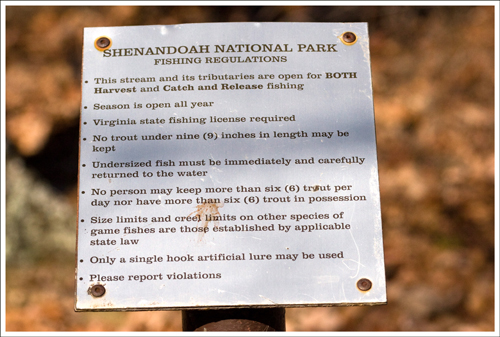
Buck in the rutting season. Pictured Below: Most places in the park allow catch and release fishing. Big Run actually allows fish to be harvested.

Fishing regulations

Due to all of the leaves falling, the hike was a little more challenging than normal.  We started the trail going downhill fairly quickly and the leaves made it for tricky footing.  The swoosh of the leaves with every step drowned out our own voices and everything else.  We had to stop to hear each other when we wanted to talk along the hike.

The blue-blazed trail descends about 1500 feet in 2.2 miles when you reach the branch of Big Run.  The water was still and barely more than a trickle this time.  After rock-hopping the stream, you will come to a cement post.  Take the left branch of the fork.  The trail is now marked by yellow blazes and starts a steep ascent.  You will gain about 1000 feet of elevation in a little over a mile.  At 3.5 miles, you will come to another cement post.  Turn left, heading east, to continue on the Big Run Loop Trail, which is now marked by blue blazes again.  While you still are going uphill for most of the rest of the hike, it is definitely more manageable.  At 4.2 miles, you will reach the junction with the Appalachian Trail.  You will take a left, heading north, to follow this white-blazed trail.  At 4.5 miles, you will cross Skyline Drive, to stay on the AT.  At 4.7 miles, you will reach the Doyles River Overlook, which provide you the best views on the hike.  The AT continues on the north side of the parking lot.  You will stay on this trail for another mile.  When you reach the cement post at 5.7 miles, you will take a left which will take you back to your car at the Doyles River Parking Lot only about 30 yards away.

While this hike is not spectacular for streams or views (until you reach the Doyles River Overlook), it was still an enjoyable walk through the woods.  As I mentioned earlier, the leaves led to some difficulty with seeing the trail.  At one point on the AT, I slipped on a rock hidden by the leaves and went tumbling down.  Luckily, I was unscathed and more importantly, I was able to protect Christine’s camera gear I was lugging on my back.

Trail Notes

  • Distance – 5.8 miles
  • Elevation Change – 1400 feet
  • Difficulty – 3.5.  There is a mile and a half of steady uphill shortly after crossing Big Run stream.
  • Trail Conditions – 4.  The trail is in great shape.  It was a little trickier than it should have been with all the downed leaves covering the trail.  Footing was tough at times because we couldn’t see rock and branches on the trail.
  • Views –1.5. You get one nice view when the Appalachian Trail crosses the Doyles River Overlook.  If you hike when leaves are down, you get some other glimpses of views along the way.
  • Waterfalls/streams – 1. Big Run is not as impressive as it sounds.  It’s not big and it doesn’t really run much either.  🙂
  • Wildlife – 2. We saw deer and lots of different kinds of birds.
  • Ease to Navigate – 4. Although there are turns, this trail is very well marked.
  • Solitude – 4. Because this trail lacks grand views and waterfalls, it tends to be more lightly trafficked than other Shenandoah trails.  The area is popular with backcountry campers.

Directions to trailhead:
Follow Skyline Drive to the Doyles River Trail Parking area near mile marker 81.  Cross the drive and begin your hike on the western side of the road.  The hike departs from the Big Run Overlook.  There may be room for a car or two at the overlook, but we recommend parking in the larger Doyles River parking area.

South Valley Trail

The South Valley Trail is a part of the 35 miles of hiking trails in Prince William Forest Park.  It is a nice stroll that takes you along the Quantico Creek.

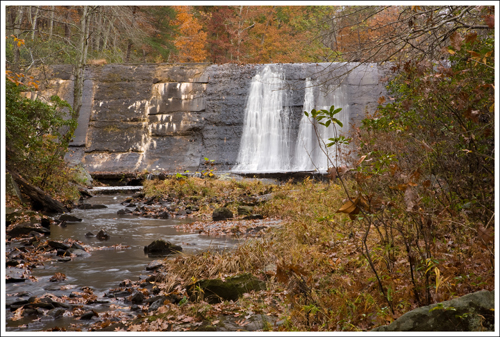
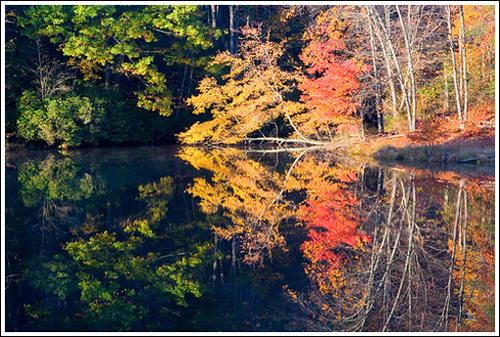
Quantico Creek in the fall.
Even though the foliage was past peak on our hike, there were still some pretty spots along Quantico Creek.

Adam Says…
We went up this past weekend to visit Christine’s parents.  Her dad’s birthday is on Halloween and he usually likes to do something active to help celebrate.  He suggested a possible bike and hike in Prince William Forest Park.  We were expecting a lot of rain that weekend, so we decided to just do a hike.  While it was raining a little before we got there, we managed to do the hike with only a light drizzle at the end of the hike.

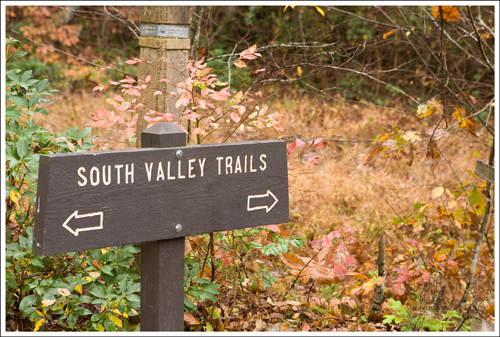
The sign marking the South Valley Trail
The South Valley Trail runs in a large loop around the park.  Pictured below: The hike starts off on Mawavi Road; A bridge over Quantico Creek;  Adam checks out evidence of beaver activity.

Walking down Mawavi Road The arched bridge at the end of the lake Evidence of beaver activity in the area.

Many people do not realize that Prince William Forest Park is part of the National Park Service.  The land was given this protection to find a new use for the land under Franklin D. Roosevelt’s New Deal.  It was used as a training school for the military during World War II, but was turned back over to the Park Service in 1946.

While the overall South Valley Trail is about nine miles, we decided to do the portion that highlighted the South Fork of Quantico Creek.  Her dad dropped a bike off at parking lot “I” and then we proceeded to lot “G” to start our trip.  Christine’s father used the bike as a shuttle at the end of the hike.  Upon reaching lot “I” at the end of the hike, he biked back to the car and then returned to pick the rest of us up.

We began by walking on Mawavi Road.  In about .4 mile, it intersects with the South Valley Trail.  We took a left on this trail.  The trail runs along Quantico Creek for the majority of the rest of this hike.  Shortly after joining the South Valley Trail, you will see a very narrow lake.  There are a couple of cabin camps on the opposite side of the lake, which are often used by Boy Scouts.  In 1.6 miles from the start, you will reach a junction with the High Meadows Trail.  Continue straight on the South Valley Trail until you reach the Scenic Drive.  Take a right and head down the road to your other vehicle at parking lot I, just about a tenth of a mile ahead.

Quantico Creek was dammed to create a lake.
Part of Quantico Creek has been dammed to create a lake. There is a group camp on the lakeshore.

We were expecting to see more color in the leaves this year, but it seems that things near the creek were a little past peak.  We did see lots of signs of beavers in the area, but we didn’t see any actual beavers.  The bridge and lake were interesting to view along the way, but this was more of a nice stroll through the woods than a momentous hike.  The grade during this hike was a mix of hills and flats, so most people could attempt this hike without much difficulty.  What amazes me most about this area is that it doesn’t seem to be heavily used.  You would think with the proximity to D.C. and the hordes of Northern Virginians, that it would be crawling with people.  But, we’ve been here several times and there doesn’t seem to be that many visitors.

Christine Says…

I’ve hiked along the South Valley trail many times over the years.  When I was a Girl Scout, we camped in the park frequently.  We took many day hikes along this trail.  As an adult, we’ve hiked it as a family several times.  In fact, it was the first trail we hiked after my younger brother returned from his first tour of duty in Iraq.   Like Adam said,  the South Valley trail is nothing spectacular.  There are no grand vistas or thundering waterfalls.  Instead, it’s simply a place to enjoy a quiet and peaceful walk through the woods.

There wasn't much foliage left, but this tree was pretty.
There wasn’t much colorful foliage left on the hike.  Pictured below: A pretty spot along the creek.

Quantico Creek in the fall.

The foliage was about a week or two past peak when we hiked this year.  There were a few ginkgo and beech trees still holding onto golden leaves, but most of the trees were bare or brown.  The last time I hiked this area was fall of 2007.   Even though it was much later in the season, the color lingered until almost December that year.  The photos below were taken on November 17, 2007.   I guess this is even more evidence that fall came and went early this year.

The foliage along this hike was much prettier in 2007.
The foliage along this hike was much prettier in 2007. Pictured below: A couple more shots from fall 2007.

The foliage along this hike was much prettier in 2007. The foliage along this hike was much prettier in 2007.

The terrain of this hike is very easy.  Since Prince William County doesn’t really have mountains, the park lacks tough grades and long climbs.  I would describe the trail as crossing rolling terrains.  You’re almost always walking uphill or downhill, but ascents and descents are never steep or long.  Quantico Creek is a lovely and lazy waterway along the trail.  There are a few places where the water forms small rapids and cascades, but most of the time it’s just a quiet, smooth ribbon of water through the woods.

The morning in Prince William Forest was a nice way to spend some time as a family.

Trail Notes

  • Distance – 3.1 miles
  • Elevation Change – Negligible
  • Difficulty – 1.  Not much uphill the way we traveled.
  • Trail Conditions – 4.  The trail is narrow, but in great condition.
  • Views –0. No views to really see.
  • Waterfalls/streams – 3. You will constantly get views of the stream nearby, but the water is usually fairly still.
  • Wildlife – 1. You’re likely to only see deer around here.  However, gnawed trees lead to the belief that there are beavers in the area.
  • Ease to Navigate – 3.5. A few turns, but easy to follow.
  • Solitude – 3. It’s Northern Virginia, so expect some people, but you should still have decent solitude.

Directions to trailhead:
From I-95, take exit 150 on to 619 heading west.  The Prince William Forest Park entrance is on the right.  Once you pass the gate, take a left at the first fork.  Once you pass parking lot C, take your next left.  To do the trail as a shuttle as we did, leave a vehicle or bike at lot I and then proceed to lot G.  Walk down the Mawavi Road to start the trip.