Abrams Falls (TN)

Special: Smokies Edition

Introductory Guide to Visiting Great Smoky Mountains National Park

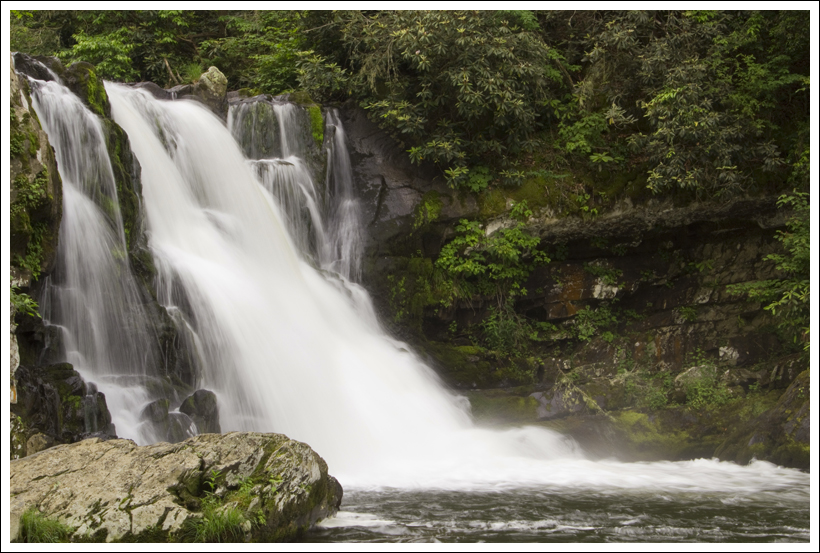
This popular five mile hike follows a beautiful stream for most of the route and ends with a visit to lovely Abrams Falls.
Abrams Falls
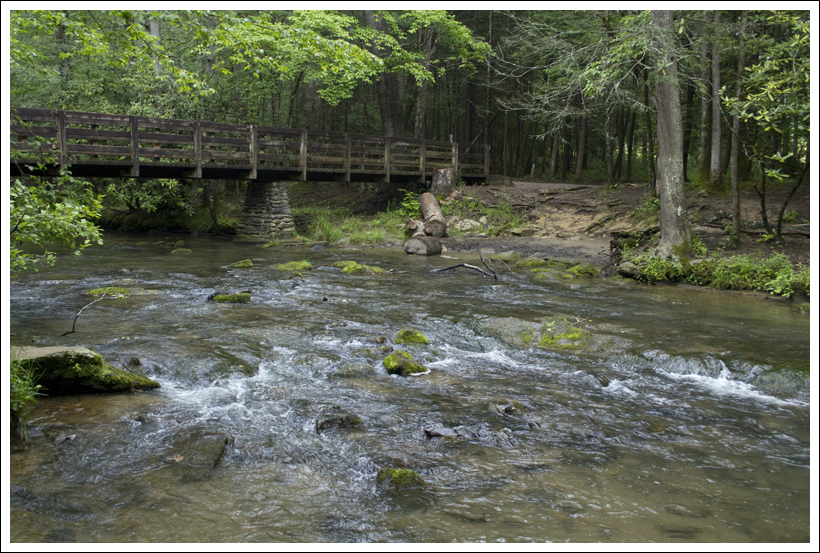
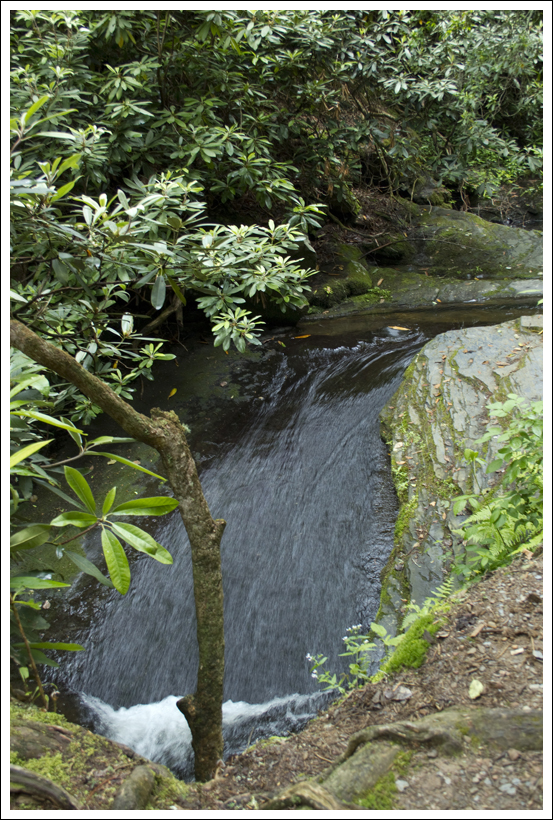
Abrams Falls pours out into a large, rock-surrounded pool. Below:  Beautiful stream scenery was abundant on this hike.

Slide Falls Abrams Creek

Christine Says…

Tuesday morning dawned thick with clouds and fog… a perfect day for a waterfall hike.  Although there were plenty of waterfalls near the Cherokee side of the Smokies, we decided to take a ride over to Cades Cove to hike the exceedingly popular Abrams Falls trail.

The easy five-mile hike is one of the top five trafficked trails in the park.  Since we had an early start on the day, we decided we could probably beat the worst of the crowds and enjoy seeing the falls with some semblance of solitude.

Getting to the trailhead took longer than we expected.  The drive along the Little River into Cades Cove was so pretty, I had to stop and take lots of photos.  Once we got into the cove, grazing horses, wild turkeys showing off their plumage, and abundant whitetail deer distracted us.  I wanted to stop at a few of the old cabins, churches and farms, but we decided that would have to wait for another day.
Adam on the Abrams Falls Trail
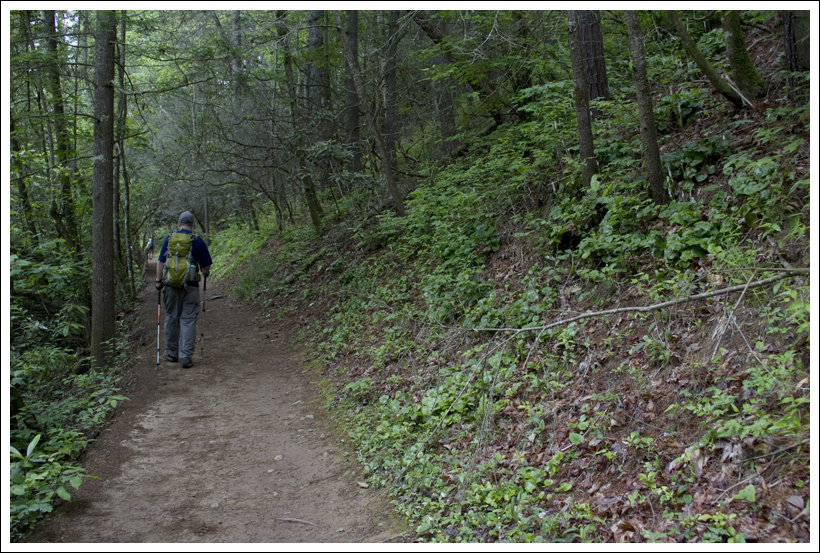
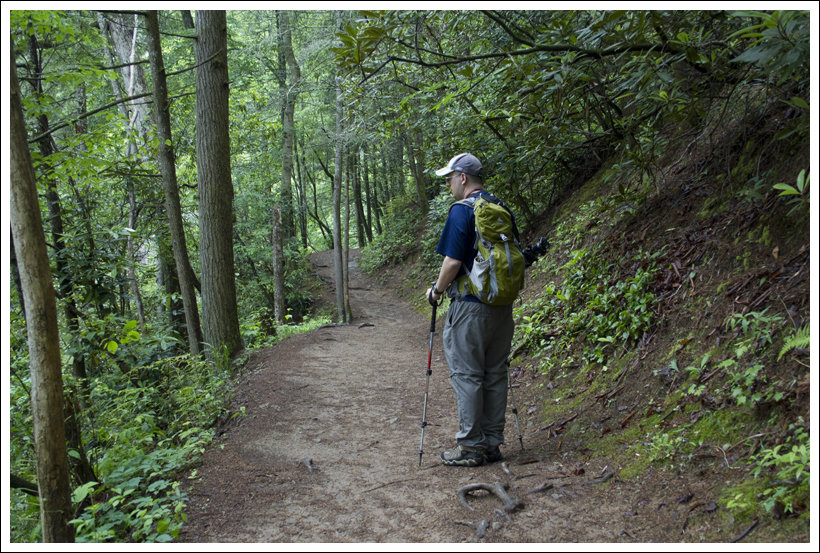
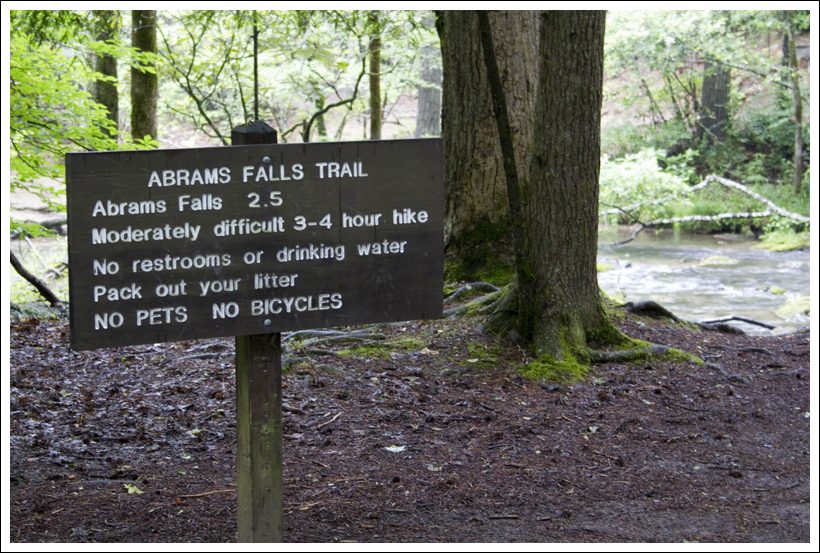
Adam enjoys the green vista along the Abrams Falls Trail. Below: Trail marker at the start; Bridges cross the stream multiple times along the trail.  This was the only full bridge.  The rest were hewn logs with rails on one side; Trail conditions were mostly smooth and gentle.

Trail Marker Bridge Near Beginning of Abrams Hike Adam on the Abrams Falls Trail

The Abrams Falls trailhead was at the end of an unpaved, muddy road.  (restroom facilities were available) The trail marker at the beginning indicated that the trail was moderately strenuous and would take 4-5 hours.  The sign also warned that no water or restrooms would be found at the falls.  I suppose this is a clear indicator that hikers of all experience levels and abilities use the trail.  And indeed this turned out to be true – I even saw a hiker wearing black pantyhose under a pair of denim shorts. That was a first for me!

The hike began by crossing a bridge over Abrams Creek.  All along the river, we saw fly fishermen.  The stream looked ideal for brook trout.  The trail runs parallel to the creek for much of the hike – sometimes at stream level, sometimes high above.

The trail is mostly flat with several short, but steep, climbs.  It mostly passes through thick green forest, with one exception.  Near the top of the steepest climb, the trail becomes rocky and almost barren, with many dead and toppled trees.  Maybe a fire or storm damaged the trail in this area, because it was nothing else like the rest of the hike.

A steep downhill climb and a walk across two log bridges empties you out into a grotto with Abrams Falls at the end.  When we visited, the falls were gushing!  The water was so powerful; I couldn’t take a long exposure of the waterfall without the water turning into a solid wave of white.

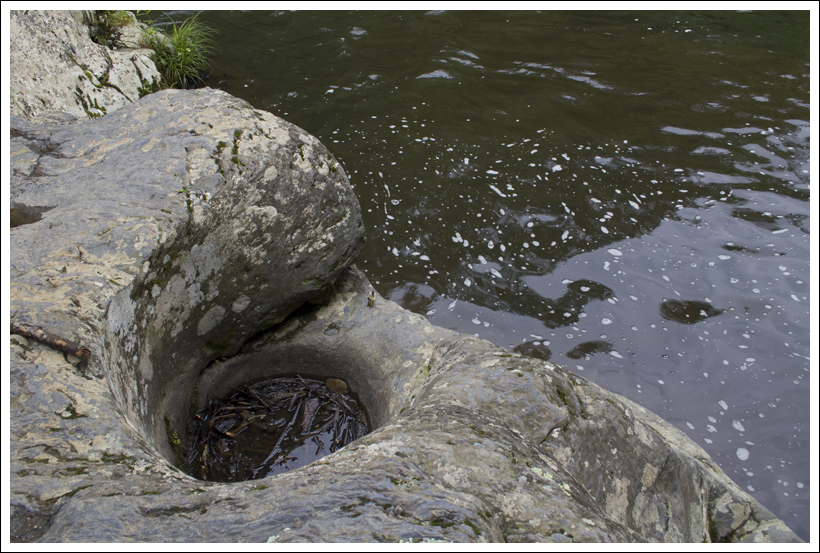
As expected, many people were enjoying the falls. Families picnicked, couples posed for photos and kids caught tadpoles in the pools of water between the rocks.  One of the notable features near the waterfall was a large glacial pothole.  It looked really similar to features I’ve seen in New Hampshire.
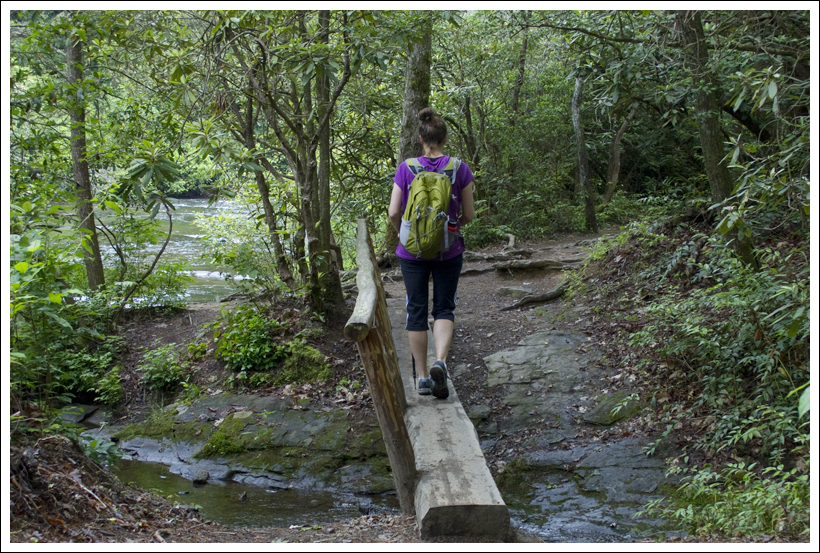
Christine Crosses the Log Bridge
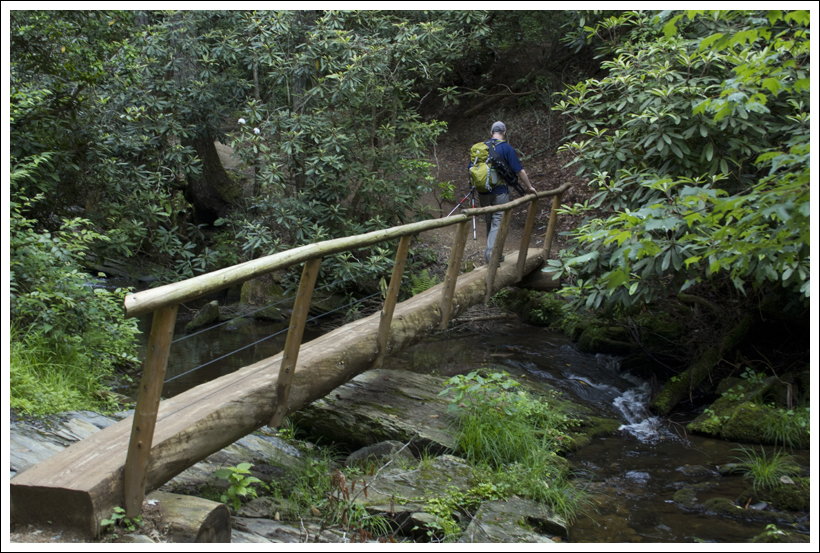
Christine crosses a log bridge. Below:  A perfect round ‘pothole’ formed by the forces of nature; Blooming rhododendron.

Pothole Blooming Rhododendron

We didn’t spend long at the falls because we wanted to get back before it started raining.  The return leg of the hike just retraced our steps. On the way back, we passed even more people on their way to the falls.  This is definitely one of the Smokies most popular spots.  Understandably – such beautiful falls, and so easily reached (by most)!

Adam Says…

When we were thinking of some hikes we wanted to accomplish in the Smokies, we wanted to hike to a bald, a nice hike with views, and some waterfalls.  After accomplishing the first two items the first two days, it was time to do a waterfall.  We started fairly early in the morning knowing that we would have a longer drive to get to Cades Cove from our takeoff point of Bryson City.  When we had been driving on 441 to Newfound Gap, we had heard about construction but had never quite reached it.  When we crossed over Newfound Gap, we quickly ran into some construction as they were working on repaving the road.  Bringing the two-way road to a one-way road required us to wait about 20 minutes before the lead car allowed us to go further.  We finally got through the construction and made our way towards Cades Cove.   When driving on the one-way Cades Cove road, you should also expect to go very slow on this 11 mile road.  Cars creep along, hoping to see wildlife.  We were shocked to see so many cars stopped to a halt to take a picture of a deer.  I guess we feel a little spoiled in Virginia with all the deer we see regularly.  We typically have a yard full of deer every morning.

The hike to Abrams Falls starts off with an informational sign.  Soon you will cross a bridge and begin to see fly fisherman in Abrams Creek.  Abrams Creek is a great spot for fishing brook trout.  Rainbow trout tend to be found in higher elevations in the Smokies.  The trail has a slight incline with a few areas of steep climbs.  At .8 miles, you cross over the Arbutus Ridge, which changes the hike from being largely uphill to being more downhill.  At 2.25 miles, the trail then begins to take a steeper descent until you reach Abrams Falls at 2.5 miles.
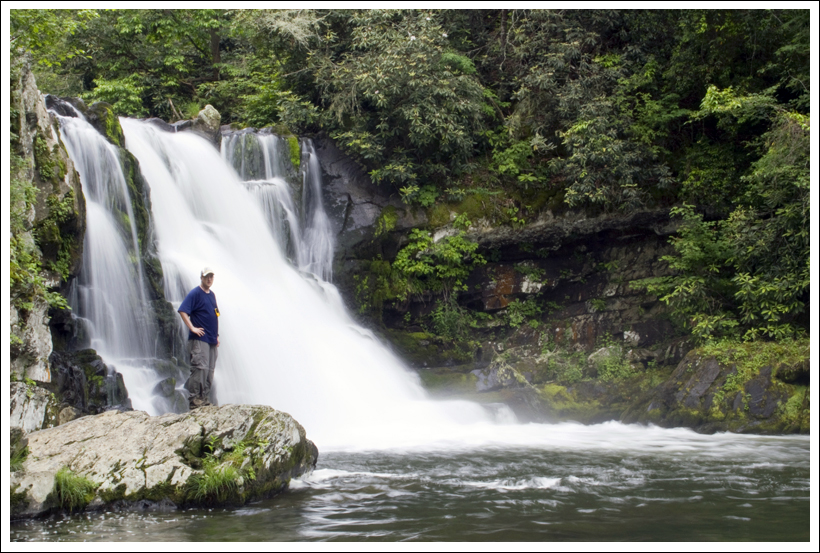
Adam at Abrams Falls
Adam enjoys Abrams Falls.  Below: More lovely views of the stream along the trail; Adam crosses another log bridge.  There were probably four or five like this on the trail.

Stream on the Hike Another log bridge

Abrams Creek and Abrams Falls were named after Chief Abram (previously known as Chief Oskuah and also known as Old Abraham), the Cherokee Chief of Chilhowie nearby.  Chief Abram and a war chief known as Dragging Canoe were aligned with the British during the outbreak of the Revolutionary War and led an attack on Fort Watauga.  In 1788, Chief Abram was killed by tomahawks by the son of John Kirk, seeking vengeance for his family that had been massacred by Cherokees on Nine Mile Creek.

This hike was a little humbling to me.  As I was hiking early on uphill, I started feeling very weak and hot.  I was carrying Christine’s heavy tripod for a while, but I was surprised if this was the reason I was feeling so fatigued.  I had to stop for about 15 minutes and ate several hand-fulls of trail mix.  My blood sugar was quite low from not eating a huge breakfast before hiking.  As we rested, I felt lame for having to take a break and let other people pass us, but I know we made the right decision.  Within about 25 minutes, I felt more like myself as we continued hiking.

There are a number of log bridges on the trail, which have handrails around thigh or waist level on one side.  I’m not a big fan of heights or water (since I can’t swim), so these log bridges can feel a little unnerving for people like me.

As soon as we reached the falls, we set up the tripod and took some nice photos of the falls.  You should expect to see a lot of people at the falls and you will likely have to wait to get pictures of the falls that don’t have strangers in them.  The water does come out in a powerful force as it plunges about 20 feet into the pool below.  We spotted some crayfish moving from rock to rock near the shoreline.   We refueled with some very disappointing Kashi granola bars to make our hike up the steep section and returned to our car.

Trail Notes

  • Distance5.0 miles
  • Elevation Change – about 600 feet
  • Difficulty –  2.  There is a little bit of climbing on this hike, but most people will find the terrain fairly easy.
  • Trail Conditions – 4. The trail is well maintained and easy to walk.  It’s much less rocky and rooty than other trails in the Smokies.
  • Views0.  None on this hike.
  • Streams/Waterfalls – 5.  The stream and the falls are both spectacularly pretty!
  • Wildlife – 2.  Because of the popularity of this hike, don’t expect to see too many animals hanging out.  Although… we did see a turkey and a deer.  Otters have been spotted in Abrams Creek.
  • Ease to Navigate – 5.   Very simple – just follow the path and you can’t get lost.  There is one trail junction near the falls, but if you read the trail marker, you’ll stay the course.
  • Solitude – 0.  Lots of hikers, lots of fly fishermen.

Directions to trailhead:  Past the Sugarlands Visitor Center, take the Little River Road until you reach the Cades Cove Loop Road.  The Cades Cove Loop Road is closed until 10AM on Wednesdays and Saturdays to car traffic.  Follow the Cades Cove Loop Road 4.9 miles.  Take a right on the gravel road that leads to the Abrams Falls parking lot.  The trail starts at the end of the lot.

Andrews Bald and Clingmans Dome (TN)

Special: Smokies Edition

Introductory Guide to Visiting Great Smoky Mountains National Park

The 4.8 mile Andrews Bald and Clingmans Dome hike leads to a grassy bald and offers 360-degree views from an observation tower on the tallest mountain in the Great Smoky Mountains National Park.

Andrew's Bald
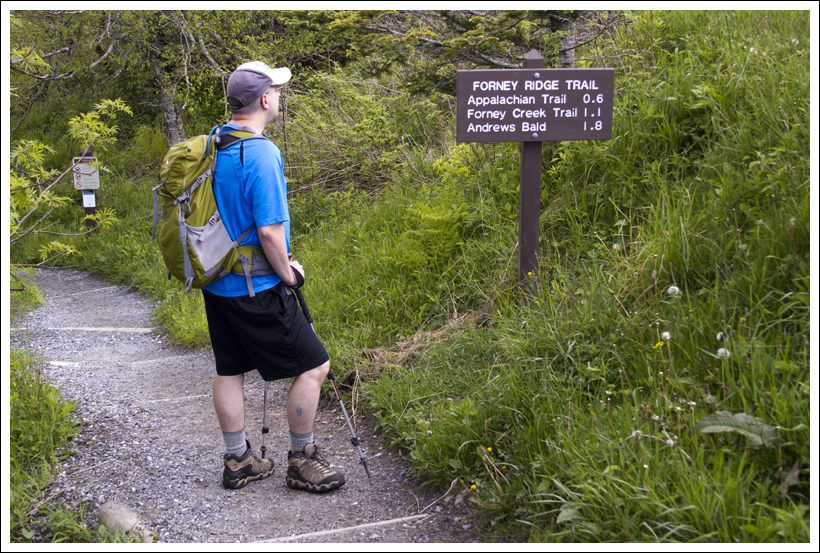
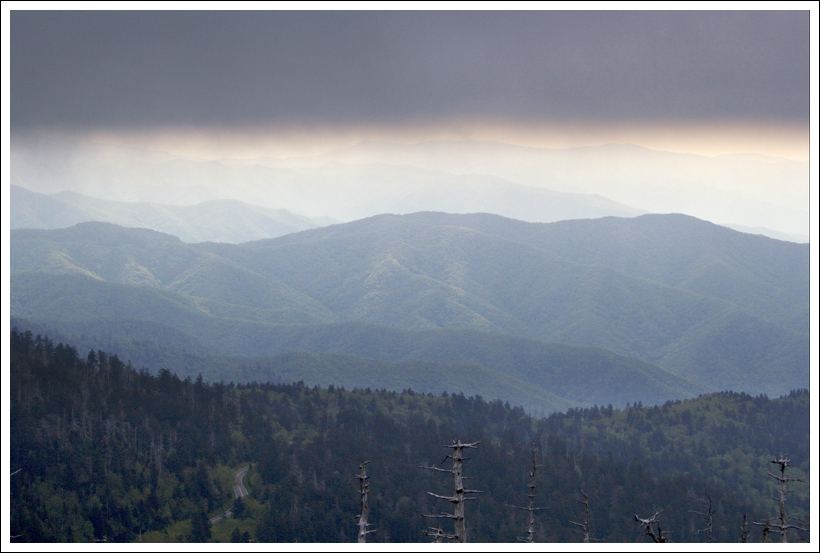
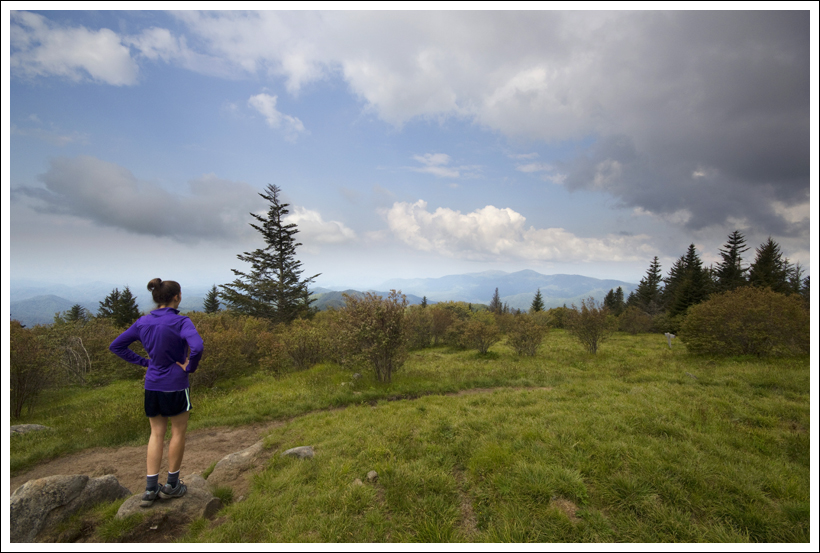
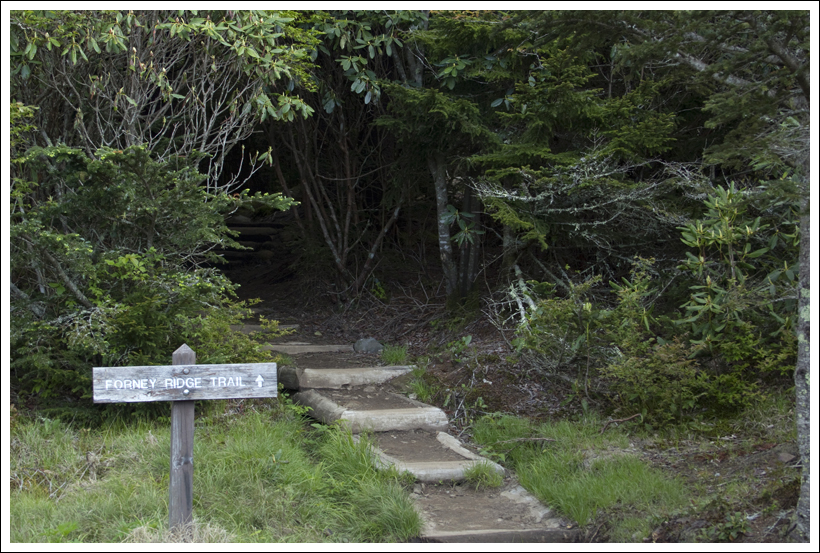
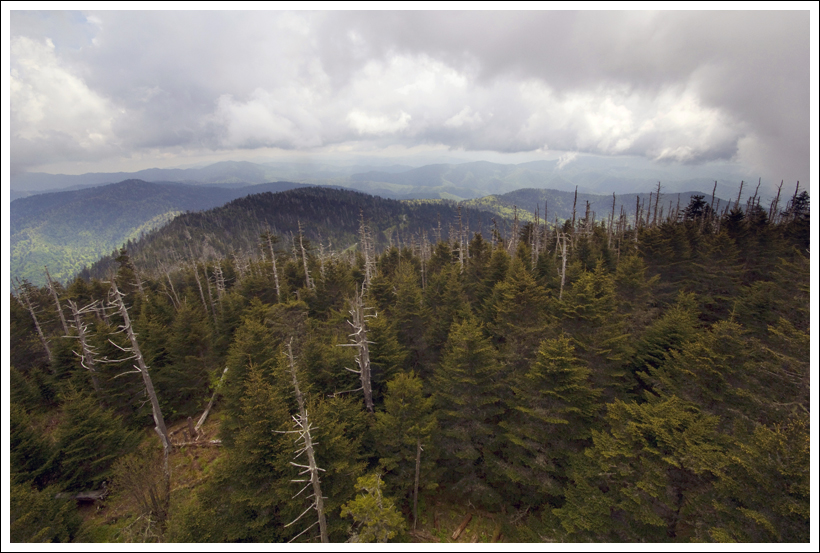
The view was nice from Andrew’s Bald, but the weather changed fast. Below: Adam checks out the trail marker at the beginning of the hike; Rhododendron were not yet blooming, but the buds were evident; The view from the Clingman’s Dome Observatory before the hike.

Start of Hike Rhododendron About to Open View From Clingmans Dome

Adam Says…

One of the things that we wanted to accomplish on our trip to the Smokies was a hike to one of the many balds in the park.  After a long day of hiking the day before to Charlies Bunion and The Jumpoff, we decided on a shorter hike to a bald, but we also wanted to include a visit to the famous viewpoint, Clingmans Dome.

We started off early in the morning and it looked like decent weather.  On our way down Clingmans Dome Road, we saw that clouds were beginning to roll in.  When we arrived in the parking lot, there wasn’t a lot of nearby views as clouds were beginning to roll in.  During the early part of this week, I kept thinking of the Mark Twain quote about New England – “If you don’t like the weather in New England, wait a minute.”  I felt the same about the Smoky Mountains.  The clouds rolled away during our trip to Charlies Bunion, so I was hoping the same would hold true at Clingmans Dome.

We made a quick trip to the top of Clingmans Dome first and the views were completely covered in clouds.  There were a couple of Appalachian Trail thru-hikers that were actually camped overnight at the top of the dome.  We were surprised to see hikers that had just started a few weeks ago, compared to March or April when most will get started.  I wondered if they would make it to the northern terminus of Mount Katahdin in Maine before it closed off due to winter snow.  The weather looked like it may change, so we headed down to decide if we should attempt the hike to Andrews Bald.

We talked to a few park rangers about what they thought the weather would do based on their experience up here and if we should expect rain.  They said that it was expected to clear up later in the morning, but we would probably have some storms in the afternoon.  We gathered our gear and decided to hit the trails.

Boardwalks on the Forney Ridge Trail
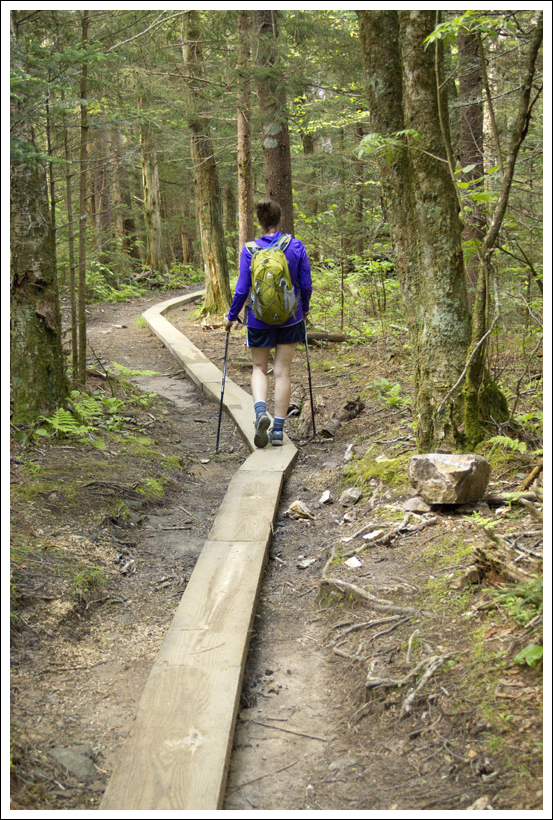
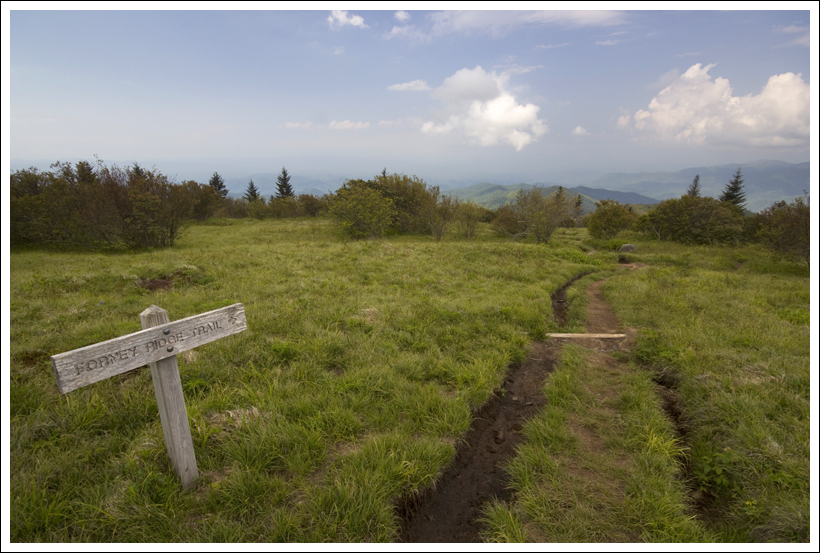
Potentially muddy areas on the Forney Ridge trail were traversed by boardwalks. Below: Adam hikes down the Forney Ridge Trail.  Extensive work has been done on this trail in recent years; Trail marker on Andrews Bald; Another view of the mountains from the bald.

The Forest Was Deep and Green Forney Ridge Trail Andrews Bald View

The trail to Andrews Bald starts from the large Clingmans Dome parking lot.  As you’re walking past the bathrooms and towards the paved trail to Clingmans Dome, you will see a sign to the left marking a few trails.  You head down a few stairs and start the hike to Andrews Bald.   The trail starts off as a steep downhill.  At .2 miles, you reach the junction with the Forney Ridge Trail.  Bear left continue your descent on the Forney Ridge Trail.  The trail is quite rocky in the beginning and can be slick if there has been recent rain, but the trail is well-constructed through this area.  At 1.1 miles, the trail reaches another junction with the Forney Creek Trail, branching off to the right.  Just stay on the Forney Ridge Trail and follow the sign towards Andrews Bald.  The trail begins to be through dense forest and there are a series of strategically-placed, wooden planks that help provide footing on a sometimes-muddy trail.   At 1.8 miles, the forest opens up and you reach the Andrews Bald area.  Enjoy the views and then head back the way you came.

When you reach the first junction at 3.4 miles with the trail back to the parking lot, just stay straight on the Forney Ridge Trail.  You will immediately begin to see the difference in how the trail is maintained as this is a steady uphill through some loose rocky areas.  The trail continues to climb for another half mile; at 3.9 miles, you reach the junction with the Appalachian Trail.  Take a right on the white-blazed AT heading North.  You will be walking along the ridge which will open up views on both sides almost instantly.  At 4.2 miles, you will come out to the paved trail for Clingmans Dome.  Head to the left and climb up the winding path of the observation tower at Clingmans Dome.  Once reaching the top, wind back down but take the paved path down which leads past a gift shop and then to the parking lot which should bring your trip total to 4.8 miles.

When we reached the top of the tower the second time, the clouds were covering most of the area again.  We were able to get a few views, but I can only imagine how beautiful this could be on a clear day.  This is the highest point in the Smokies (and also the entire state of Tennessee), reaching 6643 feet.  Since this area is home to the Cherokee, this mountain is known to this Native American tribe as Kuwahii, meaning “Mulberry Place” and is considered sacred.  Cherokee legend believes this mountaintop to be a place where the bears danced before hibernation.  The clouds that often lie in the valleys between the mountains were seen as lakes where sick bears would go to heal themselves.

The trip to Clingmans Dome is a must when you visit the park.  You can do this as a short but steep .5 mile walk up the paved path to Clingmans Dome, but I’m glad we did a hike that made you feel like you earned the views.  While this hike did meet our goal to visit one of the balds, I’ve heard that Andrews Bald pales in comparison to Gregory Bald or Silers Bald.  On our next trip, we definitely plan to visit one of those.

Christine on Andrews Bald
Christine watches storm clouds roll in. Below: After leaving the bald, the trail goes back into the forest; This area branches off into many other trails.

Stepping Out of the Woods Onto the Bald Trail Signs Along Forney Ridge

Christine Says…

We got up on Monday morning, still undecided about what hike we wanted to do that day.  We knew we wanted to see one of the Smokies’ famous balds, we just weren’t sure which one would fit best into our plans for the week.  We also knew we wanted to visit the observatory atop Clingmans Dome, so we narrowed it down to two balds – Silers or Andrews.

Andrews was a significantly shorter hike – 3.6 miles (4.8 with the Clingmans Dome add-on) compared to 10.  But, Silers was larger and had a more interesting ridge hike with most of the hike staying about 6,000 ft.  In the end, the weather made the decision for us.  When we arrived at Clingmans Dome – the starting point for both hikes – the clouds were thick and dark. In the end, we decided to go for the shorter hike to Andrews Bald.  Balds and high ridges are not where you want to be stuck when a thunderstorm rolls through!

View from the Appalachian Trail
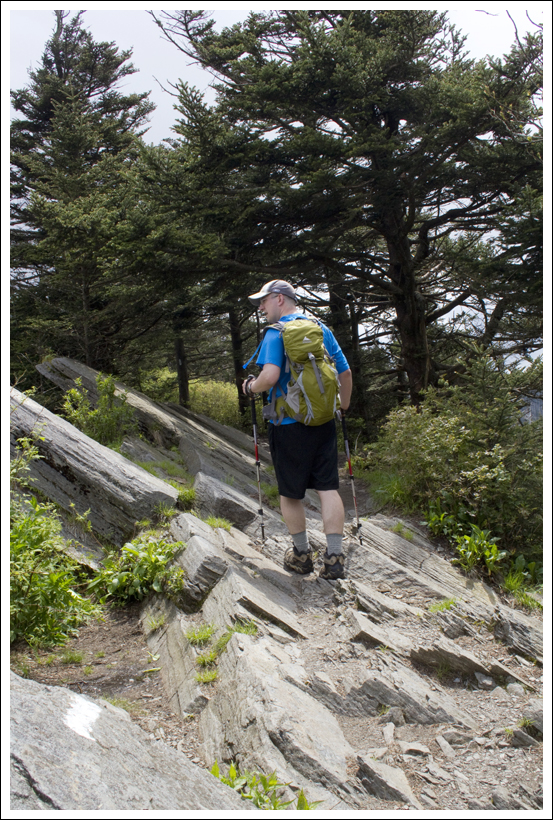
A nice view from the Appalachian Trail near Clingmans Dome. Below: Adam makes his way up to meet the AT; The ridge leading to Clingmans Dome is very rocky.

Hike Up to Meet the AT Along the Ridge Trail to Clingmans Dome

The hike to the bald was mostly downhill.  It followed an elaborately constructed trail of stone slabs, timber-blocked steps, water bars, and plank board walks.  It passed through dense, mossy forests – thick with rhododendrons, ferns and fir trees.  Again, it was so breathtakingly beautiful and different from hiking in Virginia.  As we walked, the sun made an effort to burn through the clouds and fog.

The trail passed a couple junctions to other trails, but to reach Andrews Bald, we just stayed on the Forney Ridge trail.  Eventually, the trail passed through a thick tunnel of rhododendron and opened out onto the bald.

Andrews Bald is not very large.  It consists of a small grassy/shrubby field, peppered with rhododendron, azalea and other low-lying plants.  When we visited, the rhododendrons were just about to open.  There were lots of bright pink buds on the branches, but no open flowers.  I bet the scene will be even prettier in early to mid June when everything is flowering.

The view from the bald was lovely and expansive – though the sky was quite hazy.  We sat for a few minutes and had a quick snack.  While we relaxed, we noticed darker clouds were rolling in again, so we decided to make our way back.

The return trip retraced our steps most of the way.  However, about .1 miles from the Clingman’s Dome parking area, we decided to skip the spur trail to the car and continue uphill along Forney Ridge to its junction with the Appalachian Trail.  This half mile segment was steep and rocky and passed through a stand of huge dead fir trees.

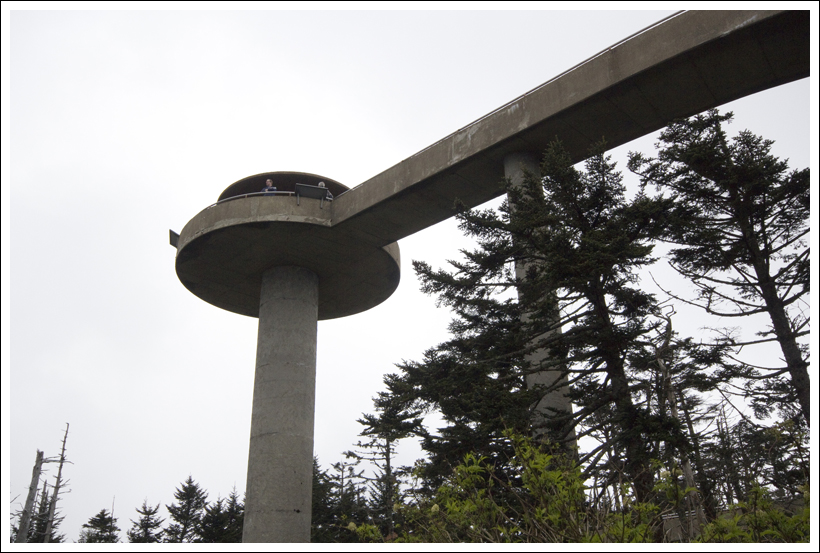
Walkway to the Observatory
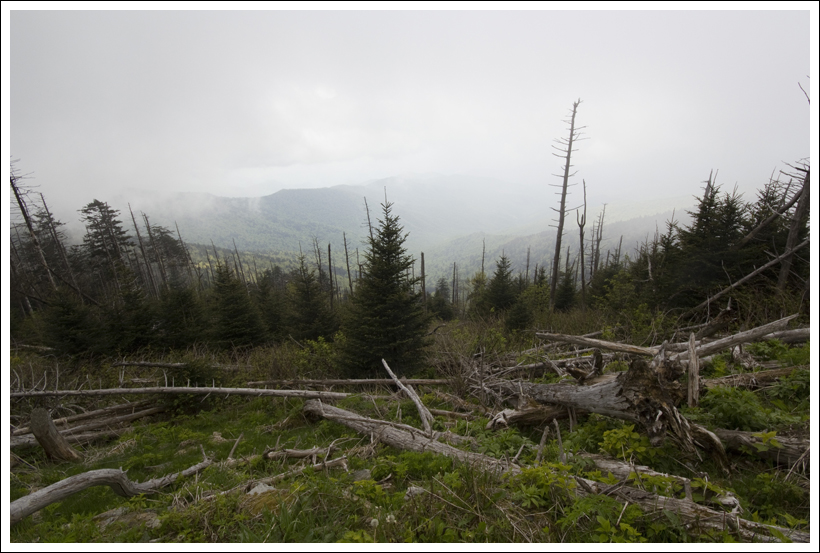
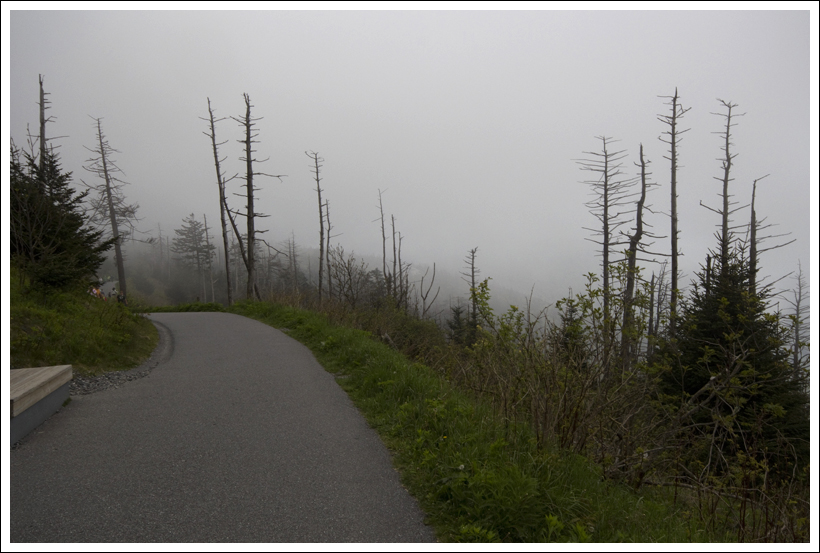
The walkway to the Clingmans Dome Observatory. Below: Another view from the observatory; The tower looks like a spaceship;  The summit is covered with many dead fir trees destroyed by an insect called the wooly adelgid;  The walkway down to the parking area was covered with fog; A view opened up from the parking lot.
Another View from Clingmans Dome The Observatory Dead Fir Trees
Foggy Walkway View from the Clingmans Dome Parking Area

Once we gained the ridge, we took a right and headed north for .3 miles along the Appalachian Trail.  There were a couple nice views along the way and even a glimpse of the parking area through the trees.

The trail came out close to the base of the observatory.  We made a second climb up the tower to see if the view was any clearer.  It wasn’t – in fact; within a few moments a giant bank of fog rolled in and covered the view completely.  We ate some lunch on the bench in the tower and did a little people watching.  Eavesdropping on conversation, I was amazed to hear so many people had never heard of the Appalachian Trail. They were stunned, upon reading the plaque at the summit, that there was an actual walking trail from Georgia to Maine.

After we finished eating, we walked the half-mile paved trail back down to the parking area.  Several people stopped us to ask if we were thru-hikers or if we were ‘headed to Maine.’  I guess trekking poles and wicking shirts  make us look very serious about the outdoors. We politely replied that we were mere dayhikers, but it would have been funny to tell people that we expect to be in Maine by mid-August.  Technically…  that is true – only we’ll be arriving by car for a week-long vacation in Acadia.  🙂

After wrapping up our hike, we drove into Cherokee and visited the Museum of the Cherokee Indian and the Qualla Arts & Crafts Mutual.  Both places were beautiful, fascinating and informative.  And, by the time we came out of the museum, it was thundering, lightning and pouring down rain.  We definitely made the right choice, but next time we’ll visit Silers Bald!

Trail Notes

  • Distance4.8 miles
  • Elevation Change – about 1200 feet
  • Difficulty – 3.  The trail from Andrews Bald to the AT is mostly uphill with a few steep sections.
  • Trail Conditions –3.5.  The upper part of the Forney Ridge Trail has loose rock, but the trail is generally well-maintained.  The hike down from Clingmans Dome is paved, but steep.
  • Views– 5. Expansive views from Andrews Bald and 360-degree views from Clingmans Dome.  On a very clear day, you could see for 100 miles in all directions.
  • Streams/Waterfalls – 0. Non-existent.
  • Wildlife – 1.5 Other than birds and maybe an occasional squirrel, I wouldn’t expect a lot of wildlife here due to the popularity of the trail.
  • Ease to Navigate – 4. Signs at junctions are well-labeled and stand out, but make sure you stay on the correct trail.
  • Solitude –1. The hike to Andrews Bald is one of the most-traveled trails in the park, and expect crowds at Clingmans Dome most days.

Directions to trailhead:  From December 1st through March 31st (and some other days based on weather), the road to Clingmans Dome is closed.  From Newfound Gap Road/441 take the Clingmans Dome road (south of the Newfound Gap parking area).  The road continues for seven miles until it reaches the large parking area.  Past the bathrooms and to the left of the paved path up to the gift shop and Clingmans Dome, take the marked trail down the steps that leads to Andrews Bald.

Appalachian Trail – Beagle Gap to Turk Gap

The Appalachian Trail – Beagle Gap to Turk Gap is a nice 6.4 mile section that includes a short summit hike and a visit to a AT shelter in the southern district of Shenandoah National Park.

View Along the Ridge
A nice view along the ridge line. You can see the spring green creeping up the mountainsides. Below:  Flowering trees near the beginning of the hike at Beagle Gap; the Calf Mountain Shelter; Dogwood in bloom.

Beagle Gap Calf Mountain Shelter Dogwood

Adam Says…

With this section of the Appalachian Trail, we finished section-hiking the southern district of Shenandoah National Park.  Now that we are finished with both the central and southern districts, we will next start working on completing the northern district so that we can ultimately cover all 105 miles of the AT through SNP.  The southern district accounts for 45 miles of that total, so we are glad to have the longest section completed.  I think hiking all of those miles was best realized by me when we are driving back home.  It feels like it took forever to drive the distance (due to the 35 mph speed limit through the park), so knowing we walked the distance gives me a little pride.   Of course, it still amazes me that some AT thru-hikers will accomplish the entire AT through SNP in about 4 days where it has taken us 5-8 days of hiking just to cover one section.

Adam hikes up Calf Mountain
Adam hikes up Calf Mountain. Below: The Charlottesville chapter of Potomac Appalachian Trail Club (PATC) is working on a less steep re-route of the Appalachian Trail near Calf Mountain; The USGS marker on Calf Mountain’s summit; After descending Calf Mountain you will cross under powerlines.  They’re very loud and buzzy!

Reroute Calf Mountain Summit Powerlines

We did bring two cars to cover more ground.  We parked one car at Turk Gap at mile 94.2 on Skyline Drive.  We took the other car to Beagle Gap and began our hike northward from there.  From the parking lot, we went through the gap of the fence on the same side of the parking lot.  We started walking across the open field and up into the woods.  Once we got into the woods, the trail becomes quite steep as you make your way up Calf Mountain, where you gain about 500 feet of elevation in the first mile.  The woods are more open through this section, so you can take in a lot of the beauty around you if you need an excuse for a break.  The AT is being re-routed through this part, so you will see some posted signs, but stay on the white-blazed AT.  At mile 1.0, you will see a large cairn on the trail.  If you look nearby on the ground, you will see a USGS marker that marks the summit of Calf Mountain at 2974 feet.  The trail then begins to descend past this point.  At mile 1.6, you will see a blue-blazed side trail that leads to the Calf Mountain Shelter.  The sign says that the shelter is .3 miles away, but it is really just slightly over .2 mile away and the trail is relatively flat.  We always enjoy visiting the shelters along the way and reading the entries in the shelter log books to see who has been through recently.  Once you return back to the AT, continue northward.  At mile 2.5, we started to hear some buzzing in the air.  Within a few short steps, we came across some power lines that are cut through the mountains that were producing the unsettling sound.  At mile 2.7, you will come across the South Fork Moormans River Fire Road.  Cross the road and continue on the AT.  The trail descends to bring you down to Moormans River, which is more like a trickling stream than a river at this point.  Once you reach the stream, the trail then begins the uphill climb for most of the remainder of the trail. At mile 4.8, you will reach Skyline Drive and the Sawmill Run Overlook.  Cross Skyline Drive, continue to climb,  and at mile 6.4 you will reach the Turk Gap parking lot.

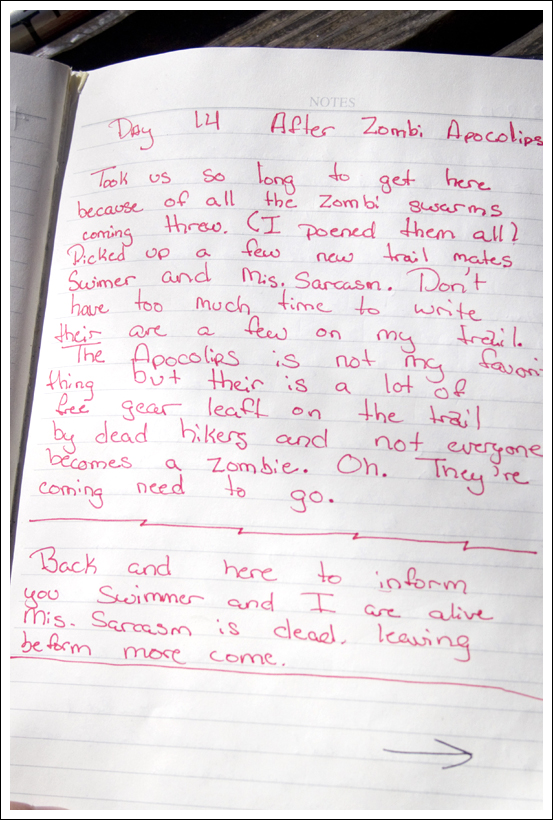
When reading the log book at the Calf Mountain shelter, it appears there were a few writings about a zombie apocalypse happening on the trail and some people were getting eaten and others were trying to stay ahead of it.  The only mention of this I could find online was through Tarzan’s AT journal.    I just picture a group of thru-hikers with zombie makeup shuffling through the forest and tagging others to spread the zombie disease.  But from watching The Walking Dead, I don’t picture anyone trying to set any speed records as a zombie.  Christine and I have toyed with doing a haunted hike on Halloween before, so this gives us some ideas.

Calf Mountain Journal
The journal at Calf Mountain shelter was full of fascinating and entertaining entries. Below: Adam reading at the shelter; Zombies on the Appalachian Trail; Climbing uphill

Adam Reading Zombies Uphill Climb

I did struggle a bit with this hike.  The last two weeks I had a very severe sinus infection.  Topping that off with a high-pollen allergy season just made this tough for me.  My lungs haven’t fully healed from all the coughing that I was doing, so walking uphill for most of this hike was taxing.  By the last mile of this hike, I was just ready to be done.

Christine Says…

This section of trail was quite a bit nicer than I expected.  On the map, it basically looked like a series of rolling hills on a trail through the woods – no panoramic views or remarkable features.  But once we got out there, we did find a couple nice views after all. The shelter visit was fun, mostly because the journal entries were more entertaining than usual.  Trees and wildflowers were blooming abundantly, so there was plenty of color along the way.  I also enjoyed the bluebird skies and the pleasant breeze.

The trail began with the climb up to the summit of Calf Mountain.  It’s a summit without a view. It’s marked by a USGS marker and a conical pile of rocks.  The pile reminded me a little of the giant cairns that mark the summits in Acadia National Park.  Adam always poses on those Maine summits, so I asked him to do the same on Calf Mountain.  Unfortunately, he made a really goofy face in the photo, so I won’t be sharing it on the blog.

Green Trail
The understory turned green early in the spring of 2012. Below: Ferns uncurling; Budding azaleas; Wildflowers

Fern Azalea Wildflowers

Hiking down from the Calf Mountain summit, I really noticed how GREEN everything is becoming.  Spring hit early and fast this year.  Even though the mature hardwoods had not leafed out when we did this hike, much of the understory was already green – ferns were uncurling, dogwoods and redbuds were in full bloom and we saw wild geraniums and dwarf irises. On this section of trail, we passed several enormous trees with lots of large, low-hanging branches.  They were just the kind of tree I would have climbed as a kid.  I wish I knew what kind they were, but they didn’t have leaves yet and I’m not good at tree identification without leaves.

Our next stop was the Calf Mountain shelter.  I ate candy and cheese. Adam almost broke my camera by getting his foot caught in the neck strap as it was sitting on the picnic table. (Aaaaaah!) I read the journal.  Apparently, there are zombies afoot on the Appalachian Trail this spring – many hikers are now undead, and it sounds wise to stay on the move.  (kidding, kidding)  There was also a fascinating entry from a man who has completed many thru-hikes (and not just the Appalachian Trail).  His entry was really uplifting and motivating.  I can’t believe one of his thru-hike attempts ended after getting thrown off the AT by a tornado in Maine  — yes, A TORNADO in MAINE.  That doesn’t happen very often!

Flowering Tree
There were plenty of flowering trees along the hike. I think we saw dogwoods, redbuds, cherry and apple. Below: Dwarf iris.

Dwarf Iris

The second half of the hike was mostly uphill.  It was never steep uphill, but we still gained several hundred feet in a pretty short distance.  I felt really bad for Adam.  He was struggling with the uphill after recovering from a chest/head cold.  At one point, I heard him cursing and muttering behind me that he was ‘*%$# tired of *%$# uphill.’  I always feel a strange sense of guilt when people I’m hiking with are having a hard time.  I almost feel like the hills are my fault.  LOL I want to carry more, encourage them to take more breaks, or offer to make a run for the car and come back to get them at an earlier stop point.  But Adam was tough, and pushed through the pain.

The nicest views of the hike came on the section of trail between Jarman Gap and Turk Gap.  There were several open views along the ridge.  It was beautiful to see the spring green creeping up the mountainside!

It feels good to be done with two sections of the AT through Shenandoah.  Now we have less than twenty miles to go.  Hopefully we’ll be able to knock those miles out in the next few weeks.

Trail Notes

  • Distance6.4 miles, including .4 miles to visit the Calf Mountain Shelter
  • Elevation Change – 1300 feet
  • Difficulty – 2.5.  While most of the trail is uphill, the grade is typically not very steep except for the section up Calf Mountain.
  • Trail Conditions – 4. The trail was in great shape and well-traveled.  There were not many rocky sections along this trail.
  • Views – 2.  There were a few views near the power lines, but most of the views along this section are obstructed.
  • Streams/Waterfalls – 2.  You do go along the south fork of Moormans River at one point, but it is largely a trickle at this point.  There are a few springs along the way, but the most reliable source is probably near Calf Mountain Shelter.
  • Wildlife – 3.  We did see several deer along the trails and we could hear lots of woodpeckers through the trees.
  • Ease to Navigate –4. Stay on the white-blazed AT and you should be fine.
  • Solitude – 3. You will find more people on the way to Calf Mountain, but not many people after that.

Directions to trailhead: At mile 99.5, you will come to a large parking area.  Look for the gap in the fence on the same side of the road and head up the Appalachian Trail.

Furnace Mountain

This 4.7 mile hike is a steady climb that gives you views of the south and west on the climb up and views of the north and east from the summit.

Christine on the Furnace Mountain Summit
The summit of Furnace Mountain has nice views of Massanutten and of Shenandoah National Park, looking back toward Skyline Drive.

Adam Says…

It is amazing to me to think about how blessed we are to have such great hiking in Virginia.  While we have been slowly trying to accomplish the Appalachian Trail through Shenandoah National Park, but we also like to mix in some other hikes.  Christine stumbled across a mention of this hike, so we decided to try it out.  We were pleasantly surprised by the nice views you get on this hike.  Keep in mind, there is another Furnace Mountain in Loudoun County.  There doesn’t seem to be a lot of originality in naming mountains sometimes.  This Furnace Mountain is named for the Mount Vernon Furnace that once stood at the bottom of the mountain for the reduction of iron ore.

Crossing Madison Run
Adam rock-hops across Madison Run. Below:  Adam adding some excitement to an otherwise boring fire road; The official start of the Furnace Mountain Trail.

Adam Leaping on the Fire Road Start of the Furnace Mountain Trail

We parked our car at the beginning of the fire road and made our way to the boundary of Shenandoah National Park.  As soon as we entered the park boundary, you will see a signpost to the right that denotes the start of the trail.  You will quickly come up to a stream crossing of Madison Run that you can rock-hop across.  These rocks are sturdy, but can be slick in some spots, so be careful.  After crossing Madison Run, the trail turns right and parallels the stream for a short distance.  Then, the trail begins climbing up the mountain.  There is a constant climb uphill for the entire hike.  Around 1.6 miles, the trail comes up to a large talus slope of large boulders which provides an open view of the valley.  The trail continues climbing and at 1.9 miles, you reach a post and an intersection with the Furnace Mountain Summit Trail.  Take this trail, which continues to climb up.  At 2.3 miles, you will reach a campsite at the summit.  Less than .1 miles is the rock outcropping which gives you the best views on the trail.  Return the way you came to make it back to your vehicle.  This time, you’re going all the way downhill.

Christine on Talus Slope
Christine hikes on the trail across the talus slope. Below: Adam takes in the view of the valley.

Adam on Talus

Madison Run is not named for James Madison, but rather from John Madison, the first Court Clerk of Augusta County.  John Madison’s cousin was the father of James Madison, the 4th US President.  Near this location stood Madison Hall Estate.

We had debated about bringing Wookie on this trip.  He would have loved most of the hike, but would have hated crossing Madison Run.  He really wants to avoid water on the trail, so I know I would have had to carry him with his claws digging in to me.  He just doesn’t like getting his precious feet wet for some reason.

Hiking this trail in the winter gives you views throughout a good portion of the hike.  When the leaves come out, you will have more obstructed views except from the talus slope and the rock outcropping at the summit.  We were excited at how great the views were from the summit.  Even though this mountain’s summit is only at 2657 feet in elevation, it provides some great vistas of the mountains around.  If you’re looking for a manageable hike off the beaten path with good views, this is one to try!

Christine Says…

Adam and I had Friday off work, so we decided to hit the trail for a morning hike.  We thought about doing some more of the Appalachian Trail through Shenandoah, but I wasn’t in the mood to drive separately for our car shuttle.  I also didn’t want to drive too far for our hike, so I started researching trails close to our home. We’ve done so many of them already that it’s getting increasingly difficult to find anything nearby.  Luckily, I happened to stumble across a route up Furnace Mountain with a trailhead located about fifteen minutes from our house.  I had been aware of Furnace Mountain before this, but most write-ups I’ve seen cover it as a 13+ mile loop hike (with 3000+ feet of elevation gain) paired with Austin Mountain.  I can hike 13+ miles as a day hike, but I usually don’t enjoy it.  My ideal length for a day hike is still 8-10 miles.

Hiking Along
You can see the valley below through the trees for much of the hike up. Below: An illegal fire pit at a backcountry campsite; The rocky outcropping at the summit; A view of Massanutten Mountain

Illegal Fire Pit Summit Rock View of Massanutten

Our trip up Furnace Mountain started off cloudy, and while the clouds thinned out somewhat during the course of the morning, it stayed mostly overcast.  That was a bit of a shame, because the views all along the trail are really nice.  I’m sure some of the views will be obscured once the trees have leaves again, but for the time being, it was great to see views of the Shenandoah Valley along the climb up.

The trail was extremely rocky most of the way, and even crossed a neat talus slope.  I imagine that this mountain was once towering and majestic, but over the ages, the rocky summit crumbled and rolled down the lower slopes.  The climb uphill was steady, but not difficult.  The most challenging part was the footing – lots of football-sized, unevenly seated rocks.

The Furnace Mountain summit trail is a half mile dog leg off the main trail.  Along this segment, we passed a campsite with a well-used fire ring.  Since Shenandoah does not allow open fires in the backcountry, the fire ring really shouldn’t have been there.  I suppose that the park just doesn’t have enough rangers to police illegal fires.

Shortly after the campsite, the trail took a short downhill to a rocky outcropping overlooking the park and the Shenandoah Valley.  We could see Massanutten mountain in one direction and a distant snip of Skyline Drive in the opposite direction.  In early March, everything is still barren and brown.  The dull color paired with the clouds took a little of the luster off the overlook, but it was still very nice.  I’d like to see it again in late spring, summer or fall!

Enjoying the Summit
Christine enjoys the summit.  Below: Adam on the rocking outcropping.  As you can see the rock is very rugged and jumbled.

Adam on the Summit Adam on the Summit 2

After hanging out a short while, we headed back down the trail.  We made it back to our car in less than half time time it took us to climb up.  We practically jogged the whole way down!  On our way home, I had really been looking forward to stopping at the Elkton McDonald’s for a Shamrock Shake.  We got there… shakes were on the menu… but the stupid machine was out of order.  I was robbed!

Trail Notes

  • Distance 4.7 miles
  • Elevation Change – about 1300 feet
  • Difficulty – 3.  The uphill isn’t too strenuous, but there isn’t much break from the climbing.
  • Trail Conditions – 3.  We were surprised at how well this trail seemed to be maintained.  The path is a little more open, but does have some rocky sections.  The danger would be in going down, since you can pick up speed and some of the rocks may be loose.
  • Views – 4.  The views are quite nice, but not 360 degree views.
  • Streams/Waterfalls –2.  The trail does go along Madison Run for a short distance.
  • Wildlife – 1.  We didn’t really see anything on this trail.
  • Ease to Navigate – 4. As long as you cross the stream at the right point and then make the turn on the Summit Trail, you should be fine.
  • Solitude – 3.5. Typically only popular with the locals, but you may see a few people on the trail.

Directions to trailhead:  From Elkton, VA follow 340 South. You will see SR 659 on the left.  Follow that until it intersects with Browns Gap Road/SR 663.  Take a left and follow the road until it becomes a gravel fire road.  Park on the road. Continue on the fire road for about .2 miles until you enter the park boundary.  The trail marker on the concrete post will be on your right.

Appalachian Trail – Brown Gap to MM89

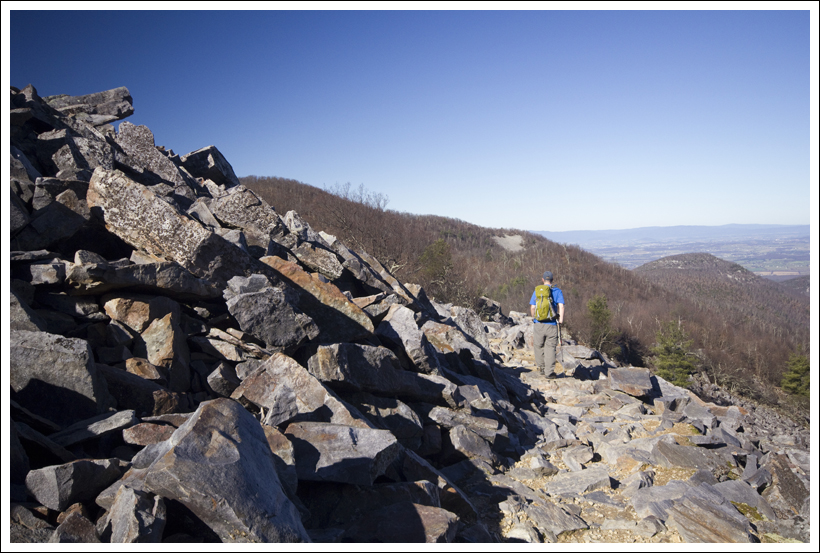
For our Thanksgiving hike, we decided to knock off another section of the Appalachian Trail through Shenandoah National Park.  This six mile hike includes a visit to the boulder summit of Blackrock mountain and a side trip to a PATC hut.

View from Blackrock Summit
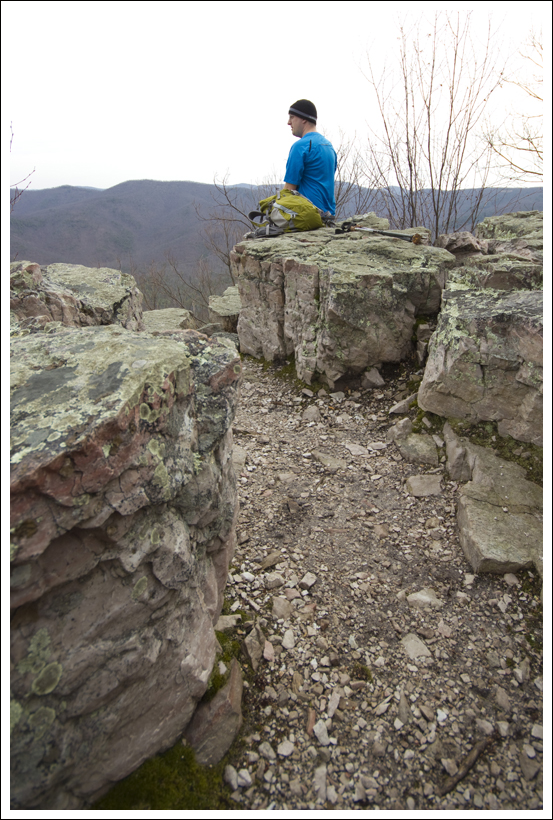
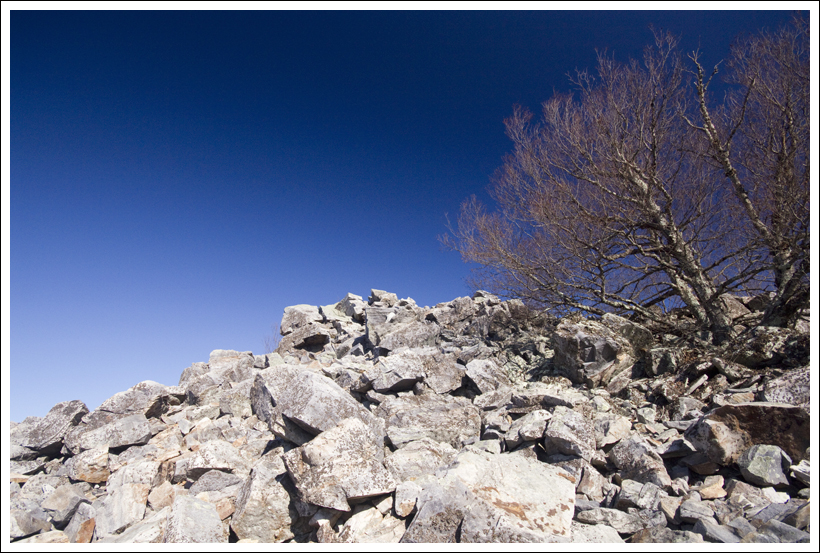
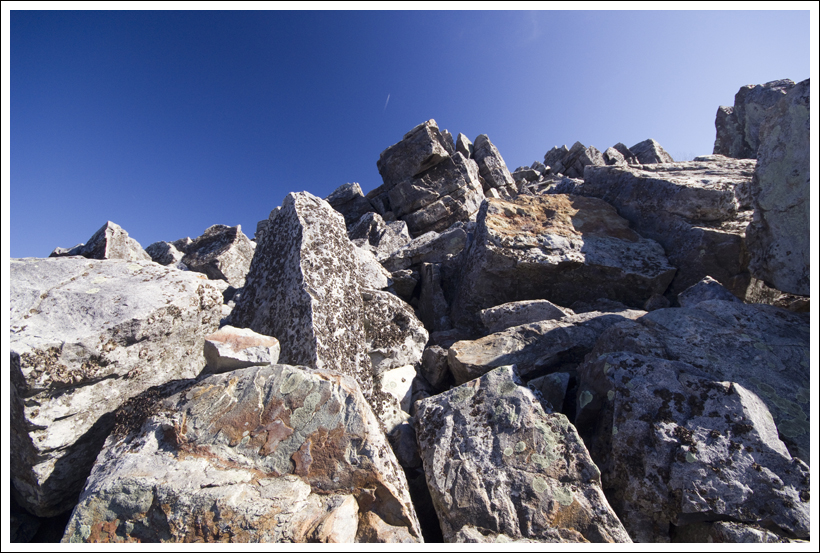
The view from Blackrock is beautiful!  Below: The summit of Blackrock is a massive jumble of boulders left behind by an ancient collapsed cliff; Adam looks at the different hiking options around Blackrock.  This area is popular with families and day-hikers due to its short length,  With all the leaves down, Skyline Drive was visible many places along the trail.

Rock Jumble Skyline Drive

Adam Says…

For the last several years, we’ve had our own non-traditional Thanksgiving Day celebration  We start off with a morning hike, and for dinner we have homemade pizza.  Since it is typically just the two of us, we haven’t felt the need to make a big turkey with all the trimmings.  Christine isn’t a big fan of turkey, so we decided to have something for dinner that we both enjoy even more. But to keep with a little tradition, we take a piece of pepperoni, make a wish, and tug on both ends.  Whoever gets the majority of the pepperoni, gets their wish.  And there is also usually football on the TV.

We started off our 2011 Thanksgiving hike by parking one car on the side of the road at mile marker 89 (after the Horsehead Mountain overlook) where the Appalachian Trail crosses Skyline Drive.  We then drove back to the Brown Gap parking lot (near mile marker 83).  The white-blazed Appalachian Trail begins across Skyline Drive.  The trail starts off with a gradual uphill.  At .8 miles, you may begin to smell campfires or see a few people since it goes right behind the Dundo Picnic Area.  At 1.3 miles, the trail intersects with the Jones Run Trail and then at 1.5 miles, the trail crosses Skyline Drive again.  The trail continues uphill to make your way up to the summit of Blackrock mountain.

Rock Jumble on Blackrock
The rock jumble on Blackrock is impressive.  Below: Adam hikes around the summit; Adam hikes along the AT under bare trees.

Adam Hikes Around Blackrock

At mile 2.0, the trail skirts a Blackrock parking lot.  A sign shows some alternate ways up Blackrock mountain, but just stay on the Appalachian Trail.  At 2.5 miles, you should reach the boulder pile for the summit of Blackrock.  You will see some nice views from this point and from a nearby overlook as the trail winds around the summit.   The trail then starts descending rather steeply down the other side.  At mile 3, we took the spur trail that leads to Blackrock hut.  The hut is about .2 miles away down a steep out-and-back trail.  We visited the hut and returned to the Appalachian Trail at mile 3.4.  At mile 3.9, the trail crosses Skyline Drive.  At this point, the trail begins to go back uphill and goes up and down two small hills until you reach your car at mile 6.0.

The best part of this hike is clearly the Blackrock summit.  It is fun to climb around on the boulders and the views from this area and the nearby overlook are great.  Many people hike this summit from the Blackrock parking lot.  For a one-mile hike from the parking lot, this does give you a good payoff for little effort.  Since it is a short hike, you should expect to see other people on this hike during most nice days.

Since it was Thanksgiving, Christine and I talked to each other about what we were thankful for.  I am very thankful to have an amazing wife, three dogs that are a great part of our family, a job that enables me to enjoy the rest of my life, and the ability to be able to hike with Christine through some gorgeous areas of Virginia.  I’m very thankful to have the life that I have.

We only have about 12 more miles to finish the southern section of Shenandoah National Park.  It is always amazing to us when we are driving to cover our next section that we have been able to cover all this distance on foot.

Christine says…

Well… this post has been a long time coming!  I can’t believe it’s taken us nearly a month to get details about our Thankgiving hike onto the blog.  The holiday season is always so busy and chaotic!

As far as hikes go, this one was pretty low-key.  There was one great view from Blackrock, but it was mostly walking through the woods.  The terrain was really easy and the weather was really warm for late November.  We only saw one other group of people the entire day – a family hiking up to Blackrock.

I really enjoyed the walk down to visit Blackrock Hut.  Adam surprised me by bringing our JetBoil along.  We got to enjoy drinking hot beverages while perusing the shelter log.  He had cocoa and I had hot cider.  The hike was such a fun and relaxing way to spend the holiday morning.

Blackrock Hut
We made a stop at Blackrock Hut. Below: The shelter journal; Adam makes cider and hot cocoa, Our non-traditional Thanksgiving dinner.

Journal Hot Beverages Pizza

I can’t even begin to describe how much I love our Thanksgiving tradition!  I used to spend the entire day in the kitchen – basting the turkey, preparing a zillion different side dishes and setting the table.  I would stress over getting everything onto the table at the same time.  And worst of all… by the time the meal was ready, I really didn’t even want to eat it.  And then there was the sink full of dishes, weeks worth of leftovers and the dreaded turkey carcass to contend with.  Now I get to go for a hike and spend the majority of the day outdoors. Plus, homemade pizza is easy, no-fuss and delicious after a hike.

Trail Notes

  • Distance 6.0 miles (including .4 mile side trail to Blackrock Hut)
  • Elevation Change – about 1100 feet
  • Difficulty – 2. There is some uphill at the end of the hike, but most of the hike is flat or downhill.
  • Trail Conditions – 3.5.  Overall was pretty well-maintained, but there were a few trees across the trail to navigate coming down from Blackrock summit.
  • Views – 3.5.  Best views on the hike are near Blackrock Mountain
  • Streams/Waterfalls – 1. A small, mostly-dry stream was near the Blackrock hut.
  • Wildlife – 1.  We didn’t see anything beyond birds and squirrels.
  • Ease to Navigate – 4.5. Just stay on the Appalachian Trail. 
  • Solitude – 3.5.  Expect to see people around Blackrock mountain, but otherwise, not a lot of traffic on this hike.

Directions to trailhead: Leave one car on the side of the road at mile marker 89 (after the Horsehead Mountain overlook) where the Appalachian Trail crosses Skyline Drive.  Drive back to the Brown Gap parking lot (near mile marker 83).  The white-blazed Appalachian Trail begins across Skyline Drive.

Hone Quarry Ridge

This five mile hike has a fair amount of climbing, one nice view and lots of solitude.

Adam Enjoys the View from Abbie Point
Adam enjoys the view from Abbie Point. Below: The trailhead for this hike is along Hone Quarry Road; Colorful foliage, A campsite near the ridgeline.

Hone Trailhead Colorful Woods Campsite

Christine Says…

Last weekend, we had a perfect fall day – probably one of the last ones of the 2011 season – bluebird skies, temperatures in the sixties and glorious fall color.  We had obligations in Harrisonburg on Sunday morning, so we decided to choose a hike close to town so we wouldn’t miss out on such a nice hiking day.  We did some research and decided on the Hone Quarry Ridge Trail.  Its five mile length and close proximity to town made it perfect for a quickie hike squeezed into a busy day.

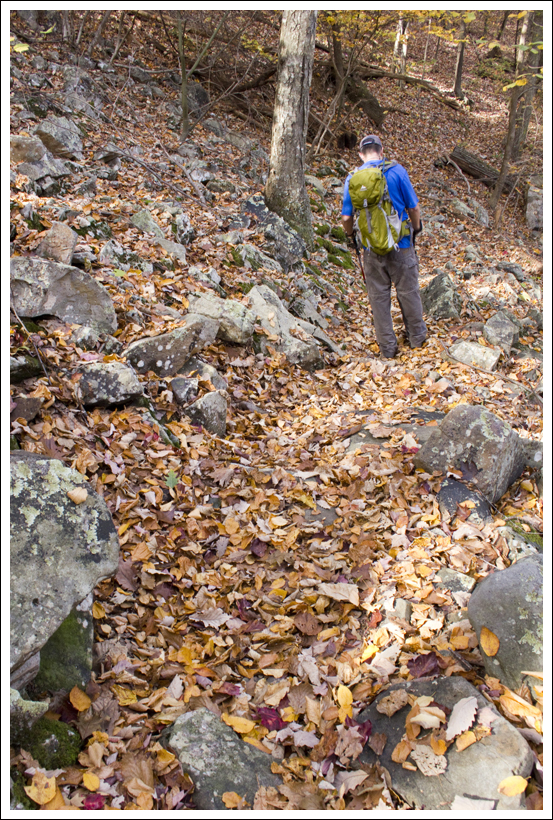
The hike was actually tougher than I expected!  The climb went uphill without many switchbacks which was a small part of the challenge, but most of the difficulty came from the tricky footing.  Large sections of the trail were covered with loose, pointy, ankle-turning rocks covered with a deep layer of dry autumn leaves.  I was so glad to have my trekking poles.  I am sure they saved me from turning my ankles multiple times.

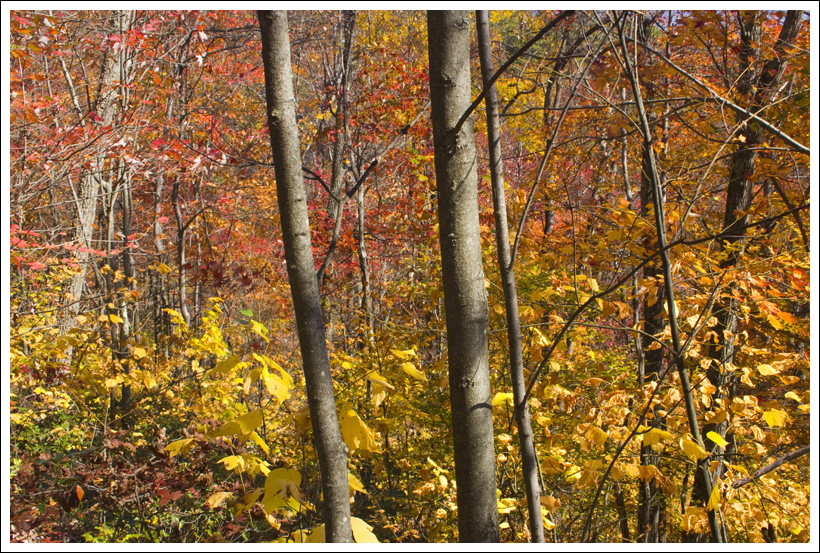
The woods were so colorful – reds, oranges, golds mixed in with occasional evergreens.  On the climb up, we caught glimpses of views through the thinning trees.  We passed a few established backcountry campsites and enjoyed one gorgeous open view from Abbie Point.

Yellow Blazes
Yellow blazes were few and far between. Below: Adam makes his way up the trail; A couple of the signs we spotted along the way. There were several trail junctions that were unsigned.

Hiking Uphill Trail Junction Near Start Trail Sign on Summit

Hiking in George Washington National Forest can be a real adventure.  Some popular trails like Big Schloss and Kennedy Peak are as navigable and well-maintained as anything in Shenandoah National Park.  While other trails, like Hone Quarry Ridge, have very little foot traffic.  Not much attention goes into maintaining these trails.  The double yellow blazes were spaced pretty far apart.  Trail junctions were often unmarked, leaving us to consult a map and compass to decide our direction.  The signs that were standing were in relatively poor condition, slowly rotting into the woods.  Don’t let this deter you from trying the trail, just be prepared to double-check your navigation.

After enjoying the view from Abbie Point, the remainder of the hike was mostly downhill (with the exception of a few short uphills), along rocky and occasionally narrow trail.  We moved pretty quickly, because we were hungry and had exciting late lunch plans.  If you’re ever in Harrisonburg, don’t miss trying Jack Brown’s Beer & Burger Joint.  They have the best burgers made with American Kobe/Wagyu beef and the fries are always hot and perfectly cooked.  They always have plain burgers and one specialty burger on the menu.  I got a cheeseburger and a Crispin Hard Cider.  We sat on the heated outdoor patio and enjoyed our decadent lunch.

It was another great hike, with one downside.  I got the largest, most painful blister I’ve ever had in my life.  I really don’t know how it happened.  My boots were the same. My socks were the same.  I’m pretty sure I laced up the same.  I made it through the hike, but the half dollar sized blister on my left heel has been monstrously painful all week. It was so bad, that I ended up at the doctor’s office on Wednesday to make sure it wasn’t infected.  I could hardly walk and I couldn’t wear shoes.  We were supposed to hike with my parents the weekend before Halloween, but I still wasn’t ready to wear boots again.  It’s finally starting to feel better a week later.

Adam Says…

As Christine mentioned, this is a hike that I’m glad we have a few modern-day conveniences for hiking since leaves were covering most of the trail.  My GPS was handy to make sure we were going the right direction and our trekking poles helped to test the ground out and give some extra support with each step.

Rocky Trail
An example of the rocky trail conditions.

The trail started off shortly after the the Hone Quarry campground.  After crossing the spillway, we parked our car on the right where there is space for about 3 cars.  The trail starts off across the road and you should see a hiking trail marker on a fire road that shortly leads to a wider off-road parking spot.  You’ll see the trail marker go over a mound to the left and up the hill to start the hike.  In .1 mile, you’ll arrive at an intersection.  The left heads towards the Heartbreak trail and the right heads to the Big Hollow Trail.  Follow the trail to the right.  The trail begins to ascend going up a wider trail that follows a stream along the way.  At .8 miles, the trail will hit a switchback and start a steeper ascent up the mountain.  At the 1.1 mile mark, the trail will cross a fire road, but keep going straight.  At 1.4 miles, the trail rejoins the same abandoned fire road you joined (you’ll see a small firepit to your left).

Take a right here to join the wider fire road.  The trail is quite steep at this point as you’re heading straight up the mountain with few breaks in the uphill climb.  At 2.1 miles, you will reach the intersection with the Hone Quarry Mountain trail.  Take a left on this trail and you will see another firepit immediately on your left.  The trail descends into a small saddle and then begins a steep hike up to a rocky overlook on your right at 2.7 miles.  This is the best point for views on the entire hike.

The trail from this point is mostly downhill, but quite overgrown.  Much of the trail feels like an animal path through the thick vegetation around.  Keep your eye out for the yellow-blazed trail markers.  At about the 4.0 mile marker you reach another firepit/campsite area and the trail seems like it splits again (There was a log covering the path straight, so I’m not sure if the trail continues at this point or everything goes to the left).  Take a sharp left here (this is now the Heartbreak trail).  The trail descends rather quickly through the forest, often through loose rocks, so be careful about your footing!  The Heartbreak trail was the most difficult to navigate.  The blazes were sparse, so we had to keep hoping we were still on the trail, since leaves covered anything that could be called a path below our feet.  Eventually the blazes led us closely to the campground area and we crossed the stream and made our way back to the intersection around 5.0 miles.  We continued straight and made our way back to the car around 5.1 miles.

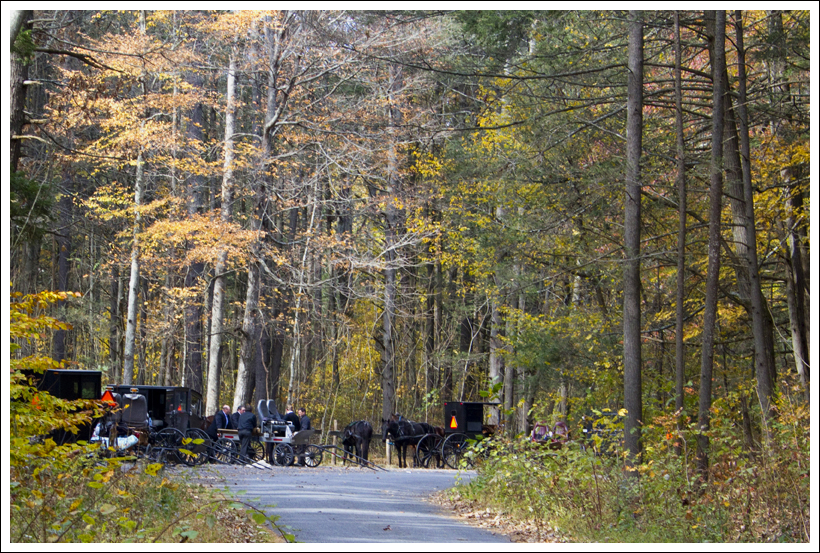
Mennonite Picnic
There was a large group of Mennonites picnicking at Hone Quarry. They’re a common site in the Shenandoah Valley. If you hike anywhere west of the city (towards Dayton or Ottobine) on Sunday, you’ll see many families out in buggies and on bikes.  Below: A few more shots.

Parked Buggies Horse Typical Sunday Scene

I joked with Christine that the Heartbreak trail was aptly named, since I can imagine lots of couples arguing about if they were still on the hiking trail and then breaking up after the hike was over.  After we got back to the car, we came across a bunch of Mennonite families that were enjoying a potluck picnic.  Several of the families were heading off to another hiking trail.  The simpler life does make me think of how families may have done this type of thing often in the past.  Seeing people hiking in suits and dresses reminds me of old pictures that I have seen of people hiking many of the national parks when they were first being established.  Today we have trekking poles, wicking shirts, hiking pants that unzip to become shorts, GPS systems, camelbaks, etc.

If you are interested in geocaching, there are a few available on this trail.

  • Gnome Watch – a fun clue that leads you to the nearby cache.
  • Hone Quarry – a standard cache not far from the trail.
  • Cache Advance – a standard cache near the picnic area.  Not on the hike, but hard to resist since you pass near it on the drive.

While I think this hike was enjoyable, I was expecting more chances to catch some views.  You really only get views from the one rocky outcropping.  Everything else is obstructed.

Trail Notes

  • Distance 5 miles
  • Elevation Change – 1480 feet.
  • Difficulty – 3.  The climbing on this hike is actually pretty steep, both uphill and downhill.
  • Trail Conditions – 1.5.  Like many less known trails in the National Forest, the Hone Quarry Ridge Trail is minimally maintained.  The trail is extremely rocky, and under a deep layer of fallen autumn leaves it can be downright perilous.
  • Views –3.  One nice, open view and some nice peeks through the trees along the way.
  • Streams/Waterfalls – 2.  The nearly dry stream along this trail has the potential of being quite prettier when there is more rain.
  • Wildlife – 1.  We didn’t see anything.
  • Ease to Navigate – 1.5.  The trail is minimally blazed and signs are far and few between.  We recommend bringing a map and a compass.  There are several trail intersections where you might go wrong.
  • Solitude – 4.  Hone Quarry is a popular camping and picnic area, but you probably won’t see many people on this hike.  On a gorgeous Sunday, at the peak of fall, we saw only three people on the trail.

Directions to trailhead: From 33, head south on SR 613/Clover Hill Road.  After passing Paul State Forest, the road comes to an intersection.   Stay straight and follow the signs to 257/Briery Branch Road.  257 eventually enters into George Washington National Forest.  Take the first right on to Hone Quarry Road.  Pass by the picnic area and then a small spillway over a stream.  You will see a parking area shortly after on the right and the hiking trail is on the opposite side of the road.

Dobie Mountain

This 6.2 mile hike includes an overlook, a great AT overnight hut, and plane wreckage.

Glass Hollow Overlook
Taking in the view from the Glass Hollow Overlook.  It was really hazy and we were facing the sun, so the photos aren’t great.  But, it was still really colorful and pretty.  Below:  Adam takes the turn onto the Appalachian Trail; The Paul C. Wolfe Shelter; Adam walks along the Albright Trail.

Trail Junction Paul C. Wolfe Shelter Albright Trail

Adam Says…

Today was our 14th wedding anniversary, so we decided to take the day off of work and go for a nice hike together.   It is a good sign that it doesn’t seem like 14 years and that time has flown.  I’ve seen a card that said on the outside “Thank you for five wonderful years of marriage” and on the inside it said “Happy 25th Anniversary”.  We’ve had some great years together.  It was wonderful to pick a beautiful fall day to experience together.

While Humpback Rocks is the more popular hike that departs from this spot, we thought it would be a good idea to talk about this other hike that takes off from the Humpback Rock parking lot.  So, if you’re interested in hiking but not tons of people, this may be an option for you. The views are better from Humpback Rock, but you do get some benefits on this hike also.

After parking in the lot, you will see a picnic table adjacent to the first parking spot.  There are two trails that take off from this spot.  Take the blue-blazed trail to the right of the picnic table that descends into the woods (you’ll return from the loop by the Albright Loop Trail on the left).   The trail descends gradually and at .25 miles, you reach an intersection with the Appalachian Trail.  Take a left on the white-blazed AT heading north.  The trail at this point is relatively flat or downhill.  At mile 1.1, you reach an intersection with a small blue-blazed trail that veers off to the right pointing to the Glass Hollow Overlook.  The trail to the overlook is just about .2 mile and is worth the walk.  At the overlook, there is a backcountry campsite for those that would like to camp and take in the views of the sunrise from the overlook.  Go back on the spur trail the way you came and join the AT again, taking a right and continuing north on the trail taking your mileage to 1.3 miles.   At mile 1.6 and 1.7, you come across intersections with the Albright Loop trail.  Just continue on the Appalachian Trail.

Inside the Shelter
Adam checks out the shelter log in the Paul C. Wolfe shelter. Below: Past campers debate (in graffiti) the philosophy of Christopher McCandless from ‘Into the Wild’; We found a name we knew in the shelter log; On the hike back up from the shelter, we got an open view of Bears Den Mountain in Shenandoah National Park.  You can’t tell in this photo, but there are radio towers atop the mountain in the distance.

Quote - Into the Wild  Log Book Looking Toward Shenandoah

The trail begins to descend for the next 1.3 miles through a long series of switchbacks.  At mile 3.0, we rock-hopped across Mill Creek and reached the Paul C. Wolfe Shelter.  We took some time to rest here before we returned the way we came on the Appalachian Trail.  We climbed back up the Appalachian Trail from the shelter heading south this time and back up the switchbacks we had just experienced.  We were both glad that these took off some of the difficulty of the elevation climb.  At mile 4.2, we reached the first junction with the blue-blazed Albright Loop Trail.  Take a right here and you will follow this trail 2 miles back to the parking lot.  The hike on the Albright Loop trail starts off very manageable, but ends up being the most difficult part of the hike since there is quite an ascent up through some switchbacks.

On the return on the Albright Loop Trail, immediately after the second switchback, look up the hillside to see the wreckage of a Beechcraft Bonanza plane.  On the trail it was marked with a cairn to show where you can leave the trail.  The plane crashed back in 1963.  Please respect the wreckage and leave it as it is.

Plane Wreckage
Plane Wreckage along the Albright Trail. Below: Adam checks out another section of the plane.

Plane Wreckage

The Paul C. Wolfe Memorial shelter was built by the Old Dominion Appalachian Trail Club in 1991.  According to their website, “it took approximately 30 people every weekend for two months to complete the shelter.  Materials were hauled two miles by hand and tractor.”  This is one of the nicest huts on the AT, according to a lot of the thru-hikers.  It really has nice construction and a beautiful location.

After our hike, we made a quick trip down to Sonic for a snack (tots and creamslushes!).  We didn’t want to spoil our anniversary dinner though, since we had reservations at The Local Chop & Grill House in Harrisonburg, VA.   It always feels good to have a guilt-free dinner when you have burned off a lot of calories on a hike.

Christine says…

What a great anniversary hike!  I love being out on the trail during the peak of fall foliage season.  All during the hike, the sun was filtering through the trees above – making a gorgeous canopy of gold.  There were also plenty of brilliant red maples tucked into the understory.  What was even better — no crowds!  Hiking on a weekday on a less well-known trail made this hike especially enjoyable.

I had new boots to try out on this hike. Right out of the box, my Oboz Sawtooth boots were perfectly comfortable.  They’re the first taller pair of boots I’ve ever worn.  I was skeptical about that, but they felt great the whole six+ miles.

Golden Forest
A golden canopy of forest.  Below: New boots on the Glass Hollow Overlook; Adam crosses Mill Creek; A small cascade on the stream.

New Boots Crossing Mill Creek Mill Creek

Since Adam has already talked about the trail specifics, I’ll just share a few of my highlights. One of my favorite stops was at the Paul C. Wolfe shelter.  It really is one of the nicest backpacking shelters I’ve ever seen – two levels, plexiglass windows, hooks to hang backpacks and a deep, well-sheltered porch, so you always stay dry when you’re sleeping.  The structure is set uphill, overlooking a wonderful, babbling stream.  Even the privy is unique at this shelter.  With it’s half-door, I can’t say you’ll ever get true privacy, but at least you know when it’s occupied and the ventilation couldn’t be better!

While we were taking our break at the shelter, we took a few minutes to flip through the log book.  We noticed the entry from one of the backpackers we met in September at the Pinefield Hut.  It was kind of neat to see a name we knew.

I also took some time to explore and photograph the stream.  Along the bank of the stream, there is a marble bench placed in memory of John Donovan.  He was an experienced hiker and a member of the Old Dominion Appalachian Trail Club. He died on his attempt to thru-hike the Pacific Crest Trail in 2005.  The bench gave me enough information to Google his name so I could learn more about what happened.  As it turns out, Backpacker Magazine published a long feature story about John Donovan’s disappearance and death in a 2006 issue.  It was a fascinating read!  The tragedy that befell Donovan turned into a miracle that saved two other lives.

John Donovan Bench
A bench is placed in memory of John Donovan. Below: The privy has a half door!

Half Door Privy

The plane crash was an interesting stop, too.  I expected the plane wreckage to be a lot rustier after close to fifty years in the woods, but it was still completely recognizable as an aircraft.  I couldn’t find anything more about the crash other than the year it happened and the type of plane.

After leaving the plane site, we finished out stint on the Albright Trail and made our way back to the car.  The parking lot was really full, but pretty much everyone else was on the Humpback Rocks trail.  I’m really glad we took the time to explore this trail – it turned out to be a perfect way to celebrate our anniversary.

Trail Notes

  • Distance 6.2 miles
  • Elevation Change – 1500 feet.
  • Difficulty – 3.  There is a good amount of uphill climbing.  The steepest section is along the Albright Loop Trail.
  • Trail Conditions – 4.  The trail is nicely maintained.  During the fall season, be sure to watch your footing if the trail is covered with leaves.  There are loose rocks underneath a good portion of the trail.
  • Views –3.  The best unobstructed views are from the Glass Hollow Overlook.
  • Streams/Waterfalls – 3.  Mill Creek was moving nicely near the shelter.  According to a journal entry from an AT hiker, there is a small waterfall and pool shortly downstream.
  • Wildlife – 1.  We didn’t see anything beyond birds, chipmunks and squirrels.
  • Ease to Navigate – 3.5.  There are a few intersections, but there are also signs at each of the intersections.
  • Solitude – 3.  You will likely run into a few others on the trail, due to the proximity of Humpback Rocks.

Directions to trailhead: The trail is located on the Blue Ridge Parkway at Mile Marker 8. The hike begins on the blue-blazed trail to the right of the picnic table.

The Beall Trails (WV)

The Beall Trails are a relatively short and flat figure-eight series of trails in Canaan Valley, West Virginia that provide open areas for viewing wildlife and a scenic walk along the Blackwater River.

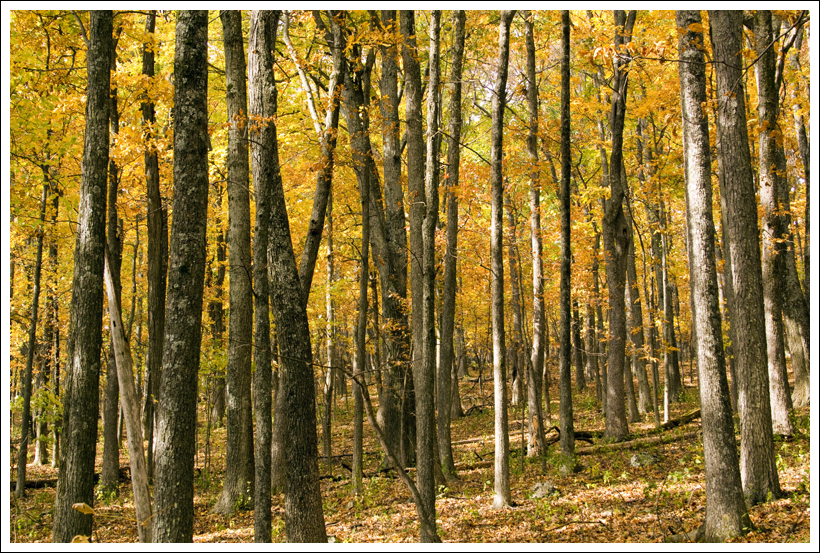
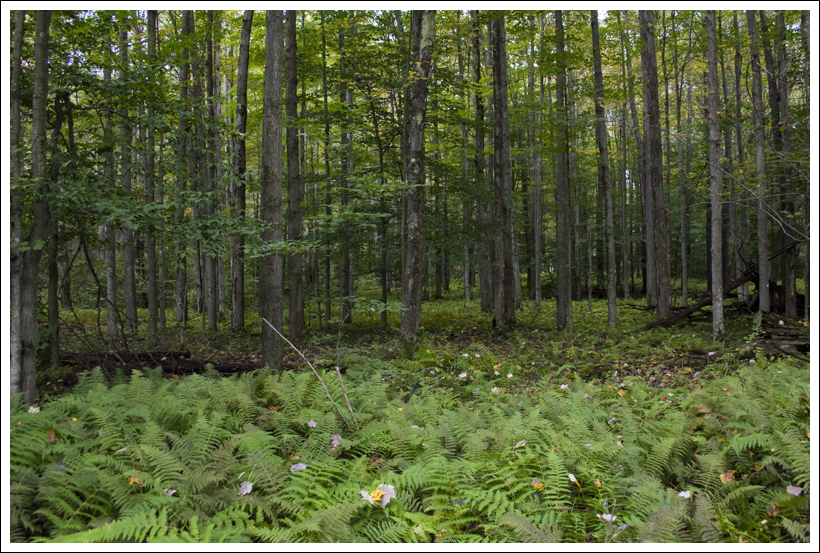
Woods Along the Beall Trails
The woods along the Beall Trails are pretty and lush. Below: Flowers were still blooming at the end of summer; The area is part of a National Wildlife Refuge; Lots of deer inhabit the area of the Beall Trails.

Flower NWR Sign Deer

Adam Says…

This figure-eight loop trail was a great way to experience some early fall weather and scenery.  This trail doesn’t have a lot of elevation change, so it is doable by most people.  It is also a birdwatchers paradise if you hit the trail in the early morning.  The open fields and nearby Blackwater River make this an active spot for birds.

We parked at the parking lot and started by taking the South Beall trail.  The trail started off cut through grass.  There are a couple of signs that point to the left, but stay straight on the trail.  Eventually, you will approach an area that is wooded.  There is a sign here for a handicapped hunting shed, that hunters use for deer hunting.  The trail begins to loop away to the left near the sign and begins to descend towards the Blackwater River.  The trail hugs closely to the River and gives you a few views of the water before you ascend back up the trail.  You will eventually rejoin the trail.  Take a right and make your way back to the parking lot.

For the North Beall trail, the trail starts off instantly in the woods.  After a few tenths of a mile, it opens back up into a large field (where a large barn used to exist) and then brings you back into the woods.  The North Beall trail then continues to loop to the east, and then brings you on more of a fire road to take you back to your vehicle.

There is a Beall Connector trail that bisects the North Beall trail to make a shorter loop.  There is also a Bog Overlook Trail and Hemlock spur trail that are both out-and-back short trails if you wanted to add more to your hike.

One interesting thing that happened along our hike is that we heard and saw about 12 fighter planes streak across the sky at lower elevations and then bank hard over the nearby mountains.   The area is used for pilot training. I’m not sure exactly what type of planes these were, but they were definitely combat-type planes.  We tried to get some pictures, but whenever we heard them we were deep in the woods and couldn’t get a clear shot with the speed they were flying.

Black Swallowtail Caterpillar
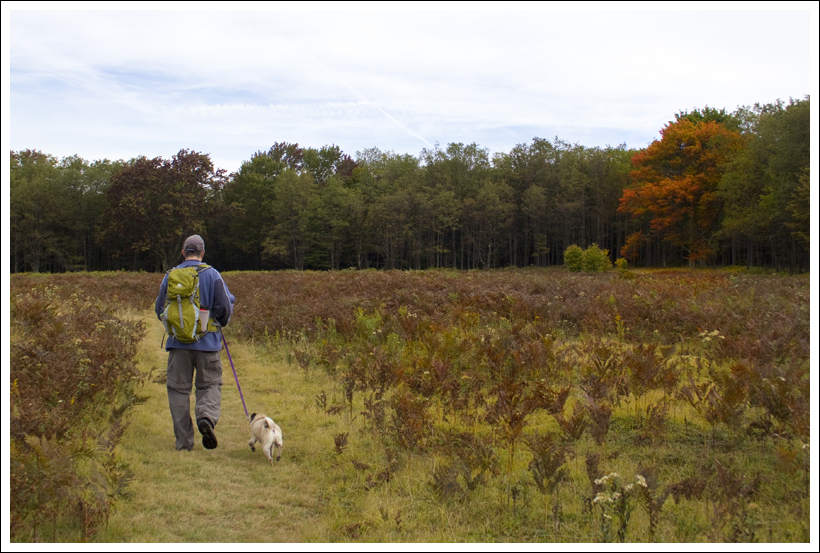
A Black Swallowtail Caterpillar.  Below: Adam and Wookie walking along the trail; Wookie perches in a tree; Trail marker

Many Ferns Pug in a Tree Beall Trail Marker

On the fire road on the North Beall trail, shortly before returning to our vehicle, I spotted a bright green caterpillar.  We inspected it closely and it had large orange antennae.  We had never seen any caterpillar that was so bright and colorful before.   After returning home, Christine was able to identify it as a Black Swallowtail caterpillar.  It also gave off a strong stench when we picked it up on a stick.  It turns out that these caterpillars brighten up and secrete a chemical as a defense mechanism.  After getting a few close photos, we put it back down to let him travel along to one day become a gorgeous butterfly.

After our short hike, we made a trip into Davis, WV for lunch at Hellbender’s Burritos.  This was our first trip there, but the food was amazing!  Christine got the Gendarme burrito, which was similar to a Philly cheese steak and I got The Admiral, which had chicken and bacon.  We will definitely make this a must-stop place for lunch in the future.

Christine Says…

When Adam and I decided to get away to Canaan Valley for a long weekend, I thought we’d do a couple hikes, go for a bike ride and maybe take a ride up to Dolly Sods. In the end, it turned out to be a chilly, gray weekend, so we opted for just one really easy hike on the Beall Trails and lot of movies on DVD, crackling fires, pizza eating and wine drinking. It was nice to have such a relaxing weekend, but I am glad we did manage to get in one hike!

We decided to take Wookie along on this hike.  He really hasn’t been hiking much lately because of the summer heat.  He was beyond thrilled to accompany us.  When he saw us packing his leash and portable crate, he started spinning in circles and whining excitedly.  That dog loves outings more than any dog I’ve ever known!

Wookie Runs
Wookie runs on the South Beall trail.  Below: Leaves were starting to turn colors; A bluebird box on the trail.

Signs of Fall Bluebird Box
The Beall Trails, which essentially form a large figure-eight path, are part of the Canaan Valley National Wildlife Refuge.  The trails go across open meadows, through boreal forest and along a small stretch of the Blackwater River.  It’s very easy, mostly flat walking.  The trail is in great shape, so it’s really a suitable hike for all kinds of people.

We started off South Beall Trail.  Essentially, the path crosses a large open meadow before turning left into the woods and dropping down to the shore of the Blackwater River.  After following the river for a few tenths of a mile, the trail ascends quickly and returns hikers the same meadow path back to the parking area.  The river is lovely and in the meadow, you’ll likely see whitetail deer, wildflowers, birds and butterflies.  There are bluebird boxes around the meadow and an accessible hunting blind is located a short distance from the trail.

Along the Blackwater River
Stopping along the Blackwater River.  Below: Adam and Wookie make their way along the South Beall Trail; More pretty trail scenery.

Old Barn Field Along the Beall Trail

The North Beall Trail is a little bit longer and a little bit more densely wooded.  There is one distinctly open area a couple tenths of a mile into the trail.  The field used to house a beautiful, run-down old barn that we enjoyed exploring and photographing.  However in May of 2008, the barn was torn down to supply the barn timbers to the National Park Service for restoration projects at Antietem Battlefield.  I’m sure the wood from the Beall Barn lent a lot of authenticity to the battlefield projects, but I wish they had left the barn where it originally stood.  I wasn’t happy about them taking history from one place and falsely installing it in another.  It also took away the home of the owls that used to roost in the barn.  You can still read about the barn and the owls on the plaque at the trail entrance.  The interpretive sign about the barn was still there as of 2011. Oh well…

Even without the barn, the area is still very pretty and we enjoyed our short hike very much!

wookieWookie Says…

This was a great trail for a dog!  Even though it went along the river, I didn’t get wet or muddy at all.  I especially liked running in the open meadows!

Trail Notes

  • Distance 3.5 miles total.  1.4 miles for the South Loop and 2.1 miles for the North Loop
  • Elevation Change – about 100 feet
  • Difficulty – 1.5.  There is only one slightly steep climb on the South Loop.
  • Trail Conditions – 3.5.  The trail is maintained, but may be overgrown in some of the summer/fall months.
  • Views – 2.5.  You will get nice views of the mountains around you from the open fields, but this isn’t a hike for overlooks.
  • Streams/Waterfalls3.  On the South Loop, you do walk along the Blackwater River for some nice views between the trees.
  • Wildlife – 3.5  We saw a few deer on the trail, but the birdwatching on this trail is prime.
  • Ease to Navigate – 3.5.  This is an enclosed group of inter-connected trails, so you shouldn’t get lost.
  • Solitude – 4.5.  We’ve hiked this a few times and haven’t seen anyone. 

Directions to trailhead:  Heading north on Route 32 through Canaan Valley, WV, take a right on Cortland Road.  In about 1.5 miles, you will reach a one-lane bridge.  Nearby is the Canaan Valley sign that points to the short road that leads to the parking lot.  The parking lot is the center of the South and North Beall trails, so you can pick which one you would like to start first.

Penobscot Mountain/Sargent Mountain/Jordan Pond Loop – Acadia National Park (ME)

Special: Acadia Edition

This moderate hike includes two panoramic mountain summits and views along one of the most scenic ponds in Maine.

Sargent Summit and View
The summit of Sargent Mountain has a beautiful view. Below: The trail marker behind the Jordan Pond House; Adam enjoys the view from atop an erratic; Jordan Pond is beautiful!

Trailhead Behind the Jordan Pond House Nice View from the Erratic View Along Jordan Pond

Adam Says…

Hiking up Penobscot Mountain is one of our favorite hikes in Acadia National Park and we decided to save this hike for our last day there.  We had hiked up Penobscot a few times before, but this was the first time that we added on Sargent Mountain.

This loop hike begins at the Jordan Pond House.  Facing the house, if you walk behind the left side of the building, you will see the trailhead marker not far from the bathrooms.  The trail goes into the woods, crossing Jordan Stream with a small footbridge.   At .3 miles you come to an intersection with the Jordan Cliffs trail (another steep option for a loop from Penobscot), but continue on the trail.  At .5 miles, you will cross over one of the gravel carriage roads.  The trail continues up the Spring Trail at this point.  The Spring Trail consists of climbing up some rocks and does require you to pull yourself up through some tight areas.  There is also one area where you will likely need to squeeze your body between a few rocks.  This is the most challenging part of the hike up the trail, but before you know it, you will reach a nice viewpoint (with a stone makeshift bench) to relax from your climb up.  The tricky part from here is that your eyes are drawn to the viewpoint and you could miss the continuation of the trail.   Sitting on the bench and looking out, the trail continues behind your right shoulder.  There is a small path behind your left shoulder, but that leads to a dead-end.

Stone Bench Overlooking Jordan Pond
Adam enjoys the stone bench overlooking Jordan Pond. Below: Christine makes her way up the Spring Trail.

Climbing the Spring Trail Climbing the Spring Trail Climbing the Spring Trail

After you soak in the views, continue on the trail.  After a short climb, the trail begins to open up as you begin your hike above the treeline on the open mountain face.  The hike up from this point consists of following cairns along the way.  At 1.6 miles, you will reach the summit marker of Penobscot Mountain at 1194 feet.    From the summit, you can see Sargent Mountain ahead, which is only a mile away.  We took the path to the west, leading to Sargent Mountain.  The trail descends rather quickly and you come across the scenic Sargent Pond at 1.75 miles.  Take some time to enjoy the views from the pond and then continue on the trail.  At 1.9 miles, you reach the junction with the Sargent Mountain South Ridge Trail.  Take a right to join this trail and make your way to the peak.  You will come out of the woods and hike on the open mountainside (passing by junctions with the Hadlock Brook Trail and Spring Trail) until you reach the summit at 2.6 miles.  The summit of 1,373 foot Sargent Mountain provides panoramic views covering most of the areas to the north, which were not able to be viewed from Penobscot.  We took a while to enjoy the views here and then followed the east trail down the mountain.  This part of the trail reminded me of Scottish highlands as you hike through fields and rock.  After a few tenths of a mile, the trail then begins a steep descent back into the woods.  There were times that we scooted along our butts to make our way down the next section of rocks.  At 3.4 miles, we reached the junction with the Deer Brook Trail.  We took this left, continuing the steep descent down the rocky trail.  At 3.55 miles, you cross over another carriage road, pass by one of the carriage road arches, and at 3.7 miles you will reach the junction with the Jordan Pond trail.  You have a choice of going either way around the pond, but we took the right to view the western side of Jordan Pond.  This trail follows closely around the pond and consists of a lot of wooden boardwalks to keep people from damaging the ground below.  At 5.4 miles, you reach the Jordan Pond House again to complete your hike.

Christine Rolling the Erratic
Christine tries to roll the erratic uphill. Below: Beautiful Maine terrain; Adam at the summit of Penobscot; Blueberries were abundant.

Beautiful Trail Penobscot Summit Blueberries

This is a perfect hike to include on your trip to Acadia.  It has a combination of everything that I think this area of Maine has to offer – gorgeous panoramic views from the pink granite summits of the islands and ocean around; chances to take in some of the smaller ponds that are tucked between mountains; and challenging, rocky ascents that give you a grand sense of accomplishment.  On our descent down Sargent Mountain, we came across a few different groups of hikers that were hiking up the east face of Sargent Mountain.  We saw one family that was huffing and puffing their way in complete silence.  I had a feeling they were regretting their decision to hike up this way.  We saw another couple that were just beginning their hike up Sargent.  They said they like doing the loop hike up Sargent and Penobscot in reverse of the way we went because they can enjoy views the entire way down.   I think hiking up Sargent from the east face trail would be extremely steep and slow going, so I’m glad we hiked it this way.

One of the great things about doing this hike early in the day, is you can claim a prime parking spot for the Jordan Pond House.  This place is packed in the summers around lunchtime and you will likely need to wait for a seat.  But it was great to finish off the hike with a nice restaurant and enjoy a popover a la mode with peach ice cream and blueberry sauce.

We had a great week in Acadia and it always sad to leave.  This has always been our favorite vacation spot and I think the hiking and biking we have done in this area show everyone why we love it so much.

Christine Says…

Remember how I was talking about perfect Maine days in our write-up of Gorham Mountain?  Well, our last day of vacation this year was just one of those days.  The weather was so perfect; I was practically swooning over it.  At first, we were just going to do the 3.2-mile out-and-back to the summit of Penobscot Mountain.  I told Adam that I didn’t want the day to end, that I wanted to use every single bit of it, enjoying the views and making the most of my time in Acadia.  We decided to tack the summit of Sargent Mountain onto our hike (this included a climb down the East Cliff Trail, a short stretch of the Deer Brook Trail and a return walk to our starting point along the Jordan Pond Trail.

Sargent Pond
Sargent Pond is tucked between Penobscot and Sargent mountains. Below: Adam makes his way toward the Sargent summit; the Sargent summit marker; The view from Sargent

Adam Headed Toward the Sargent Summit  Sargent Summit View from Sargent

After an amazing pancake breakfast at Jeannie’s Great Maine Breakfast, we headed over to the Jordan Pond House.  The trailhead lies in the woods behind the restaurant. The trail crosses Jordan Stream and immediately climbs steeply uphill to where it crosses the Carriage Road.  You see a trail marker, but you really don’t see trail.  That’s mostly because there isn’t trail, rather there is a steep scramble between boulders.  This steep pass is known as the Spring Trail.  It involves a few iron rungs and rails built into the cliff’s side.  Parts of the climb are extremely narrow and require four-point contact with the rocks.

After clearing the cliff, you step out onto a beautiful opening overlooking Jordan Pond from above.  The rock shelf even has a natural stone bench from which you can enjoy your view.  After leaving the opening, the trail goes back into the woods for a short stretch.  From there on out, it’s open walking along the granite to the summit of Penobscot.  This is a mountain that has a couple false summits.  You see a spot that looks like it’s the highest,  but it never is (until you actually reach the rock pile an summit marker.) 🙂

At the summit of Penobscot, we stopped to take in the panoramic view of Mt. Desert Island.  The view couldn’t have been more breathtaking and was made even more special by the ideal Maine summer weather.  It was 70 degrees and breezy with deep blue skies.  A solo hiker arrived at the summit a few minutes after we did and asked if we had any sunscreen for him to use.  I loaned him my pink tube of SPF50 for sensitive skin.  It was probably fortuitous that he came by when he did, because it reminded me to reapply sunscreen. It’s so easy to get sunburned when hiking in Maine because of all the open exposures along the mountaintops.  Also, the cool, breezy weather keeps your skin from ever really feeling hot.

After the Penobscot summit, the trail climbs downward into a small wooded area between the two mountains.  This is where you’ll find beautiful Sargent Pond.  We stopped there for a short while and watched dragonflies whizzing about.  We noticed a ‘No Camping’ sign posted right next to the pond.  Not surprising – I bet many people have tried to stealth camp at spots like this in Acadia.  Just for the record, Acadia has no real backcountry.  You can’t camp freely in the park, but there are two organized campgrounds – Seawall and Blackwoods.  Probably the closest you get to backcountry hiking and camping in Acadia is if you take a boat out to Isle au Haute where there are several oceanside primitive sites.

The trail climbs steeply uphill from Sargent Pond.  Eventually you clear the trees once again and begin the climb up Sargent.  Sargent’s granite surface is not quite as bare as other mountains in Acadia.  There seems to be more evergreens and low shrubbery along the way, although I’m not sure why.

Hiking down Sargent
Hiking down Sargent. Below: This carriage road bridge passes over Deer Brook.

Carriage Road Bridge

The summit of Sargent is marked the same way as Acadia’s other summits – a rock pile with a wooden sign in the middle.  We really liked the view from Sargent.  It was a little different from the other hikes we had done during this week.  It’s the only place that offered views looking out toward Trenton and Ellsworth.  The day was really clear, so we could see the airport and beyond.

At the summit, we looked at a trail map so we could decide how to make our return back to Jordan Pond House.  One option would have been to retrace our steps and go back the same way we came.  This would have been a perfectly nice option because we could have enjoyed the ocean views the entire walk down.  Instead, we decided to try out some new trails and make a big loop.

The first trail on our return loop was the East Cliff Trail. It was one of the rougher, steeper trails I’ve been on in Acadia.  Although there were occasional views of Jordan Pond, most of the way was scrambling down steeply across rocks and roots.  The trail was pretty overgrown and I gather it’s not one of Acadia’s more heavily used trails.  It was fine, though.

Eventually it met up with the Deer Brook Trail which was more gentle and followed a small stream downhill.  After crossing the carriage road, we climbed downhill past one of Acadia’s famous stone bridges to the junction with the Jordan Pond Trail.  We came out on that trail at the far end of the pond, almost directly across from the Jordan Pond House.

Shore of Jordan Pond -  Looking at the Bubbles
The shore of Jordan Pond looking toward the Bubbles. Below: Boardwalks along Jordan Pond; Lovely Jordan Pond.

Boardwalks along Jordan Pond Lovely Jordan Pond

For a mile and a half,  the trail clings closely to the edge of the lake.  There are a few places where you have to climb from rock to rock.  There are also many boardwalks over swampy ground that only allow for single-hiker passage.   But, the trail is completely flat so it’s fast hiking.  We were speeding along this easy part of the hike with popovers on our minds.

When we finally got to the Pond House, we had to wait about 45 minutes for a table, but that was OK.  I got some cold water, found a bench and listened to a book on my iPod until our buzzer went off.  I was actually kind of cold at lunch – sweat and a brisk breeze can make even a nice summer day feel chilly.  I warmed up with a big bowl of chicken-orzo soup and two huge, steaming popovers.  For dessert, Adam and I shared a popover a la mode.  It was heaven in a bowl and a fitting end to our wonderful week in Acadia.

Popover a la Mode
Popover a la Mode! Peach ice cream and Maine blueberry sauce. Below: Another look at Jordan Pond; Lunch on the lawn; Popover and strawberry lemonade.

Another Look at the Pond Lunch on the Lawn Popover and Strawberry Lemonade

Trail Notes

  • Distance 5.4 miles
  • Elevation Change – about 1200 feet total.
  • Difficulty – 4.  The ascent up the Spring Trail and the descent down Sargent Mountain can be steep and requires careful navigation.
  • Trail Conditions – 3.5.  The trail is well-maintained, but there are plenty of places to turn your ankle on the descents.
  • Views – 5.  There are amazing views throughout this hike as you make your way up to the summits of Penobscot and Sargent Mountains.
  • Wildlife – 1.  There isn’t a lot of wildlife in Acadia, but we did see a red squirrel and smaller birds (juncos and other finches) along the hike.  When birds of prey migrate through in the summer, you may see some different hawk varieties.
  • Ease to Navigate – 3.  There are some tricky parts along this trail on the ascent up Penobscot and Sargent Mountains, but the trails are fairly-well marked. 
  • Solitude – 3.  You will likely see people at the summits lingering, but you should be able to stake out your own spots for solitude.  The Jordan Pond trail will likely have lots of people on it, so you won’t have much solitude on that section.

Directions to trailhead:  Park at the Jordan Pond House, accessed from the Park Loop Road in Acadia National Park.   While looking at the house, head around the left side and you will see the signs for the bathrooms.  Across from the bathrooms, you will see the trail marker for the Penobscot Mountain trail.

Gorham Mountain to The Bowl – Acadia National Park (ME)

Special: Acadia Edition

This route combines one of our favorite short Acadia hikes to the summit of Gorham Mountain followed by a visit to a beautiful glacial pond called The Bowl, and a return walk along the Ocean Path, passing famous landmarks – Sand Beach and Thunder Hole.

Overlooking Sand Beach
Overlooking Sand Beach from Gorham Mountain. Below: Christine’s parents climb the Gorham Mountain Trail; Adam enjoys clearing skies and a view of the Bowl; Ocean scenery is spectacular along the Ocean Path.

Christine's Parents Hiking Adam Checks out the Bowl Walking the Ocean Path

Christine Says…

Even before I was an avid hiker, Gorham Mountain was always a hike I enjoyed.  By itself, the hike to the summit and back is less than two miles, requires very little climbing and offers magnificent views of the ocean, the rocky Maine coast and Sand Beach below.  If you walk the trail in late July or August, wild blueberries are abundant!

We decided to hike Gorham Mountain with my parents one morning during vacation.  We ate breakfast early and got to the trailhead before the crowds.  I really can’t stress enough how crowded Acadia trails get during the peak hours of 10:00 a.m. until 2:00 p.m.  I always suggest that people hike early or late, or rely on the Island Explorer bus (it’s FREE!) for transportation around the island.

On this particular trip, we actually drove separately from my parents because we wanted to extend our hike beyond the Gorham summit, and they did not.  The day before this hike had been overcast and a little drizzly and unfortunately, some of the gloomy weather was still lingering for our hike.  I was a little disappointed, because the lack of sunshine and blue skies always makes the ocean vista a little less colorful and sparkly.  I always prefer to hike Gorham on a ‘perfect Maine day’.   I would define ‘perfect’ as a sunny, 75 degree day with wispy or puffy clouds sitting in a deep blue sky.  There would be a light breeze and I would hear gulls crying and the sound of lobster boat motors in the distance.  There is nothing I love more than hiking Gorham on a day like this.

Even with the heavy clouds, the hike was still lovely and I enjoyed the company.  We hiked alongside my parents until we came to the junction of the Cadillac Cliffs trail.  At this point, hikers can choose to stay on the easier Gorham trail, or take a little extra challenge and scramble along the boulder-strewn cliff trail.  There aren’t any views from the Cadillac Cliffs trail, but climbing through caves and over enormous boulders is pretty fun.

Cadillac Cliffs
Cadillac Cliffs.  Below: Scenes along the Cadillac Cliffs Trail.

Cadillac Cliffs Boulders Cadillac Cliffs Cave Cadillac Cliffs Trail Christine Climbing Back up to Re-Meet Gorham

We met back up with my parents a few tenths of a mile later and made our final climb to the summit.  The views are spectacular all along this section of trail.  In fact, the views right before the summit are probably nicer than the actual summit.

We enjoyed the summit as a group for a while before Adam and I continued on our own.  The Gorham Mountain trail climbs downward, passing some interesting cliffs, before eventually joining The Bowl trail.   The Bowl trail climbs rather steeply uphill to a beautiful mountain lake.    The lake is surrounded by boardwalks and benches, and is one of the few bodies of water in Acadia where you can swim.  Many of the larger bodies of water are used for drinking water and swimming is prohibited.

There were a fair number of people sitting alongside the lake when we arrived.  We sat on a bench and almost immediately heard a child cry “Ohhh… that’s an eagle!”  Sure enough, we arrived just in time to see a bald eagle go gliding across the lake’s surface.  Talk about great timing!

The Bowl
The Bowl is a beautiful glacial pond you’ll pass along this hike. Below: Christine checks out the interesting cliff face on the hike down from the Gorham Mountain summit; Trail marker at the junction for the Bowl trail; Thick crowds at Thunder Hole.

Cliff on hike down Bowl Junction Crowds at Thunder Hole

While we sat at the lake, the clouds really cleared off quickly and the day turned into that perfect Maine day I described a few paragraphs ago.  So beautiful!

We hiked back down the Bowl Trail, past the junction to the Beehive trail and down to the Park Loop Road.  The trail comes out right above Sand Beach, which is a great place to pick up the Ocean Path.  The Ocean Path is a flat walking trail that runs between the ocean and the road.  It’s very crowded almost all the time, and if you’re a faster hiker, you’ll have to dodge slowpokes.

From the Ocean Path, there are a ton of small side trails that lead down to the rocky coastline.  There are so many places to sit and enjoy the view!  The walk along the path goes on for about 1.3 miles and eventually passes by Thunder Hole.

When we passed Thunder Hole, it was so crowded we couldn’t even get down to the viewing platform without waiting in line.  We’ve seen Thunder Hole so many times so we didn’t stay long.  Besides, it wasn’t thundering at all.  The tide was so high that the sea cave stayed full of water regardless of the wave action.  There just wasn’t any force to create the sound the spot is named for.

The Gorham Mountain parking lot is just a tenth of a mile or so past Thunder Hole, so we were back at the car after a few more minutes of walking.  We headed straight to lunch in town – lobster rolls at the Portside Grill!

Adam Says…
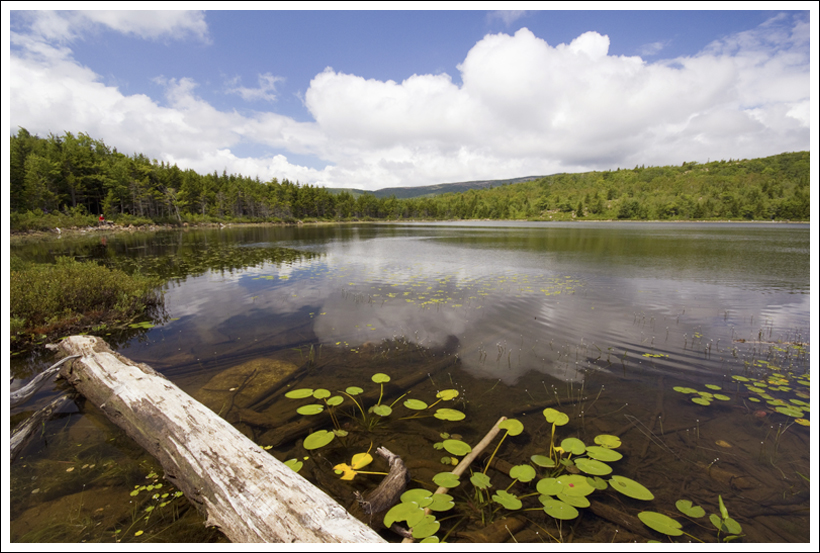
Whenever we talk about going to Maine, one of the things we plan on every trip is a hike up Gorham Mountain.  In fact, a few years ago when we came up to the park and knew we had a whole week of rain ahead, we quickly got in a hike up Gorham.  As Christine mentioned, just going up Gorham Mountain is a short hike, so it is easy to fit in when you have a break in the weather.

View from the Gorham Summit
The View from the Gorham Summit looking toward Otter Point. Below: Christine’s parents enjoy the view; The rock pile marks the summit of Gorham Mountain.

Christine's parents enjoy the view Rock Pile at the Gorham Summit

You can find the parking lot to the trailhead on the right shortly after the Thunder Hole parking lot.  The trail starts off with lots of roots and granite to navigate and can be a little slippery if a storm has recently come through.  The trail consists of a gradual uphill climb and is a popular trail for people of all hiking levels.  At .2 miles, you reach the junction with the southern part of the Cadillac Cliffs trail.  This is definitely a more challenging side trail, that includes some rock scrambling.   If you want to try the Cadillac Cliffs trail, do it on the way up since it could be more treacherous going down.  The Cadillac Cliffs trail doesn’t really provide any great views, but it does have a small cave to go through and some interesting rocks to scramble.  By the time you reach the northern junction at .5 miles, you will likely need to catch your breath.  Rejoin the Gorham Mountain trail by taking a right at this junction.  You will continue to climb upward and will see lots of places to take in the views along the way.  At .9 miles, you will reach the 525 foot Gorham Mountain summit.  On the way up the mountain, you typically get views of Sand Beach and Great Head, but from the summit, you can also see Otter Cove, Day Mountain, Pemetic Mountain, and Cadillac Mountain.  We continued on the trail from the summit.  At 1.5 miles, you reach a junction with The Bowl Trail.  Take a left and climb up the steep terrain through the woods until you reach The Bowl at 2.0 miles.  From The Bowl, you can also see close glimpses of the summit of The Beehive and there is a trail that connects with it.  We took in the views around the lake and then went back down The Bowl Trail, towards the Park Loop Road.  At 3.2 miles you will reach the Park Loop Road.  Cross the road and proceed on the Ocean Path, heading past Sand Beach.  You will likely see tons of cars and people along the road between this point and Thunder Hole.  You should reach the Gorham Mountain parking lot around 4.4 miles.

Sand Beach from the Ocean Path
Sand Beach from the Ocean Path. Below: If you look at the larger version of the Beehive photo below, you will see the long queue of people climbing the mountain; Adam enjoys the bench at the Bowl.

The Beehive Adam Sitting at the Bowl

We had a funny moment when we first started the hike.  A family was coming back from the summit and spotted us with their trekking poles.  One little girl was asking why we were all using two ‘canes’ to walk.  The parents had responded that we were “professional hikers”.  We got a few laughs out of that.  If only we could get paid to go hiking (or at least pay for some of our hiking gear).

There are many things about this hike that make it one of our favorites.  The blueberries are ripe during July and August and are plentiful on this trail.  I think I picked the largest, juiciest blueberry ever during this hike.  We always enjoy looking over Sand Beach.  You can see the dots of people on the beach, but not many in the water due to the temperature.  Walking back on the Ocean Path, you could hear the screams of children as they were being hit by the freezing waves.  You can also count on being able to see a lobster boats in the area, bringing up traps, or a large sailboat rounding the harbor.  You may also be able to catch a little rumbling from Thunder Hole, but the largest rumblings typically occur in the fall after a storm.

This area has also been where two recent movies have been filmed.  You can see Sand Beach in The Cider House Rules and nearby Otter Cliffs was used in Shutter Island.

Trail Notes

  • Distance4.4 miles
  • Elevation Change – 500 feet to the summit of Gorham and another shorter climb to the Bowl
  • Difficulty – 2. This is an easy family hike, suitable for most fitness levels.
  • Trail Conditions – 3. Trails in Acadia are always rocky and rooty and can be slick when wet.
  • Views – 5.  Breathtaking!
  • Waterfalls/Streams/Lakes – 4. The Bowl is a beautiful glacial pond.
  • Wildlife – 3.  We saw an eagle – that counts for something!  We’ve heard that people occasionally see whales off in the distance, but we never have.
  • Ease to Navigate – 4. Pay attention to the cairns and markers at trail junctions, and it’s hard to get lost.
  • Solitude – 0.  This is an extremely popular area.  No matter when you hike it, you will see people.

Directions to trailhead: The trailhead is located in the Gorham Mountain parking lot on the Park Loop Road in Acadia National Park.   The parking lot is about .5 mile south of Thunder Hole.