The walk to Beacon Heights is just another short, easy leg-stretcher we did on our fall trip down the Blue Ridge Parkway. Beacon Heights has the bonus of offering two separate, but equally spectacular, vistas at the summit.
Adam takes in spectacular foliage from the view atop Beacon Heights.
Adam Says…
The Beacon Heights trail, like the Rough Ridge trail nearby is a trail that gives you great views for minimal effort. This trail has two different expansive viewpoints at the top.
We started off our hike by parking in the parking lot at mile 305.2 on the Blue Ridge Parkway. Across the parkway, you can see Grandfather Mountain looming overhead. Behind the parking lot is another parallel road, SR 1513. We crossed that and found the trailhead easily. The trail goes up and comes to a junction shortly. Take a right at this junction to follow the Mountains-to-Sea/Beacon Heights trail. At .2 miles, you reach another junction as the Mountains-to-Sea trail and the Beacon Heights trail splits. Take a left on the Beacon Heights trail. At .3 miles, you reach a junction where the trail splits where their is a stone bench. Each junction leads to views from Beacon Heights. The path to the left leads to an outcropping that provides great views to the north and west. The path to the right leads to another outcropping with views mostly to the east. Either spot provides plenty of room to spread out and take in the scenery. Head back the way you came for about a .7 mile round trip.
Due to the shortness of the hike, you should expect a lot of people at the top. I’ve heard this trail referred to as a “leg stretcher” and that is an accurate description. It is not too difficult, so there isn’t much of a need to get geared up for an intense hiking experience. My favorite of the two viewpoints was at the junction to the left of the bench, since it did provide views of Grandfather Mountain from the top. With a cell tower visible on the other junction, it takes a little away from the view for me.
The view on the right side of the bench.
Christine Says…
This was the last mini-hike of three we did in one day near the Linn Cove Viaduct. It was a great way to finish the day, and a good way to work off some of the English Pub fare we enjoyed for lunch. The walk was short and followed a gentle uphill grade.
The two views at the top were beautiful, and the fall color was simply spectacular! If we had planned our day a little more thoroughly (and if I hadn’t been so sick), I would have liked to park near Beacon Heights and then follow the Tanawha Trail from Beacon Heights all the way over to the Rough Ridge area. It would have been a great out-and-back with lots of scenery and view pay-offs.
After Beacon Heights, we briefly discussed tacking on another short hike up to Table Rock, but in the end I was just too worn out to go any further. Adam and I agreed at the end of the day that we must make a return trip to the area to make up for all the stuff we missed seeing on this trip.
Trail Notes
Distance – About .7 miles
Elevation Change – 120 ft
Difficulty – 1. This is a fairly easy hike. It’s slightly uphill, but almost anyone should be able to make it up.
Trail Conditions – 3.5. The trail is in great condition, but rain could leave a few areas slick.
Views – 4.5. Just docked it half a point for the cell tower visibility.
Waterfalls/streams – 0. There are no streams on this hike.
Wildlife – 0. This area is heavily traveled, so it’s unlikely you’ll see wildlife.
Ease to Navigate –4. Follow the signs to Beacon Heights and you won’t have a problem.
Solitude –1. We saw quite a few people on this hike.
Directions to trailhead: Follow the Blue Ridge Parkway to mile marker 305.2 Park in the parking lot or along the road. Behind the parking lot is another parallel road to cross and you will see the trailhead on the other side.
Rough Ridge is a short hike that leads to wonderful views of Grandfather Mountain, the Linn Cove Viaduct and the valley below.
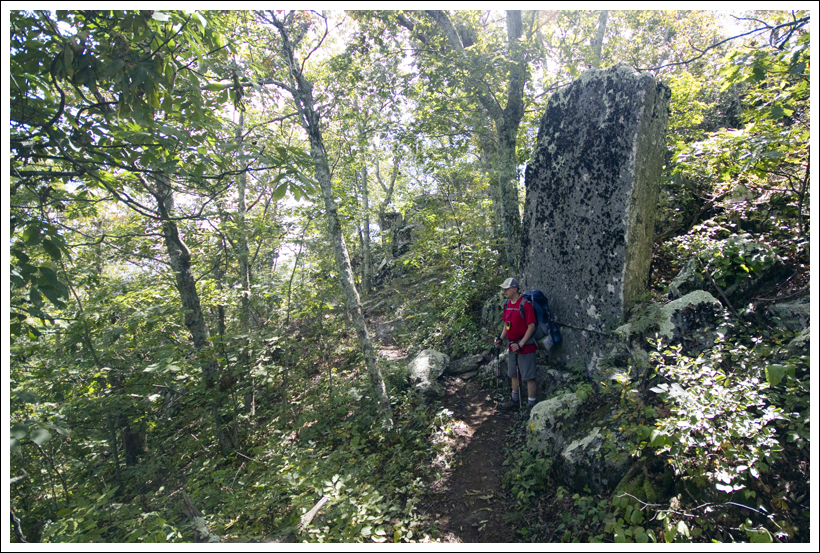
Rough Ridge is a great place to enjoy an autumn view. Below: A glimpse of the Blue Ridge Parkway below Rough Ridge; A series of boardwalks protects fragile ecology; Christine’s hair shows the windy conditions.
Christine Says…
After we finished our short hike around the Linn Cove Viaduct, we drove a short distance north on the Blue Ridge Parkway to hike Rough Ridge. This short hike is one of the Parkway’s most popular – understandably, because the views are truly breathtaking. The trail starts with a small series of log stairs that climb steeply into the woods. Shortly after the steps, there is a small footbridge over a chasm. Perhaps in wetter conditions, a small stream might flow under the bridge. When we visited it was dry.
The trail climbs uphill for about .3 mile, across muddy and rocky trail, until it reaches a series of boardwalks. The wooden pathways are intended to keep hikers off the fragile terrain. This part of the parkway is home to numerous rare species, and careless footsteps can do all sorts of damage. From the rocks beside the boardwalk, hikers are treated to a wonderful panoramic view of the scenery. The viaduct is almost always visible off in the distance.
After leaving the boardwalks, the trail continues a little more steeply uphill. There are more rocks to climb and more mud to traverse. At the top, you’ll reach a giant, sheer-faced boulder with a line of affixed cable. Use the cable to pull yourself to the top of the boulder. You’ll be treated to another amazing view. The impressive face of Grandfather Mountain looms above and pristine nature spreads out below. It’s nothing short of spectacular.
We stayed atop the boulder for a very short while – just enough time to take in the view and snap a few photos. The wind was so strong, it could almost blow a person of their feet! The hike down went very quickly, and simply retraced our steps.
After this short hike, we headed into the little town of Blowing Rock for lunch. What an adorable town! If you visit the area, don’t miss a visit to the nearby town.
Adam enjoys the rocky outcroppings on Rough Ridge. Below: Adam climbing the trail; We made it to the top; Christine crossing one of the footbridges; Log steps descending the trail.
Adam Says…
Rough Ridge was one of the hikes we were most excited to do on this trip. When we were at the Linn Cove Viaduct, we were hoping that the Rough Ridge hike would give us great views of the viaduct and we were not disappointed.
The trail starts from the parking lot by going up a few log steps. At the top, you reach a junction of the Tanawha Trail. Take the trail to the left and follow uphill until you reach the boardwalk at .3 miles. Interestingly enough, while they tell you to stay on the trail, they have left an opening to climb out onto a large flat rock. Just be careful if you have any children, since the edge has a large dropoff. From this viewpoint, you can see the Linn Cove Viaduct which looks quite straight from this perspective as you are looking at it straight on. After the boardwalk, the trail continues to climb and then takes a sharp turn leading up to another rock formation that daring people could climb onto. Continuing on, at .6 miles, you reach a junction with the Tanawha Trail again and see the trail blocked off to protect vegetation. There are a few different rocks to get great views, with the best being from the rock Christine mentioned above with a cable to hold to guide yourself up. There are some great spots here to have a quick snack and enjoy the views all around you. From the summit, you can see Grandfather Mountain rising above the Linn Cove Viaduct (which you can see snake from the summit) and views down into the Linville Gorge. On a clear day, you should be able to see for miles
One of the more popular rock climbing spots in the South lies below Rough Ridge in an area known as Ship Rock. If you are a skilled rock climber, I could see this being a way to do some climbing on the rocks before taking this trail to hike to the top.
This is definitely an easy hike for most people that has a huge payoff for minimal effort. If you are traveling along the Blue Ridge Parkway, I would make this a must-do hike along the way for a short 1-1.5 hour break.
Trail Notes
Distance – About 1.2 miles
Elevation Change – 480 ft
Difficulty – 2. This is a fairly easy hike. It’s mostly uphill, but never steep. The final viewpoint at the top requires a short, rope-assisted climb to a boulder top.
Trail Conditions – 3. The trail is good condition, but it can be muddy and slick.
Views – 5. AMAZING!
Waterfalls/streams – 0. There are no streams on this hike.
Wildlife – 0. This area is heavily traveled, so it’s unlikely you’ll see wildlife.
Ease to Navigate –4. This trail is an easy to follow out-and-back.
Solitude –1. We saw quite a few people on this hike.
Directions to trailhead: Follow the Blue Ridge Parkway to mile marker 302.8 Park at the Rough Ridge overlook.
The Linn Cove Viaduct is one of the Blue Ridge Parkway’s most recognizable features. A short (less than one mile!) loop hike lets you see the viaduct from all angles, while enjoying a lovely walk through the woods.
The Linn Coves Viaduct hugs the side of Grandfather Mountain. Below: Adam walks beneath the viaduct; Tanawha trail blazes; Markers along the trail.
Christine Says…
We recently spent a few days in western North Carolina along the Blue Ridge Parkway. What a spectacular area! On our first full day, we did a trio of short, ‘leg-stretcher’ hikes in the vicinity of Linn Cove – the Viaduct Trail, Rough Ridge and Beacon Heights. In retrospect, we think we should have covered all three of these hikes as one long out-and-back (or shuttle) along the Tanawha Trail, but you live and learn when you visit a new place.
Our first mini-hike of the day was a short loop that passed underneath and then alongside the famous Linn Cove Viaduct. The viaduct is a feature I had been wanting photograph for years, and to be able to visit at the peak of fall color was a real treat. The serpentine curve of the viaduct hugging the shoulder of Grandfather Mountain is a classic scene – probably one of the Parkway’s most iconic.
Our hike started out from the Linn Cove Visitor Center. The paved trail begins at the far end of the parking area. For almost a quarter mile, the trail passes underneath the viaduct. Cars rumble across the span overhead, while underneath walkers can marvel at the engineering it took to put the viaduct in place. At the end of the paved section, a set of stairs climbs up a hillside and the trail begins to run through the woods, parallel to the viaduct. If you continue uphill, you’ll find yourself on the Tanawha trail. A trail lower on the hillside follows the road more closely and crosses a couple small bridges. It really doesn’t matter which trail you follow, both will lead to the same place – a great vista just above the viaduct.
The trail to the vista is just a small, well-worn footpath through the woods. Be careful you don’t miss it! If you continue on, you’ll be following the Tanawha Trail for quite a while. The best clue that you’ve reached the side trail is that you’ll be able to see the north-end of the viaduct through the woods. Follow the trail until it reaches a jumble of rocks just off the side of the road. Climb the rocks, and you’ll be able to enjoy a beautiful view of the viaduct curving off around the side of the mountain, with the rolling valley beyond. It’s GORGEOUS, especially in early morning light!
After you’ve enjoyed the view, take the footpath up to the main trail and return the way you came.
The trail went through the woods, roughly running parallel to the viaduct. Below: The trail passed some interesting boulders; This tree’s roots really have to reach toward the ground; A paved section of path underneath the viaduct.
Adam Says…
Normally, if I were to hear someone suggest that I take a short hike with the highlight being a view of a paved road, I would think they don’t know what a nice hike is. However, I would be wrong in this case. It is impressive to think about how this feature was built and the bend in the road leads to some gorgeous views off the side. And when you hit this on a beautiful fall day, you have quite a scene.
I would recommend a trip inside the visitor center to learn more about the construction of this feature. I was impressed to learn that the viaduct was created with the purpose of not impacting the surrounding environment. Many times when roads are being constructed, they will cut into the mountain to build the road. The Linn Cove Viaduct was actually built by putting seven foundations below and then having 153 segments lowered down onto seven piers. This kept construction vehicles from having to build a temporary road to haul heavy construction vehicles and equipment on to the mountain, minimizing the stress on the nearby environment. For more information on how this feat was accomplished by the Figg & Muller Engineering Group, check out the NPCA’s website for details.
On our way down to North Carolina, we had extreme heavy fog and light drizzle. Visibility was at times only allowing us to see about 20 feet in front of the car. We had driven over the viaduct and didn’t even really know what we were missing. Pedestrians aren’t allowed on to the viaduct. To get the classic photo you see above, there was a side trail once you reach the other side of the viaduct that leads to a boulder for the birds-eye view.
This was a great start for a few days of hiking along this area of the Blue Ridge Parkway. The foliage near the peak of fall color made us excited to take in as many autumn views as we could.
Trail Notes
Distance – About one mile
Elevation Change – negligible
Difficulty – 1. This is an easy hike, part of it is even accessible and follows a paved path.
Trail Conditions – 4. The trail is in excellent condition.
Views – 4. The best views are from the small, rocky outcropping just above the road. You’ll also get some glimpses of the valley through the trees.
Waterfalls/streams – 1. There is one small waterfall cascading under the viaduct. You’ll pass over it on one of the small footbridges.
Wildlife – 0. This area is well-populated by people, so it’s unlikely you’ll see wildlife.
Ease to Navigate –3. We aren’t really sure what part of the hike was the Tanawha trail and what part was the interpretive trail for the Viaduct, but it really didn’t matter since the area is so small and close to the road.
Solitude –1. While we saw almost nobody on our visit, I think it was the exception. This area is typically very popular and heavily trafficked. When we passed the same area later in the day, it was swarming with people.
Directions to trailhead: Follow the Blue Ridge Parkway to mile marker 304. Park at the Linn Cove Visitor Center.
This 5.8 mile out-and-back hike along the Blackbird Knob trail gives you a sampling of many of the beauties offered by the Dolly Sods Wilderness area. While you don’t get any high-up, panoramic vistas, you still get amazing views across the high plateau.
Dolly Sods is spectacular in the Fall. Below: Trailhead along the forest road; Off to a chilly start! The morning was breezy and in the 30s; Dolly Sods is famous for turning crimson in the fall.
Adam Says…
Fall is here! At least it has arrived in Dolly Sods. For those that haven’t been to visit out this wilderness area on the eastern side of West Virginia, you will be impressed by the terrain. I have read many times that the terrain and climate up here is more similar to Canada than the surrounding areas of West Virginia and Virginia. You will quickly notice that the vegetation is just different here – you’ll see spruce and conifers in one direction and blueberry bushes and boggy areas in another.
After hyper-extending my knee on our last backpacking trip, I was thinking another trip the next weekend would be a little too much of a re-injury risk. But, we wanted to do something fun since it was Christine’s birthday, so I suggested that we spend the weekend in Canaan Valley to enjoy some of the early fall color. The last weekend of September is usually the Leaf Peepers Festival in Canaan Valley, but we were hoping for some fall color the week before and we weren’t disappointed.
Wookie rests on a warm rock in the sun. Below: Christine checks out a trail marker. There are very few signs and no blazes in Dolly Sods; Fall color is starting to pop; Walking past a colorful maple.
I feel it is necessary to put out a few warnings about Dolly Sods. First, the trails are not well-marked. They typically will have some trails marked at intersections, but there are no blazes on the trails and if you wander off on something that looks like a trail, you could become lost. Second, the road to get to and through Dolly Sods is very rough. You won’t see many Toyota Prius-like cars on this road. We approached it from Canaan Valley and there are some scary roads to drive up. You are on a road barely able to fit two cars with a large drop-off on the side. We were almost hit by some locals barreling down a blind curve on the road and they only missed hitting us by a couple of inches. The road through Dolly Sods is also extremely rough and filled with potholes. We’ve gotten a flat tire up here before and hope to never experience that again. You’ll need to drive very slowly and steer away from any potholes or sharp rocks sticking up. Four-wheel drive is not completely necessary, but it may give you ease of mind. Third, good maps are hard to find. As I mentioned on our Rohrbaugh Plains post, probably the best maps are available online. If you are looking for printed maps, we’ve bought quadrant maps of the Dolly Sods area from the nearby Seneca Rocks Discovery Center, but I’ve found some flaws with these marking trails properly (the quad for Blackbird Knob showed the knob on the wrong side of the trail). The online maps area also from 2006 and the quads are mostly from 1995.
For the hike to Blackbird Knob, we parked on the eastern side of the road just north of the Red Creek Campground area. You should see the large trailhead sign on the western side of the road just past the campground area. You quickly cross a boardwalk over a boggy area and then you will pass a large open area of pine forest to the right. In .3 miles, you will come to a grey sign that shows the trail goes to the left deeper into the woods. You may not see a trail to the left, but follow the sign and you will begin to see cairns that will lead you back to where the trail is more apparent. At .5 miles, the trail opens up to a larger field with nice views around you. The trail begins to descend at this point, but you will still see some views as you are walking through an open field. At mile 1.1, you reach Alder Run, which requires a small rock-hop to get across. You will then go slightly uphill through the forest again, but it will soon open up to more views. The trail then goes back into the woods and you will arrive at Red Creek at 1.6 miles. You will need to do more substantial rock-hopping to get across, but we didn’t have any trouble. The trail goes steeply uphill at this point. At 1.8 miles, the trail again opens up to spectacular views. You will shortly come across a junction with the Upper Red Creek Trail at 1.9 miles. Stay straight on the trail and you’ll duck back into forest. At 2.1 miles, you’ll reach another junction with the Red Creek Trail, which leads back to the campground. Stay straight again and it will finally open up to spectacular views. You are then making your way along the circumference of Blackbird Knob. Gorgeous fields with ridge views to the left give you many options to take in the sites. There are boulders on the hillside that seem to be placed by nature as auditorium seats to enjoy this area of wilderness. We continued along the trail until about 2.9 miles, when the trail was going to continue back into the woods. We turned back and returned the way we came.
Color everywhere! Below: Fall foliage scenery along the Blackbird Knob Trail. Below: Enjoying the fall color.
Time for a few confessions. We had packed our bags fairly quickly to head out for our hike. I forgot to pack the lunch that we were going to eat on the hike. All that I brought with us was a small bag of nut-heavy trail mix. Christine has a mild nut allergy, so we were a little concerned about food. I remembered that I left some Combos in the car, so we were saved with that. But, I need to learn to be a little better prepared when going into this area. As I mentioned before, maps of Dolly Sods are hard to find and trails are not marked very well. We were surprised how many people just came out here and were hiking without maps. We ran into a few guys that were unsure of where they were going. I showed them where we were on our map and they said they would just go on ahead and hope they can catch a trail that will eventually loop them back to where they were. Not the smartest strategy.
We really enjoyed our trip to Dolly Sods to explore this area. Since we hadn’t received much fall color yet in Virginia, it felt like we had a private advanced screening of the color that we’ll experience here in a few weeks.
Christine Says…
Dolly Sods is somewhat of a phoenix that has risen from the ashes. Its rugged beauty is actually a mask that belies years of abuse and damage. Until 1930, Dolly Sods was heavily logged. Entire mountainsides were stripped bare of their pristine, old-growth forest. The largest tree ever harvested in West Virginia came from this area – a magnificent white oak – about 1000 years old and nearly as big as a Giant Sequoia. Once the hillsides were barren, woodchips, fallen pine needles and small trees dried in the sun and became perfect fodder for catastrophic fires. Flames consumed more than 24,000 acres, scorching the earth down to bare rock. After the logging industry closed up, the government purchased the land. In the 1940s, Dolly Sods was used as a training range for the military. As recently as 2006, a significant amount of unexploded ordnance was still being found along trails.
Red Creek gets its red color from tannins. Below: Adam and Wookie cross; Fall color and a rocky stream bed; Trail marker in Dolly Sods.
Despite all the damage the land has endured, it is still one of the most breathtaking places in the entire mid-Atlantic. I don’t think it’s hyperbole to say that there is nothing else like it. We were lucky enough to visit this fall on one of those perfect, technicolor, early fall days. The sunshine was sparkling, the sky was crystal clear and deep blue. Already, maples were turning to flame-color and entire hillsides of fern were glowing and golden. While Dolly Sods is rugged as a whole, the Blackbird Knob Trail is gentle and without much change in elevation. Because it was an easy hike, we decided to bring Wookie along. He was so excited to finally be on a hike!
We started out along a clear path through the woods, but at the first trail sign, we became a little confused. The obvious, worn path led in the opposite direction of the directional marker on the trail sign. We sat and pondered for a moment. We consulted a map. We didn’t see any sign at all of a trail leading in the arrow’s direction, so we assumed a prankster had turned the sign. We took the trail a short way uphill before it dead-ended in a thicket of laurels. We backtracked and followed the arrow’s direction. For a short while, we were just walking through the woods, but eventually we spotted the cairn and then finally we were back on worn trail. This is very typical of Dolly Sods!
The first open view came shortly after our brief detour. From a pile of rocks, we could see all across the high plateau. Distant hillsides were already covered with red foliage. The open meadows were covered with crimson berry bushes and tall, tawny grass. We all stopped to enjoy the perfect fall day – I snapped photos and Wookie stretched out on a warm rock. After a brief stop, we continued along. A few minutes later, we passed a pair of backpackers. Then we passed three more. Then we passed five more. Passing backpackers became pretty much the ‘norm’ for the rest of the hike. All in all, I’m sure we saw thirty or more people out for the weekend. Typically, I think of Dolly Sods as being rather remote and isolated. On this particular weekend, it was not the case. People were everywhere!
It was a technicolor day in Dolly Sods. Below: Adam hikes across the open terrain; Fall color all along the hillside; Christine enjoys the fall color.
Throughout the hike, the trail passed in and out of trees and open spaces. We crossed Alder Creek and Red Creek. Both were running, but on the low side. I’ve heard that streams are often uncrossable in Dolly Sods in the spring. It’s hard to imagine that when you see them running so meagerly in the early fall. Red Creek was especially lovely. Tannins give the water a rich, reddish color. I suppose the name ‘Red Creek’ is very well-suited for this body of water!
When we reached the end-point of the hike, we stopped for a snack. As Adam mentioned, he forgot our lunches. So, he ate peanuts and cashews, while I picked all of the remaining M&Ms out of the trail mix. It was enough to tide me over for the walk back to the car. Honestly, it was such an easy hike that it really didn’t require that much energy. It also left me nice and hungry for an early dinner at Hellbender Burritos. For a tiny town, Davis, WV has two very good restaurants (the other is Sirianni’s Pizza Cafe). At Hellbender, I got my favorite Gendarme burrito. It’s basically a steak and cheese in a bowl – medium rare chunks of steak, smothered with grilled onions and peppers and then doused with queso. Yum! And even better (or worse… depends on how I look at it), I discovered Harpoon Pumpkin Cider. I’m a very picky beer person, but I really like most hard cider, and this seasonal pumpkin cider might be the best thing I’ve ever had to drink! Sadly, it’s very, very hard to find in our area. Even the local beverage shop can’t special order it and it’s nowhere to be found in stores.
Wookie Says…
Sometimes the tail says it all. What I mean by that is that on this hike for most of the way, my tail stayed nice and curled. When I get tired, it tends to start drooping like a flag slowly being brought down the pole. But I really enjoyed myself in Dolly Sods Wilderness. This was my first trip out there. Christine and Adam often call me, “Wilderness Wookie”, but this was the first time I have been in true designated wilderness area.
Wookie crosses the stream. Below: Adam and Wookie hike on the return leg of the out-and-back; Adam enjoys fall color; Don’t miss a visit to Bear Rocks when you’re in Dolly Sods.
My highlights of the trip were when first reached the open field around .5 miles. I spread out on a nice rock, sniffed the brisk, fall air and enjoyed the views. I also really enjoyed eating a few cashews from the base of Blackbird Knob. Christine poured a little rock in a natural bowl in the rock and Adam gave me some nuts to help me re-energize for the return trip.
My lowlights of the trip were crossing Red Creek and the initial boardwalk. The boardwalk made me a little uncomfortable since there were spaces where my paws could have slipped through. Crossing Red Creek was a little more troublesome. I really don’t like getting my feet wet. But, I took a wrong step and got my front paws wet. I jumped back away from the water and then made a successful second pass. My tail immediately went down to let Adam and Christine know that I didn’t like getting wet. I don’t mind mud as much and my feet did get quite muddy along the trail. But by the time that we got back to the car, most of the mud had come off.
Going almost six miles is a little taxing for a pug. For some reason, I don’t see a lot of other hiking pugs out there. When we got to the car, I immediately fell asleep and was snoring loudly by the time that we got moving. Of course, when we got back home I had to strut my stuff and tell my brothers, Yoda and Mojo, that I went on a great hike. I’m glad it’s finally getting a little cooler again so I can get back on the trails. Wilderness Wookie is ready to do some more fall hiking!
Difficulty – 1.5. The trail is not that steep at all, so most people should be able to handle it.
Trail Conditions – 3. The trail was in decent condition and was not overly rocky or muddy today. I do think mud could be a problem after larger rainfalls though.
Views – 3. While you don’t get views from a big overlook, the scenery along the way is quite gorgeous. Open fields and views of mountain ridges in the distance give you a lot to see.
Waterfalls/streams – 4. Red Creek gives you a reliable water source and picturesque stream views. There are plenty of backcountry campsites near the stream if you are planning an overnight backpack trip.
Wildlife – 3. While we didn’t see any large wildlife on this trip, the area has plenty of wildlife.
Ease to Navigate –2.5. As we’ve mentioned, trails are not blazed and only some junctions are marked with signage.
Solitude –2. We saw over 30 people on the trail. Most of these were backpacking groups. If you go on a nice weekend from Spring-Fall, expect to see others.
Directions to trailhead: From Seneca Rocks, go North on WV 28 for 12 miles. Take a left on Jordan Run Road. Go one mile up Jordan Run Road and take a left on to Forest Road 19. In 6 miles, Forest Road 19 comes to a T on to Forest Road 75. Take a right, heading north on the gravel Forest Road 75. Drive for five miles until you pass the Red Creek Campground parking on the left. Park on the opposite side of the road where the grey trailhead marker is located.
* MapMyHike is not necessarily accurate, as the GPS signal fades in and out – but it still provides some fun and interesting information.
This 13.2 mile circuit can be done as a day-hike, but we recommend extending the beauty and wildness into an overnight backpacking loop. Take your time, and you’ll be treated to panoramic views, lovely mountain streams, demanding climbs and peaceful campsites.
Christine takes in a a view of The Priest from Three Ridges mountain. Below: Welcome to the Three Ridges Wilderness; Over half of the circuit follows the Appalachian Trail; Nothing beats a campfire in the evening.
We had long been planning a three-day backpacking trip across Mt. Rogers, but as the day of the trip drew closer, we started seeing the term ‘Appalachian soaker’ thrown around in weather forecasts. We’re fine with passing showers and fleeting thunderstorms, but we didn’t want to get pinned down on Mt. Rogers on a wet and stormy night.
Fortunately, the weather in central Virginia was far more favorable, so we ditched our Mt. Rogers plan, and decided to hit another backpacking circuit on our list – Three Ridges. This route, which makes use of the Appalachian Trail and the Mau-Har Trail, is known as one of Virginia’s most rugged hikes. Everything we read about the circuit in advance of our trip emphasized the hike’s strenuous nature. With roughly 6,800 feet of elevation change, you’re almost never walking on flat trail. It’s a constant onslaught of heart-pounding climbs and knee-grinding descents. But along with the challenging terrain, you get spectacular views, beautiful streams and lovely campsites.
We started out early Saturday morning. The first stop was fuel… for ourselves. We had a huge breakfast at The Chuckwagon in Harrisonburg. If you have a chance, stop by and indulge in one of their homemade 4-inch biscuits (Adam’s favorite is ‘The Round-Up’) or a stack of their amazingly fluffy pancakes. (Sadly… Chuckwagon closed in January 2013) With full stomachs, we made our way to Reed’s Gap at mile marker 13.7 on the Blue Ridge Parkway.
When we got to the parking area, the lot was already jam-packed, mostly with heavy-duty construction vehicles left idle for the weekend. Just as we were about to give up and find a parking spot further down the parkway, one car pulled out and left an opening for us!
Adam makes the initial climb up Meadow Mountain. The climbing was occasionally rocky, but never terribly steep.
We started the Map My Hike app on Christine’s phone, hoisted our packs, and headed south along the Appalachian Trail. From the parking area, the trail hugs the edge of a meadow, which was full of blooming yellow ragweed and purple thistle. It was such perfect weather for backpacking – sunny skies, low humidity and a crisp breeze. The trail almost immediately began to climb uphill over Meadow Mountain. The climbing was steady, but never difficult, for about .8 of a mile.
At the top of the ridge, there was a small dry campsite with obstructed views. Department of the Interior boundary markers were all along the ridge. We spotted at least three or four right next to the trail. After walking briefly along level ridge, the trail descended to Maupin Field Shelter. The shelter site had tons of space for tents (many of the tent sites were flat, soft and grassy), a typical AT three-sided hut, a metal bear-hang post and a picnic table. The area also had an informational kiosk with trail notes and wilderness-usage policies. There was also a child’s orthodontic retainer tucked into a Ziploc and pinned to the board. We’re guessing there is now one retainer-less Boy Scout and a less than happy mother!
Christine climbs the stone steps up Bee Mountain.
After Maupin Field Shelter we began climbing again, over Bee Mountain. The climbing was slightly more strenuous, but definitely manageable. In several places, rock steps were set into the trail to make the climbing easier. Along the way, we started playing ‘Categories’. It’s pretty basic – each player designates a category, then players take turns naming items that fit within that category. For example, categories might include Movies Based on Comic Books or Items You Need on a Backpacking Trip. It’s pretty mindless, but it kills time. Whoever successfully names the last item for the given category wins the round. The best category of the day was Complaints Uttered When Hills Are Steep. We won’t share the specifics of our trail talk here, but it was pretty funny to reflect on this topic! Bee Mountain didn’t offer any views and was followed by a short descent before tackling the more serious climb up Three Ridges Mountain.
The climb up Three Ridges consisted of several steep pushes, with nice stops for views all along the way. The first view, Hanging Rock, was very impressive, so we decided to break for lunch and enjoy the amazing vista. As we ate our Panera bagels (Cherry-Vanilla with Justin’s Chocolate Hazelnut Butter for Christine and French Toast with Peanut Butter for Adam), we noticed two dogs fitted with radio collars – doubtlessly bear hunting dogs set loose in the woods for pre-season practice. Both dogs were female; both were emaciated and showed signs of over-breeding. We hate to cast aspersions or generalizations on any group of people, but we are not fans of hunters that use this type of technology to hunt bears. Both of the dogs were pretty persistent about trying to steal our food. The bolder dog, who was heavily perfumed by a skunk encounter, came within inches of snatching Christine’s bagel right out of her hand.
One of the bear hunting dogs we encountered seemed to be enjoying a view of the Priest from the Hanging Rock Overlook. Below: Adam climbing the first uphill section of Three Ridges Mountain; Southbounders (BeeSting, Fats and Happy) contemplate the Priest and their upcoming climb; The view from Hanging Rock.
While we sat at the overlook, we had a chance to chat with three Southbound AT hikers – Happy, Fats and BeeSting. All three had started in Pennsylvania in August and were making their way toward Georgia. Happy was already there when we arrived, so we got to talk with him for a good bit while he waited for his companions to show up. He was from Las Vegas and on his first long-distance hike. He told tales of his shoes breaking down on the Pennsylvania rocks, getting caught in a vicious cold-front driven storm on Bearfence Mountain, and his epic weight loss (40 pounds in less than a month!). He was a nice kid and we enjoyed talking to him and telling him about some of the things he has to look forward along the trail in Virginia – The Priest, Spy Rock, Cove Mountain, McAfee Knob the Grayson Highlands. He told us the friendliest place he’d stopped on the trail was the town of Waynesboro.
After a while, Fats and BeeSting came along. They were a young couple from Montgomery County, Pennsylvania. We didn’t talk to them as much, because we wanted to press on and make our way to camp by mid-afternoon. Happy left a few minutes ahead of us, and we were sure we wouldn’t see him again. Thru-hikers are known for keeping a blistering pace!
Upon leaving the vista, there was quite a bit more uphill climbing before we finally reached the true summit/highpoint of Three Ridges Mountain. At the highpoint, we ran into a group of three women out on the same circuit we were hiking. We chatted briefly about the great weather before leaving them to enjoy their lunch.
Christine enjoys the view on a perfect late-summer day. Below: The actual high point of Three Ridges is in the trees; Adam walking through ferns along the trail.
After the high point, the long, seemingly endless descent to Harper’s Creek began. It wasn’t always super-steep. Sometimes it almost leveled off. As we were walking along, we saw a bear dash off through the brush. We were both glad that the bear hunting dogs hadn’t pestered the bear into a tree. A few steps later, we heard an exuberant voice shouting into the wind – ‘Woooooo!’ ‘Yeaaaaaah’! ‘Echo Echo Echo’ and ‘I’m on TOP of the WORLD’. As the voice drew nearer, we guessed it was Happy having a ‘mountain moment’. Sure enough, he called to us through the trees so we could share the nice view spot he had found a little ways off the trail.
We left the spot before he did, knowing that there would be more views along the way. One unnamed view on the left side of the trail was especially beautiful. We stopped for photos and a pack-less rest. A bit further along, we saw a huge flat, upright rock that looked just like a tombstone. Immediately past that, we noticed a faint trail that climbed up steeply through the woods to a jumble of rock. We guessed correctly that we had found Chimney Rock. It was a great place to sit, and every bit as scenic as the very first overlook on Three Ridges. We enjoyed looking down into the valley, dotted with homes, streams and a large Christmas tree farm. The Priest, one of Virginia’s most beautiful and distinct mountains, loomed impressively across the way.
Adam enjoys one of the many spectacular views from Three Ridges Mountain. This particular stop came at a rocky outcropping known as Chimney Rock. Below: Views, views and more views!
After Chimney Rock, the last real vista was a wide flat shelf of rock overlooking the scene below. After that, the downhill got pretty bad. It was the bone-jarring, steep, type of downhill that makes your knees beg for mercy! We both slipped a couple times on the descent. It was probably all the fallen acorns – if your boot hits them just right, they sort of function like tiny roller-skate wheels. Adam managed to hyperextend his knee on one slip, and hiked in a significant amount of pain the rest of the day. Christine hit a loose flat rock and rode it like a surfboard until she finally landed hard, but unharmed, on her rear end.
Honestly, the uphill on this hike is moderately hard, but the downhill is brutal. Anyone in reasonable condition should be able to handle the physical demands of the ascents along the trail, but if you have bad knees, the descents are nothing short of punishing. We both tried to keep our packs on the light side for this trip. Christine’s pack was 22 pounds and Adam’s was 29… but that was before water. After a dry week, we weren’t sure if Harpers Creek would be flowing, so we both carried quite a bit of extra water – 3.5 liters for Christine and 4 for Adam. We knew there was a chance we wouldn’t need it, but when it comes to water it’s always better to be safe than sorry.
The climb down from the summit of Three Ridges was grueling and rocky! Below: The trail went over many large boulders; It passed thick stands of rhododendron and mountain laurel; We were thrilled when the Harpers Creek shelter site came into view.
After over two miles of switchbacks, dangerous acorns and tricky rocks, the colorful domes of tents came into sight. We had reached Harpers Creek Shelter – our stop for the evening. We found the shelter itself empty, but most of the tent sites adjacent to the shelter had already been claimed by a large group of Boy Scouts from Fluvanna County.
We found a mostly flat and smooth tent site across the creek, about 50 yards south of the shelter. We figured it was a perfect spot – we were close to the shelter and could use it for a ‘kitchen’. Also, the privy was on our side of the stream, but far enough from the tent that it wouldn’t be annoying when people went to use it.
For the most part, Harpers Creek wasn’t flowing. There were several shallow pools in the streambed, which gave us plenty of access to water, but also provided a perfect breeding ground for mosquitoes. Christine immediately noticed bites forming welts on her legs, so she quickly changed out of her shorts and into long pants. She tried to change behind a large boulder, but she’s pretty sure the Boy Scouts saw her in her underpants, but hey… modesty sort of goes out the window in the backcountry.
Within twenty minutes, the tent was up, the sleeping pads were inflated, and sleeping bags were in place. We set aside all the food, cooking implements, water filter and bear bags to take over to the picnic table at the shelter. The Harpers Creek shelter was small and kind of dingy. There was no shelter log. Actually, the only thing in the shelter was a sodden pair of ‘tighty-whiteys’.
Adam set about collecting water. We recently picked up a very handy collapsible bucket made by Sea to Summit. It folds down to about the size of a deck of cards and weighs just a few ounces. But, it allows us to collect up to nine liters of water at once. Typically, we pump water through our Katadyn straight into the bucket. Then we cover the bucket with a bandanna and usually have plenty for dinner, breakfast and bottle refills.
While Adam filtered water, Christine worked on collecting wood for a campfire. It was already starting to get chilly, so it was a perfect night for a fire. As is the case at most shelters, good firewood is hard to find. There is always plenty of tinder/kindling, but the larger, long-burning pieces of wood are at a premium. In the backcountry, we only use downed wood that we can break by hand.
Our camp on Harpers Creek. Below: Setting up our ‘kitchen’ at the Harpers Creek shelter; On the menu for dinner; Adam feeds the fire.
Christine made a teepee-style campfire with larger pieces of wood on the outside, and a tinder-packed center. All of the wood collected from the forest floor was cold and damp, so the fire had a hard time catching at first. A little squirt of alcohol-based hand sanitizer took care of that problem, and within a few minutes a small fire had sprung to life.
With the campfire going, water collected and the campsite set, it was time for dinner! We keep saying we’re going to prepare our own fancy homemade backpacking meals, but when the time comes we always seem to find ourselves reaching for Mountain House or Backpacker’s Pantry. It’s just easier, and for the most part, the packaged food is really tasty (notable exception – Natural High’s Banana Cream Pie – worst dessert EVER.) Our menu for the evening included Chili Mac with Beef as the entrée and Cheesecake for dessert. Christine brought several sticks of cheddar cheese to mix into the chili and single-serving plastic bottles of Merlot. It was quite the feast!
After dinner, we put up our bear hang. Oddly, this shelter did not have a metal post like most AT shelters in this part of Virginia. We had to find a tree with a free branch. After the food was secured, we settled into our camp chairs and enjoyed the fire. Some people we’ve met along the trail think the camp chairs are a waste of pack space, but they fold down to about the size of a water bottle and weigh just about a pound. We find them well worth the extra weight for the back-resting comfort they provide. We might not carry them on a long multi-day trip when every bit of pack space counts, but for a weekend trip, we like having creature comforts.
Entertainment unfolds by the campfire. Below: Our tent at night.
As we sat by the fire, we watched a little piece of comedy unfold on the other side of the stream. A couple of the older Scouts had been assigned the task of hanging the group’s food. We watched as they missed getting the rock and rope over the tree branch, dozens and dozens of times. The boys took turns making fun of one another for their off aim. Eventually, they got the rope over a branch. They celebrated with a high-five and a ‘Woot!’. But, the branch snapped off the tree as soon as they tried to hoist the weight of many food bags. Eventually they went for help and settled on a less-than-perfect, but still functional tree. All in all, it took them over an hour to get their food hung.
Our campfire died around 9:00, so we headed back to the tent. Adam read by headlamp and Christine listened to a book on her iPod. For one of the first times ever, we both fell asleep quickly and slept soundly through the night. We were actually awoken by voices and headlamps at what seemed like the middle of the night. Christine rolled over and asked Adam ‘Is it around midnight and these kids are up late or is it morning already?’ It turned out that the Scouts were awake and cooking/packing up at 5:30 a.m. We lazed around in the tent for another hour until the sun came up.
The Scouts actually hiked out around 7:00, just as we were getting breakfast together. Usually, we’re the early risers and the first out of camp! We made maple-brown sugar oatmeal with freeze-dried bananas and coffee and hot chocolate for breakfast. We both ate two packs, knowing that we had a tough day of hiking on the Mau-Har Trail.
After a good night of sleep, Christine is ready to tackle day two! Below: Adam changes out of his Crocs and back into boots; The Appalachian Trail departing Harpers Creek.
After breakfast, we broke down camp. Adam’s hyperextended knee was still pretty sore, so Christine stowed some of his gear in her pack to make his load a little lighter. While she was transferring gear, she noticed that a mouse had chewed through the little mesh compartment on the hipbelt of Adam’s pack! The only thing in the compartment was a set of car keys, so we’re really not sure why it was appealing to a mouse. It reminded Adam of one of his favorite books as a kid – The Mouse and the Motorcycle. He thought this mouse was trying to make a sequel with their car.
We left Harpers Creek around 8:00. On our way out, we passed four or five other groups that had been tenting near the shelter. All told, there were probably somewhere between 25 and 30 people camped along the creek that night. Quite a tent city!
After leaving the shelter site, we followed the Appalachian Trail for almost a mile, largely uphill, to its junction with the Mau-Har Trail. The odd trail name is a combination of Maupin and Harpers – the names of the two shelters the trail runs between. The Mau-Har was designed by a man named Angelo Filippi. One funny review we read of the hike evidently thinks ‘designed’ is too kind a word for the trail. The review states:
“We started from Reeds Gap and heading down the Mau-Har, cussing Angelo Philippe [sic] the whole dang way. I swear he unfolded a map, put it on the ground, pulled out a piece of string, dropped the string onto the map and said “There! That is where the trail should go!” What a jerk!”
The start of the Mau-Har Trail. Below: The Mau-Har trail starts innocently enough; Then it starts to climb more steeply downhill; And then it gets even steeper than it already was!
To be fair, the trail was clearly designed to follow scenic Campbell Creek as closely as possible and following a creek that goes tumbling through a deep gorge is going to require some rugged climbing. The Mau-Har trail descended very steeply to the creek. Adam grimaced in pain from his knee injury on every downhill step. The weight of his pack, combined with the steep trail was almost more than he could bear. This was some of the gnarliest downhill we’ve ever done.
Eventually, we got to the spur trail that leads to a series of small waterfalls. Adam decided to stay put and rest his knee while Christine explored the falls. She took off with the camera, hoping to get a few documentary shots for the blog. A few minutes later, Adam decided to follow. He had heard there was a geocache hidden by the falls (known as “firedogs fishbowl”), but he had forgotten to input coordinates into his GPS. He looked for it, but without coordinates it was pretty close to impossible to find. The waterfalls were all very small due to low water flow. In spring, with snowmelt and heavier rain, the creek is probably spectacular!
Water volume in Campbell Creek was fairly low. Below: The section of the Mau-Har that follows Campbell Creek is very steep; Some sections require you to pull yourself over the rocks; Christine is happy for a more moderate grade.
From the waterfall spur trail to the Maupin Field shelter, the Mau-Har climbs very steeply uphill. At first, the trail is very rocky as it passes through the canyon. You wind your way between and over boulders. Sometimes you have to stow your trekking poles in one hand to pull yourself up over a big step. It reminded us very much of hiking the gorge at Little Devils Stairs. The terrain was very similar. After leaving the canyon, the trail becomes less rocky, but no less steep. A series of sweeping switchbacks carry you relentlessly uphill. Eventually the grade becomes more moderate in the last half mile before you arrive at the Maupin Field shelter.
Near the end of the climb, Adam announced that he was going to stop at the shelter and ‘eat every single bit of anything edible left in his snack bag’. Two packs of oatmeal, bananas and hot chocolate burn off pretty fast when the climbing is tough! He proceeded to eat a Luna Bar, ShotBlox, a bag of cashews and a bunch of mini candy bars. He reined himself in and skipped eating a dry packet of cocoa mix.
At Maupin Field, we read the shelter log. Entries talked about the skunky, food-nabbing bear dogs (someone had named them Bagels and Muffins). A southbounder left a warning to northbounders about 20-30 miles of dry hiking. Someone even left a really nice pair of ladies LaSportiva for someone to claim.
Adam relaxes at the Maupin Field Shelter. Below: One of the stream crossings near Maupin Field Shelter; Adam checks out the shelter log; The Mau-Har’s end point at the shelter.
The last 1.6 miles retraced our route from the morning before. We had a gradual climb up and over Meadow Mountain and then back to our car at Reeds Gap. We drove back toward home along the Blue Ridge Parkway, stopping at Humpback Rocks to wash our hands with soap and running water. Our last stop was the Sonic in Waynesboro for more ‘refueling’. We definitely earned some tater tots and CreamSlushes!
Three Ridges turned out to be a great alternative to our planned Mt. Rogers trip! While the terrain was challenging, we think most people accustomed to backpacking/hiking would be up for the challenge and would enjoy the beautiful and wild scenery offered by this loop.
The one issue we would like to bring up is a discrepancy about the length of this hike. Most sources list the loop at 14.4 miles. Based on our information (maps, GPS, trailer marker posts), here is how we would break down the segment distances on the trail.
0.0 miles – Start from parking lot on Reeds Gap, heading south on the Appalachian Trail and begin your ascent. .8 miles – The trail reaches the first ridge and shortly begins to descend through some switchbacks 1.6 miles – Reach the junction with the Fire Road (which heads to Love Gap). Take a left to stay on the Appalachian Trail and pass a few side trails that lead to campsites at the Maupin Field Shelter. The trail begins to climb again. 2.0 miles – Reach the summit of Bee Mountain 3.7 miles – Reach some great views from Hanging Rock. Continue to climb further up through the woods. 4.2 miles – Reach the summit of Three Ridges 5.8 miles – Great viewpoint of the eastern ridge 5.9 miles – Reach the tombstone and take an immediate right up the path to reach Chimney Rock and the best views on the trail. Rejoin the trail and descend steeply. 7.5 miles – Arrive at Harpers Creek Shelter across the creek and your stay for the night. The next morning, cross back over the creek and continue on the Appalachian Trail. 7.6 miles – Cross Harpers Creek and the trail begins to ascend very steeply. 8.5 miles – Reach the junction with the blue-blazed Mau-Har trail. Turn right and follow the trail that parallels Campbell Creek. 10.0 miles – Reach a sign designating a short yellow-blazed trail to a few waterfalls. The waterfalls are only a few hundred feet off the Mau-Har trail. Retrace your steps and continue on the Mau-Har trail. 11.5 miles – Reach the Maupin Field Shelter. Continue straight past the shelter to rejoin the Appalachian Trail. 11.6 miles – Take a left on the Appalachian Trail to retrace your steps back to your vehicle. 13.2 miles – Return to the Reeds Gap parking lot.
Returning to Reeds Gap. At this point, Adam said he was 90% sure he was going to survive the trip. Below: Christine had a great time!
Trail Notes
Distance – 13.2 miles (Check out the stats from MapMyHike [Day One] [Day Two])*
Elevation Change – About 3900 feet
Difficulty – 5. This hike is no joke. The downhill areas are steepest on the Appalachian Trail coming down from Chimney Rock and the uphill on the Mau-Har trail is equally brutal.
Trail Conditions – 2.5. The trail starts off quite nicely, but once you reach Three Ridges, expect a rocky slide downhill and loose footing uphill for much of the hike. The Mau-Har Trail was pretty overgrown in places.
Views– 5. Absolutely amazing. Chimney Rock and Hanging Rock provide some of the nicest views.
Streams/Waterfalls – 3. You’ll be near a stream most of the second day and there are a few small waterfalls. The water wasn’t flowing too strongly though.
Wildlife –3. We did see a bear. Oh yeah, and the mouse ate through part of Adam’s backpack, so there is some wildlife out there.
Ease to Navigate – 4. The trails were fairly well marked and signs were at the junctions.
Solitude – 2. This is a tough hike, but it is popular for backpackers, trail runners, and day visitors to the shelters.
Directions to trailhead: On Blue Ridge Parkway, south of Humpback Rocks. Park at mile marker 13.7 at Reeds Gap in the large lot. Head south on the Appalachian Trail, marked with white blazes on a tree near the left of the open field.
There are longer loops that include Overall Run, but this 4.8 mile route hits the key notes with fairly minimal effort. Overall Run Falls is the tallest waterfall in Shenandoah National Park (93 feet), but the best part of this hike is actually the spectacular view overlooking a gorge with open vistas facing west.
Adam enjoys the western view from Overall Run. Below: Adam walks along the Tuscarora Trail; The first waterfall on Overall Run was pretty much non-existent; The return route on the hike took us through Mathews Arm Campground.
Christine Says…
Well… here we are – finally back to Virginia hiking! For a website that focuses on Virginia hikes, we really haven’t done many ‘home-state’ hikes lately. Part of it was finding time to hike with a busy schedule, but even more at fault was the dreadfully hot and stormy summer. I’ll admit, I’m not a summer person. I wither in the heat and humidity. I loathe bugs, especially mosquitoes and ticks. There were so many days that we passed on hiking just because we didn’t want to endure the heat.
Fortunately, over the last few weeks, summer seems to be fading away. There’s been a snap of fall in the air. Summer haze is evaporating, leaving skies crisper and clearer. Nights are dipping down into the fifties (we hit the forties a couple times last week). Even the ridgelines atop the taller peaks are started to fade to a rusty green. Autumn is just around the corner, and I couldn’t be happier!
On one of the first ‘fall-ish’ days in September, we decided to hike down to see the tallest waterfall in Shenandoah National Park. I’ve hiked just about every trail in the park, but somehow I’ve never gotten around to hiking Overall Run. It’s one of those hikes that’s been on our to-do list forever, but keeps getting bumped for other hikes. Overall Run is notorious for slowing to a trickle during dry periods, but we were coming off a very rainy/stormy week, so we figured it was a good time to see the falls with a decent volume of water.
Adam climbs down the one steep section of the hike. Below: This gorge is home to Shenandoah’s tallest waterfall – Overall Run. When we visited, there was almost no water running; Christine enjoys the view; We enjoyed the view with LOTS of other people.
We started out at Mathews Arm, in the parking lot adjacent to the campsite check-in station. We followed the Traces Trail for a short distance until it met the Tuscarora/Overall Run trail. The trail descended gently through the woods. There was nothing exceptional along the way – just pretty, quiet forest scenery.
Eventually, the trail dropped steeply down a set of log steps set into the trail. Right before the descent, we saw a shirtless guy sitting in a tent, about ten feet off the trail. Seriously… if you camp in the park, shouldn’t you be far enough off the trail that everyone passing by can’t see you? At the bottom of the initial descent, we came to the first (and smaller) of the falls. It was just a thin ribbon of water through the canyon, so we quickly moved along. After one more short descent, we reached the large falls on Overall Run. It was barely a trickle, just a sheer film of water running down the canyon wall. While the waterfalls were seriously disappointing, the view was not! It was spectacular and expansive, offering gorgeous views to the west.
We shared the view with lots of other people. Besides Dark Hollow Falls, I’ve never seen so many people at a Shenandoah waterfall at once. It was a little surprising. I had no idea Overall Run was so popular! We stayed for a while, enjoying the beautiful day and the wonderful view.
On the way back, we intended to return the same way we arrived, but at the top of the climb after the falls, we saw a trail junction that pointed 1.5 miles to Mathews Arm Campground, so we decided to go that way. The trail took us over to Beecher Ridge, which turned into a fire road, then back into a trail, which eventually led to the back side of Mathews Arm campground. We walked through the campground and back to our car.
All in all, it was a pretty hike made worthwhile by the awesome view! I’d like to see Overall Run falls running generously someday, but after doing a little digging on a couple photo sites, it seems to take seriously heavy rain or snowmelt to make the falls truly impressive. If we do this hike again, we’ll do it in the spring after there has been lots of rain!
Adam Says…
Overall Run was definitely a pleasant surprise to me. I knew about the large waterfall here, but I had no idea that the views would be so impressive.
We started off our day with a big breakfast at Skyland Resort. I hit the breakfast buffet, which had eggs, bacon, sausage, french toast, fresh fruit, oatmeal, and biscuits. It was a good way to get some energy in my system for a hike, but I did feel the need to do some exercise to “earn my bacon”. After leaving breakfast, we made our way to the trailhead at the Mathews Arm campground, seeing a coyote and bobcat on the way there. We didn’t get any pictures, since both of these animals are typically very skittish and darted off Skyline Drive as soon as we spotted them.
We pulled into the Mathews Arms campground, passing the fee station for overnight camping and taking a right to the large parking lot. From the parking lot, we began our hike on the Traces Trail, which led into the woods. We stayed on the Traces Trail until we reached the junction with the Tuscarora/Overall Run trail at .6 miles. Take a left on this trail. At 2.0 miles, you reach a junction with the Mathews Arm trail, which will be your return route for the loop. We continued on the Tuscarora Trail until we reached the overlook area at 2.5 miles. For the return, we went back the way we came. At 3.0 miles, we took a right on the Mathews Arm trail towards the campground. At 3.5 miles, we reached a junction with the yellow-blazed Beecher Ridge trail (more like a fire road) and took a left towards the campground. At 3.9 miles, you will reach a junction with the Weddlewood Trail, but stay straight. You will reach the campground around 4.5 miles near a restroom. Follow the road to the right making your way back to the amphitheater and parking area for your vehicle at 4.8 miles.
Adam walks the trail toward Mathews Arm. Below: We came to a trail junction that pointed us back toward Mathews Arm – we decided to take it; Adam crosses a rocky section of trail near the start of the stream that feeds Overall Run; A pretty clearing along the Beecher Ridge trail.
The definite highlight of the hike was the views from the overlook and I wasn’t the only one to think so. We would see people that would say, “Oh, that’s the waterfall?”, but then camp themselves on the rocks to soak in the views. There are a few different spots to enjoy the views from the overlook, but not a ton of room. The northern district in the park tends to get a lot of visitors from the northern Virginia area and since this trail is accessible from the northern most campground, you will likely see lots of people on your hike. I climbed up some precipitous rocks and sat looking out into the canyon with views of mountain ridges for miles.
Of interesting note about this hike is when you start your hike from the Traces Trail and reach the intersection with the Tuscarora Trail, the trail splits into two. If you head to the right, you will reach the eastern terminus of the Tuscarora Trail in just a few tenths of a mile. The other terminus of the trail is 252 miles away. The area in Virginia and West Virginia was once known as the Big Blue trail. Originally designed as an alternative to the Appalachian Trail (since it connects to the Appalachian Trail at both ends), it will one day become a part of the Great Eastern Trail, connecting Alabama to New York.
Difficulty – 2 This hike has only one steep section leading down to the waterfalls, the rest of the trail is flat or requires only moderate climbing/descending.
Trail Conditions – 4. The trail is well-maintained and relatively easy to walk.
Views– 4. The view at the gorge next to the waterfall is spectacular!
Streams/Waterfalls – 2. There are two primary falls on Overall Run. The second waterfall is the largest in the park, measuring 93′, however, it’s not terribly impressive in volume. We started this hike to see the waterfalls, but found the view far more rewarding.
Wildlife –2. We didn’t see anything on the hike, probably because the heavy hiker volume, but we did see a coyote and a bobcat on the drive to the trailhead.
Ease to Navigate – 4. There are few trail options to take, but most of them lead back to the start point. As long as you pay attention, you shouldn’t get lost.
Solitude – 1. We were on the trail before 9:00 a.m., but still found the trail exceedingly crowded. The overlook at the point of the largest falls had about a dozen people when we arrived. We saw many more people on the way back. We even saw one group camped less than ten feet off the trail.
Directions to trailhead: Follow Skyline Drive to the Mathews Arm Campground at mile marker 22. Park at the amphitheater and follow the blue-blazed Traces Trail that departs from the east end of the parking lot.
* MapMyHike is not necessarily accurate, as the GPS signal fades in and out – but it still provides some fun and interesting information.
This 2.9 mile segment hike starts from Bubble Pond, crosses Pemetic Mountain and comes out at Jordan Pond. You will either need access to two cars or the free Island Explorer Shuttle Bus.
Adam enjoys views from the Pemetic summit. Below: Christine climbs steeply up the trail; Views of Eagle Lake in the morning clouds; Adam walks across Pemetic in the direction of Jordan Pond; Jordan Pond.
Adam Says…
We had hiked up Pemetic Mountain as an out-and-back on previous trips up to Acadia National Park, but we decided that we wanted to try a different route this time to incorporate both sides of the mountain.
We started from the Bubble Pond parking lot early in the morning. This lot has space for about 20 cars. If you’ve been to Acadia before, you will know that there will be a lot more traffic than what this lot can accommodate. The proximity to the carriage roads makes this a popular spot for cyclists to park. By 10 a.m. this lot will likely be full and you will have to park elsewhere.
From the parking lot, we walked, taking a left, over the Bubble Pond bridge and down the carriage road. Within about 200 feet you will see a sign for the trailhead to Pemetic Mountain. The trail starts off with a steep grade through the deep woods, climbing up through exposed roots and rocky surfaces. The rain had come down heavily the night before, so this made for some slippery footing. After about .8 miles, the trail began to open up to a nice viewpoint where you could see across to Cadillac Mountain and down to the southern edge of Bubble Pond. The trail begins to open up at this point as you will continue to rise until you climb above the treeline at the one mile marker. In 1.2 miles, you reach the summit post of Pemetic Mountain, giving you panoramic views of the mountains, lakes, and ponds around you.
The Bubble Pond Bridge. Below: Bubble Creek was flowing heavily due to the previous day’s flooding rains; The first part of the hike is along the carriage trail; The trailhead marker; Adam climbs over rocky terrain.
From the summit, we decided to take a different path down and went down the South Pemetic Mountain Trail (you can also take the Northwest Pemetic Mountain Trail to form around a 4 mile loop with the Carry Loop). This led across the open granite face of the mountain and we followed cairns along the way to ensure we were going the correct way. The views on the way down this way were also spectacular. At the edge of the exposed mountaintop, we reached a junction with other trails around the 2 mile marker. We headed to the right towards the junction with the pond trail. This put us back below treeline down a steep decline that was slicker than the way we went up. We were both glad we brought our trekking poles to balance us on the wet granite trail. At 2.4 miles, we reached the junction with the Pond Trail. We took a right on this which descended until leveling out. We crossed a small rockway bridge which took us right to the Jordan Pond House.
The woods were beautiful. Below: Steep climbing; Tricky and complicated footing; The higher we climbed, the foggier it became.
We went to the front of the house and caught one of the Island Explorer buses waiting out front which carried us straight back to the Bubble Pond parking lot and our vehicle.
Usually I am a little skeptical about bus systems and how convenient they are to use, but the Island Explorer system in Acadia won us both over for convenience and ease of use. We used them earlier in the week to rent bikes and ride along the carriage roads. They had a few bike shuttles running in the morning from the center of Bar Harbor. We just lined up and we only had to wait about 15 minutes before the bus came to load up our bikes and took us to Eagle Lake. I brought a bus schedule with me on this hike and there were buses coming by the Jordan Pond House about every 20 minutes that could take you back to Bubble Pond. And if you start your hike early enough, you can be back at Jordan Pond to enjoy a nice lunch with popovers outside with your view of Jordan Pond and The Bubbles. There is not much of a better reward for a great hike than that.
While we were relaxing at the top of Pemetic Mountain, Christine and I were ranking our favorite hikes in Acadia. Over the years, we have done most of the hikes up here and there are so many great trails here. But after much pondering, here is how I would rank my favorites:
Before I share my thoughts about the Pemetic hike, I wanted to talk a little about the impact of inclement weather when hiking in Acadia. Some years, we head to Acadia and have a full week of bluebird skies and seventy-degree days. Those years are always glorious and memorable. Other years, the island seems to stay trapped under a stationary area of low pressure – with ongoing rain, fog and humidity. 2012 happened to be one of those years. We had a few nice (though still hot and muggy) days, but more days ended up foggy and rainy.
Normally, if it rains on a hiking trip, you throw on your rain gear and press on. However, with all the slick, exposed granite in Acadia, it can be a dangerous place to hike when it’s been raining. Evidently, the summer of 2012 was quite rainy and a very bad summer for hiker injuries in the park. In the several weeks before we arrived, a man slipped, fell and broke his leg on Dorr Mountain, another woman slipped and seriously injured her back on Gorham Mountain, and sadly another young woman (an experienced hiker) slipped and fell to her death on the Precipice Trail. Hiking in wet, rainy conditions is not something to be taken lightly on Acadia’s unforgiving terrain. If it’s raining, and you still want to hike, try the Carriage Roads instead. They’re lovely and always safely passable.
The Pemetic Summit. Below: Adam climbs over granite as we approach the summit; A foggy view of Bubble Pond; A view of Jordan Pond from the summit; Adam enjoys the view.
The day before we hiked Pemetic, Mount Desert Island and Acadia received a lashing of bad weather. Streets flooded, ponds jumped their banks, and waterfalls poured off the mountainsides in places where there normally isn’t any running water. The rain lasted most of the day before finally slowing to a drizzle in the evening hours. In the morning, it was still wet and foggy, but the forecast called for the clouds clear off by mid-morning. It was our last day of vacation, so we wanted to get out there and do one last hike, even if it meant slogging through a bit of mud and taking our time to be careful on slippery terrain.
We decided to climb Pemetic Mountain, which is tucked into the space between Bubble Pond and Jordan Pond. We’ve hiked it before. I remembered it being steep, and covered with a tangle of roots and loose rock. I took a hard fall there a few years ago. I slipped on a layer of wet pine needles on granite and fell about ten feet onto a dead, and very spiky, spruce. One of the broken limbs stabbed through my shirt, into my back and left a puncture wound with a large surrounding bruise. Ouch!
Needless to say, we took great care climbing up this time, choosing our steps wisely and making sure footholds were secure. I remembered the trail being much tougher and steeper than it was, but I’m in better shape now than I was a few years ago. The wooded part of Pemetic is stunningly beautiful – lush and green. There are evergreens all up the mountainside, with their tall straight trunks leading to an umbrella-like canopy of green. The forest floor is colored in a patchy pattern of soft-red of pine needles and vivid green moss.
A view of the Bubbles across Jordan Pond. Below: The trail downhill went through forest; The Island Explorer Bus.
As we climbed, the woods became increasingly foggy. It was beautiful in a quiet, mysterious kind of way, but I worried that we would miss out on any views from the top. The first viewpoint we came to was at a small outcropping overlooking Bubble Pond. Banks of fog moved across the opening, sometimes we could see the pond and sometimes we could not. We took a short break for water and continued toward the summit. For a short stretch after the view, the trail dipped back into the forest until finally stepping out onto open granite for the final push to the summit. At the summit, we ended up having a decent view of Jordan Pond and Frenchman Bay beyond. There was still a lot of blowing fog and low clouds, but the openings between them were generous enough to make the view worthwhile.
We chatted with a few other hikers at the summit about different hikes on the island, enjoyed the views, and ate some trail mix. We took photos at the summit marker, looked for hikers across the way on Penobscot and Sargent, and then made our way down the opposite side of Pemetic. The granite dome of the mountain was impressive on the downhill hike – smooth and expansive, offering more views of the offshore islands. Eventually, we ended up back in thick, evergreen forest for the steepest part of our downhill climb.
At the base of the mountain we met the Pond Trail which took us slightly around Jordan Pond and then back to the Jordan Pond House. We contemplated getting popovers a la mode, but Adam really wanted to head back into town for lunch. We ended finishing our hike at just the right time! An Island Explorer Bus headed toward Bubble Pond was waiting for us to hop right on. It was such an easy way to hike Pemetic without doing one trail as an out and back.
By the time we finished hiking, every trace of clouds and fog had cleared off! After lunch, we actually did a second hike – Gorham Mountain, which is one of our perennial favorites!
Difficulty – 2.5 The hike up and down Pemetic Mountain is quite steep, but with the short distance isn’t too grueling.
Trail Conditions – 3. The trail is well-maintained and clear, but the roots and rocks make all of the hiking in Acadia a little difficult.
Views– 5. Panoramic views for miles on a clear day.
Streams/Waterfalls – 3. The parking area for the trail is alongside Bubble Creek. The Pond Trail also runs alongside a small stream – and of course, Jordan Pond is lovely.
Wildlife –2. We only saw a few red squirrels on the trail. You may see some migrating hawks if you are lucky. An occasional loon may be spotted in one of the ponds, but typically only around dawn.
Ease to Navigate – 3.5. The trail wasn’t that hard to follow as long as you followed the blazes or cairns.
Solitude – 3. With proximity to Bubble Pond for bike riding and Jordan Pond, this is a fairly popular hike. Expect to see people lingering at the summit, but the mountaintop is so large that you should be able to stake out your own area for solitude.
Directions to trailhead: From Bar Harbor, head west on US-233 for about a mile. Enter Acadia National Park on the left and take a right onto the Park Loop Road. Travel about 1.9 miles until you see the Bubble Pond parking lot on the left. Head down towards Bubble Pond on the carriage road. The trail head starts off on the left about 200 feet along the carriage road.
* MapMyHike is not necessarily accurate, as the GPS signal fades in and out – but it still provides some fun and interesting information.
This 5.9 mile loop takes you over Cadillac and Dorr mountains – two of Acadia’s most prominent peaks. There is some very steep climbing along exposed granite on this hike, but the views are truly spectacular!
Cairns mark the trail along the ridgeline leading to the summit of Dorr. Cadillac Mountain is visible across the gorge. Below: Stone stairs on the North Ridge Trail; Adam climbs across bare granite, Trail names are marked at junctions; The trail was more forested after leaving Kebo Mountain.
Christine Says…
Tuesday morning started clear and sunny, so we decided to get an early start and tackle a loop hike that would take us across the summits of Cadillac, Dorr and Kebo mountains. After bagels, muffins, fruit and coffee (hooray for free hotel breakfasts!), we made the short drive from downtown Bar Harbor to the Cadillac North Ridge trailhead, which is located shortly after the Park Loop Road becomes one-way.
We’ve climbed the North Ridge Trail three or four times before, but this is the first time we combined it with other trails to create a loop. The North Ridge Trail is significantly shorter than the South Ridge, but still offers beautiful views of the ocean and offshore islands. When we arrived, we were able to get a parking spot at an overlook right across from the trailhead. Unless you get an early start, you’ll definitely want to use the Island Explorer bus to access this hike. It’s a popular route, and the overlook can only accommodate several cars.
Porcupine Islands are visible along the North Ridge Trail. Below: Adam at the trailhead at the beginning of our hike; Christine hikes across open granite; Cairns and the Porcupine Islands.
As we started hiking uphill, we passed a family of four that had hiked up in the dark to arrive at the summit in time for sunrise. They looked exhausted but told us it was well worth the early start. After that group, we really didn’t see anyone else until we arrived on the summit. Even though it was early, the day was already really hot and humid. Not even a hint of breeze was blowing. I’m not used to sweltering in Maine (even in the summer), but I was so hot! My head was pouring sweat which soon washed all the ‘waterproof sport’ sunscreen off my face. Sometimes sunscreen seems like a losing battle!
Occasionally, the trail would duck into a small copse of pine trees. Momentarily, the heat would abate and I would feel comfortable for a few minutes. But the shade never lasted, and I continued to march up the mountain, behind Adam. Finally, I had to stop and pull my shirt up and across my face to dry off the sweat. Adam looked back at me and I told him I was hotter than I’d ever been in my entire life. And honestly, that wasn’t much of an exaggeration!
Adam passes a precarious cairn as he nears the Cadillac Summit. Below: Lots of sweeping views and granite; The trail occasionally went into the shade; Big sky over Cadillac.
As we approached the summit, the trail followed closer to the auto road. We could see the roofs of passing cars and hear motorcycles rumbling nearby. Whenever the trail came close to the road, I noticed more trash littering the trail – bottle caps, candy wrappers, and so many cigarette butts. People driving up clearly throw stuff out their windows – how they can do that in Acadia is beyond me!
Soon, the parking lot at the summit of Cadillac came into view. It was still fairly early, so the summit wasn’t terribly crowded – one bus and a few dozen cars. We got cold drinks at the summit shop. Adam surprised me with a bandanna with a map of Mount Desert Island on it. He thought I could use it to mop sweat! I tied it onto the shoulder strap of my pack, and we headed off to explore the network of paved pathways around the summit.
We took a few photos and then worked on finding the Gorge Path. Basically, we just had to find cairns heading down Cadillac and in the general direction of Dorr Mountain. There were no signs or markers telling us we were going the right direction (all blazes in Acadia are blue and trail names are only identified at junctions). Pretty soon, we were all but certain that we were going the right way. The steep, boulder-strewn face of the mountain matched the description we had read of the Gorge Path. I put my trekking poles away, so I could have both hands free to climb. I also stowed my dSLR and got my inexpensive point-and-shoot out to document the climb down.
Christine enjoys the view from Cadillac Mountain. Below: Adam at the summit building; Crowds on the summit; Adam begins the climb down the Gorge Path.
The climb down went pretty quickly. Though, all the while we were looking at the face of Dorr. I asked Adam if we were going to be climbing up that cliff face. He said ‘I don’t see how the trail would go… but maybe?’. Around that time, we spotted two colorful specks making their way down the mountain – other hikers. They confirmed the trajectory of our upcoming climb.
At the junction in the saddle between Dorr and Cadillac, we took a break. I actually changed out of my heavy Oboz hiking boots and back into my Montrail trail runners. Initially, I thought the Oboz would be better on this ankle-turning terrain, but really they just made me feel clumsy and heavy-footed. I think I might have taken my final step (pun intended) in my transition to trail runners.
The climb up Dorr ended up being much easier than I expected. From the shoulder of Cadillac, it looked steep and slick and scary. But once we were actually there, the climbing was really fun! I enjoyed looked back at the tiny, ant-like people atop the Cadillac summit. Once we finished the initial climb up the face of Dorr, the walking was fairly gradual and moderate along a ridgeline. The summit was marked in traditional Acadia-fashion – with a large pile of stone with an elevation/summit marker in the middle. There were a few groups of hikers atop the summit of Dorr, but nowhere near the crowds on Cadillac.
Adam takes in the view from the Gorge Path.
There were several routes down Dorr, so Adam consulted out map and hiking guide to make sure we found the right one. On most Acadia hikes, you get views in nearly every direction, so we stopped frequently to admire the beauty around us. The climb down Dorr turned out to be tough – steep and knee-grinding. Granite is always jarring and unforgiving on your joints. I could see Adam starting to grimace in pain along the descent.
Once we were back in the woods and the views were gone, we still had a couple more miles to go, so we focused on covering the terrain as quickly as safety would allow. Most of the return arm of the loop was downhill, with one short uphill climb over the summit of Kebo mountain. Kebo is short and tree-covered, and offers no open views. After the summit of Kebo, the remainder of the hike passed through forest before eventually coming back out on the Park Loop Road. From the end of the trail, we still had about a mile of road walking to get back to our car.
The road was really crowded and the shoulder was narrow. I practically jogged to get the road-walking portion of the hike completed as quickly as possible. I got back to the car a little before Adam. I found a ranger writing parking tickets for all the cars that had overflowed the North Ridge parking area. There were probably about a dozen cars people had just left sitting in the middle of the road. Someone had parked on either side of our Subaru, allowing just inches in front and behind. It took me about ten minutes to rock the car out of the spot. By the time I got the car out, Adam was making the final uphill push along the road. I picked him up and we headed back into town to get a big lunch with my parents.
The Cadillac-Dorr loop was an ideal way to bag these two Acadia summits in a single hike! I think I still like the South Ridge Trail up Cadillac a little prettier, but this was a fantastic hike, too.
Adam Says…
When we were deciding which hikes that we would like to have accomplished for the week, we both knew we wanted to hike up Cadillac Mountain. On our last trip, we hiked up the south ridge of Cadillac Mountain. But our first time hiking up Cadillac Mountain was taking this route up the north ridge and we were excited to cover it on the blog. Christine has been mentioning the last few trips to Acadia that she wanted to hike up Dorr Mountain. My memory of hiking up Dorr Mountain (via the East Face Trail) included visions of hiking up seemingly endless rock stairs and I was not excited to do this again. So, I consulted my map and came up with a way that we could combine the two and also bag another peak, Kebo Mountain. The great thing about Acadia National Park is that so many of the trails intersect, so you can be quite creative with how you approach different hikes.
Adam climbs the steep, rocky face of Dorr Mountain. Below: Adam looks back at Cadillac; People look like tiny ants on Cadillac; Walking the ridge toward the summit of Dorr.
We started our hike from the Park Loop Road at the trail marker for the Cadillac North Ridge Trail. Climbing up a few quick steps, we started to ascend the granite path that makes up the entire park. In a short distance, the blue-blazed trail then turns right and you entire a wooded area of evergreens and birches. As you approach .6 miles, the trail begins to draw close to the Cadillac Summit Road and you may hear cars and motorcycles nearby but the road is not visible for much of the hike. The trail continues through the forested area, but occasionally will open up to some views. At 1.1 miles, you reach a section of over 100 steps built into the trail. Once you feel tired of the steps, the trail comes above the treeline and begins to open up to gorgeous views behind you. The trail becomes a little trickier at this point as you have to focus more on following the blue blazes marked on the rock or cairns that lead you along the trail. A few times, you will come closer to the road and may even see some cars parked at pullouts enjoying the views. Keep following the trail and you will reach the top of Cadillac Mountain (at a parking lot) at 2.2 miles.
Many of the summits of the mountains are marked by tall cairns and signs marking the summit. For Cadillac Mountain, the 1,532 foot summit is marked simply with a USGS summit marker, which is located behind the gift shop at the top. On a clear day, you will likely see a full parking lot and a ton of people climbing around the rocks of Cadillac Mountain taking photos. But, instead of driving up to the top, you have earned it by hiking up.
At the top of Cadillac Mountain, there is a .5 mile Cadillac Summit Trail which is a loop around the top of the mountain giving you great views along the way. We took this trail around for .3 miles and on the Northeast side you will begin to see some cairns that marks the Gorge Path. Follow this trail down the mountain which starts to quickly go steeply down the side of Cadillac Mountain. I would only recommend this trail if you feel like you have good balance and knees as you are climbing down a steep rocky path, often requiring you to crab crawl down the trail on all fours in some spots. It is called the Gorge Path for a definite reason and you will soon see that this path cuts sharply between Cadillac and Dorr Mountains. I kept trying to look ahead to see if the path leveled off to join Dorr Mountain, but you do have to go to the bottom of the gorge before you climb up on the other side. At 2.9 miles, just .4 miles and 500 feet down from the summit of Cadillac Mountain, you reach the bottom of the gorge and will see a sign marking the intersection of several trails. We went straight across to begin climbing up to the summit of Dorr Mountain. This part of the trail was not as bad as it appeared as we were descending Cadillac Mountain, but it does require some rock scrambling to make your way up. At 3.1 miles, we were finished with the scrambling and reached another intersection sign post. Heading to the right following the Dorr South Ridge Trail, we hiked another .1 mile, following cairns along the way, until we reached the summit post of Dorr Mountain at 1,270 feet.
Once you are finished enjoying the summit, we retraced our steps back to the intersection sign at the top of Dorr to follow the Dorr North Ridge Trail at 3.3 miles. This trail is extremely steep downhill, descending 900 feet over the next mile, but we were glad we were hiking down instead of up even though it is hard on the knees. At 4.2 miles, you come to an intersection with the Hemlock Trail, but stay straight. The trail then begins to go up and down as you crest some small hills until you make another climb up to Kebo Mountain. At 4.8 miles, you reach the summit also marked by a summit post, but there are not great views from here. Once we reached the summit, it was another downhill hike until we reached the Park Loop Road at 5.1 miles. Take a left here, ascending slightly up the road until you return to your vehicle at 5.9 miles.
The summit of Dorr Mountain. Below: Christine on the summit; Island view from the Dorr summit, Trail markers upon departing Dorr.
While I do think you earn some respect by hiking up Cadillac Mountain, I’m always impressed with the people that bike up the Cadillac Summit Road. While I was drinking a Gatorade while resting outside the gift shop, I struck up a conversation with a man in his upper 50s that had just biked up. When I asked him how long of a ride it was, he laughed and said that he just knew that it was 1150 feet up. As I researched later, it looks to be a 3.5 mile ride, but that is some decent elevation to gain in that distance on bike. I’m sure the ride down is more fun, but this could be tough on your brakes.
I did cover some of the interesting history behind Cadillac Mountain on our South Ridge post, so I thought it would be interesting to talk about the history behind the naming of Dorr Mountain. George Dorr was the man that is often credited as being the father of Acadia National Park. Hailing from Boston originally, he first came to visit Mount Desert Island in 1868. He decided to make his permanent home here on the island. He worked on convincing others that protecting this area was important and acquired much of the land through the Hancock County Trustees by purchasing it or receiving it in donations. While the trustees were being threatened with having their ownership revoked, Dorr worked with lobbying the government to help protect the land. In 1916, President Woodrow Wilson created the 6,600 acre Sieur De Monts National Monument. In 1919, the area expanded to become Lafayette National Park, later changed to Acadia National Park in 1929. George Dorr became the first director of the National Monument and the director of Acadia National Park. He swam daily from his home on the coast, even chipping through the ice in the winters. He suffered a heart attack after a morning swim in 1934 and was told he had six months to live. But, he survived for 10 more years before dying on 8/5/44. Dorr Mountain was once known as Dry Mountain. George Dorr named the mountain Flying Squadron Mountain to honor French pilots from World War I.
Adam and views on the climb down Dorr Mountain. Below: The downhill climb was steep and rocky; The tree-covered summit of Kebo; The trail exits the forest on the Park Loop Road for the final mile back to the car.
As the photos clearly demonstrate, the views from both Cadillac and Dorr Mountains are truly breathtaking. I’m glad we took the path that we did to combine the summits of these three mountains. We often felt as people were climbing up Cadillac Mountain from the Gorge Path or climbing up Dorr Mountain from the North Ridge Trail, that we were taking this trail the easiest way possible. If you were to do this in reverse, you would be up for some brutal climbing. I do agree with Christine in that I prefer the south ridge overall as a way to just hike up Cadillac Mountain. Part of the reason for this is that the south ridge doesn’t get close to the park road and the other is that most of the views along the way are behind you. But this does give you a great opportunity to stop and enjoy the views frequently. However, I do think this is the best way to enjoy both Cadillac and Dorr Mountains and I will gladly do this again.
Difficulty – 3.5. The initial climb up Cadillac Mountain is steady, but gradual. The downhill climbing is actually the tougher part of this hike – it’s steep and across unforgiving granite.
Trail Conditions – 3. The trail is rooty, rocky and crosses a lot of bare granite. It’s very typical Acadia terrain.
Views– 5. There are spectacular views all along this hike.
Streams/Waterfalls –0. No streams or waterfalls.
Wildlife – 2. Other than occasional birds and chattering red squirrels, you won’t see much.
Ease to Navigate – 3. The cairns and blazes are pretty easy to follow. The only tricky spot is finding the Gorge Path at the summit of Cadillac.
Solitude – 1. The summit of Cadillac is crawling with tourists that have driven up the auto road. You’ll see fewer people on the trails, but Acadia is too small and popular to offer real solitude.
Directions to trailhead: From Bar Harbor, head west on US-233 for about a mile. Enter Acadia National Park on the left and take another left onto the Park Loop Road. Travel for about .5 mile and park on the left side of the road at a pullout. The trailhead is on the opposite side of the road from the pullout.
* MapMyHike is not necessarily accurate, as the GPS signal fades in and out – but it still provides some fun and interesting information.
Virginia Trail Guide is back in Acadia National Park for three new hikes! It feels like we’ve been hiking everywhere but Virginia lately! 🙂
The 3.2 mile out-and-back St. Sauveur Trail gives you a ridge walk to a tree-covered summit. From the summit of Sauveur, a short lollipop loop takes you out to Valley Peak for views of Somes Sound, Northeast Harbor, and the Cranberry Islands.
A beautiful view from Valley Peak on the St. Sauveur Trail.
Adam Says…
We made it to Acadia National Park, but we had a rough start of things. Our biggest adversary on vacation always seems to be Mother Nature. Weather in New England tends to change often and weather on Mount Desert Island is even more unpredictable. When we were viewing projected online 10-day forecasts for the area, we would see a week full of rain one day and then see a week of sunshine the next day. As the departure day for us got closer, the weather tended to look more bleak. We even debated canceling the trip, since a week full of rain would definitely make it hard to do the things we enjoy.
The drive up was filled with torrential rain. Then, the first two days after we arrived were also rainy. Finally, on Monday, it looked like we would have almost a full day of sunshine so we prepared to run ourselves ragged with fun. Now, a 3.2 mile hike doesn’t sound like it should be tough, but it was the last thing we were to do that day.
Before we hiked the St. Sauveur trail, we decided to rent bikes and do our favorite loop of a bike ride around Witch Hole, Eagle Lake, Jordan Pond and Bubble Pond. We walked from our hotel about 1.5 miles to the town of Bar Harbor to rent bikes. We took the Island Explorer shuttle to Eagle Lake and started our ride. We ended up biking about 20 miles on the carriage roads and back into Bar Harbor. We arrived back to the bike rental shop and walked back to the hotel. After already covering 23 miles, we decided we needed to make the most of things – and what better way than to head out on another hike. The person that rented our bikes to us recommended the St. Sauveur trail. He said after traveling all over the country he found the views from here to be the best he has ever seen. Convinced, we decided to pursue his recommendation.
The trailhead for this route starts across from Echo Lake at the parking area for Acadia Mountain. There is another parking area further down the road for St. Sauveur, but it follows a different route to the summit. Below: The trail quickly splits in two directions, one takes you to Acadia Mountain, the other goes to Sauveur and Valley Peak; The ridge walk was pleasant; Everything in Acadia seems to be covered with granite and pines.
We drove towards Southwest Harbor and began our hike at the Acadia Mountain parking lot. There were tons of cars in the parking lot, but most of the people here were swimming in Echo Lake across the road (one of the few lakes that allow for swimming in the area). We climbed up the stairs that mark the beginning of the trail into the woods.
In .1 miles, up the trail, you come across a junction with the St. Sauveur Trail. Take a right at this intersection and continue up the gradual trail. The trail does take some tricky turns up the mountain at some points, so be on the lookout for blue blazes and cairns which will help you to navigate the trail. Since the St. Sauveur Trail is not used as heavily on this stretch, there were a few areas where we were making our way through low bushes to follow the trail.
At .7 miles, you reach another junction with the Ledge Trail, but continue straight. At 1.2 miles, you reach the peak of 679 ft. St. Sauveur Mountain, marked with a summit post. Continuing past the summit marker, you can follow the Valley Peak trail. This is a loop trail, but we took the path to the right first. This leads to the 521 ft. Valley Peak at 1.6 miles, providing great views of Somes Sound, Greening Island, Northeast Harbor, and the distant Cranberry Islands. We went back to the St. Sauveur Trail through the other branch of the loop from Valley Peak. We were immediately given even better views before making our way up a steeper path up to the St. Sauveur Trail and return trip back to the parking lot for our 3.2 mile trip.
Red squirrels are much cuter than Virginia’s gray squirrels, and they’re everywhere in Acadia. Whenever you hike, you’ll hear them chattering and even ‘yelling’ at you from the trees. Below: The summit of St. Sauveur is tucked into the trees. For the view, you must proceed to Valley Peak; Some parts of the trail dip into deeper woods. One section even crosses a short section of boardwalk.
The St. Sauveur Mountain was named after the St .Sauveur mission that was established in the nearby area.in 1613. The French established several Jesuit missions in Maine to try to convert and the Wabanaki Native Americans to Catholicism, while providing refuge from the British. The British destroyed the mission within 13 weeks of it being established, starting wars between the British and French with the Wabanaki caught in the middle. There were 150 years of battles over these types of territories as the French wanted this area to be New France while the British wanted this area to be New England.
There was a definite moment on the trail (probably just a quarter of a mile from the end) where I just felt too exhausted to continue. I laid my trekking poles on the ground and sprawled across the trail. I collapsed there for a few minutes but found it within myself to just finish the last bit of downhill. Needless to say, I slept well that night.
Christine Says…
After three straight days of rain, I was really looking forward to our first nice, sunny day in Maine. When I woke up in our hotel room Monday morning, I crept out of bed and peeked through the side of the curtain… hoping to be greeted with brilliant sunshine. What I actually saw was drizzly fog, but I felt pretty confident that it was going to dry up and burn off.
We went for an early breakfast at Café This Way, which is another one of our favorite breakfast spots on the island. It has a cozy, eclectic décor and really delicious coffee and food. After breakfast, we went back to the hotel to plan the day.
We decided to rent bikes and ride around the carriage trails. Parking in Bar Harbor and throughout Acadia is very limited – there are few spaces and most of them (especially those in town) are limited to 2-3 hours. So, we decided to leave the car at the hotel and walk into town. From the Village Green, we were able to catch a bike shuttle into the park – for FREE! The Island Explorer makes it so easy to get around the island.
Our bike ride was so fun! I always enjoy this loop so much that we ride it almost every year we visit the area. We enjoyed lunch and popovers at Jordan Pond House. We saw Martha Stewart riding a stunning Fresian horse. We saw four deer – including three fawns. And we thoroughly enjoyed all the pond views and the smell of pine on the breeze.
We rode our bikes all the way back into town instead of taking the shuttle, returned our rentals and walked back to the hotel. We refilled our water bottles and headed right back out – to hike St. Sauveur and Valley Peak. We found a parking spot right along Rt. 102, next to trailhead. As soon as I got out of the car, I saw a man hiking down the trail – with a ferret! Weird…
Adam enjoys the view from Valley Peak. Below: Various views from Valley Peak.
When I first stepped onto the blocky granite steps at the trailhead, I questioned the wisdom of our decision to continue the active portion of our day. After 23 miles of biking and walking, my quadriceps were pretty tired! But when you have nice weather in Acadia, you are obligated to GO until you can go no more.
The early part of the St. Sauveur trail climbed steadily and gradually upward. We scrambled over and between granite boulders, stepping carefully across the root and pine needle covered trail. The low blueberry and huckleberry bushes scraped our legs along the narrow trail. I could hear red squirrel chattering angrily at us from the trees overhead. One hid under a boulder and then went scampering underfoot when we passed. Red squirrels are infinitely cuter than the gray squirrels we typically see in the mid-Atlantic.
After climbing uphill for a while, the grade of the trail became gentler. We walked along the ridgeline, occasionally dipping into thicker forest, until we eventually reached the tree-covered summit of St. Sauveur. I snapped a quick photo of the summit marker before we continued on to take in view from Valley Peak.
Looking back into Somes Sound. Below: Christine enjoys the views; Adam is exhausted.
The summit of Valley Peak is mostly downhill from the St. Sauveur. You’ll know you’ve reached it when you see views opening to the sea. From rocky outcroppings and cliffsides, you’ll take in stunning views of Somes Sound and the bay. I always enjoy naming the islands, watching the sailboats and looking at the impressive homes (they call them cottages) along the coastline.
We stayed on Valley Peak for a while, enjoying the views and the cool breezes. On the return trip, we took the other side of the lollipop loop. It was more open and offered more views than the way we had come. I was glad for more chances to take in views of the sound.
The return arm contained one steep climb back up to the summit of Sauveur. From there, the remainder of the hike was either flat or downhill. Close to the end, we even had one more nice view across the island, overlooking Echo Lake.
Somewhere on the downhill climb, I noticed that I didn’t hear footsteps behind me anymore. I turned to check on Adam, and found him lying across the trail, arms and legs splayed. I asked if he was OK. He responded ‘I’m just so exhausted. I can’t go anymore’. But, somehow he managed to prevail and eventually made it back to the car. It felt so good to get back to the hotel and shower! We finished the day with a big dinner at a new restaurant called Cherrystones and an early night to bed. With sunshine in the forecast for the next two days, we definitely needed to rest up for more adventures!
Trail Notes
Distance – 3.2 miles out-and-back with a lollipop trail out to Valley Peak.
Elevation Change – about 650 feet
Difficulty – 2.
Trail Conditions – 3. The trail goes over a lot of pink granite native to the area. The first .7 miles were a little overgrown, but once you reach the ridge top, the conditions are great.
Views– 4. The best views are from Valley Peak, which on a clear day will provide gorgeous, panoramic views for miles.
Streams/Waterfalls – 0. Non-existent.
Wildlife – 2. We saw a cute red squirrel and some juncos along the trail, but not much else. You may be able to see some gulls and vultures from the viewpoint or other birds of prey if you are lucky.
Ease to Navigate – 3. There were some tricky spots along the first .7 miles and there could be a few more blue blazes and cairns to help navigate the way. Signs are only at the junctions.
Solitude – 3. We did find a few people at the Valley Peak overlook. Most people seem to choose Acadia Mountain over this trail, but the views are better here.
Directions to trailhead: From Somesville, ME head south towards Southwest Harbor on Route 102 for 3 miles. The parking lot for the Acadia Mountain trail is on the left, across from Echo Lake.
We initially intended Adam’s birthday hike on North Fork Mountain (West Virginia) to be the subject of a standard blog post. However, once we finished the hike, reviewed a couple maps and discussed the post, we decided that we’re going to hike it again in the next month or so with a different (and better!) route in mind. To tide everyone over for the time being, please enjoy a couple photos of the views along the hike. Trust us… these are just the tip of the iceberg when it comes to scenery!
Adam enjoys his birthday view!Tuscarora quartzite makes up the cliffs along the crest of North Fork Mountain.


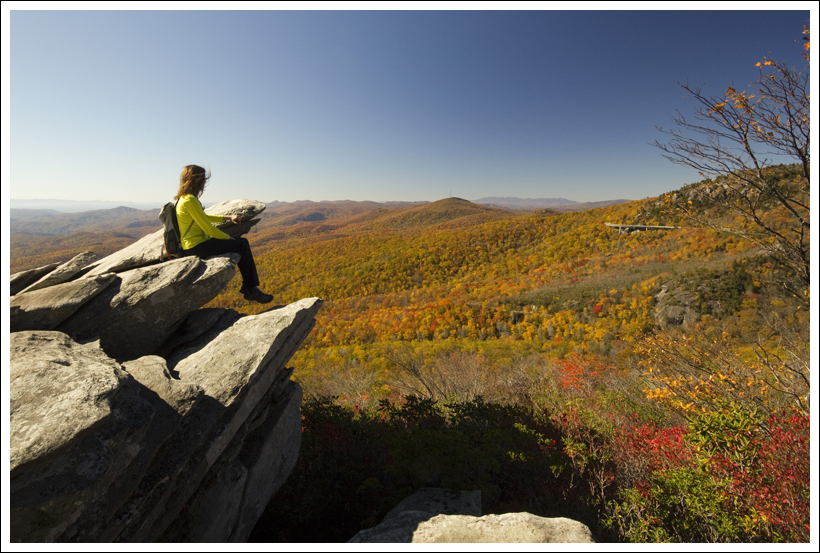
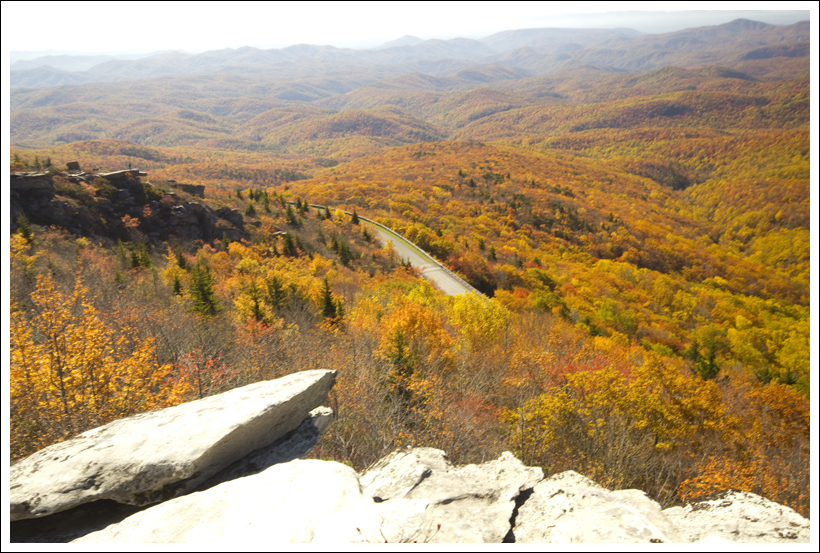
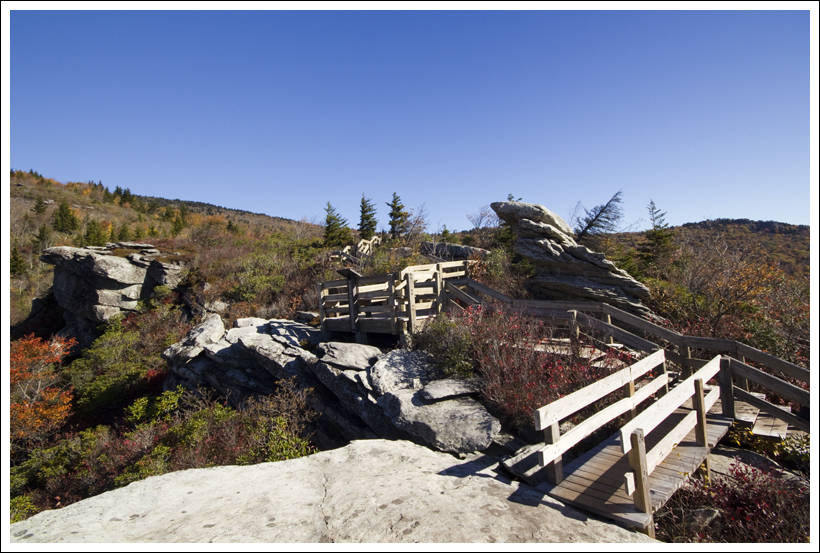

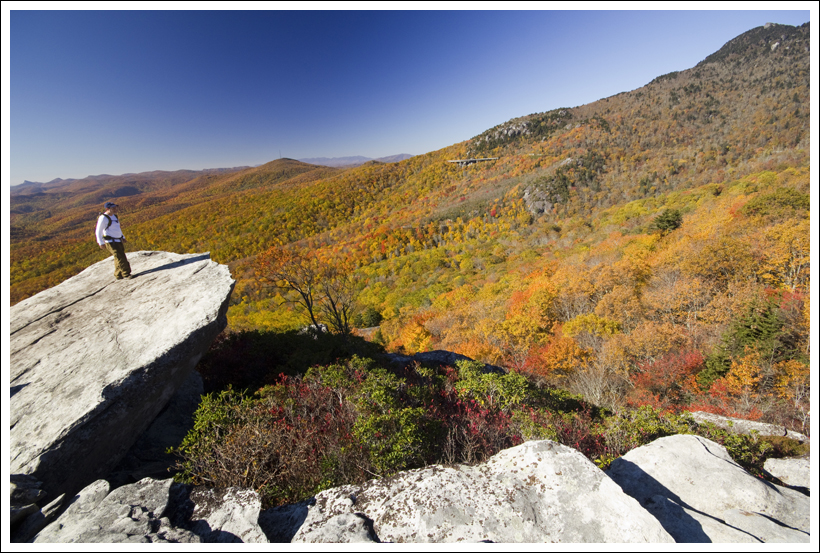

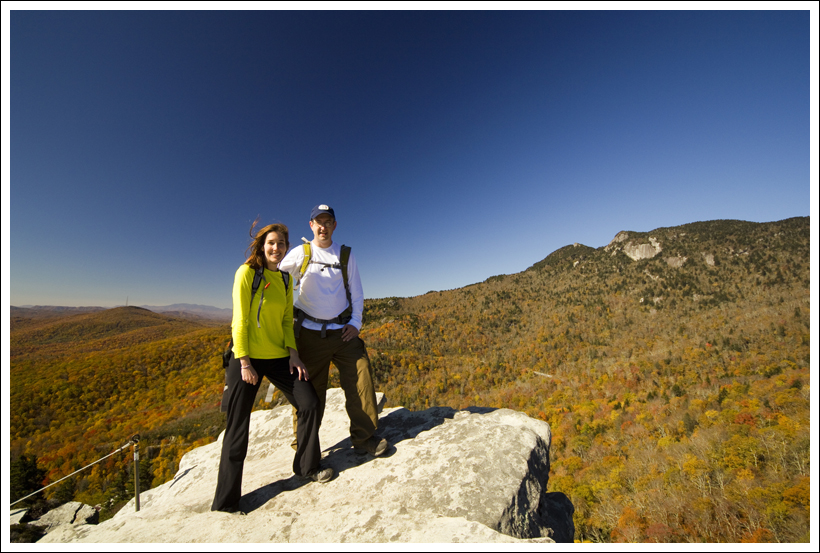

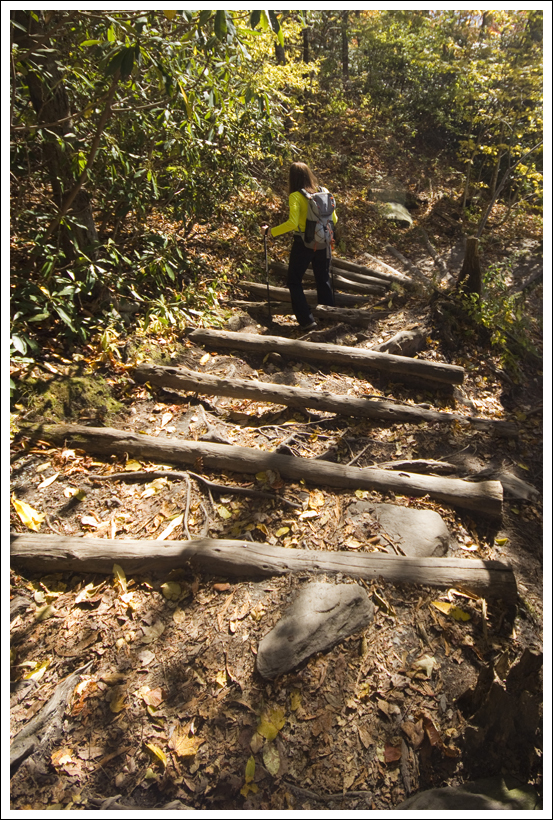


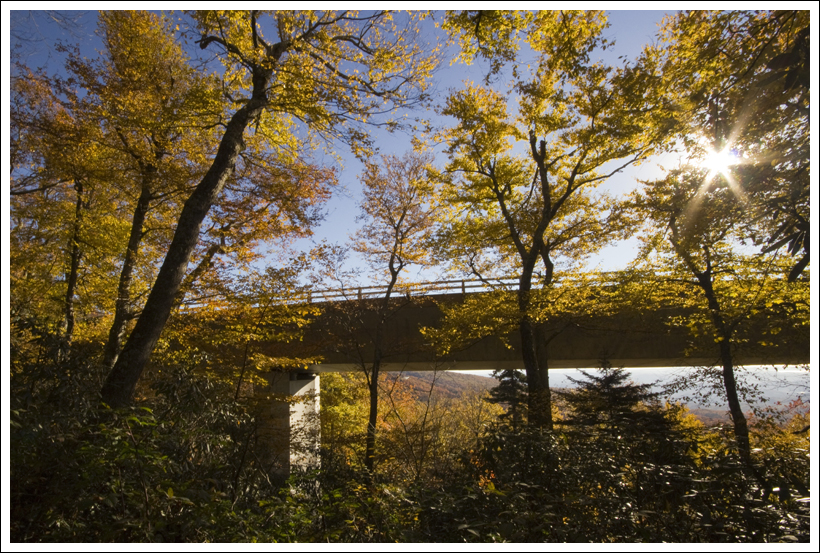


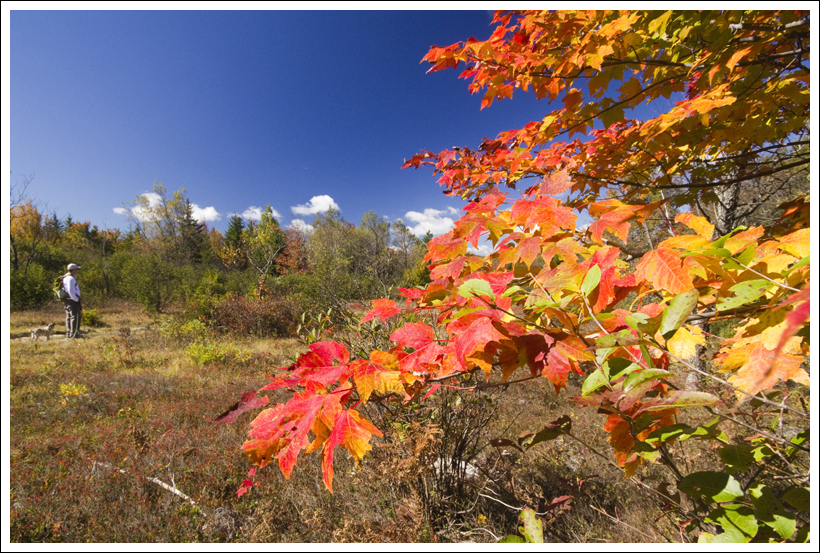
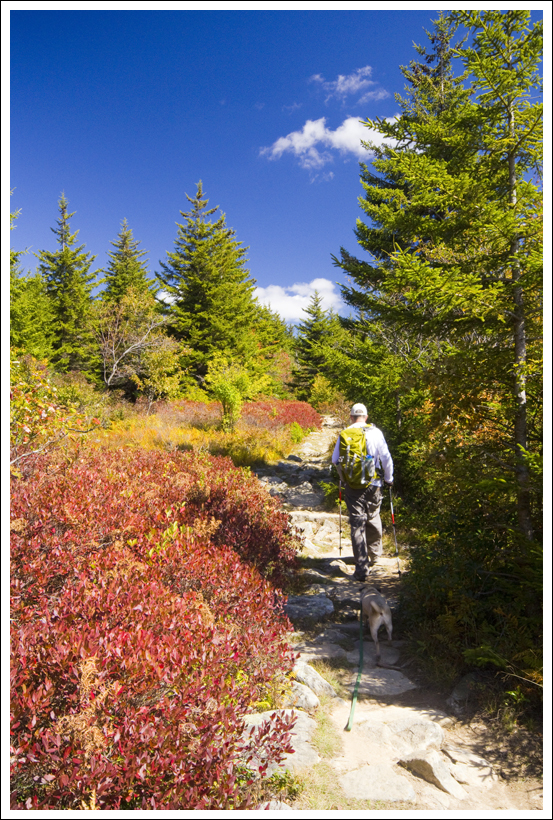


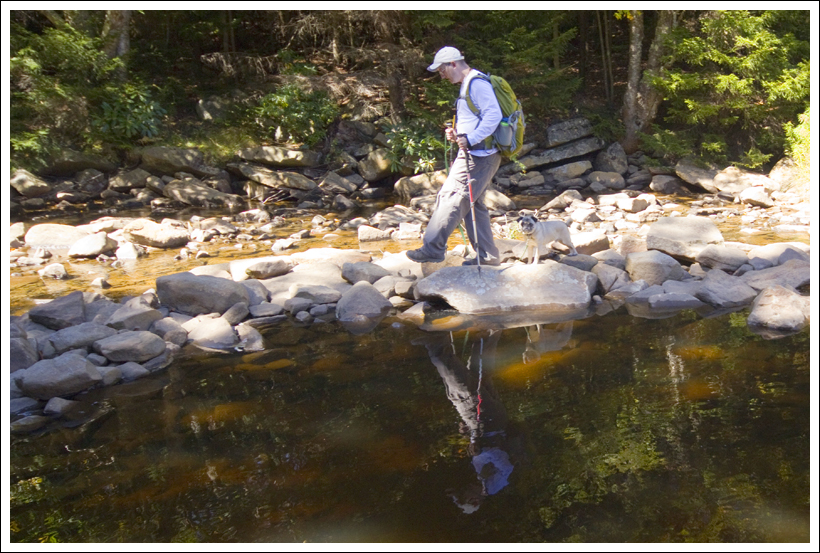


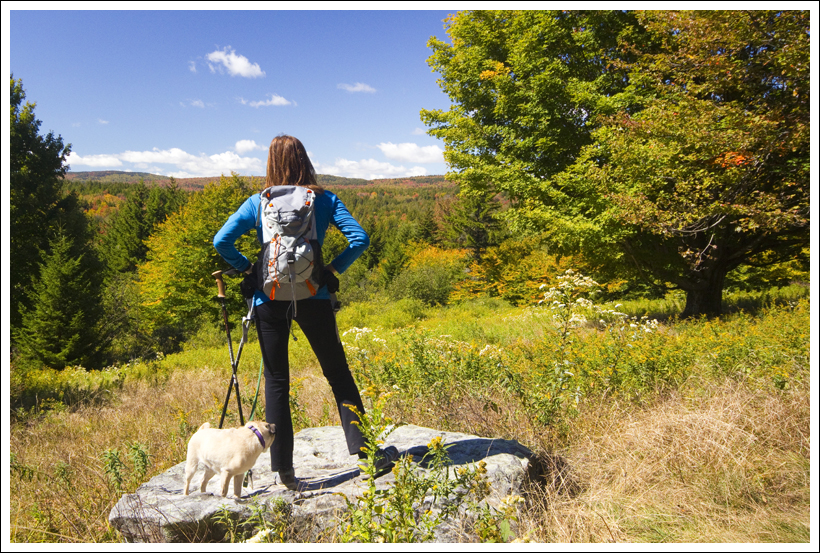
 Wookie Says…
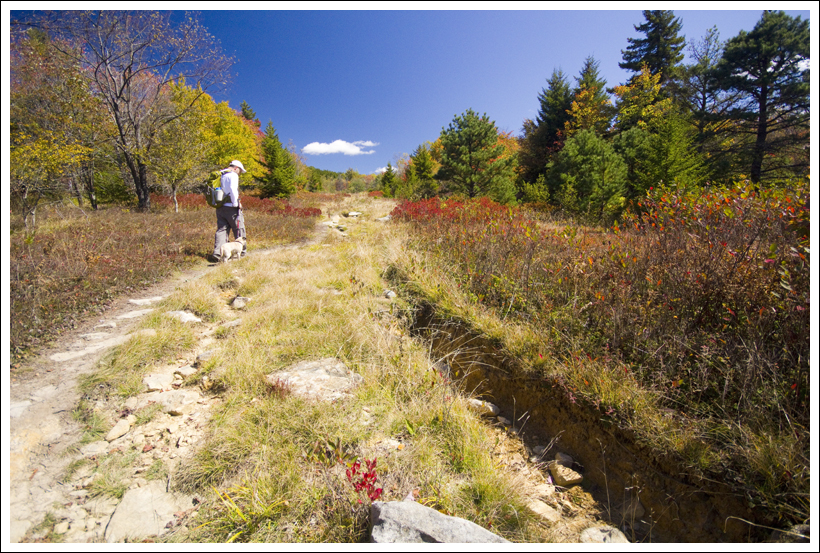


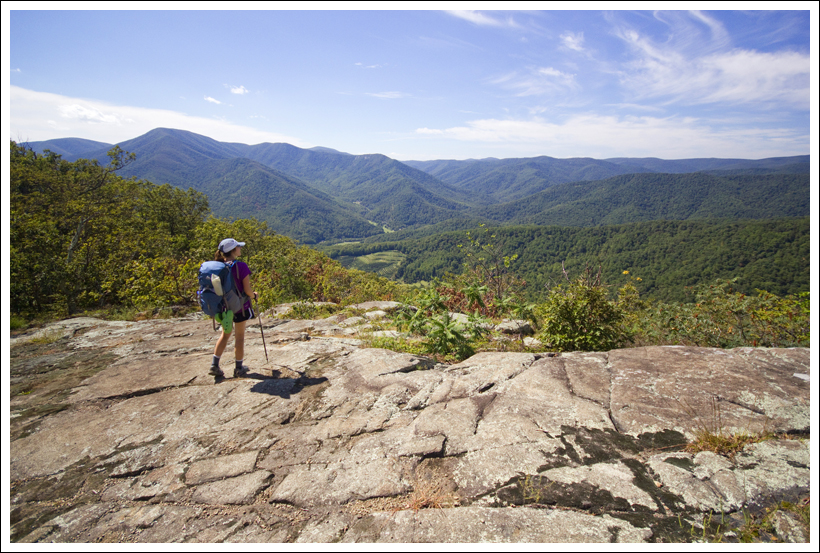


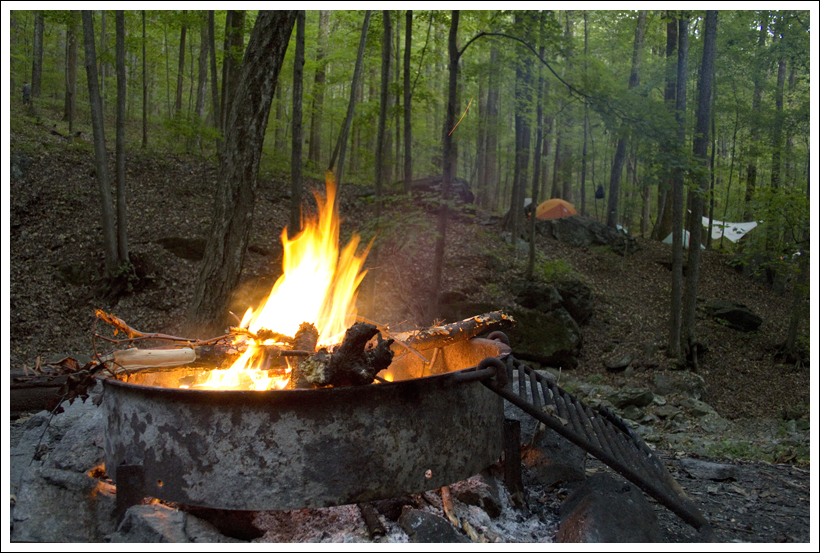
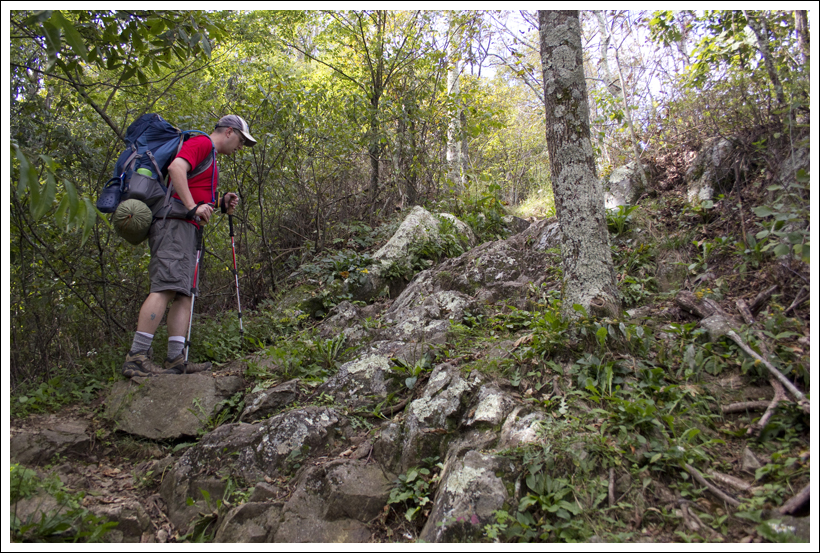


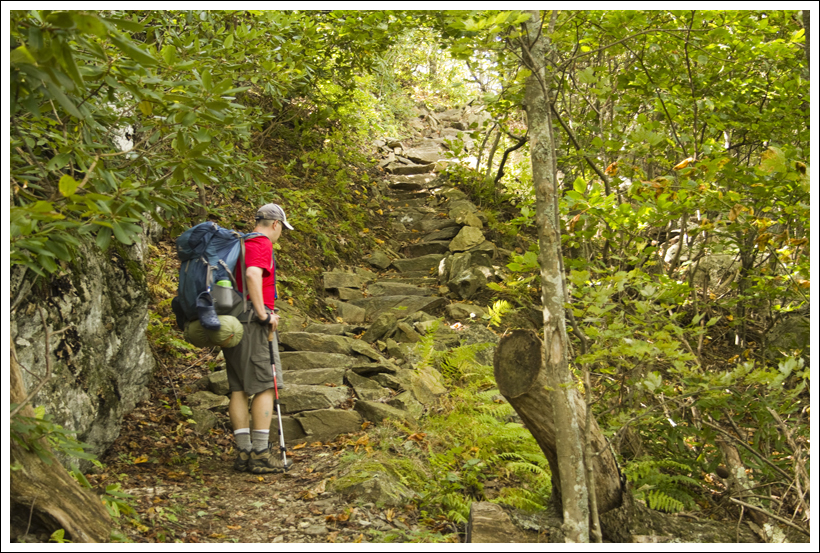


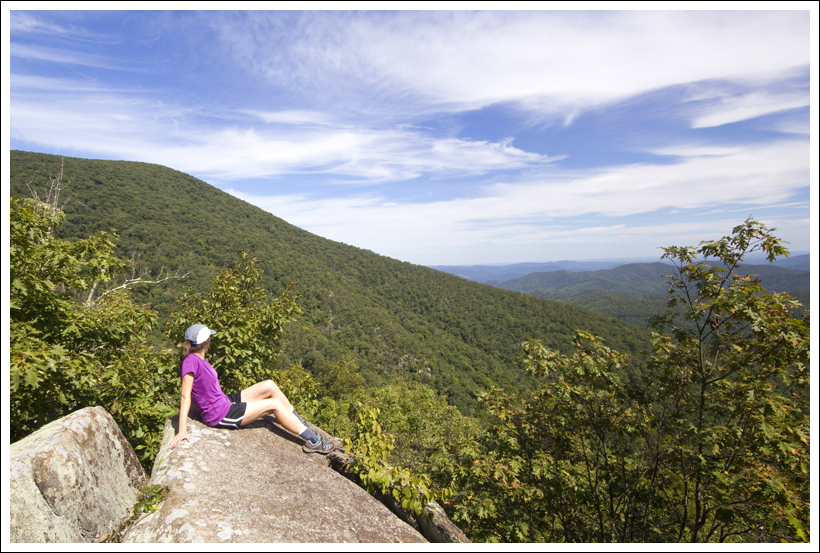


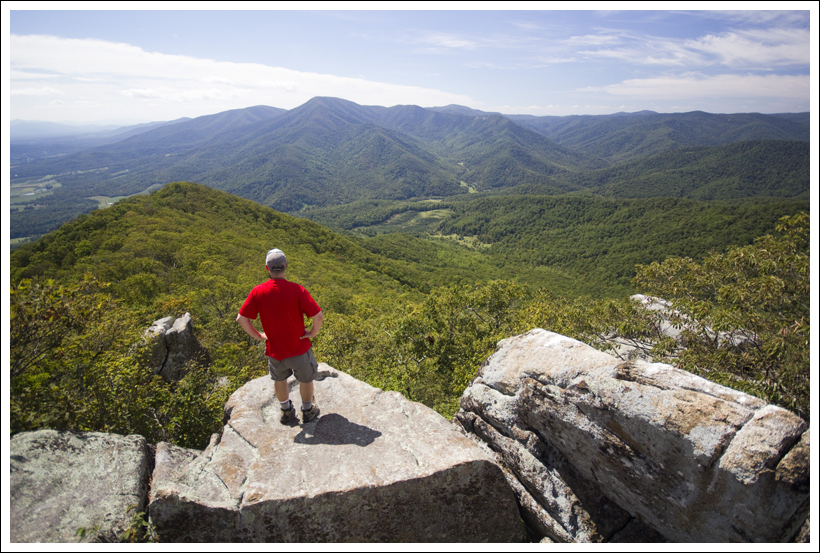
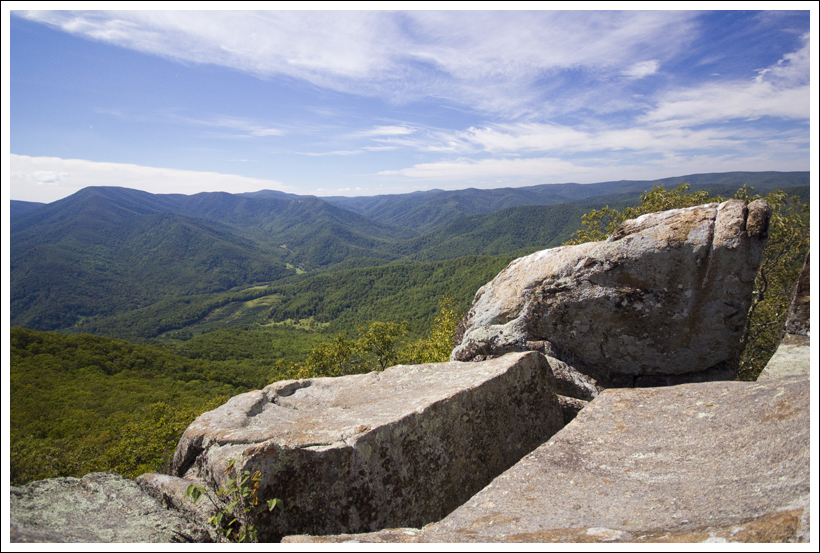

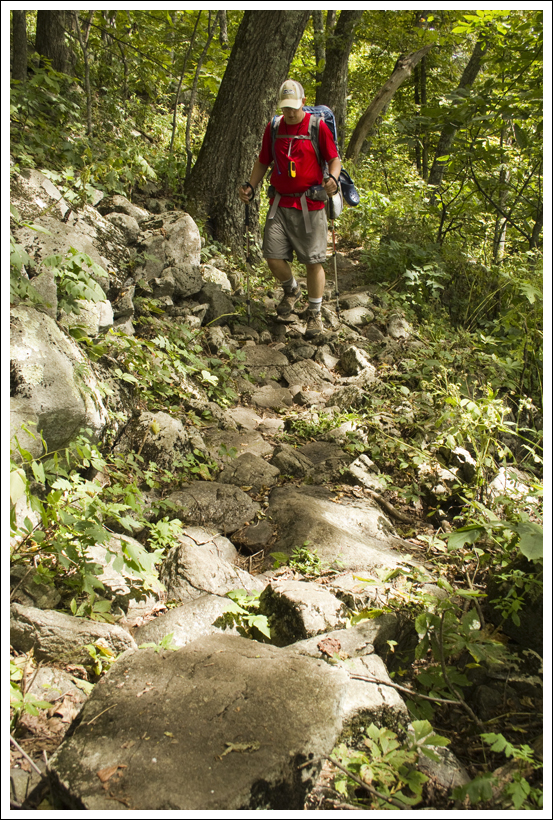
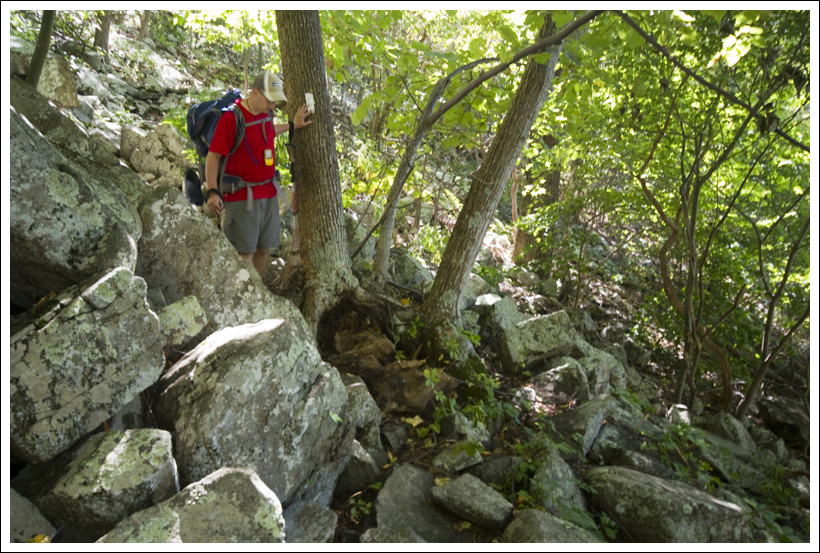


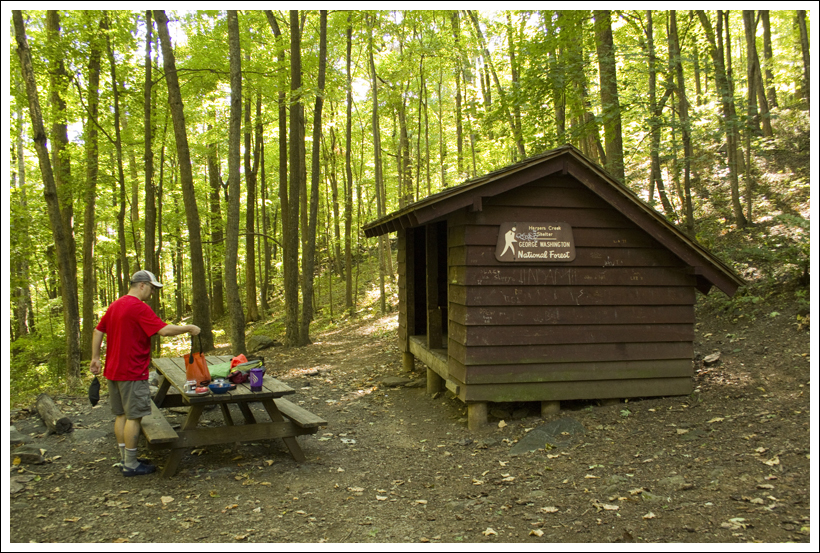


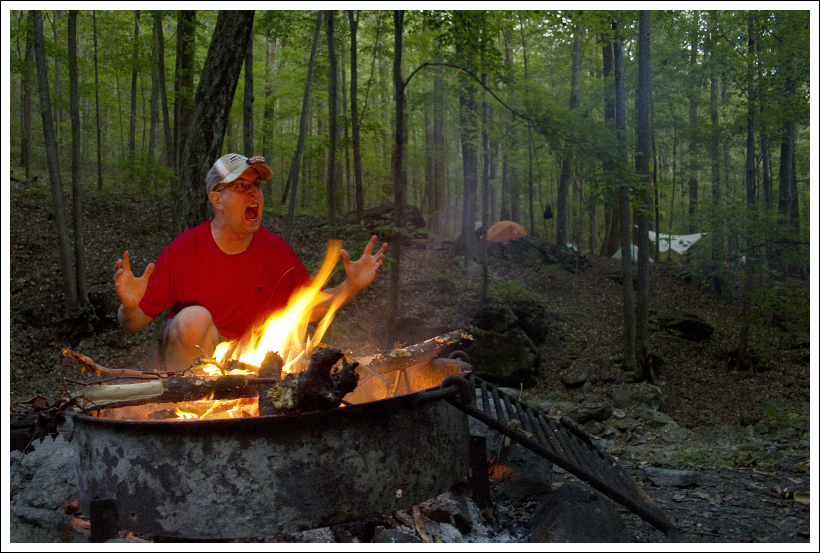

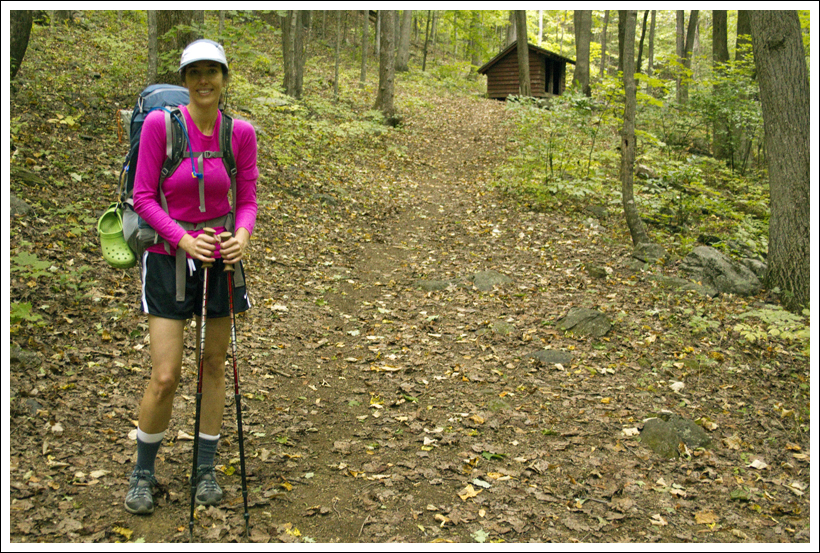


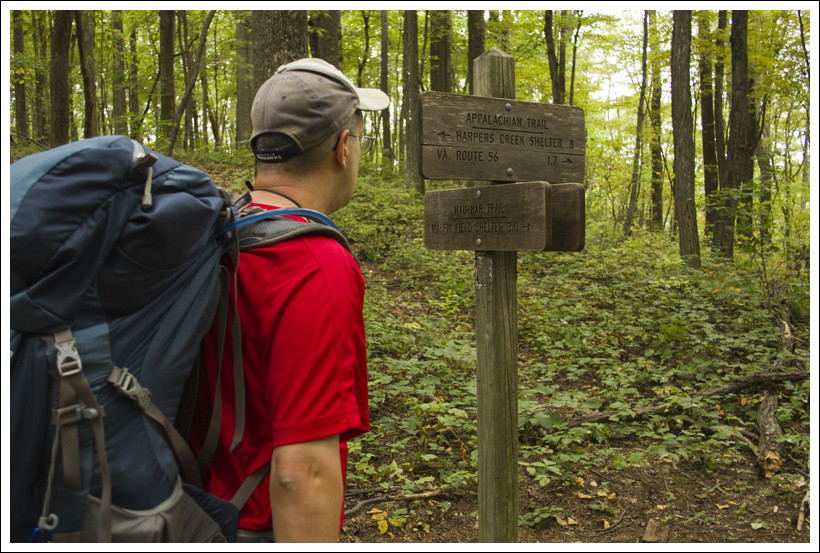


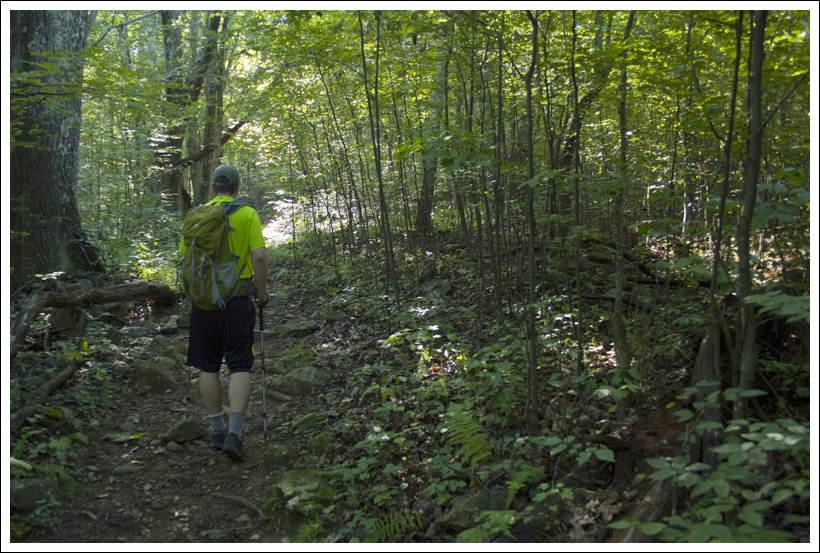


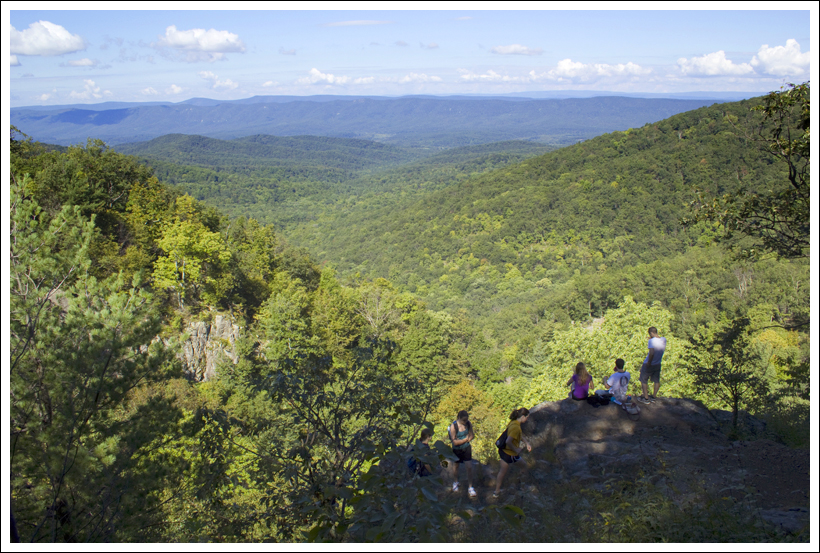


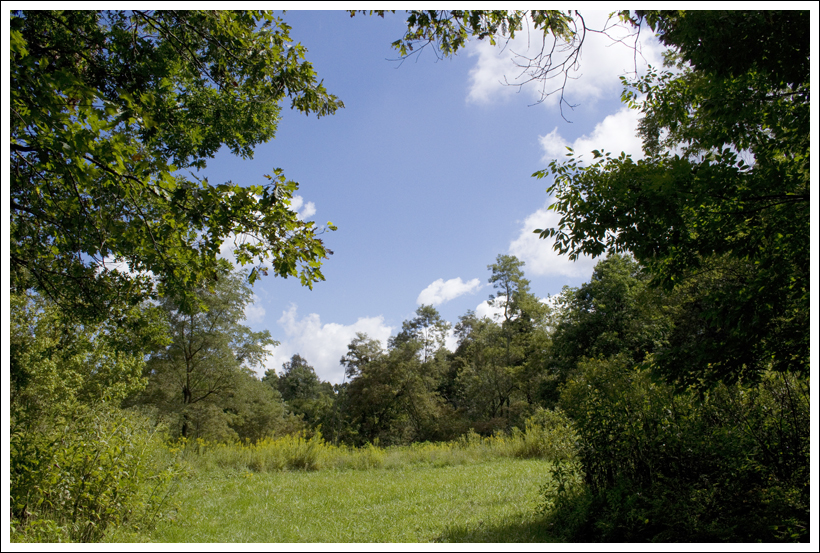


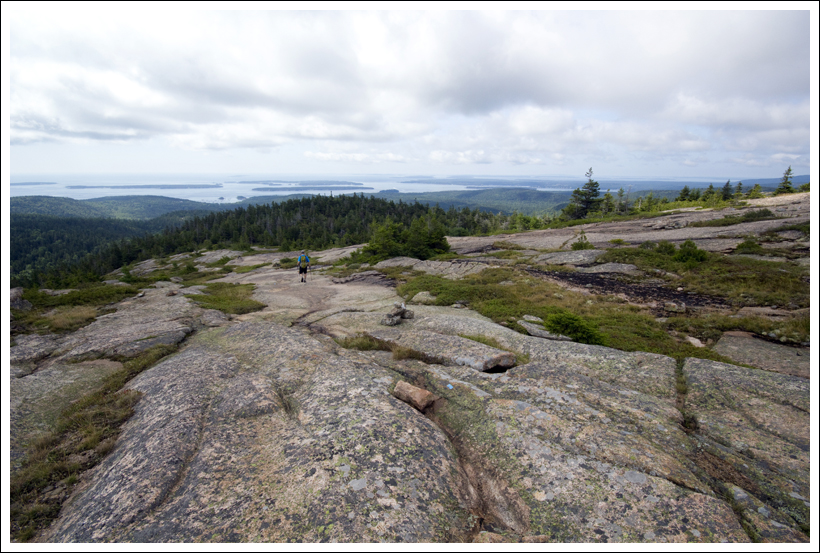


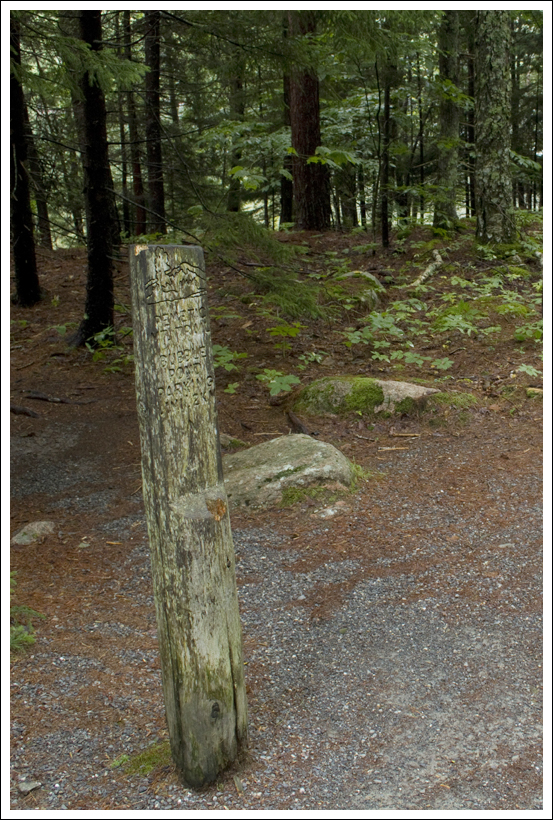

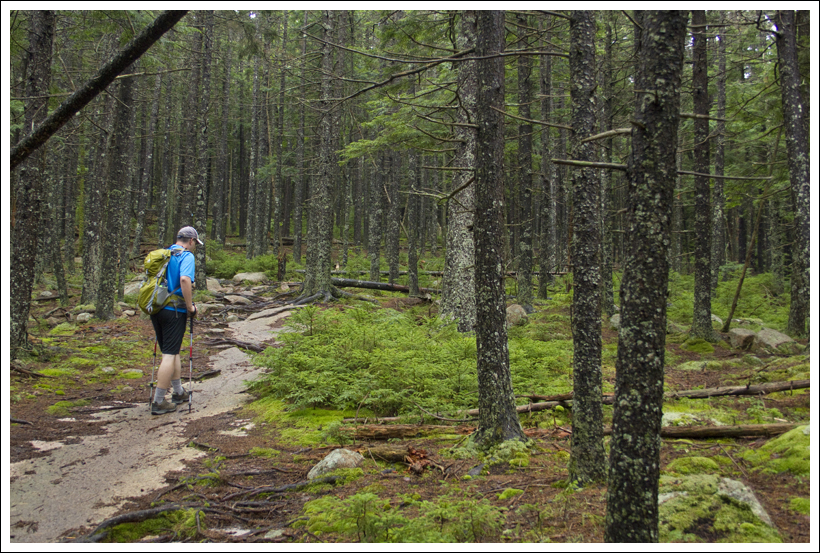


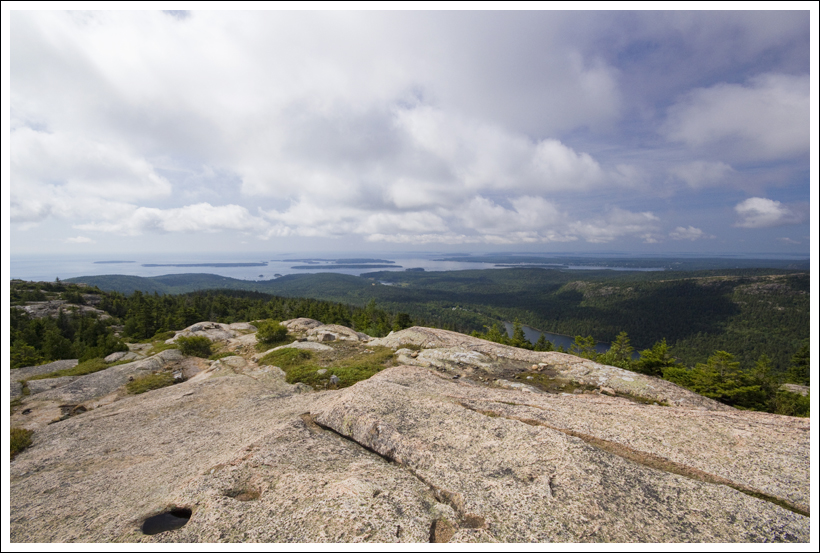
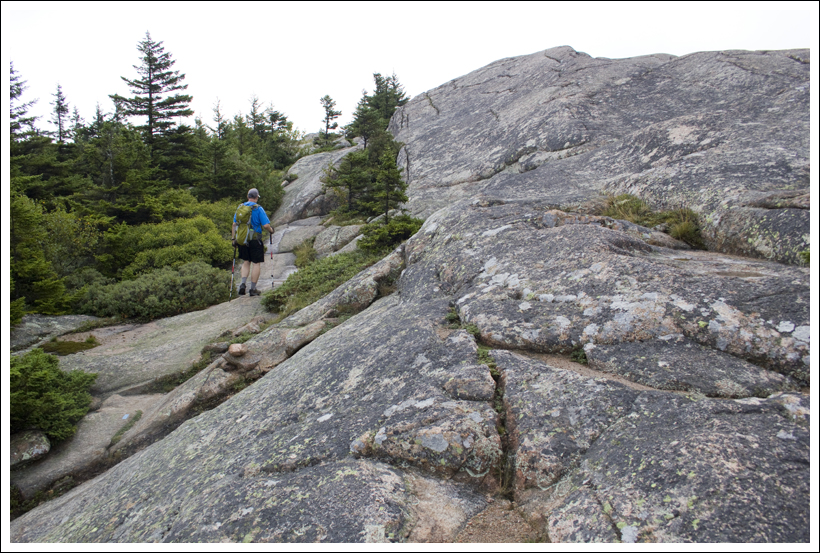


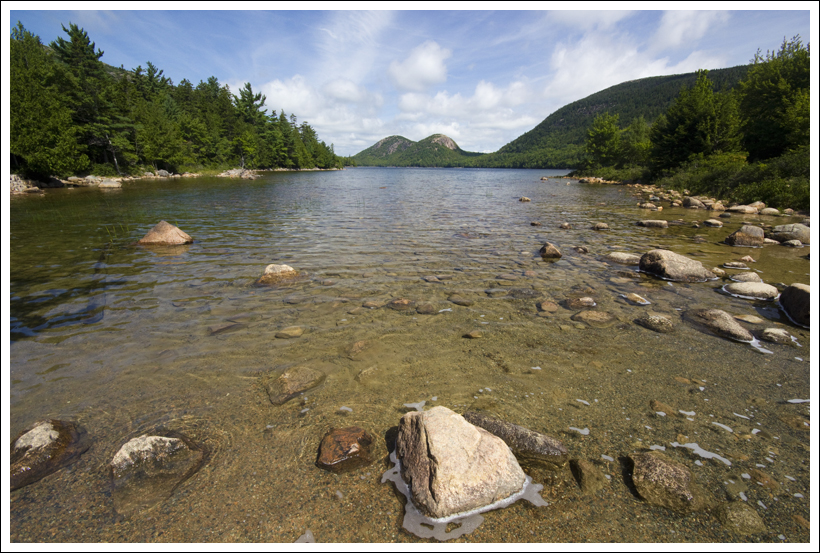


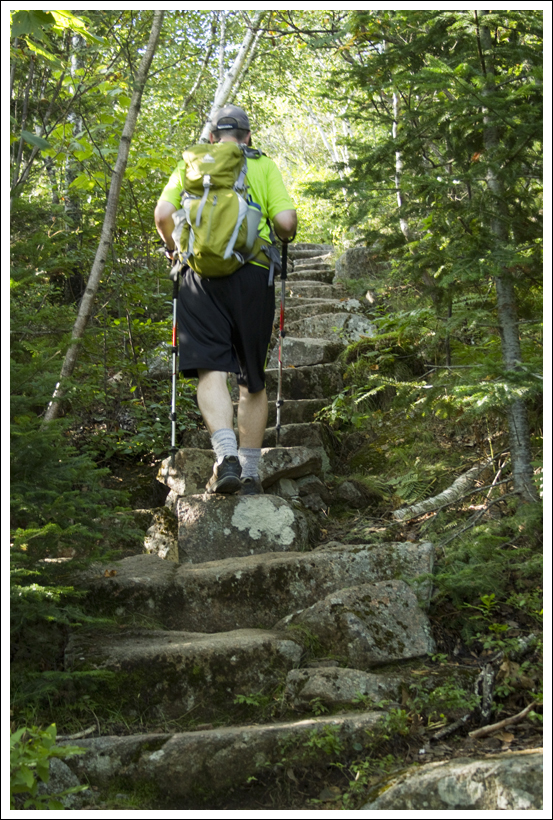


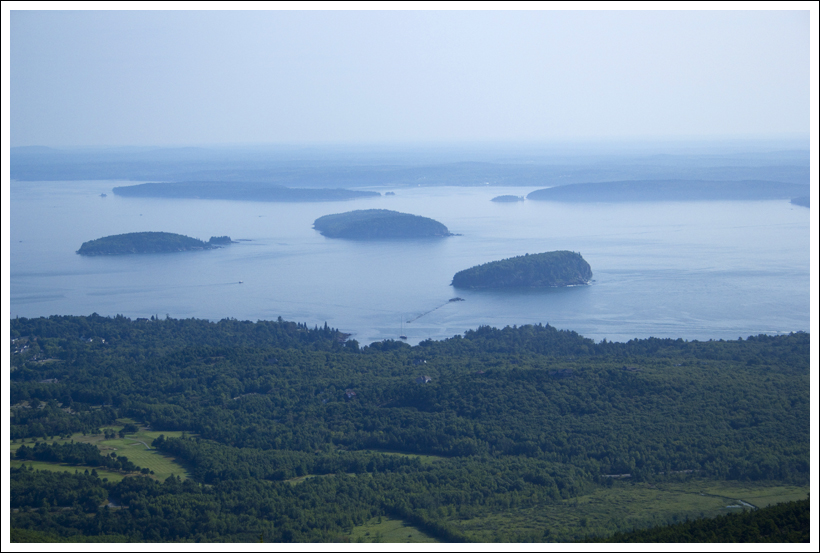


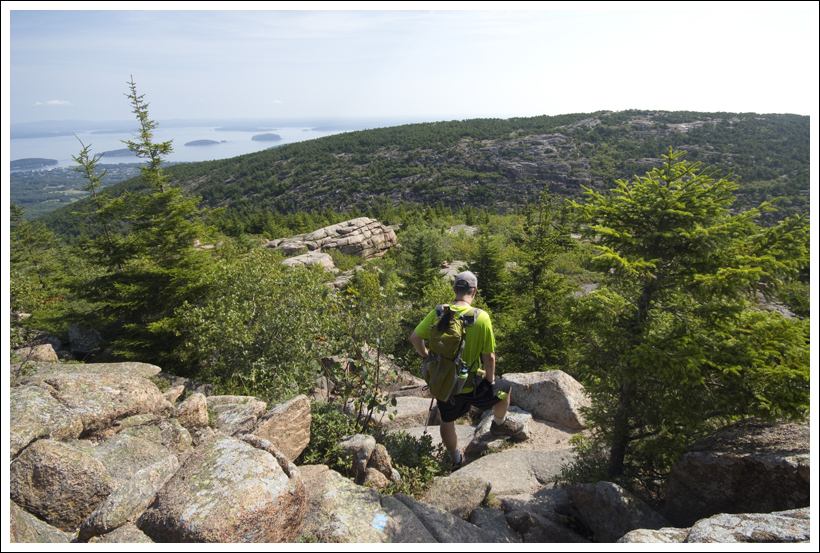
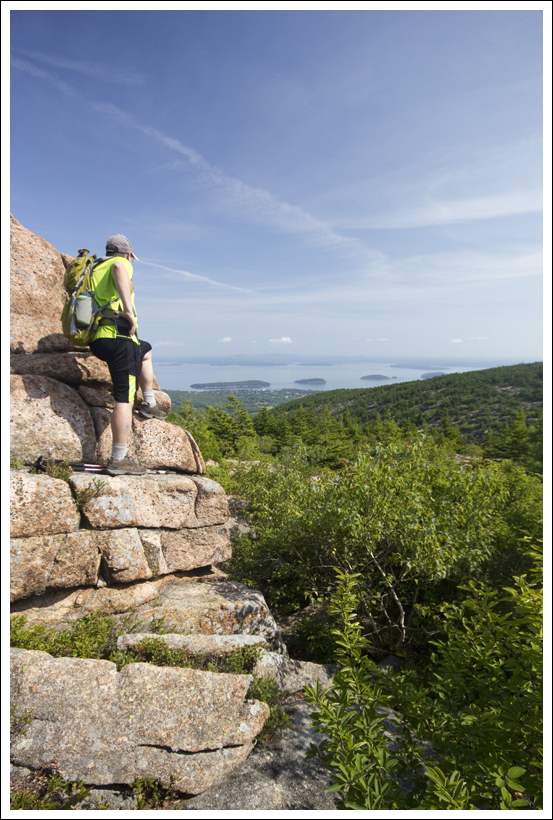

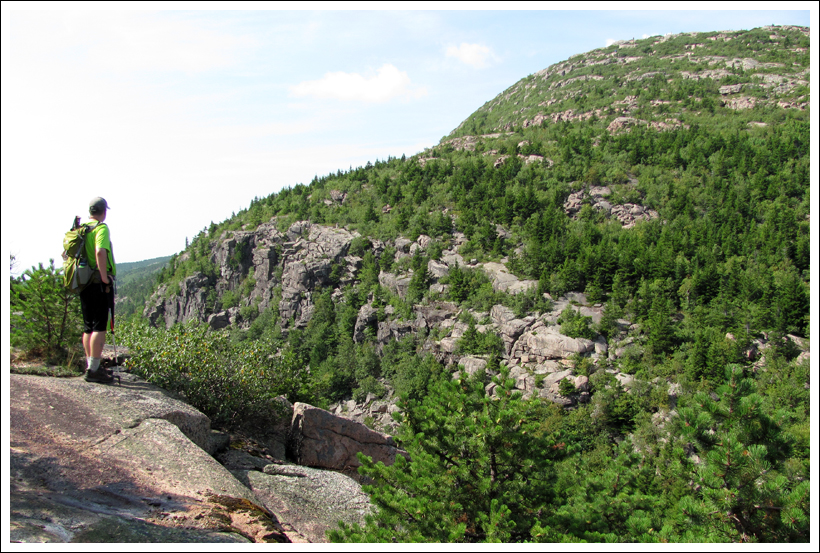


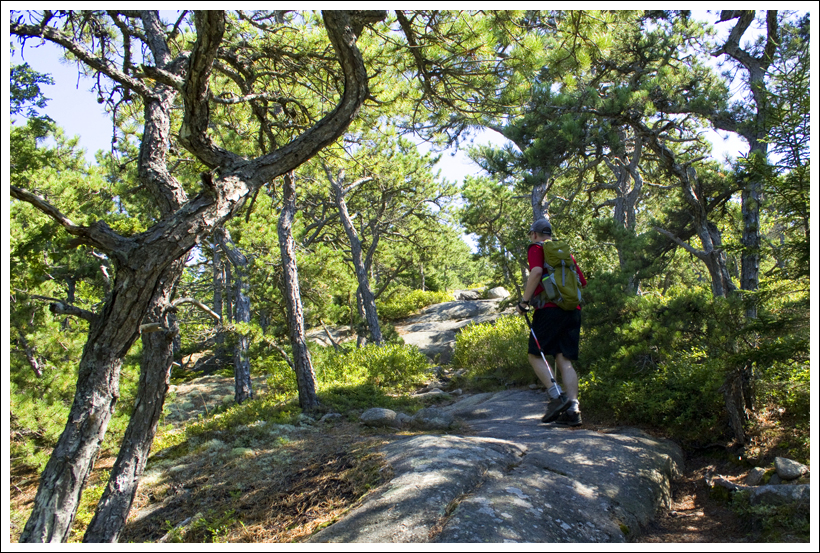


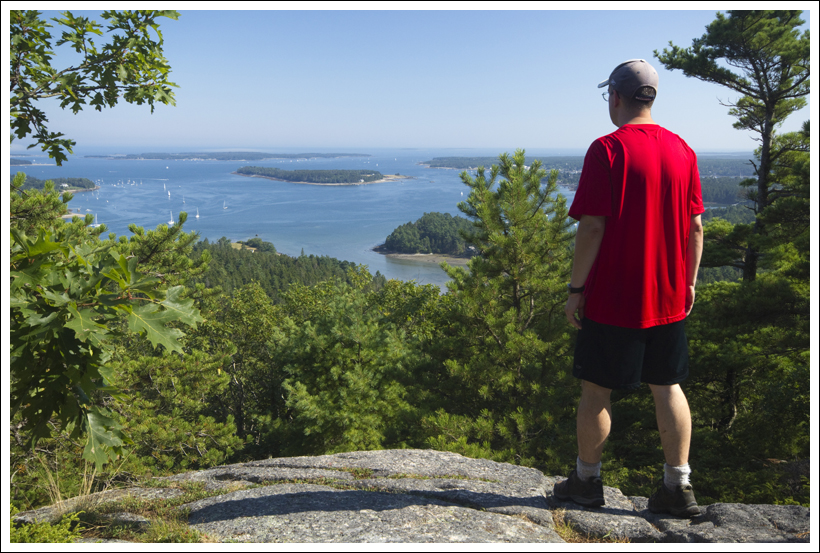


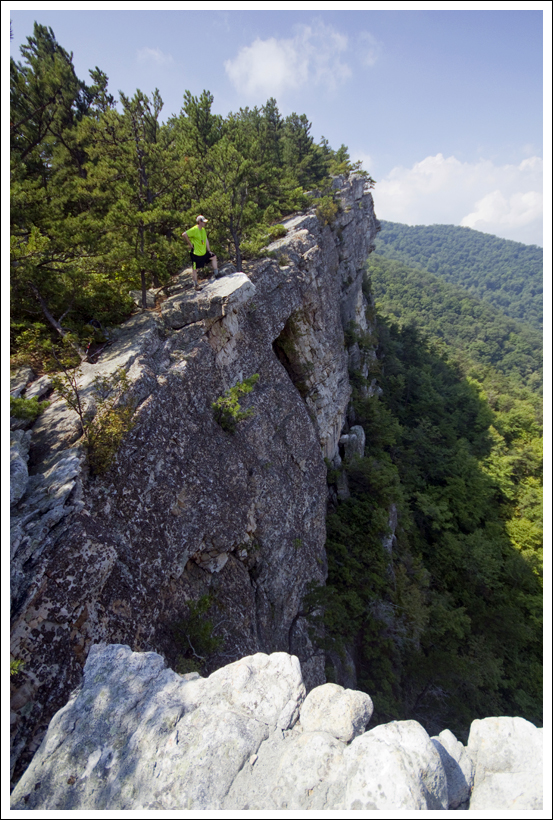
 Virginia Trail Guide