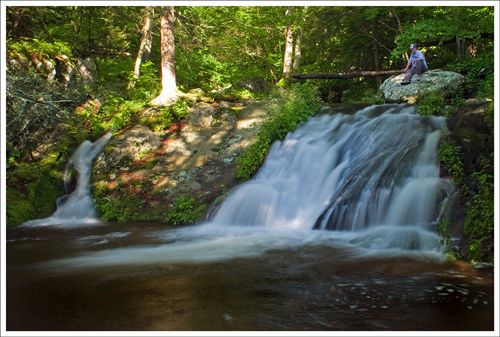
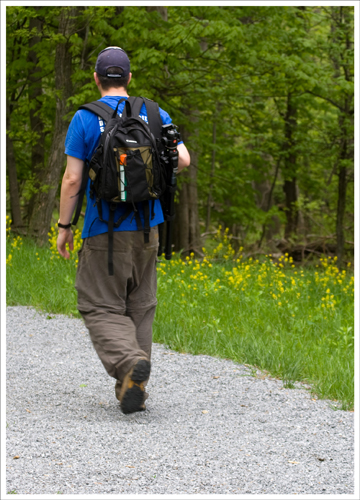
Riprap Trail

This 9.8 mile circuit hike offers all the best of Shenandoah – panoramic views,  bubbling streams, a swimming hole and even a nice final stretch along the Appalachian Trail.  It comes close to our 10 mile limit for a day hike, but it’s definitely well worth the effort.
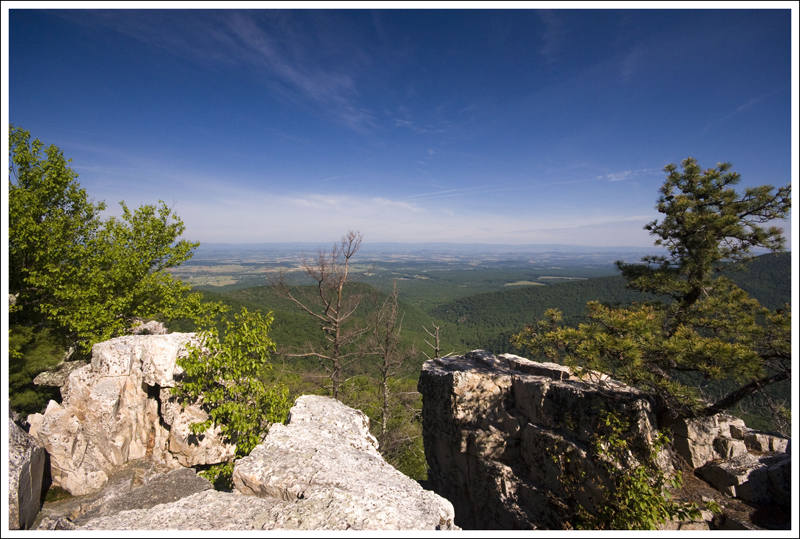
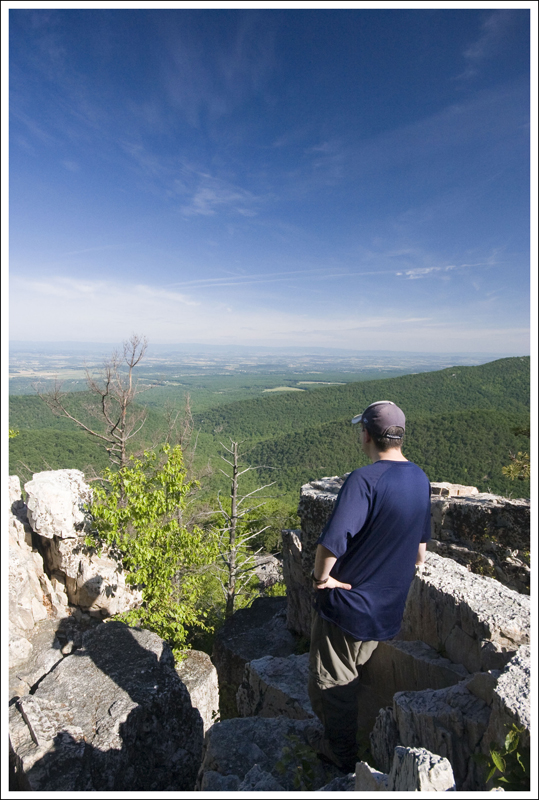
Chimney Rock View
The view from Chimney Rock is very pretty on a clear day.

Christine Says…

The Riprap trail has long been on my list of hikes to tackle in Shenandoah National Park.  Last Friday, we finally got around to it. I have to admit, the nearly ten-mile length and over 2,300 feet of elevation gain intimidated me just a little. The hikes we’ve completed that are close to that length (i.e. McAfee Knob or Mount Rogers) both have substantially less elevation gain. But, we had a free day and beautiful weather, so we decided to go for it. I’m so glad we went because the scenery on this trail showcased everything I love about Shenandoah. And, honestly… hiking 9.8 miles really wasn’t that hard.

We started the hike from the Riprap parking area at mile marker 90. We turned right at the end of the parking lot and followed the Appalachian Trail uphill for about a third of a mile. At the intersection with the Riprap trail, we turned left. The trail went alternately downhill and uphill for about three-quarters of a mile. We passed around a talus slope and came out to a viewpoint near Calvary Rocks. This was a great place to pause and take in the panoramic scene of the valley below. About a third of a mile downhill past Calvary Rocks, we arrived at Chimney Rock. I found this to be the prettier of the two views – but they were both very nice. The trail was especially pretty in late May because of all the blooming mountain laurel, wild azaleas and rhododendron. There were some sections that were so lush, I felt like I was walking through a tunnel of flowers.
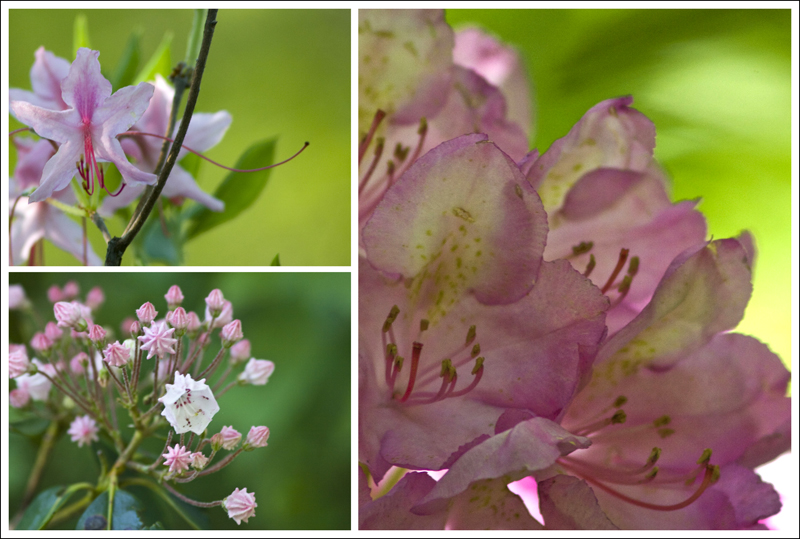
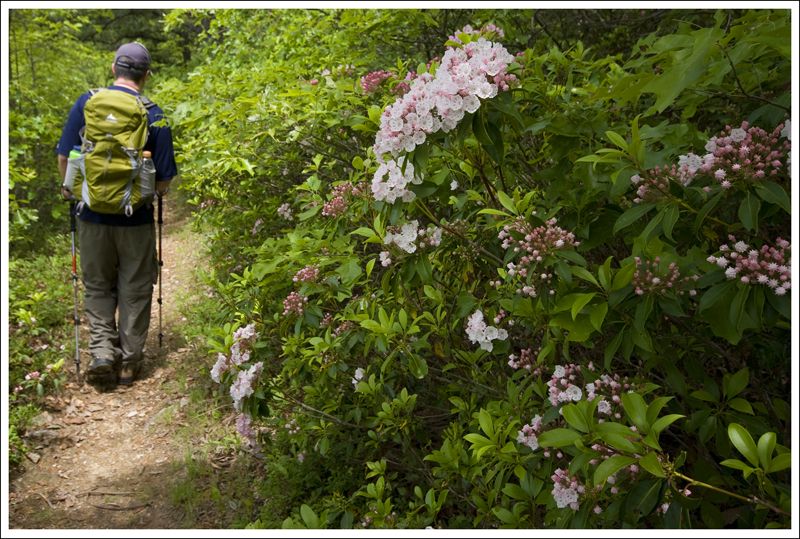
Wild Azaleas, Rhododendron and Mountain Laurel
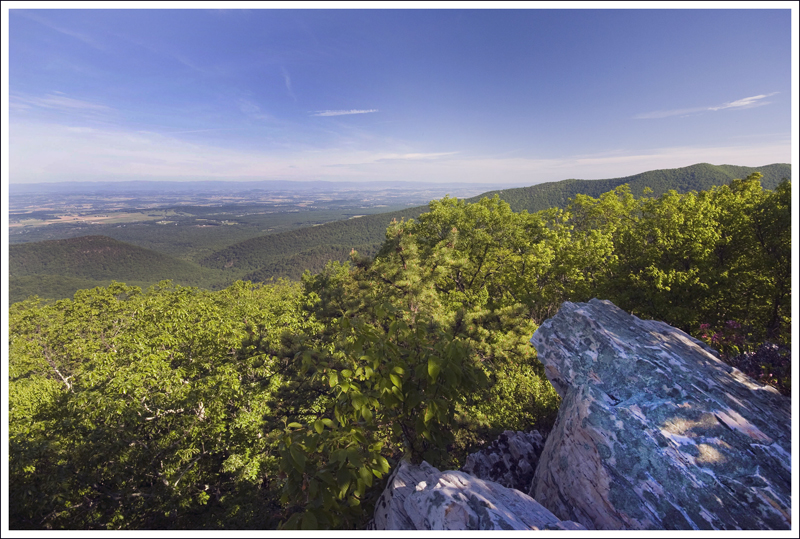
Wild Azaleas, Rhododendron and Mountain Laurel.  Below: The view near Calvary Rocks; Adam taking in the view from Chimney Rock.

View Near Calvary Rock Adam Takes in the Chimney Rock View

From Chimney Rock, the trail follows a ridge for a while, with many nice views between the trees. There is still quite a bit of evidence of forest fire damage from the late 1990’s in this area. The mountainside is still rather barren and charred stumps are visible. Slowly, the trail descends into Cold Springs Hollow. We passed through some of the densest mountain laurel along this section. We saw and heard so many beautiful birds – everything from American Redstarts to Rose-Breasted Grosbeaks.

Near the bottom of the hollow, we started to pick up the stream. It started off as a trickle, gaining volume and speed as we climbed continually downward. There were a few small, unremarkable waterfalls in the gorge, but we didn’t stop walking until the first stream crossing. Adam and I sat on a couple big boulders in the middle of the stream and ate a few handfuls of trail mix.

Swimming Hole with Fish and Rhododendron Reflection
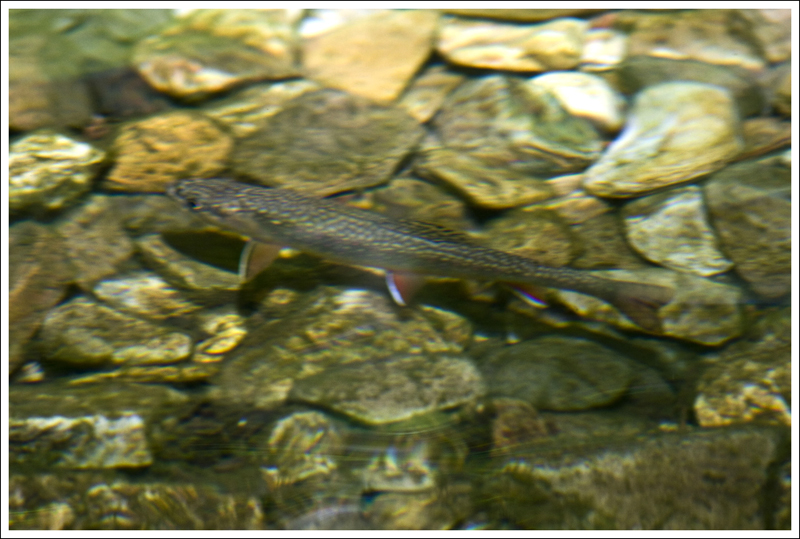
The swimming hole displayed beautiful rhododendron reflections and was full of brook trout. Below: The trout were hard to photograph through the water, but you get the point.

Brook Trout

We stopped again just a couple tenths of a mile later at my very favorite spot along the trail – a wide, green swimming hole shaded by the forest canopy. We sat along the pool for a long while. We watched colorful brook trout lolling in the water. Every now and then, one would splash up and break the quiet surface of the water. The water was so clear. We could see reflections of the rhododendron on the surface and big, round stones at the bottom of the pool. The spot is made even more beautiful by the gentle slide waterfall that cascades down and fills the pool.

After leaving the pool, we had almost about three-quarters of a mile of level walking and a couple more stream crossings. A post marks the intersection with the Wildcat Ridge Trail. We turned left, and enjoyed our last little bit of flat walking for a while. We decided to stop and eat lunch before the big uphill climb began. We had ham and cheese on crackers, chips and some candy – perfect to give us lots of energy!

Climbing along Wildcat Ridge is a steady uphill for almost three miles, but the grade is generally moderate. There were several more decent views through the trees along this section of trail. And of course, more mountain laurel! I think I must have said “This is SO PRETTY!” to Adam a dozen times as we walked through the flowers. This section is where we saw our only other hikers of the day – a young couple hiking the loop in the opposite direction. We got to the junction with the Appalachian Trail faster than we thought we would. We were anticipating another .7 miles of uphill climbing when we reached the marker post. It’s always such a pleasant surprise when an uphill climb ends earlier than you thought it would.
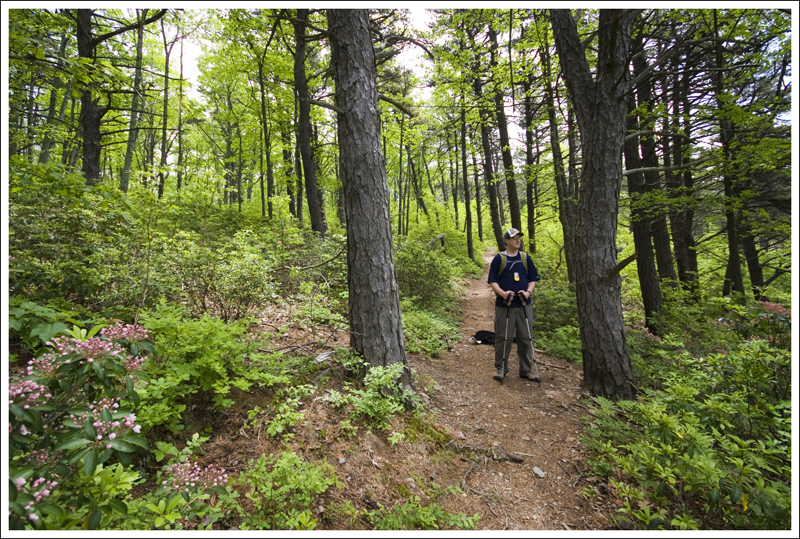
Adam on the AT
Adam and I both enjoyed the more level terrain along the Appalachian Trail.

We took a left onto the AT for the final 2.8 miles of the hike. This section was typical Appalachian Trail in Shenandoah – rolling hills, nothing too steep. We saw a brief glimpse of a bear diving into the mountain laurel about a mile into this stretch. After about an hour of walking on the AT, we arrived back at our car. My feet were a little sore and tired, but other than that I still felt pretty energetic. Riprap now claims the spot for the longest hike I’ve ever done in a day! The 9.8 mile circuit took us just under six hours – including our very frequent snack and photography stops. On the way home, we stopped and rewarded ourselves with Lime Cream Slushes from Sonic – my favorite post-hike treat.

Adam Says…

This may also be the longest hike I have done but it was well worth it!  This hike really does have it all and we hit it at a great time of year.  The mountain laurel and rhododendron were at peak on this trail and we often felt like we were in some type of fantasy land while being surrounded by pink flowers.

The views from Calvary Rocks and Chimney Rock give you some great 180 degree views to the north of the mountains.  I was a little worried that the payoff for this hike was going to be over in the first couple of miles of the hike, but I was glad to be wrong.  After we continued the descent from Chimney Rock, there were still some open views along the way.  Once we reached the bottom of Cold Springs Hollow, we saw a glimpse of a waterfall along the way.  Shortly after the falls and after crossing the stream you come to the beautiful swimming hole that Christine mentioned above.  This was a great spot to relax and enjoy seeing the fish, or you could take a quick, refreshing dip.
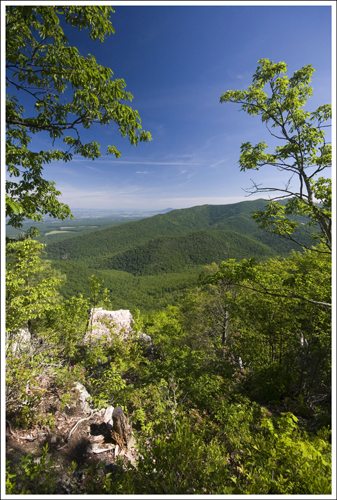
View Along the Riprap Ridge
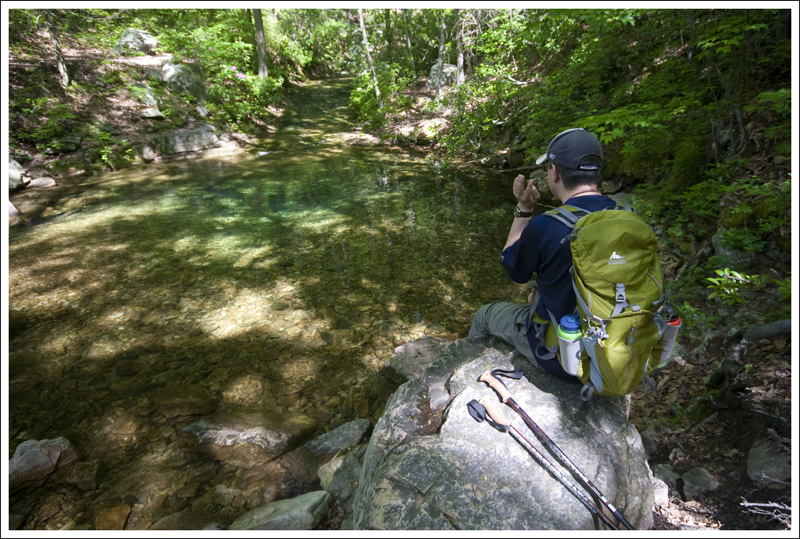
View Along the Riprap Ridge. Below:  The swimming hole is such a beautiful place – even though we constantly had to bat the bugs away.  Note the slide falls coming down to the pool.

Swimming Hole

Once we were done with relaxing, we took the hike up the Wildcat Ridge Trail.  This is a constant uphill for about three miles and does include a couple of switchbacks on the trail.  However, we felt that the terrain wasn’t too steep.  You continue to observe nice views as it hugs closely to the side of the mountain.  Once we met up with the AT, the trail didn’t have a lot of elevation gain/loss.  I do suffer from plantar fasciitis, so my feet were quite sore on the rocks of this section of the trail.

Butterfly on Mountain Laurel
Butterfly on Mountain Laurel.  Below: Adam hikes through the mountain laurel along the Appalachian Trail.

Adam hiking the AT

For those interested in geocaching, I did place an earthcache at the overlook for Calvary Rocks.  This is a way to learn about the geology of the area and there are a few steps to get credit for the cache:

I definitely enjoyed my first trip of the Riprap trail, but I know it won’t be my last.  This would also be a great place to do a backpacking trip, since there is a reliable water source at the bottom of the trail.  We really felt like it was one of the prettiest trails we have done in all of Shenandoah National Park.  Part of that largely is due to the abundance of blooming wildflowers, but another part was the views.  The Riprap trail really has it all!

Trail Notes

  • Distance – 9.8 miles
  • Elevation Change – Around 2300 feet.  The hike is a mix of uphill and downhill, with one long, steady uphill stretch of about three miles.
  • Difficulty – 4.5 While the elevation gain is substantial, the trail is rarely steep.  Grades are moderate.  We scored the hike a 4.5 mainly due to the length.
  • Trail Conditions – 4 Nice trail to walk along!  The stream crossings are easy.
  • Views4.  You get the best views from the Chimney Rocks and Calvary Rocks overlooks.
  • Waterfalls/streams – 3 The stream was on the low side when we hiked, but was still pretty.  The swimming hole at the bottom of the hollow is very beautiful.
  • Wildlife – 4 We saw lots of brook trout, a little toad, many bird species and we even caught a glimpse of a black bear’s rear end diving into the laurel thicket.
  • Ease to Navigate – 2 A few turns to make along the way.  There are a few false trails leading away from the main trail and also one tricky turn after a creek crossing.
  • Solitude – 3 We saw only two other people on the entire loop.  We hiked it on a beautiful Friday in late spring.  I imagine the trail is much more crowded on weekends.  It’s a very popular short backpack loop.

Directions to trailhead:
From Skyline Drive, park on the western side at mile marker 90.  There is a parking lot specifically for Riprap hikers.
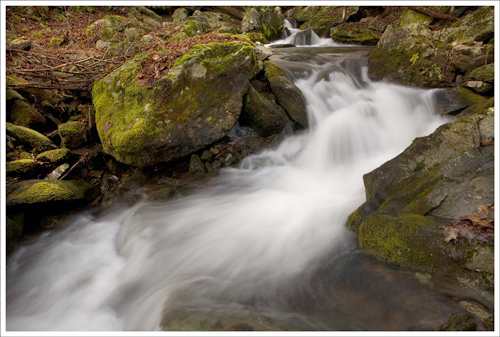
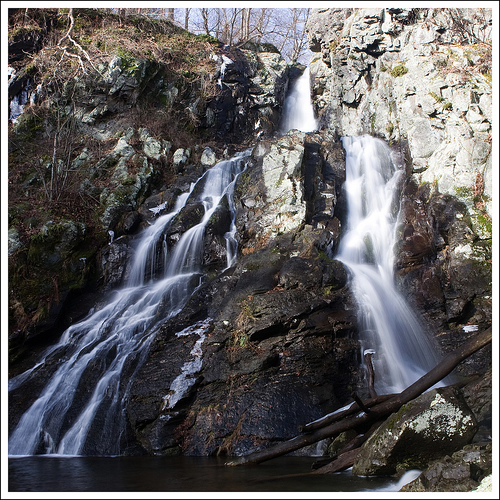
South River Falls

This 4.6 mile hike leads you along the South River to an impressive waterfall that plunges deep into a canyon.  When the park has experienced lots of rain, this waterfall hike is one of the nicest Shenandoah has to offer.

Cascades along the South River
The South River is impressive in times of heavy rain.

Adam Says…

We have kept with a tradition the last few years of doing a hike on Thanksgiving morning.  It’s a great way to appreciate nature and try to do something active before a big meal.  This year, we decided to break the tradition of having a huge Thanksgiving meal with turkey and all the trimmings.  We decided to have an easier meal that we would both enjoy – homemade pizza.

We’ve hiked South River Falls before, but we’ve never had as much water in the falls before.  We thought it would be impressive, since we could hear rushing water through the South River a lot earlier than normal.  Waterfall hikes in Shenandoah National Park tend to be fairly tough ones.  Since you park on Skyline Drive at a high elevation, you have to hike down to the valleys where the falls are created.  What makes it difficult, at least psychologically, is that you get to the payoff fairly easily and then have to do the hard work on your way back to your vehicle.

The South River right at the crest of the waterfall.
The beauty of the South River is found mostly in its small details. The cascades and little falls leading the large waterfall are prettier than the main waterfall.  Pictured below: South River Falls from the overlook at the top of the canyon; the falls from the base.  You’ll see neither vantage point of the waterfall is terribly photogenic (especially after the leaves have come down). Both of the small photos below are from another date.  This time, the falls were much bigger – but it was too sunny to photograph them.

The view from the top of the canyon. The view from the base of the falls

The hike begins at the South River Picnic Area.  Look for the large sign about the hike on the northeastern side of the picnic area.   At slightly over .1 mile, you will cross the Appalachian Trail.  You will continue your descent and around 1 mile, you will rock-hop across a small creek that drains into the South River.  Usually this is not much of a challenge due to the water, but we found the water was higher than normal this time.  At 1.3 miles, you will come to a nice overlook for the South River Falls.  You really get a great view of the 83 foot waterfall.  It plunges to a rocky ledge and splits in two about half of the length of the waterfall.  If you continue on the trail for another .2 miles, you will arrive at a cement post and join a spur to the South River Fire Road.  If you continue on for another .2 miles, you will descend even further and arrive at another cement post.  Following the path from the cement post for another .1 mile, you will arrive at the base of the falls.  For any adventurous shutterbugs, there are ample opportunities near the base of the falls for long-exposure photography. Make sure you have your strength up, because you have 2.2 miles to hike at a steady incline back to your vehicle.

To follow the trail as a loop as we did, once you make your return from the base of the falls, go .7 miles until you reach the cement post and the junction with the South River Falls Trail. Stay on the fire road instead and after .4 miles more, you will reach the yellow-blazed South River Fire Road.  Take a left on the road.  In about a mile, you will reach the junction with the Appalachian Trail.  Take a left on the white-blazed AT, heading south for about .4 miles.  You will then reach the junction with the South River Falls Trail and only have about .1 mile to reach the picnic ground.

The hike was a tough one, but it was nice to get some exercise.  The thought of carving into our pizza helped us muster the energy to make it back.

Christine Says…

This was a great trail to burn off Thanksgiving calories!  The terrain is rugged and the return arm of the loop is nothing but steady, tough uphill climbing.  Even Wookie, who is normally a bundle of boundless energy, got quite tired on this hike.  By the time we got to the Appalachian Trail junction, his corkscrew tail was completely unfurled.   Even though there are some hikes in the park with more elevation gain, I think the 1300+ feet on the South River trail provides some of the park’s tougher climbing.   Anyone looking for an easier version of this hike should consider doing the short loop (3.2 miles) that returns after the overlook at the top of the falls.  By taking that route, you reduce the elevation gain to a very manageable 850 feet.

Despite the hard work required to get there, I really enjoyed seeing the South River and its namesake falls so flush with water.  The Shenandoah area has had over five inches of rain in the month of November – more than double the normal amount.  All of the park’s streams, rivers and waterfalls are flowing beautifully right now.  It’s a great time to get out and enjoy the scenery and the less-crowded conditions in the park.

Cascades along the South River
There are many small, but beautiful, waterfalls along the trail. Pictured below: Another pretty spot along the river.

Cascades along the South River

I had hoped to get some photo opportunities along the river on our Thanksgiving hike.  I did take a few shots, but the weather was less than cooperative.  It was too sunny to take shots of the moving water. Every now and then, I found a shady spot down in a deep ravine.  I did a bit of bushwhacking to get to a few pretty spots, but overall I don’t feel like I came home with any special photos.

Honestly, while South River falls is probably the park’s most impressive waterfall, it is not one that translates nicely on film.   The falls plunge into an enormous natural amphitheater.  The sheer rock walls are amazing, but they aren’t photogenic.  I’ve seen a few nice shots of South River Falls in the spring, when the water is flowing and the falls are surrounded by the lush new green of the trees and plants.  In the late fall and winter, the falls are really scrubby and barren looking.

I think some of the prettiest and most dramatic places along the South River come at the bottom of the falls.  In the last .1 mile of the trail, leading to the base of the falls, the water tumbles over a hundred feet down over giant boulders.  There are many small, beautiful waterfalls to enjoy before you get to work climbing back up to your car.

When we got home from our hike, we found several TICKS!  Can you believe it – ticks in late November; ticks after the mountains have had snow and temperatures at night are regularly below freezing?  These were tiny ticks – about the size of a pinhead.  We pulled one off Adam’s sweatshirt and two off of Wookie.  I hate having to watch for ticks year round, but it seems that we must.

Wookie Says...Wookie Says…
Hey all of you fellow hiking dogs.  It’s been a while since I’ve been hiking, so I’m going to let you know what I thought of the trail.  I enjoy getting the chance to get in the outdoors and I usually run laps around the house when my masters ask,  “Would you like to go on a car ride?”

The hike on South River Falls was pretty fun for the most part.  I enjoyed going downhill until I reached the stream to try and rock-hop.  I’ve done this hike before with my masters, but there was a lot of water this time around.  I don’t really like to get my feet wet and when I see any water on the hike, I try to take the driest option.  After Adam crossed the creek, I really didn’t want to follow him.  Only after Christine gave me a little nudge with her trekking poles, did I take the plunge and hop across the rocks.

Wookie Enjoyed the Hike
Wookie enjoyed the hike, but was exhausted the rest of the day.

All the rushing water on the trail, really made me need to go to the bathroom.  I tried to make my mark as much as possible to let all my fellow canines know that Wookie was here.  The hike back from the falls was pretty brutal for a small dog like me.  My tail was down a lot of the trip back, because it was exhausting.  At least I got some pizza scraps and a taste of sausage instead of turkey scraps this year.  For that, I was truly thankful.

Trail Notes

  • Distance – 4.6 miles – loop.
    (Check out the stats from MapMyHike – added 5/16/15)
  • Elevation Change –1315 feet.
  • Difficulty – 3. The return arm of the circuit climbs steeply uphill along a fire road for two straight miles.
  • Trail Conditions – 4. The trail is in great shape.
  • Views –0. You are deep in the woods for the entire hike.
  • Waterfalls/streams –4. In times of heavy rain, the South River is an impressive stream.
  • Wildlife – 0. We didn’t see *anything*, but over the summer there was a bear with three cubs in the area.
  • Ease to Navigate – 4. Trails are clearly marked.
  • Solitude – 2. This trail’s proximity to a park entrance makes it a popular hike.

Directions to trailhead:
From Skyline Drive, follow the drive to the South River Picnic Area (near mile marker 62).  The trailhead is located at the back end of the picnic grounds, across from the restroom facilities.

Doyles River-Jones Run

The Doyles River-Jones Run loop is a nice six-mile hike that takes you past three sizable waterfalls and a lot of beautiful stream scenery.

Lower Doyles River Falls didn't have much water, but was surrounded by foliage.
There are three significant waterfalls along the Doyles River – Jones Run trail.

Christine Says…

Although, the wind, rain and (yes!) snow stripped the fall color from Shenandoah rather early this year, Adam and I still wanted to get out and hike on at least one glorious, sunny autumn day.  There was still a little bit of colorful foliage hanging on in the south district of Shenandoah National Park, so we decided to hike the Doyles River- Jones Run loop on Sunday morning.

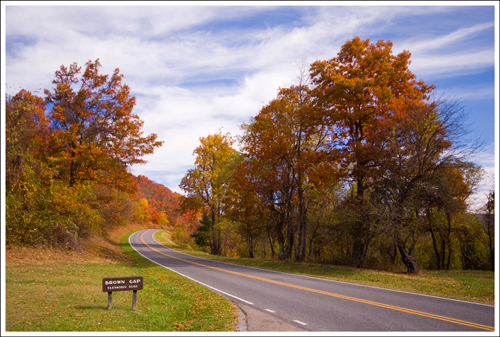
Park at the Brown Gap lot
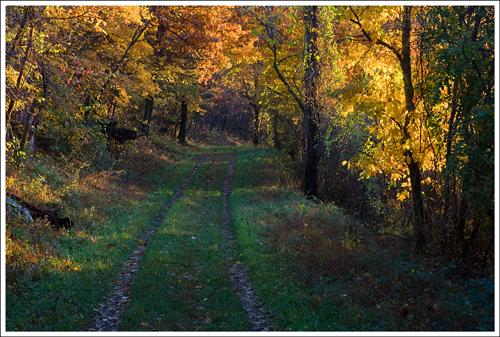
Parking is available at Brown Gap. Pictured Below: The fire road leading down from the parking lot is one of the prettiest in the park; the Shenandoah area has tons of Civil War history. We passed the grave of confederate solder, William Howard, along the way.

We started the hike along the Brown Gap fire road. William Howard, a confederate soldier, is buried along the Brown Gap fire road.

We got to the trailhead at Brown Gap right as the sun was coming up.  It was f-f-freezing and windy.  I carelessly left my hat and gloves at home, so I flipped up the collar of my fleece and retracted my hands into my sleeves.  We set out down the Brown Gap fire road, which is one of Shenandoah’s prettier fire roads.  It’s also where I used to ride my horse, “Friday”, whenever we trailed to the park.  The morning sun was filtering through the golden leaves, and soon the activity of walking warmed me up enough that I didn’t miss my gloves at all.  The fire road was really muddy, so I took that as a good sign that there would be plenty of water flowing in the three waterfalls we’d be passing along the route.

In fact, I was so sure that the waterfalls would be impressive, that I carried all the “big guns” in my photography arsenal – two camera bodies, three lenses, a shutter remote, a collection of neutral density and polarizing filters, extra batteries, memory card and my tripod (the one that feels like it weighs close to 100 pounds when I carry it on long hikes).  I also brought my new tripod bag (by Kinesis) that allows me to carry the tripod backpack style – evenly centering the weight on my back.  The sling style carrier I’ve been using for the past few years twists my neck and shoulders, so I try not to carry it on long hikes.  The new bag was really nice, but it perfectly lined up the camera mount lock lever with my butt.   Every step I took, the lever poked me quite rudely.  I ended up giving the tripod to Adam.  He’s taller, so he escaped the constant prodding.  I ended up carrying the bag with the rest of the gear.  It was much heavier, but still more comfortable.

When we reached the bridge at the junction of the fire road and the Doyles River trail, I groaned in dismay at the dry stream before us.  We walked along the river, or at least where the river should have been for another .3 miles to get to the base of Upper Doyles River Falls.  Normally, there are pretty little cascades leading down to the main double-terraced waterfall.  This time the waterfall was barely a trickle.  We ate our breakfast at the base of “Disappointment Falls” and headed on to the lower falls.

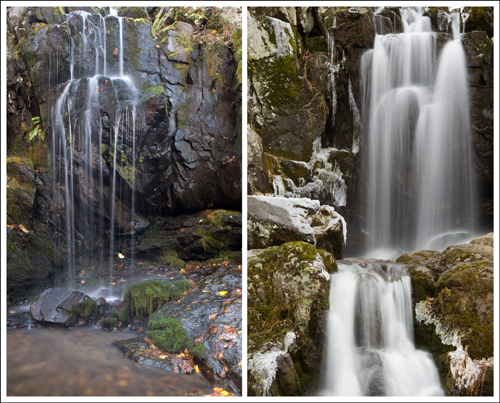
The water is Upper Doyles Falls was low - compare January 2009 to October 2009.
The photo above shows Upper Doyles Falls is October 2009 (left) compared to January 2009 (right).

Surprisingly, the lower falls were running quite a bit more than the upper falls.  I think narrower chasm through the rocks allows the second falls to hold onto more water flow.  The second falls is thin and almost chute-like.   Even though the second waterfall had more water, it still wasn’t anything spectacular.  When you’re a photographer hiking with 40+ pounds of gear and realizing the shots you had planned aren’t going to happen, the gear instantly feels twice as heavy.  I think this is the point that I started to feel like Atlas with the world resting on my shoulders.  🙂

Adam perches on a rock along lower Doyles River Falls.
Lower Doyles Falls was a bit nicer than the upper falls.

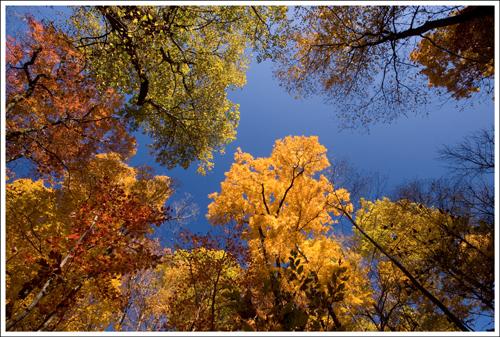
Leaving the lower falls, the trail became incredibly beautiful.  It followed a babbling brook through near-peak foliage.  The trees were a spectacular mix of gold, orange and red – all set off by the brilliant blue sky above.   This was, without a doubt, my favorite section of the trail.

So far, the hike had been relatively easy – just gentle up-and-down grades along the stream.  At the junction of the Jones Run Trail, the real work started.  In just under 2 miles, we picked up most of the elevation gain on the whole hike.  It was steep, hard climbing to reach Jones Run Falls.

The trees above displayed beautiful fall colors
The foliage along the Jones Run Trail was spectacular. Pictured Below:  Jones Run and Jones Run Falls.

Jones Run is a beautiful stream The water was low in Jones Run Falls

The waterfall on Jones Run was running low, but it was still really pretty.  From the waterfall back up to Skyline Drive, the grade of the trail moderates a bit.  It’s still a lot of uphill mixed with periods of flat terrain.  Eventually, you reach the junction with the Appalachian trail and follow it north for a little over a mile back to the Brown’s Gap parking lot.  This section of the AT follows closely to the road, so you constantly hear cars and smell exhaust.  The walk along this section is easy, but rather uneventful.

Overall, I think this was a great hike.  I’m so glad we had a chance to be outdoors on a beautiful fall day, but I wish the waterfalls had been nicer.  We’ll have to try hiking it again in the spring after heavier, more sustained rains.

Adam Says…

While we’ve hiked Doyles River a number of times, this was the first time that we had made a loop of the hike and added Jones Run.   When we have done this before, we parked at the Doyles River parking lot around mile marker 81.  We would normally hike down to both of the falls and then head back.

On this hike, we parked around mile marker 83 at the Brown Gap lot.  We crossed the road and headed down the Brown Gap fire road.  At about .4 miles, you see a short path leading up to the gravesite pictured above.  In about 1.7 miles you will reach the junction with the Doyles River Trail.  Take a right on this trail.   After about two tenths of a mile, you will reach the Upper Doyles River Falls.  There is a short spur path to lead down to the base of the falls.  Once you rejoin the trail, you will then see the Lower Doyles River Falls after a tenth of the mile.  Don’t try to blaze down off the trail to reach the falls.  The trail loops around to bring you closer to the falls.  When you reach near the base of the falls, there is a short, treacherous climb down to the base of these falls.  When you join back to the trail, continue south down the Doyles River Trail.  You will reach the Junction with the Jones Run Trail in about .6 miles from leaving the Lower Doyles River Falls.  You begin your hike up to the Jones Run Falls and will reach them about .7 miles on this trail.  After the falls, you will have a 1.2 mile hike up to the Jones Run Parking lot.  Before you enter the parking lot, there will be a junction with the Appalachian Trail.  Take a right on the AT, heading north until you reach the Brown Gap parking lot.  The AT portion is about 1.3 miles back to your car, leading you to this overall hike of 6 miles.

The woods on the Doyles River - Jones Run trail were gold and red.
The woods were very colorful at the lower elevations. Pictured Below: One downed tree we came across was so large that Adam could climb inside.

This fallen tree was big enough for Adam to crawl into.

The hike is not that long being only six miles, but there is a lot of elevation gain from the base of the Doyles River Trail, leading up to the Jones Run Parking lot.  Christine felt that it may be better to do this hike in reverse, but based on contours, I think either hike has a tough trip back at the end.

The waterfalls along the way on normal days are really some of the nicer waterfalls in Shenandoah National Park.   The water flow didn’t allow us to see them at their best today, but we enjoyed them nonetheless.  The Upper Doyles River Falls stands at 28 feet;  the Lower Doyles River Falls plummets 63 feet.; the Jones Run Falls plunges 42 feet.  If you’re looking for a hike to see multiple falls, this is the best one to do in Shenandoah.

The morning light made the trees glow golden.
More golden foliage along the trail.

On our way back to the car on the AT, we ran into a woman doing the trail in the opposite way.  She had two pugs with her on the hike, named Titan and Zoot.  They were eager to greet us, since they must have known we had three pugs of our own.  They were very energetic to begin their hike to the falls, but we wondered how they fared on the steep way back.  We wish we had taken some pictures of these boys, because they looked like they were ready for a great adventure that day.

Cars waiting to get into Shenandoah National Park
There was a very long line of cars waiting to get into Shenandoah National Park

The foliage was just slightly after peak today.  We decided to exit the south entrance of the park to reward ourselves with some frozen treats from Sonic.  On our way out, we saw the longest line of cars we’ve ever witnessed trying to enter the park at the south gate.  Cars were at a stand-still all the way down to the interstate.  Three rangers were walking down the line, handing out information to make the fee stations handle things quickly.  I guess everyone felt that it would be a nice day to see color in the park and hopefully they weren’t too disappointed in the color.

Trail Notes

  • Distance – 6 miles – loop.
  • Elevation Change –1875 feet
  • Difficulty – 4. The climb up from the bottom of Jones Run is tough!
  • Trail Conditions – 3.5 The trail is well-maintained and traveled.
  • Views –0. You might get a few glimpses of vistas through the woods along the fire road.
  • Waterfalls/streams –4. The waterfalls and streams along this trail are beautiful, especially when there is plenty of rain.
  • Wildlife – 1. Just a couple deer.
  • Ease to Navigate – 4. Trails are well marked and easy to follow.
  • Solitude – 3. You will likely see several other groups of hikers along the way, but it’s not as heavily trafficked as other waterfall trails in the park.

Directions to trailhead:
From Skyline Drive, follow the drive to Brown Gap (near mile marker 83).  The parking lot is on the west side of the drive.  To begin the hike, walk across Skyline Drive and follow the Brown Gap fire road downhill.

Virginia Creeper – Whitetop to Damascus

The Virginia Creeper Trail is a picturesque rails-to-trails path that winds its way for thirty-four miles through the Mount Rogers recreational area.  The trail starts in Whitetop and ends in Abingdon, with Damascus sitting right in the middle.  The area caters to bikers, offering plenty of opportunities for shuttles, bike rentals and food along the way.

Adam crosses one of the many old railroad trestles along the Virginia Creeper Trail.

Adam Says…

The Virginia Creeper Trail is something we’ve wanted to do for years.  It is very well known in the biking world as being one of the best rails-to-trails in the east.

The origin and history of the name has to do largely with the train that used to ride this route.  The train was called the Virginia Creeper due to the slow churning of the train. The trail was also partly named in honor of the native vine that you will normally see turning crimson as an early sign of fall.  The train ran its last trip in 1977 and it was converted and opened as a multi-use trail in 1984.

The Virginia Creeper is a beautiful trail that passes through the woods, often alongside a rushing stream.

signs green cove station green cove station_1

We were expecting rain that day and wanted to hit the trail as early as we could.  We arranged for a shuttle to take us to Whitetop Station to begin our trip.  We recommend the  Virginia Creeper Trail Bike Shop.  They are located in Abingdon and run a shuttle to Whitetop and will even pick you up in Damascus if you are thinking about only doing half of the trail.  After we were dropped off, we decided to not lollygag, since the rain was imminent.  We got through the first couple of miles of the trip with only a few errant raindrops, before the heavier rain started.

Despite the rain, we really enjoyed the beauty of the trail.  There are 47 trestles and bridges that pass over the Green Cove Creek and the Whitetop Laurel Creek.  You get gorgeous views of the rushing water in the creeks; pass by quaint, country farms; and canopy forests.  We picked a perfect weekend to do this trip to see the beautiful fall foliage.  The trail is shared by bikers, walkers, runners, horses, and even an occasional dog sledder in the winter.

Here are a few highlights along the way.  There are also several information signs along the way that provide valuable insight into the history and nature of the area.  You will see mile markers along the way to help point the way.

  • Mile 34 – The Whitetop Station to park your car.  Bathrooms are available. Highest point on the trail at 3576 ft.
  • Mile 30.5 – Green Cove Station sells a lot of essentials and souvenirs.  Bathrooms are also available.
  • Mile 27 – Creek Junction – Parking and Bathrooms are available.  563 foot trestle.
  • Mile 23 – Taylor’s Valley – Parking available. Daniel Boone campsite.
  • Mile 20.7 – Straight Branch – Parking and Bathrooms are available.
  • Mile 20 – Whitetop Laurel Falls – when you see a large overhanging rock, the falls are down a small path on the right side of the trail.
  • Mile 16 – Arrive at the town of Damascus.  Railroad exhibit is available.
There are so many beautiful farm and stream scenes along the trail.
There are so many beautiful farm and stream scenes along the trail.  The huge Christmas Tree farms along the way are lovely. Pictured Below:  The trail follows a rushing stream with many small waterfalls; The fall color was spectacular in Mid-October.

waterfall barn_2

For those that are interested in geocaching, there are a ton on this trail.

We definitely plan on coming back in the spring and tackle this another time.  The rain got us fairly wet and also covered us with “Creeper Streak” – the streak created on your back from the wet dirt being kicked up from our back tire.  We decided to stop after the halfway point and catch the shuttle back to our car.  While the rain was annoying and kept us from relaxing and enjoying the trail as much as we wanted, we still felt the scenery around us made up for it.

Christine Says…

I woke up early the morning of our Virginia Creeper bike ride, peeked out the hotel window and started silently chanting the mantra “please don’t rain, please don’t rain, please don’t rain”.  The sky was that heavy gunmetal gray that promises rain is coming sooner rather than later.  It wasn’t supposed to start raining until the evening, but I was fairly certain that we were going to be in for a soggy bike ride.

Nevertheless, I donned my new padded bike pants and a fleece top and headed over to the bike shop to catch our shuttle ride out to Whitetop Station.  The shuttle services for the Creeper Trail are a great idea, as they let bikers enjoy the whole trail without making a return trip over repeat scenery to get back to your car.  I think most people just bike half the trail – Whitetop to Damascus, but we were really hoping to do the full 34 miles back to Abingdon.

The van ride out to the trail’s end was pretty long – about an hour along winding mountain roads.  The driver shared lots of trail trivia and helpful tips to kill the time.  Some of the things he shared:

  • Celebrities like to bike the Virginia Creeper (Clint Black, Troy Aikman, Emmitt Smith, some NASCAR driver I don’t remember).  Apparently, Brad Pitt even has a home near Whitetop and has been spotted fishing the area’s rivers. (although I can’t find any evidence to corroborate this as fact)
  • Most of the accidents (75%) along the trail happen to males between the ages of 13 and 21.  Boys on bikes are reckless, I suppose.
  • It’s a very bad idea to slam on your brakes when crossing wet railroad trestles.  You WILL wipe out.  I can vouch that this tip is quite true.  We saw the same poor woman wipe out on two separate occasions – both times she was on a wet trestle.
  • The trail is probably the only 34 mile bike ride that you’ll actually gain weight on.  There are snack shops, coffee house, bakeries, ice cream parlors and full service restaurants all up and down the trail.
The trestle supports are very picturesque/
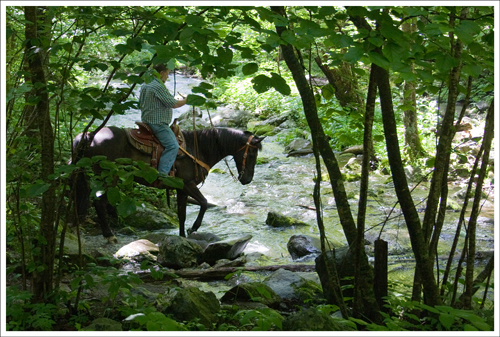
The trestles along the trail are very picturesque. Pictured Below: We were lucky enough to bike the trail during the peak of fall color; The trail is a multiuse trail and is also used by pedestrians and equestrians.

curved-trestle horses

On the ride out, the sky started spitting a bit of rain.  It had stopped again by the time we were dropped off at Whitetop Station.  We kept our fingers that it would continue to hold off.  Adam and I don’t like biking or hiking in crowds, so as soon as we got our bikes off the trailer, we raced off to get a jump start on the crowd of bikers arriving at the trailhead.  Our driver told us that on nice weekend days, the trail might see upwards of 2400 riders.  Area bike shops have 1800 bikes available, and frequently sell out of rentals.  I was a bit surprised that more people rent bikes than bring their own.  Maybe most people don’t own bikes these days.

The trail was gorgeous – a leaf-covered pathway under an endless tunnel of fall-colored trees.  Every now and then, we’d pass an opening that provided a view of the mountains or one of the area’s many vast  Christmas tree farms.  Around Green Cove Station the rain started in earnest, and never let up again.  I had to put my camera in a trashbag I had packed in my bike rack.  There were so many scenes along the way that deserved to be photographed with care.   Sadly, with the rain, all I was able to do was take a few quick snapshots.

Even in the rain, the ride was incredibly beautiful.  I loved crossing the old railroad trestles and riding alongside the rushing streams.   We biked the entire stretch from Whitetop to Damascus in about ninety minutes.  I would have loved to take more time to enjoy the scenery, but it was cold, wet and windy.  I started thinking less about scenery, and more about a mug of hot chocolate and a steaming cup of soup.

In short order, we arrived in Damascus.  We decided to try lunch at one of the places our shuttle driver had pointed out.  He had mentioned that In the Country and Fattie’s Diner were both really good.  I saw “Hot Soup” on In the Country’s sign, and I was sold.

The trail offers many charming places to stop for a delicious lunch or snack
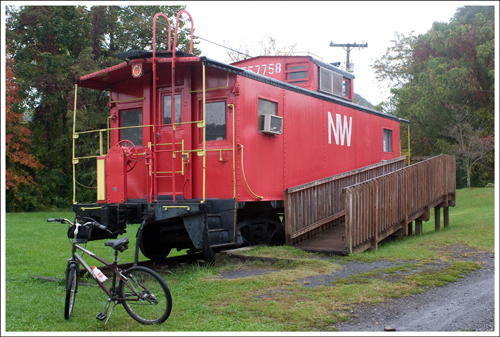
The trail offers many charming places to stop for a delicious lunch or snack.   Pictured Below:  We had a fantastic lunch at “In the Country”; The only red train car along the trail is located in Damascus.

lunch damascus station

The staff at the restaurant was so friendly and welcoming.  They didn’t even flinch when we walked in through their front door, soaking wet  – covered with mud and trail grit.  My ponytail felt like I’d dipped it in wet concrete and my legs were coated with black sludge from my ankles to my knees.  Adam even had mud splashed up and down his cheeks.  They invited us to eat inside in the warmth, but I felt too guilty about my filthiness and chose a picnic table under their covered porch.

Adam and I both got their boxed lunches which included a sandwich, side, drink and dessert.   I chose their potato soup as my side.  It totally hit the spot.  Lunch was washed down with hot chocolate and followed up with delicious homemade pumpkin squares.  We sat on the porch after lunch, watching others from our shuttle group pass by on their way to the pick-up point. I think most bikers take about two and a half hours to bike the Whitetop to Damascus section.

The rain was still falling steadily, and although we wanted badly to see the rest of the trail, we decided to call the bike shop and let them know we’d be joining the shuttle in Damascus.  We met up with everyone at the red train car in the middle of Damascus.  Everybody looked cold, dirty and tired.  The heated shuttle van was such a welcome sight.

It was a real disappointment to miss the second half of the trail, but it’s also a great motivator for us to make a return trip to the area in the spring.  I’ve heard the rhododendron and mountain laurel bloom along the Creeper is amazing!

Trail Notes

  • Distance – 18 miles for this segment
  • Elevation Change – From Whitetop to Damascus, you lose 1646 feet in elevation
  • Difficulty – 1.5.  You hardly have to pedal at all on this stretch of trail, so it is suitable for bikers of all fitness and skill levels
  • Trail Conditions – 3.5.   The trail is in good shape.  There are some errant holes and jutting rocks to watch out for.  Entrances and exits from the trestles can be jarring if you’re going moderately fast.
  • Views – 3.  While the views aren’t high and lofty, they are still beautiful and showcase Virginia’s most picturesque scenery.
  • Waterfalls/streams -4.  The two streams that flow along the trail are gorgeous and include many small waterfalls.
  • Wildlife – 1.  We didn’t see anything, but our shuttle driver told us people regularly spot deer and the occasional bear.
  • Ease to Navigate – 5. The trail is very simple to follow.
  • Solitude0.  People love the Creeper!  On nice days in the spring, summer and fall, the trail can see over 2000 bikers in a single day.

Directions to trailhead:

We recommend hiring a shuttle service in either Abingdon or Damascus.  For a reasonable fee, they will drive you and your bikes to White Top Station.  This lets you enjoy the entire trail without having to backtrack on the return trip to your car.

Short and Scenic West Virginia Walks

Last Saturday, we made a quick trip over the mountains into West Virginia.  The foliage in the Canaan Valley (Tucker County) area is always way ahead of the color change in Virginia.  We set out from home at 5:00 a.m. and made stops at Blackwater Falls State Park, Canaan Valley State Park, Douglas Falls and Dolly Sods Wilderness.  Our whirlwind trip got us thinking about how many short walks in that area have major scenic payoffs.

Let’s start off with a few beautiful spots in Blackwater Falls State Park.  All of the spots listed below are clearly marked on the park’s trail map. Pick up a copy at the lodge.

Lindy Point

The view from Lindy Point looks down into the Blackwater Canyon.

The walk out to Lindy Point is no more than a third of a mile along a relatively level path.  The trail passes through dense rhododendron and can be quite muddy if there has been rain.  At the end of the trail, you’ll come out to a platform built onto the side of the rocky cliff.   The point offers a spectacular view of the Blackwater Canyon.   If you sit quietly, chances are good that you’ll hear the river rushing through the chasm below.  The view is made even more unique due to the enormous free-standing rock “chimneys” that surround the platform.  There are several places that you can crawl through the rhododendron to stand directly on the rocks for a better view.  Despite the spot’s beauty, Christine has not had great luck photographing this spot, but it’s all been a matter of timing.  We’ve just never been lucky enough to hit the point on a day with nice “photo skies.”   The photo included really doesn’t do the place justice.


Elakala Falls

There are several "falls of Elakala" along Shays Run.
There are several “falls of Elakala” along Shays Run.

frozenelakala

This pretty waterfall is accessed by a short trail starting out from the park’s main lodge.  The falls are less than a quarter mile down the trail.   You’ll know you have reached the waterfall when you come to a wooden footbridge over Shays Run.  The falls cascade directly under your feet at this point.  The trail really doesn’t give you a good look at the waterfall, so take the time to follow the “unofficial” foot path down the ravine to the base of the falls.  Elakala is prettiest in times of heavy waterflow.  The stream leaving the base of the falls takes  a beautiful swirling path across the moss-greened rocks.  Don’t miss climbing a little farther down the ravine to see a couple other pretty waterfalls on Shays Run.  The stream actually cascades all the way down to the bottom of the Blackwater Canyon, but it’s not really safe to go much beyond the second or third cascade.  Last winter we were lucky enough to see Elakala falls completely frozen over.   The sound of the water running under the ice was magical that day.


Blackwater Falls

The main attraction in Blackwater Falls State Park

This 62 foot cascade is park’s namesake and #1 attraction.  You’ll have a couple options for accessing the waterfall.  The park road that heads toward the main lodge has a paved, wheelchair-accessible path to a viewing platform far above the waterfall.  The road that heads toward the picnic ground has a longer “staircase-path” that leads to several wooden viewing platforms.  This path puts you a lot closer to the waterfall and offers a much prettier view.   We’ve always liked visiting Blackwater Falls as soon as the sun comes up.  At dawn, the path is deserted and the falls are often shrouded in a thin veil of fog.  During more normal times, the area is extremely crowded with tourists.


And now a couple favorites outside the park.

Douglas Falls – Thomas, WV

The colors of Douglas Falls are amazing!

Blackwater Falls might be the area’s best-known waterfall, but we think Douglas Falls is the most beautiful.   The rocks are brilliant red and the water is vivid green, making for a wonderfully photogenic color contrast.  The color of the rocks is sadly unnatural, created by acid drainage from the mines and coke ovens in the area.  It’s amazing that pollution could create something so pretty.  The ride out to the falls is extremely rugged and potholed.  You should plan on walking a mile or two if you don’t have a 4WD vehicle.   The footpath down to the falls is very short, but very steep. Once you get down to the base of the falls, there is a path that follows the stream for a couple hundred yards.  The whole area is worth exploring, but take extreme caution on the slippery rocks.  The rocks around the stream are coated with slick, clear algae.  We always move “crab-style” along the rocks to keep from falling.


Bear Rocks – Dolly Sods Wilderness

The landscape of Dolly Sods reminds us of Maine.

bear rocks

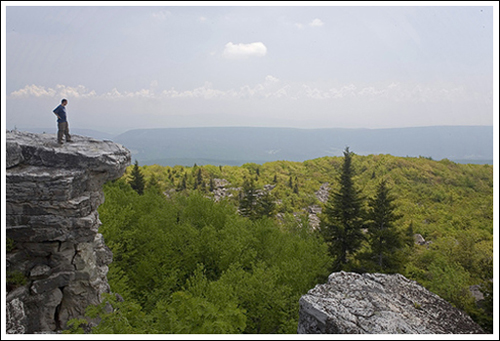
Another place to visit in the area is Bear Rocks in the Dolly Sods Wilderness Area.  The overlook is surrounded by a vast plain of huckleberry and blueberry bushes that turn blaze red in the autumn.  It’s a great place to spot migrating hawks.  The rocky cliff is endlessly fun to scramble around on and provides beautiful views of the valley below.  The plains framing the cliff are patterned with pathways through the berry bushes and punctuated with monolithic white rocks that have been sculpted by time and the elements.  Whenever we visit Dolly Sods, we feel like we’re someplace far north of the Mid-Atlantic region.  It feels more like Maine or Canada. There are several routes into Dolly Sods.  We recommend the route from WV32 onto Laneville Road as the most passable and scenic.  You might even see a black bear along the road if you’re lucky.

Lewis Spring Falls

Lewis Spring Falls is a hike leading to the fourth tallest waterfall in the park.  It starts out from the Big Meadows amphitheater.

This nice view of the layered mountains comes near the end of the hike. This view is much more impressive than the waterfall this trail is named for.

Adam Says…

In my opinion, Lewis Spring Falls is decent for a waterfall hike.  If you are visiting Shenandoah National Park, I would recommend Dark Hollow Falls, Rose River Falls, South River Falls, Doyles River or White Oak Canyon before this one.

We started this trail from the amphitheater at Big Meadows.  You can also take off from the Big Meadows Campground, adding an extra .8 miles to your trip, but we feel this is the best way to see what is necessary. From the parking lot, you’ll go down a very short spur to connect with the Appalachian Trail.  After a short distance, there is a cement post to let you know to leave the AT and proceed on the trail to the right for the Lewis Spring Falls.

The Barred Owl
The Barred Owl

Shortly after we started the Lewis Spring Falls trail, we had a great barred owl viewing.  We heard a bunch of birds causing quite a racket.  We stopped to try to identify the birds, when I spotted the barred owl on the tree.  There were at least six chickadees that were dive-bombing the owl.  Our guess is that they were trying to protect chicks nearby.  As the owl looked in one direction, the chickadees took turns diving down to snip on the owl’s back.  It reminded me of the old elementary school trick, when you would tap on someone’s shoulder to make them look behind their shoulder when nobody was there.  We got to watch this interaction for several minutes before the owl finally flew away to a different tree, giving the chickadees a moment of victory.  However, the owl may ultimately win the war when the sun sets.

The trail down to the falls is quite rocky.  While it is well-traveled, the trail is very steep downhill.  This will make you constantly have to watch where you are placing your feet, as rocks and gravel are very loose.  Once you have traveled 1.2 miles, you will come to a post showing that the viewpoint is shortly ahead.  This post also includes the junction of the trail for your return loop.  You will cross a stream but there are tons of rocks in the trail to make this an easy crossing.

On your return trip from the viewpoint, shortly after crossing the stream, you will take the spur trail to the right that connects to the Appalachian Trail.  This is a constant uphill through more rocky terrain for .7 miles.  You will come to a gravel road and a cement post showing that the AT trail junction is up ahead 70 yards.  Take the AT to the left (north) to get back to the parking lot.  The AT is definitely easier to walk, but the trail stays uphill at a slightly lesser grade.  You will eventually come up behind the Big Meadows Lodge.  There is a nice viewpoint to the west from a rocky overlook, which may give you a nice place to view a sunset and still be close to the parking lot.

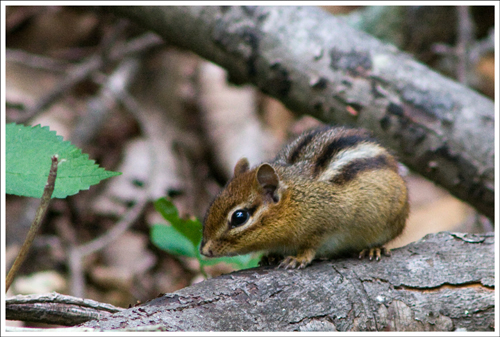
Along with the owl, lots of birds and several deer - we saw lots of chipmunks along the way.
Along with the owl, lots of birds and several deer – we saw lots of chipmunks along the way.

One side note is that before you reach the Lodge, there is a side trail to Blackrock, another popular trail to view a sunset.  This has been closed until further notice due to Peregrine Falcons nesting.

Christine Says…

I told Adam I was going to write a one word entry for this hike and that word was going to be “lame”!  Maybe I was in a crabby mood on this particular evening, but I still think there are so many nicer waterfall hikes in the park.  We hadn’t hiked to Lewis Spring Falls in three or four years.  I had remembered the falls being substantially more impressive than what we encountered on this particular night.  Even with all the wet weather we’ve had this spring/summer, the waterfall was down to a trickle.  When we got to the viewing point, I told Adam that the faucet in our bathtub has a more impressive flow.  My other problem was the light.  Even in late evening, the sun was still high enough in the western sky to put the waterfall in direct sunlight – so, alas – no nice photos of the falls.

Lewis Spring Falls
Lewis Spring Falls

The terrain on the trail down to the falls is tough going – steep, scrabbly rocks that force you to look down and pay attention to every step you take.  I always prefer to hike places where I can look around and enjoy the trail-side scenery instead of constantly following every move of my hiking boots.

We only saw one other pair of hikers along the trail – a couple guys trying to find their way down to the base of the falls. Another drawback to the Lewis Spring Falls is the fact that there is no good, safe way to reach the base of the falls.  Our hiking book advises explicitly not to attempt to climb down – there is no trail and there have actually been fatalities at this waterfall. I do know a few people who have climbed to the bottom, none of them said it was worthwhile. We watched the two guys make a couple unsuccessful attempts to descend before they eventually gave up.

The hike back up is on the long arm of the loop, so it’s a long, steady uphill back to the amphitheater.  By the time we got back, I was pretty tired and hungry.  I’m definitely a morning person through and through.  Evening hikes, even the short and easy ones,  really have a tendency to kick my butt.  If I was pressed to share my favorite thing about this hike, it would have to be the owl sighting.  That was pretty cool.

Trail Notes

  • Distance – 3.0 mile loop trail (longer options are also possible depending on how you connect to the trail)
  • Elevation Change – 990 feet.
  • Difficulty 3.  The route we hiked was moderate.
  • Trail Conditions 2.  The AT section is nice footing, but the trail down to the falls and back up is quite treacherous.
  • Views –2. There are views from the overlook near the falls, but the nicest mountain views are near the end of the hike.
  • Waterfalls/streams 3. Decent waterfall views, but because you can’t get to the bottom easily, you can only appreciate it from afar.
  • Wildlife 3. We have heard a bear on this trail before.  We saw a barred owl and several deer near the Big Meadows area.
  • Ease to Navigate 4.  The trail is easy to follow and marked with blue blazes.
  • Solitude2. You’re likely to see some people here since the close proximity to Big Meadows.

Directions to trailhead:

Follow Skyline Drive to the Big Meadows Area near mile 51.2.  Follow the signs to the amphitheater.  At the parking lot near the amphitheater, you will see the post marking the trailhead.

White Oak Canyon

White Oak Canyon is one of Shenandoah’s most popular waterfall hikes.  The trail begins directly across Skyline Drive from Skyland Resort.

Upper Falls of White Oak Canyon
The upper falls of White Oak Canyon plunge 86 feet to a pool below.

Christine Says…

Adam and I set out early on Saturday morning to hike the White Oak Canyon trail.  Our primary goal was to avoid the holiday crowds, so we were quite pleased to arrive at 7:30 and find just one other car in the parking lot.

The park is always quiet and beautiful in the early morning.

The morning was almost chilly – sunny, no humidity and a crisp breeze blowing.  It felt more like mid-May than the Fourth of July.  I don’t know about you, but I always associate the 4th with sultry, hazy, buggy weather.  Since I’m not a fan of typical Virginia summer weather, I thought the conditions were perfect for our hike.  The only thing I wasn’t thrilled about was the bright sun shining up above in the sky.  Sunny weather is great for hiking and enjoying the outdoors, but it complicates opportunities for waterfall and forest photography.  The strong overhead light makes it nearly impossible to properly expose images.  I was kind of bummed about that, but decided I was just going to enjoy the hike and not worry about getting good photos.

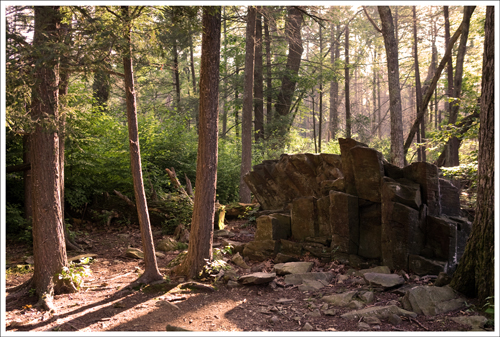
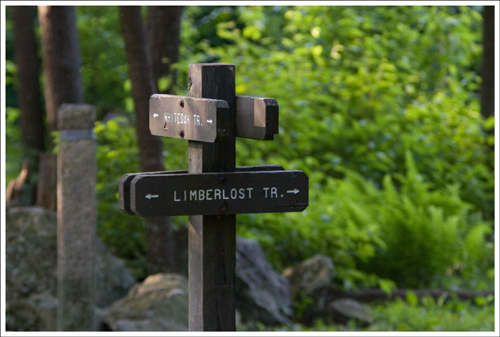
This rock formation sits at the junction of the Limberlost and the White Oak Canyon trail.
This rock formation sits at the junction of the Limberlost and the White Oak Canyon trail. Pictured below: the trail junction.

The trail makes its way down from the parking lot, crossing the Limberlost Trail twice.  After leaving the remains of the hemlock forest around Limberlost, the trail quickly descends into White Oak Canyon.  Ship-sized boulders start coming into view as you approach the stream.  The stream starts off as a trickle, but quickly picks up energy as little rivulets of run-off join the flow.  There are many small falls along the stream.  In places, the sheer canyon walls soar upward from the water.  The canyon is a rugged and wild place.

A pool along the White Oak Canyon stream.
A pool along the White Oak Canyon stream. Pictured below:  the stream passes through a narrow, rocky slot.

As you approach the upper falls, the sound of running water becomes increasingly audible in the woods.  There are two footbridges to cross before you come to the viewpoint of the upper falls.  This view is beautiful, but with a little extra effort you can reach the base of the waterfall and have an even nicer view.  On warm days, the pool at the base of the falls is a popular swimming spot.

A footbridge across the stream.

Luckily, the weather decided to throw a favor my way.  Just as we reached the falls, a large band of clouds passed over the area.  It literally went from crystal clear blue skies to thick overcast in the span of five minutes.  I was able to photograph several spots along the waterfall before the clouds blew out as quickly as they appeared.  I even got knee-deep in the water at one spot to get the composition I wanted.  It was so slimy and slippery, so I used my tripod as a crutch.  I saw lots of brook trout darting in the pool.  They’re so pretty and colorful.  They almost look like autumn leaves swimming in the water.

Cubs on the White Oak Canyon Trail.
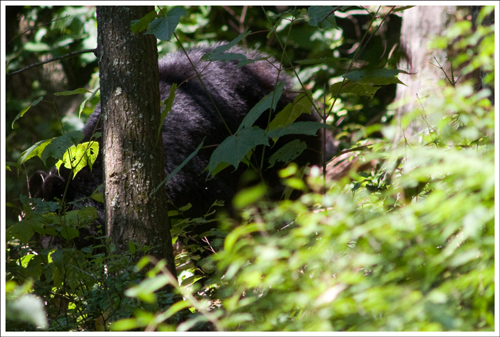
Cubs on the White Oak Canyon Trail. Pictured below: another shot of one cub and a view of momma bear’s back.

cub_2

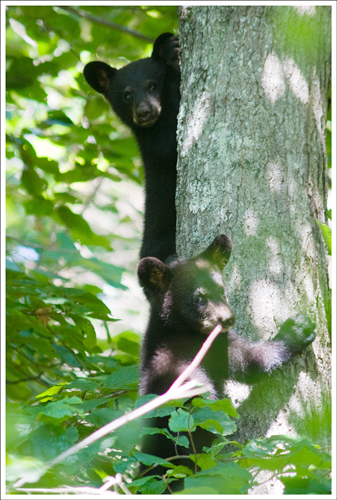
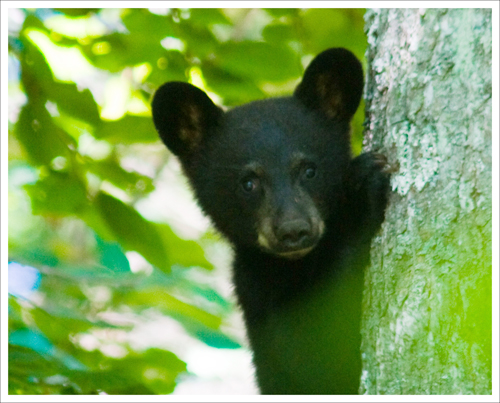
On the hike back, I stopped to take a water break.  As I was sitting on a trail-side rock, I noticed a glossy, black shape moving quietly through the woods about 50 feet uphill from the trail.  I mouthed “BEAR!” to Adam.   A moment later, the sow and her two young cubs came into clear view.  We sat and watched the family for about ten minutes.  The momma bear moved parallel to the trail, turning over rocks looking for food.  The cubs bounced along behind her.  When they finally noticed us watching them, the cubs darted up a tree and watched us curiously.  Momma bear glanced up a few times, but mostly continued feeding along the way.  She soon ambled uphill and away from the trail.  With just a quick look over her shoulder, she called the cubs to her.  The cubs slid down the tree and scampered off into the woods with their mother.  Seeing the bears was the highlight of the hike.

As we continued our return trip, we passed dozens of hikers.  When we got back up to the Limberlost, there was even a church group hiking with 40+ members, lawn chairs, musical instruments.  I’m so glad we hiked the trail early and were able to enjoy the solitude.  You really can’t beat having a gorgeous waterfall and a great bear sighting all to yourselves!

Adam Says…

The White Oak Canyon trail is a great hike if you’re into streams and waterfalls.  This hike and Dark Hollow Falls are probably the two most popular trails in all of Shenandoah National Park.  Since this trail is so close to Skyland, it appeals to a lot of people.  There is a reason why the parking lot for this trail is so large.  This was the first time that we had hiked this trail from Skyline Drive.  Typically, we have visited the lower section of falls and approached the hike from State Road 600 near Syria, VA and Graves Mountain.  Going from the lower falls to the upper falls is quite steep, so if you want an easier day hike, I would recommend doing either the hike to the upper falls or the hike to the lower falls (instead of the full 8.2 mile loop).

Upper Falls of White Oak Canyon

Taking off from the parking lot on Skyline Drive, the trail is very well-traveled and smooth until you start seeing the water to your side.  At .3 miles, you will cross the Limberlost Trail which you could add to your trip if you desire.  The trail then presents more rocky conditions and you do have to watch your feet.  As you hike along the water, you will see several spots to pause and admire the rushing water.  At 2.2 miles, you will reach the top of the Upper Falls.  There is a horse trail that cuts the trail perpendicularly and you will notice the hitch posts for horses on the trail.  The water looks very peaceful here, but it soon rushes down into a deep chasm.

Scenery near the top of the first falls.

The viewpoint at 2.4 miles has some great views of the falls from above and the canyon cutting through the forest below.  You will also see some dead hemlocks standing along the gorge.  I can just imagine how magnificent this would have looked with the hemlocks still there.  From the viewpoint, continue on the trail for another .3 miles.  This is a sharp descent, but it will lead to the view from the base of the falls.  You will come to a cement post which lets you know you are .2 miles from the next set of falls.  This is also the marker that states you’ve reached the base of the falls.  I think the park has abandoned an official trail to the pool at the bottom of the Upper Falls, but if you make your way along the rocks heading north from the cement marker, you will shortly come to a “No Camping” sign.  Continue a little further and you will be able to see the impressive falls from the base, which includes the pool where the waterfall plunges.  This is definitely worth taking the time to view.

The pool at the base of the falls is a perfect swimming hole.

We headed back from this point, since the other falls are not quite as impressive.  This made for about a 5.4 mile hike.  I have a feeling that a lot of people continue to do the whole hike without planning ahead.  There is even a sign at the base of the Upper Falls warning hikers not to overestimate their hiking skills.  Once you pass the upper falls, the continuation of the hike down is quite steep.  The phrase in hiking, “What goes down, must come up” definitely applies here.  The hike back up would be a steady uphill climb that would likely exhaust people who haven’t planned appropriately.

We both enjoyed seeing the momma bear and two cubs frolicking near the trail.  We were able to show/warn two other hikers about the bears presence.   I could tell they really enjoyed the viewing, too.  The bear wisely moved away from the trail, probably sensing that many more hikers were headed in her direction.

Trail Notes

  • Distance – Anywhere from 4.6 to 8.2 miles (we hiked about 5.4 miles)
  • Elevation Change – Around 1200 feet. (2450 if you do the entire 8.2 miles)
  • Difficulty 3.  The route we hiked was moderate.
  • Trail Conditions 4.  The trail is well-traveled and well-maintained.
  • Views –0. No views – the entire hike is down in the woods.
  • Waterfalls/streams 4. One of the park’s nicest waterfall hikes.  If you do the shorter out-and-back, you’ll see one large waterfall and many smaller ones.  If you hike the full loop, there are six waterfalls.
  • Wildlife 4. We saw a bear with her cubs, lots of chipmunks and a rabbit.
  • Ease to Navigate 4.  The trail is easy to follow and marked with blue blazes.
  • Solitude0. Unless you hike this trail very early in the morning, expect to see substantial crowds. It’s one of the most popular hikes in the park.

Directions to trailhead:

Follow Skyline Drive to the Skyland Resort area.  The parking lot for White Oak Canyon is on the east side of the drive between mile markers 42 and 43.  It’s almost directly across the drive from the south entrance to Skyland.

Crabtree Falls

Crabtree Falls is probably Virginia’s best-known waterfall hike. The hike is located a short distance from the Blue Ridge Parkway. The trail climbs alongside the falls and ends at an overlook of the Tye River Valley.

This is the first large cascade you'll encounter on the hike.
This is the first large cascade you’ll encounter on the hike.

Christine Says…

Crabtree Falls, located in George Washington National Forest’s Glenwood & Pedlar Ranger Districts, is one of the classic “must-hike” Virginia trails. When the area is experiencing good amount of rainfall, the 1,200 foot series of falls can be truly impressive.

Adam and I left our house at 5:45 a.m. on the morning of this hike. I wanted to get to the area before the sun started shining into the gorge. Sunny days usually mean crappy waterfall photos. On the morning of our hike, the area was forecast to have quite a bit of fog. I was really excited and had visions of the falls – cascading through the mist, lined with lush, blooming mountain laurel. Unfortunately, it was not to be. When we arrived, the fog was gone, the sun was already high in the sky and the laurel had mostly gone to seed. Nonetheless, I was still able to find a few shady spots along the way to take photographs.

The beautiful arched bridge over the Tye River.

The trailhead is located at the upper parking lot of the Crabtree Falls area. There is a $3.00 fee to use this area. Even though the trail starts from the upper lot, don’t miss walking down to the lower lot to take a walk across the beautiful laminated wooden arch bridge that crosses the Tye River. It was delivered to the area in a single piece and has graced the spot since 1978. Crossing the bridge used to be part of the hike, but improvements to the area expanded parking, added restrooms and shortened the trail.

As you start the hike, don’t neglect reading the bulletin board at the trailhead. It provides many cautionary tales concerning the waterfall’s deadly terrain.  As of June 2015, 29 people have fallen to their deaths at Crabtree Falls – most of them teenagers and young adults. The rocks surrounding the stream are coated with transparent algae. It doesn’t look wet or slippery, but it’s honestly as slick as grease in some spots. The forest service is always warning hikers to stay off waterfalls – but they really mean it at Crabtree.

Adam climbs the steps along the Crabtree Trail.

The first impressive cascade is at the very bottom of the trail and is accessible along a level, paved walkway. The trail to the summit starts on the right side of the paved path, and climbs quickly upward. The trail makes use of steps, railings, wooden walkways and switchbacks to traverse the steep terrain. Some of the switchbacks meander quite a distance from Crabtree Stream, but the sound of rushing water is ever present in the woods. You never move so far from the stream that you can not hear the sound of the waterfall. It’s such a soothing sound. There are five major cascades (and many smaller ones) that make up Crabtree Falls.

The trail is mostly well-graded and maintained. There are a few rocky sections, and some of the rocks may be loose or slippery. On the day we hiked, the trail was really muddy from all the recent rain, but it was still easily passable. I think most of the pretty sections of the falls are within the first three-quarters of the hike. The big, dome-shaped cascade at the top is impressive to see, but it just doesn’t photograph well. At the Tye Valley overlook at the top, you can’t see the falls below you at all. If you hadn’t just walked along the waterfall on your hike, you might not even believe it’s there. The view from the top is just so-so – mostly just tree-covered mountainsides. It pales in comparison to the waterfall views. Most hikers choose to turn around at this point, but you also have the option to continue the hike along the stream, ending up at Crabtree Meadows.

There are discrepancies about the length of this hike. On the internet, I’ve seen it listed everywhere from 2.2 to 4 miles. The on-site plaque at the base of the falls says the hike is two miles to the top, for a total 4 mile out-and-back. Our Blue Ridge Parkway hiking guide lists the hike at 3.4 miles, out-and-back. It seems like the happy medium distance, so we’ll go with that measure.

Adam Says…

The hike along Crabtree Falls is one of the best waterfall hikes, since you hike along the falls for most of the way.  I haven’t experienced any other hike in Virginia that allows you to walk along such an impressive series of falls.

Another beautiful section of falls along the trail.

This was our second trip to Crabtree Falls.  We were hoping to go in the late spring or early summer for views of mountain laurel along the stream.  It looks like in this area, we just missed the peak by about two weeks or the laurel didn’t bloom as well this year.  When you reach the top of the falls after a 1.7 mile hike, there is a stone platform at the top that provides you with nice views of the Blue Ridge Mountains.

The view from the top.

Near the entrance to the paved trail you will see a small family cemetery.  These are actually distant relatives of mine.  My great grandmother was a Fitzgerald and owned the farm next to the McCormick Farm.  My mother used to visit that farm often when she was little.  If you are interested in history, the McCormick Farm is open to visitors and has lots of exhibits showing the early farming techniques.  Cyrus McCormick was the inventor of the mechanical reaper which revolutionized farming.

This is a great hike that a lot of families do before picnicking at one of the tables near the lot entrance.  I know we will visit this location time and again.

Trail Notes

  • Distance 3.4miles out-and-back.
  • Elevation Change – 1000 feet
  • Difficulty – 3. This is a fairly steep trail with plenty of switchbacks.  However, most people will stop along the way to enjoy the falls, so it breaks up the pace.
  • Trail Conditions – 3. There are lots of pointy rocks along part of the trail, but there are some sections that are very nice.  The view to the lower falls is even paved for wheelchair access.
  • Views – 2. At the top of the falls, you get a decent view of the Tye River Valley
  • Waterfalls/streams – 4.5. This is one of the best waterfalls in the Central Virginia area.
  • Wildlife – .5. You probably won’t see anything here other than people.
  • Ease to Navigate – 4.5. Just stay on the trail.
  • Solitude –1. This is an extremely popular hike, so you will surely see people along the way.

Directions to trailhead: If you are approaching from I-81, take exit 205 towards Steeles Tavern.  Take a left on to Rte. 11 and then a quick right on to VA-56 heading east.  Follow this past the Blue Ridge Parkway (near BRP Mile Marker 30).  After a few more miles, you will see the signs for the parking area of Crabtree Falls on your right.  The parking lot loops around and you will see the trailhead and map near the restroom facilities.

Mill Prong – Rapidan Camp Trail

The hike to the Rapidan Camp (also known as Camp Hoover) is probably one of our very favorite walks in all of Shenandoah National Park.  We had such a great time there today.  It was one of those really perfect mornings along the trail.

The Brown House (as opposed to the White House) is where President Hoover stayed.
The Brown House (as opposed to the White House) is where President Hoover stayed when he wanted to escape the heat, stress and formality of Washington, D.C.  Below are photos of (left to right): The main entry to Brown House has steps that lead down to the Rapidan River; the house has a large patio overlooking the river – it was a popular place to relax in Hoover’s day; the Mill Prong was running beautifully today.

Brown House historical Mill Prong

Adam Says…

This is probably my favorite hike in Shenandoah National Park.  The reason I would say this is due to the combination of the history and scenery.

The hike isn’t too difficult, but there are three sets of rock-hopping that you’ll need to do over the Mill Prong.  Due to the recent storms, we actually had to wade across the the third stream crossing since the rocks were mostly submerged and we didn’t want to risk dropping Christine’s camera gear into the water.

The Rapidan Camp was built for Herbert Hoover during his term of office to serve as the first Presidential retreat.  Hoover was an avid outdoorsman and fisherman.  Shenandoah National Park was being built around the same time.  In order to hopefully get the park approved, they encouraged Hoover to build his retreat here.  Marines were brought in to build the camp, which included the construction of thirteen buildings and electrical/phone lines.  Interestingly enough, they heavily stocked the Rapidan River with lots of trout before Hoover arrived, so he would have lots of successful fishing trips.  When Hoover left office he donated his camp (which he paid for out of personal funds) to the government.  Hoover’s initial plan was to have the Camp serve as the permanent presidential retreat.  Due to Franklin D. Roosevelt’s wheelchair-confinement and his strong dislike of Hoover, he decided to establish a new retreat in the Catoctin Mountains of Maryland which he called Shangri-La (it was renamed by Eisenhower as Camp David).  It is interesting to think about what it would be like if the presidential retreat stayed at Camp Rapidan and how that could have impacted the park.

There does seem to be some good trout-fishing in the areas nearby, but it is all catch-and-release.  Of course, it’s not stocked like it was for Hoover.

If you aren’t able to see inside the Brown Cabin (see Christine’s info below), you can still walk around the grounds and read about the history of the area.  I would highly recommend bringing a lunch or snack. The back porch is a great place to eat and reflect on the history of this time.

Big Rock Falls is located along the trail right before you cross the river.
Big Rock Falls is located along the trail right before you cross the river. Below are photos of (left to right): the trail is lined with lush ferns; Adam wades across the stream; a pretty spot along the Mill Prong.

Ferns Deep Water mill prong_2

Christine Says…

We’ve hiked to the Rapidan Camp many times, but today was my favorite trip down the trail ever.  It was just one of those magical mornings where everything felt especially beautiful and perfect.

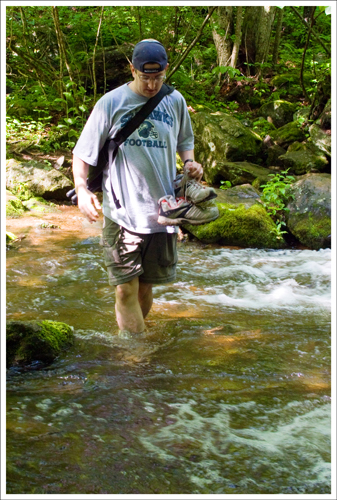
We got an early start, so the only people we came across on the way down were Boy Scouts hiking back out after a weekend of camping.  As we passed them, I had to wonder how they fared last night.  We had some fierce thunderstorms that rolled through around 3:00 a.m.  I was thrilled to see how flush with water the Mill Prong and the Rapidan River were.  Even the small waterfall, Big Rock Falls, looked impressive this morning.  When a crucial rock hop proved unavailable due to the high water, I enjoyed wading barefoot across the stream.  I thought the water would be cold, but it was actually pleasant and refreshing.

Probably the best part of the hike was our tour of the Rapidan Camp.  The volunteer ranger was just opening up when we arrived and gave us a private look at the President Hoover’s cabin, also known as “The Brown House”.  Although the cabin looks rustic on the outside, the inside is quite refined and cozy.  The floor is beautifully smooth wood, there are two bathrooms, two bedrooms, two huge stone fireplaces, hand woven rugs and a lovely study/office that overlooks the headwaters of the Rapidan River.  Until 1996, the Brown House was available to high-ranking politicians and V.I.P.s.  Al Gore was actually the last person to “rent” the Rapidan Camp for personal use. (Sandra Day O’Connor and Jimmy Carter have also been guests of the Rapidan Camp.)

The cabin is open for tours most days, May through October.  Volunteers have Tuesday and Wednesday off, so if you want to see inside, hike it on another day.  Each volunteer ranger actually gets to live at the camp for their three-week tour of duty.  The volunteer stays in the nearby Creel Cabin, which is one of the only three original buildings left standing.  The volunteers maintain the property and give tours to visitors.  The camp is also accessible on a ranger-guided program.  So, even folks who can’t (or don’t want to) walk can still see the site.

There is a fantastic exhibit set up in the “Prime Minister’s Cabin”.  It has many old photos and detailed information about the engineering feats required to build the camp.  Be sure to look at the large version of the letter pictured below.  It shows a lot of the planning that went into picking the site.

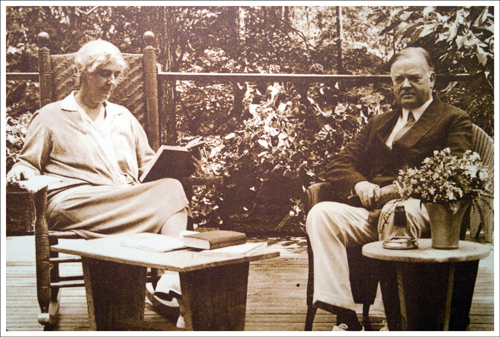
President and Mrs. Hoover
President and Mrs. Hoover enjoy the deck of the Brown House. Below are photos of (left to right): a letter from William Carson explaining preparatory steps to get the camp ready for Hoover; horses crossing the river; another historical photo of the Hoovers.

letter horse crossing historical_2

Trail Notes

  • Distance – 4 miles
  • Elevation Change – 750 feet
  • Difficulty – 2. The elevation change is gradual which makes it a fairly easy hike.
  • Trail Conditions – 4. The trail is in great condition, with few rocks or roots sticking up.  The rock-hopping could be a little challenge to anyone not stable on their feet.
  • Views – 1. Only views of the streams and the camp area.
  • Waterfalls/streams – 4. If it’s good enough for a former President, it should be good enough for you. 🙂
  • Wildlife – 1. Probably not as likely to see bigger animals due to popularity of the trail.  
  • Ease to Navigate – 4. Only a few turns to get to the camp.
  • Solitude – 2. You will likely see others here, but you should be able to find your own spot to enjoy the scenery and history.

Directions to trailhead: The hike starts at mile marker 53 on Skyline Drive.  Park in the Milam Gap lot, then cross the drive.  The trail picks up on the other side of the crosswalk.  You’ll quickly come up to a park post and take a left to start the trail.

Rose River Loop

The Rose River Loop is one of Shenandoah National Park’s most beautiful hikes for streams and waterfalls.  Over the course of 3.7 miles, you’ll hike along the Rose River, the Hog Camp Branch, and finally up the Rose River fire road.
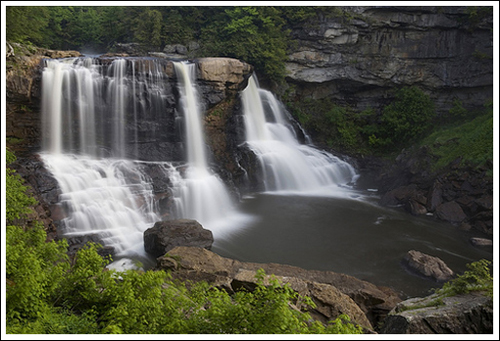
A new log is resting on the crest of the falls
Two large fallen trees obscure Rose River falls.

Adam Says…

This hike is one of our most-repeated hikes in Shenandoah National Park.  It has some great views of running water throughout the trail. This isn’t the most secluded trail since it connects to Dark Hollow Falls.  However, you should normally only come across a few other people on this trail.  There are some good places to do some trout-fishing along the river.  The man pictured a few photos down had caught a 8.5 inch trout the day before at the same spot.

The hike starts off at the parking area just north of the Fishers Gap Overlook.  Cross the road and follow the Skyland-Big Meadows Horse Trail for .5 mile.  There is a steady downhill grade, but it’s not too steep. At .5 miles, you’ll reach the junction of the Horse Trail and the Rose River Trail.  Go right and follow the Rose River Trail, continuing downhill.  Once you reach the bottom of the trail in about a mile, you’ll hear the water. The trail continues alongside the stream for a ways.  You will reach Rose River falls at 1.3 miles.  They are impressive, but more beauty awaits along the trail.  For fans of long-exposure photography, this is a paradise.

The trail will pass an old copper mine at 1.8 miles.  Some people like to explore the old mine, but we don’t think there is anything worth seeing there.

For the next mile, the trail closely follows the stream.  It is very rocky and can be icy or muddy depending on the weather.  There are tons of small waterfalls, slides, and plunge pools to explore.

At 2.7 miles, you will reach the footbridge at the bottom of Dark Hollow Falls.  Turn right, cross the  bridge, and follow the Rose River Fire Road uphill.  At 3.3 miles, you will pass the Cave Cemetery on the right.  At 3.7 miles, you will arrive back at Skyline Drive and your vehicle.

You can see from some of Christine’s pictures that there is really a lot of nice water to see on this trail.  I highly recommend doing this if you have a day or two in the park.

Some graves date back to the Civil War.
Some graves (not this one) in the Cave Family Cemetery date back to the Civil War.

As I usually like to comment, there is a geocache located here.  For those that are unaware, physical geocaches are not allowed in National Parks.  However, there is a small cemetery located off of the fire road that is considered private land and not owned by the Park Service.  The cemetery was used by the people who used to live in the mountain hollows before the government took their land for the park in the early 1900’s.  The Cave family gave permission for a geocache to be placed here called Viking Treasure Cave. ETA:  This cache has since been removed from the park (September 2010)

Christine Says…

When we started down the Rose River trail, I couldn’t help but skeptically watch the blue sky peeking between openings in the trees above.  The local weatherman had forecast a cloudy morning, but as we hiked along the sun began sending down rays and making a dappled pattern across the forest floor.  It was lovely to look at, but was definitely not the kind of light I was hoping to have for the stream and waterfall photos I wanted take.  You see, the Rose River Loop is one of the very best hikes in Shenandoah for folks who enjoy photographing running water.  It’s also the place where my brother proposed to his now wife.  They were engaged on a bitter cold New Year’s Eve camping trip somewhere along the Rose River.

The Rose River
The Rose River has many beautiful small, unnamed falls.  I’ve named this one “Slip and Slide Falls” because the bushwhack down to the base is so steep.

Even though the light made photography a challenge today, I found several spots to shoot along the Rose River.  We had to bushwhack off the trail a couple times, and all I could think about were ticks.  I don’t think I’ve recovered from our walk down the Dry Run Falls fire road yet.

One bushwhack in particular was especially steep, slick and muddy.  As luck would have it, it also offered the prettiest of all the little cascades along the walk.   When I looked down the ravine, for some reason my inner girly-girl came out.  I announced to Adam that I wasn’t going down there no matter what.  He said “Yes, you are!” and took my camera away and starting climbing down without me.  I was left with no choice but to follow.  I got really muddy and touched a gross centipede-like creature.  I’ll never like bugs!

We stopped at Rose River Falls for a few shots.  For the past few years, there has been a huge fallen tree lying across the waterfall.  It’s still there, but now there is a new downed tree stuck at the crest of the waterfall.   Both trees are way too big to move, and will likely be there for years to come.

We paused at a couple other places along the Hog Camp Branch for photos, but there was another photographer who was consistently about ten minutes ahead of us on the hike.  Each time we got to a spot I planned on photographing, he was already there.  He looked pretty serious getting his shots.  At one spot, he even donned chest high waders and water shoes so that he could get to the middle of the stream for an ideal composition.   I skipped a lot of my favorite photo spots along the Hog Camp because I always feel a bit rude stepping into somebody’s shooting space.

I had my tripod all set up when the fisherman jumped into my scene
Speaking of stepping into someone’s shooting space… I had my tripod all set up when this fisherman dropped into my scene.  Oh well 🙂

We finished the loop hike on the Rose River fire road.  The last mile on the road is always my least favorite part of the hike.  The fire road is easy walking, but yawn… it’s a bit on the boring side. Despite the dull last leg, the Rose River loop is a must-do hike for anyone visiting Shenandoah.

I'm so lucky that Adam routinely offers to carry all my photography gear.
I’m so lucky that Adam routinely offers to carry all my photography gear.

Trail Notes

  • Distance – 3.7 miles loop trail
    (Check out the stats from Map My Hike)*
  • Elevation Change – Around 900 feet
  • Difficulty – 2. Some downhill and uphill, but it’s not too bad.
  • Trail Conditions – 3.5. There are some areas along the river that are more like a 2, but there are some areas that where it is more like a 5.  Footing is tricky around the climb up after the red bridge.
  • Views – 0. Just waterfall and stream views.
  • Waterfalls/streams – 4.5. Some of the most continuous views of water that allow for some great water photography.
  • Wildlife – 1. Some birds and chipmunks, but not much else here.
  • Ease to Navigate – 5. Trail is well-marked and there aren’t any spurs until you get back to the fire road.
  • Solitude – 3. Not the best on solitude, but you won’t run into a ton of people.

Download a trail map

Directions to trailhead: The trail is located on Skyline Drive.  Park at the Fisher’s Gap Overlook (at mile marker 49.4 miles), cross the road and pick up the trail.  The Rose River Loop starts to the left of the fire road.  You will see a cement marker.