This 8.35 mile hike (with an optional .4 mile detour to the Pass Mountain Hut) follows the Appalachian Trail through beautiful forest and past one decent view.
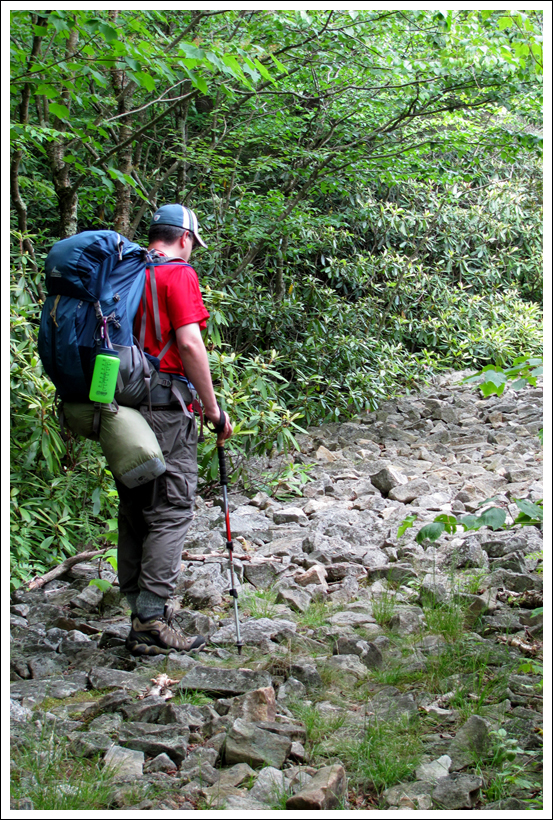
Path to Pass Mountain Hut. Below: Adam walks along the Appalachian Trail descending Pass Mountain; Rocks along the trail descending Neighbor Mountain; We crossed Skyline Drive at Beahm's Gap.
Christine Says…
Last weekend was one of my only free weekends between July and August (lots of art shows and an upcoming trip to Maine!), so we decided to go for a hike. I wasn’t in the mood to go anywhere that required a long drive, so we settled on doing another section of the Appalachian Trail in Shenandoah National Park. We’ve completed the central district and a couple segments in the south district, but we had yet to hike any of the AT in the park’s northern section. To make the drive time the shortest possible, we chose to hike from Elkwallow to Thornton Gap (Rt. 211).
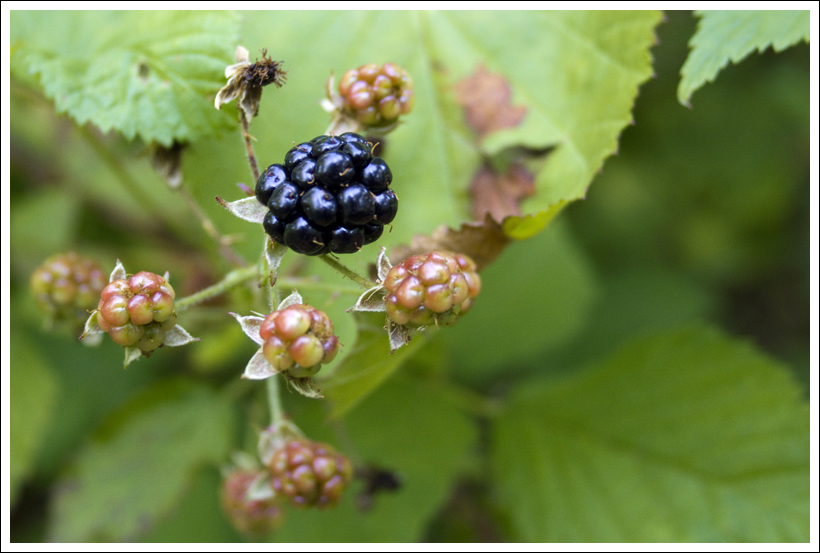
We started out at the Elkwallow Picnic Area, the same exact spot we began our backpacking loop down to Jeremy’s Run last year. After a short downhill to meet the AT, we began a gradual, steady climb up the trail – the first of three significant climbs on this section of trail. We passed lots of thickets of ripening blackberries along the trail. We also saw a lot of eastern red columbine still in bloom.
Blackberries along the trail. Below: Red eastern columbine; a couple unidentified wildflowers; Indian Pipes
After the first climb, the trail is really gentle and level until you reach the next climb, headed up Neighbor Mountain. The Neighbor Mountain trail, which branches off the AT, is another option for making a loop with Jeremy’s Run. It’s a little longer than the Knob Mountain Loop we chose, but the steepness of the climbs are a little more gradual. At the junction of the AT and the Neighbor Mountain trail, we ran into two gentlemen that turned out to be doing the same exact segment hike we were working on. They offered us a share of their fresh picked peaches and plums from a local orchard!
Near the trail junction, you have the option to take a side loop past Byrd’s Nest #4, but we decided to stay on the AT. Descending Neighbor Mountain is a little steep and rocky. On the steepest part of the descent, we passed three section hikers slogging uphill. Near the bottom of the descent, we stopped for a snack and were eventually passed by the two guys we met at the Neighbor Mountain junction. We continued to play ‘leap frog’ with them for the remainder of the day.
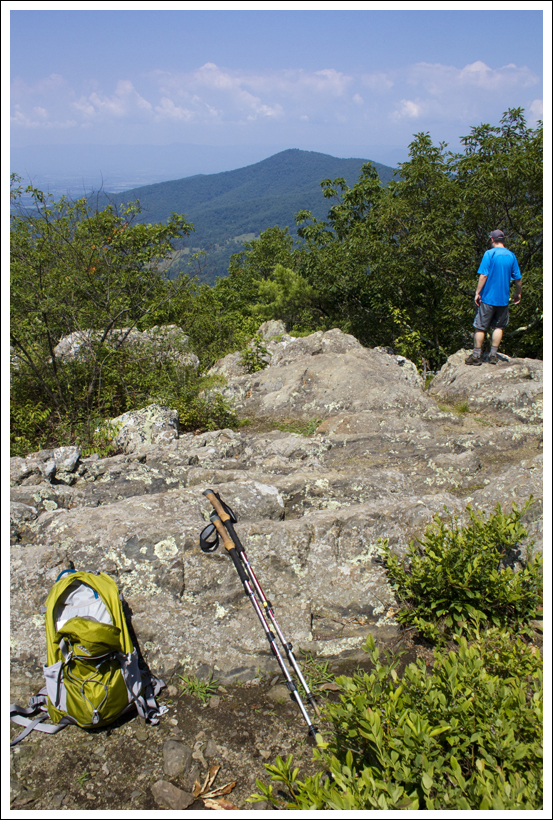
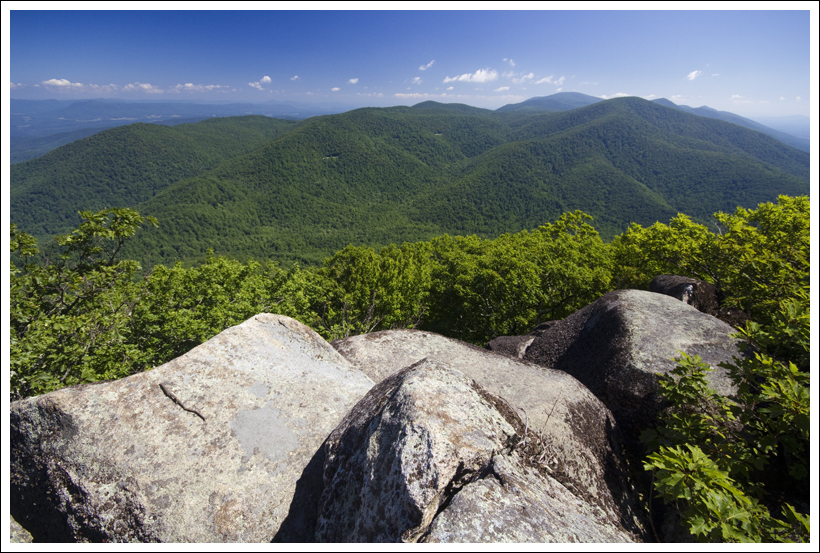
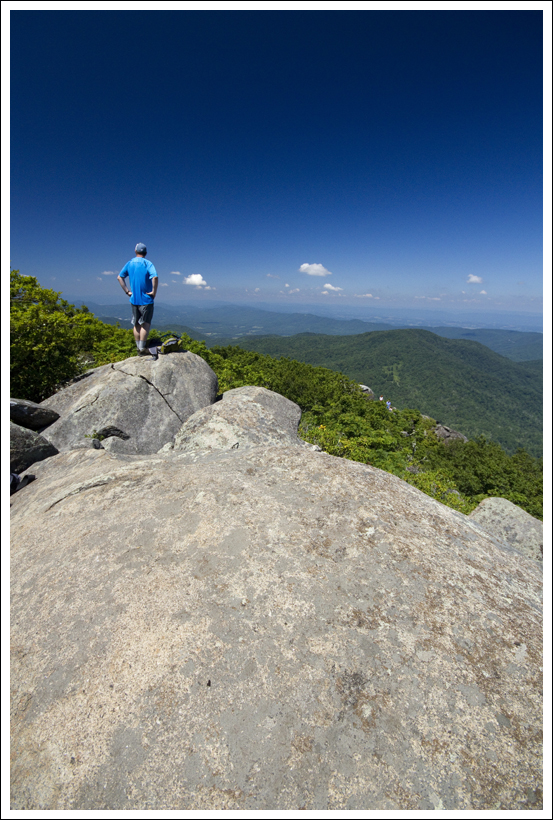
Adam takes in the view from Pass Mountain. Below: Blueberries ripening; Adam picks berries.
A bit later, we crossed Skyline Drive near the Beahm’s Gap overlook and began the final big climb of our hike – over Pass Mountain. I didn’t really expect any views on this hike, so I was pleasantly surprised to find a very nice overlook just north of the Pass Mountain Summit. It was a little hazy, so the view wasn’t as pretty as it could have been. Even if the views were slightly lacking, the abundant wild blueberries more than made up for it! It was one of the thickest, densest accumulations of ripe berries I’ve ever seen! (and this is coming from someone who has spent many, many summers in Maine).
The park has a policy allowing limited gathering of berries, nuts and seeds for personal consumption, so we ended up picking about a quart of berries. I made vanilla-blueberry pancakes with them. YUM!
After we picked berries, we had a short distance more to climb over the summit. After crossing the high point, the remainder of the hike was an easy downhill grade for a couple miles. With about 1.5 miles left, we passed the spur trail to the Pass Mountain Shelter. I ditched my backpack and hiked the extra .2 miles down to the shelter. It was set in a pretty opening under the trees. I took a peek at the journal and noticed one of the recent entries mentioned a bear visiting the shelter!
After the shelter, we continued downhill back to the car. When we crossed 211 to get back to where we parked, we noticed that there were police cars and park rangers all over the road. It turns out that 211 was closed due to a fatal motorcycle accident – very sad. Since we had to wait for the road to open, we headed back into the park to get some lunch at Elkwallow Wayside. It was a tasty, indulgent treat after our hike.
Adam Says…
Well, we’ve reached about the halfway point in covering the Appalachian Trail through Shenandoah National Park. With the Central District done, we have been starting to work on some other sections in the North and South districts. This was our first section through the North District.
We parked one car on 211 near the sign for where the Appalachian Trail crosses and outside the park boundary. We drove the other car to the Elkwallow Picnic Ground. The trail starts right near the privy and heads down into the woods. Continue on this spur trail for a short distance until you reach the junction with the Appalachian Trail. Take a left heading south on the white-blazed trail. In about a quarter of a mile, you reach a junction with the Jeremy’s Run trail but stay on the Appalachian Trail. The trail begins to ascend fairly steeply and you will gain about 500 feet of elevation over the next mile. The trail levels off at this point and even starts to descend for the next two miles. At 3.2 miles, you will start another ascent of 400 feet. You will then pass a junction with the Neighbor Mountain and Byrds Nest 4 trail. We stayed on the AT, but you can take the trail to the Byrds Nest shelter and it will rejoin the AT after the shelter. The trail descends again over the next mile and you reach Skyline Drive at the Beahms Gap parking area at mile 5.2. Cross Skyline Drive and begin the ascent up Pass Mountain as you gain 600 feet of elevation over the next mile. Once you reach the unmarked summit of Pass Mountain, the hard part is over and it is two miles back to your vehicle on 211.
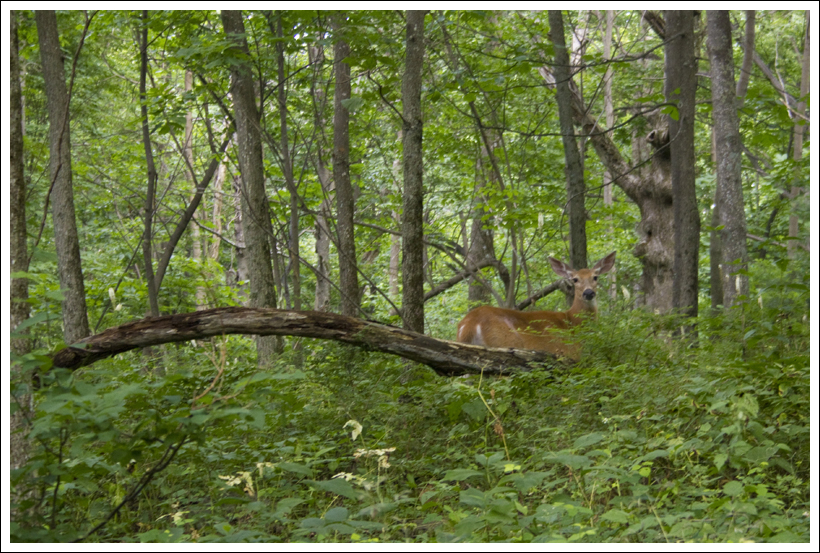
Pass Mountain Hut. Below: The shelter has a picnic table and a firepit; A peek inside the shelter journal; A curious doe along the trail.
The best part of the hike was definitely getting to the summit of Pass Mountain. We were hiking near the summit and we saw a rock outcropping to the west of the trail about 100 feet. Christine was doubtful that there would be any opening for views, but I said that I thought there would be. When I went to investigate I saw there was a decent view, but I was quite pleased to see all the wild blueberries. As Christine mentioned, we have often seen blueberries when we go hiking in Acadia National Park in Maine, but these patches seemed untouched. We spended about 30 minutes picking blueberries and taking in the view. We also thought of our friend, Suzanne, that accompanied us on the backpacking trip in Dolly Sods the previous week. She went crazy for wild blueberries, and we pictured her screaming in glee over these patches. There were still lots of blueberries that weren’t ripe enough to pick, so if you are interested in doing this hike for some blueberries, I would hit this trail in mid to late July. I’m guessing that this trail could also be frequented by bears since they tend to go where the food sources are.
The Appalachian Trail is like a green tunnel through the woods. Below: Christine crossing 211 at the end of the hike; Blueberries at home!
Christine was impressed when I spotted the indian pipes on the trail. Of course, I wasn’t sure what they were called. I just said, “Isn’t this something you’re interested in?” She has quickly become great at identifying wild flowers. Maybe one day I will get there also, but I can at least point some things out for now.
Most of this hike is more or less a walk through the woods. The terrain wasn’t too tough, and this is not a section of the AT that is riddled with views and interesting things along the way. Unless you’re tackling a section of the AT, I would say that most people that you would run into on this section are hiking up Pass Mountain.
Trail Notes
Distance – 8.35 miles (8.75 if you do the optional side trail to the Pass Mountain Hut)
Elevation Change – 1600 feet
Difficulty – 3. This hike is a moderate mix of climbs, descents and flats.
Trail Conditions –4. The trail is in great shape, but a little overgrown due to the wet summer.
Views–2.5 The view from Pass Mountain is nice.
Wildlife – 1. We saw a deer but nothing else.
Ease to Navigate – 4.5. The trail is unmistakably easy to follow.
Solitude –2.5. You probably won’t see many hikers after the peak of thru-hiking season. We saw only a handful of people over the miles.
Directions to trailhead: From Skyline Drive around mile marker 24.3, follow the signs to the Elkwallow Picnic area (not Elkwallow Gap parking lot). Park near the privy. The trail starts next to the privy.
The Fisher Springs Run – Rohrbaugh Plains hike is a five mile out-and-back that leads to spectacular wilderness views from a cliffside.
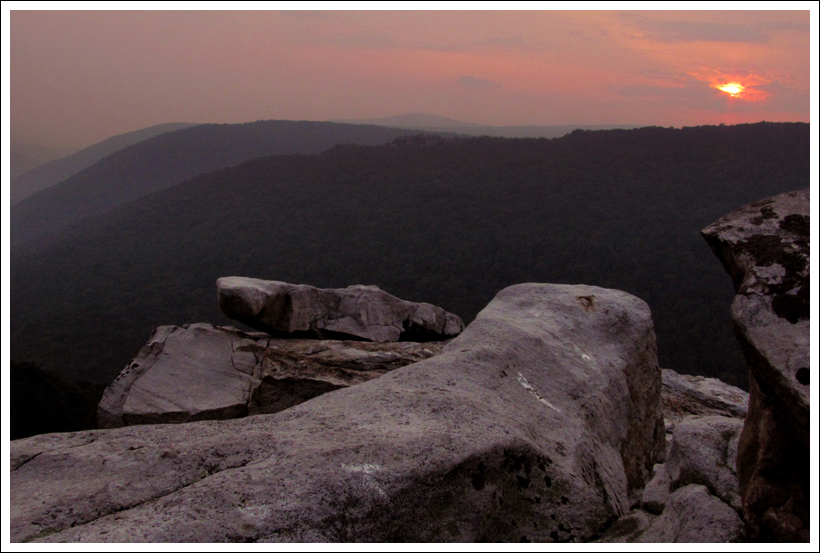
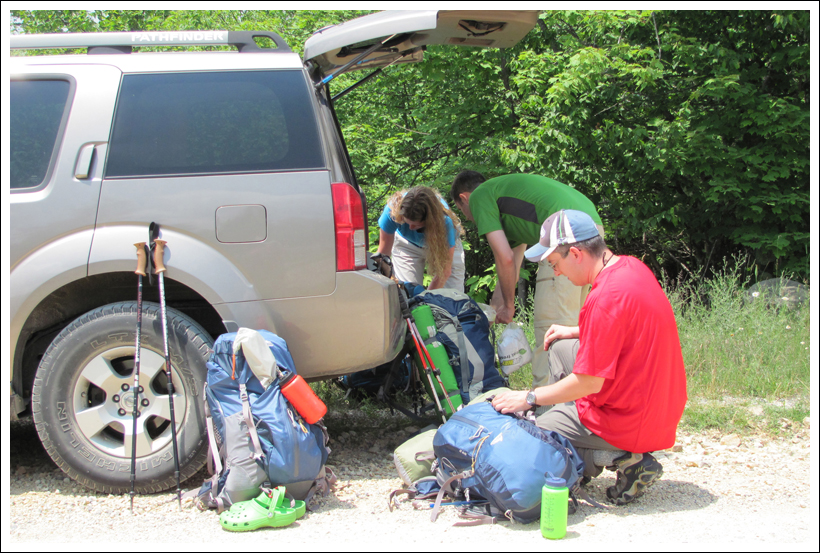
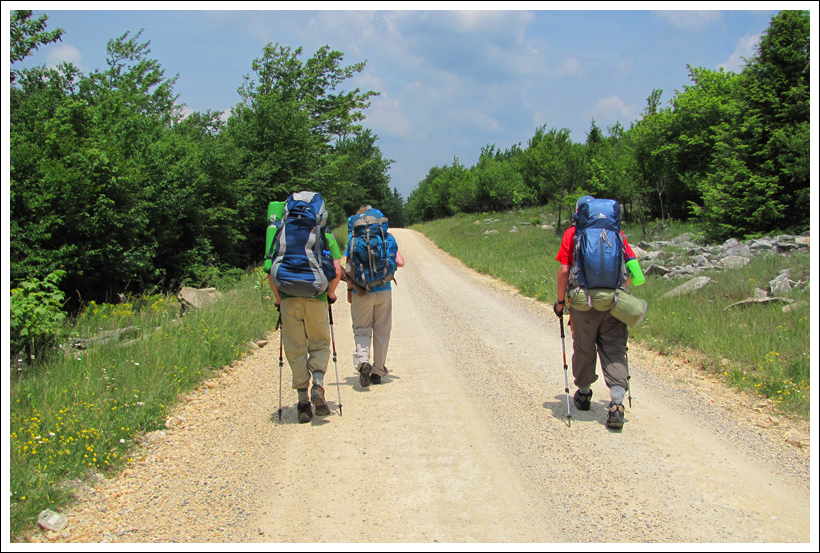
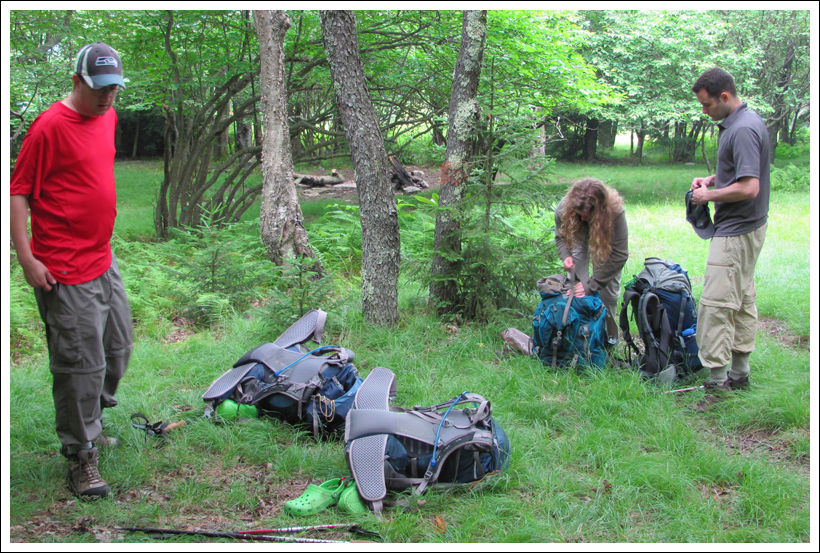
Rohrbaugh Cliffs at Sunset. Below: Gearing up at the car before starting the hike; Making the short walk down Forest Road 75; Adam points out our route on the trail sign.
Christine and Adam Say…
For this particular post, we decided to team up and write one massive post, instead of the normal ‘He Says, She Says’ versions. Enjoy!)
Last year, we participated in a Potomac Appalachian Trail Club workshop called Backpacking 101 (read part one, part two, and part three). Initially, we were scheduled to do an overnight trip to the Dolly Sods Wilderness as a ‘graduation’ from our class. Sadly, we ended up missing that trip because Christine’s ankle sprain still hadn’t healed enough for the rigors of backpacking. While the make-up trip we eventually did to Hazel Mountain in Shenandoah National Park was great, we still wanted to do an overnight trip in Dolly Sods.
Dolly Sods is such a unique area for the mid-Atlantic region. It’s the only area close to us with a sub-Arctic tundra climate – loaded with heath barrens, blueberry bushes, acidic bogs and coniferous forest. You feel like you’re somewhere far north of West Virginia when you visit this wilderness area.
The route we chose through Dolly Sods was of a length and difficulty we would typically choose for an easy day hike. (5 miles with 900 feet of elevation change) But we decided it would be fun to do an easy hike and enjoy camping at one of the most beautiful sites in the entire Monongahela National Forest’s wilderness area.
We also were lucky to have some awesome company for this trip. In Backpacking 101, we met a nice couple – Suzanne and Anthony. We enjoyed hanging out with them on our class trip to Hazel Mountain and had stayed in touch with them ever since. We tried planning trips together a couple times, but until this trip our schedules just hadn’t matched up. We were thrilled when plans finally came together for this Fourth of July weekend trip.
Day One:
Suzanne and Anthony drove down to our house on Friday night so we would have time to go through all our gear before getting an early(ish) start on Saturday morning. We spent most of the evening fiddling with our packs, splitting up shared gear and contemplating how many Clif bars we truly needed to survive our expedition. That evening, it looked like an REI store exploded in our basement. We laughed about how much stuff we had to pack for just one night of camping. We ran through our checklist to make sure we had everything – stove, tent, sleeping bag, clothes, food, emergency kit, etc.
On Saturday, we had a big breakfast and were out the door a little after 9:30. We didn’t make it to the trailhead until after 1:00. We made a stop at Seneca Rocks Visitor’s Center and ended up buying another trail guide and a new map for West Virginia hiking. (Not for use on this trip, but just to have for the future.) We also stopped at the Subway in Franklin, WV to grab sandwiches to have for lunch on the trail.
When we got to the Fisher Springs Run trailhead, the parking lot was overflowing with cars. A couple people had decided to park sideways in the lot instead of straight-on, so they took up space that could have accommodated five or six more cars. It was a little annoying and worrisome – would we get out to Rohrbaugh Cliffs and find all the prime campsites already occupied? We ended up parking a short distance down Forest Road 75, in a patch of dirt just wide enough to get our car off the road.
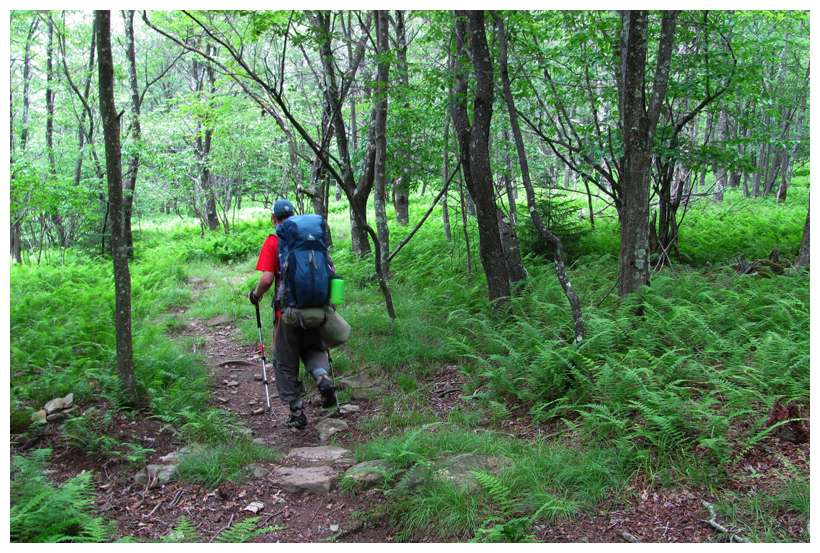
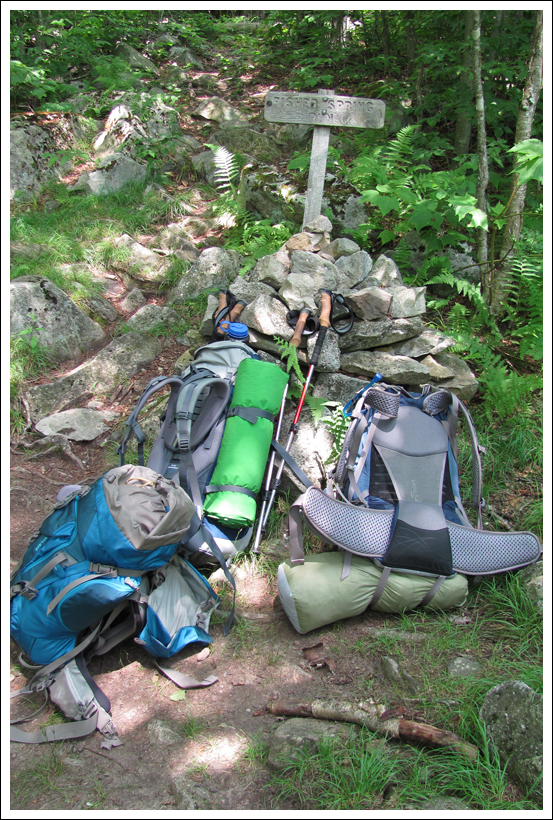
The forest floor was a sea of ferns. Below: Adam hikes along the Fisher Springs Run Trail; The trail junction of Fisher Springs and Rohrbaugh Plains; Subway for lunch; Our huge pile of packs; Adam traverses a rocky section of trail, Suzanne crosses a small stream.
We found space to shove the sandwiches into Suzanne’s pack, slathered ourselves with sunscreen and bug spray, and got to the business of walking. Almost immediately after stepping off the dusty, gravel forest road onto the trail, we found ourselves ensconced in a cool, lush, green forest. Ferns spread across the ground for as far as the eye could see. The trail descended gradually, occasionally crossing small, mostly dry streams. The trail got rockier as we followed it for a little over a mile to its junction with the Rohrbaugh Plains trail. We stopped at the trail junction and ate our lunch. We chatted with a passing backpacker who was doing a 19-mile loop through Dolly Sods. She was on a solo trip and told us she was headed down into the Red Creek basin. We asked her if she had noticed many camps set up near the cliffs. She said she hadn’t seen anyone, so we took that as a hopeful sign.
After lunch, we took a left onto the Rohrbaugh Plains trail. The trail at this point was all rocks. They almost looked fitted together like a jigsaw puzzle. Almost immediately after the rocky patch, we dipped deeply into a ravine with a pretty flowing stream. It was a perfect water source for backpacking. We figured that in the worst case scenario, we could hike back to this point to fetch water for cooking and cleaning at camp.
The last 1.2 miles to our campsite ascended ever so slightly, winding past giant mossy boulders and through dense thickets of rhododendron. With about a half mile to go, we passed another trail junction with the Wildlife Trail. Taking the Wildlife Trail to the Rohrbaugh Plains trail is probably the most popular route for day hikers to reach Rohrbaugh Cliffs. After this trail junction, we crossed a swampy, muddy area and walked across a grassy meadow. A couple tenths of a mile past the meadow, we came to a beautiful clearing where we ended up making camp.
Crossing the meadow. Below: Christine and Adam’s camp; Adam collects water for cooking and cleaning; Anthony and Suzanne’s camp.
There were so many soft, flat spots that were perfect for our tents! We chose a couple spots located out of sight of the trail. We had a fire pit, a nice place for cooking, a view and shady trees. It was nothing short of perfect.
It felt great to shed our packs and get to work setting up camp. Our Mountain Hardwear tent (the Drifter 3) is super-simple and was pitched in just a few moments. While Adam worked on staking the tent, Christine inflated our Big Agnes pads. We put them in the tent along with our sleeping bags, so they’d have some time to re-fluff after being compressed in stuff sacks all day.
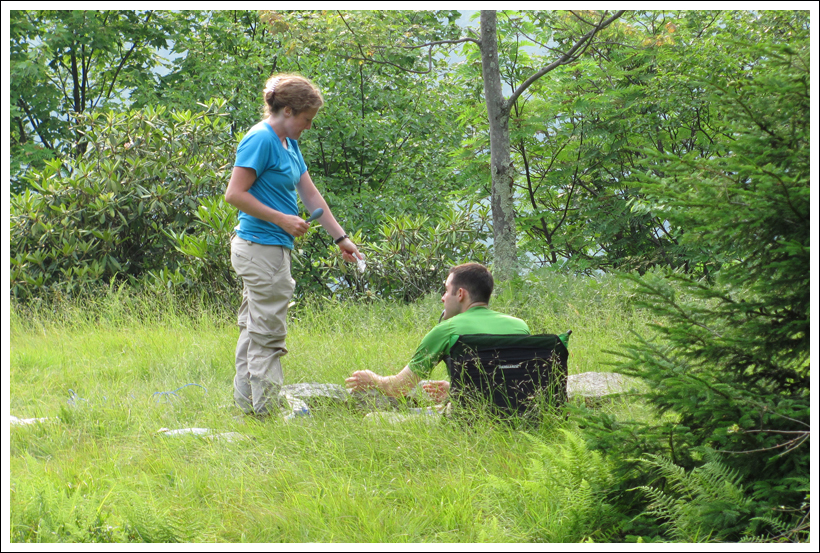
On this backpacking trip, we had a few new and exciting ‘creature comforts’. Since our last backpacking trip, we acquired Alite camp chairs. They’re so comfortable and lightweight! We also both got the large Thermarest pillows. They’re really bulky and take up a ton of pack space, but they’re very lightweight and make a world’s difference for getting comfortable at night. Christine also brought a fitted sheet for her sleeping pad. Even though the sheet is made by Thermarest, it fits the Big Agnes pad perfectly. A sheet is not a necessity, but it definitely improves the texture and breathability of your sleeping pad. Christine especially hates feeling clammy or slippery when she’s trying to sleep, so having the sheet made a huge difference. Neither of us actually sleep inside our sleeping bag unless it’s freezing cold. We prefer to open our bags up and use them like quilts.
After we finished setting up our tent, we carried our cooking stuff down to our kitchen area. We also pulled out all our ‘smellables’ and set them aside so they could easily be stowed away in our hanging bear bag. Christine found a couple branch stubs to hang our trekking poles and our packs. We both covered our packs with garbage bags in case it rained overnight.
Anthony and Suzanne were still working on getting there camp set up, so we decided to go on a water run. We hadn’t passed a better water source after the stream near the trail junction, so we took our collapsible bucket and headed back down the trail. Filling up was easy, but getting two gallons of water in a soft-sided bucket back to camp without spilling anything over a 1.2 mile distance was substantially trickier! We were very thankful we went as a pair to get water, because it was nice to trade off carrying the bucket. We joked that it was like being in a challenge on some adventure reality show. We made it back without much spillage at all! (Note: We hiked this trail as a dayhike in 2014 and found a closer water source just a few hundred yards past where we stopped to camp… so you don’t have to hike back like we did!)
When we got back, Anthony and Suzanne were all set up, so we decided to walk a few hundred feet further down the trail to explore the cliffs. Rohrbaugh Cliffs were spectacular. The view into the valley below was all wilderness – not a single road or farm or house – just mountains and streams for as far as the eye could see.
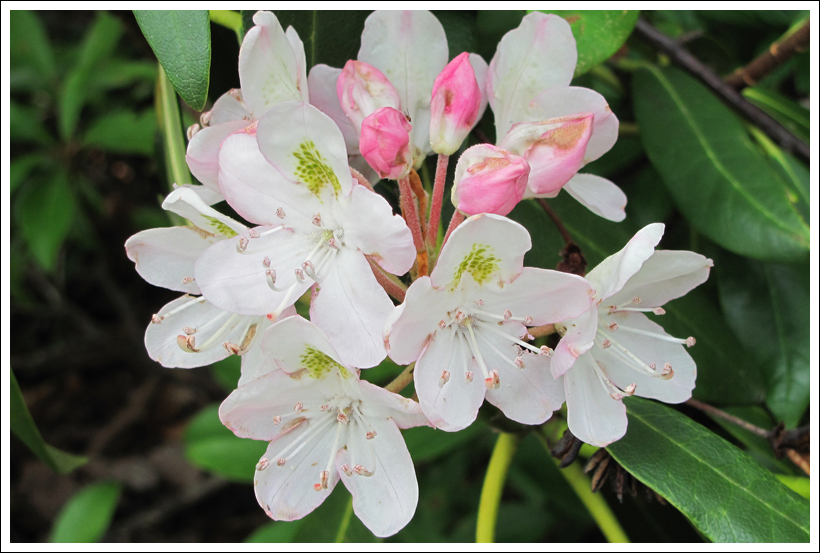
Adam on Rohrbaugh Cliffs. Below: Wild, ripe blueberries; A cute frog that visited our camp; Rosebay Rhododendron were in bloom; Our group on Rohrbaugh Cliffs; A couple more views of the cliffside.
We visited the area at a truly beautiful time of year. The Rosebay Rhododendrons were just starting to bloom. The mountain laurel was a bit past peak, but there were still plenty of flowers to enjoy. And best of all WILD BLUEBERRIES were everywhere along the cliffs! Suzanne and Christine were significantly more excited about the berries than the guys and spent a lot of time searching for ripe berries tucked into the bushes.
Most of the late afternoon was spent relaxing near camp and getting dinner ready. Around 5:30, Adam got out the JetBoil and boiled water for all of our dinners. We had wanted to come up with some homemade backpacking recipes, but never got our act together. Adam and Christine ended up eating Backpacker’s Pantry Chicken Risotto with Mocha Mousse Pie for dessert. It was satisfying and very filling! Anthony and Suzanne had macaroni and cheese and blueberry cobbler from some backpacking meal company (AlpineAire) none of us had heard of before. They were pretty happy with their dinner, too.
Chef Adam filters and boils water for dinner. Below: Chicken Risotto for dinner; Anthony and Suzanne relax after dinner; Playing Monopoly on the cliffs; Hanging our bear bag.
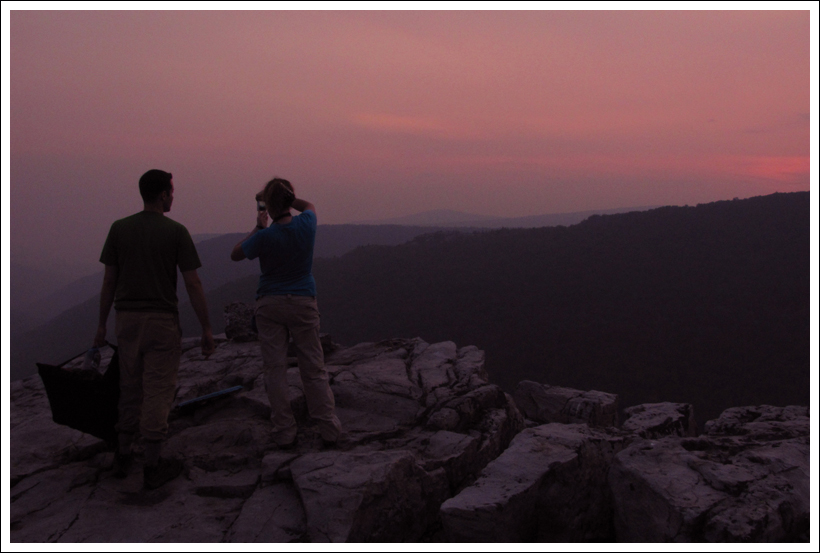
We cleaned up our dishes, brushed our teeth (We love Colgate Wisps for backpacking) and hoisted our bear bag into the highest, safest tree we could find. We decided to play cards and watch sunset from the cliffs. We found a big flat rock near the edge and played the card version of Monopoly. The game took a long time, and Adam eventually won. The sky turned to hues of pink and soft purple and the sun dipped down behind the mountains. It was so beautiful!
Shortly before full dark, a couple more groups of backpackers showed up – maybe five people and two dogs. They set up their camps down the trail from us. So even though we weren’t the only people up there, we still felt like we had a good measure of solitude. It definitely was not the situation we feared when we saw the packed parking lot at the trailhead. We’re guessing most of the other backpackers ended up along Red Creek.
Once the sun was down, we all retreated to our tents. Christine listened to a book on her iPod for a while. By the light of his headlamp, Adam enjoyed reading some of his book by John Muir. He’s been reading this book exclusively on backpacking trips. It’s a nice tribute to read something by the ultimate outdoorsman while having our own experience with nature.
Christine started getting really sleepy, so she stowed her iPod away and dozed off, only to be woken almost immediately by the sound of fireworks in the valley below. We think we heard fireworks shows from three different locations, because there were definitely three distinct grand finales. The booming sounds and bursts of light in the sky came from different directions, too. We contemplated leaving our tent and going back out to the cliffs to see if we could see the fireworks from above, but we ended up staying put. Christine didn’t feel like getting dressed again. When all was said and done, we kind of regretted not going back out to see the fireworks.
Eventually the fireworks drew to a close, and Christine drifted back to sleep. Unfortunately, Adam did not sleep that well on this trip. He was physically comfortable, but he just wasn’t tired enough to sleep soundly. Going to bed shortly after sunset just isn’t what his body is used to, so he did a lot of tossing and turning during the night.
Our sunset card game. Below: Layers of mountains frame the Red Creek Valley; We had a pretty sunset; Suzanne takes a few final photos of the evening sky.
Around 2:30 a.m., Adam shook Christine awake to close the rainfly on the tent – a storm was approaching. Christine stumbled and grumbled and totally failed at closing the fly. Adam had to crawl over her to get both sides of the tent closed. Christine completely lacks dexterity when she’s half asleep. The storm never really materialized beyond some lightning and wind. We both fell back to sleep and didn’t wake up again until about 6:15. Christine said it was the best night of sleep she’s ever had in a tent.
Day Two
Shortly after sunrise, we got out of the tent and took a walk over to the cliffs. Christine thought there might be some pretty morning light, but it was completely cloudy. Back at camp, we started breaking down our tent, deflating our sleeping pads and re-stuffing our sleeping bags. We got the bear bag down and got everything ready to cook breakfast.
Christine tried Starbuck’s instant coffee, Via, for the first time. It was surprisingly delicious. Once she added sweetener and powdered Coffeemate, it tasted almost identical to a cup of brewed coffee. In addition to coffee, we had boxes of apple-grape juice and instant maple-brown sugar oatmeal. We figured that would be plenty of food to give us energy for the short hike out.
After everyone was done with breakfast, we finished packing up and cleaning up our camp area. We were back on the trail by 8:45. Our exit route simply retraced the trail we had hiked in. We were back at the car by 10:15.
Breaking camp in the morning. Below: Fat Boy’s Pork Palace for lunch!
On the way home, we stopped at Fat Boy’s Pork Palace (now permanently closed) for lunch. With a name like that, you know it’s going to have perfect options for a post-backpacking calorie splurge! We enjoyed BBQ sandwiches with coleslaw and French fries. Suzanne got breakfast and Anthony got a burger. It was all delicious!
Once we were back at our house, we split up our group gear and saw Anthony and Suzanne on their way. Christine said her post-backpacking shower might have been one of the best showers of her entire life. It always feels awesome to wash away DEET, sunscreen and sweat!
We all had a great time on the trip. We’re already trying to plan our next backpacking adventure for some time in September! Although, it’s going to be hard to top the scenery at Dolly Sods!
Trail Notes
Distance – 5.2 miles total
Elevation Change – 900 feet. The Fisher Springs Run trail descends about 500 feet and the Rohraugh Plains ascends about 400 feet.
Difficulty – 2. The hike was not that difficult, even with 35 pounds on my back.
Trail Conditions –2.5. The Fisher Spring Run trail was well-maintained, but there are lots of rocky spots on the Rohrbaugh trail where you could turn your ankle.
Views–5. The views from Rohrbaugh cliffs were quite spectacular and it was nice to see the sun disappear over the mountains.
Wildlife – 1. We were expecting to see some wildlife up here, but we didn’t see anything other than squirrels, frogs and some birds. We did wake up to the sounds of dark-eyed juncos in the morning.
Ease to Navigate – 3.5. There are not any blazes on trails at Dolly Sods, but the trails are very well-defined and signs are in place to mark junctions. Stay on the trail as much as possible and you won’t have any trouble. I can imagine that when leaves fall and cover the trail in the fall, it would be more challenging to find the trail.
Solitude –4. On a nice day, you may see some people at the overlook.
Directions to trailhead: From Seneca Rocks, go North on WV 28 for 12 miles. Take a left on Jordan Run Road. Go one mile up Jordan Run Road and take a left on to Forest Road 19. In 6 miles, Forest Road 19 comes to a T on to Forest Road 75. Take a right, heading north on Forest Road 75. Drive for three miles until reaching the small parking lot and the trailhead for Fisher Springs Run.
Flat Top is one of the two ‘Peaks of Otter’. While not as popular as the other peak (Sharp Top), this 5.4 mile hike to Flat Top’s summit offers some nice views of the area.
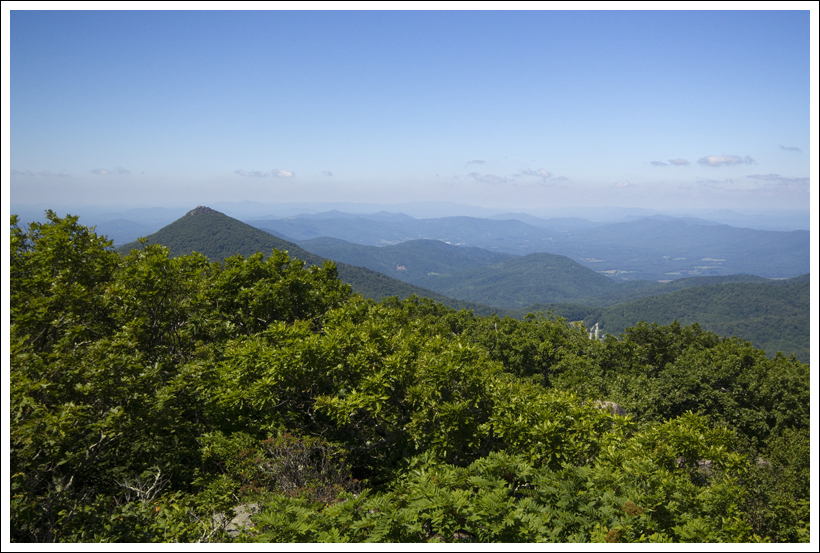
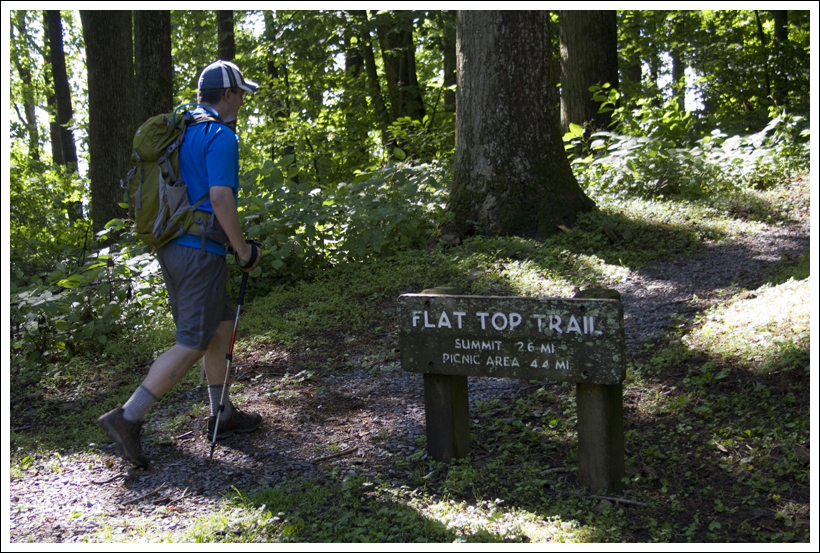
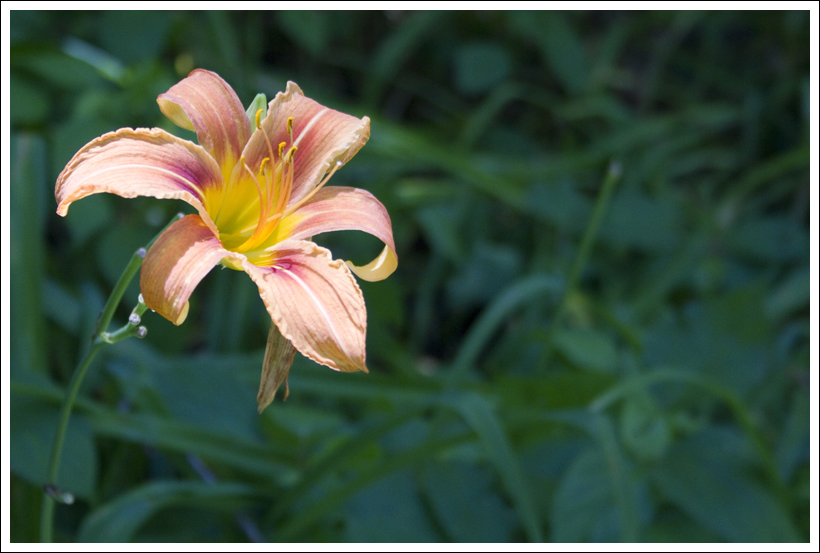
A view of Sharp Top from just below the Flat Top summit. Below: Starting out on the Flat Top trail; The trailhead was decorated with lilies; The junction of the trail down to Cross Rock is right at the Pinnacle.
Christine Says…
Last week, we were home on a week long ‘staycation’. Most of the week, we relaxed at home, sleeping in and watching movies. When Wednesday turned out to be cool and breezy with low humidity, we decided to get up early and go for a day hike in the Peaks of Otter area of the Blue Ridge Parkway. We’ve hiked Sharp Top many times, but I had never really considered hiking the companion peak. Adam had always described the hike up Flat Top as steep and lacking any spectacular views. But, we’d read a few more positive descriptions of the views, so we decided to give the trail a shot.
When we got to the trailhead, it was almost chilly. Personally, I think chilly weather is always welcome in the middle of summer! The hike was all uphill, passing hillsides of ferns, giant boulders and patches of red columbine. The first point of interest we came to was the Pinnacle. It offered panoramic views of the valley. We could even see the Blue Ridge Parkway snaking through the mountains across the valley.
A view from the Pinnacle. Below: The trail was often lined with ferns; There were many giant boulders along the trail; Cross Rock was underwhelming.
At the Pinnacle, there is sign marking a side trail down to Cross Rock. We assumed Cross Rock would be another outcropping with nice views. We were quite wrong. Instead, it was a brutally steep descent to a rock formation in the shape of a cross. Others might find Cross Rock to be fascinating, but I think I would have passed on the side trail if I had known I was just going to look at some rocks.
From the Cross Rock junction, the trail became steeper and rockier. We continued climbing for the last half mile to the summit of Flat Top. At first, we were a little confused because the summit marker was buried in the trees. Our hiking book had described the views from the top as panoramic and majestic. We eventually found a little path through the brush leading to a rocky outcropping with views. It was a little below the actual summit. The views from that point were nice, but I wouldn’t describe them as generously as our hiking guide did. If you climbed out to the edge, stood and peered beyond the trees, you could see Sharp Top. Overall, I think the view from the Pinnacle was much nicer than the view from the summit.
We relaxed on the rocks for a while, then made our way down the trail. The trail going down was really slick from the thunderstorms the night before. On one steep section, I slipped and fell hard on my left knee. At first, I was really worried I may have banged it up badly enough to jeopardize our planned backpacking trip. Fortunately, I was able to walk it off and only suffered a bruise.
The downhill hike seemed endless at times after I hurt my knee, but we got back to the car in less than an hour. Afterwards, we enjoyed a delicious lunch at the Peakview Dining Room in the Peaks of Otter lodge.
Adam Says…
The Peaks of Otter place has a special place in my heart, since this was where my family would often visit for a picnic. I have hiked up the sister peak, Sharp Top, countless times, but I have only been up Flat Top a few times. The times that I had approached the peak of Flat Top, we had started out from the trailhead from the Peaks of Otter picnic area. I remember that path being very steep and forested, with views that were mostly through the trees. After consulting our Falcon Guide of Hiking the Blue Ridge Parkway, it mentioned great views and starting from the actual Blue Ridge Parkway to shave off some of the elevation gain. We decided to check out this path instead of the way I had experienced.
View just below the Flat Top summit. Below: The actual summit of Flat Top is in the trees; Adam took a photo of Christine with the camera’s manual settings customized for a sunny landscape shot – oops!; Inside the Peaks of Otter lodge.
The start of this trail begins around mile marker 83.5 on the Blue Ridge Parkway, north of the Peaks of Otter Lodge. There is a parking lot on the eastern side and you will see a brown sign denoting the beginning of the Flat Top trail. The trail starts off by slowly elevating through the forest in more of a gradual ascent. Around .6 miles, the trail turns sharply to the left and you begin a series of switchbacks that last until you reach the junction with the Cross Rock trail at 2.1 miles. At this junction you reach what is termed the pinnacle. If you crawl out on the outcropping of rocks near you, you are at the Pinnacle, which provides the best views on this hike. You have the option of climbing down to Cross Rock, but this is not a great viewpoint, just an interesting rock formation. Follow the signs up the last .5 miles to reach the Flat Top summit at 4,001 feet. You will see the summit marker in the middle of the woods. Continue past the summit marker slightly for a short sidepath onto a rock outcropping that will give you some nice views. Continue back the way you came.
This path up Flat Top was better than my memories of hiking up from the picnic area. The views from the Pinnacle are gorgeous and you would miss out on this if you did the hike from the picnic area. The hike back down from the summit felt steeper than going up and there were loose rocks that required you to keep an eye on your footing. Take trekking poles to help secure your footing. There is one geocache on the hike, but I forgot to plug in the coordinates before we left:
The one thing that Flat Top has over the Sharp Top hike is more solitude. Sometimes it seems that Sharp Top is crawling with large groups of hikers, but you will likely only see a few people on the Flat Top hike. Sharp Top does have better viewpoints, but this is a nice hike to do if you have more time to spend in the area. If you are interested and not too exhausted, you can also cross the road from the parking lot for a short 1.6 mile hike to Fallingwater Cascades.
Trail Notes
Distance – 5.4 miles (including the optional .2 mile side trail to Cross Rock)
Elevation Change – 1391 feet
Difficulty – 3. The hike is steady uphill climbing and get rockier the higher you climb.
Trail Conditions –2. The trail is very rocky and is rather overgrown in places.
Views–3.5 The view from the Pinnacle is beautiful, but views from the summit are somewhat obstructed.
Wildlife – 0. We didn’t see anything.
Ease to Navigate – 3.5. The trail itself is easy to follow, but at the summit there is no clear pointer to the best overlook. The technical summit is buried in the woods, but by following community trails you can climb onto rocky outcroppings to gain a view.
Solitude –2.5. Compared to Sharp Top, this trail is lightly traveled. But due to the popularity of the Peaks of Otter area, you will likely see other hikers.
Directions to trailhead: At mile marker 83.5 on the Blue Ridge Parkway, north of the Peaks of Otter Lodge. Park in the lot on the eastern side and a brown sign denotes the beginning of the Flat Top trail.






















 Virginia Trail Guide
