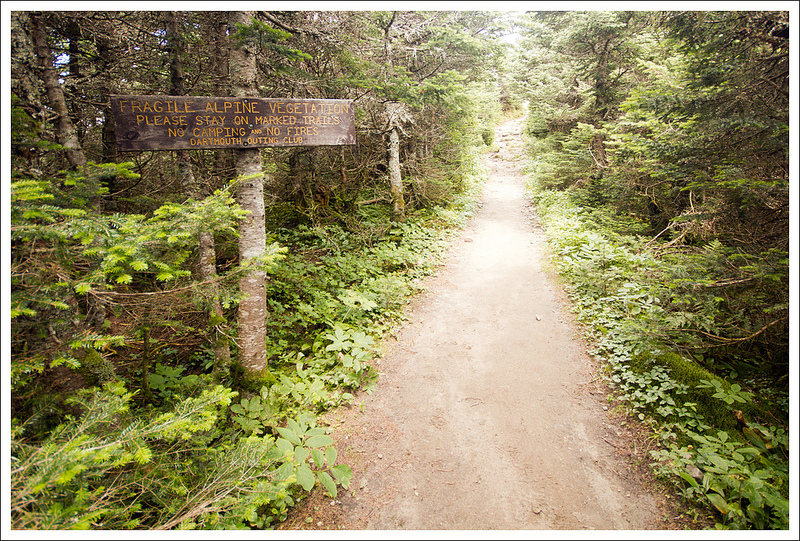
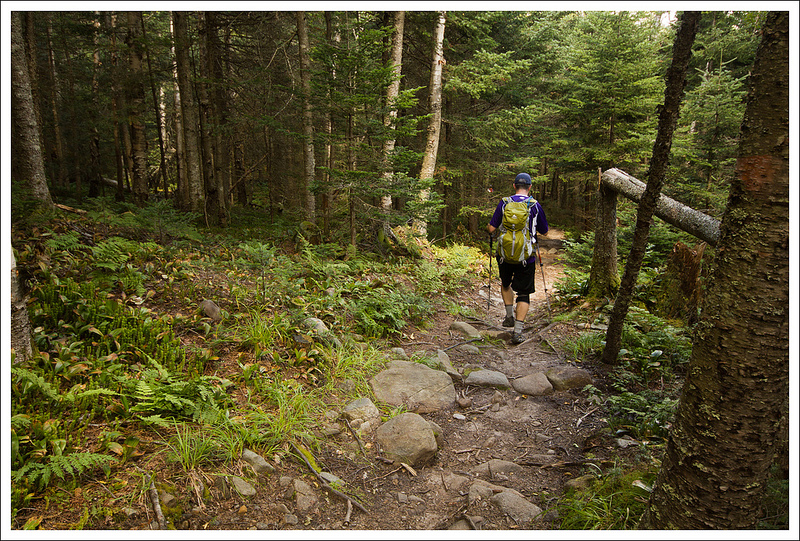
Appalachian Trail – Dripping Rock to Rockfish Gap

This 14.5 mile section of the Appalachian Trail includes great views of Wintergreen Resort from Humpback Mountain.  The campsite for the evening is the Paul C. Wolfe Memorial Shelter, which is located on the bank of lovely, rushing Mill Creek.

View the Full Album of Photos From This Hike

Hiking Over Humpback Mountain
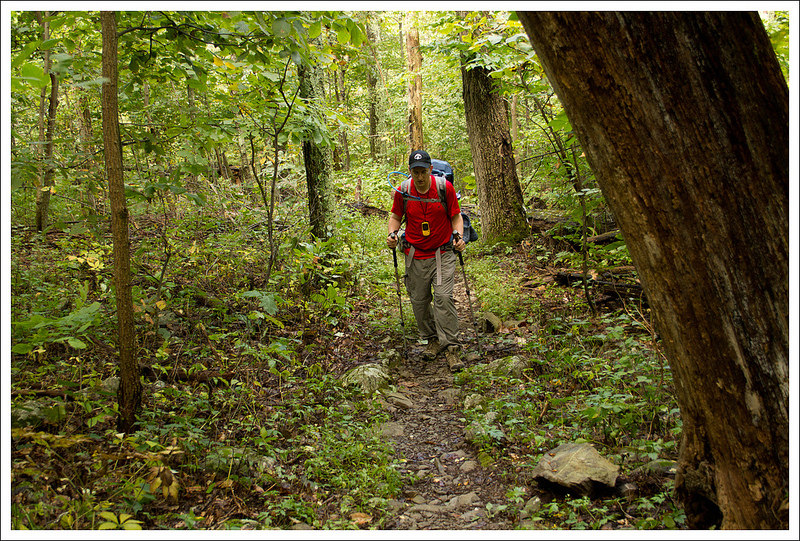
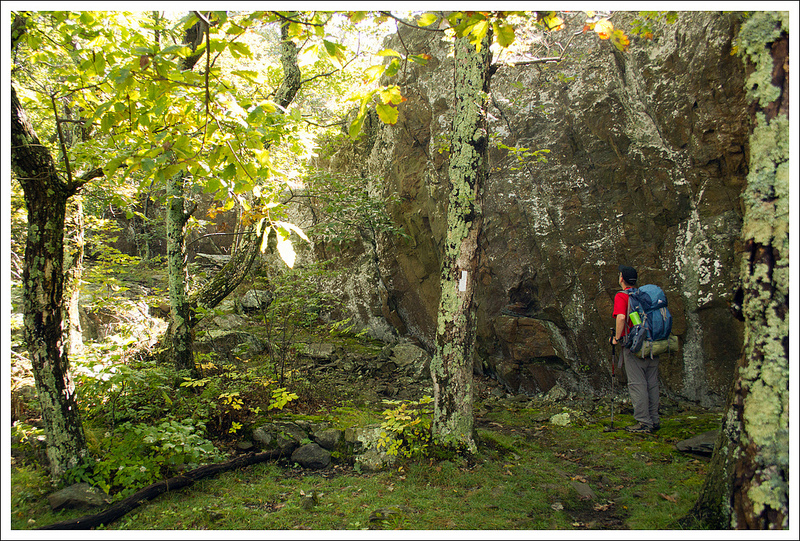
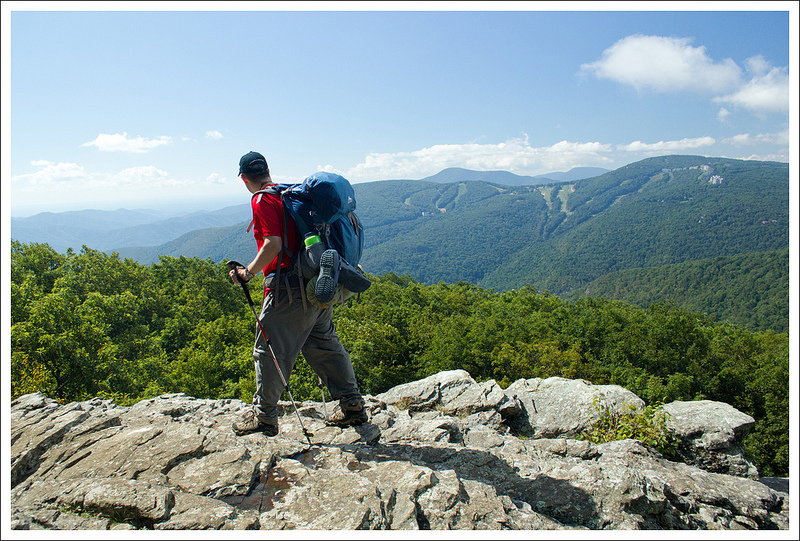
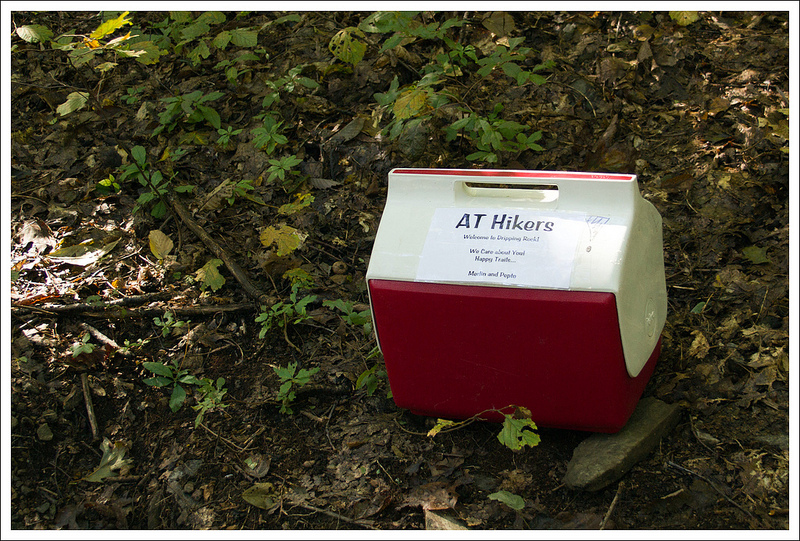
Adam traverses Humpback Mountain.  Below: We found trail magic right away on our hike; Adam climbing the southern side of Humpback Mountain; Rock walls along the trail.

Trail Magic Adam Hiking Rock Wall

Day One

For Christine’s birthday this year, we decided to do a quick overnight backpacking trip along the Appalachian Trail.  Following an all-day soaking rain and a cold front on Saturday, we had ideal weather for hiking and camping on Sunday into Monday – low humidity, clear skies, daytime highs in the 70s and a nighttime low near 45. It was perfect!

We started our morning with a big breakfast at Thunderbird Café and then made the 40 minute drive to the trailhead.  For this hike, we left one car parked in the small lot near where the Blue Ridge Parkway (BRP) crosses I-64 and Rt250.  From there, we drove our second vehicle to the Dripping Rock parking area at mile 9.6 on the BRP.  The name Dripping Rock refers to the small spring adjacent to the parking area.  Supposedly, it was a water source well-used by Monocan Indians en route to summer hunting grounds.

The AT crosses the parkway at this point, so it’s an easy place to hop on without using any access trails or spurs.  The hike starts out climbing gently uphill through the woods.  Almost immediately, we spotted a small cooler alongside the trail – trail magic!  We didn’t need (or take) any trail magic on our hike, but we were curious so we opened the cooler to see what was inside.  We found a log book, a camera, a small whiteboard, a bottle of ibuprofen and a nice supply of granola bars.  The camera and whiteboard were provided so that hikers could take photos with their trail names.

A couple tenths of a mile down the trail, we passed even more trail magic in the form of 2 liter-sized bottles of tap water from Wintergreen Resort.  Typically by September, streams and springs in the Shenandoah Valley are dry or running very low, so the free, clean water would be quite welcome.  The bottles were situated next to one of the trail’s spring-fed water sources.  We noticed the sign marking the spring indicated that water might be contaminated and should be filtered or boiled.  The sign included an outline drawing of a moose, and we both found it comical to think about the implausibility of Virginia water being contaminated by a moose.

Wintergreen View
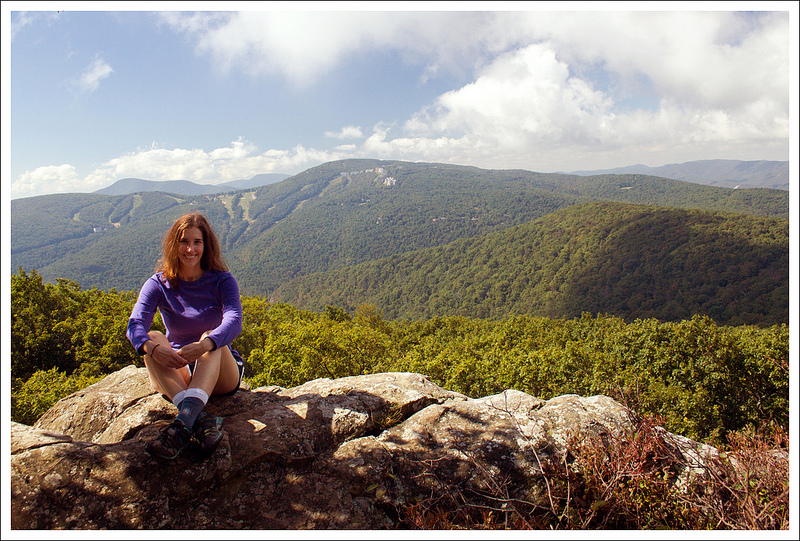
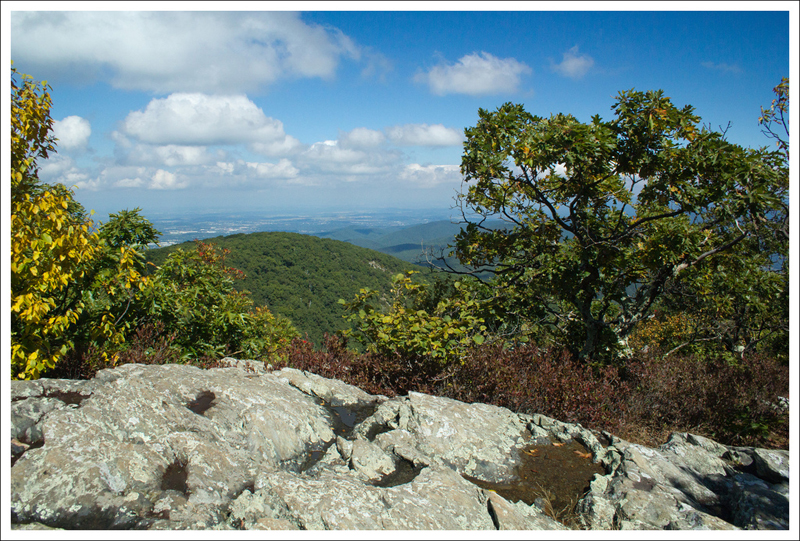
Christine enjoys the outcropping overlooking Wintergreen.  Below: Hiking up Humpback Mountain; Adam checks out the view of Wintergreen; Pretty views.

Christine Hiking Wintergreen Views

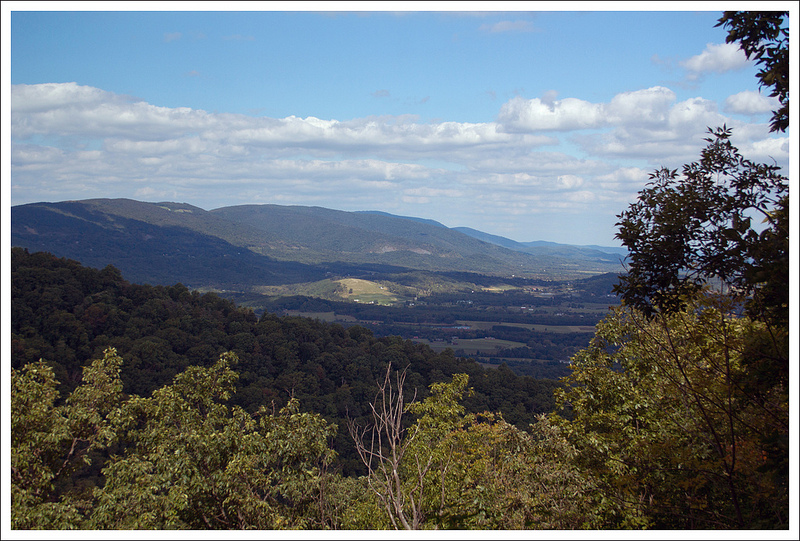
The hike continued gradually uphill along the side of Humpback Mountain.  We saw several nice campsites along the trail.  Soon after that, the views started to open up.  We didn’t really have any expectations for great views on this hike.  We figured we might take the side trail to Humpback Rocks and eat lunch there.  We also knew from past hikes on Dobie Mountain that we’d be passing one decent overlook at Glass Hollow.  However, we were pleasantly surprised to find spectacular views along the rocky, spiny ridge of Humpback Mountain. These views are about 2.5 miles from the better known outcropping of Humpback Rocks, and we thought they were even nicer!  The crowds, graffiti and car noise always take away from the experience at Humpback Rocks. We had this lofty ridge all to ourselves.

We took some time to take off our heavy packs and enjoy the view.  We could see the Priest, Three Ridges and the slopes of Wintergreen Resort.  When we got home, we read more about this section of the trail and learned that the view is named Battery Cliff, because the condos on the slopes of Wintergreen look like fortifications from a distance.  The rocks on the cliffs are Catoctin greenstone formed in an ancient volcanic eruption.  When you sit on these rocks and look across to Wintergreen, you’re looking over to where the Appalachian Trail used to traverse the mountains.  Five miles of the trail used to cross the resort.  But in 1983, the resort sold the land to private developers – basically pulling the rug out from under the Appalachian Trail Conservancy.  Luckily, the organization was able to quickly pull funds together and preserve the land across Humpback Mountain – where the trail currently sits.

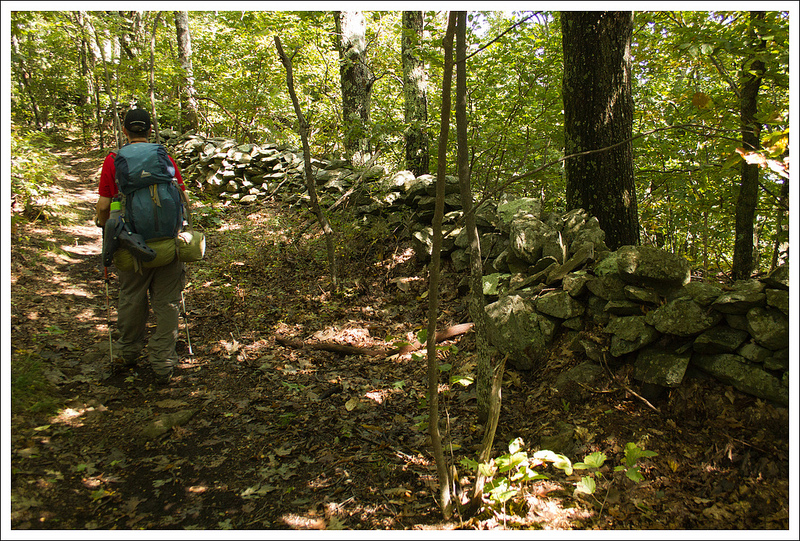
Leaving the open ridge, we dipped back into the woods and continued walking along a long, impressive stretch of stone ‘hog wall’.  People living in the area before the establishment of the parkway built these long walls to roughly mark property and attempt to contain livestock.  Eventually we arrived at a junction, one direction headed toward Humpback Rock and the other continued downhill along the Appalachian Trail.  We decided to skip the extra mileage it would take to visit the Rock and continue toward our destination.  We’ve seen the Rocks many times and didn’t really want to face the crowds that arrive with beautiful-weather Sundays.

Hog Wall
Adam walks along one of the many hog walls.

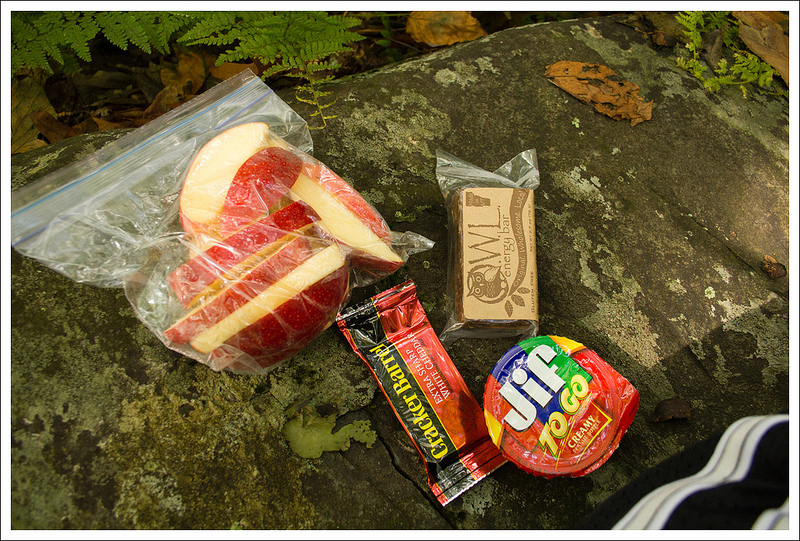
As we walked downhill, we started contemplating our lunch break.  We decided that the next spot with good ‘sitting rocks’ we’d stop for lunch.  As it turned out, the next rocks we found were just a few, big random flat boulders right alongside the trail. We had lunch of apples, peanut butter, cheese, and energy bars.  As we ate lunch, two groups of people passed us – a couple with their dog and a man who had just visited his daughter at JMU’s family weekend.  All in all, we only saw a total of eight people over the entire ten miles of hiking that day.  The solitude was nice!

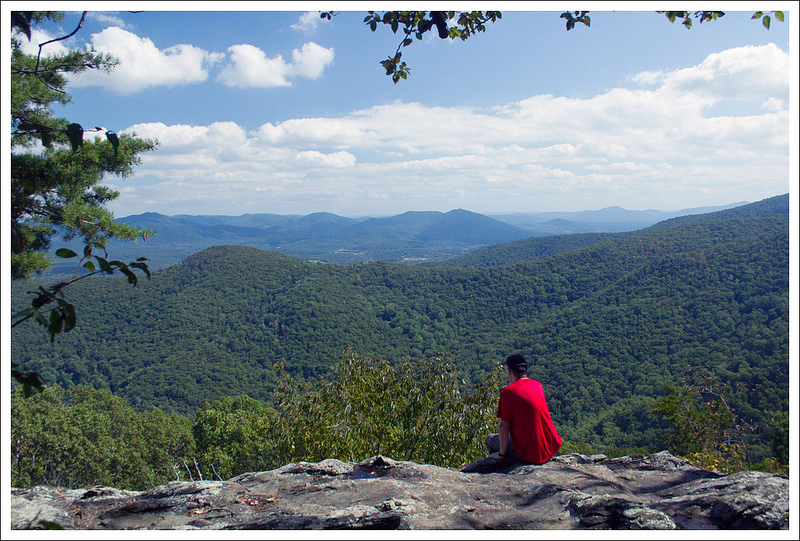
After lunch, we continued the 5.5 mile descent toward our evening stop point.   The trail was in great shape and the downhill was easy going.  At the bottom of Humpback Mountain, the Appalachian Trail intersects with the Howardsville Turnpike – an old toll road that was heavily used to transport goods before the Civil War.  It’s long been reclaimed by the forest, but the wide, flatness of the trail still has the definite feel of a well-traveled road.  We continued along the Appalachian Trail until we spotted a small sign marking the Glass Hollow overlook. We followed the short access trail and spent a good twenty minutes relaxing on the beautiful rocky viewpoint.  The views this time were much clearer than they had been two years ago when we visited.

Glass Hollow
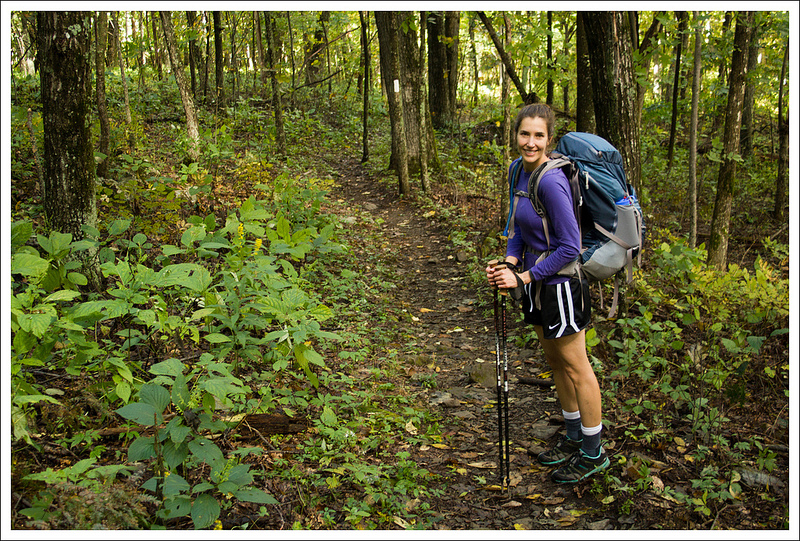
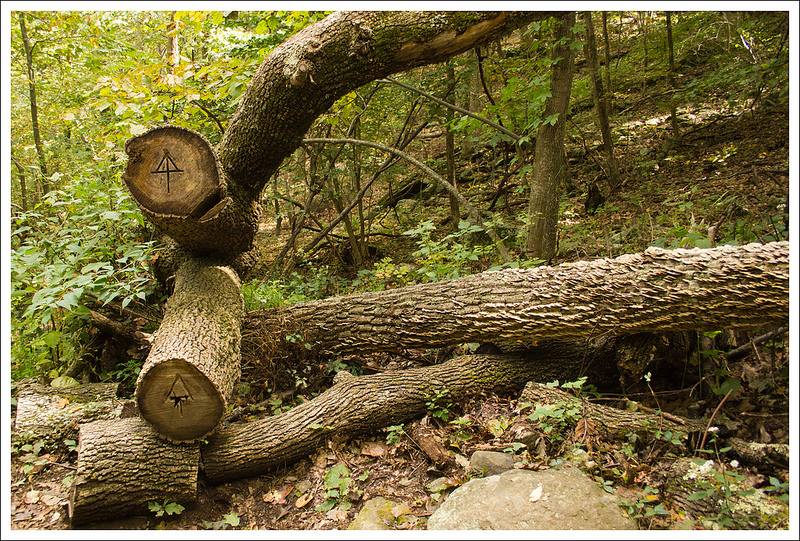
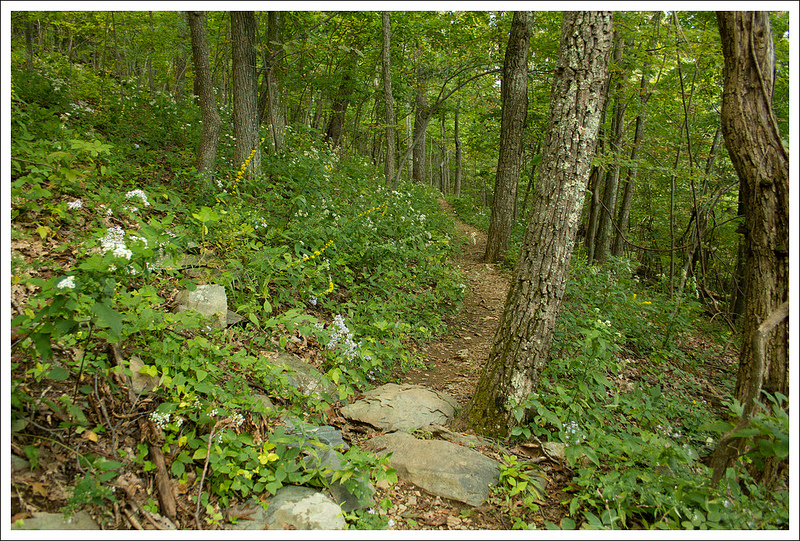
Taking in the view at Glass Hollow. Below: Trail lunch, AT logos carved on deadfall; Pretty trail with late season wildflowers.

Lunch AT Logo Pretty trail

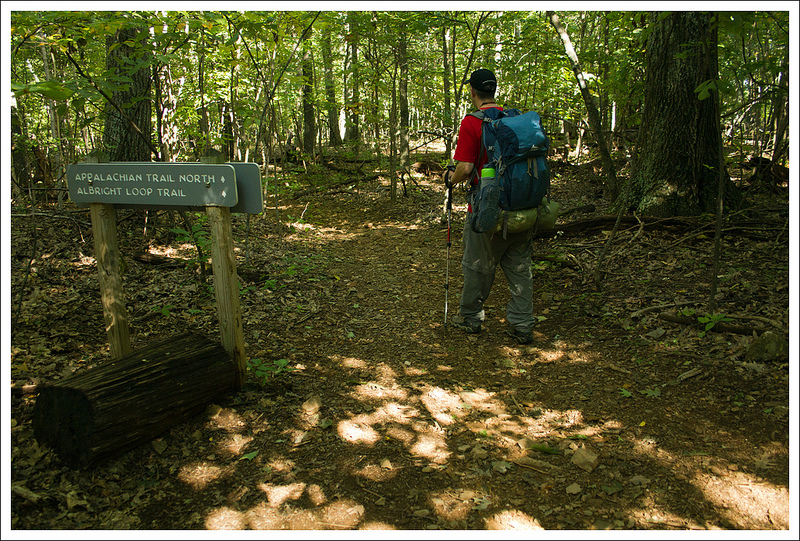
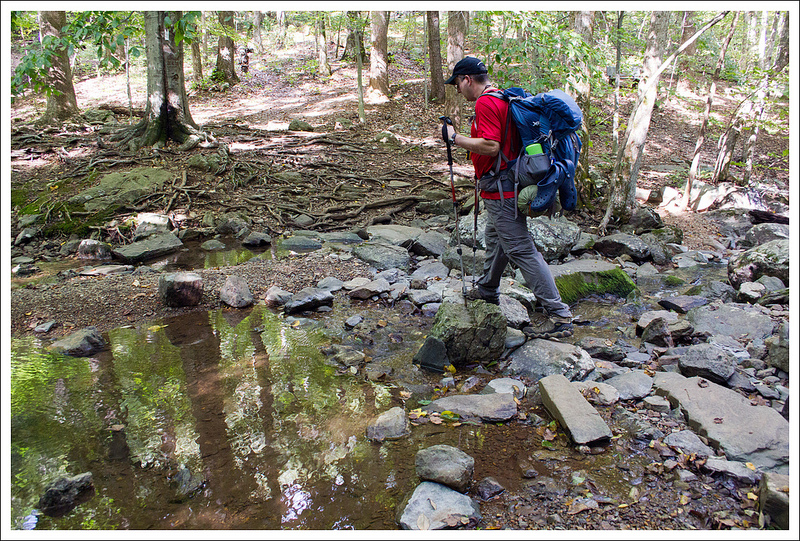
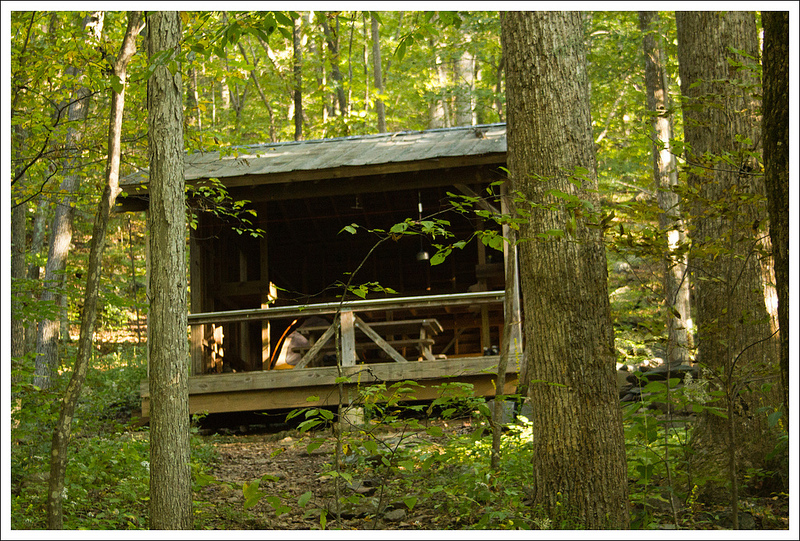
After leaving the overlook, we continued along the Appalachian Trail, passing the junction with the Albright Loop Trail – a popular day hike in this area.  From this junction, you can follow the Albright Trail for two miles back to Humpback Rocks parking.  We continued northbound on the Appalachian Trail, descending Dobie Mountain.  The trail follows a series of gradual, well-graded switchbacks.  There is one nice view of the valley about halfway down the mountain.  Eventually, we started hearing the sounds of running water through the trees. After crossing Mill Creek, we arrived at our stop point for the evening – the Paul C. Wolfe shelter.  This shelter is one of the nicest we’ve seen. The location is beautiful, the picnic table is on the porch and the shelter has sidelights, so it’s bright and cheerful inside.  So many shelters are gloomy and dark.  We will caution you – the privy at Paul C. Wolfe shelter is kind of weird – the door is only a half-door.  When you sit on the toilet, you have a nice view – but people can also see you sitting there.

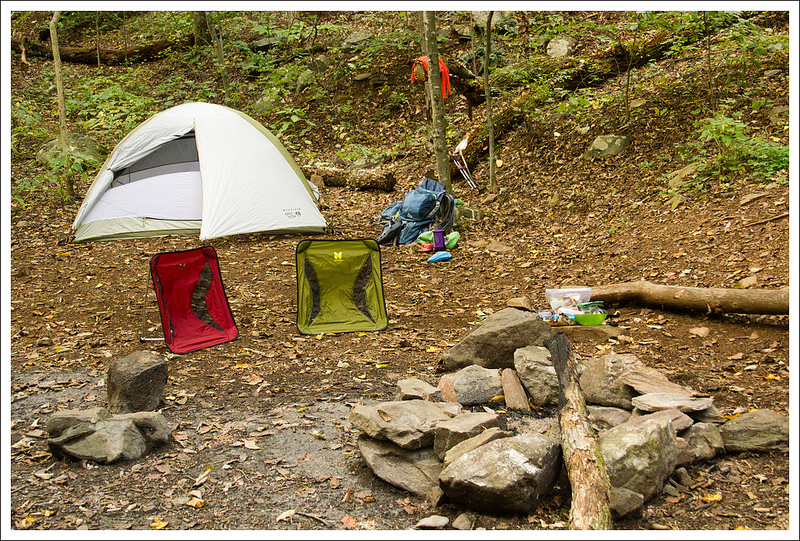
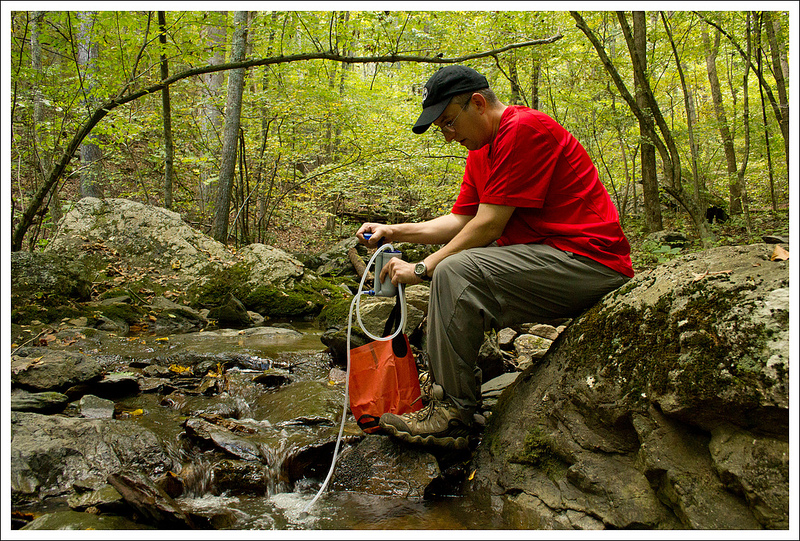
We were the first campers to arrive for the night, so we got a prime campsite near the banks of Mill Creek.  We had our own established fire pit and our own bear pole – fancy!  We immediately got started setting up camp and taking care of necessary chores.  Mill Creek was running beautifully, so we had a clear, cool water source to filter from.

Camp
Our nice campsite along Mill Creek. Below: Overlook on the descent of Dobie Mountain; Junction with the Albright Trail; Crossing Mill Creek

View from Dobie Albright Intersection Crossing Mill Creek

We decided to take our dinner up to the shelter so we could use the picnic table for meal prep.  Dinner consisted of pepper steak, wine and dark chocolate cheesecake.  As we were finishing up dinner, a southbound thru-hiker named Nightwalker arrived at camp.  He told us he had hiked almost 30 miles that day. He was from the Boston area and freshly out of high school.  We chatted with him a bit and marveled at him eating huge handfuls of candy corn mixed with Skittles.  He had the look of a true trail-weathered hiker – beard, tattered long-johns and feet held together by duct tape.

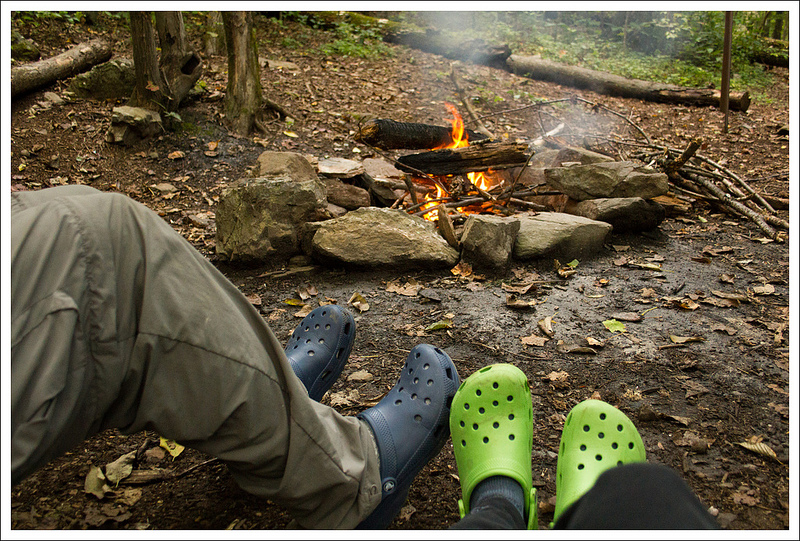
When the sun was going down, we headed back to our own camp.  Despite the heavy rains the night before, we were able to find enough old wood to have a small campfire for a while.  We heard another southbound hiker arrive sometime after sunset, but we never met him.  With the temperatures dropping with the darkness, we headed to bed around 9:00.  Both of us slept pretty well, but Christine woke up around 3:00 a.m., struggling to close both of the doors in the tent fly.  It was in the upper 30’s and she’s a cold sleeper.

Campfire
Our nice little campfire. Below: Adam filtering water; The Paul C. Wolfe Shelter; The steep climb that starts Day 2.

Filtering Water Shelter Climb Behind the Shelte

Day Two

We were up at first light, but noticed both the thru-hikers were still sleeping.  We didn’t want to disturb them, so we cooked our breakfast of oatmeal, cheese, coffee and hot chocolate near the fire pit at our campsite.  We were packed up and back on the trail within 45 minutes of waking up.

The morning’s hike consisted of a rather steep climb up Elk Mountain.  From the back of the shelter, the trail climbed almost straight up via a series of switchbacks.  We had about 1000 feet of climbing in just about a mile.  A8fter that, the remainder of the hike was more moderate or even gently downhill.

Mayo Cabin
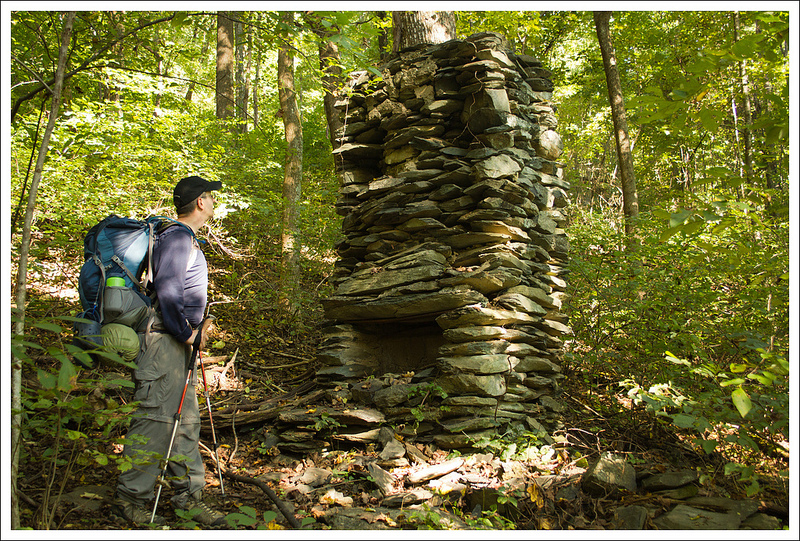
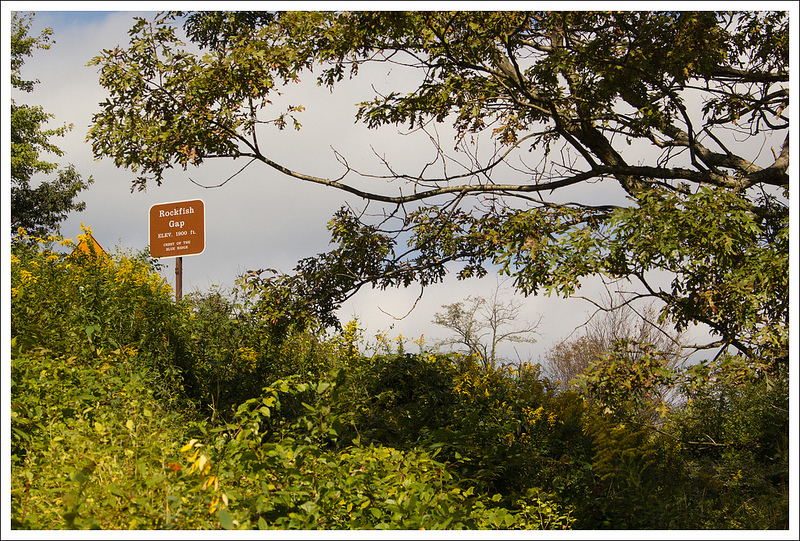
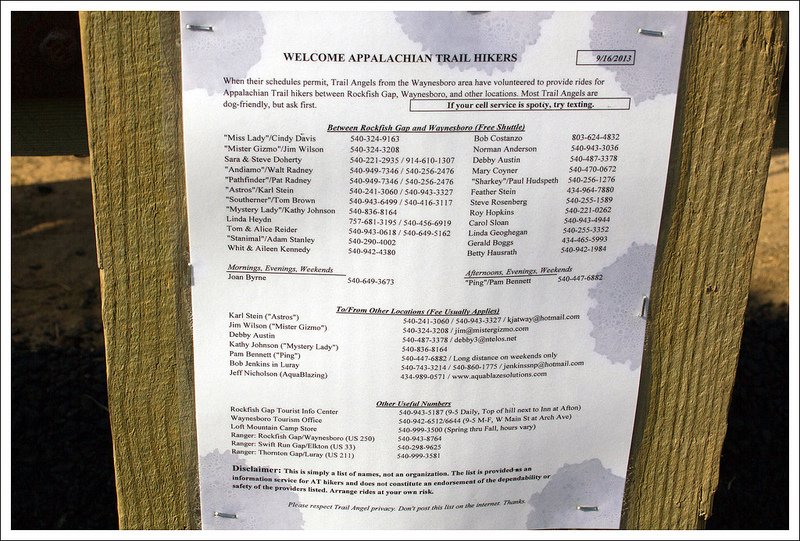
The remnants of an old cabin sit right along the trail. Below: Approaching Rockfish Gap; We can see Rt. 250; Waynesboro’s great network of trail angels.

Done The Gap Trail Angels

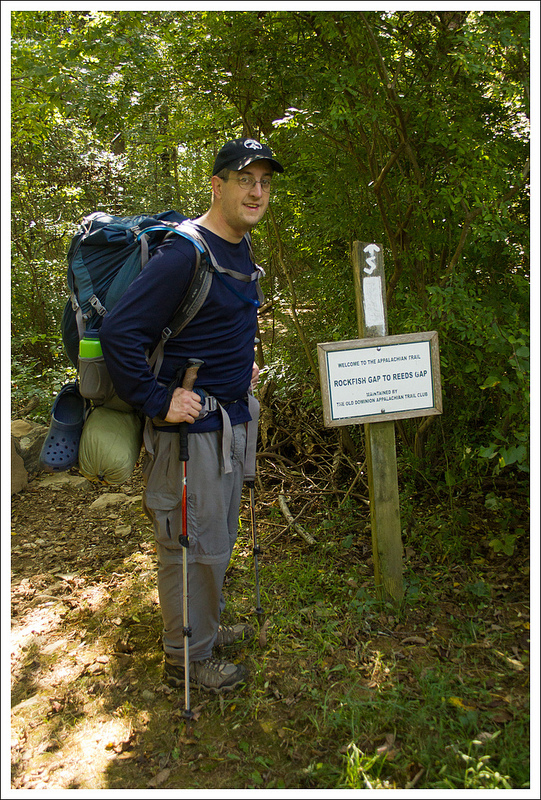
The five miles of trail back to Rockfish Gap are largely unremarkable; just a nice walk through the woods.  There are a few small stream crossings, but no views along the way.  The one noteworthy feature would probably be the ruins of an old cabin, about 1.7 miles north of Paul C. Wolfe.  The chimney and hearth are still standing right alongside the trail.  Evidently, there is also a cemetery for the Lowe family and additional cabin ruins somewhere east of the trail, but we didn’t see it.  The trail exits onto Route 250 at Rockfish Gap through an opening in the guardrail.  Thru-hikers can find lists of trail angels at the guardrail opening.  Waynesboro has one of the best organized trail angel networks along the AT.  It’s easy to find a ride or shelter at this point on the trail.

We arrived back to our car around 10:30 in the morning.  By the time we shuttled back to our car parked at Dripping Rock, we were already thinking about lunch.  We realized how close we were to Devil’s Backbone Brewery and decided it was a perfect place to wrap up our backpacking weekend.  We had a huge lunch – beers, a big soft pretzel to share, and sandwiches (French Dip for Christine, BBQ for Adam). After lunch, we decided to take Rt. 151 back to Waynesboro.  This allowed us to also pass Bold Rock Cidery.  It’s definitely worth a stop if you enjoy hard cider.  Since it was a Monday, we were the only people there.  We got to go behind the scenes into the cider pressing room and the fermentation/bottling facility.  That was really neat!

Bold Rock
The tasting room at Bold Rock. Below: Enjoying a post-hike beer at Devil’s Backbone.

Devils Backbone

Trail Notes

  • Distance – 14.5 miles (9.5 miles on Day One, 5 miles on Day Two)
    (Check out the stats from Map My Hike – [Day One] [Day Two])*
  • Elevation Change – 1800 ft. on Day One, 1100 ft. on Day Two
  • Difficulty –  2.  This is an easy backpacking trip with moderate, well-graded climbing.
  • Trail Conditions – 4.5.  Trails are in excellent shape.
  • Views – 4.  Views from Humpback Mountain and Glass Hollow are beautiful!
  • Streams/Waterfalls – 3.  Mill Creek is pretty and a great water source.  There is a small waterfall and swimming hole downstream from the shelter.
  • Wildlife – 2.  We saw a few deer and heard owls at night.
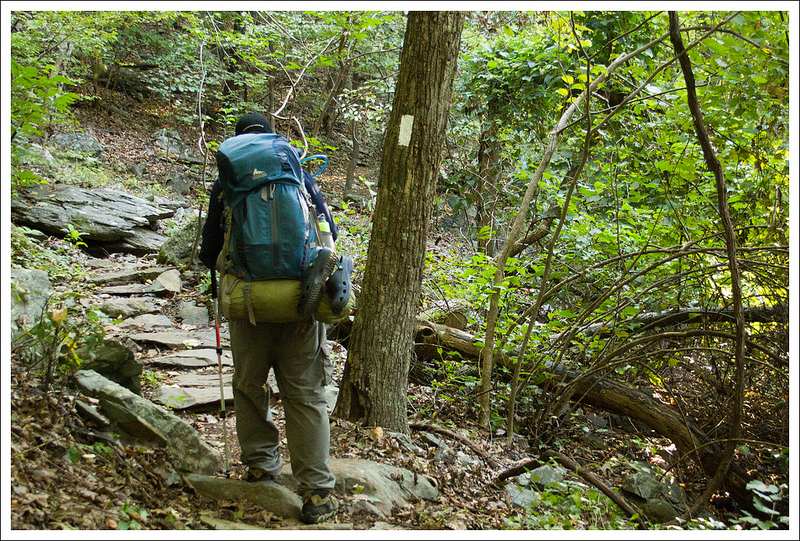
  • Ease to Navigate – 4.   There are several intersections/junctions to pay attention to, but following the white blazes is pretty easy.
  • Solitude – 4.  Because we avoided Humpback Rock, we only saw a small handful of people on a beautiful Sunday.  

Download a Trail Map (PDF)

Directions to trailhead:  Follow the Blue Ridge Parkway to mile 9.6.  Park in the small Dripping Rock parking area.

MapMyHike is not necessarily accurate, as the GPS signal fades in and out – but it still provides some fun and interesting information.

Our Most Popular Trails

These are Virginia Trail Guide’s most searched and most viewed hikes as of June 2017!

1. Mt. Rogers

Mt. Rogers is beautiful, rugged and home to several herds of wild ponies.

At the top of the list for the fourth year –  Mt. Rogers – Virginia’s tallest peak. It also has wild ponies, breathtaking views and one of Virginia’s most spectacular rhododendron blooms. In our book, Mt. Rogers is a must-see destination for every Virginia hiker. It’s our all-time favorite hike in the state!

2. Sharp Top

View of Abbot Lake from Sharp Top Summit
The view from the Sharp Top Summit is gorgeous!

Sharp Top is a classic central Virginia hike with spectacular views.  For those preferring an easier day, there is a shuttle bus that goes almost to the top of the mountain.

3. Crabtree Falls

Another beautiful section of Crabtree Falls.

Crabtree Falls sits in the number 3 spot. This long, meandering waterfall tumbles down the mountainside over the entire course of the hikes. If you like to hike along and hear the sound of rushing water, this hike is a don’t miss!

4. Hawksbill Mountain

This is the first of the four summit views you’ll come to along the Hawksbill Loop Trail.

It’s no surprise that Hawksbill Mountain has a spot in the top ten. It’s a moderate hike with amazing views, located right in the heart of Shenandoah National Park. Hawksbill is also the park’s tallest mountain. If you’re lucky, you’ll catch a glimpse of peregrine falcons along the way.

5. Humpback Rock

The summit of Humpback Rock is almost always crowded.

Humpback Rock remains a perennial favorite. It’s probably one of central Virginia’s most popular and accessible hikes.

6. Rose River Loop

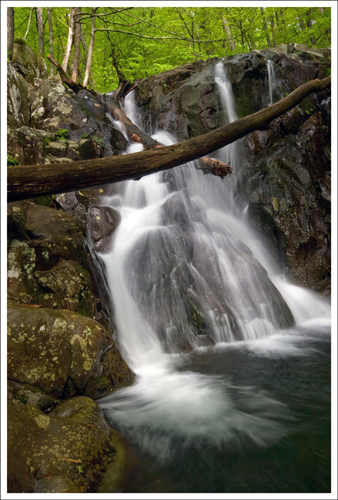
Pretty Rose River Falls.

The Rose River Loop has some of Shenandoah’s best stream and waterfall scenery.  It’s a moderate hike in the park’s central district.

7. Dark Hollow Falls

Autumn at Dark Hollow

Of course Shenandoah National Park’s most popular short waterfall hike has a spot in the top ten. If you hike to Dark Hollow expect a steep climb and lots of people!

8. Cascade Falls

Cascades Falls in Giles County
Beautiful Cascades in Giles County.

Cascade Falls is new to our top ten list.  It’s a gorgeous waterfall in Giles County.  The terrain is easy and the hike is relatively short.

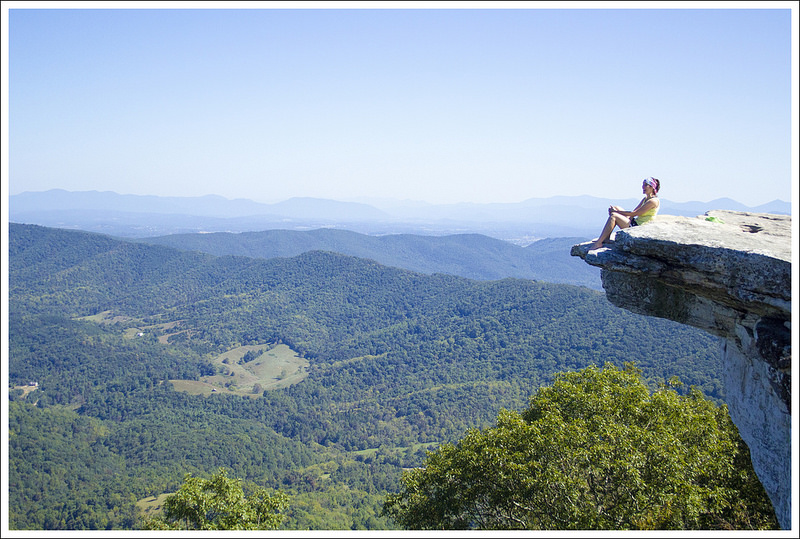
9. McAfee Knob

Sitting on McAfee Knob

McAfee Knob sits at number nine. It’s a classic and it was one of our very first blog posts!  McAfee Knob is considered a must-do Virginia hike.  The ledge in the photo above is the most photographed spot on the Appalachian Trail.

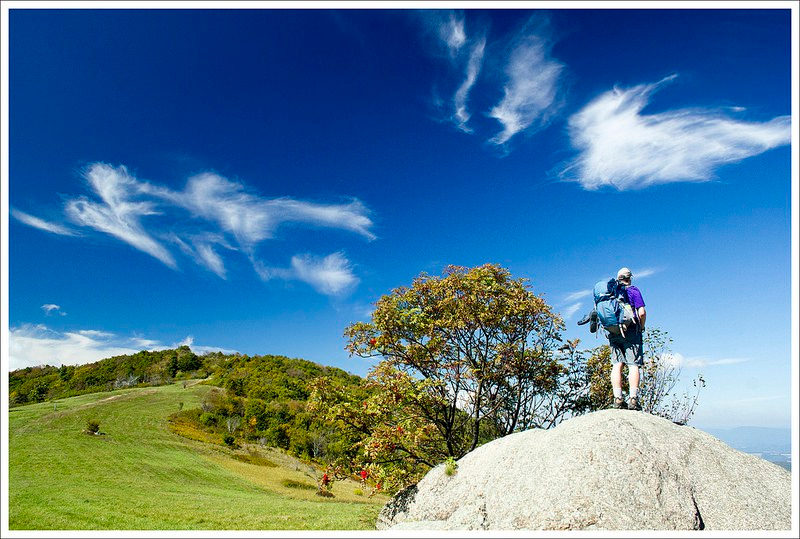
10. Cole/Cold Mountain

Adam Takes in the View from the Summit of Cole Mountain
Adam takes in the view from the summit of Cole Mountain.

Grassy meadows with panoramic views are the primary draw for Cole/Cold Mountain.  It’s a moderate hike that can be done as a loop or an out-and-back.


These hikes were all just outside the top ten.

11. Massanutten Ridge

12. Three Ridges

13. White Oak

14. Great Channels

15. Marys Rock

16. Moormans River & Big Branch Falls

17. The Priest

18. Appalachian Trail – Ashby Gap to Bears Den Rocks (The Roller Coaster)

19. Big Schloss

20. Stony Man & Little Stony Man


Mount Moosilauke (NH)

Special: New Hampshire Edition

Introductory Guide to Visiting the White Mountains

This 7.2 mile hike takes you to the summit of Mt. Moosilauke – Dartmouth College’s ‘home mountain’.  It’s also the first place in New Hampshire where Appalachian Trail hikers walk above treeline in the alpine zone.

View the Full Album of Photos From This Hike
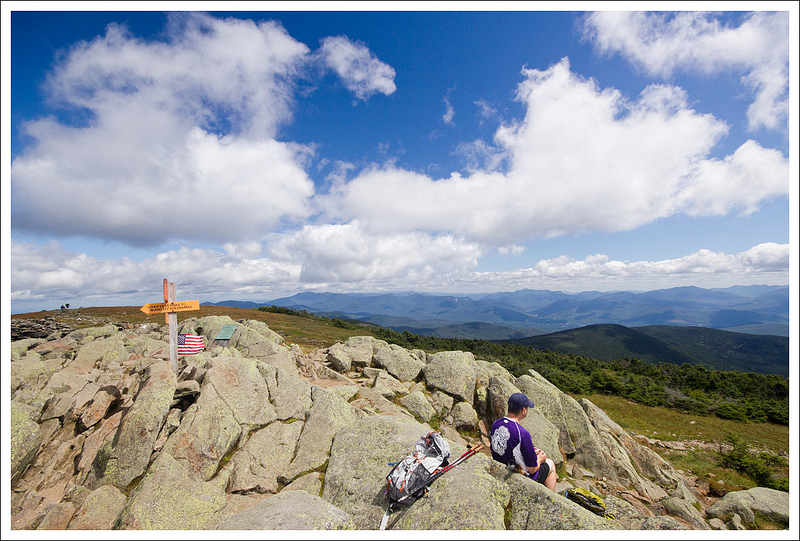
Mt. Moosilauke Summit Views
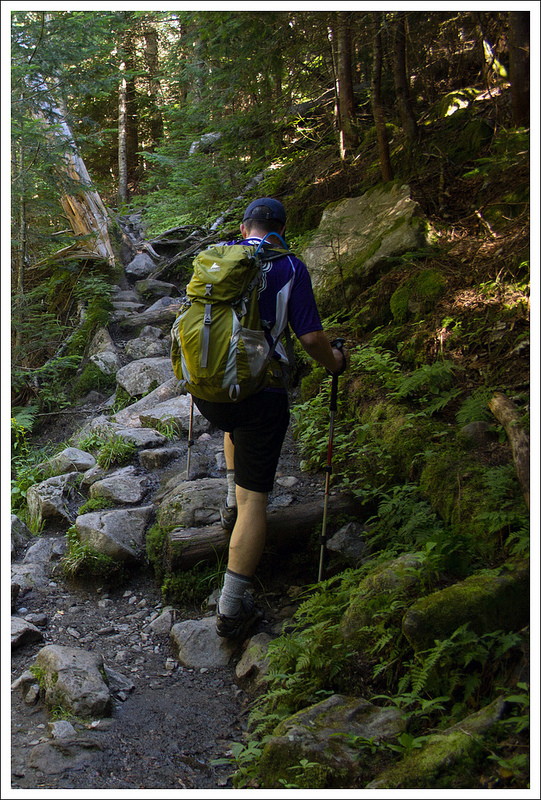
Adam enjoys the summit of Mt. Moosilauke. Below: Damage from Hurricane Irene forced the rerouting of trails; Adam climbs the Gorge Brook Trail; Open views along the ‘balcony’ section of the hike; The area right below treeline was thickly forested with evergreens.

Irene Damage Climbing Gorge Brook Balcony Dense Pines

Christine Says…

For the final hike of our granite-state adventure, Adam and I chose to hike the western-most of  New Hampshire’s 4,000-footers – Mount Moosilauke.  At 4,802 feet, Moosilauke is the first spot northbound Appalachian Trail thru-hikers truly walk above the treeline.  Yes… there are balds and high grassy meadows in the south, but those are not created by the unforgiving alpine climate it takes to truly create areas above the treeline.

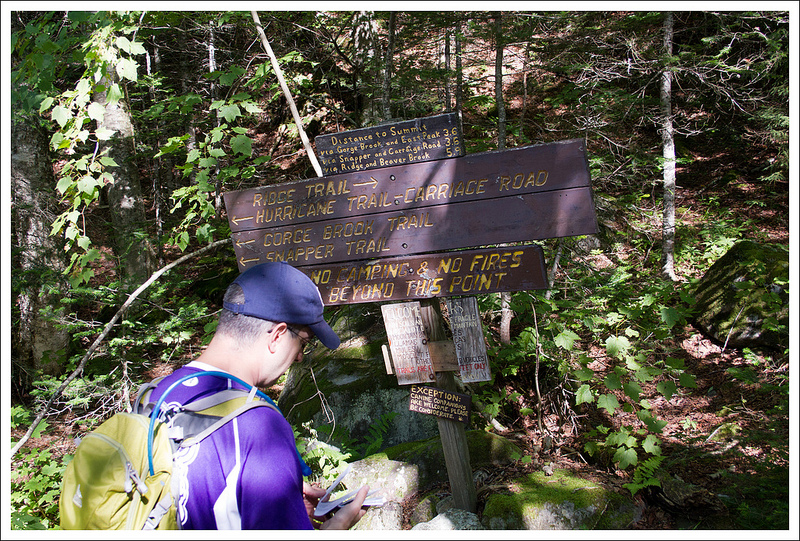
There are several different routes up Moosilauke.  We chose a 7.2 mile loop following the Gorge Book Trail, the old Carriage Road and the Snapper trail. It’s probably the most popular route for dayhikers.

We started off from the Moosilauke Ravine Lodge.  Before I get started talking about the actual hike, I wanted to take a moment to talk about how much I enjoyed visiting the Ravine Lodge.  The lodge and several surrounding bunkhouses were built in the late 1930’s and were originally used as a hub for competitive skiers.  Nowadays, the lodge is owned by Dartmouth College and run by students. You can stay the night or just come in to enjoy a hearty home-style dinner.  The lodge is everything you would imagine a rustic mountain cabin to be – antique skis, old trail signs and mooseheads adorn the walls. There’s a big stone fireplace (yes… a fire was necessary and burning cheerfully on this chilly August morning) and an old piano along one wall of the dining room.  There’s even a cozy library on the lower level!   The lodge windows and back porches also offer stunning views of its namesake mountain.

Moosilauke Ravine Lodge
Dartmouth College owns and runs the Moosilauke Ravine Lodge.  Below: The lodge is very rustic and comfortable.  It was even cool enough in August to have a fire in the fireplace; The food at the Ravine Lodge is supposed to be pretty good!; Adam checks out out route.

Inside the Lodge Ravine Lodge Trail Marker

Now back to the hike… our route started off behind the lodge.  We almost immediately crossed the Baker River on a nice, sturdy bridge.  The Gorge Brook trail climbs uphill gradually over rocky terrain.  We soon came to a sign announcing a reroute of the Gorge Brook Trail.  Evidently, the heavy rains from Tropical Storm Irene caused rock slides and irreparable damage to part of the original route.  A group of Dartmouth students built the Wales Carter Connection, a short section of trail that bypasses the damage.  The connection eventually came back out on the Gorge Brook trail near it’s junction with the Snapper Trail.  We continued gradually uphill on Gorge Brook.  Much of this section of trail followed a pretty stream.  After passing a memorial plaque and a sign for ‘last sure water’ we moved away from the stream and into forest increasingly made up of evergreens.

At 2.3 miles, we got our first open views of the hike.  Through a wide opening in the trees, we could look across the valley in the direction of Mount Cardigan – our first hike of the trip!  Around this part of the hike, we came across our first human company!  One group of three was carrying on a loud and detailed conversation about the best spots to get clear 3G service in the wilderness.  Another group, maybe a father/daughter, was arguing about the nature of God – whether he’s benign and quietly observes suffering or if he’s like a menacing boy who enjoys pulling the legs off of bugs to watch them struggle.  I think we overheard them talking about Shakespeare, too, but I can’t be certain. Usually when Adam and I talk on the trail, we talk about the scenery/wildlife or we just walk in companionable silence.  It made me curious… are you a chatty hiker?  What are your typical trail topics?

Gorge Brook Trail
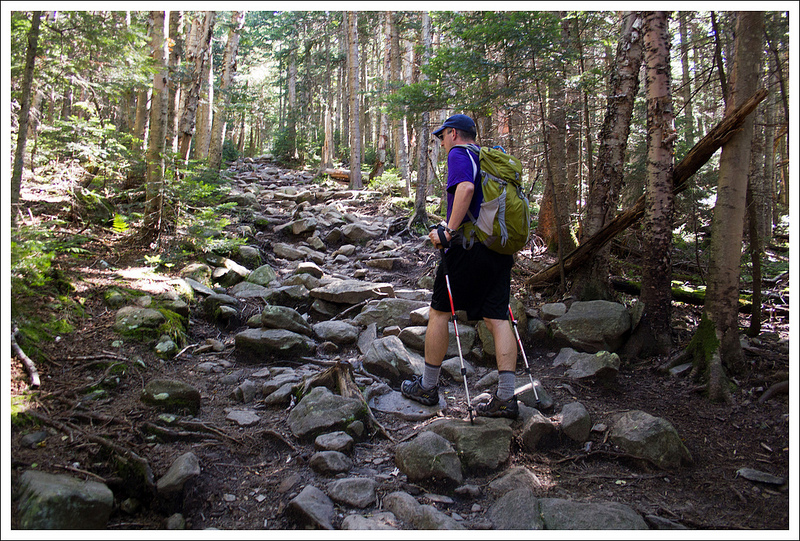
Adam climbs the rocky Gorge Brook Trail.  Below:  Beautiful stream scenery; The  Gorge Brook trail was very rocky; Our first views along the way.

Brook More Rocky Climbing First Views

After the first view, the trail got a bit steeper and the trees a bit sparser.  We enjoyed several nice views from a section of the trail called ‘The Balcony’. After climbing the massive stone steps along the Balcony, we dipped in and out of thick stands of evergreens.  It was almost like walking through an overcrowded Christmas tree farm.

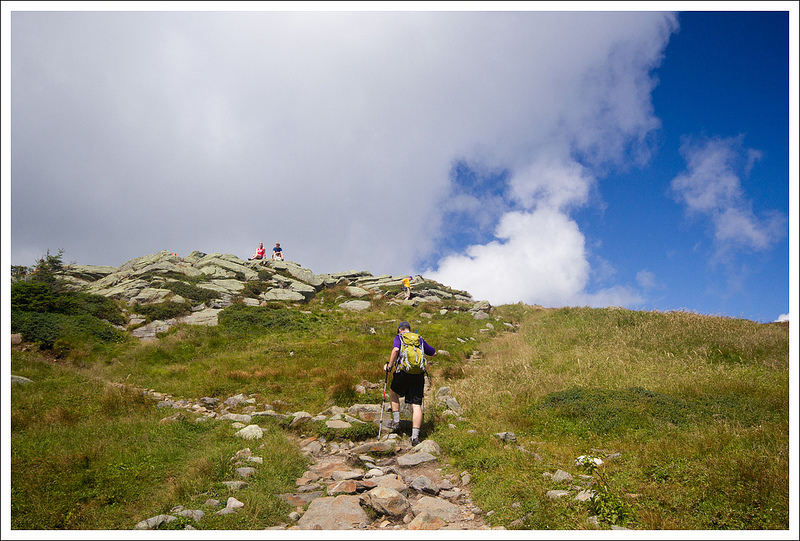
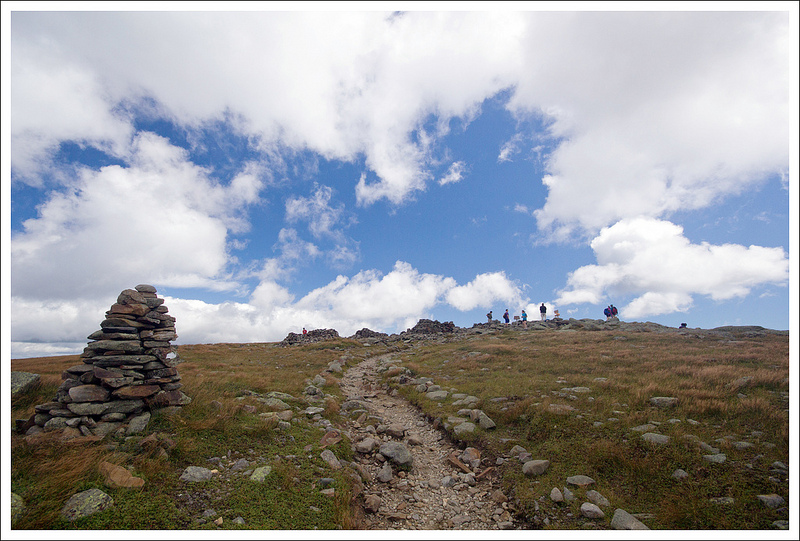
We soon stepped out into the alpine zone – the barren rocky expanse that exists above the treeline.  We could see the rocky path winding across the bare terrain toward a copse of rocks a top the summit of Moosilauke.

As soon as we were in the open, I had to dig my fleece out of my backpack.  It was a good 15-20 degrees colder (and much windier) on the summit.  We enjoyed a snack, took our photos at the summit sign and marveled at the views.  I especially liked looking across and seeing the Kinsmans, Franconia Ridge and the distant Presidentials.

Above Treeline
Mt. Moosilauke is the first New Hampshire peak on the Appalachian Trail that includes an alpine zone.  Below:  Coming out of the trees; The final push to the summit; At the summit marker.

Approaching the Treeline Nearing the Summit Summit Marker

Leaving the summit, we briefly followed the white-blazed Glencliff trail (which is also the Appalachian Trail across this mountain) to its junction with the Carriage Road.  This section of trail was almost perfectly flat and went through more areas that resembled large groupings of Christmas trees.  We could have taken a detour to visit the South Peak of Moosilauke, but we decided to skip it.

The Carriage Road was wide and graveled, but a little steep.  I can’t imagine people coming up this route in horse-drawn carriages!  This part of the hike was pretty uneventful, and we were glad to finally reach the Snapper Trail.

The Snapper Trail descended gradually through stunningly beautiful New England woods.  There were thick beds of moss, peeling white birches and several small bubbling streams.  It was a lovely way to bid farewell to New Hampshire trails.  Before we knew it, we were back at the Ravine Lodge and finished with a productive week of hiking!

Adam Says…

Mt. Moosilauke was one of the three hikes we most wanted to do in New Hampshire.  Having hiked Mt. Washington and Franconia Ridge earlier that week, we were feeling a little tired and sore but we decided to press on to cover Mt. Moosilauke.   We try to get a lot accomplished on our vacations, so we didn’t want to have any regrets of not doing a certain hike.  We always say that we can be tired when we go back to work, so we run ourselves ragged on our vacations.

Parking at Mt. Moosilauke can at times be a challenge.  There is one long gravel road and during the summer, you will likely see cars lining one side of the road, parallel parked.  We had to drive to the end of the road and then turn around and backtrack, but we were able to find a decent spot since we left so early in the morning.

We first visited the lodge and you can just imagine the history here.  The lodge is rustic but has that snuggle-by-the-fire cozy feel to it.  Since this is maintained by an Ivy League school, my mind began to wonder if there were academic secret society meetings held here or if famous alumnus, Robert Frost penned any of his poetry here.  All I witnessed were a few students playing Magic: The Gathering in the basement.

Leaving the Summit
The first trail we used for our descent was the Appalachian Trail, also called the Glencliff trail in this area.  Below: Christine makes the descent; Looking back through the pines toward the summit; Alpine zone marker.

Views on Hike Down More Pines Alpine Warning

The trail had us a little confused to start off on the right path.  My recommendation would be to go to the back of the lodge and as you are looking into the backyard, head down the lawn towards the right.  You will soon come to a path that will lead you to the Baker River.  In a short distance, you will cross the bridge over the river.  The Gorge Brook Trail starts off to the left.  The trail takes a right turn in a short distance and you begin a moderate ascent through a very rocky trail.  You’ll hear the sounds of the Gorge Brook to the left of the trail at times as it carries water to the Baker River.  As you keep climbing, at .6 miles you will reach the junction with the Snapper Trail, your return route.  The trail has been rerouted at this point with the Wales Carter Connection.  Follow the signs through this .5 mile connection to continue along the Gorge River Trail.  The trail continues to ascend through a steeper section of trail through the woods.

At 2.3 miles you reach a break in the trees and can see your first views of Mount Carr, Mount Cardigan, and Mount Kearsarge.  The trail continues to ascend and then loops back around to the northwest as you gain some more views from the area known as The Balcony at 3.0 miles.  The views were quite delightful and gave us something else to focus on as we labored up more rocky steps.  The trail then ducks away from the views and you find yourself soon immersed into a dense forest of spruce and fir as the trail snakes through.  You will see signs reminding you to stay on the trail to protect the fragile vegetation.   At about 3.25 miles, you will come out of the trees and into the open alpine area.  Large cairns are placed on the side of the trail.  The summit looks misleadingly close, but due to the open nature it still takes about 10 minutes to reach the summit at 3.5 miles.

At the summit, the wind had picked up quite a bit across this vast, open area.  We found lots of people huddled up against rocks, trying to protect themselves from the wind.  We ate some lunch on the trail, snapped a few photos from the summit, and made our way back on a different set of trails.

Snapper Trail
The Snapper Trail was delightfully green and shady.  Below: Adam descends the Old Carriage Road; The Snapper trail was mossy; Water crossing on the Snapper Trail.

Old Carriage Road Mossy Water Crossing

From the summit marker, we followed the signs for the Glencliff Trail (also known as the Appalachian Trail) southwest of the summit.  This trail started off as a ridgeline hike which gave us even more views along the way to start our hike.  At 4.4 miles, the Appalachian Trail ducks off to the right to take you to the South Peak summit.  We stayed on the main trail which is the Moosilauke Carriage Trail, which drops steeply down the rocky “road”.  The trail was fairly uneventful, but the downward climb can be hard on the knees.  At 5.7 miles, we reached a junction and took the Snapper Trail.  This trail was thickly wooded and had lots of beautiful fern along the trail.  At 6.4 miles, we rejoined the Gorge Brook Trail and made our way back to the lodge, which we reached at 7.2 miles.

Back at the Ravine Lodge
The trail returns to the Ravine Lodge. Below: Looking back toward Mt. Moosilauke; A pleasant patio spot to take in views of the summit; Lodge decor

Looking Back to Moosilauke Patio Moosehead

One thing that amazed me about this hike is how Dartmouth College has integrated with and adopted this mountain.  They maintain and run the lodge and the network of trails is maintained by students in the Dartmouth Outing Club.  We had the opportunity on our visit to New Hampshire to step on the campus and actually walked into the Dartmouth Outing Club building.  Yes, this college has a building designated for this club and they even post information for Appalachian Trail thru-hikers to get them connected to where they could stay for the night.  I was amazed at how the students have made this a strong tradition of caring for the mountain and environment.  They even hold freshman pre-orientation trips where they all meet up at the Ravine Lodge.  I wish more colleges and universities had more intentional connectivity with the outdoors.

What a great last hike for our trip to New Hampshire!  We felt so blessed to have great weather for the entire week and our hiking adventures whetted our appetites for more trips in the future.

Trail Notes

  • Distance – 7.2 miles
    (Check out the stats from MapMyHike)*
  • Elevation Change – About 2500 ft.
  • Difficulty – 3.  There may be over 2,000 feet of climbing, but it’s gradual and never feels that difficult.
  • Trail Conditions –  4.  The Dartmouth Outing Club does a great job on these trails!
  • Views –  5.  Spectacular – especially at the summit where you can see all across the White Mountains.
  • Waterfalls/streams  3.  The Baker River and streams in the area are lovely.
  • Wildlife – 2.  We didn’t see anything, but rumor has it that there are occasional moose sightings in the area.
  • Ease to Navigate – 3.  The reroute was a little confusing at first because it varied from our map.
  • Solitude – 1.  This is an extremely popular dayhike.  Expect to see many other hikers.

Download a trail map (PDF)

Directions to trailhead: From Interstate 93, take exit 32 for NH-112 toward North Woodstock/Lincoln.  Follow NH-112 West for 3.2 miles.  Take a slight left onto NH-118 S/Sawyer Highway.  Follow this for 7.1 miles.  Take a right on to Ravine Road.  Follow this gravel road for 1.5 miles.  The entrance to the lodge is on the left.  Go behind the lodge across the lawn to the right to start the hike.

MapMyHike is not necessarily accurate, as the GPS signal fades in and out – but it still provides some fun and interesting information.