The Sugarloaf-Keyser Run-Hogback Mountain Loop is a lovely 4.9 mile hike through classic Virginia forest. It passes by several nice panoramic viewpoints and makes use of the Appalachian Trail, a couple SNP trails and a fire road.
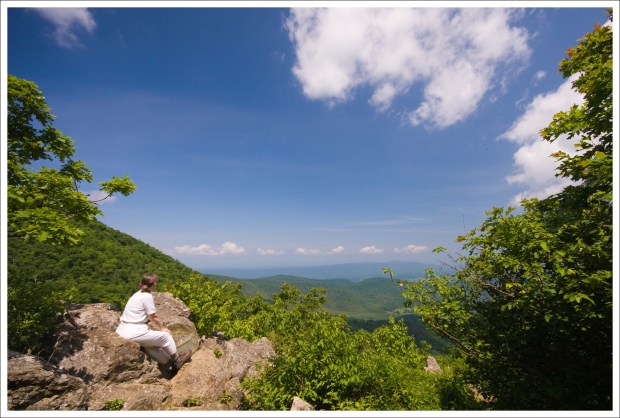
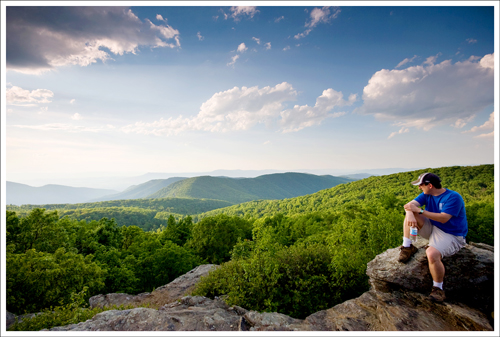
Mom on the Little Hogback Summit
Christine says…
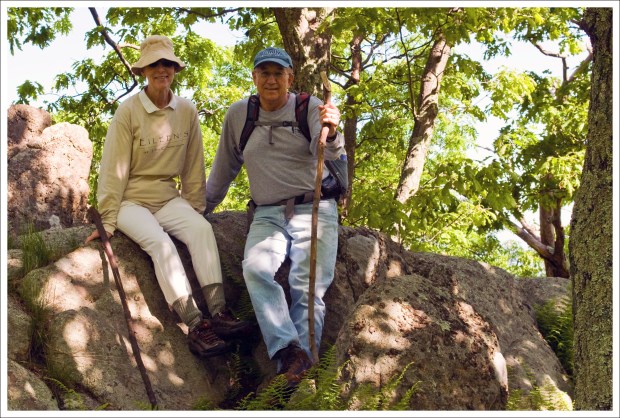
We hiked this trail with my parents to celebrate a combination of (belated) Mother’s Day and (early) Father’s Day. My parents are fit, active, outdoorsy people, so we knew they would enjoy a day of wildlife watching, hiking and picnicking in Shenandoah.
My Wonderful Mom & Dad
We picked the Sugarloaf-Keyser Run-Hogback Mountain Loop because it sounded like the perfect length and difficulty for the whole group. For some reason, my mom had a hard time remembering the name of the hike, and kept referring to it as “Hogland.” I chuckle every time I think of a hiking trail being called Hogland; it sounds like the name of a porcine-themed amusement park.
It definitely turned out to be a suitable hike for the whole group. The first 3.5 miles were really easy going. The AT and Sugarloaf segments were both especially pretty. The section along the Keyser Run Fire Road was boring, as fire roads always are. My mom and I agreed that fire roads are always a little dull compared to “real” trails. We saw a couple hikers coming out of the Little Devil’s Stairs area on Keyser Run Road. They looked exhausted and sweat-drenched. The day turned out to be a lot warmer than had been forecast.
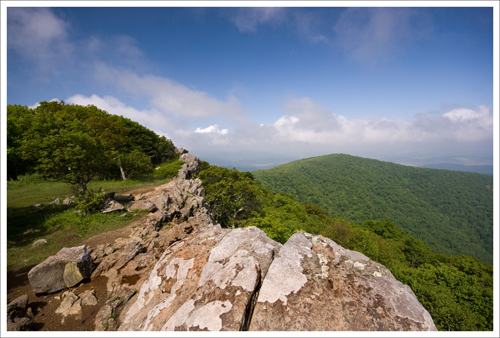
The view from the summit of Hogback Mountain (the highest point on the trail) was a little underwhelming for me. The valley vista was lovely, but it was hazy and the view was ruined by power lines and an obstructive radio tower. The views from Little Hogback are definitely nicer, even though the vantage point isn’t as lofty in elevation. The saddle between Little Hogback and Hogback also has one especially beautiful view spot.
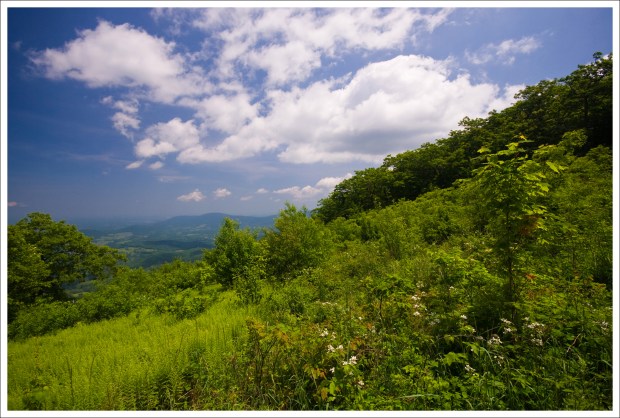
The saddle between Little Hogback and Hogback is very pretty
The whole hike only took us a couple hours to complete, even with water and snack breaks along the way. Afterwards, we shared a delicious picnic lunch at Pinnacles and headed home tired and stuffed full of chocolate chip cookies and fried chicken. It was a really fun day.
Adam says…
Since there are a lot of trails and options in this area, here are the trail directions we used. After crossing Skyline Drive from the parking lot and proceeding .3 miles, you will come to a concrete post. Take a right and follow the blue blazes down the Sugarloaf Trail. Hike for 1.1 miles until you come to the next marker. Take a left onto the Pole Bridge Link Trail. Continue for .5 miles and then take a left on to the Keyser Run fire road. Follow this for 1.1 miles, crossing Skyline Drive. When you reach the AT junction, take a left heading south on the AT. Keep on the south AT, going up Little Hogback and then Hogback Mountain. You will cross Skyline Drive one more time on your descent. Follow the south AT until you reach the parking lot.
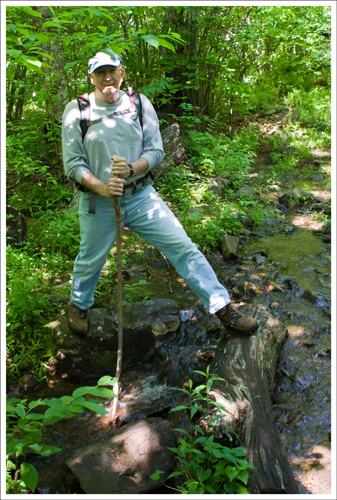
The stream crossings were shallow and easy
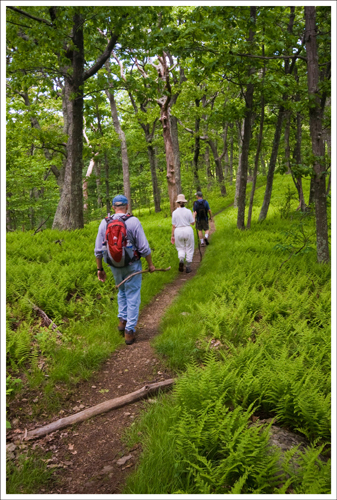
This hike had some very pretty spots on the trail. The fern-covered forest floor near the beginning of the trail and again near Hogback Mountain was really quite gorgeous. I felt this trail was very easy and most people could handle it. The only challenging portion was the brief half-mile set of switchbacks climbing up to the Hogback Summit. Last year, a ranger told us this was the best hike in Shenandoah National Park. I would disagree, but it was still an enjoyable hike and our first time on this particular route.
One of the prettiest sections of trail was the Appalachian Trail crossing Hogback Mountain
We ran into our AT thru-hiker for a third time! When we stopped to talk to him, I told him, “I promise we’re not stalking you.” He laughed and asked “Don’t you guys ever go home?” Quite funny that we’ve seen him so many times in a park that encompasses 196,000 acres!
Trail Notes
Distance – 4.9 mile loop.
Elevation Change – 700 ft. Most of this is during the climb up to Hogback Mountain.
Difficulty –1.5. For most of the trail, the trail is level or slightly downhill. There is a steep set of switchbacks to the summit of Hogback Mountain.
Trail Conditions –4. The AT is well-maintained. You also travel on the Keyser Run fire road for a little over a mile.
Views – 3. The view from the summit of Little Hogback was the nicest unobstructed view.
Waterfalls/streams – 1. A couple of very small stream crossings, but not photo-worthy.
Wildlife –2. Some signs of bears in the area, but you’re more likely to see some deer along the way.
Ease to Navigate – 4. There are a couple turns, but the directions are well-marked on cement posts.
Solitude – 4. Likely to see AT hikers mostly during June, but we didn’t really see many others.
Directions to trailhead:
Park just south of the Hogback Overlook, in the parking lot located at mile marker 21 on Skyline Drive. At the south end of the lot, you will find the AT marker. You will cross the drive here, go slightly uphill, and then start the descent.
The Hawksbill Summit is a fairly easy, 2.9 mile trail that takes you to the highest peak of Shenandoah National Park at 4,049 feet.
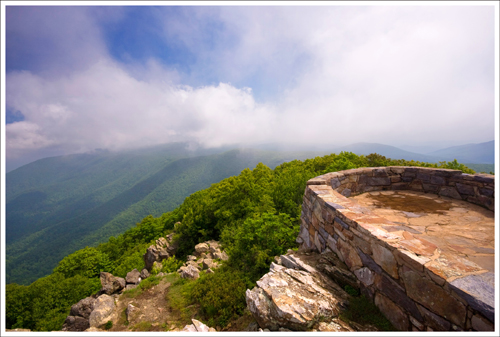
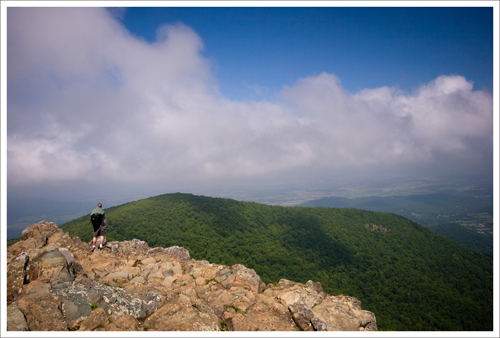
This is the first of the four summit views you’ll come to along the Hawksbill Loop Trail. Pictured below (left to right): The third viewpoint – the hack box for the falcon chicks is along this rock shelf; The CCC constructed summit; Adam climbing around the rock jumble at the summit.
Adam Says…
We really had one of those almost perfect days in Shenandoah National Park. We made it up to the park before 7AM. There was a lot of fog on the mountains that made for tough visibility, so we decided to grab breakfast at Skyland Resort before setting out on our hike. While we were eating breakfast, our waitress pointed out a black bear right outside the dining room window. It stayed out there for several minutes while people photographed it (they got really close – within 10-15 feet of the bear). While Christine made an attempt to grab her camera from the car for her own photo opportunity (which she missed), I noticed the AT thru-hiker we met on the Loft Mountain Loop had just sat down to dive into a hearty breakfast. I talked to him about how we were thinking about him braving the thunderstorms the last few days. He said that the Tuesday night storms had indeed been brutal.
After breakfast, we drove south from Skyland to start our hike on Hawksbill Summit. The posted trail board listed an out-and-back hike of 1.7 miles and a loop hike of 2.8 miles. We decided to do the loop and were very glad that we did!
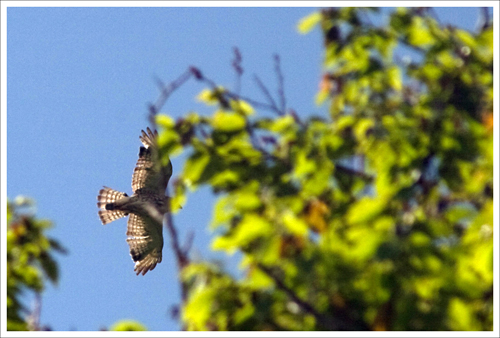
Hawksbill Mountain is a great place to watch birds of prey. While I was photographing the scenery, Adam took this shot of a bird soaring overhead. He felt pretty lucky to have even part of the bird, in-focus and in the frame. He sometimes feels overwhelmed by all the controls on the dSLR, but I think he does a great job whenever he takes photos.
At around the half mile mark, we heard some screeching up ahead and above. We came up to the first of three talus slopes and sure enough there were a pair of peregrine falcons swooping around. We tried to get some pictures of them flying, but they swooped by way too quickly for the camera to lock focus. When we came to the second talus slope, one of the falcons had landed about 15 feet in front of me, gave me a quick cry, and darted off at eye level from us. We’ve never had an opportunity to see these birds up close. We usually vacation in Acadia National Park every summer. The park’s Precipice Trail is a great place to view falcons; however, this trail is closed off during much of the summer for falcon nesting and we have had to resort to viewing them through binoculars.
The Byrd’s Nest #2 Shelter is available for day use only. It’s a three-sided structure.
Once we arrived at the Byrd’s Nest Day Shelter near the summit, we ran into a SNP Volunteer who has been monitoring falcon activity in the area. Shenandoah National Park has been working with the College of William & Mary’s Center for Conservation Biology to help reintroduce these birds to the park ecosystem. It was fascinating to learn about these birds of prey. He pointed out the cliff-side hack box that currently houses six falcon chicks. Students find falcons nesting around Williamsburg and Norfolk, grab the babies when they’re a few weeks old and deliver them to SNP for rehoming.
The volunteer feeds the falcon chicks twice per day, giving the birds quail through a slot door in the hack box. The chicks never actually see the person. The goal is to keep the chicks completely unaware of the human intervention.
The feeder told us a funny story about his time on the mountainside. He was on his way to feed the birds that morning when he was charged by a deer. He reached for a slingshot he had in his pocket, but the deer was too close. He ended up using the slingshot as a club and thumping the doe lightly on the head. It just stared at him like he was crazy. He realized as he looked down that he had almost stepped on her newborn fawn.
The volunteer told us that there was a belief that the peregrine falcon pair that we saw was moving over from their established nest site on Old Rag. They have been observing the Old Rag falcons for a while, and are hoping they stay put. If the Old Rag falcons relocate to Hawksbill, the hack box holding the chicks will have to be moved to a new location. The volunteer was trying to read numbers on the bands of the falcons swooping by to see if he could identify them as the same pair from Old Rag.
After a bit more chatting, we left the volunteer and proceeded on to the summit. When we came back to the shelter, we noticed that there were now three falcons swooping around near the summit. We found the volunteer and told him. He told us that seeing the three falcons might help prove that these birds might not be the pair from Old Rag. We felt proud to have been able to provide some useful information for their research.
Christine Says…
It’s kind of ironic, but Adam really didn’t want to go to the park at all on this particular morning. He thought the trails would be sloppy-muddy from all the rain. Also, he was longing for a morning of sleeping in, followed by loafing on the couch and possibly even some video games. But, being the insanely cruel morning person I am, I dragged him out of bed and told him that I wanted to hike Hawksbill. After all was said and done, he ended up declaring this to be “one of our best days in the park ever!”
At the trailhead, Adam lobbied for the shorter out-and-back, but I really wanted to do the longer loop. It’s more scenic and there are many more opportunities to see wildlife along the way. Besides, the out and back is a tough, boring, uphill climb – straight up the side of Hawksbill Mountain. You don’t see anything special – you just climb.
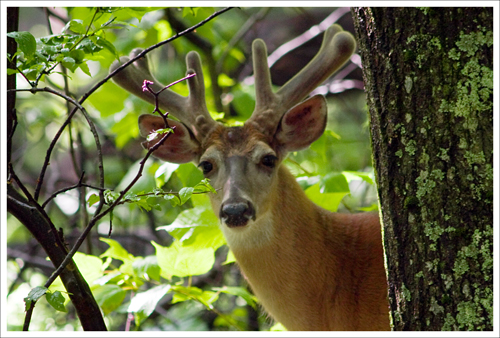
I bet this magnificent buck gets a lot of female attention in the fall. The photo below is another of the bucks from the group.
A quarter mile into the hike, we saw three impressive bucks. Even this early in the season, these guys were already displaying large, velvety racks of antlers. During the summer months, it’s not uncommon to see groups of big bucks hanging out in mini-herds like this. I think they’re planning strategies on how to get the girls in the fall. 🙂 They were completely indifferent to our presence, so we stayed and watched them for a few moments. I wish it hadn’t been so dark in the forest. I would have loved to get some better photos of these handsome guys.
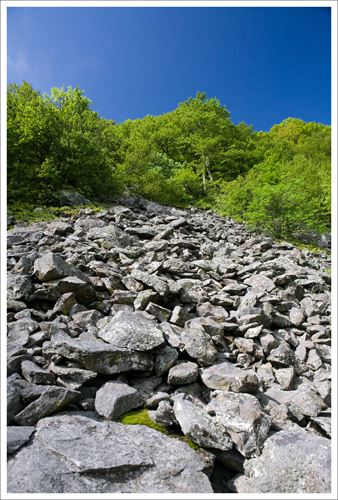
This is the talus slope where we first spotted the peregrine falcons.
Seeing the falcons near the talus slopes was simply amazing. I’ve never seen peregrines so close in the wild before. They’re truly expert aerial acrobats. I also really liked talking to the naturalist at the summit. No matter how much time I spend in the park, I still feel like I see and learn new things on every visit.
Our view at the CCC-established summit was largely obscured by clouds and fog, but it was still a beautiful, breezy day. Hawksbill gives full views in every direction. You get a nice look at Skyline Drive winding its way through the forest and a wonderful, distant view of magnificent Old Rag Mountain. Hawksbill Mountain actually has four excellent viewpoints along the summit. You only see two on the out and back hike. Typically you can see all four on the loop hike, but on this particular day one viewpoint was closed off for the falcons.
Although it’s relatively level here, the trail back down Hawksbill Mountain is quite steep.
The hike back down is pretty steep, but the trail is well-maintained and covered with gravel. My knees always ache climbing down Hawksbill – there are no switchbacks to gentle the grade. It’s straight down the mountainside. Hikers should be careful to follow the correct trail back down the mountain! There are trails leading back to Upper Hawksbill and Lower Hawksbill parking lots. There is also a fire road. If you don’t pay attention to the cement marking posts, you may end up on the wrong trail and have an extra mile or so of hiking to do along Skyline Drive to make it back to your car. We saw a couple who had made that exact mistake walking along the road when we finished our hike. They didn’t look too happy.
Trail Notes
Distance – 2.9 mile loop. A 1.7 mile strenuous out-and-back is one option, but the loop is recommended for it’s scenic beauty and wildlife viewing potential.
Elevation Change – 800 ft
Difficulty –1.5. If you do the loop. The out and back may be shorter, but it’s more strenuous.
Trail Conditions –4. The AT portion is well-maintained. The trail down from the summit is covered with small gravel.
Views – 4. The view from the summit is impressive on a clear day.
Waterfalls/streams – 0. No streams on this trail.
Wildlife – 4. We did hit some great luck this day, but we saw several deer including three bucks and you have some decent chances of spotting peregrine falcons in the summer.
Ease to Navigate – 3. There are a couple turns, but the directions are well-marked on cement posts. Pay attention on your way back down the mountain. There are several descents to choose from.
Solitude – 2. The hike is fairly popular and featured often with SNP handouts, but we never seem to run into many people up there. I hear the summit gets very crowded on pleasant weekend afternoons.
Directions to trailhead:
Park at the Hawksbill Gap parking lot which is located around mile marker 45.6 in the Central Section of Skyline Drive. The trail can be done as an out-and-back hike taking a steep trail to the summit, but we recommend that instead of going straight up to the summit, take the spur trail to the Appalachian Trail and follow the signs to the Hawksbill Summit.
The Loft Mountain Loop is an easy, 2.7 mile trail that makes use of a fire road, the Appalachian Trail and the Frazier Discovery Trail. It takes you past one of Shenandoah National Park’s finest views.
Adam on the Loft Mountain summit
Christine Says…
Adam and I love visiting the park on weeknights after we get off work. The traffic is usually light and the animals tend to be more active. On Tuesday night, we saw many deer, a timber rattlesnake, a couple rabbits, a bear with three cubs and only a handful of human beings. If you live close to the park, weekday evenings are the perfect time for a quick hiking escape – especially on June nights when twilight lingers until 9:00 p.m.
On this particular night, we chose to hike the Loft Mountain Loop, which is located in the south district of the park. Generally, fewer people visit the south end of the park than the other two districts (north and central), so it always feels quiet and peaceful. I have so many fond memories of camping at Loft Mountain as a child. We had a rickety, second-hand, pop-up camper. I remember waking up on cold mountain mornings to the smell of bacon cooking over the campfire and going to sleep at night after roasting marshmallows and listening to my dad’s goofy “ghost stories”. Ah… such nostalgia!
A friendly rabbit along the fire road.
The hike starts out on a fire road almost directly across Skyline Drive from the Patterson Ridge Trail. The hike goes uphill for a short distance until you reach the Ivy Creek Hut (used by the Potomac Appalachian Trail Club for maintenance activities) and the Ivy Creek Spring. Pass through the site and follow the blue blazes uphill for a couple hundred yards to the junction with the Appalachian Trail. The stretch along the AT climbs steadily uphill for about a mile. It eventually levels out on the ridge of Loft Mountain. At this point the terrain opens up – the trees are further apart and the trail is grassy and almost meadow-like. Adam kept getting ticks on him (FIVE!), but I didn’t get any at all.
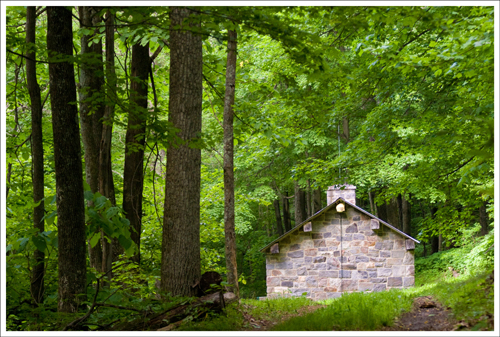
The Ivy Creek Hut is used by the PATC.
Your first nice view will come on a small rock outcropping facing northeast, but the big payoff for this hike comes at the 1.5 mile mark. The southwest facing summit of Loft Mountain is awesome – definitely one of the park’s most spectacular views.
We reached the vantage point in time to see the building storm clouds to the west. We shared the summit with an Appalachian Trail thru-hiker camping nearby. He was from Boston and had been on the trail since March. He told us he had covered 22 miles that day and was looking forward to spending an upcoming night off the trail at the Big Meadows Lodge. He remarked that he was thinking hard about a big cheeseburger and a cold beer.
I couldn’t help but think of the guy later on in the evening when we were back in our car, watching the Loft Mountain area being pummeled with lightning and torrential downpours. I love hearing trail stories from thru-hikers, but I don’t think long distance backpacking is for me.
We stayed on the summit for about fifteen minutes, and then quickly made our way down the Frazier Discover Trail and back to our car.
Adam Says…
This is a trail that we both enjoy quite a bit. It’s not too tough and has some nice views to both the east and west, which is not common for Skyline Drive. If you do this hike early in the morning or late in the evening, you should be able to see a good view for a sunrise or sunset. There are also a couple of possible campsites along this stretch of trail and a developed campground along Skyline Drive at Loft Mountain.
The trail was lined with little flowers.
It was very interesting to talk to the AT hiker. June is the month when most of the northbound thru-hikers are passing through Virginia. If you have a chance, it’s worth talking to some of these people about their experiences. Most of them use trail names instead of real names during the hike. The one we talked to this night was very friendly and talkative. He said that his toughest leg so far was in the Smoky Mountains, but this was largely due to the snow that was still there. He was enjoying his first sunset view in SNP. It’s quite an accomplishment to be able to hike the entire AT. I would love to be able to have the chance to do this some day.
The rock cliff below is an impressive sight to find along the Frazier Discovery Trail.
This giant rock wall can be found on the descent along the Frazier Discovery Trail
Trail Notes
Distance – 2.7 miles
Elevation Change – 600 ft
Difficulty –1.5. Other than a mile of climbing along the fire road and the Appalachian Trail, the hike is either level or downhill.
Trail Conditions –4.5. The trail is extremely well-maintained.
Views – 4. The view from the Loft Mountain summit is really spectacular.
Waterfalls/streams – 0. No streams on this trail. There is a spring near the PATC maintenance cabin.
Wildlife –2. We saw deer and a rabbit.
Ease to Navigate – 4. There are a couple turns, but the directions are well-marked on cement posts.
Solitude – 3. The hike is short and near one of Shenandoah’s campgrounds. So, on busy weekends, expect to see a fair number of people. We hiked it on a weeknight in June and came across a pair of backcountry campers and an AT thru-hiker.
Directions to trailhead:
Park at the Loft Mountain Wayside at Skyline Drive mile marker 79.5. Walk north along the drive for a 150 yard and then cross the drive to pick up the fire road. The trailhead is almost directly across the drive from the Patterson Ridge trail.
The hike to the Rapidan Camp (also known as Camp Hoover) is probably one of our very favorite walks in all of Shenandoah National Park. We had such a great time there today. It was one of those really perfect mornings along the trail.
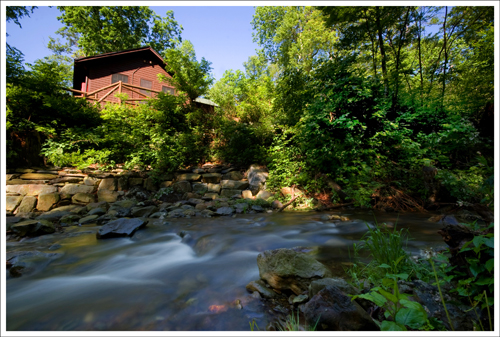
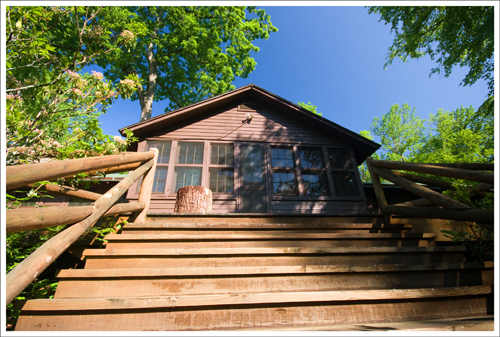
The Brown House (as opposed to the White House) is where President Hoover stayed when he wanted to escape the heat, stress and formality of Washington, D.C. Below are photos of (left to right): The main entry to Brown House has steps that lead down to the Rapidan River; the house has a large patio overlooking the river – it was a popular place to relax in Hoover’s day; the Mill Prong was running beautifully today.
Adam Says…
This is probably my favorite hike in Shenandoah National Park. The reason I would say this is due to the combination of the history and scenery.
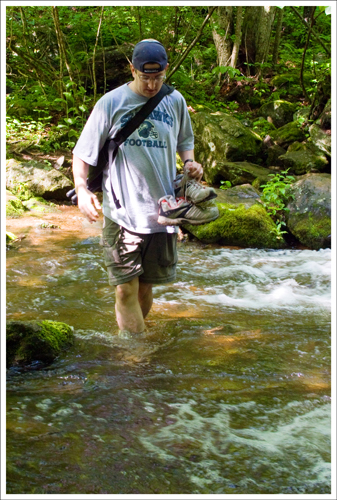
The hike isn’t too difficult, but there are three sets of rock-hopping that you’ll need to do over the Mill Prong. Due to the recent storms, we actually had to wade across the the third stream crossing since the rocks were mostly submerged and we didn’t want to risk dropping Christine’s camera gear into the water.
The Rapidan Camp was built for Herbert Hoover during his term of office to serve as the first Presidential retreat. Hoover was an avid outdoorsman and fisherman. Shenandoah National Park was being built around the same time. In order to hopefully get the park approved, they encouraged Hoover to build his retreat here. Marines were brought in to build the camp, which included the construction of thirteen buildings and electrical/phone lines. Interestingly enough, they heavily stocked the Rapidan River with lots of trout before Hoover arrived, so he would have lots of successful fishing trips. When Hoover left office he donated his camp (which he paid for out of personal funds) to the government. Hoover’s initial plan was to have the Camp serve as the permanent presidential retreat. Due to Franklin D. Roosevelt’s wheelchair-confinement and his strong dislike of Hoover, he decided to establish a new retreat in the Catoctin Mountains of Maryland which he called Shangri-La (it was renamed by Eisenhower as Camp David). It is interesting to think about what it would be like if the presidential retreat stayed at Camp Rapidan and how that could have impacted the park.
There does seem to be some good trout-fishing in the areas nearby, but it is all catch-and-release. Of course, it’s not stocked like it was for Hoover.
If you aren’t able to see inside the Brown Cabin (see Christine’s info below), you can still walk around the grounds and read about the history of the area. I would highly recommend bringing a lunch or snack. The back porch is a great place to eat and reflect on the history of this time.
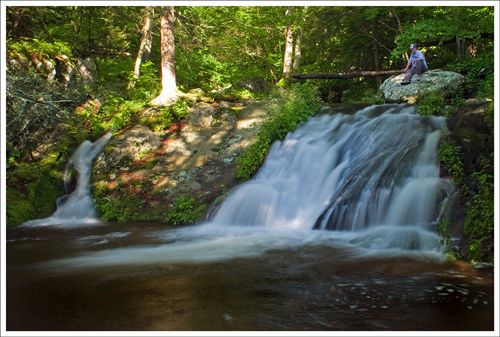
Big Rock Falls is located along the trail right before you cross the river. Below are photos of (left to right): the trail is lined with lush ferns; Adam wades across the stream; a pretty spot along the Mill Prong.
Christine Says…
We’ve hiked to the Rapidan Camp many times, but today was my favorite trip down the trail ever. It was just one of those magical mornings where everything felt especially beautiful and perfect.
We got an early start, so the only people we came across on the way down were Boy Scouts hiking back out after a weekend of camping. As we passed them, I had to wonder how they fared last night. We had some fierce thunderstorms that rolled through around 3:00 a.m. I was thrilled to see how flush with water the Mill Prong and the Rapidan River were. Even the small waterfall, Big Rock Falls, looked impressive this morning. When a crucial rock hop proved unavailable due to the high water, I enjoyed wading barefoot across the stream. I thought the water would be cold, but it was actually pleasant and refreshing.
Probably the best part of the hike was our tour of the Rapidan Camp. The volunteer ranger was just opening up when we arrived and gave us a private look at the President Hoover’s cabin, also known as “The Brown House”. Although the cabin looks rustic on the outside, the inside is quite refined and cozy. The floor is beautifully smooth wood, there are two bathrooms, two bedrooms, two huge stone fireplaces, hand woven rugs and a lovely study/office that overlooks the headwaters of the Rapidan River. Until 1996, the Brown House was available to high-ranking politicians and V.I.P.s. Al Gore was actually the last person to “rent” the Rapidan Camp for personal use. (Sandra Day O’Connor and Jimmy Carter have also been guests of the Rapidan Camp.)
The cabin is open for tours most days, May through October. Volunteers have Tuesday and Wednesday off, so if you want to see inside, hike it on another day. Each volunteer ranger actually gets to live at the camp for their three-week tour of duty. The volunteer stays in the nearby Creel Cabin, which is one of the only three original buildings left standing. The volunteers maintain the property and give tours to visitors. The camp is also accessible on a ranger-guided program. So, even folks who can’t (or don’t want to) walk can still see the site.
There is a fantastic exhibit set up in the “Prime Minister’s Cabin”. It has many old photos and detailed information about the engineering feats required to build the camp. Be sure to look at the large version of the letter pictured below. It shows a lot of the planning that went into picking the site.
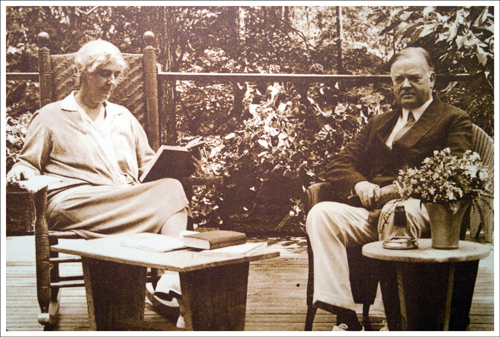
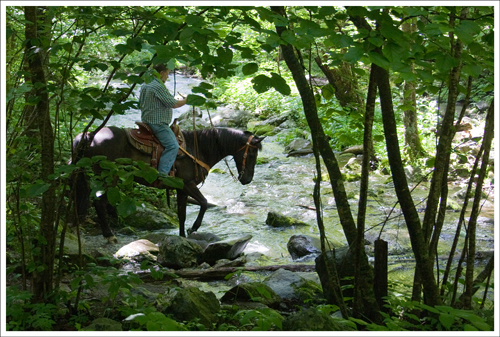
President and Mrs. Hoover enjoy the deck of the Brown House. Below are photos of (left to right): a letter from William Carson explaining preparatory steps to get the camp ready for Hoover; horses crossing the river; another historical photo of the Hoovers.
Trail Notes
Distance – 4 miles
Elevation Change – 750 feet
Difficulty – 2. The elevation change is gradual which makes it a fairly easy hike.
Trail Conditions – 4. The trail is in great condition, with few rocks or roots sticking up. The rock-hopping could be a little challenge to anyone not stable on their feet.
Views – 1. Only views of the streams and the camp area.
Waterfalls/streams – 4. If it’s good enough for a former President, it should be good enough for you. 🙂
Wildlife – 1. Probably not as likely to see bigger animals due to popularity of the trail.
Ease to Navigate – 4. Only a few turns to get to the camp.
Solitude – 2. You will likely see others here, but you should be able to find your own spot to enjoy the scenery and history.
Directions to trailhead: The hike starts at mile marker 53 on Skyline Drive. Park in the Milam Gap lot, then cross the drive. The trail picks up on the other side of the crosswalk. You’ll quickly come up to a park post and take a left to start the trail.
Bearfence Mountain is a short, but deceptively challenging hike in the central district of Shenandoah National Park. Although it measures just 1.2 miles, it’s not for the faint of heart when it comes to heights.
The beginning of the Bearfence Trail
Adam Says…
We decided to do this one on short notice, because it’s so close to our house and we didn’t have a lot of free time today. It is one of the southernmost hikes in the central district of the Shenandoah National Park. While it is only 1.2 miles, the short length can be misleading. The footing is tricky through the rock scramble and it is not a good idea to attempt for a lot of people. If you have weak knees, aren’t flexible, have unsure balance or a fear of heights, this is not a hike for you. Bearfence can also serve as good practice if you are planning on attempting Old Rag. The rock scramble does take some planning to determine how you will traverse each obstacle. The hike takes most people well under an hour, so it’s a great hike to combine with other short hikes in SNP (especially if you’re trying to add to your summit total.)
The rock scramble begins right after you round this rock outcropping
There is an earthcache geocache hidden here titled On Top of Bearfence Mountain. While physical geocaches are not allowed in the park, earthcaches typically teach something about geology. You will normally have to find some information or spot something regarding the geology and answer a few questions to be allowed to give yourself credit.
The scramble.
Christine Says…
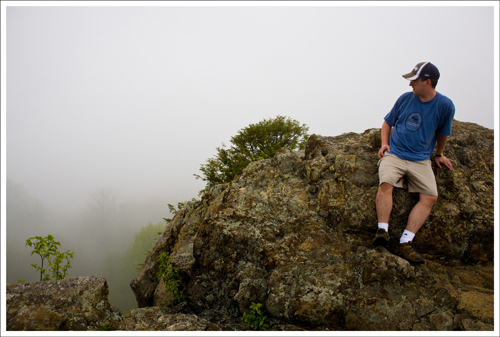
Bearfence Mountain is usually a hike that offers great views of the western valley (photo from winter 2007) and Skyline Drive. But today, we were socked in by unusual mid-day fog. It was so odd – at our house (which may be ten miles away as the crow flies) it was mostly clear blue skies with the occasional puffy cloud. But on Bearfence, it was like pea soup.
The trail was really crowded today, mostly by two vanloads of folks from Eastern Mennonite University. They were inexperienced hikers, and moved at a snail’s pace across the rock scramble. Luckily, they let us pass them along the way. Several in the party were really struggling, and were obviously uncomfortable with the terrain. They were hiking with two trained trailguides, so I was a little surprised to see the group on Bearfence. Of all the hikes in the park, I see more people turn back on Bearfence than any other trail. I think the short length misleads people into hiking something they’re not capable of or comfortable with. Don’t get me wrong… most average hikers will find the rock scramble to be quite fun. Personally, scrambles are my favorite type of terrain to hike. I’d rather do a scramble than a sheer uphill any day!
What a view, eh?
The scramble on Bearfence starts after about the first quarter mile of the hike. It’s really the only challenging portion of the trail. After the scramble, you’ll walk along the ridge for a short while. Eventually, you’ll meet back up with the Appalachian Trail and make an easy walk back to where you started.
While we hiked it in the spring this time, Bearfence is especially spectacular during the peak of autumn color.
Trail Notes
Distance – 1.2 miles loop trail
Elevation Change – 380 feet
Difficulty – 2.5. This is short and not strenuous, but if you’re not in good shape , you’ll find it more challenging.
Trail Conditions – 2. While the rest of the trail is in good shape, the rock scramble definitely brings this score down. (however, if you’re like us and love to scramble, this trail rates a 5!)
Views – 3.5. (usually) Today was foggy.
Waterfalls/streams – 0. Non-existent
Wildlife – 1.5. We saw a deer up here and heard that a bear has been spotted along the AT on this mountain.
Ease to Navigate – 3.5. During the rock scramble you’ll need to look for the blue blazes, but it’s not very difficult to follow.
Solitude – 1.5. Expect to see people due to the short distance. Also, plan on being held up by others through the rock scramble if you’re a faster hiker.
Directions to trailhead: The trail is located on Skyline Drive at mile marker 56.4. Park at the the Bearfence Trail parking lot, cross Skyline Drive and begin the hike up, following the blue blazes. Once you complete the rock scramble, you can continue up to the summit or turn right on to the Appalachian Trail to make your way back down. (the trail crosses the AT twice, so you can make your hike even shorter than 1.2 miles if you like)
The Rose River Loop is one of Shenandoah National Park’s most beautiful hikes for streams and waterfalls. Over the course of 3.7 miles, you’ll hike along the Rose River, the Hog Camp Branch, and finally up the Rose River fire road.
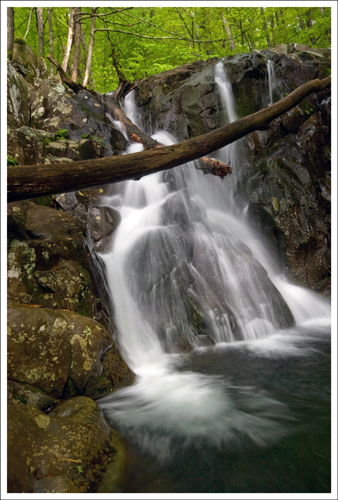
Two large fallen trees obscure Rose River falls.
Adam Says…
This hike is one of our most-repeated hikes in Shenandoah National Park. It has some great views of running water throughout the trail. This isn’t the most secluded trail since it connects to Dark Hollow Falls. However, you should normally only come across a few other people on this trail. There are some good places to do some trout-fishing along the river. The man pictured a few photos down had caught a 8.5 inch trout the day before at the same spot.
The hike starts off at the parking area just north of the Fishers Gap Overlook. Cross the road and follow the Skyland-Big Meadows Horse Trail for .5 mile. There is a steady downhill grade, but it’s not too steep. At .5 miles, you’ll reach the junction of the Horse Trail and the Rose River Trail. Go right and follow the Rose River Trail, continuing downhill. Once you reach the bottom of the trail in about a mile, you’ll hear the water. The trail continues alongside the stream for a ways. You will reach Rose River falls at 1.3 miles. They are impressive, but more beauty awaits along the trail. For fans of long-exposure photography, this is a paradise.
The trail will pass an old copper mine at 1.8 miles. Some people like to explore the old mine, but we don’t think there is anything worth seeing there.
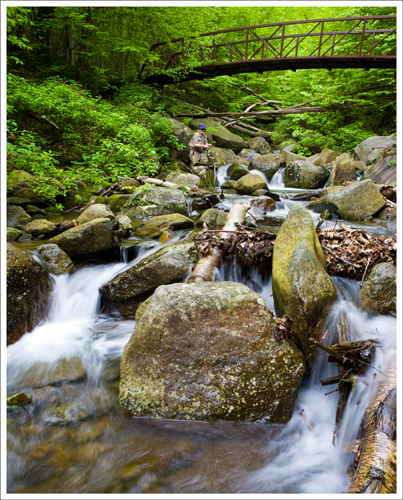
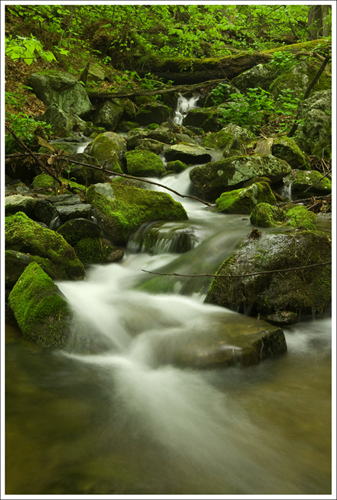
For the next mile, the trail closely follows the stream. It is very rocky and can be icy or muddy depending on the weather. There are tons of small waterfalls, slides, and plunge pools to explore.
At 2.7 miles, you will reach the footbridge at the bottom of Dark Hollow Falls. Turn right, cross the bridge, and follow the Rose River Fire Road uphill. At 3.3 miles, you will pass the Cave Cemetery on the right. At 3.7 miles, you will arrive back at Skyline Drive and your vehicle.
You can see from some of Christine’s pictures that there is really a lot of nice water to see on this trail. I highly recommend doing this if you have a day or two in the park.
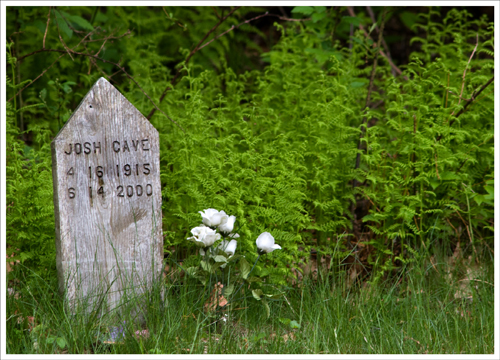
Some graves (not this one) in the Cave Family Cemetery date back to the Civil War.
As I usually like to comment, there is a geocache located here. For those that are unaware, physical geocaches are not allowed in National Parks. However, there is a small cemetery located off of the fire road that is considered private land and not owned by the Park Service. The cemetery was used by the people who used to live in the mountain hollows before the government took their land for the park in the early 1900’s. The Cave family gave permission for a geocache to be placed here called Viking Treasure Cave.ETA: This cache has since been removed from the park (September 2010)
Christine Says…
When we started down the Rose River trail, I couldn’t help but skeptically watch the blue sky peeking between openings in the trees above. The local weatherman had forecast a cloudy morning, but as we hiked along the sun began sending down rays and making a dappled pattern across the forest floor. It was lovely to look at, but was definitely not the kind of light I was hoping to have for the stream and waterfall photos I wanted take. You see, the Rose River Loop is one of the very best hikes in Shenandoah for folks who enjoy photographing running water. It’s also the place where my brother proposed to his now wife. They were engaged on a bitter cold New Year’s Eve camping trip somewhere along the Rose River.
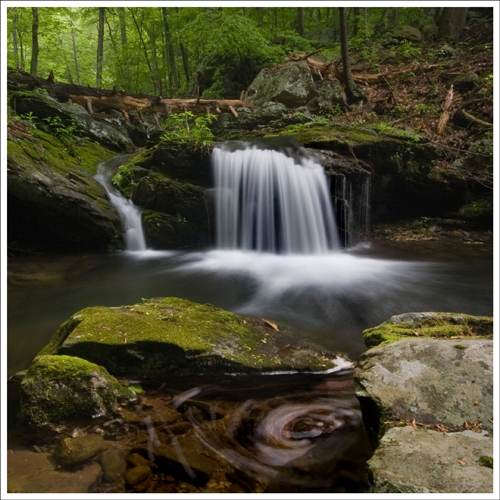
The Rose River has many beautiful small, unnamed falls. I’ve named this one “Slip and Slide Falls” because the bushwhack down to the base is so steep.
Even though the light made photography a challenge today, I found several spots to shoot along the Rose River. We had to bushwhack off the trail a couple times, and all I could think about were ticks. I don’t think I’ve recovered from our walk down the Dry Run Falls fire road yet.
One bushwhack in particular was especially steep, slick and muddy. As luck would have it, it also offered the prettiest of all the little cascades along the walk. When I looked down the ravine, for some reason my inner girly-girl came out. I announced to Adam that I wasn’t going down there no matter what. He said “Yes, you are!” and took my camera away and starting climbing down without me. I was left with no choice but to follow. I got really muddy and touched a gross centipede-like creature. I’ll never like bugs!
We stopped at Rose River Falls for a few shots. For the past few years, there has been a huge fallen tree lying across the waterfall. It’s still there, but now there is a new downed tree stuck at the crest of the waterfall. Both trees are way too big to move, and will likely be there for years to come.
We paused at a couple other places along the Hog Camp Branch for photos, but there was another photographer who was consistently about ten minutes ahead of us on the hike. Each time we got to a spot I planned on photographing, he was already there. He looked pretty serious getting his shots. At one spot, he even donned chest high waders and water shoes so that he could get to the middle of the stream for an ideal composition. I skipped a lot of my favorite photo spots along the Hog Camp because I always feel a bit rude stepping into somebody’s shooting space.
Speaking of stepping into someone’s shooting space… I had my tripod all set up when this fisherman dropped into my scene. Oh well 🙂
We finished the loop hike on the Rose River fire road. The last mile on the road is always my least favorite part of the hike. The fire road is easy walking, but yawn… it’s a bit on the boring side. Despite the dull last leg, the Rose River loop is a must-do hike for anyone visiting Shenandoah.
I’m so lucky that Adam routinely offers to carry all my photography gear.
Trail Notes
Distance – 3.7 miles loop trail (Check out the stats from Map My Hike)*
Elevation Change – Around 900 feet
Difficulty – 2. Some downhill and uphill, but it’s not too bad.
Trail Conditions – 3.5. There are some areas along the river that are more like a 2, but there are some areas that where it is more like a 5. Footing is tricky around the climb up after the red bridge.
Views – 0. Just waterfall and stream views.
Waterfalls/streams – 4.5. Some of the most continuous views of water that allow for some great water photography.
Wildlife – 1. Some birds and chipmunks, but not much else here.
Ease to Navigate – 5. Trail is well-marked and there aren’t any spurs until you get back to the fire road.
Solitude – 3. Not the best on solitude, but you won’t run into a ton of people.
Directions to trailhead: The trail is located on Skyline Drive. Park at the Fisher’s Gap Overlook (at mile marker 49.4 miles), cross the road and pick up the trail. The Rose River Loop starts to the left of the fire road. You will see a cement marker.
Adam found this hike mentioned in a book called Waterfalls of Virginia and West Virginia. Since we’ve had so much rain lately, we decided to take the short three mile hike to see the falls.
Dry Run is pretty after substantial rain
Christine Says…
We parked our car at the South River Overlook and made our way down the Dry Run Falls Fire Road. The road was wet and sloppy, but still beautiful because it was lined with countless wildflowers: trillium, wild geranium, violets, hepatica, ragwort and many more I couldn’t identify.
Trillium
The road follows a gentle downhill grade and eventually passes Lost Cliffs, an impressive rock face rising straight up from the forest floor. A little over a mile into the hike, you start to hear the sounds of water gurgling downhill, getting louder and stronger as more run-off joins the flow.
Dry Run falls are visible from the trail, and would actually be quite pretty if there weren’t several large fallen trees obscuring the view. To get close to the stream, you have to do a little bit of bushwhacking down the ravine. There are a few places along the stream that are photogenic and worth the effort to climb down.
On the hike, we all found multiple ticks crawling on us. After all was said and done, I think we ended up picking sixteen ticks off our clothing and skin. I skipped using bug spray on this hike because our dog was hiking with us, and DEET is so toxic to them. This was by far the most ticks I’ve ever found on myself after a hike.
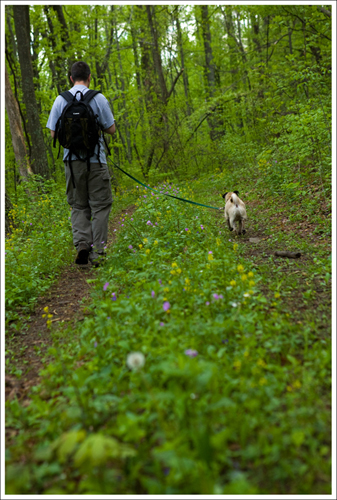
We brought the dog along.
All in all, Dry Run was a pleasant walk, but not something I would consider a “must-do” hike. There isn’t really anything noteworthy to see along the way and the falls weren’t anything special.
Adam Says…
I was a little unimpressed by this hike. It was something new for us, since we have done most of the Central and South SNP hikes, but it was good to get out to stretch the legs. The fire road leads to an easy walk through the woods. We saw a few bear droppings through the hike, so be careful and make some noise along the trail. Dry Run can be viewed from the trail, but you need to do some bushwhacking to get to the water for any photo opportunities. The water was rushing hard today, but we’ve had a couple of weeks of heavy rain. I’m not sure how heavy this is during a dry season. The water does have several areas of falls and tumbling water if you continue on the trail. You can also approach this hike without entering through the main gate by way of Elkton, but we wanted to do the normal hike.
Lost Cliffs – Can you spot Adam in the shot?
A neat side-trip was to climb up Lost Cliffs. At the end of the large formation on your right, you will see signs of a short trail that leads you up to the rocks above. Be careful, since most of the rocks are covered with moss and that first step is a lulu.
Wookie Says…
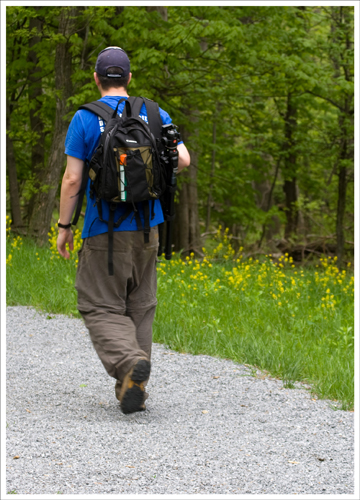
Wookie really enjoyed walking on the fire road. It was definitely an easy and suitable trail for dogs. There was lots of mud and standing water on the trail, so he was filthy and needed a bath when he got home. He also came home with lots ticks crawling on him — one had already attached to his ear.
Trail Notes
Distance – 3.2 miles round-trip
Elevation Change – insignificant – maybe a couple hundred feet.
Difficulty – 1. The trail follows a fire road and has very gentle climbs and descents.
Trail Conditions – 5. The trail is well maintained.
Views – 0. No views.
Waterfalls/streams – 2. The falls and stream are pretty, but nothing special.
Wildlife – 2. We heard a turkey and saw several kinds of salamanders. There were also signs of bear and deer around.
Ease to Navigate – 5. It would be nearly impossible to get lost.
Solitude – 4. Fire roads are used infrequently in the park. We saw only one other person – a local guy collecting mushrooms.
Directions to trailhead:
Follow Skyline Drive to mile 62.7. Park at the South River Overlook. Cross the drive and pick up the trail on the west side of the road.
We thought we would start off the Virginia Trail Guide site with one of the most popular hikes in Virginia – Dark Hollow Falls.
Upper Dark Hollow Falls
Adam Says…
This trail is probably the most popular of all the hikes in Shenandoah National Park. Due to the short length and the waterfall views, it is a quick hike that gives you a lot of bang-for-your-buck.
I used to hike this trail a lot while a student at JMU. We would choose the coldest day of the year and sit under the falls for as long as we could stand it. It was our version of the Polar Bear Club, but we always brought a change of clothes to save us from hypothermia.
Dark Hollow Falls are created by the Hogcamp Branch, which will come into quick view on your right as the trail descends. At the top of the falls, you will see a sign that depicts “Falls Can Kill”. Make sure you stay on the trail! A college friend of mine tried to cross the falls near the top and fell to a lower shelf. He broke his coccyx and had to sit on a donut for about a month. His butt looked like a cross between a baboon and a Smurf. After the sign, you will approach an impressive rock formation on the left. The trail descends sharply at this point until you reach the base of the upper falls. When there has been a decent amount of rain, water falls impressively over three rock shelves. However, in dry times, the entire waterfall is usually reduced to a mere trickle. The lower falls are significantly less impressive and are a short walk down the trail. The lower falls also mark the spot where the Dark Hollow Trail converges with the Fisher’s Gap Fire Road and the Rose River Trail.
Since there is a 440 foot elevation change in this short hike, the hike back up is more strenuous. There are plenty of places to rest along the way back up.
Christine Says…
Without a doubt, Dark Hollow Falls is Shenandoah’s iconic hike. Whenever I talk to anyone about the park, they almost always ask, “Have you hiked Dark Hollow?” It’s short, it’s close to Big Meadows and it gives you easy access to one of the park’s more impressive waterfalls. Photographically speaking, Dark Hollow isn’t the most photogenic of waterfalls. It’s usually crowded and the falls are surrounded by lots of scraggly brush and bare rock. The upper falls are definitely more impressive in size and scale, but the lower falls are probably a little more picturesque. During autumn, the lower falls are a nice spot to photograph colorful leaves on rocks surrounded by rushing water. The other benefit Dark Hollow offers for photographers is hinted at by its name. The water stays in the shadows most of the day, so it’s usually pretty easy to get even light and longer exposures.
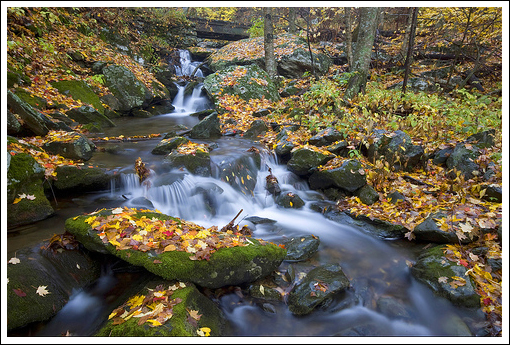
Autumn at Dark Hollow
When we hiked the trail this Saturday, it was cloudy and very still. We’d had days of rain, so the water was really running down the gorge. We got to the trailhead around 7:30 a.m. The only other people on the trail were a pair of photographers. We saw a lot more people coming down the trail when we were hiking back up. When we got back to the top, it was perfect timing for a fantastic breakfast at Skyland, one of the park’s two lodges.
Until yesterday, it had actually been years since we’d hiked the Dark Hollow Trail. I walk down to the falls frequently, but I prefer to use the fire road – fewer people and less wear and tear on the trail.
Trail Notes
Distance – 1.4 miles round-trip
Elevation Change – 440 feet
Difficulty – 2.75. Like most waterfall trails, you typically hike down to see them and hike up to return. While it is only .7 mile to see the falls, coming back will definitely make you break a sweat. The way down is more like a 2 and the way back is more like a 3.
Trail Conditions – 4. Since this is a well-traveled trail, the trail is maintained often. Mostly small gravel on the trail, but due to the steepness of the trail and erosion fro heavy foot traffic, there are often muddy areas.
Views – 1. Views are only of the waterfalls and streams below. Wooded trail doesn’t lead to overlooks.
Waterfalls/streams – 4. Great waterfall view at the end of the trail and the Hogcamp Branch is in view along the much of the trail.
Wildlife – 2. You would be likely to see deer that have visited here from Big Meadows area. Chipmunks are everywhere. Bears tend to stay away due to the human traffic. Many bird species in the trees.
Ease to Navigate – 5. Trail is easily marked and it would be nearly impossible to get lost.
Solitude – 1. Due to the trail’s popularity, you will not get a lot of solitude there. Early morning visits will get the highest possibility of solitude.
Directions to trailhead: On Skyline Drive. Parking lot is located around mile marker 50.7 in the Central District of Shenandoah National Park. Trail begins near signs on the north end of the parking lot.
Alternate Hike: You can also approach Dark Hollow Falls by hiking down the Fisher’s Gap Fire Road which originates across from the overlook of the same name. Across Skyline Drive, you will see the fire road with the road gate. After about .75 miles, you will come to an iron bridge at the bottom of lower Dark Hollow Falls. You can then walk up the trail to get a view of the upper falls. This alternate is a great idea for anyone who wants a less strenous option. The fire road is smooth enough that I’ve actually seen parents pushing strollers down the trail.















 Wookie Says…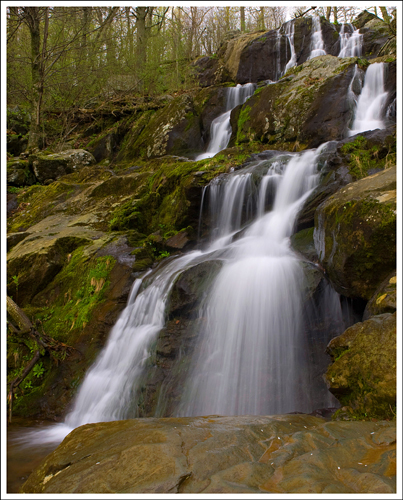
 Virginia Trail Guide