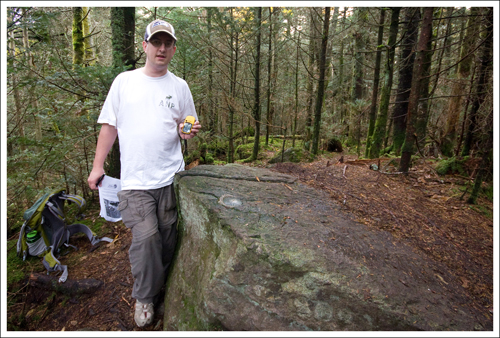
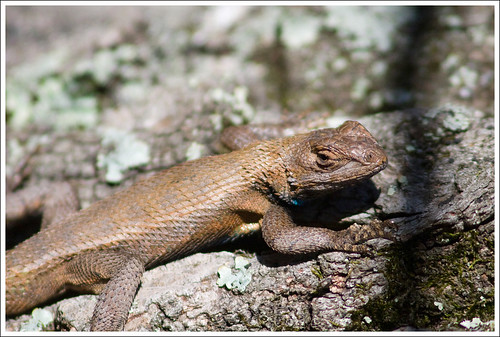
Apple Orchard Falls – Cornelius Creek Loop

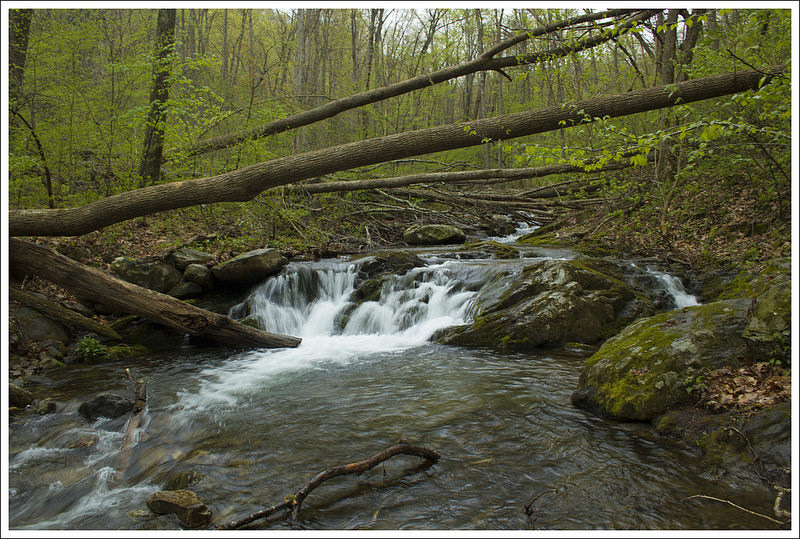
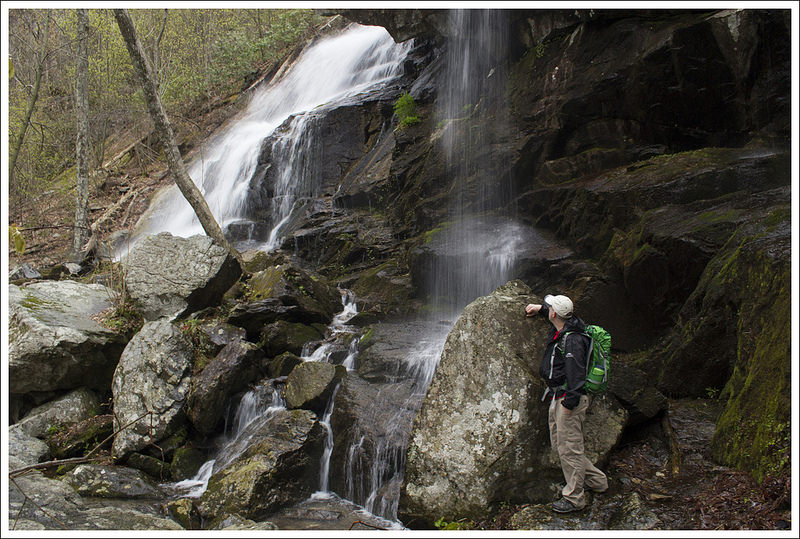
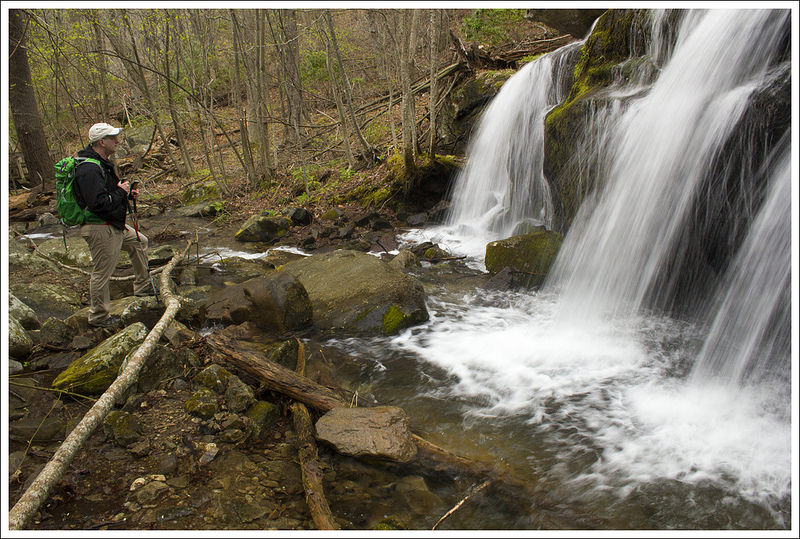
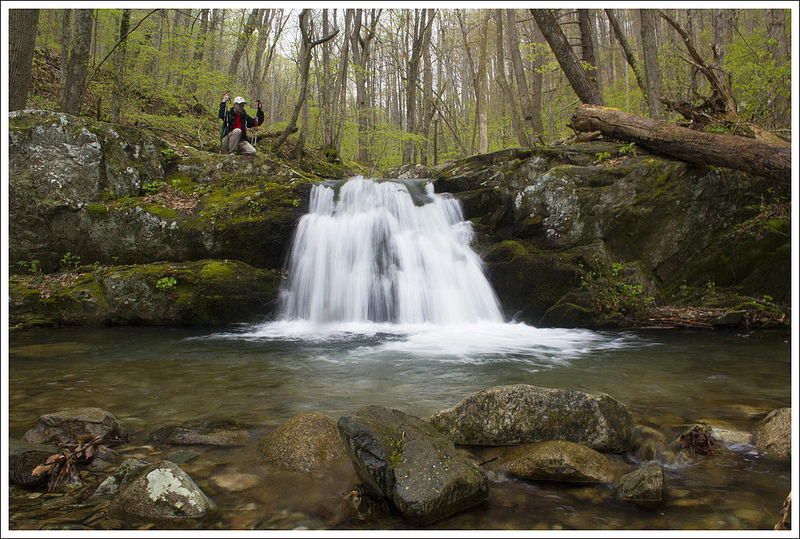
This 6-mile hike is jam-packed with spectacular stream scenery and waterfalls – the most impressive being the 200 foot Apple Orchard Falls.

View the Full Album of Photos From This Hike
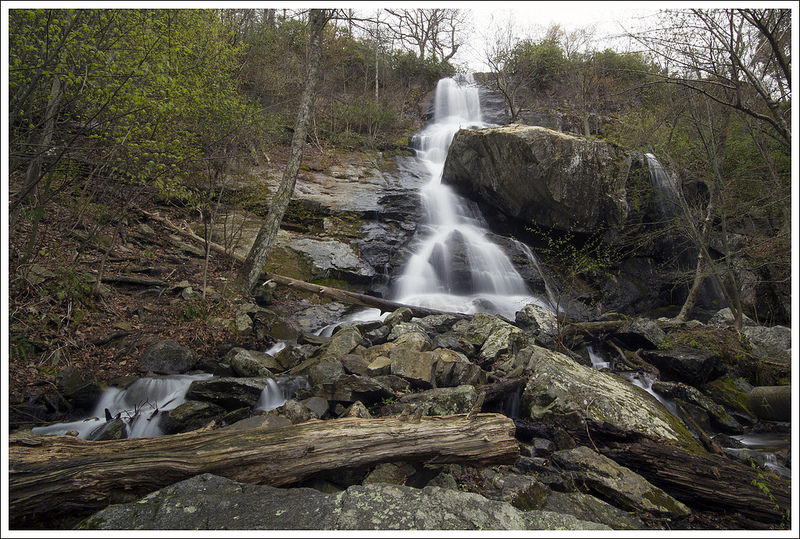
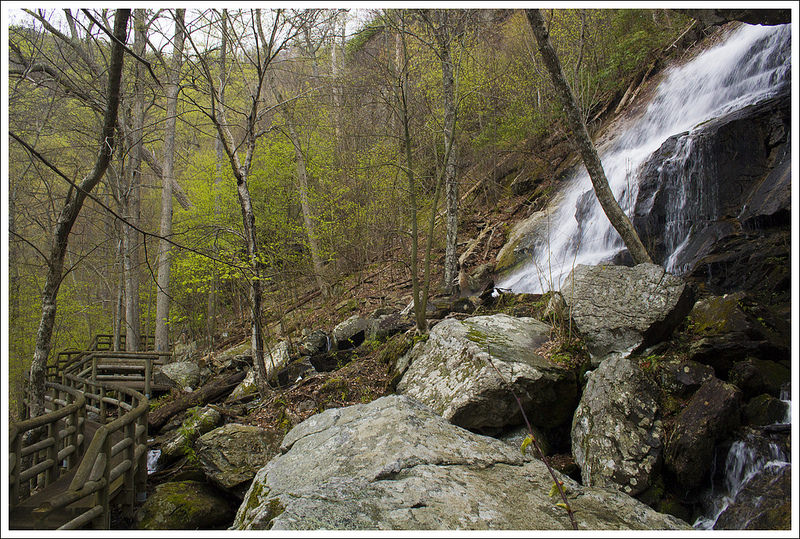
Apple Orchard Falls
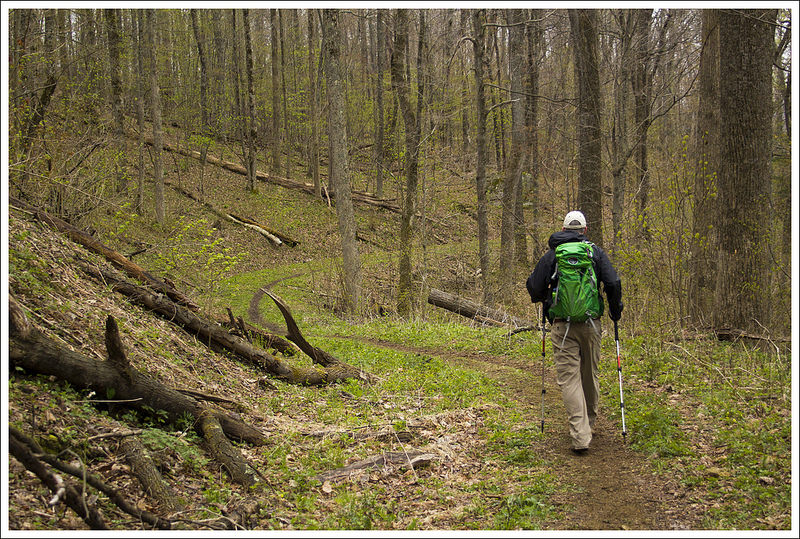
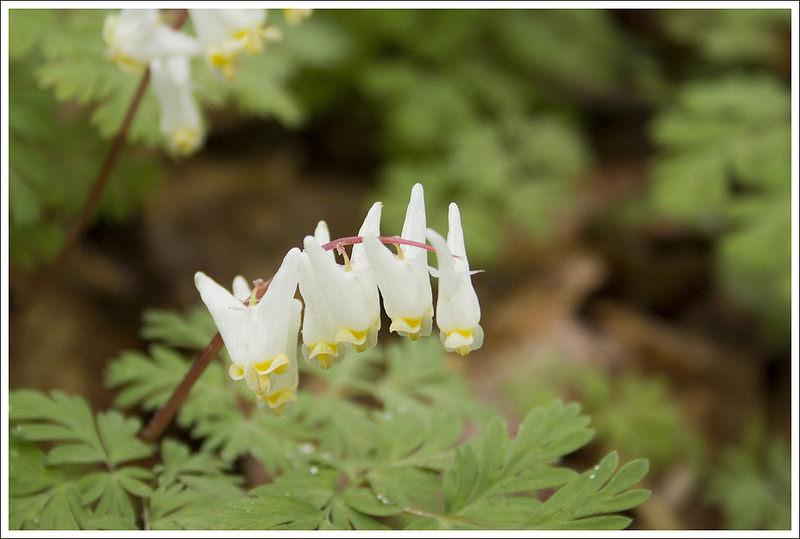
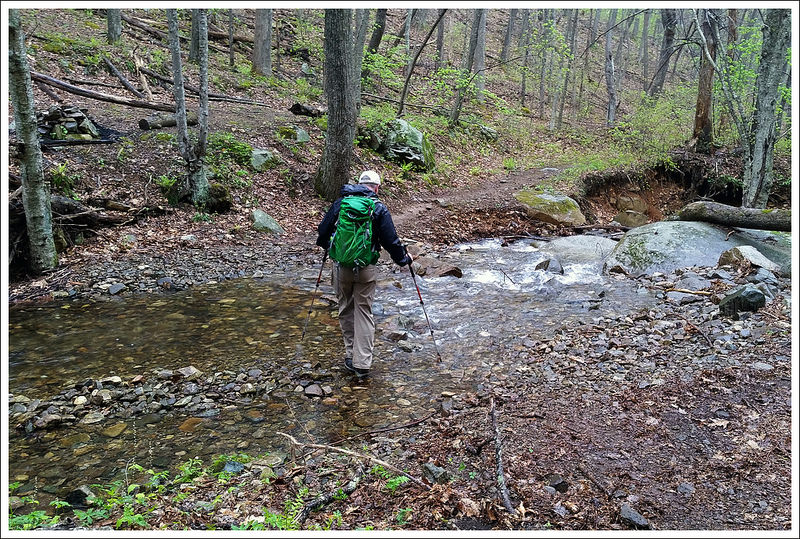
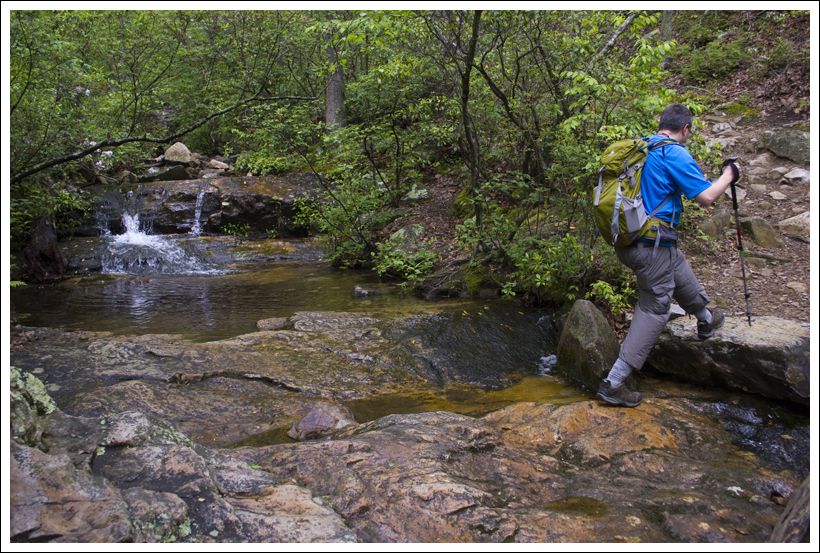
Beautiful Apple Orchard Falls plunges about 200 feet down the mountainside. Below: Even the fire roads were scenic on this hike; Abundant wildflowers including Dutchmans Breeches; There were several stream crossings to negotiate.

Fire Road Dutchmens Breeches Crossing

Christine Says…

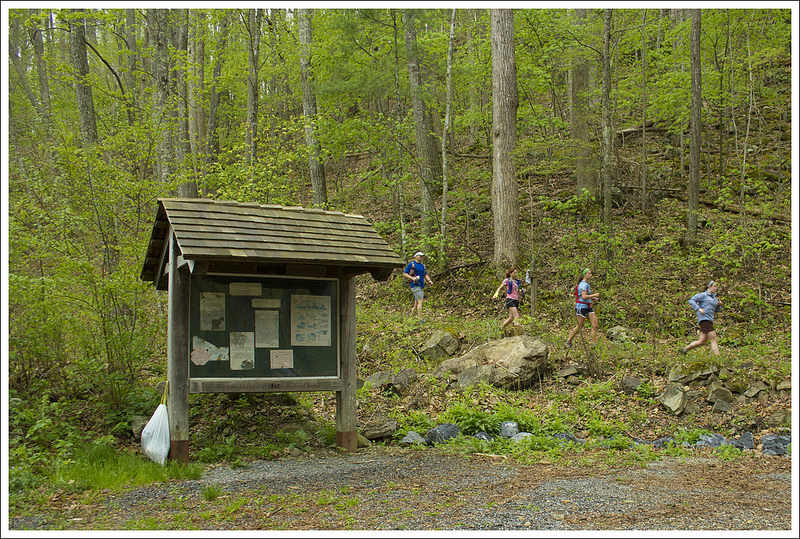
Apple Orchard Falls has been on our ‘must hike’ list for years now, and I’m so glad we finally got out there and did it!  It’s a bit of a drive from our home-base of the central Shenandoah valley, but it was well worth the trip!  We hiked it on a cool, rainy day in mid-April.  We thought we’d have the trail all to ourselves, but as our car bumped along the forest road nearing the parking area, a runner went by.  Then three more runners… and then a cluster of ten.  Pretty soon we realized that there was some kind of race going on in the vicinity.  It turns out we picked the same day as the Promise Land 50K for our hike.  We ended up sharing the first half of our six-mile route with 300+ trail runners.

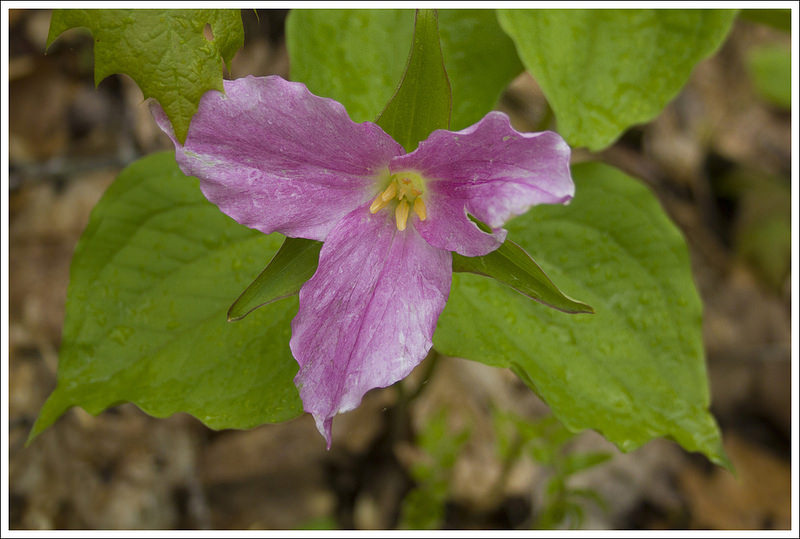
They were all friendly folks, but it was a little stressful to constantly be looking over my shoulder, watching to make sure there wasn’t a racer on my heels, needing to pass.  I certainly didn’t want to get in anyone’s way as they cruised toward victory or a personal record!  I still enjoyed the gorgeous stream scenery as we ascended alongside North Creek.  The sound of the water was soothing. The hillsides along the trail were covered with trillium and purple wild geraniums.  The air was filled with a light misty rain and all the trees were unfurling their brilliant spring green leaves.  With all these pleasures along the trail, I tried my best not to let the constant stream of passing racers disrupt the zen-like peace.
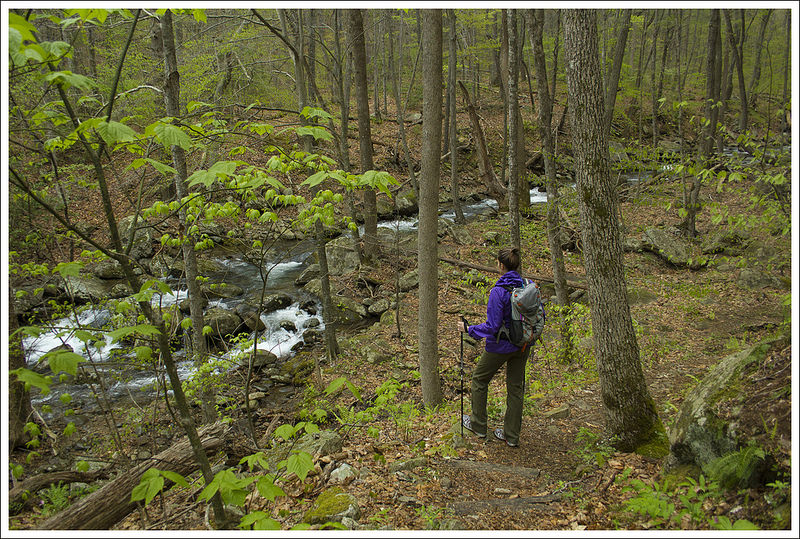
Christine checks out the creek early in the hike.
Christine checks out the creek early in the hike. Below: We hike the loop on the same day the Promised Land 50K was running.  It made for a crowded trail; Trillium was blooming everywhere; Pretty little rapids on the creek.

Promised Land 50K Runners Trillium Small Cascade on North Creek

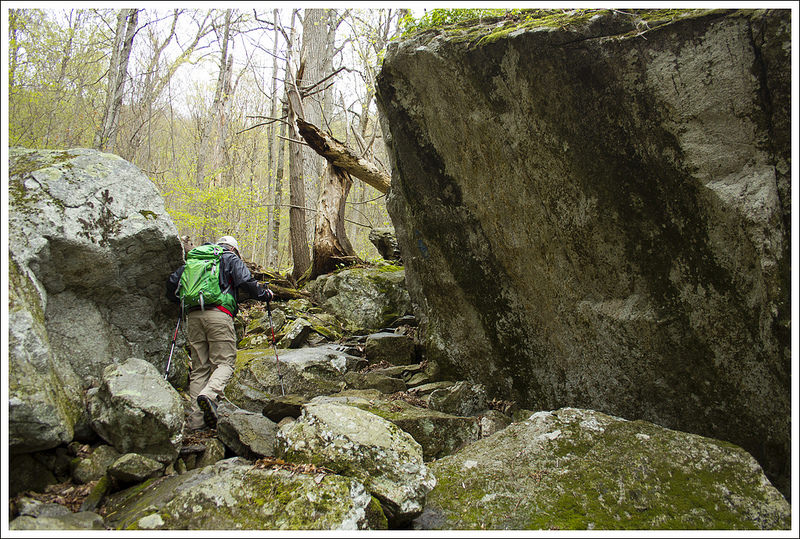
The trail was in great shape and ascended steadily and moderately uphill.  There were several sturdy footbridges across the creek on our hike up.  Around 1.3 miles into the hike, the climb became a little steeper and rockier. Right before reaching the base of the falls, we passed through a jumble of huge boulders.  At first, we could only see the falls through the trees.  They were majestic, but obscured by the foliage.  We continued uphill, making a wide switchback before coming to a curved wooden bridge and a viewing platform at the base of the fall’s largest plunge.

Adam set up my tripod and I spent some time photographing the waterfall from a variety of angles.  I wish the trees around the falls had been a little more ‘leafed out’.  The green would have made an even more attractive frame for the falls, but it was still very nice.  I was challenged by the rain – which was beginning to fall at a steadier pace. Droplets kept landing on my lens, and making blurry bubbles on each of my photos. I used a hat as an umbrella as much as I could. While we were enjoying the waterfall,  the bulk of the racers passed us by.

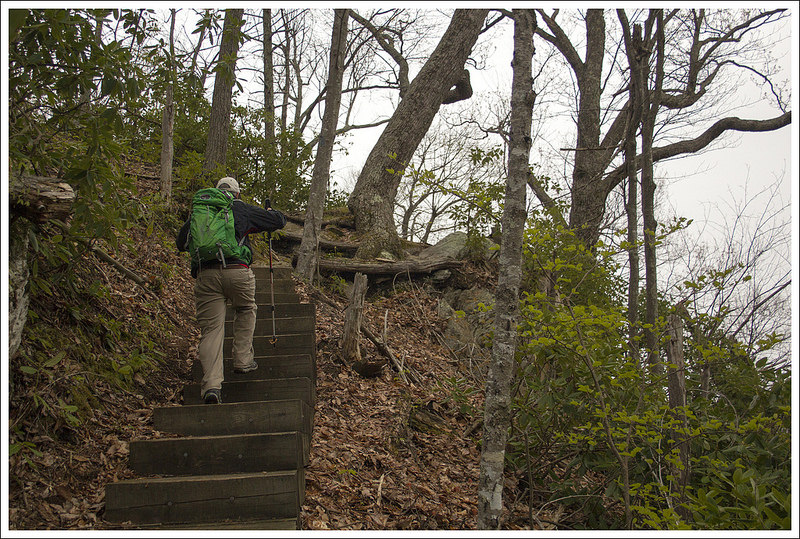
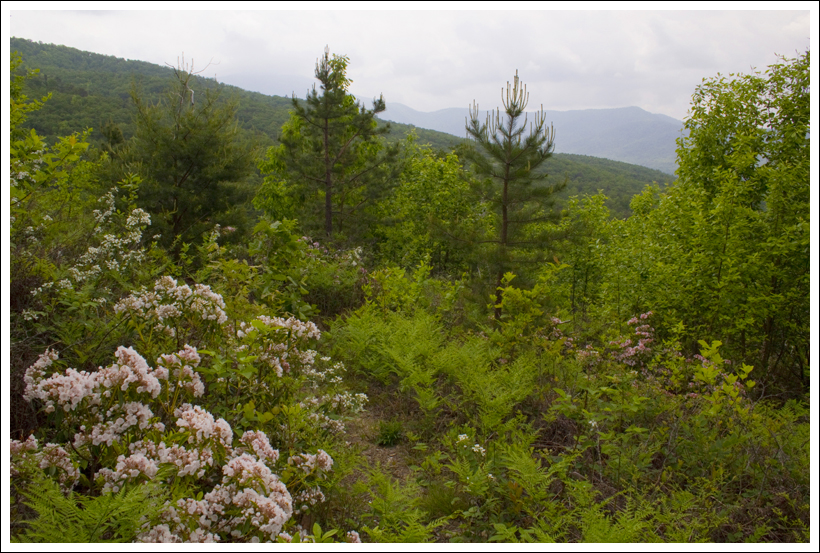
After leaving the falls, we climbed the 175 stairs above the falls.  About halfway up the stairs, we caught our one open view of the hike – a pretty peek out over a spring green valley.  Shortly after the top of the stairs, we passed another small waterfall.   There was a nice established campsite near the smaller fall.  What a idyllic place to spend a night!  In fact, we saw many great campsites all along this loop.  I think it would make a great beginner backpacking trip or short gear shakedown route.
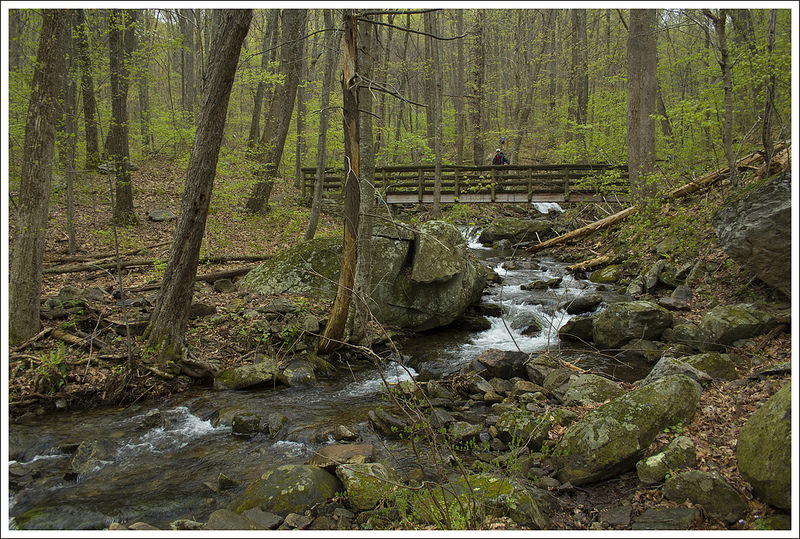
Bridge
There were several sturdy, well-constructed bridges on the trail toward the falls.  Below: Just before reaching the falls you climb through an opening between huge boulders; The viewing deck for the falls is very nice; Adam checks out the falls.

Boulders  Side View Falls

About a third of a mile past the small waterfall, we reached Apple Orchard Road, which is a grassy fire road that connects to the Cornelius Creek trail.  The racers all continued uphill toward the Blue Ridge Parkway.  We turned right and followed the fire road for about a mile to its intersection with the Cornelius Creek Trail.  Fire roads are typically sort of dull, but this one was actually quite nice – lush green, curvy, and decorated with wildflowers – more trillium, geraniums, violets, and enormous dense patches of Dutchman’s Breeches.

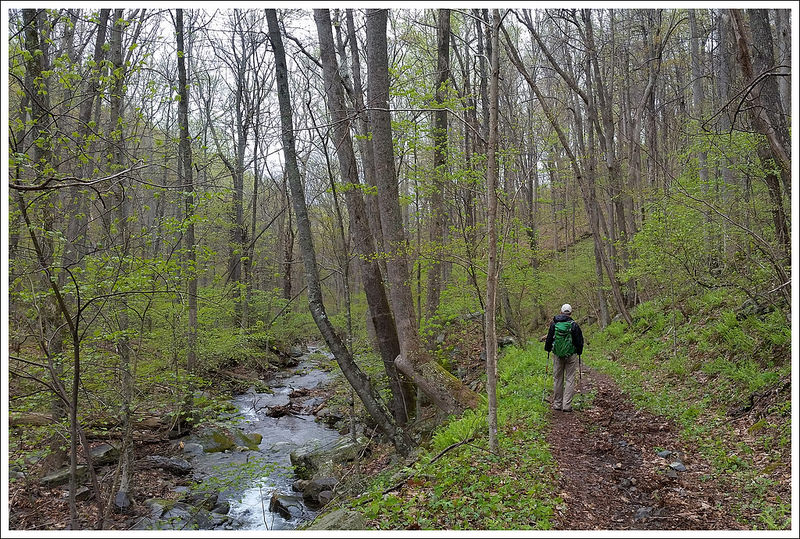
The Cornelius Creek trail was probably my favorite part of the hike.  The racers were off our tail, and I could fully focus on the spring forest and sound of flowing water.  The rain was coming down steadily, so my photo opportunities were a bit limited. Hopefully, I captured enough to adequately convey the feel of Cornelius Creek.  It was lovely with so many small cascades and swimming holes.  The only real challenge on this part of the hike were the two significant stream crossings.  The first (pictured at the top of the post) was wide, but not very deep.  Our toes got a little wet.  But the second was quite deep, wide, and fast-moving.  We packed all of our camera gear and electronics away in dry bags and plunged in.  Even rock-hopping, the water came halfway up to my knees.  The footing was small, shifty, and slick!  Thankfully, we made it across without falling completely into the water!  The last bit of walking was done with sodden shoes and socks – that squishy feeling is always so weird!

When we got back to the car the first thing I did was take off my soaked shoes and socks and put on flip flops!  Then we were off on our way for a well-deserved lunch at Peaks of Otter!

Adam Says…

We got up early to hit the road and beat the crowds on this hike.  With a gloomy day with some rain scheduled around the early afternoon, we wanted to make the best use of our day.  When we first saw the runners on the gravel road, I thought well at least they are going in the opposite way.  We parked our car at the end of the road and there was a race stop set up for people to check in, get some snacks and water and keep running.  Little did we know we would see most of them all again on the trail.

We got out of our car and found out that there were going to be runners on the trail.  We thought we would at least try to get a head start, so we jumped on the trail right away.  We took the blue-blazed Apple Orchard Falls trail left of the kiosk that came to a wooden bridge almost immediately.  We soon came across the first runner of the day on the trail, who we heard ended up coming in 2nd in the race.  Along the trail, there were funny signs to try and inspire the runners along the way (and most were done with Game of Thrones references).  At .2 miles, take a right at the intersection to stay on the trail.
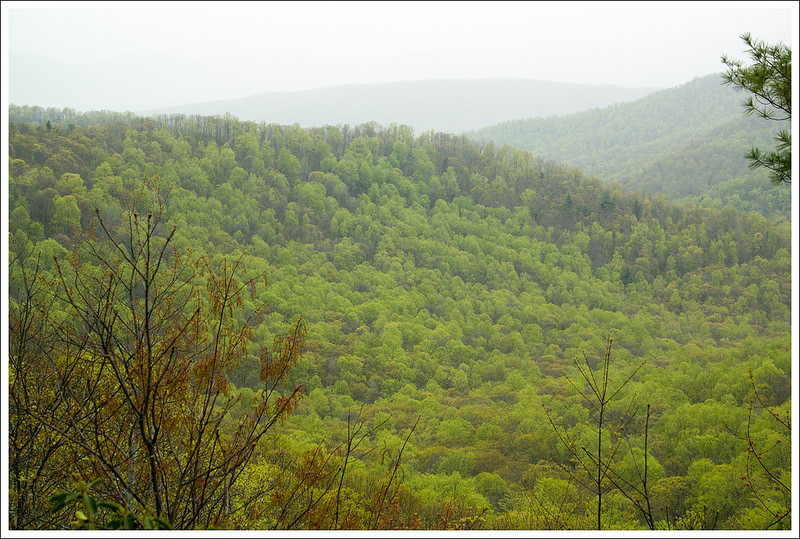
Spring Green
A view into the valley on our way up the stairs. Below: Adam takes in a side view of the falls; Climbing the famous stairs, the smaller waterfall above Apple Orchard Falls.

Side View of Apple Orchard Stairs  Small Falls Above Apple Orchard

The trail continues along North Creek for a steady uphill.  At 1.2 miles, you reach a couple of bridges and a small creekside campsite.  Crossing over the second bridge, the trail becomes steeper uphill.  Eventually, you get some views of the falls to the right as you make the climb up.  But don’t worry, the trail leads right up to the falls.  The climb up to the falls is also very steep.  But, as you reach the falls at 2.0 miles, there is a nice bench and platform, inviting you to take your time to enjoy the views.  We stayed here for a while and saw a ton of runners pass by.  Some of them just took a quick glance, some walked slowly by, but one guy stopped to take a picture.  I guess the runners had different levels of competitiveness and different levels of exhaustion at this stage of the race.

The trail continues on and winds around the hillside before beginning a series of stairs.  Along the climb, there was a nice viewpoint that gave you glimpses of mountains to the west.  We continued uphill along the trail until we reached another waterfall around 2.3 miles.  There was a nice campsite by this waterfall also and we thought it would be a great overnight stop for a backpacking trip. At 2.5 miles, we reached a junction with a fire road.  We took this fire road to the right.  At 3.7 miles, the trail meets a junction with the Cornelius Creek Trail.  We headed straight to start the Cornelius Creek Trail.  This trail descends quite steeply.  As we had seen the runners on this trail when we first arrived at the parking lot, I felt that I too was having to run down the steepness of this trail in the beginning.  Be careful where you step, since the trail is incredibly steep and filled with loose rock, begging for a twisted ankle or fall.  At 4.2 miles, the trail runs along Cornelius Creek.
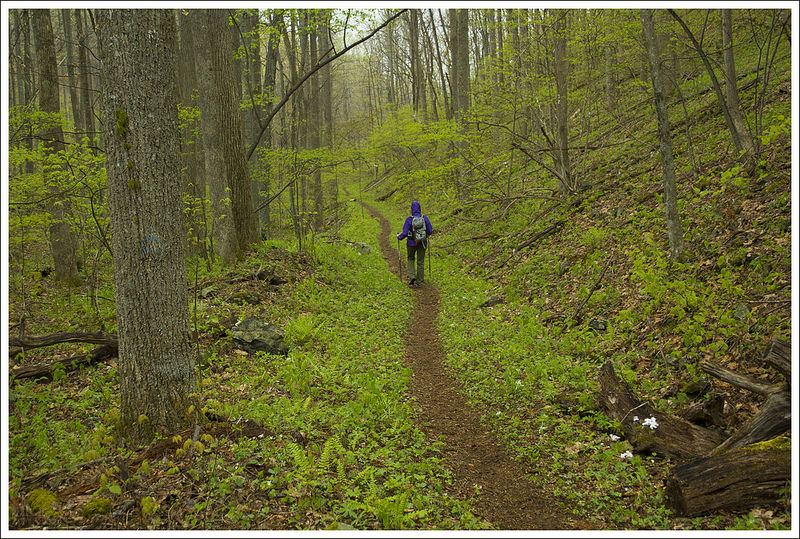
Walking the Cornelius Creek Trail
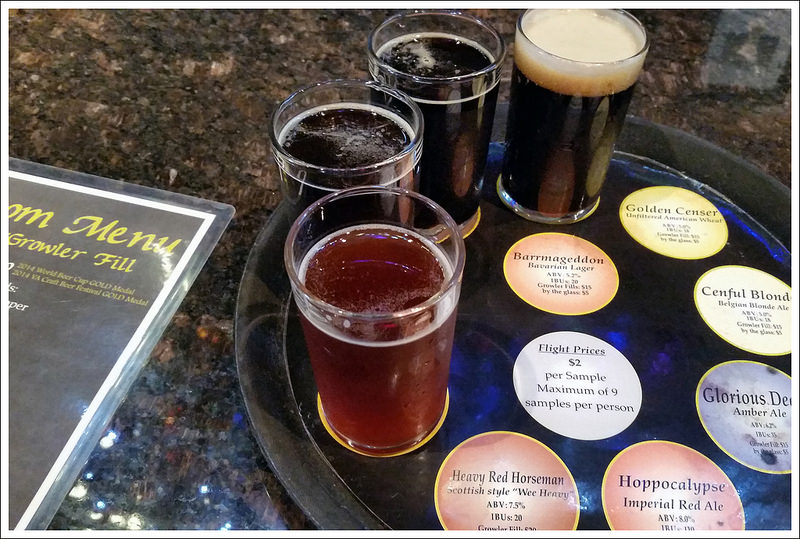
Christine walks along in the rain. Below: Most of the hike closely follows water; A lovely little cascade on the Cornelius Creek Trail; Post hike beers at Apocalypse Ale Works.

Cornelius Creek Small Falls on Cornelius Creek Post Hike Beers at Apocalypse

Cornelius Creek was a long exposure photographer’s dream.  There were so many spots where you saw small waterfalls and swimming holes along the way.  Contrasted with the lush green forest, it was truly beautiful to see.  We did have to cross Cornelius Creek a couple of times and with any recent rain, you are likely going to get your feet wet.  Be careful as there are some deep holes along the creek crossings that could have you up to your waist if you don’t step carefully.  We made it across and continued our hike.  The rain was coming down fairly steadily, so we didn’t stop a lot for fear of ruining camera gear, but it was one of the most beautiful creekside hikes you will see in Virginia.  Right before you return to the parking lot, you’ll see a large campsite (with even a rope swing put in).   We got back to the parking lot at the 6 mile marker.

On our way back home, we took a detour and drove along the Blue Ridge Parkway to have lunch at Peaks of Otter.  My family used to picnic here yearly, so this spot always holds a near and dear place in my heart.  We had a nice lunch with music from a local singer.  We decided also to stop by Apocalypse Ale Works brewery for one of our favorite post-hike things to do – beer sampling.  The drive back home was rainy most of the day, but we felt like we had accomplished a lot on a dreary day.

Trail Notes

  • Distance – 6 miles
    (Check out the stats from Map My Hike)*
  • Elevation Change – 1438 ft.
  • Difficulty –  3.  This is a great moderate hike!
  • Trail Conditions – 4. The trail is very pleasant to walk.  Sturdy bridges and a wide viewing platform are available so the walk up to the falls along North Creek is pleasant and safe.  There are a couple crossings on the Cornelius Creek descent that can be tricky when there has been recent rain.
  • Views  2.  There is one nice view when you’re climbing the stairs after visiting Apple Orchard Falls.
  • Streams/Waterfalls – 5.  Spectacular – you are within view of the stream for most of the hike.
  • Wildlife – 1.  Too many people to see much wildlife!
  • Ease to Navigate – 4. The signs make this route pretty easy to follow.  There are several places where trails go in multiple directions, but this route is well marked.
  • Solitude – 0.  It’s supposedly the most popular hike in Jefferson National Forest.  It was cool and rainy when we hiked it, so there weren’t many other day hikers.  But there were 300+ racers on the trail with us.

Download a Trail Map (PDF)

Directions to trailhead:  From I-81, take exit 168 for VA-614 toward Arcadia.  Turn on to VA-614 heading east and go 3.3 miles.  Turn left on to North Creek Road.  Go 2.8 miles and turn right on to an unnamed road*.  This road is a gravel road.  Follow it for 2.2 miles until you reach the large parking lot.  The trail starts left of the kiosk.  Right of the kiosk, the trail going uphill is your return route.  *Since this unnamed road can’t be found on GoogleMaps, I would suggest printing the trail map above to have a way to find this road.

The Devil’s Marbleyard

This 8.1 mile hike passes an impressive boulder field then climbs along the Gunter Ridge trail for some nice (but obstructed) views.

Devil's Marbleyard Scramble
Adam scrambles around the Marbleyard. Below: The hike begins on the Belfast Trail; Entrance to the National Forest is marked by a placard. The two stone pillars mark an old Boy Scout camp that used to be located in this area. You can still see the footprint of the swimming pool and a few building foundations along the Belfast Trail. The camp was named after Chief Powhatan; Catawba Rhododendron were in bloom everywhere!

Start of the Belfast Trail National Forest Marker Rhododendron on Gunter Ridge

Christine Says…

We keep a list of hikes we want to do stuck with a magnet to the side of our refrigerator. The Devil’s Marbleyard hike had been on that list for nearly three years. It kept getting delayed for closer hikes or hikes with better views or taller waterfalls.  We finally decided it was time to knock it off the list.

We got up early Sunday morning, grabbed donuts, bagels and coffee en route and made our way down the Blue Ridge Parkway. We got to the trailhead parking area around 10:00 and thankfully found only a couple other cars there.  Evidently, cars that overflow the official parking lot are frequently towed.  So, if you hike this trail, make sure your car is in the lot or that all four wheels are off the road and not on private property.

Belfast Creek
The beginning of the trail takes you over Belfast Creek. Below: The bridge over the creek;  Adam crossing a small stream early in the hike; All the recent rainy weather made conditions ideal for snails.

Belfast Trail Bridge Second Stream Crossing Snail

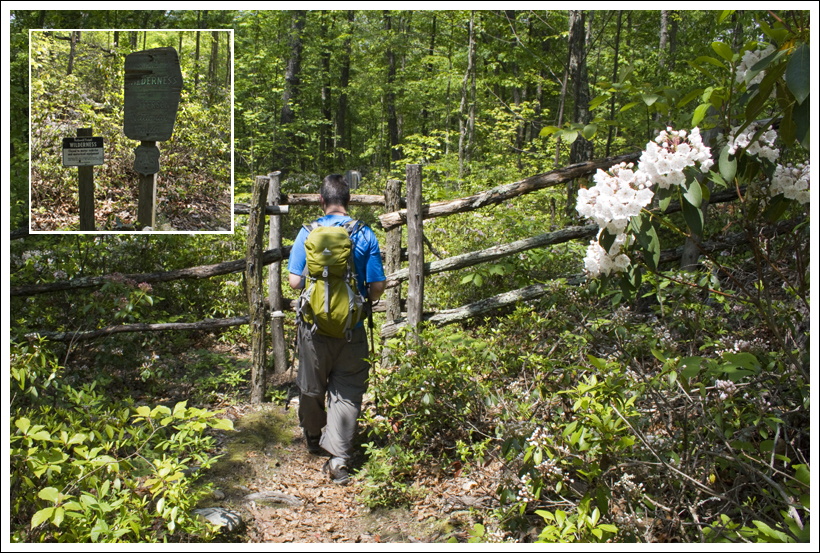
After crossing a small bridge over a stream, the trail passes through an old stone gateway that used to mark entry to a Boy Scout camp called ‘Camp Powhatan’.  You immediately come to a National Forest/Wilderness placard.  At this point, you’re only a little over a mile from the Devil’s Marbleyard.   (The sign says one mile, but our GPS and most trail guides seem to say it’s about 1.4 miles to reach the Marbleyard).  The trail meanders through the woods, crossing shallow spots on the creek a couple times.

I really enjoyed seeing the blooming azaleas, Catawba rhododendron and mountain laurel.  The laurel bloomed so early this year!  What I did not enjoy were the locusts!  The Blue Ridge Brood of the seventeen-year cicada is currently emerging in our area, and they were everywhere along the Belfast Creek trail. They were screaming overhead in the trees — I likened the sound to the one made by a failing belt tensioner on our SUV a few years ago.  It’s a squeal mixed with an undertone of hiss.  Not only are the locusts noisy – they’re CREEPY!  Sometimes they fly into you.  They have red eyes.  And worst of all, they leave yellowish-clear, crunchy, empty husks everywhere when they molt.  I will be very glad when locust season is over and I can have seventeen years of peace again!

Blooming Along the Trail
So much stuff was blooming along the trail.  Below: Christine checks out the large boulders that make up the Devil’s Marbleyard;  Adam climbs back down the Marbleyard to rejoin the trail; A creepy locust husk.

Christine on the Marbleyard  Adam Climbing Down Gross Locust Husk

As we came upon the Marbleyard, we crossed paths with the hikers from the two other cars we had seen in the lot.  The first was a nice guy from Virginia Beach who was at the tail end of a week-long hiking vacation along the Blue Ridge Parkway.  We enjoyed chatting with him and sharing information and tips about favorite hikes.  The second was a pair of local kids who warned us of muddy/slippery conditions on the trail ahead.  Adam had a little incident there, but I’ll let him share that tale in his portion of the post.

Before proceeding up the trail, we took some time to explore the Marbleyard.  Basically, it looks like an immense stone mountain exploded and collapsed into thousands of boulders of every shape and size.  If you want to climb to the top of the Marbleyard, you have to do so by scrambling up the rocks. It looks like the trail alongside the Marbleyard reaches the top, but in reality the trail turns slightly away from the boulder field and climbs upward to the Gunter Ridge trail. I imagine most hikers visit the Marbleyard and then head back to their car, making this a short 2.8 out and back.  We considered doing this, but since we had already driven so far, we decided to do the full 8.3 mile loop.

After playing on the rocks for a while, we headed along… climbing uphill for a while until we reached the junction of the Belfast trail and the Gunter Ridge trail. At this spot there is a spacious (but dry) campsite.

Steep Trail Alongside the Marbleyard
Christine climbs the steep trail that runs alongside the Marbleyard. Below: The junction of the Belfast and Gunter Ridge trails;  Adam spotted a black widow spider along the trail; Christine walks past an especially pretty stand of mountain laurel.

Top of the Ridge Black Widow Christine Walking Through the Laurels

The Gunter Ridge trail was easy walking, but was quite overgrown.  Because of the heat and humidity, I had decided to hike in shorts and a t-shirt, so I started to worry about ticks climbing onto my legs from the tall grass.  Adam, on the other hand, hiked in long pants tucked into his socks.  I’m getting ahead of myself, but guess who came home with six ticks crawling on his clothes – and guess who came home with none crawling on her.  I always joke that my husband is a real ‘tick magnet’.

The trail along this section really opens up and provides some nice, but slightly obstructed, views.  A forest fire that swept through this area about a decade ago is still very evident.  There are no tall trees and charred stumps can be seen peeking up through the brushy vegetation in many places.

After walking along the ridge for a while, you come to a seemingly endless series of switchbacks climbing down the mountain. Eventually you reach a wooden horse gate, and cross out of designated wilderness into standard National Forest.  Almost immediately after passing through the gate,  you will encounter a stream.  We stopped here for lunch.  I had been wanting to eat for almost an hour, but this was the first place that really had an opening to sit and eat since the campsite at the junction of the Gunter Ridge and Belfast trails.

Mountain View on Gunter Ridge Trail
A hazy mountain view from the Gunter Ridge Trail.  Below: Damage from a forest fire about ten years ago is still very evident;  A view of mountains and clouds along the trail.

Old Forest Fire Damage on Gunter Ridge Mountains and Clouds on Gunter Ridge

After lunch, we still had a couple miles of walking along the Glenmont Horse trail.  It was easy hiking, but also really boring.  It’s the part of the hike where you know you’ve seen all the cool stuff, but you still have several miles of walking along a featureless road/path.  It reminded me a lot of all the fire road/paved road walking at the end of the Old Rag hike.

All in all, the hike to Devil’s Marbleyard made for a pleasant day. But, if I were to recommend the hike to others, I’d suggest just hiking to the Marbleyard as an out-and-back.  If the rhododendron, laurel and azaleas hadn’t been blooming, I don’t think there was much to see on the rest of the loop.

Adam Says…

It has been about 20 years since I last hiked the Devil’s Marbleyard trail.  Those that know me personally or have read this blog for a while know I grew up in Lynchburg.  Some of the hikes that are most popular with people around there are Sharp Top, Flat Top, and Devil’s Marbleyard.  The first two have great views and are close to Peaks of Otter, a popular picnic area.  The last time I did this hike I was with with a group of friends from home.  I remember the boulder field seemed so impressive.  While there are similar slopes of rock along Furnace Mountain and Hawksbill summit (among others), these boulders are much larger.  My friends and I climbed up the boulders from the bottom of the field.  One of my friends almost stepped on a rattlesnake that was sunning itself on the rocks.  I’m sure a number of rattlesnakes make their home in the cracks between the rocks, so be careful.  The climb up to the top takes longer than you would expect and requires a lot of energy to navigate the scramble.  Since we planned on hiking a long loop, we opted to just climb around a while on the bottom.

Beautiful Mountain Laurel
Beautiful mountain laurel along the ridge hike.  Below: Stopping to enjoy the mountain laurel; Passing out of the designated wilderness area; Lunch by the stream.

Christine and Mountain Laurel Leaving the Wilderness Area Lunch by the Stream

With every interesting geological feature, there seems to be a legend that has been passed down over the years and Devil’s Marbleyard is no different.  In the local tale, this area was occupied by Native Americans and the land was supposedly very green and lush.  There was a large stone altar at the top of this hill that was used for worship on full-moon nights.  A white couple met the Native Americans and they were thought to be spirits since they looked so different than the local tribes.  The couple said they were not spirits but they worshiped a higher power.  They converted the Native Americans to Christianity.  However, the next year brought about a great drought and the Native Americans felt the new God and the missionaries were to be held responsible.  They burned the couple alive on the altar.  As the flames reached high into the sky, a storm formed.  Lightning struck down upon the altar and exploded the rock over the mountainside.

Christine and I talked about this legend on the hike.  I guess there can be a few different morals to the story depending on your perspective.  From the perspective of the white missionaries, it may be best to not spread your religion to others if you want to stay alive.  From the perspective of the Native Americans, it may be to either believe your own gods or keep faith in your new God.  It is an interesting thing to think about on this hike, even if there may not be much truth to the origin of the boulder slope.

The Glenmont Horse Trail
Walking along the Glenmont Horse Trail gets tedious.

To complete the full loop hike, begin in the parking lot and cross the bridge and take the blue-blazed Belfast Trail.  At .2 miles, the trail splits.  Bear right to stay on the blue-blazed trail.  The trail is a rocky, uphill climb that leads to the Devil’s Marbleyard boulder field at 1.4 miles.  Continue up the trail which follows parallel to the right of the boulders up a steep section (which can also be very slippery if there has been recent rain – as I found out with a hard fall onto slick rock).  After you near the summit of the boulder field, the steepness of the trail lessens.  At 2.5 miles, you reach a junction with the Gunter Ridge Trail and a small campsite.  The Gunter Ridge Trail heads off to the left heading down the mountain slightly, but you are mostly following along a ridge line.  Eventually, this trail begins to open up to some obstructed but nice views on the ridge.  The trail then descends quickly through a series of switchbacks.  At 5.8 miles, you will exit the James River Face Wilderness boundary through a gate and cross Little Hellgate Creek.  At the 6.0 mile mark, you will reach the orange-blazed Glenwood Horse Trail, a large fire road.  Follow this to the left and make your way along this trail that does go slightly uphill until reaching the junction with the Belfast Trail at 7.9 miles.  Take a right on the Belfast Trail to reach the parking lot at 8.1 miles.

If you are interested in geocaching, there is one geocache that can be found on the scramble up the boulders at the Devil’s Marbleyard – Devils Marble Yard Cache.

Like Christine, I would probably recommend that if you were coming here to see the best features of the trail, I would just do this as a 2.8 mile out-and-back to the Marbleyard and back.  The views from the top of the Gunter Ridge Trail are more obstructed and doesn’t seem necessary when there are many other nice view hikes nearby on the Blue Ridge Parkway.

Trail Notes

  • Distance8.1 miles
  • Elevation Change – 1510 feet
  • Difficulty – 3.  The climb up past the Marbleyard to the Gunter Ridge trail is steep, but once you gain the ridge it’s most level or downhill.  The Glenmont horse trail is wide open and slightly uphill.
  • Trail Conditions – 3The trail is in decent shape in most places.  It was very slick, steep and muddy climbing alongside the Marbleyard.  The Gunter Ridge trail was easy to follow, but very overgrown with tall grasses and brush.
  • Views– 2. There are plenty of obstructed views on the Gunter Ridge Trail, but nothing spectacular.
  • Streams/Waterfalls – 2.5.  The stream running along the Belfast Trail is small but lovely.
  • Wildlife – 2.  We saw a ton of fence lizards but not much else (unless you want to count the seventeen year locusts)
  • Ease to Navigate – 3.  There are a few turns and trails here are not as well marked as trails in the national park, but if you pay attention, finding your way should be easy.
  • Solitude – 3  You will likely share the Marbleyard with other hikers, but the rest of the loop does not seem heavily traveled.

Directions to trailhead:  From the Blue Ridge Parkway at mile 71, you will see a small road (FSR 35) that is on the western side of the road at a curve.  Take this road which leads past the Petites Gap AT parking area.  At 4.2 miles, you will see the parking area on the right (just after you start seeing more houses on the road).  Make sure you either park in the lot or make sure you park completely off the road or your vehicle may be towed.

Sharp Top

This 3.4-mile hike leads to gorgeous views from the summit of Sharp Top.  You will be treated with gorgeous views of the area around you.

View of Abbot Lake from Sharp Top Summit
The view from the Sharp Top Summit is gorgeous!  Below:  Adam walks by some of the huge boulders along the Sharp Top trail; The trail is very rocky; A set of stone steps leads you to the summit; Looking back on Sharp Top mountain from Buzzard’s Roost.

Adam Walking by Giant Boulders The trail is rocky Arriving at the summit Looking back on Sharp Top from Buzzards Roost

Adam Says…

Sharp Top has such a special place in my heart.  I grew up in nearby Lynchburg and I couldn’t even tell you the number of times I have hiked this trail.  I went with family, friends, church groups, and scouts.  My family used to regularly have picnic lunches at Peaks of Otter, so this is a place I’ve been visiting all of my life.  On one hike with a friend I had growing up, we spotted some trail runners.  Trail runners are common on Sharp Top most mornings.  My friend had said he wanted to try and be in that good of shape, so we took weekly hikes up during one summer.  We never made it up to the intensity of running the mountain, but it was some good exercise.  Lately, Christine and I have made this hike a nearly annual fall tradition.  I’ve brought my older brother a few times over the last few years.  Each year, he seems proud to know that he can still “climb up that hill.”  He was working the day we hiked it this year, so he didn’t get to make the trip.  I’ll try to get him to haul his cookies up the mountain again next year.

Peaks of Otter Nature Center
The Peaks of Otter Nature Center is the start point for this hike.  Below: The trailhead sign; The Sharp Top bus takes riders close to the summit and is a great option for those not physically able to do the full hike; The trail starts off smooth and gentle – things soon change!

Trailhead Sign The Sharp Top Bus Lower Trail

You start up the trail near the nature center.  There is a plaque there that mentions that Sharp Top was once believed to be the tallest mountain in Virginia and that a stone from this mountain was used to build the Washington Monument.  On the stone in the monument, it is inscribed “From Otter’s Summit, Virginia’s Loftiest Peak, To Crown a Monument to Virginia’s Noblest Son.”  It is hard to believe that this was thought to be the highest summit.  According to official elevations, this Sharp Top doesn’t even make the top 50 list. (another mountain, also named Sharp Top, is #42)

For those that don’t feel the need to hike all the way to the summit, you can take a bus ride that brings you closer to the summit.  More information is available on the Peaks website (http://www.peaksofotter.com/Sharp-Top-Shuttle.aspx)

This is an extremely popular hike for families and larger groups, but it definitely has some steep sections.  However, most people should be able to accomplish this hike since it is only a three-mile round trip (the side trip to Buzzards Roost adds .4 miles).  The trail starts off with a slow but steady climb and then crosses the bus summit road at .25 miles.  Continue to climb up the trail which includes some sections of stairs.  At 1.2 miles, you reach a junction.  Continue left on the trail to the summit.  The remaining .3 miles to the summit starts off relatively flat, but there are more sections of rock stairs along the way.  You will see a day-use only cabin at the summit and stairs to different platforms to soak in the views.  You will see the Peaks of Otter Lodge and Abbott Lake to the North.  To the South, you will see Turtle Rock (which some of the adventurous will find a way to climb up it) near the roof of the cabin.  Go back the way you came.  When you reach the junction .3 miles from the summit, I would highly recommend adding .2 miles (.4 miles round trip) to check out Buzzard’s Roost.  The trail is relatively flat with minimal elevation difference.  You will get more great views from here and can actually get some nice views of the summit of Sharp Top.  Buzzards Roost does require some rock scrambling and carefully navigating around large rocks, so it isn’t for the faint of heart.  Once you leave the Roost, go back to the junction and take a left down the trail to make your way back to the car.

There are lots of places to perch on Sharp Top
There are lots of places to perch on Sharp Top.  Below: Adam makes his way up the trail; The trail has many stairs built into the rock; Adam on Turtle Rock.

Adam making his way up the trail The trail has quite a few stairs Adam on Turtle Rock

As I mentioned above, there are a lot of great places nearby for a picnic or you can dine at the Peaks of Otter Lodge.  There is also a gift shop that sells sweatshirts inside that say “I Survived Sharp Top”.  While I personally don’t think it is that difficult, I can understand some people feeling that way.  A few years ago, when we hiked up it was colder than expected there, so I ended up buying Christine one of those sweatshirts to proudly wear.

Christine Says…

I’m so glad Adam introduced me to this hike.  It’s a tough little climb, but the summit is spectacular.  It’s covered with boulders the size of houses and has a view that rivals any Virginia hike.  The one downside to Sharp Top is the crowd of people you’ll be almost guaranteed to see.  It is indeed a popular place!

View of Sharp Top from Abbot Lake
A view of the mountain from the lodge at the bottom. Below: A sign lets you know you’ve arrived at the summit; At this point you can turn and go to Buzzard’s Roost or continue to the Sharp Top Summit; Another beautiful summit view.

Arriving at the Summit Trail Junction Another Summit View

I always thought Peaks of Otter was an odd name for a place, so I did a little research and found some information about the origin of the name on the nearby lodge’s website:

There are three opinions on how the Peaks of Otter got their name. The name may come from the Cherokee Indian word, “ottari,” which means “high places.” The Peaks may have been named after the Otter River, which has its headwaters in the area. Finally, Scottish settlers may have named the Peaks after Ben Otter, a mountain in their homeland that resembles Sharp Top.

We got a really early start on our morning, and were headed up the trail by 9:30 or so.  It was cool and brilliantly sunny.  Even though it was the second weekend of October, the leaves were still mostly green.  That was a little disappointing – I had hoped to hike Sharp Top at the peak of fall color.  We’ve done that in past years, and the foliage makes the view even nicer!  As we hiked up the trail, we passed several downhill hikers on their way back from watching sunrise atop the summit.  Other than that, we had the trail mostly to ourselves.

The uphill grade starts of gently, on a mostly smooth and wide trail.  For some reason, this is always the only part of the Sharp Top trail I remember.  I don’t know why, but I always seem to block the steep and rocky parts out of my mind.  After you cross the bus road, the path gets a lot tougher.  It’s fairly relentless uphill for a while.  Periodically, there are reprieves where the grade moderates and you get a chance to catch your breath.  But after each little flat spot, you’re guaranteed to have more climbing.  As the summit draws near, you’ll find yourself hiking between and around gigantic boulders.  The rock formations on this mountain are impressive!  Near the end of the trail, there are quite a few stone stairs to climb.  Almost immediately upon reaching the summit, you’ll pass the cabin.  The inside is an empty room – concrete floor, fireplace and small windows that look out to the view beyond.  It apparently used to be a concession stand.  I’m glad someone thought better of the idea and closed the place down – do we really need hot dogs and ice cream for sale on mountain summits?

Adam looking out the building window
The empty building on the Sharp Top summit. Below: Inside the summit house; A boulder jumble at the summit; View of mountains in the distance.

Inside the Building Boulder jumble Another Summit View

After passing the building, the path winds between the stones up to the highest spot.  All over the summit, there are small alcoves and large rocks to perch upon to take in the view.  Unless you started very early, the mountain will be crawling with people who took the bus ride to the top.  You can usually spot the bus crowd easily – they’re never sweaty and are often wearing dressier clothing and insensible shoes.  🙂 Hikers seem to enjoy quietly referring to the bus riders as “cheaters”.  I think it’s great that a bus ride is available for people who aren’t physically able to hike up, but I see lots of young families that I wish would give hiking a chance.

On the way down, Adam and I took the side trail to visit the Buzzard’s Roost.  For some reason, this was the first time I’ve taken the option.  The roost had amazing views, but I did not enjoy climbing up the rock.  I had an inner ear virus a few years ago, and have suffered serious bouts of vertigo ever since.  Anytime I climb places with uneven footing and precipitous, open drops I get an awful spinning sensation. It’s like the feel of my feet doesn’t match what my eyes are seeing.  It’s a very strange sensation.  Sometimes I start to panic, but I’ve found that if I stay low to the ground and go very slow, I can always manage to get where I want to go.  But needless to say… you’ll never find me doing any serious rock climbing!

Adam on Buzzard's Roost
Adam takes in the view from Buzzard’s Roost. Below: Another view from Buzzard’s Roost.

Another view from Buzzard's Roost

After the stop at Buzzard’s Roost, we started our final climb down.  I was so glad to have my trekking poles on the steep, uneven ground.  So many upwards hikers commented on them!  Everything from “We thought you were skiing down!” to “Why do you have two hiking sticks?” to “Darn… I wish I remembered to bring my trekking poles!”.  I was surprised so many people had never seen trekking poles before, but I suppose Sharp Top has a very high percentage of people who aren’t regular hikers.  Personally, after using trekking poles for a while now, I don’t know how I ever hiked without them!

The hike down was over pretty quickly and we were off to lunch!  Typically, we pack a picnic – but this time we decided to try the restaurant at the Peaks of Otter Lodge.  They had a buffet option, but it was really expensive and there was no way I could have eaten my money’s worth.  But I have to admit… that mountain of fried chicken on the buffet table looked very compelling! We settled for sandwiches instead.

After lunch, we walked along the water and did a bit of people watching.  I even saw (allegedly) an otter swimming across the lake.

Trail Notes

  • Distance – 3.4 miles.  You can make it just 3.0 miles if you don’t do the Buzzards Roost side hike.
  • Elevation Change –  1340 feet
  • Difficulty – 3. The hike is fairly steep most of the way, with a number of stairs to climb towards the middle and end of the trail.  The hike to Buzzards Roast does not have much elevation change.
  • Trail Conditions –3. The trail is well-maintained, but there are a number of sharp rocks that can make footing tricky.
  • Views5. Amazing 360 degree views from the summit give you some of the best views in Virginia.  Go up on a clear day and you will see for miles.
  • Waterfalls/streams – 0. Non-existent.
  • Wildlife –1.5. Due to the popularity, you will likely only see birds.  You may spot soaring hawks at the top.
  • Ease to Navigate – 5. Trails are well-labeled, so you shouldn’t have much difficulty navigating the area.
  • Solitude – 0. This is one of the most popular hikes in Virginia.  To escape the crowds, go up early in the morning.

Directions to trailhead: The trail begins near mile marker 86 on the Blue Ridge Parkway.  The trailhead is to the left of the nature center, which is directly across from the Peaks of Otter Visitor Center.

Virginia Creeper – Whitetop to Damascus

The Virginia Creeper Trail is a picturesque rails-to-trails path that winds its way for thirty-four miles through the Mount Rogers recreational area.  The trail starts in Whitetop and ends in Abingdon, with Damascus sitting right in the middle.  The area caters to bikers, offering plenty of opportunities for shuttles, bike rentals and food along the way.

Adam crosses one of the many old railroad trestles along the Virginia Creeper Trail.

Adam Says…

The Virginia Creeper Trail is something we’ve wanted to do for years.  It is very well known in the biking world as being one of the best rails-to-trails in the east.

The origin and history of the name has to do largely with the train that used to ride this route.  The train was called the Virginia Creeper due to the slow churning of the train. The trail was also partly named in honor of the native vine that you will normally see turning crimson as an early sign of fall.  The train ran its last trip in 1977 and it was converted and opened as a multi-use trail in 1984.

The Virginia Creeper is a beautiful trail that passes through the woods, often alongside a rushing stream.

signs green cove station green cove station_1

We were expecting rain that day and wanted to hit the trail as early as we could.  We arranged for a shuttle to take us to Whitetop Station to begin our trip.  We recommend the  Virginia Creeper Trail Bike Shop.  They are located in Abingdon and run a shuttle to Whitetop and will even pick you up in Damascus if you are thinking about only doing half of the trail.  After we were dropped off, we decided to not lollygag, since the rain was imminent.  We got through the first couple of miles of the trip with only a few errant raindrops, before the heavier rain started.
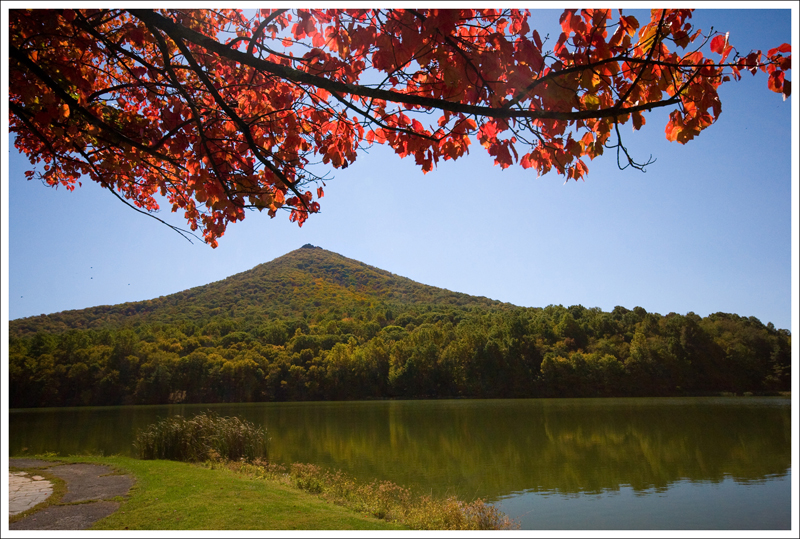
Despite the rain, we really enjoyed the beauty of the trail.  There are 47 trestles and bridges that pass over the Green Cove Creek and the Whitetop Laurel Creek.  You get gorgeous views of the rushing water in the creeks; pass by quaint, country farms; and canopy forests.  We picked a perfect weekend to do this trip to see the beautiful fall foliage.  The trail is shared by bikers, walkers, runners, horses, and even an occasional dog sledder in the winter.

Here are a few highlights along the way.  There are also several information signs along the way that provide valuable insight into the history and nature of the area.  You will see mile markers along the way to help point the way.

  • Mile 34 – The Whitetop Station to park your car.  Bathrooms are available. Highest point on the trail at 3576 ft.
  • Mile 30.5 – Green Cove Station sells a lot of essentials and souvenirs.  Bathrooms are also available.
  • Mile 27 – Creek Junction – Parking and Bathrooms are available.  563 foot trestle.
  • Mile 23 – Taylor’s Valley – Parking available. Daniel Boone campsite.
  • Mile 20.7 – Straight Branch – Parking and Bathrooms are available.
  • Mile 20 – Whitetop Laurel Falls – when you see a large overhanging rock, the falls are down a small path on the right side of the trail.
  • Mile 16 – Arrive at the town of Damascus.  Railroad exhibit is available.
There are so many beautiful farm and stream scenes along the trail.
There are so many beautiful farm and stream scenes along the trail.  The huge Christmas Tree farms along the way are lovely. Pictured Below:  The trail follows a rushing stream with many small waterfalls; The fall color was spectacular in Mid-October.

waterfall barn_2

For those that are interested in geocaching, there are a ton on this trail.

We definitely plan on coming back in the spring and tackle this another time.  The rain got us fairly wet and also covered us with “Creeper Streak” – the streak created on your back from the wet dirt being kicked up from our back tire.  We decided to stop after the halfway point and catch the shuttle back to our car.  While the rain was annoying and kept us from relaxing and enjoying the trail as much as we wanted, we still felt the scenery around us made up for it.

Christine Says…

I woke up early the morning of our Virginia Creeper bike ride, peeked out the hotel window and started silently chanting the mantra “please don’t rain, please don’t rain, please don’t rain”.  The sky was that heavy gunmetal gray that promises rain is coming sooner rather than later.  It wasn’t supposed to start raining until the evening, but I was fairly certain that we were going to be in for a soggy bike ride.

Nevertheless, I donned my new padded bike pants and a fleece top and headed over to the bike shop to catch our shuttle ride out to Whitetop Station.  The shuttle services for the Creeper Trail are a great idea, as they let bikers enjoy the whole trail without making a return trip over repeat scenery to get back to your car.  I think most people just bike half the trail – Whitetop to Damascus, but we were really hoping to do the full 34 miles back to Abingdon.

The van ride out to the trail’s end was pretty long – about an hour along winding mountain roads.  The driver shared lots of trail trivia and helpful tips to kill the time.  Some of the things he shared:

  • Celebrities like to bike the Virginia Creeper (Clint Black, Troy Aikman, Emmitt Smith, some NASCAR driver I don’t remember).  Apparently, Brad Pitt even has a home near Whitetop and has been spotted fishing the area’s rivers. (although I can’t find any evidence to corroborate this as fact)
  • Most of the accidents (75%) along the trail happen to males between the ages of 13 and 21.  Boys on bikes are reckless, I suppose.
  • It’s a very bad idea to slam on your brakes when crossing wet railroad trestles.  You WILL wipe out.  I can vouch that this tip is quite true.  We saw the same poor woman wipe out on two separate occasions – both times she was on a wet trestle.
  • The trail is probably the only 34 mile bike ride that you’ll actually gain weight on.  There are snack shops, coffee house, bakeries, ice cream parlors and full service restaurants all up and down the trail.
The trestle supports are very picturesque/
The trestles along the trail are very picturesque. Pictured Below: We were lucky enough to bike the trail during the peak of fall color; The trail is a multiuse trail and is also used by pedestrians and equestrians.

curved-trestle horses

On the ride out, the sky started spitting a bit of rain.  It had stopped again by the time we were dropped off at Whitetop Station.  We kept our fingers that it would continue to hold off.  Adam and I don’t like biking or hiking in crowds, so as soon as we got our bikes off the trailer, we raced off to get a jump start on the crowd of bikers arriving at the trailhead.  Our driver told us that on nice weekend days, the trail might see upwards of 2400 riders.  Area bike shops have 1800 bikes available, and frequently sell out of rentals.  I was a bit surprised that more people rent bikes than bring their own.  Maybe most people don’t own bikes these days.

The trail was gorgeous – a leaf-covered pathway under an endless tunnel of fall-colored trees.  Every now and then, we’d pass an opening that provided a view of the mountains or one of the area’s many vast  Christmas tree farms.  Around Green Cove Station the rain started in earnest, and never let up again.  I had to put my camera in a trashbag I had packed in my bike rack.  There were so many scenes along the way that deserved to be photographed with care.   Sadly, with the rain, all I was able to do was take a few quick snapshots.

Even in the rain, the ride was incredibly beautiful.  I loved crossing the old railroad trestles and riding alongside the rushing streams.   We biked the entire stretch from Whitetop to Damascus in about ninety minutes.  I would have loved to take more time to enjoy the scenery, but it was cold, wet and windy.  I started thinking less about scenery, and more about a mug of hot chocolate and a steaming cup of soup.

In short order, we arrived in Damascus.  We decided to try lunch at one of the places our shuttle driver had pointed out.  He had mentioned that In the Country and Fattie’s Diner were both really good.  I saw “Hot Soup” on In the Country’s sign, and I was sold.

The trail offers many charming places to stop for a delicious lunch or snack
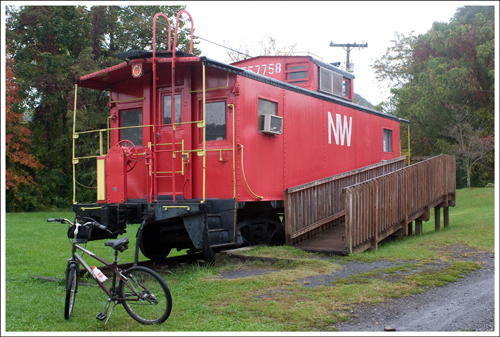
The trail offers many charming places to stop for a delicious lunch or snack.   Pictured Below:  We had a fantastic lunch at “In the Country”; The only red train car along the trail is located in Damascus.

lunch damascus station

The staff at the restaurant was so friendly and welcoming.  They didn’t even flinch when we walked in through their front door, soaking wet  – covered with mud and trail grit.  My ponytail felt like I’d dipped it in wet concrete and my legs were coated with black sludge from my ankles to my knees.  Adam even had mud splashed up and down his cheeks.  They invited us to eat inside in the warmth, but I felt too guilty about my filthiness and chose a picnic table under their covered porch.

Adam and I both got their boxed lunches which included a sandwich, side, drink and dessert.   I chose their potato soup as my side.  It totally hit the spot.  Lunch was washed down with hot chocolate and followed up with delicious homemade pumpkin squares.  We sat on the porch after lunch, watching others from our shuttle group pass by on their way to the pick-up point. I think most bikers take about two and a half hours to bike the Whitetop to Damascus section.

The rain was still falling steadily, and although we wanted badly to see the rest of the trail, we decided to call the bike shop and let them know we’d be joining the shuttle in Damascus.  We met up with everyone at the red train car in the middle of Damascus.  Everybody looked cold, dirty and tired.  The heated shuttle van was such a welcome sight.

It was a real disappointment to miss the second half of the trail, but it’s also a great motivator for us to make a return trip to the area in the spring.  I’ve heard the rhododendron and mountain laurel bloom along the Creeper is amazing!

Trail Notes

  • Distance – 18 miles for this segment
  • Elevation Change – From Whitetop to Damascus, you lose 1646 feet in elevation
  • Difficulty – 1.5.  You hardly have to pedal at all on this stretch of trail, so it is suitable for bikers of all fitness and skill levels
  • Trail Conditions – 3.5.   The trail is in good shape.  There are some errant holes and jutting rocks to watch out for.  Entrances and exits from the trestles can be jarring if you’re going moderately fast.
  • Views – 3.  While the views aren’t high and lofty, they are still beautiful and showcase Virginia’s most picturesque scenery.
  • Waterfalls/streams -4.  The two streams that flow along the trail are gorgeous and include many small waterfalls.
  • Wildlife – 1.  We didn’t see anything, but our shuttle driver told us people regularly spot deer and the occasional bear.
  • Ease to Navigate – 5. The trail is very simple to follow.
  • Solitude0.  People love the Creeper!  On nice days in the spring, summer and fall, the trail can see over 2000 bikers in a single day.

Directions to trailhead:

We recommend hiring a shuttle service in either Abingdon or Damascus.  For a reasonable fee, they will drive you and your bikes to White Top Station.  This lets you enjoy the entire trail without having to backtrack on the return trip to your car.

Mount Rogers

The summit of Mount Rogers, Virginia’s highest peak, can be reached via a nine mile (total, out-and-back) hike starting from Grayson Highlands State Park.  The hike follows the Appalachian Trail for most of the way and crosses into Jefferson National Forest.

Mt. Rogers is beautiful, rugged and home to several herds of wild ponies.
Mount Rogers has beautiful and rugged terrain.  The area is home to several herds of wild ponies.

Christine Says…

Mount Rogers has long been on my list of must-do hikes.  The peak’s status as the state’s highest point was one draw, but personally, I wanted a chance to see the feral highland ponies that roam the area.

Our trip started under rather inauspicious conditions.  We missed a turn on our way to the park, and ended up an hour out of the way.  The weather had been forecast to be sunny, but the morning dawned with a thick, wet, windy cloud of bleakness blanketing the entire area.  But when you have driven almost four hours to do a long-anticipated hike, you’re going to do it regardless of minor complications like gloominess and getting lost.

The trail starts out from Massie Gap in Grayson Highlands State Park.

We parked at Massie Gap in Grayson Highlands State Park.  From there, we walked across a wide pasture, passed a sign warning of extremely erratic weather in the area and went through a horse gate.  The trail climbed upward along a wide, gravel path.

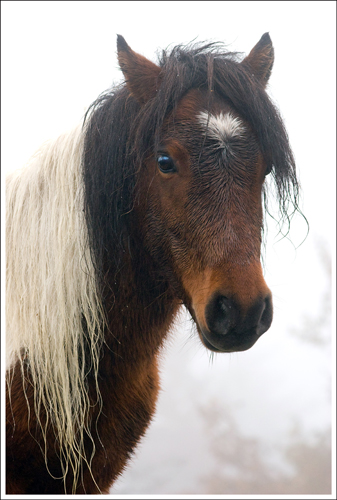
We almost immediately saw our first small group of wild ponies, clustered under the trees on a hillside next to the trail.  The fog was so thick; they looked like silhouettes in the mist.  I quickly got my camera out and started snapping shots.  The ponies were so small and rugged looking.  Their coats were thick and their manes long and wavy.  Some were solid colored and some were spotted.  They also turned out to be incredibly inquisitive and gentle.  While I was squatting down to take photos, a dark brown pony walked up to me and nuzzled her soft nose onto the back of my hand.  I know she was looking for food, but I had nothing to offer. We lingered with the ponies for a while, and then moved on.

(note:  The park rules prohibit feeding the ponies.)

The ponies are very friendly.
The ponies are very friendly.  They come right up to you, especially if they think you have food.  Although it may look like Adam is feeding the pony, he’s actually just unzipping his backpack.  Pictured Below:  More ponies; State park rules!

Grayson Highlands Pony in the Mist. This Mt. Rogers pony was especially friendly
Grayson Highlands Pony in the Fog. Mt. Rogers ponies have long beautiful manes
Adam laughs at the misspelled sign in Grayson Highlands State Park The sign at Grayson Highlands State Park misspelled the word Alcoholic

We soon reached the junction with the Appalachian Trail, followed the white blazes and headed south. The fog was such a transformative element on the morning of our hike.  Instead of the amazing mountain views we’d heard about, the thick mist made the scenery feel closer and more intimate. I told Adam several times that I didn’t feel like I was in Virginia at all.  I felt like I was walking through some storybook version of the Scottish Highlands.  It was so quiet and mysterious-feeling – no people, no tall trees rustling in the wind, no birds chirping. The terrain was open, studded with rocks and covered with scrubby low-lying brush.

The Wilburn Rock scramble was slippery, but fun.

The Appalachian Trail exits Grayson Highlands State Park at around the 1.5 mile mark.  The trail becomes increasingly rugged and rocky at this point.   There are a couple route options for the middle section of the trail.  Hikers can continue along the AT, or choose to branch off on the Wilburn Ridge Trail for a short rock scramble (and nice views on a clear day).  We chose to scramble.  In retrospect, we probably should have stuck to the AT.  The boulders on Wilburn Ridge were quite slippery.  After we finished scrambling, we passed through a thick tunnel of rhododendron that spilled us back out into another open pasture area.

When we rejoined the AT, we started to see signs of the sun burning through the cloud layer.  We soon reached a horse camp next to an enormous rock outcropping .  When we climbed to the top of the rocks, we both gasped in awe at the view.    The valley below us had been mostly cleared of clouds and fog, and a blanket of fall color spread out before us, as far as the eye could see.  Only a few wisps of mist were left hanging on the ridges below.  We sat on the rocks and took a break from walking.  A couple backpackers passed below, and we overheard them talking about hearing coyotes howling in the night before.  Instead of coyotes, we heard the distant squeal of ponies whinnying ahead on the trail.

We got our first view with clearning clouds atop a huge rocky outcropping.
We got our first clear view from atop a huge rocky outcropping. Pictured Below: fog and clouds lift off the colorful mountainside;  the ferns along the trail were turning gold; one of the pony stallions we saw along the way.

The clouds and fog begin to lift off Mt. Rogers The ferns on Mt. Rogers turn gold in the fall Pony Stallion on Mt. Rogers

After a short break atop the rocks, we continued along, passing through another thicket of rhododendron.  The area was completely shaded and nearly ankle deep in mud.  My trekking poles came in very handy traversing the sloppy footing.  This section of the trail runs almost parallel to the Mount Rogers horse trail.  There are many beautiful backcountry campgrounds nestled into the trees along this stretch.    We saw about a dozen more wild ponies near the campsites, including a couple stallions.

This gorgeous gray was hanging out near the campsites.
This gorgeous gray was hanging out near the campsites. Pictured Below: More ponies – they are everywhere along the trail through Rhododendron Gap.

Ponies at rest on Mt. Rogers Beautiful spotted pony on Mt. Rogers Adam watches the red pony on the Mt. Rogers hike

By this point in the hike, all the fog and clouds had blown off the mountain, giving us a great look at the gentle rolling terrain and spectacular open views.  You can’t help but feel like you’re on top of the world walking along this ridge.  The fall color was amazing!   We stopped for lunch at the Thomas Knob Appalachian Trail hut.  We shared the picnic table with several groups of day hikers and backpackers.  We read the logbook, stretched a bit and then made our final push for the summit.

The spur to the summit departs the AT and heads into a dense, rainforest-like grove of spruce-fir trees.  It was damp and green and draped with moss.  It reminded Adam and I of the forests in the Pacific Northwest.  The summit of Mt. Rogers is rather anticlimactic after passing by so many sweeping panoramic views and rocky pinnacles.  The marker lays set in stone, tucked into a shady spot in the woods.  There is no view to speak of, just a quiet little spot under the trees.

We only stayed at the summit for a few minutes, as there were quite a few people there.  We hiked the return trip to Massie Gap fairly quickly, stopping briefly along the way to admire ponies and take in views that had been obscured by fog earlier in the day.  The hike almost felt like a loop because the weather changed so dramatically between the hike up and the hike down.   My final treat along the hike came less than a mile from the end, when a young foal came bounding out of the brush, nickering loudly for his mother.  The foal was absolutely adorable.  I wanted to pack him up and take him home with me!  (Incidentally, the wild ponies are periodically rounded up and sold to keep the herd at a sustainable size.  Although, I don’t think our property owners association would appreciate me bringing a miniature horse home, so I’ll just have to keep the pony ownership idea in the realm of fantasy for now.)

We had beautiful autumn views hiking back down Mt. Rogers
We had beautiful autumn views hiking back down Mount Rogers. Pictured Below: A foal is curious; View from the trail on our return.

A wild Mt. Rogers foal stays close to his mother We had awesome views on the hike back.

We got back to our car, tired and happy.  The entire hike took around six hours – even with lots of breaks and dawdling along the way.  For its nine mile length, it’s a surprisingly easy hike.

I really can’t fully put into words how much I loved this hike. I went to sleep that night dreaming of wild ponies and gorgeous fall views.  I know I’ll revisit Mt. Rogers often in my mind until I have a chance to hike it again.

Adam Says…

We had such a great hike up Mount Rogers!  A co-worker that had previously hiked the mountain had described the scenery as God’s country and I couldn’t agree more.  While walking across the highlands, you can’t help but feel reflective about the beauty before you.  The land around you is vast and I guarantee you will be humbled by the nature.

The trail along the top of Mt. Rogers is surprisingly level.

Mount Rogers was originally named Balsam Mountain, but the name was changed to honor Virginia’s first state geologist and first president of MIT, William B. Rogers.  With the peak being the highest in Virginia at 5,729 feet, this is quite an honor.

One thing that does make this a special hike is the ponies.  Another co-worker of mine didn’t believe that there were wild ponies here (even with photographic evidence).  The ponies were originally placed here by the park service in 1974, but are currently maintained by the Wilburn Ridge Pony Association.  The ponies help protect the area from wildfires by eating grasses and underbrush.  The Wilburn Ridge Pony Association takes care of their veterinary needs and provides supplements of salt and hay in winter months.  There are close to 150 ponies, that are separated into three herds – some are in Grayson Highlands State Park, more are  in the Scales area of Pine Mountain, and the most are near Rhododendron Gap on the Mount Rogers trail.  The proceeds from the sale of the ponies at the end of September supports the vet and winter feed costs.

Adam points out the only sign of humans he can see for miles from Mt. Rogers
Adam points out the only sign of humans he can see for miles from Mt. Rogers. Picture Below: a pair of palominos; beautiful clouds and blue skies over the rocky vista.

Pair of palomino ponies on Mt. Rogers Rocky views and blue skies on the hike down Mt. Rogers

The geology of Mount Rogers provides an interesting tale of how things were formed over the years.  Geologists will be able to see evidence of gneiss, sandstone, rhyolite, and shale on their hike along the trail.

For people that like a little more direction for the route that we took, here are some points of interest along the way:

  • Cross the field at the Massie Gap parking lot and go through the gate to start the trail.
  • You will now be on the Rhododendron Trail for .8 mile until it intersects the Virginia Highlands Connector Trail.  Take a left on this trail for just .2 miles.
  • When you reach the junction with the Appalachian trail, head south.  You will shortly leave Grayson Highlands State Park and enter Mount Rogers National Recreation Area through a gate – continue straight on the AT at this point.  After another .25 mile, you will have the option to stay straight on the Appalachian Trail or turn left and proceed on the Wilburn Ridge Trail.  The distance is about 1 mile either way.  The Wilburn Ridge Trail does join back to the AT.  It is a tougher rock scramble, but I would recommend doing it on the way up rather than the way down.
  • Once you are back on the AT, proceed for another mile until you reach a junction of trails.  This area is known as Rhododendron Gap and comes to an elevation of 5526 feet.  At this junction, there is a large pinnacle rock.  Climbing up the rock will give you gorgeous panoramic views that are a must-see of the hike.  This area joins the AT with the Pine Mountain Trail and Crest Trail.  Once you enjoy the view, make sure you follow the white blazes to stay on the AT.
  • You will then proceed on the AT for about 1.5 miles, walking through the bald area known as the Crest Zone, until you reach the Thomas Knob Shelter, protected by gates on both sides.  This is a great place to grab a snack.  There are also great views behind the cabin.  This cabin sleeps plenty, since there is a ladder that goes to a second floor, allowing a little light through two small windows on the side.
  • Once you leave the shelter through the gate, you will be entering Lewis Fork Wilderness.  Shortly after this point, to reach the summit you will need to leave the AT and proceed to the summit by taking the Mount Rogers Spur Trail for .5 mile straight ahead.  The summit is marked by a simple USGS benchmark in the stone.  There are two within 100 feet of each other, so make sure you find the correct one for any of you peakbaggers.
The Summit of Mt. Rogers resembles a rainforest. Pictured Below: the Thomas Knob Appalachian Trail Shelter; Adam on the summit.

The Thomas Knob Applachian Trail Hut Adam claims a geocache on the summit of Mount Rogers.

Overall, the trail was really quite manageable for a 9-mile hike.  The terrain is very nice in some points walking across flat lands, but there are some rocky parts, especially around the Wilburn Ridge Trail.  My back and feet were in pain from having too much weight on my pack, but my muscles didn’t feel sore at all the next day.

There are just a few geocaches that you can find along the way.  A couple of them are earthcaches, which do not have you finding a physical cache, but it teaches you about the geology of the area.

Christine told me that this hike has been her favorite ever.  While there are a lot of contenders for me, this would definitely be a strong candidate for me as well.  I feel that anyone interested in hiking in Virginia should make this a trail you must do.  It is a day you will remember forever.

Trail Notes

  • Distance – 9 miles the way we went making a partial loop in the middle with the Wilburn Ridge Trail.
  • Elevation Change –About 1100 feet
  • Difficulty – 4. The actual trail wasn’t too tough, but due to the length we upped the difficulty.  The Wilburn Ridge Trail does include a few rock scrambles, but is also manageable for most people that are the slightest bit nimble.
  • Trail Conditions – 3.5 The trail is well-maintained and traveled.  There are muddy spots, especially through the Mount Rogers Spur Trail.  The hike on the AT and Wilburn Ridge before the Rhododendron Gap area is quite rocky, causing you to watch your feet.
  • Views –5. Great views walking along the trail in all directions.  The views from Rhododendron Gap are especially beautiful.
  • Waterfalls/streams –0. Non-existent.
  • Wildlife – 5. It doesn’t get much better than wild ponies.  Bears and coyotes have been spotted also.  Lots of bird-watching available also.
  • Ease to Navigate – 3. It is easy to get a little confused at Rhododendron Gap, but overall things are very well-maintained.  Make sure you grab a map to have a backup plan.
  • Solitude – 2. You will get good spacing due to the length, but you will see other people due to the backpackers, AT hikers, and day visitors.  It is the highest summit, which is going to draw crowds, especially at the shelter and summit.

Directions to trailhead:
From Abingdon, take 58 East until you reachGrayson Highlands State Park on the left through SR 362.  Continue for three miles to reach the Massie Gap parking area.  The start of the trail at the gate is across the field to the north.

McAfee Knob

IMPORTANT: Please read these important regulations and helpful tips before hiking in this area

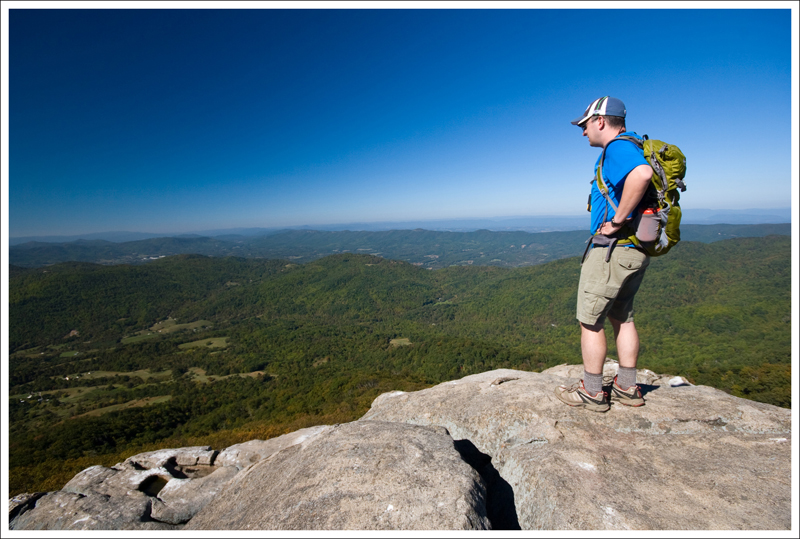
McAfee Knob is an 8.3 mile hike along the Appalachian Trail near Roanoke.  The summit offers truly magnificent views of the Catawba valley below.  On a clear day, you can also get great views of the Peaks of Otter (Sharp Top and Flat Top) along the Blue Ridge Parkway.

McAfee Knob's View of the Catawba Valley
McAfee Knob’s View of the Catawba Valley

Christine says…

We picked a perfect day in April to hike McAfee Knob.  The trees were still mostly bare of leaves, but the skies were crystal clear and completely free of the milky haze that dominates the Virginia summer.  We got to the trailhead right at 9:00 a.m. and the parking lot on 311 was already about halfway full.  From what I’ve been told, this trail rivals Old Rag in popularity for folks in the southern part of the Shenandoah Valley.

The trail is meticulously maintained.  I believe the Roanoke Appalachian Trail Club and local Boy Scouts do most of the trail work.  There are many wooden bridges and walkways in the first two miles of the trail that were built as Eagle Scout projects. I think the hike, despite its eight+ mile length, qualifies as a solidly moderate hike.  It’s not steep and the trail is smooth and pleasant.  It feels a lot shorter than eight miles.

The first few miles of the hike make their way through beautiful, classic Virginia mountains.  The trees are a mix of hardwoods and pines that smell delicious as they warm in the sun.  There are also expansive stands of mountain laurel along the way.  I’m certain they’re a site to behold when they bloom in June.

The view finally opens up when you complete the toughest part of the climb and walk along the ridge of the mountain.  The gnats were something else on the day we hiked.  If we so much as paused for a few seconds, the bugs swarmed us like mad.  The walk along the ridge is brief and leads you past a very cool series of rock formations nicknamed the Devil’s Kitchen.  After walking past the giant boulders, you come to a short spur trail to McAfee knob.

The hike is an out-and-back, so the return trip simply retraces your steps.

I think this is a hike I’ll return to time and again.  I thought it was one of the most spectacular views I’ve seen in the state.

Adam says…

This was a truly wonderful hike.  The views are spectacular and  are likely the best views I can remember in Virginia. I grew up in Lynchburg, VA and we used to always hike up Sharp Top at the Peaks of Otter on the Blue Ridge Parkway.  I think the views here are better than Sharp Top and well worth the mileage.  You can continue the trek on to Tinker Cliffs, but that adds several miles onto the trek and would work better as an overnight backpack trip.  The views of the ridgeline and Tinker Cliffs are breathtaking.  There is a lot of space at the top to chill out on some rocks and eat a snack.  You will often see pictures like the one below when you see pictures for the Appalachian Trail.

I do a lot of geocaching and there is a geocache here if you approach it from the fire road and not the hike on the AT.  However, I left my notes in the car, so I just tried to go from my memory and GPS.  I tried hiking off the trail and up the mountainside and it took away all my energy.

This View of McAfee is an Appalachian Trail Icon
This View of McAfee Knob is an Appalachian Trail Icon

Trail Notes

  • Distance – 8.3 miles round-trip
  • Elevation Change – 1,740 feet
  • Difficulty – 4.  The trail is fairly easy walking, but because the length, we scored it a 4.
  • Trail Conditions – 5.   The trail is well maintained.
  • Views – 5.  One of the finest views in Virginia.
  • Waterfalls/streams – 0.
  • Wildlife – 2.  We saw a lot of Eastern Fence Lizards, but nothing else.
  • Ease to Navigate – 5.   It would be nearly impossible to get lost.
  • Solitude – 1.  The trail is exceedingly popular.  Parking can be a challenge if you arrive mid-day.

Special regulations for this area:

  • Maximum group size, day hikes: 25
  • Maximum group size, backpacking/camping: 10
  • No alcohol
  • Dogs must be kept on leash at all times
  • No camping or campfires outside of seven designated areas (north of Va 624/Newport Rd, the only legal campsites are Johns Spring Shelter, Catawba Shelter and campsites, Pig Farm campsite, Campbell Shelter and Lambert’s Meadow Shelter and campsites)
  • No camping or campfires on McAfee Knob or Tinker Cliffs

Directions to trailhead:

Take I-81 to exit 141.  Follow signs to VA-311.  The parking lot is located about 5.5 miles down 311.  Park ONLY in the designated lot.  Roadside parking is prohibited and will result in towing.