Wayah Bald (NC)

Special: Smokies Edition

Introductory Guide to Visiting Great Smoky Mountains National Park Area

Hiking from Wayah Gap to Wayah Bald is a fun, moderate 8.5 mile hike.  The view from a top the stone observation tower has to be among the best in the area.

View the Full Album of Photos From This Hike

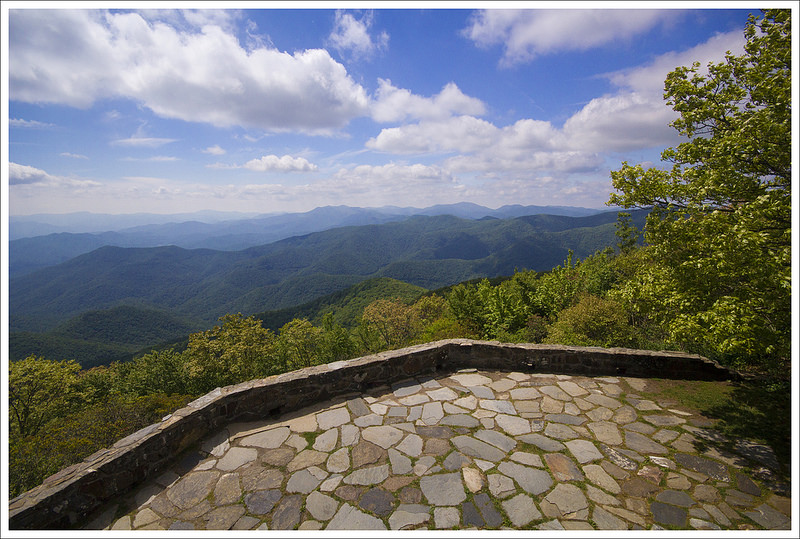
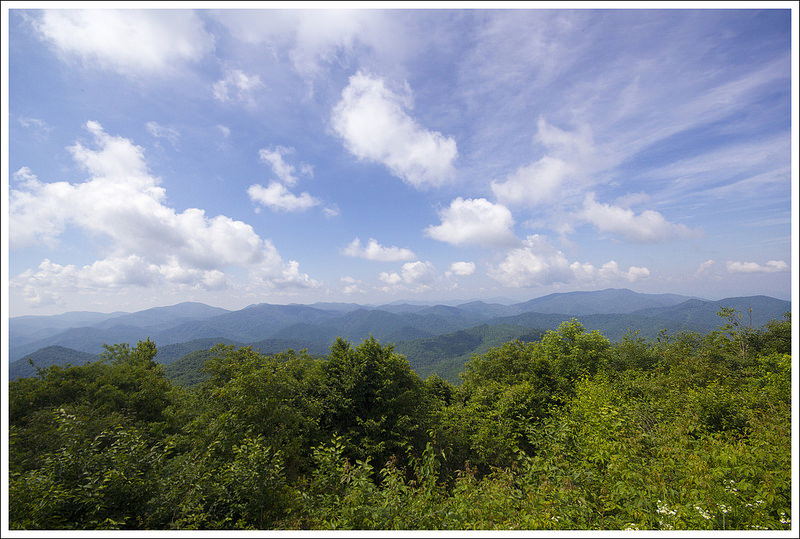
The View from Wayah Bald
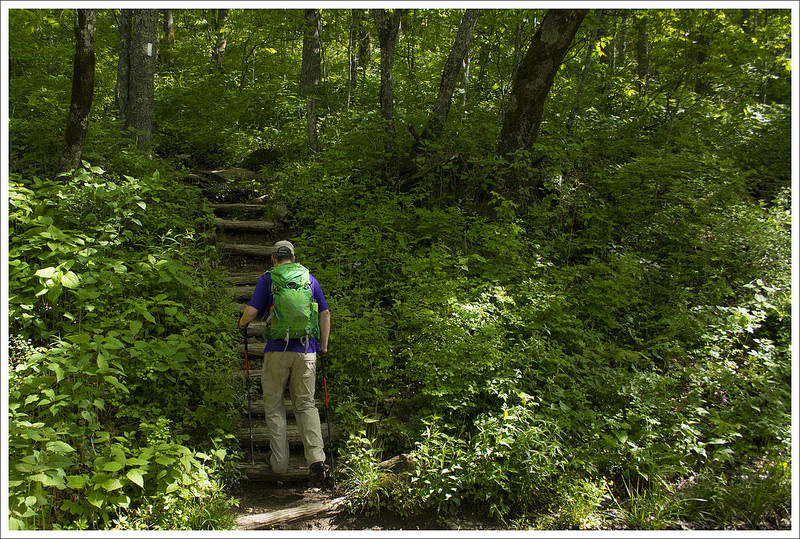
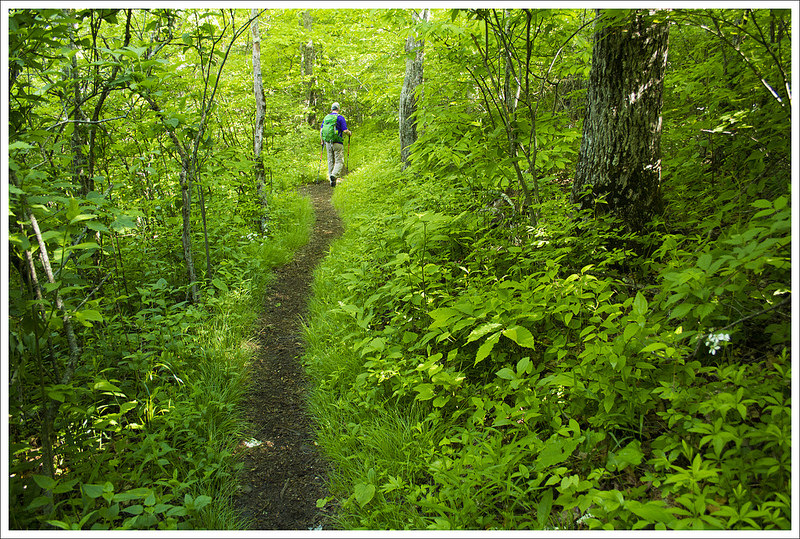
The view from Wayah Bald is majestic! Below: The Appalachian Trail cuts like a ribbon through the green of the forest; Adam looks at the rhododendron tunnel; Stairs climb back up to the trail after crossing a forest road.

Walking the Appalachian Trail Tunnel of Rhododendron Stairs on the AT

Adam Says…

This hike was a true gem!  When you are just reading text about a hike, you can’t get a great idea of how wonderful a hike will be (hopefully this write-up and pictures will help).  What we couldn’t believe through the day was how uncrowded this trail was, especially at the fire tower.  We went on a perfect weekend day and you can even drive up to the very top if you want to skip the hike but still get the views.  Having a spot like this to yourself just doesn’t seem right.

“Wayah” comes from the Cherokee word for “wolf”, since red wolves were once part of this area.  The tower was built in 1937 by the Civilian Conservation Corps and used as a lookout for fires in the area.

As we were driving on Wayah Road making our way to the top, we were both thankful that the drive up would take a lot of feet off the elevation.  The road winds around the mountain as it is taking many switchbacks to get up to the top.  At the crest was the sign for the Wayah Bald Fire Tower and a small parking lot to the side.   We started on the white-blazed Appalachian Trail going north (the same side as the sign and the parking lot).  You climb up a few water-bar stairs and then come to a sign for Wayah Gap.  The trail runs parallel to a national forest road on the left for the first portion of the trail (this is the same forest road you can drive to get to the top without hiking).

Red Trillum
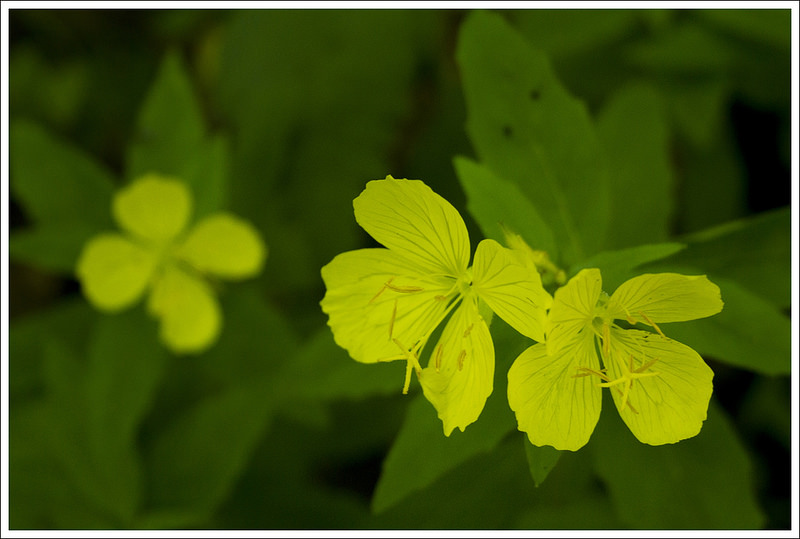
There were many wildflowers and blooming trees along the trail. We enjoyed seeing red trillium, even though they were fading. Below: Flame azalea; Mountain Laurel; Something white?

Flame Azalea Mountain Laurel White Flower

The trail was filled with wildflowers and greenery everywhere you looked and overall the uphill climb was quite manageable.  At 1.75 miles, you make a steeper climb up to a forest road (the same forest road leading to the top).  The trail picks up on the other side, but there is a spring to the right of the trail if you need to refill water.  Crossing the road, you head up some stairs and up a steeper section looking down on the fire road, before it resumes the gradual climb.

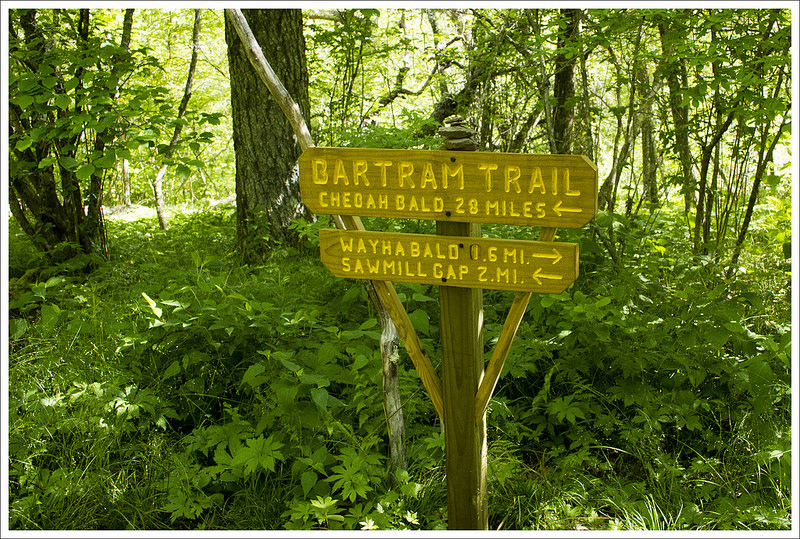
At 2.15 and 2.35 miles, you will see junctions with the yellow-blazed Bartram Trail (a 110 mile trail that goes from Northern Georgia into Southwest North Carolina) and a forest road on the left side.  This trail loops around for an extra 5.4 miles, but stay on the main white-blazed Appalachian Trail.  Since the Bartram Trail joins the AT through this section, you will often see yellow and white blazes together.  At 2.5 miles the trail levels out and then starts to descend.

Bartram - AT Share a Course
The Bartram Trail shares course with the Appalachian Trail for a while. We though the joint blazes looked like a beer with a foamy head. Below: The junction of the AT and the Bartram Trail; There is a nice campsite near the junction; Views from the trail from an old burn.

Bartram Junction Campsite Log Views from the Trail

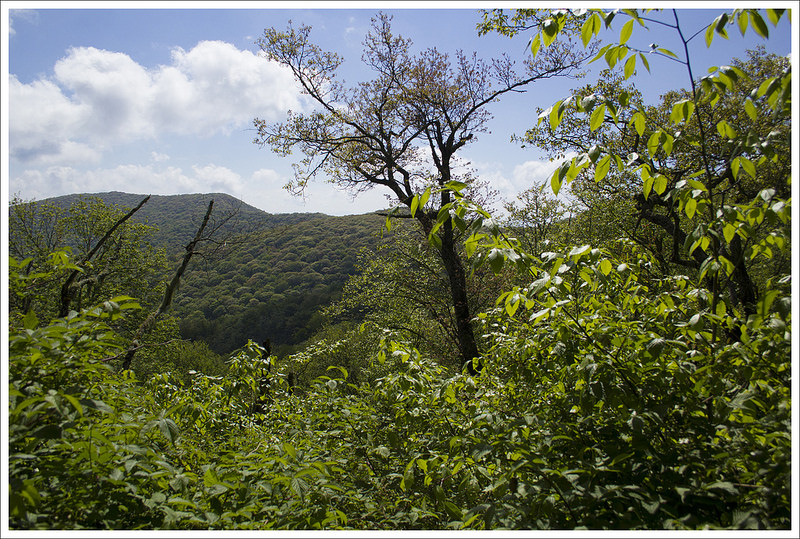
Descending through the forest, the trail then begins to skirt along the mountainside.  The trail became narrow and overgrown as you walk through some high grass and brush.  But, you do get some more open, yet obstructed views of the valley between the mountains.  At 3.5 miles, the trail reaches its bottom and then begins to ascend again.  At 3.8 miles, you cross the forest road again and at 4.15 miles, you reach the final junction with the paved forest road.  Going to the right leads to a picnic area with nice views (and a bathroom if you need it).  Heading to the left from the junction, leads to the Wayah Bald fire tower which we reached around 4.3 miles.

The views from the fire tower were amazing!  Some fire towers are rickety and you wonder if all the bolts have been screwed and tightened in the last few decades.  This structure was a nice stone fire tower with a few steps to the top.  From the top of the tower are maps that will help you identify the mountains in the ranges around you.  If you go on a clear day, you should be able to see for quite a distance.

We stayed at the top for quite a while and this was definitely my top hike from this trip.  We ate our packed lunch and talked to the few people we saw at the top, but it was hard to pull me away from the stunning landscape around me.  If you aren’t capable of doing the hike, this is still a place to visit on a trip in North Carolina.

Christine Says…

This was another hike I mapped out using my AWOL Guide for the Appalachian Trail.  You can practically drive up to the tower, but we wanted to put in longer trail miles, so we opted to start at Wayah Gap, about four miles south of Wayah Bald.

It turned out to be a beautiful hike!  There were tons of blooming wildflowers, a crisp breeze, abundant sunshine, and pleasant temperatures.  I was thrilled to see the last few red trillium blooms and the first of the flame azaleas lighting up the forest. The hike was perfectly timed to see lots of wildflowers.

View From the Wayah Bald Tower
The view from the Wayah Bald Tower is almost 360. Below: The views are also nice from the Wayah Picnic Area; The tower; Inside the Wayah Tower.

View from Wayah Picnic Area Wayah Tower Inside Wayah Tower

We started early and had most of the trail to ourselves.  Just a few tenths of a mile after starting, we passed a very early-season southbound thru-hiker.  I didn’t know it at the time, but we learned later that he was Mountain Man – possibly the oldest person to ever complete a winter thru-hike.  He finished about ten days after our paths crossed.

The terrain on the way to Wayah Bald was pretty gentle – moderate climbs and descents and lots of easy walking.  We passed several really nice campsites along the way, with the largest and nicest being located at the junction of the AT and the Bartram Trail.

We walked through an area that was recently burned, leaving behind some open views and lots of fast-growing tall grass to wade through.  Most of the sunny spots on the trail were pretty overgrown.

When we arrived at Wayah Bald, we took a wrong turn and ended up walking up to the picnic area.  It was a lucky mistake, because the picnic area offers a second beautiful vista.  Once we realized we were in the wrong place, we turned around an walked the opposite way up to the tower.

Layers of Mountains
We never get tired of looking at our beautiful, velvety rolling mountains. Below: No idea why there were so many worms/grubs in a pile. It was gross and fascinating; We liked this lone tree in a small meadow we passed; Post-hike lunch at Big Wesser Brew & BBQ at the Nantahala Outdoor Center – one of our favorite riverside lunch stops.

Worms Meadow and Tree Lunch at Nantahala Outdoor Center

There were only three or four other people at the tower, despite it being a beautiful holiday weekend.  We climbed to the top and ate a snack. We loved looking at and identifying the other mountains that made up the panoramic vista.  One of the most recognizable was Siler Bald – identified by the wide grassy swath leading to the summit. We spent a bit more time enjoying the spectacular view before making our way back.

After the hike, we decided to go to one of our favorite places – the Nantahala Outdoor Center. The place was hopping with Memorial Day activities, but we were still able to find a parking spot and a table at Big Wesser Brew & BBQ.

Trail Notes

  • Distance – 8.5 miles
    (Check out the stats from Map My Hike)*
  • Elevation Change – 1613  ft.
  • Difficulty – 3.  The length makes this rated a 3, but the overall climb was manageable.
  • Trail Conditions – 3.  The trail was well-maintained, but very overgrown from the junction with the Bartram Trail leading up to the summit.  There weren’t many rocky sections, so it made for nice footing most of the trail.
  • Views  5.  Panoramic, 360-degree views from the Fire Tower on a clear day.
  • Streams/Waterfalls – 1.  There were two adequate springs to use as water sources along the way.
  • Wildlife – 2.  Nothing spotted on this trail.
  • Ease to Navigate – 4.0. As long as you follow the white blazes for the Appalachian Trail, you should be in good shape. 
  • Solitude – 4.  Maybe we hit this on an odd day, but we had a lot of solitude on a “should have been busy” day and even had the fire tower to ourselves for about 15 minutes. 

Download a Trail Map (PDF)

Directions to trailhead:  GPS coordinates for this trailhead are 35.153662, -83.580462. From Highway 74 in North Carolina (near Cherokee/Bryson City) take the US23 S/US 441 S exit for Dillsboro/Franklin/Atlanta. Follow this road for 20.4 miles to the junction with US64 W.  Follow 64W for 3.7 miles.  Take a right on Patton Road.  Follow Patton for .3 of a mile and then turn left on Wayah Road.  Follow Wayah Road for 9 miles until you reach the well-marked trail crossing.  Follow the Appalachian Trail north from this point.

Standing Indian Mountain (NC)

Special: Smokies Edition

Introductory Guide to Visiting Great Smoky Mountains National Park Area

Standing Indian is a pleasant five mile (round trip) hike along the Appalachian Trail in North Carolina’s Southern Nantahala Wilderness.  There is plenty of camping and a beautiful viewpoint at the summit.

View the Full Album of Photos From This Hike
The View from Standing Indian Mountain
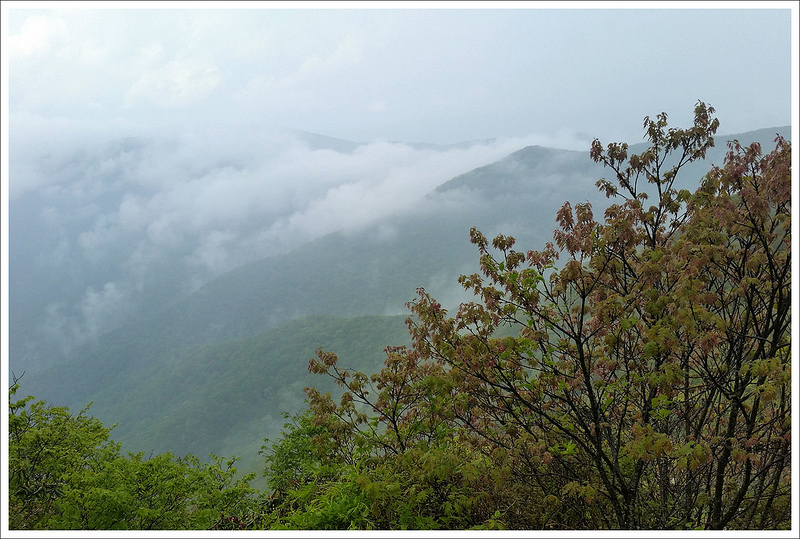
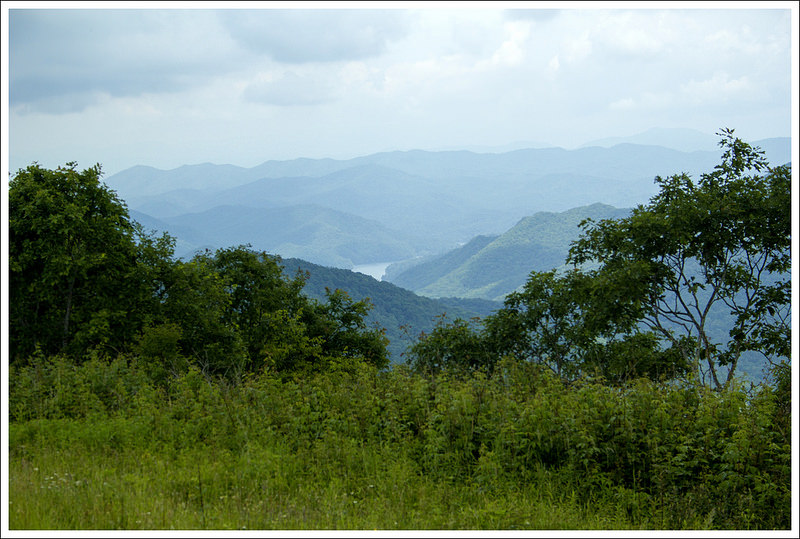
The view from Standing Indian was almost completely socked in by fog. We did get a couple moments of partial clearing that let us enjoy the view. Below: Camping along the road crossing is closed in Deep Gap, but signs point to nearby sites; Camping around the shelter has also been closed to allow reforestation; Adam makes his way up the Appalachian Trail. This was all before the downpour started.

Standing Indian Designated Campsites No Camping Restoration Standing Indian Before the Rain Started

Christine Says…

When we visited the Smokies this year, we decided to spend the entire trip – an unfortunately short four days – on the southern side of the park.  On our last few trips to the area, we enjoyed exploring the Appalachian Trail corridor just before it enters GSMNP.  We thought Wesser Bald and Siler Bald were both fun hikes with spectacular views, so before we traveled, I spent some time perusing my AWOL Guide to see if there were other nice view hikes close to easily accessible road crossings. One of the hikes I came up with was Standing Indian Mountain.

By the miles, the drive to the trailhead was pretty short, but the last six miles to get to Deep Gap were along a narrow, steep, and winding forest/logging road. It took about 25 minutes to reach the road’s dead-end at Deep Gap Primitive Campground.  There were some really nice campsites available, but the largest and flattest of the sites was closed for reforestation/restoration.  Quite a few of the overused backcountry tent sites in this area have been closed to allow them to return to their natural state.

Standing Indian Shelter
Standing Indian Shelter – there were tent sites behind the shelter. Below: The Appalachian Trail winds through the ferns; We saw dozens of these snails; Signage for the Southern Nantahala Wilderness.

Tons of Ferns Along the AT Snail on Standing Indian Southern Nantahala

We picked up the northbound Appalachian Trail at the end of the road. It was sunny and humid when we started hiking.  The trail climbed steadily and gently the whole way on this hike. Just under a half mile into the hike, we passed a piped spring coming out of the mountainside.  We passed a couple more closed campsites before arriving at the spur trail to Standing Indian Shelter at 1.1 miles.  The shelter is barely a tenth of a mile off the trail.  It had room for about eight people and was equipped with benches and a large fire pit.  There were lots of flat, grassy tent sites behind the shelter.  Supposedly there is a stream/water source 70 yards downhill of the shelter, but we didn’t take the time to explore.  We signed the shelter log and continued our hike up the mountain.

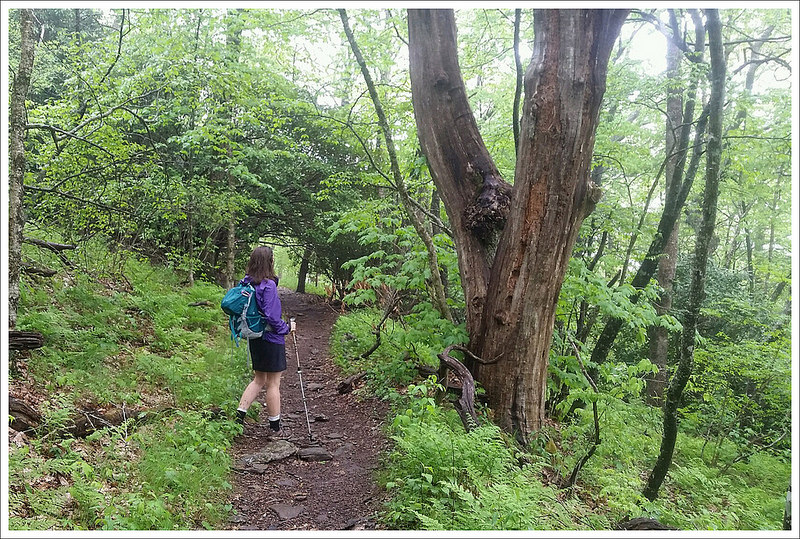
Shortly after the shelter, sun gave way to fog.  We figured it was just leftover moisture from storms the night before or a passing cloud.  At 5,499′, Standing Indian is the tallest peak along the Nantahala River and often gets different weather than the valley below.  We hiked on and the fog gave way to occasional raindrops.  We assured one another it was just a passing shower and pressed on.  By the time we reached a tunnel of rhododendron, the light shower had become a downpour.  Adam wanted to put on our rain gear and stay sheltered under the canopy of rhododendron, but I was getting cold and wanted to push on.  In the end, we decided to wait a little bit; hoping the storm would pass and allow us to enjoy the view that was to be the main point of the hike.

Bluets on Standing Indian
We saw lots of bluets on the hike up. Below: The forest was lush with ferns; A tunnel of mountain laurel gave us a little shelter from the rain; The trail soon was flowing like a stream.

Lush Ferns on Standing Indian Rain and Rhododendrons on Standing Indian Rain on the Appalachian Trail

After about 20 minutes, the rain still hadn’t slowed so I suggested we hike back to the shelter and wait a bit there.  On our way down, the rain stopped, so we turned around and climbed back up. It started pouring again almost immediately after we turned around, so we admitted defeat and decided to just roll with whatever nature threw our way.

So, we hiked to the summit of Standing Indian in a deluge! The summit was completely socked it, but after waiting about ten minutes the fog moved enough to give us a cloudy, misty view of the mountains beyond.  We enjoyed every second of the three minute vista before the fog fell back around.  The hike back was really quick – all downhill over easy terrain.  And wouldn’t you know it… the sun came back out as soon as we got to the parking lot!

Adam Says…

As Christine mentioned, this may not have been the best day for this hike.  The weather forecast predicted some late afternoon storms, so we really thought we could get in a hike before things turned for the worse. It was quite humid from the recent rain.  After we left the shelter, we noticed the clouds were getting thicker, but we pressed on hoping we could beat any rain. We made it to a large rhododendron tunnel and what started off as sprinkling rain quickly became a downpour.  The rain was unrelenting.  We talked about going to the top, but with all the rain, we didn’t think we would see anything, so we decided to turn around before reaching the summit.

As we made our way down, we came across a Appalachian Trail thru-hiker.  She looked college-aged and was carrying a pack that looked like it weighed 60 pounds.  The rain had soaked a bandana she was wearing as headband and the dye from the fabric was bleeding blue streaks all down her face.

The trail heading back was more like walking through a small stream in some spots as the heavy rain looked for a place to escape the steep slope of the mountain.  The rocks on the trail were slippery from the rain.  After making it back about halfway to the shelter, the rain slowed considerably so we changed our mind and decided to give the summit another go.

Campsite on Standing Indian Summit
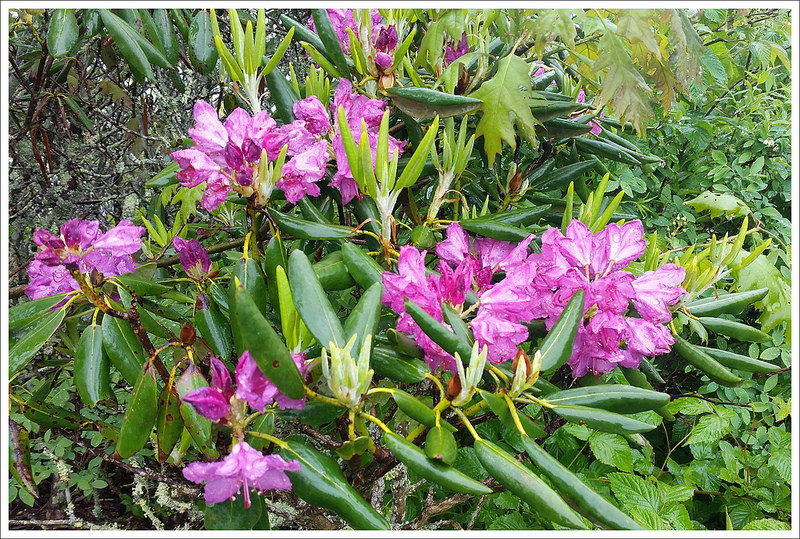
What a great campsite on the summit of Standing Indian. Below: Standing Indian summit marker; Rhododendrons blooming near the summit; Christine checks out a cool, gnarled, old tree.

Standing Indian Summit Marker Rhododendron Blooming on Standing Indian Summit Big Gnarled Tree

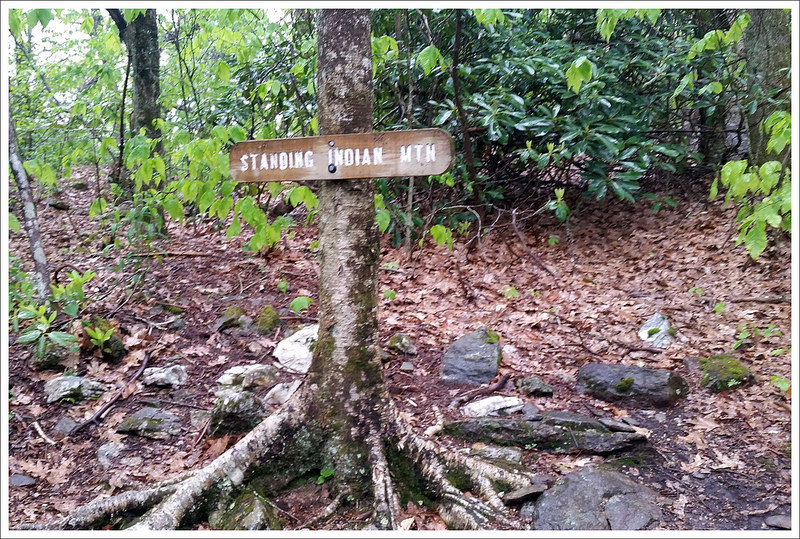
At 2.45 miles, the trail comes to a junction with the Lower Ridge trail.  You will see a sign for Standing Indian Mountain.  Take a right off the Appalachian Trail to follow a path through a campsite area which leads to the summit of Standing Indian Mountain in just a tenth of a mile.  There was a large fire pit at the top and a small nook to catch a view of the mountains around you.  When we arrived, we were able to catch a quick view before the fog and clouds enveloped everything in a sea of gray.  We were at least thankful to be up there to appreciate the view for a few minutes.

The name “Standing Indian Mountain” comes from Cherokee myth.  An Indian warrior had been sent to the summit to watch for a winged monster that came from the sky and stole children.  The monster was captured and destroyed with thunder and lightning from the Great Spirit.  The Cherokee warrior had become afraid and ran away from his post and was turned into stone for his cowardice.  The Cherokee referred to Standing Indian Mountain as “Yunwitsule-nunyi”, meaning “where the man stood”.

Fog and Rain Along the Appalachian Trail on Standing Indian
Fog and rain along the Appalachian Trail on Standing Indian Mountain. Below:  A Blue Ridge two-lined salamander (we think); A black-chinned red salamander (we think): Post-hike beers at The Lazy Hiker (we know for sure!)

Blue-Ridge Two-Lined Salamander Black Chinned Red Salamander Lazy Hiker Brewery

The rain continued for most of the hike down.  But one treat the rain provided was the chance to see several salamanders hanging out on the trail.   We first spotted a Blue Ridge two-lined salamander, but the real treat was seeing a black-chinned red salamander.  The Great Smoky Mountains are known as the “Salamander Capital of the World”, so we were glad to catch a few species on this hike.  We have yet to spot a hellbender salamander (which range from 12-29 inches long) in the wild there, but maybe one day we will.

After we made it back to the car, we decided to drive over to Franklin, NC for the afternoon.  We stopped in a wonderful outfitter store called Outdoor 76.  When we had stopped to take pictures of the salamanders, I realized my backpack was completely soaked inside which ruined our copy of our AWOL guide.  So we purchased those as well as a couple of Pelican cases for our phones.  They even have several beers on tap at the back of the store.  It wasn’t until later that I thought about how my daypack has a built-in rain cover – ugh.  We then went to grab some lunch at Motor Company Grill (just an average 50s-style burger and sandwich place) and then went to the Lazy Hiker Brewing Company.  Since a lot of AT thru-hikers will spend a day off the trail to eat and resupply in Franklin, this place is a popular spot.  They had great trail and hiking information posted inside and had some of the coolest hiking-related pint glasses I have seen.   It is definitely worth a stop if you are in the area.

Trail Notes

  • Distance – 5 miles
    (Check out the stats from Map My Hike)*
  • Elevation Change – 1300 ft.
  • Difficulty – 2.5.  The climbing on this trail is all very gradual and well-graded. We were surprised it even came out to 1300 feet!
  • Trail Conditions – 4.   The local chapter of the Appalachian Trail Conservancy is working hard on restoration projects in this area and their work was definitely evident.
  • Views  4.  We are giving this the score it deserves on a nice day with good visibility.  We still had a pretty view, but it could have been much nicer if the rain had held off.
  • Streams/Waterfalls – 1.  There were a couple small springs (at least one was piped) that could be used as a water source.
  • Wildlife – 3. We saw a couple unique salamanders along the trail in the rain. They were both species we hadn’t seen before.
  • Ease to Navigate – 3. The trail is well blazed.  The view at the top is hidden behind a spur trail through a bunch of campsites.  If you don’t know to cut through the campsites, you would miss the view completely.
  • Solitude – 3.  There were a ton of cars parked at Deep Gap, but we only saw a handful of people on the trail – probably because it was *pouring*!

Download a Trail Map (PDF)

Directions to trailhead:  GPS coordinates for this trailhead are 35.039847, -83.552506. From Highway 74 in North Carolina (near Cherokee/Bryson City) take the US23 S/US 441 S exit for Dillsboro/Franklin/Atlanta. Follow this road for 20.4 miles to the junction with US64 W.  Follow 64W for 14.5 miles.  Take a left on Deep Gap Road.  It will become a gravel forest service road almost immediately.  Follow the forest road for almost 6 miles until you reach Deep Gap.  Follow the Appalachian Trail north from this point.

Siler Bald (NC)

Special: Smokies Edition

Introductory Guide to Visiting Great Smoky Mountains National Park Area

Not to be confused with Silers Bald in the Great Smoky Mountains National Park, this 8.8 mile hike in Nantahala National Forest has some of the best views in the southern Appalachians – mountains roll out in every direction from the summit.  The hike is moderate and doesn’t require any tough climbing or tricky terrain.

View the Full Album of Photos From This Hike

We thought this video really showcased how amazing the view is from Siler Bald!  Sorry it’s so shaky!

Adam Says…

One thing we hoped to do on our trip was to hike some new piece of the Appalachian Trail.  While it would have been nice to complete a larger section of the trail, when you only have one car you are stuck with doing some out-and-backs.  When we were researching some different options we came upon Siler Bald.  My first thought was “Didn’t we already hike this another time?”  Oh, that was SilerS Bald, not Siler Bald.  I always get a kick out of how many mountains and hikes have similar names.  We have come across several Chimney Rocks in our travels.  It reminds me of the unoriginal naming of cities in New England.  You can find multiple Manchesters, Andovers, Portsmouths, Dovers, and Salems in the New England states, as if their goal is to get you lost when you try to navigate with your GPS.  The nice thing about both of these similarly-named balds is they have great views so you can’t go wrong.

There wasn’t a GPS signal when we started this hike, so it was a little difficult to find the starting point.  I had a map of the area and we were able to find the parking lot easily enough. The Appalachian Trail crosses over Hwy-64 near the parking lot.  The southbound path is easy to find, it takes off from the parking lot.  However, the northbound path was harder to find.  I crossed the road and walked down the road heading east for about a hundred feet.  Then, I saw the AT cut through on a small, overgrown path.  I signaled back up to Christine that I found it and we began our hike.

Small Waterfall near Winding Stair Gap
There was a pretty small waterfall near the beginning of the hike. Below: Winding Stair Gap; National Forest Information, Stream crossing and nice campsite.

Parking at Winding Stair Gap Nantahala National Forest Sign Stream and Nice Campsites

Heading into the woods, the white-blazed trail starts on a very gradual uphill slope.  Like many parts of the AT, this hike can be called a green tunnel – one path cutting through lush, green forest.  We reached a waterfall and forest service road in .2 miles, followed shortly by a stream crossing and a nice campsite area.  The trail then continues uphill as you pass by Swinging Lick Gap at 1.1 miles and Panther Gap at 2 miles.  Right before the sign of Panther Gap, we were startled as 5 grouse took off across the trail just ahead of us.  When you are walking along the trail with nothing but the sounds of the woods around you, a big move from the brush can you make you almost leap out of your hiking boots.  From Panther Gap, the trail then goes slightly downhill for about a quarter of a mile before going gradually uphill.  We eventually reached a junction trail at 4.2 miles.  The trail branches off to the Siler Bald Shelter, which is about .5 mile from this junction (this trail eventually loops around to the other side if you see it out after the summit).  We didn’t take the trip to the shelter since we were getting hungry and wanted to make our way to the views.

Scarlet Flycatch
There were still some colorful things growing and blooming along the trail.

Orange Azalea Fungus Yellow Wildflowers

Continuing on the AT, we met another junction with the Siler Bald summit trail.  From here, we took the path up the hillside, requiring us to almost bushwhack through this thick, tall grass and brush for a short distance before we came out of it.  We climbed a very steep .2 miles to reach the summit of Siler Bald at 4.4 miles.  As you are climbing up, if you look behind you the views start opening up of the mountains around you, but when you reach the summit the views are spectacular.  Having hiked without seeing anyone the entire day, we were surprised to see a thru-hiker at the top.  He was hoping to get a ride into town, having a craving for a pizza.  We talked with him for a while and were pleased to find out he was from Virginia as well.  He made a call to have someone meet him at the trailhead and he was off in a flash. We ate our lunch and enjoyed the views all to ourselves.  On our way back down, we did come across a few other people that were out for a backpacking trip.  This hike is one that has outstanding views for a minimal effort and is not as well-traveled.

Appalachian Trail Near Siler Bald
The trail was green and lush.  Below: Tunnels of mountain laurel;  There was a shelter on a side trail – we skipped visiting; Making our way up to the top of the bald.

Rhododendron Tunnel Siler Bald Shelter Sign Climbing the Bald

Christine Says…

Three and a half days in the Smokies just aren’t enough!  On our 2015 stay, we tried two new hikes in the park (Ramsey Cascades and Gregory Bald), revisited an old favorite (Charlies Bunion), and then picked something new! For our final hike of the trip, we chose a hike outside the park borders – Siler Bald.  This hike is located just south of the park in Nantahala National Forest. It offers a spectacular, panoramic vista from a spur just off the Appalachian Trail.

We parked our car at Winding Stair Gap.  There is a good-sized lot along Hwy-64.  From the parking area, we crossed the highway and picked up the Appalachian Trail heading north.  In the first couple tenths of a mile, we crossed a footbridge over a pretty small waterfall.  On the other side of the bridge, there was a kiosk with information about the forest. Shortly after the sign, we crossed a wider stream with a lovely backcounty campsite next to it.

Almost to the Top of Siler Ba
This was about the moment we realized ‘Wow… mountains everywhere!’ Below: Siler Bald scenery.

So Many Mountains from Siler Bald Lake Nantahala Summit Campsite and Marker on Siler Bald

We hiked along, enjoying the abundance of interesting wildflowers and fungi. The climb was steady and slow.  It was by far the easiest hike of our trip.  We chuckled at the random sign posts in the woods declaring that a particular spot was a ‘gap’.  None of the gaps really seemed to be low points between mountains, nevertheless their were signs indicating that we had passed through Swinging Lick Gap, Panther Gap, and Snowbird Gap. Other than enjoying the pleasant weather and small things along the trail, there’s nothing grand along the way to Siler Bald.  The grandeur all comes shortly after you reach a grassy clearing about 4 miles into the hike.

From the grassy clearing, climb the spur trail steeply up through the meadow for .2 miles.  When we visited, the meadow was full of tall grasses and daisies.  At the very top, we reached a flat opening that looked out across what seemed like all of the southern Appalachians. We had great views of Standing Indian mountain, Wayah Bald, Lake Nantahala, and even into Georgia.

Storm Clouds
Storm clouds started to roll in. Below: Mountain views on the descent; Small waterfall

Starting the Hike Down Bridge at the Bottom

There’s a marker at the top of the bald declaring the mountain’s name and elevation (5,216 feet).  There’s also an established fire pit and plenty of room for several tents.  What a place to watch both sunrise and sunset!

Adam and I ate our lunch (so many peanut butter and jelly sandwiches on this trip), took lots photos, and spent some time chatting with a fellow Virginian we met atop the summit.  Rambling Wreck was his name, and he was doing a flip-flop thru-hike of the Appalachian Trail.  He was really the only person we saw all day until we were almost done with our hike.

Nachos and Beers at the NOC
Nachos and Beers at the NOC.

The NOC

As we enjoyed the bald, darker clouds started to roll in.  We knew thunderstorms were forecast for later in the day, so we decided to make our way down.  The descent from the bald is nearly as magnificent as being on top – walking downhill with all the mountains laid out before me was breathtaking!  I was probably paying too much attention to the view, because the toe of my shoe got hooked on a root hidden by deep grass.  I took one of those epic falls that happen so fast you can do nothing to stop and catch yourself.  I faceplanted and ended up with several deep, painful bruises, but nothing that stopped me from hiking on.  When you’re a regular hiker, these things are bound to happen sooner or later!

The hike down went quickly and soon we arrived back at our car.  We decided to make the drive out to the Nantahala Outdoor Center (NOC) for our next stop.  On the way, we were pounded by thunderstorms.  I’m glad we missed them on the trail!  At the NOC we grabbed an outdoor riverside table at Big Wesser Brew and BBQ (one of our favorite spots) and shared nachos and a couple beers. Super day!

Trail Notes

  • Distance – 8.8 miles
    (Check out the stats from Map My Hike)*
  • Elevation Change – 1737 ft.
  • Difficulty – 3.  The climbing on this trail is all easy to moderate until the last couple tenths of a mile, up to the top of the bald.
  • Trail Conditions – 4.  The trail was nice, smooth, dirt with very few rocky sections.
  • Views  5.  Breathtaking, expansive, amazing, beautiful!
  • Streams/Waterfalls – 2.  There were a couple small streams and a small waterfall near the beginning of the hike.
  • Wildlife – 3. We saw some bear scat on the trail, so I’m sure bear sightings happen in this area.
  • Ease to Navigate – 3. The trail is clearly blazed and the spur to Siler Bald is pretty obvious.
  • Solitude – 4.  We saw one thru-hiker atop the bald and one group of four men backpacking together.  It has immensely more solitude than trails in GSMNP.

Download a Trail Map (PDF)

Directions to trailhead:  GPS coordinates for this trailhead are 35.12175, -83.54435. It is located on US 64,  11 miles west of Franklin, NC.  There is a spacious parking lot at Winding Stair Gap. From the parking lot, cross the road, head east about 100 feet, and begin hiking north along the Appalachian Trail.