Woodstock Tower

The Woodstock Tower hike is a fairly easy hike in the Lee Ranger District of George Washington National Forest that leads to a fire tower with 360-degree views of the surrounding area.

View from Woodstock Tower
The view from the Woodstock Tower is panoramic - offering views of the valley, river and distant mountains. Below: A wider view includes the mountains; It really wasn't the best time of day to photograph the actual tower -- I had to shoot right into the sun; The inside of the tower is covered with graffiti.

A wider view Tower Sunburst Inside the Tower

Adam Says…

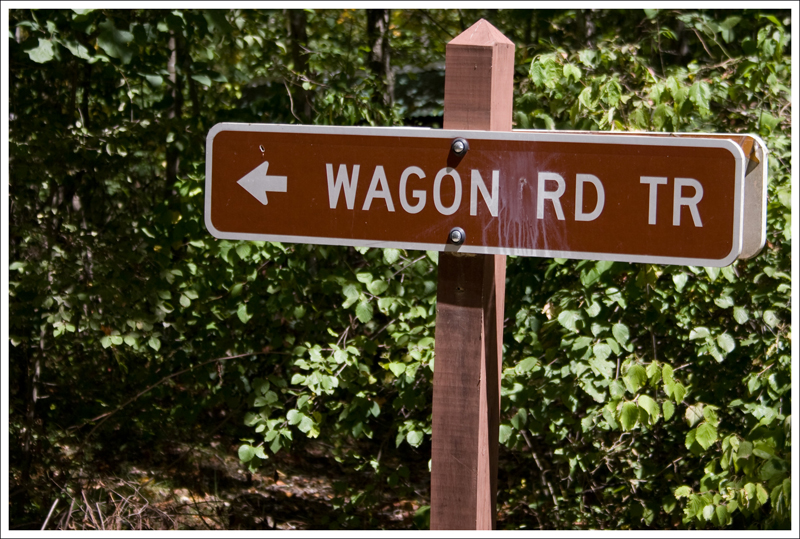
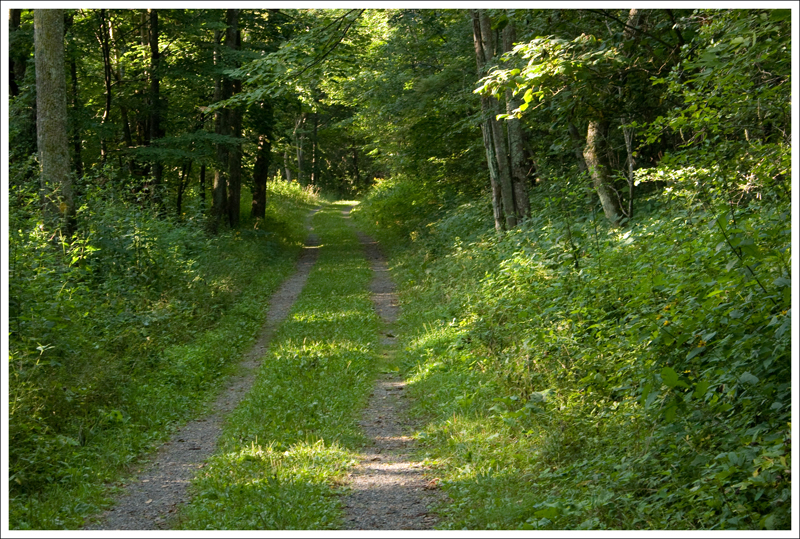
After parking in the Little Fort Campground area, we headed up for our hike to Woodstock Tower.  The white-blazed Wagon Road/Nature Trail starts off as a rough fire road and after .1 mile, intersects with Peters Mill Run.  Peters Mill Run is an ATV/OHV trail, so look both ways before crossing this popular trail for ATVs and motorcycles.  Continue straight across Peters Mill Run to connect to the trail again.  The trail does go steadily up with a few switchbacks, but the switchbacks really make the trail easier of a climb.  The first switchback comes in around .25 miles and the second switchback comes around .5 miles.  After the second switchback, the trail does become steeper, but it ends after just a couple tenths of a mile.  At .7 miles, take a left on the pink-blazed Tower Trail.  It is only about .2 miles to reach the tower on a fairly level trail.
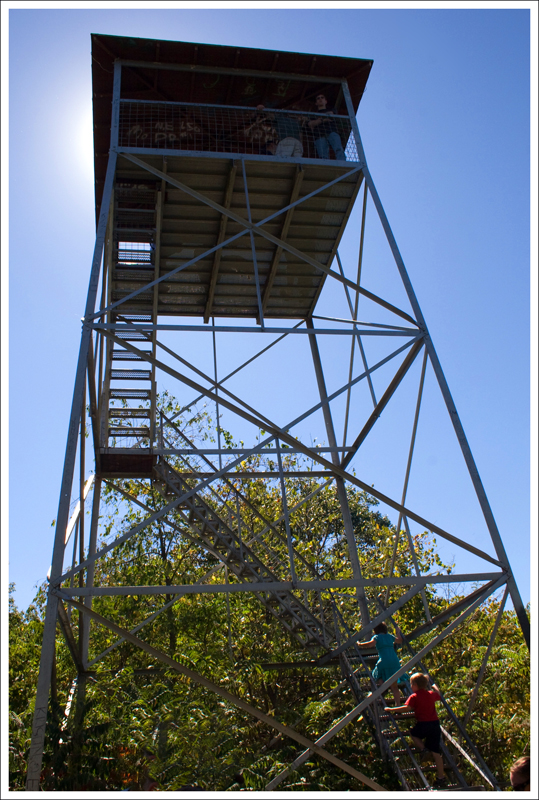
The Woodstock Tower
The Woodstock Tower. Below: A little bit of fall color was already showing; We took a break for water where the short trail meets up with the longer trail; Looking up through the Woodstock Tower.

A little fall foliage Water Stop Looking up through the tower

When we reached the tower, we climbed up the metal stairs to reach the top.  I’m not a big fan of heights, but I’m especially nervous when it involves man-made things.  The tower did seem quite sturdy, but it makes some noises when railings move slightly, so I was more eager to get down from the tower than the rest of Christine’s family.  The views are nice, but the area is quite crowded.  Unless you went up early in the morning, I fear that it would be hard to have a moment’s peace at the top.  There aren’t any signs posted for maximum number of people on the tower and you may have to hug the side of a platform as people pass in opposite directions.

There are a few geocaches in the nearby area:

Christine Says…

This was the second time I’ve been to the Woodstock Tower.  Last time I was there was several years ago in mid-October.  I remember the fall foliage being amazing from atop the tower. This time, the foliage had just the slightest hint of change, but the day was crystal clear and sunny – not a bit of haze – so the view was extra nice.

There are shorter ways to get to the view.  In fact, you can practically drive right up to it.  However, we chose to hike up from the Little Fort campground instead.   The slightly longer route gave my mom a chance to try out her new hiking boots.

Off Highway Vehicle
The area has lots of ATV and dirt bike trails. Below: All the roads and trails in this area are well-marked.

Wagon Road Campground Sign

Because the day was so beautiful, we had to share the tower with crowds of people.  At times, there was actually a line of people waiting to get to the top.  We even saw a person trying to coax their pit bull up the open, metal stairs.  That didn’t go so well, and they had to turn back about halfway to the top.  The inside of the tower is covered with graffiti and the area is littered with broken beer bottles and empty soda cans – a very unfortunate side effect of its popularity.

Despite the tower’s less-than-pristine nature, it still offers one of the best views of the mountains in the area.  It’s well worth the short walk.

Trail Notes

  • Distance – 2 miles
  • Elevation Change – about 500 feet
  • Difficulty –2. While you would think that going up 500 feet in one mile would be steep, the trail up seems to take off a lot of the steep terrain.
  • Trail Conditions – 3. The trail had some loose ground in a few areas (especially in the first .1 mile), but overall was well-maintained.
  • Views – 4.5. It does have 360-degree views, but we always enjoy views from natural surroundings like rock outcrops over man-made towers.
  • Waterfalls/streams 0. Non-existent.
  • Wildlife – 2. Too many people to see anything other than people.  May be good for hawk spotting or some other woodland birds.
  • Ease to Navigate – 4.  Not too many turns on this one and trails are well-labeled.
  • Solitude – 1. You will see lots of people on this trail during a nice day.

Directions to trailhead:
We approached this from I-81.  There are other ways to the east to approach this, but here is the most common way for anyone traveling via interstate.  Take exit 283 on I-81, heading east on 42.  Stay on 42 until it intersects with US 11.  Take a left on US 11, heading north through the town of Woodstock.  As soon as you pass the Woodstock Shopping Center, take a right on S.R. 665/Mill Road.  Take this until it ends at S.R. 758/Woodstock Tower Road.  Take a left here and continue to follow S.R. 758 up and down the mountain (this area can be scary when passing other vehicles – there are no guardrails in most spots).  Be sure to stay on S.R. 758 until you reach Little Fort Campground.  Turn into the campground area.  There are campsites and parking spots along the road here.  The trailhead is located on the right-hand side of the road near a campsite right before you reach the outdoor restrooms.
Story of the Forest Nature Trail

The Story of the Forest Trail is an easy family walk in the Big Meadows area of Shenandoah National Park.  The entire loop is 1.8 miles and half of the trail is paved.

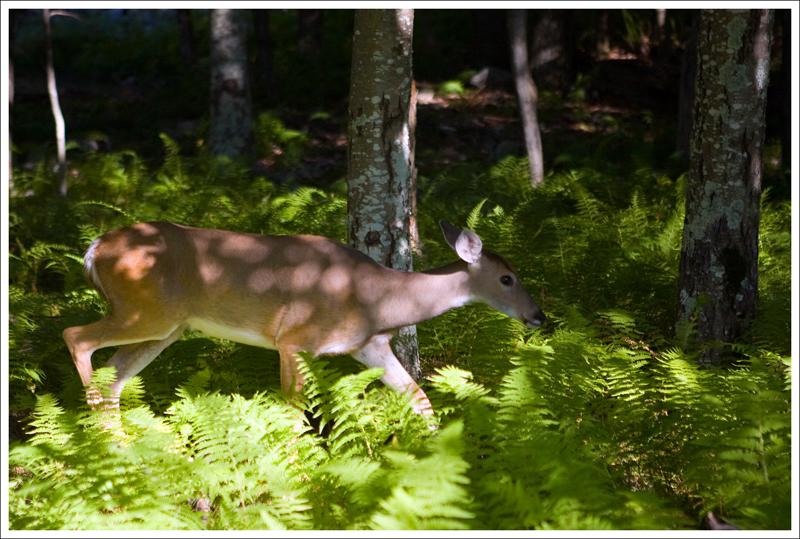
Dappled Light on a Doe
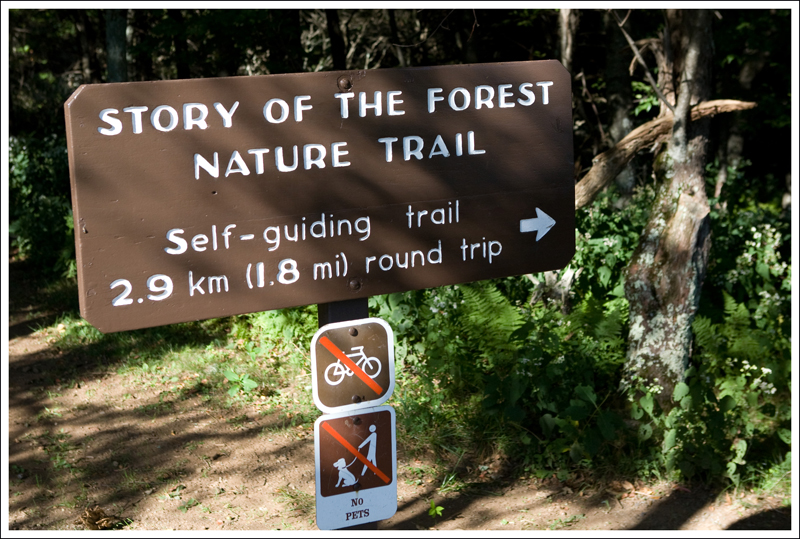
Whitetail Deer are a common sight along the Story of the Forest Trail. Below: No pets or bikes are allowed on the trail; The return arm of the loop follows a paved path along the road.

No Dogs or Bikes Allowed on Story of the Forest Return Arm of Story of the Forest

Christine Says…

The first weekend of September was spectacular – simply perfect weather to be outside.  Adam and I decided to take a picnic dinner up to the park.  The Big Meadows area has a 1.8-mile nature trail, called “Story of the Forest”, that joins the wayside and the campground. We decided that a pleasant pre-dinner stroll sounded ideal.

We parked at the Byrd Visitor’s Center, and set out from the north end of the lot.  The trailhead is marked by a sign that also indicates that dogs and bikes are prohibited on this path.

Late Wildflowers
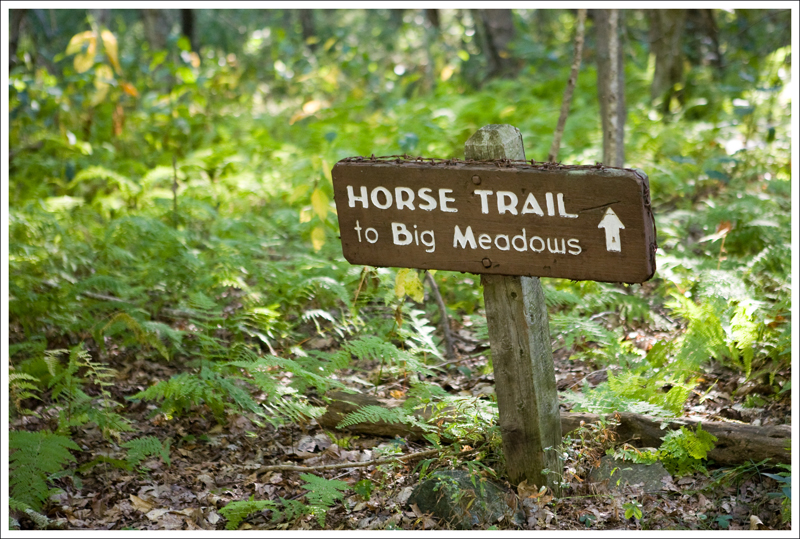
The trail was lined with these small white wildflowers. Below: The Big Meadows-Skyland horse trail crosses the path.

Horse Trail

The trail starts off gently downhill – passing through an area lush with ferns and wildflowers.  After crossing a small footbridge over a stream that feeds Dark Hollow Falls, the trail bears left and heads deeper into the woods.  You’ll pass over the Big Meadows-Skyland horse trail.  After that, you’ll pass communication towers that are part of the lodging complex.  Eventually, the campground will come into view.  To make the hike into a loop, turn left when you see the campground.  This will lead you back out to a paved bike path running parallel to the road through Big Meadows.  The paved path will lead you back to the wayside and visitor’s center.

The Story of the Forest doesn’t offer anything especially unique , but it is a nice walk for anyone visiting the Big Meadows area.

Adam Says…

I think this was actually the first time I have done the Story of the Forest Trail.  It is a very easy hike, so it is perfect for families with small children.  You can also use this trail to connect to Dark Hollow Falls to create a longer hike.  The trail is a nice walk in the woods, passing by some impressive trees and ferns.  I was expecting a guide that would possibly tell the “story of the forest”, but there isn’t a hike brochure like there is at the Stony Man Trail.

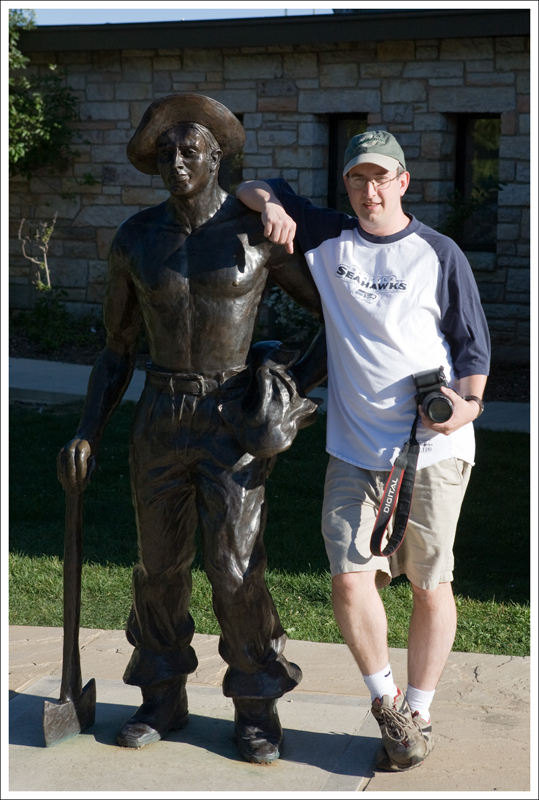
There are a few turns that form this loop.  The trail is marked on the cement posts as “nature trail”.  Once you start the trail, you will go through the forest until you reach a couple of bridges that go over the Hogcamp Branch.  In .2 miles, take a left at the junction to stay on the trail.  In .4 miles, the trail will intersect with a horse trail – just go straight and don’t turn on the horse trail.  In .8 miles, you will begin to see the Big Meadows campground.  Take a left on the paved path to follow this back to the Big Meadows wayside, which is next to the Visitor Center.  Grab a blackberry shake from the wayside and take a picture with the CCC statue at the visitor center to round out the experience.

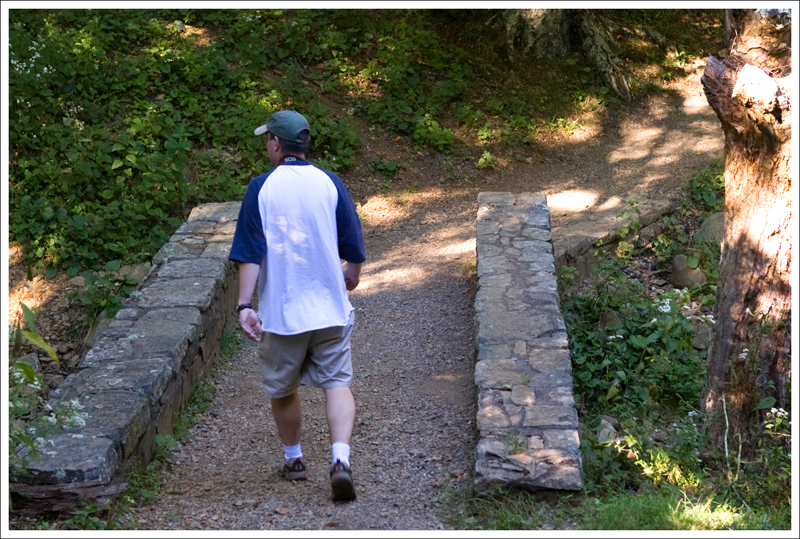
Small Bridge Across the Hog Camp Branch
This small footbridge crosses a stream that feeds Dark Hollow Falls. Below: When you pass the visitor’s center near the end of the loop, stop to pose with the CCC statue.

CCC Statue

I’m surprised that Christine didn’t tell the story, but we passed a family that were slowly making their way along the trail.  A girl hoisted on the shoulders of her father was soooo excited to see a deer.  She said to us as we passed, “Take a picture of the deer.”  We went a little further up the trail and saw a different deer.  I stopped to take some pictures and the deer wasn’t being cooperative.  When the deer got startled and bolted off, I said a curse word.  I heard far off through the woods, the same girl say, “That man said a bad word.”  I felt bad about that and Christine hasn’t let me live it down.  I like to think that I was reinforcing her education rather than being a bad influence.  If she hadn’t heard the word before, she wouldn’t know it was bad.  At least that’s how I’m trying to justify it.

Trail Notes

  • Distance – 1.8 miles loop hike
  • Elevation Change – Negligible
  • Difficulty – 1. This trail is suitable for everyone.
  • Trail Conditions –4.5. The trail is very well-graded and easy to walk on.  The return arm of the loop is a paved bike path.
  • Views – 0. None.
  • Waterfalls/streams .5. In wet weather, you’ll cross a small stream that feeds Dark Hollow Falls.
  • Wildlife –3. There should be plenty of deer.  Many folks have also spotted bears on this trail.
  • Ease to Navigate –4. Easy to follow, just look for the Nature Trail marked on cement posts.
  • Solitude –1. You’ll see many people on this trail, as it connects the Big Meadows campground to the wayside and visitor’s center.
Directions to trailhead:
Park at Big Meadows near the Harry S. Byrd Sr. Visitor Center (mile 51 on Skyline Drive).  The trailhead starts across from the northern end of the Visitor Center parking lot.

Powell Gap

Powell Gap is a fantastic short hike to a beautiful view of the eastern valley.  Even if you’re not a regular hiker, this walk can be done by nearly anyone. The rock ledge on the ridge provides better views than many of the scenic pull-outs along Skyline Drive.

Adam Enjoys the View of Powell Gap
Adam Enjoys the View of Powell Gap.  Below: Parking for this hike is right along the road.  There is not a lot or pull-off.

Parking

Christine Says…

For the final leg in our mini-hike trio, we chose the short walk up to a rocky ledge overlooking Powell Gap.  The hike follows the Appalachian Trail the entire way – which is only a brief half mile.  The trail goes rather steeply uphill the entire way.  And although it’s short, our Falcon Guide still rates this trail as “moderately strenuous”.  I would agree with that assessment if this hike was longer, but due to the shortness, I think this trail would be quite easy for anyone to do.

The overlook along the ridge-line comes atop a beautiful, little rocky ledge.  Views face eastward, and include a wonderful look at the rolling mountains and the valley below.  If you look to the north, you can even see a little snip of Skyline Drive winding its way through the forest below.

Appalachian Trail to Powell Gap
The viewpoint is accessed via the Appalachian Trail.

We spent a good twenty minutes on the rock ledge.  Adam covered his face with his cap and took a brief nap.  He exclaimed “That was the most comfortable rock I’ve ever laid on!” when he woke up.  Apparently, it was smooth and the shape cradled his back perfectly.  While he dozed, I enjoyed the nice summer breeze and watched butterflies fluttering about in the trees right below the overlook.

I could have happily stayed longer, but we were both hungry and wanted to squeeze in a picnic lunch on the beautiful summer day.  We ended up having our picnic back in Harrisonburg – at Lake Shenandoah.  Even at high noon, it never got hotter than 81.  It was such a perfect day!

Trail Notes

  • Distance – 1 mile out and back
  • Elevation Change – 300 feet
  • Difficulty – 2. Although the trail is a bit steep, the route is so short that the hike qualifies as easy.
  • Trail Conditions – 3. The trail is typical of this section of the AT – well graded, but some rocks and uneven footing.
  • Views – 3.5. A very nice view of the mountains and the eastern valley.
  • Waterfalls/streams 0. None.
  • Wildlife – 2. We didn’t see anything, but in the park it is always possible to see deer, bears and other wildlife.
  • Ease to Navigate – 5. There is only one trail in the area, so it’s nearly impossible to get lost as long as you head south on the Appalachian Trail
  • Solitude – 4. This section of the AT is not heavily traveled.  We did come across two section hikers.

Directions to trailhead:
At Mile 69.9 on Skyline Drive.  Park on the eastern side of the road along the meadow.  The trail begins just near the Powell Gap sign on the eastern side of Skyline Drive.

Simmons Gap

Simmons Gap is a very easy walk from the ranger station down to the park’s eastern border.  It follows an old route used by the mountain people that inhabited the area.

Simmons Gap Fire Road
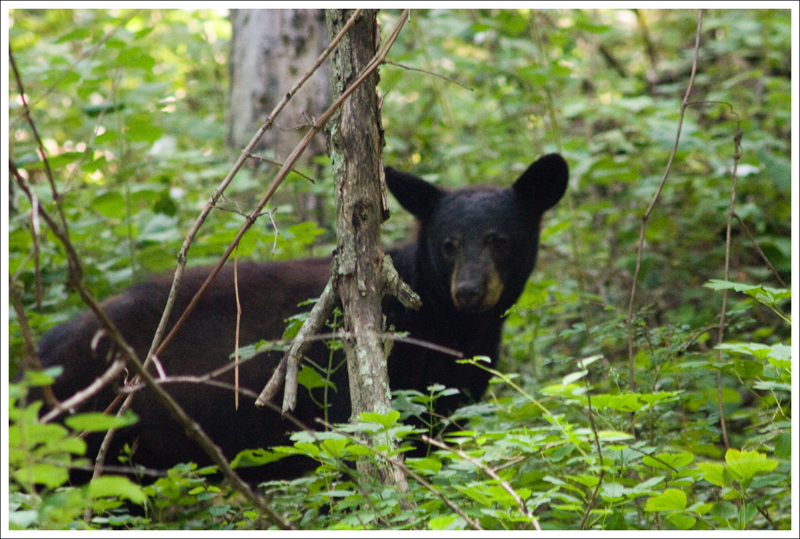
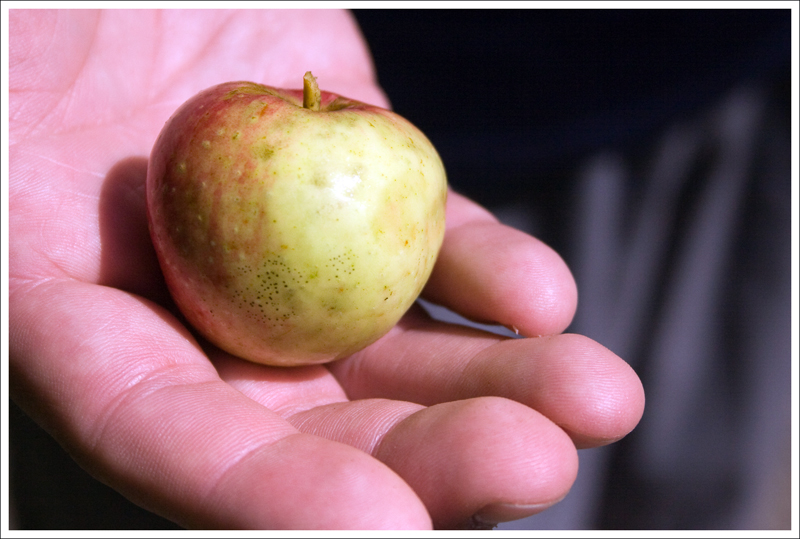
The Simmons Gap fire road extends to the park boundary. Below: We saw a bear less than a tenth of a mile from the Simmons Gap parking area; Apple trees probably attract lots of wildlife; Bear scat was everywhere along the Simmons Gap trail.

Bear Near the Trail Apples Trees Along the Way Scat

Christine Says…

Truthfully, we probably wouldn’t have bothered with this hike if it weren’t so close in proximity to the other two we selected for the day.  Our Falcon Guide said it was nothing special, but it was one of the few hikes left in the park that we haven’t done at least once.  (There are a few long 10-16 miles hikes still on the to-do list, but we’ll likely do those as backpacking trips)

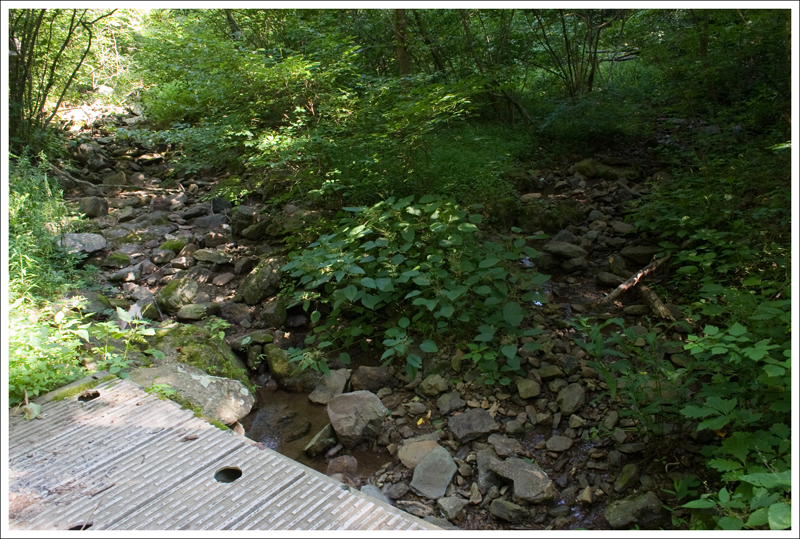
The walk down Simmons Gap was about what I expected – a quiet walk down a shady path through the woods.  There wasn’t much scenery – no views and no waterfalls.  The stream running along the trail was nearly dry despite the decent rain we’ve had lately.

As we walked, we kept our eyes peeled for bears.  We had seen a bear less than a tenth of a mile from where we parked our car.  Also, the fire road was practically paved with bear scat.  Besides the ridge of Knob Mountain, I don’t think I’ve ever seen so much bear poop in one place. Unfortunately, all we saw was the poop… no bears!

Wildflowers in Simmons Gap
Wildflowers along the Simmons Gap fire road. Below: The trail follows along, and eventually crosses a small stream.

Small Stream Along Simmons Gap

There are many hints of a bygone era along the trail – old stone walls, crumbling foundations and the odd apple tree tucked into the forest.  The spot where the fire road meets the park boundary is obviously used as a dump by people who are too rude and lazy to take their garbage to a proper facility.  The streambed at the end of the trail was littered with everything from a broken baby stroller, to a beaten plastic Shrek suitcase to a box full of empty 2-liter bottles of Dr. Pepper.  It was disgusting.  I wish I knew what people were thinking when they did stuff like this. How could anyone back their car up to a beautiful mountain stream, and just empty their trunk-load of discarded property?

Despite the disappointment of seeing the litter, we still had a nice walk down the path.  Although, I don’t think I’d recommend this hike to anyone.

Trail Notes

  • Distance – 1.6 miles out and back
  • Elevation Change – About 200 feet
  • Difficulty –1. Easy walking with very little elevation change.
  • Trail Conditions – 4.5. This fire road is smooth and easy to walk on.
  • Views –0. You’ll be in the woods the whole time.
  • Waterfalls/streams 1. The small stream is pretty and is often lined by stone walls, but it may be dry most of the summer.
  • Wildlife – 3. There’s a good likelihood of seeing bears in this area.
  • Ease to Navigate – 5. There is no place to go wrong.  Follow the fire road straight out and back.
  • Solitude – 4.5. Because there isn’t much to see in this area, not many people come this way.

Directions to trailhead:
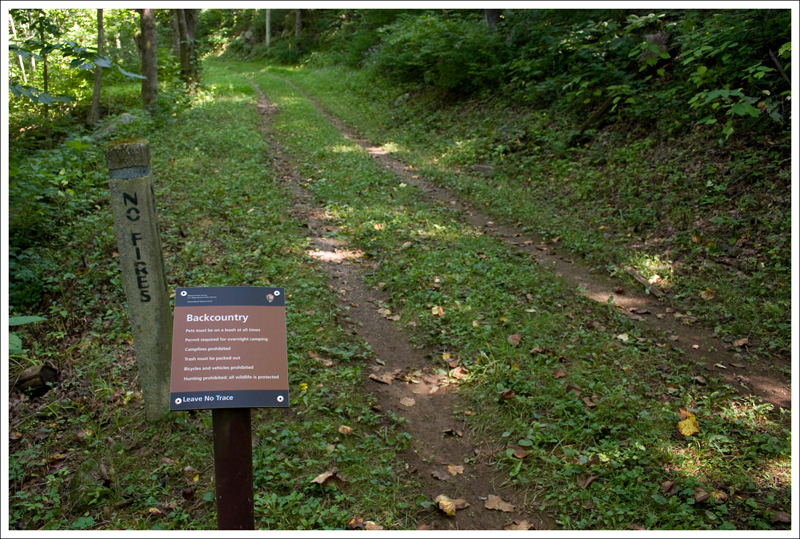
At mile 73.2 on Skyline Drive you will see a small parking lot on the western side of the road (directly opposite of the sign for the Simmons Gap Ranger Station).  Cross Skyline Drive, walking on the paved road to the ranger station.  You will see a chain guarding a fire road.  Cross the chain and start the trail down the fire road.

Pocosin Mission Trail

The Pocosin Mission Trail is a fairly short walk along a fire road that leads to the ruins of an abandoned Episcopal mission.

Pocosin Mission Ruins
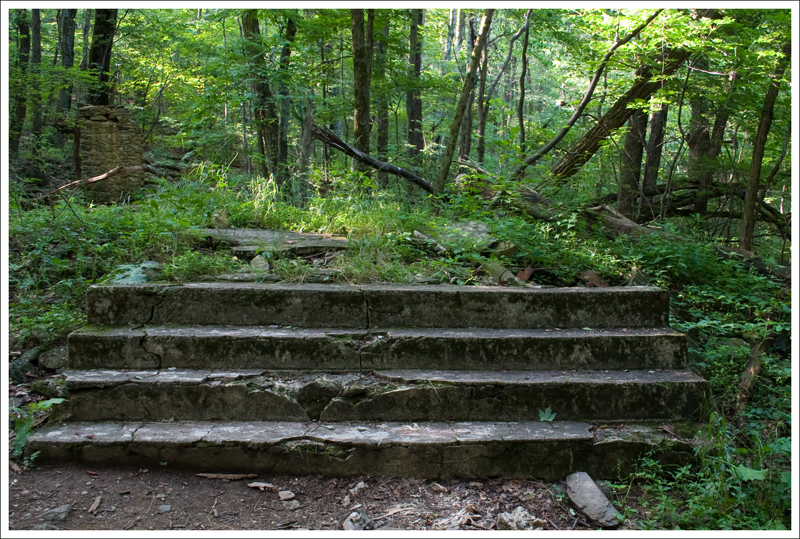
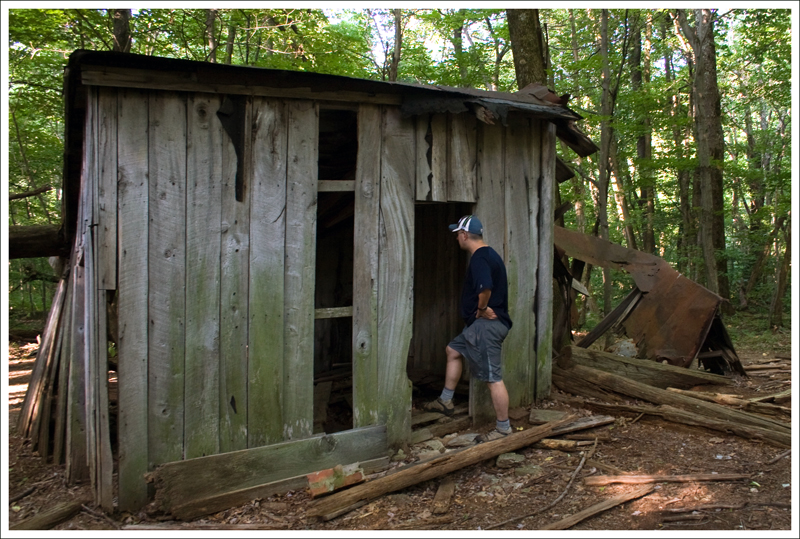
The Pocosin Mission ruins are slowly sinking back into the forest. Below: The fire road makes this trail pleasant and easy to walk along; The old church steps still stand at the site; Adam explores the ruins.

Pocosin Church Steps Adam Explores the Mission Ruins

Adam Says…

We’re back to Virginia hikes!  This week, we’ll be sharing a trio of short hikes.  In fact, the hikes are so short that we’re going to skip doing our typical dual write-ups.  I’ll cover this one, and Christine will cover the next two.

Since we had surprisingly nice temperatures on an August day (it didn’t get above 68 on our hike), we decided to go for three short hikes off Skyline Drive. The last time we did the Pocosin Mission Trail we were with a couple of friends.  Shortly after we got to the mission site, we were pounded with a fierce thunderstorm.  We were all so soaked to the bone, that we ended up buying clothes at the Big Meadows wayside, looking like complete tourists with all of our Shenandoah National Park gear.

PATC Cabin

The PATC maintain a cabin, available for rent, along the Pocosin Mission Fire Road. Below: Wildflowers (and bees) were abundant along the trail; We saw many varieties of berries; There were also butterflies everywhere.

Bees and Flowers Along the Pocosin Trail Berries Along the Trail Butterfly along the Pocosin Trail

On this trip, we had a nice easy stroll down the fire road.  After about .2 miles, the road crosses over the Appalachian Trail, but you just want to stay on the fire road for this trail.  We took a few minutes on our way down to stop by the PATC Pocosin Cabin, which can be rented by the PATC.  The cabin was locked, but we could tell that people renting this cabin would wake to a nice sunrise view.  Continue down the trail for another .8 miles until you reach another cement post, marking the junction with the South River Falls fire road.  You will see the remains of a cabin nearby and stone steps with a foundation.  After exploring, just go back to your car up the fire road.

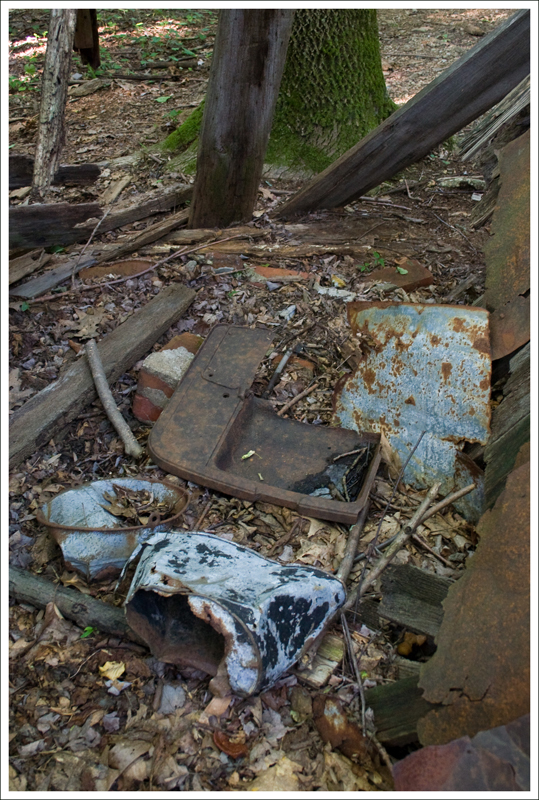
The Pocosin Mission was an Episcopal mission established in 1904 for the mountain community living in the area.  “Pocosin” is a Native American word meaning “swamp”.  The mission building is actually where you see the stone steps, a small foundation, and a fallen-down chimney.  Be careful as you explore the area – there is a lot of broken glass and twisted metal.  The cabin has a rusted metal roof and there are plenty of rusted materials on the ground, so watch your kids carefully in this area.  In addition to these sites, there is also an overgrown cemetery that is across the trail from the mission, marked by old nameless headstones.

Old Church Walls and Fallen Chimney
The old church walls and a fallen chimney are still visible. Below: Buckets and an old sink can still be found inside the mission ruins.

Inside the Ruins

For those interested in the history of the people that lived on this mountain will enjoy visiting this site.  While there aren’t any views to speak of, the hike does cause you to speculate on how life was back in the early 1900s being a part of a community that lived and worshiped together.

Trail Notes

  • Distance – 2.2 miles out and back
  • Elevation Change – 450 feet
  • Difficulty 1.5.  Most people should be able to handle this.
  • Trail Conditions 4. It’s just a fire road, so not much difficulty for trail conditions.
  • Views –0. No views.
  • Waterfalls/streams 0. No streams/waterfalls.
  • Wildlife 2.  There should be a variety of wildlife in the vicinity.
  • Ease to Navigate 5.  Just straight down a road and back.
  • Solitude 4.  This isn’t a very popular spot, so you should have your peace.

Directions to trailhead:
Around mile 59.5 on Skyline Drive, you will see a small gravel road leading to a parking lot on the eastern side of the trail.  Park here, cross the chain, and walk down the fire road to start the trail.

Arethusa Falls and Bemis Brook (NH)

Special: New Hampshire Edition

Introductory Guide to Visiting the White Mountains

Note – 10/11/10: In their October issue, Backpacker Magazine inaccurately listed Arethusa Falls as a Virginia destination. The falls are in New Hampshire.

This three mile hike leads to Arethusa Falls, which is (arguably) New Hampshire’s tallest single waterfall. The optional arm along Bemis Brook is challenging in spots, but offers more lovely stream scenery.

Arethusa Falls
Arethusa Falls might not be the most photogenic of New Hampshire’s many waterfalls, but it is likely the  tallest. Below: The optional side-loop trail along Bemis Brook takes you past Coliseum Falls.

Coliseum Falls

Christine Says…

We originally planned on combining these two trails with Frankenstein Cliffs to make a loop, but unfortunately we ran short on time and just did the three mile out-and-back.

The trail along Bemis Brook was extremely tough walking!  In addition to the roots, rocks and mud, we suffered a full-on mosquito assault.  I spent a lot of the walk along the trail cursing and flailing my arms wildly.  Even with DEET, the little buggers hovered right around my eyes, ears and nostrils, constantly buzzing in too close and getting caught in my eyelashes.

There were several very pretty small waterfalls along the Bemis trail.  Coliseum Falls were especially picturesque.  Since it was such a sunny day, I didn’t bother with a tripod.  Long exposures weren’t a possibility in the harsh sun, so I just took snapshots along the way.  The climb from Bemis Brook back up to the Arethusa Trail was practically vertical.  We had to climb, hand-over-hand, grabbing roots and rocks to drag our way up the mountainside.  There was one blown down tree that was particularly difficult to negotiate.  It was one of those fallen trees that was a little too high to climb over, but a little too low to scramble under.  I decided to clamber over it, and ended up getting my boot toe caught on the tree trunk.  I took a spectacular fall down onto the roots and rocks.  It absolutely left a big black and blue mark!  I was really glad when we finally saw the junction with the Arethusa Trail!

Frankenstein Cliffs
This trailhead for this hike offers beautiful views of Frankenstein Cliffs looming overhead. The trail has an option to lengthen the hike by a few miles to gain access to the top of the cliffs. We ran out of time and had to pass on that option. Below: Trails in the area are clear and well-marked.

Trail Sign

The rest of the way to the falls was much easier.  It was uphill and muddy in spots, but the trail was well-graded and nice to walk along.  The last stretch to Arethusa Falls led downhill into a chasm that opened to an amphitheater like setting.  The falls were very impressive!  The water falls like lace over the sheer rock face.

On the hike back, Adam and I waffled about whether or not to continue our hike up to Frankenstein Cliffs.  We even started down the Cliffs Trail, before turning back in less than a tenth of a mile.  We had plans to meet my parents in North Conway, and we just didn’t have time to finish the loop.

Instead, we visited the Appalachian Mountain Club’s Highland Center and got a few Cokes and relaxed in their lobby.  After we met up with my parents, we had an amazing lunch at Moat Mountain Brewery & Smokehouse.  If you’re ever in the area, don’t miss their barbecue and microbrews!

Adam Says…

Arethusa Falls is a gorgeous 160 foot waterfall that is very popular with families.  We started on the blue-blazed trail near the railroad tracks at the parking lot.  After about .1 miles, you come to a junction with the yellow-blazed Bemis Brook Trail.  We decided to do this side trail, since it goes partially along the water, guiding you to a few pools and smaller falls areas.  Once you come up to the Coliseum Falls area, you will need to climb up almost vertically up the trail to join back with the Arethusa Falls trail.  If you do want to do the Bemis Brook trail you should do this at the start of your trip rather than trying to descend it at the end.  This part of the trip was tough and takes a lot of strength out of you in a short distance, so plan appropriately.  Once we reached the junction at the top, we took a left to return to the Arethusa Falls trail.  The trail continues to go uphill until you reach a junction with the Cliffs Trail.  From this point, you continue downhill until you reach the falls in .2 miles.  You return the way you came, but you will avoid the Bemis Brook Trail on the way back and just stay on the Arethusa Falls trail to reach your vehicle.

Arethusa Falls was named after the poem, “Arethusa” by Percy Bysshe Shelley.  The falls were discovered by Edward Tuckerman, but named by Moses Sweetser and Professor Huntington in 1875.

Bemis Trail
The Bemis Brook Trail follows a beautiful stream for most of the way, until you get to the portion where it climbs, nearly vertically, back up to meet the Arethusa Trail. Below: The Arethusa Trail is much easier to walk – smooth and well-graded, compared to the Bemis Trail.

Arethusa Trail

While I was off hunting for a geocache and Christine was taking some photos, she struck up a conversation with a man hiking solo on the trail.  When I got back to them (after sliding down the hillside 20 feet on my butt), he wanted to take a look at my map.  He was thinking about doing the Frankenstein Cliffs trail and then looping back to make it to his car.  He was to meet up with his wife in less than two hours to take a ride up Mount Washington on the cog railroad.  We told him that it might be hard to make it in time.  He decided to go for it, but I don’t think there was any way he could have made it back in time for his trip up.  We both pictured his wife riding solo up the railroad, muttering to herself, and awaiting the moment she could give her husband a piece of her mind.

There are two geocaches you can get on the trail:

We wish we had more time to do the Frankenstein Cliffs trail (these are named after an artist, not the doctor who created a monster), because we have heard that it does give you some nice views from the top.  The trail is allegedly muddy and not as well maintained as the Arethusa Falls trail.

Trail Notes

  • Distance – 3 miles, out-and-back (2.8 if you leave the Bemis Brook Trail off and just stay on the Arethusa Trail the entire way)
  • Elevation Change – 650 ft to the falls.  There might be a bit more climbing if you do Bemis Brook.
  • Difficulty – 3. The Arethusa Trail is squarely moderate.  The Bemis Brook trail is more difficult with one killer climb uphill at the end.
  • Trail Conditions – 2.5 The Arethusa Trail is in nice condition most of the way.  There are some muddy spots and we encountered a flew blow downs.  The Bemis Trail is not easy walking.  There are numerous fallen trees, tricky footing and if it’s the slightest bit damp, the trail is very slippery.
  • Views –0. You’ll be in the woods the entire time.
  • Waterfalls/streams 4. The falls are large and impressive, but not terribly photogenic.
  • Wildlife – 0. The heavy human traffic probably scares any wildlife away.
  • Ease to Navigate – 5. Trails are marked and easy to follow.
  • Solitude – 2. Because the hiking is a little more challenging, you won’t see the same crowds as you do at Flume Gorge or Sabbaday Falls.

Directions to trailhead:
From I-93, follow New Hampshire Route 302 west through Crawford Notch State Park.  A few miles past Sawyer Rock Picnic area you will see the Arethusa Falls parking area on the right.

Sabbaday Falls (NH)

Special: New Hampshire Edition

Introductory Guide to Visiting the White Mountains

More of a pleasant stroll than an actual hike, this gentle path leads to one of New Hampshire’s most beautiful waterfalls.  The entire walk is only a mile (round-trip), so this waterfall is easily accessible by nearly anyone, regardless of age or fitness level.

Sabbaday Falls
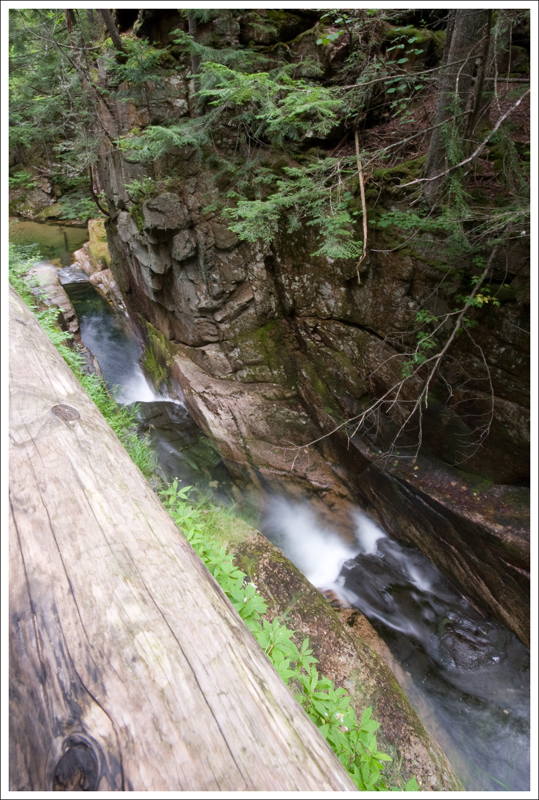
Sabbaday Falls has two sections.  The top is a large, beautiful cascade. The bottom section takes almost a right angle through a slot in the rock. Below: A view looking downstream through the slot

A view looking downstream through the slot

Adam Says…

Sabbaday Falls has to be one of the prettiest waterfalls I have visited.  There is a reason it is on the current cover of the White Mountains Visitor Map & Guide – it is very photogenic.

The falls were once known as Church’s Falls, named after Frederic Church, who was a landscape painter.  The area is now known as Sabbaday Falls. The name was allegedly coined by some road builders who stashed their tools near the falls, so they wouldn’t have to carry them home at the end of the building season and could return to them the next year.  Before leaving on a Sunday morning they named the area for the “Sabbath Day” or shortened to “Sabbaday”.  Later, the Shackford family had a house nearby after the Civil War.  They housed guests visiting the White Mountains and ushered them to popular spots, such as these falls.

The Pool at the base of Sabbaday Falls
The pool at the bottom of Sabbaday Falls is lovely and green! Below: A wider view of the pool and lower half of the falls.

Wider view of the pool.

This is a fee area, so you will need to deposit $3 for a parking pass for the area.  The waterfall has an overall drop of 35 feet, but the main plunge is 22 feet.  The pathway up the stairs gives you very close looks along the entire waterfall.   Similar to much of the interesting geology in the area, this gorge was formed by a glacier carving through the rock.  You can see near the base of the falls, some clear lines of black basalt dikes mixed in with the granite.  These are formed from the rapid cooling of molten rock.

For those hoping to bag some geocaches, there are a few in the area:

This is a very easy “hike” that is very family-friendly and takes you to a great place to get some photos.  I highly recommend a trip next time you are in the White Mountains.

Christine Says…

This short one-mile walk can barely be considered a “hike” – it follows a smooth, well-graded path and several sets of wooden stairs to a view of spectacular Sabbaday Falls.

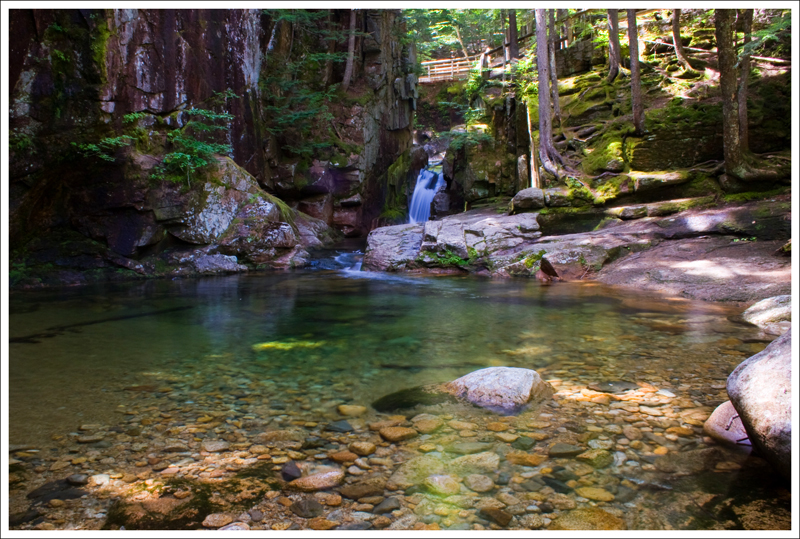
The wide, crushed stone trail runs parallel to crystal-clear Sabbaday Brook.  At .3 miles, you’ll arrive at a clear, green pool bottomed by round stones.   Water enters the pool through a narrow chute between two sheer rock walls.  At the top of the chute lies the lower half of the falls.  This section of the waterfall is the smaller of the two.   Even though it’s smaller, it’s no less pretty.  The rock formations are dramatic in this section.  There is even a perfect, round “pothole” in the stone.

Lower Sabbaday and the Slot in the Rock
Lower Sabbaday and the Slot in the Rock.  Below: The area includes several informational plaques about the area’s history.

Information About Sabbaday Falls

The top of the falls is about tenth of a mile beyond and is reached via a couple walkways and sets of steps.  The upper falls are quite a bit taller, and sit at almost a right angle to the lower falls.  Without a doubt, this is one of the prettiest waterfalls I’ve seen in the area so far.

The trail has a railing and staircases to make viewing safe and easy from almost any angle.  There are signs all up and down the trail indicating that swimming is prohibited in the falls.  However, when we visited, there was a group of four unsupervised kids that kept getting into the pool at the very top of the waterfall.  It was pretty dangerous.  They generally acted like idiots and were the main reason we didn’t hang around the falls for very long.

Sabbaday Falls is very popular, and you should expect thick crowds.

Trail Notes

  • Distance – 1 mile, out-and-back
  • Elevation Change – 125 ft
  • Difficulty – 1. Very easy!
  • Trail Conditions – 5. Smooth and well-graded with well-planned stairs and railings.
  • Views –0. You’ll be in the shady woods the entire time.
  • Waterfalls/streams 5. Simply gorgeous!
  • Wildlife – 0. The heavy human traffic probably scares any wildlife away.
  • Ease to Navigate – 5.  Impossible to get lost.
  • Solitude – 0. Prepare for heavy crowds. People love Sabbaday Falls!

Directions to trailhead:
From Conway, NH follow the Kancamagus Highway for about 15 miles.  The trail parking is well-marked.

The Basin & Kinsman Falls (NH)

Special: New Hampshire Edition

Introductory Guide to Visiting the White Mountains

The Basin  and Kinsman Falls is a short 1.2 mile out-and-back walk to a lovely waterfall in Franconia Notch State Park.  The trail follows Cascade Brook and passes many beautiful (and popular) water features.  The falls are also called Tunnel Falls.

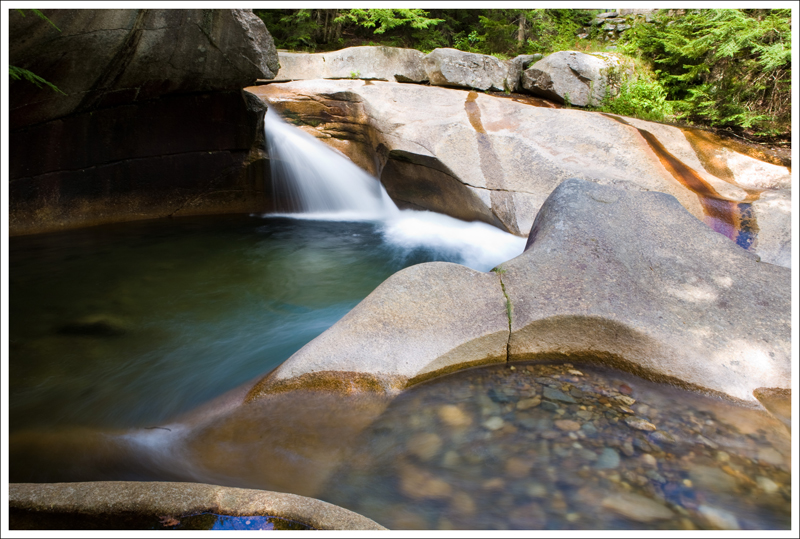
The Basin
The Basin is a beautiful glacial pothole at the base of this hike. Below: Kinsman Falls is a pretty 20 foot waterfall that plunges into a wide pool at the bottom; Many of the streambeds look sculpted.

Kinsman Falls Water Features along the Trail

Adam Says…

We had visited the Basin last year, but it is always worth a quick stop off I-93.  It takes only .1 mile to reach it from the parking lot.  You will see signs to lead you directly to the Basin.  The Basin was formed about 15,000 years ago as an ice sheet eroded the pathway.  According to the plaque at the site there, Henry David Thoreau wrote “this pothole is perhaps the most remarkable curiosity of its kind in New England.” Samuel Eastman called this area, “One of the most beautiful haunts of Nature, a luxurious and delicious bath fit for the ablutions of a goddess.”

There are several paths to walk along in this area to explore streams and small waterfalls.   If you go back the way you came, you will see a larger junction with a sign for Kinsman Falls being .5 miles away.  The path up to Kinsman Falls was filled with roots and rocks, so you do need to continually watch where you are stepping.  Shortly up the ascent, you will see several spots to your left along the way of the river.  These are good places to soak in the sun or to wade in a small pool.  Be careful about footing if you venture into the water, since the water does rush through these areas rapidly. Getting back on the trail, you have more of an ascent, but you will quickly come up to the sign pointing to Kinsman Falls.  The falls were very impressive as they plunged into a serene pool at the base.

View of the Mountain from Cascade Brook
View of the Mountain from Cascade Brook.  Below:  Colorful fungus on the trail;  Christine’s dad and Adam climb back up from the base of the falls.

Orange Mushrooms Along the Trail Climbing Back up from the base of the falls.

I definitely recommend checking out these areas if you are taking a trip through the White Mountains. Most people just view the Basin and some of the swimming holes along the way and don’t venture any further, but it is worth the hike up to Kinsman Falls and most families can easily make the trip.

There are several geocaches in the area:

Christine Says…

We planned to do lots of family hikes on this visit to New Hampshire, but about a week before the trip an MRI revealed that my dad had torn his meniscus.  His doctor told him to be careful and to limit activity that could extend the tear.  Sadly, this put most of his hiking plans on hold for the time being.  He did decide that he felt up to joining us on the short hike past the Basin and up to Kinsman Falls.

Like Flume Gorge, this little hike packs in a lot of impressive scenery over a very short distance.  Also, like the Flume, it is extremely popular and crowded.

The Basin is such a gorgeous spot.  I love how the water curls through the rock formation.  The rock walls of the Basin are smooth and sculpted – they almost look unnatural. The water is blue-green colored and crystal clear.  It’s one of those spots you’ll never forget!

After the Basin, the beautiful water features keep on coming!  There are so many small waterfalls and cascades along the trail, that you always hear the pleasant sound of rushing water.  A sign marks the way to Kinsman Falls, but honestly, we could say “just follow the water uphill” and you’d find your way there.

The trail was rocky and root-y.
The trail was rocky and root-y. Below:  The base of the falls was a nice place to stop and contemplate nature; Cascade Brook rushes over the rocks.

Dad on the rocks Water flowing along Cascade Brook

The trail followed alongside Cascade Brook for a half mile.  There were many little side-trails leading to scenic spots along the brook.  Dozens of people reclined on the rocks while kids used the streambed like a natural waterslide.  One mother remarked to us that her family had visited the spot two days in a row, and both her boys had worn through the backsides of two sets of swim trunks.

The trail is muddy, with a mix of gnarled roots and slick granite underfoot.  It’s all uphill, but it’s never steep.  It really is an ideal family hike.

A small sign announces Kinsman Falls.  From the trail, you get a view of the falls from above.  The twenty-foot waterfall crashes into a large, round pool in a chasm below.  There is a rough footpath down to the base of the falls – take care if you climb down – it’s slippery with numerous rocks to scramble over.

There are lots of big rocks to sit on around the edge of the pool.  It’s a nice place to relax and enjoy feeling the mist from the falls spray your face.  We were really surprised to have the falls all to ourselves.  Even though there were many people in the area, no one else was at the waterfall.  Odd – but very welcome!  On our return trip, we passed quite a few people hiking up, so I suppose we just had fortuitous timing.

Trail Notes

  • Distance – 1.2 miles out-and-back. Plus a couple additional tenths of a mile to get to and from your car.
  • Elevation Change –Around 300 feet
  • Difficulty 2. The hike is all uphill over slick granite and gnarled roots, but it is short and never steep.
  • Trail Conditions 2. The trail is extremely rocky, muddy and covered with gnarled tree roots.
  • Views –2. From the Cascade Brook streambed, you get a decent view of the mountains.
  • Waterfalls/streams 5. Nothing short of spectacular!
  • Wildlife 0. A few squirrels and chipmunks.
  • Ease to Navigate 4. After walking uphill from the Basin, look for the sign to Kinsman Falls and follow the blue blazes uphill.
  • Solitude0. This area is extremely popular.  We saw dozen of people along the way, but surprisingly had Kinsman Falls all to ourselves.

Directions to trailhead:
From I-93N. Once you enter the Franconia Notch area, take the Basin exit.  The area is well-marked and has ample parking.

Flume Gorge Loop (NH)


Special: New Hampshire Edition

Introductory Guide to Visiting the White Mountains

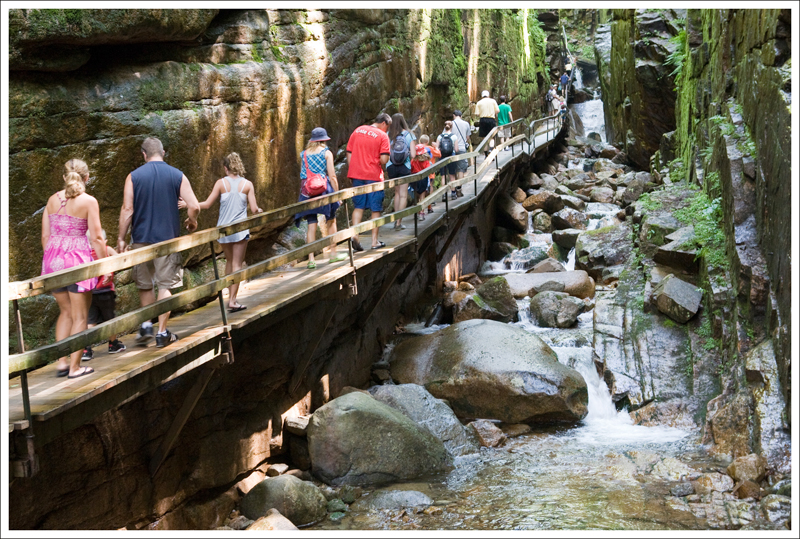
Located in Franconia Notch State Park, this two-mile path around the Flume Gorge showcases a lot of beautiful scenery on a short and easy walk.  If you crave solitude, this is not the place for you.  But if you don’t mind crowds and want to see some unique scenery, don’t miss a visit to this area.

Scenes from the Flume
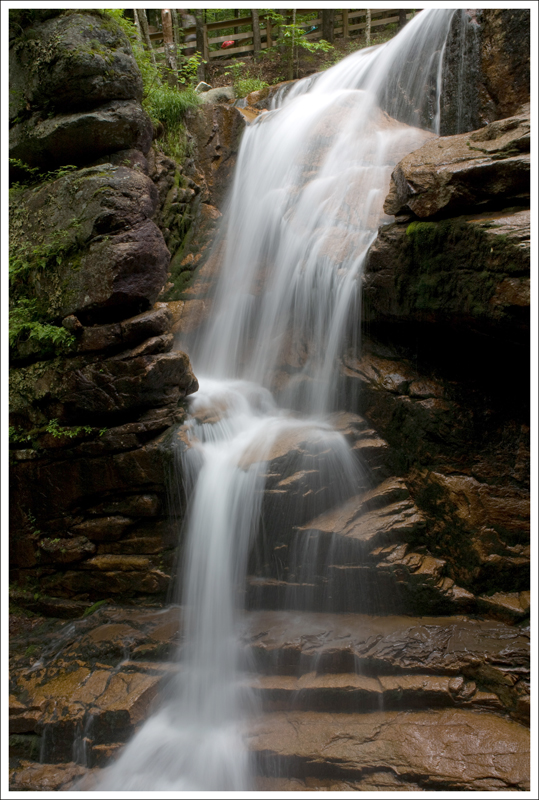
The Flume is a beautiful and unique place. Below: Avalanche Falls is located inside the Flume; Liberty Gorge Cascade is also impressive; The trail is lined with large boulders called glacial erratics; The Sentinel Pine Covered Bridge is for pedestrians only.

Avalanche Falls Liberty Gorge Cascade Glacial Erratic Sentinel Pine Bridge

Christine Says…

Last year, when we visited New Hampshire for the first time, we went to Flume Gorge with my parents.  It was insanely crowded, unusually hot and glaringly sunny on that visit, so we decided to make a return visit on this trip – hoping that the clouds and cooler weather would keep the crowds at bay.  There were definitely fewer people this time, but that’s not to say we had solitude.  Flume Gorge is an extremely popular area. There will always be hordes of people, no matter the time of day, week or year you visit.

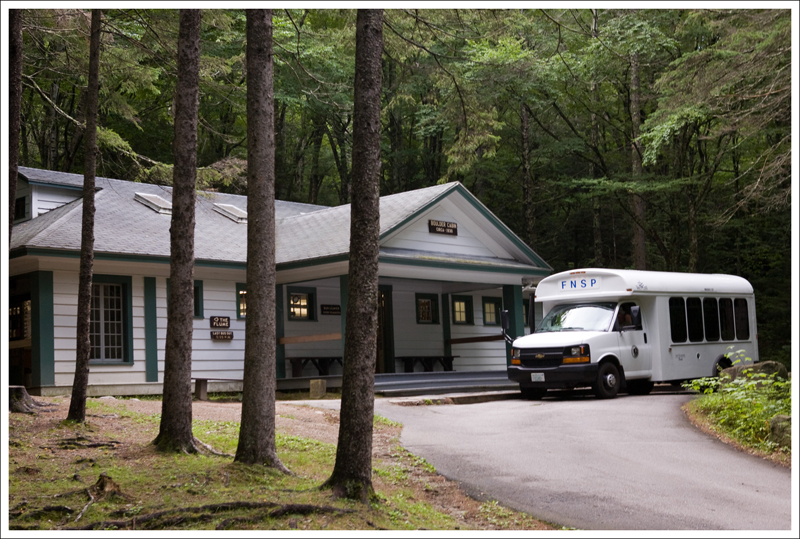
It’s no surprise the area draws such large crowds – it packs an amazing amount of unique scenery into an easy, two-mile loop.  For anyone who doesn’t want to walk the two miles, there is a bus that will take visitors to a drop-off point at the Boulder Cabin.  This option substantially shortens the distance and climbing necessary to see the gorge.  However, bus riders miss seeing a lot of the other impressive scenery along the loop.

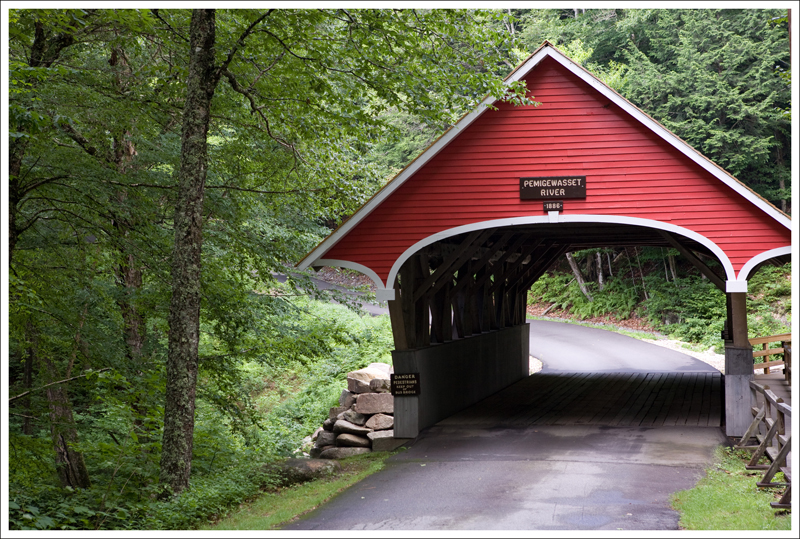
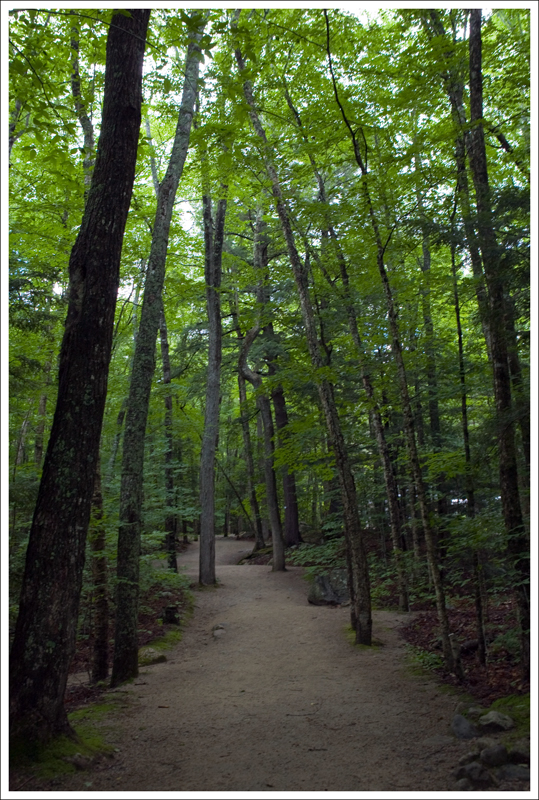
The two-mile loop starts off along a shady, wooded path that climbs down to the Pemigawasset River.  In .25 miles, there is a bright, red covered bridge across the water – the bus goes through the bridge, but pedestrians cross a walkway attached to the side of the bridge.  After a short uphill, both the bus riders and the walkers arrive at the Boulder Cabin.  The building is full of exhibits – both historical and natural.

Covered Bridge
The first covered bridge in Flume Gorge is brilliant red. Below: Table Rock;  The path through the woods is peaceful and shady; Bear Cave is located near the top of the Flume; The side view of Avalanche Falls.

Table Rock Shady Trail Bear Cave Avalanche Falls

After passing the cabin, the path follows alongside an area called Table Rock.  The water in the river passes thinly over a wide, smooth expanse of granite.  A sign announces the beginning of the Flume.  The Flume is a fascinating geological area – a narrow slot canyon carved out from thousands of years of river flow over the rock.  Wooden walkways are attached to the sheer canyon walls and allow people to climb through the gorge using a series of ramps and steps.  Near the top of the Flume, visitors are treated to views of the crashing water of Avalanche Falls.  The falls take several directional turns through the Flume – each angle makes it look like a completely different waterfall. After passing the waterfall, be sure to take a quick peek inside Bear Cave.

At the top of the Flume, the trail has two options – one returns people to Boulder Cabin and the bus stop, the other follows a trail for a little over a mile back to the main entry.  If you’re able, it’s definitely worth following the longer route to see Liberty Gorge Cascade, the Pool, The Sentinel Pine Covered Bridge, the Wolf’s Den and several impressive erratics along the trail.

Water Under the Sentinel Pine Bridge
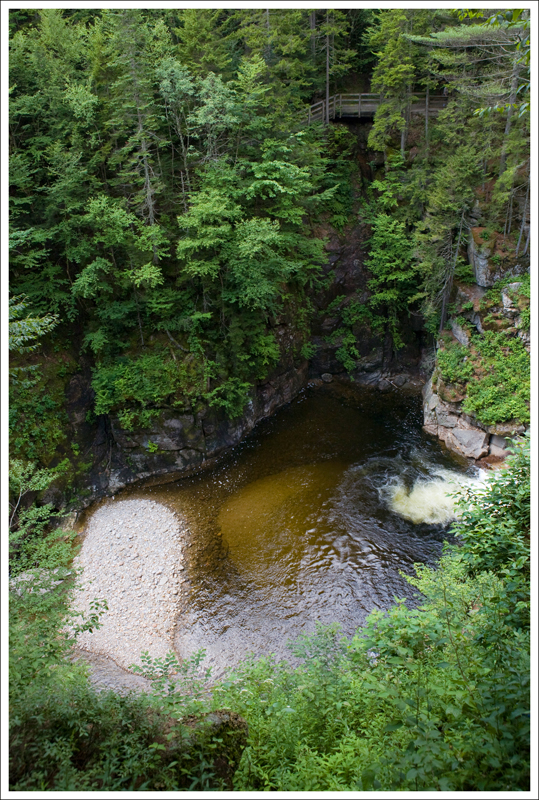
My favorite view along the trail came at the spot overlooking the Sentinel Bridge. Below:  The river under the bridge is very scenic; The Pool is a wide, still spot on the river.

River under the Sentinel Bridge The Pool

One of my favorite views along the trail was looking back at the Pool and the Sentinel Covered Bridge from a little spur trail to an overlook.  From this point, the walk back is steeply uphill for a short while.  Once you gain the ridge, the path levels off and you get a nice view of Liberty Mountain.  A short while later, you arrive back at the visitor’s center – where you can treat yourself to an ice cream cone.

Even though Flume Gorge is crowded and rather expensive to visit, it’s still very worthwhile.  Not many short two-mile loops pack in quite so much scenery into a pleasant, easy-to-walk package.

Adams Says…

After dropping off our thru-hiker friends, The Traveling Circus, we headed off to hike around Flume Gorge.  We did this trip last year with Christine’s parents, but thought it was worth a second trip.

This is a very popular attraction and is definitely one of the highlights of the Franconia Notch State Park.  Similar to many areas of New Hampshire, it requires a fee (in 2010, it was $13 for adults).  The visitor center has a theatre that shows an informational film throughout the day and a few exhibits around the entrance.  The snack bar is also fully equipped to provide enough refreshment and food for a lunch or snack.

Cascade near table rock
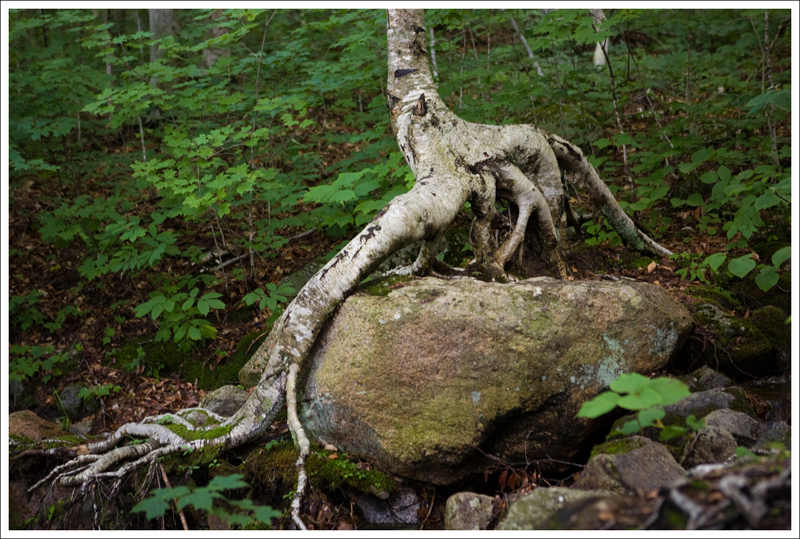
The entire Flume Gorge area is loaded with small waterfalls and cascades. Below: Tree roots grow over rocks; The crowds at Flume Gorge are always thick;  Ramps and stairs allow people to climb easily through the gorge; We saw lots of chipmunks and red squirrels.

Tree growing over rock The Flume
The top of Avalanche Falls Chipmunk

This hike packs a lot of features into one short hike.  The covered bridge was built in 1886.  While you can’t walk inside since it is for bus traffic, it does provide a nice photo opportunity.  Table Rock is a large rock outcropping where Flume Brook slowly glides over the water.  The rock is 500 feet long and 75 feet wide.  The Flume Gorge is quite impressive.  You walk along a boardwalk that clings to one side of the gorge.  The Conway granite walls rise on either side 70-90 feet as you see the brook rush out of Avalanche Falls and down the brook.  We were impressed to see all of the small trees and moss that grows amazingly out of the cliff walls.  The Flume was discovered in 1808 by a 93 year-old woman while she was fishing.  Signs describe a large boulder that was suspended between the walls of the gorge but a storm in 1883 swept it away and no signs of the boulder have been spotted since.  Avalanche Falls is an impressive 45-foot waterfall that you can see from several angles while along the boardwalk.

After walking another .5 miles from Avalanche Falls, Liberty Gorge is your next stop.  There is a nice overlook to see the water flow through this gorge.  After a few tenths of a mile past Liberty Gorge, you will come across the Pool overlook and another covered bridge.   Shortly after the covered bridge, you have an option to join go through the one-way Wolf’s Den, but it does require crawling on your hands and knees to make it through the cave.  We continued pass the Wolf’s Den, to catch the additional overlook of the Pool.  We thought this was a better view of the covered bridge and the Pool.  Continue from here to arrive at the Glacial Boulder garden to view some nice erratics.

While there aren’t any geocaches inside the gorge, there are a few outside the area:

Trail Notes

  • Distance – 2 miles
  • Elevation Change 400 feet
  • Difficulty 1.5. There are some steps and hills, but most people should be able to do this without too much effort.
  • Trail Conditions 4.5 The trail is covered in small crushed gravel, allowing for easy footing.
  • Views – 1. You do get one view of Liberty Mountain, but otherwise you won’t see many far-off views.
  • Waterfalls/streams 5. Great views of Avalanche Falls and much of the trip is in sight of water.
  • Wildlife 1.  We saw a few red squirrels and chipmunks, but this is so popular with tourists, you won’t see a lot of wildlife.
  • Ease to Navigate 5. The area is secluded from other areas, so you can’t get lost.  You just have options to cut distance off of the trail.
  • Solitude0. You will always find lots of people here.

Directions to trailhead:
From I-93, once you enter the Franconia Notch area, take the Flume Gorge exit.  The area is well-marked.  Park at the Visitor’s Center.  The trail starts from the Visitor’s Center.  Purchase tickets and proceed.

Short and Scenic West Virginia Walks

Last Saturday, we made a quick trip over the mountains into West Virginia.  The foliage in the Canaan Valley (Tucker County) area is always way ahead of the color change in Virginia.  We set out from home at 5:00 a.m. and made stops at Blackwater Falls State Park, Canaan Valley State Park, Douglas Falls and Dolly Sods Wilderness.  Our whirlwind trip got us thinking about how many short walks in that area have major scenic payoffs.

Let’s start off with a few beautiful spots in Blackwater Falls State Park.  All of the spots listed below are clearly marked on the park’s trail map. Pick up a copy at the lodge.

Lindy Point

The view from Lindy Point looks down into the Blackwater Canyon.

The walk out to Lindy Point is no more than a third of a mile along a relatively level path.  The trail passes through dense rhododendron and can be quite muddy if there has been rain.  At the end of the trail, you’ll come out to a platform built onto the side of the rocky cliff.   The point offers a spectacular view of the Blackwater Canyon.   If you sit quietly, chances are good that you’ll hear the river rushing through the chasm below.  The view is made even more unique due to the enormous free-standing rock “chimneys” that surround the platform.  There are several places that you can crawl through the rhododendron to stand directly on the rocks for a better view.  Despite the spot’s beauty, Christine has not had great luck photographing this spot, but it’s all been a matter of timing.  We’ve just never been lucky enough to hit the point on a day with nice “photo skies.”   The photo included really doesn’t do the place justice.


Elakala Falls

There are several "falls of Elakala" along Shays Run.
There are several “falls of Elakala” along Shays Run.

frozenelakala

This pretty waterfall is accessed by a short trail starting out from the park’s main lodge.  The falls are less than a quarter mile down the trail.   You’ll know you have reached the waterfall when you come to a wooden footbridge over Shays Run.  The falls cascade directly under your feet at this point.  The trail really doesn’t give you a good look at the waterfall, so take the time to follow the “unofficial” foot path down the ravine to the base of the falls.  Elakala is prettiest in times of heavy waterflow.  The stream leaving the base of the falls takes  a beautiful swirling path across the moss-greened rocks.  Don’t miss climbing a little farther down the ravine to see a couple other pretty waterfalls on Shays Run.  The stream actually cascades all the way down to the bottom of the Blackwater Canyon, but it’s not really safe to go much beyond the second or third cascade.  Last winter we were lucky enough to see Elakala falls completely frozen over.   The sound of the water running under the ice was magical that day.


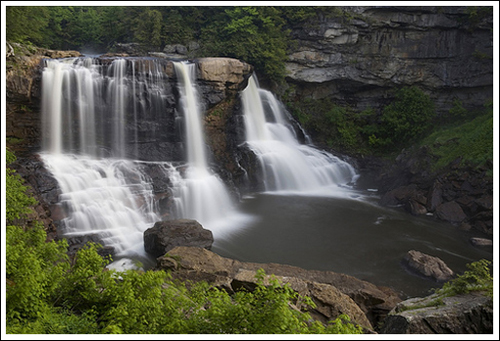
Blackwater Falls

The main attraction in Blackwater Falls State Park

This 62 foot cascade is park’s namesake and #1 attraction.  You’ll have a couple options for accessing the waterfall.  The park road that heads toward the main lodge has a paved, wheelchair-accessible path to a viewing platform far above the waterfall.  The road that heads toward the picnic ground has a longer “staircase-path” that leads to several wooden viewing platforms.  This path puts you a lot closer to the waterfall and offers a much prettier view.   We’ve always liked visiting Blackwater Falls as soon as the sun comes up.  At dawn, the path is deserted and the falls are often shrouded in a thin veil of fog.  During more normal times, the area is extremely crowded with tourists.

And now a couple favorites outside the park.

Douglas Falls – Thomas, WV

The colors of Douglas Falls are amazing!

Blackwater Falls might be the area’s best-known waterfall, but we think Douglas Falls is the most beautiful.   The rocks are brilliant red and the water is vivid green, making for a wonderfully photogenic color contrast.  The color of the rocks is sadly unnatural, created by acid drainage from the mines and coke ovens in the area.  It’s amazing that pollution could create something so pretty.  The ride out to the falls is extremely rugged and potholed.  You should plan on walking a mile or two if you don’t have a 4WD vehicle.   The footpath down to the falls is very short, but very steep. Once you get down to the base of the falls, there is a path that follows the stream for a couple hundred yards.  The whole area is worth exploring, but take extreme caution on the slippery rocks.  The rocks around the stream are coated with slick, clear algae.  We always move “crab-style” along the rocks to keep from falling.


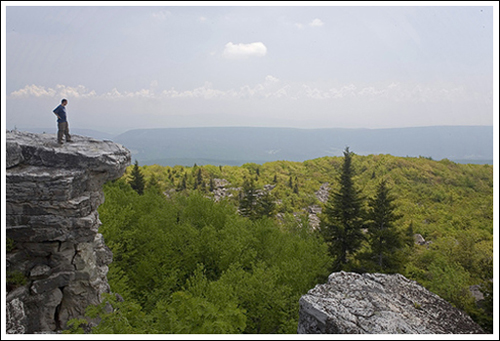
Bear Rocks – Dolly Sods Wilderness

The landscape of Dolly Sods reminds us of Maine.

bear rocks

Another place to visit in the area is Bear Rocks in the Dolly Sods Wilderness Area.  The overlook is surrounded by a vast plain of huckleberry and blueberry bushes that turn blaze red in the autumn.  It’s a great place to spot migrating hawks.  The rocky cliff is endlessly fun to scramble around on and provides beautiful views of the valley below.  The plains framing the cliff are patterned with pathways through the berry bushes and punctuated with monolithic white rocks that have been sculpted by time and the elements.  Whenever we visit Dolly Sods, we feel like we’re someplace far north of the Mid-Atlantic region.  It feels more like Maine or Canada. There are several routes into Dolly Sods.  We recommend the route from WV32 onto Laneville Road as the most passable and scenic.  You might even see a black bear along the road if you’re lucky.