The Devil’s Marbleyard

This 8.1 mile hike passes an impressive boulder field then climbs along the Gunter Ridge trail for some nice (but obstructed) views.

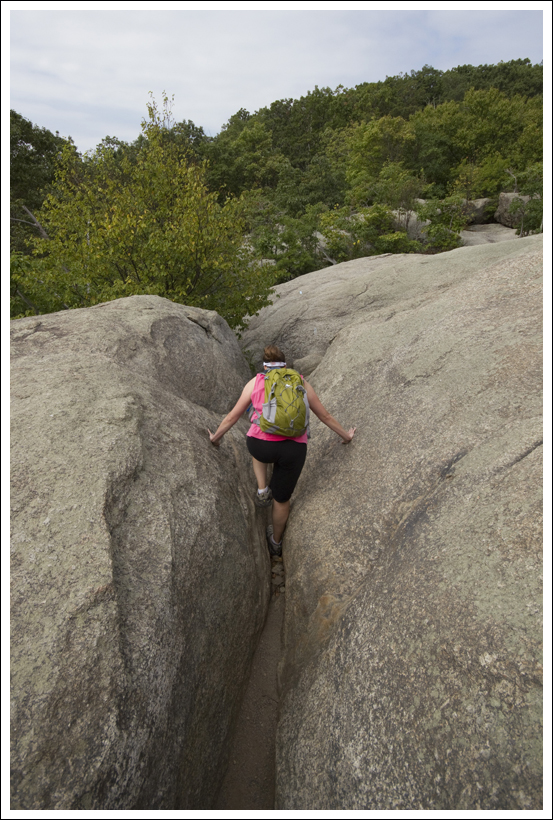
Devil's Marbleyard Scramble
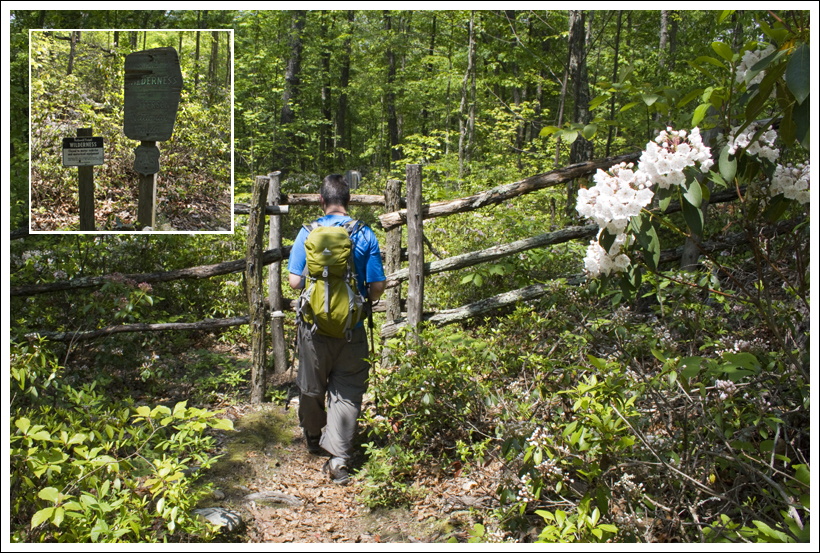
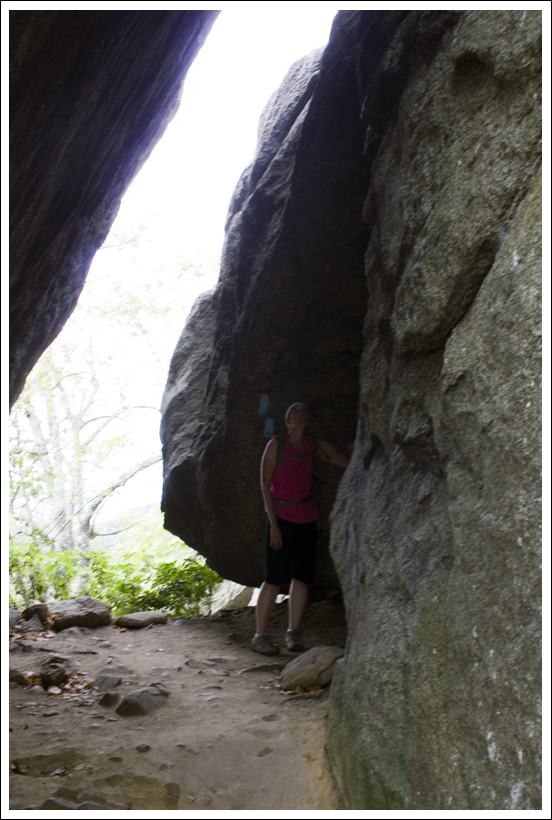
Adam scrambles around the Marbleyard. Below: The hike begins on the Belfast Trail; Entrance to the National Forest is marked by a placard. The two stone pillars mark an old Boy Scout camp that used to be located in this area. You can still see the footprint of the swimming pool and a few building foundations along the Belfast Trail. The camp was named after Chief Powhatan; Catawba Rhododendron were in bloom everywhere!

Start of the Belfast Trail National Forest Marker Rhododendron on Gunter Ridge

Christine Says…

We keep a list of hikes we want to do stuck with a magnet to the side of our refrigerator. The Devil’s Marbleyard hike had been on that list for nearly three years. It kept getting delayed for closer hikes or hikes with better views or taller waterfalls.  We finally decided it was time to knock it off the list.

We got up early Sunday morning, grabbed donuts, bagels and coffee en route and made our way down the Blue Ridge Parkway. We got to the trailhead parking area around 10:00 and thankfully found only a couple other cars there.  Evidently, cars that overflow the official parking lot are frequently towed.  So, if you hike this trail, make sure your car is in the lot or that all four wheels are off the road and not on private property.

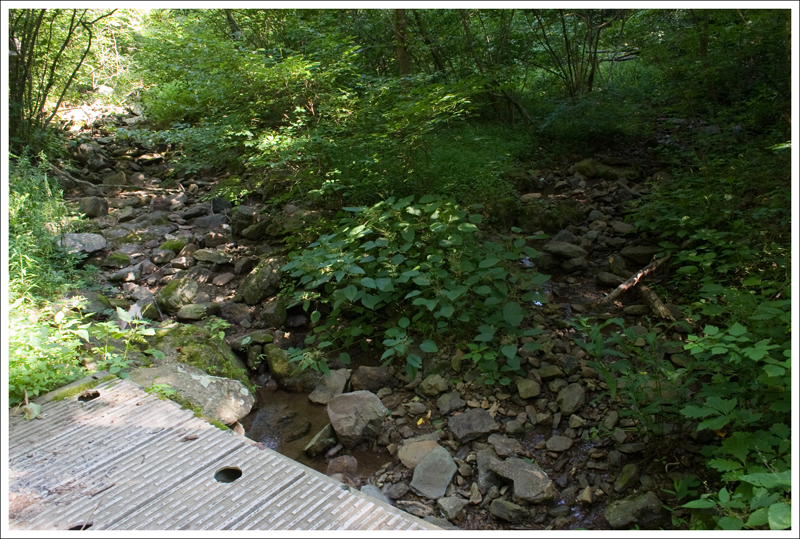
Belfast Creek
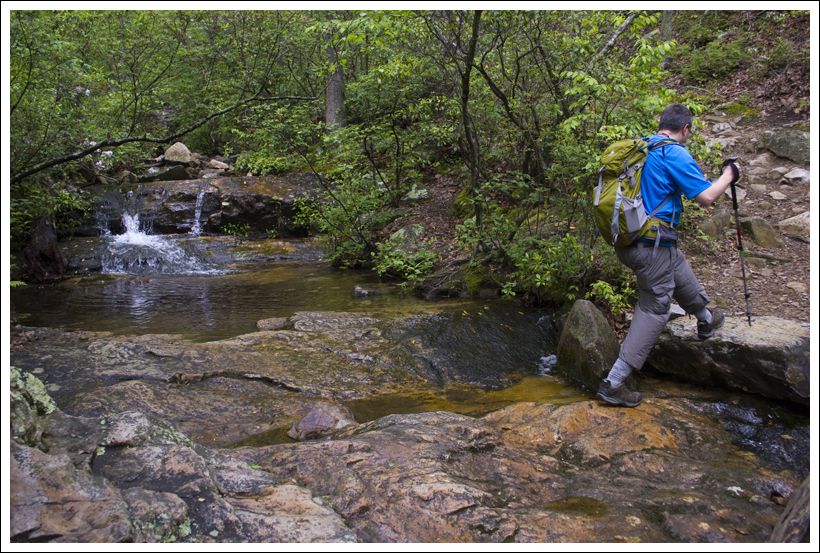
The beginning of the trail takes you over Belfast Creek. Below: The bridge over the creek;  Adam crossing a small stream early in the hike; All the recent rainy weather made conditions ideal for snails.

Belfast Trail Bridge Second Stream Crossing Snail

After crossing a small bridge over a stream, the trail passes through an old stone gateway that used to mark entry to a Boy Scout camp called ‘Camp Powhatan’.  You immediately come to a National Forest/Wilderness placard.  At this point, you’re only a little over a mile from the Devil’s Marbleyard.   (The sign says one mile, but our GPS and most trail guides seem to say it’s about 1.4 miles to reach the Marbleyard).  The trail meanders through the woods, crossing shallow spots on the creek a couple times.

I really enjoyed seeing the blooming azaleas, Catawba rhododendron and mountain laurel.  The laurel bloomed so early this year!  What I did not enjoy were the locusts!  The Blue Ridge Brood of the seventeen-year cicada is currently emerging in our area, and they were everywhere along the Belfast Creek trail. They were screaming overhead in the trees — I likened the sound to the one made by a failing belt tensioner on our SUV a few years ago.  It’s a squeal mixed with an undertone of hiss.  Not only are the locusts noisy – they’re CREEPY!  Sometimes they fly into you.  They have red eyes.  And worst of all, they leave yellowish-clear, crunchy, empty husks everywhere when they molt.  I will be very glad when locust season is over and I can have seventeen years of peace again!

Blooming Along the Trail
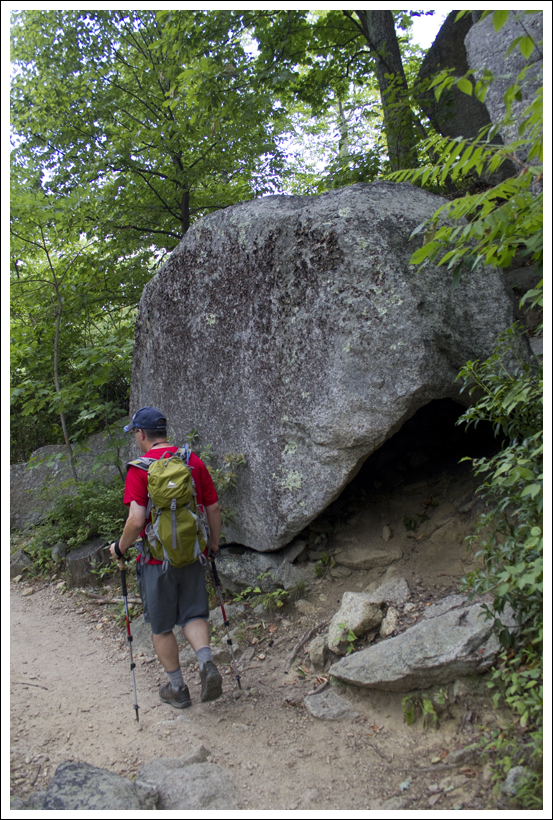
So much stuff was blooming along the trail.  Below: Christine checks out the large boulders that make up the Devil’s Marbleyard;  Adam climbs back down the Marbleyard to rejoin the trail; A creepy locust husk.

Christine on the Marbleyard  Adam Climbing Down Gross Locust Husk

As we came upon the Marbleyard, we crossed paths with the hikers from the two other cars we had seen in the lot.  The first was a nice guy from Virginia Beach who was at the tail end of a week-long hiking vacation along the Blue Ridge Parkway.  We enjoyed chatting with him and sharing information and tips about favorite hikes.  The second was a pair of local kids who warned us of muddy/slippery conditions on the trail ahead.  Adam had a little incident there, but I’ll let him share that tale in his portion of the post.

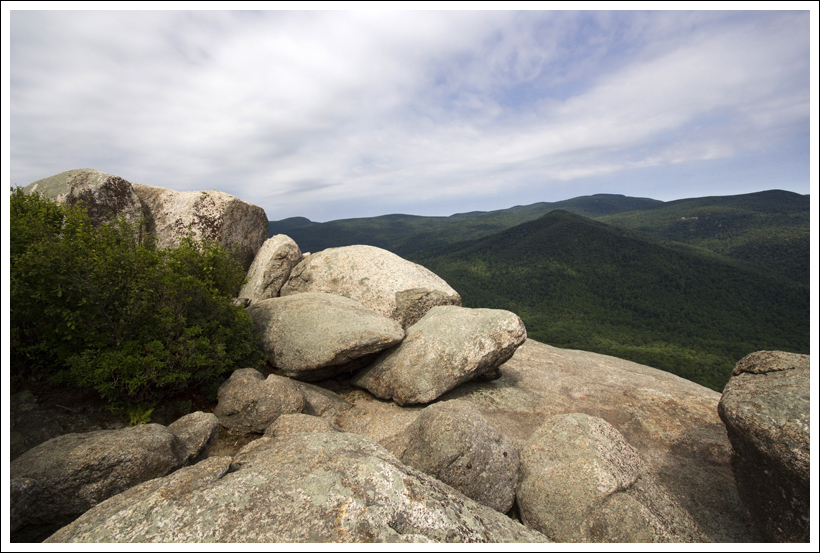
Before proceeding up the trail, we took some time to explore the Marbleyard.  Basically, it looks like an immense stone mountain exploded and collapsed into thousands of boulders of every shape and size.  If you want to climb to the top of the Marbleyard, you have to do so by scrambling up the rocks. It looks like the trail alongside the Marbleyard reaches the top, but in reality the trail turns slightly away from the boulder field and climbs upward to the Gunter Ridge trail. I imagine most hikers visit the Marbleyard and then head back to their car, making this a short 2.8 out and back.  We considered doing this, but since we had already driven so far, we decided to do the full 8.3 mile loop.

After playing on the rocks for a while, we headed along… climbing uphill for a while until we reached the junction of the Belfast trail and the Gunter Ridge trail. At this spot there is a spacious (but dry) campsite.

Steep Trail Alongside the Marbleyard
Christine climbs the steep trail that runs alongside the Marbleyard. Below: The junction of the Belfast and Gunter Ridge trails;  Adam spotted a black widow spider along the trail; Christine walks past an especially pretty stand of mountain laurel.

Top of the Ridge Black Widow Christine Walking Through the Laurels

The Gunter Ridge trail was easy walking, but was quite overgrown.  Because of the heat and humidity, I had decided to hike in shorts and a t-shirt, so I started to worry about ticks climbing onto my legs from the tall grass.  Adam, on the other hand, hiked in long pants tucked into his socks.  I’m getting ahead of myself, but guess who came home with six ticks crawling on his clothes – and guess who came home with none crawling on her.  I always joke that my husband is a real ‘tick magnet’.

The trail along this section really opens up and provides some nice, but slightly obstructed, views.  A forest fire that swept through this area about a decade ago is still very evident.  There are no tall trees and charred stumps can be seen peeking up through the brushy vegetation in many places.

After walking along the ridge for a while, you come to a seemingly endless series of switchbacks climbing down the mountain. Eventually you reach a wooden horse gate, and cross out of designated wilderness into standard National Forest.  Almost immediately after passing through the gate,  you will encounter a stream.  We stopped here for lunch.  I had been wanting to eat for almost an hour, but this was the first place that really had an opening to sit and eat since the campsite at the junction of the Gunter Ridge and Belfast trails.

Mountain View on Gunter Ridge Trail
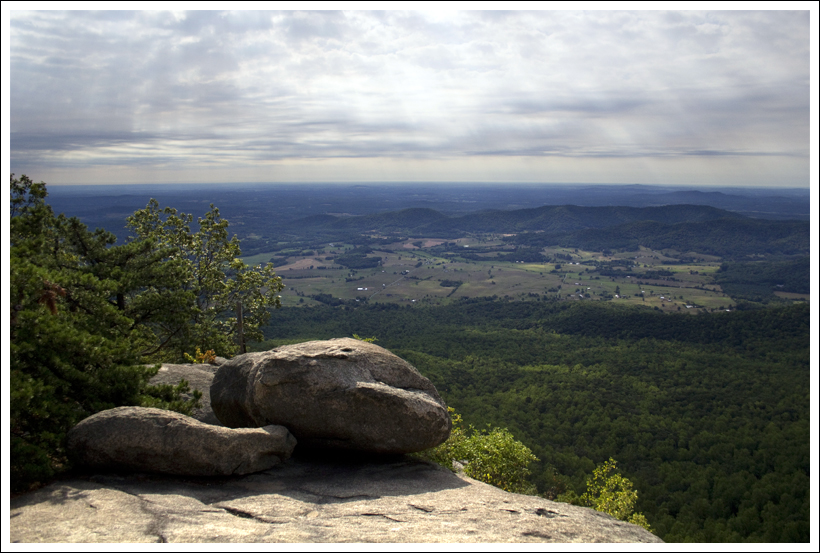
A hazy mountain view from the Gunter Ridge Trail.  Below: Damage from a forest fire about ten years ago is still very evident;  A view of mountains and clouds along the trail.

Old Forest Fire Damage on Gunter Ridge Mountains and Clouds on Gunter Ridge

After lunch, we still had a couple miles of walking along the Glenmont Horse trail.  It was easy hiking, but also really boring.  It’s the part of the hike where you know you’ve seen all the cool stuff, but you still have several miles of walking along a featureless road/path.  It reminded me a lot of all the fire road/paved road walking at the end of the Old Rag hike.

All in all, the hike to Devil’s Marbleyard made for a pleasant day. But, if I were to recommend the hike to others, I’d suggest just hiking to the Marbleyard as an out-and-back.  If the rhododendron, laurel and azaleas hadn’t been blooming, I don’t think there was much to see on the rest of the loop.

Adam Says…

It has been about 20 years since I last hiked the Devil’s Marbleyard trail.  Those that know me personally or have read this blog for a while know I grew up in Lynchburg.  Some of the hikes that are most popular with people around there are Sharp Top, Flat Top, and Devil’s Marbleyard.  The first two have great views and are close to Peaks of Otter, a popular picnic area.  The last time I did this hike I was with with a group of friends from home.  I remember the boulder field seemed so impressive.  While there are similar slopes of rock along Furnace Mountain and Hawksbill summit (among others), these boulders are much larger.  My friends and I climbed up the boulders from the bottom of the field.  One of my friends almost stepped on a rattlesnake that was sunning itself on the rocks.  I’m sure a number of rattlesnakes make their home in the cracks between the rocks, so be careful.  The climb up to the top takes longer than you would expect and requires a lot of energy to navigate the scramble.  Since we planned on hiking a long loop, we opted to just climb around a while on the bottom.
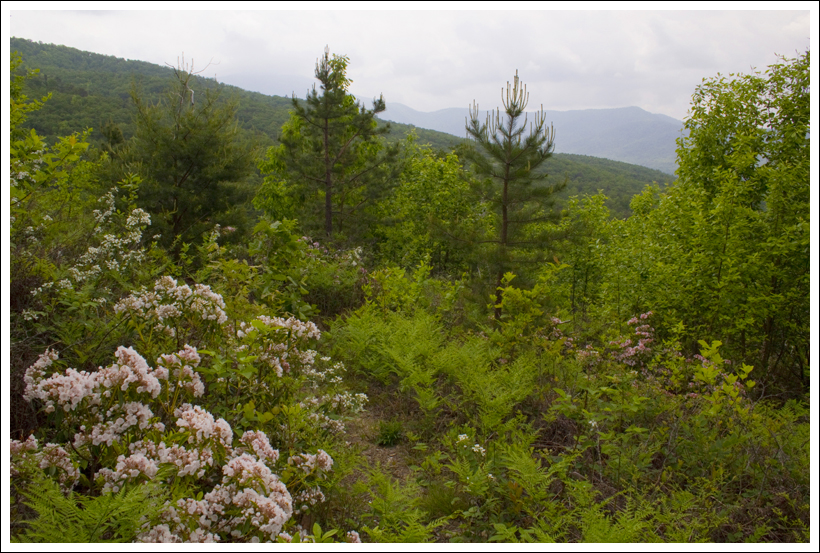
Beautiful Mountain Laurel
Beautiful mountain laurel along the ridge hike.  Below: Stopping to enjoy the mountain laurel; Passing out of the designated wilderness area; Lunch by the stream.

Christine and Mountain Laurel Leaving the Wilderness Area Lunch by the Stream

With every interesting geological feature, there seems to be a legend that has been passed down over the years and Devil’s Marbleyard is no different.  In the local tale, this area was occupied by Native Americans and the land was supposedly very green and lush.  There was a large stone altar at the top of this hill that was used for worship on full-moon nights.  A white couple met the Native Americans and they were thought to be spirits since they looked so different than the local tribes.  The couple said they were not spirits but they worshiped a higher power.  They converted the Native Americans to Christianity.  However, the next year brought about a great drought and the Native Americans felt the new God and the missionaries were to be held responsible.  They burned the couple alive on the altar.  As the flames reached high into the sky, a storm formed.  Lightning struck down upon the altar and exploded the rock over the mountainside.

Christine and I talked about this legend on the hike.  I guess there can be a few different morals to the story depending on your perspective.  From the perspective of the white missionaries, it may be best to not spread your religion to others if you want to stay alive.  From the perspective of the Native Americans, it may be to either believe your own gods or keep faith in your new God.  It is an interesting thing to think about on this hike, even if there may not be much truth to the origin of the boulder slope.
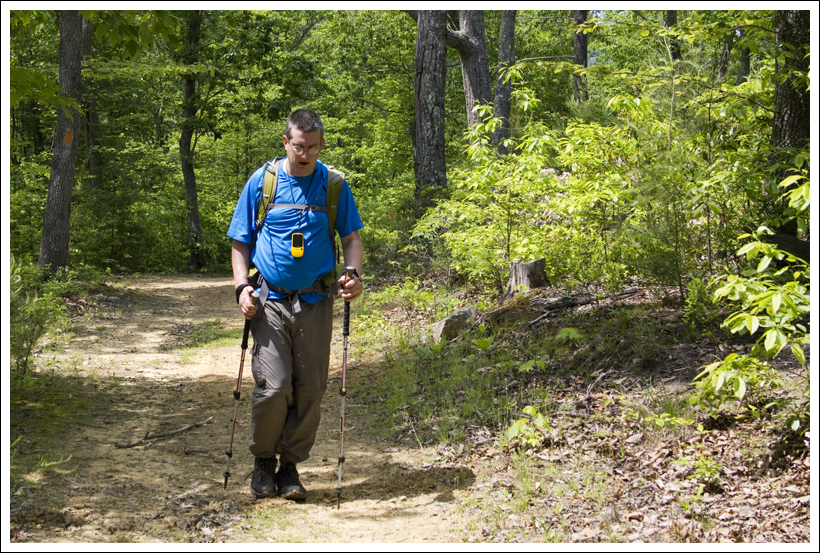
The Glenmont Horse Trail
Walking along the Glenmont Horse Trail gets tedious.

To complete the full loop hike, begin in the parking lot and cross the bridge and take the blue-blazed Belfast Trail.  At .2 miles, the trail splits.  Bear right to stay on the blue-blazed trail.  The trail is a rocky, uphill climb that leads to the Devil’s Marbleyard boulder field at 1.4 miles.  Continue up the trail which follows parallel to the right of the boulders up a steep section (which can also be very slippery if there has been recent rain – as I found out with a hard fall onto slick rock).  After you near the summit of the boulder field, the steepness of the trail lessens.  At 2.5 miles, you reach a junction with the Gunter Ridge Trail and a small campsite.  The Gunter Ridge Trail heads off to the left heading down the mountain slightly, but you are mostly following along a ridge line.  Eventually, this trail begins to open up to some obstructed but nice views on the ridge.  The trail then descends quickly through a series of switchbacks.  At 5.8 miles, you will exit the James River Face Wilderness boundary through a gate and cross Little Hellgate Creek.  At the 6.0 mile mark, you will reach the orange-blazed Glenwood Horse Trail, a large fire road.  Follow this to the left and make your way along this trail that does go slightly uphill until reaching the junction with the Belfast Trail at 7.9 miles.  Take a right on the Belfast Trail to reach the parking lot at 8.1 miles.

If you are interested in geocaching, there is one geocache that can be found on the scramble up the boulders at the Devil’s Marbleyard – Devils Marble Yard Cache.

Like Christine, I would probably recommend that if you were coming here to see the best features of the trail, I would just do this as a 2.8 mile out-and-back to the Marbleyard and back.  The views from the top of the Gunter Ridge Trail are more obstructed and doesn’t seem necessary when there are many other nice view hikes nearby on the Blue Ridge Parkway.

Trail Notes

  • Distance8.1 miles
  • Elevation Change – 1510 feet
  • Difficulty – 3.  The climb up past the Marbleyard to the Gunter Ridge trail is steep, but once you gain the ridge it’s most level or downhill.  The Glenmont horse trail is wide open and slightly uphill.
  • Trail Conditions – 3The trail is in decent shape in most places.  It was very slick, steep and muddy climbing alongside the Marbleyard.  The Gunter Ridge trail was easy to follow, but very overgrown with tall grasses and brush.
  • Views– 2. There are plenty of obstructed views on the Gunter Ridge Trail, but nothing spectacular.
  • Streams/Waterfalls – 2.5.  The stream running along the Belfast Trail is small but lovely.
  • Wildlife – 2.  We saw a ton of fence lizards but not much else (unless you want to count the seventeen year locusts)
  • Ease to Navigate – 3.  There are a few turns and trails here are not as well marked as trails in the national park, but if you pay attention, finding your way should be easy.
  • Solitude – 3  You will likely share the Marbleyard with other hikers, but the rest of the loop does not seem heavily traveled.

Directions to trailhead:  From the Blue Ridge Parkway at mile 71, you will see a small road (FSR 35) that is on the western side of the road at a curve.  Take this road which leads past the Petites Gap AT parking area.  At 4.2 miles, you will see the parking area on the right (just after you start seeing more houses on the road).  Make sure you either park in the lot or make sure you park completely off the road or your vehicle may be towed.

Byrd’s Nest #4 Loop

This short 2.4 mile loop takes you along the Appalachian Trail, the Neighbor Mountain Trail and the Hull School fire road.  The highlight of the loop is a visit to the Byrd’s Nest Day Shelter.

Byrd's Nest
Byrd’s Nest #4 sits in a lovely opening off the Neighbor Mountain trail. Below: Parking is available at the Beahm’s Gap Overlook; the trail begins after crossing the railing; Blooming azaleas along the trail.

Parking at Beahms Gap Start of Hike Blooming Azaleas

Christine Says…

We were supposed to go backpacking, but when we heard terms like ‘flooding rains’, Nor’easter and ‘wash out’, we decided to delay the trip.  When Saturday morning dawned, it was sunny and warm and beautiful!  I made a trip into town, worked on a photography project in the arboretum, bought a bunch of veggies and strawberries (yay!) at the farmers’ market and got a haircut, figuring that the rain had to be on its way.  When I got home, it was still sunny and gorgeous with no sign of the coming deluge.  Adam suggested we hop in the car, go for a short hike and then have lunch in the park.  It sounded like a great idea to me, so off we went.

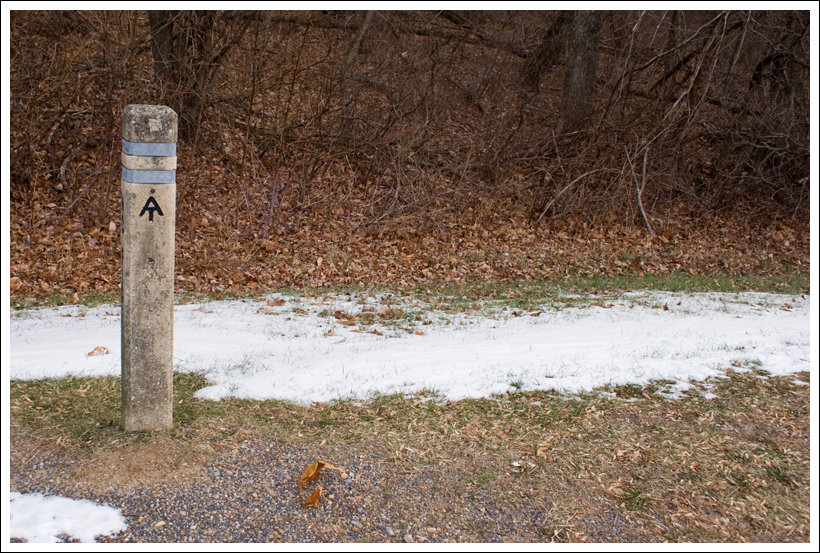
We decided on the short Byrd’s Nest #4 loop, starting from the Beahms Gap Overlook.  The trail started with a hop over the retaining rail at the overlook – a cement trail marker post will show the spot to cross the rail.  The trail goes slightly downhill along a short spur to the Appalachian Trail.  Follow the AT north until the junction with the Neighbor Mountain trail.  Take a right onto the Neighbor Mountain trail and follow it uphill until you reach a clearing and the Byrd’s Nest shelter. For the return trip, follow the grassy path in front of the shelter downhill.  The path quickly widens to the Hull School fire road.  After a few tenths of a mile, you’ll come back out on Skyline Drive.  Follow the drive south for about a tenth of a mile back to your car.

Adam Hiking Along the Rocky Appalachian Trail
Adam hikes along a rocky section of the Appalachian Trail.

Although there are no sweeping views or rocky outcroppings, this hike is a lovely leg-stretcher.  The Byrd’s Nest shelter is a perfect place to enjoy a picnic lunch.  We had planned to relax at the shelter for a while, but when we arrived we found it already occupied by a picnicking couple.  Not wanting to infringe on their space, we took a few photos and headed back on the return arm of the hike pretty quickly.

We decided to have lunch at the Big Meadows Wayside.  It was packed – more crowded than we’ve ever seen it!  They had some new selections on the menu, which was a pleasant surprise.  The menu has been pretty much the same for years!  I got a grilled chicken sandwich with roasted red peppers, provolone cheese and aioli.  It was surprisingly juicy and delicious.  You don’t expect amazing food from park concessionaires – but this was actually one of the best grilled chicken sandwiches I’ve ever eaten.  Go figure!

It was still beautiful and sunny when we left the park around 2:00 p.m. – but by 4:00 heavy thunderstorms had moved in and it rained pretty much non-stop the next 48 hours.  I was glad that we had decided to postpone our backpacking trip.

Adam Says…

I was originally thinking that we would just take a drive on Skyline Drive when I whisked Christine away.  But, I decided to bring our Shenandoah National Park Falcon Guide hiking book and had Christine thumb through to find this hike we hadn’t completed yet.  We had done the majority of this trail before on our Appalachian Trail hike from Elkwallow to Thornton Gap.  The last time we had been on this trail, we saw the post that showed this side trail, but we decided to avoid more hiking.  The Falcon Guide book actually mentioned another trail that should have looped back to the AT, but that trail no longer exists (at least the posts have been removed).

Another View of Byrd's Nest
A front view of Byrd’s Nest. Below: Adam walking along the Neighbor Mountain trail; A few dark clouds rolled over on the short section of road walking at the end of the hike.  They quickly passed and blue skies returned.

Adam Walking the Neighbor Mountain Trail Road Walk

The cabin is named for Senator Harry Byrd Sr., who donated four of these shelters for the national park (the other three are at Old Rag, between the Pinnacle and Meadow Spring Trail, and Hawksbill mountains).  His name also graces the Visitor’s Center near Big Meadows and he hiked Old Rag annually into his 70s.  It appears that the cabin up here must have had a few other buildings or other things nearby since you can see some nearby foundations.  I’m not sure if this area once served as someone’s home or if it was an overnight shelter with a spring and a privy.  It is listed as a day-use shelter only.

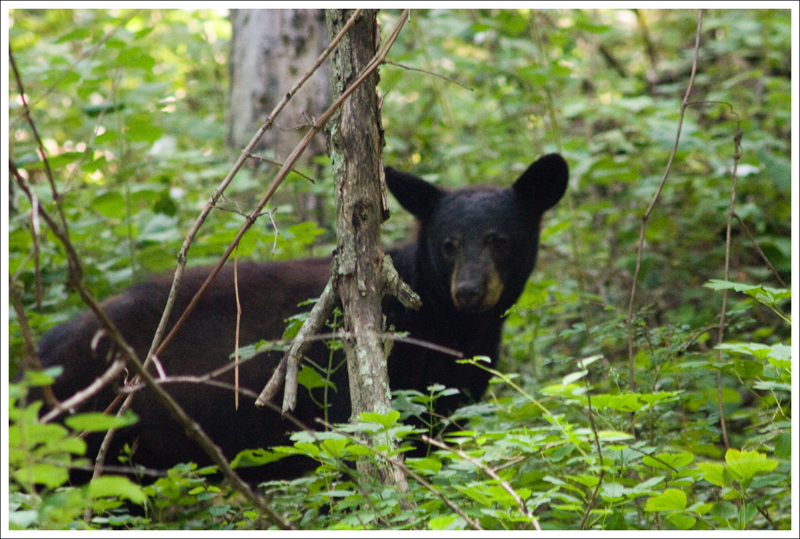
Once we descended from the shelter down the fire road, we both thought we saw a bear dash off into the woods.  We saw a black shape and a big crashing through the brush, so we are convinced it was a bear.

The cabin is definitely the highlight of the trail, but we were disappointed that others had taken it completely over to eat lunch.  So, we quickly got on our way to not interrupt them.  Overall, there are definitely more interesting trails in Shenandoah National Park.  But if you want a quick hike with a possible place to eat a packed lunch, this could be one for you.

Trail Notes

  • Distance 2.4 miles
  • Elevation Change –850 feet
  • Difficulty – 2.  There is a substantial amount of uphill climbing, but the overall distance is short.
  • Trail Conditions – 5.  The trail is in excellent shape, like most of the AT through Shenandoah.
  • Views– 1.5.  There is a partially obscured view at the Byrd’s Nest Shelter.  It was probably much more panoramic and open when the shelter was originally built.
  • Streams/Waterfalls –0.  There are no streams or waterfalls, but you will pass a spring-fed water source.
  • Wildlife – 3.  We heard lots of birds, and *think* we saw a bear.
  • Ease to Navigate – 2. After leaving the AT and Neighbor Mountain trails, it was all guesswork.  Nothing was marked and the description of the trail in our Falcon Guide was inaccurate.
  • Solitude – 3. This is a fairly popular family hike.

Directions to trailhead:  Park at the Beahms Gap Overlook parking lot around mile 28.5 on Skyline Drive.  From the lot, you should see a cement post marking the start of the trail on the other side of the log barrier.

Old Rag – via Weakley Hollow

We hope you enjoyed our Acadia series… but now it’s time to get back to Virginia hiking.  We decided resume our normal posts with an exceedingly well-known mountain – Old Rag.  This 8.8 mile loop hike is Shenandoah’s most popular hike.  It’s so well-loved and traveled that the official Shenandoah website has a whole section dedicated to hiking this mountain.  [View NPS Map for this hike]

Note: Some of the NPS website details (and mileage markers along the actual trail) were a little outdated as of summer 2011, as they refer to the hike distance before the park service closed the upper parking lot in April of 2010.

Nearing the Summit of Old Rag
Large boulders near the summit of Old Rag.  Below: Adam walking along the road headed toward the Ridge Trail’s start; Views from the summit of Old Rag; Adam drops down into a narrow passage between the rocks.

Lots of Road Walking  Views at Summit Dipping Into a Narrow Slot

Christine Says…

After two and a half years, we’re finally getting around to covering Virginia’s most popular, most well-known hike – Old Rag. I’ll make an outright confession.  Old Rag, as beloved as it might be by (seemingly) everyone else, is not my favorite hike.   But, when you have a Virginia hiking website, you’re practically obligated to have a write up about this mountain.  So, on to the post!

We’d been tossing around the idea of hiking Old Rag for the blog for well over a year.  Adam would suggest it and I’d invariably tell him that it was too hot, too cold, possibly wet and slippery, I heard there was ice, my feet hurt, I don’t feel like driving that far, etc.  Basically, I floated every excuse in the book to delay the hike.  But then I went and did something incredibly stupid and it really blew up in my face!  I had a day off work coming up.  It was going to be a beautiful August day – crisp and unseasonably cool!  I had visions of getting up early, doing a photo shoot in the park, maybe eating some donuts and then taking myself to a matinee movie.  But before I could stop myself, I found that I had blurted out “Tomorrow would be a GREAT day to hike Old Rag!”  I assumed this was purely hypothetical because Adam had to work.  But he immediately responded “Yeah!  Let’s go!  I’m taking tomorrow off too!”  Ugh – I didn’t see that one coming!  I don’t like to back out on plans, so the next morning we were up before dawn, snacks stashed and Camelbaks filled.

We got to the parking lot before 8:00 a.m..  Getting to Old Rag early is something I consider to be a necessity.  The trail is always crowded – even on weekdays.  The Old Rag parking lot is actually my first point of contention with the hike.  It used to be if you got up early, you could always get a parking spot in the small upper parking area located right at the trailhead.  In April of 2010, a couple years after our last hike up Old Rag (fall of 2008 – see photos), the park service closed the upper lot to all vehicles.  Now, all vehicles must park in the lower lot, which is just a shade under a mile from the trailhead.  The added mile follows a paved road uphill to the beginning of the Ridge Trail. I’m not going to make any apologies; I just don’t like road walking on outings that are supposed to be hikes.

The Scrambling Begins
The first section of rock scramble is just a little sampling of what is ahead.  Below: Giant boulders along the trail; Christine climbing up the Ridge Trail; Christine taking in the view; A view of the valley; A dog who has panhandling all figured out!

Giant Boulders Along the Trail Christine Hiking Up the Trail First Views
Wider View Before starting Major Scramble
Beggar on the Mountain

Once we got to the Ridge Trail, things improved a bit.  The trail climbed upward for about two miles. It’s not terribly steep or difficult climbing, but it is steady uphill.  There are occasional switchbacks, lots of gigantic boulders along the trail and even some glimpses of views through the trees.

The higher you climb, the better and more open the views become.  After the first real panoramic view, you get your first little sample of the extensive rock scrambling you’re about to encounter.  The first pass is short, but requires hoisting yourself up through a small opening, then across a flat pancake of rock.  At this point, my boot slipped and I almost toppled over backwards.  Luckily, I was able to hang on long enough for Adam to give me a hand up.

Shortly after that little scramble, you’ll come to what I think is the nicest view on the hike.  Instead of overlooking mountains with a distant peek at Skyline Drive, this viewpoint overlooks the valley below.  The vista is dotted with little farms and winding country roads.  It’s really pretty!  At this point of our hike, we encountered an emaciated, but super-friendly dog.  He had a collar but there didn’t seem to be any human to claim him.  Dogs are not allowed on Old Rag’s hiking trails, so we figured someone brought a dog up anyhow, and then abandoned him when he could no longer follow along the rock scramble.  The dog looked so pitiful and hungry that we ended up sharing some cashews and half a Luna Bar.

The dog followed us along until the scramble began in earnest.  He looked sad to see us go, so we decided to report him to park rangers at the end of our hike, in hopes that they could send someone up to retrieve him and lead him back down to the base of the mountain.

After saying goodbye to the dog, we began nearly one-mile of rock scrambling required to reach the summit of Old Rag via the Ridge Trail.  Anyone wishing to reach the summit without the scramble can follow the Saddle Trail (accessed by either the Weakley Hollow or Old Rag fire roads).  The scramble is the part of this hike that I enjoy most, but also simultaneously fear.  I have vertigo, so there are a couple passes that play tricks on my visual and balance centers.  Otherwise, the scramble is a lot of fun!  It’s almost like a hiking puzzle.  You have to look at each obstacle and plan the best strategy for traversing it.  The scramble is tough – it’s not so much a cardio challenge as it is a strength challenge.  There are lots of places where you’ll rely on  both your upper and lower body strength to carry you across the rocks.  It’s nice to have at least one hiking buddy to help you along.  One particularly steep place, I had to shove Adam up (one hand on each butt cheek) and then he had to tow me up behind him.

Narrow Passage
Near the beginning of the scramble, you have to drop down into this narrow passage. Below: A variety of obstacles along the rock scramble. Below: Adam shinnies down into the narrow passage pictured above (note the blaze is numbered R22.  Each blaze on the scramble is numbered to help rescuers find injured people more quickly); More scenes along the scramble.

Dropping Down More Scrambling Stairs Climb Up That

The summit of Old Rag is beautiful and decorated with many large and interesting boulders.  It’s the perfect place to enjoy a snack while taking in the view.  We watched the clouds clearing away, ate cheese and trail mix and watched falcon soaring on the breeze.  It may have been a peregrine, as they are known to nest on Old Rag, but we’re really not sure.

After leaving the summit, the hike becomes sort of tedious.  Yes, it’s all downhill, and you’ll pass a couple interesting trail shelters (Byrd’s Nest and Old Rag).  Both are available for day use only.  There is one more decent view.  But right after passing the Old Rag Shelter, you’ll reach the Berry Hollow fire road.  You’re only on that for a short while, until you meet the Weakley Hollow fire road.  You’re on that road for the remainder of the loop until you come back to the paved road at the trailhead.  Honestly, everything after the scramble on this hike is just not fun to me – too many miles of featureless road walking.   All in all, the Old Rag hike has close to 4.5 miles of road walking (over half the hike).  Adam and I were eager to finish up our hike, so we jogged most of the way back along the fire road and paved road.

Adam Pretends to Balance a Giant Boulder
Adam pretends to balance a giant boulder. Below: More scenes along the scramble.

A Cave Adam Passing Through the Cave Another Narrow Pass

When we got back to the car, we told the ranger at the check-in station about the skinny dog.  She laughed and said “Oh, him!  He’s our resident Old Rag beggar!”  Apparently the dog belongs to a local family.  He likes to take daily hikes to solicit treats from people climbing the mountain.  He sure tricked us!

The parking lot had really filled up since we arrived!  We were glad to be done, and on out way to get some lunch (fried chicken – yay!).

When I reflect back on hiking Old Rag, and what could be done to improve the experience, I can think of a few things.  One idea I think would work well is to issue a finite number of permits per day to hike the mountain.  Perhaps limiting numbers on weekends would be enough.  I think if they could limit hikers, they could reopen the upper lot and eliminate almost two miles of road walking.  Another thought is to limit the number of people allowed per hiking party.  So many church youth groups and college clubs hike Old Rag in huge crowds.  This causes massive ‘traffic jams’ along the scramble.  No fun!  I also think that limiting hikers would go along way toward alleviating the trail damage and erosion on Old Rag.  The trail is crumbling, lots of rocks on the scramble have been worn to a smooth polish under years’ of boot traffic, and sadly there is garbage everywhere.  It’s a trail that would benefit greatly from being enjoyed by fewer people.

That said, I think every lover of the outdoors in Virginia should hike Old Rag at least once!  The scramble is truly without compare.

Adam Says…

Well, Christine summed it up nicely describing the pressure that I have been putting on her to tackle Old Rag.  We last did this hike together shortly before we started this blog.  The logo that we use for the website is actually taken from a photo of Old Rag, so it was a must do.  About every year, I put together a list of hikes that we have talked about doing in Virginia and we hang it on our refrigerator.  After we finish the hike, we have a ceremonial highlighter that we use to highlight the hikes we’ve finished.  For the last few years of printing a new list, Old Rag has been one of the few that has not been highlighted before the latest version is posted.  I let Christine do the honors of marking Old Rag off the list – and she was happy to do so.

Adam on the Summit
Adam on the Summit. Below: Summit scenery; Some kind of bird of prey.

More Summit Views Another Summit View Falcon

I would also agree with Christine that Old Rag is very overused.  One thing that makes this hike particularly challenging during the rock scramble is that the rocks are so smooth, you could easily slip.  When it has just rained, you know you will have no footing whatsoever.  Many of these boulders have no handholds or footholds, so you do have to be creative with how you will get through the scramble.  I would recommend that you do this hike with someone else to help you through the scramble.  I think Christine especially enjoyed the opportunity of putting both of her hands on my butt and shoving with all of her might.  It’s not very often that she gets to do that.

Old Rag Shelter
The Old Rag day-use shelter. Below: Adam takes in the last nice view on the way down; The Byrd’s Nest day-use shelter; The crowded Old Rag parking lot.

View on the Way Down Byrd's Nest Shelter Crowded Old Rag Lot

The hike begins from the parking lot and consists of walking up a paved and then gravel road for about .9 miles until you reach a smaller blocked off gravel lot (with a portable toilet) and a sign for the trailhead to the left.  This begins the Ridge Trail.  The trail starts off as a gradual ascent through the forest.  At about 2.3 miles, you reach the first of several switchbacks.  There isn’t a lot of note on the main portion of the trail as you are just walking uphill through the woods, without any notable views.  At about 3.2 miles, you reach a nice overlook.  As soon as you leave this spot, the rock scrambling will begin.  You have about .8 of a mile of rock scrambling until you reach the summit.  This path is quite dangerous as you have to navigate down tight crevasses, around boulders open to large drop-offs, and up other boulders with slick surfaces.  The summit marker will indicate the end of the tough climbing.  There are several places to take in the panoramic views at the top and some of the more adventurous will climb up some of the large boulders at the top.  Once you are done taking in the views backtrack to the trail and then take a right on to the Saddle Trail.  At about 4 miles you reach, the Byrds Nest Shelter No. 1, a day-use only shelter.  Continue down the steep trail and at 4.5 miles, you will reach another day-use Old Rag shelter.  Continue down the trail and at 4.9 miles, you reach the junction with the Weakley Hollow fire road.  Take a right on this fire road and you have about 3 miles of this fire road to walk down before you reach a few bridges and finally the smaller blocked-off Old Rag gravel lot.  Go back the way you came and you should reach your vehicle around 8.8 miles.

I do think we have put a lot of warnings about this hike, but the reason that this hike is likely so popular is due to the challenge and the amazing views.  The summit of Old Rag does provide some of the best views in Virginia.  Some people even do rock climbing at the top to rappel over the edge and make their way back up.  On a clear day, you can see for miles of countryside and layers of mountains.  I know most people do put this on their list of must-hikes in Virginia.  I recommend to tackle this hike as early in the morning as possible to beat the crowds.  If you wait until the middle of the day, you will likely face people-jams as the navigating through the rock scramble takes a while.

For any of those interested in geocaching, there are two geocaches nearby the trail:

For further reading about Old Rag and its history, check out the Climber’s Guide to Old Rag Mountain with some interesting information about the history of the area and the USGS’ Hiker’s Guide to the Geology of Old Rag.

I really have to hand it to Christine for confronting her vertigo and facing Old Rag.  I told her I wouldn’t bother her again to do the hike since we now officially have it on the blog, but I will probably do it again sometime.  I think this hike does have about 1.5 miles of very exciting climbing and wonderful views, but the rest of the hike (especially the way back on the fire roads) seems a little boring and you will look forward to seeing your car in the parking lot after the long hike back.  The last time we did this hike was on a fall day at the peak of fall color.  If you can find a day like that to tackle this hike, you won’t regret it.

Trail Notes

  • Distance8.8 miles
  • Elevation Change – about 2600 feet total.
  • Difficulty – 4.  The uphill climbing is gradual and never terribly steep, but the scramble requires good upper and lower body strength.
  • Trail Conditions – 2.  I think the trail is eroded and worn smooth in many places due to years of overuse.
  • Views – 5.  The views are wonderful and include both mountain and valley views.
  • Wildlife – 3.  There have been a fair number of bear sightings on Old Rag.  You also have a good chance of seeing birds of prey on the summit.
  • Ease to Navigate – 4.  Follow the signs.  This well-traveled trail is well-marked. Distances on the markers are out-of-date and refer to mileage when the upper lot was still open.
  • Solitude – 0.  Can I give this a negative score?

Download a trail map (PDF)

Directions to trailhead:  From Sperryville, Route 211, turn onto Route 522 and follow it south for .8 mile. Turn right on Route 231, follow 8 miles, turn right onto Route 601 and follow signs to the parking area, approximately 3 miles.
From Madison, Route 29 Business,  turn onto Route 231 and follow it for 12.8 miles. Turn left onto Route 602.
Follow signs for the parking area. Old Rag parking is approximately 3 miles from the turn onto Route 602.

Saddleback Mountain Loop

The Saddleback Mountain Loop is a hike for people that are looking for a convenient day hike of moderate length – about six miles.  There aren’t any great views, but it is an enjoyable walk.

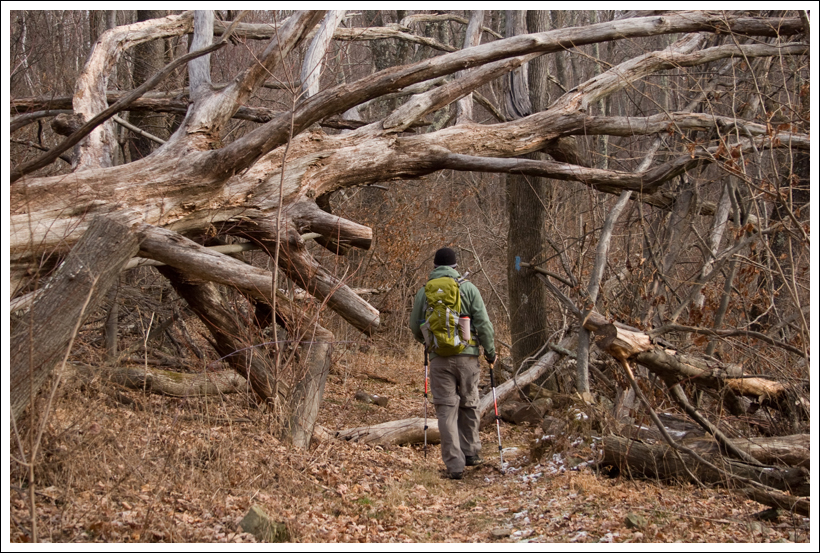
Gnarled Tree on the Saddleback Trail
Adam walks under a fallen, gnarled tree on the Saddleback Trail.

Adam Says…

Sorry it has been awhile everyone.  We’ve had a crazy fall and haven’t been able to get out as much as we had hoped.

We have had a plan this winter to try and do sections of the Appalachian Trail through Shenandoah National Park.  We thought we would start with a shuttle trip to cover the section from Swift Run Gap to Lewis Mountain.  We made our way up to the Swift Run Gap entrance to Shenandoah Park and talked to the ranger at the gate.  He told us that the entire drive was closed, but we could do some day hikes around the area.  He said there was snow and ice on the road and they were also worried about more bad weather moving into the area later that night.  Boooo!  We went back to the car, upset that our plans couldn’t work out the way we wanted.  Rather than admitting total defeat, we decided to try a loop hike that included Saddleback Mountain.  It was close enough to the entrance gate that we could walk into the park from Route 33.

Skyline Drive Closed for Snow
Skyline Drive Closed for Snow.  Below:  The trailhead had a small amount of snow; The trees overhead were all bare; We saw a little bit of milkweed still hanging on.

Snow at the Trailhead Bare Trees Milkweed

Throughout the hike we got a few glimpses of Skyline Drive through the woods and we never saw any snow.  I talked to a friend of mine who is married to a ranger and he said that often they close the road because they don’t want to have people get trapped up there.  Then, the rangers have to deal with them, since they typically close during hunting season at 5PM.  I also found out they send one ranger north to inspect the Central section and one ranger drives up from Waynesboro to view the Southern section.  We found out later that the Southern section ended up remaining open all day, so we could have done a different hike.  Oh well, at least we were able to cover something we hadn’t done yet for the blog.

The hike starts where the Appalachian Trail crosses the road at the border between the Southern and Central Districts of Shenandoah National Park.  Heading north up the white-blazed trail, the trail ascends steadily.  After a few tenths of a mile, you will see an unmarked path to the right that leads to an old family cemetery.  It was nice to pay some respects to the families that lived and died here on the mountain.  Continuing back on the AT, the trail continued to slowly ascend.  At 1.4 miles, you reach a junction with the blue-blazed Saddleback Mountain Trail.  Take a right on this trail to make this hike a loop.  The Saddleback Mountain Trail goes around the mountain, which was a nice break from climbing uphill.  We saw a few nice icy formations and some heavier patches of snow on this shadowy side of the mountain.  At 2.6 miles, you will come to a PATC maintenance hut.  These huts are scattered throughout the park that serve as places where PATC volunteers can have access to some tools to help repair sections of the trail.  There is an open outhouse here and a spring nearby, but we found that the spring was mostly dry.  We continued past the PATC maintenance hut for .2 miles on a fire road until we met the junction with the AT.  Head south on the AT and you will have 2.7 miles until you reach the original trailhead.  As I mentioned before, the Saddleback Mountain goes around the mountain, so when you start the trail you will again be heading uphill until you reach the summit.  The summit was not marked, but it was nice to have a downhill trip back to the car.

Snow on the Trail
The shady side of the mountain had a little snow.  Below:  We took a short side trail to take a look at an old cemetery; Even though there was a little snow on the ground, the morning temps were well above freezing; We saw some recent bear scat and scratches along the trail.

Cemetery Not Cold Bear Scratches

On our way back downhill, we ran into two hikers that were there hoping to catch up to the Valley Hikers group that were evidently doing that hike to South River Falls.  They got a late start but said there was a note on a car telling them where they went.  We talked to the couple for a while before parting ways.  When I got back home, I checked my email and it looks like the Valley Hikers changed their itinerary completely and were not doing the South River Falls after all.  I hope the couple didn’t get too discouraged on their trip.  Valley Hikers is a great group to join if you are interested in meeting up with some other people in the Shenandoah Valley that enjoy hiking.  Members are of all skill levels and they do a good variety of hikes and an occasional backpacking trip.  I do belong to the group, but I have yet to meet up with them to do a hike.

When Skyline Drive is open, you can also do a shorter version of the Saddleback trail, starting from the South River Falls picnic area.  From that direction, you would have just a few tenths of a mile of an uphill hike to the summit area.

I’m glad we were able to get out and do a hike after our hiatus.  Even though this trail doesn’t have a lot of great views, it is a nice walk in the woods and it was good to get some exercise outdoors on a cool winter day.

Christine Says…

With our original plans foiled, we sat in the car for a few minutes and deliberated our options – go home or figure out an alternate hike route that allowed us to walk into the park from outside the pay station.  I’m really glad we decided to go for the latter, because the hike (while rather uneventful) turned out to be a pleasant way to spend the morning.  It was great to get back out on the trail after a month of sloth (the flu and three weekends of art shows severely limit the ability to hike!)

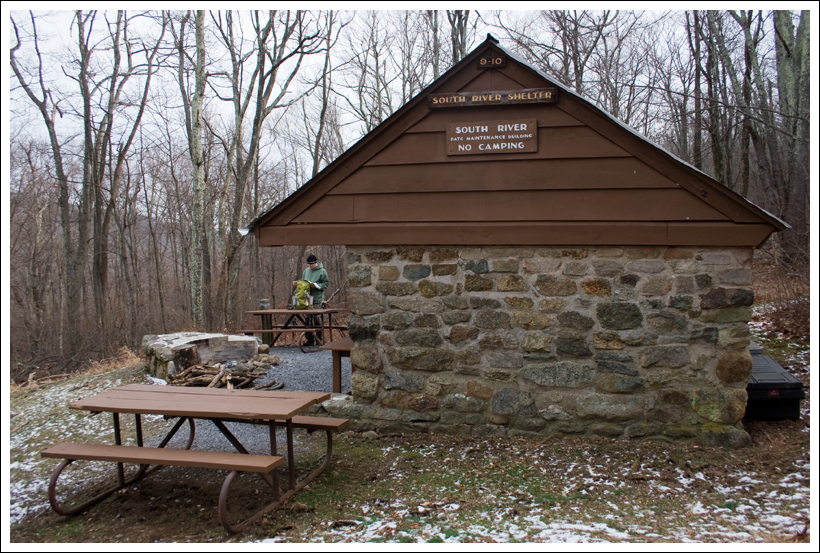
PATC Maintenance Building
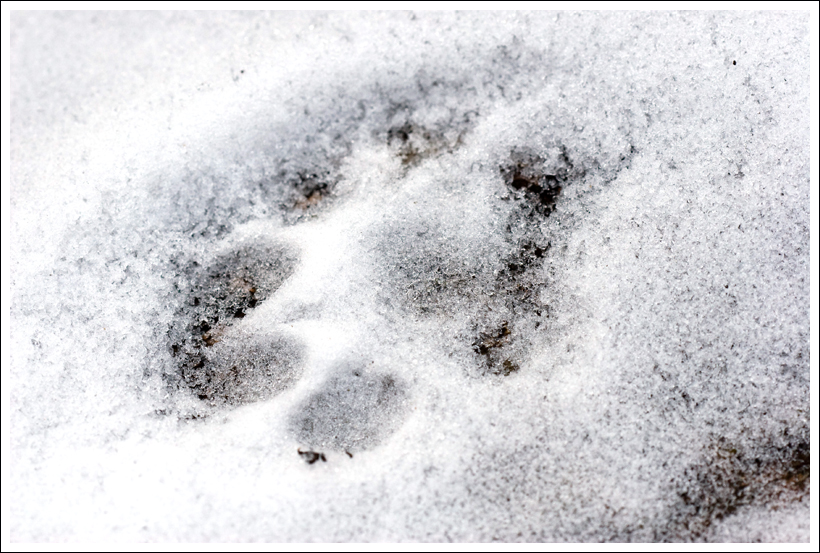
PATC Maintenance Building.  Below: Adam checks out the map at the first trail intersection; Someone left pennies on top of each of the cement trail marker posts; We saw some pawprints in the snow – maybe a fox or bobcat – they were too smudged to determine for sure.

Adam checks out the map Penny Pawprints in the snow

As we started up the Appalachian Trail, I couldn’t help but remember that this was the exact spot we met our friends from The Traveling Circus back in May.  The trail looks pretty different now than it did back then – bare trees and fallen leaves instead of a lush tunnel of green.  While the woods might be prettier in the spring, summer and fall, there is still something I really enjoy about winter hiking.  I like the lack of bugs, the fact that I don’t get sweaty, the solitude and the glimpses of views through the trees that you miss the rest of the year.

A few tenths of a mile up the trail, we took a short spur to take a look at an old cemetery.  Headstones we saw dated back to the turn of the twentieth century.  Many of the people buried here lived in the park throughout the 1800’s up until they were forcibly removed in the early 1900’s by the US Government.  I think there were many older unmarked graves as well, but we took a few minutes to read each of the headstones still left standing.

After leaving the cemetery, the trail climbed gently, but endlessly, uphill to the junction of the Saddleback Mountain Trail.  There really wasn’t anything remarkable about the trail to this point – no amazing scenery, just the occasional peek through the trees at the valley and Skyline Drive below.  Adam and I laughed at how bare of the snow the drive was every time it came into view.  We really don’t understand why it was closed at all.

We turned onto the Saddleback Trail and enjoyed a relatively flat walk skirting around the shoulder of the mountain.  Near the end of the trail, we passed a PATC maintenance cabin and a pit toilet.

We stopped to rest a few minutes.  I noticed a thermometer on the hearth outside the cabin and saw that it read 40 degrees – pretty balmy for a winter hike!  The morning we hiked, a bit of a southerly air flow arrived.  The warmer air came in aloft, creating the rare phenomenon that it was much warmer in the mountains than it was down in the valley.

From the PATC cabin, we passed the South River spring (a boxed spring intended as a water supply) and headed up a short fire road to meet back up with the Appalachian Trail.  We turned south, and walked along the AT, climbing up to the summit of Saddleback Mountain.  The summit of Saddleback is covered with trees and does not offer a view.

After crossing the summit, the hike was an easy, all-downhill stroll back to the car.  Even though we didn’t get to hike the route we originally planned, this Saddleback loop made a great substitute and we had a fun morning.

Trail Notes

  • Distance5.9 miles
    (Check out the stats from Map My Hike)*
  • Elevation Change – about 1080 feet
  • Difficulty – 2 There is some steady uphill, but it is manageable.
  • Trail Conditions – 3.5. Since most is on the AT, the trail is very well-maintained, but rocky and steep in spots.
  • Views1. We only had a few views through the trees, that I’m sure would not be there when leaves are on the trees.
  • Waterfalls/streams – 1. Two springs near the shelter.
  • Wildlife – 3.5. We did see deer and heard the echoing sounds of a pileated woodpecker.  There was also fresh bear scat in the area and possible tracks in the snow.
  • Ease to Navigate –4. This is fairly easy to follow if you read the concrete posts at the junctions.
  • Solitude –4. You may see some hikers on the AT due to the proximity to the South River picnic area.

MapMyHike is not necessarily accurate, as the GPS signal fades in and out – but it still provides some fun and interesting information.

Directions to trailhead: Once you go through the Swift Run Gap entrance station, park your car across the street from the stop sign.  The Appalachian Trail sign is straight ahead and head north.

Snead Farm

This 3-mile hike leads to the old Snead Farm.  It’s one of the few hikes in the park that really shows off what life at the turn of the twentieth century must have been like for the people who made their homes where the park now stands.

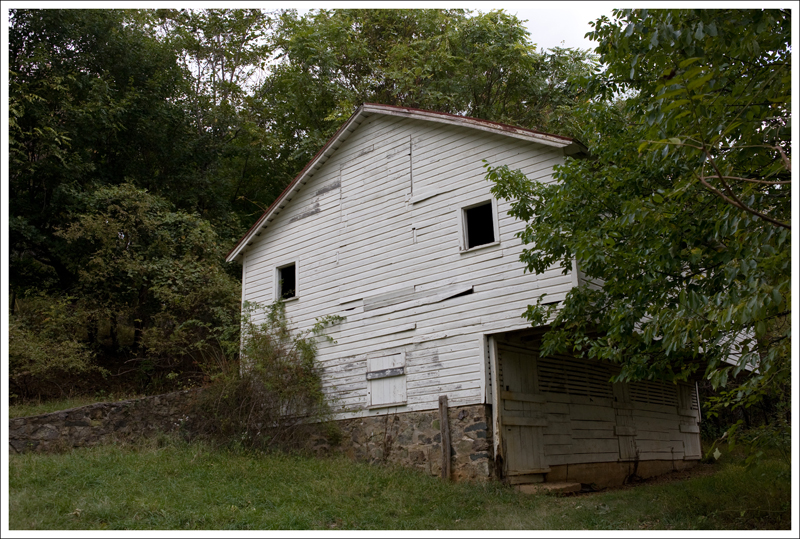
Snead Farm - Barn and Cistern
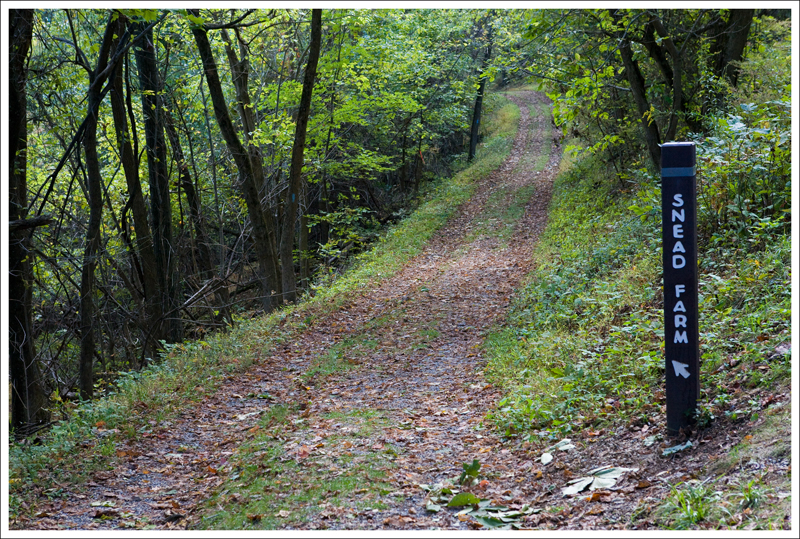
The barn at the old Snead Farm is still in good shape. Most of the other structures are gone, only foundations left.  Below: There is a view from the fire road before you follow the final fork to the farm.

View from Snead Farm Fire Road

Christine Says…

The walk to Snead Farm is really easy and perfect for families.  Much of the trail is level and follows a fire road.  There are a couple of route options, too. If you start from the visitor’s center, you’ll walk .8 miles on the Dickey Ridge trail before reaching Snead Farm Road.  This ends up making a three-mile route, and is the route we followed.  You can also start from Skyline Drive, directly on the Snead Farm road.  This cuts the route to a mere 1.4 mile out-and-back.  Just be sure to follow the correct forks in the road, or you’ll find yourself on a walk to nowhere (like we did… more about that later).  Whatever route you choose, the going is easy and relatively level.

As far as I know, Snead Farm has the only remaining barn left standing in the park.  In fact, it’s one of the few non-park structures of any kind left standing within the boundaries. The doors are barred closed, so you can’t go inside – but you can peek through windows and gaps in the doors to see the old hayloft up top and animal stalls on the lower level.

Behind a tangle of vines, you can still climb down into the root cellar located behind the barn. The cellar is deep and lined with sturdy shelves, which undoubtedly held stores of food for the farm.  The main house’s foundation and several sets of stairs still stand slightly uphill from the barn.  The boxwoods that stood on either side of the front door are still there.  They have grown tall and wild!  The cistern is still there as well.  The farm was occupied until the early 1950’s, so the site doesn’t feel as old as some other places in the park, like Pocosin Mission.

Adam Says…

Our hike to Snead Farm ended up being longer than we were expecting.  We were using our Falcon Guide Shenandoah National Park book as a guideline and there was misleading information in the book.  I’ll try to set things straight with our own directions.  From the Dickey Ridge Visitor Center, cross Skyline Drive and walk to the flagpole.  Take a right at the plaque with hike information.  In .2 miles, you will come to the intersection with the Dickey Ridge Trail.  Take a right here and proceed for about .3 miles until you reach a fire road (Snead Farm Road).  Take a left on the fire road.  In another .2 miles, you will reach a fork on the trail.  Stay to the left.  In another short distance, you will come to another fork where you will see a concrete post.  Go to the right, heading uphill.  You will continue this trail for about .5 miles until you reach Snead Farm.  You will begin to see the barn through the trees.

We did misinterpret the information in the book since it told us to take a left at the last fork.  Since we were going a different way than the book, we ended up second-guessing ourselves.  When we thought we had gone far enough, we decided to turn around and take a different fork.  When the other fork came to a dead-end at a utility building, we realized we had been going the right way.  We went back the way we came, took the correct fork, and made our way to the farm.  We ended up adding only an extra mile to our hike, but after doing a couple of other hikes that day, we weren’t in the mood for more miles.

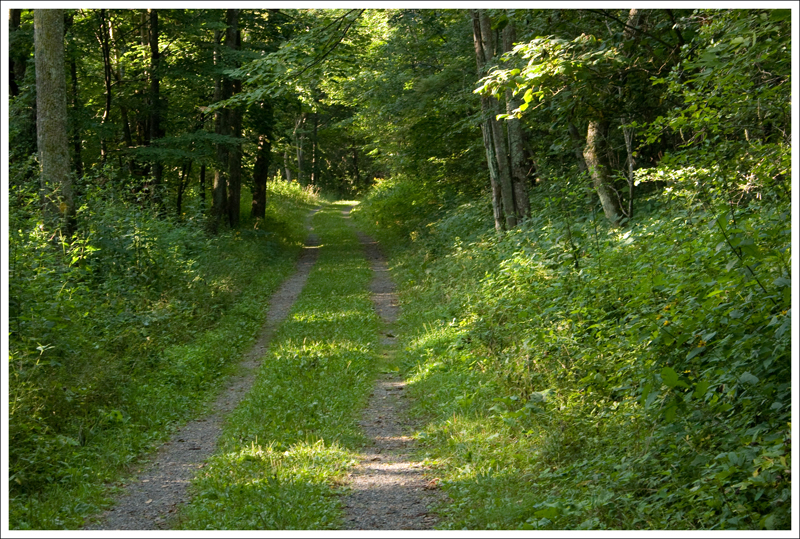
The Snead Farm Fire Road is pleasant walking.
The Snead Farm Fire Road is pleasant walking.  Below: The old root cellar is still standing; Another view of the barn.

Snead Farm Root Cellar Another view of Snead Barn

Christine and I marveled at how well-maintained the barn looks.  Since it was abandoned in the 50s, it is clear that the park service has kept up with maintaining the barn and even painting it.  I wonder if this will be a permanent part of the hike or if the park service will one day let this building fall prey to the elements and the woods.

Overall, this hike was a decent leg-stretcher and a good family hike.

Trail Notes

  • Distance – 3 miles
  • Elevation Change – 300 feet
  • Difficulty – 1.5 An easy walk down a mostly level trail.
  • Trail Conditions –3.5. Half of the trail followed the Dickey Ridge trail which was well-maintained and the rest is on fire roads.
  • Views1.5 Some views are seen from the final fork to get to Snead Farm.
  • Waterfalls/streams – 0. Non-existent.
  • Wildlife – 2. You may run into some of the usual park animals like deer and birds.
  • Ease to Navigate – 2.5. The turns did us wrong, so we’re marking it down.
  • Solitude – 2.5. This is a popular hike due to the proximity to the Northern entrance to Shenandoah National Park and the short distance.

Directions to trailhead: Follow Skyline Drive to the Dickey Ridge Visitors Center (around mile marker 4.6) Park at the visitors center. The trail begins on the east side of the drive, across from the center.

Lands Run Falls

The hike to Lands Run Falls is a fairly easy 1.6 mile walk down an old park road.  The waterfall is not terribly large or impressive, but it’s definitely worth a look if you’re in the mood for a short leg-stretcher.

Adam sits alongside Lands Run Falls.
Adam sits alongside Lands Run Falls.  The falls were still a little on the low side despite five inches of recent rain.

Christine Says…

We planned to do a long hike on Saturday, but Adam was having knee trouble.  Instead, we waited until Sunday and decided to try doing a few short, gentle hikes in the north district of Shenandoah National Park.   It’s been several years since I ventured as far north in the park as Lands Run Falls, so it was a nice change of pace.

The walk to the waterfall stays on a wide gravel road the entire time, so the footing is easy and there is absolutely no place you can possibly take a wrong turn.  The only place you might go wrong is by hiking across the top of the waterfall and missing it completely.  The falls aren’t marked and they’re really not visible from the trail.  You’ll know you’ve reached the falls when you pass over a small stream and culvert. You can also follow the sounds of  falling water!

To get a good look at the falls, you’ll need to follow a worn path through the woods down into the ravine.  It’s a fairly well-worn path, and the rocks in the ravine sort of form big steps.  Be careful on the rocks immediately around the waterfall.  They’re very slick and covered with moss and algae.

Lands Run in Winter
The last time I visited Lands Run Falls it was winter and there had been quite a bit more rain.

If you hit Lands Run Falls when there has been lots of rain, you’ll be treated to a pretty waterfall with three small, but distinct drops.  The first drop of about 20 feet is the most accessible and the most photogenic.  The other two drops are mostly obscured by blow-downs and underbrush.  If the weather has been dry, Lands Run Falls probably is not worth your time.  It frequently dries up completely in the summer.

In Henry Heatwole’s well-known Guide to Shenandoah National Park and Skyline Drive,  he stated “This [Lands Run Falls] is an unrewarding experience for most people… This is for the very few hikers who are willing to go to a lot of trouble to find solitude beside a pool on a mountain stream.”

I wouldn’t characterize Lands Run Falls quite so grimly.  I mean, it’s not spectacular – but it is definitely worth seeing if the water flow has been nice.

Adam Says…

We started off with this as our first of three short hikes for the day.  I was battling some knee issues and Christine thought we should turn around because I was limping the first few steps.  I felt I could make it though and luckily my knee felt better on the trip back up from the falls.

You descend 310 feet during this walk down the fire road.  While it doesn’t seem quite as noticeable on the way down, you will feel the elevation change on the way back up.  Most people should be able to do this hike, but you may need to take your time if the steepness gets to you.

Once you reach the area of the falls, to get the views that we did, you do need to climb down a steep section off the trail that can be slippery.  I was able to do it on a bad knee, but you do have to watch your feet carefully.  The fire road continues further for another 1.4 miles past the falls, but that only leads to a park boundary and there is nothing of interest to see.

The day was quite brisk with temperatures in the upper 40s.  I initially wished that I had brought a fleece along, but once the blood got pumping I was fine in my T-shirt and shorts.  The leaves were just starting to turn color – I think we’re still two weeks before peak season on Skyline Drive and higher elevations.

Lands Run Fire Road
The Lands Run Fire Road descends about 300 vertical feet over .6 of a mile to the falls.

The trail was a nice quick view to a waterfall.  I believe it is a somewhat popular trail, but that is largely due to the number of people that are driving down from Northern Virginia and are looking for a close waterfall hike.  The falls themselves are pretty but they are not as impressive as many others in the park.

Trail Notes

  • Distance – 1.6 miles out and back
  • Elevation Change – Around 300 feet
  • Difficulty – 2. Relatively easy, but definitely uphill on the return trip
  • Trail Conditions – 4.5 The trail is a well-maintained fire road
  • Views0.  The trail stays in the woods and does not offer any panoramic views
  • Waterfalls/streams – 3. Lands Run Falls is small but pretty.  It does dry up when there hasn’t been much rain
  • Wildlife – 2. You’ll likely see the usual park specimens along this trail – birds, squirrels and deer
  • Ease to Navigate – 4. The fire road doesn’t have any turns.  Be careful not to miss the falls – you walk over a small stream and the waterfall cascades below the trail.
  • Solitude – 3.  We saw a couple groups, but for a beautiful fall day, the traffic was light.

Directions to trailhead: Follow Skyline Drive to mile marker 9.2.  Park in the lot on the west side of the drive.  The hike starts at the south end of the lot.

Woodstock Tower

The Woodstock Tower hike is a fairly easy hike in the Lee Ranger District of George Washington National Forest that leads to a fire tower with 360-degree views of the surrounding area.

View from Woodstock Tower
The view from the Woodstock Tower is panoramic - offering views of the valley, river and distant mountains. Below: A wider view includes the mountains; It really wasn't the best time of day to photograph the actual tower -- I had to shoot right into the sun; The inside of the tower is covered with graffiti.

A wider view Tower Sunburst Inside the Tower

Adam Says…

After parking in the Little Fort Campground area, we headed up for our hike to Woodstock Tower.  The white-blazed Wagon Road/Nature Trail starts off as a rough fire road and after .1 mile, intersects with Peters Mill Run.  Peters Mill Run is an ATV/OHV trail, so look both ways before crossing this popular trail for ATVs and motorcycles.  Continue straight across Peters Mill Run to connect to the trail again.  The trail does go steadily up with a few switchbacks, but the switchbacks really make the trail easier of a climb.  The first switchback comes in around .25 miles and the second switchback comes around .5 miles.  After the second switchback, the trail does become steeper, but it ends after just a couple tenths of a mile.  At .7 miles, take a left on the pink-blazed Tower Trail.  It is only about .2 miles to reach the tower on a fairly level trail.

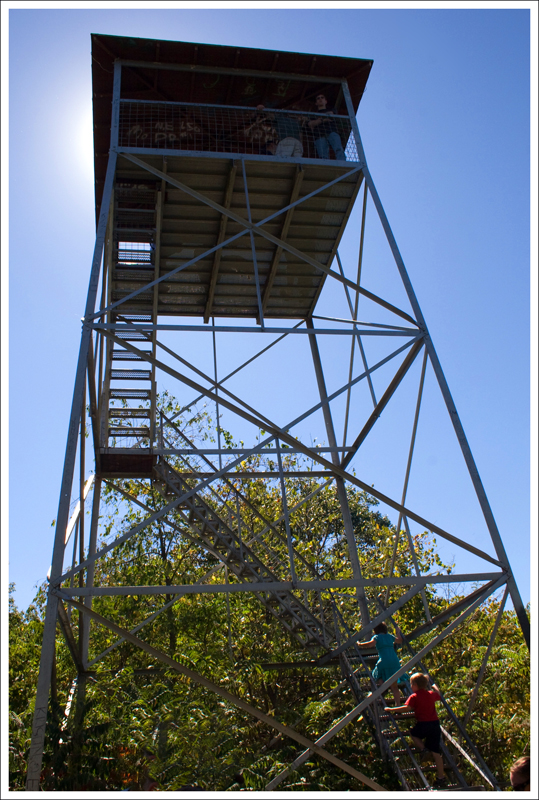
The Woodstock Tower
The Woodstock Tower. Below: A little bit of fall color was already showing; We took a break for water where the short trail meets up with the longer trail; Looking up through the Woodstock Tower.

A little fall foliage Water Stop Looking up through the tower

When we reached the tower, we climbed up the metal stairs to reach the top.  I’m not a big fan of heights, but I’m especially nervous when it involves man-made things.  The tower did seem quite sturdy, but it makes some noises when railings move slightly, so I was more eager to get down from the tower than the rest of Christine’s family.  The views are nice, but the area is quite crowded.  Unless you went up early in the morning, I fear that it would be hard to have a moment’s peace at the top.  There aren’t any signs posted for maximum number of people on the tower and you may have to hug the side of a platform as people pass in opposite directions.
There are a few geocaches in the nearby area:

Christine Says…

This was the second time I’ve been to the Woodstock Tower.  Last time I was there was several years ago in mid-October.  I remember the fall foliage being amazing from atop the tower. This time, the foliage had just the slightest hint of change, but the day was crystal clear and sunny – not a bit of haze – so the view was extra nice.

There are shorter ways to get to the view.  In fact, you can practically drive right up to it.  However, we chose to hike up from the Little Fort campground instead.   The slightly longer route gave my mom a chance to try out her new hiking boots.
Off Highway Vehicle
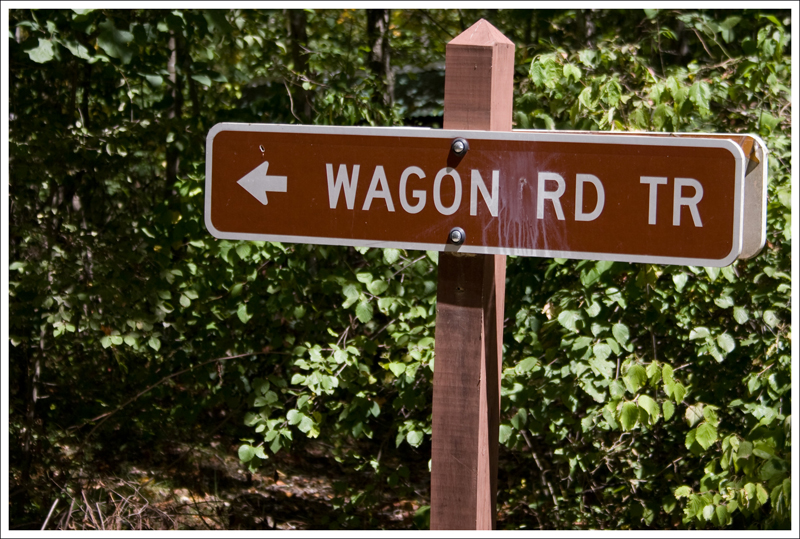
The area has lots of ATV and dirt bike trails. Below: All the roads and trails in this area are well-marked.

Wagon Road Campground Sign

Because the day was so beautiful, we had to share the tower with crowds of people.  At times, there was actually a line of people waiting to get to the top.  We even saw a person trying to coax their pit bull up the open, metal stairs.  That didn’t go so well, and they had to turn back about halfway to the top.  The inside of the tower is covered with graffiti and the area is littered with broken beer bottles and empty soda cans – a very unfortunate side effect of its popularity.

Despite the tower’s less-than-pristine nature, it still offers one of the best views of the mountains in the area.  It’s well worth the short walk.

Trail Notes

  • Distance – 2 miles
  • Elevation Change – about 500 feet
  • Difficulty –2. While you would think that going up 500 feet in one mile would be steep, the trail up seems to take off a lot of the steep terrain.
  • Trail Conditions – 3. The trail had some loose ground in a few areas (especially in the first .1 mile), but overall was well-maintained.
  • Views – 4.5. It does have 360-degree views, but we always enjoy views from natural surroundings like rock outcrops over man-made towers.
  • Waterfalls/streams 0. Non-existent.
  • Wildlife – 2. Too many people to see anything other than people.  May be good for hawk spotting or some other woodland birds.
  • Ease to Navigate – 4.  Not too many turns on this one and trails are well-labeled.
  • Solitude – 1. You will see lots of people on this trail during a nice day.

Directions to trailhead:
We approached this from I-81.  There are other ways to the east to approach this, but here is the most common way for anyone traveling via interstate.  Take exit 283 on I-81, heading east on 42.  Stay on 42 until it intersects with US 11.  Take a left on US 11, heading north through the town of Woodstock.  As soon as you pass the Woodstock Shopping Center, take a right on S.R. 665/Mill Road.  Take this until it ends at S.R. 758/Woodstock Tower Road.  Take a left here and continue to follow S.R. 758 up and down the mountain (this area can be scary when passing other vehicles – there are no guardrails in most spots).  Be sure to stay on S.R. 758 until you reach Little Fort Campground.  Turn into the campground area.  There are campsites and parking spots along the road here.  The trailhead is located on the right-hand side of the road near a campsite right before you reach the outdoor restrooms.

Simmons Gap

Simmons Gap is a very easy walk from the ranger station down to the park’s eastern border.  It follows an old route used by the mountain people that inhabited the area.

Simmons Gap Fire Road
The Simmons Gap fire road extends to the park boundary. Below: We saw a bear less than a tenth of a mile from the Simmons Gap parking area; Apple trees probably attract lots of wildlife; Bear scat was everywhere along the Simmons Gap trail.

Bear Near the Trail Apples Trees Along the Way Scat

Christine Says…

Truthfully, we probably wouldn’t have bothered with this hike if it weren’t so close in proximity to the other two we selected for the day.  Our Falcon Guide said it was nothing special, but it was one of the few hikes left in the park that we haven’t done at least once.  (There are a few long 10-16 miles hikes still on the to-do list, but we’ll likely do those as backpacking trips)

The walk down Simmons Gap was about what I expected – a quiet walk down a shady path through the woods.  There wasn’t much scenery – no views and no waterfalls.  The stream running along the trail was nearly dry despite the decent rain we’ve had lately.

As we walked, we kept our eyes peeled for bears.  We had seen a bear less than a tenth of a mile from where we parked our car.  Also, the fire road was practically paved with bear scat.  Besides the ridge of Knob Mountain, I don’t think I’ve ever seen so much bear poop in one place. Unfortunately, all we saw was the poop… no bears!

Wildflowers in Simmons Gap
Wildflowers along the Simmons Gap fire road. Below: The trail follows along, and eventually crosses a small stream.

Small Stream Along Simmons Gap

There are many hints of a bygone era along the trail – old stone walls, crumbling foundations and the odd apple tree tucked into the forest.  The spot where the fire road meets the park boundary is obviously used as a dump by people who are too rude and lazy to take their garbage to a proper facility.  The streambed at the end of the trail was littered with everything from a broken baby stroller, to a beaten plastic Shrek suitcase to a box full of empty 2-liter bottles of Dr. Pepper.  It was disgusting.  I wish I knew what people were thinking when they did stuff like this. How could anyone back their car up to a beautiful mountain stream, and just empty their trunk-load of discarded property?

Despite the disappointment of seeing the litter, we still had a nice walk down the path.  Although, I don’t think I’d recommend this hike to anyone.

Trail Notes

  • Distance – 1.6 miles out and back
  • Elevation Change – About 200 feet
  • Difficulty –1. Easy walking with very little elevation change.
  • Trail Conditions – 4.5. This fire road is smooth and easy to walk on.
  • Views –0. You’ll be in the woods the whole time.
  • Waterfalls/streams 1. The small stream is pretty and is often lined by stone walls, but it may be dry most of the summer.
  • Wildlife – 3. There’s a good likelihood of seeing bears in this area.
  • Ease to Navigate – 5. There is no place to go wrong.  Follow the fire road straight out and back.
  • Solitude – 4.5. Because there isn’t much to see in this area, not many people come this way.

Directions to trailhead:
At mile 73.2 on Skyline Drive you will see a small parking lot on the western side of the road (directly opposite of the sign for the Simmons Gap Ranger Station).  Cross Skyline Drive, walking on the paved road to the ranger station.  You will see a chain guarding a fire road.  Cross the chain and start the trail down the fire road.

Pocosin Mission Trail

The Pocosin Mission Trail is a fairly short walk along a fire road that leads to the ruins of an abandoned Episcopal mission.

Pocosin Mission Ruins
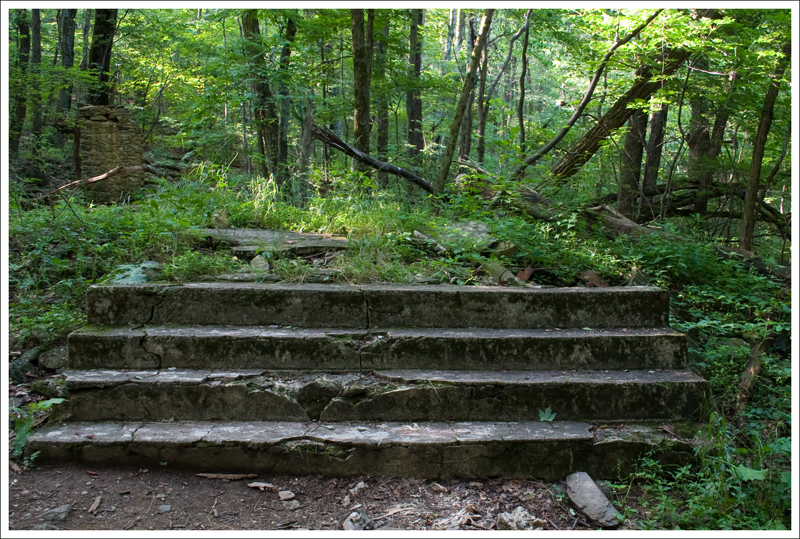
The Pocosin Mission ruins are slowly sinking back into the forest. Below: The fire road makes this trail pleasant and easy to walk along; The old church steps still stand at the site; Adam explores the ruins.

Pocosin Church Steps Adam Explores the Mission Ruins

Adam Says…

We’re back to Virginia hikes!  This week, we’ll be sharing a trio of short hikes.  In fact, the hikes are so short that we’re going to skip doing our typical dual write-ups.  I’ll cover this one, and Christine will cover the next two.

Since we had surprisingly nice temperatures on an August day (it didn’t get above 68 on our hike), we decided to go for three short hikes off Skyline Drive. The last time we did the Pocosin Mission Trail we were with a couple of friends.  Shortly after we got to the mission site, we were pounded with a fierce thunderstorm.  We were all so soaked to the bone, that we ended up buying clothes at the Big Meadows wayside, looking like complete tourists with all of our Shenandoah National Park gear.

PATC Cabin

The PATC maintain a cabin, available for rent, along the Pocosin Mission Fire Road. Below: Wildflowers (and bees) were abundant along the trail; We saw many varieties of berries; There were also butterflies everywhere.

Bees and Flowers Along the Pocosin Trail Berries Along the Trail Butterfly along the Pocosin Trail

On this trip, we had a nice easy stroll down the fire road.  After about .2 miles, the road crosses over the Appalachian Trail, but you just want to stay on the fire road for this trail.  We took a few minutes on our way down to stop by the PATC Pocosin Cabin, which can be rented by the PATC.  The cabin was locked, but we could tell that people renting this cabin would wake to a nice sunrise view.  Continue down the trail for another .8 miles until you reach another cement post, marking the junction with the South River Falls fire road.  You will see the remains of a cabin nearby and stone steps with a foundation.  After exploring, just go back to your car up the fire road.

The Pocosin Mission was an Episcopal mission established in 1904 for the mountain community living in the area.  “Pocosin” is a Native American word meaning “swamp”.  The mission building is actually where you see the stone steps, a small foundation, and a fallen-down chimney.  Be careful as you explore the area – there is a lot of broken glass and twisted metal.  The cabin has a rusted metal roof and there are plenty of rusted materials on the ground, so watch your kids carefully in this area.  In addition to these sites, there is also an overgrown cemetery that is across the trail from the mission, marked by old nameless headstones.

Old Church Walls and Fallen Chimney
The old church walls and a fallen chimney are still visible. Below: Buckets and an old sink can still be found inside the mission ruins.

Inside the Ruins

For those interested in the history of the people that lived on this mountain will enjoy visiting this site.  While there aren’t any views to speak of, the hike does cause you to speculate on how life was back in the early 1900s being a part of a community that lived and worshiped together.

Trail Notes

  • Distance – 2.2 miles out and back
  • Elevation Change – 450 feet
  • Difficulty 1.5.  Most people should be able to handle this.
  • Trail Conditions 4. It’s just a fire road, so not much difficulty for trail conditions.
  • Views –0. No views.
  • Waterfalls/streams 0. No streams/waterfalls.
  • Wildlife 2.  There should be a variety of wildlife in the vicinity.
  • Ease to Navigate 5.  Just straight down a road and back.
  • Solitude 4.  This isn’t a very popular spot, so you should have your peace.

Directions to trailhead:
Around mile 59.5 on Skyline Drive, you will see a small gravel road leading to a parking lot on the eastern side of the trail.  Park here, cross the chain, and walk down the fire road to start the trail.

South River Falls

This 4.6 mile hike leads you along the South River to an impressive waterfall that plunges deep into a canyon.  When the park has experienced lots of rain, this waterfall hike is one of the nicest Shenandoah has to offer.

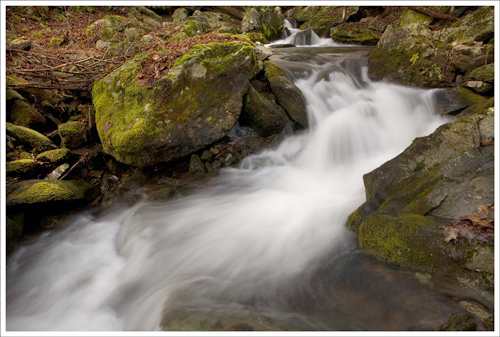
Cascades along the South River
The South River is impressive in times of heavy rain.

Adam Says…

We have kept with a tradition the last few years of doing a hike on Thanksgiving morning.  It’s a great way to appreciate nature and try to do something active before a big meal.  This year, we decided to break the tradition of having a huge Thanksgiving meal with turkey and all the trimmings.  We decided to have an easier meal that we would both enjoy – homemade pizza.

We’ve hiked South River Falls before, but we’ve never had as much water in the falls before.  We thought it would be impressive, since we could hear rushing water through the South River a lot earlier than normal.  Waterfall hikes in Shenandoah National Park tend to be fairly tough ones.  Since you park on Skyline Drive at a high elevation, you have to hike down to the valleys where the falls are created.  What makes it difficult, at least psychologically, is that you get to the payoff fairly easily and then have to do the hard work on your way back to your vehicle.

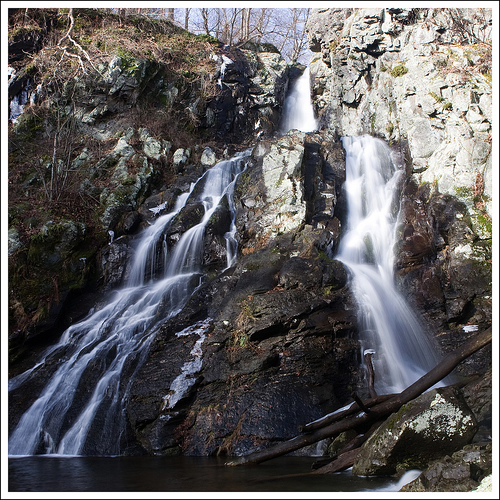
The South River right at the crest of the waterfall.
The beauty of the South River is found mostly in its small details. The cascades and little falls leading the large waterfall are prettier than the main waterfall.  Pictured below: South River Falls from the overlook at the top of the canyon; the falls from the base.  You’ll see neither vantage point of the waterfall is terribly photogenic (especially after the leaves have come down). Both of the small photos below are from another date.  This time, the falls were much bigger – but it was too sunny to photograph them.

The view from the top of the canyon. The view from the base of the falls

The hike begins at the South River Picnic Area.  Look for the large sign about the hike on the northeastern side of the picnic area.   At slightly over .1 mile, you will cross the Appalachian Trail.  You will continue your descent and around 1 mile, you will rock-hop across a small creek that drains into the South River.  Usually this is not much of a challenge due to the water, but we found the water was higher than normal this time.  At 1.3 miles, you will come to a nice overlook for the South River Falls.  You really get a great view of the 83 foot waterfall.  It plunges to a rocky ledge and splits in two about half of the length of the waterfall.  If you continue on the trail for another .2 miles, you will arrive at a cement post and join a spur to the South River Fire Road.  If you continue on for another .2 miles, you will descend even further and arrive at another cement post.  Following the path from the cement post for another .1 mile, you will arrive at the base of the falls.  For any adventurous shutterbugs, there are ample opportunities near the base of the falls for long-exposure photography. Make sure you have your strength up, because you have 2.2 miles to hike at a steady incline back to your vehicle.

To follow the trail as a loop as we did, once you make your return from the base of the falls, go .7 miles until you reach the cement post and the junction with the South River Falls Trail. Stay on the fire road instead and after .4 miles more, you will reach the yellow-blazed South River Fire Road.  Take a left on the road.  In about a mile, you will reach the junction with the Appalachian Trail.  Take a left on the white-blazed AT, heading south for about .4 miles.  You will then reach the junction with the South River Falls Trail and only have about .1 mile to reach the picnic ground.

The hike was a tough one, but it was nice to get some exercise.  The thought of carving into our pizza helped us muster the energy to make it back.

Christine Says…

This was a great trail to burn off Thanksgiving calories!  The terrain is rugged and the return arm of the loop is nothing but steady, tough uphill climbing.  Even Wookie, who is normally a bundle of boundless energy, got quite tired on this hike.  By the time we got to the Appalachian Trail junction, his corkscrew tail was completely unfurled.   Even though there are some hikes in the park with more elevation gain, I think the 1300+ feet on the South River trail provides some of the park’s tougher climbing.   Anyone looking for an easier version of this hike should consider doing the short loop (3.2 miles) that returns after the overlook at the top of the falls.  By taking that route, you reduce the elevation gain to a very manageable 850 feet.

Despite the hard work required to get there, I really enjoyed seeing the South River and its namesake falls so flush with water.  The Shenandoah area has had over five inches of rain in the month of November – more than double the normal amount.  All of the park’s streams, rivers and waterfalls are flowing beautifully right now.  It’s a great time to get out and enjoy the scenery and the less-crowded conditions in the park.

Cascades along the South River
There are many small, but beautiful, waterfalls along the trail. Pictured below: Another pretty spot along the river.

Cascades along the South River

I had hoped to get some photo opportunities along the river on our Thanksgiving hike.  I did take a few shots, but the weather was less than cooperative.  It was too sunny to take shots of the moving water. Every now and then, I found a shady spot down in a deep ravine.  I did a bit of bushwhacking to get to a few pretty spots, but overall I don’t feel like I came home with any special photos.

Honestly, while South River falls is probably the park’s most impressive waterfall, it is not one that translates nicely on film.   The falls plunge into an enormous natural amphitheater.  The sheer rock walls are amazing, but they aren’t photogenic.  I’ve seen a few nice shots of South River Falls in the spring, when the water is flowing and the falls are surrounded by the lush new green of the trees and plants.  In the late fall and winter, the falls are really scrubby and barren looking.

I think some of the prettiest and most dramatic places along the South River come at the bottom of the falls.  In the last .1 mile of the trail, leading to the base of the falls, the water tumbles over a hundred feet down over giant boulders.  There are many small, beautiful waterfalls to enjoy before you get to work climbing back up to your car.

When we got home from our hike, we found several TICKS!  Can you believe it – ticks in late November; ticks after the mountains have had snow and temperatures at night are regularly below freezing?  These were tiny ticks – about the size of a pinhead.  We pulled one off Adam’s sweatshirt and two off of Wookie.  I hate having to watch for ticks year round, but it seems that we must.

Wookie Says...Wookie Says…
Hey all of you fellow hiking dogs.  It’s been a while since I’ve been hiking, so I’m going to let you know what I thought of the trail.  I enjoy getting the chance to get in the outdoors and I usually run laps around the house when my masters ask,  “Would you like to go on a car ride?”

The hike on South River Falls was pretty fun for the most part.  I enjoyed going downhill until I reached the stream to try and rock-hop.  I’ve done this hike before with my masters, but there was a lot of water this time around.  I don’t really like to get my feet wet and when I see any water on the hike, I try to take the driest option.  After Adam crossed the creek, I really didn’t want to follow him.  Only after Christine gave me a little nudge with her trekking poles, did I take the plunge and hop across the rocks.

Wookie Enjoyed the Hike
Wookie enjoyed the hike, but was exhausted the rest of the day.

All the rushing water on the trail, really made me need to go to the bathroom.  I tried to make my mark as much as possible to let all my fellow canines know that Wookie was here.  The hike back from the falls was pretty brutal for a small dog like me.  My tail was down a lot of the trip back, because it was exhausting.  At least I got some pizza scraps and a taste of sausage instead of turkey scraps this year.  For that, I was truly thankful.

Trail Notes

  • Distance – 4.6 miles – loop.
    (Check out the stats from MapMyHike – added 5/16/15)
  • Elevation Change –1315 feet.
  • Difficulty – 3. The return arm of the circuit climbs steeply uphill along a fire road for two straight miles.
  • Trail Conditions – 4. The trail is in great shape.
  • Views –0. You are deep in the woods for the entire hike.
  • Waterfalls/streams –4. In times of heavy rain, the South River is an impressive stream.
  • Wildlife – 0. We didn’t see *anything*, but over the summer there was a bear with three cubs in the area.
  • Ease to Navigate – 4. Trails are clearly marked.
  • Solitude – 2. This trail’s proximity to a park entrance makes it a popular hike.

Directions to trailhead:
From Skyline Drive, follow the drive to the South River Picnic Area (near mile marker 62).  The trailhead is located at the back end of the picnic grounds, across from the restroom facilities.