Appalachian Trail – Loft Mountain to Brown Gap

This 7.1 mile hike picks up right where we left off on our last Appalachian Trail segment.  It turned out to be an easy section of hiking with many sweeping, panoramic views.

The View from Atop Loft Mountain
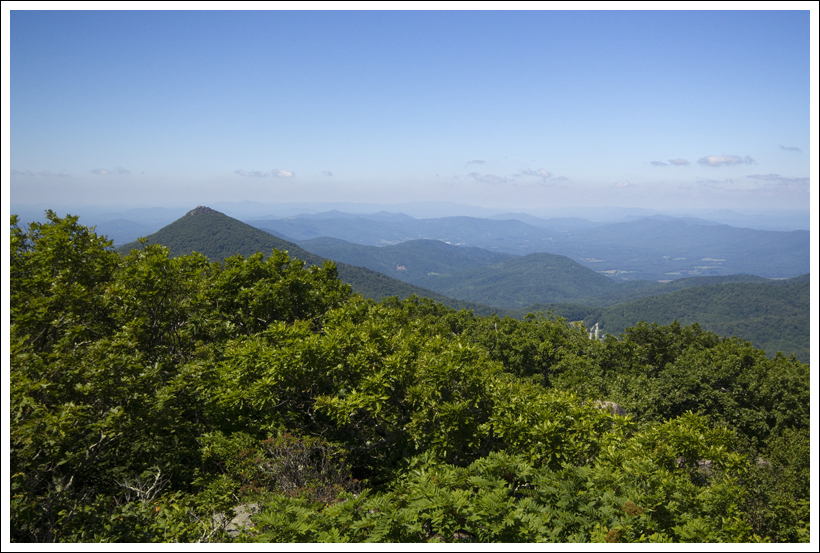
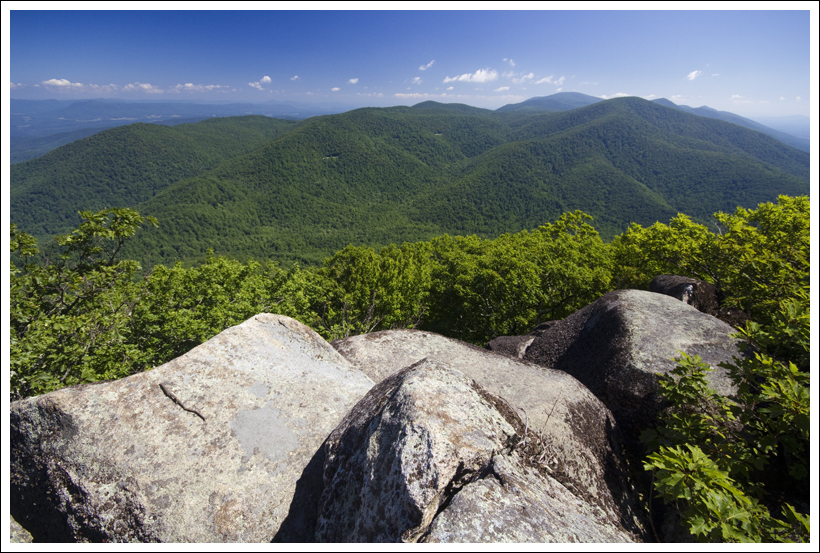
The view from Loft Mountain is one of the nicest in the park. Below: Wookie perches on the tool chest at the Ivy Creek maintenance hut; Taking in the view from the first eastern-facing overlook. You’ll pass this spot on the initial climb up Loft Mountain.

Wookie at Ivy Creek Eastern Overlook

Christine Says…

When we got to the Loft Mountain Wayside to begin our hike, the temperature was hovering right around 40 degrees and the wind was howling through the trees, making it feel quite a bit colder!  I donned a fleece pullover, gloves and a hat for the first time since last winter.  It was kind of nice to bundle up for a change.  I actually enjoy cold weather and snow (although I dislike the short, dark days and bare-limbed trees that winter brings.)  This was the valley’s first real cold-snap of the fall season, and I was glad we had a chance to get out for another hike.  Since the hike was not too long or hard, we brought our pug, Wookie, along for the trek.

The hike started off with a climb back up the Patterson Ridge trail and past the Ivy Creek Maintenance Hut to reach the point of the Appalachian Trail where our last segment left off.   Most of the early part of this section is a gradual hike up Loft Mountain.  After about a half mile of walking, I had already warmed up enough to ditch the hat and gloves.  Climbing uphill is a great way to heat yourself!

Christine and Wookie
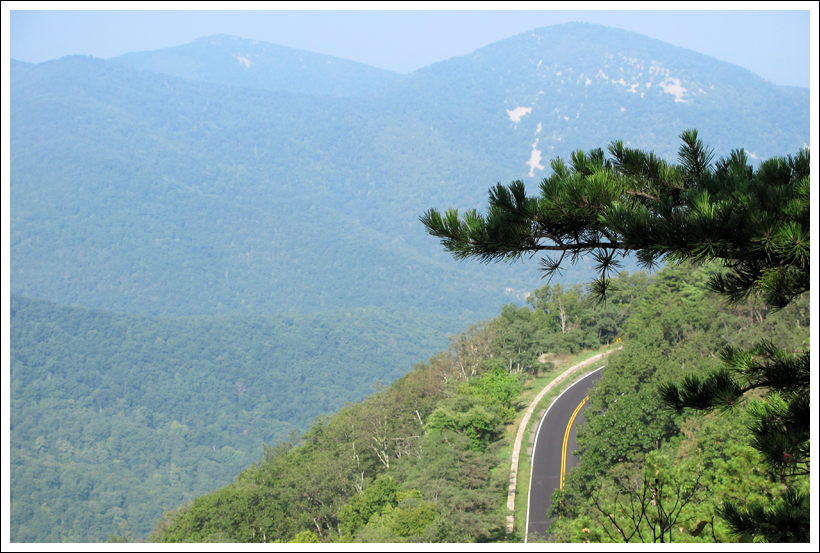
Christine and Wookie enjoy the windy view on Loft Mountain. Below: From Loft Mountain you get nice views of Massanutten peak and Skyline Drive; Wookie stays hydrated.

Massanutten Wookie Drinking

I went into this section only expecting two nice views – the same ones we had seen when we hiked the Loft Mountain Loop a couple years ago.  So, I was pleasantly surprised that the open vistas occurred pretty regularly throughout the entire distance of the hike.  Instead of cutting a straight line through the middle of the camping area, the Appalachian Trail swings a wide arc around the area, adding distance but keeping the trail more scenic. In fact, some of the nicest views came from rocky ledges not far off the trail behind the Loft Mountain campground.

When we got to one of the overlooks near the campground, and I had a vivid flashback to my childhood.  My family camped at Loft frequently when I was in elementary school.  I remember our run-down, brown pop-up camper and the smell of bacon cooking over the campfire in the mornings.  I remember my dad’s goofy-scary ghost stories, making s’mores and going for family hikes on the AT.  So many fond recollections!  But this rocky overlook stirred a memory that wasn’t so pleasant!  I remember once when I was maybe seven or so, my parents let my brother and I go unsupervised to the overlook.  It was only a hundred or so yards from our campsite and we were well within earshot of mom and dad. For some reason, I decided to sit right on the edge of the rock shelf and dangle my feet over the edge.  It was all lots of fun, until it was time to swing my legs around and stand back up.  When I tried to get up, I couldn’t do it.  I was suddenly and utterly paralyzed with a fear of falling off that rock ledge.  I screamed and cried and sent my brother running to get my dad.  He dashed down, grabbed me under my armpits and yanked me back from the edge.  I had really forgotten about that moment until we passed the spot on this hike.  Looking at it again, it wasn’t quite as scary or precipitous as I remembered.

Ent
This tree looked like one of J.R.R. Tolkien’s Ents (see the eyes, nose and mouth?) Below: Butterflies were abundant, but they were all weak and slow due to the cold temperatures.

Monarch

After leaving the Loft Mountain area, the trail is really easy.  It’s either downhill or relatively flat for the remainder of the miles.  We covered the distance at a really good clip.  We passed quite a few other people out dayhiking – especially in the vicinity of the Doyles River-Jones Run trail.  We saw a lot of dogs out hiking, too.  All but two were leashed!  This was unusual and very welcome!  Wookie is always one of the smallest dogs on the trail, and big dogs sort of frighten him a bit when they come bounding up freely.

Near the end of the hike, the trail crosses a scenic overlook along Skyline Drive.  Basically, you walk across the overlook and pick the trail back up on the south end of the paved area.  A few tenths of a mile after that, the trail crosses to the west side of the Drive for the last mile of walking.

Our other vehicle was parked at the end of the segment – in the Brown Gap parking area.  Good hike!

Adam says…

This section of the Appalachian Trail can look misleading on a map.  On the road, it passes from mile marker 79 to 83, but the distance is longer on the actual trail since this section separates from the road to the east and winds around Loft Mountain and the Loft Mountain campground before rejoining the proximity of Skyline Drive again.  We left one vehicle at Brown Gap and parked our first vehicle at Loft Mountain.

Behind the Loft Mountain Campground
Some great views are a short walk from the Loft Mountain Campground. Below: Another nice view; Walking through the fallen leaves.

Views Near the Campground Trail

To make sure we cover every inch of the AT through SNP, we started off our trail by going down the fire road on the north side of the Loft Mountain wayside, across from the street.  You hurdle a small chain blocking off the fire road and then shortly take a right to head down the fire road.  You will pass the Ivy Creek Maintenance Hut and spring after about .3 miles.  At .6 miles, this fire road joins the white-blazed Appalachian Trail.  Take a right to head south and begin your climb up Loft Mountain.  At 1.1 miles, you reach a nice view to the east and at 1.6 miles you reach a few nice views to the west (along with an intersection with the Frazier Discovery Trail).  The trail then begins to take on a quick descent from Loft Mountain.  At 2.7 miles, you reach a post that shows a short side-trail to reach the Loft Mountain camp store.   At this point, you will begin to make your way around the Loft Mountain campground.  There are even a few trails to the campground, but you will see tents on a busy weekend through the trees.  Around 4.0 miles, you will also find some nice views if you step out on to the rocks near the campsites.  The trail begins to descend again.  At 6.1 miles, you will cross Skyline Drive and at 7.1 miles you should reach your vehicle at the Brown Gap parking lot.

Wookie Post Hike
Wookie was pretty happy with the hike.  Below: As soon as the car started moving, he fell asleep.

Sleeping Pug

This section of the AT had several great viewpoints.  The views from the top of Loft Mountain are in my opinion the best views from hiking in the southern section of SNP.  You’ll get to see views of mountains for miles and you can even glimpse Skyline Drive snaking through the mountain ridge.  It was also great to smell campfires from the Loft Mountain campground.  The smell of campfires on a cool day defines outdoors in the fall to me.

The day that we hiked this section happened to be JMU’s Homecoming.  Since we graduated from there a while ago, most of our close friends no longer return.  So, we typically try to avoid Harrisonburg that weekend, since it is packed with people at the restaurants, grocery stores, etc.  When we were just about a mile from the end of our hike, a group was coming up the trail and I heard someone say “Adam”.  It turned out to be a student assistant for our office and one of our JMU tour guides (of which, I used to serve as an adviser).  He was backpacking for a few days with some other students in his law program at the College of William & Mary.  It was great to catch up with him for a few minutes and it gave me a sense that we had our own version of Homecoming out on the trail.

wookieWookie Says…

It was great to get outside and do a hike.  On most trails, I tend to not be very confident with where I’m going.  I typically have Christine walk me, but I heel closely right behind her ankles with Adam walking behind.  This gives me a good buffer against anything we may come across on the trail.  But, if we are doing an out-and-back hike, on our return trip I remember where we’ve gone before, so I’ll walk proudly in front.  Since we did this with one car serving as a shuttle, I stayed in the middle on the hike.

The hike wasn’t too tough, since I’m in pretty good shape for a pug.  However, with about 1.5 miles left I started kicking my back foot out a little and was kind of limping along.  When Adam noticed this, we stopped.  It turns out I just had some mud between my pads which was making me step a little funny.  They don’t make hiking shoes for dogs like me, so occasionally this happens.

I did enjoy this hike, taking in the views and sniffing near the campgrounds for the smells of hot dogs cooking on the fire.  When we stopped for a quick break, I even found some peanuts on one of the rocks, left behind by some careless hiker.  I tried to wolf down before Adam & Christine noticed, but they were quick to grab me before I did.  I did have a few bowls of water to keep me hydrated and I got to eat some extra food when I got home.

Trail Notes

  • Distance 7.1 miles
  • Elevation Change – about 800 feet
  • Difficulty – 2. The hike was really pretty easy, but 7 miles might be long for some people.
  • Trail Conditions – 4.  The Appalachian Trail is typically in good shape, but this section was especially nice and not too rocky at all.
  • Views – 5.  Many excellent places to take in the scenery below.
  • Streams/Waterfalls – 0. None
  • Wildlife – 1.  We didn’t see anything beyond birds and squirrels.
  • Ease to Navigate – 4.5. Just follow the white blazes and sign posts.  The trail is very direct.  When crossing parking lots and the Skyline Drive, keep your eyes peeled for cement trail markers to continue your hike.
  • Solitude – 2.  This hike passes Loft Mountain Campground and the very popular Doyles River-Jones Run trail, so you’ll like see quite a few people.

Directions to trailhead: Park one vehicle at Brown Gap, near mile marker 83 on Skyline Drive.  Then drive up to the Loft Mountain wayside, near mile marker 79 on Skyline Drive.  The trail begins across the street on the north side of the wayside.

Appalachian Trail – Powell Gap to Loft Mountain

This post covers the ten miles from Powell Gap to Loft Mountain, with an overnight stop at the Pinefield Hut. Sleeping inside a hut is typically something reserved for people out on multi-night trips, so we tented in a spot uphill from the hut.  Hut sites offer the convenience of a spring-fed water source or stream (usually), a picnic table to cook on, a place to have a campfire (the only permissible place in Shenandoah’s backcountry) and access to a privy (no catholes to dig).

The Pinefield Hut
There was a nice group of eight people camping in or around the Pinefield Hut – our stop for the night.  Below: Pretty mountain layers as seen from the Ivy Creek overlook; Our tent site was on a hill above the hut. You can see the roof of the hut through the trees; Adam climbing the trail upwards from Simmons Gap.

Ivy Creek Overlook Our Tent Site Climbing Up From Simmons Gap

Adam and Christine Say …

We’ve found that with our backpacking trips, it’s usually easier to combine our thoughts into one large post.  Here we go!

Even though this backpacking trip was scheduled weeks ago, we weren’t sure until the last minute that we were actually going to pull it off.  It rained all week, Adam was having back spasms, our friends couldn’t make the trip and we were both coming off a particularly busy week at work.  Sitting in the air-conditioned house, pajama-clad, and watching TV from the couch seemed quite a bit more appealing than heading out into the damp, buggy woods with 30+ pounds of gear strapped to our backs.

The thing that ultimately tipped the scale in favor of hitting the trail for an overnighter was actually all the 9/11 anniversary coverage.  When Friday morning rolled around, Christine was feeling overwhelmingly sad.  All week long, virtually every news outlet had been covering 9/11 – bringing all the horrific imagery and stories back to the forefront.  Remembering and paying tribute is important to her, and she felt drawn to having a quiet, peaceful place to reflect without seeing any more images of people dying or cities burning.  We both wanted to be in the woods – away from the TV, away from the internet, away from the radio.

Powell Gap View
Adam takes in the view after the first climb out of Powell Gap. Below: There is not a paved parking lot at Powell Gap.  Instead, you can leave a car in the grassy field next to the trail entrance.

Powell Gap Parking

We had a leisurely Saturday morning.  Christine made a big breakfast with eggs and biscuits (for Adam), blueberry pancakes (for herself) and bacon (for both of us).  After cleaning up dishes, Christine packed our camp food into Ziploc bags and put together bathroom kits.  Adam worked on loading our backpacks.  We decided to eat lunch at home and then headed off to the park around 1:00.  We chose to hike south along the Appalachian Trail from Powell Gap to Loft Mountain, with an overnight stop at the Pinefield Hut.  We brought two cars into the park to make the trip logistically easier, parking the return car at the Loft Mountain wayside.

We left one car in the grassy field next to the trail entrance at Powell Gap.  After doing last minute pack checks, we headed off.  The trail climbs immediately upward from the gap.  You gain about 300 feet in just a few tenths of a mile. Within the first half mile, you pass a pretty eastern-facing view of the valley below.  We stopped and made some pack adjustments.  Adam insisted on taking over the burden of carrying our extra water.  The south district of Shenandoah is famously dry, so we hauled a 3 liter Nalgene canteen so we’d have plenty of water for cooking and hiking on Sunday. Even with all the rain, we weren’t sure if the spring at the hut would be running.  Christine bickered with Adam over the extra weight of the water, because she didn’t want him to make his back pain worse.  In the end, he won and we headed down the trail with the extra 6.6 pounds of water hooked and freely swinging from a carabiner on the back of his pack.  He was definitely carrying too much and it did slow his pace down a bit!

Young Bear
We spotted a young bear on a hillside before the descent to Simmons Gap.  Below: Stopping for a snack and map break at the Simmons Gap crossing; Our trekking poles make backpacking trips so much easier; Monarch butterflies were everywhere!

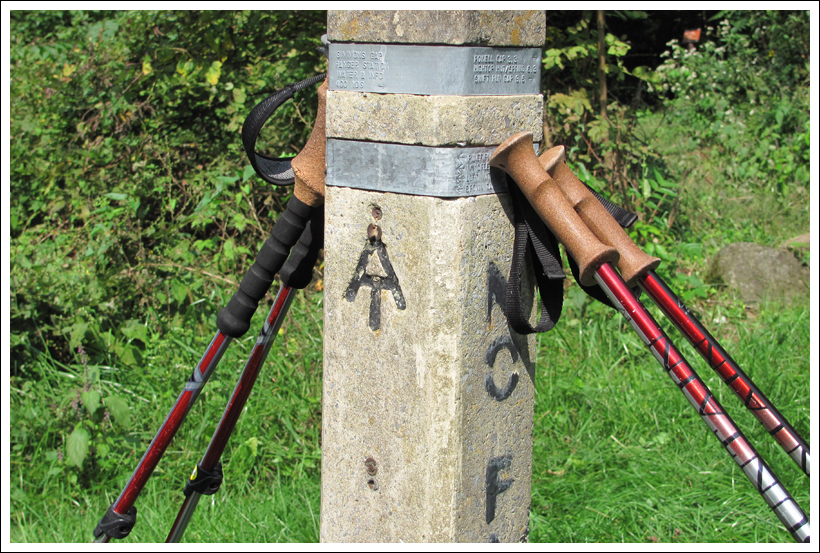
Snack Break at Simmons Gap Trekking Poles Monarch

The Appalachian Trail between Powell Gap and Pinefield Hut is pretty uneventful.  There are a few road crossings, several climbs and descents, and just the one open view.  Most of the trail is just typical walking along a forest trail – pretty, but not remarkable.

On the descent toward Simmons Gap, a black shape caught Christine’s eye.  She turned back and mouthed ‘BEAR!’ to Adam.  Sure enough, a handsome yearling bear was perched on the hillside, quietly watching us pass.  She managed to get an OK photo of the bear, but he was really too far up the hillside for our pocket camera’s zoom capabilities.  We stood still and had a little stare-down with the bear for a few moments before he turned and lumbered up the hill.  We’ve decided the park has two kinds of bears: 1) indifferent bears and 2) scared bears.  The scared bears run as soon as a human comes into view.  Indifferent bears may cast you a sidelong glance, but otherwise ignore you and continue along with whatever they were doing before you spotted them.  We like the indifferent bears; they’re easier to photograph!  We’ve never come across an aggressive bear in Shenandoah – thankfully.

At the trail crossing near the Simmons Gap Ranger Station, we stopped and had a snack of cashews.  The cement post indicated that we had 2.2 miles to cover before reaching Pinefield Hut.  We figured we’d make it there well before dinner time.  As we were sitting on the grass eating cashews, another backpacker came up to us and asked which way it was to reach Brown Gap.  We pointed the way (12 miles to the south), rested for a few more minutes and then continued.  The trail climbing out of Simmons Gap was probably the hardest climbing of the day, but still fairly moderate. Christine noticed that Adam was really struggling with his pack weight, so we made some more adjustments and she took the big Nalgene canteen back.

Timber Rattlesnake
We saw this timber rattler after climbing out of Simmons Gap. Below: A good look at the rattle.

Rattle on the Trail

As we continued climbing, we spotted the hiker headed toward Brown Gap stopped in the middle of the trail.  We didn’t see anything, so we continued climbing until we were right behind him.  He turned and said ‘There’s a rattlesnake on the trail!’  Christine replied ‘Ooooh, where?’  But as soon as she peered over his shoulder, she immediately saw the large snake laid out, almost completely spanning the trail.  He wasn’t moving or rattling.  We speculated that maybe he was dead or in a state of torpor.  We stood and looked at him for a good five minutes.  Finally Adam climbed off the side of the trail, making a wide arc around the snake (since he is definitely more fearful of snakes than Christine).  Christine followed suit, as did the other hiker.  As soon as we all passed, the snake slowly slithered off the trail and coiled up in the leaves about a foot off the path.  We got a few exciting photos of the snake before we headed off to finish our climb uphill.

Eventually the trail leveled off for a while before gently descending to Pinefield Gap.  Climbing downhill, we both noticed how much bear scat there was along the trail.  This area obviously has a pretty healthy population of black bears.  After one final road crossing, we had just two tenths of a mile left until we got to the shelter.

Pinefield Shelter lies just a couple hundred yards off the AT.  As we were walking down the side path to the shelter, we heard voices and laughter.  We were greeted at the shelter by six other hikers – a mix of thru-hikers, section hikers and weekenders. Peak use of AT shelters happens May- June, so we were a little surprised to see so many people at Pinefield.  Everyone was really friendly and they already had a great campfire going.  We chose a tent site up the steep hill behind the shelter.

We quickly set up the tent, inflated our sleeping pads and fluffed our bags before heading back down to the shelter to socialize and cook dinner.  We had a repeat favorite dinner from Backpacker’s Pantry – Pad Thai and Chocolate Cheesecake for dessert.  Two of the others hikers in for the night, Brendan and Ayla, had purchased a bag of marshmallows and were roasting them over the fire.  Talk centered heavily on food for much of the evening.  If there is one thing hikers have in common, it’s hunger!  We set our camp chairs near the fire and enjoyed an evening of conversation and a little music.  Ayla had a flute and Brendan carried a small guitar.  It was a pleasant evening, and you really can’t beat a good campfire!

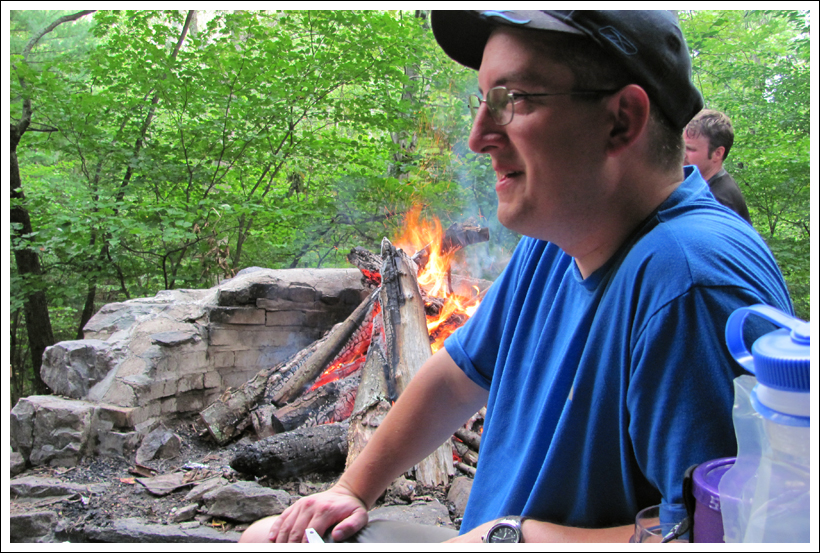
Adam By the Fire
Adam relaxes by the fire.  Below:  A comparison – the first photo is the park’s representation of Appalachian Trail backpackers.  The second and third photos are what backpackers really look like!  Sometime soon, I think Adam and I are going to pose to recreate the park’s image – spacy expressions and all!

Funny Backpackers Real Backpackers 1 Ayla and Brendan

Sometime after dark, we climbed back up the hill to our tent by the light of Adam’s headlamp.  Christine listened to the new book in the Game of Thrones series on her iPod and Adam continued to read his John Muir book.  As we relaxed in the tent, we began to notice that our tent site wasn’t quite flat.  It was on just enough of a slope that you can feel, even if you can’t see it!

Christine had a decent night of sleep – occasionally waking to the hoot of an owl or the sound of Adam thrashing around next to her.  He didn’t sleep well at all!   He still hasn’t figured out the best way to get comfortable with his sleeping set-up.   In the morning, everything had shifted to the downhill side of the tent.  Adam was crammed up along the tent wall and Christine was practically on top of him!

Almost everyone was up early, cooking breakfast and packing up their gear.  We took down our tent and shoved everything back into our packs.  We fired up our JetBoil and made oatmeal and coffee.  We didn’t even use all the extra water we had hauled down to camp, so we shared with everyone else.  Incidentally, the spring was running at Pinefield so we didn’t even need to carry all that extra water.  Oh well… better safe than sorry.

Our second day of hiking was a little tougher, but a little more rewarding in terms of views and scenery.  Ivy Creek, which we passed near the end of the hike, was actually running much more than usual  Our packs were lighter, since most of the food and water were gone.  The forest was beautiful and misty, with golden sunrays cutting down between the trees.  Spider webs covered with dew glistened in the morning sun.  We crossed paths with the hiker we had met at Simmons Gap the day before.  He was headed north, and looking for water.  We were kind of surprised, because he must have passed at least three decent water sources that morning returning from Brown Gap.

View of Skyline Drive
We got a great view of Skyline Drive and the mountains beyond on our second day.  This view looks to the west.  Below: Morning fog created some nice sunrays in the forest; Ivy Creek was running nicely; Spider webs glistening in the morning light.

Sunrays  Ivy Creek Spider Web with Dew

We reached the junction of the AT and the trail down to the Ivy Creek maintenance building around 10:15 a.m.  It was a quick downhill walk of .6 miles back to Skyline Drive.  We got to the Loft Mountain Wayside around 10:30.  Even though it was still on the early side, we wanted lunch!  The cook behind the counter was nice enough to make us fries and grilled ham and cheese sandwiches even though they were technically still serving breakfast.  It really hit the spot!

After lunch we passed through the gift shop and picked up a couple 75th Anniversary Shenandoah souvenirs – a magnet and a Christmas ornament.  We’d been meaning to get something from the anniversary all season.  Park shops are only open for a few more weeks, so we figured it was now or never.

Lunch at the Loft Mountain Wayside
Lunch at the Loft Mountain Wayside. Below: Our hike down to Skyline Drive from the Appalachian Trail took us past the PATC’s Ivy Creek trail maintenance building; Adam crosses Skyline Drive and heads toward the Loft Mountain Wayside where we left our car.  Unfortunately, someone whacked our car pretty hard while we were away.  We have a huge dent and a paintless streak on the passenger side now.  Boo!

Ivy Creek Maintenance Finishing at Loft Mountain

We were back home before 1:00, which was perfect!  We had the rest of the day to relax and clean up before heading back to work on Monday.

Trail Notes

  • Distance 10 miles
  • Elevation Change – 2500 feet over five different climbs
  • Difficulty – 3.  Mostly uphill climbing on this hike.
  • Trail Conditions – 4.  The trail was in pretty good shape.  Some areas were slightly overgrown and there were a few tree blowdowns, but otherwise, it was fine.
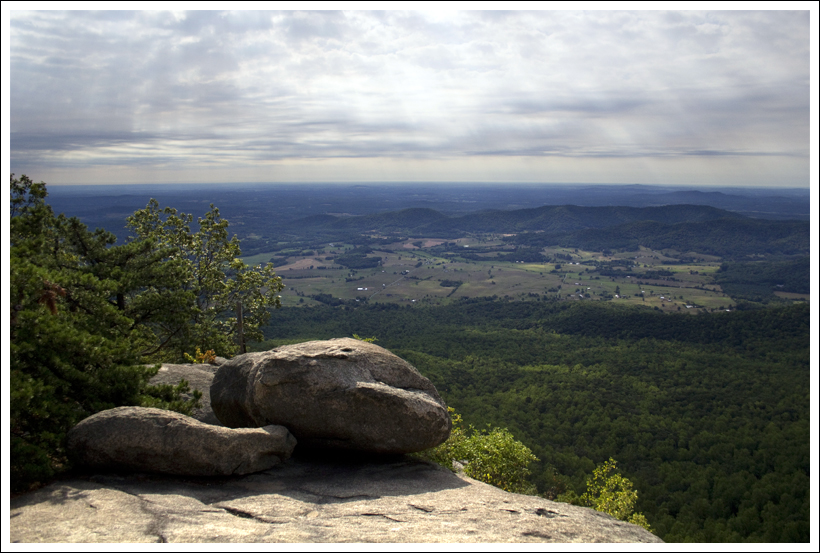
  • Views – 3.5.  Some nice eastern views on the climb up from Powell Gap and nice western views near the Rockytop overlook.
  • Wildlife – 4.  We saw many signs of bears along the trail (and saw one), we saw our first timber rattlesnake, and several pileated woodpeckers.
  • Ease to Navigate – 4.  Not many turns on the Appalachian Trail, but a few turns to make it to the Loft Mountain wayside.
  • Solitude – 4.  You will likely see people near Powell Gap and Loft Mountain, but not a lot in between.

Directions to trailhead:  Mile 70 on Skyline Drive, park in the large field.  You’ll see the post for the Appalachian Trail from the lot and head south.

Old Rag – via Weakley Hollow

We hope you enjoyed our Acadia series… but now it’s time to get back to Virginia hiking.  We decided resume our normal posts with an exceedingly well-known mountain – Old Rag.  This 8.8 mile loop hike is Shenandoah’s most popular hike.  It’s so well-loved and traveled that the official Shenandoah website has a whole section dedicated to hiking this mountain.  [View NPS Map for this hike]

Note: Some of the NPS website details (and mileage markers along the actual trail) were a little outdated as of summer 2011, as they refer to the hike distance before the park service closed the upper parking lot in April of 2010.

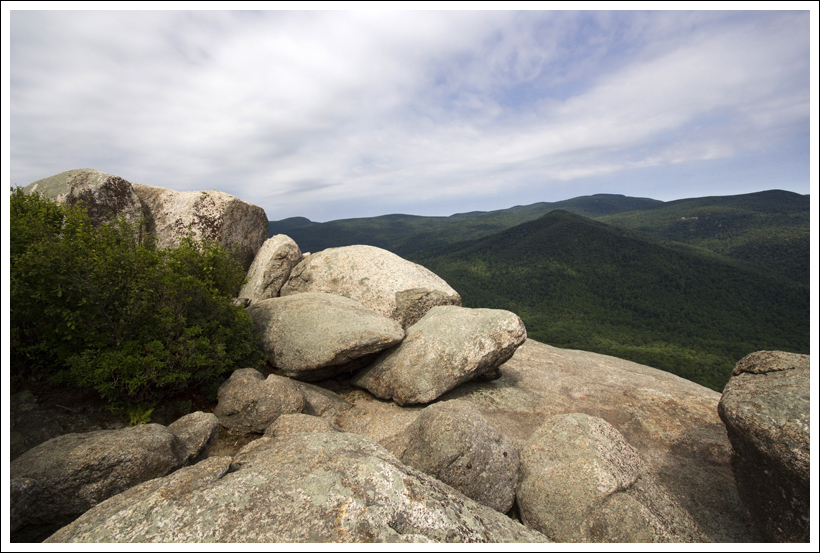
Nearing the Summit of Old Rag
Large boulders near the summit of Old Rag.  Below: Adam walking along the road headed toward the Ridge Trail’s start; Views from the summit of Old Rag; Adam drops down into a narrow passage between the rocks.

Lots of Road Walking  Views at Summit Dipping Into a Narrow Slot

Christine Says…

After two and a half years, we’re finally getting around to covering Virginia’s most popular, most well-known hike – Old Rag. I’ll make an outright confession.  Old Rag, as beloved as it might be by (seemingly) everyone else, is not my favorite hike.   But, when you have a Virginia hiking website, you’re practically obligated to have a write up about this mountain.  So, on to the post!

We’d been tossing around the idea of hiking Old Rag for the blog for well over a year.  Adam would suggest it and I’d invariably tell him that it was too hot, too cold, possibly wet and slippery, I heard there was ice, my feet hurt, I don’t feel like driving that far, etc.  Basically, I floated every excuse in the book to delay the hike.  But then I went and did something incredibly stupid and it really blew up in my face!  I had a day off work coming up.  It was going to be a beautiful August day – crisp and unseasonably cool!  I had visions of getting up early, doing a photo shoot in the park, maybe eating some donuts and then taking myself to a matinee movie.  But before I could stop myself, I found that I had blurted out “Tomorrow would be a GREAT day to hike Old Rag!”  I assumed this was purely hypothetical because Adam had to work.  But he immediately responded “Yeah!  Let’s go!  I’m taking tomorrow off too!”  Ugh – I didn’t see that one coming!  I don’t like to back out on plans, so the next morning we were up before dawn, snacks stashed and Camelbaks filled.

We got to the parking lot before 8:00 a.m..  Getting to Old Rag early is something I consider to be a necessity.  The trail is always crowded – even on weekdays.  The Old Rag parking lot is actually my first point of contention with the hike.  It used to be if you got up early, you could always get a parking spot in the small upper parking area located right at the trailhead.  In April of 2010, a couple years after our last hike up Old Rag (fall of 2008 – see photos), the park service closed the upper lot to all vehicles.  Now, all vehicles must park in the lower lot, which is just a shade under a mile from the trailhead.  The added mile follows a paved road uphill to the beginning of the Ridge Trail. I’m not going to make any apologies; I just don’t like road walking on outings that are supposed to be hikes.

The Scrambling Begins
The first section of rock scramble is just a little sampling of what is ahead.  Below: Giant boulders along the trail; Christine climbing up the Ridge Trail; Christine taking in the view; A view of the valley; A dog who has panhandling all figured out!

Giant Boulders Along the Trail Christine Hiking Up the Trail First Views
Wider View Before starting Major Scramble
Beggar on the Mountain

Once we got to the Ridge Trail, things improved a bit.  The trail climbed upward for about two miles. It’s not terribly steep or difficult climbing, but it is steady uphill.  There are occasional switchbacks, lots of gigantic boulders along the trail and even some glimpses of views through the trees.

The higher you climb, the better and more open the views become.  After the first real panoramic view, you get your first little sample of the extensive rock scrambling you’re about to encounter.  The first pass is short, but requires hoisting yourself up through a small opening, then across a flat pancake of rock.  At this point, my boot slipped and I almost toppled over backwards.  Luckily, I was able to hang on long enough for Adam to give me a hand up.

Shortly after that little scramble, you’ll come to what I think is the nicest view on the hike.  Instead of overlooking mountains with a distant peek at Skyline Drive, this viewpoint overlooks the valley below.  The vista is dotted with little farms and winding country roads.  It’s really pretty!  At this point of our hike, we encountered an emaciated, but super-friendly dog.  He had a collar but there didn’t seem to be any human to claim him.  Dogs are not allowed on Old Rag’s hiking trails, so we figured someone brought a dog up anyhow, and then abandoned him when he could no longer follow along the rock scramble.  The dog looked so pitiful and hungry that we ended up sharing some cashews and half a Luna Bar.

The dog followed us along until the scramble began in earnest.  He looked sad to see us go, so we decided to report him to park rangers at the end of our hike, in hopes that they could send someone up to retrieve him and lead him back down to the base of the mountain.

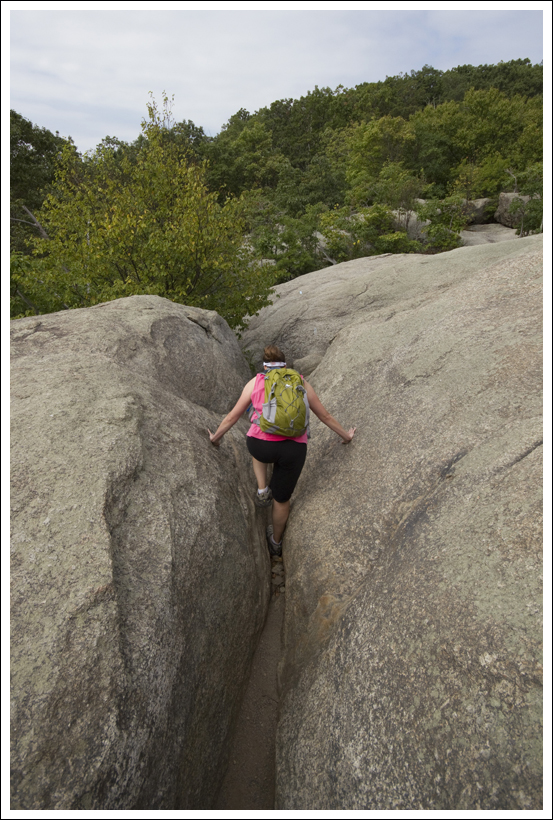
After saying goodbye to the dog, we began nearly one-mile of rock scrambling required to reach the summit of Old Rag via the Ridge Trail.  Anyone wishing to reach the summit without the scramble can follow the Saddle Trail (accessed by either the Weakley Hollow or Old Rag fire roads).  The scramble is the part of this hike that I enjoy most, but also simultaneously fear.  I have vertigo, so there are a couple passes that play tricks on my visual and balance centers.  Otherwise, the scramble is a lot of fun!  It’s almost like a hiking puzzle.  You have to look at each obstacle and plan the best strategy for traversing it.  The scramble is tough – it’s not so much a cardio challenge as it is a strength challenge.  There are lots of places where you’ll rely on  both your upper and lower body strength to carry you across the rocks.  It’s nice to have at least one hiking buddy to help you along.  One particularly steep place, I had to shove Adam up (one hand on each butt cheek) and then he had to tow me up behind him.

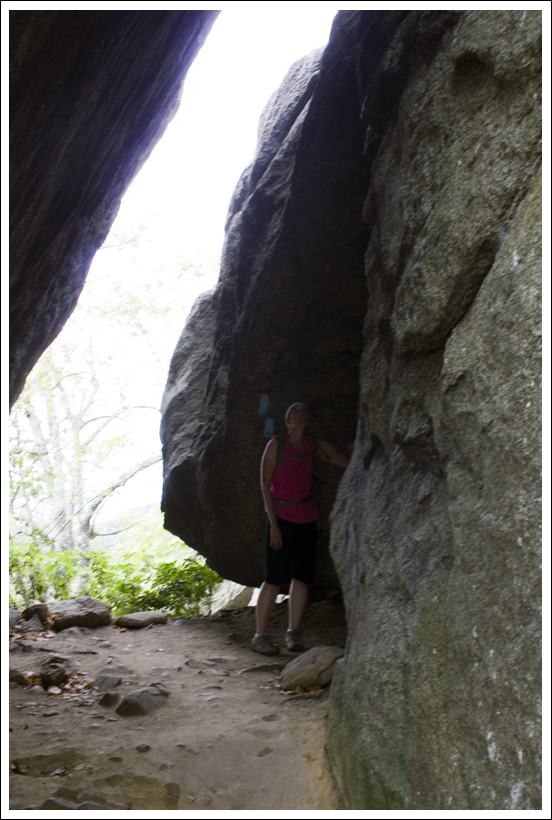
Narrow Passage
Near the beginning of the scramble, you have to drop down into this narrow passage. Below: A variety of obstacles along the rock scramble. Below: Adam shinnies down into the narrow passage pictured above (note the blaze is numbered R22.  Each blaze on the scramble is numbered to help rescuers find injured people more quickly); More scenes along the scramble.

Dropping Down More Scrambling Stairs Climb Up That

The summit of Old Rag is beautiful and decorated with many large and interesting boulders.  It’s the perfect place to enjoy a snack while taking in the view.  We watched the clouds clearing away, ate cheese and trail mix and watched falcon soaring on the breeze.  It may have been a peregrine, as they are known to nest on Old Rag, but we’re really not sure.

After leaving the summit, the hike becomes sort of tedious.  Yes, it’s all downhill, and you’ll pass a couple interesting trail shelters (Byrd’s Nest and Old Rag).  Both are available for day use only.  There is one more decent view.  But right after passing the Old Rag Shelter, you’ll reach the Berry Hollow fire road.  You’re only on that for a short while, until you meet the Weakley Hollow fire road.  You’re on that road for the remainder of the loop until you come back to the paved road at the trailhead.  Honestly, everything after the scramble on this hike is just not fun to me – too many miles of featureless road walking.   All in all, the Old Rag hike has close to 4.5 miles of road walking (over half the hike).  Adam and I were eager to finish up our hike, so we jogged most of the way back along the fire road and paved road.

Adam Pretends to Balance a Giant Boulder
Adam pretends to balance a giant boulder. Below: More scenes along the scramble.

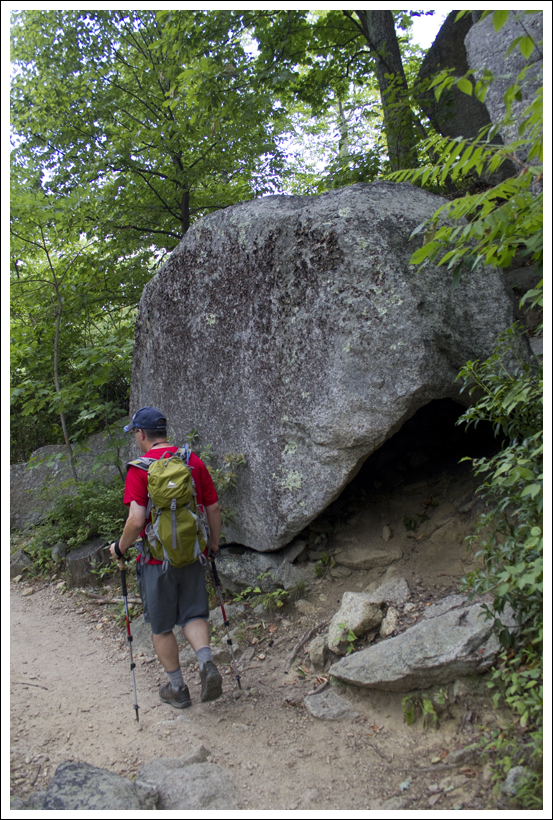
A Cave Adam Passing Through the Cave Another Narrow Pass

When we got back to the car, we told the ranger at the check-in station about the skinny dog.  She laughed and said “Oh, him!  He’s our resident Old Rag beggar!”  Apparently the dog belongs to a local family.  He likes to take daily hikes to solicit treats from people climbing the mountain.  He sure tricked us!

The parking lot had really filled up since we arrived!  We were glad to be done, and on out way to get some lunch (fried chicken – yay!).

When I reflect back on hiking Old Rag, and what could be done to improve the experience, I can think of a few things.  One idea I think would work well is to issue a finite number of permits per day to hike the mountain.  Perhaps limiting numbers on weekends would be enough.  I think if they could limit hikers, they could reopen the upper lot and eliminate almost two miles of road walking.  Another thought is to limit the number of people allowed per hiking party.  So many church youth groups and college clubs hike Old Rag in huge crowds.  This causes massive ‘traffic jams’ along the scramble.  No fun!  I also think that limiting hikers would go along way toward alleviating the trail damage and erosion on Old Rag.  The trail is crumbling, lots of rocks on the scramble have been worn to a smooth polish under years’ of boot traffic, and sadly there is garbage everywhere.  It’s a trail that would benefit greatly from being enjoyed by fewer people.

That said, I think every lover of the outdoors in Virginia should hike Old Rag at least once!  The scramble is truly without compare.

Adam Says…

Well, Christine summed it up nicely describing the pressure that I have been putting on her to tackle Old Rag.  We last did this hike together shortly before we started this blog.  The logo that we use for the website is actually taken from a photo of Old Rag, so it was a must do.  About every year, I put together a list of hikes that we have talked about doing in Virginia and we hang it on our refrigerator.  After we finish the hike, we have a ceremonial highlighter that we use to highlight the hikes we’ve finished.  For the last few years of printing a new list, Old Rag has been one of the few that has not been highlighted before the latest version is posted.  I let Christine do the honors of marking Old Rag off the list – and she was happy to do so.

Adam on the Summit
Adam on the Summit. Below: Summit scenery; Some kind of bird of prey.

More Summit Views Another Summit View Falcon

I would also agree with Christine that Old Rag is very overused.  One thing that makes this hike particularly challenging during the rock scramble is that the rocks are so smooth, you could easily slip.  When it has just rained, you know you will have no footing whatsoever.  Many of these boulders have no handholds or footholds, so you do have to be creative with how you will get through the scramble.  I would recommend that you do this hike with someone else to help you through the scramble.  I think Christine especially enjoyed the opportunity of putting both of her hands on my butt and shoving with all of her might.  It’s not very often that she gets to do that.

Old Rag Shelter
The Old Rag day-use shelter. Below: Adam takes in the last nice view on the way down; The Byrd’s Nest day-use shelter; The crowded Old Rag parking lot.

View on the Way Down Byrd's Nest Shelter Crowded Old Rag Lot

The hike begins from the parking lot and consists of walking up a paved and then gravel road for about .9 miles until you reach a smaller blocked off gravel lot (with a portable toilet) and a sign for the trailhead to the left.  This begins the Ridge Trail.  The trail starts off as a gradual ascent through the forest.  At about 2.3 miles, you reach the first of several switchbacks.  There isn’t a lot of note on the main portion of the trail as you are just walking uphill through the woods, without any notable views.  At about 3.2 miles, you reach a nice overlook.  As soon as you leave this spot, the rock scrambling will begin.  You have about .8 of a mile of rock scrambling until you reach the summit.  This path is quite dangerous as you have to navigate down tight crevasses, around boulders open to large drop-offs, and up other boulders with slick surfaces.  The summit marker will indicate the end of the tough climbing.  There are several places to take in the panoramic views at the top and some of the more adventurous will climb up some of the large boulders at the top.  Once you are done taking in the views backtrack to the trail and then take a right on to the Saddle Trail.  At about 4 miles you reach, the Byrds Nest Shelter No. 1, a day-use only shelter.  Continue down the steep trail and at 4.5 miles, you will reach another day-use Old Rag shelter.  Continue down the trail and at 4.9 miles, you reach the junction with the Weakley Hollow fire road.  Take a right on this fire road and you have about 3 miles of this fire road to walk down before you reach a few bridges and finally the smaller blocked-off Old Rag gravel lot.  Go back the way you came and you should reach your vehicle around 8.8 miles.

I do think we have put a lot of warnings about this hike, but the reason that this hike is likely so popular is due to the challenge and the amazing views.  The summit of Old Rag does provide some of the best views in Virginia.  Some people even do rock climbing at the top to rappel over the edge and make their way back up.  On a clear day, you can see for miles of countryside and layers of mountains.  I know most people do put this on their list of must-hikes in Virginia.  I recommend to tackle this hike as early in the morning as possible to beat the crowds.  If you wait until the middle of the day, you will likely face people-jams as the navigating through the rock scramble takes a while.

For any of those interested in geocaching, there are two geocaches nearby the trail:

For further reading about Old Rag and its history, check out the Climber’s Guide to Old Rag Mountain with some interesting information about the history of the area and the USGS’ Hiker’s Guide to the Geology of Old Rag.

I really have to hand it to Christine for confronting her vertigo and facing Old Rag.  I told her I wouldn’t bother her again to do the hike since we now officially have it on the blog, but I will probably do it again sometime.  I think this hike does have about 1.5 miles of very exciting climbing and wonderful views, but the rest of the hike (especially the way back on the fire roads) seems a little boring and you will look forward to seeing your car in the parking lot after the long hike back.  The last time we did this hike was on a fall day at the peak of fall color.  If you can find a day like that to tackle this hike, you won’t regret it.

Trail Notes

  • Distance8.8 miles
  • Elevation Change – about 2600 feet total.
  • Difficulty – 4.  The uphill climbing is gradual and never terribly steep, but the scramble requires good upper and lower body strength.
  • Trail Conditions – 2.  I think the trail is eroded and worn smooth in many places due to years of overuse.
  • Views – 5.  The views are wonderful and include both mountain and valley views.
  • Wildlife – 3.  There have been a fair number of bear sightings on Old Rag.  You also have a good chance of seeing birds of prey on the summit.
  • Ease to Navigate – 4.  Follow the signs.  This well-traveled trail is well-marked. Distances on the markers are out-of-date and refer to mileage when the upper lot was still open.
  • Solitude – 0.  Can I give this a negative score?

Download a trail map (PDF)

Directions to trailhead:  From Sperryville, Route 211, turn onto Route 522 and follow it south for .8 mile. Turn right on Route 231, follow 8 miles, turn right onto Route 601 and follow signs to the parking area, approximately 3 miles.
From Madison, Route 29 Business,  turn onto Route 231 and follow it for 12.8 miles. Turn left onto Route 602.
Follow signs for the parking area. Old Rag parking is approximately 3 miles from the turn onto Route 602.

Penobscot Mountain/Sargent Mountain/Jordan Pond Loop – Acadia National Park (ME)

Special: Acadia Edition

This moderate hike includes two panoramic mountain summits and views along one of the most scenic ponds in Maine.

Sargent Summit and View
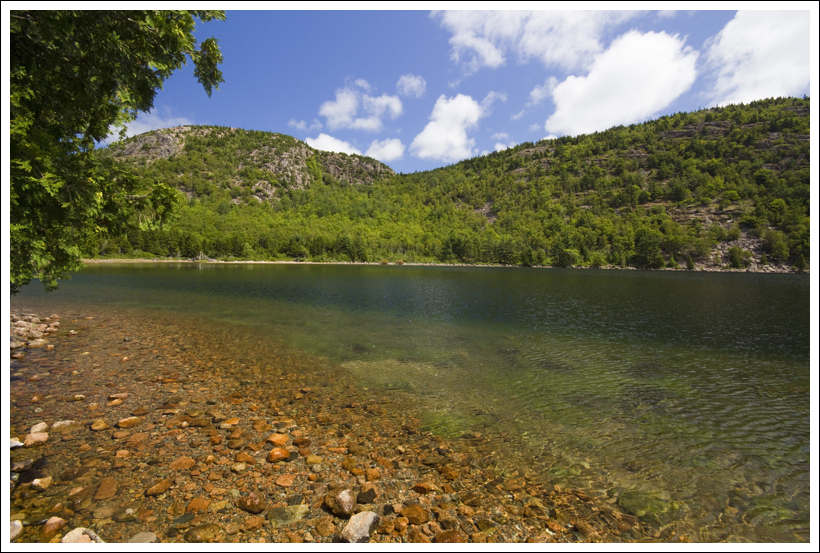
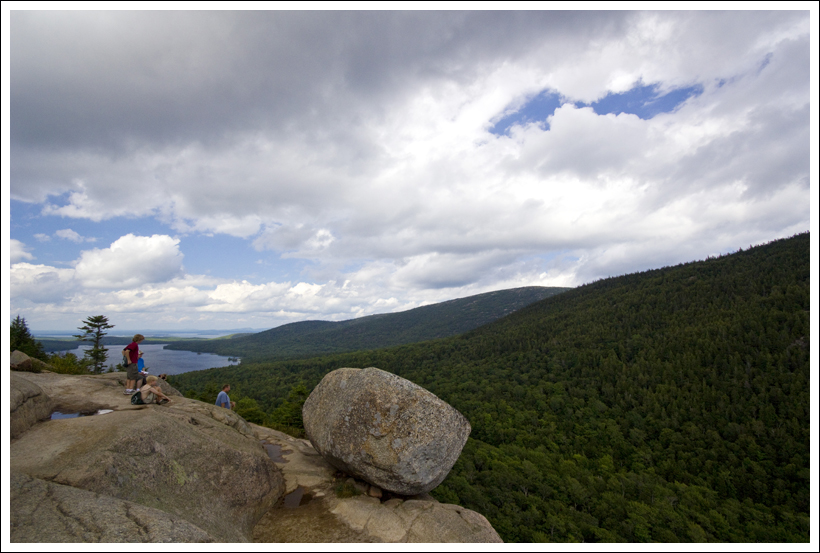
The summit of Sargent Mountain has a beautiful view. Below: The trail marker behind the Jordan Pond House; Adam enjoys the view from atop an erratic; Jordan Pond is beautiful!

Trailhead Behind the Jordan Pond House Nice View from the Erratic View Along Jordan Pond

Adam Says…

Hiking up Penobscot Mountain is one of our favorite hikes in Acadia National Park and we decided to save this hike for our last day there.  We had hiked up Penobscot a few times before, but this was the first time that we added on Sargent Mountain.

This loop hike begins at the Jordan Pond House.  Facing the house, if you walk behind the left side of the building, you will see the trailhead marker not far from the bathrooms.  The trail goes into the woods, crossing Jordan Stream with a small footbridge.   At .3 miles you come to an intersection with the Jordan Cliffs trail (another steep option for a loop from Penobscot), but continue on the trail.  At .5 miles, you will cross over one of the gravel carriage roads.  The trail continues up the Spring Trail at this point.  The Spring Trail consists of climbing up some rocks and does require you to pull yourself up through some tight areas.  There is also one area where you will likely need to squeeze your body between a few rocks.  This is the most challenging part of the hike up the trail, but before you know it, you will reach a nice viewpoint (with a stone makeshift bench) to relax from your climb up.  The tricky part from here is that your eyes are drawn to the viewpoint and you could miss the continuation of the trail.   Sitting on the bench and looking out, the trail continues behind your right shoulder.  There is a small path behind your left shoulder, but that leads to a dead-end.

Stone Bench Overlooking Jordan Pond
Adam enjoys the stone bench overlooking Jordan Pond. Below: Christine makes her way up the Spring Trail.

Climbing the Spring Trail Climbing the Spring Trail Climbing the Spring Trail

After you soak in the views, continue on the trail.  After a short climb, the trail begins to open up as you begin your hike above the treeline on the open mountain face.  The hike up from this point consists of following cairns along the way.  At 1.6 miles, you will reach the summit marker of Penobscot Mountain at 1194 feet.    From the summit, you can see Sargent Mountain ahead, which is only a mile away.  We took the path to the west, leading to Sargent Mountain.  The trail descends rather quickly and you come across the scenic Sargent Pond at 1.75 miles.  Take some time to enjoy the views from the pond and then continue on the trail.  At 1.9 miles, you reach the junction with the Sargent Mountain South Ridge Trail.  Take a right to join this trail and make your way to the peak.  You will come out of the woods and hike on the open mountainside (passing by junctions with the Hadlock Brook Trail and Spring Trail) until you reach the summit at 2.6 miles.  The summit of 1,373 foot Sargent Mountain provides panoramic views covering most of the areas to the north, which were not able to be viewed from Penobscot.  We took a while to enjoy the views here and then followed the east trail down the mountain.  This part of the trail reminded me of Scottish highlands as you hike through fields and rock.  After a few tenths of a mile, the trail then begins a steep descent back into the woods.  There were times that we scooted along our butts to make our way down the next section of rocks.  At 3.4 miles, we reached the junction with the Deer Brook Trail.  We took this left, continuing the steep descent down the rocky trail.  At 3.55 miles, you cross over another carriage road, pass by one of the carriage road arches, and at 3.7 miles you will reach the junction with the Jordan Pond trail.  You have a choice of going either way around the pond, but we took the right to view the western side of Jordan Pond.  This trail follows closely around the pond and consists of a lot of wooden boardwalks to keep people from damaging the ground below.  At 5.4 miles, you reach the Jordan Pond House again to complete your hike.

Christine Rolling the Erratic
Christine tries to roll the erratic uphill. Below: Beautiful Maine terrain; Adam at the summit of Penobscot; Blueberries were abundant.

Beautiful Trail Penobscot Summit Blueberries

This is a perfect hike to include on your trip to Acadia.  It has a combination of everything that I think this area of Maine has to offer – gorgeous panoramic views from the pink granite summits of the islands and ocean around; chances to take in some of the smaller ponds that are tucked between mountains; and challenging, rocky ascents that give you a grand sense of accomplishment.  On our descent down Sargent Mountain, we came across a few different groups of hikers that were hiking up the east face of Sargent Mountain.  We saw one family that was huffing and puffing their way in complete silence.  I had a feeling they were regretting their decision to hike up this way.  We saw another couple that were just beginning their hike up Sargent.  They said they like doing the loop hike up Sargent and Penobscot in reverse of the way we went because they can enjoy views the entire way down.   I think hiking up Sargent from the east face trail would be extremely steep and slow going, so I’m glad we hiked it this way.

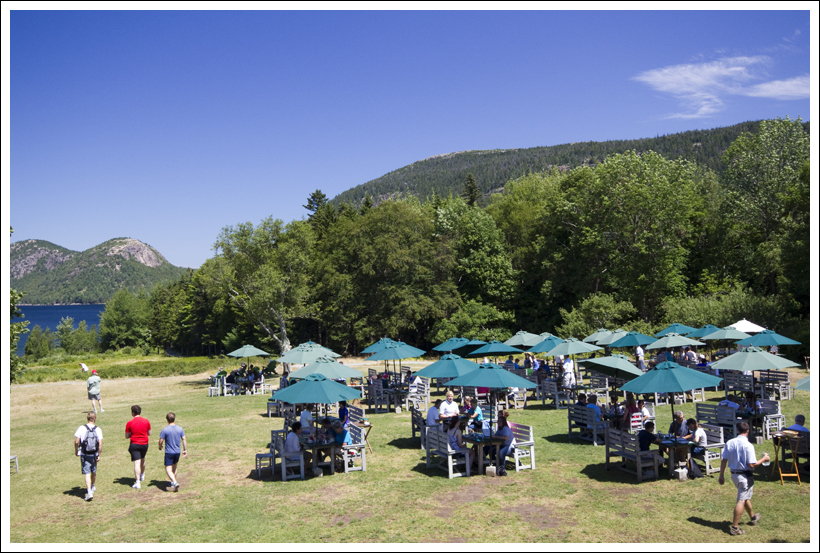
One of the great things about doing this hike early in the day, is you can claim a prime parking spot for the Jordan Pond House.  This place is packed in the summers around lunchtime and you will likely need to wait for a seat.  But it was great to finish off the hike with a nice restaurant and enjoy a popover a la mode with peach ice cream and blueberry sauce.

We had a great week in Acadia and it always sad to leave.  This has always been our favorite vacation spot and I think the hiking and biking we have done in this area show everyone why we love it so much.

Christine Says…

Remember how I was talking about perfect Maine days in our write-up of Gorham Mountain?  Well, our last day of vacation this year was just one of those days.  The weather was so perfect; I was practically swooning over it.  At first, we were just going to do the 3.2-mile out-and-back to the summit of Penobscot Mountain.  I told Adam that I didn’t want the day to end, that I wanted to use every single bit of it, enjoying the views and making the most of my time in Acadia.  We decided to tack the summit of Sargent Mountain onto our hike (this included a climb down the East Cliff Trail, a short stretch of the Deer Brook Trail and a return walk to our starting point along the Jordan Pond Trail.

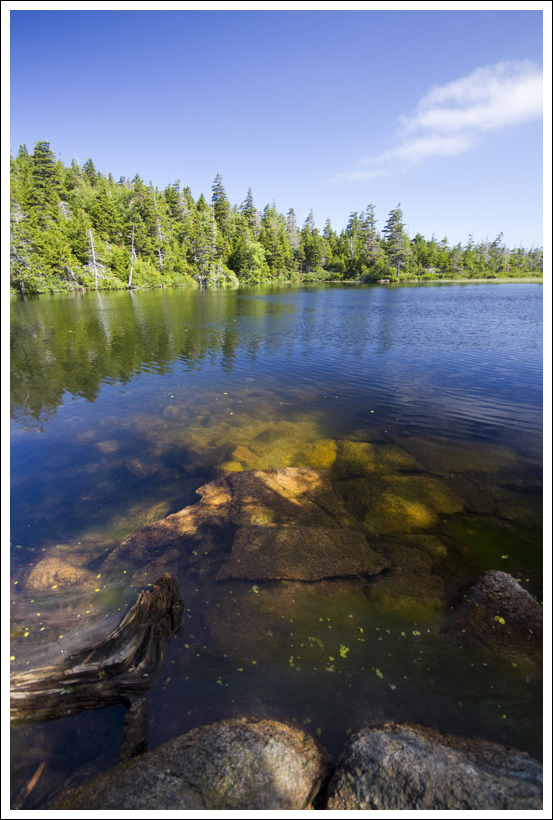
Sargent Pond
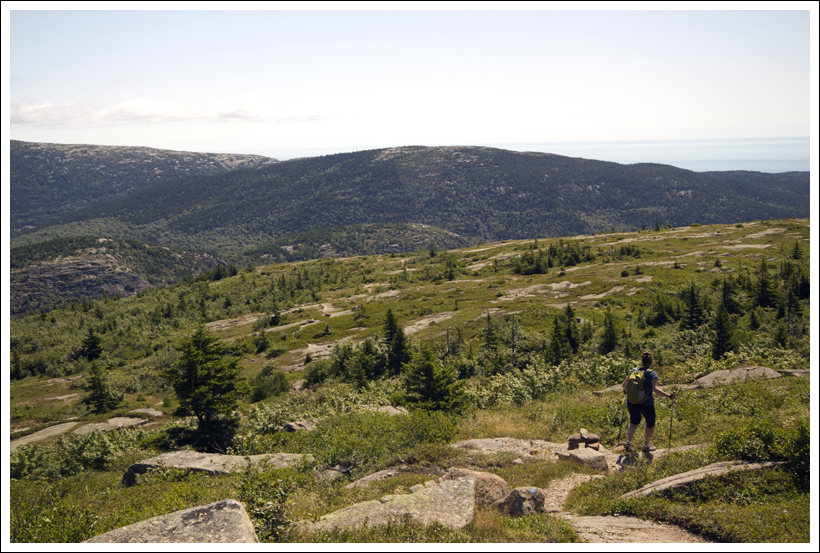
Sargent Pond is tucked between Penobscot and Sargent mountains. Below: Adam makes his way toward the Sargent summit; the Sargent summit marker; The view from Sargent

Adam Headed Toward the Sargent Summit  Sargent Summit View from Sargent

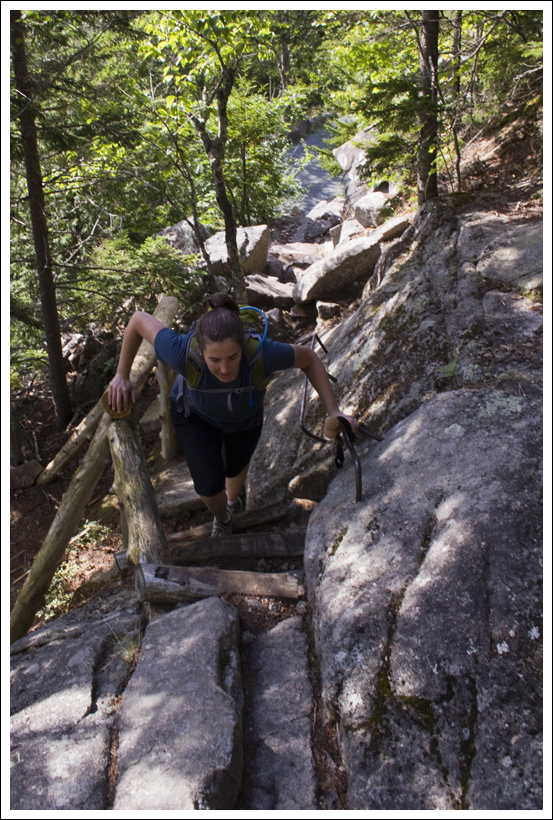
After an amazing pancake breakfast at Jeannie’s Great Maine Breakfast, we headed over to the Jordan Pond House.  The trailhead lies in the woods behind the restaurant. The trail crosses Jordan Stream and immediately climbs steeply uphill to where it crosses the Carriage Road.  You see a trail marker, but you really don’t see trail.  That’s mostly because there isn’t trail, rather there is a steep scramble between boulders.  This steep pass is known as the Spring Trail.  It involves a few iron rungs and rails built into the cliff’s side.  Parts of the climb are extremely narrow and require four-point contact with the rocks.

After clearing the cliff, you step out onto a beautiful opening overlooking Jordan Pond from above.  The rock shelf even has a natural stone bench from which you can enjoy your view.  After leaving the opening, the trail goes back into the woods for a short stretch.  From there on out, it’s open walking along the granite to the summit of Penobscot.  This is a mountain that has a couple false summits.  You see a spot that looks like it’s the highest,  but it never is (until you actually reach the rock pile an summit marker.) 🙂

At the summit of Penobscot, we stopped to take in the panoramic view of Mt. Desert Island.  The view couldn’t have been more breathtaking and was made even more special by the ideal Maine summer weather.  It was 70 degrees and breezy with deep blue skies.  A solo hiker arrived at the summit a few minutes after we did and asked if we had any sunscreen for him to use.  I loaned him my pink tube of SPF50 for sensitive skin.  It was probably fortuitous that he came by when he did, because it reminded me to reapply sunscreen. It’s so easy to get sunburned when hiking in Maine because of all the open exposures along the mountaintops.  Also, the cool, breezy weather keeps your skin from ever really feeling hot.

After the Penobscot summit, the trail climbs downward into a small wooded area between the two mountains.  This is where you’ll find beautiful Sargent Pond.  We stopped there for a short while and watched dragonflies whizzing about.  We noticed a ‘No Camping’ sign posted right next to the pond.  Not surprising – I bet many people have tried to stealth camp at spots like this in Acadia.  Just for the record, Acadia has no real backcountry.  You can’t camp freely in the park, but there are two organized campgrounds – Seawall and Blackwoods.  Probably the closest you get to backcountry hiking and camping in Acadia is if you take a boat out to Isle au Haute where there are several oceanside primitive sites.

The trail climbs steeply uphill from Sargent Pond.  Eventually you clear the trees once again and begin the climb up Sargent.  Sargent’s granite surface is not quite as bare as other mountains in Acadia.  There seems to be more evergreens and low shrubbery along the way, although I’m not sure why.

Hiking down Sargent
Hiking down Sargent. Below: This carriage road bridge passes over Deer Brook.

Carriage Road Bridge

The summit of Sargent is marked the same way as Acadia’s other summits – a rock pile with a wooden sign in the middle.  We really liked the view from Sargent.  It was a little different from the other hikes we had done during this week.  It’s the only place that offered views looking out toward Trenton and Ellsworth.  The day was really clear, so we could see the airport and beyond.

At the summit, we looked at a trail map so we could decide how to make our return back to Jordan Pond House.  One option would have been to retrace our steps and go back the same way we came.  This would have been a perfectly nice option because we could have enjoyed the ocean views the entire walk down.  Instead, we decided to try out some new trails and make a big loop.

The first trail on our return loop was the East Cliff Trail. It was one of the rougher, steeper trails I’ve been on in Acadia.  Although there were occasional views of Jordan Pond, most of the way was scrambling down steeply across rocks and roots.  The trail was pretty overgrown and I gather it’s not one of Acadia’s more heavily used trails.  It was fine, though.

Eventually it met up with the Deer Brook Trail which was more gentle and followed a small stream downhill.  After crossing the carriage road, we climbed downhill past one of Acadia’s famous stone bridges to the junction with the Jordan Pond Trail.  We came out on that trail at the far end of the pond, almost directly across from the Jordan Pond House.

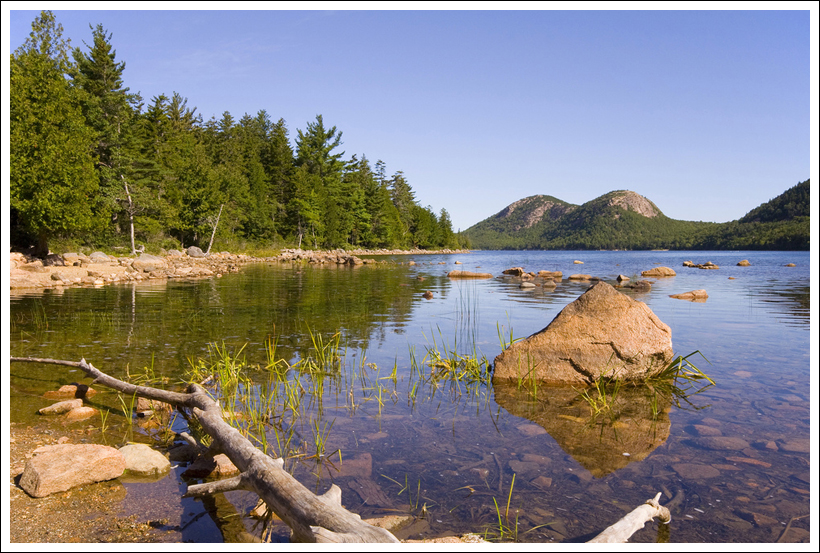
Shore of Jordan Pond -  Looking at the Bubbles
The shore of Jordan Pond looking toward the Bubbles. Below: Boardwalks along Jordan Pond; Lovely Jordan Pond.

Boardwalks along Jordan Pond Lovely Jordan Pond

For a mile and a half,  the trail clings closely to the edge of the lake.  There are a few places where you have to climb from rock to rock.  There are also many boardwalks over swampy ground that only allow for single-hiker passage.   But, the trail is completely flat so it’s fast hiking.  We were speeding along this easy part of the hike with popovers on our minds.

When we finally got to the Pond House, we had to wait about 45 minutes for a table, but that was OK.  I got some cold water, found a bench and listened to a book on my iPod until our buzzer went off.  I was actually kind of cold at lunch – sweat and a brisk breeze can make even a nice summer day feel chilly.  I warmed up with a big bowl of chicken-orzo soup and two huge, steaming popovers.  For dessert, Adam and I shared a popover a la mode.  It was heaven in a bowl and a fitting end to our wonderful week in Acadia.

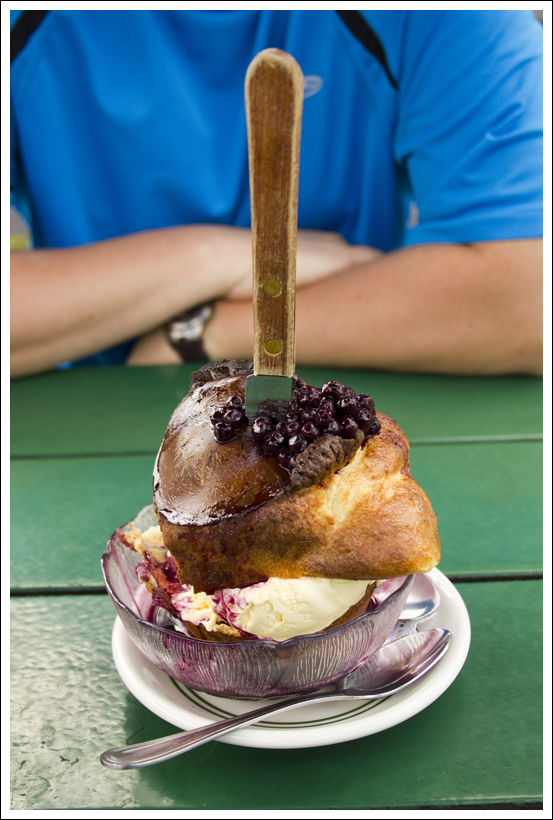
Popover a la Mode
Popover a la Mode! Peach ice cream and Maine blueberry sauce. Below: Another look at Jordan Pond; Lunch on the lawn; Popover and strawberry lemonade.

Another Look at the Pond Lunch on the Lawn Popover and Strawberry Lemonade

Trail Notes

  • Distance 5.4 miles
  • Elevation Change – about 1200 feet total.
  • Difficulty – 4.  The ascent up the Spring Trail and the descent down Sargent Mountain can be steep and requires careful navigation.
  • Trail Conditions – 3.5.  The trail is well-maintained, but there are plenty of places to turn your ankle on the descents.
  • Views – 5.  There are amazing views throughout this hike as you make your way up to the summits of Penobscot and Sargent Mountains.
  • Wildlife – 1.  There isn’t a lot of wildlife in Acadia, but we did see a red squirrel and smaller birds (juncos and other finches) along the hike.  When birds of prey migrate through in the summer, you may see some different hawk varieties.
  • Ease to Navigate – 3.  There are some tricky parts along this trail on the ascent up Penobscot and Sargent Mountains, but the trails are fairly-well marked. 
  • Solitude – 3.  You will likely see people at the summits lingering, but you should be able to stake out your own spots for solitude.  The Jordan Pond trail will likely have lots of people on it, so you won’t have much solitude on that section.

Directions to trailhead:  Park at the Jordan Pond House, accessed from the Park Loop Road in Acadia National Park.   While looking at the house, head around the left side and you will see the signs for the bathrooms.  Across from the bathrooms, you will see the trail marker for the Penobscot Mountain trail.

Gorham Mountain to The Bowl – Acadia National Park (ME)

Special: Acadia Edition

This route combines one of our favorite short Acadia hikes to the summit of Gorham Mountain followed by a visit to a beautiful glacial pond called The Bowl, and a return walk along the Ocean Path, passing famous landmarks – Sand Beach and Thunder Hole.

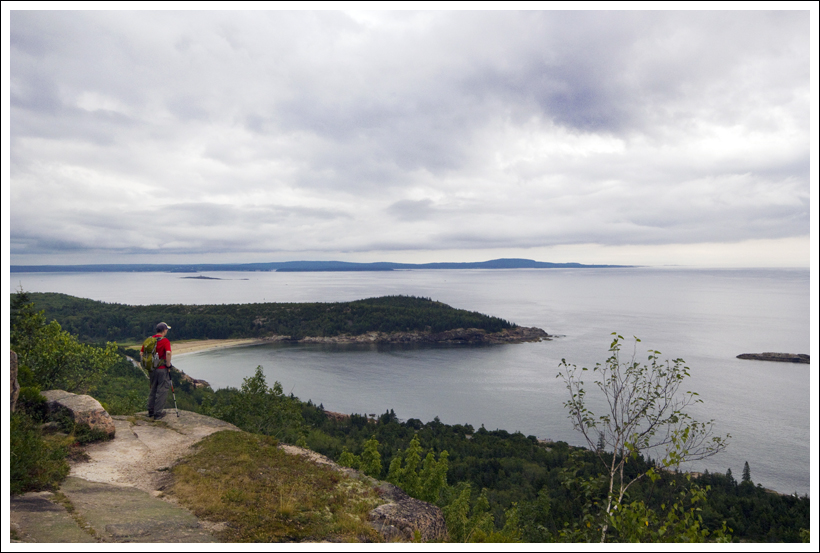
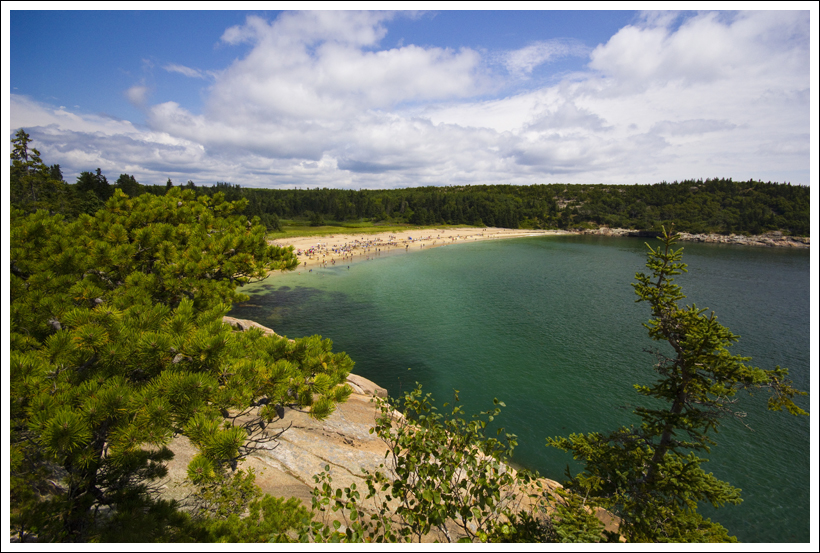
Overlooking Sand Beach
Overlooking Sand Beach from Gorham Mountain. Below: Christine’s parents climb the Gorham Mountain Trail; Adam enjoys clearing skies and a view of the Bowl; Ocean scenery is spectacular along the Ocean Path.

Christine's Parents Hiking Adam Checks out the Bowl Walking the Ocean Path

Christine Says…

Even before I was an avid hiker, Gorham Mountain was always a hike I enjoyed.  By itself, the hike to the summit and back is less than two miles, requires very little climbing and offers magnificent views of the ocean, the rocky Maine coast and Sand Beach below.  If you walk the trail in late July or August, wild blueberries are abundant!

We decided to hike Gorham Mountain with my parents one morning during vacation.  We ate breakfast early and got to the trailhead before the crowds.  I really can’t stress enough how crowded Acadia trails get during the peak hours of 10:00 a.m. until 2:00 p.m.  I always suggest that people hike early or late, or rely on the Island Explorer bus (it’s FREE!) for transportation around the island.

On this particular trip, we actually drove separately from my parents because we wanted to extend our hike beyond the Gorham summit, and they did not.  The day before this hike had been overcast and a little drizzly and unfortunately, some of the gloomy weather was still lingering for our hike.  I was a little disappointed, because the lack of sunshine and blue skies always makes the ocean vista a little less colorful and sparkly.  I always prefer to hike Gorham on a ‘perfect Maine day’.   I would define ‘perfect’ as a sunny, 75 degree day with wispy or puffy clouds sitting in a deep blue sky.  There would be a light breeze and I would hear gulls crying and the sound of lobster boat motors in the distance.  There is nothing I love more than hiking Gorham on a day like this.

Even with the heavy clouds, the hike was still lovely and I enjoyed the company.  We hiked alongside my parents until we came to the junction of the Cadillac Cliffs trail.  At this point, hikers can choose to stay on the easier Gorham trail, or take a little extra challenge and scramble along the boulder-strewn cliff trail.  There aren’t any views from the Cadillac Cliffs trail, but climbing through caves and over enormous boulders is pretty fun.

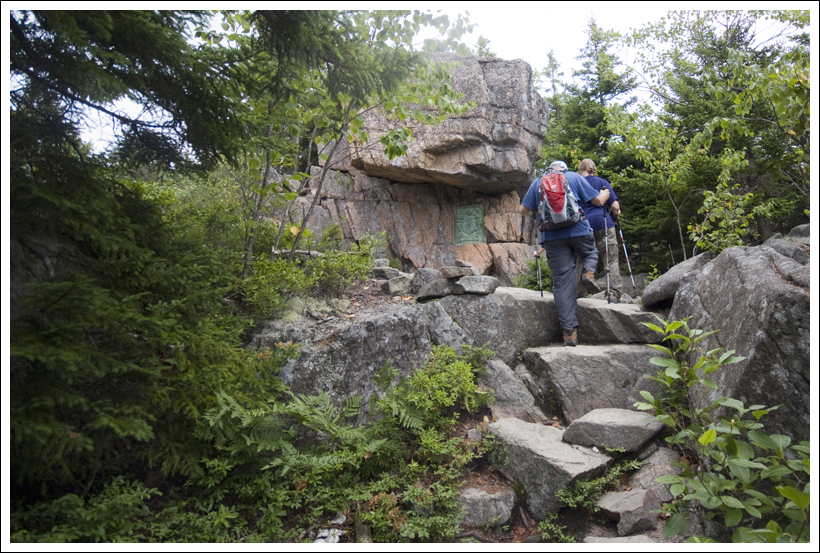
Cadillac Cliffs
Cadillac Cliffs.  Below: Scenes along the Cadillac Cliffs Trail.

Cadillac Cliffs Boulders Cadillac Cliffs Cave Cadillac Cliffs Trail Christine Climbing Back up to Re-Meet Gorham

We met back up with my parents a few tenths of a mile later and made our final climb to the summit.  The views are spectacular all along this section of trail.  In fact, the views right before the summit are probably nicer than the actual summit.

We enjoyed the summit as a group for a while before Adam and I continued on our own.  The Gorham Mountain trail climbs downward, passing some interesting cliffs, before eventually joining The Bowl trail.   The Bowl trail climbs rather steeply uphill to a beautiful mountain lake.    The lake is surrounded by boardwalks and benches, and is one of the few bodies of water in Acadia where you can swim.  Many of the larger bodies of water are used for drinking water and swimming is prohibited.

There were a fair number of people sitting alongside the lake when we arrived.  We sat on a bench and almost immediately heard a child cry “Ohhh… that’s an eagle!”  Sure enough, we arrived just in time to see a bald eagle go gliding across the lake’s surface.  Talk about great timing!

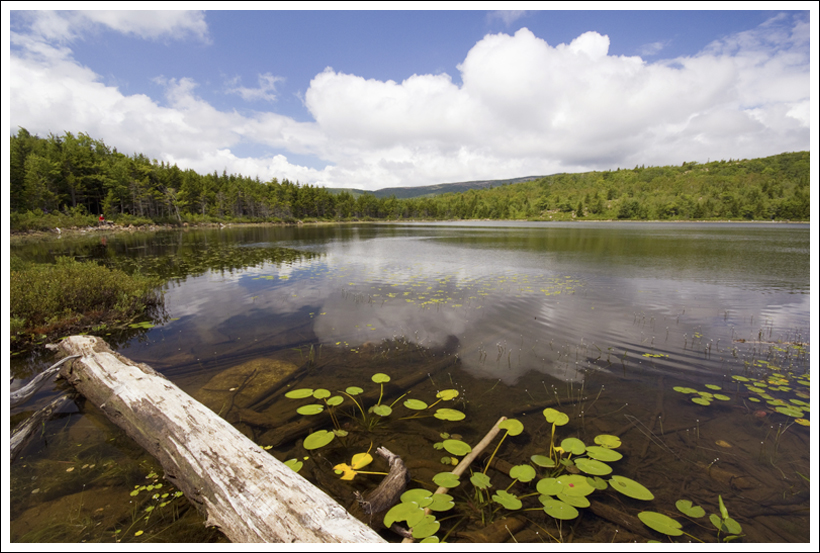
The Bowl
The Bowl is a beautiful glacial pond you’ll pass along this hike. Below: Christine checks out the interesting cliff face on the hike down from the Gorham Mountain summit; Trail marker at the junction for the Bowl trail; Thick crowds at Thunder Hole.

Cliff on hike down Bowl Junction Crowds at Thunder Hole

While we sat at the lake, the clouds really cleared off quickly and the day turned into that perfect Maine day I described a few paragraphs ago.  So beautiful!

We hiked back down the Bowl Trail, past the junction to the Beehive trail and down to the Park Loop Road.  The trail comes out right above Sand Beach, which is a great place to pick up the Ocean Path.  The Ocean Path is a flat walking trail that runs between the ocean and the road.  It’s very crowded almost all the time, and if you’re a faster hiker, you’ll have to dodge slowpokes.

From the Ocean Path, there are a ton of small side trails that lead down to the rocky coastline.  There are so many places to sit and enjoy the view!  The walk along the path goes on for about 1.3 miles and eventually passes by Thunder Hole.

When we passed Thunder Hole, it was so crowded we couldn’t even get down to the viewing platform without waiting in line.  We’ve seen Thunder Hole so many times so we didn’t stay long.  Besides, it wasn’t thundering at all.  The tide was so high that the sea cave stayed full of water regardless of the wave action.  There just wasn’t any force to create the sound the spot is named for.

The Gorham Mountain parking lot is just a tenth of a mile or so past Thunder Hole, so we were back at the car after a few more minutes of walking.  We headed straight to lunch in town – lobster rolls at the Portside Grill!

Adam Says…

Whenever we talk about going to Maine, one of the things we plan on every trip is a hike up Gorham Mountain.  In fact, a few years ago when we came up to the park and knew we had a whole week of rain ahead, we quickly got in a hike up Gorham.  As Christine mentioned, just going up Gorham Mountain is a short hike, so it is easy to fit in when you have a break in the weather.

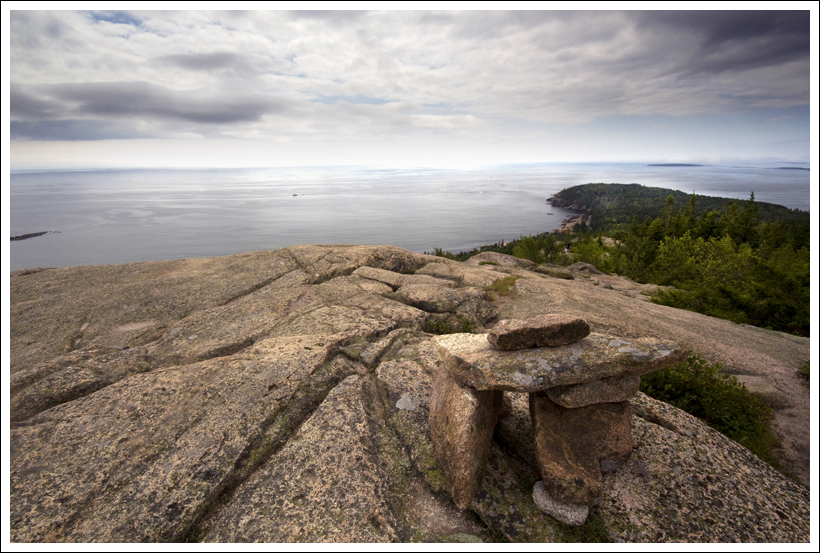
View from the Gorham Summit
The View from the Gorham Summit looking toward Otter Point. Below: Christine’s parents enjoy the view; The rock pile marks the summit of Gorham Mountain.

Christine's parents enjoy the view Rock Pile at the Gorham Summit

You can find the parking lot to the trailhead on the right shortly after the Thunder Hole parking lot.  The trail starts off with lots of roots and granite to navigate and can be a little slippery if a storm has recently come through.  The trail consists of a gradual uphill climb and is a popular trail for people of all hiking levels.  At .2 miles, you reach the junction with the southern part of the Cadillac Cliffs trail.  This is definitely a more challenging side trail, that includes some rock scrambling.   If you want to try the Cadillac Cliffs trail, do it on the way up since it could be more treacherous going down.  The Cadillac Cliffs trail doesn’t really provide any great views, but it does have a small cave to go through and some interesting rocks to scramble.  By the time you reach the northern junction at .5 miles, you will likely need to catch your breath.  Rejoin the Gorham Mountain trail by taking a right at this junction.  You will continue to climb upward and will see lots of places to take in the views along the way.  At .9 miles, you will reach the 525 foot Gorham Mountain summit.  On the way up the mountain, you typically get views of Sand Beach and Great Head, but from the summit, you can also see Otter Cove, Day Mountain, Pemetic Mountain, and Cadillac Mountain.  We continued on the trail from the summit.  At 1.5 miles, you reach a junction with The Bowl Trail.  Take a left and climb up the steep terrain through the woods until you reach The Bowl at 2.0 miles.  From The Bowl, you can also see close glimpses of the summit of The Beehive and there is a trail that connects with it.  We took in the views around the lake and then went back down The Bowl Trail, towards the Park Loop Road.  At 3.2 miles you will reach the Park Loop Road.  Cross the road and proceed on the Ocean Path, heading past Sand Beach.  You will likely see tons of cars and people along the road between this point and Thunder Hole.  You should reach the Gorham Mountain parking lot around 4.4 miles.

Sand Beach from the Ocean Path
Sand Beach from the Ocean Path. Below: If you look at the larger version of the Beehive photo below, you will see the long queue of people climbing the mountain; Adam enjoys the bench at the Bowl.

The Beehive Adam Sitting at the Bowl

We had a funny moment when we first started the hike.  A family was coming back from the summit and spotted us with their trekking poles.  One little girl was asking why we were all using two ‘canes’ to walk.  The parents had responded that we were “professional hikers”.  We got a few laughs out of that.  If only we could get paid to go hiking (or at least pay for some of our hiking gear).

There are many things about this hike that make it one of our favorites.  The blueberries are ripe during July and August and are plentiful on this trail.  I think I picked the largest, juiciest blueberry ever during this hike.  We always enjoy looking over Sand Beach.  You can see the dots of people on the beach, but not many in the water due to the temperature.  Walking back on the Ocean Path, you could hear the screams of children as they were being hit by the freezing waves.  You can also count on being able to see a lobster boats in the area, bringing up traps, or a large sailboat rounding the harbor.  You may also be able to catch a little rumbling from Thunder Hole, but the largest rumblings typically occur in the fall after a storm.

This area has also been where two recent movies have been filmed.  You can see Sand Beach in The Cider House Rules and nearby Otter Cliffs was used in Shutter Island.

Trail Notes

  • Distance4.4 miles
  • Elevation Change – 500 feet to the summit of Gorham and another shorter climb to the Bowl
  • Difficulty – 2. This is an easy family hike, suitable for most fitness levels.
  • Trail Conditions – 3. Trails in Acadia are always rocky and rooty and can be slick when wet.
  • Views – 5.  Breathtaking!
  • Waterfalls/Streams/Lakes – 4. The Bowl is a beautiful glacial pond.
  • Wildlife – 3.  We saw an eagle – that counts for something!  We’ve heard that people occasionally see whales off in the distance, but we never have.
  • Ease to Navigate – 4. Pay attention to the cairns and markers at trail junctions, and it’s hard to get lost.
  • Solitude – 0.  This is an extremely popular area.  No matter when you hike it, you will see people.

Directions to trailhead: The trailhead is located in the Gorham Mountain parking lot on the Park Loop Road in Acadia National Park.   The parking lot is about .5 mile south of Thunder Hole.

Cadillac Mountain South Ridge – Acadia National Park (ME)

Special: Acadia Edition

The seven-mile South Ridge trail takes you to the highest mountain on the east coast – Cadillac Mountain.  At over 1500 feet, it is also one of the first places sunlight hits the U.S. each morning,  The views from this hike are panoramic and breathtaking!

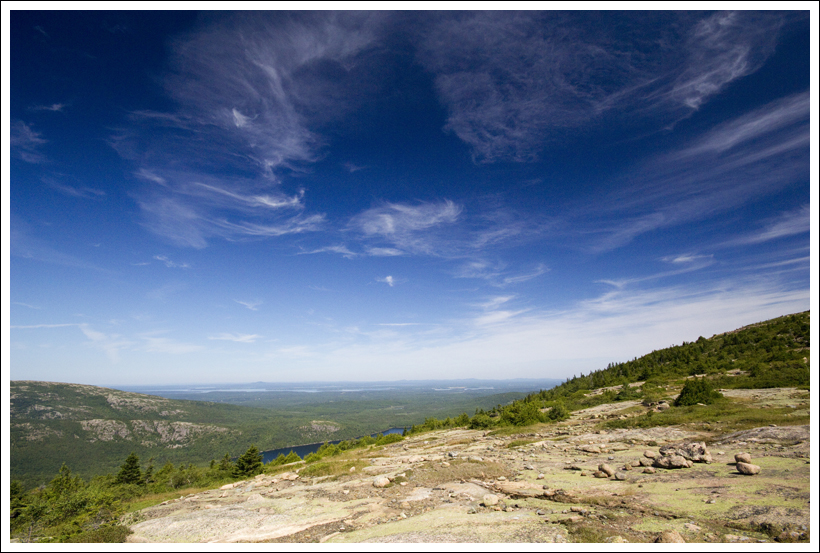
A View of the Porcupines from the Cadillac Summit
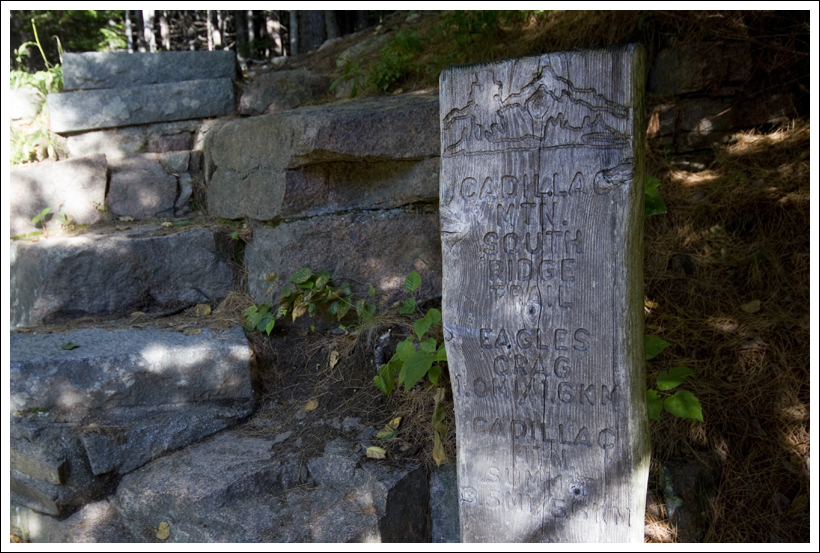
A View of the Porcupine Islands from the Cadillac Summit. Below:  The marker at the trailhead; A view of Cadillac Mountain from along the lower part of the trail; Geodetic Marker at the summit.

Trailhead Marker Cadillac Mountain Along the Route Geodetic Marker

Christine Says…

We’ve driven to the top of Cadillac Mountain.  We’ve also walked up the 4.4 mile North Ridge trail a few times.  But this is the first time we’ve ever hiked to the summit via the South Ridge route.  At seven miles (plus some additional length for the side trip to Eagles Crag and walking the summit path) this route probably qualifies as one of Acadia’s longest hikes.  It’s also become one of our favorite Maine hikes.  It was fantastic!

The trail starts off in the deep coolness of the evergreen forest.  Everything is green – covered with moss and ferns.  The thin island soil leaves gnarled roots and rocks exposed along the trail.  You have to constantly watch where you’re stepping so you don’t catch a boot toe and trip.  Planked boardwalks traverse the boggy, marshy places along the trail.   This part of the trail is one face of Acadia, with the other being expansive, open domes of granite.

Root-Covered Trail
The lower trail is covered with roots and rocks. Below: The view from Eagles Crag; Abundant blueberries along the trail; The first open views on the climb up.

View from Eagles Crag Abundant Blueberries First Open Views

The first trail junction you come to marks a short side-loop across the Eagles Crag.  The trail is quite a bit steeper here and leads out to an open rock ledge overlooking the ocean.  We hiked early in the morning, so the view looked directly into the sun, rendering the ocean silver and shiny.

On the return arm of the side-loop, we reentered the woods for a short while.  Near the trail junction where we met back up with the South Ridge trail, we found one of the densest patches of wild blueberries we’d ever seen!  I stopped to pick and eat some berries before we pushed on.  Yum!  Blueberries are at their peak in late July and early August, so our trip was timed perfectly for enjoying the fruit.

Near this point of the trail, the forest started thinning out and becoming patchier.  There were still trees, but they were broken up by open rocky sections.  Eventually we left the shade of the trees completely and stepped out onto the pink granite that Acadia is so famous for.  The trail was blazed blue, but we also had cairns guide our way.  The granite was punctuated by abundant patches of blueberry bushes and water filled glacial potholes.  The view behind and to the side of us was SPECTACULAR!  We found ourselves stopping time and time again to take in the majestic views.  I’ve been to a good number of national parks.  They’re all beautiful in their own way, but there is something really special about Acadia.

There were some sections of rock that required climbing and scrambling, but the way was never really steep or difficult.  We climbed one especially large rocky pass and found ourselves looking down into a small forested ravine tucked between two mountains.  The trail climbed downward into the trees and past a lovely glacial pond called ‘The Featherbed’.

The Ocean and the Featherbed
The Ocean and the Featherbed. Below: Another look at the Featherbed; Trails in Acadia are marked by cairns and blazes; Christine hikes up toward the summit.

The Featherbed Cairns and Clouds Christine Climbing

After the pond, we began the climb up Cadillac in earnest.  The first little bit after leaving the pond was quite steep with some mild rock scrambling.  Once we regained the ridge, the trail became moderate again.  The sun was bright.  The sky was deep blue and painted with wispy clouds.  The ocean below was sparkling and so beautiful.  I must have said to Adam a couple dozen times “It’s so gorgeous! This is a perfect Maine day!  We are so lucky!”

Along the ridge, we began to see distant glimpses of cars making their way up the auto road to the Cadillac summit.  But we didn’t come close to the road at all until we were almost to the top of the mountain.  Once drawback of the shorter 4.4 mile North Ridge is its proximity to the road for much of the hike.  We really enjoyed staying away from the road this time.

Near the summit, we passed through one more section of forest and came out on a gravel road behind the gift shop located at the summit.  It’s always kind of bizarre to hike several miles along pristine, quiet trail only to summit a mountain with auto access.  More than a few people looked at us strangely with our Camelbaks and trekking poles.

Even though it was still pretty early, the summit was packed with people!  Adam got cold drinks from the gift shop and I walked around the summit path to take a few photos.  The view from Cadillac offers a great look at the town of Bar Harbor and the outlying Porcupine Islands in Frenchman Bay.

With the thick crowds and the notion of a big lunch, we didn’t linger too long at the summit.  On the way down, we passed quite a few people heading up the trail.  I was really glad we had started around 7:30 and had been able to enjoy a bit of solitude.

The hike down was bright and hot under the mid-morning sun!  I had slathered myself with SPF 50, but I missed one spot between my ponytail and my backpack.  I ended up with a strange sunburned triangle on my back. 😦

We really enjoyed the views the whole hike down!  I was kind of bummed when the trail eventually descended back into the woods.  The shade was nice, but losing the view was not!

When we got back to the car we debated whether we should go back to our room and shower, or head straight to lunch in town.  In the end, hunger won out and we ate lunch covered with sweat and grime.  We went to one of our favorite lunch spots in town – Rupununi.  They have the best Buffalo Chicken sandwiches and clam chowder.  We got a great seat out on the patio, the food was delicious and I didn’t even care that I was filthy!

Adam Says…

A trip to Acadia National Park almost requires you to visit Cadillac Mountain.  However, most people drive to the top of it rather than try hiking up.  Their are also some insane bikers that bike up the mountain, but we’re not in that kind of shape.  Since Cadillac Mountain is the highest summit in the park, we used to feel intimidated about trying to hike up.  Several years ago, we hiked up the north ridge since that seemed to be the easiest route.  We remembered the north ridge hike being a great hike, so this time we decided to try a different route.

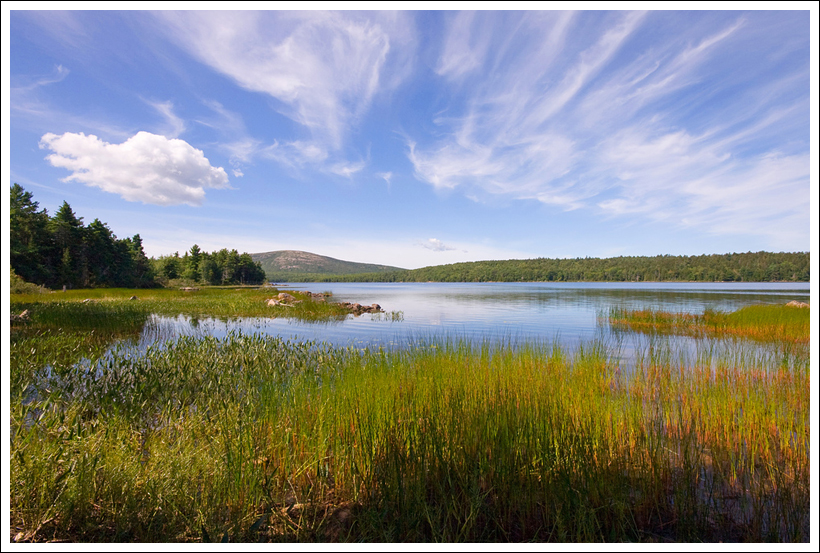
View of Eagle Lake
A view of Eagle Lake.

To start the hike, we parked on Route 3, almost directly across from the entrance to Blackwoods Campground.  You take a few steps up and then the trail begins.  This first section is just about the only part that is completely in the woods.  At .8 miles, you reach a junction with the Eagles Crag trail.  We took a right and went on the Eagles Crag trail, which joins back on to the South Ridge Trail at 1.2 miles.  The Eagles Crag trail was probably the toughest climbing on the trail, but it does take you out of the woods to some nice views to the east of Otter Cove and Gorham Mountain.  In retrospect, we feel that it really isn’t necessary to do Eagles Crag, since you will quickly see tons of views right after you rejoin the trail.  But, if you want more views and/or some more challenge, go for it.  When you rejoin the South Ridge Trail at 1.2 miles, the trail begins to open up to more views in a short distance.  You will need to pay attention to the cairns on the trail since there are no tall trees to mark trail paths.  The views on this trail are completely amazing!  You have to turn around to see the great views on the way up.  We found ourselves taking pictures from a gorgeous spot and then going another .1 mile and finding even better views behind us.  At 2.4 miles, you reach a summit of a small hill where you can see the small pond, The Featherbed, below.  You climb down this small hill and then reach The Featherbed and a junction with the Canon Brook Trail at 2.7 miles.  Stay straight on the South Ridge trail as you begin your next ascent to reach the summit.  At 3.2 miles, you reach a junction with the West Face Trail to the left, but stay straight.  The trail is steeper up this last section of the trail.  There are a few areas where you will climb up some rocks (even using one iron rung handrail), but we didn’t find it to be overly difficult.  Through this section, you are likely to hear or see people along the Auto Road heading up Cadillac Mountain.  At 3.7 miles, you will reach the summit of Cadillac Mountain.  Go back the way you came.

Hiking in the Open
Adam hiking along in the open.  Below: Trail junctions are well-marked in Acadia; The building at the summit; Another view of the Porcupine Islands from the summit;  Views on the hike down.

Trail Markers Summit Building
Cadillac Summit and Porcupines View Hiking Down

You feel like you are making an accomplishment when you hike up Cadillac Mountain.  While many of these people are driving to the top, you feel like you really earned the views.  The actual summit marker for Cadillac Mountain is not as easy to find.  As you’re coming up the South Ridge trail, you may walk right past it.  I like to get a picture of each summit we make.  Unlike most of Acadia that marks the summit with a large wooden summit marker, Cadillac Mountain only has a USGS marker in the rock.  To find it, walk behind the gift shop by about 100 steps where the gravel ends.  To the right, you will see a greenish-looking marker on a rock.  This marker has an arrow, that points about 20 feet to another marker on another rock.  This is the true summit marker.

We took a little time to hit the bathrooms, buy some cold drinks (that is always welcome when you are finishing a hike), and take in the views.  From Cadillac Mountain, you can see just about all of Mount Desert Island and on a clear day, the views are spectacular.  Many people drive to the summit of Cadillac Mountain to see the sunrise.  This is the second earliest place where you can see the sunrise on the east coast (only to be beaten slightly by Maine’s own Mount Katahdin).  While Christine was off taking some photos, I relaxed and talked to a family that just arrived from New York.  They were impressed that we hiked up it and I told them about some other things they should do during their week of vacation.  I could tell the father of the family was ready to tackle it all, but I could see some of his family wasn’t as enthusiastic.  After talking with me, they were going to try and hike up Cadillac Mountain that afternoon.

Cadillac Mountain does have some interesting history.   The area was named after Antoine Laumet de La Mothe, sieur de Cadillac, a french explorer and trader.  This area was well-explored and controlled by the French and Antoine was given this area (now known as Bar Harbor) with this mountain (then known as Mount Desert).  When I was attending a ranger program while I was trying to achieve my rank as a “Acadia Senior Ranger”, I learned about how this man was much-hated and was basically run out of this area for misappropriation of money.  He then left this area and founded what became Detroit.  The Cadillac car is named after this man and the seal is his family crest.  It is funny that this country holds the car in such high esteem, when the man was a criminal (once called “one of the worst scoundrels to set foot in New France”).

If you are interested in geocaching, you can find a geocache near the top of Cadillac Mountain that is located near the beginning of the north ridge trail: Cadillac Mountain Cache.

As Christine and I were reflecting on all of the hiking we have done in Acadia, I will say this is my favorite hike to do in the park.  You truly don’t get any better views than on this hike up the south ridge of Cadillac.  There were times that I even felt tears welling up due to the awe-inspiring, panoramic landscape.  The north ridge trail also has great views along, but several times you are walking very close to the Auto Road and you are limited to views on one side of the trail.  With the vast expanses on the south ridge trail, it can’t be beat.  If you are up for doing a longer hike in Acadia, make this the one to do!

Trail Notes

  • Distance7.4 miles
  • Elevation Change – approximately 1300 feet
  • Difficulty – 3.  The hike is steadily uphill but is quite moderate.
  • Trail Conditions – 3. The trail is occasionally root-covered and has a lot of open granite.
  • Views 5.  It doesn’t get any better than this!
  • Waterfalls/Lakes/Streams – 4.  The Featherbed is beautiful and you get lots of distant views of the bay and ocean.
  • Wildlife – 1.  Maybe some red squirrels and (if you’re lucky) hawks on Eagles Crag.
  • Ease to Navigate – 4.  Just follow the markers, blazes and cairns, and you can’t go wrong.
  • Solitude – 1.  We started early and didn’t see many people on the trail, but the summit is always very crowded.

Directions to trailhead:  Located on Route 3, about 5 miles south of the Jackson Lab.  Look for the signs for Blackwoods Campground and park directly across the road from the entrance to the campground.  You will see a break in the woods with a few steps that starts your trail.

Carriage Road Bike Ride – Witch Hole/Eagle Lake/Jordan Pond – Acadia National Park (ME)

Special: Acadia Edition

The bike ride along this loop gives you beautiful lakeside views in the interior of Acadia National Park.

Eagle Lake from the Carriage Roads
A view of Eagle Lake from the Carriage Roads.  Below:  The Duck Brook Bridge entrance to the Carriage Roads; There are lots of water lilies in Acadia’s ponds;  Adam bikes along the shore of Jordan Pond.  The rocks lining the trail are affectionately known as ‘Rockefeller’s Teeth’.

Duck Brook entrance  Water Lilies Rockefeller's teeth

Adam Says…

This is truly one of our favorite places to bike!  If you are ever near Acadia, I would recommend taking a bike ride around Eagle Lake.  While there are 45 miles of carriage roads in Acadia National Park, the loop around Eagle Lake is by far the most popular.

The carriage roads were donated and built by John D. Rockefeller, Jr., emulating the carriage roads his father created in Ohio and New York.  While the Park Loop Road provides access to much of the circumference of Acadia National Park and ocean views, the carriage roads provide great access to the interior, providing glimpses from the top of mountains and around the lakes and ponds.

I recently had a co-worker, Kristen, that was going to Maine to visit some family property.  Having been to Acadia many times, I planned out an ambitious day for her and her sister to capture the things I enjoy up here.  She wasn’t able to do everything I suggested, but she did the Eagle Lake/Jordan Pond section of the trail.  They rented bikes in Bar Harbor and decided to bike from town to reach the carriage roads.  There is a large hill from Bar Harbor to reach the entrance to the Eagle Lake parking lot.  Her sister was yelling up ahead to her, “KRISTEN!  I DON’T THINK I CAN MAKE IT!”  I should have been explicit in telling her to rent a bike rack and park near the carriage road entrance. Some people bike to the carriage roads from town, but I think it is best to park closer or you’ll burn up all your energy before you get to enjoy the actual ride.

Biking toward eagle lake
Adam on his rented comfort bike, passing under the Eagle Lake bridge. It was quite different from the mountain bike he normally rides.  Below: Christine’s parents take a break after a long uphill stretch along Eagle Lake.  This is the spot we took a wrong turn!

Parents at junction

We started our ride, by parking on Duck Brook Road.  Right before the roadside parking, you pass a beaver dam on New Mill Meadow.  Park your vehicle near the bridge that begins your journey.  The carriage road intersections are all numbered on wooden posts (that also serve as posts to provide you some overall direction) and have this trail started at Post #5.  We took a right after crossing the bridge to make our way around Witch Hole Pond.  The trail does tend to go uphill during this part of the section about 100 feet.  In 1.1 miles you will take a left at Post #3.  You will begin to see some up close views of Witch Hole Pond.  At 1.3 miles, you take a left at Post #2.  The trail continues to loop around Witch Hole Pond.  At mile 2.3, you will reach Post #4, bearing right and seeing views of the small Halfmoon Pond.  At mile 3.4, you will reach Post #6, going under a bridge and close access to the Eagle Lake parking lot.  Most people start their bike ride here, so expect lots of people around this bridge.  After going through the bridge, you will arrive at Post #9 at mile 3.5.   The trail goes along the western side of Eagle Lake, but goes up during one of the tougher sections of this loop ascending over 200 feet.  At mile 5.5, you will come to Post #8.  Take a break if you would like here, for the toughest part of the first section is over.  At Post #8, take a right (this is where I failed to follow the map closely which caused us to retrace our steps and made us go uphill).  At mile 5.7, you will reach Post #10.  Take a left at this junction to make your way.  The trail does ascend slightly.  At mile 7.0, the trail begins to open up to views of Jordan Pond and the Bubbles to your left.  At mile 7.9, you reach the Jordan Pond House and Post #14.  Bear left at this intersection for about .3 mile passing by Post #15 and Post #16.  Cross the Park Loop Road carefully and then you will see the large Jordan Pond Gatehouse.  Bike carefully through the gate.  At mile 9.8, you reach Post #17, near Wildwood Stables.  Take a left here and your climb begins again.  Once the trail levels out, you will pass by Bubble Pond on your right.  At mile 12.9, you reach Post #7.  Take a right at this junction and you will begin to enjoy the best views of Eagle Lake.  The trail continues along the eastern side of Eagle Lake.  At mile 15.1, you will reach Post #6 again.  Take a right and go under the bridge.  At mile 16.2, you will reach Post #4.  Take a right here and at mile 17.3, you will reach Post #5 to complete your loop.

As there are a lot of intersections, I would recommend picking up a map of the trails.  While you can purchase them from many places in Bar Harbor or Acadia National Park, they do have some decent carriage road maps that are free.  These are typically in some of the boxes attached to the post intersections near some of the entrances to the carriage roads.  I did spot these boxes at Post #5 and Post #8.

Lunch on the Lawn
Lunch on the lawn at Jordan Pond is not to be missed.  Below: Views of Jordan Pond and the Bubbles.

Jordan Pond and Bubbles The Bubbles

If you do your planning well, you can include a stop near the halfway point at the Jordan Pond House Restaurant.  This is a must-visit restaurant while in Acadia. Get a seat outside and enjoy popovers as you take in the scenes of Jordan Pond and the Bubbles.  The menu has been expanded since the last time we had been here, so we were thrilled to try some new things.  Christine really enjoys their lobster quiche and I like their cranberry walnut chicken salad sandwich.  While the prices are a little high, you do have one of the best views for a restaurant.  There are plenty of places nearby to lock your bike and there is a gift shop that sells everything from hiking gear to pottery to Gatorade.  They even sell Jordan Pond coffee and popover mix.

I have two favorite sections of scenery along this trail – the view near the rock slide approaching Jordan Pond and the eastern side of Eagle Lake.  This is a bike ride that almost invites you to take your time by soaking in the great views of the lake, taking your time to pick wild blueberries near Witch Hole Pond, or listening for the cry of loons on Eagle Lake or Jordan Pond.

Christine Says…

Biking Acadia’s Carriage Roads is always one of the Maine activities I look forward to most on our trips!  It’s funny, when I visited Acadia as a child and teen, I never tried the carriage roads by bike.  Instead I preferred to run.  Looking back, I don’t know what I was thinking!  Sure… the carriage roads are great for walking and running, but I can’t imagine a better way to see them than by bicycle (Unless I was given the option to go on horseback; but unless you arrive at Acadia with your own horse, the closest you can get is taking a chauffeured horse carriage ride.)  The car-free carriage roads in Acadia meander through the woods, passing ponds and lakes.  If you’re lucky, you’ll spot beavers or loons swimming.  You get occasional glimpses of the ocean.  You breathe in the clean, evergreen-scented air.  And best of all… you can bike right up to the Jordan Pond House and indulge in popovers with butter, popovers with strawberry jam, popovers with soup, popovers with salad and even popovers a la mode!  Don’t even get me started on how much I love popovers a la mode.  They’re one of my raison d’êtres.  I’m not even kidding – ask Adam!

Sometimes we bring our bikes on the long drive up to Maine, but this time we drove our small car to save gas money, and ended up renting bikes at the Bar Harbor Bicycle Shop.  The folks there are really friendly and knowledgeable and their bikes are all expertly maintained.  We tried renting a carrier for our car, but none of them worked with our particular hatchback.  Thankfully, my parents were vacationing with us and were able to haul our bikes to the start point of our ride.  Technically, you can ride your bike from the shop to the carriage road entrance, but it’s an arduous uphill ride along a very busy road.  Biking the few extra miles from the shop to the trails takes a lot of the enjoyment out of the ride, so we avoid it any way we can.

On this particular day, we decided to follow one of our absolute favorite routes.  Starting at Duck Brook Bridge, we biked around Witch Hole, then around Eagle Lake, past the north shore of Jordan Pond to the Jordan Pond House.  After lunch, we continued the route past Wildwood Stables, along Bubble Pond and the opposite shore of Eagle Lake.  A few final miles along the other side of Witch Hole returned us to our car.

Jordan Pond Gatehouse
Even though the Gatehouse sits in the park, it’s still privately owned. Below: A horse carriage on its way from Wildwood Stables to Jordan Pond.

Horse team

It’s a fabulous route that shows off a little bit of all of Acadia’s best scenery.  There are some substantial hills along the route, and it’s not uncommon to see people walking their bikes uphill instead of riding them.  I remember the first time I biked the carriage roads many years ago, the first steep hill along the first side of Eagle Lake about killed me!  Despite the fact I was beet red and out of breath, I was determined NOT to walk my bike.  I did have to take a water break or two, but I never had to get off and push my bike uphill.  Nowadays, I’m in much better shape (even though I’m almost 20 years older) and biking the hills is no sweat at all!  In fact, I must brag that I biked easily past dozens of people headed uphill.  🙂

The trail marker at the far end of Eagle Lake is one of the only places that directions get confusing along the ride.  The trail branches off in several different directions at this point.  As (bad) luck would have it, we biked following our instinctive directions instead of looking at our detailed map.  We ended up going the wrong way for almost two miles – mostly along a steep, beautiful downhill coaster of a descent.  This meant we had a tough uphill slog once we finally realized we were going the wrong way.

I suppose we could have kept on going in the wrong direction – most of the trails eventually cross one another and we would have ultimately arrived at the Jordan Pond House.  However, I really enjoy the ride along the north shore of the pond, so we decided to retrace our ride.  My parents decided to stay the course (my mom didn’t want to bike back uphill) and meet us at the Pond House.

The uphill turned out to be less painful than I imagined and after about 15 minutes, we were coasting downhill along the edge of Jordan Pond.  I enjoyed the sparkling water, the first glimpse of the Bubbles, passing the big rock slide and knowing I’d soon be eating popovers.

The ride along Jordan Pond goes really quickly.  At Jordan Pond, the first thing we always do is get our name on the waiting list for a table on the lawn.  If you visit the Pond House, you can almost always get an indoor table immediately, but you DO NOT want to do that.  The best place to sit is outside on the lawn at one of the picnic tables overlooking the water and the Bubbles.  I always start my meal off with lemonade.  It’s fresh-squeezed and comes unsweetened with a tiny pitcher of simple syrup, so you can sweeten the drink to your personal taste.  The regular lemonade is good, but the strawberry lemonade, loaded with fresh strawberry puree, is even better.  As soon as you finish placing your order, a waiter will come around with a basket of piping hot popovers.  They’re served with butter and homemade strawberry preserves.  On this particular day, I ordered the lobster quiche, which has always been a favorite of mine.  I also couldn’t refuse a second popover, even though it cost a little extra.  Because we were biking and I didn’t want to feel over-full, I had to pass on the a la mode (for now).

After lunch, we refilled water bottles and took a few minutes to digest lunch while browsing the Acadia gift shop.  We also stopped to chat with the Friends of Acadia who were working on fundraising and recruiting new members.  We joined a few years ago and are happy to support our favorite National Park.

After leaving the Jordan Pond House, we crossed the Park Loop Road and passed by the privately owned gate house.  We happened to time our departure perfectly to pass a team of draft horses pulling a buckboard up the hill.  They’re such huge and beautiful creatures!

The ride along this section is wooded and doesn’t pass anything remarkable.  You can take a side road to get down to Wildwood Stables and Day Mountain, but we continued on toward Bubble Pond.

Bubble Pond from the Carriage Roads
A look at Bubble Pond from the Carriage Roads

Bubble Pond is a gorgeous spot.  We’ve seen loons there and I’ve even taken a photo of the pond that was featured on the cover of Boston Magazine’s 2011 Summer Travel issue.  This year, the view was as lovely as ever, but the experience was marred by a couple changing the diaper of their caterwauling toddler.  They had the child laid out on a rock on the pond’s edge… the edge of the pond that is a source of public drinking water.  Ewww!  I know babies need changing, but for God’s sake… take the diaper-changing activities off the trail and away from the water source.

After passing the end of Bubble Pond, you go over a neat arched bridge, cross the Park Loop Road again and make the final push back toward the opposite shore of Eagle Lake.  As the trail gets closer to the lake side, you get some really lovely lake and mountain views.  You also pass one of the most popular kayak launch spots in the park.

Shortly after passing the launch, you arrive at the Eagle Lake parking area.  This area is another parking option for accessing the Carriage Roads, but it’s usually horrible congested.  We continued past this spot to bike the remainder of the trail along Witch Hole and back to our car.

Witch Hole
Witch Hole is very pretty – full of lily pads and beaver dams.

It was a fantastic ride – one that I know I’ll want to do again and again!  After we wrapped up the ride, we headed back to the hotel to get cleaned up before dinner.  Sometime between the end of the ride and leaving for dinner a heavy fog rolled over the island.  It’s really amazing how quickly clear blue skies can turn to thick, cottony fog in Maine!  It’s part of the island’s charm, I suppose!  We enjoyed the foggy evening at one of our favorite lobster pounds, Thurston’s (in Bernard).  If you’re on MDI and want a classic Maine lobster experience, don’t miss Thurston’s!

Trail Notes

  • Distance17.3 miles.  We added about another 4.4 miles due to our misdirection.
  • Elevation Change – Approximately 500 feet.
  • Difficulty – 2.  There are some uphill sections which will have you switching to lower gears, but it is doable for most people.  Take breaks whenever you need one or walk your bike up the steeper sections.
  • Trail Conditions – 4.5.  The only thing better is pavement.  The carriage roads have small crushed gravel, which is good for just about any type of bike.  I would recommend a hybrid or mountain bike though due to the gravel.
  • Views – 3.5.  Most of the views are of the lakes, so you can’t see for miles and miles in most parts, but the lakes and ponds are gorgeous.
  • Waterfalls/Streams – 4.  You get great views of Witch Hole Pond, Eagle Lake, Jordan Pond, and Bubble Pond.
  • Wildlife – 1.  You may see an occasional loon or gull in the lakes, but not much else other than a red squirrel.
  • Ease to Navigate – 3.  There are lots of turns on this trail, but bring a map and follow the signposts and you should do well.
  • Solitude – 0This is an extremely popular spot for bikers, walkers, runners, and even horses.  

Directions to trailhead: Head west on 233 out of Bar Harbor.  After about a mile outside of town, take a right on Duck Brook Road.  Travel for about two miles until you reach the roadside parking near the park service building.

The Bubbles – Acadia National Park (ME)

Special: Acadia Edition

We’ve taken a detour from our normal coverage of Virginia hiking and biking!  For the next five posts, we’ll be doing a special edition covering the trails of Acadia National Park in Maine.

The Bubbles hike consists of two small mountains that overlook Jordan Pond.  One of the key features on this hike is a large glacial erratic hanging on the edge of the south Bubble.

Adam and Bubble Rock
Adam pretends to support the giant glacial erratic known as Bubble Rock.  Below: The first viewpoint along the trail up the South Bubble;  A view of Jordan Pond from the South Bubble; You can see how precariously the erratic hangs on the side of the mountain; When you visit the Jordan Pond House you get a great look at the Bubbles from a distance.  The two small mountains have such a distinct shape (photo from another trip).

The First View Jordan Pond from the South Bubble
Precarious
The Bubbles from Jordan Pond

Adam Says…

We had an extraordinarily tough drive up to Maine this year.  We left on a Friday with plans to stay in Sturbridge, MA for one night and then finish the trip to Maine the following day.  We were counting on a lot of weekend and rush hour traffic around Boston, so we thought breaking this into a two-day drive was a good idea.   Well, the drive on the first day should have taken us around 8 hours and ended up taking us over 12 hours.  We ran into an over two-hour delay near Allentown, PA and Connecticut traffic is always ridiculous.  On Saturday, we had a better day of driving to get to Mount Desert Island  We were very eager to stretch our legs when we got there.  When we vacation, we are not ones to idly relax; we like to pack in as much as possible.

We have hiked up the Bubbles a couple of times in the past, and have always enjoyed it.  Since this is a short hike, you should be able to fit it in a narrow time period.  From the Bubble Rock parking lot, start off on the Bubble Rock trail.  At .1 miles, you will reach a junction with the Jordan Pond Carry Trail.  We went past this and just continued straight on the trail.  In about .3 miles, you reach a junction where the North and South Bubble trail split.  Take a left at this junction and continue the path up to reach the top of the South Bubble.  Take in the views and then go back the way you came.  At the previous junction, then follow the path to the North Bubble summit.  You can this take this path back to the junction and then just take a left to head back to your vehicle.

South Bubble View
Another view from the South Bubble. Below: Trails are very well-marked throughout Acadia; Adam scrambles to the top of the boulder pile to reach the summit marker on the South Bubble; The sun came out a bit more by the time we climbed the North Bubble.

Trail Sign  Adam scampers up to the top of the summit marker A View from the North Bubble

When you reach the summit of the South Bubble, take in the views of Jordan Pond and also take some time to find Bubble Rock (not to be confused with Balance Rock, which is located along the Shore Path in downtown Bar Harbor).  It was amazing to see all the people that try to push on the rock in hopes that they can personally move a multi-ton granite boulder.  There was one family that we enjoyed watching that had a couple of younger boys with them.  One of them held a stick like a spear and seemed to have a little violent streak running through him.  He kept wanting to throw his stick at things.  We overheard him telling his family, “When I see things, I want to chuck my spear at it SOOOOO BAAAAAD!”  I’m curious to see how his deviant behavior develops over the years.  From the Bubble Rock, you can also get some views of the Park Loop Road below.  This hike pays off with stunning views despite little effort.

We also enjoyed talking with a couple at the North Bubble.  They were taking part of a quest to visit all of the U.S. National Parks.  They had been to lots of places over the last few weeks and had come from Canada a few days before Acadia.  They took some pictures of the two of us and we returned the favor.  They said they were sending their pictures to their friends that were cursing them at all of the things they have been able to do.  I guess once you make your friends envious, you have to keep it up.  I will say that the North Bubble is a little steeper to climb up, but the views from both of the Bubbles are great.

We hope that you enjoy our reviews of Acadia National Park hikes.  We have been going there for years and I think you will see that over the next few blog entries that this is a place that you should put on your “must visit” list!  There is a reason that nearby Bar Harbor, ME was once called “Eden”.  This area really feels like a paradise to both of us.

Christine Says…

We rolled onto Mount Desert Island, home of Acadia National Park, in the early afternoon after an easy six hour drive from Massachusetts.  It was a beautiful afternoon with a cold front pushing out the last of the dark, gray storm clouds and humidity from the day before.  We were really eager to start enjoying the park, so instead of going to our hotel, we immediately headed to the Acadia Visitor Center.  We changed into hiking clothes, bought our park pass and set out to do the short hike across the north and south Bubbles, overlooking Jordan Pond.

The hike is short and easy/moderate, so it’s very popular with families and novice hikers.  Even so, most of the traffic had cleared out earlier in the day, so we were able to find a parking spot right at the trailhead.  Anyone who visits Acadia knows how rare that is!  Acadia is one of the smallest and most congested national parks, so we always try to plan our activities at non-peak times to avoid crowds.

The trail climbs from the parking lot.  It starts off smoothly, but soon you’re scrambling over roots and up granite ‘stairs’.  It was a little wet from storms the night before, so we had to be careful of our footing.  There aren’t many footing surfaces more slippery than wet granite!

The first viewpoint we came too came atop a rocky shelf, mostly overlooking the mountains, but with a little snip of water visible.  After snapping a few quick photos, we made our way to the summit of the South Bubble.

The View from the North Bubble
The View from the North Bubble. Below: Christine and Adam enjoy views along the hike.

Christine Enjoys the View Adam enjoys the view

Of the two Bubbles, the south peak is quite a bit more popular due to the presence of ‘Bubble Rock’ – a glacial erratic that sits precariously on the side of the mountain.  It looks like it could go rolling down the mountainside at any moment.  It’s always fun to sit and listen to people plotting to push the boulder off its perch.  Some people think it would take a group pushing effort; others contemplate the lift power of a lever.  Personally, I think when the boulder falls; it will be solely Mother Nature who moves it.  I hope it doesn’t happen in my lifetime, because I like the boulder right where it is!  Another fun tradition is to take photos of your hiking buddies pretending to hold the boulder up.

If you hike past Bubble Rock, the trail leads over to an open view of Jordan Pond below.  It’s a lovely spot!

To get to the North Bubble, you simply retrace your steps back to a trail junction marking the path north.  The trail up the North Bubble might be slightly steeper, but it’s still a short and easy hike.  We spent a bit of time atop the peak, enjoying the view and luxuriating in the cool, breezy Maine air.  Being in Maine always makes me feel so happy.

We hiked back down the way we came and were back at our car quickly.  Even though the hike was nothing long or challenging, it was still a perfect way to kick off our week in Acadia!

Trail Notes

  • Distance1.7 miles
  • Elevation Change – approximately 1050 feet.  You first go up about 500 feet up to the South Bubble, go back down 200 feet and then up another 550 feet to the North Bubble
  • Difficulty – 2.5.  These trails are very short, so most people should be able to do them.  The South Bubble is fairly easy with the short distance and I would give about a 2 in difficulty.  The North Bubble is definitely more of a steep trail and is closer to a 3-3.5 in difficulty.
  • Trail Conditions – 3.  The trail is very well-maintained and traveled.  However, some of the footing can be slick in the rain on the granite.  The North Bubble does have some steeper sections which make the footing a little more treacherous.
  • Views – 4.  Great views from both Bubbles.
  • Wildlife – 0.  We didn’t really see anything, but you may be able to see birds soaring above or relaxing on the lakes below.
  • Ease to Navigate – 3.5.  This path we took was more like a T, since you split off in different directions.  Almost all of the trails in Acadia lead to other options to combine into loops with other trails.   
  • Solitude – 1Due to the distance, this is an incredibly popular hike.  You will very likely have several hikers to share in the views if you go over the summer.

Directions to trailhead: On the Park Loop Road in Acadia National Park, keep following the road until you reach the Bubble Rock parking lot.  This is just south of the Bubble Pond parking lot, so don’t be confused by the name.  The trailhead starts from about the middle of the parking lot. 

Appalachian Trail – Elkwallow to Thornton Gap

This 8.35 mile hike (with an optional .4 mile detour to the Pass Mountain Hut) follows the Appalachian Trail through beautiful forest and past one decent view.

Path to Pass Mountain Hut
Path to Pass Mountain Hut. Below: Adam walks along the Appalachian Trail descending Pass Mountain; Rocks along the trail descending Neighbor Mountain; We crossed Skyline Drive at Beahm's Gap.

Ferns Rocks along trail Skyline drive near Beahms Gap

Christine Says…

Last weekend was one of my only free weekends between July and August (lots of art shows and an upcoming trip to Maine!), so we decided to go for a hike.  I wasn’t in the mood to go anywhere that required a long drive, so we settled on doing another section of the Appalachian Trail in Shenandoah National Park.  We’ve completed the central district and a couple segments in the south district, but we had yet to hike any of the AT in the park’s northern section.  To make the drive time the shortest possible, we chose to hike from Elkwallow to Thornton Gap (Rt. 211).

We started out at the Elkwallow Picnic Area, the same exact spot we began our backpacking loop down to Jeremy’s Run last year.  After a short downhill to meet the AT, we began a gradual, steady climb up the trail – the first of three significant climbs on this section of trail.  We passed lots of thickets of ripening blackberries along the trail.  We also saw a lot of eastern red columbine still in bloom.

Blackberries
Blackberries along the trail. Below: Red eastern columbine; a couple unidentified wildflowers; Indian Pipes

Columbine Wildflower Wildflower
Wildflower Indian Pipes

After the first climb, the trail is really gentle and level until you reach the next climb, headed up Neighbor Mountain.  The Neighbor Mountain trail, which branches off the AT, is another option for making a loop with Jeremy’s Run.  It’s a little longer than the Knob Mountain Loop we chose, but the steepness of the climbs are a little more gradual.  At the junction of the AT and the Neighbor Mountain trail, we ran into two gentlemen that turned out to be doing the same exact segment hike we were working on.  They offered us a share of their fresh picked peaches and plums from a local orchard!

Near the trail junction, you have the option to take a side loop past Byrd’s Nest #4, but we decided to stay on the AT.  Descending Neighbor Mountain is a little steep and rocky.  On the steepest part of the descent, we passed three section hikers slogging uphill.  Near the bottom of the descent, we stopped for a snack and were eventually passed by the two guys we met at the Neighbor Mountain junction.  We continued to play ‘leap frog’ with them for the remainder of the day.

View off Pass Mountain
Adam takes in the view from Pass Mountain. Below: Blueberries ripening; Adam picks berries.

Blueberries Picking Blueberries

A bit later, we crossed Skyline Drive near the Beahm’s Gap overlook and began the final big climb of our hike – over Pass Mountain.  I didn’t really expect any views on this hike, so I was pleasantly surprised to find a very nice overlook just north of the Pass Mountain Summit.  It was a little hazy, so the view wasn’t as pretty as it could have been.  Even if the views were slightly lacking, the abundant wild blueberries more than made up for it!  It was one of the thickest, densest accumulations of ripe berries I’ve ever seen!  (and this is coming from someone who has spent many, many summers in Maine).

The park has a policy allowing limited gathering of berries, nuts and seeds for personal consumption, so we ended up picking about a quart of berries.  I made vanilla-blueberry pancakes with them.  YUM!

After we picked berries, we had a short distance more to climb over the summit.  After crossing the high point, the remainder of the hike was an easy downhill grade for a couple miles.  With about 1.5 miles left, we passed the spur trail to the Pass Mountain Shelter.  I ditched my backpack and hiked the extra .2 miles down to the shelter.  It was set in a pretty opening under the trees.  I took a peek at the journal and noticed one of the recent entries mentioned a bear visiting the shelter!

After the shelter, we continued downhill back to the car.  When we crossed 211 to get back to where we parked, we noticed that there were police cars and park rangers all over the road.  It turns out that 211 was closed due to a fatal motorcycle accident – very sad.  Since we had to wait for the road to open, we headed back into the park to get some lunch at Elkwallow Wayside.  It was a tasty, indulgent treat after our hike.

Adam Says…

Well, we’ve reached about the halfway point in covering the Appalachian Trail through Shenandoah National Park.  With the Central District done, we have been starting to work on some other sections in the North and South districts.  This was our first section through the North District.

We parked one car on 211 near the sign for where the Appalachian Trail crosses and outside the park boundary.  We drove the other car to the Elkwallow Picnic Ground.  The trail starts right near the privy and heads down into the woods.  Continue on this spur trail for a short distance until you reach the junction with the Appalachian Trail.  Take a left heading south on the white-blazed trail.  In about a quarter of a mile, you reach a junction with the Jeremy’s Run trail but stay on the Appalachian Trail.  The trail begins to ascend fairly steeply and you will gain about 500 feet of elevation over the next mile.  The trail levels off at this point and even starts to descend for the next two miles.  At 3.2 miles, you will start another ascent of 400 feet.  You will then pass a junction with the Neighbor Mountain and Byrds Nest 4 trail.  We stayed on the AT, but you can take the trail to the Byrds Nest shelter and it will rejoin the AT after the shelter.  The trail descends again over the next mile and you reach Skyline Drive at the Beahms Gap parking area at mile 5.2. Cross Skyline Drive and begin the ascent up Pass Mountain as you gain 600 feet of elevation over the next mile.  Once you reach the unmarked summit of Pass Mountain, the hard part is over and it is two miles back to your vehicle on 211.

Pass Mountain Hut
Pass Mountain Hut. Below: The shelter has a picnic table and a firepit; A peek inside the shelter journal; A curious doe along the trail.

Journal and fire pit Shelter journal Doe near the Pass Mountain Hut

The best part of the hike was definitely getting to the summit of Pass Mountain.  We were hiking near the summit and we saw a rock outcropping to the west of the trail about 100 feet.  Christine was doubtful that there would be any opening for views, but I said that I thought there would be.  When I went to investigate I saw there was a decent view, but I was quite pleased to see all the wild blueberries.  As Christine mentioned, we have often seen blueberries when we go hiking in Acadia National Park in Maine, but these patches seemed untouched.  We spended about 30 minutes picking blueberries and taking in the view.  We also thought of our friend, Suzanne, that accompanied us on the backpacking trip in Dolly Sods the previous week.  She went crazy for wild blueberries, and we pictured her screaming in glee over these patches.  There were still lots of blueberries that weren’t ripe enough to pick, so if you are interested in doing this hike for some blueberries, I would hit this trail in mid to late July.  I’m guessing that this trail could also be frequented by bears since they tend to go where the food sources are.

Path through woods
The Appalachian Trail is like a green tunnel through the woods. Below: Christine crossing 211 at the end of the hike; Blueberries at home!

Crossing 211 Blueberries at home

Christine was impressed when I spotted the indian pipes on the trail.  Of course, I wasn’t sure what they were called.  I just said, “Isn’t this something you’re interested in?”  She has quickly become great at identifying wild flowers.  Maybe one day I will get there also, but I can at least point some things out for now.

Most of this hike is more or less a walk through the woods.  The terrain wasn’t too tough, and this is not a section of the AT that is riddled with views and interesting things along the way.  Unless you’re tackling a section of the AT, I would say that most people that you would run into on this section are hiking up Pass Mountain.

Trail Notes

  • Distance 8.35 miles (8.75 if you do the optional side trail to the Pass Mountain Hut)
  • Elevation Change – 1600 feet
  • Difficulty – 3.  This hike is a moderate mix of climbs, descents and flats.
  • Trail Conditions – 4.  The trail is in great shape, but a little overgrown due to the wet summer.
  • Views –2.5  The view from Pass Mountain is nice.
  • Wildlife – 1We saw a deer but nothing else.
  • Ease to Navigate – 4.5.  The trail is unmistakably easy to follow.
  • Solitude – 2.5.  You probably won’t see many hikers after the peak of thru-hiking season.  We saw only a handful of people over the miles.

Directions to trailhead: From Skyline Drive around mile marker 24.3, follow the signs to the Elkwallow Picnic area (not Elkwallow Gap parking lot).  Park near the privy.  The trail starts next to the privy.

Flat Top

Flat Top is one of the two ‘Peaks of Otter’.  While not as popular as the other peak (Sharp Top), this 5.4 mile hike to Flat Top’s summit offers some nice views of the area.

A View of Sharp Top from Flat Top
A view of Sharp Top from just below the Flat Top summit. Below: Starting out on the Flat Top trail; The trailhead was decorated with lilies; The junction of the trail down to Cross Rock is right at the Pinnacle.

Flat Top Trail  Day Lily Cross Rock Junction

Christine Says…

Last week, we were home on a week long ‘staycation’.  Most of the week, we relaxed at home, sleeping in and watching movies.  When Wednesday turned out to be cool and breezy with low humidity, we decided to get up early and go for a day hike in the Peaks of Otter area of the Blue Ridge Parkway.  We’ve hiked Sharp Top many times, but I had never really considered hiking the companion peak.  Adam had always described the hike up Flat Top as steep and lacking any spectacular views.  But, we’d read a few more positive descriptions of the views, so we decided to give the trail a shot.

When we got to the trailhead, it was almost chilly.  Personally, I think chilly weather is always welcome in the middle of summer!  The hike was all uphill, passing hillsides of ferns, giant boulders and patches of red columbine.  The first point of interest we came to was the Pinnacle.  It offered panoramic views of the valley.  We could even see the Blue Ridge Parkway snaking through the mountains across the valley.

View from the Pinnacle
A view from the Pinnacle. Below: The trail was often lined with ferns; There were many giant boulders along the trail; Cross Rock was underwhelming.

Ferns Along the Trail Giant Boulders Along the Trail Cross Rock

At the Pinnacle, there is sign marking a side trail down to Cross Rock.  We assumed Cross Rock would be another outcropping with nice views.  We were quite wrong. Instead, it was a brutally steep descent to a rock formation in the shape of a cross.  Others might find Cross Rock to be fascinating, but I think I would have passed on the side trail if I had known I was just going to look at some rocks.

From the Cross Rock junction, the trail became steeper and rockier.  We continued climbing for the last half mile to the summit of Flat Top.  At first, we were a little confused because the summit marker was buried in the trees.  Our hiking book had described the views from the top as panoramic and majestic.  We eventually found a little path through the brush leading to a rocky outcropping with views.  It was a little below the actual summit.  The views from that point were nice, but I wouldn’t describe them as generously as our hiking guide did.  If you climbed out to the edge, stood and peered beyond the trees, you could see Sharp Top.  Overall, I think the view from the Pinnacle was much nicer than the view from the summit.

We relaxed on the rocks for a while, then made our way down the trail.  The trail going down was really slick from the thunderstorms the night before.  On one steep section, I slipped and fell hard on my left knee.  At first, I was really worried I may have banged it up badly enough to jeopardize our planned backpacking trip.  Fortunately, I was able to walk it off and only suffered a bruise.

The downhill hike seemed endless at times after I hurt my knee, but we got back to the car in less than an hour. Afterwards, we enjoyed a delicious lunch at the Peakview Dining Room in the Peaks of Otter lodge.

Adam Says…

The Peaks of Otter place has a special place in my heart, since this was where my family would often visit for a picnic.  I have hiked up the sister peak, Sharp Top, countless times, but I have only been up Flat Top a few times.  The times that I had approached the peak of Flat Top, we had started out from the trailhead from the Peaks of Otter picnic area.  I remember that path being very steep and forested, with views that were mostly through the trees.  After consulting our Falcon Guide of Hiking the Blue Ridge Parkway, it mentioned great views and starting from the actual Blue Ridge Parkway to shave off some of the elevation gain.  We decided to check out this path instead of the way I had experienced.

View Just Below the Flat Top Summit
View just below the Flat Top summit. Below: The actual summit of Flat Top is in the trees; Adam took a photo of Christine with the camera’s manual settings customized for a sunny landscape shot – oops!; Inside the Peaks of Otter lodge.

The actual summit of Flat Top Christine in Motion Peak View Dining Room

The start of this trail begins around mile marker 83.5 on the Blue Ridge Parkway, north of the Peaks of Otter Lodge.   There is a parking lot on the eastern side and you will see a brown sign denoting the beginning of the Flat Top trail. The trail starts off by slowly elevating through the forest in more of a gradual ascent.  Around .6 miles, the trail turns sharply to the left and you begin a series of switchbacks that last until you reach the junction with the Cross Rock trail at 2.1 miles.  At this junction you reach what is termed the pinnacle.  If you crawl out on the outcropping of rocks near you, you are at the Pinnacle, which provides the best views on this hike.  You have the option of climbing down to Cross Rock, but this is not a great viewpoint, just an interesting rock formation.  Follow the signs up the last .5 miles to reach the Flat Top summit at 4,001 feet.  You will see the summit marker in the middle of the woods.  Continue past the summit marker slightly for a short sidepath onto a rock outcropping that will give you some nice views.  Continue back the way you came.

This path up Flat Top was better than my memories of hiking up from the picnic area.  The views from the Pinnacle are gorgeous and you would miss out on this if you did the hike from the picnic area.  The hike back down from the summit felt steeper than going up and there were loose rocks that required you to keep an eye on your footing.  Take trekking poles to help secure your footing.  There is one geocache on the hike, but I forgot to plug in the coordinates before we left:

The one thing that Flat Top has over the Sharp Top hike is more solitude. Sometimes it seems that Sharp Top is crawling with large groups of hikers, but you will likely only see a few people on the Flat Top hike.  Sharp Top does have better viewpoints, but this is a nice hike to do if you have more time to spend in the area.  If you are interested and not too exhausted, you can also cross the road from the parking lot for a short 1.6 mile hike to Fallingwater Cascades.

Trail Notes

  • Distance 5.4 miles (including the optional .2 mile side trail to Cross Rock)
  • Elevation Change – 1391 feet
  • Difficulty – 3.  The hike is steady uphill climbing and get rockier the higher you climb.
  • Trail Conditions – 2.  The trail is very rocky and is rather overgrown in places.
  • Views –3.5  The view from the Pinnacle is beautiful, but views from the summit are somewhat obstructed.
  • Wildlife – 0.  We didn’t see anything.
  • Ease to Navigate – 3.5.  The trail itself is easy to follow, but at the summit there is no clear pointer to the best overlook.  The technical summit is buried in the woods, but by following community trails you can climb onto rocky outcroppings to gain a view.
  • Solitude – 2.5.  Compared to Sharp Top, this trail is lightly traveled.  But due to the popularity of the Peaks of Otter area, you will likely see other hikers.

Directions to trailhead: At mile marker 83.5 on the Blue Ridge Parkway, north of the Peaks of Otter Lodge.   Park in the lot on the eastern side and a brown sign denotes the beginning of the Flat Top trail.