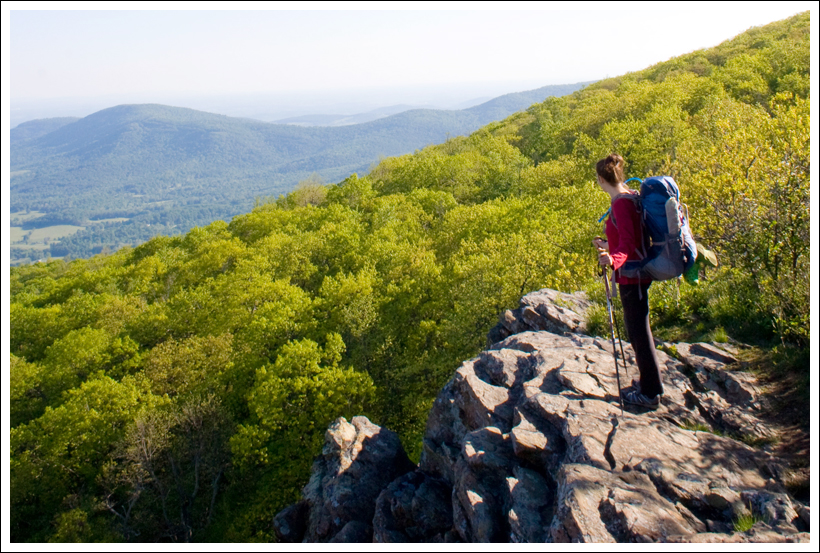
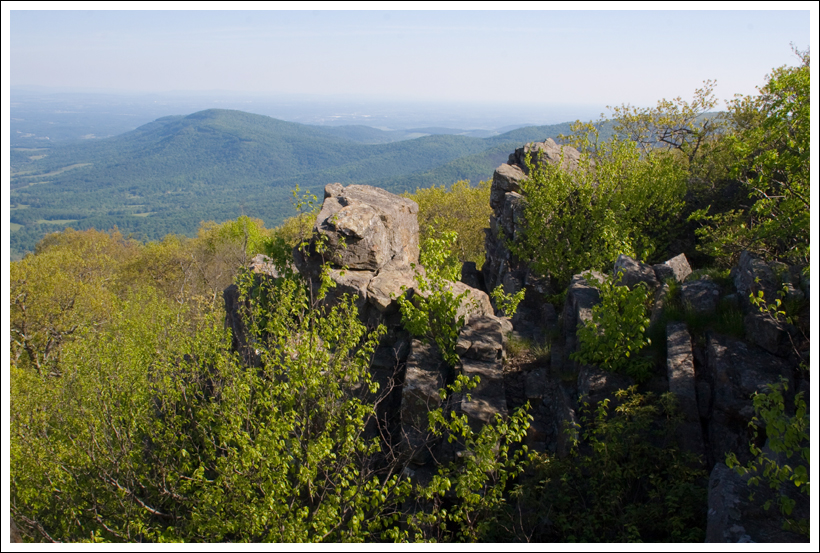
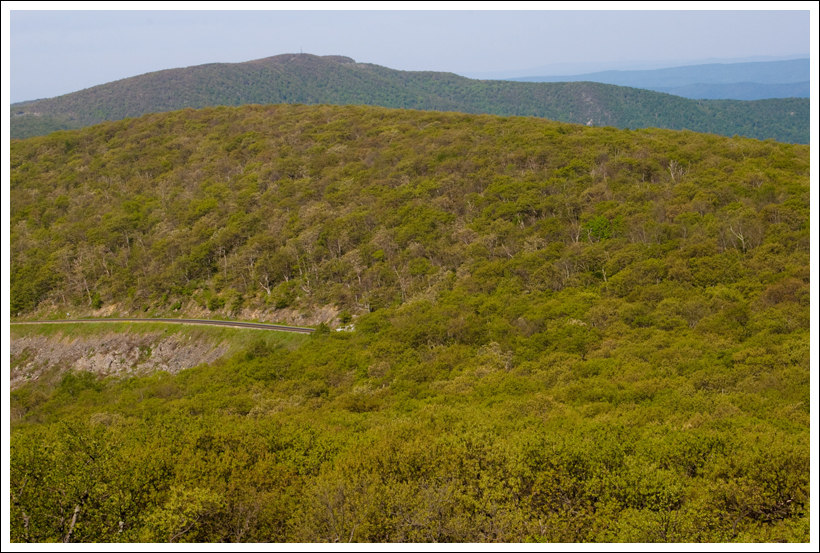
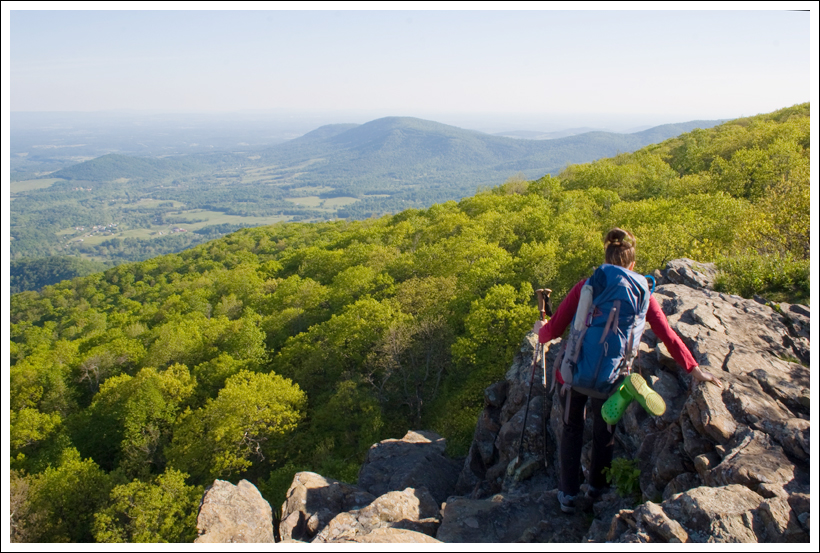
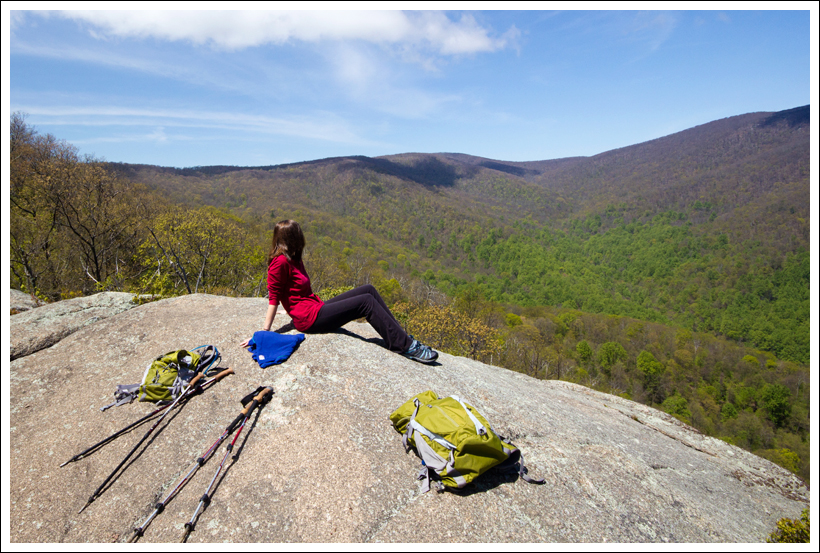
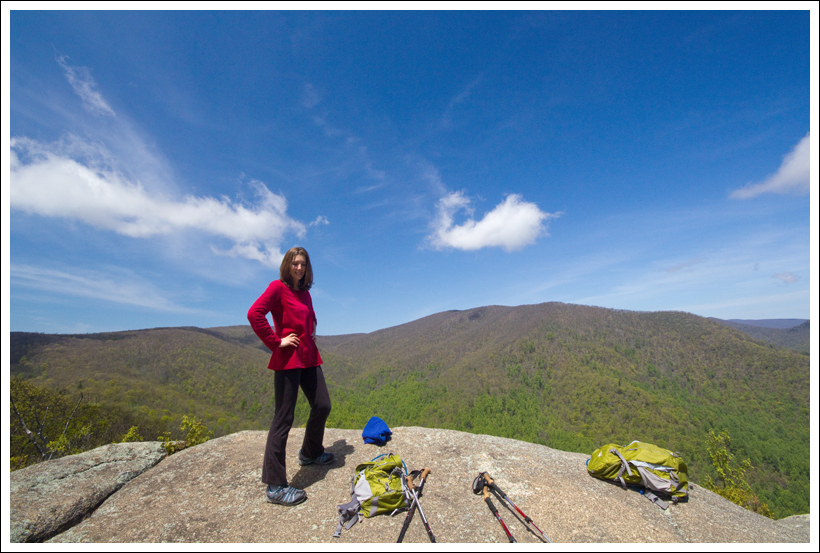
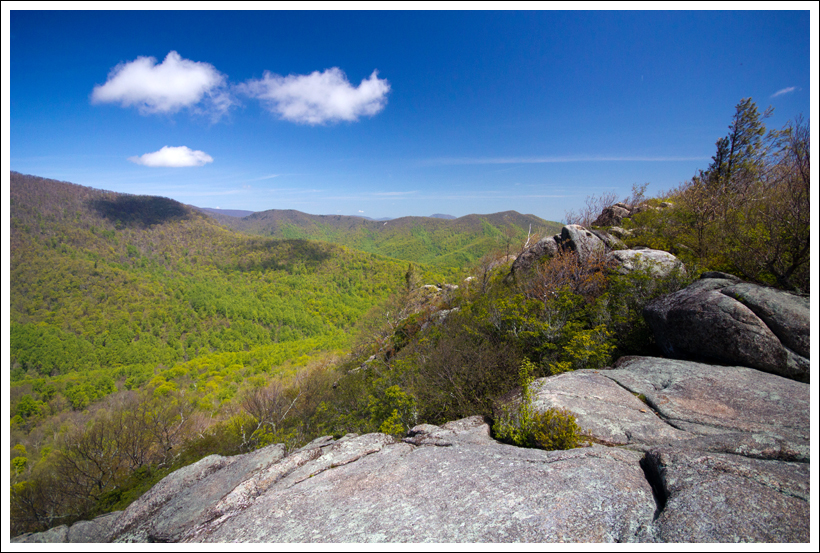
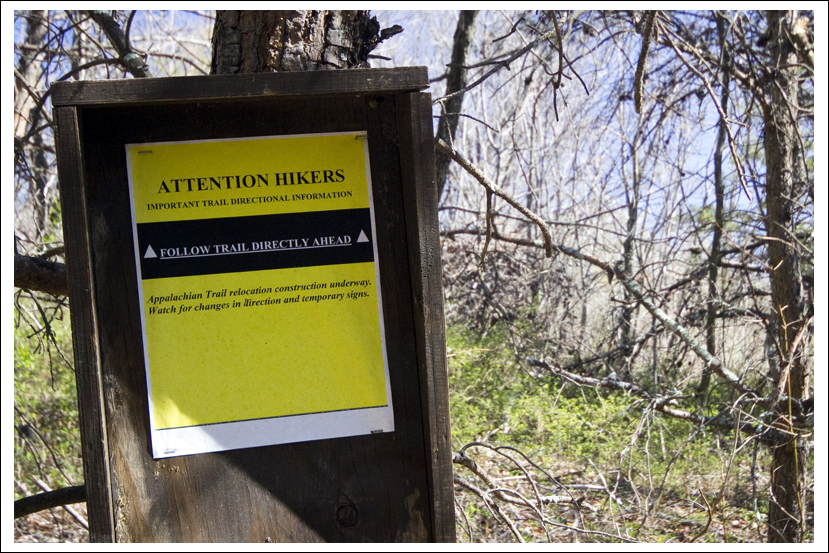
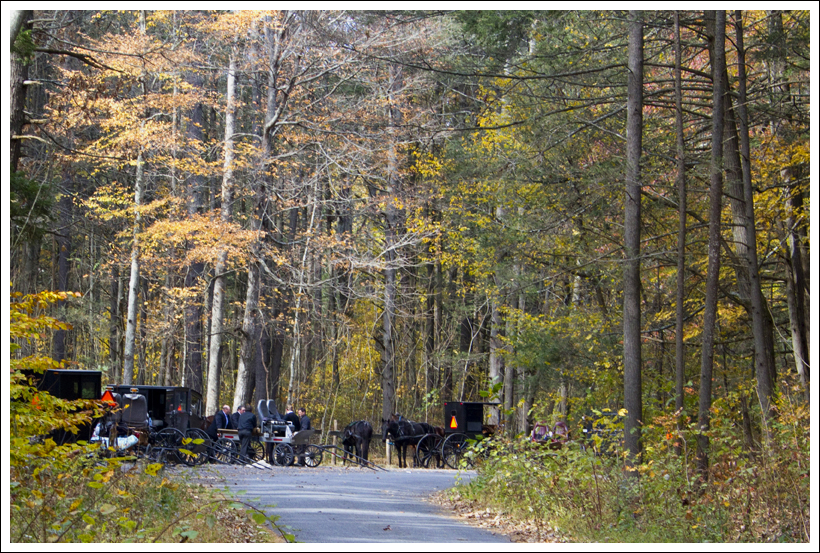
Little Devils Stairs

We hope you enjoyed our special Great Smoky Mountains Edition!  Now we’re back to Virginia!  Although… honestly, the heat has kept us mostly off the trail lately.

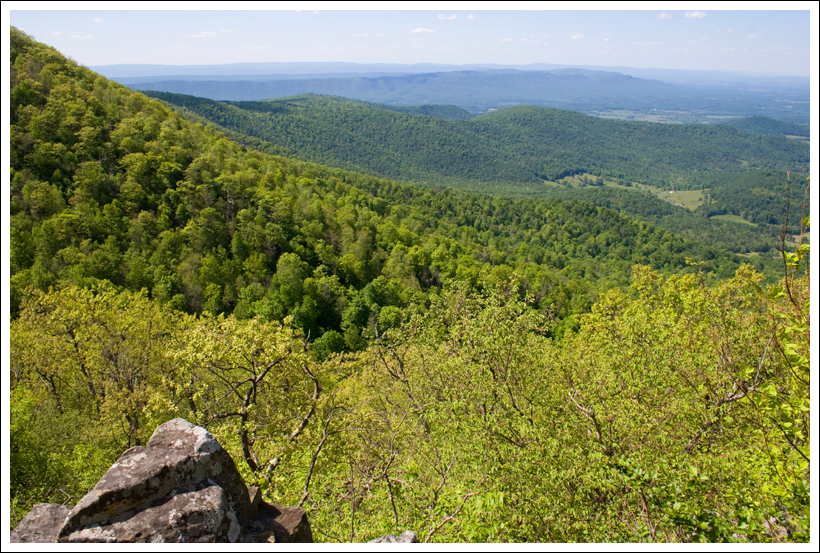
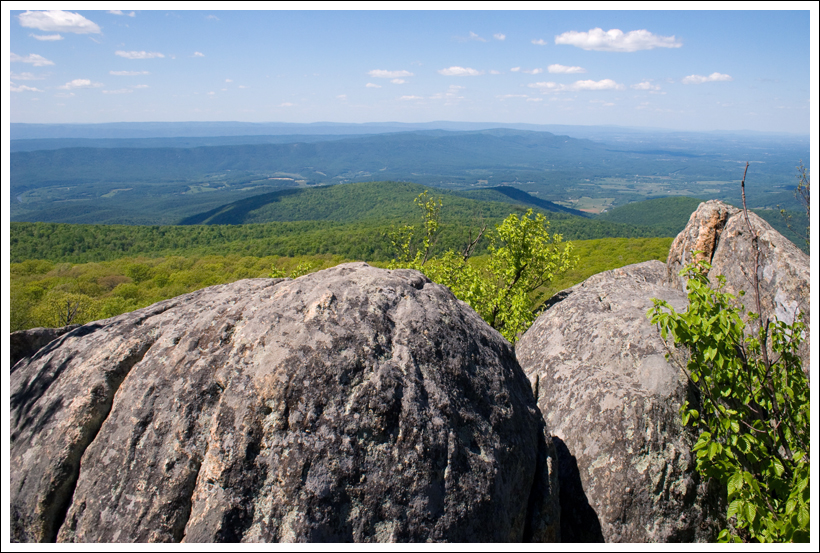
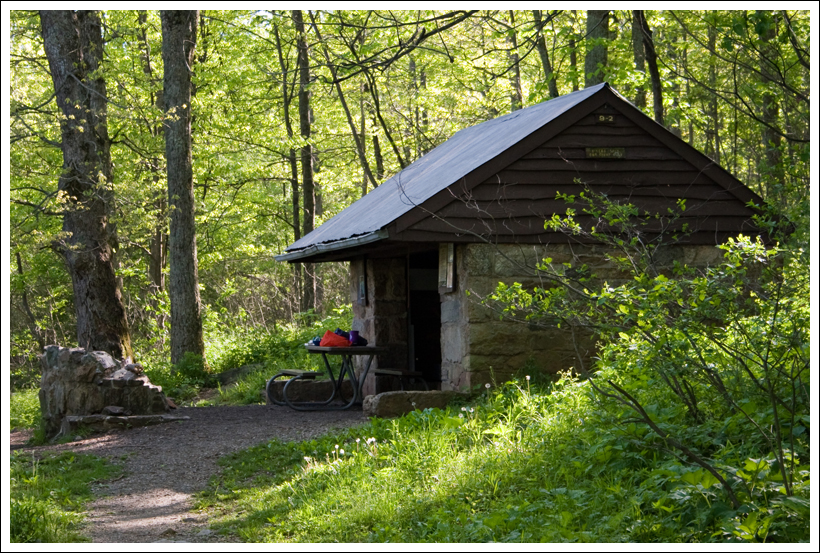
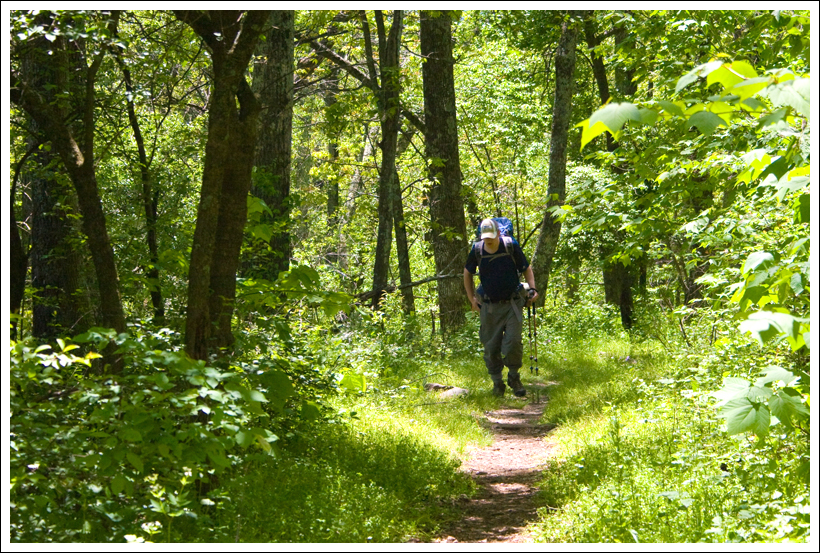
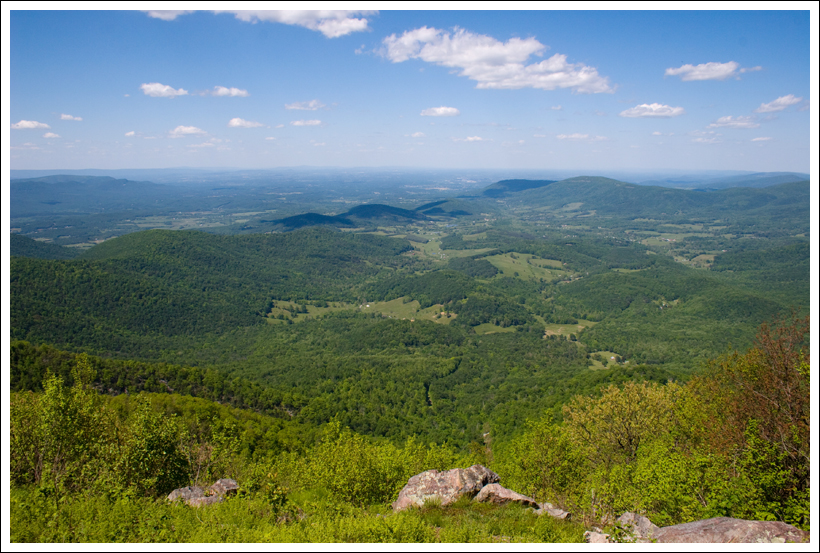
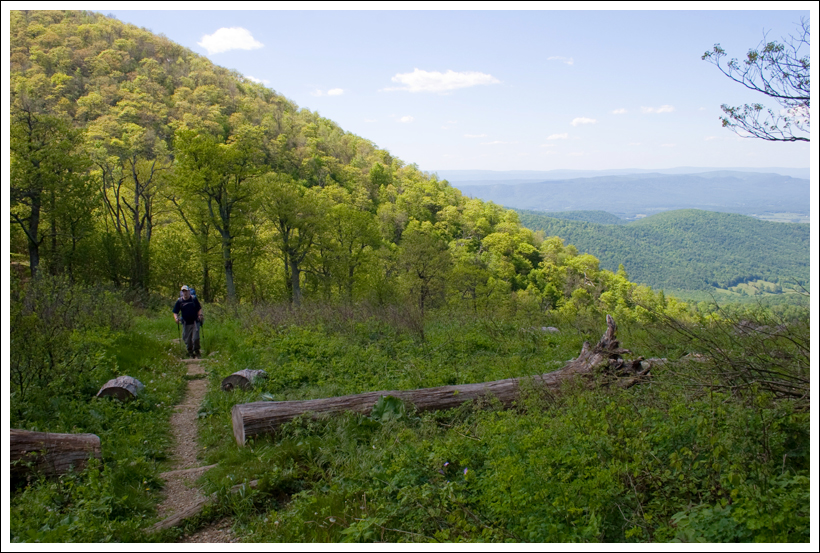
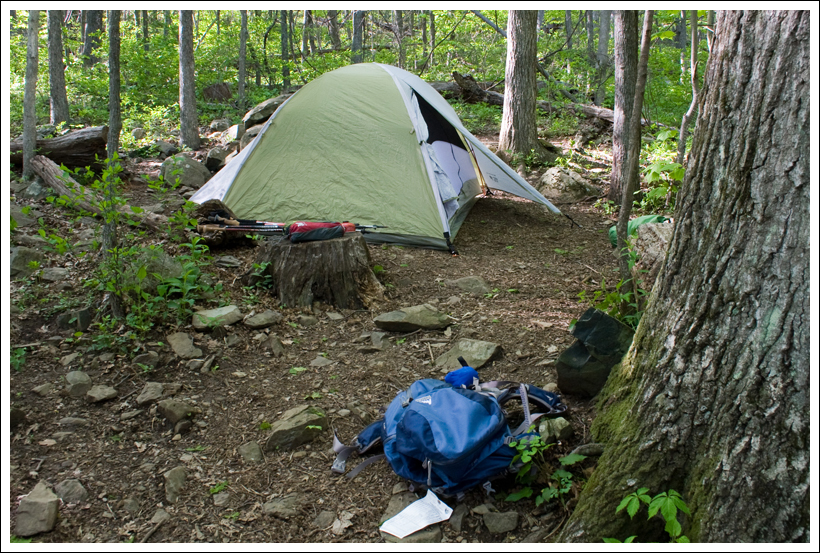
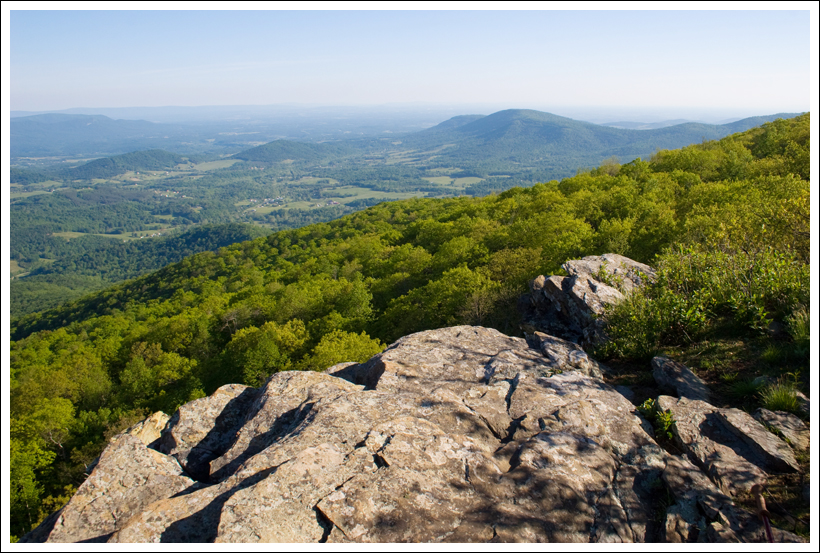
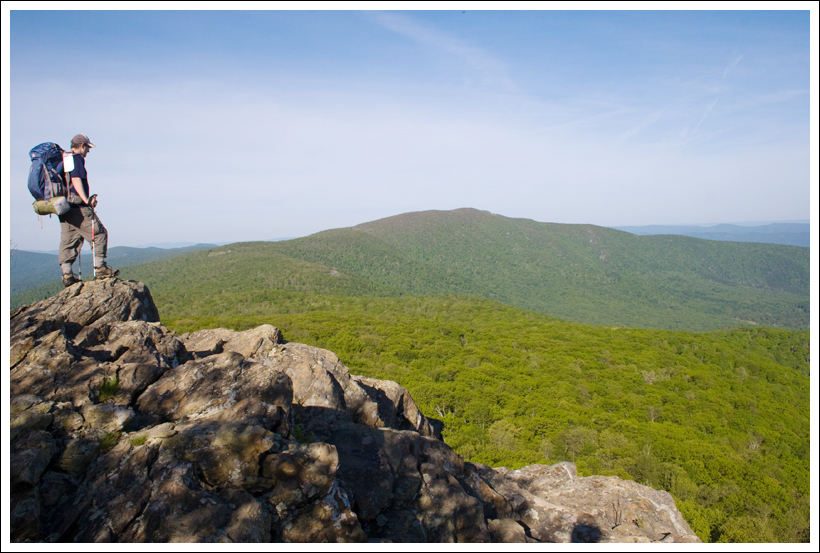
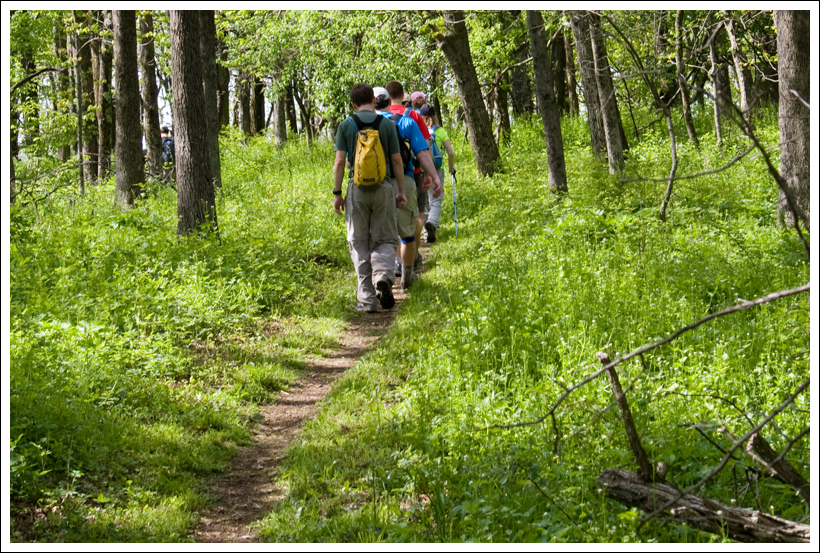
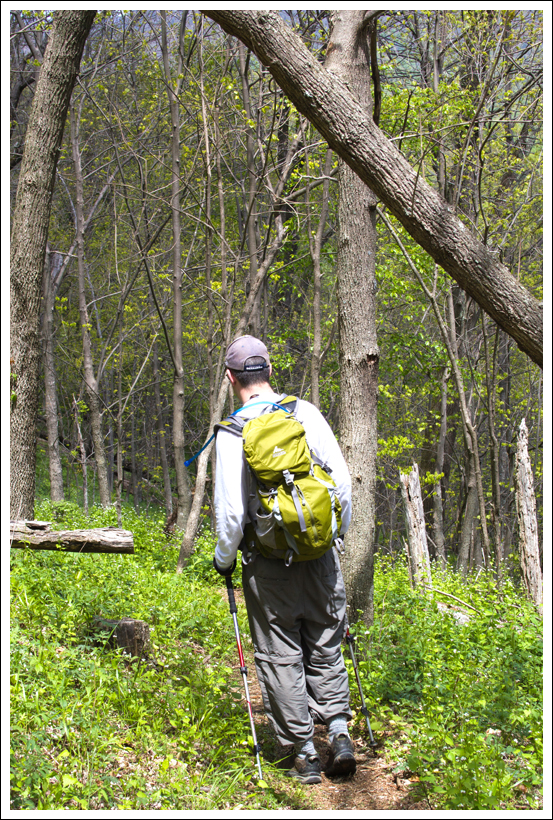
The 5.5 mile Little Devils Stairs hike climbs through an impressive gorge along Keyser Run and loops back past a family cemetery that pre-dates the park.

Canyon Walls Along Little Devils Stairs Hike
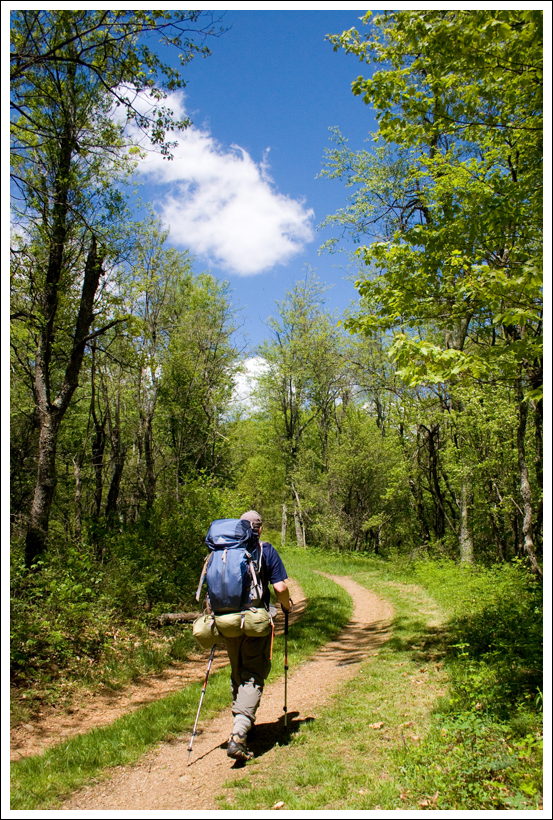
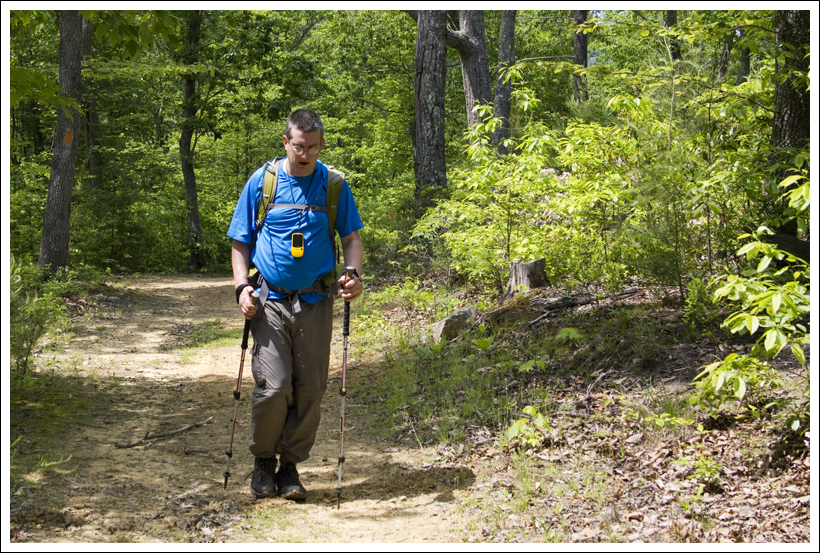
it is Adam makes his way past rugged canyon walls on the Little Devils Stairs hike. Below: The parking lot at the end of Keyser Run Rd. provides access to the fire road and the Little Devils Stairs trail; When we hiked in early June, water was still flowing in the stream (but not much); Red columbine bloomed abundantly.

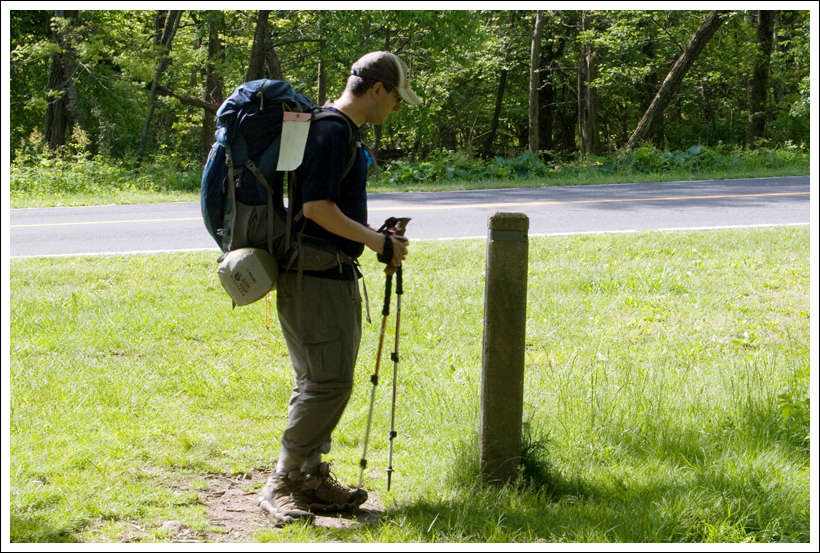
Start of Little Devils Stairs Hike Keyser Run Was Flowing Red Columbine

Adam Says…

To try and beat afternoon rain in the forecast, we decided to hike Little Devils Stairs early in the morning.  To cut back a little on the distance along fire roads, we decided to start the hike from the perimeter of the park (near Sperryville) rather than from Skyline drive.

The trail begins immediately going into the forest from the parking lot and is a very gradual ascent along Keyser Run.  After about .9 miles, the trail then begins to climb more steeply as you are climbing up the “stairs” along the gorge.  The climbing can be quite steep, at times requiring you to use your hands to also help balance or pull yourself up.  Over the next mile, you gain 1000 feet of elevation on your climb.  Along the way up the climb, you will come across several smaller waterfalls and will have to cross over the stream in a few places.  At 1.75 miles, the climb tapers off and the trail moves away from the gorge.  At 2.1 miles, you reach the junction with the Keyser Run Fire Road.  Take a left on this fire road and begin your descent.  The road was fairly uneventful, but it is a good place to spot butterflies and you may see a snake sunning itself on a part of the road.  At 3.9 miles, the road begins to enter the forest again and you will see some more old-growth hemlocks along the road that create a canopy over the road.  At 4.2 miles, you will reach the Bolen family cemetery.  Just ahead is the junction with the Hull School Trail, but stay on the fire road veering to the left.  At 5.4 miles, you will reach the park boundary and at 5.5 miles, you will return back to your vehicle in the small parking lot.

Steep Uphill on Little Devils Stairs
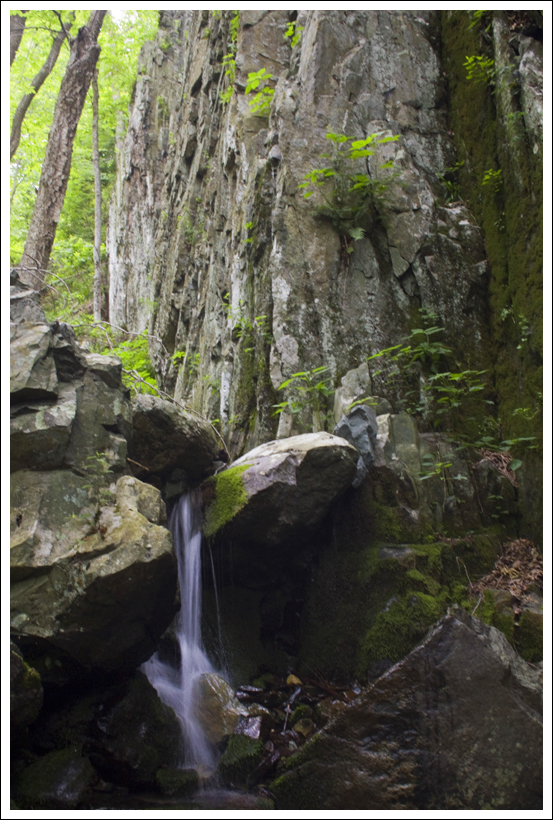
Adam climbs up the steepest part of the Little Devils Stairs hike. Below: There are many tiny waterfalls along the Little Devils Stairs hike; Christine contemplates the rocky climb through the gorge; Adam makes one of the many stream crossings.

Waterfall and Canyon Walls in Little Devils Stairs Pretty Keyser Run Christine Contemplates the Rocky Trail One of Many Stream Crossings on the Little Devils Stairs Hike

The highlight of this hike is definitely the gorge that was created along this geological fault line that eroded quickly.  At one point along the trail, you can see a sheer cliff face of rock.  I can easily imagine people rock climbing up this gorge wall with the proper technical gear.   I have seen Little Devils Stairs and Big Devils Stairs listed in a book about rock climbing in Virginia, so you may luck out and see some people navigating up to the top.

A sadder note along the trail is the Bolen family cemetery.  While we may enjoy the national park that is here, there were many families that were forced to uproot their lives and move out of the area as the government took over the land.  The cemetery of the family still stands and was rededicated in 2002.
Waterfall at the Top of Keyser Run
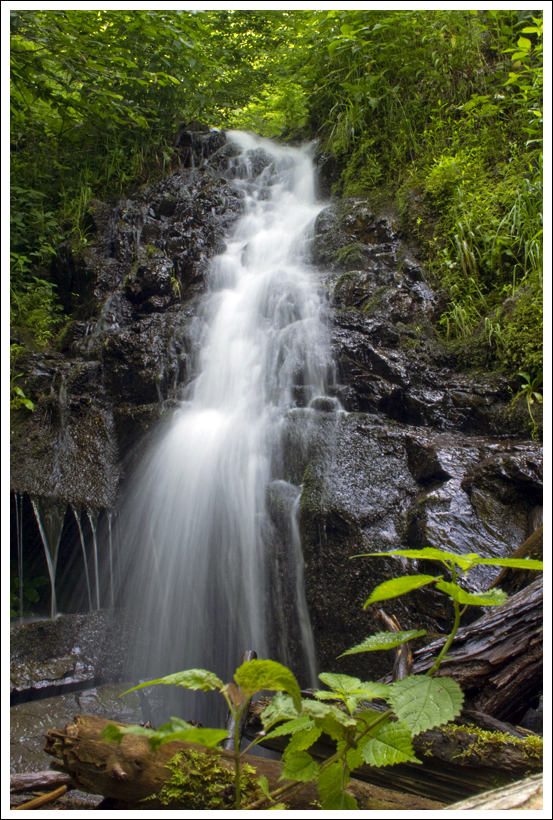
The largest of the falls was at the very top of the gorge. Below: There are many fallen trees, especially hemlocks in the gorge; We saw a lot of these flowers along the trail;  After exiting the gorge, most of the remainder of the trail is along the Keyser Run Fire Road.

Fallen Hemlocks Wildflower Along Little Devils Stairs Keyser Run Fire Road

Christine Says…

Little Devil Stairs is another hike we’ve had on our list of trails we wanted to add to the website for quite a while.  We’ve hiked it before –  the last time was probably about a year before we started this website. It’s a decent hike, but I’ll admit it’s not one of my favorites in the park.  The section of the hike that passes through the gorge is fun, tough and interesting – but that’s only a little over one mile of the entire five and a half miles.  Way more than half of the hike is along a fire road.  And if you’ve read our site with any regularity, you know how I feel about fire roads (they’re boring!)

The drive to the trailhead was really pretty.  We passed by Luray, over Thornton Gap and down past Sperryville.  There were lots of winding country roads, meadow views and meandering stone walls on the way to the parking area.  When we got there, we were the only car.  I absolutely LOVE having a trail all to myself!

We started off climbing gently uphill through the woods, crossing several spots of dry streambed. The insect activity on this particular day was insane.  I alternated walking like a normal person with walking like a crazy person, arms flailing all around my face, trying to bat away the clouds of gnats and midges.  Between the bugs, the humidity and the heat – summer hiking can be really tough.

Bolen Cemetery
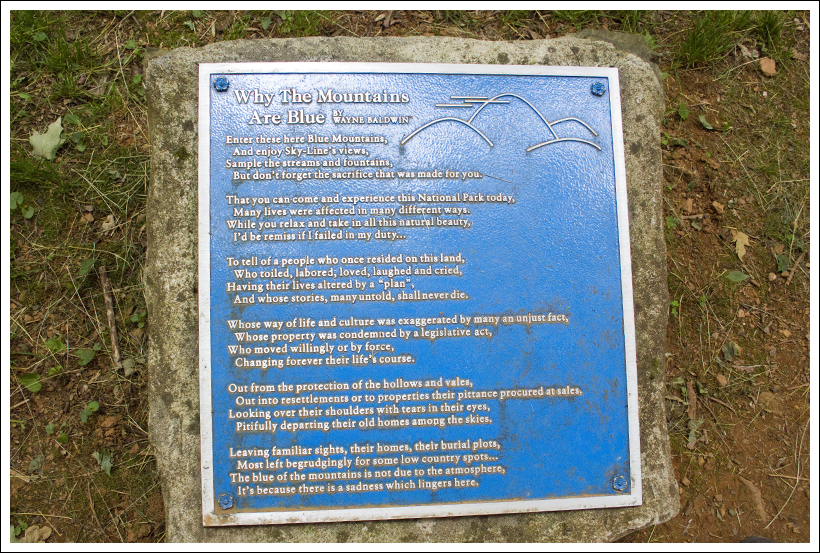
Adam reads headstones in the Bolen Cemetery. Below: The gate leading to the cemetery; A memorial poem from the cemetery’s re-dedication;  We saw lots of indian pipes along the hike.

Why Are the Mountains Blue - Bolen Cemetery Indian Pipes

I had been pretty concerned about the dry streambed crossings, but once we reached the gorge, the water flow picked up a bit.  Little Devil Stairs is definitely a hike you want to do when there has been a significant amount of recent rain.  The primary appeal of the gorge is the constant string of small waterfalls and rapids that pours down the ‘stairs’.  When the weather has been wet, Little Devils Stairs is lovely and wild.  The sound of running water hemmed in by stone walls constantly surrounds you. However, when the weather has been dry, the hike is nothing but steep uphill through a rugged, overgrown and brushy gorge.  The towering rock walls are still impressive, but without running water, something is missing from this hike.

With a thousand feet of elevation gain in just under a mile, the path up can be a real quad-burner if you’re not in decent shape.  It’s mostly walking along trail, but there are several sections where you must scramble up over giant stair-like rocks.  The top of the gorge is marked by the largest of all the waterfalls along Keyser Run.  After you pass the final fall, the trail grade becomes more gentle and passes through pretty, quiet forest.  In a short time, you’ll reach the Fourway Junction.  People hiking Little Devil Stairs from Skyline Drive will come down the trail at this junction.  For us, it was the point where the ‘hike’ ended and the fire road walking began.

Frittilary
We saw lots of butterflies on this hike! Below: I’ve never seen a yellow moth like this one before. I think it’s an Io moth because it had the ‘eye’ marking on it’s wings, though you can’t see them in the photograph; On the drive back through the park we spotted a pair of black bears mid-courtship (this is the male);While eating lunch at Big Meadows we met this cute biker dog.

Yellow Moth in Shenandoah Mated Pair of Black Bears - Boar Harley-Davidson Chihuahua

We considered jogging down the trail to make the distance pass more quickly, but I wanted to keep my camera and telephoto out in case we saw wild flowers, butterflies or bears!  The heavy camera kept bouncing on my hipbone, so I had to slow to a walk (I got a huge bruise anyhow).  And indeed – there were plenty of butterflies and wildflowers to photograph along the way.  We didn’t see a bear on the trail, but we did see one later as we drove back through the park.

The last point of interest along the fire road was the stop at the Bolen Cemetary.  It’s a beautiful spot for a final resting place – surrounded by a stone wall and shaded by elegant maple trees planted by the original property owner.  It’s one of the more meticulously maintained cemeteries in the park.  If you walk amongst the headstones, you can’t help but notice how young most people died.  So many babies, children and young adults rest under these markers.  When I was researching information about this trail, I came across a wonderful feature article from Blue Ridge Country magazine about the family reunions that still take place at the cemetery.  I enjoyed reading all the recollections of Beulah and Mary Bolen about their life in the area before the park existed.

After leaving the cemetery, the remaining distance along the fire road went steeply downhill.  We arrived back at our car fairly quickly and headed to Big Meadows to have some lunch in the park.  After lunch, the skies opened up and it poured down rain the rest of the day.  I’m glad we got a chance to get out before the weather changed!

Trail Notes

  • Distance 5.5  miles
  • Elevation Change – About 1650 feet
  • Difficulty –  3.  The climb up Little Devils Stairs can be strenuous in parts, but the fire road is easy walking.
  • Trail Conditions – 3.  The climb up the stairs is rocky and you do have to cross Keyser Run as the trail criss-crosses over in several places.
  • Views– 1.  From near the top of the gorge, you may get an obstructed view, but nothing spectacular.
  • Streams/Waterfalls – 3.5.  You are walking along Keyser Run through the first couple of miles of the hike.  The waterfalls are mostly small, but still nice to see.
  • Wildlife – 2. There are signs of bear scat in the area, but we didn’t see much wildlife other than a snake along the fire road.  You will hear lots of warblers and other birds as you enter the hemlock forest near the end of the hike.
  • Ease to Navigate – 3.5.  The blue blazes for the Little Devils Stairs hike are not as prevalent in some places and may require you to look around for the next one, especially in the fall when leaves cover the trail.  Posts at the trail junctions provide some great direction.
  • Solitude – 3.  Except on weekends, I wouldn’t expect to see a lot of people on this trail.

Directions to trailhead:  Off of 211 north of Sperryville, take a left on County Road 622/Gidbrown Hollow Road.  Follow this road for a few miles and then take a left on County Road 614/Keyser Run Road.  At the end of this road, you will reach a small parking lot.  The trailhead starts to the right of the parking lot, marked by a concrete post.
Appalachian Trail – Elkwallow to Jenkins Gap

This 12.6 mile hike gives you several breathtaking views to the west and a visit to an AT overnight shelter.  Instead of doing our normal ‘Adam Says‘ and ‘Christine Says‘ segments, Adam is going to cover the first day and Christine will cover the second.

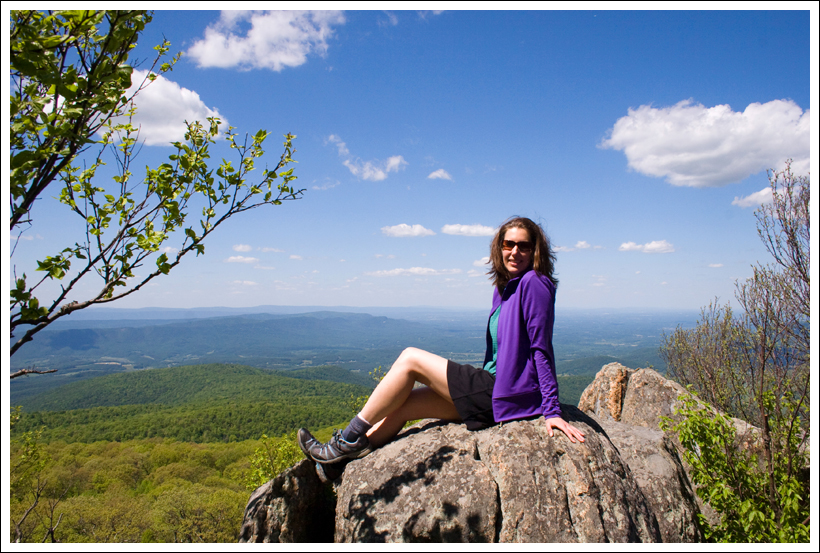
Christine Taking in the View
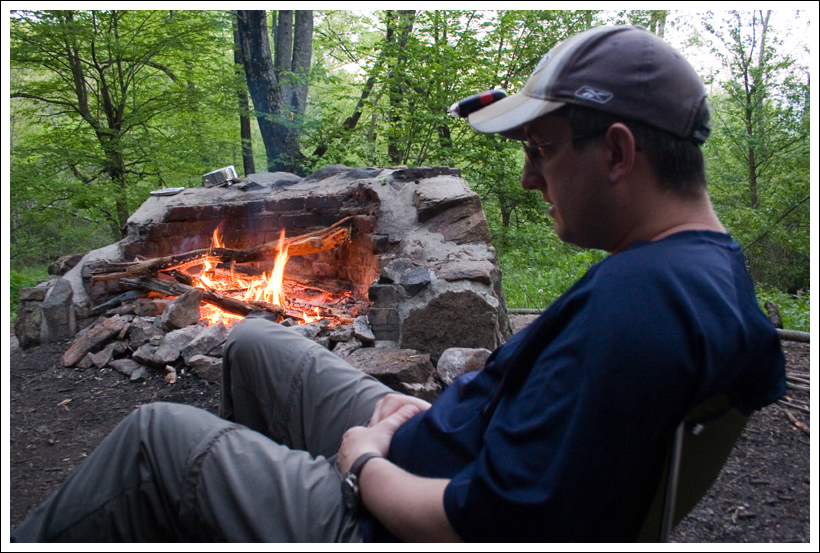
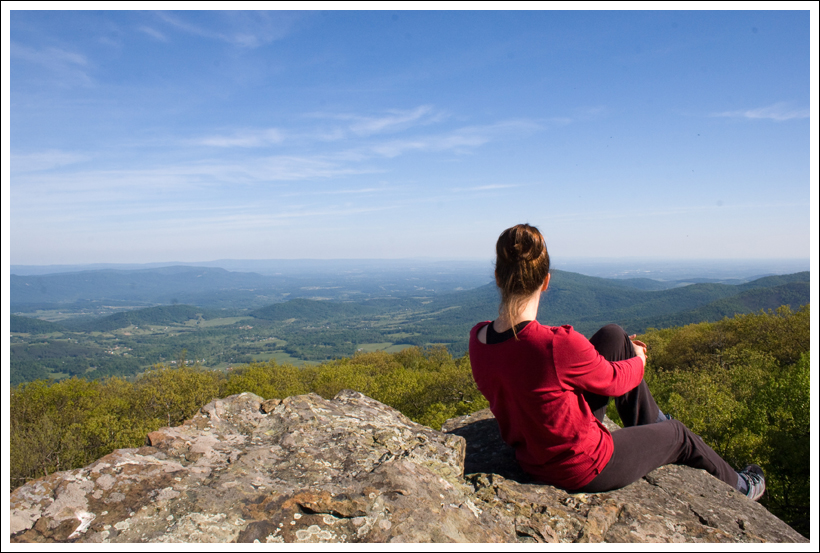
Christine enjoys the view from one of the Marshalls on the second day of the trip. Below: The Gravel Springs Hut; Views on the first day; Adam relaxes by the campfire.

Views on Day One Beautiful Mountain Views
The Gravel Springs Hut
Relaxing by the Campfire

From the Elkwallow Wayside, follow the short spur trail at the northern parking lot for .1 miles until it reaches the junction with the white-blazed Appalachian Trail.  Turn right, heading north and you will almost immediately cross Skyline Drive.  The trail begins to climb.  At 1.4 miles, the trail crosses Skyline Drive again and continues to climb.  At 2.5 miles, the climbing reaches an end as you reach the junction with the Tuscarora Trail.  At mile 2.9 and mile 3.2 you will cross Skyline Drive a few more points crossing over Hogback Mountain.  At the cross at mile 3.2, you are on a fire road for a very short while (that is used for people bringing in hang gliders) and the AT goes into the woods.  At mile 3.4 you reach some nice views and where the hang gliders take off for a descent over the mountains.  At mile 3.6, you will reach a junction with a side trail that leads to a spring.  The trail begins to descend at this point.  At mile 4.3, the trail begins to slightly ascend until you reach a nice viewpoint at mile 4.4.  The trail descends again and crosses Skyline Drive again at mile 5.0.  At mile 6.0, you reach the side trail which leads .2 miles to the Gravel Springs Hut.  For the start of our second day, from the Gravel Springs Hut, rejoin the AT at 6.4 miles.  At mile 6.6, the trail crosses Skyline Drive again and continues to ascend.  At mile 7.4, you reach a great viewpoint on South Marshall Mountain.  The trail continues to climb up and crosses Skyline Drive at mile 8.2.  The trail then ascends steeply up North Marshall Mountain and leads to another nice view at 9.4.  The trail ascends for another quarter of a mile and then descends steeply down the trail. The trail crosses Skyline Drive again at mile 11.0.  The trail ascends over a short bubble of a hill and then reaches the Jenkins Gap Trail junction at mile 12.5.  Take a right at this junction and reach the Jenkins Gap Trail parking lot at mile 12.6.

Day One – Adam Says…

I noticed the weather forecast was saying that we had a 0% chance of rain on Friday and only a 10% chance of rain on Saturday.  Since we have opted to cancel a few backpacking trips recently due to rain, we felt we couldn’t resist these odds and decided to take the day off work to work on this section of the Appalachian Trail.  We had bought two annual park passes last year, with one expiring at the end of May.  We felt the pressure of getting this hike in since it required two vehicles for the shuttle.

Adam Climbing Up from Elkwallow
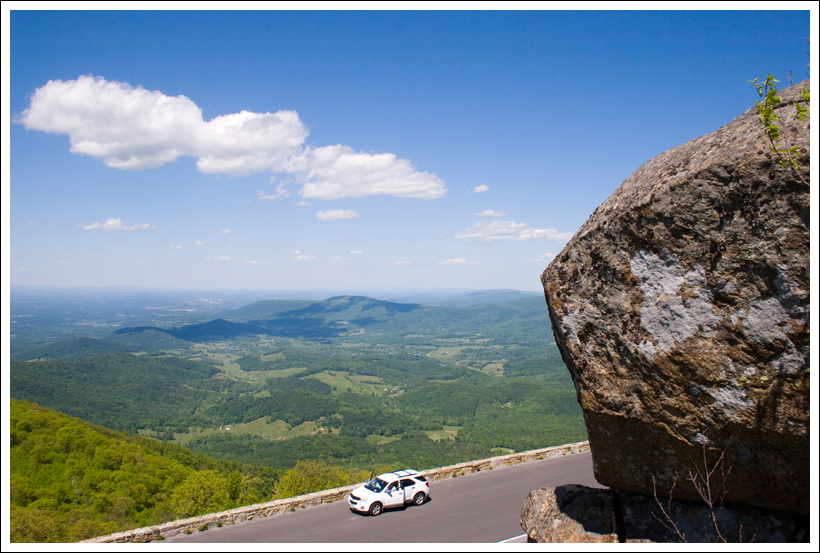
Adam climbs uphill from the Elkwallow Wayside. Below: A nice view of the valley below.  For some reason, Christine likes to wear backpacking clothes that don’t match; The Appalachian Trail in Shenandoah often runs within sight (or earshot) of Skyline Drive; The trail crosses and briefly follows fire roads in several spots.

Great View of the Valley Above Skyline Drive Crossing a Fire Road on Day One

It took us a while to get our act together to make sure we were ready for the trip.   We started loading our packs, made sure we had instructions for our dog sitter, and picked up some lunch along the way from Subway.  We drove up to drop a car off at the Jenkins Gap parking lot and then made our way back down to the Elkwallow Wayside.  We ate our lunch outside and saw a few thru-hikers that we wondered if we would see later that evening.  Christine was really cold sitting in the wind outside the wayside. Her legs were covered with goosebumps and she kept pulling her jacket tighter and tighter around her ribs.  She told me that she was really worried about the cooler temperatures, and hoped she would warm up once we started hiking.

We finally started off on our hike around 1:30PM.  We strapped on our 30 lb. packs on to our backs and started climbing up the hill.  While we had been hearing the loud screams of the seventeen-year cicadas near our house, we were pleasantly surprised to hear they were not out in Shenandoah National Park.  We stopped at a few points on the uphill climb to take in the views from Hogback Mountain.  One nice thing about this hike is that the views were mostly on the uphill climbs, so it gives you a reason to take off your heavy pack and enjoy the scenery.  A couple of thru-hikers we had seen at Elkwallow passed us near the hang glider launch.  We’re always amazed at how fast they hike.  I guess hiking every day has its pay-offs!

Hangglider Launch Site
The hang-glider launch site offers a beautiful view! Below: Adam hikes uphill again near Hogback Mountain; Wildflowers blooming along the trail; Our tent site at the hut.

Hiking Past Hogback Wildflowers Along the Trail Our Tent Site at Gravel Spring

We made our way down the mountain at this point.  Backpacking uphill seems to be where you feel the weight the most, but going downhill has its own challenges – you feel the weight differently in your legs and have to be extra careful of your footing.  We made it to the Gravel Springs Hut around 4:30PM and checked out the nearby area.  There weren’t any other hikers there yet, so we were wondering if we were going to have this all to ourselves that night.  We scouted out some of the campsites near the shelter.  There were five campsites.  We started to pitch our tent at the first campsite, but we realized we wouldn’t have enough of room to put up the fly.  And with the night forecast to go into the upper 30’s, we definitely wanted the extra layer of insulation on our tent.  We ending up moving to the largest of the sites, but this site was more sloped.  We pitched our tent so that our feet were on the lowest, downhill part of the slope.  We filtered some water and I began to work on cooking dinner while Christine gathered some kindling for a campfire.  In most places in Shenandoah National Park, you can’t set fires in the backcountry, but this shelter had a large stone fireplace.  We ate a dinner of Backpacker’s Pantry Sweet and Sour Chicken (which was delicious and definitely something we would have again) and Natural High’s Banana Cream Pie (which we didn’t like the taste or consistency).

One of the highlights of staying at an AT shelter, is the people that you get to meet.  Around 5:30, we met our first group of hikers that were planning on staying at the shelter.   There was a gentleman named Don from Indiana, who had suffered a knee injury from hiking the AT previously, but was returning for a hike through Shenandoah to Harper’s Ferry to test his knee on an extended trip.  He was accompanied by two brothers from Florida. The older brother, Adam had decided to introduce backpacking to his younger brother (who wasn’t enjoying it as much).  The original plan was to hike the AT through SNP and return back.  However, they had recently decided they would stop at Front Royal and then find a way back to Waynesboro that didn’t involve hiking.  Next, two women came along and set up tents at two more of the campsites.  They were out on a two night trip and had parked a car nearby so they could slackpack most of the trail.  Shortly afterwards, Standing Bear arrived.  Standing Bear was a thru-hiker that had started his trip from Georgia around the end of February.  He told us a lot that night about how he has been attracting a lot of recent trail magic, from margaritas at a campsite to meals and lodging along the way.  He told everyone that he was very good at  ‘Yogi-ing‘.  We then had another thru-hiker join us named Mountain Goat.  When you looked at Mountain Goat’s legs, he just looked like a tough beast and he was working on trying to do over 25 miles a day to finish the trail quickly.  As dusk approached, the last group of thru-hikers joined us – Rat Bucket and Sketch.  They had purchased a couple of bottles of wine and were making their 6-mile trip from Elkwallow to the hut drinking wine instead of water.  They were of course a little happier than most of the hikers when they arrived at the cabin.  We hung out for a while, sitting around the campfire and talking about what areas the hikers had enjoyed the most (Grayson Highlands was the unanimous vote) along the way and food (which seems to be a constant discussion with thru-hikers).

Christine Works on the Fire
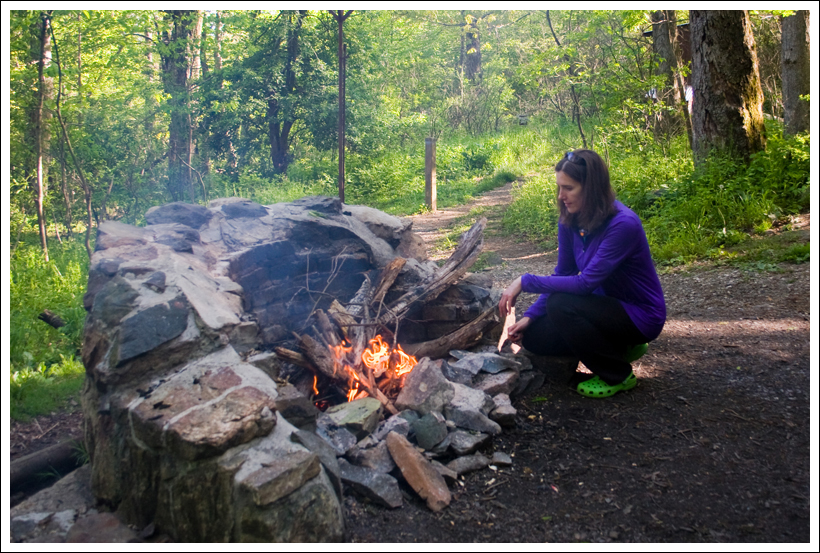
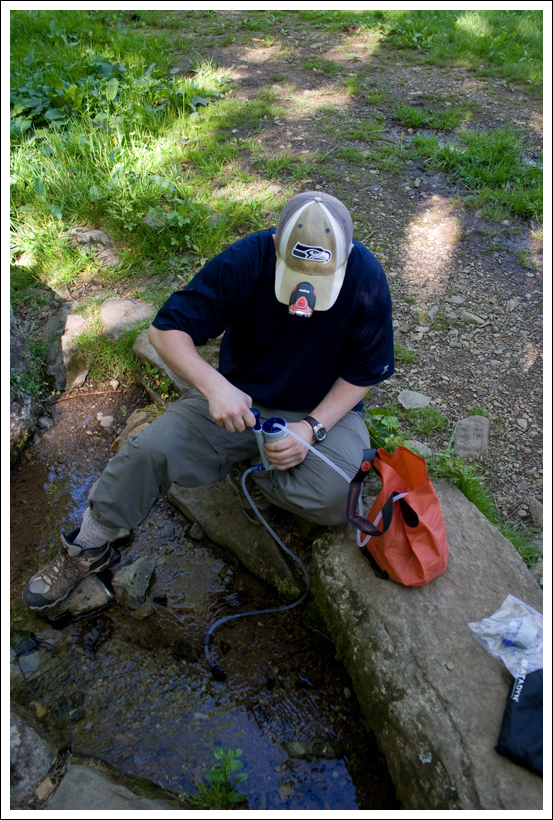
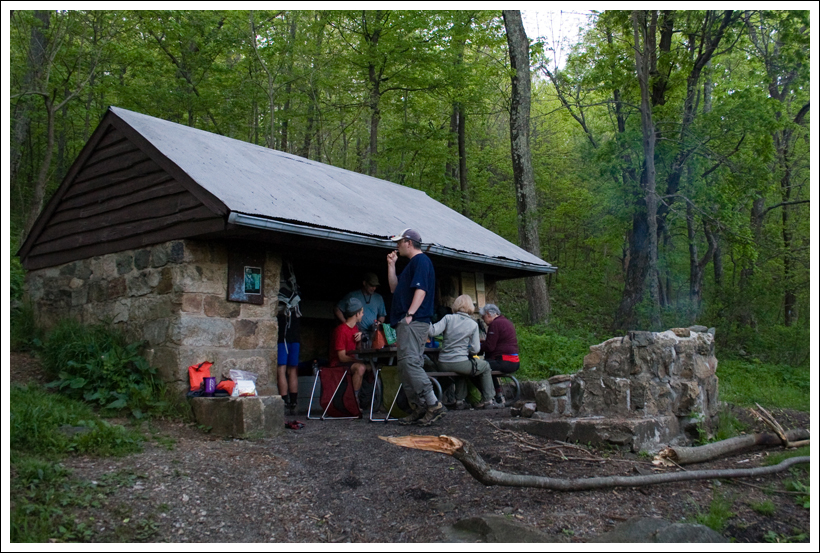
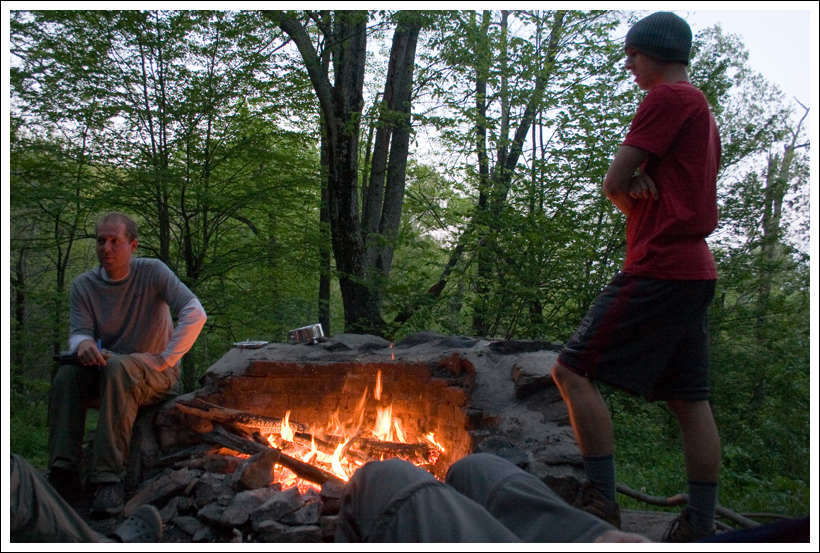
Christine works on getting a fire going. She still hates her lime green Crocs. Below: Adam filters water from the spring at the shelter; Everyone congregates and cooks dinner at the picnic table in front of the shelter; Relaxing by the campfire after dinner.  Everyone is usually in bed by 9:00 or so.

Adam Filtering Water from Gravel Spring Hikers at the Shelter Relaxing by the Fire

Around 9:00, we headed back to our tent.  I continued to read my book that I have been only reading while backpacking – a book of John Muir’s writings and Christine listened to her iPod.  We fell asleep to the sound of nearby owls.  The slope really affected my sleeping as my fitted sheet for my air mattress kept coming off and I would wake up in fetal position at the bottom of the tent and would have to fight back up to the top.

Day Two – Christine Says…

I woke up as soon as the birds started chirping and the first hints of light filtered through the trees.  It was cold, so I pulled my sleeping bag tighter around me and cinched its hood around my head.  I had slept really well despite the fact I had repeatedly slid downhill to the bottom of the tent. I heard others nearby starting to stir as well – tent zippers sliding, the privy door slamming and the whoosh of camp stoves firing up.  I didn’t want to leave the warmth of the tent, but I did.  There’s always so much that needs done to break down camp before eating breakfast.

Breakfast Time
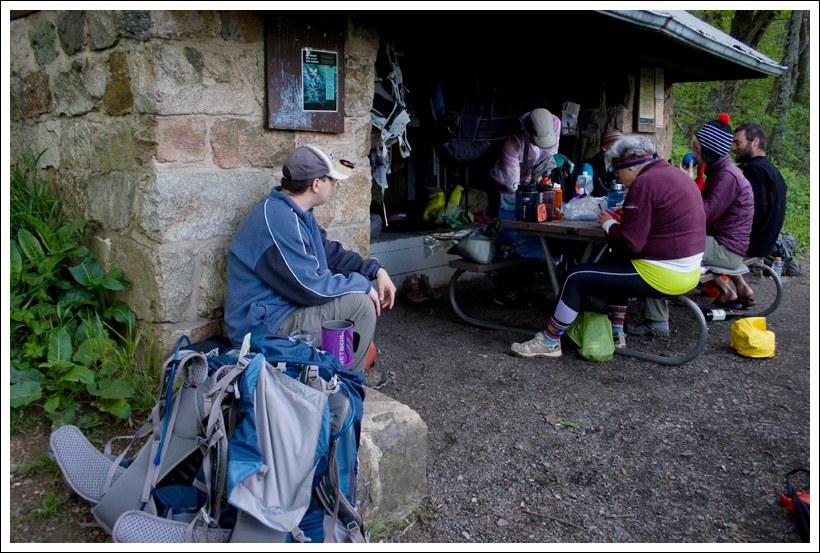
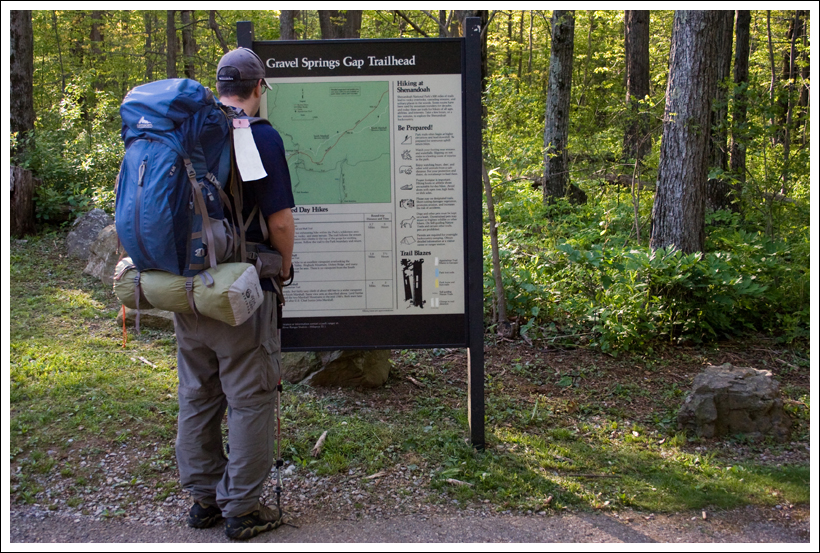
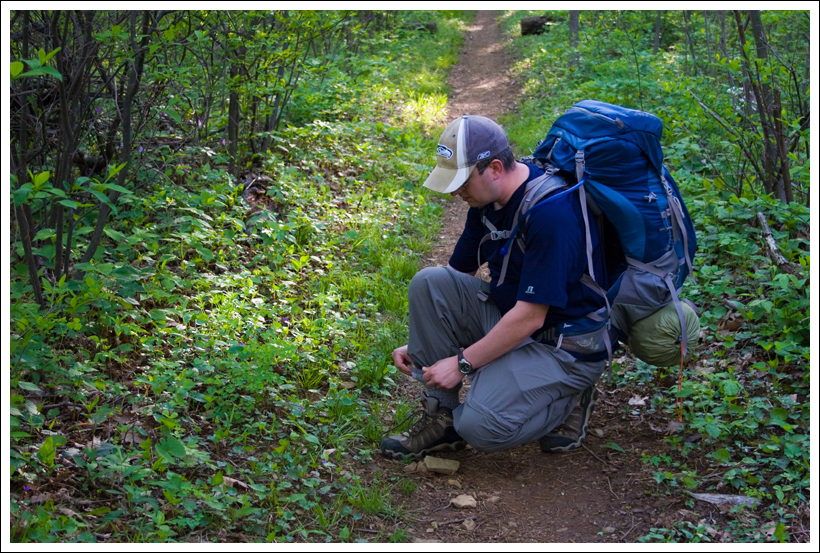
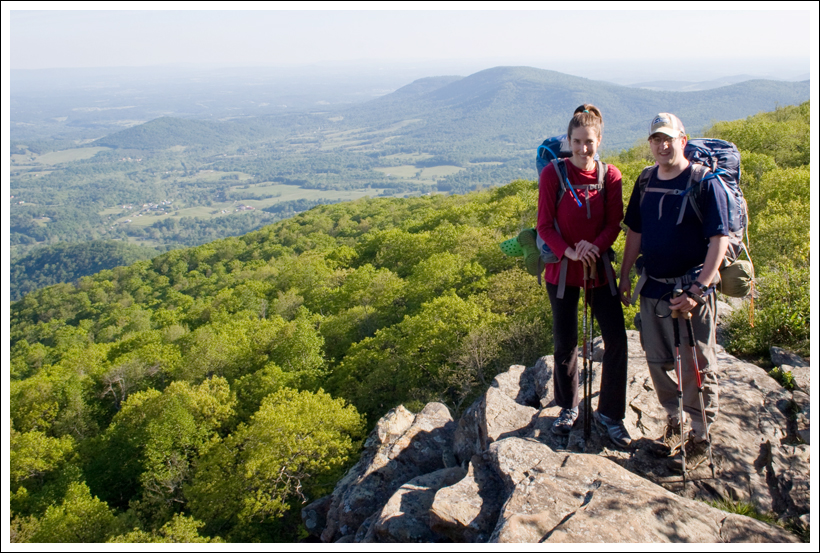
The table got really crowded at breakfast time, so we cooked on the little stone bench on the side of the shelter. Below: Adam checks out the trail sign showing hike options in the vicinity of Gravel Springs; Adam tucks his pants into his socks to avoid ticks; Christine and Adam on South Marshall Mountain.

Leaving Gravel Springs Tucking Socks Adam and Christine on South Marshall

Adam and I are usually pretty efficient and can have our whole campsite broken down and backpacks repacked within about half an hour.  The first step is always to shove our sleeping bags back into their stuff sacks.  Then we repack our sheets, crunch down our pillows and let the air out of the sleeping pads. Once the bedding is stowed away, we pack up the tent and any clothing that was left strewn about the site.  Yes… we really carry all this stuff!  As you might have guess, we are not lightweight backpackers.  We carry a lot of creature comforts and luxury items (pillows, sheets, chairs, books, card games, etc).   When we go on longer trips, we’re really going to have to reevaluate our gear and make some sacrifices. 🙂

When we walked down to breakfast, our backpacks were pretty much fully loaded and ready to go for the day.  The only things left to pack were our food, dishes, stove and water filter – and we always keep those items near the top of our packs.  When we got down to the hut, almost everyone was already up and working on breakfast.  We got our two bags (trash and food/other stuff that has a scent) down from the bear hang and joined the rest of the group at the picnic table. Breakfast was coffee and instant apple cinnamon oatmeal.  You see a lot of oatmeal and granola at backpacker breakfasts.  Clif bars and bagels are pretty popular too.  Although, this particular morning, one pair of hikers even had a container of fresh berries!

Adam and I were the first to leave the hut.  We climbed up the short, but steep, access trail back to the AT and headed north.  The early part of the morning’s hike took us past several gorgeous views from the Marshalls. We spent time at each of them, taking photos and enjoying the cool, crystal-clear morning.  While we were at the first view, Rat Bucket caught up with us.  We took a photo of him and he returned the favor for us before heading quickly down the trail.  Once again, I marveled at the speed and distance covered by thru-hikers.  Most of these folks are covering 20-28 miles a day through Shenandoah National Park.

Christine on North Marshall
Christine on North Marshall Mountain. Below: Views from both Marshalls were excellent;  You can see Skyline Drive off in the distance; Christine scrambling around on the cliffside; Another excellent view; Adam takes in the scenery from a high perch; Checking out mileage on the trail marker.

Another Great View Distant Skyline Drive Scrambling on the Cliffs
Great Views on Day 2 Adam Checks Out the View Consulting a Trail Marker

At the next view, Mountain Goat caught up and passed us.  He only briefly stopped to check out the vista.  I guess when you hike big miles, you don’t have time to meander and pause at every pretty spot along the trail. While we were stopped at this spot, we had a quick snack of PowerBar Energy Blasts.  They’re basically caffeinated gummy candy, but the website makes them sound like they magically give you Lance Armstrong-like endurance and help your muscles recover.  Maybe they don’t do all that, but they sure do taste good!  And they have sugar and caffeine – both of which seem to help me hike stronger.

At the third viewpoint, Standing Bear passed us, but we ended up leapfrogging him a little further down the trail and didn’t see him again.  Nor did we see any of the other folks from the hut.  All but two people staying at Gravel Springs had been northbound, so I suppose they just stayed at camp a bit later.

The trail was so beautiful and lush and green!  Even when there wasn’t a view to enjoy, the hike itself was so lovely.  The climbs were never too hard and the descents were never too steep.  We crossed Skyline Drive several times.  We saw lots of dayhikers… two of them were even dressed in their ‘Sunday Best’ clothing.  They were walking south along the trail, not in the vicinity of any views or special attractions.  Neither of them looked in the least bit happy and both of them looked hot and uncomfortable.  I see people like that and wonder if this hike was a spontaneous decision.  I wonder if they know where they’re going, or if they just set out on a trail thinking ‘Hmmm… if I walk on a trail, eventually I’ll see something!’

Dayhikers
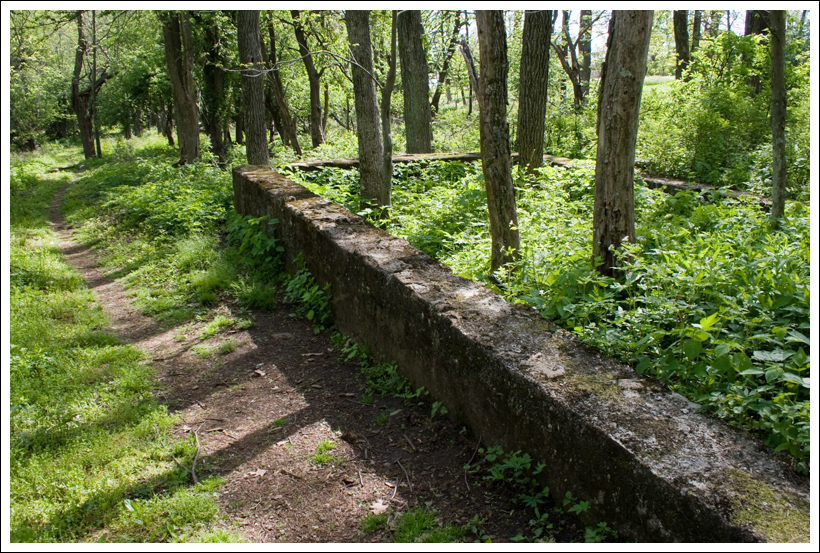
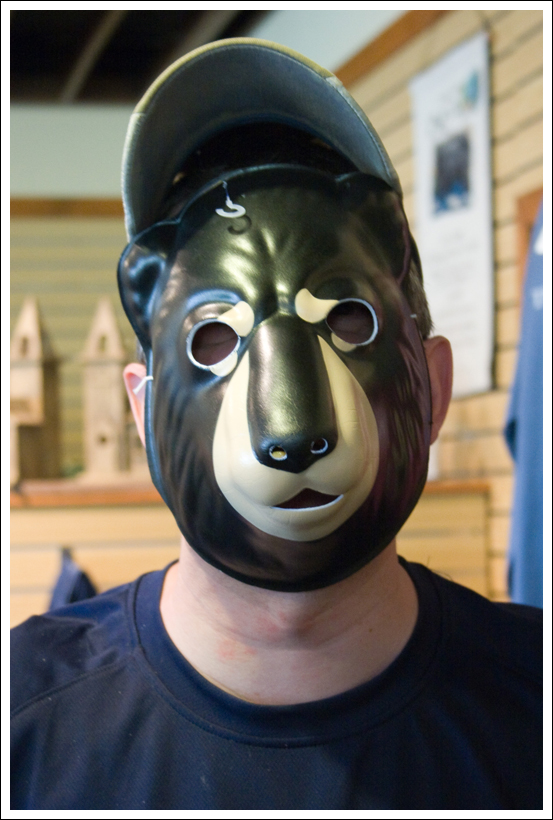
We saw a lot of dayhikers as we approached Jenkins Gap. Below: An old foundation along the trail; The only bear we saw on this trip came in the form of Adam in a mask at the Skyland gift shop.

Old Foundation The Only Bear We Saw

We made it back to our car at Jenkins Gap around 10:30 or so.  We had plans to meet my parents at Skyland for a Mother’s Day lunch at noon, so I brushed my hair and changed into my less-dirty clothes.  We had plenty of time to kill, so we stopped by the Elkwallow wayside for more snacks and drinks.  When we got to Skyland, it wasn’t even 11:30, so we relaxed in the lobby until they arrived.  We had a nice lunch together and then headed home.  It was a fun trip, and I can’t believe we only have several more miles of Appalachian Trail to hike in Shenandoah!

Trail Notes

  • Distance 12.6 miles
  • Elevation Change – 1900 feet.
  • Difficulty – 3.  Despite the two big climbs of elevation, we didn’t feel that it was overly difficult.
  • Trail Conditions – 4.  The trail was in great condition and was well-maintained.  There were only a few rocky areas that you had to worry about footing.
  • Views – 4.5.  We were impressed with the views along this section.  The best views were from South Marshall Mountain, but there were probably 4-5 areas to take in the expansive views.
  • Streams/Waterfalls – 0.  There were no streams or rivers nearby, but there was a reliable water source at Gravel Springs Hut.
  • Wildlife – 3.  Someone had written in the hut trail journal they had seen a few bears on the way down to the hut that day.  We did see a deer and the woods were filled with pileated woodpeckers, owls, and other birds.
  • Ease to Navigate – 4.  There are some side trails, but just consult the cement posts to keep following the Appalachian Trail.
  • Solitude – 3.  We ran into most of the people around the Jenkins Gap to North Marshall mountain.  I would imagine this would be fairly popular since it is closer to the northern end of Shenandoah National Park.

Directions to trailhead:  Park one vehicle at the Jenkins Gap lot at mile 12 on Skyline Drive.  Then travel down south to mile 24 at Elkwallow Gap Wayside.  The spur trail to the Appalachian Trail starts from the northern parking lot.

The Devil’s Marbleyard

This 8.1 mile hike passes an impressive boulder field then climbs along the Gunter Ridge trail for some nice (but obstructed) views.

Devil's Marbleyard Scramble
Adam scrambles around the Marbleyard. Below: The hike begins on the Belfast Trail; Entrance to the National Forest is marked by a placard. The two stone pillars mark an old Boy Scout camp that used to be located in this area. You can still see the footprint of the swimming pool and a few building foundations along the Belfast Trail. The camp was named after Chief Powhatan; Catawba Rhododendron were in bloom everywhere!

Start of the Belfast Trail National Forest Marker Rhododendron on Gunter Ridge

Christine Says…

We keep a list of hikes we want to do stuck with a magnet to the side of our refrigerator. The Devil’s Marbleyard hike had been on that list for nearly three years. It kept getting delayed for closer hikes or hikes with better views or taller waterfalls.  We finally decided it was time to knock it off the list.

We got up early Sunday morning, grabbed donuts, bagels and coffee en route and made our way down the Blue Ridge Parkway. We got to the trailhead parking area around 10:00 and thankfully found only a couple other cars there.  Evidently, cars that overflow the official parking lot are frequently towed.  So, if you hike this trail, make sure your car is in the lot or that all four wheels are off the road and not on private property.

Belfast Creek
The beginning of the trail takes you over Belfast Creek. Below: The bridge over the creek;  Adam crossing a small stream early in the hike; All the recent rainy weather made conditions ideal for snails.

Belfast Trail Bridge Second Stream Crossing Snail

After crossing a small bridge over a stream, the trail passes through an old stone gateway that used to mark entry to a Boy Scout camp called ‘Camp Powhatan’.  You immediately come to a National Forest/Wilderness placard.  At this point, you’re only a little over a mile from the Devil’s Marbleyard.   (The sign says one mile, but our GPS and most trail guides seem to say it’s about 1.4 miles to reach the Marbleyard).  The trail meanders through the woods, crossing shallow spots on the creek a couple times.

I really enjoyed seeing the blooming azaleas, Catawba rhododendron and mountain laurel.  The laurel bloomed so early this year!  What I did not enjoy were the locusts!  The Blue Ridge Brood of the seventeen-year cicada is currently emerging in our area, and they were everywhere along the Belfast Creek trail. They were screaming overhead in the trees — I likened the sound to the one made by a failing belt tensioner on our SUV a few years ago.  It’s a squeal mixed with an undertone of hiss.  Not only are the locusts noisy – they’re CREEPY!  Sometimes they fly into you.  They have red eyes.  And worst of all, they leave yellowish-clear, crunchy, empty husks everywhere when they molt.  I will be very glad when locust season is over and I can have seventeen years of peace again!

Blooming Along the Trail
So much stuff was blooming along the trail.  Below: Christine checks out the large boulders that make up the Devil’s Marbleyard;  Adam climbs back down the Marbleyard to rejoin the trail; A creepy locust husk.

Christine on the Marbleyard  Adam Climbing Down Gross Locust Husk

As we came upon the Marbleyard, we crossed paths with the hikers from the two other cars we had seen in the lot.  The first was a nice guy from Virginia Beach who was at the tail end of a week-long hiking vacation along the Blue Ridge Parkway.  We enjoyed chatting with him and sharing information and tips about favorite hikes.  The second was a pair of local kids who warned us of muddy/slippery conditions on the trail ahead.  Adam had a little incident there, but I’ll let him share that tale in his portion of the post.

Before proceeding up the trail, we took some time to explore the Marbleyard.  Basically, it looks like an immense stone mountain exploded and collapsed into thousands of boulders of every shape and size.  If you want to climb to the top of the Marbleyard, you have to do so by scrambling up the rocks. It looks like the trail alongside the Marbleyard reaches the top, but in reality the trail turns slightly away from the boulder field and climbs upward to the Gunter Ridge trail. I imagine most hikers visit the Marbleyard and then head back to their car, making this a short 2.8 out and back.  We considered doing this, but since we had already driven so far, we decided to do the full 8.3 mile loop.

After playing on the rocks for a while, we headed along… climbing uphill for a while until we reached the junction of the Belfast trail and the Gunter Ridge trail. At this spot there is a spacious (but dry) campsite.

Steep Trail Alongside the Marbleyard
Christine climbs the steep trail that runs alongside the Marbleyard. Below: The junction of the Belfast and Gunter Ridge trails;  Adam spotted a black widow spider along the trail; Christine walks past an especially pretty stand of mountain laurel.

Top of the Ridge Black Widow Christine Walking Through the Laurels

The Gunter Ridge trail was easy walking, but was quite overgrown.  Because of the heat and humidity, I had decided to hike in shorts and a t-shirt, so I started to worry about ticks climbing onto my legs from the tall grass.  Adam, on the other hand, hiked in long pants tucked into his socks.  I’m getting ahead of myself, but guess who came home with six ticks crawling on his clothes – and guess who came home with none crawling on her.  I always joke that my husband is a real ‘tick magnet’.

The trail along this section really opens up and provides some nice, but slightly obstructed, views.  A forest fire that swept through this area about a decade ago is still very evident.  There are no tall trees and charred stumps can be seen peeking up through the brushy vegetation in many places.

After walking along the ridge for a while, you come to a seemingly endless series of switchbacks climbing down the mountain. Eventually you reach a wooden horse gate, and cross out of designated wilderness into standard National Forest.  Almost immediately after passing through the gate,  you will encounter a stream.  We stopped here for lunch.  I had been wanting to eat for almost an hour, but this was the first place that really had an opening to sit and eat since the campsite at the junction of the Gunter Ridge and Belfast trails.

Mountain View on Gunter Ridge Trail
A hazy mountain view from the Gunter Ridge Trail.  Below: Damage from a forest fire about ten years ago is still very evident;  A view of mountains and clouds along the trail.

Old Forest Fire Damage on Gunter Ridge Mountains and Clouds on Gunter Ridge

After lunch, we still had a couple miles of walking along the Glenmont Horse trail.  It was easy hiking, but also really boring.  It’s the part of the hike where you know you’ve seen all the cool stuff, but you still have several miles of walking along a featureless road/path.  It reminded me a lot of all the fire road/paved road walking at the end of the Old Rag hike.

All in all, the hike to Devil’s Marbleyard made for a pleasant day. But, if I were to recommend the hike to others, I’d suggest just hiking to the Marbleyard as an out-and-back.  If the rhododendron, laurel and azaleas hadn’t been blooming, I don’t think there was much to see on the rest of the loop.

Adam Says…

It has been about 20 years since I last hiked the Devil’s Marbleyard trail.  Those that know me personally or have read this blog for a while know I grew up in Lynchburg.  Some of the hikes that are most popular with people around there are Sharp Top, Flat Top, and Devil’s Marbleyard.  The first two have great views and are close to Peaks of Otter, a popular picnic area.  The last time I did this hike I was with with a group of friends from home.  I remember the boulder field seemed so impressive.  While there are similar slopes of rock along Furnace Mountain and Hawksbill summit (among others), these boulders are much larger.  My friends and I climbed up the boulders from the bottom of the field.  One of my friends almost stepped on a rattlesnake that was sunning itself on the rocks.  I’m sure a number of rattlesnakes make their home in the cracks between the rocks, so be careful.  The climb up to the top takes longer than you would expect and requires a lot of energy to navigate the scramble.  Since we planned on hiking a long loop, we opted to just climb around a while on the bottom.

Beautiful Mountain Laurel
Beautiful mountain laurel along the ridge hike.  Below: Stopping to enjoy the mountain laurel; Passing out of the designated wilderness area; Lunch by the stream.

Christine and Mountain Laurel Leaving the Wilderness Area Lunch by the Stream

With every interesting geological feature, there seems to be a legend that has been passed down over the years and Devil’s Marbleyard is no different.  In the local tale, this area was occupied by Native Americans and the land was supposedly very green and lush.  There was a large stone altar at the top of this hill that was used for worship on full-moon nights.  A white couple met the Native Americans and they were thought to be spirits since they looked so different than the local tribes.  The couple said they were not spirits but they worshiped a higher power.  They converted the Native Americans to Christianity.  However, the next year brought about a great drought and the Native Americans felt the new God and the missionaries were to be held responsible.  They burned the couple alive on the altar.  As the flames reached high into the sky, a storm formed.  Lightning struck down upon the altar and exploded the rock over the mountainside.

Christine and I talked about this legend on the hike.  I guess there can be a few different morals to the story depending on your perspective.  From the perspective of the white missionaries, it may be best to not spread your religion to others if you want to stay alive.  From the perspective of the Native Americans, it may be to either believe your own gods or keep faith in your new God.  It is an interesting thing to think about on this hike, even if there may not be much truth to the origin of the boulder slope.

The Glenmont Horse Trail
Walking along the Glenmont Horse Trail gets tedious.

To complete the full loop hike, begin in the parking lot and cross the bridge and take the blue-blazed Belfast Trail.  At .2 miles, the trail splits.  Bear right to stay on the blue-blazed trail.  The trail is a rocky, uphill climb that leads to the Devil’s Marbleyard boulder field at 1.4 miles.  Continue up the trail which follows parallel to the right of the boulders up a steep section (which can also be very slippery if there has been recent rain – as I found out with a hard fall onto slick rock).  After you near the summit of the boulder field, the steepness of the trail lessens.  At 2.5 miles, you reach a junction with the Gunter Ridge Trail and a small campsite.  The Gunter Ridge Trail heads off to the left heading down the mountain slightly, but you are mostly following along a ridge line.  Eventually, this trail begins to open up to some obstructed but nice views on the ridge.  The trail then descends quickly through a series of switchbacks.  At 5.8 miles, you will exit the James River Face Wilderness boundary through a gate and cross Little Hellgate Creek.  At the 6.0 mile mark, you will reach the orange-blazed Glenwood Horse Trail, a large fire road.  Follow this to the left and make your way along this trail that does go slightly uphill until reaching the junction with the Belfast Trail at 7.9 miles.  Take a right on the Belfast Trail to reach the parking lot at 8.1 miles.

If you are interested in geocaching, there is one geocache that can be found on the scramble up the boulders at the Devil’s Marbleyard – Devils Marble Yard Cache.

Like Christine, I would probably recommend that if you were coming here to see the best features of the trail, I would just do this as a 2.8 mile out-and-back to the Marbleyard and back.  The views from the top of the Gunter Ridge Trail are more obstructed and doesn’t seem necessary when there are many other nice view hikes nearby on the Blue Ridge Parkway.

Trail Notes

  • Distance8.1 miles
  • Elevation Change – 1510 feet
  • Difficulty – 3.  The climb up past the Marbleyard to the Gunter Ridge trail is steep, but once you gain the ridge it’s most level or downhill.  The Glenmont horse trail is wide open and slightly uphill.
  • Trail Conditions – 3The trail is in decent shape in most places.  It was very slick, steep and muddy climbing alongside the Marbleyard.  The Gunter Ridge trail was easy to follow, but very overgrown with tall grasses and brush.
  • Views– 2. There are plenty of obstructed views on the Gunter Ridge Trail, but nothing spectacular.
  • Streams/Waterfalls – 2.5.  The stream running along the Belfast Trail is small but lovely.
  • Wildlife – 2.  We saw a ton of fence lizards but not much else (unless you want to count the seventeen year locusts)
  • Ease to Navigate – 3.  There are a few turns and trails here are not as well marked as trails in the national park, but if you pay attention, finding your way should be easy.
  • Solitude – 3  You will likely share the Marbleyard with other hikers, but the rest of the loop does not seem heavily traveled.

Directions to trailhead:  From the Blue Ridge Parkway at mile 71, you will see a small road (FSR 35) that is on the western side of the road at a curve.  Take this road which leads past the Petites Gap AT parking area.  At 4.2 miles, you will see the parking area on the right (just after you start seeing more houses on the road).  Make sure you either park in the lot or make sure you park completely off the road or your vehicle may be towed.

Bear Church Rock – via Graves Mill

Bear Church Rock is a 8.5 mile hike that leads to gorgeous, mountain views.  The hike passes alongside two rivers, waterfalls, and a PATC cabin. You can also reach this beautiful overlook from Skyline Drive (Bootens Gap).

Taking in the View From Bear Church Rock
Adam enjoys the view from Bear Church Rock. Below: The tall, straight trees along the Staunton River trail were very beautiful; Azalea blooming near the top of Jones Mountain; The last push to the rock almost killed Adam.

Beautiful, Tall Straight Trees on the Staunton River Trail Blooming Azalea Adam Almost Died

Adam Says…

Bear Church Rock is a hike that has it all – nice trail alongside a stream, a few small waterfalls, a visit to a PATC cabin, and a great view at the top.  The views are completely of mountains with rarely a sign of civilization.  I always feel like I am truly getting away when I don’t have to see houses or roads dotted across the landscape.  You can easily see Fork Mountain and Doubletop Mountain nearby, but past that ridge, you can also get glimpses of the ridge that makes up Skyline Drive.

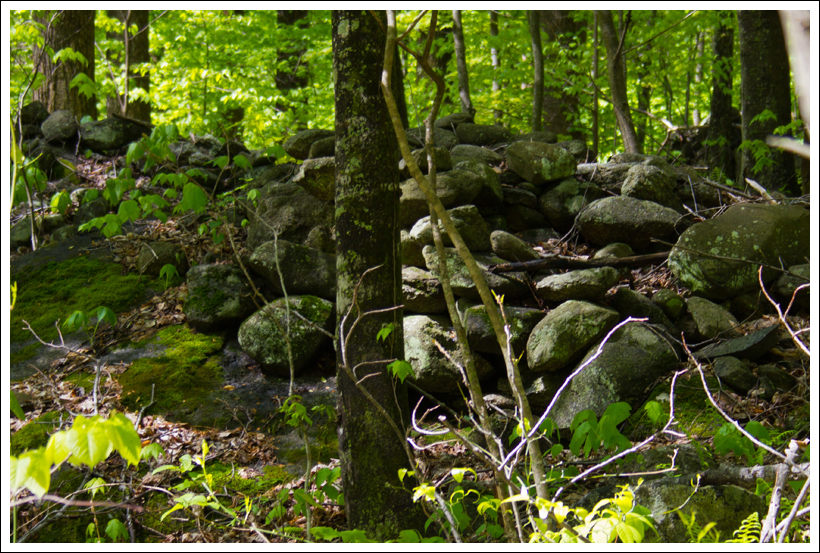
The hike starts off on the Graves Mill Trail, which is a flat walk that runs along the Rapidan River.  At .5 miles, you reach a junction with the Staunton River Trail.  Take a left at the junction to follow the Staunton River Trail, which runs along the Staunton River.  Shortly after you join the trail, you will come across a beaver dam on the river and you’ll notice several stumps of trees that have been gnawed by beavers.  At 1.1 miles, you will see a small waterfall leading into a small pool off the trail that is worth a stop.  At 1.8 miles, you will see on the left side of the trail some piles of stone and on the right you’ll be able to see another small waterfall through the trees.  At 2.7 miles, you reach the junction with the Jones Mountain Trail.  Take a left on this trail.  The trail becomes very steep at this point and will remain so until you reach the top.  At 3.1 miles, you reach the junction with the McDaniel Hollow trail.  Take a left here to follow the Jones Mountain Trail.  At mile 3.4, you reach a junction that leads to the available-to-rent PATC cabin.  If you stay relatively straight on the trail, it leads to the PATC Jones Mountain Cabin.  We took this trail which starts off flat, but then descends rather steeply.  After visiting the cabin, return to reach the junction with the Jones Mountain Trail and head up the steep incline until you reach Bear Church Rock.  Continue back the way you came, but your return trip will be shorter if you have already visited the Jones Mountain Cabin.  The total trip should be 8.5 miles.

You could also approach this hike from Skyline Drive for a longer hike, following the Laurel Prong Trail to Cat Knob Trail to Jones Mountain Trail.  My guess is it would be about a 10 to 12-mile round-trip to approach it from that direction.

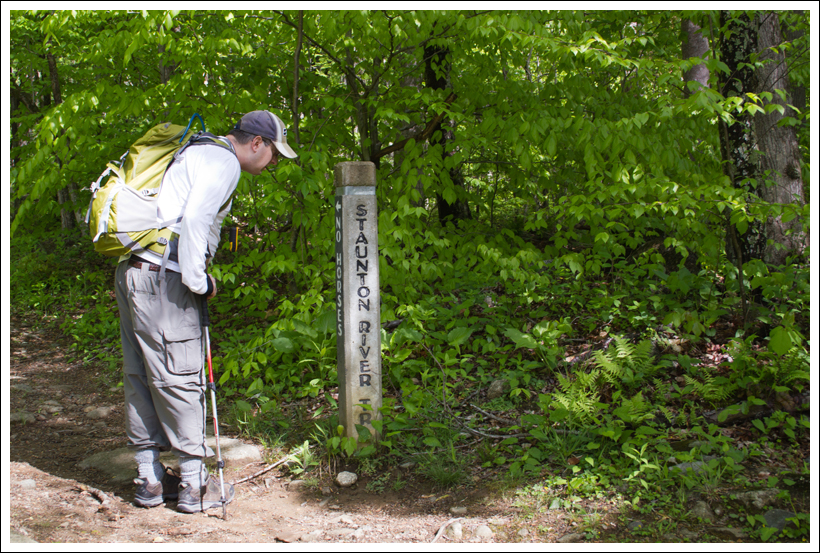
Start of the Staunton River Trail
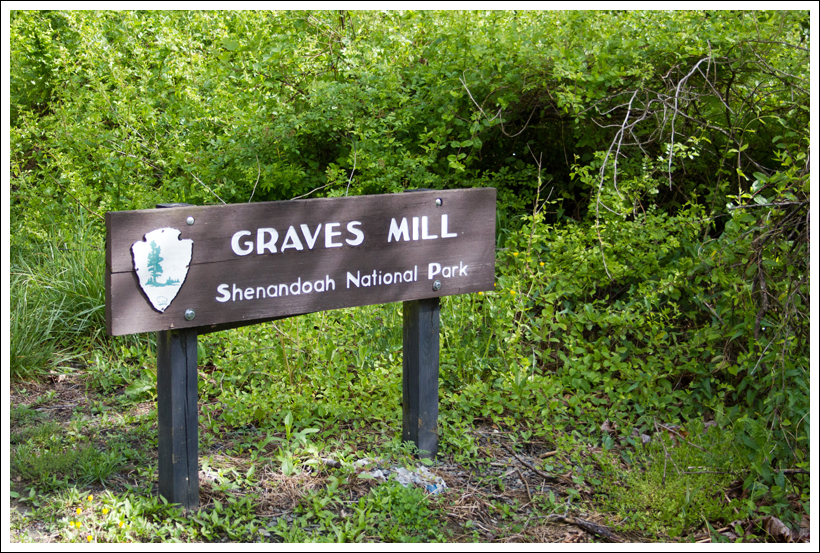
Adam pauses to look at distances marked on the Staunton River trail sign. Below: Parking for this hike is at Graves Mill; The lovely Rapidan River; Trillium were still blooming along the trail, but were nearing the end of their peak.

Graves Mill Sign The Rapidan River Trillium

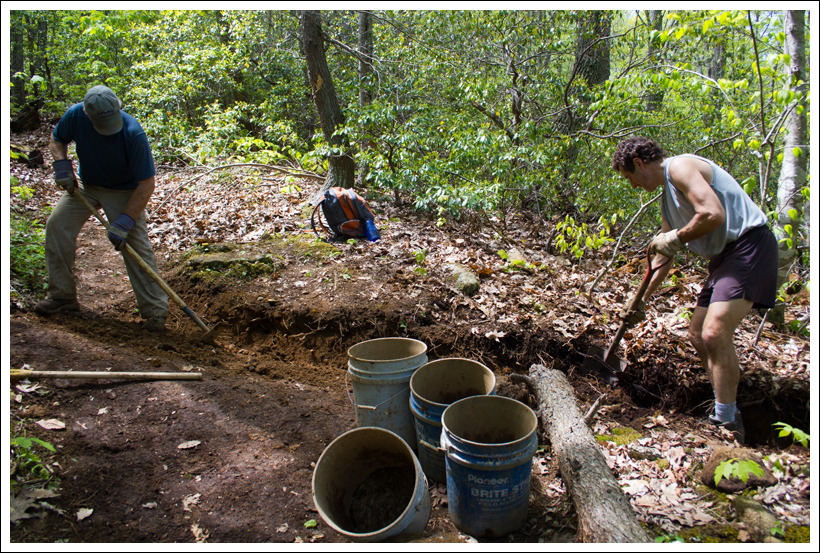
On our way up the Jones Mountain Trail, we ran into a few PATC volunteers that were working on maintaining the trail.  Some PATC members volunteer to help maintain the trails that run through Shenandoah National Park, the Appalachian Trail, and other regional trails.  One of the workers has been working on improving this trail for the last five years.  At the time that we saw them, they were working on building in some water bars through the trail that helps pull the water off the trail to prevent erosion.   They were digging drainage ditches, placing some dead black locust tree logs across the trail they had cut, refilling with dirt, and then mounding the dirt in a way that it was unnoticeable to hikers.  We learned that the black locust trees were great trail logs because they don’t rot.  We thanked them for helping to improve the trails and we plan on getting in touch with them to help them some weekend in the future.  We both feel that as much as we enjoy hiking, it would be nice to give back.

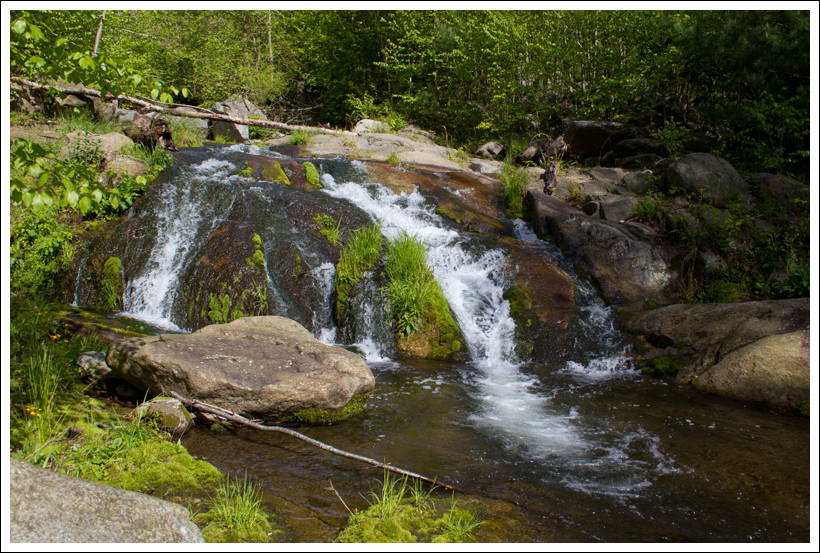
First Waterfall on Staunton River Trail
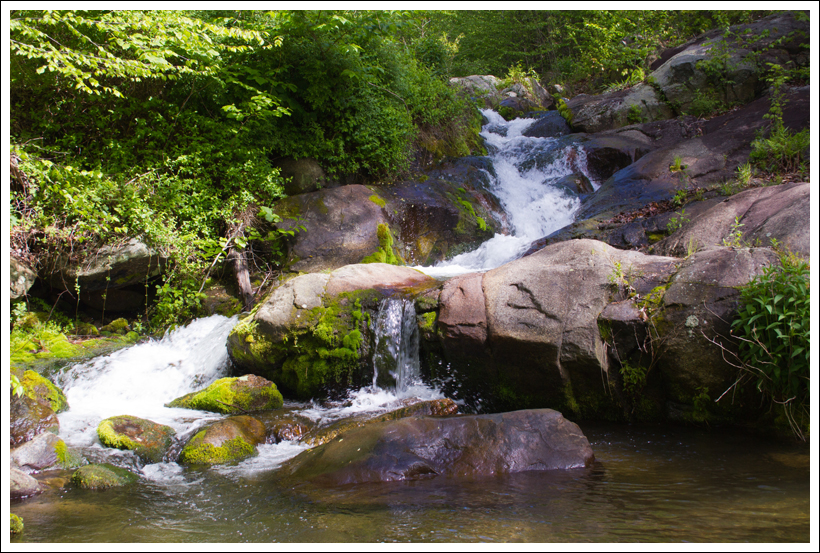
This was the first of many small waterfalls we saw along the Staunton River trail. Below: Another waterfall; There were many remnants of stone walls and stone structures in the woods along the trail; Adam stops to consult the map at the junction of the Staunton River and Jones Mountain trails.

Another Small Waterfall on the Staunton River Trail Old Stone Wall in Shenandoah Junction of Staunton River and Jones Mountain Trails

At one moment when we were hiking up the Jones Mountain Trail, I decided to take a break from the climb and sat on a log on the side of the trail.  As I was relaxing, a piece of the log broke off, causing me to hit myself in the head with one of my trekking poles.  I felt like I was in the Subway commercial of fat people breaking things.  Embarrassing, but funny.

This was our first time hiking this trail, but Christine and I both think this is one of the best trails in Shenandoah National Park.  If you can handle the distance and the steep climb, this should be on your “must” list.  For further reading about this area, check out Lost Trails and Forgotten People: The Story of Jones Mountain.  I think I would like to pick up a copy and learn more about this area, since it was such an amazing hike.

Christine Says…

Another weekend, another backpacking trip cancelled due to rainy weather – what can I say?  When you’re a fair-weather backpacker, lots of spring trips end up delayed.  We were pretty glad we postponed again, because the thunderstorms that passed through overnight on Saturday were pretty fierce and torrential.  I would not have enjoyed being in our tent during those winds and rains!  Fortunately, Sunday morning dawned dry, but foggy with a forecast of dissipating clouds followed by brilliant sunshine.  We decided to tackle the 8.5 mile route up Jones Mountain to Bear Church Rock.  It’s a hike we’ve been meaning to do, especially after seeing it covered by PATC – Charlottesville Chapter and Hiking Upward.

The hike vastly exceeded my already high expectations. I had the BEST time! Without a doubt, this hike has cracked my top-five list of hikes in Shenandoah National Park (along with Riprap, Mary’s Rock from Pinnacles, Rapidan Camp and the Rose River Loop).  This hike had it all – gorgeous river scenery, waterfalls, fantastic trail conditions, a rustic cabin, spectacular views and plenty of opportunities to spot wildlife.

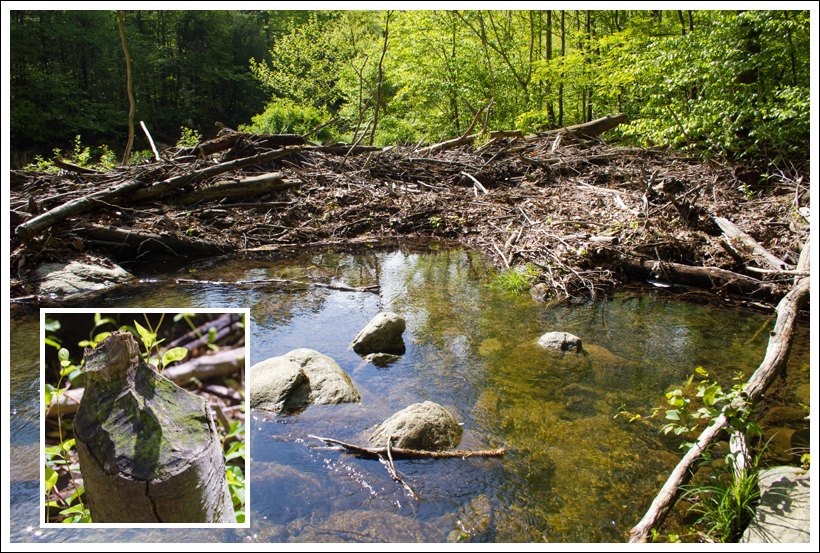
Beaver Dam on the Staunton River
We saw this impressive beaver dam on the Staunton River. There were lots of gnawed trees (inset) around the water. Below: Showy Orchis is a common wildflower seen blooming along the trail; Everything was so lush and green; You may notice Adam’s pants tucked into his socks to avoid ticks. Ticks are out in force this year!

Wildflowers Along the Trail Beautiful Spring Trail Downhill Hike

We started out around 10:00 a.m. from the Graves Mill parking area.  The lot is small; with room for about 8-12 cars at most.  It was already mostly full when we arrived.  The hike starts off on the Graves Mill trail – a flat section of trail running parallel to the Rapidan River.  Within a half mile, the Graves Mill trail meets the Staunton River trail.  This trail is a gentle uphill grade, following within sight or earshot of the water.  One of the first interesting things we passed was a series of several beaver dams spanning the river.  I don’t know if they’re active dams or long abandoned.  We saw plenty of gnawed tree stumps, but no sign of beavers or any fresh activity.  A little further upstream, we passed the first of a series of small waterfalls.  All of the falls and cascades along the Staunton River are beautiful!  If you’re a photographer and like shooting long exposures on moving water, this river is a goldmine.  I’d love to return on an overcast day after there has been plenty of rain.  I think this trail would also be popular with people in search of the perfect summertime swimming hole.  There were so many deep, quiet pools between the faster moving cascades.

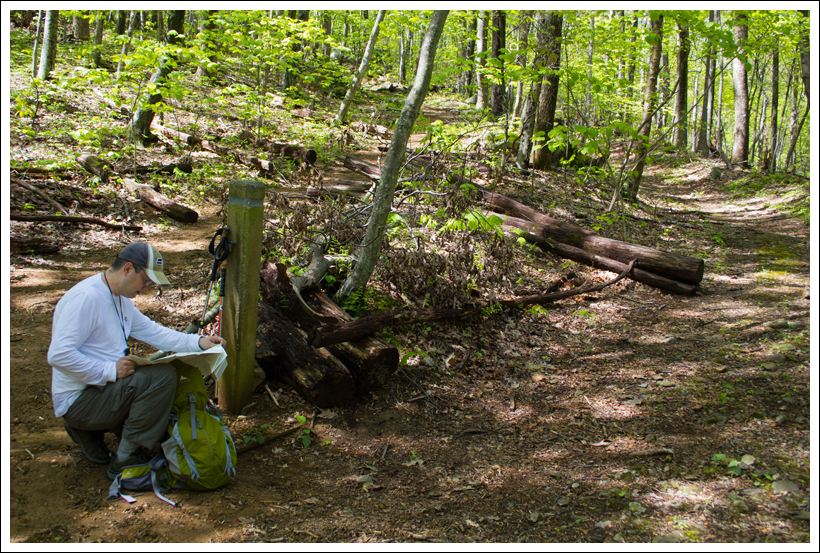
After about a mile and a half along the Staunton River trail, we reached the junction with the Jones Mountain trail.  Adam took a brief break at this point to consult the map. We quickly figured out that we were about to start climbing.  Overall, the path to Bear Church Rock requires about 2200 feet of elevation gain.

PATC Work Crew
PATC volunteers have been working on the trails in this area for over five years, spending 1000+ hours of their time.

After just a few minutes of walking, we heard voices and the sound of tools coming through the woods.  Shortly later, our paths crossed with a PATC trail crew hard at work installing water bars.  We learned from the crew that they’ve done over 1000 hours of work on this particular section of trail over the past five years.  No wonder the trail is in such magnificent shape.  Everyone who hikes in Shenandoah and enjoys the fantastic trail conditions owes a debt of gratitude to volunteer trail workers.  They do mind-boggling amounts of backbreaking labor to make the trails nice for everyone else.

After chatting with the trail crew for a few minutes, a couple came down the trail.  They mentioned that they had seen a bear with two tiny cubs just a few minutes earlier.  We were excited and hopeful that we might spot them too.  Unfortunately, we weren’t that lucky!

Eventually we reached a ‘Y’ in the trail, with one arm leading .3 of a mile down to the Jones Mountain cabin and the other arm leading a half mile up to Bear Church Rock.  We decided to visit the cabin first, and then enjoy lunch atop Bear Church.

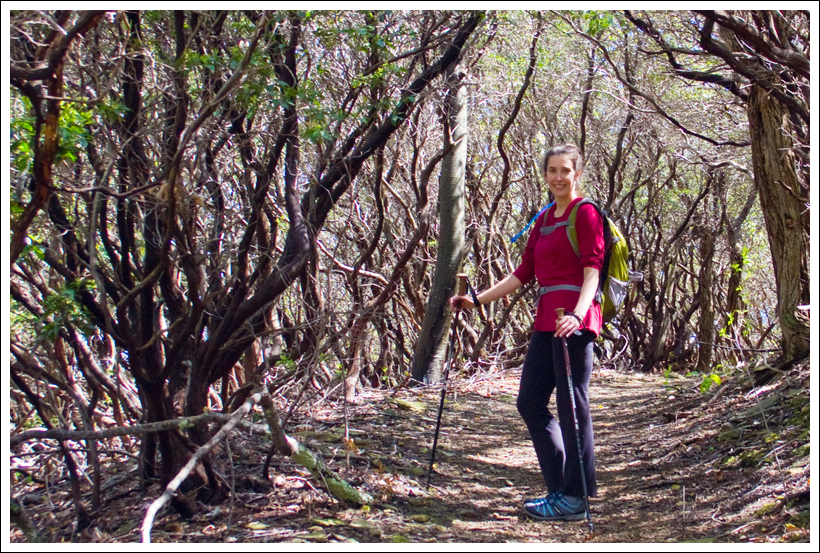
The trail to the cabin led rather sharply downhill, first passing through an ancient, gnarled stand of mountain laurel.  The curly branches practically formed a tunnel over the trail.  All along the final descent to the cabin were stacks of firewood – also courtesy of PATC trail crews.  Apparently, there is a significant problem with cabin renter chopping down live trees near the cabin to use as firewood.  I find that SHOCKING!  What is wrong with people?  Who goes to a National Park… and chops down living trees (especially when deadfall is so abundant in the park)?

The Jones Mountain Cabin
The Jones Mountain cabin sits in a peaceful opening in the woods. Below: Christine walks through a tunnel of ancient mountain laurel on the path down to the cabin; Christine has new hiking shoes – Montrail Mountain Masochists (very comfy!); Christine enjoys the wilderness views from the rock.

Christine Hikes Through Old Mountain Laurel Love My New Montrails Christine On Bear Church Rock

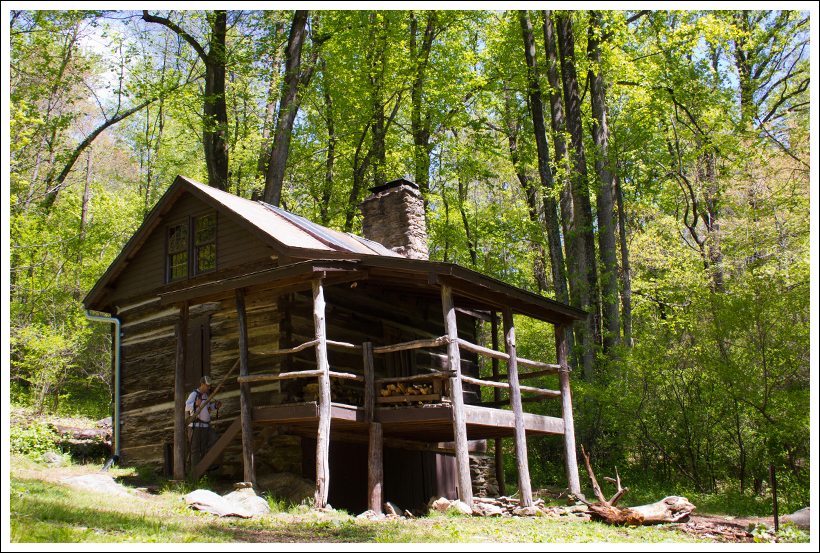
After rounding a final bend, the roof of the cabin comes into view.  The Jones Mountain cabin is adorable – two stories with a big front porch.  We peeked in through an opening in the shutters and saw a big fireplace, a rustic wooden dining table and a sunny loft on the top level.  A privy and a spring are both located near the cabin.  What a great place to hike in and camp for a couple nights!

We didn’t stay long at the cabin because we were hungry for lunch and wanted to enjoy Bear Church Rock before any other hikers arrived.  The climb back up to the trail junction was pretty steep, but didn’t take too long.

The toughest climbing of the day came along the final push up to the rock.  After a few switchbacks, the trail went straight up the mountainside.  At the top, a little unmarked (but highly visible) path cuts through the vegetation onto a large rocky outcropping.  The trail continues past the little spur trail to the rocks, so don’t miss it!  If you continued along the trail, you’d eventually come to trails in the vicinity of Camp Hoover.

The view from Bear Church Rock is fantastic!  Instead of looking down into a valley full of roads, farms and small towns, you look down into wilderness.  You see nothing but trees and a line where the river cuts through the forest.  If you have a map, you can identify some of Shenandoah’s other peaks from this spot.  We hit this spot on a perfect spring day.  We had bluebird skies with only occasional puffy clouds.  The progression of spring was evident in the mountains – vibrant green climbing its way up toward the still barren mountain tops.  We enjoyed our lunch and relaxing in the sunshine.
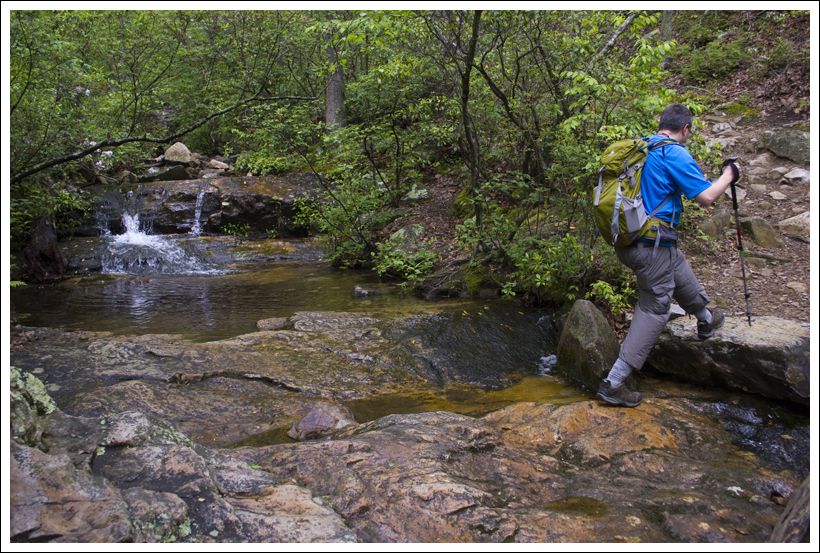
Spectacular View from Bear Church Rock
Just some more beauty shots from atop Bear Church Rock.

Christine on Bear Church The Rock Continues Adam and Hiking Gear on Bear Church

The hike back down went quickly – with a descent so steep it was easier to run than to walk! We made the return trip to the car in about half the time it took us to climb up.  In the end, the entire hike took us about four hours, including stops at the cabin and half an hour for lunch.

Bear Church Rock is definitely worth doing!  What a beautiful day!

Trail Notes

  • Distance8.5 miles
  • Elevation Change – 2210 feet
  • Difficulty – 4.  The parts near the Rapidan and Staunton Rivers are very flat, but the uphill climbs are very steep.
  • Trail Conditions – 4. The trail is wide during much of the trail where you could even walk side-by-side with someone if you wanted.  The trails are well-maintained thanks to our PATC volunteers and it is not very rocky through most of the hike.
  • Views– 4. The view from Bear Church Rock is amazing.  It’s not a 360-degree view, but you can see mountains for miles and little sign of civilization.
  • Streams/Waterfalls – 4.5.  The rivers are nice to walk alongside.  You also have a beaver dam and a few small waterfalls on this trail.
  • Wildlife – 4.  We saw some snakes by the river and on the trail.  We saw deer by the Jones Mountain Cabin.  People coming down the trail when we were coming up had just seen a mama bear with two cubs.
  • Ease to Navigate – 4.  While the trail does have a few turns, it is well marked with concrete posts to help give you direction.
  • Solitude – 3.5.  We had the view to ourselves by going early in the day, but this is a fairly popular hike.

Directions to trailhead:  From Route 230 near Wolftown, VA turn on to Route 662.  Continue to follow the signs for 662.  In about 6 miles until 662 ends at a parking lot.  The trailhead is visible from the parking lot.

Byrd’s Nest #4 Loop

This short 2.4 mile loop takes you along the Appalachian Trail, the Neighbor Mountain Trail and the Hull School fire road.  The highlight of the loop is a visit to the Byrd’s Nest Day Shelter.

Byrd's Nest
Byrd’s Nest #4 sits in a lovely opening off the Neighbor Mountain trail. Below: Parking is available at the Beahm’s Gap Overlook; the trail begins after crossing the railing; Blooming azaleas along the trail.

Parking at Beahms Gap Start of Hike Blooming Azaleas

Christine Says…

We were supposed to go backpacking, but when we heard terms like ‘flooding rains’, Nor’easter and ‘wash out’, we decided to delay the trip.  When Saturday morning dawned, it was sunny and warm and beautiful!  I made a trip into town, worked on a photography project in the arboretum, bought a bunch of veggies and strawberries (yay!) at the farmers’ market and got a haircut, figuring that the rain had to be on its way.  When I got home, it was still sunny and gorgeous with no sign of the coming deluge.  Adam suggested we hop in the car, go for a short hike and then have lunch in the park.  It sounded like a great idea to me, so off we went.

We decided on the short Byrd’s Nest #4 loop, starting from the Beahms Gap Overlook.  The trail started with a hop over the retaining rail at the overlook – a cement trail marker post will show the spot to cross the rail.  The trail goes slightly downhill along a short spur to the Appalachian Trail.  Follow the AT north until the junction with the Neighbor Mountain trail.  Take a right onto the Neighbor Mountain trail and follow it uphill until you reach a clearing and the Byrd’s Nest shelter. For the return trip, follow the grassy path in front of the shelter downhill.  The path quickly widens to the Hull School fire road.  After a few tenths of a mile, you’ll come back out on Skyline Drive.  Follow the drive south for about a tenth of a mile back to your car.

Adam Hiking Along the Rocky Appalachian Trail
Adam hikes along a rocky section of the Appalachian Trail.

Although there are no sweeping views or rocky outcroppings, this hike is a lovely leg-stretcher.  The Byrd’s Nest shelter is a perfect place to enjoy a picnic lunch.  We had planned to relax at the shelter for a while, but when we arrived we found it already occupied by a picnicking couple.  Not wanting to infringe on their space, we took a few photos and headed back on the return arm of the hike pretty quickly.

We decided to have lunch at the Big Meadows Wayside.  It was packed – more crowded than we’ve ever seen it!  They had some new selections on the menu, which was a pleasant surprise.  The menu has been pretty much the same for years!  I got a grilled chicken sandwich with roasted red peppers, provolone cheese and aioli.  It was surprisingly juicy and delicious.  You don’t expect amazing food from park concessionaires – but this was actually one of the best grilled chicken sandwiches I’ve ever eaten.  Go figure!

It was still beautiful and sunny when we left the park around 2:00 p.m. – but by 4:00 heavy thunderstorms had moved in and it rained pretty much non-stop the next 48 hours.  I was glad that we had decided to postpone our backpacking trip.

Adam Says…

I was originally thinking that we would just take a drive on Skyline Drive when I whisked Christine away.  But, I decided to bring our Shenandoah National Park Falcon Guide hiking book and had Christine thumb through to find this hike we hadn’t completed yet.  We had done the majority of this trail before on our Appalachian Trail hike from Elkwallow to Thornton Gap.  The last time we had been on this trail, we saw the post that showed this side trail, but we decided to avoid more hiking.  The Falcon Guide book actually mentioned another trail that should have looped back to the AT, but that trail no longer exists (at least the posts have been removed).

Another View of Byrd's Nest
A front view of Byrd’s Nest. Below: Adam walking along the Neighbor Mountain trail; A few dark clouds rolled over on the short section of road walking at the end of the hike.  They quickly passed and blue skies returned.

Adam Walking the Neighbor Mountain Trail Road Walk

The cabin is named for Senator Harry Byrd Sr., who donated four of these shelters for the national park (the other three are at Old Rag, between the Pinnacle and Meadow Spring Trail, and Hawksbill mountains).  His name also graces the Visitor’s Center near Big Meadows and he hiked Old Rag annually into his 70s.  It appears that the cabin up here must have had a few other buildings or other things nearby since you can see some nearby foundations.  I’m not sure if this area once served as someone’s home or if it was an overnight shelter with a spring and a privy.  It is listed as a day-use shelter only.

Once we descended from the shelter down the fire road, we both thought we saw a bear dash off into the woods.  We saw a black shape and a big crashing through the brush, so we are convinced it was a bear.

The cabin is definitely the highlight of the trail, but we were disappointed that others had taken it completely over to eat lunch.  So, we quickly got on our way to not interrupt them.  Overall, there are definitely more interesting trails in Shenandoah National Park.  But if you want a quick hike with a possible place to eat a packed lunch, this could be one for you.

Trail Notes

  • Distance 2.4 miles
  • Elevation Change –850 feet
  • Difficulty – 2.  There is a substantial amount of uphill climbing, but the overall distance is short.
  • Trail Conditions – 5.  The trail is in excellent shape, like most of the AT through Shenandoah.
  • Views– 1.5.  There is a partially obscured view at the Byrd’s Nest Shelter.  It was probably much more panoramic and open when the shelter was originally built.
  • Streams/Waterfalls –0.  There are no streams or waterfalls, but you will pass a spring-fed water source.
  • Wildlife – 3.  We heard lots of birds, and *think* we saw a bear.
  • Ease to Navigate – 2. After leaving the AT and Neighbor Mountain trails, it was all guesswork.  Nothing was marked and the description of the trail in our Falcon Guide was inaccurate.
  • Solitude – 3. This is a fairly popular family hike.

Directions to trailhead:  Park at the Beahms Gap Overlook parking lot around mile 28.5 on Skyline Drive.  From the lot, you should see a cement post marking the start of the trail on the other side of the log barrier.

Appalachian Trail – Beagle Gap to Turk Gap

The Appalachian Trail – Beagle Gap to Turk Gap is a nice 6.4 mile section that includes a short summit hike and a visit to a AT shelter in the southern district of Shenandoah National Park.

View Along the Ridge
A nice view along the ridge line. You can see the spring green creeping up the mountainsides. Below:  Flowering trees near the beginning of the hike at Beagle Gap; the Calf Mountain Shelter; Dogwood in bloom.

Beagle Gap Calf Mountain Shelter Dogwood

Adam Says…

With this section of the Appalachian Trail, we finished section-hiking the southern district of Shenandoah National Park.  Now that we are finished with both the central and southern districts, we will next start working on completing the northern district so that we can ultimately cover all 105 miles of the AT through SNP.  The southern district accounts for 45 miles of that total, so we are glad to have the longest section completed.  I think hiking all of those miles was best realized by me when we are driving back home.  It feels like it took forever to drive the distance (due to the 35 mph speed limit through the park), so knowing we walked the distance gives me a little pride.   Of course, it still amazes me that some AT thru-hikers will accomplish the entire AT through SNP in about 4 days where it has taken us 5-8 days of hiking just to cover one section.

Adam hikes up Calf Mountain
Adam hikes up Calf Mountain. Below: The Charlottesville chapter of Potomac Appalachian Trail Club (PATC) is working on a less steep re-route of the Appalachian Trail near Calf Mountain; The USGS marker on Calf Mountain’s summit; After descending Calf Mountain you will cross under powerlines.  They’re very loud and buzzy!

Reroute Calf Mountain Summit Powerlines

We did bring two cars to cover more ground.  We parked one car at Turk Gap at mile 94.2 on Skyline Drive.  We took the other car to Beagle Gap and began our hike northward from there.  From the parking lot, we went through the gap of the fence on the same side of the parking lot.  We started walking across the open field and up into the woods.  Once we got into the woods, the trail becomes quite steep as you make your way up Calf Mountain, where you gain about 500 feet of elevation in the first mile.  The woods are more open through this section, so you can take in a lot of the beauty around you if you need an excuse for a break.  The AT is being re-routed through this part, so you will see some posted signs, but stay on the white-blazed AT.  At mile 1.0, you will see a large cairn on the trail.  If you look nearby on the ground, you will see a USGS marker that marks the summit of Calf Mountain at 2974 feet.  The trail then begins to descend past this point.  At mile 1.6, you will see a blue-blazed side trail that leads to the Calf Mountain Shelter.  The sign says that the shelter is .3 miles away, but it is really just slightly over .2 mile away and the trail is relatively flat.  We always enjoy visiting the shelters along the way and reading the entries in the shelter log books to see who has been through recently.  Once you return back to the AT, continue northward.  At mile 2.5, we started to hear some buzzing in the air.  Within a few short steps, we came across some power lines that are cut through the mountains that were producing the unsettling sound.  At mile 2.7, you will come across the South Fork Moormans River Fire Road.  Cross the road and continue on the AT.  The trail descends to bring you down to Moormans River, which is more like a trickling stream than a river at this point.  Once you reach the stream, the trail then begins the uphill climb for most of the remainder of the trail. At mile 4.8, you will reach Skyline Drive and the Sawmill Run Overlook.  Cross Skyline Drive, continue to climb,  and at mile 6.4 you will reach the Turk Gap parking lot.

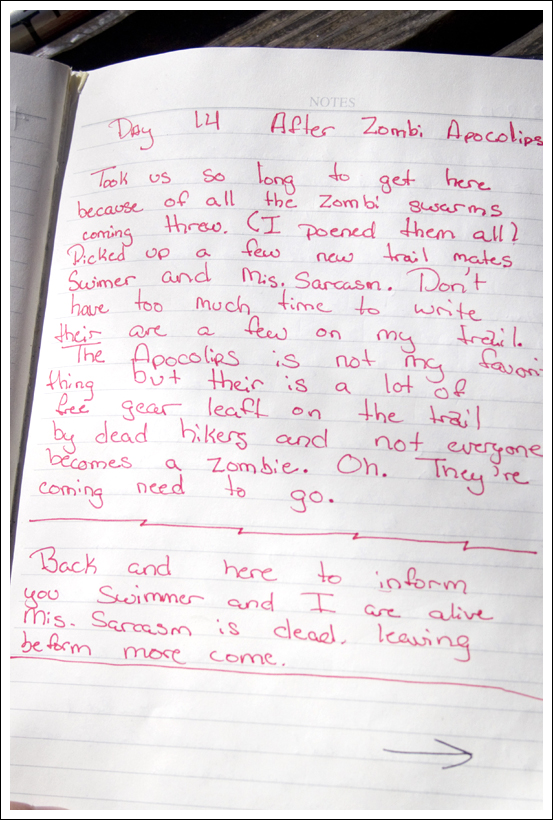
When reading the log book at the Calf Mountain shelter, it appears there were a few writings about a zombie apocalypse happening on the trail and some people were getting eaten and others were trying to stay ahead of it.  The only mention of this I could find online was through Tarzan’s AT journal.    I just picture a group of thru-hikers with zombie makeup shuffling through the forest and tagging others to spread the zombie disease.  But from watching The Walking Dead, I don’t picture anyone trying to set any speed records as a zombie.  Christine and I have toyed with doing a haunted hike on Halloween before, so this gives us some ideas.

Calf Mountain Journal
The journal at Calf Mountain shelter was full of fascinating and entertaining entries. Below: Adam reading at the shelter; Zombies on the Appalachian Trail; Climbing uphill

Adam Reading Zombies Uphill Climb

I did struggle a bit with this hike.  The last two weeks I had a very severe sinus infection.  Topping that off with a high-pollen allergy season just made this tough for me.  My lungs haven’t fully healed from all the coughing that I was doing, so walking uphill for most of this hike was taxing.  By the last mile of this hike, I was just ready to be done.

Christine Says…

This section of trail was quite a bit nicer than I expected.  On the map, it basically looked like a series of rolling hills on a trail through the woods – no panoramic views or remarkable features.  But once we got out there, we did find a couple nice views after all. The shelter visit was fun, mostly because the journal entries were more entertaining than usual.  Trees and wildflowers were blooming abundantly, so there was plenty of color along the way.  I also enjoyed the bluebird skies and the pleasant breeze.

The trail began with the climb up to the summit of Calf Mountain.  It’s a summit without a view. It’s marked by a USGS marker and a conical pile of rocks.  The pile reminded me a little of the giant cairns that mark the summits in Acadia National Park.  Adam always poses on those Maine summits, so I asked him to do the same on Calf Mountain.  Unfortunately, he made a really goofy face in the photo, so I won’t be sharing it on the blog.

Green Trail
The understory turned green early in the spring of 2012. Below: Ferns uncurling; Budding azaleas; Wildflowers

Fern Azalea Wildflowers

Hiking down from the Calf Mountain summit, I really noticed how GREEN everything is becoming.  Spring hit early and fast this year.  Even though the mature hardwoods had not leafed out when we did this hike, much of the understory was already green – ferns were uncurling, dogwoods and redbuds were in full bloom and we saw wild geraniums and dwarf irises. On this section of trail, we passed several enormous trees with lots of large, low-hanging branches.  They were just the kind of tree I would have climbed as a kid.  I wish I knew what kind they were, but they didn’t have leaves yet and I’m not good at tree identification without leaves.

Our next stop was the Calf Mountain shelter.  I ate candy and cheese. Adam almost broke my camera by getting his foot caught in the neck strap as it was sitting on the picnic table. (Aaaaaah!) I read the journal.  Apparently, there are zombies afoot on the Appalachian Trail this spring – many hikers are now undead, and it sounds wise to stay on the move.  (kidding, kidding)  There was also a fascinating entry from a man who has completed many thru-hikes (and not just the Appalachian Trail).  His entry was really uplifting and motivating.  I can’t believe one of his thru-hike attempts ended after getting thrown off the AT by a tornado in Maine  — yes, A TORNADO in MAINE.  That doesn’t happen very often!

Flowering Tree
There were plenty of flowering trees along the hike. I think we saw dogwoods, redbuds, cherry and apple. Below: Dwarf iris.

Dwarf Iris

The second half of the hike was mostly uphill.  It was never steep uphill, but we still gained several hundred feet in a pretty short distance.  I felt really bad for Adam.  He was struggling with the uphill after recovering from a chest/head cold.  At one point, I heard him cursing and muttering behind me that he was ‘*%$# tired of *%$# uphill.’  I always feel a strange sense of guilt when people I’m hiking with are having a hard time.  I almost feel like the hills are my fault.  LOL I want to carry more, encourage them to take more breaks, or offer to make a run for the car and come back to get them at an earlier stop point.  But Adam was tough, and pushed through the pain.

The nicest views of the hike came on the section of trail between Jarman Gap and Turk Gap.  There were several open views along the ridge.  It was beautiful to see the spring green creeping up the mountainside!

It feels good to be done with two sections of the AT through Shenandoah.  Now we have less than twenty miles to go.  Hopefully we’ll be able to knock those miles out in the next few weeks.

Trail Notes

  • Distance6.4 miles, including .4 miles to visit the Calf Mountain Shelter
  • Elevation Change – 1300 feet
  • Difficulty – 2.5.  While most of the trail is uphill, the grade is typically not very steep except for the section up Calf Mountain.
  • Trail Conditions – 4. The trail was in great shape and well-traveled.  There were not many rocky sections along this trail.
  • Views – 2.  There were a few views near the power lines, but most of the views along this section are obstructed.
  • Streams/Waterfalls – 2.  You do go along the south fork of Moormans River at one point, but it is largely a trickle at this point.  There are a few springs along the way, but the most reliable source is probably near Calf Mountain Shelter.
  • Wildlife – 3.  We did see several deer along the trails and we could hear lots of woodpeckers through the trees.
  • Ease to Navigate –4. Stay on the white-blazed AT and you should be fine.
  • Solitude – 3. You will find more people on the way to Calf Mountain, but not many people after that.

Directions to trailhead: At mile 99.5, you will come to a large parking area.  Look for the gap in the fence on the same side of the road and head up the Appalachian Trail.

Edith J. Carrier Arboretum

The Edith J. Carrier Arboretum is a 125-acre botanical preserve located within the city limits of Harrisonburg on the campus of James Madison University.  There are between three and four miles of interconnecting trails through the arboretum.  (Maps) Spring is a fabulous time to visit this special spot and witness flowers opening and the forest coming back to life again!

Arboretum Pond
Spring is a gorgeous time of year to visit the Edith J. Carrier Arboretum. Below: The paths in the arboretum are all well-maintained; Adam hunts down a geocache; Enjoying the labyrinth.

Pathway in the Arboretum Finding a Geocache Enjoying the Labyrinth

Christine Says…

What do you do on a morning you want to get out into nature, but you don’t have time for a longer hike in the national forest or Shenandoah National Park?  If you’re anywhere near Harrisonburg… you go to the Arboretum.  It’s a beautiful, lush, wooded spot in the middle of Harrisonburg.  Trails covered with wood chips or gravel wind their way through the forest.  There are two ponds where you can spot ducks — usually mallards, but sometimes wood ducks if you’re lucky.  Squirrels crunch through the understory, woodchucks duck into holes when they hear approaching footsteps and birds sing in the trees overhead.  There are even a few hawks that call the Arboretum home, so be on the lookout for them!

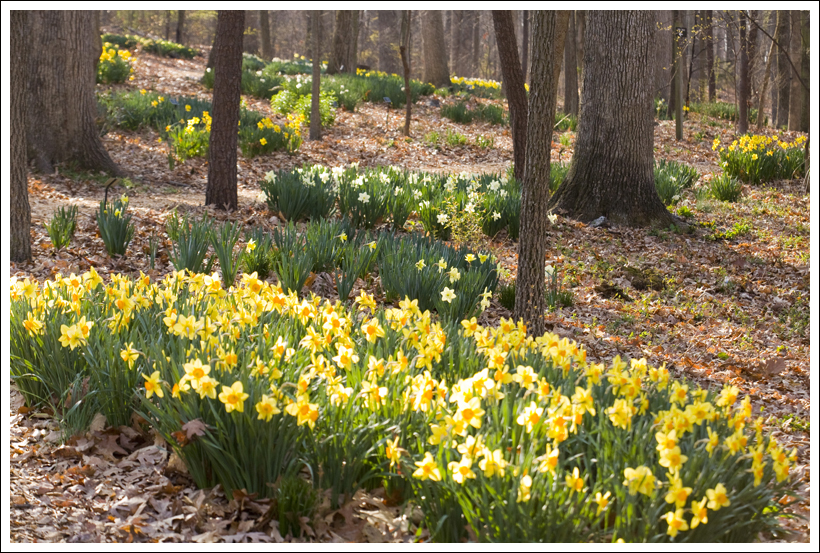
Beyond the wildlife, the Arboretum has abundant plant life – both wild natives and cultivated species.  In the spring, flowering trees – redbuds, dogwoods and magnolias – burst with color.  One section of the trail passes through an area populated by hundreds of daffodils.  Bleeding hearts bloom in quiet corners. Trillium, Virginia bluebells, snowdrops, hellebore and even some yellow lady slippers can be found along the paths. There is always something new and different blooming, so it’s a place we visit time and time again.

Abundant Daffodils
Daffodils are abundant and impressive at their peak! Below: Adam checks out the arboretum map.

Map

On this particular morning, Adam and I hiked the path along the perimeter of the arboretum.  We walked through the daffodils, passed the quiet, smaller pond near the greenhouse and then climbed into the natural wooded section.  On the return half of the walk, we stopped at the labyrinth and spent a little time walking the maze.  All in all, we walked about two miles.  We could have walked more if we had taken all of the side paths and connectors, but on this morning, two miles was enough.  It was a beautiful morning!

Take a moment to stop by the arboretum’s Flickr site to view hundreds of photos from their grounds!

Adam Says…

This should probably be listed as a “hike” with the quotation marks since it is more of a walk through a nice arboretum.  We do like to cover hikes for all different types of abilities and this should be one that most people can do.  There is even a wheelchair-access ramp down to the pond, so anyone can enjoy this.   You will likely see several families here on pretty days by the lake or perhaps see some wedding or family photos taking place nearby.  This is a place to stroll through and enjoy the scenery.

Turtles Sunning
Turtles can usually be spotted basking in the sun. Below: A mallard swims in the pond.

Mallard

One thing that is exceptional here is all the beautiful flowers.  At this time of year, everywhere you turn your head you’ll be greeted with vibrant colors from the blooming trees and flowers.  You can read more about the history and flora on their website.  There are probably a few key highlights of the arboretum.  The most prominent is the pond.  You will most likely see mallards floating on top and a coin-operated machine to purchase feed for the ducks.  At certain times of the year, there is also a poet-tree where the Arboretum hangs a wicker basket.  People are invited to write a poem and leave it there for others to read.  Another highlight is the rock labyrinth that is located off a trail.  While it is not a labyrinth created to the level that you may have seen in The Shining, it is a path made with rocks in the ground that produces a zen-like rock garden feel.

We started from the northern parking lot and made the large loop around the perimeter of the park, starting near the picnic pavilion.  The end of the perimeter loop brought us by the education center, to the lake, and back to the parking lot.  We then walked around the upper terrace Caroline Sinclair Memorial Garden.  With everything blooming typically in April-June this is a great place to visit in the spring!

Bridge
Adam enjoys a view of the pond from the bridge.

You can download a map of the Arboretum here.

If you are interested in geocaching, there are also several geocaches here in the Arboretum.  This might be another thing to enjoy as a family here.

Trail Notes

  • Distance 1.7 miles for the long path around, but it can vary based on how far you want to explore the side trails inside.
  • Elevation Change – Negligible
  • Difficulty – 1.  These gentle paths can be walked by nearly anyone.  There is even an accessible path around the main pond.
  • Trail Conditions – 5.  The trails are in great shape – covered with gravel or wood chips
  • Views – 0.  This is a wooded walk, so there are no views.
  • Streams/Waterfalls –3.  There are two ponds, a small man-made waterfall and a pretty stream passing through.
  • Wildlife – 3.  Many bird species and small mammals.  Occasionally deer are spotted.
  • Ease to Navigate – 5. All the paths interconnect and lead back to the center hub.
  • Solitude – 0. This arboretum is very popular!

Directions to trailhead:  The best way to get directions is using the website google directions here.

Furnace Mountain

This 4.7 mile hike is a steady climb that gives you views of the south and west on the climb up and views of the north and east from the summit.

Christine on the Furnace Mountain Summit
The summit of Furnace Mountain has nice views of Massanutten and of Shenandoah National Park, looking back toward Skyline Drive.

Adam Says…

It is amazing to me to think about how blessed we are to have such great hiking in Virginia.  While we have been slowly trying to accomplish the Appalachian Trail through Shenandoah National Park, but we also like to mix in some other hikes.  Christine stumbled across a mention of this hike, so we decided to try it out.  We were pleasantly surprised by the nice views you get on this hike.  Keep in mind, there is another Furnace Mountain in Loudoun County.  There doesn’t seem to be a lot of originality in naming mountains sometimes.  This Furnace Mountain is named for the Mount Vernon Furnace that once stood at the bottom of the mountain for the reduction of iron ore.

Crossing Madison Run
Adam rock-hops across Madison Run. Below:  Adam adding some excitement to an otherwise boring fire road; The official start of the Furnace Mountain Trail.

Adam Leaping on the Fire Road Start of the Furnace Mountain Trail

We parked our car at the beginning of the fire road and made our way to the boundary of Shenandoah National Park.  As soon as we entered the park boundary, you will see a signpost to the right that denotes the start of the trail.  You will quickly come up to a stream crossing of Madison Run that you can rock-hop across.  These rocks are sturdy, but can be slick in some spots, so be careful.  After crossing Madison Run, the trail turns right and parallels the stream for a short distance.  Then, the trail begins climbing up the mountain.  There is a constant climb uphill for the entire hike.  Around 1.6 miles, the trail comes up to a large talus slope of large boulders which provides an open view of the valley.  The trail continues climbing and at 1.9 miles, you reach a post and an intersection with the Furnace Mountain Summit Trail.  Take this trail, which continues to climb up.  At 2.3 miles, you will reach a campsite at the summit.  Less than .1 miles is the rock outcropping which gives you the best views on the trail.  Return the way you came to make it back to your vehicle.  This time, you’re going all the way downhill.

Christine on Talus Slope
Christine hikes on the trail across the talus slope. Below: Adam takes in the view of the valley.

Adam on Talus

Madison Run is not named for James Madison, but rather from John Madison, the first Court Clerk of Augusta County.  John Madison’s cousin was the father of James Madison, the 4th US President.  Near this location stood Madison Hall Estate.

We had debated about bringing Wookie on this trip.  He would have loved most of the hike, but would have hated crossing Madison Run.  He really wants to avoid water on the trail, so I know I would have had to carry him with his claws digging in to me.  He just doesn’t like getting his precious feet wet for some reason.

Hiking this trail in the winter gives you views throughout a good portion of the hike.  When the leaves come out, you will have more obstructed views except from the talus slope and the rock outcropping at the summit.  We were excited at how great the views were from the summit.  Even though this mountain’s summit is only at 2657 feet in elevation, it provides some great vistas of the mountains around.  If you’re looking for a manageable hike off the beaten path with good views, this is one to try!

Christine Says…

Adam and I had Friday off work, so we decided to hit the trail for a morning hike.  We thought about doing some more of the Appalachian Trail through Shenandoah, but I wasn’t in the mood to drive separately for our car shuttle.  I also didn’t want to drive too far for our hike, so I started researching trails close to our home. We’ve done so many of them already that it’s getting increasingly difficult to find anything nearby.  Luckily, I happened to stumble across a route up Furnace Mountain with a trailhead located about fifteen minutes from our house.  I had been aware of Furnace Mountain before this, but most write-ups I’ve seen cover it as a 13+ mile loop hike (with 3000+ feet of elevation gain) paired with Austin Mountain.  I can hike 13+ miles as a day hike, but I usually don’t enjoy it.  My ideal length for a day hike is still 8-10 miles.

Hiking Along
You can see the valley below through the trees for much of the hike up. Below: An illegal fire pit at a backcountry campsite; The rocky outcropping at the summit; A view of Massanutten Mountain

Illegal Fire Pit Summit Rock View of Massanutten

Our trip up Furnace Mountain started off cloudy, and while the clouds thinned out somewhat during the course of the morning, it stayed mostly overcast.  That was a bit of a shame, because the views all along the trail are really nice.  I’m sure some of the views will be obscured once the trees have leaves again, but for the time being, it was great to see views of the Shenandoah Valley along the climb up.

The trail was extremely rocky most of the way, and even crossed a neat talus slope.  I imagine that this mountain was once towering and majestic, but over the ages, the rocky summit crumbled and rolled down the lower slopes.  The climb uphill was steady, but not difficult.  The most challenging part was the footing – lots of football-sized, unevenly seated rocks.

The Furnace Mountain summit trail is a half mile dog leg off the main trail.  Along this segment, we passed a campsite with a well-used fire ring.  Since Shenandoah does not allow open fires in the backcountry, the fire ring really shouldn’t have been there.  I suppose that the park just doesn’t have enough rangers to police illegal fires.

Shortly after the campsite, the trail took a short downhill to a rocky outcropping overlooking the park and the Shenandoah Valley.  We could see Massanutten mountain in one direction and a distant snip of Skyline Drive in the opposite direction.  In early March, everything is still barren and brown.  The dull color paired with the clouds took a little of the luster off the overlook, but it was still very nice.  I’d like to see it again in late spring, summer or fall!

Enjoying the Summit
Christine enjoys the summit.  Below: Adam on the rocking outcropping.  As you can see the rock is very rugged and jumbled.

Adam on the Summit Adam on the Summit 2

After hanging out a short while, we headed back down the trail.  We made it back to our car in less than half time time it took us to climb up.  We practically jogged the whole way down!  On our way home, I had really been looking forward to stopping at the Elkton McDonald’s for a Shamrock Shake.  We got there… shakes were on the menu… but the stupid machine was out of order.  I was robbed!

Trail Notes

  • Distance 4.7 miles
  • Elevation Change – about 1300 feet
  • Difficulty – 3.  The uphill isn’t too strenuous, but there isn’t much break from the climbing.
  • Trail Conditions – 3.  We were surprised at how well this trail seemed to be maintained.  The path is a little more open, but does have some rocky sections.  The danger would be in going down, since you can pick up speed and some of the rocks may be loose.
  • Views – 4.  The views are quite nice, but not 360 degree views.
  • Streams/Waterfalls –2.  The trail does go along Madison Run for a short distance.
  • Wildlife – 1.  We didn’t really see anything on this trail.
  • Ease to Navigate – 4. As long as you cross the stream at the right point and then make the turn on the Summit Trail, you should be fine.
  • Solitude – 3.5. Typically only popular with the locals, but you may see a few people on the trail.

Directions to trailhead:  From Elkton, VA follow 340 South. You will see SR 659 on the left.  Follow that until it intersects with Browns Gap Road/SR 663.  Take a left and follow the road until it becomes a gravel fire road.  Park on the road. Continue on the fire road for about .2 miles until you enter the park boundary.  The trail marker on the concrete post will be on your right.

Appalachian Trail: MM89 to Turk Gap

This 6.1 mile segment along the Appalachian Trail was relatively short and easy – a perfect first hike after a long break from the woods.  Although there aren’t any views or noteworthy stops along this section of trail, it’s a nice walk.

Walking Under the Pines
Wookie and Adam make their way along the trail. We saw quite a few people along the segment of AT that makes up the Rip Rap circuit.

Christine Says…

Hooray – our first ‘real’ hike since Thanksgiving Day. We decided to knock off another little section of the Appalachian Trail in Shenandoah National Park.  It was a fun hike, but an uneventful one.

For some reason, Adam wanted to hike southbound even though I pointed out that it was a lot more uphill.  He didn’t think the elevation profile looked substantially different in either direction, but he was wrong (as he’ll admit in his write-up).  He told me I can choose the direction on our next hike.  🙂

Honestly, it really didn’t matter one way or another to me.  The hiking wasn’t steep or challenging by any stretch of the imagination.  Even though the hike was mostly uphill, it was gentle uphill.

Wookie and Adam Climb Uphill
Wookie and Adam climb uphill. Below:  Wookie is always very eager to get started; Adam checks out trail mileage at the junction of the AT and the Riprap trail.

Wookie Waiting to Start  Riprap Junction

There really weren’t any views or distinct stops along this section of trail, but it was still good to be out and about.  I will say, this section of trail is GORGEOUS in late spring when mountain laurel is in bloom.  When we hiked Riprap a couple years ago, the section of AT joining the Rip Rap trail and Wildcat Ridge trail was abundantly in bloom.  It was like a tunnel of flowers.  So, if you want something to see – hike this trail section in May/June!

Oddly, we didn’t see (or even hear) any wildlife the entire hike.  Usually we see a deer or two, or at least hear a few birds singing in the trees.  This hike was practically silent.  The closest we came to wildlife was a ‘problem bear’ sign near the Wildcat Ridge trail junction.

All in all, this was a pleasant outing with nothing special to report.  Hopefully, we’ll be hitting the trails a bit more frequently as spring approaches.

Adam Says…

Well, it has been a while since we’ve been out on the trail.  Actually, this has been the longest gap since we started this blog.  It was great to get back on the trails again.  We decided to continue working on covering the Appalachian Trail through Shenandoah National Park.  We bought a second park pass last year, so we could be able to cover this with some shuttles.

Christine and I had talked about how we were going to cover the trail.  We had some differing opinions on whether to do this northbound or southbound.  I wanted to do the southbound way because I would prefer to not have an uphill climb at the end of the trail.  However, going southbound ended up being uphill most of the way until the very end.

Crossing the Drive
There was one road crossing on this section of trail. Below: Problem bears!

Problem Bear Sign

The white-blazed Appalachian Trail starts off uphill going about .7 miles and covering 300 feet of elevation until you reach the junction with the Riprap Trail.  Stay on the AT and the trail does go back downhill for the next .5 mile until you reach the nearby Riprap parking lot.  The trail continues a steady incline over the next few miles.  If you hike during the winter you will have some obstructed views of the rocky ledge of Calvary Rocks to the east, but there aren’t any good overlooks on the trail.  The trail then meets up with the Wildcat Ridge Trail at mile 4.2.  Continue on the AT for a short incline.  You will cross Skyline Drive around mile 4.4. The trail finally levels off and eventually leads downhill until you reach your second car at mile 6.1.

Despite it being a little break since we had been hiking, we still felt like we were in decent enough shape to handle the hiking without much problem.  We were surprised to run into several groups of people along this trail, but I think it is largely due to the access to the nearby Riprap and Wildcat Ridge Trails we have covered in the past.  That set of trails are some of the best hiking in the southern section of Shenandoah National Park.

wookieWookie Says…

It’s been a while since I’ve been hiking, too!  What you might not know is that I had surgery shortly after my last hike.  While I’m fit and trim for a pug, my soft palette had become thicker and longer in my middle years.  Any time I became excited or exerted myself, I would faint.  I don’t remember much – I would be happy and spinning around, then I would see stars and find myself lying on the ground wondering what the heck happened.  My masters were very frightened for me and took me right into the vet.  After a simple surgery and a month of recovery, I’m as good as new!

This was a fun hike for me!  I kept up pretty easily and even met several intimidating dogs along the way.  I think they were friendly, but you can’t be too safe around strangers, so I mostly hid behind Christine.  As a treat for doing so well on the hike, I got to eat two chicken nuggets when I got home!

Trail Notes

  • Distance 6.1 miles
  • Elevation Change – about 850 feet
  • Difficulty – 2.5. The hike was fairly easy.  If you would like less uphill walking, follow the trail northbound instead.
  • Trail Conditions – 4.  The trail was in great shape after our mild winter.
  • Views – 0.  Nothing to see here.
  • Streams/Waterfalls – 0. None
  • Wildlife – 0.  We barely even heard the chirp of a bird along this hike.  We did see a ‘problem bears’ sign near Rip Rap, but no sign of them.
  • Ease to Navigate – 4.5. Just follow the white blazes and sign posts.  The trail is very direct.  When crossing parking lots and the Skyline Drive, keep your eyes peeled for cement trail markers to continue your hike.
  • Solitude – 2.  This hike passes along a substantial section of trail used as part of the Rip Rap circuit, so expect to see plenty of people.

Directions to trailhead: Park one vehicle along the side of the road at MM89 on Skyline Drive.  You will see the AT crossing.  Park a second car at the Turk Gap parking area (This is where the Turk Mountain hike begins)

Hone Quarry Ridge

This five mile hike has a fair amount of climbing, one nice view and lots of solitude.

Adam Enjoys the View from Abbie Point
Adam enjoys the view from Abbie Point. Below: The trailhead for this hike is along Hone Quarry Road; Colorful foliage, A campsite near the ridgeline.

Hone Trailhead Colorful Woods Campsite

Christine Says…

Last weekend, we had a perfect fall day – probably one of the last ones of the 2011 season – bluebird skies, temperatures in the sixties and glorious fall color.  We had obligations in Harrisonburg on Sunday morning, so we decided to choose a hike close to town so we wouldn’t miss out on such a nice hiking day.  We did some research and decided on the Hone Quarry Ridge Trail.  Its five mile length and close proximity to town made it perfect for a quickie hike squeezed into a busy day.

The hike was actually tougher than I expected!  The climb went uphill without many switchbacks which was a small part of the challenge, but most of the difficulty came from the tricky footing.  Large sections of the trail were covered with loose, pointy, ankle-turning rocks covered with a deep layer of dry autumn leaves.  I was so glad to have my trekking poles.  I am sure they saved me from turning my ankles multiple times.

The woods were so colorful – reds, oranges, golds mixed in with occasional evergreens.  On the climb up, we caught glimpses of views through the thinning trees.  We passed a few established backcountry campsites and enjoyed one gorgeous open view from Abbie Point.

Yellow Blazes
Yellow blazes were few and far between. Below: Adam makes his way up the trail; A couple of the signs we spotted along the way. There were several trail junctions that were unsigned.

Hiking Uphill Trail Junction Near Start Trail Sign on Summit

Hiking in George Washington National Forest can be a real adventure.  Some popular trails like Big Schloss and Kennedy Peak are as navigable and well-maintained as anything in Shenandoah National Park.  While other trails, like Hone Quarry Ridge, have very little foot traffic.  Not much attention goes into maintaining these trails.  The double yellow blazes were spaced pretty far apart.  Trail junctions were often unmarked, leaving us to consult a map and compass to decide our direction.  The signs that were standing were in relatively poor condition, slowly rotting into the woods.  Don’t let this deter you from trying the trail, just be prepared to double-check your navigation.

After enjoying the view from Abbie Point, the remainder of the hike was mostly downhill (with the exception of a few short uphills), along rocky and occasionally narrow trail.  We moved pretty quickly, because we were hungry and had exciting late lunch plans.  If you’re ever in Harrisonburg, don’t miss trying Jack Brown’s Beer & Burger Joint.  They have the best burgers made with American Kobe/Wagyu beef and the fries are always hot and perfectly cooked.  They always have plain burgers and one specialty burger on the menu.  I got a cheeseburger and a Crispin Hard Cider.  We sat on the heated outdoor patio and enjoyed our decadent lunch.

It was another great hike, with one downside.  I got the largest, most painful blister I’ve ever had in my life.  I really don’t know how it happened.  My boots were the same. My socks were the same.  I’m pretty sure I laced up the same.  I made it through the hike, but the half dollar sized blister on my left heel has been monstrously painful all week. It was so bad, that I ended up at the doctor’s office on Wednesday to make sure it wasn’t infected.  I could hardly walk and I couldn’t wear shoes.  We were supposed to hike with my parents the weekend before Halloween, but I still wasn’t ready to wear boots again.  It’s finally starting to feel better a week later.

Adam Says…

As Christine mentioned, this is a hike that I’m glad we have a few modern-day conveniences for hiking since leaves were covering most of the trail.  My GPS was handy to make sure we were going the right direction and our trekking poles helped to test the ground out and give some extra support with each step.

Rocky Trail
An example of the rocky trail conditions.

The trail started off shortly after the the Hone Quarry campground.  After crossing the spillway, we parked our car on the right where there is space for about 3 cars.  The trail starts off across the road and you should see a hiking trail marker on a fire road that shortly leads to a wider off-road parking spot.  You’ll see the trail marker go over a mound to the left and up the hill to start the hike.  In .1 mile, you’ll arrive at an intersection.  The left heads towards the Heartbreak trail and the right heads to the Big Hollow Trail.  Follow the trail to the right.  The trail begins to ascend going up a wider trail that follows a stream along the way.  At .8 miles, the trail will hit a switchback and start a steeper ascent up the mountain.  At the 1.1 mile mark, the trail will cross a fire road, but keep going straight.  At 1.4 miles, the trail rejoins the same abandoned fire road you joined (you’ll see a small firepit to your left).

Take a right here to join the wider fire road.  The trail is quite steep at this point as you’re heading straight up the mountain with few breaks in the uphill climb.  At 2.1 miles, you will reach the intersection with the Hone Quarry Mountain trail.  Take a left on this trail and you will see another firepit immediately on your left.  The trail descends into a small saddle and then begins a steep hike up to a rocky overlook on your right at 2.7 miles.  This is the best point for views on the entire hike.

The trail from this point is mostly downhill, but quite overgrown.  Much of the trail feels like an animal path through the thick vegetation around.  Keep your eye out for the yellow-blazed trail markers.  At about the 4.0 mile marker you reach another firepit/campsite area and the trail seems like it splits again (There was a log covering the path straight, so I’m not sure if the trail continues at this point or everything goes to the left).  Take a sharp left here (this is now the Heartbreak trail).  The trail descends rather quickly through the forest, often through loose rocks, so be careful about your footing!  The Heartbreak trail was the most difficult to navigate.  The blazes were sparse, so we had to keep hoping we were still on the trail, since leaves covered anything that could be called a path below our feet.  Eventually the blazes led us closely to the campground area and we crossed the stream and made our way back to the intersection around 5.0 miles.  We continued straight and made our way back to the car around 5.1 miles.

Mennonite Picnic
There was a large group of Mennonites picnicking at Hone Quarry. They’re a common site in the Shenandoah Valley. If you hike anywhere west of the city (towards Dayton or Ottobine) on Sunday, you’ll see many families out in buggies and on bikes.  Below: A few more shots.

Parked Buggies Horse Typical Sunday Scene

I joked with Christine that the Heartbreak trail was aptly named, since I can imagine lots of couples arguing about if they were still on the hiking trail and then breaking up after the hike was over.  After we got back to the car, we came across a bunch of Mennonite families that were enjoying a potluck picnic.  Several of the families were heading off to another hiking trail.  The simpler life does make me think of how families may have done this type of thing often in the past.  Seeing people hiking in suits and dresses reminds me of old pictures that I have seen of people hiking many of the national parks when they were first being established.  Today we have trekking poles, wicking shirts, hiking pants that unzip to become shorts, GPS systems, camelbaks, etc.

If you are interested in geocaching, there are a few available on this trail.

  • Gnome Watch – a fun clue that leads you to the nearby cache.
  • Hone Quarry – a standard cache not far from the trail.
  • Cache Advance – a standard cache near the picnic area.  Not on the hike, but hard to resist since you pass near it on the drive.

While I think this hike was enjoyable, I was expecting more chances to catch some views.  You really only get views from the one rocky outcropping.  Everything else is obstructed.

Trail Notes

  • Distance 5 miles
  • Elevation Change – 1480 feet.
  • Difficulty – 3.  The climbing on this hike is actually pretty steep, both uphill and downhill.
  • Trail Conditions – 1.5.  Like many less known trails in the National Forest, the Hone Quarry Ridge Trail is minimally maintained.  The trail is extremely rocky, and under a deep layer of fallen autumn leaves it can be downright perilous.
  • Views –3.  One nice, open view and some nice peeks through the trees along the way.
  • Streams/Waterfalls – 2.  The nearly dry stream along this trail has the potential of being quite prettier when there is more rain.
  • Wildlife – 1.  We didn’t see anything.
  • Ease to Navigate – 1.5.  The trail is minimally blazed and signs are far and few between.  We recommend bringing a map and a compass.  There are several trail intersections where you might go wrong.
  • Solitude – 4.  Hone Quarry is a popular camping and picnic area, but you probably won’t see many people on this hike.  On a gorgeous Sunday, at the peak of fall, we saw only three people on the trail.

Directions to trailhead: From 33, head south on SR 613/Clover Hill Road.  After passing Paul State Forest, the road comes to an intersection.   Stay straight and follow the signs to 257/Briery Branch Road.  257 eventually enters into George Washington National Forest.  Take the first right on to Hone Quarry Road.  Pass by the picnic area and then a small spillway over a stream.  You will see a parking area shortly after on the right and the hiking trail is on the opposite side of the road.