The summit of Mount Rogers, Virginia’s highest peak, can be reached via a nine mile (total, out-and-back) hike starting from Grayson Highlands State Park. The hike follows the Appalachian Trail for most of the way and crosses into Jefferson National Forest.

Christine Says…
Mount Rogers has long been on my list of must-do hikes. The peak’s status as the state’s highest point was one draw, but personally, I wanted a chance to see the feral highland ponies that roam the area.
Our trip started under rather inauspicious conditions. We missed a turn on our way to the park, and ended up an hour out of the way. The weather had been forecast to be sunny, but the morning dawned with a thick, wet, windy cloud of bleakness blanketing the entire area. But when you have driven almost four hours to do a long-anticipated hike, you’re going to do it regardless of minor complications like gloominess and getting lost.

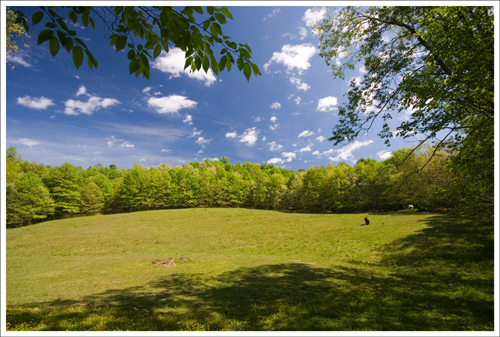
We parked at Massie Gap in Grayson Highlands State Park. From there, we walked across a wide pasture, passed a sign warning of extremely erratic weather in the area and went through a horse gate. The trail climbed upward along a wide, gravel path.
We almost immediately saw our first small group of wild ponies, clustered under the trees on a hillside next to the trail. The fog was so thick; they looked like silhouettes in the mist. I quickly got my camera out and started snapping shots. The ponies were so small and rugged looking. Their coats were thick and their manes long and wavy. Some were solid colored and some were spotted. They also turned out to be incredibly inquisitive and gentle. While I was squatting down to take photos, a dark brown pony walked up to me and nuzzled her soft nose onto the back of my hand. I know she was looking for food, but I had nothing to offer. We lingered with the ponies for a while, and then moved on.
(note: The park rules prohibit feeding the ponies.)


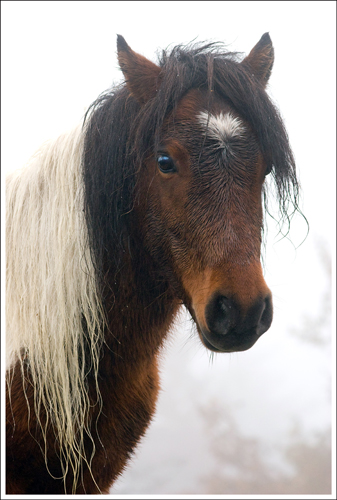


We soon reached the junction with the Appalachian Trail, followed the white blazes and headed south. The fog was such a transformative element on the morning of our hike. Instead of the amazing mountain views we’d heard about, the thick mist made the scenery feel closer and more intimate. I told Adam several times that I didn’t feel like I was in Virginia at all. I felt like I was walking through some storybook version of the Scottish Highlands. It was so quiet and mysterious-feeling – no people, no tall trees rustling in the wind, no birds chirping. The terrain was open, studded with rocks and covered with scrubby low-lying brush.

The Appalachian Trail exits Grayson Highlands State Park at around the 1.5 mile mark. The trail becomes increasingly rugged and rocky at this point. There are a couple route options for the middle section of the trail. Hikers can continue along the AT, or choose to branch off on the Wilburn Ridge Trail for a short rock scramble (and nice views on a clear day). We chose to scramble. In retrospect, we probably should have stuck to the AT. The boulders on Wilburn Ridge were quite slippery. After we finished scrambling, we passed through a thick tunnel of rhododendron that spilled us back out into another open pasture area.
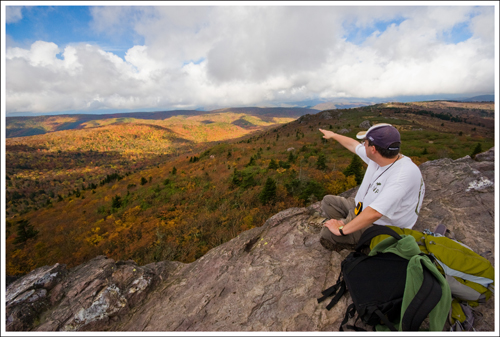
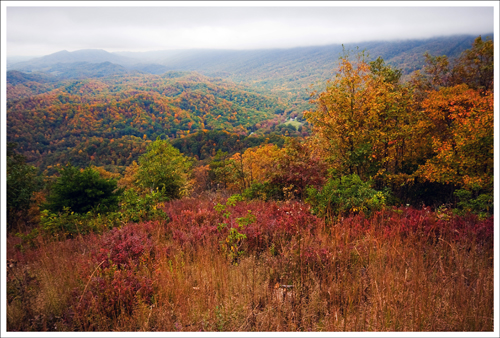
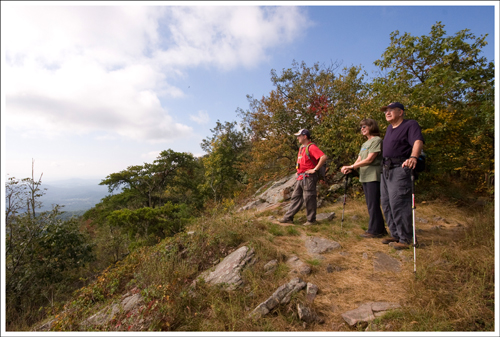
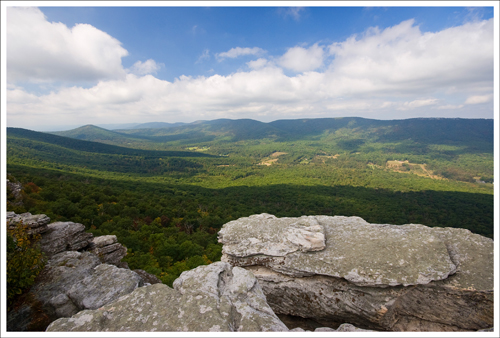
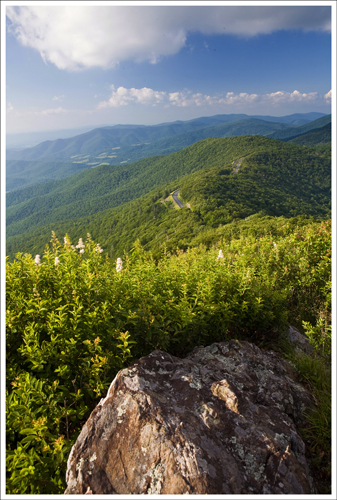
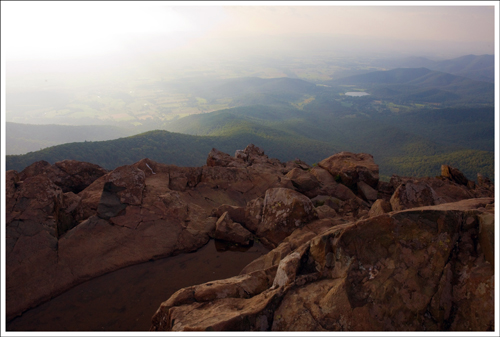
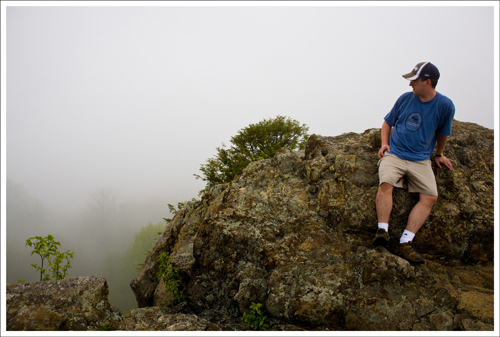
When we rejoined the AT, we started to see signs of the sun burning through the cloud layer. We soon reached a horse camp next to an enormous rock outcropping . When we climbed to the top of the rocks, we both gasped in awe at the view. The valley below us had been mostly cleared of clouds and fog, and a blanket of fall color spread out before us, as far as the eye could see. Only a few wisps of mist were left hanging on the ridges below. We sat on the rocks and took a break from walking. A couple backpackers passed below, and we overheard them talking about hearing coyotes howling in the night before. Instead of coyotes, we heard the distant squeal of ponies whinnying ahead on the trail.


After a short break atop the rocks, we continued along, passing through another thicket of rhododendron. The area was completely shaded and nearly ankle deep in mud. My trekking poles came in very handy traversing the sloppy footing. This section of the trail runs almost parallel to the Mount Rogers horse trail. There are many beautiful backcountry campgrounds nestled into the trees along this stretch. We saw about a dozen more wild ponies near the campsites, including a couple stallions.


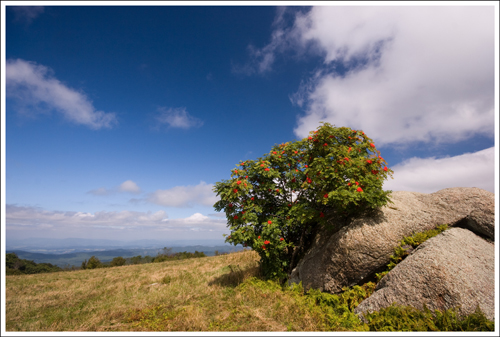
By this point in the hike, all the fog and clouds had blown off the mountain, giving us a great look at the gentle rolling terrain and spectacular open views. You can’t help but feel like you’re on top of the world walking along this ridge. The fall color was amazing! We stopped for lunch at the Thomas Knob Appalachian Trail hut. We shared the picnic table with several groups of day hikers and backpackers. We read the logbook, stretched a bit and then made our final push for the summit.
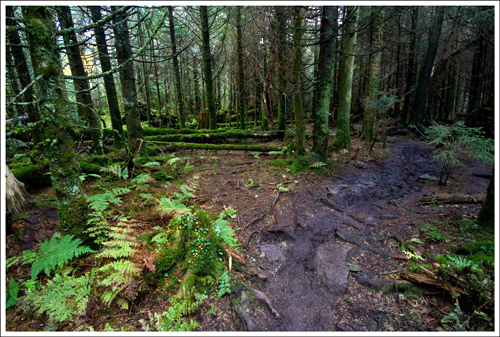
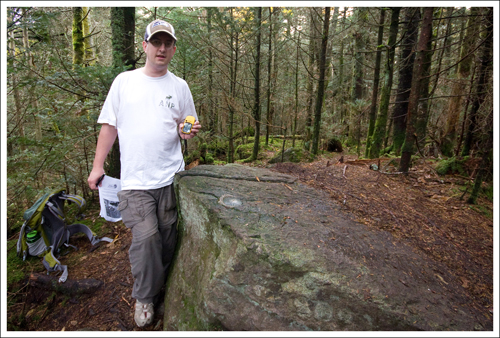
The spur to the summit departs the AT and heads into a dense, rainforest-like grove of spruce-fir trees. It was damp and green and draped with moss. It reminded Adam and I of the forests in the Pacific Northwest. The summit of Mt. Rogers is rather anticlimactic after passing by so many sweeping panoramic views and rocky pinnacles. The marker lays set in stone, tucked into a shady spot in the woods. There is no view to speak of, just a quiet little spot under the trees.
We only stayed at the summit for a few minutes, as there were quite a few people there. We hiked the return trip to Massie Gap fairly quickly, stopping briefly along the way to admire ponies and take in views that had been obscured by fog earlier in the day. The hike almost felt like a loop because the weather changed so dramatically between the hike up and the hike down. My final treat along the hike came less than a mile from the end, when a young foal came bounding out of the brush, nickering loudly for his mother. The foal was absolutely adorable. I wanted to pack him up and take him home with me! (Incidentally, the wild ponies are periodically rounded up and sold to keep the herd at a sustainable size. Although, I don’t think our property owners association would appreciate me bringing a miniature horse home, so I’ll just have to keep the pony ownership idea in the realm of fantasy for now.)


We got back to our car, tired and happy. The entire hike took around six hours – even with lots of breaks and dawdling along the way. For its nine mile length, it’s a surprisingly easy hike.
I really can’t fully put into words how much I loved this hike. I went to sleep that night dreaming of wild ponies and gorgeous fall views. I know I’ll revisit Mt. Rogers often in my mind until I have a chance to hike it again.
Adam Says…
We had such a great hike up Mount Rogers! A co-worker that had previously hiked the mountain had described the scenery as God’s country and I couldn’t agree more. While walking across the highlands, you can’t help but feel reflective about the beauty before you. The land around you is vast and I guarantee you will be humbled by the nature.

Mount Rogers was originally named Balsam Mountain, but the name was changed to honor Virginia’s first state geologist and first president of MIT, William B. Rogers. With the peak being the highest in Virginia at 5,729 feet, this is quite an honor.
One thing that does make this a special hike is the ponies. Another co-worker of mine didn’t believe that there were wild ponies here (even with photographic evidence). The ponies were originally placed here by the park service in 1974, but are currently maintained by the Wilburn Ridge Pony Association. The ponies help protect the area from wildfires by eating grasses and underbrush. The Wilburn Ridge Pony Association takes care of their veterinary needs and provides supplements of salt and hay in winter months. There are close to 150 ponies, that are separated into three herds – some are in Grayson Highlands State Park, more are in the Scales area of Pine Mountain, and the most are near Rhododendron Gap on the Mount Rogers trail. The proceeds from the sale of the ponies at the end of September supports the vet and winter feed costs.

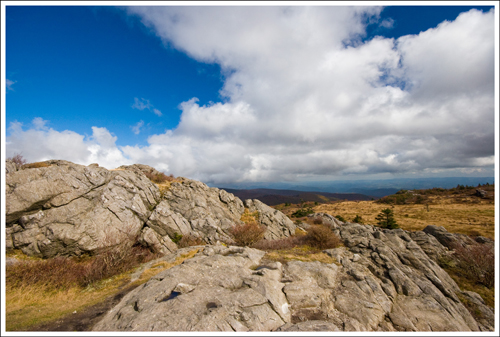
The geology of Mount Rogers provides an interesting tale of how things were formed over the years. Geologists will be able to see evidence of gneiss, sandstone, rhyolite, and shale on their hike along the trail.
For people that like a little more direction for the route that we took, here are some points of interest along the way:
- Cross the field at the Massie Gap parking lot and go through the gate to start the trail.
- You will now be on the Rhododendron Trail for .8 mile until it intersects the Virginia Highlands Connector Trail. Take a left on this trail for just .2 miles.
- When you reach the junction with the Appalachian trail, head south. You will shortly leave Grayson Highlands State Park and enter Mount Rogers National Recreation Area through a gate – continue straight on the AT at this point. After another .25 mile, you will have the option to stay straight on the Appalachian Trail or turn left and proceed on the Wilburn Ridge Trail. The distance is about 1 mile either way. The Wilburn Ridge Trail does join back to the AT. It is a tougher rock scramble, but I would recommend doing it on the way up rather than the way down.
- Once you are back on the AT, proceed for another mile until you reach a junction of trails. This area is known as Rhododendron Gap and comes to an elevation of 5526 feet. At this junction, there is a large pinnacle rock. Climbing up the rock will give you gorgeous panoramic views that are a must-see of the hike. This area joins the AT with the Pine Mountain Trail and Crest Trail. Once you enjoy the view, make sure you follow the white blazes to stay on the AT.
- You will then proceed on the AT for about 1.5 miles, walking through the bald area known as the Crest Zone, until you reach the Thomas Knob Shelter, protected by gates on both sides. This is a great place to grab a snack. There are also great views behind the cabin. This cabin sleeps plenty, since there is a ladder that goes to a second floor, allowing a little light through two small windows on the side.
- Once you leave the shelter through the gate, you will be entering Lewis Fork Wilderness. Shortly after this point, to reach the summit you will need to leave the AT and proceed to the summit by taking the Mount Rogers Spur Trail for .5 mile straight ahead. The summit is marked by a simple USGS benchmark in the stone. There are two within 100 feet of each other, so make sure you find the correct one for any of you peakbaggers.

Overall, the trail was really quite manageable for a 9-mile hike. The terrain is very nice in some points walking across flat lands, but there are some rocky parts, especially around the Wilburn Ridge Trail. My back and feet were in pain from having too much weight on my pack, but my muscles didn’t feel sore at all the next day.
There are just a few geocaches that you can find along the way. A couple of them are earthcaches, which do not have you finding a physical cache, but it teaches you about the geology of the area.
Christine told me that this hike has been her favorite ever. While there are a lot of contenders for me, this would definitely be a strong candidate for me as well. I feel that anyone interested in hiking in Virginia should make this a trail you must do. It is a day you will remember forever.
Trail Notes
- Distance – 9 miles the way we went making a partial loop in the middle with the Wilburn Ridge Trail.
- Elevation Change –About 1100 feet
- Difficulty – 4. The actual trail wasn’t too tough, but due to the length we upped the difficulty. The Wilburn Ridge Trail does include a few rock scrambles, but is also manageable for most people that are the slightest bit nimble.
- Trail Conditions – 3.5 The trail is well-maintained and traveled. There are muddy spots, especially through the Mount Rogers Spur Trail. The hike on the AT and Wilburn Ridge before the Rhododendron Gap area is quite rocky, causing you to watch your feet.
- Views –5. Great views walking along the trail in all directions. The views from Rhododendron Gap are especially beautiful.
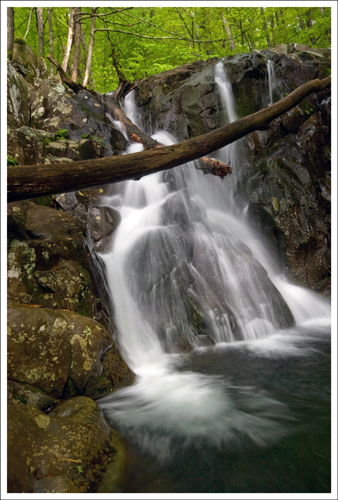
- Waterfalls/streams –0. Non-existent.
- Wildlife – 5. It doesn’t get much better than wild ponies. Bears and coyotes have been spotted also. Lots of bird-watching available also.
- Ease to Navigate – 3. It is easy to get a little confused at Rhododendron Gap, but overall things are very well-maintained. Make sure you grab a map to have a backup plan.
- Solitude – 2. You will get good spacing due to the length, but you will see other people due to the backpackers, AT hikers, and day visitors. It is the highest summit, which is going to draw crowds, especially at the shelter and summit.
Directions to trailhead:
From Abingdon, take 58 East until you reachGrayson Highlands State Park on the left through SR 362. Continue for three miles to reach the Massie Gap parking area. The start of the trail at the gate is across the field to the north.











 Virginia Trail Guide

