Abrams Falls (TN)

Special: Smokies Edition

Introductory Guide to Visiting Great Smoky Mountains National Park

This popular five mile hike follows a beautiful stream for most of the route and ends with a visit to lovely Abrams Falls.
Abrams Falls
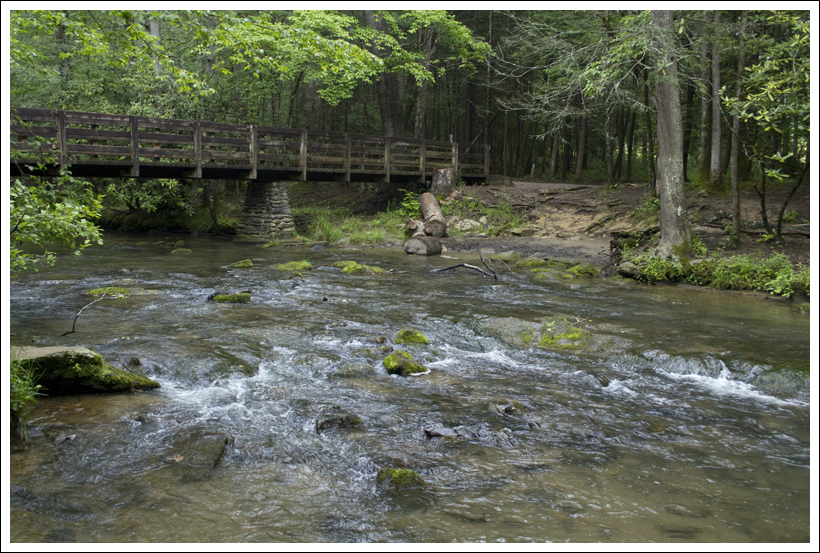
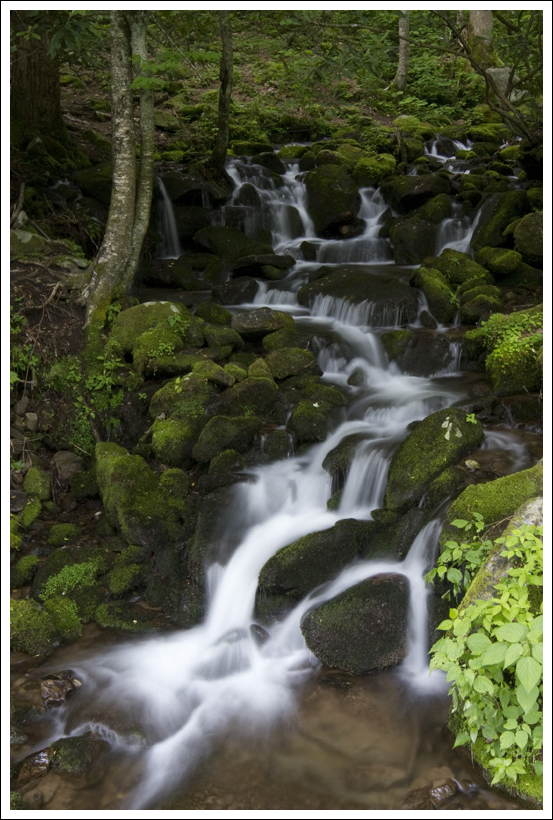
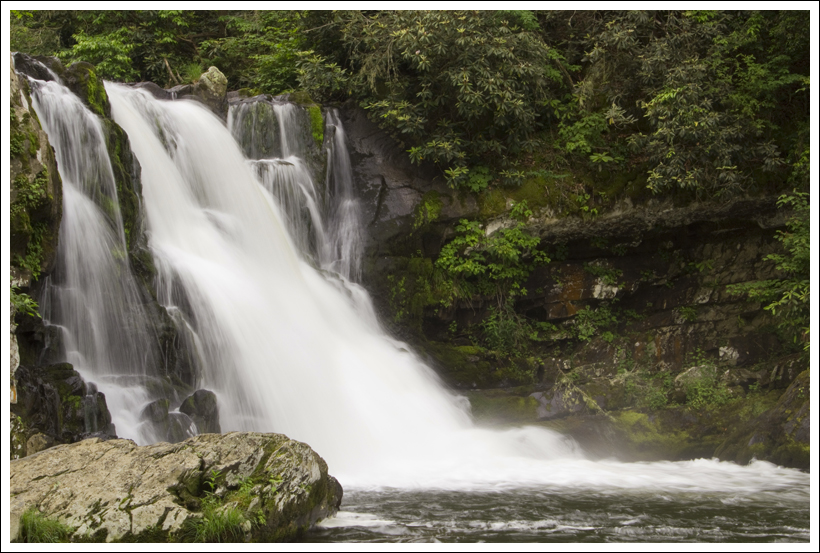
Abrams Falls pours out into a large, rock-surrounded pool. Below:  Beautiful stream scenery was abundant on this hike.

Slide Falls Abrams Creek

Christine Says…

Tuesday morning dawned thick with clouds and fog… a perfect day for a waterfall hike.  Although there were plenty of waterfalls near the Cherokee side of the Smokies, we decided to take a ride over to Cades Cove to hike the exceedingly popular Abrams Falls trail.

The easy five-mile hike is one of the top five trafficked trails in the park.  Since we had an early start on the day, we decided we could probably beat the worst of the crowds and enjoy seeing the falls with some semblance of solitude.

Getting to the trailhead took longer than we expected.  The drive along the Little River into Cades Cove was so pretty, I had to stop and take lots of photos.  Once we got into the cove, grazing horses, wild turkeys showing off their plumage, and abundant whitetail deer distracted us.  I wanted to stop at a few of the old cabins, churches and farms, but we decided that would have to wait for another day.
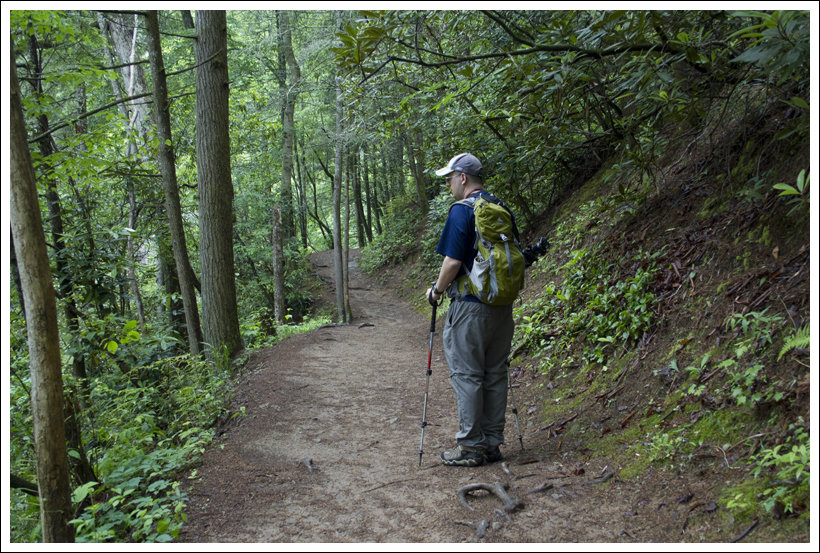
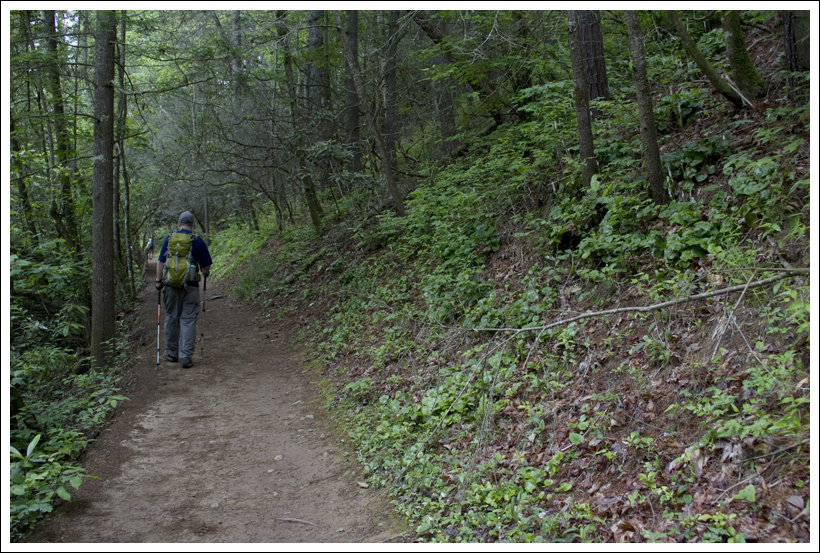
Adam on the Abrams Falls Trail
Adam enjoys the green vista along the Abrams Falls Trail. Below: Trail marker at the start; Bridges cross the stream multiple times along the trail.  This was the only full bridge.  The rest were hewn logs with rails on one side; Trail conditions were mostly smooth and gentle.

Trail Marker Bridge Near Beginning of Abrams Hike Adam on the Abrams Falls Trail

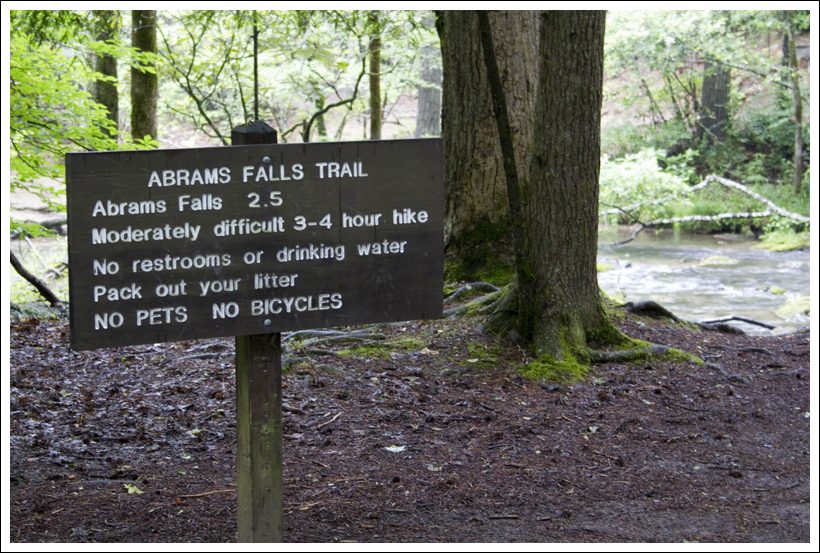
The Abrams Falls trailhead was at the end of an unpaved, muddy road.  (restroom facilities were available) The trail marker at the beginning indicated that the trail was moderately strenuous and would take 4-5 hours.  The sign also warned that no water or restrooms would be found at the falls.  I suppose this is a clear indicator that hikers of all experience levels and abilities use the trail.  And indeed this turned out to be true – I even saw a hiker wearing black pantyhose under a pair of denim shorts. That was a first for me!

The hike began by crossing a bridge over Abrams Creek.  All along the river, we saw fly fishermen.  The stream looked ideal for brook trout.  The trail runs parallel to the creek for much of the hike – sometimes at stream level, sometimes high above.

The trail is mostly flat with several short, but steep, climbs.  It mostly passes through thick green forest, with one exception.  Near the top of the steepest climb, the trail becomes rocky and almost barren, with many dead and toppled trees.  Maybe a fire or storm damaged the trail in this area, because it was nothing else like the rest of the hike.

A steep downhill climb and a walk across two log bridges empties you out into a grotto with Abrams Falls at the end.  When we visited, the falls were gushing!  The water was so powerful; I couldn’t take a long exposure of the waterfall without the water turning into a solid wave of white.

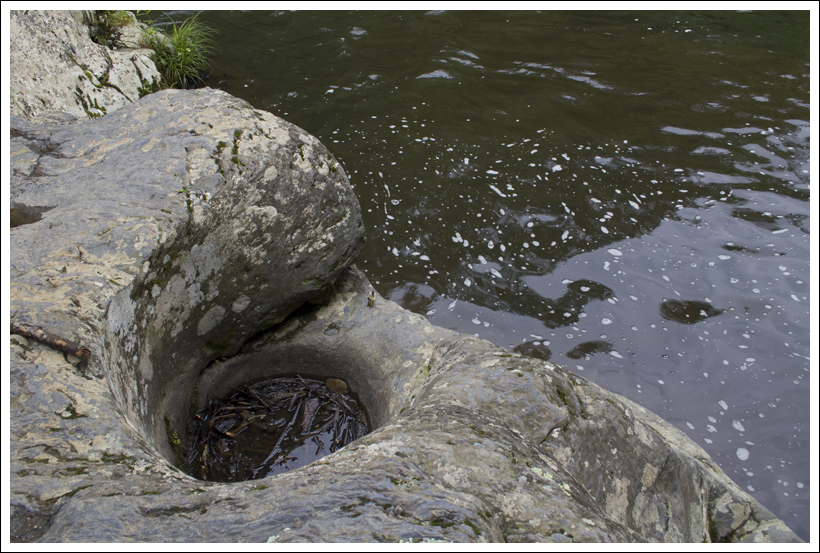
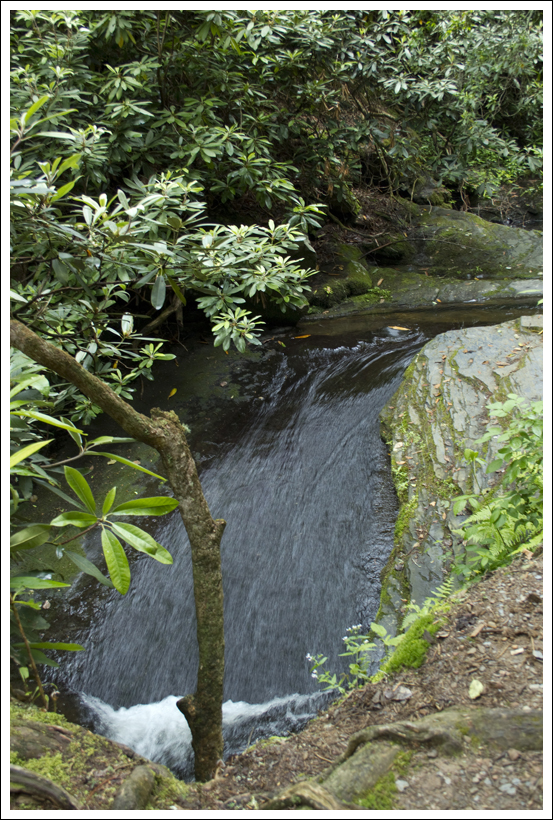
As expected, many people were enjoying the falls. Families picnicked, couples posed for photos and kids caught tadpoles in the pools of water between the rocks.  One of the notable features near the waterfall was a large glacial pothole.  It looked really similar to features I’ve seen in New Hampshire.
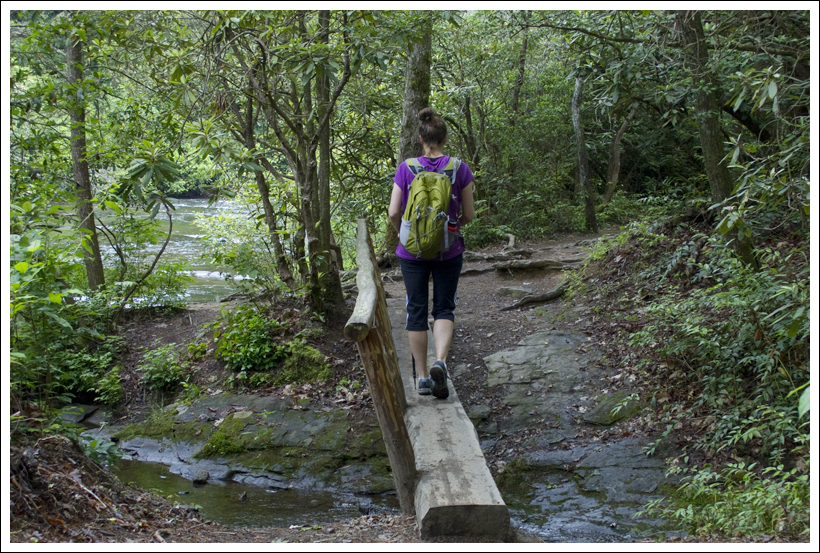
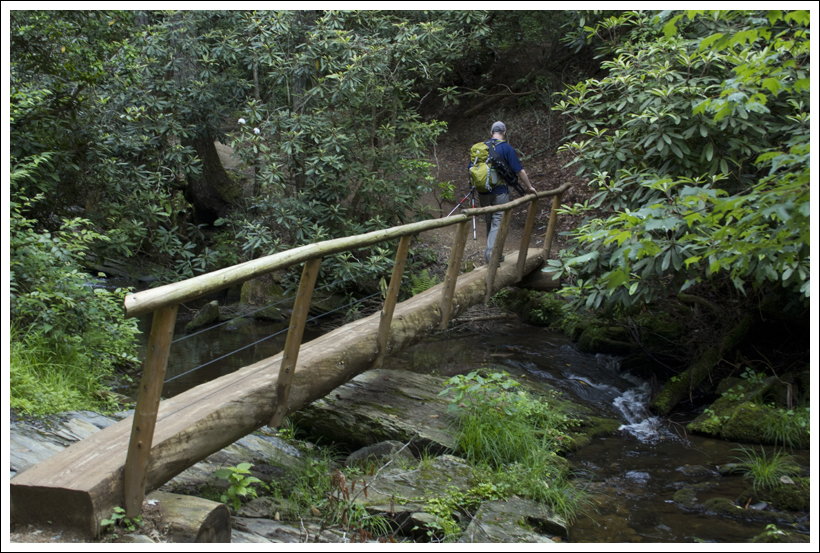
Christine Crosses the Log Bridge
Christine crosses a log bridge. Below:  A perfect round ‘pothole’ formed by the forces of nature; Blooming rhododendron.

Pothole Blooming Rhododendron

We didn’t spend long at the falls because we wanted to get back before it started raining.  The return leg of the hike just retraced our steps. On the way back, we passed even more people on their way to the falls.  This is definitely one of the Smokies most popular spots.  Understandably – such beautiful falls, and so easily reached (by most)!

Adam Says…

When we were thinking of some hikes we wanted to accomplish in the Smokies, we wanted to hike to a bald, a nice hike with views, and some waterfalls.  After accomplishing the first two items the first two days, it was time to do a waterfall.  We started fairly early in the morning knowing that we would have a longer drive to get to Cades Cove from our takeoff point of Bryson City.  When we had been driving on 441 to Newfound Gap, we had heard about construction but had never quite reached it.  When we crossed over Newfound Gap, we quickly ran into some construction as they were working on repaving the road.  Bringing the two-way road to a one-way road required us to wait about 20 minutes before the lead car allowed us to go further.  We finally got through the construction and made our way towards Cades Cove.   When driving on the one-way Cades Cove road, you should also expect to go very slow on this 11 mile road.  Cars creep along, hoping to see wildlife.  We were shocked to see so many cars stopped to a halt to take a picture of a deer.  I guess we feel a little spoiled in Virginia with all the deer we see regularly.  We typically have a yard full of deer every morning.

The hike to Abrams Falls starts off with an informational sign.  Soon you will cross a bridge and begin to see fly fisherman in Abrams Creek.  Abrams Creek is a great spot for fishing brook trout.  Rainbow trout tend to be found in higher elevations in the Smokies.  The trail has a slight incline with a few areas of steep climbs.  At .8 miles, you cross over the Arbutus Ridge, which changes the hike from being largely uphill to being more downhill.  At 2.25 miles, the trail then begins to take a steeper descent until you reach Abrams Falls at 2.5 miles.
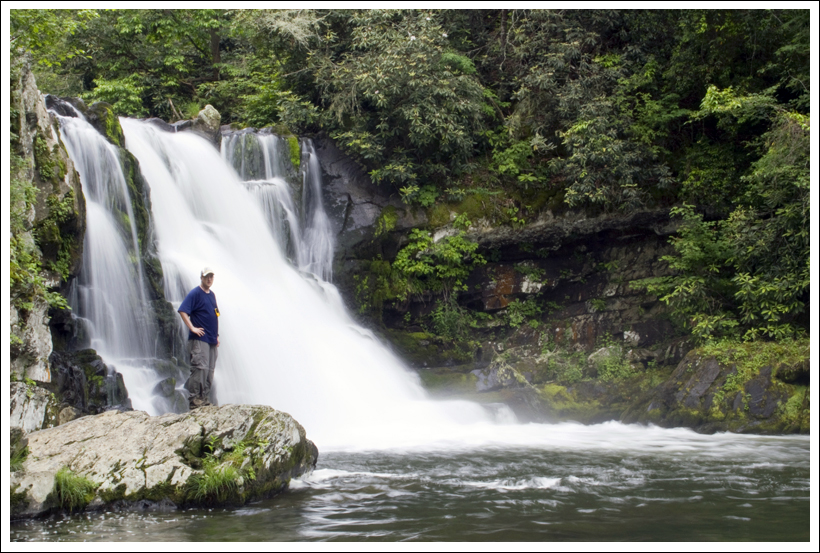
Adam at Abrams Falls
Adam enjoys Abrams Falls.  Below: More lovely views of the stream along the trail; Adam crosses another log bridge.  There were probably four or five like this on the trail.

Stream on the Hike Another log bridge

Abrams Creek and Abrams Falls were named after Chief Abram (previously known as Chief Oskuah and also known as Old Abraham), the Cherokee Chief of Chilhowie nearby.  Chief Abram and a war chief known as Dragging Canoe were aligned with the British during the outbreak of the Revolutionary War and led an attack on Fort Watauga.  In 1788, Chief Abram was killed by tomahawks by the son of John Kirk, seeking vengeance for his family that had been massacred by Cherokees on Nine Mile Creek.

This hike was a little humbling to me.  As I was hiking early on uphill, I started feeling very weak and hot.  I was carrying Christine’s heavy tripod for a while, but I was surprised if this was the reason I was feeling so fatigued.  I had to stop for about 15 minutes and ate several hand-fulls of trail mix.  My blood sugar was quite low from not eating a huge breakfast before hiking.  As we rested, I felt lame for having to take a break and let other people pass us, but I know we made the right decision.  Within about 25 minutes, I felt more like myself as we continued hiking.

There are a number of log bridges on the trail, which have handrails around thigh or waist level on one side.  I’m not a big fan of heights or water (since I can’t swim), so these log bridges can feel a little unnerving for people like me.

As soon as we reached the falls, we set up the tripod and took some nice photos of the falls.  You should expect to see a lot of people at the falls and you will likely have to wait to get pictures of the falls that don’t have strangers in them.  The water does come out in a powerful force as it plunges about 20 feet into the pool below.  We spotted some crayfish moving from rock to rock near the shoreline.   We refueled with some very disappointing Kashi granola bars to make our hike up the steep section and returned to our car.

Trail Notes

  • Distance5.0 miles
  • Elevation Change – about 600 feet
  • Difficulty –  2.  There is a little bit of climbing on this hike, but most people will find the terrain fairly easy.
  • Trail Conditions – 4. The trail is well maintained and easy to walk.  It’s much less rocky and rooty than other trails in the Smokies.
  • Views0.  None on this hike.
  • Streams/Waterfalls – 5.  The stream and the falls are both spectacularly pretty!
  • Wildlife – 2.  Because of the popularity of this hike, don’t expect to see too many animals hanging out.  Although… we did see a turkey and a deer.  Otters have been spotted in Abrams Creek.
  • Ease to Navigate – 5.   Very simple – just follow the path and you can’t get lost.  There is one trail junction near the falls, but if you read the trail marker, you’ll stay the course.
  • Solitude – 0.  Lots of hikers, lots of fly fishermen.

Directions to trailhead:  Past the Sugarlands Visitor Center, take the Little River Road until you reach the Cades Cove Loop Road.  The Cades Cove Loop Road is closed until 10AM on Wednesdays and Saturdays to car traffic.  Follow the Cades Cove Loop Road 4.9 miles.  Take a right on the gravel road that leads to the Abrams Falls parking lot.  The trail starts at the end of the lot.

Andrews Bald and Clingmans Dome (TN)

Special: Smokies Edition

Introductory Guide to Visiting Great Smoky Mountains National Park

The 4.8 mile Andrews Bald and Clingmans Dome hike leads to a grassy bald and offers 360-degree views from an observation tower on the tallest mountain in the Great Smoky Mountains National Park.

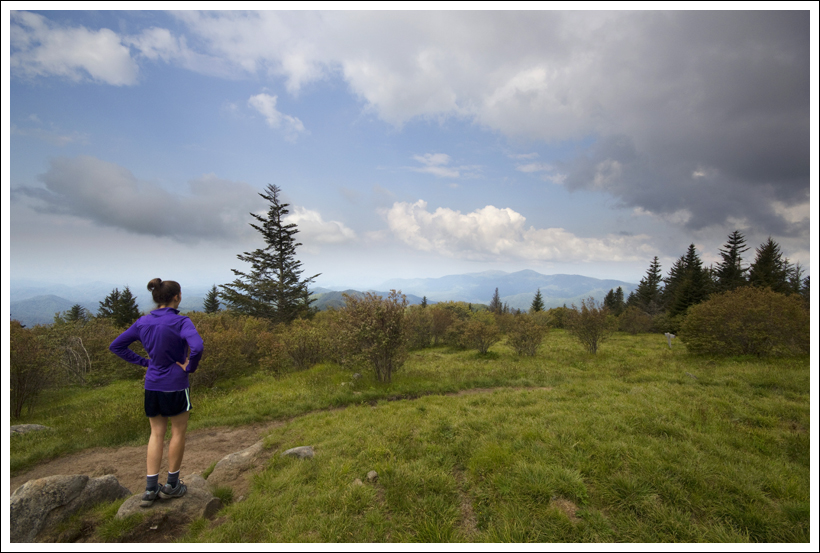
Andrew's Bald
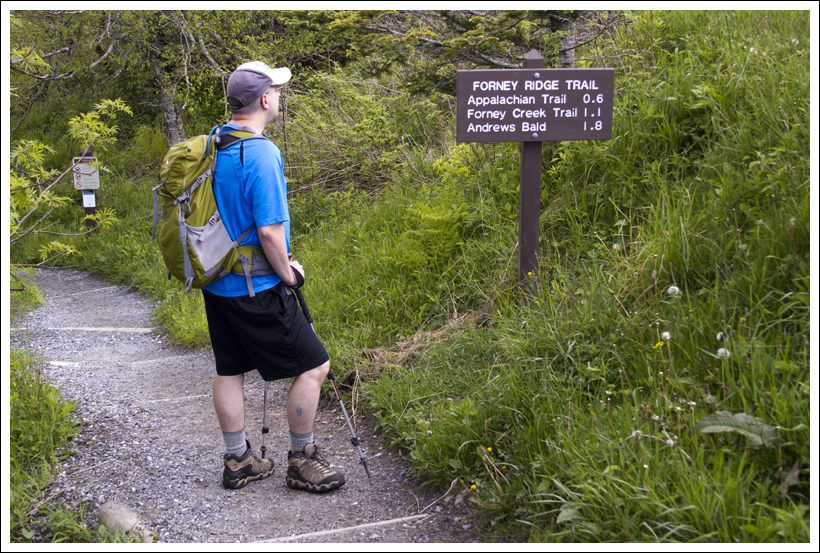
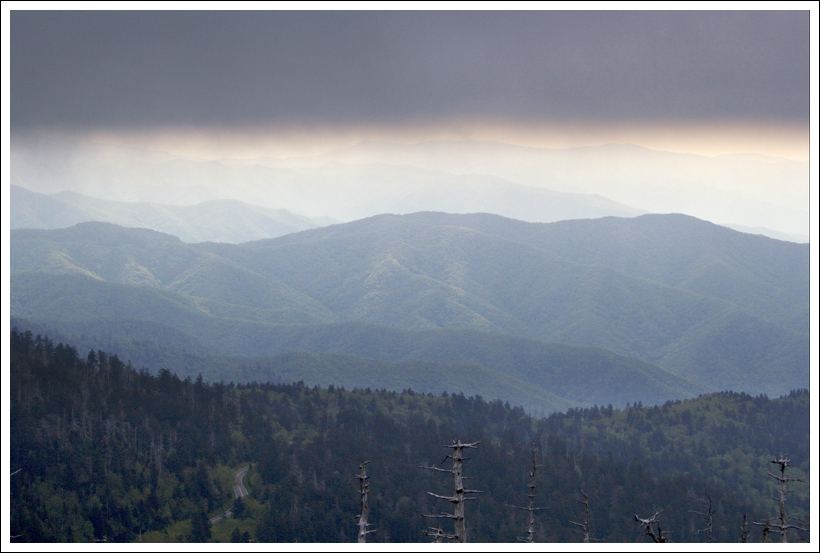
The view was nice from Andrew’s Bald, but the weather changed fast. Below: Adam checks out the trail marker at the beginning of the hike; Rhododendron were not yet blooming, but the buds were evident; The view from the Clingman’s Dome Observatory before the hike.

Start of Hike Rhododendron About to Open View From Clingmans Dome

Adam Says…

One of the things that we wanted to accomplish on our trip to the Smokies was a hike to one of the many balds in the park.  After a long day of hiking the day before to Charlies Bunion and The Jumpoff, we decided on a shorter hike to a bald, but we also wanted to include a visit to the famous viewpoint, Clingmans Dome.

We started off early in the morning and it looked like decent weather.  On our way down Clingmans Dome Road, we saw that clouds were beginning to roll in.  When we arrived in the parking lot, there wasn’t a lot of nearby views as clouds were beginning to roll in.  During the early part of this week, I kept thinking of the Mark Twain quote about New England – “If you don’t like the weather in New England, wait a minute.”  I felt the same about the Smoky Mountains.  The clouds rolled away during our trip to Charlies Bunion, so I was hoping the same would hold true at Clingmans Dome.

We made a quick trip to the top of Clingmans Dome first and the views were completely covered in clouds.  There were a couple of Appalachian Trail thru-hikers that were actually camped overnight at the top of the dome.  We were surprised to see hikers that had just started a few weeks ago, compared to March or April when most will get started.  I wondered if they would make it to the northern terminus of Mount Katahdin in Maine before it closed off due to winter snow.  The weather looked like it may change, so we headed down to decide if we should attempt the hike to Andrews Bald.

We talked to a few park rangers about what they thought the weather would do based on their experience up here and if we should expect rain.  They said that it was expected to clear up later in the morning, but we would probably have some storms in the afternoon.  We gathered our gear and decided to hit the trails.

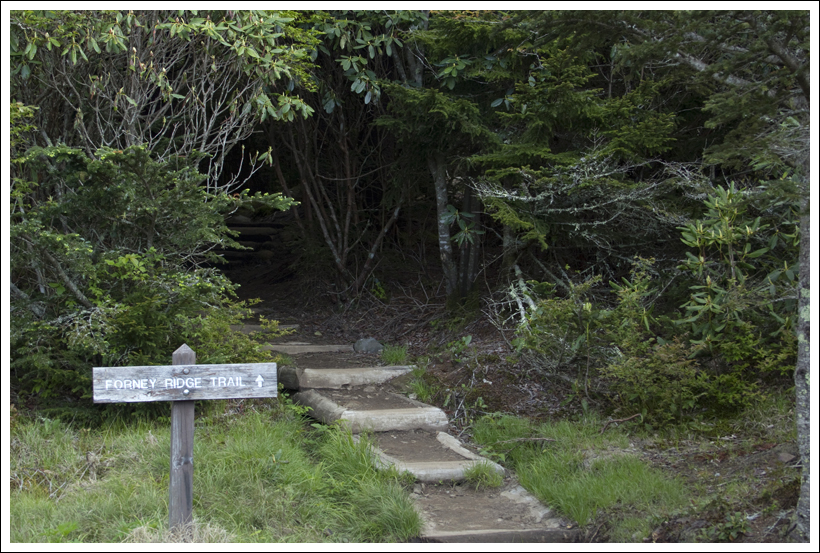
Boardwalks on the Forney Ridge Trail
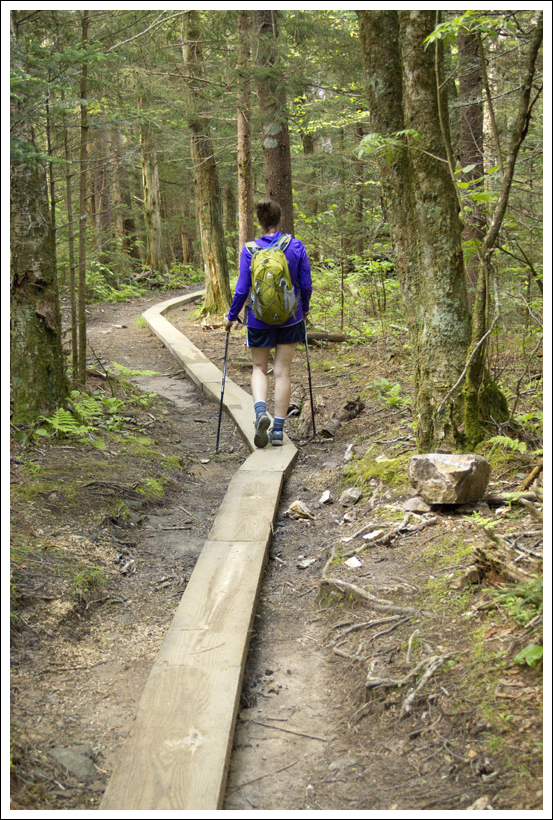
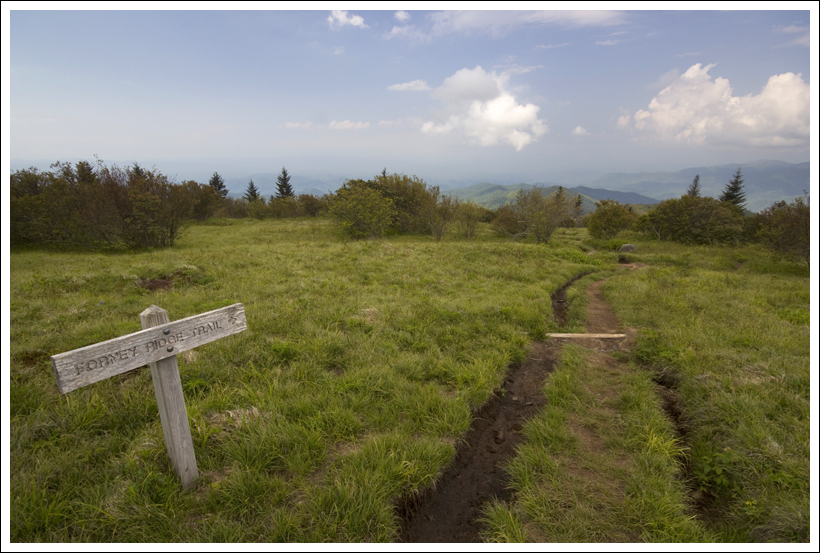
Potentially muddy areas on the Forney Ridge trail were traversed by boardwalks. Below: Adam hikes down the Forney Ridge Trail.  Extensive work has been done on this trail in recent years; Trail marker on Andrews Bald; Another view of the mountains from the bald.

The Forest Was Deep and Green Forney Ridge Trail Andrews Bald View

The trail to Andrews Bald starts from the large Clingmans Dome parking lot.  As you’re walking past the bathrooms and towards the paved trail to Clingmans Dome, you will see a sign to the left marking a few trails.  You head down a few stairs and start the hike to Andrews Bald.   The trail starts off as a steep downhill.  At .2 miles, you reach the junction with the Forney Ridge Trail.  Bear left continue your descent on the Forney Ridge Trail.  The trail is quite rocky in the beginning and can be slick if there has been recent rain, but the trail is well-constructed through this area.  At 1.1 miles, the trail reaches another junction with the Forney Creek Trail, branching off to the right.  Just stay on the Forney Ridge Trail and follow the sign towards Andrews Bald.  The trail begins to be through dense forest and there are a series of strategically-placed, wooden planks that help provide footing on a sometimes-muddy trail.   At 1.8 miles, the forest opens up and you reach the Andrews Bald area.  Enjoy the views and then head back the way you came.
When you reach the first junction at 3.4 miles with the trail back to the parking lot, just stay straight on the Forney Ridge Trail.  You will immediately begin to see the difference in how the trail is maintained as this is a steady uphill through some loose rocky areas.  The trail continues to climb for another half mile; at 3.9 miles, you reach the junction with the Appalachian Trail.  Take a right on the white-blazed AT heading North.  You will be walking along the ridge which will open up views on both sides almost instantly.  At 4.2 miles, you will come out to the paved trail for Clingmans Dome.  Head to the left and climb up the winding path of the observation tower at Clingmans Dome.  Once reaching the top, wind back down but take the paved path down which leads past a gift shop and then to the parking lot which should bring your trip total to 4.8 miles.

When we reached the top of the tower the second time, the clouds were covering most of the area again.  We were able to get a few views, but I can only imagine how beautiful this could be on a clear day.  This is the highest point in the Smokies (and also the entire state of Tennessee), reaching 6643 feet.  Since this area is home to the Cherokee, this mountain is known to this Native American tribe as Kuwahii, meaning “Mulberry Place” and is considered sacred.  Cherokee legend believes this mountaintop to be a place where the bears danced before hibernation.  The clouds that often lie in the valleys between the mountains were seen as lakes where sick bears would go to heal themselves.

The trip to Clingmans Dome is a must when you visit the park.  You can do this as a short but steep .5 mile walk up the paved path to Clingmans Dome, but I’m glad we did a hike that made you feel like you earned the views.  While this hike did meet our goal to visit one of the balds, I’ve heard that Andrews Bald pales in comparison to Gregory Bald or Silers Bald.  On our next trip, we definitely plan to visit one of those.

Christine on Andrews Bald
Christine watches storm clouds roll in. Below: After leaving the bald, the trail goes back into the forest; This area branches off into many other trails.

Stepping Out of the Woods Onto the Bald Trail Signs Along Forney Ridge

Christine Says…

We got up on Monday morning, still undecided about what hike we wanted to do that day.  We knew we wanted to see one of the Smokies’ famous balds, we just weren’t sure which one would fit best into our plans for the week.  We also knew we wanted to visit the observatory atop Clingmans Dome, so we narrowed it down to two balds – Silers or Andrews.

Andrews was a significantly shorter hike – 3.6 miles (4.8 with the Clingmans Dome add-on) compared to 10.  But, Silers was larger and had a more interesting ridge hike with most of the hike staying about 6,000 ft.  In the end, the weather made the decision for us.  When we arrived at Clingmans Dome – the starting point for both hikes – the clouds were thick and dark. In the end, we decided to go for the shorter hike to Andrews Bald.  Balds and high ridges are not where you want to be stuck when a thunderstorm rolls through!

View from the Appalachian Trail
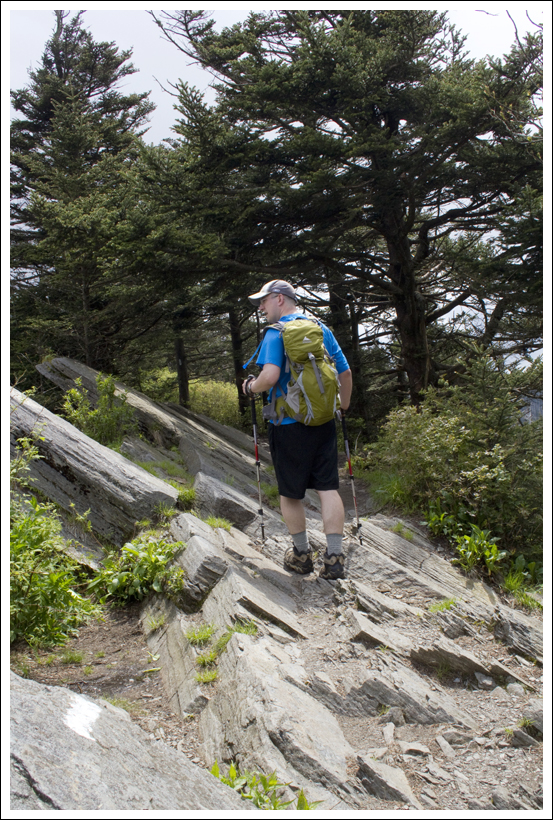
A nice view from the Appalachian Trail near Clingmans Dome. Below: Adam makes his way up to meet the AT; The ridge leading to Clingmans Dome is very rocky.

Hike Up to Meet the AT Along the Ridge Trail to Clingmans Dome

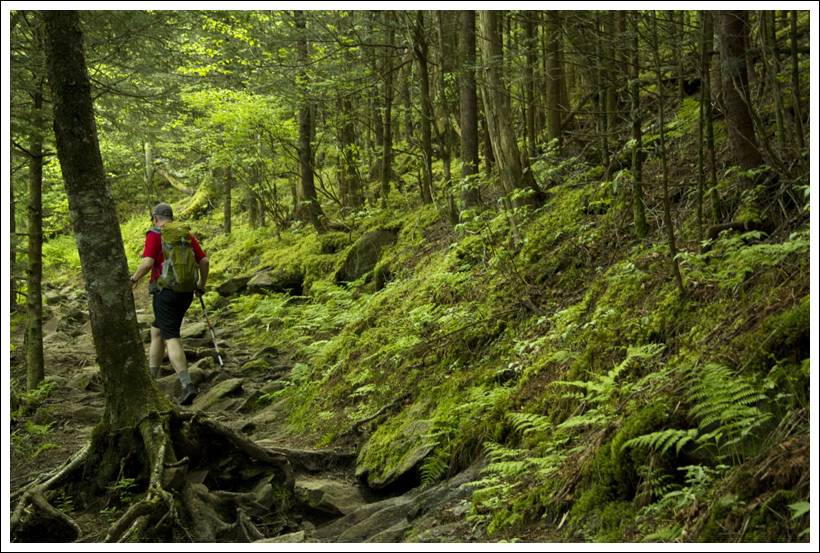
The hike to the bald was mostly downhill.  It followed an elaborately constructed trail of stone slabs, timber-blocked steps, water bars, and plank board walks.  It passed through dense, mossy forests – thick with rhododendrons, ferns and fir trees.  Again, it was so breathtakingly beautiful and different from hiking in Virginia.  As we walked, the sun made an effort to burn through the clouds and fog.

The trail passed a couple junctions to other trails, but to reach Andrews Bald, we just stayed on the Forney Ridge trail.  Eventually, the trail passed through a thick tunnel of rhododendron and opened out onto the bald.

Andrews Bald is not very large.  It consists of a small grassy/shrubby field, peppered with rhododendron, azalea and other low-lying plants.  When we visited, the rhododendrons were just about to open.  There were lots of bright pink buds on the branches, but no open flowers.  I bet the scene will be even prettier in early to mid June when everything is flowering.

The view from the bald was lovely and expansive – though the sky was quite hazy.  We sat for a few minutes and had a quick snack.  While we relaxed, we noticed darker clouds were rolling in again, so we decided to make our way back.

The return trip retraced our steps most of the way.  However, about .1 miles from the Clingman’s Dome parking area, we decided to skip the spur trail to the car and continue uphill along Forney Ridge to its junction with the Appalachian Trail.  This half mile segment was steep and rocky and passed through a stand of huge dead fir trees.

Walkway to the Observatory
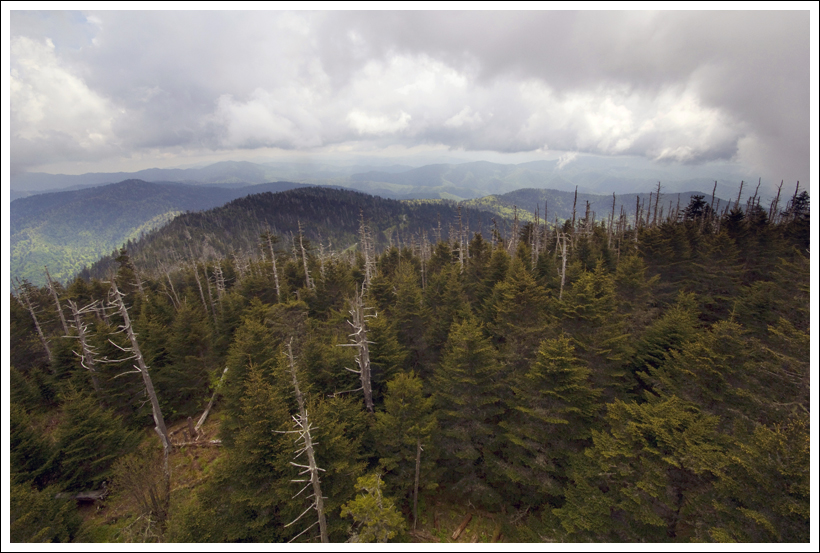
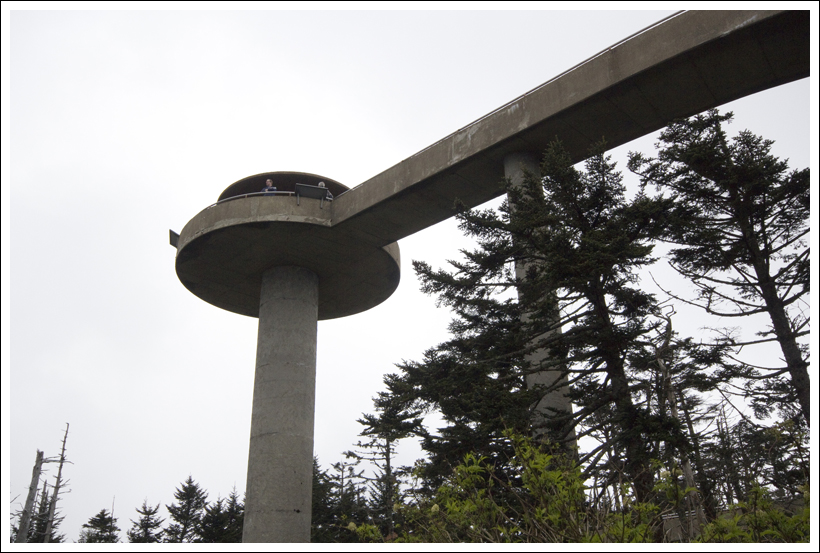
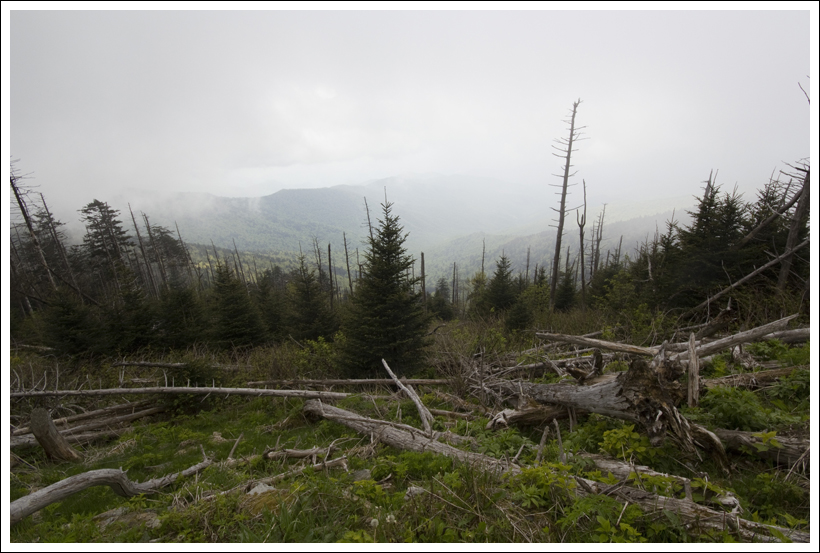
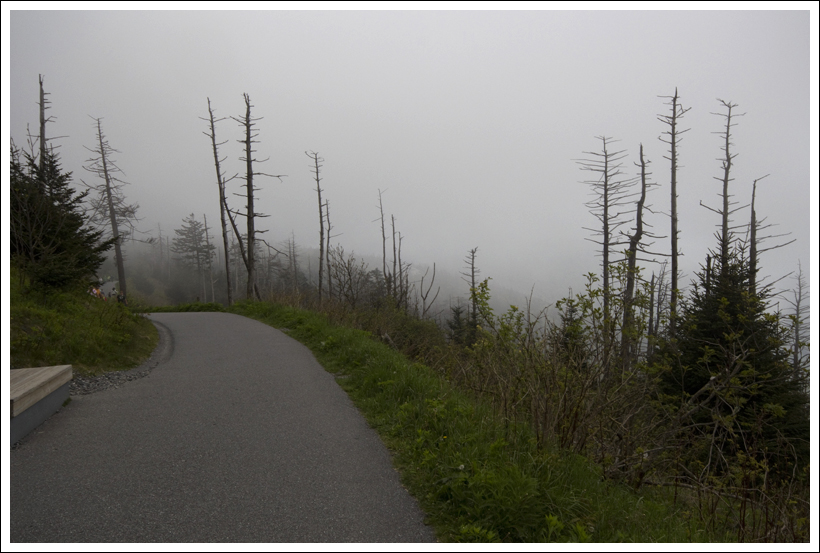
The walkway to the Clingmans Dome Observatory. Below: Another view from the observatory; The tower looks like a spaceship;  The summit is covered with many dead fir trees destroyed by an insect called the wooly adelgid;  The walkway down to the parking area was covered with fog; A view opened up from the parking lot.
Another View from Clingmans Dome The Observatory Dead Fir Trees
Foggy Walkway View from the Clingmans Dome Parking Area

Once we gained the ridge, we took a right and headed north for .3 miles along the Appalachian Trail.  There were a couple nice views along the way and even a glimpse of the parking area through the trees.

The trail came out close to the base of the observatory.  We made a second climb up the tower to see if the view was any clearer.  It wasn’t – in fact; within a few moments a giant bank of fog rolled in and covered the view completely.  We ate some lunch on the bench in the tower and did a little people watching.  Eavesdropping on conversation, I was amazed to hear so many people had never heard of the Appalachian Trail. They were stunned, upon reading the plaque at the summit, that there was an actual walking trail from Georgia to Maine.

After we finished eating, we walked the half-mile paved trail back down to the parking area.  Several people stopped us to ask if we were thru-hikers or if we were ‘headed to Maine.’  I guess trekking poles and wicking shirts  make us look very serious about the outdoors. We politely replied that we were mere dayhikers, but it would have been funny to tell people that we expect to be in Maine by mid-August.  Technically…  that is true – only we’ll be arriving by car for a week-long vacation in Acadia.  🙂

After wrapping up our hike, we drove into Cherokee and visited the Museum of the Cherokee Indian and the Qualla Arts & Crafts Mutual.  Both places were beautiful, fascinating and informative.  And, by the time we came out of the museum, it was thundering, lightning and pouring down rain.  We definitely made the right choice, but next time we’ll visit Silers Bald!

Trail Notes

  • Distance4.8 miles
  • Elevation Change – about 1200 feet
  • Difficulty – 3.  The trail from Andrews Bald to the AT is mostly uphill with a few steep sections.
  • Trail Conditions –3.5.  The upper part of the Forney Ridge Trail has loose rock, but the trail is generally well-maintained.  The hike down from Clingmans Dome is paved, but steep.
  • Views– 5. Expansive views from Andrews Bald and 360-degree views from Clingmans Dome.  On a very clear day, you could see for 100 miles in all directions.
  • Streams/Waterfalls – 0. Non-existent.
  • Wildlife – 1.5 Other than birds and maybe an occasional squirrel, I wouldn’t expect a lot of wildlife here due to the popularity of the trail.
  • Ease to Navigate – 4. Signs at junctions are well-labeled and stand out, but make sure you stay on the correct trail.
  • Solitude –1. The hike to Andrews Bald is one of the most-traveled trails in the park, and expect crowds at Clingmans Dome most days.

Directions to trailhead:  From December 1st through March 31st (and some other days based on weather), the road to Clingmans Dome is closed.  From Newfound Gap Road/441 take the Clingmans Dome road (south of the Newfound Gap parking area).  The road continues for seven miles until it reaches the large parking area.  Past the bathrooms and to the left of the paved path up to the gift shop and Clingmans Dome, take the marked trail down the steps that leads to Andrews Bald.

Charlies Bunion and The Jumpoff (TN/NC)

Special: Smokies Edition

Introductory Guide to Visiting Great Smoky Mountains National Park

This 9.5 mile hike, mostly along the Appalachian Trail, starts out from Newfound Gap. The route offers several places to take in magnificent vistas of the Smoky Mountains.

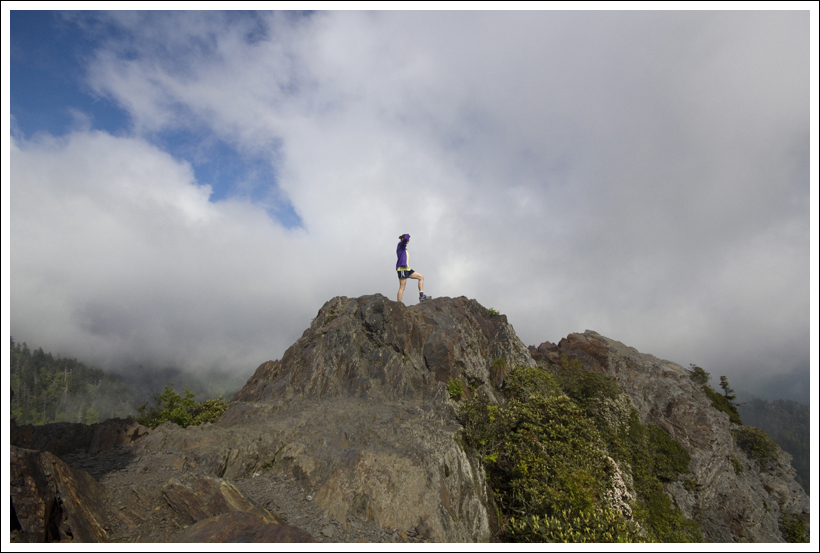
Adam on Charlie's Bunion
Adam enjoys the view from Charlies Bunion. Below: The trail starts out from Newfound Gap. The area has the Rockefeller Memorial (pictured), plenty of parking and restrooms; Christine at the start of the hike; The forests in the Smokies are so dense and green.

Newfound Gap Christine at the Trail's Start Everything Was So Green

Christine Says…

We knew this hike was one of the most popular in the Smokies, so we got off to an early start – breakfast at the hotel, in the car by 7:15 and on the trail around 8:00.  We were one of the first cars in the Newfound Gap parking lot, which is always very busy.

We headed north along the Appalachian Trail.  Immediately, we began to marvel at how different the Smokies are from Shenandoah.  I’ll admit, I sort of expected this park to be similar to Shenandoah – kind of like an older sister – bigger and taller, but still similar in looks and personality.  But, the trail was strikingly different – more evergreens, wetter, mossier, greener, more rugged – I might even say ‘more alive’.

I’d heard and read plenty about the extensive biodiversity of the Smokies before, but wasn’t really prepared by how awestruck the park would make me feel. This park has dramatically more plant and animal species than almost any other place on earth. During the last ice age, plants and animals were pushed into the Southern Appalachians as glaciers advanced. When the glaciers retreated, species were left behind – almost stranded in the Smokies.

The trail climbed gradually uphill over the first couple miles, climbing over rocks and roots and mud.  Little rivulets of water were running down the mountainside all over the place and filling the woods with the sound of dripping and trickling.  Every now and then, we got a view of mountains in the distance.  Everything was still partly cloaked with fog and clouds, but it was evident that the sun was making a full effort to burn through.

Hiking Up the Appalachian Trail
Christine makes her way up the trail. Below: One of the first nice views came at the junction of the AT and the Sweat Heifer Creek trail;  Trail junctions were well-marked; There were plenty of wildflowers along the trail.  We even spotted a few fading trillium, but they were all pretty tattered and not photo-worthy.

View From the Trail Junction With Sweat Heifer Creek Trail Wildflowers in the Smokies

At the junction of the AT and the Sweat Heifer Creek Trail (isn’t that a funny name?), we diverted a short distance off the AT to take in the view.  Almost immediately after turning onto Sweat Heifer, there is a bench and a marvelous open view of the mountains.  After a few minutes, we proceeded along the trail which had become more level as it followed a ridgeline.  We saw a couple trillium still in bloom – one bright purple and one white, but most were far past their peak.

Eventually we reached the junction with the Boulevard trail.  This is the spot where you can take a detour to another viewpoint – the Jumpoff.  We decided to press on toward Charlies Bunion, in hopes of having the spot to ourselves a while before the crowds materialized. About .3 of a mile past the junction, we reached the Icewater Shelter.  It was still full of weekend backpackers, some making breakfast and some still in their sleeping bags.  We didn’t want to disturb them, so after a brief hello, we moved on.  Shortly after leaving the shelter, we stepped over Icewater Spring, which is the water source for this area.  The piped spring seemed to be running nicely.

The trail climbed steeply downward over slick, wet trail.  The forest around us was extremely dense evergreen.  It was quite beautiful and different!  As we made our way along, thick, cottony fog started to roll in.  We passed one hiker marching south – tripod in hand and a disgusted look on his face.  I can only gather that he went to Charlies Bunion for the view and saw nothing.  The next hiker we encountered pretty much confirmed the sky conditions.  We asked how the view looked and he said ‘No view – unless you like fog, but it looks pretty cool blowing up the sides of the mountains.’

I felt a little disappointed about the prospect of missing out on the view, but we stayed optimistic and hoped that the fog would burn off within the next fifteen minutes.  When we first spotted Charlies Bunion from a distance, the fog was swirling around and covering the rocky outcropping almost completely.  But, by the time we reached the bunion, conditions were clearly improving.

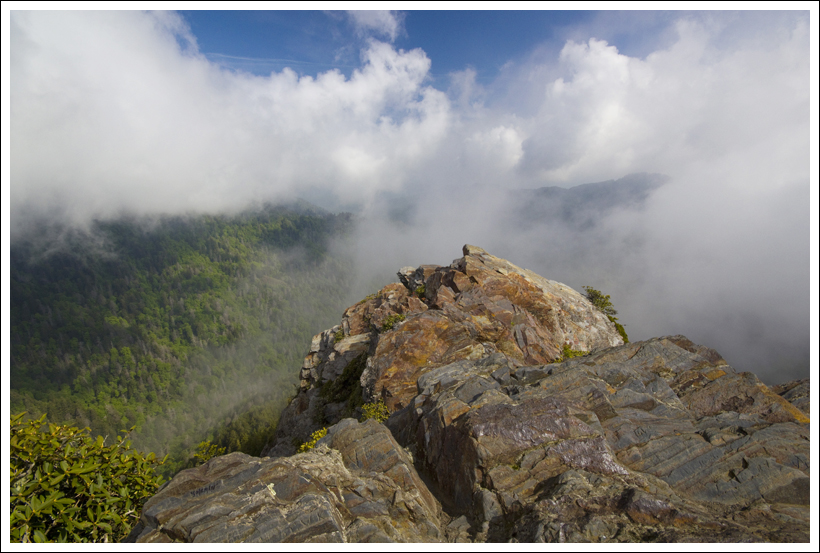
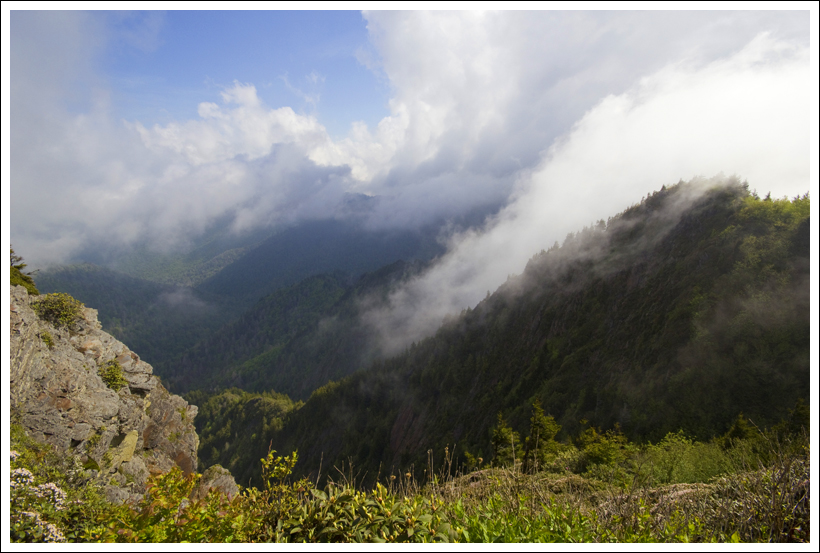
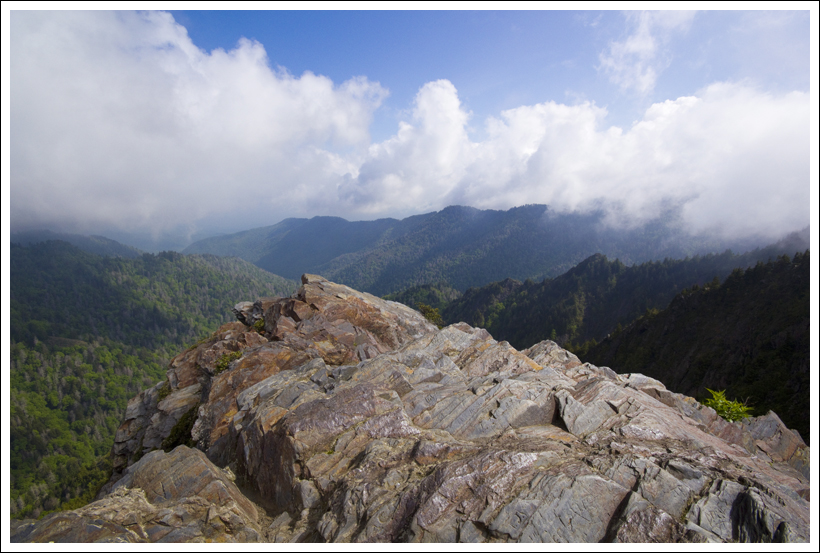
What a spectacular place!  The mountains are so craggy and ragged and sharp around the bunion.  The rocks were covered with sand myrtle and a few rhododendron were about to bloom.  The fog was whipping by, rolling up the sides of the mountains in giant waves.  Every now and then, a thin spot would give us a glimpse of distant mountains and not even a hint of civilization.  We sat on the rocks, enjoying the solitude.  We were absolutely thrilled to enjoy this special place without the company of other park visitors.  As the minutes passed, the view became more and more clear.   It was everything I imagined the Smokies would be!

Christine Checks Out the View from the Bunion
Christine checks out the view from the Bunion.  Below:  Adam walks through the cool, dense evergreen forest as we cover the last mile toward Charlies Bunion; Some sections of trail were covered with this smooth, slate-like rock; Many high, rocky places in the Smokies (including Charlies Bunion) are covered with sand myrtle.

Evergreen Trees Slate Trail Sand Myrtle

Shortly before we were ready to head back, another couple from Michigan joined us at the rock.  We chatted a while and took photos for one another.  We decided to head on out and let them enjoy a bit of solitude, too.

On the hike back, we planned on eating lunch at the Icewater Shelter, but found it still loaded with people – and not very friendly ones at that.  So we pressed on, with plans to eat lunch at our next stop – a viewpoint called ‘The Jumpoff.’

The side trip to the Jumpoff required about an extra ¾ mile of hiking along the Boulevard Trail and a small side spur trail.  The climb up to this view was our toughest climbing of the day.  It was steep and very slippery and root-covered.  Once we got to the view, it was quite evident why the spot garnered the name ‘jump off’.  It has an extremely precipitous drop from the edge!  We ate lunch on the rocks and enjoyed the view.

On the hike back down to the junction, we passed a huge hiking party and were thankful that we had once again dodged sharing a nice viewpoint with crowds.

The rest of the hike back down went quickly and was mostly downhill.  We saw dozens and dozens of backpackers and dayhikers making their way up the trail. When we got back to the parking lot, it was full of people taking in the view from Newfound Gap.  Most of them will probably never set foot on the trail, and maybe with so many people already out there… that’s just fine!

Adam Says…

This was a great first hike in the Smokies for us.  We had driven up to Newfound Gap the previous day and saw a ton of cars.  We knew it would be a great idea to start off on this trail as early as possible.  The view from Newfound Gap is absolutely gorgeous, but you’re in for a treat if you continue on to Charlies Bunion and The Jumpoff.

When you park in the large lot, you will see a terraced memorial for Laura Spelman Rockefeller, the wife of John D. Rockefeller.  It is amazing the impact that Rockefeller family’s philanthropy has had on our national parks.  In addition to the Great Smoky Mountain National Park, the Rockefeller family’s donations have given land and money to help establish Acadia, Grand Teton, Yosemite, and Shenandoah national parks.

The origin of the rock outcropping being called Charlies Bunion is amusing.  A mountain guide named Charlie Conner had a large bunion on his foot and Horace Kephart named it in honor of him and his foot affliction stating “That sticks out like Charlie’s bunion”.  Horace Kephart was one of the people that helped get the Great Smoky National Park established and plotted the Appalachian Trail path through the Smokies.

This rock outcropping was created through a combination of logging, fire, and flooding.  This area was heavily logged in the early 20th century, leaving behind lots of dried debris.  A large forest fire came through this area known as The Sawteeth in 1925, destroying much of the vegetation and sterilizing the soil.  A torrential cloudburst in 1929 washed away the soil and left this as a rocky outcropping.

View Through the Smoke
A view through the ‘smoke’ at Charlies Bunion. Below: The quickly changing clouds and fog opened up new views depending on how the wind blew; The Icewater Shelter.

Another View from the Bunion Another Bunion View The Icewater Shelter

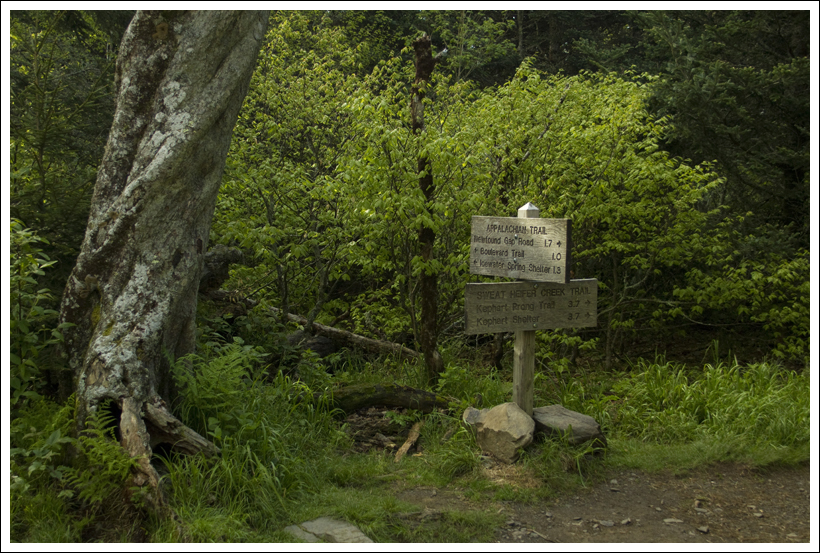
For trail directions, the hike started with an uphill climb just right of the memorial (there is also a small bathroom to the right of the trail) on the white-blazed Appalachian Trail.  At 1.7 miles, you will reach the junction with the Sweat Heifer Creek Trail.  Continue straight on the AT.  At 2.7 miles, you will reach another junction with the Boulevard Trail to the left.  You will use this trail to get to The Jumpoff, but we continued straight on the AT.  At mile 3.0, we reached the Icewater Spring cabin, which serves as an overnight cabin for any backpackers.  On the trail shortly after the shelter, you will see a pipe that serves as a water source if you need water, but you should treat any water before drinking.  The trail then begins to go downhill steeply at this point as you make your way to Charlies Bunion.  You will reach Charlies Bunion at mile 4.4.  After visiting the Bunion, go back the way that you came.  At mile 6.1, you will reach the junction with the Boulevard Trail again.  Take a right on this trail and after a very short distance, you will see a wooden sign that points up to The Jumpoff.  This trail was definitely the most strenuous of the entire hike.  The trail is about .4 miles to reach the end at 6.5 miles.  Take a minute to enjoy the view and then head back down the way you came to rejoin the Boulevard Trail and take a right at the junction to rejoin the Appalachian Trail.  You should reach the parking lot at 9.5 miles.

The Appalachian Trail is relatively smooth up to the junction with the Boulevard Trail, but gets rougher, rockier and more slippery as you descend down to Charlies Bunion.   The trail up The Jumpoff is the toughest climbing of the day – quite steep and treacherous, so it will take a while to reach the viewpoint.

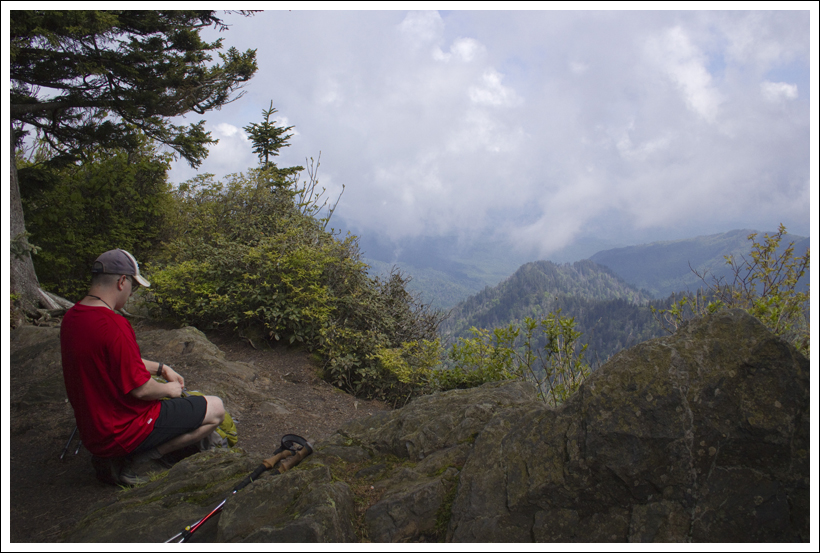
View from the Jump Off
The view from the Jumpoff was pretty impressive! Below: To reach the Jumpoff, follow a short spur from the Boulevard Trail; Adam gets ready to eat lunch with a view; By the time we passed back by early spots on the trail, the view had cleared up significantly.

The Jump Off Junction Lunch on the Jump Off View at the End

When Christine and I were hiking up past the junction with the Sweat Heifer Creek Trail, the strangest thing happened.  We both felt that we had a drumming noise inside our heads that was beating rapidly for a few seconds.  I said to Christine, “That was weird” and she asked what I felt.  It turns out that she had the same sensation happen at the exact same spot.  I’m not sure if it was an adjustment to the altitude, a pulse increase, or an alien scanning us, but it was quite odd.

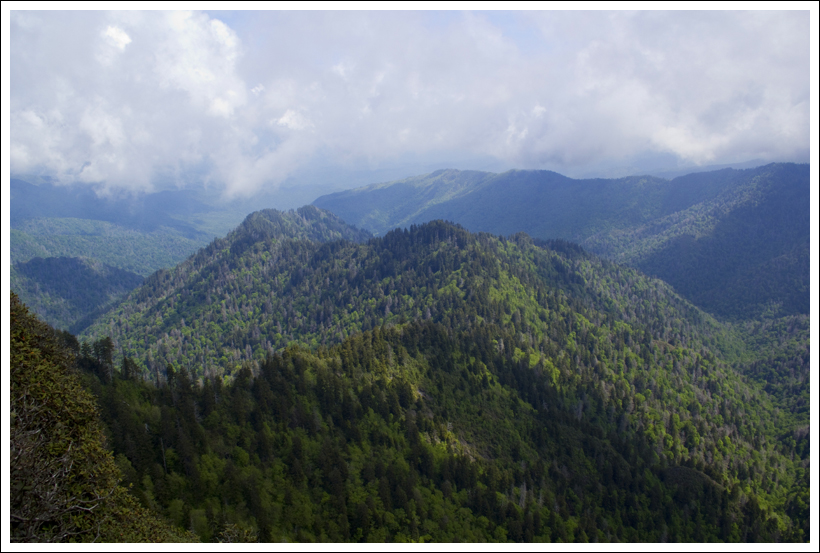
The highlight of this hike is definitely the views.  From the Bunion, you can see steep, mountain peaks all around.  We were so glad that we stayed around a while to be able to watch the “smoke” rise up and blow over the Smokies.  We really felt like we were up in the clouds as the wind blew the fog around quickly.  We stayed around at this viewpoint for longer than we normally stay because it was so entertaining to get different glimpses of the mountains.  The Jumpoff trail gives you similar views, but you can also see Charlies Bunyon from afar.  The Jumpoff did seem a lot more treacherous.  The soil is eroding off this viewpoint and you just think if you take a wrong step you could plummet.  When we were leaving the area, a large group of older adults were on their way to The Jumpoff.  There is not a lot of room at the viewpoint, which made us both wonder how they were going to be able to take the views in.  We found someone’s driver’s license at the top of this point and we were just hoping that he has survived.  We took it to mail it off to him, but we did check the news to see if anyone was missing.
Trail Notes

  • Distance 9.5 miles if you go to The Jumpoff, 8.2 miles if you just do Charlies Bunion
  • Elevation Change – about 1600 feet for the complete hike
  • Difficulty – 3.  There are several moderate climbs on this hike.  The only truly steep climbing is the short spur trail to The Jumpoff
  • Trail Conditions – 3.  The trail is in good condition, but you can expect to hike over lots of mud, loose rocks and roots. It’s just the way the Smokies are made.
  • Views – 5.  Spectacular!
  • Streams/Waterfalls – 0.  There are no streams or waterfalls along this trail, as it follows mostly ridgeline.
  • Wildlife – 1.  Lots of juncos darting underfoot from low-lying plants.  We didn’t see anything else, but the  Icewater Shelter was closed during fall 2011 for an aggressive bear, so there is undoubtedly other wildlife in the area.
  • Ease to Navigate – 4.  Trails are well-marked and blazed.  There are several turns, but it would be tough to get lost on this trail.
  • Solitude – 2.  This trail is one of the top five most popular hikes in the Smokies.  Hike early if you want to avoid crowds.

Directions to trailhead:  Take 441 through Great Smoky National Park to reach the large Newfound Gap parking lot.  Park in the lot and head towards the memorial.  The trail starts off just to the right of the memorial.

Intro to Great Smoky Mountains National Park

Special: Smokies Edition

Our original introduction to the Smokies was written in 2012!  We’ve visited the park twice since then, so it was time to update our list of tips and recommendations.  Enjoy!

Smoke in the Smokies
We loved seeing ‘smoke’ in the Smokies. When we visited, the rhododendron were just starting to bloom. Below: Adam sitting alongside the Oconaluftee River; A Smoky Mountains view; The obligatory pose at the park entrance.

Adam Sitting by the Oconoluftee River View Into the Deep Creek Area Welcome to the Smokies

The Smokies Are Big and Rugged – We were surprised how different the Smoky Mountains are from the Blue Ridge in Virginia.  The mountains are so much taller and steeper. Mountaintops soar to over 6,000 ft. instead of the 3,000-4,000 we’re more used to in the Shenandoahs. The trees are bigger, there are more firs and pines, and everything is greener, mossier, and wetter.  Water flows freely and abundantly throughout the park.  The waterfalls and rapids are very impressive.

Entering The Smokies Is Free – Most of the national parks we’ve been to make visitors enter through a fee station and charge $10-$20 for a week’s visit.  The Smokies have no fee stations, but there are plenty of donation boxes throughout the park.  We always put $20 in one of the boxes each week we visit.  National Parks are something we both treasure and twenty dollars is a small gift to help support a resource we love.

Best Hiking Book – We had purchased Falcon Guide Hiking Great Smoky National Park by Kevin Adams.  While the descriptions of the trails were decent, the author seemed a little bit negative about the park.  His descriptions made us feel that we were going to be constantly overwhelmed by crowds and never have a moment of solitude.  While we were there, we picked up two books that we recommend over the Falcon Guide.  Day Hikes of the Smokies by Carson Brewer and Friends gave us some great ideas and was broken down by easy, moderate, and strenuous hikes.  Also available is Hiking Trails of the Smokies.  This book was recommended to us by a park ranger as ‘their Bible’ for the trails in the Smokies.  Both can be purchased online through the Great Smoky Mountains Association.  The one drawback of the books is that they embellish the features of hikes.  Sometimes we found ourselves disappointed when features didn’t live up to the rhapsodizing descriptions in the guide.  We also love  the website Hiking in the Smokys.  Their descriptions of hikes are very accurate and their indexing system for locations and hike difficulty makes it really easy to find the right hike for you.

Food Is Scarce In The Park – Besides a few vending machines at visitors centers, food is nowhere to be found in the park.  The park does not have restaurants or gas stations.  You should definitely plan on packing snacks or a lunch if you plan on spending the day in the park. The only exceptions we found were the Cades Cove campground and the LeConte Lodge.  The snack bar at Cades Cove had burgers, hotdogs, BBQ sandwiches, ice cream, chips and sodas.  LeConte offers drinks, baked goods and bag lunches, but you have to hike anywhere from 5-12 miles to get to the lodge.  Sit down dining is only available for reserved overnight guests.

The Smokies Are Crowded – Millions of people visit GSMNP each year – it’s the most-visited national park in the country. The busiest times are June 15-August 15 and October (especially weekends).  While we did see lots of people in late May, I think a good rule of thumb is to get an early start.  We typically woke up before 7:00 most mornings, grabbed some breakfast, and headed to the park.  We were able to hit most trails before 8:30 a.m. and typically had the views or waterfalls all to ourselves for at least a few minutes before anyone else came along.  When we were done with our hikes, the parking lots were always more crowded.  If you arrive 10:00 a.m. or later, expect to share vistas and waterfalls with lots of other people.  Cades Cove is by far the most crowded place in the park.  If you want to drive the loop, plan at least half a day, maybe all day. Here is a great online guide to driving the loop. Traffic is very heavy and slow moving.  If you’re trying to get to a trailhead on the loop, bring your patience with you and enjoy the scenery along the way!

The Smokies Are Hazy – The views are amazing, but there was usually a thick haze over everything.  Due to research the NPS has done, the haze is a result of air pollution and acid rain.  Occasionally you get a day that is strikingly clear, but fog, mist and haze are the norm.

Bear Cub
We spotted this adorable bear cub in a tree along Little River Road, leading into Cades Cove. Shortly after spotting the cub, we noticed momma bear watching us from the hillside above the road. Below: One of the many small, roadside waterfalls we spotted.

Roadside Waterfall

Best Place To See Wildlife – Cades Cove had the best wildlife viewing.  The first year, we saw seven bears on our way into or around the Cades Cove loop.  In 2014, we saw a bear within 15-20 feet while hiking the Rich Mountain Loop (trailhead in Cades Cove). While black bears can be seen throughout the park, the heaviest concentration and the better likelihood of spotting them is in this area.  You will also see tons of deer and wild turkeys in the fields.  If you want to see elk, the largest population is in the Cataloochee Valley area. But there is also a small herd near the Oconaluftee Visitor Center.  We were lucky enough to get a private ranger-led walk out to spot the Oconaluftee elk in 2012.

Don’t Just Stay In One Place – We stayed in Bryson City, NC for the first half of the week and ended our trip with a couple of days in Gatlinburg, TN. In 2012, we spent one night in the middle of the week at the LeConte Lodge that sits atop the Smokies’ third tallest peak.  Bryson City is a quaint, peaceful town with a Mayberry-esque feel.  The people were friendly and there were some good restaurants in town.  On the southern end of the park, more people probably stay in Cherokee, NC, which is about ten miles from Bryson City.  It’s located in the middle of the Qualla Cherokee Indian Reservation for the Eastern band of Cherokee Native Americans.  The town of Cherokee is definitely more commercial.  There is a large Harrah’s casino and lots of souvenir shops.  Without a doubt, Gatlinburg, TN is the most popular park town.  It reminded us of a town you would find at a touristy beach.  The downtown area had tons of shops selling kitsch (airbrush shirts, old-time photos, plastic trinkets and T-shirts emblazed with neon letters proclaiming ‘I’m Sexy and I Know It’ and ‘YOLO’).  There are also tons of mini golf courses, Ripley’s Believe It or Not attractions, and four moonshine distilleries.  The food in Gatlinburg was great and I’m sure we’ll mention some of our meals in our upcoming posts.  We prefer the quiet areas, so we were glad to spend the bulk of our time in Bryson City.   The largest benefit we experienced was by staying in different spots, we were able to get to different areas of the park quicker.

Must-See Things That Don’t Involve Hiking 

  • Visit the Museum of the Cherokee Indian in Cherokee, NC.  The exhibits were interesting and give you a good overview of Cherokee history and culture.
  • Across the street is the Qualla Arts and Crafts Mutual, which serves as a co-op and gallery showcasing the traditional work of over 250 Cherokee artists.  The items you’ll find here are quality, hand-made arts and crafts, so expect to pay a higher price than you would for the replicas and knock-offs seen in other shops.  The baskets, carvings, pottery and jewelery are all very beautiful.
  • Visit the Nantahala Outdoor Center located southwest of Bryson City.  There are several places to eat, an amazing/knowledgeable outdoor outfitter, and a bridge that carries the Appalachian Trail over the river.  They have an even larger outdoor outfitter shop in Gatlinburg.  It was nicer than any REI we’ve been to, so if you like hiking, camping, kayaking or backpacking – don’t miss the NOC! One of our favorite things to do at the NOC, is to get a beer at Big Wesser Brew & BBQ, sit at a riverside umbrella table and watch kayakers run the river.
  • Drive through Cades Cove.  As mentioned above, it is a great place to see wildlife, but there are some interesting homesteads, churches and farms from a bygone era. Traffic is very slow, so if you’re not the ambling, sightseer type – you’ll need a lot of patience to visit this part of the park.  If you want a more laid-back experience in Cades Cove, try biking it on one of the mornings it’s closed to car traffic.  It’s still crowded, but you can go at your own pace without getting stuck in traffic jams.
  • Drive to Newfound Gap and Clingmans Dome.  There are gorgeous views from some of the highest areas of the park here!
  • Visit the park’s many spectacular waterfalls and streams.  The Smokies are a rainforest fed by numerous streams and rivers.  They’re so beautiful!
  • Visit Nantahala Brewing (Bryson City) and Lazy Hiker (Franklin) to sample their fantastic craft beer.
  • Taste some moonshine –  Ole Smoky Tennessee Moonshine and Sugarlands (both in Gatlinburg) are fun (and offer cheap samples)!

A Restaurant Recap – We had lots of good food on our visit!

Pancake Pantry Breakfasy
Pancake Pantry breakfast!  Below: Barbecue at the Bar-B-Que Wagon in Bryson City; Sugarlands Moonshine; Nantahala Brewery in Bryson City; Lunch at the River’s End Cafe; Pizza at Anthony’s, Enjoying a beer at Big Wesser at the NOC.

Carolina 'Cue shine nantahala
riversend pizza bigwesser

  • In Bryson City, we ate at Pasqualino’s (huge portions, cute atmosphere, the best calzone Adam has ever had), River’s End Restaurant at the NOC (good chili, salads, yummy onion rings with a tasty dipping sauce, pizza, burgers), Soda Pop’s for ice cream, Bar-B-Que Wagon had delicious, classic Carolina-style barbecue, for pizza – Anthony’s (located right next to Nantahala Brewing) has really good food, and for a quick breakfast and great coffee, Mountain Perks! In 2015, we finally got to try The Bistro at Everett Hotel. It was worth the hype and the crepes were amazing.
  • Sylva/Dillsboro is worth a visit – don’t miss Haywood Smokehouse and Innovation Brewing.
  • In Gatlinburg, we ate at the Smoky Mountain Brewery (house-brewed beer, amazing burgers – Christine thought the Brewery ‘Ale’ Steak was the best steak she had ever eaten).  We also ate at Mellow Mushroom which is a chain, but definitely a good one!  They had delicious pizza, good beer selection, and a fun environment.  Hungry Bear had excellent barbecue with all the trimmings. For a quick on-the-go breakfast, you must go to the Donut Friar.  They have the best donuts we’ve ever eaten – lightly crisp exterior with a soft, airy interior.  If you have time for a more leisurely breakfast, don’t miss the Pancake Pantry.  They have Gatlinburg’s best pancakes and they make them a million different ways.  We both got crepes and they were phenomenal!  And lastly, for ice cream and candy – Kilwin’s.  They had lots of creative flavors of ice cream and the candy selection was out of this world.
  • We recommend packing lunches for your day in the park.  The Smokies are big and it’s time-consuming to drive to one of the gateway towns for lunch.  We packed a lot of energy bars, candy, trail mix and Lunchables so we wouldn’t have to drive out of the park to get something to eat mid-day.

Trails We Covered in (or Near) the Smokies

2018

2017

2016

2015

2014

2013

2012