The Bubbles – Acadia National Park (ME)

Special: Acadia Edition

We’ve taken a detour from our normal coverage of Virginia hiking and biking!  For the next five posts, we’ll be doing a special edition covering the trails of Acadia National Park in Maine.

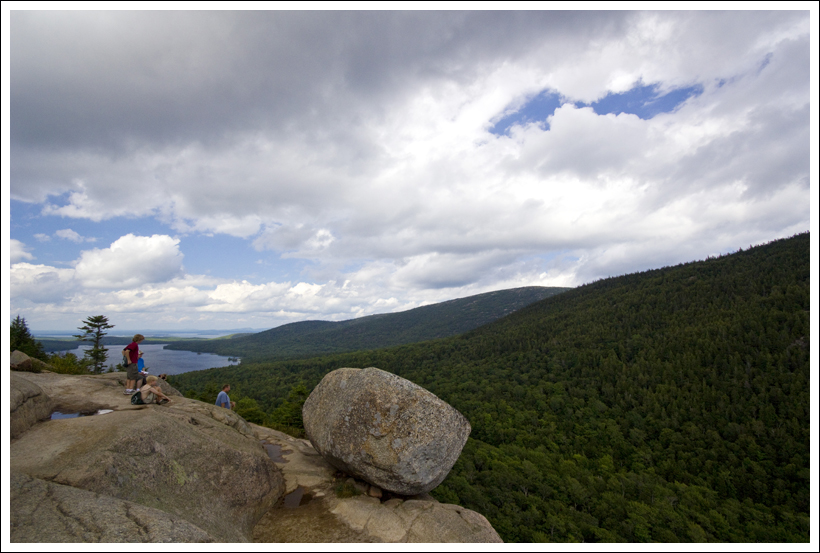
The Bubbles hike consists of two small mountains that overlook Jordan Pond.  One of the key features on this hike is a large glacial erratic hanging on the edge of the south Bubble.

Adam and Bubble Rock
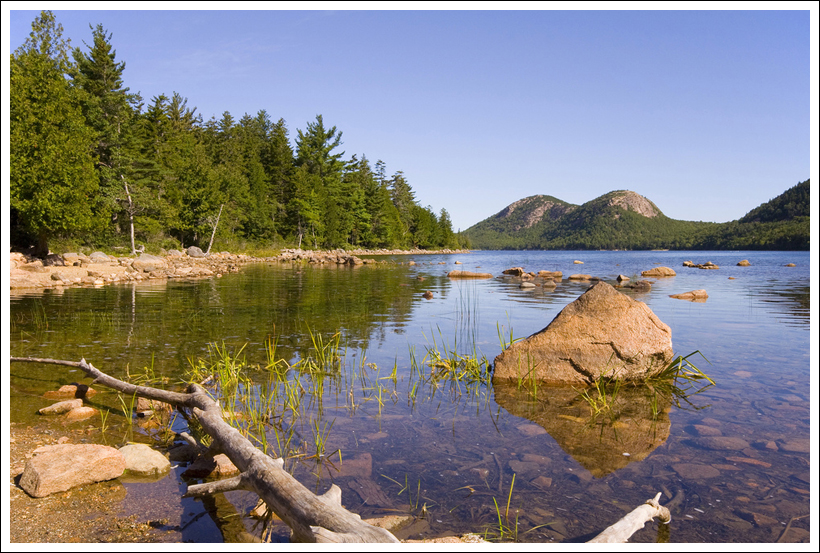
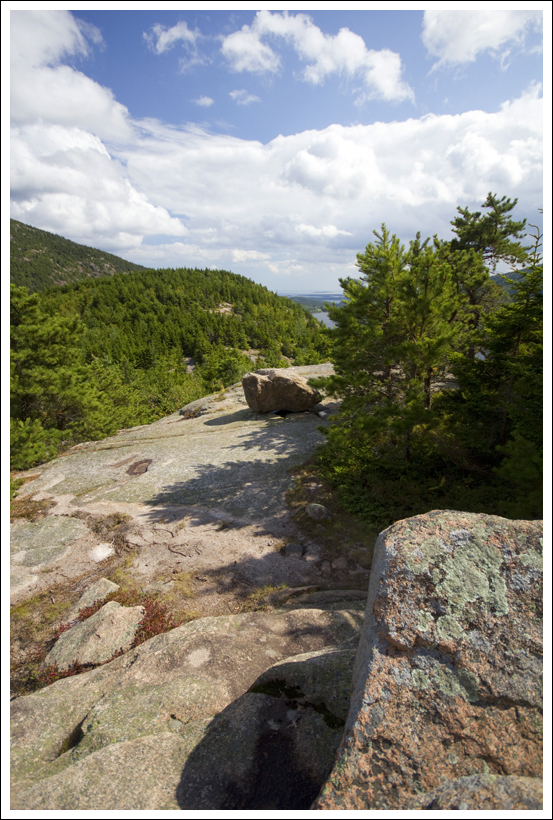
Adam pretends to support the giant glacial erratic known as Bubble Rock.  Below: The first viewpoint along the trail up the South Bubble;  A view of Jordan Pond from the South Bubble; You can see how precariously the erratic hangs on the side of the mountain; When you visit the Jordan Pond House you get a great look at the Bubbles from a distance.  The two small mountains have such a distinct shape (photo from another trip).

The First View Jordan Pond from the South Bubble
Precarious
The Bubbles from Jordan Pond

Adam Says…

We had an extraordinarily tough drive up to Maine this year.  We left on a Friday with plans to stay in Sturbridge, MA for one night and then finish the trip to Maine the following day.  We were counting on a lot of weekend and rush hour traffic around Boston, so we thought breaking this into a two-day drive was a good idea.   Well, the drive on the first day should have taken us around 8 hours and ended up taking us over 12 hours.  We ran into an over two-hour delay near Allentown, PA and Connecticut traffic is always ridiculous.  On Saturday, we had a better day of driving to get to Mount Desert Island  We were very eager to stretch our legs when we got there.  When we vacation, we are not ones to idly relax; we like to pack in as much as possible.

We have hiked up the Bubbles a couple of times in the past, and have always enjoyed it.  Since this is a short hike, you should be able to fit it in a narrow time period.  From the Bubble Rock parking lot, start off on the Bubble Rock trail.  At .1 miles, you will reach a junction with the Jordan Pond Carry Trail.  We went past this and just continued straight on the trail.  In about .3 miles, you reach a junction where the North and South Bubble trail split.  Take a left at this junction and continue the path up to reach the top of the South Bubble.  Take in the views and then go back the way you came.  At the previous junction, then follow the path to the North Bubble summit.  You can this take this path back to the junction and then just take a left to head back to your vehicle.

South Bubble View
Another view from the South Bubble. Below: Trails are very well-marked throughout Acadia; Adam scrambles to the top of the boulder pile to reach the summit marker on the South Bubble; The sun came out a bit more by the time we climbed the North Bubble.

Trail Sign  Adam scampers up to the top of the summit marker A View from the North Bubble

When you reach the summit of the South Bubble, take in the views of Jordan Pond and also take some time to find Bubble Rock (not to be confused with Balance Rock, which is located along the Shore Path in downtown Bar Harbor).  It was amazing to see all the people that try to push on the rock in hopes that they can personally move a multi-ton granite boulder.  There was one family that we enjoyed watching that had a couple of younger boys with them.  One of them held a stick like a spear and seemed to have a little violent streak running through him.  He kept wanting to throw his stick at things.  We overheard him telling his family, “When I see things, I want to chuck my spear at it SOOOOO BAAAAAD!”  I’m curious to see how his deviant behavior develops over the years.  From the Bubble Rock, you can also get some views of the Park Loop Road below.  This hike pays off with stunning views despite little effort.

We also enjoyed talking with a couple at the North Bubble.  They were taking part of a quest to visit all of the U.S. National Parks.  They had been to lots of places over the last few weeks and had come from Canada a few days before Acadia.  They took some pictures of the two of us and we returned the favor.  They said they were sending their pictures to their friends that were cursing them at all of the things they have been able to do.  I guess once you make your friends envious, you have to keep it up.  I will say that the North Bubble is a little steeper to climb up, but the views from both of the Bubbles are great.

We hope that you enjoy our reviews of Acadia National Park hikes.  We have been going there for years and I think you will see that over the next few blog entries that this is a place that you should put on your “must visit” list!  There is a reason that nearby Bar Harbor, ME was once called “Eden”.  This area really feels like a paradise to both of us.

Christine Says…

We rolled onto Mount Desert Island, home of Acadia National Park, in the early afternoon after an easy six hour drive from Massachusetts.  It was a beautiful afternoon with a cold front pushing out the last of the dark, gray storm clouds and humidity from the day before.  We were really eager to start enjoying the park, so instead of going to our hotel, we immediately headed to the Acadia Visitor Center.  We changed into hiking clothes, bought our park pass and set out to do the short hike across the north and south Bubbles, overlooking Jordan Pond.

The hike is short and easy/moderate, so it’s very popular with families and novice hikers.  Even so, most of the traffic had cleared out earlier in the day, so we were able to find a parking spot right at the trailhead.  Anyone who visits Acadia knows how rare that is!  Acadia is one of the smallest and most congested national parks, so we always try to plan our activities at non-peak times to avoid crowds.

The trail climbs from the parking lot.  It starts off smoothly, but soon you’re scrambling over roots and up granite ‘stairs’.  It was a little wet from storms the night before, so we had to be careful of our footing.  There aren’t many footing surfaces more slippery than wet granite!

The first viewpoint we came too came atop a rocky shelf, mostly overlooking the mountains, but with a little snip of water visible.  After snapping a few quick photos, we made our way to the summit of the South Bubble.

The View from the North Bubble
The View from the North Bubble. Below: Christine and Adam enjoy views along the hike.

Christine Enjoys the View Adam enjoys the view

Of the two Bubbles, the south peak is quite a bit more popular due to the presence of ‘Bubble Rock’ – a glacial erratic that sits precariously on the side of the mountain.  It looks like it could go rolling down the mountainside at any moment.  It’s always fun to sit and listen to people plotting to push the boulder off its perch.  Some people think it would take a group pushing effort; others contemplate the lift power of a lever.  Personally, I think when the boulder falls; it will be solely Mother Nature who moves it.  I hope it doesn’t happen in my lifetime, because I like the boulder right where it is!  Another fun tradition is to take photos of your hiking buddies pretending to hold the boulder up.

If you hike past Bubble Rock, the trail leads over to an open view of Jordan Pond below.  It’s a lovely spot!

To get to the North Bubble, you simply retrace your steps back to a trail junction marking the path north.  The trail up the North Bubble might be slightly steeper, but it’s still a short and easy hike.  We spent a bit of time atop the peak, enjoying the view and luxuriating in the cool, breezy Maine air.  Being in Maine always makes me feel so happy.

We hiked back down the way we came and were back at our car quickly.  Even though the hike was nothing long or challenging, it was still a perfect way to kick off our week in Acadia!

Trail Notes

  • Distance1.7 miles
  • Elevation Change – approximately 1050 feet.  You first go up about 500 feet up to the South Bubble, go back down 200 feet and then up another 550 feet to the North Bubble
  • Difficulty – 2.5.  These trails are very short, so most people should be able to do them.  The South Bubble is fairly easy with the short distance and I would give about a 2 in difficulty.  The North Bubble is definitely more of a steep trail and is closer to a 3-3.5 in difficulty.
  • Trail Conditions – 3.  The trail is very well-maintained and traveled.  However, some of the footing can be slick in the rain on the granite.  The North Bubble does have some steeper sections which make the footing a little more treacherous.
  • Views – 4.  Great views from both Bubbles.
  • Wildlife – 0.  We didn’t really see anything, but you may be able to see birds soaring above or relaxing on the lakes below.
  • Ease to Navigate – 3.5.  This path we took was more like a T, since you split off in different directions.  Almost all of the trails in Acadia lead to other options to combine into loops with other trails.   
  • Solitude – 1Due to the distance, this is an incredibly popular hike.  You will very likely have several hikers to share in the views if you go over the summer.

Directions to trailhead: On the Park Loop Road in Acadia National Park, keep following the road until you reach the Bubble Rock parking lot.  This is just south of the Bubble Pond parking lot, so don’t be confused by the name.  The trailhead starts from about the middle of the parking lot. 

West and East Rattlesnake (NH)

Special: New Hampshire Edition

Introductory Guide to Visiting the White Mountains

This fun, four-mile loop hike offers gorgeous scenery and amazing views with not much work.  The trail takes you across the summits of two small mountains – known as East and West Rattlesnake – overlooking the Squam Lakes.

Adam and the Rain Storm
Adam watches a rain storm pass over the Squam Lakes.  Below: The trail has many steps built into it.

Old Bridle Path

Adam Says…

Since we had already done a bunch of hikes to waterfalls over the last few days, we decided it was time to do a hike with some views.  We waited around in the morning due to rain and an overcast sky, but we caught a break shortly after lunch and decided to head out to the Rattlesnakes.  As Mark Twain said, “If you don’t like the weather in New England, wait a minute.”

We started the trail up the Old Bridle Path, which takes off from the marked parking lot for West Rattlesnake Mountain.  This area includes a lot of crossing trails that are all yellow-blazed, so you will need to pay attention to signs to be sure you are going the way you want.  The hike was a continual uphill with lots of steps built into the trail.  We found this part of the trail to be very well maintained and you will see lots of people on this section of your trip.  At .75 miles, you will come to a fork.  The right goes out to a nice overlook, but the left is where you will continue the trail.  At .9 miles, you will reach the summit of West Rattlesnake Mountain.  Look on the ground to find  a USGS marker to mark the elevation.

From the summit, we then took the Ridge Trail which leads to East Rattlesnake Mountain (one option is to take the Pasture Trail to the East Rattlesnake Trail, but that has a lot of elevation loss and gain.)  The Ridge Trail descends about 300 feet of elevation into a thick quiet wood.  Here is where the mosquitoes were unleashed on us since the breeze was non-existent to blow them away.  At 1.3 miles, you will reach a junction with the Col Trail, but continue on the Ridge Trail until 1.7 miles when you reach the East Rattlesnake Mountain summit.

First Viewpoint
The first viewpoint from high up comes along a small spur trail. Below: The Armstrong Natural Area sign provides some historical information about the area; Several trails intersect in this area; Watching the rain storm pass over the Squam Lakes.

Armstrong Natural Area SLA Sign West Rattlesnake

We headed back from the summit and at 2.1 miles, we took a right on the Col Trail.  The Col Trail descends a few hundred feet and was very overgrown and poorly maintained in several areas.  At 2.8 miles, it leads to a fire road.  Take a right on the fire road.  At 3.0 miles, you will reach Route 113.  Taking a left on the road, you will head back to your car to make this a four-mile loop.

Looking back, we might have decided to do this as an out-and-back hike and not ventured onto the Col Trail.  Walking on roads is never as fun as trails and it seems that the road goes on forever.

Both summits give you expansive views of the Squam Lakes and you can likely see several mountains surrounding you.  I was amazed at how many people were on West Rattlesnake Mountain and we only saw one other person at East Rattlesnake Mountain.  So, you can easily escape the crowds if you want with just a little longer hike.

There are a number of geocaches in the area for anyone interested:

Christine Says…

On this trip to New Hampshire, we spent far more time hiking to waterfalls and ponds than we did hiking to mountaintops.  We decided to save our summit hikes for days that offered clear views of the valleys below.  Unfortunately, we had a lot of hot, humid days that put the high peaks of the White Mountains into the clouds.  I know some people just like the workout and the act of hiking, regardless of whether or not there is a view.  I do too, but only to an extent. I can’t help but feel a little let down when a great view is covered in clouds and fog.

The morning we planned to hike the Rattlesnakes had been forecast to be sunny and pleasant.  However, in keeping with the theme for New Hampshire’s changeable weather, we woke to soggy clouds and pop-up showers.  The radar map indicated clearing as the day went on, so we sat and waited at the house.  When the sun finally broke through the clouds, we hopped in the car and raced off the trailhead.

The hike was easy and pleasant to the top of West Rattlesnake, and the views couldn’t have been nicer.  They reminded me a lot of the views we had from the Mt. Morgan – Mt. Percival hike.  (You can actually see the Rattlesnakes from above on that hike.) Both hikes overlook the Squam Lakes, but Mt. Morgan – Mt. Percival goes to higher mountains and offers a loftier view. If I were pressed to choose, I would say the Rattlesnakes view is nicer, but only because it’s a little closer to the lake.  The Squam Lakes Association does a fantastic job managing and maintaining the trails in this area.

East Rattlesnake
The view from East Rattlesnake is pretty and offers quite a bit more solitude. Below: The trails are nicely marked and expertly maintained by the Squam Lakes Association; Adam walks along the fireroad that joins the Col Trail to Route 113.

Col Trail Fire Road

Atop West Rattlesnake, we were able to sit on a sunny rock ledge and watch a leftover rain squall pass at a distance across Squam Lake.  The clouds were so dramatic and it was interesting to see the gray sheet of rain pass over the water.

We decided to continue along the trail and visit East Rattlesnake as well.  Although it’s less popular and has a smaller rock ledge, the other Rattlesnake offers views just as nice as its “sister”.  We had a couple options for hiking over to East Rattlesnake.  At first, we considered hiking the Pasture Trail so we could check out Five Finger Point.  A friend of mine from Flickr mentioned one of his favorite swimming spots was on the point, so I thought it might be fun to go check out the spot.  But, in the end, we decided to take the shorter route across the Ridge Trail.  The bugs ate me alive!  This trail was the one place in New Hampshire that my liberal application of DEET didn’t seem to deter the mosquitoes.  Two weeks after the hike, I still have a few marks leftover from bites I got on that hike.

On the return from East Rattlesnake, we wanted to get out of the woods and away from the bugs as quickly as possible.  Instead of doing the hike as an out-and-back, we followed the Col Trail back to the road and finished a loop with a mile of walking along Route 113.  The road walking wasn’t particularly fun or scenic, but at least I was away from most of the bugs.

Trail Notes

  • Distance – 4 mile, loop
  • Elevation Change – About 800 ft.
  • Difficulty –2.5. The walk up to West Rattlesnake is very easy.  The hike up East Rattlesnake is a little tougher.
  • Trail Conditions –3.5. The trail is very nicely maintained.
  • Views – 5. Stunning views of the Squam Lakes.
  • Waterfalls/streams 0. None to mention.
  • Wildlife –0. Unless you count mosquitoes and biting flies.
  • Ease to Navigate – 4. Although several trails cross in the area, everything is clearly marked.
  • Solitude – 1. On West Rattlesnake, you won’t get any solitude.  East Rattlesnake is quieter.  We saw only one other person there, while we saw close to 20 people atop West Rattlesnake.

Directions to trailhead:

From I-93, take Rt. 3 east to Holderness. From Holderness, follow Rt. 113 (a slow, curvy road) northeast for about 5.5 miles. Just past Pinehurst Road, park in the small lot on the right side of the road. The Old Bridle Path starts at the far end of the parking lot.

Greeley Ponds (NH)

Special: New Hampshire Edition

Introductory Guide to Visiting the White Mountains

The Greeley Ponds trail is a popular hike that leads to a pair of beautiful ponds surrounded by the White Mountains.

Upper Greeley Pond
We didn’t have great weather for our hike to the Greeley Ponds. It was very muddy and overcast, but the ponds were still really pretty! Below: There were several small stream crossings along the hike; We saw Indian Pipes growing along the trail; the terrain in this area is very wet and dark, making it a perfect place for mosses and mushrooms.

Stream Crossing Indian Pipes Mushrooms

Christine Says…

We got up early to take a scenic drive and do some hiking along the Kancamagus Highway.  We decided to check out the trail leading to the Greeley Ponds.  This hike intrigued me, because it is so different from anything we have in Virginia.  Ponds and lakes are not terribly common in the Blue Ridge, so I thought a hike leading to two ponds surrounded by mountains sounded really perfect.

The trail did not disappoint!  The woods in New Hampshire are so thick and green and different.  I love the abundant evergreens in the New England woods. Everything is so fragrant, lush and moss-covered.  Old fallen trees become nurseries for tiny mushrooms and tree seedlings.  Streams trickle in seemingly every direction.  Even the birds are different – singing unfamiliar songs up in the trees.

The Greeley Ponds Trail is relatively easy – with only about 500 feet of elevation gain over 2.5 miles. The things that slow you down are the roots, rocks and mud.  You have to watch your feet with every step.  We found our trekking poles to be very helpful.  Many places along the trail are traversed using wooden planks and split logs. There are several small streams to cross along the way, hopping from rock to rock.  Some of the trail system is a little confusing because cross-country skiing trails cross the hiking trail in many places.  The key is to look for yellow blazes.

At the 1.7-mile mark, the Upper Greeley Pond comes into view.  There are several places to climb down to the shoreline and take in views of the pond.  Although Upper Greeley is the smaller of the two ponds, I found it the prettier of the two. I loved seeing the towering mountains all around the pond.

Lower Greeley Pond
Lower Greeley Pond has a lot of dead trees at one end, giving it a swamp-like appearance. Below: Trailhead sign along the Kancamagus Highway; New Hampshire’s “Hike Safe” Signs are posted at all trailheads. Hike Safe (http://www.hikesafe.com) was developed by the state to help hikers become safer in the outdoors; Adam checks out the trail map illustrating skiing and hiking trails.

Greeley Ponds Trail Sign Hike Safe Trail Maps

Lower Greeley Pond is just several tenths of a mile past the end of Upper Greeley.  There is a big stand of what appears to be dead hemlocks at the end of the pond.  It gives the pond a swamp-like appearance. The lower pond also has fewer places to enjoy a shoreline view.

We turned around for our return hike a little past the end of Lower Greeley Pond.  Although, if you want a longer hike, the trail continues, following the Mad River all the way to Livermore Road.

We didn’t see a soul on the hike out to the ponds, but passed numerous groups of hikers on the return trip.  Greeley Ponds is clearly a popular hike in this area.

Adam Says…

The Greeley Ponds Trail is close to the western side of the Kancamagus Highway, so it was our first stop along the way.  The trail has a small parking lot that tends to get crowded during the busy summer.  This is a fee area, so you’ll need to deposit $3 in an envelope and display your pass.

The trail wasn’t difficult, but due to the recent rain, it was a little muddy and slick in spots.  I also felt overwhelmed by mosquitoes and had to flail around and swat them at every step.  It reminded me of the quote from Lord of the Rings when Merry asks, “What do they eat when they can’t get hobbit?”.  Well, my answer to Merry is “me”.  The bug repellent held many off, but other than taking a DEET bath, you’ll likely find a bite or two without multiple applications along the hike.  Christine asked if I would rather have the flies and mosquitoes in New Hampshire or the gnats and ticks in Virginia.  Maybe it’s because of what I’m experiencing now, but give me some ticks and the threat of Lyme Disease over these pesky creatures.

Mossy Trail and Boardwalks
Much of the trail was traversed by boardwalks and planks. Below: The trail intersects a couple other trails; Adam enjoys the view from a small, sandy beach at Upper Greeley Pond.

Trail Marker Adam takes in the view at Upper Greeley

The yellow-blazed Greeley Ponds Trail goes for 1.3 miles until it reaches a junction with the East Osceola Trail (you could add this to your hike if you want for an additional three mile out-and-back hike). At this junction, you will see the sign stating you should reach the Lower Greeley Pond  at 1.7 miles.  The trail intersects several times with a blue-blazed trail, but this is a cross-country skiing trail to the ponds (Hikers stay off the ski trails in the winter, so they can avoid leaving footprints over the cross-country ski tracks).  Both will get you to the same place, but you’ll notice the yellow-blazed trail will be a shorter route.  Once the pond comes into view, you can see a short off-trail path to a beach-y area with good views of the pond.  Going back on the trail, you continue along the bank and can continue to get different views.  Staying on the main trail, you will reach the Upper Greeley Pond around the 2 mile marker.   There are a few good views of this longer pond for the next few tenths of a mile and then you can return the way you came.

There is no camping allowed within .25 mile of the Greeley Ponds, but we did see some illegal campsites around the area created by people that weren’t respectful of the ecosystems around the area.

The area around the ponds, especially the Upper Greeley Pond seems like a great area for birdwatchers.  We were treated with songs from warblers and the knocking of woodpeckers.

There are a few geocaches along the trail:

The hike exhibited a lot of different features of the area’s forests –  dense pines and birches, gorgeous ponds, and erratic boulders along the way.  The minimal elevation change makes this a good hike for families as long as you can maintain good footing on wet surfaces.  We saw a few groups with dogs along the trail, so it is even four-legged friendly. (Please note…dogs are not allowed on the ski trails in the winter)

Trail Notes

  • Distance – 5 miles
  • Elevation Change – 500 ft
  • Difficulty – 2. The hike has a very gradual uphill.
  • Trail Conditions – 2. Like most trails in New Hampshire, this one is rocky, muddy and covered with roots.
  • Views –2. Some nice views of the mountains at the ponds.
  • Waterfalls/streams 3.5. Ponds aren’t really lakes or streams, but they do qualify for a high rating for water features.
  • Wildlife – 2. Lots of bird species near the ponds.
  • Ease to Navigate – 3.  Pay attention to the yellow blazes and you won’t get lost.
  • Solitude – 2. This is a popular and well-traveled hike.

Directions to trailhead:
Take I-93 Exit 32 at Lincoln and go east on Route 112/Kancamagus Highway about 10.5 miles to the marked Greeley Ponds parking lot.

Beards Mountain

Beards Mountain is a hike within Douthat State Park that provides lake and mountain views at various stages of the trail.

View of Douthat Lake from Beards Mountain
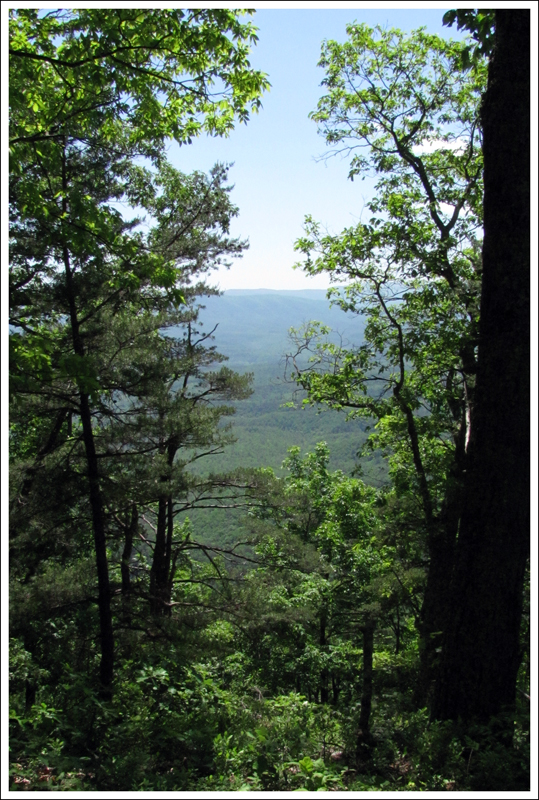
A view of Douthat Lake from the trail. Below: The trails in Douthat State Park are clear and well-marked.

Trail Signs

Adam Says…

This was our first trip to Douthat State Park and we were quite impressed.  The park contains over 40 miles of hiking trails.  The origin of the name “Douthat” is from a land patent given to Robert Douthat from the Governor Robert Brooke.  Part of this land makes up the park today.  The best guess as to how to pronounce the name I found was “dow-thut”.

Like most state parks, you have to pay $3 on the weekends to enter.  We went to the park office first to talk to someone about the two hikes we were contemplating – this one and Blue Suck Falls.  The Blue Suck Falls hike is close to 10 miles, so we opted for the shorter hike on this particular day.  Before we started, I wanted to check out two new programs that state parks are now offering.  The Trail Quest Program is something created to replace the state park passport program.  This program allows you to track the state parks you have visited online and there are some pins given as rewards based on how many you visit.  I started the passport system a while ago, which I have enjoyed, but I think this program is also a great idea.  The second opportunity is now all of the Virginia state parks are sponsoring geocaches.  Each park has a multi-stage geocache that leads you to a wildlife card for each park.  When you collect a number of these cards, you can also get some prizes.

View from the Trail
Most of the views along the hike were peeks through the trees. Below: Another glimpse through the trees; the stream along the Beards Gap Trail was made up of interesting terraced rocks; another view of Douthat Lake

Due to the tricky network of trails, I would recommend picking up a map at the park office.  The hike up Beards Mountain starts to the right of the park office entrance by taking the blue-blazed Beard’s Gap Trail.  This trail starts off relatively flat and crosses a creek a few times (it was dry when we crossed) before it starts an uphill climb with several switchbacks.  While I normally don’t enjoy switchbacks, this trail was well planned and it really takes the difficulty out of the elevation gain.  At 1.2 miles you will reach a trail junction and a hut that was created as an eagle scout project.  Take a left on this trail to join the yellow-blazed Mountain Top Trail.  At 1.7 miles, you will reach a junction of three trails.  You will see the Buck Hollow Trail and the Mountain Side Trail to the left, but you will just head straight continuing on the yellow-blazed Mountain Top Trail for the toughest climb of the trip.  At 1.8 miles, you will take a sharp right on a switchback and be able to see Douthat Lake below through the trees.  There are better views ahead.  The hike continues to climb up, leveling off around 2.0 miles, until you see a marker for the forest boundary around 2.5 miles.  At the marker, you will take a left to stay on the yellow-blazed Mountain Top Trail.  Around 2.7 miles, the trail begins to descend steeply.  Around mile 3.1 the woods will open up to reveal a very nice view of Douthat Lake below.  Around mile 3.4, as you are descending, you will come to another junction of trails.  Take a left on to the Mountain Side Trail.  This will continue be a fairly level trail that will eventually give you a third lower view of Douthat Lake around the 3.7 mile marker.  After the view, you will have a slight ascent back up to the familiar junction with the Mountain Top Trail.  At this junction, you will take a right down the blue-blazed Buck Hollow Trail.  Around the 4.7 mile marker, you will see a branched path that is marked as an Overlook Trail.  We did not go down that path this time, but it adds an extra .5 mile on to your trip.  Around the 5.4 marker, you will reach a junction and take a left on the white-blazed Wilson Creek Trail and you will cross a small bridge.  Shortly after rounding the corner, you will see a water tower that is on a gravel road.  Just cross the road and stay on the white-blazed trail.  The trail will eventually pass a few staff houses and a stone chimney around 6.9 miles.  Just travel the last .1 miles to reach the park office and your vehicle.

While we felt the views weren’t exceptional, we did really enjoy this hike.  We had a perfect hiking weather day with a cool breeze to keep from sweating profusely and to keep the bugs away.  We definitely plan on returning to visit and explore this park some more.  Most of the people that come here seem to come for fishing, picnics, and camping but I do think the trails we saw were very enjoyable.  While it was a longer hike, it wasn’t too tough to handle if you’re in decent shape.

Christine Says…

Beards Mountain was an enjoyable hike for a blustery spring day.  For a seven-mile hike, it was relatively easygoing. Most of the steep climbing was in the first third of the loop, which allowed for very pleasant downhill or level walking for the last two-thirds of the hike.

This was by far the windiest day I’ve ever been out in the woods – gusts were easily 45-50 mph.  The wind was really roaring through the mountains, catching on all the newly leafy trees.  Any time I looked up, I could see the treetops swaying and swirling dramatically above our heads.  Every now and then, we would hear branches snap – but thankfully none fell close to the trail.  It was nearly impossible to talk over the wind, so Adam and I hiked in silence most of the way.

Hiking Upward gave this trail a five-star rating for views, so I was really hoping there would be a pretty overlook to stop and eat our picnic lunch along the way.  Unfortunately, all of the views were merely small openings in the trees along the trail.  None of the viewpoints really had an off-the-trail space to sit and take in the view.  We ended up eating lunch along the ridge of Beards Mountain, near the National Forest border marker.  We love Hiking Upward, but have found that our opinions sometimes differ on what makes a five-star view.  For me, a top rated view has to be panoramic, unobstructed, offer a deep view into the landscape beyond and have a nice place for a couple people to sit and enjoy the vista. The views on this hike were nice, but I wouldn’t give them top marks.

Snake Along the Trail
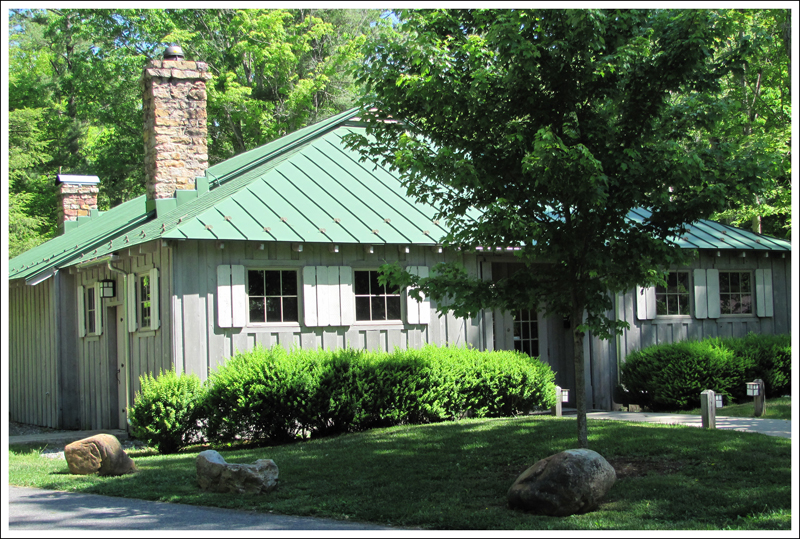
We saw so many reptiles along the hike. Below:  The Visitor’s Center is both the start and end point of the hike.

Visitor Center

The descent on this hike was long and followed a (usually) gentle grade.  The one thing that made it tricky was the dryness/looseness of the soil and the narrowness of the trail.  There were a couple spots along the Mountain Side Trail that had precipitous drops on the downhill side.  For some stretches, the trail was only 12-18 inches wide – not even wide enough to use trekking poles.  Every now and then, a rock would slip off the edge of the trail, and bounce endlessly down the steep mountainside.   It made me think that someone could get hurt pretty badly if they took a wrong step.  On these sections, I just kept my eyes straight ahead on the trail and my feet.  If I looked downhill, I felt dizzy.

I think in early June, a lot of this loop hike will be extremely gorgeous!  I noticed a lot of the trail was lined with mountain laurel.  When it blooms in a few weeks, it should be amazing.

All in all, I was really impressed with Douthat State Park.  The trail system there is pretty expansive and well-maintained.  I’ll look forward to visiting the area again sometime.

Trail Notes

  • Distance – 7 miles loop
  • Elevation Change – around 1400 feet
  • Difficulty – 3.  Some sections are tougher than others, but we still felt it was fairly challenging.  The first couple of miles are the toughest.
  • Trail Conditions – 3.  The trails were in decent shape, but some were a little overgrown and there were some areas affected by landslides that made for a narrow trail and careful footing.
  • Views3.  The views are nice, but they are obstructed.  You won’t find overlooks with expansive views on the trail, but you do see pretty mountainous scenery through the trees throughout your hike.
  • Waterfalls/streams – 1.5 There are some streams that might be really beautiful in times with lots of rain.  The water was down to a trickle when we visited.
  • Wildlife – 2. We saw a couple of snakes on the trail, a few fence lizards, and some different bird species.
  • Ease to Navigate – 3.  The trail is well-marked, but there are a lot of intersections and different trails to make this a loop.
  • Solitude – 3.  We were surprised since it was a state park, but we only saw one hiker and a couple of mountain bikers on the trail.

Directions to trailhead: Take I-64 to exit 27 near Clifton Forge, VA heading north on state route 629.  Continue on this road until you enter the park.  Pay your fee at the gate and park at the park office just ahead on your right.  The trail starts to the right of the park office entrance.

South Valley Trail

The South Valley Trail is a part of the 35 miles of hiking trails in Prince William Forest Park.  It is a nice stroll that takes you along the Quantico Creek.

Quantico Creek in the fall.
Even though the foliage was past peak on our hike, there were still some pretty spots along Quantico Creek.

Adam Says…

We went up this past weekend to visit Christine’s parents.  Her dad’s birthday is on Halloween and he usually likes to do something active to help celebrate.  He suggested a possible bike and hike in Prince William Forest Park.  We were expecting a lot of rain that weekend, so we decided to just do a hike.  While it was raining a little before we got there, we managed to do the hike with only a light drizzle at the end of the hike.

The sign marking the South Valley Trail
The South Valley Trail runs in a large loop around the park.  Pictured below: The hike starts off on Mawavi Road; A bridge over Quantico Creek;  Adam checks out evidence of beaver activity.

Walking down Mawavi Road The arched bridge at the end of the lake Evidence of beaver activity in the area.

Many people do not realize that Prince William Forest Park is part of the National Park Service.  The land was given this protection to find a new use for the land under Franklin D. Roosevelt’s New Deal.  It was used as a training school for the military during World War II, but was turned back over to the Park Service in 1946.

While the overall South Valley Trail is about nine miles, we decided to do the portion that highlighted the South Fork of Quantico Creek.  Her dad dropped a bike off at parking lot “I” and then we proceeded to lot “G” to start our trip.  Christine’s father used the bike as a shuttle at the end of the hike.  Upon reaching lot “I” at the end of the hike, he biked back to the car and then returned to pick the rest of us up.

We began by walking on Mawavi Road.  In about .4 mile, it intersects with the South Valley Trail.  We took a left on this trail.  The trail runs along Quantico Creek for the majority of the rest of this hike.  Shortly after joining the South Valley Trail, you will see a very narrow lake.  There are a couple of cabin camps on the opposite side of the lake, which are often used by Boy Scouts.  In 1.6 miles from the start, you will reach a junction with the High Meadows Trail.  Continue straight on the South Valley Trail until you reach the Scenic Drive.  Take a right and head down the road to your other vehicle at parking lot I, just about a tenth of a mile ahead.

Quantico Creek was dammed to create a lake.
Part of Quantico Creek has been dammed to create a lake. There is a group camp on the lakeshore.

We were expecting to see more color in the leaves this year, but it seems that things near the creek were a little past peak.  We did see lots of signs of beavers in the area, but we didn’t see any actual beavers.  The bridge and lake were interesting to view along the way, but this was more of a nice stroll through the woods than a momentous hike.  The grade during this hike was a mix of hills and flats, so most people could attempt this hike without much difficulty.  What amazes me most about this area is that it doesn’t seem to be heavily used.  You would think with the proximity to D.C. and the hordes of Northern Virginians, that it would be crawling with people.  But, we’ve been here several times and there doesn’t seem to be that many visitors.

Christine Says…

I’ve hiked along the South Valley trail many times over the years.  When I was a Girl Scout, we camped in the park frequently.  We took many day hikes along this trail.  As an adult, we’ve hiked it as a family several times.  In fact, it was the first trail we hiked after my younger brother returned from his first tour of duty in Iraq.   Like Adam said,  the South Valley trail is nothing spectacular.  There are no grand vistas or thundering waterfalls.  Instead, it’s simply a place to enjoy a quiet and peaceful walk through the woods.

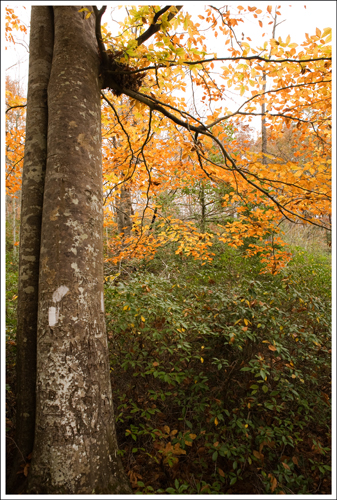
There wasn't much foliage left, but this tree was pretty.
There wasn’t much colorful foliage left on the hike.  Pictured below: A pretty spot along the creek.

Quantico Creek in the fall.

The foliage was about a week or two past peak when we hiked this year.  There were a few ginkgo and beech trees still holding onto golden leaves, but most of the trees were bare or brown.  The last time I hiked this area was fall of 2007.   Even though it was much later in the season, the color lingered until almost December that year.  The photos below were taken on November 17, 2007.   I guess this is even more evidence that fall came and went early this year.

The foliage along this hike was much prettier in 2007.
The foliage along this hike was much prettier in 2007. Pictured below: A couple more shots from fall 2007.

The foliage along this hike was much prettier in 2007. The foliage along this hike was much prettier in 2007.

The terrain of this hike is very easy.  Since Prince William County doesn’t really have mountains, the park lacks tough grades and long climbs.  I would describe the trail as crossing rolling terrains.  You’re almost always walking uphill or downhill, but ascents and descents are never steep or long.  Quantico Creek is a lovely and lazy waterway along the trail.  There are a few places where the water forms small rapids and cascades, but most of the time it’s just a quiet, smooth ribbon of water through the woods.

The morning in Prince William Forest was a nice way to spend some time as a family.

Trail Notes

  • Distance – 3.1 miles
  • Elevation Change – Negligible
  • Difficulty – 1.  Not much uphill the way we traveled.
  • Trail Conditions – 4.  The trail is narrow, but in great condition.
  • Views –0. No views to really see.
  • Waterfalls/streams – 3. You will constantly get views of the stream nearby, but the water is usually fairly still.
  • Wildlife – 1. You’re likely to only see deer around here.  However, gnawed trees lead to the belief that there are beavers in the area.
  • Ease to Navigate – 3.5. A few turns, but easy to follow.
  • Solitude – 3. It’s Northern Virginia, so expect some people, but you should still have decent solitude.

Directions to trailhead:
From I-95, take exit 150 on to 619 heading west.  The Prince William Forest Park entrance is on the right.  Once you pass the gate, take a left at the first fork.  Once you pass parking lot C, take your next left.  To do the trail as a shuttle as we did, leave a vehicle or bike at lot I and then proceed to lot G.  Walk down the Mawavi Road to start the trip.

Molly’s Knob

Molly’s Knob is the best known hike in Hungry Mother State Park.  On a clear day, views of Mount Rogers can be seen from the summit.

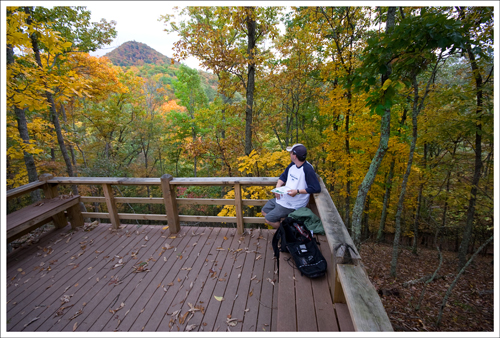
Adam takes a look at Molly's Knob from the viewing platform lower on the trail.
Adam takes a look at Molly’s Knob from the viewing platform lower on the trail.

Adam Says

On our way down to Abingdon for a weekend of hiking and biking in the Highlands, we decided to stop by Hungry Mother State Park.   There is an interesting legend surrounding the origin of the park’s name.  Native Americans destroyed many settlements south of this park on the New River.  Molly Marley and her child survived the raid and were taken captive.   Eventually they escaped the raiders.  They wandered through the wilderness until Molly finally collapsed.  Her child wandered away, hungry and alone.  Eventually the child was found by residents of a small settlement near where the park stands today.  All the child would say was “Hungry Mother”.  A search party went out to find Molly, but they were too late.  There are some variations to this legend, but it is an interesting tale.

The colors of the fall leaves were really quite gorgeous in the park, so we decided walk around a bit.  Of course, the hiking enthusiasts that we are, we decided to try the hike up Molly’s Knob.

We parked in a small lot on the northeast side of Hungry Mother Lake.  We left the car and began walking the Lake Trail Loop, giving us glimpses of the beauty of the lake.  After .5 miles, this joined the blue-blazed Ridge Trail.  We continued on this up a steady uphill grade for .2 miles until we reached the viewing platform pictured below.  With the beautiful colors on the mountain of Molly’s Knob in view, we decided to take the remaining trip to the summit.  We continued up the white-blazed Molly’s Knob Trail for .9 miles.  The trail was marked as a black diamond trail, but we didn’t find this portion to be too difficult.   After the .9 miles, we began the fuchsia-blazed Vista Trail.  This was the steepest portion of the hike, but once we got to the top, we were quite impressed by the view.  While I scurried around looking for a geocache, Christine enjoyed taking a few pictures of the views.  We shortened the trip back by just following the Molly’s Knob Trail to our car.  We were worried about the hike taking too much out of us for our trip to Mount Rogers the next day, but it was worth the risk to see these views.

There are several geocaches to find in Hungry Mother State Park, but here are the few that I located on the trail:

foliage
The forest was filled with foliage of every color. Pictured Below: The golden foliage along this trail was especially spectacular. Adam even found several geocaches along the way.

geocache foliage and pdp

Christine Says…

Going on this hike was completely unintentional.  We wanted to drive through Hungry Mother State Park just to see what the park had to offer.  But the foliage along the lake was so pretty, that we felt compelled to get out of the car and walk a bit.  I thought a short stroll along the level Lake Trail would be pleasant and scenic.

After a short bit of walking, we reached the junction of the Ridge Trail, and decided to turn there to make a short 1 mile loop back to the car.  At the top of the ridge, we saw the platform overlooking Molly’s Knob off in the distance.  Next to the platform, a sign indicated that the summit was only 1.3 miles further.  The short distance made the summit far too tempting, and we were on our way.  I kind of regretted not changing clothes before we hiked.   The impromptu nature of this hike had me wearing jeans, a dressy shirt and my hair was down.  About halfway up the steep climb, I would have traded just about anything for a ponytail holder.  As luck would have it, someone left a pack of hair elastics in one of the geocache boxes Adam found.  I was much more comfortable with my hair up, but hiking in jeans is never fun.

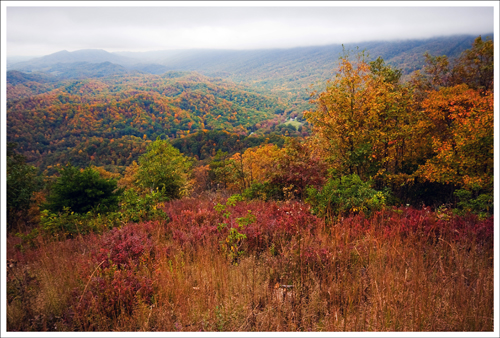
The view from the top was obscured by fog and clouds, but it was still beautiful with all the fall color.
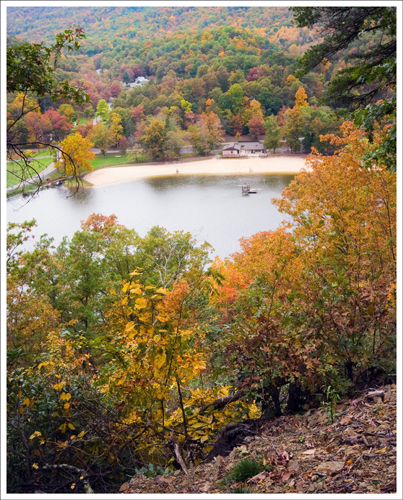
The view from the top was obscured by fog and clouds, but it was still beautiful with all the fall color. Pictured Below:  You get some nice views of the lake along the trail.

lake view

There were some steep sections of trail, but the fall colors were so beautiful I hardly noticed the climb.  We had almost the entire trail to ourselves, too.  We saw just two other solo hikers near the beginning of the hike, but after that we didn’t encounter a single soul.   The wind was rustling through the treetops, sending colored leaves falling down all around us.  Plumes of fog curled around the folds of the mountains.  Off in the distance, we could hear a pileated woodpecker cackling.  In no time, we reached the summit and its beautiful view of the valley.  There were two benches built into the summit, so it was a perfect place to rest before hiking back down.

The trail down was so steep in some places, that momentum had us practically running downhill.  The final stretch back gave us a very pretty view of the lake and the beach below. This hike turned out to be a great surprise!

Trail Notes

  • Distance – 3.8 miles the way we went making a partial loop.  You can shed .4 miles off, by cutting out the Lake Trail Loop trail and Ridge Trail
  • Elevation Change –1000 feet
  • Difficulty – 3. The steepest parts were the Ridge Trail portion and the Vista Trail, but we found it to be a moderate hike.
  • Trail Conditions – 4 The trail is well-maintained and traveled.  We found the Vista Trail to be a little slippery during the rain due to some clay surface.
  • Views –3.5. Great views from the summit and Hungry Mother Lake.  On a clear day, you should be able to see Mount Rogers.
  • Waterfalls/streams –2. You do get some nice views of the lake.  Since it used to be a stream before it was dammed, we thought it was worth mentioning.
  • Wildlife – 1. We saw a pileated woodpecker, but nothing else.  There is some good birding in the area.
  • Ease to Navigate – 4. There are a few switches in trails during the path we chose, but everything was well-marked.
  • Solitude – 4. We only saw two people on the trail on a Saturday afternoon, so I’m guessing it is not very well-traveled.  During heavy camping weekends, I would expect more traffic.

Directions to trailhead:
On I-81, take exit 47 and then take 11 South.  After a little over a mile, take a right on to 16.  Follow this into Hungry Mother State Park (fee required of $2-$3).  Take a right immediately after the P6 lot and continue on the road until you reach a cul-de-sac parking lot.  The sign for the Lake Trail Loop is at the end of the cul-de-sac.