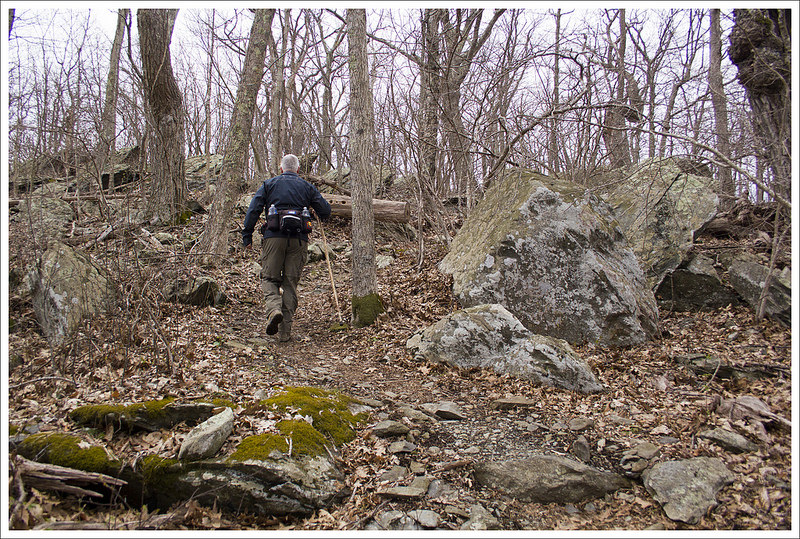
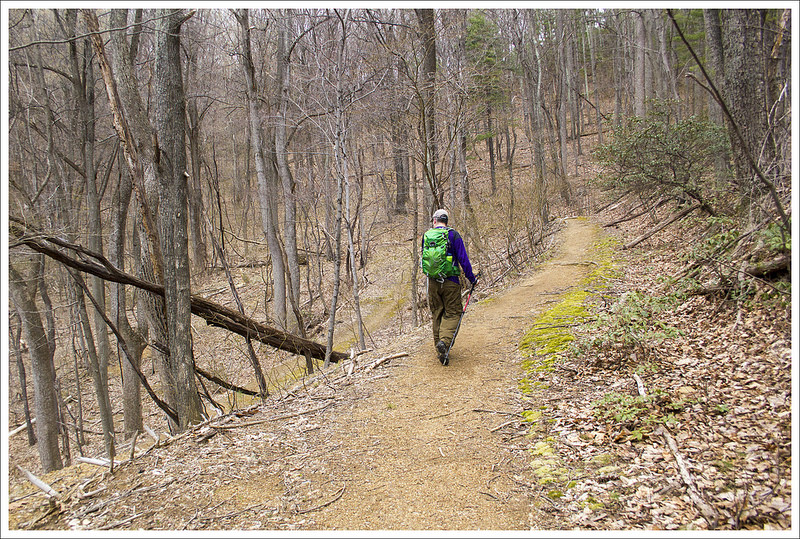
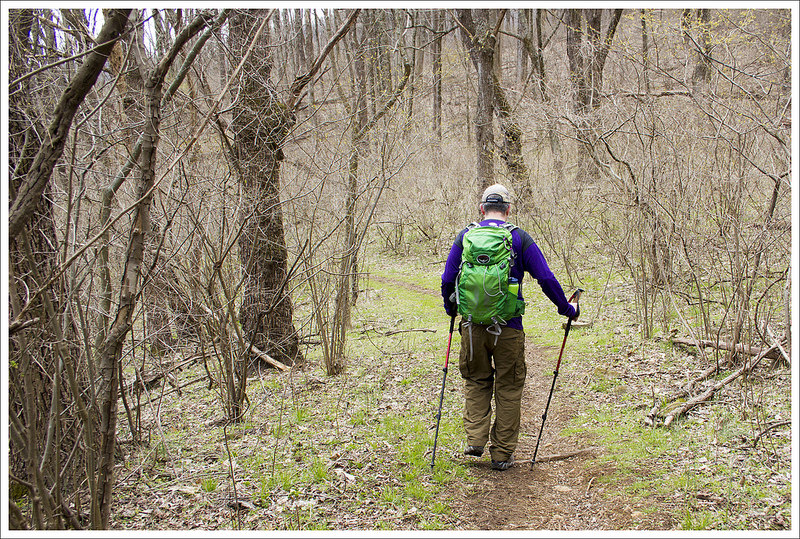
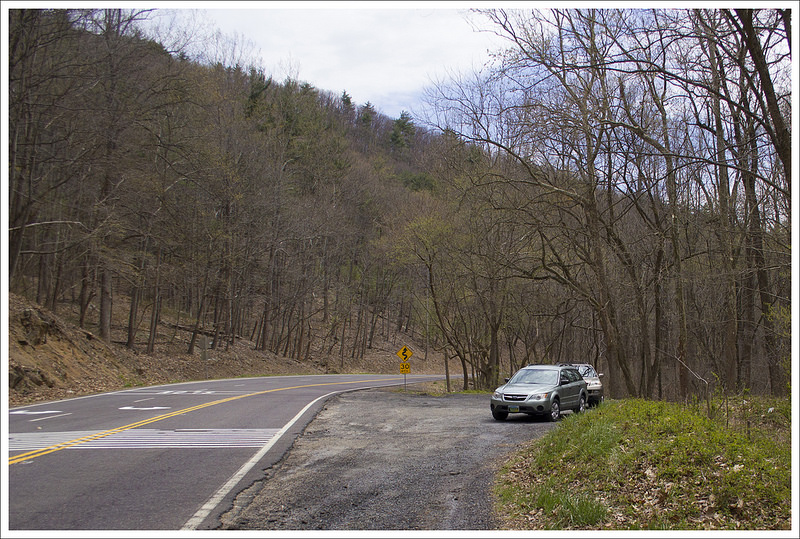
Appalachian Trail – Elk Garden to Buzzard Rock

If you like high meadows and spectacular vistas all-around, this easy 7.2 mile hike along the Appalachian Trail is a perfect fit!  The hike meanders through lovely forest and then takes you across open balds on two of the state’s tallest mountains. It’s a majestic hike!

View the Full Album of Photos From This Hike
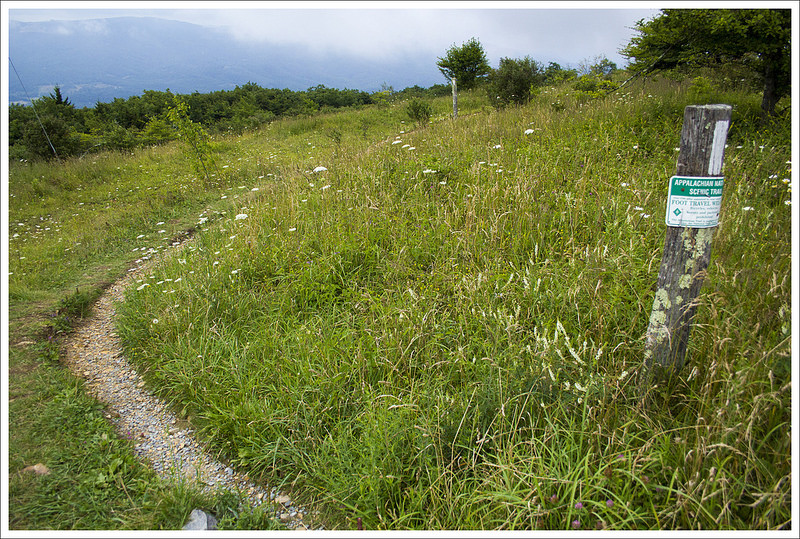
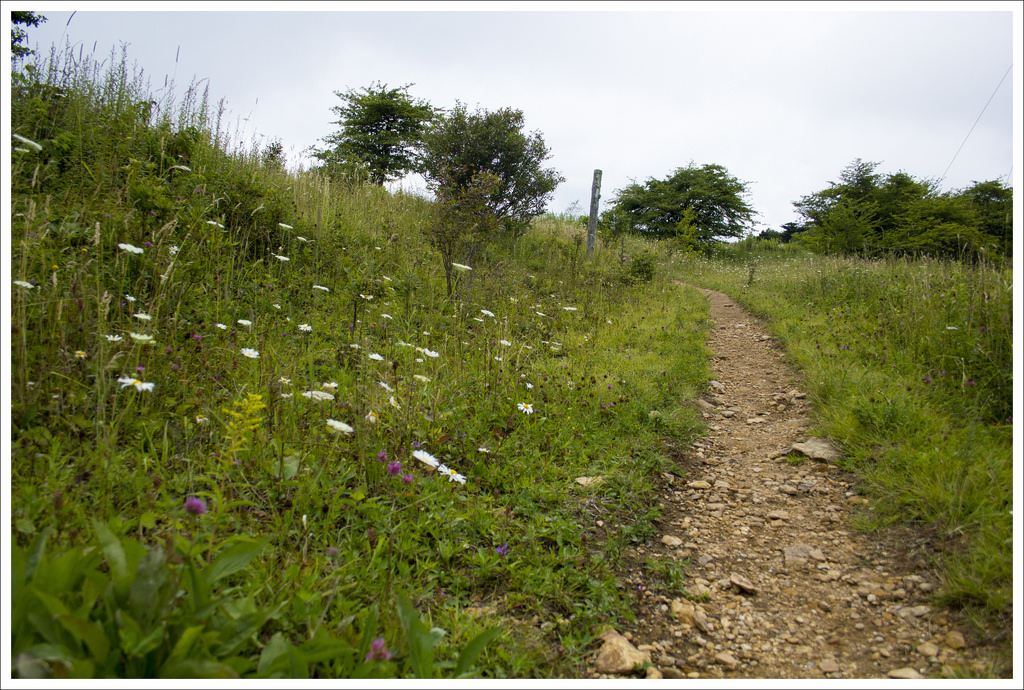
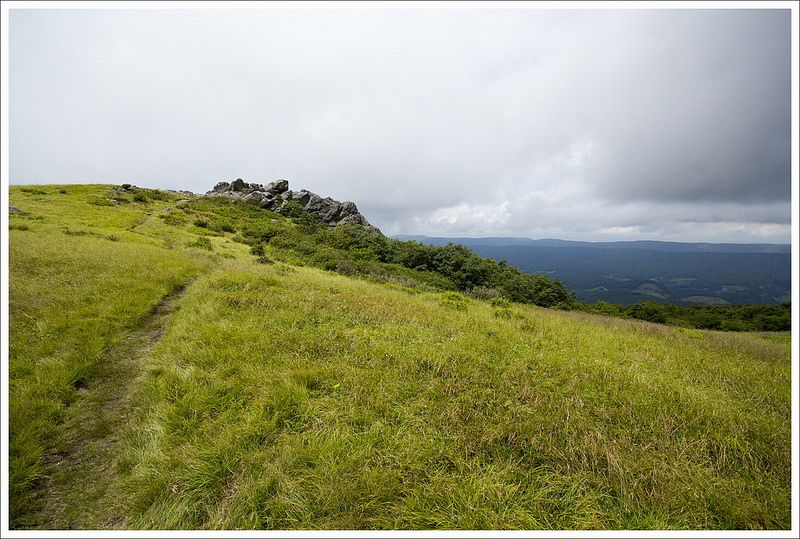
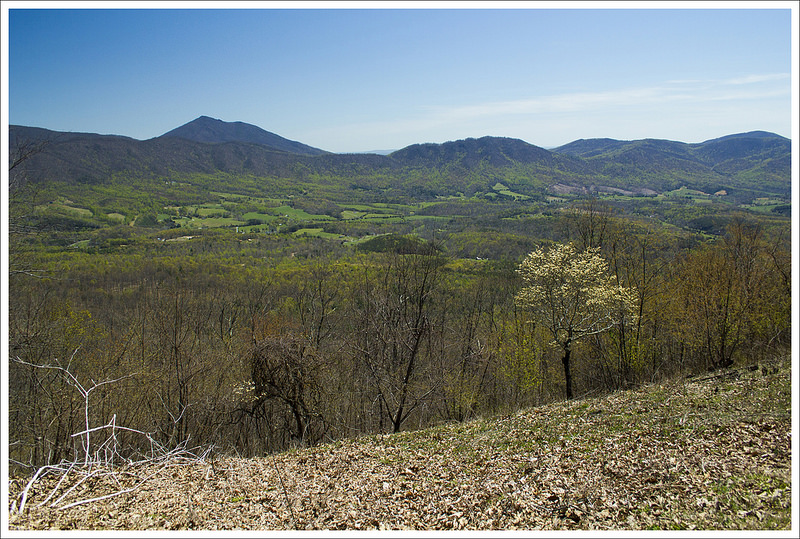
The Appalachian Trail Near Whitetop Mountain
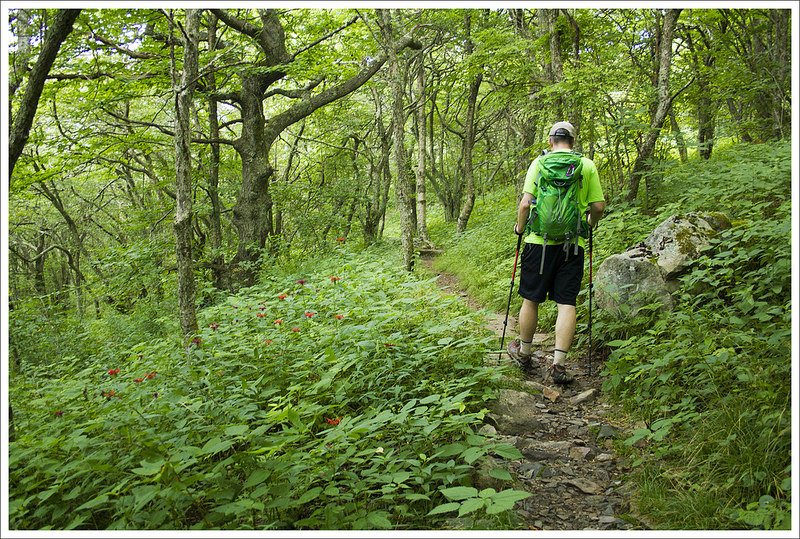
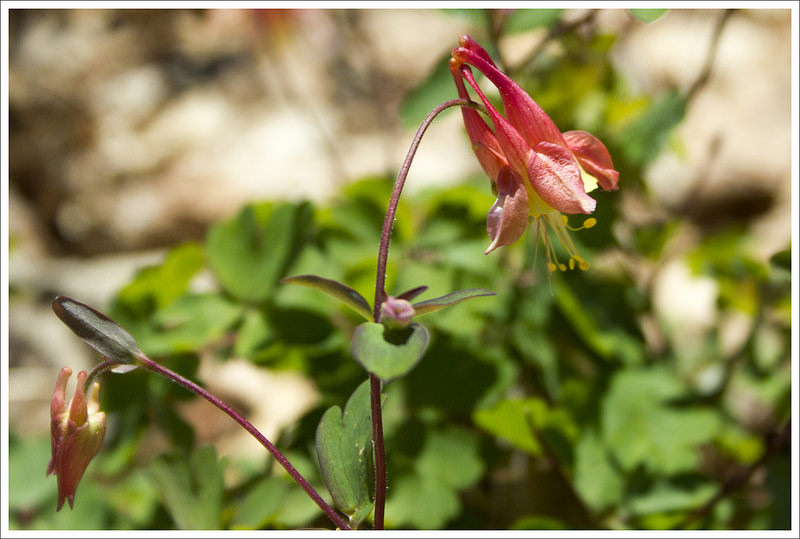
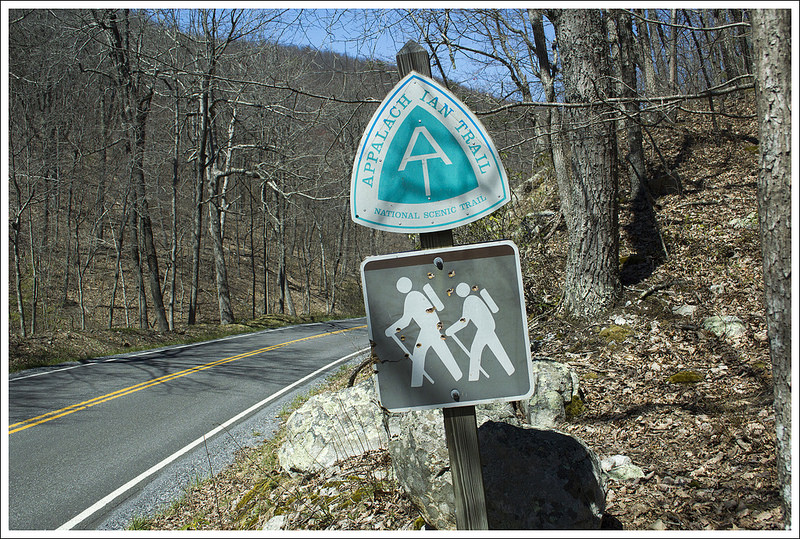
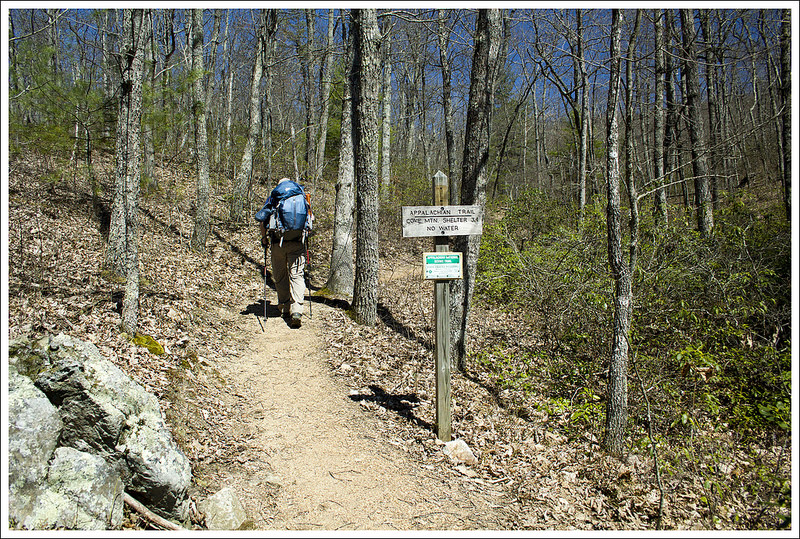
The Appalachian Trail Near Whitetop Mountain.  Below: Hiking the Appalchian Trail; Wildflowers; A buck and a fawn.

The Appalachian Trail Near Elk Garden Flowers on the AT A Buck With a Fawn Friend

Adam Says…

On our trip to southwest Virginia, we did three hikes in three days and they were all very distinct.  We explored the slot canyons of the Great Channels, we discovered the serene waters of Devils Bathtub, and then we took in majestic views from a high bald on this trip to Buzzard Rock.  All of the experiences on these three hikes were memorable in different ways and when we were talking about our favorite, is was hard to pick one.  The day we did this hike was my birthday and I can’t think of a better way to celebrate.

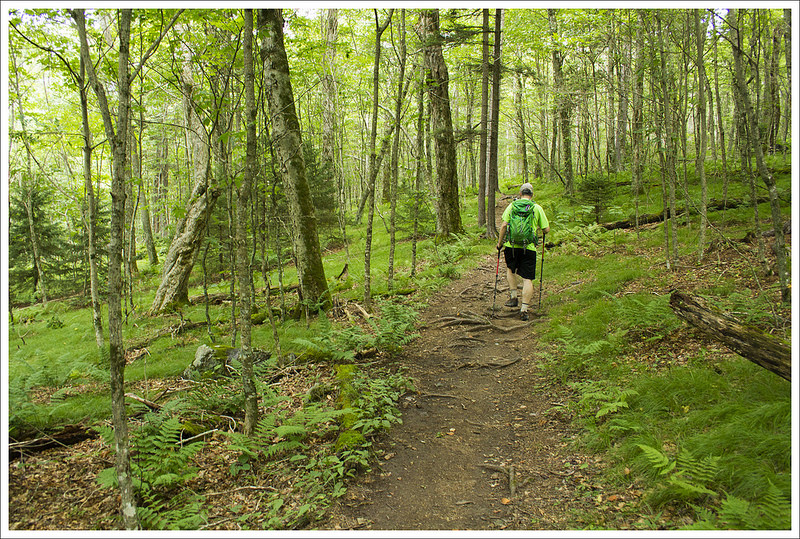
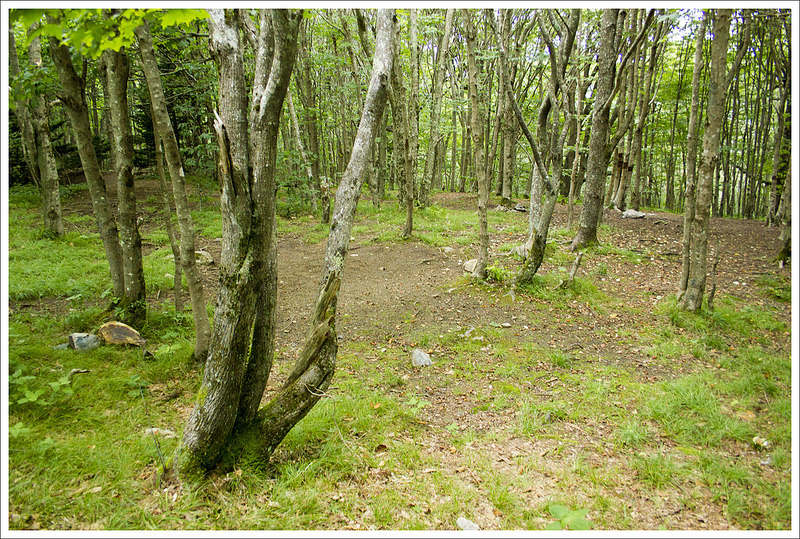
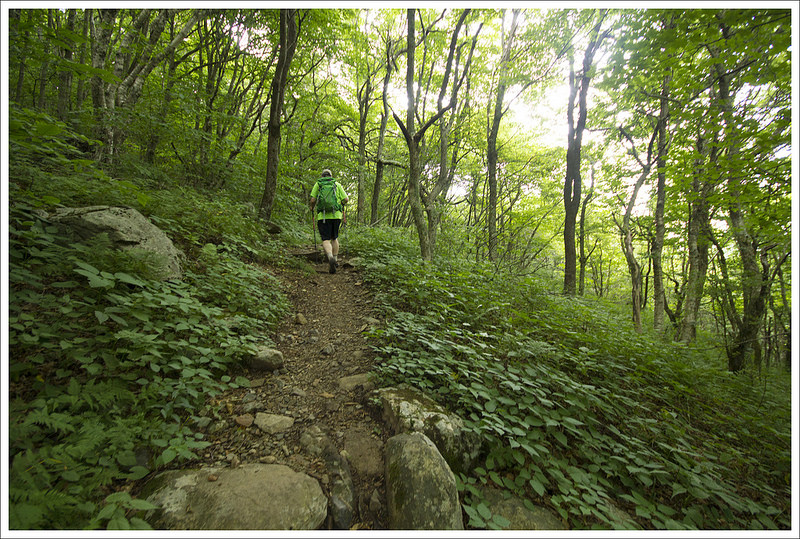
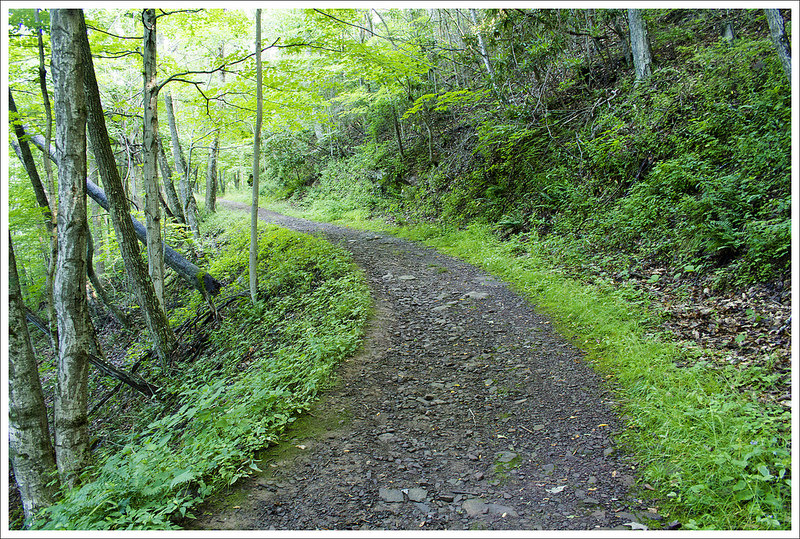
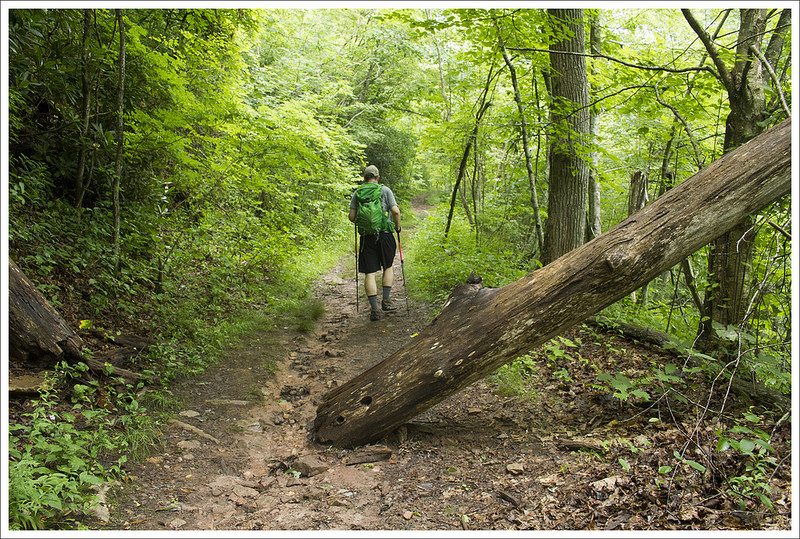
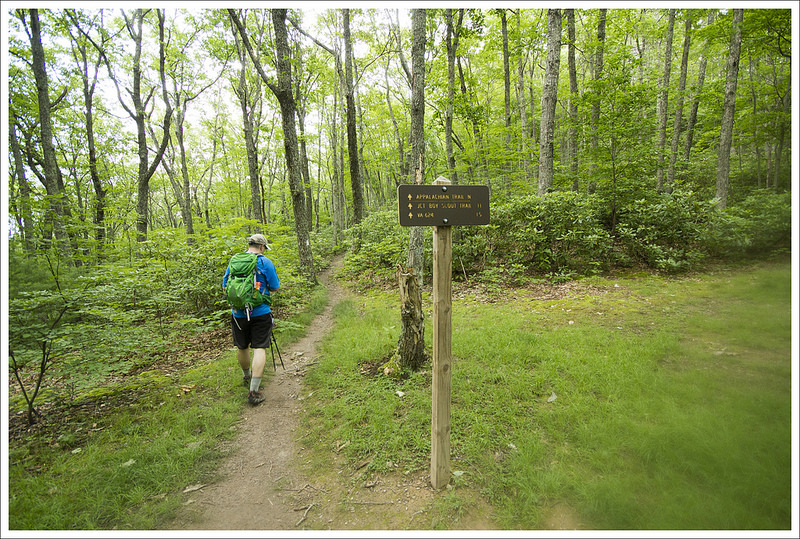
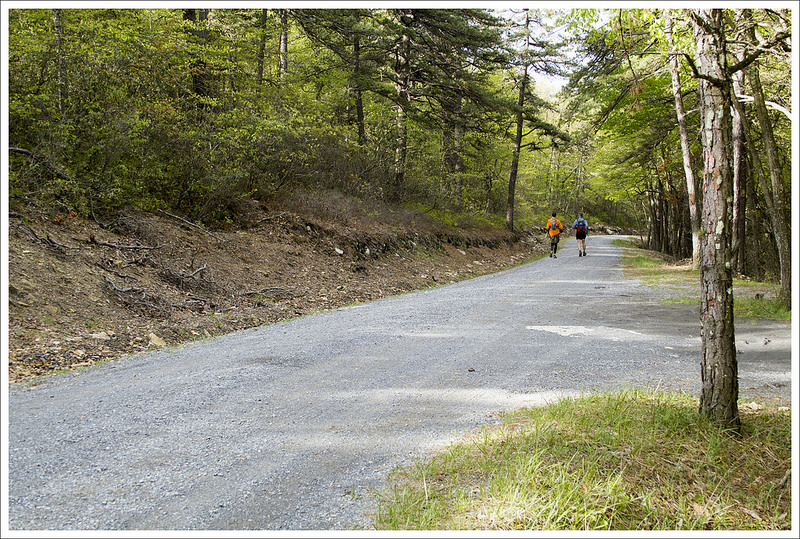
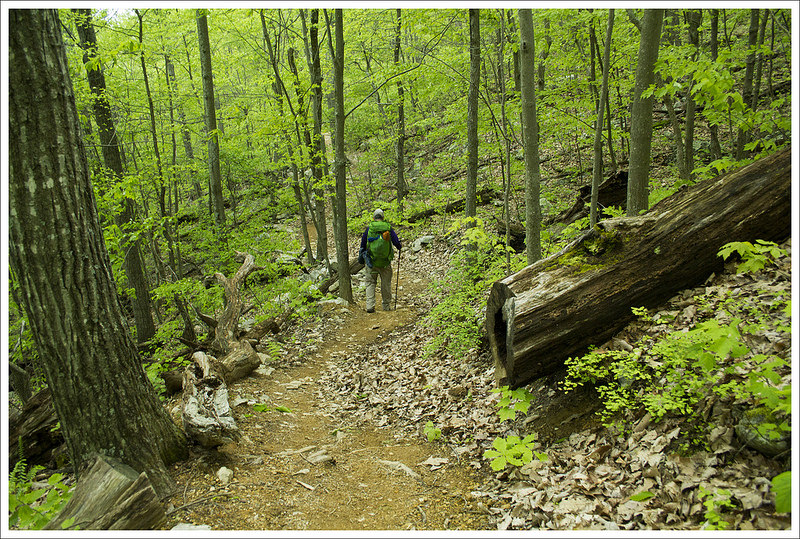
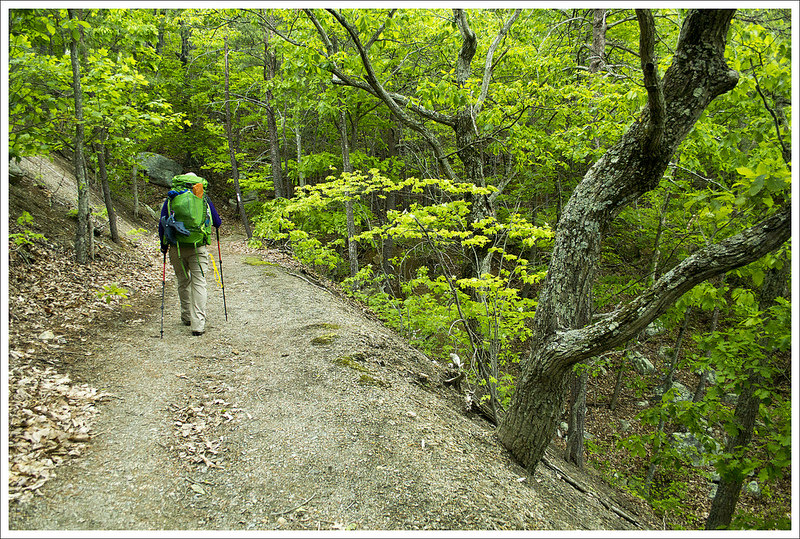
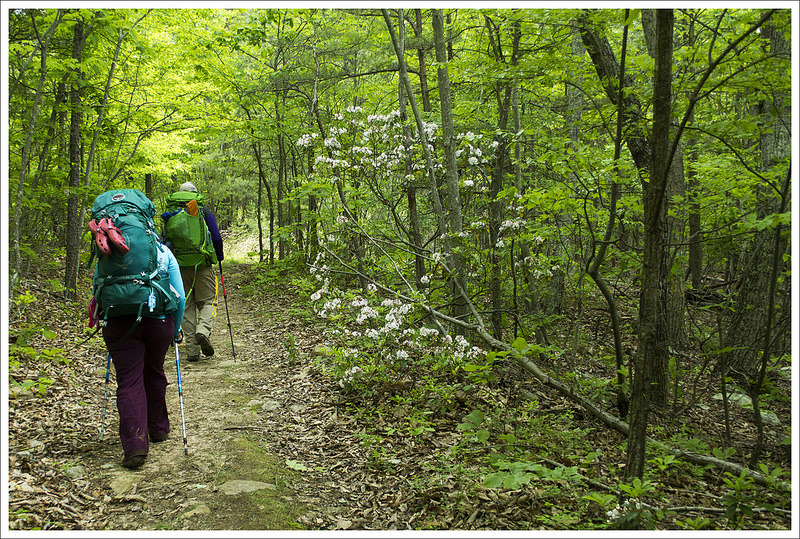
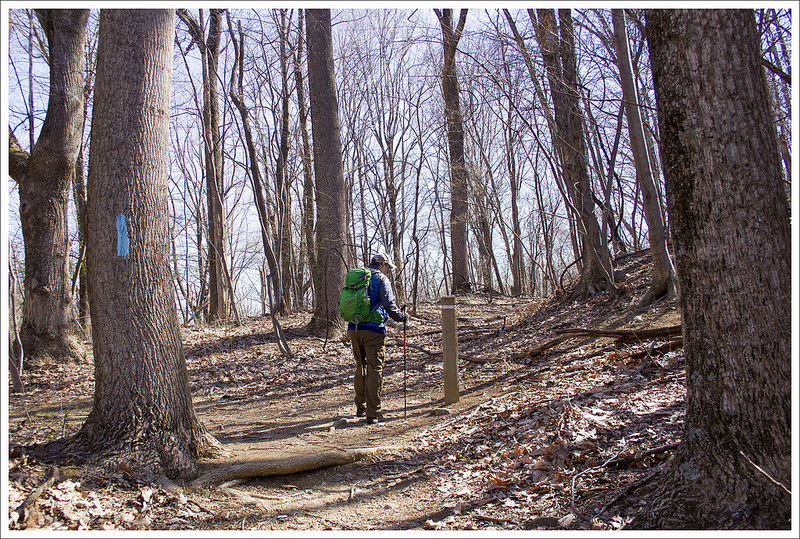
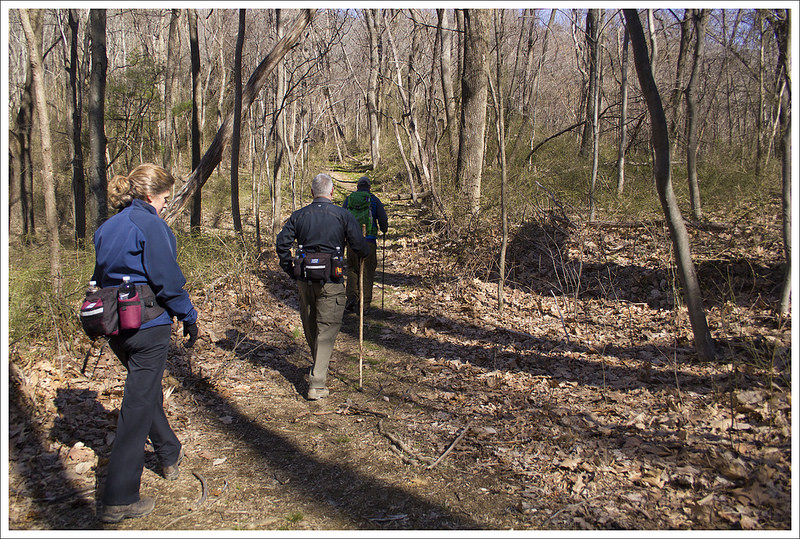
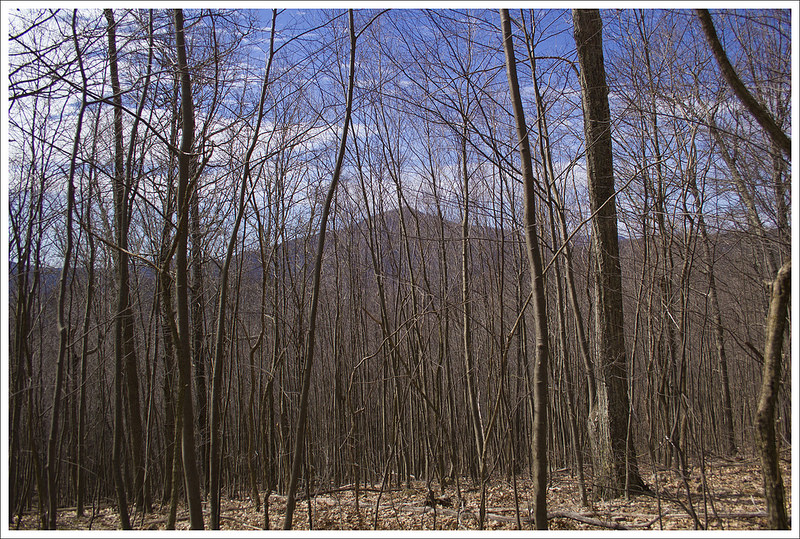
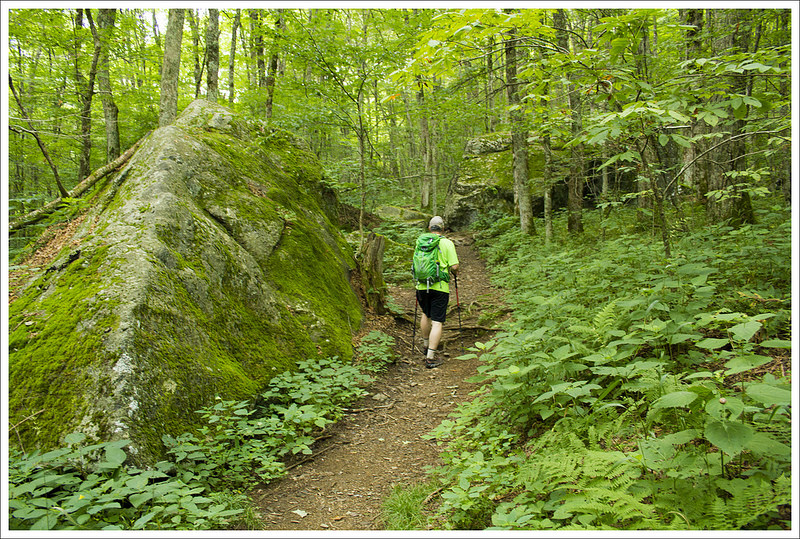
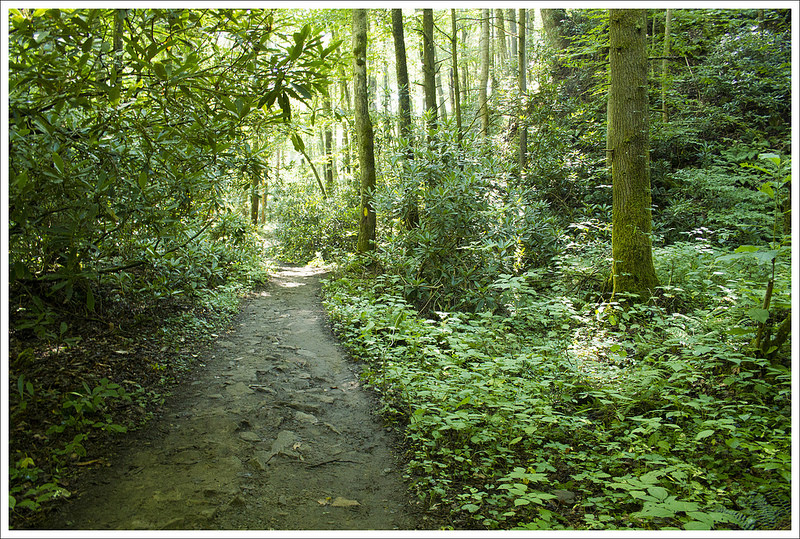
The trail starts from the Elk Garden parking lot by entering the woods behind the parking lot and heading south on the white-blazed Appalachian Trail.  The trail ascends mostly over the first two miles, but we never found it too difficult (you only gain about 700 feet of elevation over those two miles).  The trail bisected a sea of fern and short understory with tall trees above, painting a beautiful forest walk.

The AT in Mount Rogers National Recreation Area
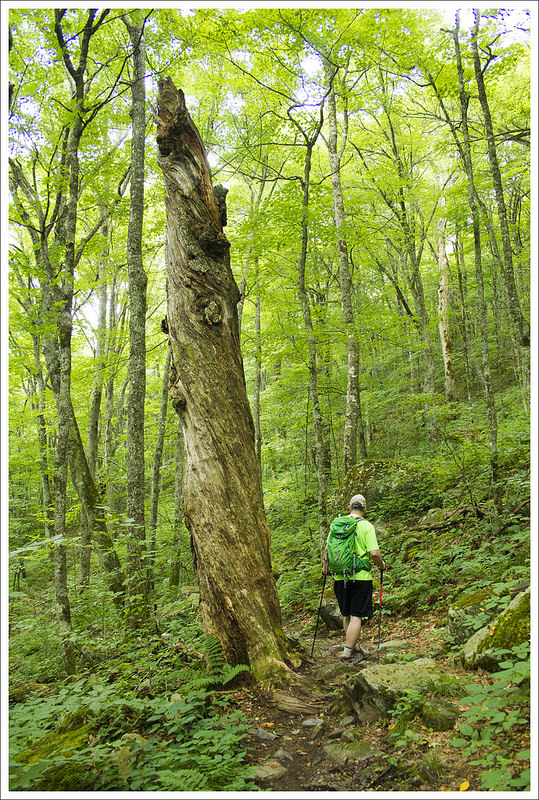
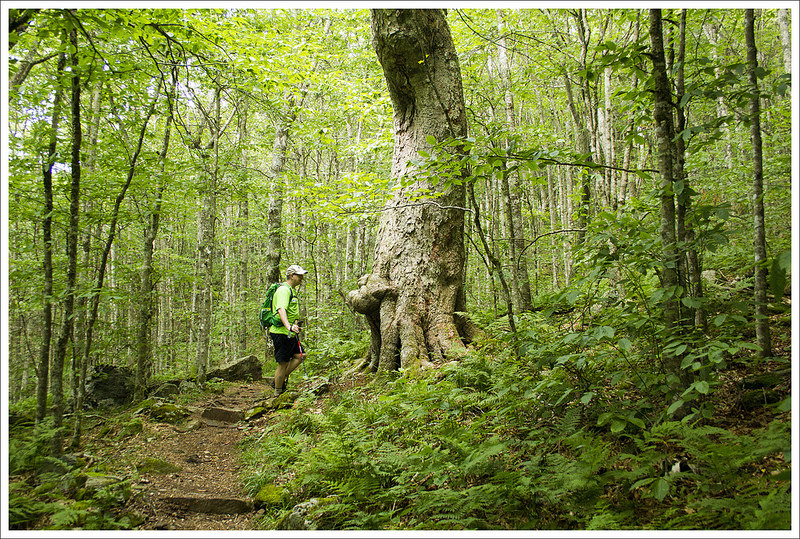
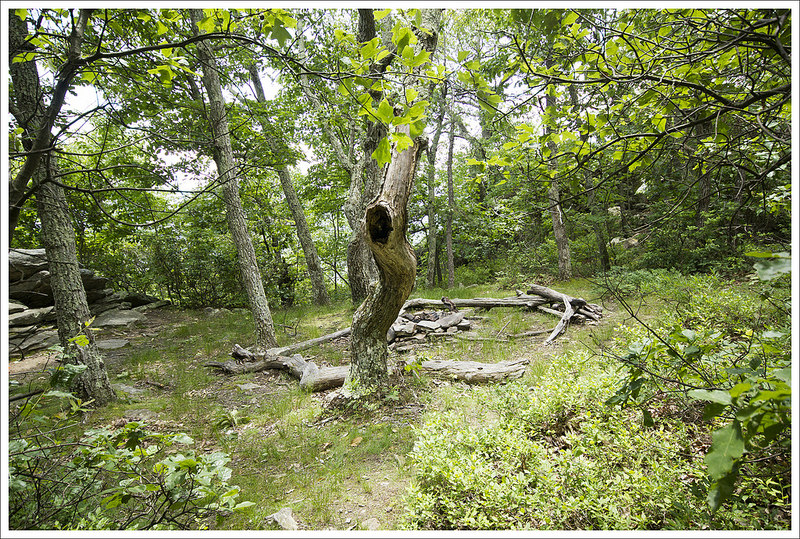
A twisted old tree along the AT in Mount Rogers National Recreation Area. Below: Appalachian Trail scenes.

Pretty Open Forest Along The AT in Mount Rogers National Recreation Area Pretty Open Forest Along The AT in Mount Rogers National Recreation Area

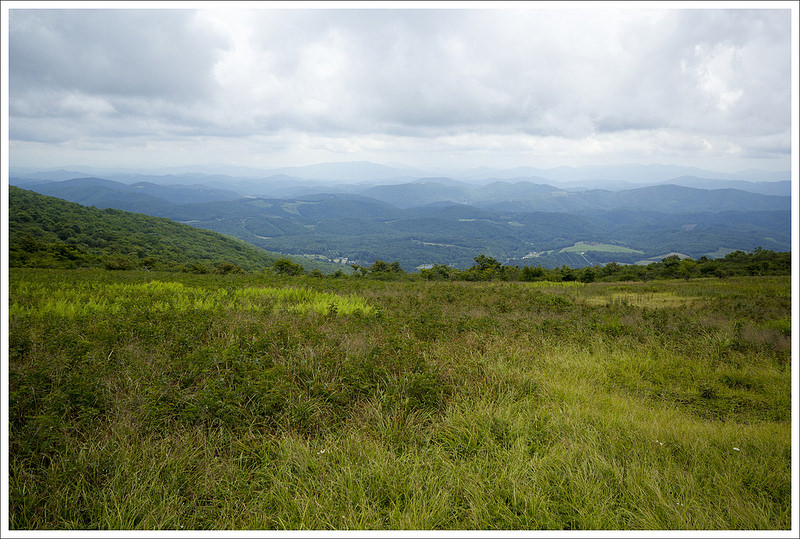
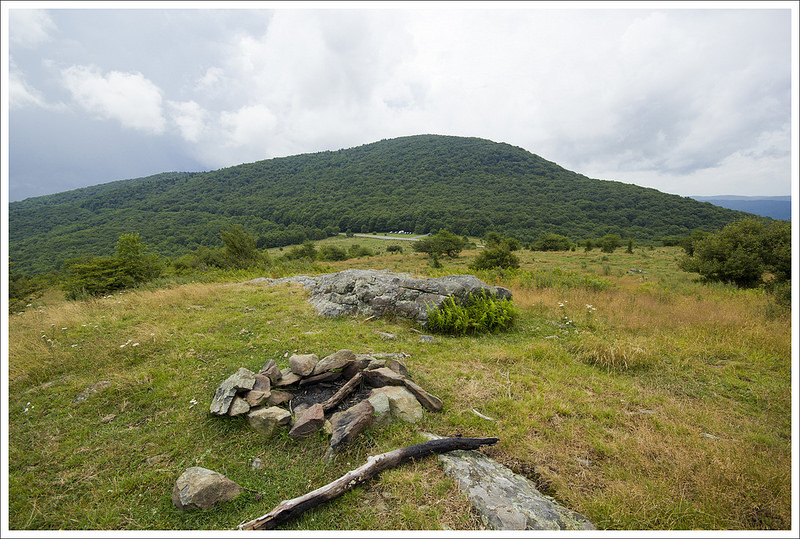
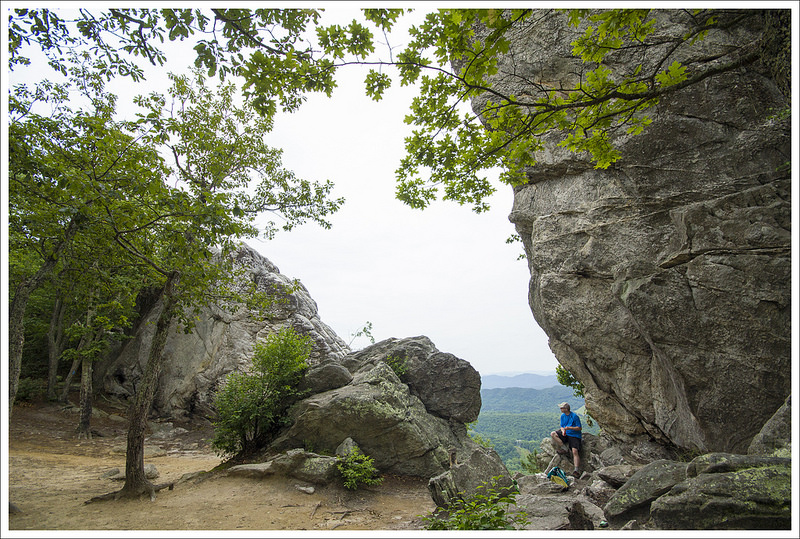
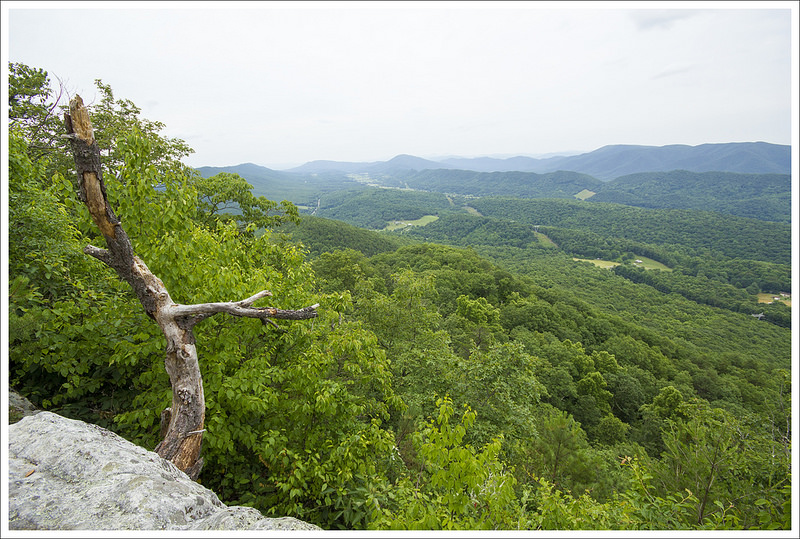
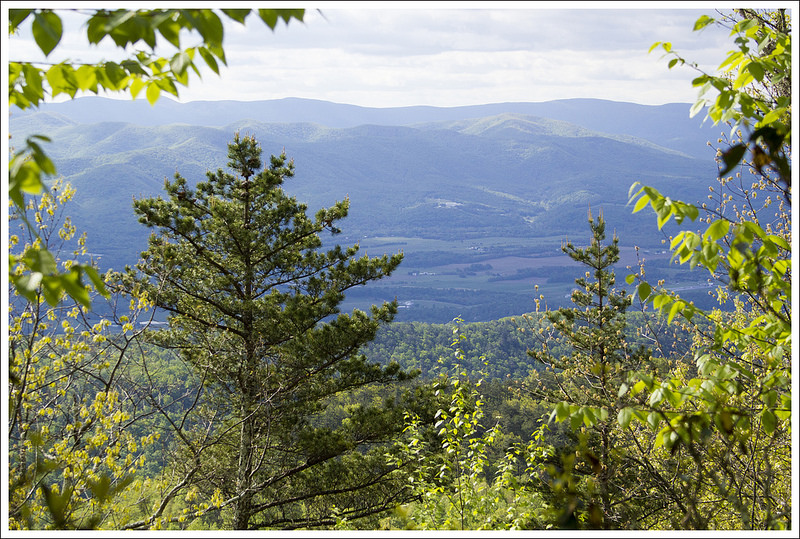
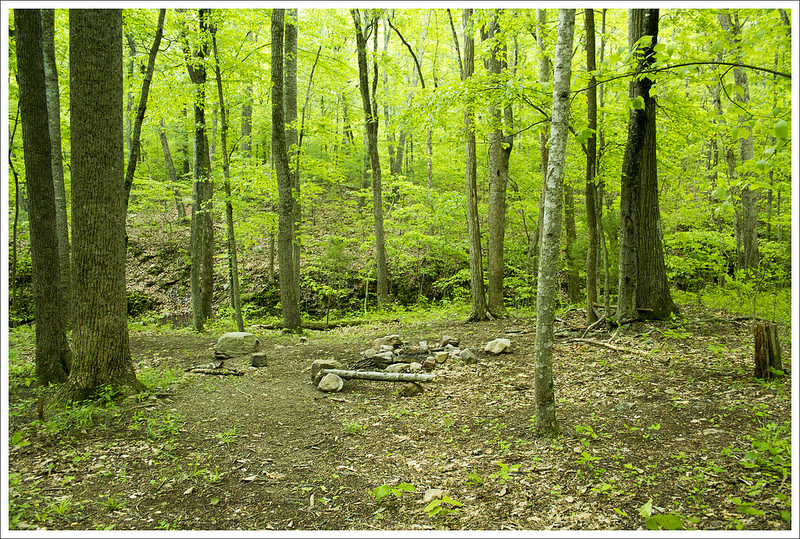
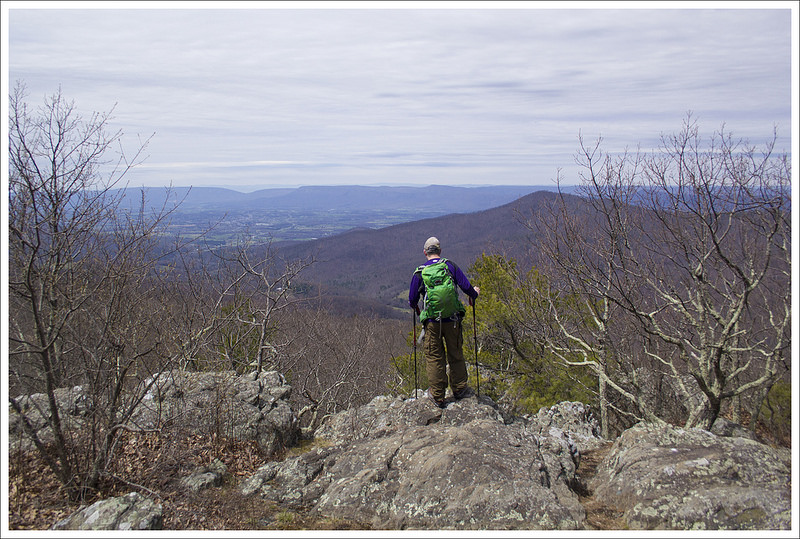
At 1.7 miles, a small trickle of a stream passed over the trail, but it was quite dry and not a reliable water source.  At 2.4 miles, we passed by a series of campsites to the left of the trail and crossed over Whitetop Mountain Road  and came into an open field.  The views around us were quite hazy, but we know on a clear day you would have some magnificent views.  At 2.5 miles, we walked pass a small spring that was on the eastern (left) side of the trail.  We talked briefly to a couple of AT section hikers were pausing to eat lunch and refill water bottles here.   The trail descends slightly, dips into the woods again, and then emerges into the open bald leading up to Buzzard Rock.   The views are outstanding along the open bald and the trail leads you right to the only outcropping of rock nearby at 3.3 miles, known as Buzzard Rock.  From the summit you can also see another trail leading up to Whitetop Mountain Road.  According to peakery.com, Buzzard Rock is the fourth highest peak in Virginia at 5,095 feet.  You can see the Whitetop Mountain peak and Mount Rogers from the rock, which are the third and first highest peaks respectively.

At Buzzard Rock and the open bald surrounding area, you have panoramic views to both the east and west.  There were a large bank of clouds moving our way, so we knew some rain was likely.  We ate some lunch and talked to a couple at the summit.  The man we talked to had been visiting this spot since he was in high school in the early 1960s.  He told me that when he first visited nearby Whitetop Mountain, there used to be cabins at the top.  Whitetop Mountain Road used to have a toll gate where they would charge $2 per person in the car to drive to the top and $2 per person to stay in the cabins.  He and his friends would hide in the trunk to keep from paying and climb in the windows to avoid the extra charges.  He told us how they would knock on the cabins to inspect who was staying there and they would have to jump out the window to avoid being caught.  They also charged $1 per person to take the hike down from Whitetop Mountain to Buzzard Rock.  So, he was enjoying doing this hike for free these days.  Many people that visit Buzzard Rock tend to drive up Whitetop Mountain Road and then hike down from the road, for a short but easy out-and-back.  Another interesting piece of trivia about Whitetop Mountain is that they used to hold a folk festival in the 1930s here and Eleanor Roosevelt visited in 1933, during her first year of being First Lady, which drew 20,000 visitors to the mountain.

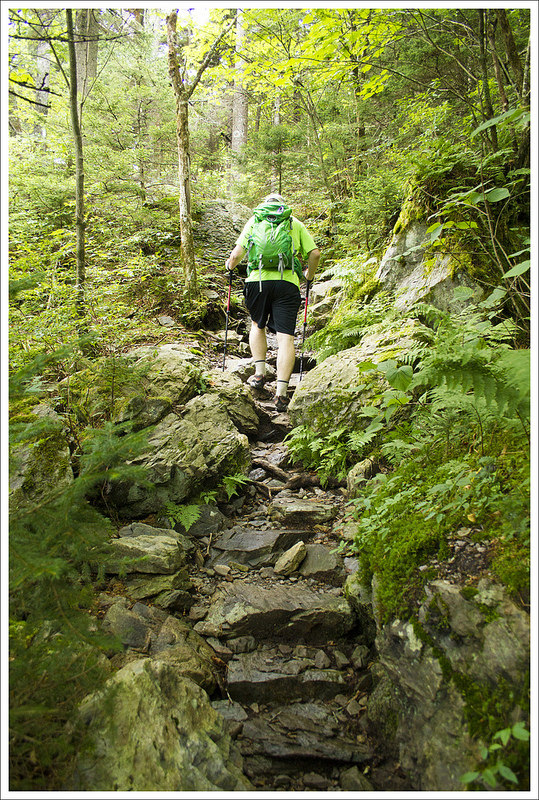
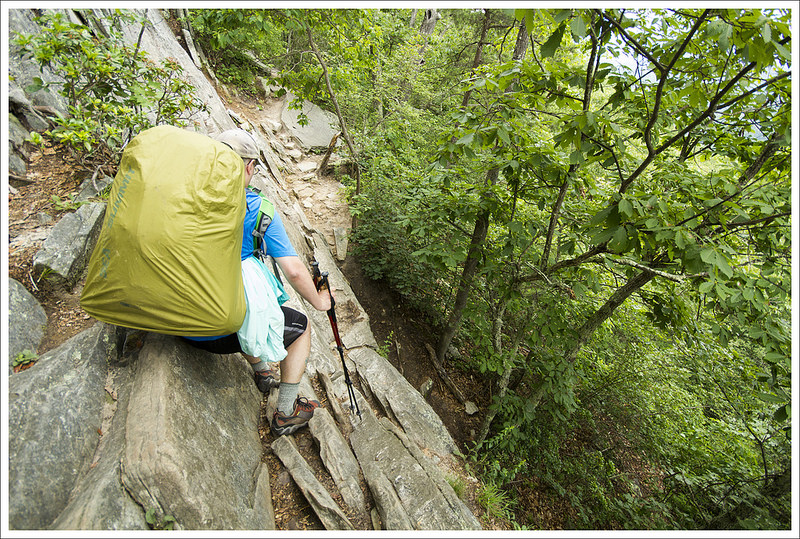
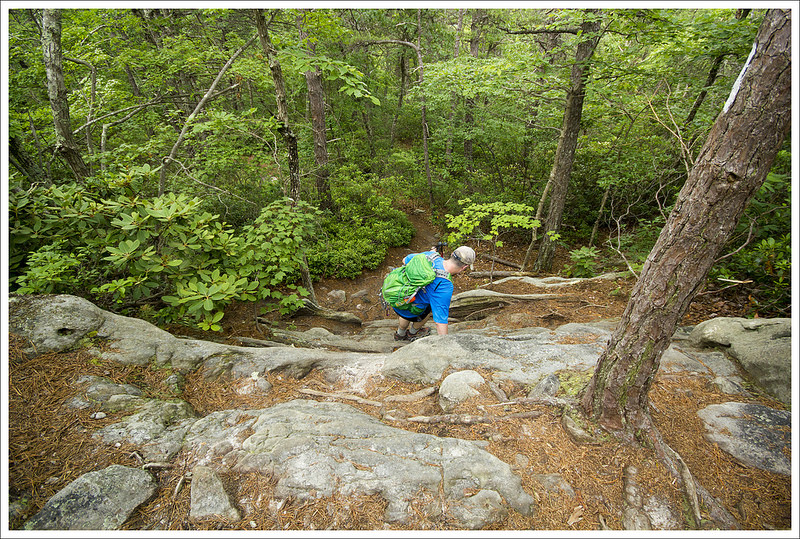
Rocky Steps Along the Appalachian Trail
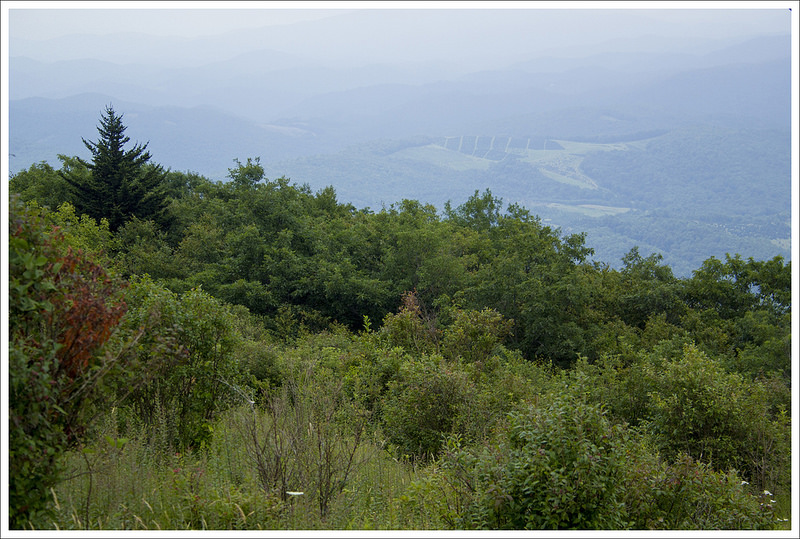
Rocky Steps Along the Appalachian Trail. Below: Campsites near the road crossing; Entering the high meadows; Foggy view looking at christmas tree farms.

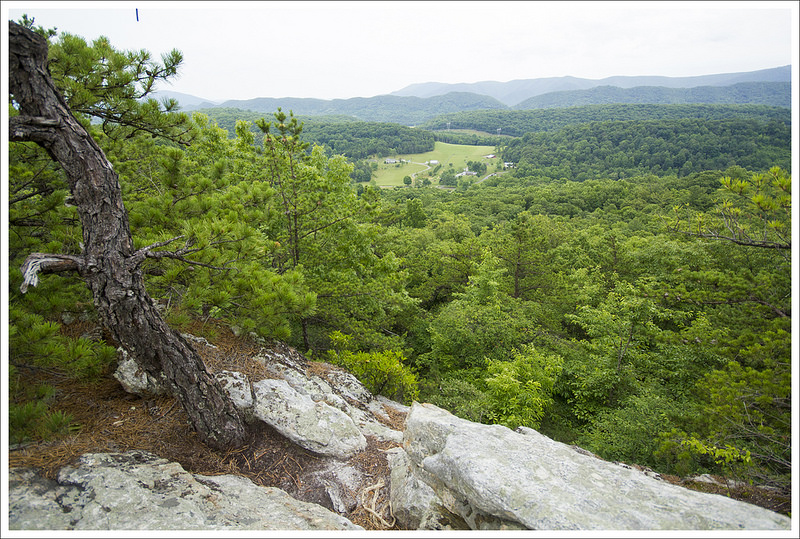
Campsites Near Whitetop Mountain Open Meadow Walking Near Whitetop Mountain View from the Appalachian Trail of Christmas Tree Farm

We decided to head back the way we came (make sure you stay on the AT trail and don’t take the path to Whitetop Mountain Road) and almost as soon as we ducked into the woods, it started to rain.  We made a quick choice to put on our rain gear and within minutes we were in a full downpour.  We made haste along the trail on our return.  While this would have ruined some people’s spirits, we enjoyed walking through the rain.  We saw a few tents on our way back from people that had quickly set them up to escape the downpour.  About a mile from the end of the hike, the rain stopped and we reached our car at 6.6 miles.

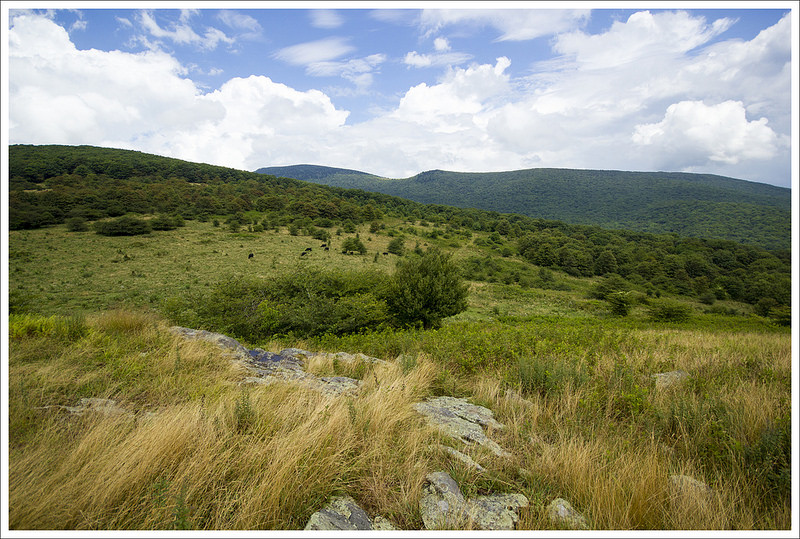
After seeing it listed in our AWOL Appalachian Trail guide, we decided to continue on the AT to check out another view from Elk Garden.  We dumped some of our wet gear, crossed the road, and made our way up a steep hill for an added on .3 miles to another plateau.  We did see more views from this hill summit and saw a large herd of cows in the valley below us (we had seen humongous cow patties on our way up the hill, so we thought we may encounter some).  We took a few minutes checking out the views. We then descended the hill and returned to our car yet again.  It was a great day on the trail and we were surprised at how great the views were on this hike!

Christine Says…

This hike was the perfect finish to our four-day visit to southwest Virginia!  We aren’t terribly familiar with the trails in this area, so when I was looking for another hike to do on our trip, I turned to our AWOL guide.  The guide is a detailed resource outlining the entire Appalachian Trail from end to end.  It includes elevation profiles, distances, camping options, water sources, and scenic stops along the way.  Each noteworthy view is marked in the book with a camera icon.  For this stretch, there was just one marked viewpoint – near the parking lot at Elk Garden. I figured we would get one nice view from Elk Garden, and then walk a few additional miles along the Appalachian Trail.  I didn’t expect to get such amazing views from both the flank of Whitetop Mountain and from the rocky outcropping atop Buzzard Rock Mountain.  Neither of those spots were marked with a camera icon in the AWOL guide, so the additional views turned out to be a pleasant surprise.

Wildflowers in Meadows Near Whitetop Mountain
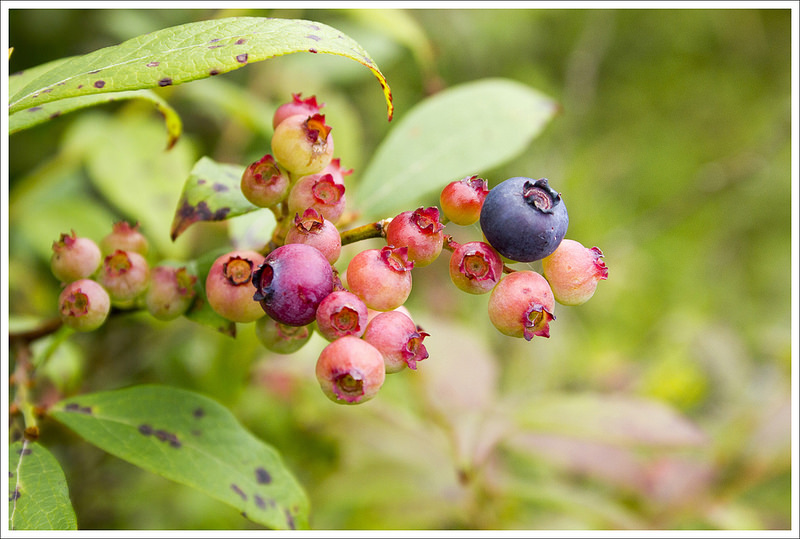
Wildflowers in Meadows Near Whitetop Mountain. Below: High meadow walking; Loads of blueberries; Back into the woods

Meadow on the Appalachian Trail So Many Blueberries on the Appalachian Trail Saddle in the Woods

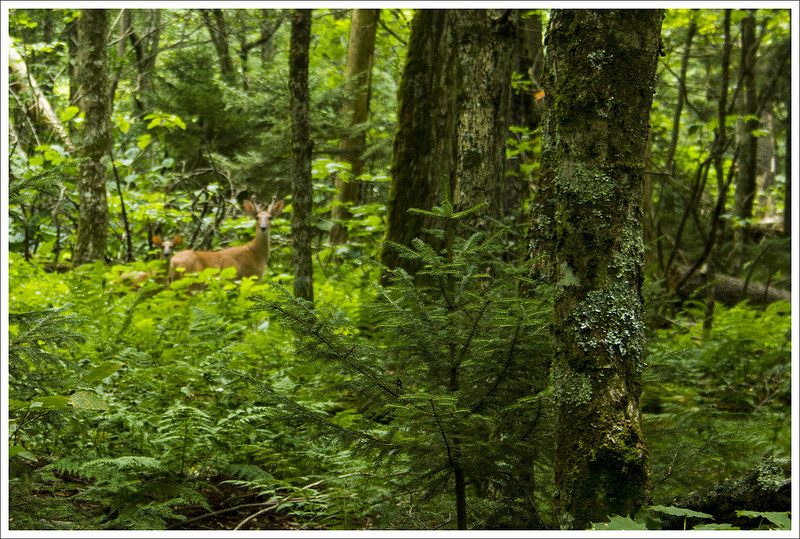
The first couple miles of the hike climbed gently through pretty, open forest.  The trail was mostly soft dirt with just a few rocky spots.  About a mile into the hike, we saw a buck hanging out with a tiny spotted fawn.  It was unusual to see a young fawn hanging out with an adult male instead of his mother.  They were cute and watched us suspiciously from a safe distance.

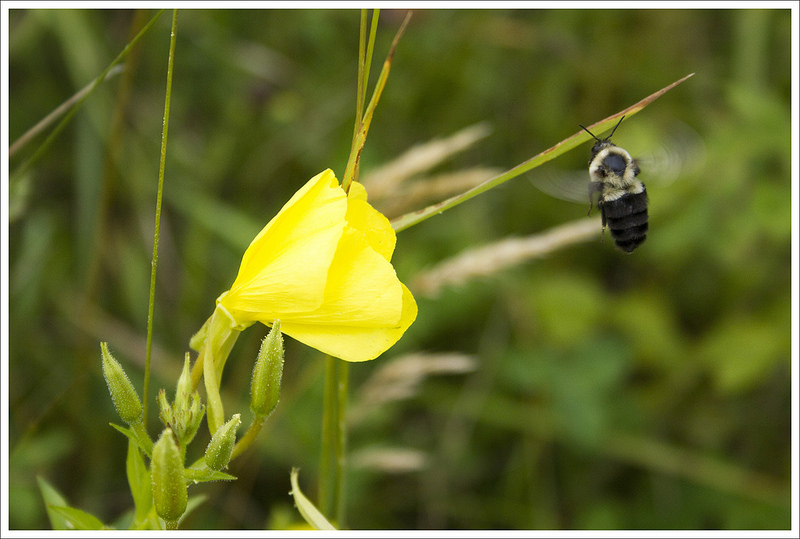
At 2.4 miles we crossed Whitetop Mountain Road and stepped out into an open meadow.  There were tons of wildflowers in every color, bees buzzed busily collecting pollen, and there were tons of wild blueberries, raspberries, and blackberries.  The view was gorgeous and a little misty.  The thin fog obscured a bit of the vista’s majesty, but since we weren’t expecting a view at all, it was a treat.  The trail continued through the open meadow for a few tenths of a mile before reentering the woods.  I wondered aloud to Adam if there would be more views.  He thought the woods looked like they cleared in the next half mile and that Buzzard Rock sounded like it could be something worth checking out… and he was right!

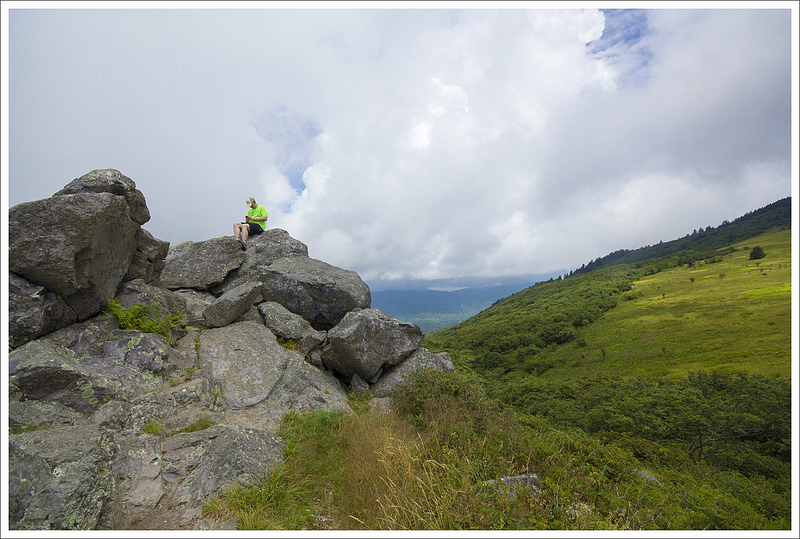
Buzzard Rock Near Whitetop Mountain
Buzzard Rock Near Whitetop Mountain.  Below: Enjoying the top of Buzzard Rock Mountain.

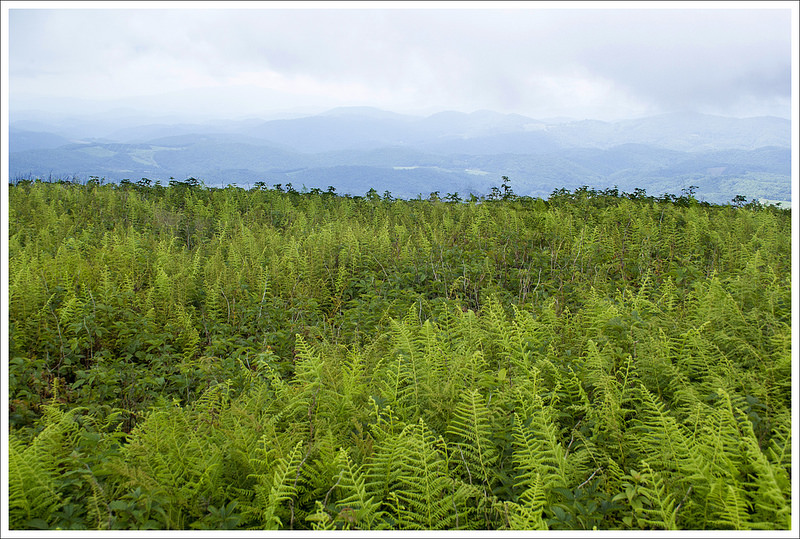
Approaching Buzzard Rock Ferns and Views Adam Takes in the View

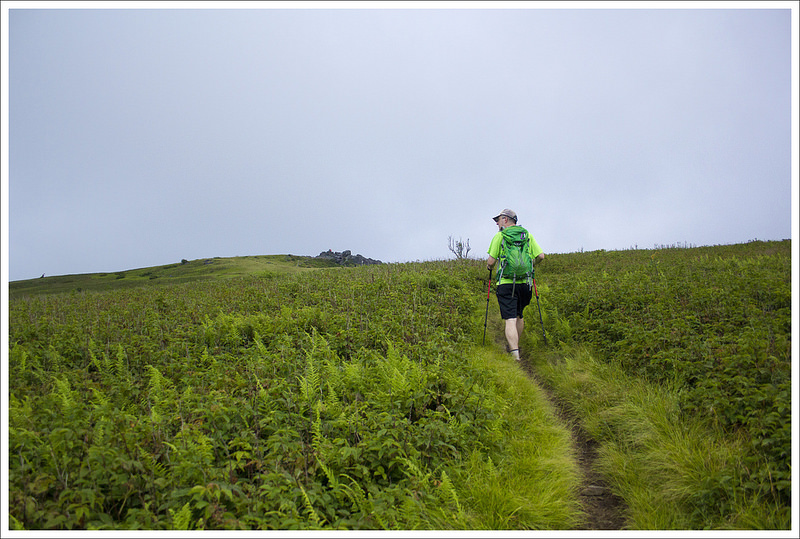
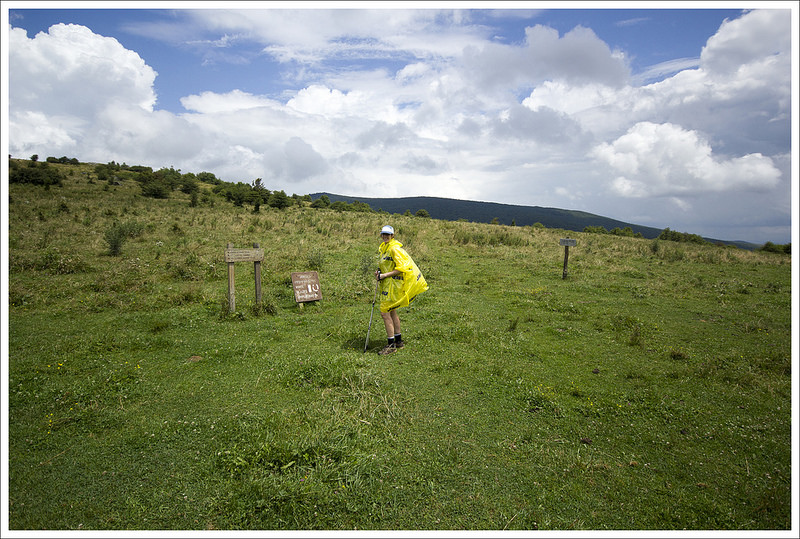
We stepped out of the woods again into another mountaintop bald.  The Appalachian Trail climbed the hill like a dark ribbon through a sea of grass.  Off in the distance, athe top of the hill, we could see a rocky outcropping.  There were big, fast-moving, banks of clouds, so the valley below came in and out of view as we climbed.

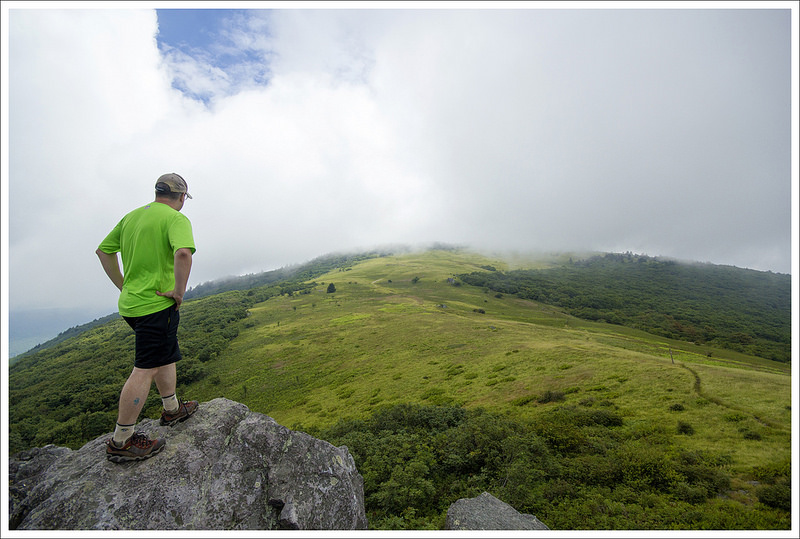
We reached the rocky pinnacle and stopped to take in everything around us.  It was spectacular! Little bits of clear blue skies opened through the clouds and the view below came and went as the clouds moved.  The wind rustled the tall grass all around us.  We wook lots of photos and ate our lunch.  After a while, I noticed that the clouds were starting to darken and gather.  It was time to head back!

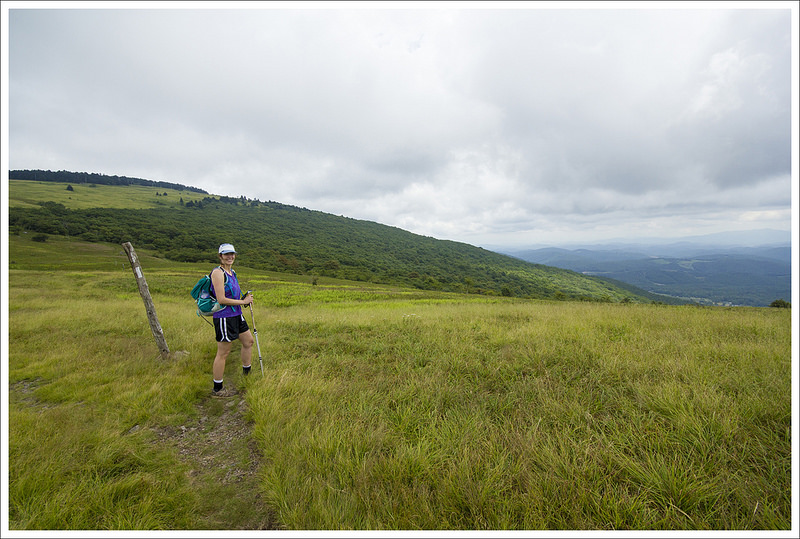
Christine Enjoys the Views
Taking in the views near Whitetop Mountain. Below:  Storms approaching; Back into the woods right before the rain.

A Look Back at Buzzard Rock Views from WhitetopHiking Back

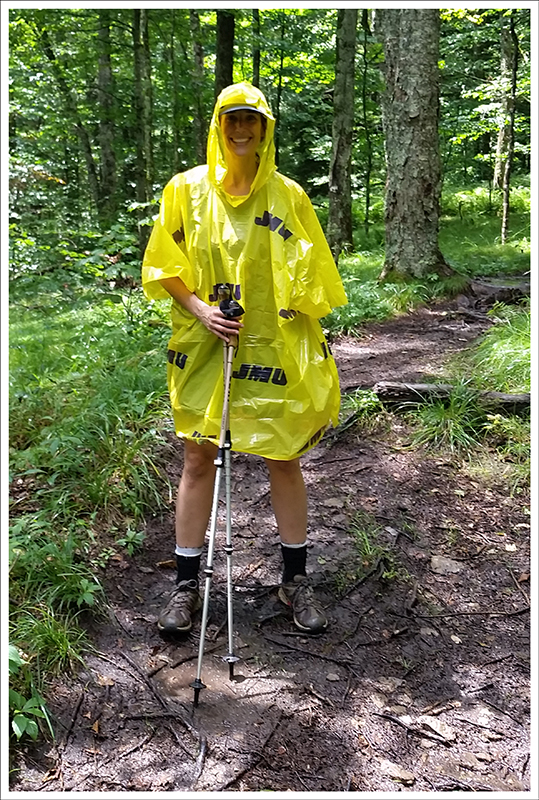
We made it back into the woods just as the rain started.  At first, it was just a few drops and we thought it might blow over.  But instead, it picked up becoming a steady rain and then a torrential downpour.  I packed my camera away and got out my freebie JMU poncho.  I prefer a cheap plastic poncho to my Marmot rain jacket in the summer.  The poncho covers my backpack and my clothes without trapping in any of the body heat from hiking.  The rain relentlessly poured down for almost 2.5 miles of hiking.  The trail was running like a stream.  It might be some of the hardest rain we’ve ever hiked in.

A couple tenths of a mile before we got back to Elk Garden, the rain tapered off and the sun came out.  I didn’t feel like stopping, so I hiked on in my poncho.  We passed the car in the parking lot, crossed the highway and made our way uphill to the Elk Garden view. To climb the hill, you have to open a farm gate.  Be sure you securely latch it after crossing, as it keeps the cow herd safely enclosed. And yes… you may have some close encounters with BIG cows on this part of the hike.

The storm had cleared out the mist and the low clouds and the sky was blue and the view was clear.  We took in the views of the cow herd and Mount Rogers off in the distance.  After the hike, we headed into Damascus for ice cream and a stop at the outdoor outfitters.  It was a great way to celebrate Adam’s birthday!

Elk Garden Views
After the storms stopped, we got great views from Elk Garden. The little black dots are cows. Below: Thankful for cheap ponchos; Campsite with a view toward Mount Rogers.

Cheap Poncho Cheap Poncho Campsite at Elk Garden

Trail Notes

  • Distance – 7.2 miles
    (Check out the stats from Map My Hike)*
  • Elevation Change – 1225 ft
  • Difficulty –  2.5.  This was an easier hike that had a huge payoff for minimum effort.
  • Trail Conditions – 4.  The trail was well-maintained and we didn’t have any issues.  I imagine it could be overgrown somewhat in the spring. 
  • Views –  5.  You have great views from Buzzard Rock and Elk Garden. 
  • Waterfalls/streams 0.  Non-existent.
  • Wildlife – 2.  We did see deer along the trail.  You likely won’t see much on the bald areas, but the woods and elevation add to some wildlife possibilities.
  • Ease to Navigate – 4.5.  Just follow the white-blazed AT markers.
  • Solitude – 3.5.  This is a popular spot for locals, but because of the vastness of the bald, you can find your own solitude for the summit if you desire.

Download a trail map (PDF)

Directions to trailhead: Parking lot GPS directions are N36 378.769 W 82 34.992  From Damascus, VA take US-58 East for 10.5 miles.  Instead of turning right to stay on US-58, go straight on 603/Konnarock Road for 2.7 miles.  Turn right onto 600/Whitetop Road and follow that for 5.2 miles until you reach the parking lot for Elk Garden on the right.

MapMyHike is not necessarily accurate, as the GPS signal fades in and out – but it still provides some fun and interesting information.

Devils Bathtub

This 3.6 mile hike takes you over more than 15 water-crossings to see a series of small waterfalls and swimming holes.  The main scenic draw of this hike is the visit to the Devils Bathtub – a beautiful sandstone formation in the streambed.

View the Full Album of Photos From This Hike
Follow the Devils Bathtub page on Facebook (current conditions, updates, and tips)

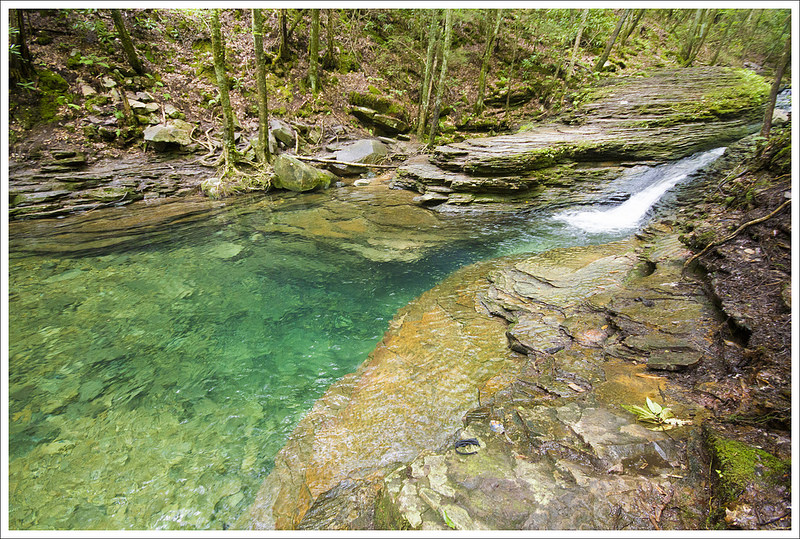
The Devils Bathtub
The Devils Bathtub is a perfectly clear, oval pit in the sandstone. It really does look like a bathtub! When we visited the water levels were very low.  Normally the striated area above the tub forms an even larger pool. Below: Stairs at the beginning of the hike; First water crossing; Early part of the trail.

Devils Bathtub Hike One of 11 or 12 Crossings The Devils Bathtub Hike Requires Very Little Climbing

Christine Says…

The Devils Bathtub popped up on our radar after getting quite a bit of attention on the internet. Sometime after 2014, it started showing up on Pinterest, on Reddit, on lists of most beautiful places in each state – even the Weather Channel called it Virginia’s hidden gem. As dedicated hikers, we wondered how such an amazing place could have escaped our notice for so long.

As it turned out, this hike has been hiding in our plain sight for years.  The route to the Devil’s Bathtub is fully outlined in Bill and Mary Burnham’s ‘Hiking Virginia’ guidebook as part of the larger Devil’s Fork loop.  Burnham’s description of the scenery was far less dramatic than accounts we read on the internet.  And, we’re rarely in the far southwest corner of Virginia, so we stayed in the dark like most outdoorsy Virginians.

However, on our summer trip to the Abingdon area, we finally had a chance to find out first-hand if the Devil’s Bathtub lived up to its internet hype.

First off, the Devil’s Bathtub is in the middle of nowhere in Scott County, Virginia.  There isn’t a nearby gas station to ask for directions or use the restroom.  You probably won’t have any cell service, so make sure you have good directions and all your trail information ahead of time.  Second, the last bit of road to get to the trailhead parking is quite rugged with mud and deep potholes in the road bed.  Our Subaru did fine, but it was a bumpy ride!  Third, parking for this hike is extremely limited with room for just a few cars.  We visited early in the morning on a quiet, overcast weekday, so there was just one other car when we arrived. We’ve heard parking can be a nightmare for this hike, so time your visit strategically.

Red Newt Eft
We saw dozens and dozens of these efts. Below: Scenery along the stream

Devils Bathtub Hike Devils Bathtub Hike Devils Bathtub Hike

Once we got past the logistical challenges – location, road access, and parking, we were all set to see this spectacular beauty spot!  The hike started at the top of a staircase at the top of the parking area.  At the top of the stairs, follow the trail to the left, passing almost immediately under/around a locked metal gate.  In just a quarter mile, you’ll have your first of many stream crossings.  The first crossing was the widest and deepest we experienced on the hike – and we visited during drought conditions.  During periods of heavier rain or snow melt, this stream crossing could be quite a bit deeper and wider.

Shortly after the first stream crossing, you’ll reach marked split in the trail.  You’ll want to bear to the left, following the arrow in the direction of the Devils Bathtub.  The sign says it’s 1.8 miles to the Bathtub, but our GPS calculated the hike at almost a full half mile shorter by the end of the round trip.  This route is also the most direct way to the scenery and is an out-and-back hike.  There is a full 7-mile loop of this area, but all recent accounts say that most of the trail is poorly blazed, covered with blowdowns, and beset by aggressive wasps.

After the junction, we continued along following the yellow blazes.  Even though the trail doesn’t climb much in elevation, it still provides challenges with its sporadic blazing and 15+ water crossings.  It was really easy to lose the yellow blazes, as the trail is eroded and appears to have been relocated several times.  We made our way by carefully looking for yellow blazes any time the trail wasn’t abundantly clear.  We were lucky to visit in a time of low water, so all of the water crossings were easily passable.  I imagine the way could be really tricky when there is more rain.

We passed a neat cliff-side that looked like it was built out of block.  It was set off the trail, about 20 feet into the woods. Shortly after the cliff, the trail dipped down along an eroded bank next to the stream.  There was a rope fixed to the uphill side of the trail to make passage a little easier.   At the end of the rope, we reached the beautiful sandstone streambed that makes this area so popular.

Rock Formations on the Devils Bathtub Hike
Rock Formations on the Devils Bathtub Hike. Below: More stream scenery; A rope assist along the eroded trail; Steep eroded bank

Low Water Levels at Devils Bathtub Narrow Trail One Steep Climb on Devil's Bathtub

The trail crossed the stream one final time at the base of a large pool with a small waterfall.  I imagine a lot of people reach this point and think it’s the Bathtub.  It’s a pretty spot with deep, clear green water.  But, to get to the Bathtub you should continue along the trail up a short but very steep scramble up the bankside.

At the top of the bank, a newer wooden sign indicates that you’ve reached the Devil’s Bathtub.  If you follow the footpath down to the stream’s edge, you’ll find the formation at the base of another small waterfall.  It’s a gorgeous spot, though smaller than I expected it to be.  The water was low on our trip, so I’d say the tub was only about half full!

We explored and photographed the area for a while… dismayed by the enormous amount of garbage left behind by other hikers. We saw dirty diapers, Styrofoam cups, beer cans/bottles, tampon applicators, sodden socks, discarded t-shirts, empty pudding cups, a spent asthma inhaler, and countless cigarette butts.  I simply can’t understand how a person can visit such a naturally lovely place, and feel alright about leaving their trash behind.  Adam and I ended up carrying out three bags of garbage, and it didn’t even make a dent in what was still left behind.

After a while, a couple more groups of hikers joined us at the Bathtub, so we decided to pack up and make our way back to the car.  To exit, we simply retraced our steps.  On the way out, I kept thinking about all the litter we saw on our hike.  If you choose to do this hike (and we hope you will) please bring a trash bag and help clean up along the way!  This is a gorgeous area – but it’s overused and fragile.

Adam Says…

A friend of mine had asked me about a year ago if we had hiked Devil’s Bathtub yet.  After checking out pictures online, I knew this is one we had to put on our radar.  Living several hours away and the fact this is a short hike made our decision to incorporate this hike into a four-day trip to check out a bunch of hikes in southwest Virginia.

This hike does have some challenges involved – navigating to parking without reliable GPS signal, the bumpy drive on the fire road to get to parking, the often poor blazing on the trail, and the numerous stream crossings.  But with a little determination, we found our way to this gorgeous spot.

The Devils Bathtub
Adam enjoys the Devils Bathtub. Below: Signage; Terrain around the Bathtub; The Bathtub

Trail Sign Devils Bathtub Hike Devils Bathtub Hike

From the parking lot, we heading up the short flight of stairs where we met the trail.  There are no signs to say which way to go, but we took a left at the top of the stairs and found we were correct.  The yellow-blazed trail leads to a gate and passing through, the trail leads down to your first of about 15 stream crossings at .15 miles.  When we went, the water was at a low level, so if you are hiking when there has been a lot of rain, expect your feet to get wet and plan to do a lot of rock hopping.  At about .2 miles, you reach a junction with the straight fork ridge spur trail.  Bear left to stay straight on the trail.

Devils Bathtub Hike
The Devils Pool. Below: Small cascades; Pools along the stream.

Devils Bathtub Hike Devils Bathtub Hike Devils Bathtub Hike

At .7 miles, we reached the first of the hard to navigate sections.  We approached this larger creek section and saw some blazes straight ahead, but also to the right of us.  We went straight ahead and up a steep bank that went down a steep, slick hill back to the creek, only to realize this section had been re-routed.  We went back to the original spot to cross, bore right to the larger fire road and found the blaze to continue on the trail.

At .9 miles, at the fifth stream crossing, we had a hard time finding where the blazes continued.  We reached the large stream bed and rock-hopped and walked ahead on the creek about 75 yards before finding the yellow blaze going up a steep bank to the other side.  Our instincts led us the right way, but the lack of blazes made this an unnecessary challenge.  We got back on the trail and just a little over a tenth of a mile, we were standing above a swimming hole, looking down to the left.  From the trash and abandoned clothing left behind, we could tell many people have taken a dip in this spot before.  Continue on the trail and continue to cross the stream several more times.

Devils Bathtub Hike
A beautiful green, waterfall-fed swimming hole. Below: A sampling of litter; Butterflies

The Saddest Part of the Devils Bathtub Hike Butterflies

At about 1.5 miles, the trail reaches a large rock formation and you scale the side of it on a narrow path, but with some assistance to an anchored rope that guides you along.  You then climb down to a stream crossing and swimming hole before making your way up a very steep bank to continue on the trail.  From here, the hike is relatively flat and at 1.7 miles, you reach the sign for Devil’s Bathtub.  There is a small lookout over the bathtub from here, but if you want to see it up close, the best thing to do is continue past the sign and stay on the trail.  When you reach the stream again, cross it and then navigate along the side (the rocks were very slippery here) until you make your way down to the bathtub at 1.8 miles.  The water again was low, so we were expecting a deeper basin of water from what we have seen in some pictures.  The rock around the bathtub was covered in algae and very slick, so be careful!!

It took us a while to just remove enough trash around the site to get some decent pictures.  As Christine mentioned, please bring a trashbag and help pick up around the area.  The devastation of litter here made me quite sad that people would treat such a picturesque spot with such disrespect.  We made our way back the way we came and saw a few people on our way back.

The green water plunging over and into the Devil’s Bathtub makes for one of those truly magical places in Virginia.  If you are ever down in the southwestern part of Virginia, put this on your must-hike list.

Trail Notes

  • Distance – 3.6 miles
    (Check out the stats from Map My Hike)*
  • Elevation Change – 580 ft
  • Difficulty –  3.  The climb is easy and very small/gradual.  The challenge factor is increased by the number of water crossings you must negotiate.
  • Trail Conditions – 2.5  The trail is eroded in numerous places and there is a real issue with litter. 
  • Views –  0. None on this hike.
  • Waterfalls/streams – 5.  The stream scenery is gorgeous!
  • Wildlife – 2.  We saw lots of newts.
  • Ease to Navigate – 2.5  The trail is poorly blazed and hard to follow in several spots.
  • Solitude – 2.  We visited on a quiet weekday, and still saw multiple groups of people.

Download a trail map (PDF)

Directions to trailhead:  Parking coordinates: 36.819106, -82.628852.  This location is very isolated and not really close to anything.  It’s best to use the GPS coordinates and navigate fro=m your home direction.

MapMyHike is not necessarily accurate, as the GPS signal fades in and out – but it still provides some fun and interesting information.

Great Channels

The Great Channels Natural Area Preserve is one of Virginia’s most geologically fascinating areas.  This 6.6 mile out-and-back takes you down into a network of maze-like crevices formed in soft sandstone.  You won’t find any other hike in Virginia like this one!

View the Full Album of Photos From This Hike

Adam Explores Virginia's Great Channels
Adam explores Virginia’s Great Channels.

Adam Says…

Who would have thought there were slot canyons in Virginia?  I have read about the slot canyons in the southwest of the US and thought it would be so cool to actually go hiking through these formations.  It wasn’t until recently that we had heard about the Great Channels in the southwest of Virginia and we just had to take a trip and explore them.  We decided to take a four-day trip down to Abingdon, Virginia and rented a house that served as a great launchpoint for some of those interesting hikes we have heard about in the area.

We left our car in the parking lot and then followed the Brumley Mountain Road up the fire road (blocked from cars by a gate) that went up the hill to the right of the parking lot.  The initial part of the hike follows this wide fire road, making it nice to walk side-by-side with your hiking partner.  The trail is mostly a gradual uphill climb to the top, with the first 1.5 miles being very little climbing at all.  At about .6 miles, you reach a set of power lines that are cut in that may give you an obstructed view to the left of the trail of the valley below.  At .75 miles, you reach a junction where the fire road takes a sharp turn to the right and goes uphill.  Stay straight instead of veering to the right to stay on the trail.  The trail continues along and at 1.0 miles, a cabin and picnic area appears to the right of the trail.  This is private property, so stay on the trail.  Continuing along the trail, at 1.5 miles, you reach Shallow Gap, which provides some obstructed ridgeline views to the right of the trail.

Easy Footing at Great Channels
The trail to Great Channels climbs a bit, but the footing is all easy.  Below: The trail follows an old road bed most of the way; A pretty cabin along the trail; Blooming rosebay rhododendron.

Easy Footing at Great Channels Cute Cabin Along the Trail Blooming Rhododendron

The trail becomes slightly steeper from this point and at 2.25 miles, you reach an outcrop of sandstone, which is what you will later see that forms the Great Channels themselves.  You hit a few switchbacks shortly after that take away the steepness of the terrain.   At 2.8 miles, you reach the junction where the Great Channels trail breaks off to the left of the Brumley Mountain Road.  Take this trail to reach the summit of Middle Knob, which you should reach around 3.0 miles.

At the summit, you will find a shelter with rotted boards and exposed nails (it looks like quite the danger, so don’t explore).  Behind the shelter you will see some exposed boulders that allow for some obstructed views around you.  Straight ahead also is the incredibly tall fire tower that was once used to spot fires from a long distance.  The rocks that you walk across near the fire tower will show you exposed cracks that travel deep below.  Shortly past and to the right of the fire tower, you will see a blaze that enters into the woods.  Take this trail as it leads down a steep, hillside.  We found another rock on the way down that we could hoist ourselves up which gave us some nice views.  While the views are nice, you do need to be extremely careful here, since there are gaps in the rocks below where you are looking from the top of the Great Channels down below.  One slip could spell catastrophe here.

Rhododendron Tunnels on the Great Channels Trail
Rhododendron tunnel on the Great Channels Trail. Below: Hiking along the Brumley Mountain Trail; The junction of the Brumley Trail and the Channels Trail.

More Scenes from Great Channels More Scenes from Great Channels More Scenes from Great Channels

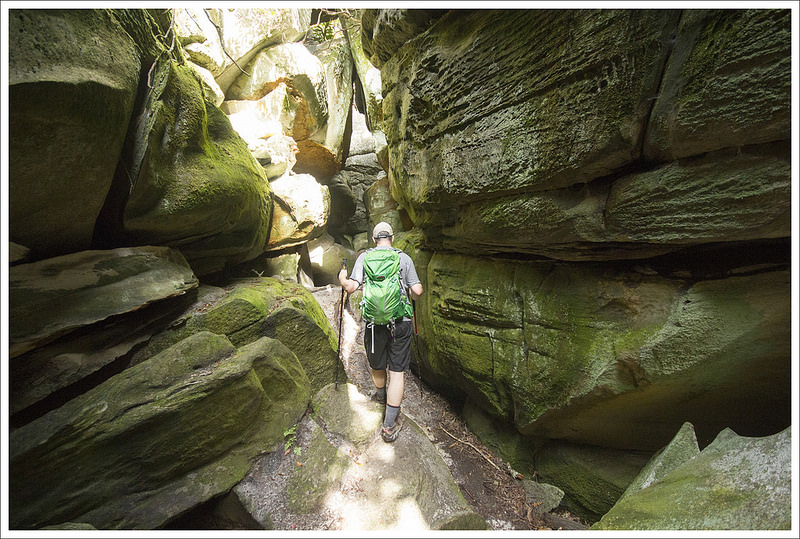
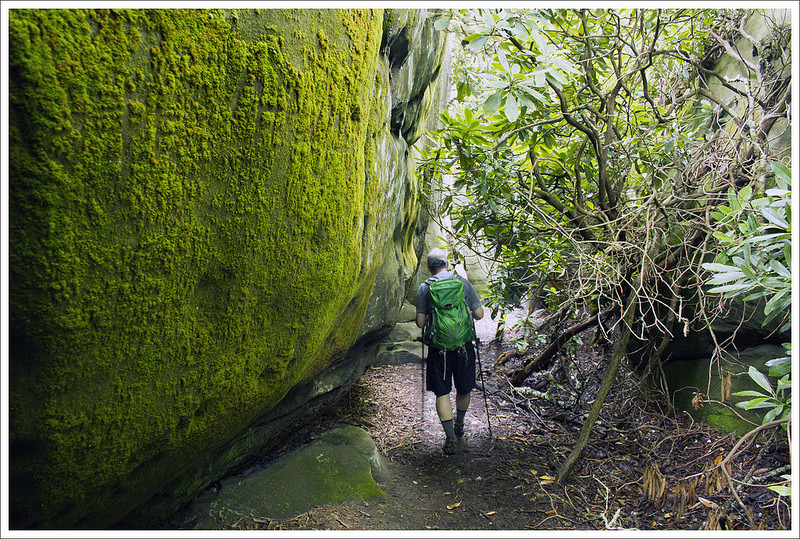
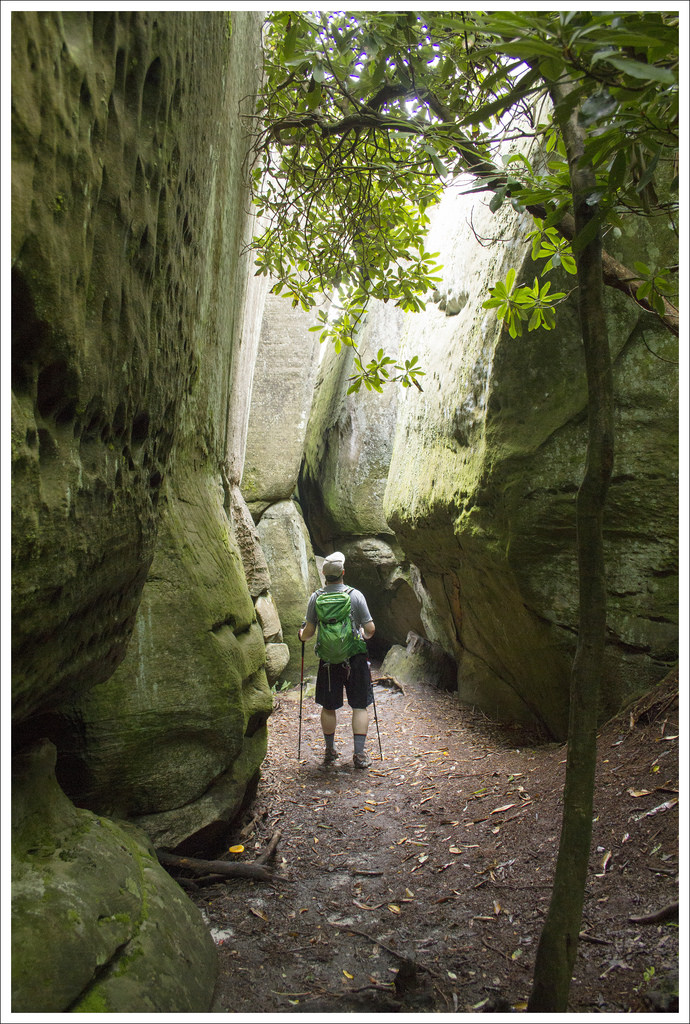
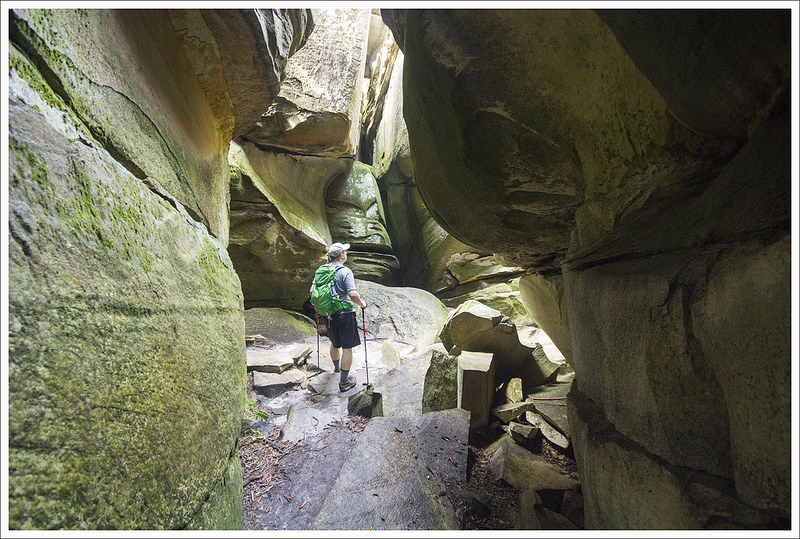
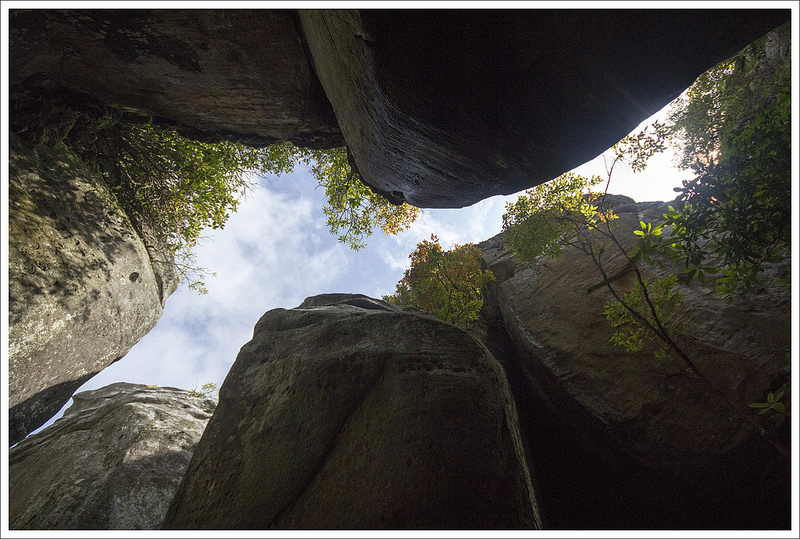
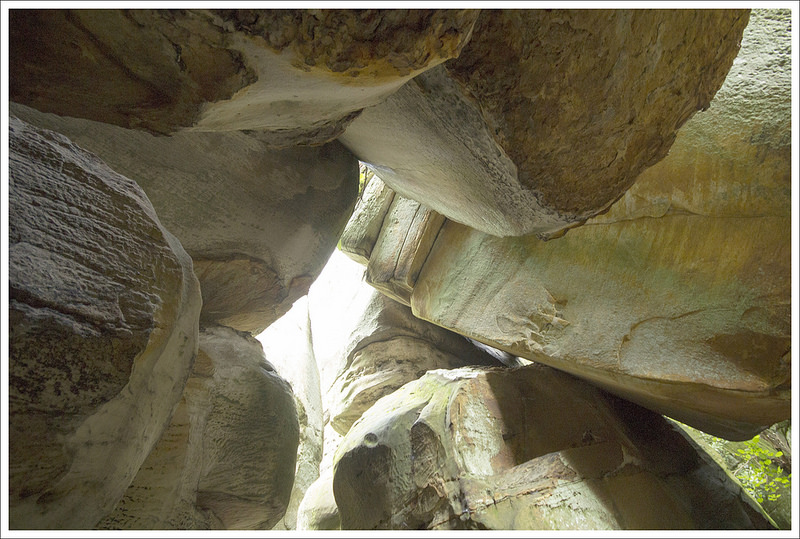
The trail descended the hillside until it led to the entrance of the Great Channels.  I will say this is one of the most unique things I have ever seen.  You walk down a path in between these sandstone formations that creates a maze of trails and rocks.  You will feel like a kid again with your desire to explore this maze.  Most of the paths between the rocks are passable (I did squeeze my body through one tight area just to see what was on the other side), but get your bearings early so you can remember the proper way back.  We found you can get a little turned around as you explore these channels, which could create some panic from anyone claustrophobic.  It was much darker in the Channels, but occasionally you would find a spot where the sun shined down to the bottom.  The formations were so unique that you will want to take some time to explore down all the channels.  The only real exit to the Channels is going back the way you came.

After we were done exploring, we climbed back to the top and ate a snack underneath the fire tower before finishing up our trip.  We came across a few other families at the top, but we enjoyed having the Great Channels to ourselves.  We made our way back the way we came, giving us about a 6.6 mile hike total.  We were so glad we were given this hike recommendation.  This is a true geological treasure that is surprisingly not as well known beyond the local community.

Arriving at the Entrance to Great Channels
Look for the fire tower when you’re seeking the entrance to the Great Channels. Below: There is an old, burned out watcher’s hut; The descent into the maze; Moss covered walls.

Burnt Out Shelter at Great Channels Entering Great Channels Entering Great Channels

Christine Says…

The idea to hike the Great Channels came from one of our readers (thanks, Dj!)  We had never heard of the area and were excited to add this hike to our itinerary on a recent visit to Abingdon, Va.  Since Adam has covered all the details and distances, I’d like to use my part of the post to share some of the fascinating history of this area.

The Channels has only been accessible to the public for a little over a decade. It’s really one of Virginia’s newer hikes!  In 2004, The Nature Conservancy purchased the 5,000 acre tract land from a private owner.  Then in 2008, through a partnership with the state, Channels State Forest was established.

In the early years of the new state forest, the route to the Channels formation was traversed only by the rugged Channels Trail.  Marked in green on this map, the hike required an 11-mile round trip effort with about 2,600 feet of climbing.

Inside Virginia's Great Channels
There is nothing else in Virginia like the Great Channels. Below: As seen inside the Channels.

Inside Virginia's Great Channels Inside Virginia's Great ChannelsInside Virginia's Great Channels

In 2012, the non-profit group Mountain Heritage opened the Brumley Mountain Trail.  The trail was built over several years with the assistance of volunteers and labor supplied by inmates from the Appalachian Detention Center.  All in all, the Brumley Mountain Trail covers 14 miles along the spine of Clinch Mountain from Hayters Gap on VA80 to Hidden Valley Lake.  If you park in the new lot at Hayters  Gap and follow the Brumley Trail, you can access the Channels formation via a moderate, well-graded trail – totaling six miles, round trip.  The establishment of this trail made the Channels infinitely more accessible for hikers of all abilities!

The sandstone maze at the heart of Channels State Forest sits hidden at the top of Middle Knob – elevation 4208’.  Formed 400 million years ago, the deep crevices and slots likely formed due to permafrost and ice wedging during the last ice age.  The expanding ice fractured the sandstone and water slowly spread and smoothed the breaks over millions of years.  What we’re left with now is a labyrinth of slots and crevices through the rocks. The pathways range from 20 to nearly 40 feet deep and wind their way through damp, moss-covered walls of stone.  It stays shady and cool in the Channels – even on a hot mid-summer day.

Inside Virginia's Great Channels
The rock walls of the channels had lots of interesting textures. Below: More scenes from the Channels.

A Look Up from the Bottom of Great Channels Jumbles of Boulders in the Great Channels A Look Up from the Bottom of Great Channels

The entrance to the maze is located near one of the tallest and most rickety fire towers I’ve ever seen.  You could not pay me a million dollars to climb that tower! However, when doing research for this post, I stumbled across the blog of another hiker who DID climb the tower in 2013 (despite the bottom two flights of stairs being removed and posted signs saying NOT to climb the tower.)  We implore our readers to stay safe and stay off the tower.  I will add that photos shared by this particular hiker showcased 360 degree views all the way to Mt. Rogers, Roan Mountain, and Grandfather Mountain.  From the tower’s top, you can also down into the maze from above.  His photos were pretty cool – but again – do not attempt to climb the tower.  An article from the June 3, 2012 issue of the Bristol Herald Courier says that funding is being sought to renovate the old tower and turn it into an observation platform.  Clearly, nothing has happened between 2012 and 2016!

I enjoyed exploring the labyrinth of passageways that make up Great Channels.  The scale and size of the formation exceeded what I pictured before visiting. The maze covers about 20 acres.  Some pathways loop around and connect to other paths and some just reach a dead end.  There was plenty to explore, but the area is not so expansive that you feel you’ll get lost and not find your way out.  I will add that after a suitable amount of exploration, I was ready to see the land from back ‘on top’.   After a while, the maze started feeling eerie and close.  I guess I’m more claustrophobic than I thought!

The Precarious Fire Tower
The fire tower is closed to climbing. It is very tall and rickety. Below: You do not want to climb this fire tower: Atop the maze

Elevation at the top of Channels The Great Channels from the Top Leaving the Great Channels

Another couple things I wanted to note about this hike!  The first one is a big plus — there were TONS of sweet, ripe, juicy blueberries around the fire tower when we visited in late July.  It was a treat to enjoy them with our packed lunch.  The negative I wanted to remark on is the amount of litter left in the Channels.  There were so many plastic water bottles, candy wrappers, and beer cans tucked into crevices in the rocks.  It’s always a bummer to visit a beautiful, unique place and find it covered with garbage, and unfortunately that was the case with the Channels.  If you think about it when you visit, bring a trash bag and try to carry some of the trash out with you.

Trail Notes

  • Distance – 6.6 miles
    (Check out the stats from Map My Hike)*
  • Elevation Change – 1200 ft
  • Difficulty –  3.  The hike isn’t as tough to approach the Middle Knob fire tower, but the climb down to the Channels may be a little steep for some.
  • Trail Conditions – 4.  The trail mostly follows a large fire road, so footing is easy. 
  • Views –  2.  There were some obstructed views along the way, but nothing overly dramatic. 
  • Waterfalls/streams 0. non-existent. 
  • Wildlife – 3.  This area is not as well populated and black bears have been spotted.  We saw several deer along the trail.
  • Ease to Navigate – 4.  There are only a few junctions that could lead to any confusion.  Finding the trail down to the Great Channels was a little tough since there was no sign, but with our directions, you should have no trouble.
  • Solitude – 3.  This is a popular spot for locals on nice days, but overall isn’t used heavily. 

Download a trail map (PDF)

Directions to trailhead: GPS coordinates:  36.864640, -81.946982.  Take exit 24 on I-81 and get on VA-80 W.  In .2 miles, take a left on VA-80/609/Hillman Highway.  Take a right shortly after the light to stay on VA-80/Lindell Road.  Continue to follow VA-80 for 13.5 miles until you reach the parking lot on the left of the road.  You will find the name for this road changes from Lindell Road to Hayters Gap Road.  It takes a sharp left turn about 10.5 miles in on your 13.5 mile trip and the road winds up very steeply until you reach the crest and the parking lot on the left.

MapMyHike is not necessarily accurate, as the GPS signal fades in and out – but it still provides some fun and interesting information.


Hidden Rocks

This 2.5 mile hike passes a small waterfall and two beautiful rock crags.  The views are pretty limited, but it’s still a worthwhile hike in the vicinity of Hone Quarry.  If you visit in early July, the blooming Rosebay rhododendron is impressive!

View the Full Album of Photos From This Hike
Hidden Rocks View
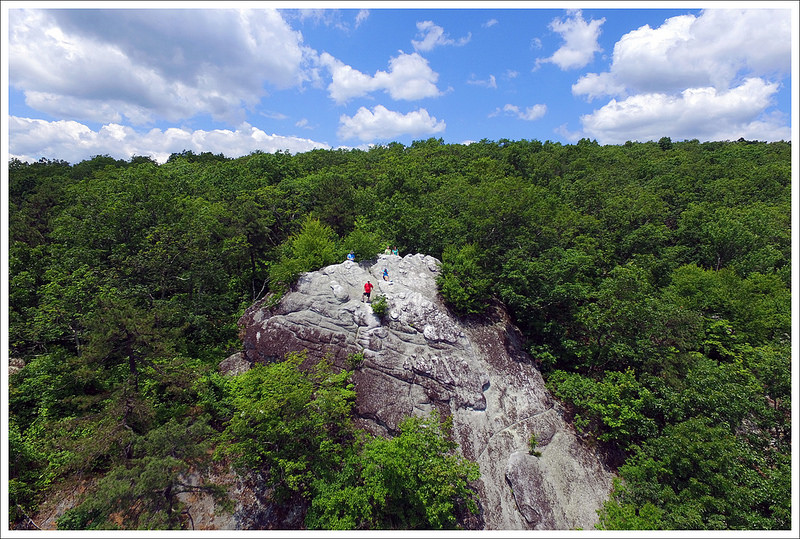
Tony and Adam launched a drone from the top of Hidden Rocks. Below: Adam crosses Rocky Run – a small stream on the hike; The trail splits and makes a lariat loop near this pretty small waterfall; Blooming Rosebay Rhododendron.

Crossing Rocky Run Small Waterfall and Pool on Rocky Run Blooming Rosebay Rhododendron

Adam Says…

Hidden Rocks was truly trying to stay hidden from us.  It took a while for us to find the location of this hike from another website, it was steering us about 35 minutes off course.  We ultimately arrived at the correct parking area and met up with Tony and Linda from Hiking Upward to start our hike for the day.  This hike is relatively easy and if you want to just do a quick, out-and-back hike to the main rock outcropping, you would be looking at around a two mile hike.  We decided to make a loop out of this hike and at the time, there wasn’t a lot of information about this hike.

The hike started from the right of the parking area.  The yellow-blazed trail starts fairly easily and consists of a few ups and downs, reminiscent of a roller coaster before finally descending down to Rocky Run which you will reach at .65 miles.  Crossing the stream, you can see there is a smaller trail that branches to the right, but stick to the left.  You will quickly come into a thick tunnel of rhododendron.  You cross Rocky Run a couple of more times before reaching a small, scenic waterfall at .9 miles.  Here, the trail splits as you will see yellow blazes that go to the left and right of the waterfall.  Take the trail to the right of the waterfall (the left trail will be how you return on the loop) that leads steeply above the waterfall area.

Rock Climber at Hidden Rocks
A rock climber descending Hidden Rocks. Below: Christine and Adam atop Hidden Rocks; Ripening blueberries at the top of the crag; A sideview of Hidden Rocks.

Christine & Adam Atop the Crag Ripening Blueberries Side View of Hidden Rocks

In a short distance, we arrived at the base of the Hidden Rocks face where we came across a man rock climbing and rappelling off the structure.  The trail skirts along the left of the rock base and then climbs steeply up some rocky steps.  At the top of the trail, the trail splits.  Head up to the right on some wooden steps to reach the top of the Hidden Rocks structure that you saw from the base a few moments ago.  There was a campsite at the top and a couple of ledges that you could enjoy the view.

Tony set up his drone to take pictures and video of the area around us.  We were hoping to get some shots of the rock climber, but he had just switched spots on where he wanted to climb, so it took him a long time to position ropes to start his rappel.  Tony let me even steer the drone a bit which was a blast.  Christine and I posed for a high elevation selfie before we packed up the drone and continued our hike.

We went back to where the trail split leading us to the rock outcropping and then continued on the trail.  This part of the trail was less-traveled and narrow.  After skirting along another large rock face, I found a break between two large rock areas and decided to explore.  I had to climb by holding onto rocks and roots, making it not an easily accessible sidetrip that should only be done if you feel capable. I ventured out to the right and left areas of the rock.  The rock to the right led to precarious footing and fearing I was going to look for a handhold and upset a timber rattler, I decided to not go any further on that rock.  On the left rock, I found a way to climb to the very top and found a very small perch to enjoy some views that I thought were better than those on Hidden Rocks.  I called back down to the rest of the group and Tony and Christine decided to climb up also.  We then made our way down the steep decline and joined Linda back on the trail.

The trail descends rather steeply after this point, causing us to take our time make sure we had good footing.  We reached another stream crossing at 1.4 miles and at 1.6 miles we were back at the small waterfall, completing the small lollipop loop of this hike.  We retraced our steps and made it back to our car at 2.5 miles.

Christine Says…

We were thrilled to see Tony and Linda again for the second time in the span of just a few weeks! We were also pleased to have cooler, less humid weather for this hike (compared to the sauna-like conditions we had for our hike at Shrine Mont). The morning started off with a bit of chaos related to bad directions. We originally found the Hidden Rocks hike outlined on the Virginia Wilderness Committee website.  Their write-up included GPS coordinates that took us to some random road – in the middle of nowhere – about 30 minutes from the actual trailhead.  We arrived at their designated coordinates and found ourselves in the totally wrong place with no cell phone service.  Fortunately, Tony and Linda were also running a few minutes late, and we all arrived at the trailhead parking around the same time.

The hike started off over a mini ‘roller coaster’ – with the trail steeply ascending and descending over a series of gullies and washes.  Eventually, we descended a gentle hill down to Rocky Run – a shallow, winding stream.  The trail was shaded by a tunnel of Rosebay Rhododendron that was just starting to bloom.  At about a mile in, the route got a bit confusing when we reached a split in the trail near a small waterfall.  The Virginia Wilderness directions said there was a loop trail, but added that the loop route was not on their map (it’s on ours – see below).  We took a guess and headed steeply uphill on the trail on the right side of the split.  In just a couple tenths of a mile, we arrived at the bottom of a towering rock wall – Hidden Rocks.  There was a local guy rock climbing.  He had a beautiful Vizsla dog – she barked a lot, but was very friendly and hung out with us the entire time we visited the rock.

Hidden Cracks
The second crag on the hikes is known locally as Hidden Cracks. Below: The view from the top of Hidden Cracks; Christine scrambles down Hidden Cracks; We enjoyed beers and Grillizza Pizza after the hike.

The Top of Hidden Cracks Descending Hidden Cracks Grillizza Pizza

To reach the summit of Hidden Rocks, we followed the trail along the left side of the crag, eventually climbing steeply to the top via a small set of constructed stairs.  The top of Hidden Rocks has two outcroppings and a spacious campsite with a fire ring.  The views are limited – all you really see is another hillside of trees across the ravine.  If you’re looking for expansive views of mountains, distant valleys, or the lake in Hone Quarry – this is not the hike for you!  Fortunately, the outcropping still gave Tony enough room to launch his drone.  He was able to get a few cool shots looking back at Hidden Rocks.

From Hidden Rocks, we came back down the stairs and continued following the trail across the ridge.  We passed another towering cliffside on the right – this one called Hidden Cracks.  Adam found a split in the rocks with a jumble of boulders.  We were able to climb to the top and get another view – this one included an obstructed peek at some distant mountains.  Soon after Hidden Cracks, the trail descended, crossed the stream again. We arrived back to the split in the trail that made the loop, passing the small waterfall once again.  From there, we retraced our steps back to the parking area.

After our hike, we headed back into Harrisonburg so that we could take Tony and Linda on a tour of Harrisonburg’s craft beer scene.  We started off at Wolfe Street, then proceeded to Billy Jack’s for lunch.  The day rounded out with stops at Pale Fire and Brothers (with dinner from the Grillizza food truck).  It was a fun day and we really enjoyed exploring this little gem of a hike!

Trail Notes

  • Distance – 2.5 miles
    (Check out the stats from Map My Hike)*
  • Elevation Change –  390 feet
  • Difficulty –  2.  This is doable by most people.  If you do the entire loop, be careful climbing up to the top of the other rock outcropping.  That short climb feels more like a 4-4.5.
  • Trail Conditions –  3.5.  Overall the trail was in great condition, but the lollipop loop part of the trail was not as maintained.
  • Views –  2.5.  The views were nice, but not as expansive as I would have liked since most of your views are blocked by the mountain directly in front.  
  • Waterfalls/streams   2.  Rocky Run was pretty with rhododendron nearby.  The small waterfall creates a peaceful setting.
  • Wildlife – 0.  We didn’t see anything. 
  • Ease to Navigate – 2.5.  There weren’t any signs for junctions which caused us to get confused about which way to go when we first crossed Rocky Run and again at the waterfall junction.
  • Solitude – 4.  This isn’t heavily used, but you may see some people at the top of Hidden Rocks or rock climbing. 

Download a trail map (PDF)

Directions to trailhead: GPS Coordinates for this hike are 38.44813, -79.12205.

MapMyHike is not necessarily accurate, as the GPS signal fades in and out – but it still provides some fun and interesting information.


Dragons Tooth

IMPORTANT: Please read these important regulations and helpful tips before hiking in this area

This five mile loop features a fun rock scramble and a view from atop one of Virginia’s most interesting rock formations.  It’s considered part of the ‘Triple Crown’ of Virginia hiking that also includes McAfee Knob and Tinker Cliffs.

View the Full Album of Photos From This Hike

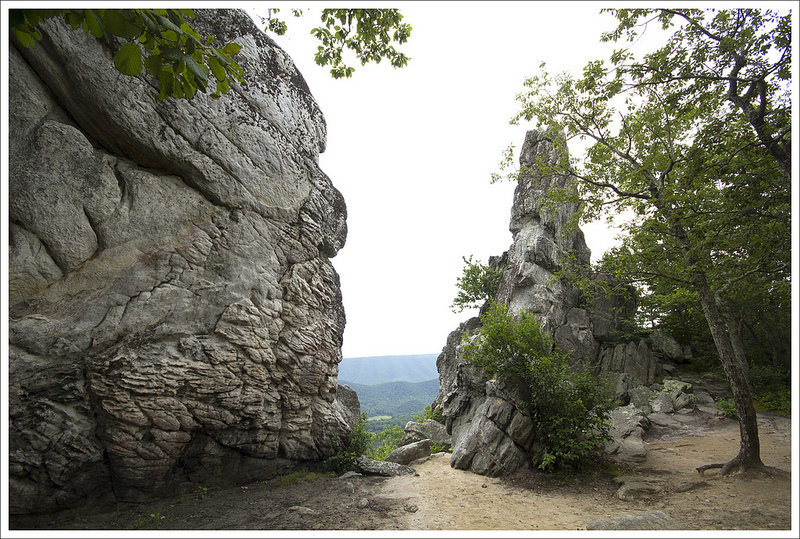
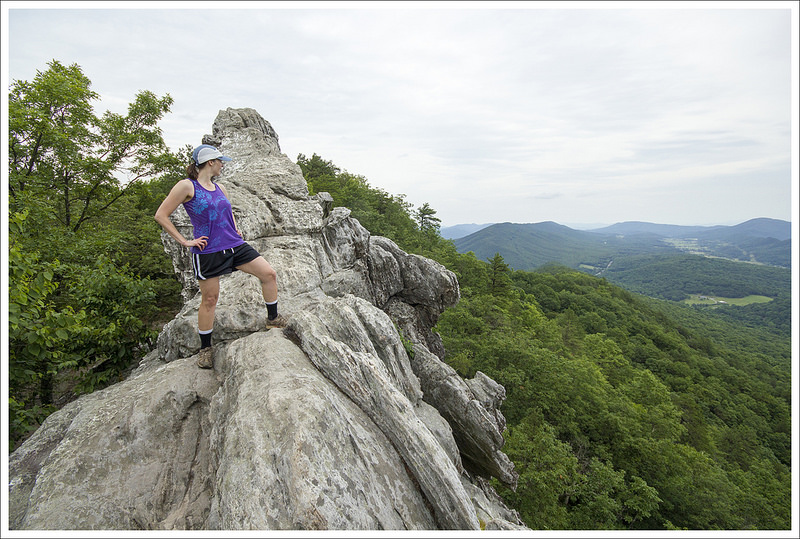
Atop the Dragons Tooth
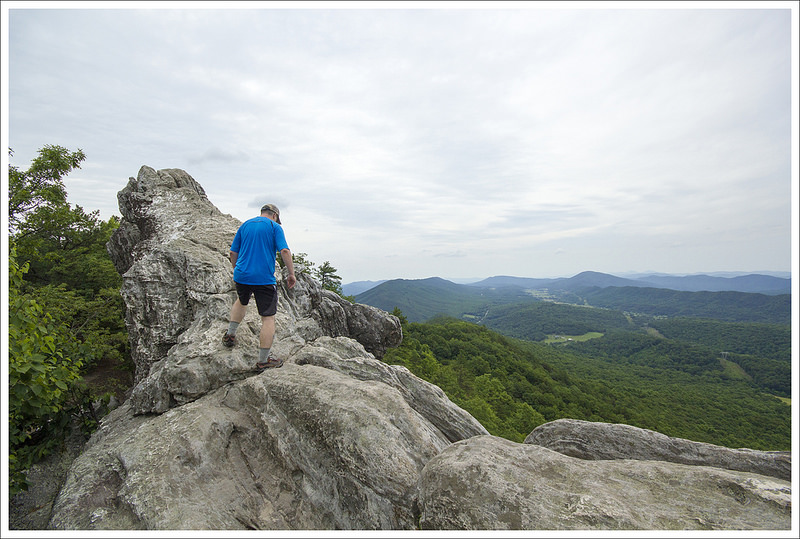
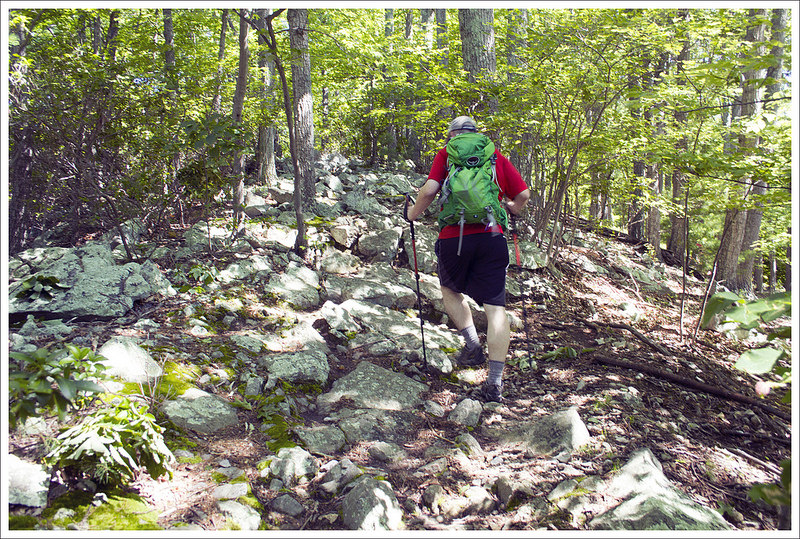
Adam climbs on Dragons Tooth. Below: Trail signage; The trail starts off as a wide, gentle path; Most of the climb to the junction with the AT is moderate.

Dragons Tooth Signage Dragons Tooth Trail Dragons Tooth Trail Stream Crossing

Christine Says…

When Adam proposed doing Dragons Tooth, I had mixed feelings. On one hand, I eventually want to hike every bit of the Appalachian Trail – especially the most famous and scenic parts. But, I’m a bit fearful on rock scrambles and precipitous drops. From reputation, Dragons Tooth is called by some ‘the toughest mile’ of AT south of Mahoosuc Notch. The section includes slick stone slabs, narrow ledges, and even iron rungs affixed to the rocks to aid with the traverse.  With my come-and-go vertigo, terrain like that typically isn’t my cup of tea. I also heard the trail was extremely crowded and nothing feels worse that freaking out on a rock scramble with a huge crowd of people watching you and waiting to traverse behind you.  In the end, I psyched myself up and we chose a quiet cloudy Wednesday to visit this well-known landmark.

We got an early start and arrived at the parking lot around 9:00 a.m.  It was practically empty, just a couple cars and a forest service truck.  We started up the blue-blazed Dragons Tooth Trail.  About a quarter mile in, we passed the junction with the Boy Scout Trail.  Bearing right, we continued a 1.2 mile moderate ascent of the Dragons Tooth Trail.

When we gained the ridge, we found ourselves at a beautiful, large (dry) campsite at Lost Spectacles Gap.  This is where the Dragons Tooth Trail meets up with the Appalachian Trail.  We turned right and continued south on the Appalachian Trail.   We soon passed a sign warning ‘CAUTION: The next mile of trail is rocky and steep’.

Adam Negotiates the Rock Scramble
The climb to Dragons Tooth has quite a bit of rock scrambling. Below: The campsite at Lost Spectacles Gap (right before the scramble begins); A warning sign about the terrain; Christine scrambles.

Campsite at Lost Spectacles Gap Warning - Rocks Ahead Hmmm...

They were not kidding!  Almost immediately, we found ourselves climbing stone stairs and clambering over roots.  As we climbed, the rocks turned to boulders and the hike turned to a scramble.  White blazes and directional arrows were painted onto the rocks to direct your route through the jumble.  Every now and then, we would get a nice view of the valley through the trees.  We came to one spot that was basically a sheer 20 foot cliff-face to climb.  There were ledges, each several inches wide, that traversed the cliff and could be used as toe holds. (see a detailed shot of this cliff – notice the arrow pointing straight up!)  I definitely panicked and hyperventilated a little bit at this pass, but I made it through with minimal drama.

After the cliff face, there were lots more rocks and a couple sections with iron rungs fastened to the rocks, but nothing as fear-inducing as that cliff.  Finally we made it to the top of Cove Mountain and were just a short easy stroll from the actual Dragons Tooth.

The ‘Tooth’ is an impressive quartzite monolith that juts from a clearing in the woods.  The views from the bottom are nice, but to enjoy Dragons Tooth in all its glory, you need to climb to the top.  Of course, if you don’t feel physically able or have a fear of heights, it’s probably better to skip the crawl to the top.  But, I thought the climb was easier than it looked, and was glad I did it.

Rocks with Rungs
Some of the rocks had iron rungs to help with climbing. Below: Scenery along the scramble.

Stairs in the Rock Views Along the Scramble Another Set of Rungs

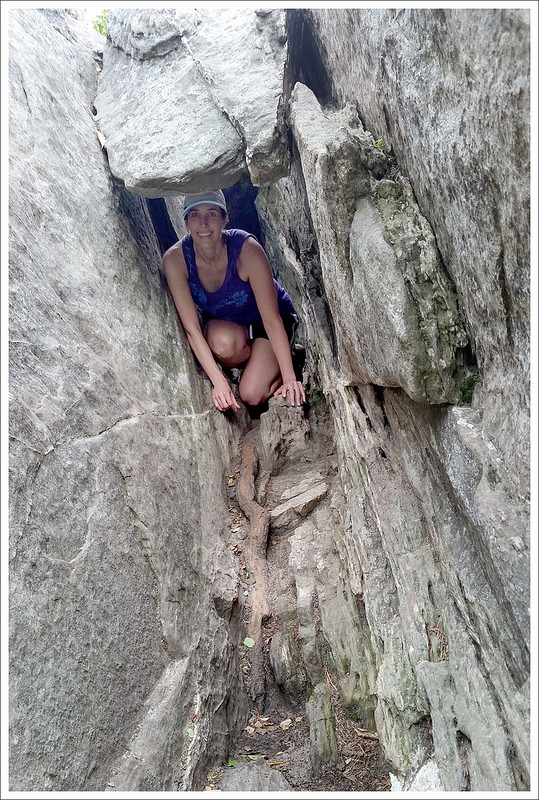
To get to the top, look for a footpath that circles behind the Tooth.  There is a large crack in the middle that allows you to make your way up a fin of rock that leads up the backside of the Tooth.  You’ll duck under a boulder that’s wedged in the crack and then pull yourself up to the top.  Once at the top, we enjoyed magnificent views!  The nice thing about hiking it on a weekday was that we had the entire place to ourselves.  We saw very few people the entire day and sat atop Dragons Tooth alone for almost half an hour.

After we sufficiently enjoyed the view, we made our way back down.  At first, the hike back follows the same route.  This meant doing the entire rock scramble again!  Going down, I felt much more confident and didn’t have any problems.   However, not everyone was feeling as secure and happy as me.  Near the top of the scramble, we came across a mother/daughter pair of section hikers.  They had started in Georgia and were aiming to make it to Pennsylvania.  The mother had suffered a bad fall with injuries earlier on the trail, and was paralyzed with fear on the first set of iron rungs.  I’ll let Adam share the story in his write-up, but I will say that he played the role of a true Trail Angel for them that day.

Arriving at Dragons Tooth
The tooth sits like a solitary fang rising from the ground. Below: The path leads behind the Tooth and to a crack in the rock; An opening in the rocks on the climb up Dragons Tooth; A boulder to cli,b under.

Go This Way Scrambling to the Top of Dragons Tooth Ducking Under the Suspended Boulder

We eventually arrived back at Lost Spectacles Gap. Instead of taking the Dragons Tooth Trail back down to the parking lot, we continued north on the Appalachian Trail.  This involved a little more climbing, but gave us access to several more beautiful views. We followed the AT for almost a mile until it met up with the yellow-blazed Boy Scout Trail.  We took a left onto the Boy Scout Trail and followed it for about a quarter mile where it crossed the blue-blazed Dragons Tooth trail.  It was just another quarter mile back to the parking area.  What a great hike!  Even though I’m not a fan of rock scrambles, I thought this hike was fun and very rewarding.

Adam Says…

Well, Christine has pointed out some of the rough parts and why this hike may be scary for some people.  Part of the reason that we both do write-ups for each post is because we have different perspectives.  I would probably put Dragons Tooth in my Top 10 Favorite View Hikes in Virginia That Everyone Should Do.  What else makes that list (in no particular order), you ask?  Mt. Rogers, Old Rag, Three Ridges, The Priest, Sharp Top, McAfee Knob, Mary’s Rock, Strickler Knob, and Big Schloss.  I remember hiking Dragons Tooth when I was in my later high school years and I have been bugging Christine to do it for years.  Christine has some real vertigo issues and nobody likes to see their spouse go through fearful moments, but I knew she could get through this.  We had planned to do a week of AT hiking in June, but our dogs have been getting older and leaving them behind for a week is getting harder and harder to do.  So, I did a stay-cation that week at home and Christine took a day off work to join me for this day hike, we drove down in the morning and were back home in time for dinner.

For our plans for a week on the AT, we had thought about hiking the section that included Virginia’s Triple Crown, which includes Dragons Tooth, Tinker Cliffs, and McAfee Knob.  Since we changed our plans, we picked out this loop which provided us with Dragons Tooth, but also gave us some time to try out a few of the side trails that connect close to the summit of Dragons Tooth.

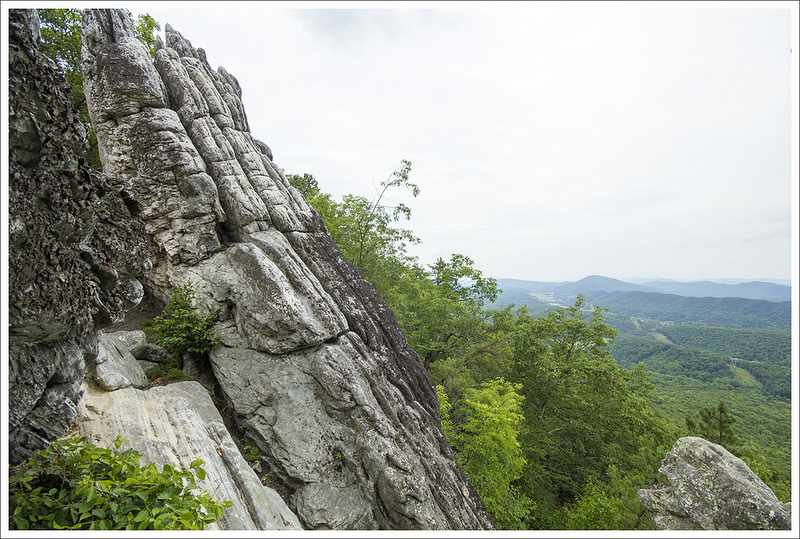
The View From Dragons Tooth
Nice views from the top of Dragons Tooth. Below: More scenes from the top of Dragons Tooth.

Dragons Tooth Dragons Tooth Dragons Tooth

We arrived before 9AM and during the week, so I’m sure this parking lot gets packed on beautiful weekends.  We made a pit stop at the toilets located at the elevated section above the parking lot and then proceeded to the trailhead, located by a kiosk at the back end of the parking lot.  The beginning of this blue-blazed section of trail is very level and flat.  At .25 miles, we crossed a small bridge and came to an intersection with the Boy Scout Trail (your return trip on the loop).  We noticed a few nice spots for camping on this section of trail.  You cross the creek bed a few times, but the next 1.4 mile section is a very gradual, uphill climb.  At 1.65 miles, you reach the Lost Spectacles campsite and the junction with the white-blazed Appalachian Trail .  Take a right (heading south on the AT) to start your climb up to the top.  Christine talked a lot about this terrain.  I agree that it is an extremely tough stretch of trail.  You will find yourself watching where you place every foot and it will be slow-going as you have to scramble up a few rocky sections.  The roughest spot was the one Christine mentioned where you have to zigzag up a cliff-face on rock that is only as wide as your feet.  You have to be very careful through navigating these rocks at times, so if you are not comfortable with this type of terrain this may not be the best choice of hike for you.

Eventually we got to the top of the ridge around 2.25 miles up.  There is a nice viewpoint a few feet to the right of the trail, but you will head left to take the side summit trail to reach Dragons Tooth.  There are a few side trails to the left that lead to other views, but the best view is at Dragons Tooth.  At 2.4 miles, you reach Dragons Tooth.  You will see a cleared-out area and a small view between Dragons Tooth and a lesser tooth.  There aren’t any good signs pointing how to climb up to the top, but if you head to the right side, you will see a small trail that leads to the base on the right side of the tooth.  The fun part for me was trying to figure out how to climb up this.  At 45, I am not the most flexible of human beings and I tried climbing up other ways, feeling like I needed to do the splits to get up one way.  I then ducked under the small rock “pedal” Christine is pictured under below.  Ducking under that, I was then able to stand up and using rock holds, pull myself up to the top.  The views from the summit were phenomenal.  I told Christine I could help her figure out how to navigate and I am proud of her for summoning the courage to do it.  We took some pictures from the top and enjoyed the views for a few minutes before climbing down.  We found it hard to believe we had this Virginia treasure all to ourselves.  We climbed down and ate a snack at the area between the two teeth and enjoyed the views from a less precarious spot.  Another couple arrived at the summit and we made our way back down to allow them the privacy we enjoyed.

Boulder Lodged in Tooth
To climb up and down, you have to duck under this boulder. Below: Scenery at the base of Dragons Tooth; Views near the top; Adam carries an extra pack.

View From the Bottom of Dragons Tooth Views Near the Top An Extra Backpack

As soon as we were descending down from the ridge at the AT junction, we came across a thru-hiking mother and daughter.  They were incredibly cautious on the trail and after talking to them a bit, the mother told us about how she had fallen in Tennessee and this terrain was making her terrified.  They had to take a few weeks off for her to recover.  The mother had talked about quitting the trail, but they decided to press on.  The mother developed the trailname of “Bad Ass” after her ability to keep fighting.  After seeing Bad Ass’ apprehension and tears on the easier parts of the hike down from Dragons Tooth, we began to wonder how she would get through the next .7 miles.  I turned around and did the only thing I could think of and offered to carry her pack down to the Lost Spectacles camp.  I can understand this terrain would be scary with a lot of extra weight.  She eventually agreed this was a good idea, so I hoisted on her backpack (probably about 35 pounds) and then wore my backpack on my chest, making it a little difficult to see over the top where my feet were at all times. I pressed on quickly while Christine stayed with them for a while on the trail.  There were a few times I struggled as well with both packs on, but I was able to keep my feet under me and navigate through some of the tough sections.  I arrived at the Lost Spectacles camping area at 3.3 miles and waited.  Christine came down about 15 minutes later and it was probably another 15-20 minutes before Bad Ass and her daughter met up.  They thanked me profusely, but I was just glad to help out.  We all have to lift each other up when we have down times, so hopefully I was able to give them a bright spot in a tough day.

From the Lost Spectacles site, we continued along the Appalachian Trail heading north.  This section started off steep as well and did have just a couple small scrambles around some more rocky sections.  But there were several nice views along this section of the AT and I’m so glad we did this as a loop instead of an out-and-back hike.  This section of the AT, walks along a ridge and descends slightly, but you will have several opportunities to take in more views.  Eventually the trail descends into the woods.  At around 4.3 miles, we arrived at a junction with the Boy Scout Trail.  We took this yellow-blazed trail and found it very steep as you are basically going straight down without any switchbacks.  The trail didn’t have anything overly scenic on it worth mentioning, but it provided a quick return to the Dragons Tooth trail at 4.7 miles.  We took a right at the junction and were back at our car around 5 miles.

View from the Appalachian Trail
There are several more nice views along the Appalachian Trail portion of the hike. Below: Following the AT north; Climbing some of the rock slabs on the Appalachian Trail; Berries

Trail Junction Appalachian Trail Blueberries

Once we got back to our car, we got on the interstate and headed north.  We had heard about Three Li’l Pigs Barbecue in Daleville, VA as being a favorite spot for thru-hikers so we decided to check it out.  The food there was magnificent and we saw a couple of thru-hikers there enjoying the big quantities of food.  After stuffing my face, I was tempted into also ordering some banana pudding for dessert but I found a way to fit it all in.  As we were leaving, we quickly saw some fast-moving thunderstorms moving in quickly.  Near Three Li’l Pigs in the same shopping center we stopped in Outdoor Trails – an outdoor outfitter store.  This shopping center had the bulk of what every thru-hiker would need for a zero day (a day where they would do zero miles).  A barbecue spot, an outfitter, a grocery store, a coffee shop, and a hotel directly across the street.  If you’re doing a section of the Appalachian Trail, Daleville would be a great place to stop and resupply.

We got stuck in terrible thunderstorms on our drive home. We were thankful that we did the hike earlier and weren’t stuck in the deluge.  While some of the hiking was a bit frightening for Christine, we ultimately had a wonderful day on the hike!  If you are comfortable with rock scrambles and open ledges and haven’t done this hike yet, put it on your must-do list and it may make your top 10 list for Virginia as well.

Appalachian Trail

This section of Appalachian Trail has such varied terrain. Below: More views along the AT; The Boy Scout Trail; Three Li’l Pigs BBQ.

More Views The Boy Scout Trail Three Li'l Pigs BBQ

Trail Notes

  • Distance – 5 miles
    Check out the stats from Map My Hike*
  • Elevation Change – 1215 ft.
  • Difficulty –  3.5.  The rock scramble provides a bit of challenge on an otherwise solidly moderate hike. 
  • Trail Conditions – 2.  The scramble is mostly sandstone, so it can be slick with grit/sand.  It’s also very slippery when there’s been recent rain.
  • Views  5.  There are viewpoints all along the hike and you can’t beat the view from the top of the tooth!
  • Streams/Waterfalls – 1.  There is a small stream that could be used as a water source near the trailhead.
  • Wildlife – 1.  The trail is heavily traveled and wildlife seems to steer mostly clear of the area.
  • Ease to Navigate – 4.  The trail signs are easy to follow and blazes are abundant.
  • Solitude – 1.  We hiked this early on an overcast weekday morning, so we enjoyed quite a bit of solitude.  However, expect crowds and significant trail traffic at more popular times.

Special regulations for this area:

  • Maximum group size, day hikes: 25
  • Maximum group size, backpacking/camping: 10
  • No alcohol
  • Dogs must be kept on leash at all times
  • No camping or campfires outside of seven designated areas (north of Va 624/Newport Rd, the only legal campsites are Johns Spring Shelter, Catawba Shelter and campsites, Pig Farm campsite, Campbell Shelter and Lambert’s Meadow Shelter and campsites)
  • No camping or campfires on McAfee Knob or Tinker Cliffs

MapMyHike is not necessarily accurate, as the GPS signal fades in and out – but it still provides some fun and interesting information.

Download a Trail Map (PDF)

Directions to trailhead:  GPS coordinates for the parking area are: 37°22’44.5″N 80°09’22.1″W.  From I-81, take exit 141.  Turn left onto VA-419 N.  Follow for .4 mile.  Turn right onto VA-311 N.  Follow for 9.5 miles.  The parking area will be on the left.

Stairway to Heaven – Shrine Mont to North Mountain Rocks

Pets ARE NOT allowed on this hike

This 5.6 mile hike offers a great scenic viewpoint, a cool rock formation to explore, and a chance to stroll around historic Shrine Mont.  While the hike is generally moderate, almost 1,150 feet of the the ascent occurs in just over a mile of trail.

View the Full Album of Photos From This Hike

Download a Map of All Trails Around Shrine Mont

Rocks on Great North Mountain
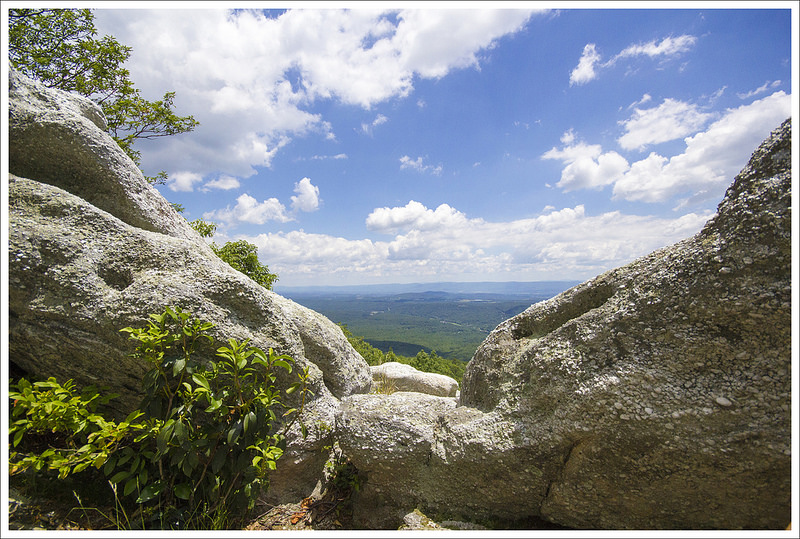
The rocky outcropping on Great North Mountain offered spectacular views. Below: Orkney Springs – water pours from the rocks; The Shrine at Shrine Mont – a beautiful outdoor chapel; The Cross Trail included the Stations of the Cross.

Orkney Springs The Shrine at Shrine Mont Stations of the Cross on the Cross Trail

Adam Says…

Tony and Linda from Hiking Upward had suggested we tackle this hike together from Shrine Mont.  We met up on the porch of the Virginia House.  Since Christine and I got there a little early, we went inside this main lodge building and found a copy of their trail map at the front lobby.  Most of the people there were there for a church retreat.  When we got together, we walked down the road and found a sign directing us to the shrine.  We walked up to the shrine, which was a cute outdoor chapel made of stone, reminding me of an old historical spanish mission church where the congregation would meet up in an outdoor location to worship.

At the shrine, you will see a kiosk and sign pointing to the cross and north mountain, which will start the main hike.  Along this part of the trail, you will pass by signs along the way that depict the Stations of the Cross.  The trail leads along a side of a large hill.  Once the trail switches back, you arrive at the large cross and Cross Observation Deck at 1.1 miles.  You can climb up a few flights to an observation deck.  We were hoping for a nice view at the top – maybe there was at one time, but the overgrown trees have taken away most of the view.

The Cross Tower at Shrine Mont
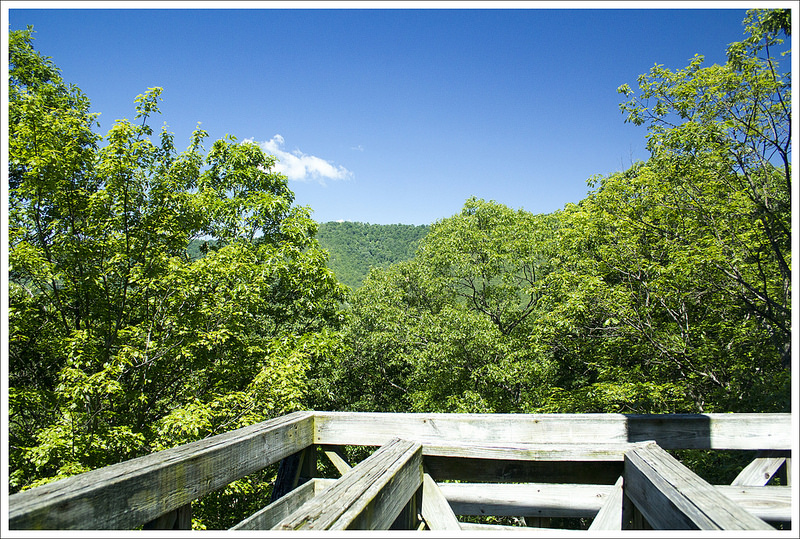
Shrine Mont has a large cross built atop an observation deck. Below: Views from the deck; The cross; Seventeen year cicadas were everywhere on the day we hiked.

View from Shrine Mont Cross The Shrine Mont Cross Seventeen Year Cicada

Continuing along, the trail walked a ridgeline for a short time before descending again.  At 1.75 miles, we reached a junction and took a left to start the trail up North Mountain.  You quickly pass a forest road and at 1.85 miles, you will arrive at another junction (the Bradford Trail branches off to the left).  Stay straight on the North Mountain Trail, which follows a gravel road for a short distance, before turning left to stay on the trail.  The trail is a constant uphill from this point, with some of the trail being quite rocky and steep.  Around the 2.6 mile mark, we reached a large cliff.  I decided to explore a little further and found on the left side of the cliff, there was a way up that allowed me to walk along the shelf of the cliff as the rock sloped upward.  Of course, I wasn’t the first to get this idea as I found a fire ring and lots of graffiti on the cliff shelf.  I could see this being an interesting spot for rock climbers.

We jumped back on the trail and continued our climb up.  The trail was very steep and rocky in some of these next sections, making for a slow pace to the summit.  Eventually, you will skirt an edge where you get some obstructed views along the way and you won’t have much further.  We eventually made it at 3.3 miles to a campsite and the summit.  When you arrive, you will be at the back side of the views.  Go around to the right of the rocks and you will find some rocky ledges that you can climb up about 15 feet to get to the shelf of rocks for an outstanding view.  This climb up the rocks should only be done if you feel comfortable and I wouldn’t recommend this for families.  Once you climb over the top, you are on a sloping downward piece of rock covered with some slippery lichen.  There is a small area that you can sit and enjoy the views, but could be hard to accomplish if a lot of people are at the top at once.

Tony had brought along his drone to try and get some good photos of the scenery around us.  I helped him launch it and it got some great shots of us and the views all around.  When Tony was bringing it back in, he mixed up the controls and it came crashing down on the rockface and into the trees below.  We both made a path along the side of the rockface and scrambled through a ton of briars to retrieve the drone.  It turned out that it was still operational and we enjoyed watching the video of the crash and retrieval.

We made our way back down retracing our steps for most of the hike.  At 4.85 miles, when we reached the junction that would have led us back to the Cross Observation Deck, we instead stayed straight and followed the signs back to Shrine Mont.  The trail winds back down the mountain and goes behind some of the cabins of Shrine Mont.  We got back to the main road and the parking area at 5.6 miles.  We took a few minutes to explore the Shrine Mont area before making our way on to Woodstock Brewery for some food and drinks.

Adam on the Rock Formation
This rock formation was huge! Adam enjoyed climbing on it. Below: The hike had a few shallow, easy stream crossings; The trail was very rocky in many places; A nice campsite next to the summit.

Shallow Stream Crossing Rocky Shrine Mont Trail Summit Campsite

Christine Says…

We always enjoy a chance to meet up with our friends from Hiking Upward.  Tony and Linda suggested meeting at Shrine Mont and hiking to a rocky outcropping on Great North Mountain.

We thought we were doing an easy 3-4 mile hike, but it turned out to be a bit longer and much more challenging than expected. I think most of the challenge was due to two factors: 1) the heat/humidity and 2) most of the ascent was stacked into just a mile and a half of the hike.

I got my first hint that I wasn’t going to have an easy day on the trail when we started climbing to the Cross Observation Tower.  The trail to the cross is short but fairly steep.  I trudged along, thinking to myself ‘I feel really hot. I’m sort of lightheaded. I hope I don’t barf!’  By the time we got to the cross, I had to sit down and cool off. This was one of the first really hot and sunny days we hiked this summer and I just wasn’t used to it.  It didn’t help that my Camelbak was full of <gag> tepid tap water. 

For a while after the tower, the way was easy going. The trail was moss-covered and followed a gentle grade. We heard millions of cicadas singing in the trees.  It was a constant, other-worldly static sound.  We saw a few of the large insects clinging to branches, dead on the ground, or buzzing lazily around in the air. One of them even flew right into my face and bounced off my forehead. I was too hot to care. I didn’t even manage a half-hearted swat.

Adam Launching the Drone
Adam Launching the drone. Below: A look back at our group from Tony’s drone; Views from the rocks

View from the Drone North Mountain Rocks View North Mountain Rocks View

Eventually the Ridge Trail intersected with the North Link Trail.  We followed that for a short distance to the North Mountain Trail.  At first the North Mountain trail was deceptively easy.  I was feeling better and cooling off.  Then the trail started getting rockier.  We had to constantly watch our footing on the shifty rocks beneath our feet. After a couple tenths of a mile, the trail started to climb rather steeply uphill through stands of dense mountain laurel and rhododendron.  It felt close – the air was sweltering with no hint of a breeze. I started to feel woozy again.  Eventually, we reached the towering cliffside/cave in the middle of the woods.  We all took a break, cooled off, and some time to explore the rock formation.

After the break, the climbing got even steeper.  I’d hike a quarter mile and then need to rest.  I almost never take breaks unless there is something interesting to see.  In this case, I just thought it would be interesting not to pass out.  I found myself sitting on the ground with my head between my knees. I was so hot – I felt like a furnace was stoked up in the core of my body. The lukewarm water in my pack wasn’t doing anything to cool me off.  So, I took lots of breaks and trudged until we finally reached the ridgeline. At that point, the climbing moderated and we only had a few more tenths of a mile to go. But, we were also in more direct sun, so it was even hotter.  Adam was really the only one of us hiking at a quick pace. Tony and Linda were behind me a bit, and I kept watching the space between Adam and I get bigger and bigger.  I started seeing stars, and proclaimed to nobody in particular ‘I NEED TO SIT DOWN NOW OR I WILL PASS OUT!’  In a minute or two, Tony and Linda caught up and Linda poured ice water on my neck and head.  They were both hiking with frozen bottles of water and Gatorade.

After another rest, I was able to make the final push to the summit and its rocky outcropping.  I scrambled to the top of the rock and found a nice breezy spot to lie down and enjoy the magnificent view.  I ate a Larabar and watched Adam and Tony play with (and crash!) the drone.  After a pleasant stay at the top, we made our way down. The downhill hike was much faster and easier, and I felt completely normal again.  I’m not sure why I struggled so much with this hike.  Yes – it was hot and the climbing was stacked into one small section, but I’ve certainly done harder hikes on hotter days.  The only thing I can guess is that I was fatigued from doing a lot of hiking in the days leading up to the Shrine Mont hike.  I’d done a 16 mile, a 4 mile, and an 8 mile hike and was already pretty depleted.  In the hikes since this one, I’ve started making gigantic ice cubes for my Camelbak.  I have plastic mason jars that I fill and freeze.  The jars are just small enough that they just fit through the circular opening in the bladder, but they’re big enough to not melt quickly.

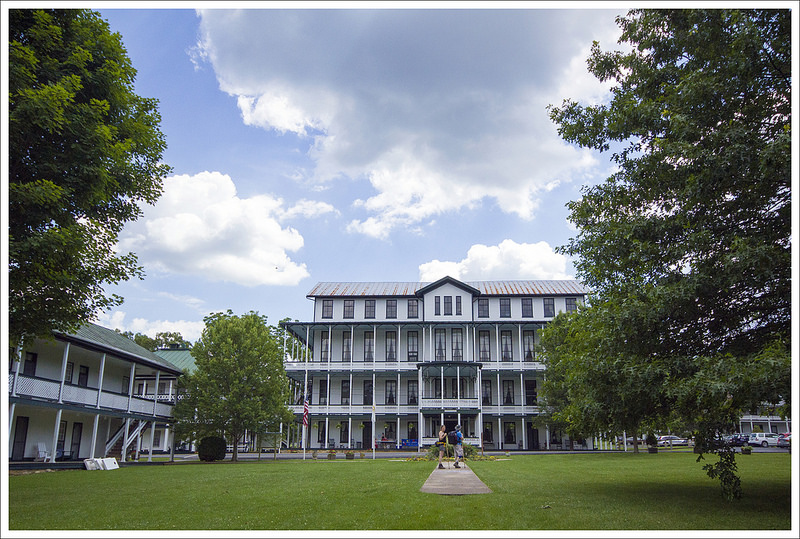
The Virginia House at Shrine Mont
The Virginia House at Shrine Mont. Below: Vegetation around the trail was dense; A nice place to sit by the Shrine Mont Pond; Post-hike goodness at Woodstock Brew House.

Dense Vegetation Shrine Mont Pond Woodstock Brew House

Our hike down followed the same route we came up for most of the way.  We were planning on turning onto the Bradford Trail, which would have added another mile or two to our hike.  But everyone was hot, tired, and thinking about beer – so we opted to follow the much shorter route down the North Link Trail back to Shrine Mont.

We got back to the cars, cleaned up, and made our way for an afternoon at Woodstock Brewery.  They had excellent barbecue and we all enjoyed their vanilla porter.

Trail Notes

  • Distance – 5.6 miles
    Check out the stats from Map My Hike*
  • Elevation Change – 1545 ft.
  • Difficulty –  4.  Some of this trail is quite rocky and steep making for a hard climb at the end.
  • Trail Conditions – 3.5.  The trail was well-maintained and traveled with very few blow-downs, but the rocky terrain makes for some tough steps.
  • Views  4.   If you aren’t bold enough to climb up the rock outcropping, this score would be a lot lower.  You are treated with a nice panoramic view if you do.
  • Streams/Waterfalls – 1.  There are some small stream views, but nothing substantial. 
  • Wildlife – 1.  This is a popular trail, so wildlife tends to stay away.
  • Ease to Navigate – 2.5.  The trail system is tricky.  Some of the junctions are not well-marked and labeled on the printed map.  Download both of the maps from this page and you should be fine.  On our way back, there were several options leading down to Shrine Mont, which could bring some confusion as well.
  • Solitude – 3.  We ran into some people that were staying for a retreat as well as locals. 

MapMyHike is not necessarily accurate, as the GPS signal fades in and out – but it still provides some fun and interesting information.
Download a Trail Map (PDF)

Directions to trailhead: Coordinates for parking are 38.795500, -78.815932

From Woodstock, VA, head southwest on VA-42 for 13.8 miles.  Turn right on State Route 720 and in .7 miles, stay straight to join State Route 721.  Go 1.5 miles and then stay straight (right fork) to join State Route 722.  Go .5 miles and turn right on to VA-263West.  Follow this for 3.7 miles and it will lead to Shrine Mont.  Park in the parking lot behind the pavilion and the main Virginia house.  Walking from the parking lot, take a left at the main road walking in front of the Virginia house and follow the road until you see signs directing you to the Shrine.

Bird Knob – Browns Hollow Loop

This 11 mile loop has everything – stunning views, scenic streams, a clear mountain pond, and even a small waterfall.  You could hike it as a long(ish) day hike, but there is so much great camping along the way that it’s ideal for an easy overnight backpacking trip!

View the Full Album of Photos From This Hike

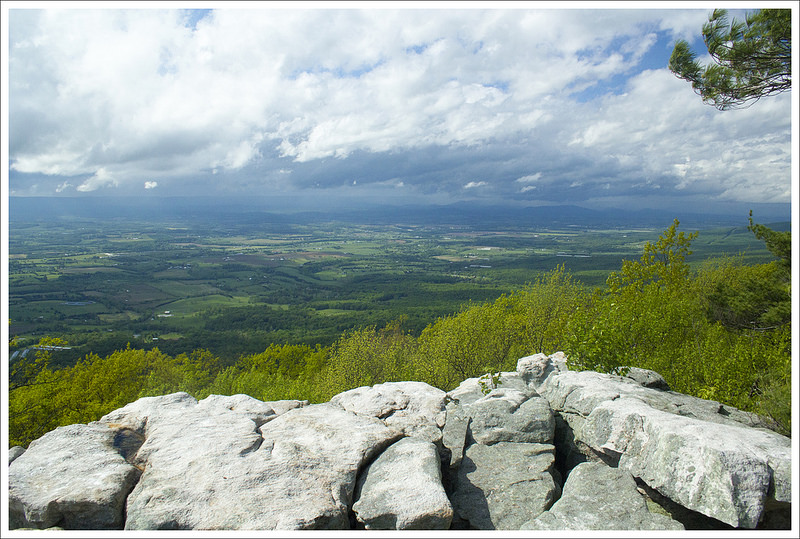
Views Along the Massanutten Trail
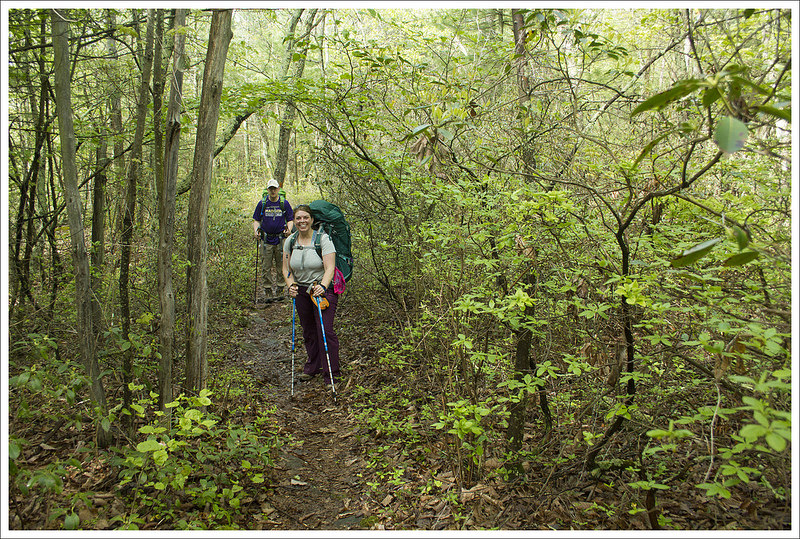
Views Along the Massanutten Trail. Below:  The mountain laurel was just starting to bloom in mid-May; Christine and Adam attempt to fix Kris’s broken trekking pole with duct tape; Kris makes her way up the steepest, rockiest part of the hike.

Blooming Mountain Laurel Trekking Pole Repairs Steep Uphill

Day One (4 miles)…

One thing that was true about May in 2016 was we had a TON of rain in Virginia.  It was hard to find a time to actually go for a hike in good weather.  We had been itching to try and do an overnight trip, but the threat of drenching downpours and storms was standing in the way.  We had some very stressful days at work, so getting out and finding some peace away from the hustle of everyday life was just what the doctor ordered.  In looking at the weather closely, we decided we may be able to get a short, overnight trip in if we timed it just right.  We decided to do something very close by to our home to allow us to get on the trail quickly to get in a few miles before it started to get dark.  We had called our friend, Kris, who was going to accompany us, and told her to be ready anytime during the Saturday afternoon.  We felt like Doppler radar experts as we were tracking the storm movement and finally around 2:30PM, we felt the rain was going to stop to allow us to hike.

We got to the Massanutten Visitor Center and saw a lot of cars in the parking lot.  We were thinking there was no way that others were on the trail at this same time due to all the rain we had in the last few days.  A large camper was at the front and I talked to one gentleman out front.  As it turns out, it was the Massanutten Mountain Trails 100 race that weekend, a 100-mile race along the Massanutten Mountain range that covers 16,200 feet of ascent.  We were a little worried about the trail conditions and how many runners we may see along the way, but nothing was stopping us now.

Views on the Massanutten Trail
Two nice views come in the first mile and a half of hiking.  Below: The ascent along the orange-blazed Massanutten trail is fairly rocky and steep; Pink lady’s slippers were blooming everywhere; We hear rumbles of thunder!

The Ascent was Rocky Pink Lady's Slippers We Hear Thunder

From the parking lot, we took the white-blazed Wildflower trail (do not take the Nature trail at the end of the parking lot).  This trail leads downhill and passes some comical information plaques along the way.  At .3 miles, when you reach an intersection with the Massanutten South trail, take a right to start on the orange-blazed Massanutten South trail.  The trail goes up a steep ascent and we found with the recent rain the footing was slippery and mucky in a few parts.  On the ascent, we found that Kris’ new trekking poles weren’t locking properly, so we paused to get some duct tape to try and make a repair (not long after we realized that our fix didn’t hold up and she lost part of her pole somewhere along the trail).  The uphill was quite steep and had us breathing heavily with our heavy packs, but this is the toughest part of the entire hike.  We passed a hiker who was doing the reverse route and he told us right near the summit there were about 100 pink lady’s slippers along the trail.  We decided to count what we had saw; while we didn’t see 100 of these rare wildflowers, we did count close to 60 over the weekend which may be the most we’ve ever seen on a trail.  We came to the first overlook around the 1.6 mile mark (the second is just shortly ahead), took our packs off for a few minutes and enjoyed the panoramic views.  The clouds after the recent storm blanketed the sky.  We stopped at the second view also before continuing on.  At 2.5 miles, the trail splits; head to the right to join the Bird Knob trail.

The Bird Knob trail is a ridge walk and is quite flat, which was a nice change from climbing. But, the sky began to get dark and we started hearing thunder in the near distance.  Within five minutes, we started to feel rain.  We decided to put on our pack covers and rain gear and it was just in the nick of time, as the clouds unleashed a downpour mixed with pea-sized hail.  We kept marching through the hailstorm and within about 20 minutes, the storm had passed.

Camp for the Night
We wanted to camp by Emerald Pond, but the sites were taken early in the day. We found an equally nice spot in the meadow. Below: The rumbles of thunder turned into a downpour with hail – we were all prepared; Kris and Adam scout out the open meadow that would soon be our back-up campsite for the night; This grassy path departs the meadow. Shortly after this photo, we turned back and set up our camp at the top of the meadow.

We Got Hailed On Scouting the Campsite We Had to Turn Back

At 3.8 miles, we reached a large open field with a campsite.  We decided to press on to get a spot at Emerald Pond, so we skirted the left side of the field to stay on the trail.  The trail then turns into an old logging road going downhill.  About halfway down the road, we came across a couple of rain-soaked college-aged guys.  They were asking if there were any campsites up ahead and they told us all the spots were taken at Emerald Pond.  We mentioned the big field with lots of room and they left the way they came to go get the rest of their group and their packs.  Since we heard there were no spots, we decided to turn around and get a nice spot in the open field.  Christine scouted around and saw there were also sites in the woods next to a small hidden pond, but the bear scat around the site was a deterrent.  We decided to camp near the fire pit we saw at the top of the field.  One thing that was nice about camping in this grassy field was we knew we would have a comfortable floor bed to pitch our tent.  We set up in a short amount of time and we were soon joined by about eight others in the field that night.

The wind had picked up as the storm front had moved through and I felt unprepared in terms of clothing.  I switched out of my damp clothes, but I didn’t bring enough warmer clothes for that evening.  We made a quick meal and were even able to start a fire at camp despite the wetness of the wood.  After dinner, I was getting a little colder each minute, so I decided to call it an early night and get in my down sleeping bag while Kris and Christine talked until nightfall.  It was a crazy day on the trail, but one thing I like about hiking is it is always an adventure.

Day Two (7 miles)…

The morning dawned sunny but frigid!  Adam had been cold all night, so I let him stay curled up in his sleeping bag while I went to take down the bear hang.  No one else who camped in the meadow was stirring, but the three of us quickly cooked breakfast and packed up camp.  On our way out of the meadow, we all got a good chuckle over one of the tents set up nearby.  It was technically pitched, but in no way like it was supposed to be.  We’re guessing someone borrowed a tent and couldn’t figure out how to set it up.  I love a backpacker’s ability to improvise!

After walking downhill to the bottom of the meadow, we picked up the old logging road for a few tenths of a mile until we reached an unmarked gravel road on the left.  The gravel road led to Emerald Pond – a beautiful, spring-fed mountain pool.  The last time we visited, we had the pond all to ourselves and very much enjoyed the peace and solitude.  This time, the pond was crawling with other campers.  They had big tents, tons of gear, and were dressed in jeans and work boots.  We’re guessing that they parked on the nearby forest service road and walked the tenth of a mile to the prime campsite on the pond.  I guess it’s worth noting that the early bird gets the worm when it comes to staking a claim on an Emerald Pond campsite!  We didn’t want to intrude, so we just took a few photos from the near-side of the pond. The campsite side is prettier, so don’t miss visiting if the spot is open.

Emerald Pond
Emerald Pond is a much sought after campsite. It was full of people by mid-day. Below: Breaking down camp in the morning; Kris leaving camp; Adam passes the locked gate onto the forest service road.

Breaking Down Camp Off to an Early Start Gate to Fire Road

We left the pond and continued a tenth of a mile to the forest service road.  There was a locked gate where the trail met the road.  At that point, we took a right and hiked downhill along the road (orange blazed) for a few tenths of a mile until we reached the junction with the Roaring Run Gap trail.  The trail is on the left side of the forest road and is marked by a wooden post with two sets of blazes – light purple and pink. The climb up Big Mountain via the Roaring Run Gap trail (blazed purple) was our last big climb of the trip.  For a little less than half a mile, the trail climbs steeply uphill over rocky terrain.  At the top, we passed a small/dry campsite. On the descent, which came almost immediately, we glimpsed beautiful views through the trees.  There were switchbacks and quite a few muddy spots along this stretch of trail.  We cheered on the last few runners on the Massanutten 100 Miler race.  Even if you’re finishing at the back of the pack in a race like that, you’re still tougher than we’ll ever be!  We also met the sweeper who was jogging the course behind the last racer to pick up reflective hang-tags that helped keep runners on course during the night.

After about a mile of walking along the purple-blazed Roaring Run trail, we reached an unmarked junction with the pink-blazed Browns Hollow trail.  The trail is a left turn from the Roaring Run Gap trail.  Over four miles of the hike on day two follows this Browns Hollow trail – so look for the pink blazes.

Hiking Roaring Run Gap
We got nice glimpses through the trees on the Roaring Run Gap trail. Below: The route follows the forest service road for a short while.  We shared much of our hike with runners competing in the Massnutten 100-miler; Roaring Run Gap trail is steep and rocky for a short while; Views through the trees.

Massanutten 100 Miler Rocky Grade on Roaring Run Gap Trail Views Through the Trees

The Browns Hollow trail starts off passing through pretty forest.  There are stretches of trail that pass through impressive blueberry bushes.  Eventually, you descend to Browns Run. Along the way, you’ll pass a couple nice campsites suitable for one or two small tents.  Both sites had fire rings and easy access to water.

There are several beautiful rapids and a small, but lovely, waterfall on this section of trail.  We all enjoyed walking through the verdant green forest, while listening to the sounds of bubbling water. It was gorgeous and peaceful.  If you look around you’ll notice the stream runs through a pretty deep and dramatic gorge.  The far side of the stream goes upward quickly and steeply.  There were even a couple places that looked like there had been recent landslides.  All the trees and dirt slid straight down the mountainside and ended in a jumble at the bottom. This part of the hike was gentle and easy, so we made great time and enjoyed chatting along the way.  We counted more pink lady’s slippers and admired other spring blooms along the trail.

Small Waterfall on Browns Run
Small Waterfall on Browns Run. Below: Everything was lush and green from all the spring rain; One of several campsites along Browns Run; Walking the Browns Run Trail

Lush Green Forest Campsite on Browns Run Lush Green Trail

At a little over the five mile mark of day two, you’ll cross Browns Run.  I imagine most of the time this is a shallow, easy stream crossing.  We hiked the trail after weeks of rain, and still found the crossing very doable.  The stream was only 12-18 inches deep and there were enough large rocks to rock hop most of the way.  There were a few places I had to submerge the toe of my boot on an underwater rock, but all three of us crossed without any trouble.  Right after the crossing, there is a fantastic group campsite.  The area is large and clear with space for multiple tents.

We continued to follow the Browns Hollow trail as it became a wide old road.  We passed lots of blooming mountain laurel along this part of the hike.  Eventually we came upon a picnic area with a shelter.  At that point, we took a left onto the marked Wildflower Trail at this point.  It passes a series of interpretive signs before eventually leading back to the Massanutten Visitors Center (closed) where we started out the prior morning.

Crossing Browns Run
Kris crosses Browns Run. Below:  A large campsite right after the stream crossing; The trail turns into an old roadbed; Walking past blooming mountain laurel.

Big Campsite at the Junction Browns Hollow Trail Browns Hollow Trail

It was still before noon when we wrapped up, so we decided to drive back into Harrisonburg for lunch. We enjoyed burgers at Jack Brown’s and then headed over to Brothers Craft Brewing to enjoy their new Verdure series.  They’ve done a tart Berliner-Weisse beer infused with all kinds of seasonal/summer fruits.  They had Blackberry Verdure on tap.  It was the perfect reward for a fun weekend of hiking.

Trail Notes

  • Distance – 11 miles
    Check out the stats from Map My Hike [Day 1] [Day 2]*
  • Elevation Change – 2290 ft.
  • Difficulty –  2.5.  The toughest stretch is the initial push up to the viewpoints. 
  • Trail Conditions – 3.  There were a couple of blowdowns, some muddy patches due to the heavy rain, and a stream crossing, but footing was overall very good.
  • Views  4.  The two viewpoints provide some nice panoramic views.
  • Streams/Waterfalls – 3.5.  Browns Run is a nice stream and a good water source.  While not a stream or waterfall, Emerald Pond is extremely picturesque and would make a nice swimming hole. 
  • Wildlife – 3.  The start of the Wildflower Trail had us surrounded by birds.  With bear scat spotted near our campsite, there is some bear activity here. 
  • Ease to Navigate – 2.  There are multiple trails that cross over between Bird Knob and the Massanutten trail.  Take a map to make sure you are going the correct way.
  • Solitude – 2.  While you won’t see many on the trail, we found a lot of locals like to drive in close and visit Emerald Pond.

MapMyHike is not necessarily accurate, as the GPS signal fades in and out – but it still provides some fun and interesting information.

Download a Trail Map (PDF)

Directions to trailhead: GPS coordinates for this hike are 38°38’35.4″N 78°36’43.0″W. From I-81, take exit 264 for US-211 toward New Market/Timberville/Luray.  Head east on US-211/W Old Cross Road and go .3 miles.  Turn left onto N. Congress St. and go .3 miles.  Turn right onto US-211 East and go 4.5 miles.  Park at the old Massanutten Visitor Center parking lot on the right.  The trail starts towards the front of the lot on the Wildflower Trail.

Double Bear Rocks

This 8.3 mile hike follows the Pass Mountain Trail from the route 211 trailhead up to the Pass Mountain Hut.  From there, you’ll follow the Appalachian Trail north to the beautiful viewpoint at Double Bear Rocks.

View the Full Album of Photos From This Hike

Double Bear Rocks
The view from Double Bear Rocks looks in the direction of Strickler Knob, Kennedy Peak, and Duncan Knob.

Christine Says…

The first weekend in April, we met up with Tony & Linda (of Hiking Upward fame) for a day of exploring a new trail and a new brewery. When we were discussing route options, Tony tossed out the idea of climbing the Pass Mountain trail for a visit to the same-named Appalachian Trail shelter.  The route was about five miles with 1,300 feet of climbing – perfectly moderate for my recovering ankle injury.

We initially planned to hike on Saturday, but sleet, rain, and high winds compelled us to postpone for Sunday’s more pleasant forecast.  We met at the trailhead along Route 211, just a little bit west of Sperryville.  The trail begins at the cement marker post across the road.  211 can be very busy and its twists and turns are often traveled at speed, so be extremely careful crossing the road from your car to the Pass Mountain trail.

The Pass Mountain trail was beautifully maintained – blowdowns were cleared, branches were trimmed back, and it looked like someone had put a lot of time installing new water bars.  The hike began with a meandering series of switchbacks that climbed steadily but gently uphill. At about the one mile mark, we reached another cement marker.  At the marker, you’ll notice a defunct, unlabeled fire road; stay to the left and follow the blue-blazed Pass Mountain trail uphill.  The trail continues uphill for almost a mile before leveling out on the ridge.  If you happen to hike this trail in winter or early spring, you’ll get great views of Marys Rock through the trees.

Pass Mountain Trail
Our hike started from a trailhead on route 211 near Sperryville. Below: A trailmarker in the middle of the woods.  It appears there used to be another trail or fireroad at the marker that is no longer maintained; Our hiking entourage; A view of Marys Rock through the trees.

Trail Junction Hiking Entourage Mary's Rock Through the Trees

At 2.8 miles, the trail ends at Pass Mountain Hut – one of the park’s nine Appalachian Trail shelters.  The shelter is a typical structure with a nearby spring and privy.  The unusual thing about Pass Mountain Hut that sets it apart from other AT shelters in the park is that it has a fairly new bear locker instead of a bear pole.  A couple years ago, the Pass Mountain Hut was closed due to aggressive bear activity.  In late summer, a young, extremely thin black bear destroyed the tent of an ATC Ridgerunner.  She was out on patrol and came back to a flattened, saliva-covered tent.  Park authorities closed the shelter area until the bear could be trapped and relocated to a less populated part of the park.

We spent a few minutes at the shelter debating the rest of our hike.  I mentioned to Tony and Linda that I remembered a nice vista just north of the Pass Mountain summit.  My ankle felt OK and even though I wasn’t sure exactly how far it was to the viewpoint, I thought I would be OK pressing on.  We all agreed that a view always makes extra miles worthwhile.  We followed the blue-blazed spur trail from the hut to its junction with the Appalachian Trail.

We headed north on the AT for about a mile, reaching the rocky but viewless summit of Pass Mountain.  This summit does not have a cement marker.  You’ll know you crossed the summit only because you start descending again.  When we crossed the summit, we were still vaguely guessing about how much further we needed to hike to reach the view.  We explored off-trail a little on rocky outcroppings, but they all turned out to be closed in by trees.  Adam jogged ahead to scout for the view. Tony, Linda, and I were all several hundred yards back when we heard Adam shouting ‘BEAR, BEAR, BEAR(S)’.  We all raced ahead, too – because who wants to miss a bear sighting?

Pass Mountain Hut
Shortly before reaching the junction with the Applachian Trail, we passed the Pass Mountain Hut. Below: The hut’s water source; Shelter log; Adam hiking the AT.

Water Source at Pass Mountain Shelter Log Walking the AT

We got there just in time to see two big, furry rear ends disappearing into the brush.  Adam, however, got a great close-up view of the bears.  Lucky!  Just a couple tenths of a mile past the bears, we spotted the side path to the view – Double Bear Rocks, named for the high population of bears in this area.  The view itself is quite nice, but what I remember most about this rocky outcropping is its seasonal abundance in blueberries!  Last time we hiked by this spot, it was July and there were berries everywhere!  In the short time we sat and enjoyed the view, clouds moved in, so we decided to be on our way.

The hike back simply retraced our steps coming up.  Since it was mostly downhill, it went by really quickly.  Before we knew it, we were back at our cars for a total hike of 8.3 miles with 1,750 feet of climbing.  We were all quite ready to make our way into Sperryville for some post-hike refreshments.  We decided to pick up a  to-go order from the Creekside Deli.  It’s a humble-looking building painted bright yellow, but there is nothing humble about their baked goods.  They make top-notch sandwiches on homemade bread, cookies, brownies, and other pastries.   We took our food over to Pen Druid brewery to enjoy a couple beers with lunch.  The brewery doesn’t have a kitchen, so they follow picnic rules. The guys at Pen Druid do small batches of interesting beers – most featuring wild yeast strains.   We had great conversation and agreed that we really must get out together more often.  Great day with friends!

Adam Says…

We always enjoy hiking with Tony and Linda.  When you get people together that have done a lot of hiking, our conversations always quickly go through talking about different trail systems.  We can all talk through different routes as if we were following a map along in our heads.  I’m not sure if it is dull conversation for others, but we enjoy talking about the places we have been or have been hoping to go.  Both Hiking Upward and our site were created to share our experiences.  We may have different approaches to the content, but we do this because of our love of nature and the ability to share hiking ideas with others.  We consider ourselves lucky to live where we live and to be able to have all of these experiences so close by – and we hope you enjoy it as well.

With Christine nursing an ankle injury, we picked a route that she thought would be a decent test with a little elevation but not overly challenging.  This route isn’t well-traveled and is accessed from outside of Shenandoah National Park on US-211, in between Luray and Sperryville, VA.  We arrived a few minutes before Tony and Linda, so we parked where we felt was the correct spot – a gravel pull-off at the bottom of a steep curve.  I consulted a map of the area and felt we were correct, but we didn’t see a signpost to designate the beginning of the trail.  I got out of the car and crossed the road near the sharp curve in the road and found the trail marker.

Two Bears on the AT
We saw a mama bear and her yearling cub not far from the viewpoint. Below: Tony scales a rocky lump near the summit of Pass Mountain.

Rocky Portion

The trail starts as the Pass Mountain trail.  While we felt this isn’t a heavily-traversed trail, we were surprised at how well this small section has been maintained.  The hike on the Pass Mountain Trail is a steady uphill climb, but the conditions of the trail made for easy footing.  On the way up, we caught up with what was going on with our lives  – from aging parents to worrisome dogs to trail sections to hiker rescues to beer.  Around the 2.75 mile mark, we reached the Pass Mountain Shelter.  We stopped and ate a snack and checked out the hiking log.   Christine’s ankle was feeling decent, so we decided to press further up the trail.  At the shelter, there is a junction with the fire road (Pass Mountain Hut Road), but the trail ascends up to the left of the shelter as you are facing it.  We continued up the trail until we reached the junction with the Appalachian Trail at 3.0 miles.

We remembered we found a nice overlook on Pass Mountain that was off the trail and we didn’t think it was too terribly far so we decided to try and find it again together.  We took a right, heading north on the white-blazed AT.  The trail continued to go slightly uphill, but the grade wasn’t as steep as most of the Pass Mountain Trail.  When we carried onward for about a mile, I decided to scout ahead a bit since I didn’t want Christine to put a lot of undue pressure on her ankle.  Trekking up ahead at a brisk speed, I came across a mother bear and a yearling bear cub ambling close to the trail.  They were both curious about me, so I said a few “Hey, bears” to let them know I wasn’t a threat.  They slowly were walking away, paying me little mind so I shouted back at the rest of the group “BEAR, BEAR” to let them know I spotted one.  I wondered if the group thought I was shouting for beer instead, but they understood.  When they caught up, they were able to see the bears not too far off but they had moved away from their comfy spot.

The Descent of Pass Mountain
The trail down is nicely graded with switchbacks. Below: Green plants were just beginning to reappear; Parking area – the road crossing can be very treacherous.

Descent of Pass Mountain Parking

Right around the corner from where we spotted the bear, we saw the jumbled rocks on the left of the trail that we remembered as being the viewpoint.  We cut off the trail and out onto the rocks to enjoy a nice view to the west.  There are nicer views in the park, but on a clear day you can see ridges of mountains for miles.

After taking in the view for a few minutes, we made our way back to our cars.  We continued our trip to Creekside Deli and then Pen Druid Brewery for some delicious food and drink before parting ways.  We look forward to our next adventure with them!

Trail Notes

  • Distance – 8.3 miles roundtrip
    (Check out the stats from Map My Hike)*
  • Elevation Change – 1730 ft.
  • Difficulty –  3.  This was a nice, moderate hike with steady but well-graded climbing.
  • Trail Conditions – 4.5.  The trail was in fantastic shape – very well maintained and tended to by the PATC. 
  • Views  3.5.  There’s a beautiful, but not quite panoramic view on the northern flank of Pass Mountain.
  • Streams/Waterfalls – 0.  There isn’t any stream scenery, but there is a spring behind the Pass Mountain Hut.
  • Wildlife – 4.  We saw bears – a yearling cub and mama!
  • Ease to Navigate – 4.  The trail is well marked and easy to follow.
  • Solitude – 4.  We saw one couple at the hut, but no one else at all during the entirety of the 8+ mile hike.

MapMyHike is not necessarily accurate, as the GPS signal fades in and out – but it still provides some fun and interesting information.
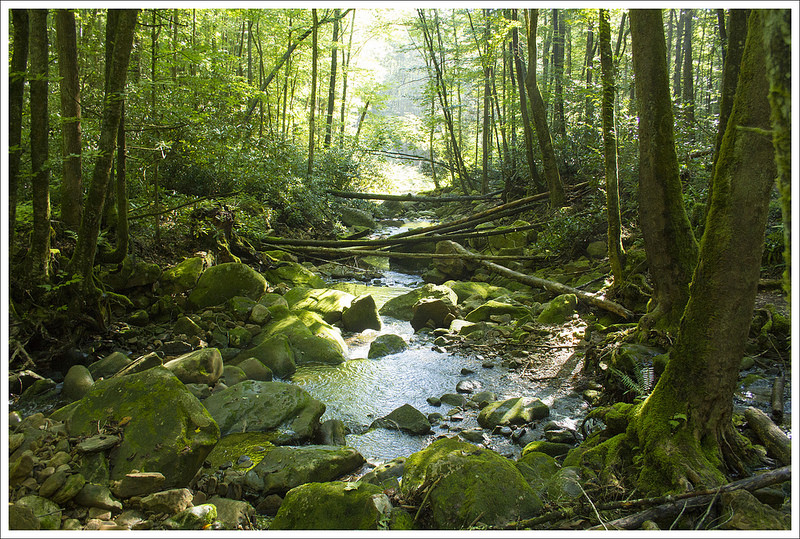
Download a Trail Map (PDF)

Directions to trailhead: The trail is located off of US-211 about 12 miles east of Luray, VA and 2.8 miles east of where US-211 crosses Skyline Drive.  The gravel lot is located at 38.66855, -78.28999.   Cross the road (be careful as this is a blind curve and cars may not see you easily) and at the bottom of the steep, sharp curve you will see the signpost for the Pass Mountain Trail.

Appalachian Trail – Black Horse Gap to Jennings Creek

This 14.6 mile stretch of Appalachian Trail offers many splendid views as you closely follow the Blue Ridge Parkway.

View the Full Album of Photos From This Hike

Blackhorse Gap to Jennings Creek
Our first overnight backpacking trip of the season allowed us to watch the green of spring creeping its way up the mountainsides.

Day One…

When you are gifted a sunny 75-degree weekend in April, you must snatch it up and go backpacking!  At least, that is my belief on the matter. We had just such a weekend in mid-April this year, so we decided to get out there and work on completing some more Virginia Appalachian Trail miles.

We’ve already completed all the miles between Jennings Creek, VA and Harpers Ferry, WV, so we decided to pick up the next section south – Black Horse Gap northbound to Jennings Creek.  It was a relatively short route for an overnighter – twelve miles the first day and just three miles the second day.  We always try to do about 20 miles on a one-night trip, but access to road crossings for our shuttle drop-off made fifteen miles the best logistical option for this trip.

We looked up shuttle options in our AWOL Guide, and ended up hiring Homer Witcher to give us a ride to our start point.  Homer is a great trail ambassador – he’s in his 70s and still finds the time and energy to run on the AT most days.  He, his wife, and children are all avid, lifelong hikers – completing multiple section and thru hikes.  He told us he and his wife are planning another thru in 2017.  We greatly enjoyed talking to him on the ride over to Black Horse Gap.

Walking the Appalachian Trail
The signage for the AT along the Blue Ridge Parkway is nice. Below: Our start point at Black Horse Gap; Adam hikes through a rhododendron thicket; We had nice views through the trees for most of this hike.

Our Start Point Rhododendron Thicket Views Through the Trees

About a half hour later, we found ourselves standing along the Blue Ridge Parkway at Black Horse Gap.  We found the trail easily and started our northbound walk.  Over the first few miles of hiking, the AT crosses the Blue Ridge Parkway a couple times – at Taylors Mountain and Harveys Knob.  Both crossings offer panoramic vistas of the valley below.  Most of the views in this section include a nice look at Sharp Top, one of the areas most popular mountains for day hiking. The terrain along this stretch of trail could best be described as rolling – there were lots of ups and downs, none dramatic.  We passed a large group of Boy Scouts hiking along the trail.  They turned out to be pretty much the only people we saw on our hike.

By 12:30, we reached our lunch stop at Bobblets Gap shelter. We ate and assessed our water supply.  We knew we’d have another chance to resupply water at around the 8 mile mark, but read that the water source at Bearwallow Gap was iffy and seasonal.  I still had over two liters of water, some in my Camelbak and a full Smartwater bottle.  Adam filled his Camelbak to three liters and also had a full Smartwater.  Our planned campsite at the Cove Mountain Shelter is dry (no spring, no stream) and the closest water source to camp is three miles away in either direction, so we tried to guess how much water we would need to cook and hike the next day.  It’s a delicate balance between carrying too much heavy water and not enough, risking dehydration.

After lunch, we leapfrogged the same group of scouts again.  They had decided to skip the shelter since they had moms and lunch waiting for them at a road crossing ahead.  The post-lunch hiking was decidedly more uphill than the morning hiking.  We gradually climbed, crossing the parkway two more times at Peaks of Otter and Mills Gap.  At Mills Gap, we were able to get rid of our lunch trash at a roadside trashcan – being able to get rid of garbage is a real treat for any backpacker!  We took a rest at Mills Gap, reclining on a picnic table in dappled shade.  The temperatures weren’t that hot – maybe high 60’s, but the sun was incredibly strong and relentless through the mostly leafless trees.  We both got sunburned despite using sunscreen.

Beautiful Views from the Blue Ridge Parkway
The trail crossed the parkway numerous times – usually near vistas. Below: One of many road crossings with a view;  Blooming columbines; A huge retaining wall under the parkway; Bobblets Gap Shelter; Lunch and shelter log; A very dank water source.

Vistas along the BRP Columbine Retaining Wall
Bobblets Gap Shelter Lunch at Bobblets Gap Dank Water Source

After a little more climbing from Mills Gap, we started a nice descent to Bearwallow Gap and the VA43 road crossing.  We passed a murky, dank wildlife pond along the way – maybe it’s the bear wallow!  At the road crossing, we sat like a pair of hobos under the Blue Ridge Parkway road sign.  People driving past looked at us like we were a novelty.  There turned out to be plenty of water in the seasonal stream at the crossing, but neither of us had drunk much more water so we decided not to resupply again. That wasn’t the best idea – more about that later!

We crossed VA43 and immediately began the climb up Cove Mountain.   Within the first hundred feet there was a sign reminding us about the dry conditions at Cove Mountain Shelter.  We still were certain we had plenty of water.  As we ascended, I said to Adam “This isn’t bad!  The trail looked WAY steeper on the map!”  Adam replied, “I hope you’re not jinxing us.”  Well, I totally jinxed us.  The trail got much steeper and due to past forest fires, we were climbing in direct, unrelenting sunshine at the hottest part of the day.  We both went through much more water than we had planned for.  I chewed gum to try and preserve what water I had left.  We passed a couple small campsites along the ridge of Cove Mountain. We contemplated stopping for the day, but decided to press on to our planned stop.

Climbing Cove Mountain
Cove Mountain (one of several mountains by this name in the Blue Ridge) was the only tough part of the day. Below: Sitting like a hobo at the road crossing; It’s not nice to shoot at hikers; Beginning the climb up Cove Mountain; Campsites along the top of Cove Mountain; Adam gets nice views as we begin the descent to the shelter; Evidence of an old forest fire.

Hobo Gunshots at AT Sign Climbing Cove
Campsite on Cove Mountain Beginning the Descent Burnt Out

The descent of Cove Mountain was incredibly beautiful.  I think the area burned in 2011 or 2012, leaving spectacular open views along the ridgeline.  I was thankful for such beautiful, distracting views the last couple miles because my feet were killing me.  In addition to not refilling water when we should have, I made the mistake of trying out new gear on a long(ish) hike.  For many years, I have hiked in Thorlo thick-cushion hiker socks with a pair of silk sock liners.  I don’t get blisters -ever- with that combo.  This time, I decided to wear my Darn Tough wool socks.  They’re super popular with hikers and were always comfortable for me on day hikes – even long day hikes, but apparently I do need the extra cushioning I get from Thorlos when I’m carrying a heavier pack.  Lesson learned – don’t mess with the tried and true, especially when it comes to your feet!

We hobbled into camp around 3:30 – almost 12 miles in about 6 hours included stops for lunch, rest, and photography – not a bad pace for our first trip of the season.  We set up camp and spent the remainder of the afternoon reading and napping.   Despite being dry, Cove Mountain Shelter is an idyllic spot.  The shelter is typical, the privy is new, and there was space for a good number of tents both around and on the ridge above the shelter. Recently, I learned an interesting piece of trivia about the Cove Mountain Shelter from my friend Jeff Monroe (of Wandering Virginia). Apparently, this shelter used to sit at Marble Springs (where we camped on the second night of our Jennings Creek to the James River section).  When the area around Marble Springs became designated wilderness, the shelter was moved to its current location on Cove Mountain.

Road Around Mountain
It was neat to see Rt. 43 wrapping around the mountain. Below: The Cove Mountain Shelter; Tents and bear bags.

Cove Mountain Shelter Bear Hangs and Tents

Before dinner, Adam found a good tree and slung the rope for our bear hang.  As we prepared dinner, we rationed out our water, so we’d have enough for breakfast and our second day of hiking.  We were both pretty thirsty and wished we had filled up to the maximum at Bearwallow.  We even ended up drinking our dishwashing water.  Lots of ‘Leave No Trace’ folks always drink their wash water, but it’s also acceptable to broadcast water away from camp.  We usually broadcast.  But this time, we enjoyed a lovely ‘tea’ flecked with a mélange of buffalo chicken, macaroni and cheese, and crème brulee.  Mmmm! Even after conserving water, we really didn’t have much left for both breakfast and tomorrow’s hiking.

As we were finishing dinner, Boy Scouts started rolling into camp – first two, then five more, then another four, then the final three an hour later.  We were sure they had come off the trail at VA43. They’d been hiking since 9:30 a.m. – many of them were first time backpackers, a few were first time hikers!  The troop was from Roanoke Rapids, NC.  They were nice folks, but clearly new to backpacking, as they took the time to remove our bear hang from the tree, thinking it was litter!  Adam was not happy about having to get the rope back over the precarious branch, but in the end he agreed it was a little bit funny.

Good Night
We got to watch sunset from the hillside above the shelter. Below: The sun goes down over the Blue Ridge; Enjoying our view!

Pretty Sunset Happy Place

After dinner, we hiked up the hill behind the shelter to catch sunset.  The view was lovely! As soon as the sun went down, it got cold pretty quickly.  The dry, breezy conditions precluded a campfire, so we crawled into our tent a little after 8:00 p.m.  I fell asleep but was woken several times during the night to sounds of foxes, whippoorwills, and owls! Despite the interruptions, it was a peaceful night and I was so glad to be out in the woods again!

Day Two…

We knew our next day on the trail was going to be quite easy.  We woke up early before the Boy Scouts were even stirring.  It was quite chilly, so we were probably moving a little faster in the morning to get the blood flowing.  We packed away all of our stuff and enjoyed a breakfast of Little Debbie Peanut Butter Pies and coffee.  The plan was to have hot granola with Nido, but we didn’t have enough water left to make both hot cereal and coffee, so coffee and cookies won.  We left the shelter area and were on our way in a little over an hour.   Just about .2 miles away from the shelter, we came to a nice western morning view from the top of Cove Mountain.  The trail continued to ascend, but it was hardly noticeable.  From camp, the trail ascends about 200 feet in .8 miles.  At this point, the trail descends the rest of the way.  We were impressed with the views through the trees along the way.

View from Cove Mountain
A couple tenths of a mile past camp, we got a nice view from Cove Mountain. Below: Tents in the morning sun; Adam hikes along the Appalachian Trail; Christine descends toward Jennings Creek.

Tents in the Morning Walking the AT Descending to Jennings Creek

The trail on the descent was easy walking for the most part.  The trail had just a few longer switchbacks on it, but it was a nice, peaceful walk in the woods.  It was just a short amount of time before we could hear the sound of water from Jennings Creek and around 3.2 miles we were back at Jennings Creek Road.  We took a right and crossed over the creek for some picturesque creek scenes before getting to our car on the left side of the road.

Descending to Jennings Creek
Adam makes his way downhill through the evergreens. Below: Pretty Jennings Creek; The parking area at the AT crossing; We saw zebras on the way home.

Jennings Creek Parking at Jennings Creek Zebras

We had previously planned to get to Sonic in Waynesboro for a celebratory lunch and a stop at Rockfish Gap Outfitter’s Anniversary Sale (where I got a new Osprey Atmos pack), but arriving at the car around 9 a.m., we knew we had some time to kill.  We decided to stop on our way at the Virginia Safari Park near Lexington.  If you are a fan of animals, this is a must-see place to visit.  We drove through the loop (we could even see rhinos through the window) with a bucket of feed while zebras, emus, alpacas, elk, and yaks tried to rip it from our hands.  After driving through the loop, we also walked through their other exhibits, where we could see giraffes at eye level, walk among kangaroos, and see other animals through cages – tigers, hyenas, and monkeys.  I believe this was our third time visiting and there are always new additions every time we visit.

This section of the Appalachian Trail has some wonderful scenery on it.  If you are looking for a shorter, overnight trip with lots of views along the way, this hike won’t disappoint – just plan for water.

Trail Notes

  • Distance – 14.6 miles
    Check out the stats from Map My Hike [Day 1] [Day 2]*
  • Elevation Change – 1650 ft.
  • Difficulty –  3.  This was a pretty easy backpacking route.  It was perfect for our first outing of the season and gentle injury recovery.
  • Trail Conditions – 4.  The trail was in typical Appalachian Trail shape for this part of Virginia – well maintained and nicely graded.
  • Views  5.  There are many fantastic viewpoints along this route.  Most of them come from overlooks along the Blue Ridge Parkway – which you’ll cross multiple times on this route.
  • Streams/Waterfalls – 0.  This is a quite dry stretch of trail. There is a small, low-flow spring at Bobblets Gap and a seasonal stream at Bearwallow Gap. There is NO WATER SOURCE at the Cove Mountain Shelter, so plan ahead.
  • Wildlife – 3.  We saw several deer and had a barred owl and a whippoorwill in camp.
  • Ease to Navigate – 4.  The trail is well marked and easy to follow. There are road crossings and several other trail junctions, but the white blazes are easy to follow in most places.
  • Solitude – 3.  We actually saw very few people on this hike considering the beautiful weather and its proximity to the parkway.  

MapMyHike is not necessarily accurate, as the GPS signal fades in and out – but it still provides some fun and interesting information.
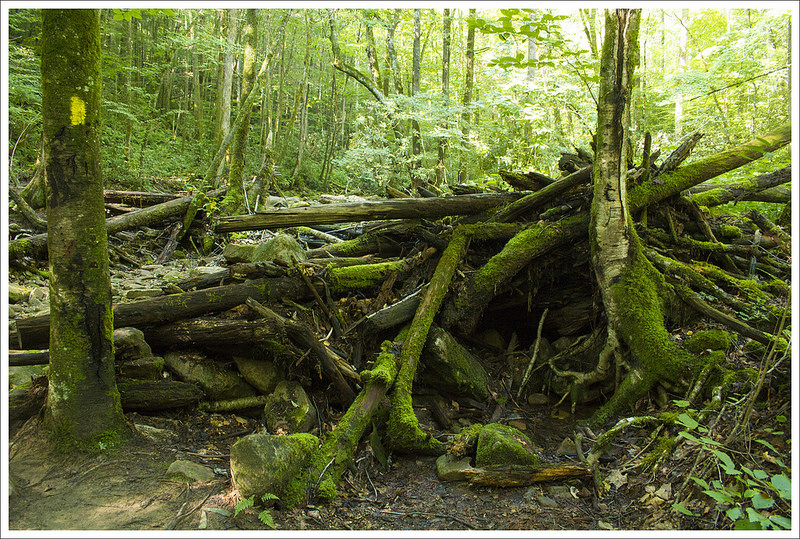
Download a Trail Map (PDF)

Directions to trailhead: To drop off first car: Take exit 168 off of I-81 toward Arcadia, VA.  Turn on to State Route 614/Arcadia Road off the exit.  Arcadia Road becomes Jennings Creek Road.  After 4.5 miles, you will see a large gravel parking lot after crossing Jennings Creek and you will see a sign for where the Appalachian Trail crosses.  Park in this lot. Coordinates 37.529352, -79.622693  To drop off second car and start your hike:  Continue down Jennings Creek Road from where you parked (not arriving the way you came).  In 1.8 miles, turn right on to State Route 618/McFalls Creek Road.  Go 4.1 miles and then turn right on to the Blue Ridge Parkway.  Follow this for 8.6 miles until you reach the small pulloff on the right side for Black Horse Gap.  With not much space here for a vehicle, you will likely want to park along the side of the road.  Just a few feet on the fire road, you will see the sign for the Appalachian Trail junction. Coordinates: 37.424611, -79.757202. Head right and start on the trail.

Pamplin Historical Park Trails

Pamplin Historical Park, located in Petersburg, Va is a hike that demonstrates a pivotal piece of civil war history that takes you through battlefields that led to the folding of the Confederate troops.

View the Full Album of Photos From This Hike

Pamplin Historical Park
If you’re interested in history, but still want to get some vigorous walking in, Pamplin Historical Park is a great place to visit.

Adam Says…

We are always looking for new and interesting places to hike in Virginia.  We were contacted a couple of months ago by Diane Willard, Director of Administration, Marketing, & Membership Services for Pamplin Historical Park about visiting their park and telling others about the trails they had on their property.  As I was visiting the area in late March, I was able to squeeze in a visit.  Please note, there is an entrance fee -as of 2016 adults $12.50, seniors 62+ $11.50, and children (6-12) $7.50.  The park is open seven days a week from Spring to Fall from 9AM-5PM daily, so plan accordingly. 

The focus of the park is to bring visitors into the history of the Civil War from one dramatic date – April 2, 1865.  On this day, the Sixth Corps Union troops under General Horatio Wright broke through the Confederate line at Petersburg.  The Confederate forces were working on maintaining a line of defense that stretched for 40 miles from north of Richmond, the Confederate capital, to southwest of Petersburg.   A rough winter and desertion had dwindled General Lee’s troops to 60,000 while Grant’s troops were double that size.  The day before, General Grant had cut through the Confederate supply lines and killed about 5,000 troops at Five Forks.  This line on April 2nd tried to hold off the Union troops, but in the early morning Union forces got to the Confederate trenches but nearly 4,000 Union troops were killed.   The battle raged on throughout the day, but by the end of the day, the Confederate troops decided to retreat and abandon the line.  Petersburg and Richmond were evacuated and a mere week later, General Lee surrendered to General Grant at the Appomattox Court House.

Pamplin Historical
Civil War Trench from the Fortification Exhibit; Below: National Museum of the Civil War Soldier, views of the battlefield, trail views go from woods to open fields

Pamplin Historical Park Pamplin Historical Park Pamplin Historical Park

There are several miles of hiking trails through this park and it also connects to the Petersburg Battlefields Trail if you want a longer hike.  I would recommend printing this map of the area, so you can get an idea of the landscape to start the hike.  The main entrance is known as The National Museum of the Civil War Soldier.  Leaving the building through the side entrance, you walk past a demonstration and then pass by the Tudor Hall plantation on the right.  Continuing ahead, you walk past a Fortification Exhibit which gives you a closeup view of a trench and the defense systems around them.  You then pass the Battlefield Center on the left and and begin the real hike on the Breakthrough Trail.  The Breakthrough Trail has a Main Loop, Short Loop, and Intermediate Loop.  Knowing I was going on a bit further, I started in .2 miles on the Main Loop.  The main loop is mostly wooded as you go through an area known as Arthur’s Swamp.  At .4 miles, you reach a junction where you can break off and take the Short Loop, but I continued on the Main Loop.  At .85 miles, you come to a junction where you can continue on the Main Loop or begin the Headwaters Trail.  I picked up a brochure at the junction and saw that The Headwaters Trail would actually connect as a large loop, so I decided to take the longer Headwaters Loop.  Along the way, you get to see several Confederate rifle pits, small dugouts that formed strategic encampments.  At 1.35 miles, you reach a short path that has a sign explaining an original logging bridge.  From here you can break off the Headwaters Trail and make your way on to the Petersburg Battlefields Trail.  The idea of checking out how these trails connected intrigued me, so I took this trail.  From here, you are leaving the Pamplin Historical Park boundary.  You go through some woods but then are left with great farmland views where you can imagine the feelings of the soldiers that were crossing this field.  You can only begin to think about how many people lost their lives on that fateful day to stand up for their beliefs.

Pamplin Historical Park
Battlefield Center.  Below: historic placards along the trails, wooded walkways, school trips learning about trench warfare and getting into formations

Pamplin Historical Park Pamplin Historical Park Pamplin Historical Park

Continuing on this trail allows you to get some open scenery, which is great for spotting birds in the fields.  I walked on an open path and then at 1.65 miles, followed the sign pointing towards the parking lot.  This trail continued to skirt around some open fields of farmland.  At 2.4 miles, the trail takes a sharp turn to the left where you come across some large earthworks, serving as barriers protecting the Union line.  I walked along these for a short distance and saw the trail continued further, but decided to make my way back.  On my way back, at 3.25 miles, I came to the junction of the sign (one way leading to the parking lot, the other pointing to the Petersburg Battlefield Trail).  Instead of taking a right, I decided to take a left to walk along the farmland and get more views, but I turned around after just .2 miles to get back to the trail I knew.  From the junction sign follow the sign pointing to the Petersburg Battlefield Trail and at 3.6 miles, you finally rejoin the Headwaters Trail.  At 4.0 miles, you reach a junction with the Woodlands Trail, which also leads back to the start, but I continued on the main Headwaters Trail.  In a short distance, you begin to see the large Confederate Earthworks, forming that historic line the Confederates tried to maintain.  The trail crosses over a break in the earthworks and then takes a sharp left turn to parallel the earthworks.  At 4.4 miles, you reach another junction where you have an option on which side of the earthworks that you like to walk along the Intermediate Loop.  At 4.5 miles, you reach a junction with the Woodlands Trail again and at 4.6 miles, you meet a junction with the Main Loop.  Staying straight on the Intermediate Loop, it joins the Short Loop in a short distance.  I took a right here and reached the Battlefield Center at 4.8 miles.  I explored inside the Battlefield Center and then took in the Tudor Hall Plantation before returning to the main entrance at the National Museum of the Civil War Soldier.

If you are a civil war history buff, this would be a great place to hike and explore.  I was thoroughly impressed with how much has been put into the care of the trails and the exhibits themselves.  You could easily spend most of the day exploring the trails and grounds here.  This would be a great hike to go as a family to learn about the history and if you have children, they may enjoy reading about the civil war on the placards along the way.  I must say that I was pleasantly surprised at how great the trails were maintained here.  I went in expecting that I could walk along some short, easy trails, but with adding the spur to the Petersburg Battlefield Trail, you can get a more serious hike into your day.

Pamplin Historical Park
The Tudor Hall Plantation.  Below: Open field views, statue at the entrance station.

Pamplin Historical Park Pamplin Historical Park

Trail Notes

  • Distance –5.0 miles.
    (Check out the stats from Map My Hike)*
  • Elevation Change –  100 ft.
  • Difficulty –  1.  Very easy walking on this one with very little elevation gain. 
  • Trail Conditions – 4.5  Trails are well-maintained and easy footing. 
  • Views – 2.5.  Not high views, but vast views of open, picturesque fields.
  • Waterfalls/streams 0. Non-existent.
  • Wildlife – 2.  Some decent bird-watching over boggy areas and expansive fields.
  • Ease to Navigate – 3.  When you leave Pamplin, things can get a bit confusing.
  • Solitude –  3.5.  You will see people at Pamplin Historical Park, but hardly anyone on the trail system. 

MapMyHike is not necessarily accurate, as the GPS signal fades in and out – but it still provides some fun and interesting information.
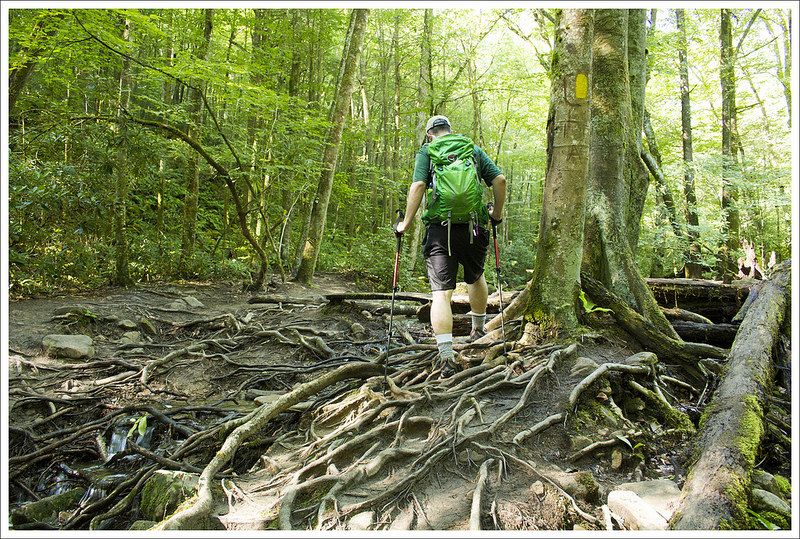
Download a trail map (PDF)

Directions to trailhead: From Richmond, take I-95 south to I-85 south, to Exit 63-A (U.S. 1 south). Proceed one mile to Park entrance on the left. The Park is 30 minutes south of Richmond, VA. Coordinates: 37.182980, -77.480095