This wonderful little network of trails gives you the opportunity to view Linville Falls from every angle! You can choose short/easy routes or longer/harder routes depending what you’re in the mood to do. When all was said and done, we hiked a little over 3.5 miles and enjoyed several views of the falls.
Adam enjoys a bird’s eye view of Linville Falls. Below: The forest service information station; the trail network offers many options; beautiful blooming rhododendron.
Adam Says…
To finish our trip to North Carolina, we had to visit Linville Falls along the Blue Ridge Parkway. While overcast days are better days for photographing waterfalls, we had to take what we were given. The sun was high in the sky and it was quite hot on the hike, but we knew this wasn’t going to be too long of a hike.
We drove up the gravel Wiseman’s View Road and went first to the USFS Visitor’s Center. Two women were inside and gave us some information on how to tackle the falls. We were looking for a place to eat lunch before the hike and they recommended Famous Louise’s Rock House, especially for their pies. We took their advice and refueled for the hike. We ventured back up Wiseman’s View Road and parked in the large gravel lot at the to the left of the road. The trail starts from the eastern side of the lot and begins with a steep descent.
At about .2 miles of a descent, we reached a junction. We took a right here to make our way to the series of overlooks of the falls. In a short distance, we reached another smaller junction with the trail to the Upper Falls, but we decided to approach that on the way back. Since there are so many choices to make about the order in which you take in the views, I will not list all the distances; but you can tell from the downloaded map the distances to each. We opted first to take a left for the trail to Chimney View, which provided a viewpoint to see the upper and lower falls. From this point, we backtracked to the main trail and took a left. Shortly, we came on to the side trail on the right for the Gorge View. The views from here showed the canyon of the gorge but the views didn’t allow you to see the bottom of the canyon. Next was the end of the main trail, which ended at Erwins View. This view gave you the furthest view away from the falls, but it was still spectacular. We backtracked and made our way back to the Upper Falls viewpoint. From here, you could see the water plunge down the falls from a closer distance.
The upper falls view. Below: A view into the gorge; Adam hikes along.
From seeing people on the opposite side of the water and very close to the falls, we decided to take the trail down to the Linville Falls Visitor Center. The trail was wide, road-like and going slightly downhill. We eventually came to a bridge over the Linville River and the Visitor Center was on the opposite side. We grabbed a few cold waters from the center and talked to the rangers about the trails on the other side. We were fairly tired by this point, since we had done so much hiking during the week, but the temptation of the falls kept us pressing forward. From the front of the Visitor Center, the trail headed into the woods on the eastern side of the building. In a few feet, the trail branched and we took a right to head to the next overlook. This trail branched off after about .3 miles. We took a right at the junction, descending to reach the Plunge Basin overlook at .5 miles. This point gave you a vantage point to see the water shoot through the gorge and down below. We watched one man standing on the cliffside below, fishing from a precarious position. We then made our way back to our car by returning to the Visitor Center, back across the bridge, and taking a right to the trail junction that led us back to our vehicle.
We had a great time visiting Linville Falls and this is definitely a hike that most people could do with their families. A return trip in the peak of fall color with an overcast sky is something we will try to do. While many waterfalls allow you to get very close to them, the trails here mostly keep you at a distance. However, the view of the gorge with the waterfalls is breathtaking.
Christine Says…
Linville Falls was a perfect hike to end our trip through Tennessee and North Carolina – short and very easy! Ten hikes packed into eight days was pretty rigorous and I had the sore knees, bruises and sunburned arms to show for it! Truth be told, I was secretly pleased that the ninth day of our voyage was stormy and rainy, because it meant we’d go home a day early instead of biking the 33+ miles of the Virginia Creeper. Don’t get me wrong – I LOVE biking the Creeper, but I was exhausted from our whirlwind trip. Maybe we ought to relax more on vacations – like normal people! Nah…. probably not. 🙂
Linville Falls were a gift to the National Park Service from John D. Rockefeller. So many of our favorite parks would not have existed without his generosity. Acadia, Shenandoah, Yosemite, the Grand Tetons, and the Smokies were all established, in part, due to his financial support.
The plunge view of the falls. Below: The Linville River; Beautiful desserts from Storie Street Grille.
Adam did a thorough job describing all the different paths we took, so I don’t have a lot of details to add about the terrain. The only thing I would say is that you can walk to the bottom of the falls. It’s about about .8 miles of hiking (some steep). We opted to skip the view from the bottom on this trip, mainly because we were tired and could tell that the base of the falls was extremely crowded.
I enjoyed stopping in the visitors center and talking to the park ranger. He was a pretty serious hiker and we enjoyed trading trail tips. He suggested Crabtree Falls, NC for a future hike. I was also fascinated by the cross section of an enormous tree hanging in the center. It fell when the Linville Gorge flooded in September of 2004. The hurricane-related flooding was so severe, that it washed away half of the visitor’s center and left many gigantic, toppled trees in its wake. Water is such a powerful force!
Linville Falls has one of the highest water volumes of any waterfall in the Blue Ridge, so it’s not surprising that it floods so easily. The high volume of water also makes the gorge perilous for people. Swimming is not allowed in the river near the falls, but numerous fatalities have still occurred in the area.
After finishing our hiking for the day, we retreated back to our cabin at the Pineola so we could get showered and dressed for dinner. We decided to go fancy for our last evening in the area, and enjoyed a fabulous dinner at the Storie Street Grille in Blowing Rock, NC. In addition to lovely outdoor patio seating, hey had a great wine line, beautifully prepared entrees, and amazing desserts. Even though I’d already had pie a la mode earlier in the day, I could not pass up their dark chocolate – coconut bread pudding. Adam’s banana creme brulee was equally delicious. It was a fitting end to a fabulous trip!
Our next post will actually be a Virginia hike – shocking! But then we’ll be going back to some more out-of-state posts. We’re headed for the White Mountains of New Hampshire in a couple weeks, and are hoping to bring back at least a couple posts from that area. Stay tuned!
Difficulty – 1. The trail does have a little climbing up and down on the trail, but most people should be able to do it without too much trouble. We saw people of all ages and all levels of fitness on the trail, so it should be doable by anyone willing. The options for different viewpoints allow for people to choose what they can handle and decide when to stop.
Trail Conditions – 4.5. Most of the trail is either gravel or dirt and is well-worn.
Views – 4. Great views of the gorge and waterfalls.
Streams/Waterfalls – 5. There are many viewpoints to see the waterfalls. The only challenge will be to enjoy it with few others around.
Wildlife – 1. You may see squirrels and some birds flying around, but it would be unlikely to see much else.
Ease to Navigate – 4. There is a large branching of side trails here, but using the map should guide you along.
Solitude – 0. With such a close proximity to the Blue Ridge Parkway along with the ease of difficulty, this hike is crowded.
Directions to trailhead: From US 221, turn on to NC 183. In .7 miles, turn right on to Wisemans View Road at the large curve. The parking lot is a short distance on the left and the trail starts from the eastern side of the parking lot.
* MapMyHike is not necessarily accurate, as the GPS signal fades in and out – but it still provides some fun and interesting information.
The beautiful, myrtle-crowned summit of Hawksbill. The distinctly shaped mountains on the left side of the gorge are Table Rock and Short Off. Below: Trailhead sign; Adam climbs through thick laurels and rhododendrons; Blooming Catawba rhododendron.
Christine Says…
Shenandoah National Park has a Hawksbill Mountain. It’s a nice hike and has lovely views, but Hawksbill Mountain in North Carolina’s Pisgah National Forest is even more impressive! With a dramatic skyline of mountains with interesting profiles and a plunging view into Linville Gorge, this short hike offers scenery unparalleled by our Virginia Hawksbill. (sorry… I have to be honest!)
Adam and I woke up early on our last morning at the Pineola Inn. After a grueling day on Grandfather Mountain, we were in search of low-key hiking. My knee was hurting; every step I took on even the slightest downhill elicited stabbing pain under my kneecap. I thought to myself, ‘if only we could find a hike without much elevation change, I can gut this out!’ I referred to our hiking guide for the Blue Ridge Parkway and found a few short, easy hikes in the Linville Gorge area. The first was Hawksbill. The description was pretty vague, but it sounded easy and short – good enough to fit the bill for the day.
We had breakfast and made our way to the trailhead. The drive down Table Rock Road was dusty, bumpy and pitted with axle-rattling potholes. Fortunately, we were on the road only a short while. We parked near the trailhead and started up the Hawksbill Trail.
The views only get better from here! You have to scramble over boulders and through brush before the views really open up. Below: The steeper, rockier part of the trail; Blooming mountain laurel; The rocks at the summit had a wavy pattern in some places.
There’s really not a lot you can say about a .9 mile trail that pretty goes straight up a mountainside. There weren’t many noteworthy features on the route. It started off gentle, but became increasingly steep and rocky as we approached the summit. We saw mountain laurel and Catawba rhododendron blooming along the way. After a short while of walking, the trail leveled out on a rocky summit. At first, we didn’t see any views. But then we followed a series of worn footpaths through the brush and over boulders. On the other side, we found magnificent views that far exceeded any expectations we had for the hike. Linville Gorge is a precipitous plunge from the summit of Hawksbill. If you look deep into the canyon, you can see the river trailing through the forest. All the mountains around the gorge have unusual shapes. Instead of gentle rounded domes like most mountains, they have cliffs and plunges and missing chunks.
There were tons of places to sit and enjoy the views in every direction. When we visited, morning clouds were still swirling around the summits – making the vista even more dramatic. We saw a large group of cedar waxwings cross the summit, pausing to eat berries from the trees. Much of the summit was crowned with sand myrtle. And best of all, we had the entire place to ourselves! We stayed up there for about 45 minutes before climbing back down.
On the descent my knee nagged at me, but I still wanted to get one more little hike done after Hawksbill! Because, what would a visit to the Linville Gorge area be without a visit to the famous Linville Falls? We opted to stop for lunch at Famous Louise’s Rock House before visiting the falls. The restaurant sits simultaneously in three different counties (Burke, McDowell, and Avery), and is very well known for its pies. I enjoyed a slice of their five fruit pie with ice cream, then it was on to our final hike of the trip!
You can see the river making its way through the gorge. Below: A cedar waxwing; Another view of Table Rock and Short Off; The pattern in the rocks was beautiful!
Adam Says…
When we started off our hike from the parking lot up Hawksbill Mountain, there were lots of cars at the trailhead. After seeing some of the people preparing for the walk, we noticed they were bringing a supply of ropes and carabiners for rock climbing. As it turns out, Hawksbill is more popular for rock-climbing than hiking, featuring several moderate and difficult routes. We jumped on to the trail not knowing how many people we would see, but as it turns out we were the only ones hiking the trail on this gorgeous day.
We thought this rock formation looked like a diving board over the gorge. You can’t tell from the photo, but the drop beneath was pretty scary! Below: Pie!
The trail started off very gradual, which felt fine to our sore joints from hiking up Grandfather Mountain the previous day. At .6 miles, the trail took a sharp left up the mountain. I’m not sure, but this may be the point that the rock climbers veer off the main trail since we saw a faint trail leading out from this point. The trail then becomes more steep and there are some very large steps to take in places up rocks to keep climbing up the trail. At .8 miles, we reached the height of the trail. We headed to the left and within a short distance, we could see the views open up. We walked on a faint trail at the top until we reached a nice rock outcropping to take in the views of the gorge. Across from this viewpoint was Table Rock and Short Off. We talked about how we would like to come down here again and hike those two. As we were taking in the views, we saw several cedar waxwings chasing each other in the air.
We initially thought this viewpoint was what we came to see, but I wondered where the rock climbers were. So, while Christine took some more photos, I decided to scout back to the top of the trail we traveled and headed the opposite direction. I could tell this opened up to even grander views, so I backtracked and brought Christine back. We walked about .1 mile to this other viewpoint which had a large rocky cliff-face to take in the view. We climbed around on the rocks for a while taking in the views of the gorge and mountains. One rock that I stood on pictured above wobbled a bit when I stood on it, so be very careful on the edges!
We made our way back to the trail, again not encountering any other people. We were so glad that we had found this gem of a hike. This is another one of those hikes that has outstanding views with not a lot of effort. I would recommend it to anyone visiting the Linville Gorge area.
Difficulty – 2. A little bit of the hike is steep and rocky, but it’s so short that most people should be able to tackle the route with ease.
Trail Conditions – 4. The trail is in nice condition.
Views – 5. Beautiful views of the gorge, Table Rock Mountain and Short Off Mountain
Streams/Waterfalls – 0. None.
Wildlife – 2. We saw a flock of cedar waxwings and a lizard.
Ease to Navigate – 4. The trail is a straight shot up the mountainside. There are a variety of footpaths around the summit, and lots of places to take in the view.
Solitude – 4. Oddly, we did not see a single other person after we left the parking lot. We had the summit all to ourselves for a full 45 minutes.
Directions to trailhead: From Banner Elk, NC (a good hub for this area). Follow NC 105 south for about eight miles, turn left on NC-181 S/US-221 S/Linville Falls Hwy for about three miles, turn left onto NC-181 S/Jonas Ridge Hwy for six miles, turn right onto Ginger Cake road and continue onto Table Rock Rd. The trailhead will be marked with NFS signage.
* MapMyHike is not necessarily accurate, as the GPS signal fades in and out – but it still provides some fun and interesting information.
This five-mile hike is demanding, thrilling and beautiful! It has everything from ladders and cables to amazing views of the Watauga Valley and the Blue Ridge Parkway. If you’re a fit hiker looking for something a little different – Grandfather Mountain definitely fits the bill!
Sand Myrtle crowns Attic Window Peak on Grandfather Mountain, making the view all the more lovely. You can see the ‘Sugar Cube’ sitting on the mountain top off in the distance. Below: Hiker parking on Grandfather Mountain; A view looking back on the Mile High Swinging Bridge; Native pink azaleas.
Adam Says…
We have a love-hate relationship with Grandfather Mountain. I definitely enjoy the hike more than Christine, but both times we have hiked it, things haven’t gone as great as planned. The views on Grandfather Mountain are amazing, but some of the physical and mental challenges definitely take their toll.
The last time we hiked up Grandfather Mountain, we only made it a little past Attic Window peak. Christine wasn’t feeling well that day, so we decided we make a second attempt on this trip and make it to the highest peak, Calloway Peak.
We were some of the first people on the trail that day. The lady at the entrance gate (it costs $18 per adult) gave us a parking sign to put in our car window. This is used in case someone goes missing on the mountain and they need to perform a rescue. We were told they wanted us back at our car by an hour before closing. We parked in the lower Trails Parking area and were the first car in the parking lot. We quickly set off on to the Bridge Trail, which winds through a series of switchbacks, crossing underneath the Mile High Swinging Bridge, before reaching the upper parking lot at .4 miles. We made a quick trip into the gift shop and then took a quick trip across the Mile High Swinging Bridge. The wind was quite calm this time on the trail; last time, the bridge was singing and the wind was so strong, Christine could barely walk across the parking lot. I have a big fear of heights when it comes to man-made things (roller coasters, ziplines, ladders, etc.), so the swinging bridge is always a gut-check for me. The fact that the wind was calm made it easier for me. We walked on to the rocks on the other side and enjoyed some spectacular morning views to the west.
Crossing back across the bridge, we made our way down the stairs and across the parking lot to the large wooden sign to begin our real hike on the Grandfather Trail. We climbed up a few stairs and started our hike on the blue-blazed trail. The first part of the trail isn’t too tough. You reach an open area called The Patio at .6 miles and at .7 miles you reach the junction with the Grandfather Extension Trail. Continue past this trail and at .8 miles, you will pass the scenic Grandfather Gap area. Just ahead is a junction where the Underwood Trail branches off at .9 miles. We continued on the Grandfather Trail and here is where it can be challenging. Your first introduction to the difficulty of the hike is when you come across some cables that are helpful to grab onto to help yourself climb up or down the trail. When it is wet, the rocks can be steep and slippery, so it is helpful and often necessary to grab onto these.
Adam uses cables to assist him across a steep, slick rock. Below: Adam enjoys the views; Christine hiking along the easy part of the Grandfather Trail; Climbing one of the first ladders en route to MacRae Peak.
In a short distance as you are making way toward MacRae Peak, you have to navigate a series of ladders. The first one starts off as you squeeze along a rock that will have you hunched over and you climb up a tall ladder that is at an angle along a large rock face. This climb wasn’t as scary, but it is just a taste of what is to come. If you’re feeling uncomfortable climbing this ladder, I would recommend turning around. After climbing this first ladder, you will come upon more series of ladders. Some of these go directly up the cliff side and you are looking at huge drop-offs on the side. The first time I was definitely scared going up, but I felt more comfortable on this climb. The ladders are bolted into the rock and the ladders are placed at just enough angle that I didn’t feel I was going to plummet to my death. Once you navigate up through the ladders and climb up where it begins to level off, you are rewarded with more amazing views around you. We continued further and reached the sign to MacRae Peak at 1.3 miles. The sign rests at the bottom of another ladder. Climbing up to the top of the ladder, you then need to grab a cable to help pull yourself up to the summit boulder of MacRae Peak. The 360-degree views at this point are stunning on a clear day.
We took a short break at the top and then made our way back down the ladder to continue our hike. The trail begins to climb down and at 1.4 miles, you see another junction with the Underwood Trail. Continue the Grandfather Trail downhill with some big steps and cables. The trail then begins to climb again up to the Attic Window. You navigate through an area called The Chute, which has you climbing up a short but very steep area of small boulders to make your way to the top. As you crest the top at 1.6 miles, you can wind around to a rock outcropping known as Attic Window Peak, which serves as a great viewpoint. We had spotted someone sitting at the top of Attic Window Peak from MacRae peak. He was still there when we arrived and I noticed he was taking in the views while reading The Great Gatsby by F. Scott Fitzgerald. He was asking if any of the other views were worth the trip, since he came up via the Profile Trail. He was interested in seeing the Mile High Swinging Bridge, but when we saw him later on the trail, we learned that he decided to just go back the way he came.
Christine climbs the rocks. Below: Adam on a set of multiple ladders, Coming off the top of the ladder onto exposed cliffside; A well-earned view!
From Attic Window Peak, the trail goes downhill again, but then passes through a level area as you walk along a ridgeline with some great northwestern views (and a view of the steep Profile Trail). At 1.9 miles, you reach another overnight camping area known as Alpine Meadow. The trail descends again down another gap, before making the way up to Calloway Peak. At this point, the clouds were rolling in and sticking to the mountain, so our visibility was going away fast. We climbed up the Calloway Gap area and reached the junction with the Profile Trail at 2.3 miles. We pressed on, passing by the Cliffside Campsite at 2.4 miles. The trail continued to climb up some switchbacks. A sign came up at 2.7 miles which pointed the way to the Watauga View. Knowing there wasn’t much a view as we hiked in the fog, we made our way to the Calloway Peak. The trail at this point climbed up a couple of more technical ladders. We reached a rock that was the Calloway Peak at 2.8 miles. There was no sign designating this as the peak, but from ground markings, we could tell this is where the white-blazed trail of the Daniel Boone Scout Trail met the blue-blazed Grandfather Trail. I’m sure there is a view from the rocks here, but we could barely see 10 feet in front of our face. Disappointed, we made our way back down the ladders and took the side trail to the Watauga View. The view was barely there, but we stayed long enough to eat our packed lunch before making our way back. The views on the way back were getting swallowed by the clouds settling on the mountain, so we lost a lot of the views on the way back.
At 3.7 miles, we reached the junction with the yellow-blazed Underwood Trail. We decided to take that trail back to avoid some of the ladders. This trail is incredibly rocky and my knees were in so much pain after a short distance on this trail. I think if we do this trail again, I would rather take the ladders than this hellish, downhill knee-destroyer. Every step, I felt shooting pain in one of my knees and I wondered if I would need to be rescued (at least there was a sign in our car). We navigated down one large ladder and finally reached the junction with the Grandfather Trail again at 4.2 miles. I turned around to flip the bird to the trail for my personal enjoyment and reached the Grandfather Extension Trail junction at 4.4 miles. We took this red-blazed trail, which goes gradually downhill through a series of switchbacks until we reached the parking lot for our car at 5.0 miles. It was a tiring day, but if you are up for an adventurous hike, this is one you should definitely try.
Christine Says…
Oh… Grandfather Mountain – what can I say about this place.
On one hand, it’s a beautiful, rugged and exciting place to hike. On the other hand, things always seem to go wrong when I hike there – I’m sick, my technology fails, I injure myself. Maybe this mountain is trying to tell me something?
Adam enjoys the view from MacRae Peak. Below; Christine on MacRae Peak; Climbing the rocky trail.
The first time we hiked Grandfather, I developed a 101 degree fever, and ended up having to turn around near Attic Window Peak (the original goal had been to make it to Calloway Peak). I was just too dizzy and fatigued to hike anymore.
I was really excited to revisit the mountain and finish the hike we tried to do last fall. The morning started off with a great breakfast at the River Dog Café. We paid our entry fee to the park and headed up the mountain. The hiker parking lot was completely empty, skies were sunny and the wind was fairly gentle. It was pretty much the opposite of our last trip up the mountain.
We hiked up to the Mile-High Swinging Bridge. This time, we took the time to climb around the rocky outcropping on the far side of the bridge. Back in the fall, the wind had been so strong that we didn’t dare go out on the rocks!
We started up the Grandfather Trail, which departs from the upper parking area. We had the trail mostly to ourselves this time. We really didn’t see anyone else at all until the latter part of the hike. I enjoyed seeing the wild pink azaleas in bloom. Grandfather Gap was especially colorful with blossoms.
We negotiated the cables and ladders before coming to MacRae Peak. We scaled the ladder to the top and enjoyed the view from the big rock. One side of the mountain was clear, but the other was covered with low clouds and fog. The breeze pushed the clouds against the side of the mountain. They would hang along the ridge for a few minutes and then roll over and dissipate on the clearer side of the mountain. It was fun to watch the low clouds moving so quickly.
Adam crawls through the Subway. Below: Climbing up the Chute; Beautiful sand myrtle; Painted trillium along the trail.
From MacRae, we descended steeply through a slick and rocky gap. The descent was short and ended at an immense rock jumble called ‘The Subway’. Ladders and blazes lead you through openings between giant boulders. On the other side, you soon face ‘The Chute’. The chute is a narrow, steep rock scramble that you must negotiate to reach Attic Window Peak.
From Attic Window Peak, the hike offers some more moderate ridge walking with spectacular views all along the way. The rocky spine was covered with blooming sand myrtle, so it was especially pretty on this visit. In fact, when famed naturalist John Muir visited this mountain, he described this ridge as “the face of all Heaven come to earth.” Luckily, John Muir got to visit this area before some idiot approved the Sugar Mountain construction project. I swear, ‘The Sugar Cube‘ (the main building’s nickname) has to be one of the worst eyesores in Appalachian nature. I guess its construction did inspire a change in legislation, so mistakes like that are less likely to happen again.
From the crest of the mountain, the trail descends again before beginning the final ascent toward Calloway Peak. The uphill hike passes through rich, mossy evergreen forest. On the way to Calloway, don’t miss taking a few minutes to walk out to the Watauga View. It’s a lovely rocky outcropping that looks into the Watuaga Valley. It was also the last place we had a view on our hike! On the way to Calloway, a massive cloud bank moved in and parked atop the mountain. It was like it was stuck and couldn’t quite make it over the peak. Watauga View was also the place I noticed that my smart phone had crashed at some point and wouldn’t restart (sorry – no MapMyHike stats). Normally, this would be a small annoyance, but just the night before my MacBook Pro self-destructed. Such technology angst!
The Watauga View was partially obscured by clouds. Below: Hiking toward Calloway Peak; Foggy Calloway Peak
We finished the climb to Calloway (which required a couple more ladders), spotted the elevation benchmark and wondered what the view would have been like on a clear day. Had we continued hiking, we would have continued on the Daniel Boone Trail and soon reached the Hi-Balsam backcountry shelter. But the peak was our turnaround point.
We made our way back along the ridge before eventually reaching the junction of the Underwood Trail. I remembered the Underwood Trail as very rocky and difficult. And it certainly was! I think at this point of the hike, the exhaustion of six straight days of hiking kind of kicked in. We really struggled, physically and mentally, with the tough terrain on this stretch of the hike. I guess I was fatigued and not being careful, because my foot slipped and I felt a twinge in my knee. I shook it off and kept going, but after that I felt a nagging, sharp pain under my knee cap. It came and went, so I did my best to ignore it. (I continued to ignore it on our last two hikes of the trip the next day, and ended up at the orthopedist and off the trail for a month after our trip.)
When the Underwood Trail ended near Grandfather Gap, I was thrilled to be back on easier footing. The rest of the hike went by quickly and easily. After we got back to our car, we spent some time walking around the Nature Center. We saw bears, eagles and mountain lions and enjoyed eating giant cookies and icy soda.
Like I said at the beginning, I both love and hate this trail. It offers so much in terms of scenery and physical challenge, but it’s a tough hike and I always seem to pay some kind of price for hiking there. Maybe I’ll hike it again someday… maybe.
The Dreaded Underwood Trail. Below: Grandfather Gap; Almost back to the hiker parking area.
Trail Notes
Distance – 5.0 miles.
Elevation Change – 2084 ft
Difficulty – 5. Having to use cables and climb ladders should tell you something. While this route was only five miles, you will go very slowly during most of the hike due to the steepness of the terrain.
Trail Conditions – 4. The trail is well-maintained, but that doesn’t make it easy. There are lots of rocky parts to navigate, especially on The Chute up Attic Window and the footing on the Underwood Trail is grueling.
Views – 5. The best views are from the Mile High Swinging Bridge, MacRae Peak, and Attic Window Peak. The clouds were covering the area at Calloway Peak for us, but I could tell the views from the Watauga View would have been spectacular also.
Streams/Waterfalls – 0. None.
Wildlife – 1. We didn’t really see anything beyond birds.
Ease to Navigate – 4. All junctions are labeled and the trail is fairly easy to follow. We have seen people get turned around at certain points (including us previously).
Solitude – 1.5. I would expect to see people along the trail and lingering especially at the viewpoints. Starting out early in the day should help with the solitude.
Directions to trailhead: The entrance to Grandfather Mountain is located on US 221, two miles north of Linville, North Carolina, and one mile south of the Blue Ridge Parkway at milepost 305. Signs for the entrance are well-marked and an entrance station is right off the road with large gates. Travel up the road by car until you reach the parking lot designated for hiking trails. The trailhead for the Bridge Trail is on the left side of the parking lot as you are driving up. Coordinates for the hiker parking area are 36.096145, -81.831802.
This hike follows the Grandfather Trail across series of ladders and cables to the summit of MacRae Peak. After climbing MacRae peak, we continued a little way along the trail before turning back right after Attic Window Peak. It’s a truly amazing hike with phenomenal views.
Christine and Adam enjoy the view atop MacRae Peak. Below: Adam checks out the sign at the beginning of the Swinging Bridge Trail; A view of the bridge from the trail; the valley from the bridge.
Adam Says…
Hiking up Grandfather Mountain is nothing short of an adventure and one that I will not forget. This will challenge you as much mentally as it will physically as you have to decide how far you can go. Choosing to navigate up ladders on the side of a mountainside with nothing to save you from a nasty fall makes this hike one not for the faint of heart. I have a fear of heights, but especially when it comes to trusting in man-made things that tested me a few times on this hike. But Christine and I kept saying, “I can’t believe we just did that” when we passed through these obstacles and the adrenaline kept us going.
We drove into Grandfather Mountain through the main entrance off 221. If you are planning on doing any hiking on Grandfather Mountain, I would recommend starting as early as possible. Starting later than when the park opens could lead to an extremely long line of cars waiting to enter on a weekend or pretty summer/fall day. There is an admissions fee to get into the park ($18/adult with discounts for seniors and children at press time). Another reason to start early is this hike does take a while. While it is only a relatively short distance, you will want to take time to enjoy the numerous views and you will need to take time going up the ladders. With a lot of people on the trail, there could be a bottleneck through some of these passes. The park closes before nightfall and they do have rangers hiking along the trail to make sure that people get off the mountain in time. If you don’t get back to your car by nightfall, they post they will send out a search.
Adam crosses the Swinging Bridge. Below: A look back at the Top Shop from the beginning of the Grandfather Trail; Adam looks at MacRae Peak
At the entrance to the park, the ranger warned us that the winds were between over 30 mph at the top. We made our way up the drive and stopped by Split Rock, a picnic spot and witnessed the drop in temperatures and wind firsthand. We then made our way to the Nature Museum and wildlife habitat. We walked around briefly and picked up a hiking trail map from the Nature Museum cashier. We continued our drive along the curvy road up until we reached a parking lot attendant. Since we were hiking, he instructed us to park in the lower lot to begin our hike.
From the parking lot, we took the Bridge Trail, a non-blazed trail that includes switchbacks through a hardwood forest. After a short distance, we started hearing a mechanical, whistling sound. This was the sound of wind whipping through the Mile High Swinging Bridge that lay above us. At .4 miles, we reached the Mile High Swinging Bridge and visitor center. The wind was blowing so hard up here. I felt that I didn’t have warm enough clothes, so we went inside the visitor center to buy a hat and gloves to replace the ones I’d forgotten back at our hotel. The wind was blowing much harder than 30-40mph. I would guess that it was closer to 60mph. My pants sounded like flags beaten by high winds and it was hard to even take a step ahead of you. From the visitor center, we went up the stairs to reach the bridge. Christine was eager to go across, but I had a lot of trepidation. The bridge was “singing” more than “swinging”, but I was wondering if it was safe to cross. Christine made her way across and per an earlier agreement, if I was going to make her hike up Grandfather Mountain, I had to hold my end of the bargain and walk across this 228 foot bridge. Being 6 feet tall, the side railings barely reached my hips and I was worried that a strong enough wind would have blown me off. The bridge has its name because the elevation here is 5280 feet above sea level making it a mile high. The bridge actually only spans two rock formations that has an 80 foot drop, but it is still unnerving. After making it across the bridge and back, we continued the hike.
Most of the way was steep and rocky.
Christine was having a difficult time making her way across the parking lot to the trailhead. I would see her take one step forward and the wind blew her two steps to the side. We made it to the other side and debated on if we could do this hike with such high winds. I convinced Christine to go a little further, hoping that the brush would slow the wind and after a short distance we didn’t feel the affect of the wind. We began the hike up using the Grandfather Trail, a blue diamond-blazed trail. At .8 miles (including the hike from the parking lot), we reached a junction with the Grandfather Extension trail. We kept going forward on the Grandfather Trail and at .9 miles, we reached Grandfather Gap, an open area that gives you great views. Continuing on at 1.4 miles, we reached a junction with the Underwood Trail. We stayed again on the Grandfather Trail and in a short distance the first ladder appeared. This was a long ladder (the first of nine total) that helped you navigate through a tight gorge between two rocks, but was not that scary. Shortly after this ladder, the real fun started where we had to do some rock scrambling, sometimes with the assistance of cables before coming up to a series of ladders. These ladders were definitely more frightening as you had to often climb up one ladder and then take a step to the left and climb up another ladder. We saw several people that got to the ladders and then wisely turned around as they didn’t think they can handle it. Knowing your limitations is definitely important. These ladders eventually led up to to one area that you were climbing up ladders on the side of the mountain with an insane drop to the side. We made it up this final ladder and took a moment to reflect on what we did and take in the views from the side of the mountain. We continued on the trail for a short distance and at 1.4 miles we reached a ladder on the side of the rock leading to the summit of MacRae Peak at 5845 feet. You climb up this 20 foot ladder and then grab a cable at the top of the ladder to pull yourself up the rock. You can find the benchmark for the peak at the top of the rock, giving you 360 degree views all around you, including the bridge to the southwest.
Christine climbs a ladder on the Grandfather Trail. Below: One ladder went between two giant slabs of rock; Adam pulls himself up a sheer rock face; More ladders along steep, cliffside terrain.
We climbed back down the ladder and then continued on the Grandfather Trail to the next peak. At 1.5 miles, we reached another junction with the Underwood trail. Continuing on the Grandfather Trail, we went up to The Chute, a rock scramble that leads to the top of Attic Window Peak. The scramble wasn’t too tough, but did require you to climb up on all fours at some points. We reached the top at 1.7 miles and passed the overnight Attic Window campsite. Continuing on the trail, we reached a junction with the Indian House Cave, a short but steep side trail that leads to a cave wall that was a shelter to Native Americans back in the day as artifacts were found here when it was first discovered. We continued back on the Grandfather Trail and the trail here begins to be more of a ridge walk. We took some time to find some nice spots to take in the views, eat some snacks, and then made our way back. At the junction with the Underwood Trail at 2.2 miles, we ended up taking this Yellow Diamond blazed trail to avoid the ladders on the return. This was a steep and rocky trail back without much to see and there is still one large ladder to climb down on the way, but it feels safer than the ones leading to MacRae Peak. At 2.7 miles, we reached the opposite end of the Underwood Trail, rejoining the Grandfather Trail, by taking a right. At 2.9 miles, we reached the junction with the Grandfather Extension trail and then took this Red Diamond blazed trail downhill through some switchbacks for .6 miles (with some more views along the way) until we reached our car at 3.5. miles.
Many people just drive to the upper parking lot to experience the Mile High Swinging Bridge and then return. It is definitely a highlight of Grandfather Mountain, but we were so glad that we hiked past this feature. The bridge used to be a wooden suspension bridge (erected in 1952) and used to sway more in the wind, but the side rails and floorboards were replaced with steel in 1999.
Adam enjoys the view near the top of MacRae. Below: The Blue Ridge Parkway winds its way through forest below Grandfather Mountain; the last ladder to the top of MacRae; Beautiful rugged scenery on Grandfather Mountain.
Grandfather Mountain was originally named Tanawha Mountain by the Cherokee, meaning “glorious hawk or eagle”. It was named Grandfather Mountain by pioneers as one view of the mountain does look like an old man’s face staring up into the sky. Daniel Boone once hunted in this area and John Muir after climbing Grandfather Mountain in 1898 proclaimed that the air during his climb had healed him of a bronchial cough.
Overall, I will say this has been one of my favorite and most memorable hikes that I have ever done. The views are absolutely gorgeous around you, as you can see for miles around on a clear day. Once you reached a viewpoint, you thought that it couldn’t get any better; but then you would take a few more steps and be even more impressed. We definitely plan on returning to tackle the hike all the way to Calloway Peak, the tallest peak at 5946 feet.
Christine Says…
It’s kind of ironic that John Muir proclaimed that Grandfather Mountain’s air cured him of bronchitis. I was sick as a dog when I hiked this trail, and the air did not have any magical curative properties for me! In fact, I think it may have helped precipitate my garden-variety bronchitis into a full-blown, month-long battle with pneumonia.
Some readers might wonder why I didn’t do the sensible thing and actually rest while I was sick. I wish I had been smarter, but we had planned this trip several months earlier and were there to celebrate our 15th wedding anniversary. There was no way I was going to miss it. So… stupidly, I pushed myself mercilessly so that I could see and do all the things we had planned. I had a great time on the trip, and especially this hike – but I definitely paid a high price for all that fun.
Adam approaches the rock scramble known as The Chute. Below: The Chute
Illness aside, this hike is probably near the top of my list of all-time favorite hikes. The scenery was breathtaking. Every boulder I rounded, every opening I stepped into; I practically gasped with disbelief at how truly beautiful nature can be. The ladders and cables were a perfect balance of scary and fun. I felt challenged and rewarded in equal measures.
Our adventure started off in the hiker parking area on Grandfather Mountain. The trail from the parking lot to the bridge was short and easy. Almost immediately, we could hear the harmonic hum of the wind whipping through the bridge. Evidently, the ‘singing bridge’ is a more accurate moniker than ‘swinging bridge’. We spent a little time at the ‘Top Shop’. We both crossed the bridge. I was very proud of Adam for crossing. He does not like heights and the bridge was not a happy place for him!
The bridge didn’t scare me at all, but the wind’s strength did! The main trail system on Grandfather Mountain starts directly above the parking area. The sign marking the trailhead is loaded with many, many warnings and cautionary tales. On the way over the the trailhead, the wind literally blew me off my feet! I rolled like a tumbleweed across the parking area – pretty remarkable for a full-grown, adult woman! It was the strongest wind I’ve ever encountered — even topping the weather we experienced on Mt. Washington. I told Adam that I thought it was stupid to hike in such strong wind, but he encouraged me to hike a little along the trail, in hopes that the trees and other obstacles would shelter us from the wind. Thankfully, he was right and the wind wasn’t bad for most of the hike.
All of the ladders and cables were sturdy and securely fixed to the rock, so I never felt like I was in any real danger. They greatly aided us in traversing some very steep terrain. When you look at MacRae peak from a distance, it looks so steep and practically unscalable. When you finally climb the last ladder to the highest point of the peak, you truly feel on top of the world! We shared the peak with a group of Boy Scouts and a group of Amish men. Quite an interesting mix of folks!
Beautiful views from Attic Window Peak. Below: Tent site on Attic Window Peak; More gorgeous vistas
After leaving MacRae, we continued along the Grandfather Trail in the direction of Calloway peak. The trail took us through a fun and challenging rock scramble called ‘The Chute’. Near there, we met one of the Grandfather Mountain rangers. He was out hiking the trail to sweep for hikers in trouble and for people who might be cutting time short to make it back to the parking area by 5:00.
After the Chute, we passed the Attic Window Peak backcountry tent site. After that, we walked a short way along an open, razorback ridge or rock. We had more spectacular views looking toward Banner Elk and in the direction of Calloway Peak. Along this ridge, we stopped for a snack. While I was eating my Luna bar, I measured up the distance to Calloway peak. I wasn’t feeling any better. I was cold, stuffy, achy and exhausted. As much as I wanted to reach Calloway peak, I wanted some soup and a hot bath even more. I apologetically told Adam that I couldn’t go any further. I could tell he was disappointed, but he willingly turned back.
Adam enjoys cliffside views. Below: Fall foliage from Grandfather Mountain; Our last ladder down the Underwood Trail, Fall Foliage; Rocky and rooty footing on the Underwood Trail.
On the return, we took the Underwood Trail. It was quite steep and rocky, but only required one downward ladder climb. Eventually, we reached the junction of the Grandfather Trail and the Grandfather Extension. The extension led us back down to the hiker parking area without having to cross the Swinging Bridge parking lot again. That little section of trail had one pretty view from a bridge and lots of fall color. We got back to the car and made our way back down the mountain. I could not believe the line of cars waiting to get into Grandfather Mountain. It stretched for several miles! Insane! I guess it’s a good idea to get an early start when you visit Grandfather. All in all, it was a super day and a great hike. I can’t wait to go back sometime when I’m not sick!
Trail Notes
Distance – about 3.5 miles
Elevation Change – about 1600 feet
Difficulty – 4.5. The ladders and cables make this a tough hike. The climbs over the mountains make this hike take a lot longer than you would normally on this distance.
Trail Conditions – 4. The trail was in good condition. Ladders and cables were sturdy and secure, but rainy/icy/snowy weather will make the rock climbing treacherous. If you have a fear of heights, ladders or precipitous edges, this hike might not be for you.
Views – 5. AMAZING!
Waterfalls/streams – 0. There are no streams on this hike.
Wildlife – 0. This area is heavily traveled, so it’s unlikely you’ll see wildlife.
Ease to Navigate –4. The junctions at all the trails are well-marked. We got a little turned around through one of the rock scrambles.
Solitude – 1.5. Expect to see lots of people on this trail unless you go at an off time. But we never felt too crowded where we couldn’t enjoy things by ourselves.
Directions to trailhead: The entrance to Grandfather Mountain is located on US 221, two miles north of Linville, North Carolina, and one mile south of the Blue Ridge Parkway at milepost 305. Signs for the entrance are well-marked and an entrance station is right off the road with large gates. Travel up the road by car until you reach the parking lot designated for hiking trails. The trailhead for the Bridge Trail is on the left side of the parking lot as you are driving up. Coordinates for the hiker parking area are 36.096145, -81.831802.
The walk to Beacon Heights is just another short, easy leg-stretcher we did on our fall trip down the Blue Ridge Parkway. Beacon Heights has the bonus of offering two separate, but equally spectacular, vistas at the summit.
Adam takes in spectacular foliage from the view atop Beacon Heights.
Adam Says…
The Beacon Heights trail, like the Rough Ridge trail nearby is a trail that gives you great views for minimal effort. This trail has two different expansive viewpoints at the top.
We started off our hike by parking in the parking lot at mile 305.2 on the Blue Ridge Parkway. Across the parkway, you can see Grandfather Mountain looming overhead. Behind the parking lot is another parallel road, SR 1513. We crossed that and found the trailhead easily. The trail goes up and comes to a junction shortly. Take a right at this junction to follow the Mountains-to-Sea/Beacon Heights trail. At .2 miles, you reach another junction as the Mountains-to-Sea trail and the Beacon Heights trail splits. Take a left on the Beacon Heights trail. At .3 miles, you reach a junction where the trail splits where their is a stone bench. Each junction leads to views from Beacon Heights. The path to the left leads to an outcropping that provides great views to the north and west. The path to the right leads to another outcropping with views mostly to the east. Either spot provides plenty of room to spread out and take in the scenery. Head back the way you came for about a .7 mile round trip.
Due to the shortness of the hike, you should expect a lot of people at the top. I’ve heard this trail referred to as a “leg stretcher” and that is an accurate description. It is not too difficult, so there isn’t much of a need to get geared up for an intense hiking experience. My favorite of the two viewpoints was at the junction to the left of the bench, since it did provide views of Grandfather Mountain from the top. With a cell tower visible on the other junction, it takes a little away from the view for me.
The view on the right side of the bench.
Christine Says…
This was the last mini-hike of three we did in one day near the Linn Cove Viaduct. It was a great way to finish the day, and a good way to work off some of the English Pub fare we enjoyed for lunch. The walk was short and followed a gentle uphill grade.
The two views at the top were beautiful, and the fall color was simply spectacular! If we had planned our day a little more thoroughly (and if I hadn’t been so sick), I would have liked to park near Beacon Heights and then follow the Tanawha Trail from Beacon Heights all the way over to the Rough Ridge area. It would have been a great out-and-back with lots of scenery and view pay-offs.
After Beacon Heights, we briefly discussed tacking on another short hike up to Table Rock, but in the end I was just too worn out to go any further. Adam and I agreed at the end of the day that we must make a return trip to the area to make up for all the stuff we missed seeing on this trip.
Trail Notes
Distance – About .7 miles
Elevation Change – 120 ft
Difficulty – 1. This is a fairly easy hike. It’s slightly uphill, but almost anyone should be able to make it up.
Trail Conditions – 3.5. The trail is in great condition, but rain could leave a few areas slick.
Views – 4.5. Just docked it half a point for the cell tower visibility.
Waterfalls/streams – 0. There are no streams on this hike.
Wildlife – 0. This area is heavily traveled, so it’s unlikely you’ll see wildlife.
Ease to Navigate –4. Follow the signs to Beacon Heights and you won’t have a problem.
Solitude –1. We saw quite a few people on this hike.
Directions to trailhead: Follow the Blue Ridge Parkway to mile marker 305.2 Park in the parking lot or along the road. Behind the parking lot is another parallel road to cross and you will see the trailhead on the other side.
Rough Ridge is a short hike that leads to wonderful views of Grandfather Mountain, the Linn Cove Viaduct and the valley below.
Rough Ridge is a great place to enjoy an autumn view. Below: A glimpse of the Blue Ridge Parkway below Rough Ridge; A series of boardwalks protects fragile ecology; Christine’s hair shows the windy conditions.
Christine Says…
After we finished our short hike around the Linn Cove Viaduct, we drove a short distance north on the Blue Ridge Parkway to hike Rough Ridge. This short hike is one of the Parkway’s most popular – understandably, because the views are truly breathtaking. The trail starts with a small series of log stairs that climb steeply into the woods. Shortly after the steps, there is a small footbridge over a chasm. Perhaps in wetter conditions, a small stream might flow under the bridge. When we visited it was dry.
The trail climbs uphill for about .3 mile, across muddy and rocky trail, until it reaches a series of boardwalks. The wooden pathways are intended to keep hikers off the fragile terrain. This part of the parkway is home to numerous rare species, and careless footsteps can do all sorts of damage. From the rocks beside the boardwalk, hikers are treated to a wonderful panoramic view of the scenery. The viaduct is almost always visible off in the distance.
After leaving the boardwalks, the trail continues a little more steeply uphill. There are more rocks to climb and more mud to traverse. At the top, you’ll reach a giant, sheer-faced boulder with a line of affixed cable. Use the cable to pull yourself to the top of the boulder. You’ll be treated to another amazing view. The impressive face of Grandfather Mountain looms above and pristine nature spreads out below. It’s nothing short of spectacular.
We stayed atop the boulder for a very short while – just enough time to take in the view and snap a few photos. The wind was so strong, it could almost blow a person of their feet! The hike down went very quickly, and simply retraced our steps.
After this short hike, we headed into the little town of Blowing Rock for lunch. What an adorable town! If you visit the area, don’t miss a visit to the nearby town.
Adam enjoys the rocky outcroppings on Rough Ridge. Below: Adam climbing the trail; We made it to the top; Christine crossing one of the footbridges; Log steps descending the trail.
Adam Says…
Rough Ridge was one of the hikes we were most excited to do on this trip. When we were at the Linn Cove Viaduct, we were hoping that the Rough Ridge hike would give us great views of the viaduct and we were not disappointed.
The trail starts from the parking lot by going up a few log steps. At the top, you reach a junction of the Tanawha Trail. Take the trail to the left and follow uphill until you reach the boardwalk at .3 miles. Interestingly enough, while they tell you to stay on the trail, they have left an opening to climb out onto a large flat rock. Just be careful if you have any children, since the edge has a large dropoff. From this viewpoint, you can see the Linn Cove Viaduct which looks quite straight from this perspective as you are looking at it straight on. After the boardwalk, the trail continues to climb and then takes a sharp turn leading up to another rock formation that daring people could climb onto. Continuing on, at .6 miles, you reach a junction with the Tanawha Trail again and see the trail blocked off to protect vegetation. There are a few different rocks to get great views, with the best being from the rock Christine mentioned above with a cable to hold to guide yourself up. There are some great spots here to have a quick snack and enjoy the views all around you. From the summit, you can see Grandfather Mountain rising above the Linn Cove Viaduct (which you can see snake from the summit) and views down into the Linville Gorge. On a clear day, you should be able to see for miles
One of the more popular rock climbing spots in the South lies below Rough Ridge in an area known as Ship Rock. If you are a skilled rock climber, I could see this being a way to do some climbing on the rocks before taking this trail to hike to the top.
This is definitely an easy hike for most people that has a huge payoff for minimal effort. If you are traveling along the Blue Ridge Parkway, I would make this a must-do hike along the way for a short 1-1.5 hour break.
Trail Notes
Distance – About 1.2 miles
Elevation Change – 480 ft
Difficulty – 2. This is a fairly easy hike. It’s mostly uphill, but never steep. The final viewpoint at the top requires a short, rope-assisted climb to a boulder top.
Trail Conditions – 3. The trail is good condition, but it can be muddy and slick.
Views – 5. AMAZING!
Waterfalls/streams – 0. There are no streams on this hike.
Wildlife – 0. This area is heavily traveled, so it’s unlikely you’ll see wildlife.
Ease to Navigate –4. This trail is an easy to follow out-and-back.
Solitude –1. We saw quite a few people on this hike.
Directions to trailhead: Follow the Blue Ridge Parkway to mile marker 302.8 Park at the Rough Ridge overlook.
The Linn Cove Viaduct is one of the Blue Ridge Parkway’s most recognizable features. A short (less than one mile!) loop hike lets you see the viaduct from all angles, while enjoying a lovely walk through the woods.
The Linn Coves Viaduct hugs the side of Grandfather Mountain. Below: Adam walks beneath the viaduct; Tanawha trail blazes; Markers along the trail.
Christine Says…
We recently spent a few days in western North Carolina along the Blue Ridge Parkway. What a spectacular area! On our first full day, we did a trio of short, ‘leg-stretcher’ hikes in the vicinity of Linn Cove – the Viaduct Trail, Rough Ridge and Beacon Heights. In retrospect, we think we should have covered all three of these hikes as one long out-and-back (or shuttle) along the Tanawha Trail, but you live and learn when you visit a new place.
Our first mini-hike of the day was a short loop that passed underneath and then alongside the famous Linn Cove Viaduct. The viaduct is a feature I had been wanting photograph for years, and to be able to visit at the peak of fall color was a real treat. The serpentine curve of the viaduct hugging the shoulder of Grandfather Mountain is a classic scene – probably one of the Parkway’s most iconic.
Our hike started out from the Linn Cove Visitor Center. The paved trail begins at the far end of the parking area. For almost a quarter mile, the trail passes underneath the viaduct. Cars rumble across the span overhead, while underneath walkers can marvel at the engineering it took to put the viaduct in place. At the end of the paved section, a set of stairs climbs up a hillside and the trail begins to run through the woods, parallel to the viaduct. If you continue uphill, you’ll find yourself on the Tanawha trail. A trail lower on the hillside follows the road more closely and crosses a couple small bridges. It really doesn’t matter which trail you follow, both will lead to the same place – a great vista just above the viaduct.
The trail to the vista is just a small, well-worn footpath through the woods. Be careful you don’t miss it! If you continue on, you’ll be following the Tanawha Trail for quite a while. The best clue that you’ve reached the side trail is that you’ll be able to see the north-end of the viaduct through the woods. Follow the trail until it reaches a jumble of rocks just off the side of the road. Climb the rocks, and you’ll be able to enjoy a beautiful view of the viaduct curving off around the side of the mountain, with the rolling valley beyond. It’s GORGEOUS, especially in early morning light!
After you’ve enjoyed the view, take the footpath up to the main trail and return the way you came.
The trail went through the woods, roughly running parallel to the viaduct. Below: The trail passed some interesting boulders; This tree’s roots really have to reach toward the ground; A paved section of path underneath the viaduct.
Adam Says…
Normally, if I were to hear someone suggest that I take a short hike with the highlight being a view of a paved road, I would think they don’t know what a nice hike is. However, I would be wrong in this case. It is impressive to think about how this feature was built and the bend in the road leads to some gorgeous views off the side. And when you hit this on a beautiful fall day, you have quite a scene.
I would recommend a trip inside the visitor center to learn more about the construction of this feature. I was impressed to learn that the viaduct was created with the purpose of not impacting the surrounding environment. Many times when roads are being constructed, they will cut into the mountain to build the road. The Linn Cove Viaduct was actually built by putting seven foundations below and then having 153 segments lowered down onto seven piers. This kept construction vehicles from having to build a temporary road to haul heavy construction vehicles and equipment on to the mountain, minimizing the stress on the nearby environment. For more information on how this feat was accomplished by the Figg & Muller Engineering Group, check out the NPCA’s website for details.
On our way down to North Carolina, we had extreme heavy fog and light drizzle. Visibility was at times only allowing us to see about 20 feet in front of the car. We had driven over the viaduct and didn’t even really know what we were missing. Pedestrians aren’t allowed on to the viaduct. To get the classic photo you see above, there was a side trail once you reach the other side of the viaduct that leads to a boulder for the birds-eye view.
This was a great start for a few days of hiking along this area of the Blue Ridge Parkway. The foliage near the peak of fall color made us excited to take in as many autumn views as we could.
Trail Notes
Distance – About one mile
Elevation Change – negligible
Difficulty – 1. This is an easy hike, part of it is even accessible and follows a paved path.
Trail Conditions – 4. The trail is in excellent condition.
Views – 4. The best views are from the small, rocky outcropping just above the road. You’ll also get some glimpses of the valley through the trees.
Waterfalls/streams – 1. There is one small waterfall cascading under the viaduct. You’ll pass over it on one of the small footbridges.
Wildlife – 0. This area is well-populated by people, so it’s unlikely you’ll see wildlife.
Ease to Navigate –3. We aren’t really sure what part of the hike was the Tanawha trail and what part was the interpretive trail for the Viaduct, but it really didn’t matter since the area is so small and close to the road.
Solitude –1. While we saw almost nobody on our visit, I think it was the exception. This area is typically very popular and heavily trafficked. When we passed the same area later in the day, it was swarming with people.
Directions to trailhead: Follow the Blue Ridge Parkway to mile marker 304. Park at the Linn Cove Visitor Center.
This 13.2 mile circuit can be done as a day-hike, but we recommend extending the beauty and wildness into an overnight backpacking loop. Take your time, and you’ll be treated to panoramic views, lovely mountain streams, demanding climbs and peaceful campsites.
Christine takes in a a view of The Priest from Three Ridges mountain. Below: Welcome to the Three Ridges Wilderness; Over half of the circuit follows the Appalachian Trail; Nothing beats a campfire in the evening.
We had long been planning a three-day backpacking trip across Mt. Rogers, but as the day of the trip drew closer, we started seeing the term ‘Appalachian soaker’ thrown around in weather forecasts. We’re fine with passing showers and fleeting thunderstorms, but we didn’t want to get pinned down on Mt. Rogers on a wet and stormy night.
Fortunately, the weather in central Virginia was far more favorable, so we ditched our Mt. Rogers plan, and decided to hit another backpacking circuit on our list – Three Ridges. This route, which makes use of the Appalachian Trail and the Mau-Har Trail, is known as one of Virginia’s most rugged hikes. Everything we read about the circuit in advance of our trip emphasized the hike’s strenuous nature. With roughly 6,800 feet of elevation change, you’re almost never walking on flat trail. It’s a constant onslaught of heart-pounding climbs and knee-grinding descents. But along with the challenging terrain, you get spectacular views, beautiful streams and lovely campsites.
We started out early Saturday morning. The first stop was fuel… for ourselves. We had a huge breakfast at The Chuckwagon in Harrisonburg. If you have a chance, stop by and indulge in one of their homemade 4-inch biscuits (Adam’s favorite is ‘The Round-Up’) or a stack of their amazingly fluffy pancakes. (Sadly… Chuckwagon closed in January 2013) With full stomachs, we made our way to Reed’s Gap at mile marker 13.7 on the Blue Ridge Parkway.
When we got to the parking area, the lot was already jam-packed, mostly with heavy-duty construction vehicles left idle for the weekend. Just as we were about to give up and find a parking spot further down the parkway, one car pulled out and left an opening for us!
Adam makes the initial climb up Meadow Mountain. The climbing was occasionally rocky, but never terribly steep.
We started the Map My Hike app on Christine’s phone, hoisted our packs, and headed south along the Appalachian Trail. From the parking area, the trail hugs the edge of a meadow, which was full of blooming yellow ragweed and purple thistle. It was such perfect weather for backpacking – sunny skies, low humidity and a crisp breeze. The trail almost immediately began to climb uphill over Meadow Mountain. The climbing was steady, but never difficult, for about .8 of a mile.
At the top of the ridge, there was a small dry campsite with obstructed views. Department of the Interior boundary markers were all along the ridge. We spotted at least three or four right next to the trail. After walking briefly along level ridge, the trail descended to Maupin Field Shelter. The shelter site had tons of space for tents (many of the tent sites were flat, soft and grassy), a typical AT three-sided hut, a metal bear-hang post and a picnic table. The area also had an informational kiosk with trail notes and wilderness-usage policies. There was also a child’s orthodontic retainer tucked into a Ziploc and pinned to the board. We’re guessing there is now one retainer-less Boy Scout and a less than happy mother!
Christine climbs the stone steps up Bee Mountain.
After Maupin Field Shelter we began climbing again, over Bee Mountain. The climbing was slightly more strenuous, but definitely manageable. In several places, rock steps were set into the trail to make the climbing easier. Along the way, we started playing ‘Categories’. It’s pretty basic – each player designates a category, then players take turns naming items that fit within that category. For example, categories might include Movies Based on Comic Books or Items You Need on a Backpacking Trip. It’s pretty mindless, but it kills time. Whoever successfully names the last item for the given category wins the round. The best category of the day was Complaints Uttered When Hills Are Steep. We won’t share the specifics of our trail talk here, but it was pretty funny to reflect on this topic! Bee Mountain didn’t offer any views and was followed by a short descent before tackling the more serious climb up Three Ridges Mountain.
The climb up Three Ridges consisted of several steep pushes, with nice stops for views all along the way. The first view, Hanging Rock, was very impressive, so we decided to break for lunch and enjoy the amazing vista. As we ate our Panera bagels (Cherry-Vanilla with Justin’s Chocolate Hazelnut Butter for Christine and French Toast with Peanut Butter for Adam), we noticed two dogs fitted with radio collars – doubtlessly bear hunting dogs set loose in the woods for pre-season practice. Both dogs were female; both were emaciated and showed signs of over-breeding. We hate to cast aspersions or generalizations on any group of people, but we are not fans of hunters that use this type of technology to hunt bears. Both of the dogs were pretty persistent about trying to steal our food. The bolder dog, who was heavily perfumed by a skunk encounter, came within inches of snatching Christine’s bagel right out of her hand.
One of the bear hunting dogs we encountered seemed to be enjoying a view of the Priest from the Hanging Rock Overlook. Below: Adam climbing the first uphill section of Three Ridges Mountain; Southbounders (BeeSting, Fats and Happy) contemplate the Priest and their upcoming climb; The view from Hanging Rock.
While we sat at the overlook, we had a chance to chat with three Southbound AT hikers – Happy, Fats and BeeSting. All three had started in Pennsylvania in August and were making their way toward Georgia. Happy was already there when we arrived, so we got to talk with him for a good bit while he waited for his companions to show up. He was from Las Vegas and on his first long-distance hike. He told tales of his shoes breaking down on the Pennsylvania rocks, getting caught in a vicious cold-front driven storm on Bearfence Mountain, and his epic weight loss (40 pounds in less than a month!). He was a nice kid and we enjoyed talking to him and telling him about some of the things he has to look forward along the trail in Virginia – The Priest, Spy Rock, Cove Mountain, McAfee Knob the Grayson Highlands. He told us the friendliest place he’d stopped on the trail was the town of Waynesboro.
After a while, Fats and BeeSting came along. They were a young couple from Montgomery County, Pennsylvania. We didn’t talk to them as much, because we wanted to press on and make our way to camp by mid-afternoon. Happy left a few minutes ahead of us, and we were sure we wouldn’t see him again. Thru-hikers are known for keeping a blistering pace!
Upon leaving the vista, there was quite a bit more uphill climbing before we finally reached the true summit/highpoint of Three Ridges Mountain. At the highpoint, we ran into a group of three women out on the same circuit we were hiking. We chatted briefly about the great weather before leaving them to enjoy their lunch.
Christine enjoys the view on a perfect late-summer day. Below: The actual high point of Three Ridges is in the trees; Adam walking through ferns along the trail.
After the high point, the long, seemingly endless descent to Harper’s Creek began. It wasn’t always super-steep. Sometimes it almost leveled off. As we were walking along, we saw a bear dash off through the brush. We were both glad that the bear hunting dogs hadn’t pestered the bear into a tree. A few steps later, we heard an exuberant voice shouting into the wind – ‘Woooooo!’ ‘Yeaaaaaah’! ‘Echo Echo Echo’ and ‘I’m on TOP of the WORLD’. As the voice drew nearer, we guessed it was Happy having a ‘mountain moment’. Sure enough, he called to us through the trees so we could share the nice view spot he had found a little ways off the trail.
We left the spot before he did, knowing that there would be more views along the way. One unnamed view on the left side of the trail was especially beautiful. We stopped for photos and a pack-less rest. A bit further along, we saw a huge flat, upright rock that looked just like a tombstone. Immediately past that, we noticed a faint trail that climbed up steeply through the woods to a jumble of rock. We guessed correctly that we had found Chimney Rock. It was a great place to sit, and every bit as scenic as the very first overlook on Three Ridges. We enjoyed looking down into the valley, dotted with homes, streams and a large Christmas tree farm. The Priest, one of Virginia’s most beautiful and distinct mountains, loomed impressively across the way.
Adam enjoys one of the many spectacular views from Three Ridges Mountain. This particular stop came at a rocky outcropping known as Chimney Rock. Below: Views, views and more views!
After Chimney Rock, the last real vista was a wide flat shelf of rock overlooking the scene below. After that, the downhill got pretty bad. It was the bone-jarring, steep, type of downhill that makes your knees beg for mercy! We both slipped a couple times on the descent. It was probably all the fallen acorns – if your boot hits them just right, they sort of function like tiny roller-skate wheels. Adam managed to hyperextend his knee on one slip, and hiked in a significant amount of pain the rest of the day. Christine hit a loose flat rock and rode it like a surfboard until she finally landed hard, but unharmed, on her rear end.
Honestly, the uphill on this hike is moderately hard, but the downhill is brutal. Anyone in reasonable condition should be able to handle the physical demands of the ascents along the trail, but if you have bad knees, the descents are nothing short of punishing. We both tried to keep our packs on the light side for this trip. Christine’s pack was 22 pounds and Adam’s was 29… but that was before water. After a dry week, we weren’t sure if Harpers Creek would be flowing, so we both carried quite a bit of extra water – 3.5 liters for Christine and 4 for Adam. We knew there was a chance we wouldn’t need it, but when it comes to water it’s always better to be safe than sorry.
The climb down from the summit of Three Ridges was grueling and rocky! Below: The trail went over many large boulders; It passed thick stands of rhododendron and mountain laurel; We were thrilled when the Harpers Creek shelter site came into view.
After over two miles of switchbacks, dangerous acorns and tricky rocks, the colorful domes of tents came into sight. We had reached Harpers Creek Shelter – our stop for the evening. We found the shelter itself empty, but most of the tent sites adjacent to the shelter had already been claimed by a large group of Boy Scouts from Fluvanna County.
We found a mostly flat and smooth tent site across the creek, about 50 yards south of the shelter. We figured it was a perfect spot – we were close to the shelter and could use it for a ‘kitchen’. Also, the privy was on our side of the stream, but far enough from the tent that it wouldn’t be annoying when people went to use it.
For the most part, Harpers Creek wasn’t flowing. There were several shallow pools in the streambed, which gave us plenty of access to water, but also provided a perfect breeding ground for mosquitoes. Christine immediately noticed bites forming welts on her legs, so she quickly changed out of her shorts and into long pants. She tried to change behind a large boulder, but she’s pretty sure the Boy Scouts saw her in her underpants, but hey… modesty sort of goes out the window in the backcountry.
Within twenty minutes, the tent was up, the sleeping pads were inflated, and sleeping bags were in place. We set aside all the food, cooking implements, water filter and bear bags to take over to the picnic table at the shelter. The Harpers Creek shelter was small and kind of dingy. There was no shelter log. Actually, the only thing in the shelter was a sodden pair of ‘tighty-whiteys’.
Adam set about collecting water. We recently picked up a very handy collapsible bucket made by Sea to Summit. It folds down to about the size of a deck of cards and weighs just a few ounces. But, it allows us to collect up to nine liters of water at once. Typically, we pump water through our Katadyn straight into the bucket. Then we cover the bucket with a bandanna and usually have plenty for dinner, breakfast and bottle refills.
While Adam filtered water, Christine worked on collecting wood for a campfire. It was already starting to get chilly, so it was a perfect night for a fire. As is the case at most shelters, good firewood is hard to find. There is always plenty of tinder/kindling, but the larger, long-burning pieces of wood are at a premium. In the backcountry, we only use downed wood that we can break by hand.
Our camp on Harpers Creek. Below: Setting up our ‘kitchen’ at the Harpers Creek shelter; On the menu for dinner; Adam feeds the fire.
Christine made a teepee-style campfire with larger pieces of wood on the outside, and a tinder-packed center. All of the wood collected from the forest floor was cold and damp, so the fire had a hard time catching at first. A little squirt of alcohol-based hand sanitizer took care of that problem, and within a few minutes a small fire had sprung to life.
With the campfire going, water collected and the campsite set, it was time for dinner! We keep saying we’re going to prepare our own fancy homemade backpacking meals, but when the time comes we always seem to find ourselves reaching for Mountain House or Backpacker’s Pantry. It’s just easier, and for the most part, the packaged food is really tasty (notable exception – Natural High’s Banana Cream Pie – worst dessert EVER.) Our menu for the evening included Chili Mac with Beef as the entrée and Cheesecake for dessert. Christine brought several sticks of cheddar cheese to mix into the chili and single-serving plastic bottles of Merlot. It was quite the feast!
After dinner, we put up our bear hang. Oddly, this shelter did not have a metal post like most AT shelters in this part of Virginia. We had to find a tree with a free branch. After the food was secured, we settled into our camp chairs and enjoyed the fire. Some people we’ve met along the trail think the camp chairs are a waste of pack space, but they fold down to about the size of a water bottle and weigh just about a pound. We find them well worth the extra weight for the back-resting comfort they provide. We might not carry them on a long multi-day trip when every bit of pack space counts, but for a weekend trip, we like having creature comforts.
Entertainment unfolds by the campfire. Below: Our tent at night.
As we sat by the fire, we watched a little piece of comedy unfold on the other side of the stream. A couple of the older Scouts had been assigned the task of hanging the group’s food. We watched as they missed getting the rock and rope over the tree branch, dozens and dozens of times. The boys took turns making fun of one another for their off aim. Eventually, they got the rope over a branch. They celebrated with a high-five and a ‘Woot!’. But, the branch snapped off the tree as soon as they tried to hoist the weight of many food bags. Eventually they went for help and settled on a less-than-perfect, but still functional tree. All in all, it took them over an hour to get their food hung.
Our campfire died around 9:00, so we headed back to the tent. Adam read by headlamp and Christine listened to a book on her iPod. For one of the first times ever, we both fell asleep quickly and slept soundly through the night. We were actually awoken by voices and headlamps at what seemed like the middle of the night. Christine rolled over and asked Adam ‘Is it around midnight and these kids are up late or is it morning already?’ It turned out that the Scouts were awake and cooking/packing up at 5:30 a.m. We lazed around in the tent for another hour until the sun came up.
The Scouts actually hiked out around 7:00, just as we were getting breakfast together. Usually, we’re the early risers and the first out of camp! We made maple-brown sugar oatmeal with freeze-dried bananas and coffee and hot chocolate for breakfast. We both ate two packs, knowing that we had a tough day of hiking on the Mau-Har Trail.
After a good night of sleep, Christine is ready to tackle day two! Below: Adam changes out of his Crocs and back into boots; The Appalachian Trail departing Harpers Creek.
After breakfast, we broke down camp. Adam’s hyperextended knee was still pretty sore, so Christine stowed some of his gear in her pack to make his load a little lighter. While she was transferring gear, she noticed that a mouse had chewed through the little mesh compartment on the hipbelt of Adam’s pack! The only thing in the compartment was a set of car keys, so we’re really not sure why it was appealing to a mouse. It reminded Adam of one of his favorite books as a kid – The Mouse and the Motorcycle. He thought this mouse was trying to make a sequel with their car.
We left Harpers Creek around 8:00. On our way out, we passed four or five other groups that had been tenting near the shelter. All told, there were probably somewhere between 25 and 30 people camped along the creek that night. Quite a tent city!
After leaving the shelter site, we followed the Appalachian Trail for almost a mile, largely uphill, to its junction with the Mau-Har Trail. The odd trail name is a combination of Maupin and Harpers – the names of the two shelters the trail runs between. The Mau-Har was designed by a man named Angelo Filippi. One funny review we read of the hike evidently thinks ‘designed’ is too kind a word for the trail. The review states:
“We started from Reeds Gap and heading down the Mau-Har, cussing Angelo Philippe [sic] the whole dang way. I swear he unfolded a map, put it on the ground, pulled out a piece of string, dropped the string onto the map and said “There! That is where the trail should go!” What a jerk!”
The start of the Mau-Har Trail. Below: The Mau-Har trail starts innocently enough; Then it starts to climb more steeply downhill; And then it gets even steeper than it already was!
To be fair, the trail was clearly designed to follow scenic Campbell Creek as closely as possible and following a creek that goes tumbling through a deep gorge is going to require some rugged climbing. The Mau-Har trail descended very steeply to the creek. Adam grimaced in pain from his knee injury on every downhill step. The weight of his pack, combined with the steep trail was almost more than he could bear. This was some of the gnarliest downhill we’ve ever done.
Eventually, we got to the spur trail that leads to a series of small waterfalls. Adam decided to stay put and rest his knee while Christine explored the falls. She took off with the camera, hoping to get a few documentary shots for the blog. A few minutes later, Adam decided to follow. He had heard there was a geocache hidden by the falls (known as “firedogs fishbowl”), but he had forgotten to input coordinates into his GPS. He looked for it, but without coordinates it was pretty close to impossible to find. The waterfalls were all very small due to low water flow. In spring, with snowmelt and heavier rain, the creek is probably spectacular!
Water volume in Campbell Creek was fairly low. Below: The section of the Mau-Har that follows Campbell Creek is very steep; Some sections require you to pull yourself over the rocks; Christine is happy for a more moderate grade.
From the waterfall spur trail to the Maupin Field shelter, the Mau-Har climbs very steeply uphill. At first, the trail is very rocky as it passes through the canyon. You wind your way between and over boulders. Sometimes you have to stow your trekking poles in one hand to pull yourself up over a big step. It reminded us very much of hiking the gorge at Little Devils Stairs. The terrain was very similar. After leaving the canyon, the trail becomes less rocky, but no less steep. A series of sweeping switchbacks carry you relentlessly uphill. Eventually the grade becomes more moderate in the last half mile before you arrive at the Maupin Field shelter.
Near the end of the climb, Adam announced that he was going to stop at the shelter and ‘eat every single bit of anything edible left in his snack bag’. Two packs of oatmeal, bananas and hot chocolate burn off pretty fast when the climbing is tough! He proceeded to eat a Luna Bar, ShotBlox, a bag of cashews and a bunch of mini candy bars. He reined himself in and skipped eating a dry packet of cocoa mix.
At Maupin Field, we read the shelter log. Entries talked about the skunky, food-nabbing bear dogs (someone had named them Bagels and Muffins). A southbounder left a warning to northbounders about 20-30 miles of dry hiking. Someone even left a really nice pair of ladies LaSportiva for someone to claim.
Adam relaxes at the Maupin Field Shelter. Below: One of the stream crossings near Maupin Field Shelter; Adam checks out the shelter log; The Mau-Har’s end point at the shelter.
The last 1.6 miles retraced our route from the morning before. We had a gradual climb up and over Meadow Mountain and then back to our car at Reeds Gap. We drove back toward home along the Blue Ridge Parkway, stopping at Humpback Rocks to wash our hands with soap and running water. Our last stop was the Sonic in Waynesboro for more ‘refueling’. We definitely earned some tater tots and CreamSlushes!
Three Ridges turned out to be a great alternative to our planned Mt. Rogers trip! While the terrain was challenging, we think most people accustomed to backpacking/hiking would be up for the challenge and would enjoy the beautiful and wild scenery offered by this loop.
The one issue we would like to bring up is a discrepancy about the length of this hike. Most sources list the loop at 14.4 miles. Based on our information (maps, GPS, trailer marker posts), here is how we would break down the segment distances on the trail.
0.0 miles – Start from parking lot on Reeds Gap, heading south on the Appalachian Trail and begin your ascent. .8 miles – The trail reaches the first ridge and shortly begins to descend through some switchbacks 1.6 miles – Reach the junction with the Fire Road (which heads to Love Gap). Take a left to stay on the Appalachian Trail and pass a few side trails that lead to campsites at the Maupin Field Shelter. The trail begins to climb again. 2.0 miles – Reach the summit of Bee Mountain 3.7 miles – Reach some great views from Hanging Rock. Continue to climb further up through the woods. 4.2 miles – Reach the summit of Three Ridges 5.8 miles – Great viewpoint of the eastern ridge 5.9 miles – Reach the tombstone and take an immediate right up the path to reach Chimney Rock and the best views on the trail. Rejoin the trail and descend steeply. 7.5 miles – Arrive at Harpers Creek Shelter across the creek and your stay for the night. The next morning, cross back over the creek and continue on the Appalachian Trail. 7.6 miles – Cross Harpers Creek and the trail begins to ascend very steeply. 8.5 miles – Reach the junction with the blue-blazed Mau-Har trail. Turn right and follow the trail that parallels Campbell Creek. 10.0 miles – Reach a sign designating a short yellow-blazed trail to a few waterfalls. The waterfalls are only a few hundred feet off the Mau-Har trail. Retrace your steps and continue on the Mau-Har trail. 11.5 miles – Reach the Maupin Field Shelter. Continue straight past the shelter to rejoin the Appalachian Trail. 11.6 miles – Take a left on the Appalachian Trail to retrace your steps back to your vehicle. 13.2 miles – Return to the Reeds Gap parking lot.
Returning to Reeds Gap. At this point, Adam said he was 90% sure he was going to survive the trip. Below: Christine had a great time!
Trail Notes
Distance – 13.2 miles (Check out the stats from MapMyHike [Day One] [Day Two])*
Elevation Change – About 3900 feet
Difficulty – 5. This hike is no joke. The downhill areas are steepest on the Appalachian Trail coming down from Chimney Rock and the uphill on the Mau-Har trail is equally brutal.
Trail Conditions – 2.5. The trail starts off quite nicely, but once you reach Three Ridges, expect a rocky slide downhill and loose footing uphill for much of the hike. The Mau-Har Trail was pretty overgrown in places.
Views– 5. Absolutely amazing. Chimney Rock and Hanging Rock provide some of the nicest views.
Streams/Waterfalls – 3. You’ll be near a stream most of the second day and there are a few small waterfalls. The water wasn’t flowing too strongly though.
Wildlife –3. We did see a bear. Oh yeah, and the mouse ate through part of Adam’s backpack, so there is some wildlife out there.
Ease to Navigate – 4. The trails were fairly well marked and signs were at the junctions.
Solitude – 2. This is a tough hike, but it is popular for backpackers, trail runners, and day visitors to the shelters.
Directions to trailhead: On Blue Ridge Parkway, south of Humpback Rocks. Park at mile marker 13.7 at Reeds Gap in the large lot. Head south on the Appalachian Trail, marked with white blazes on a tree near the left of the open field.
This 8.1 mile hike passes an impressive boulder field then climbs along the Gunter Ridge trail for some nice (but obstructed) views.
Adam scrambles around the Marbleyard. Below: The hike begins on the Belfast Trail; Entrance to the National Forest is marked by a placard. The two stone pillars mark an old Boy Scout camp that used to be located in this area. You can still see the footprint of the swimming pool and a few building foundations along the Belfast Trail. The camp was named after Chief Powhatan; Catawba Rhododendron were in bloom everywhere!
Christine Says…
We keep a list of hikes we want to do stuck with a magnet to the side of our refrigerator. The Devil’s Marbleyard hike had been on that list for nearly three years. It kept getting delayed for closer hikes or hikes with better views or taller waterfalls. We finally decided it was time to knock it off the list.
We got up early Sunday morning, grabbed donuts, bagels and coffee en route and made our way down the Blue Ridge Parkway. We got to the trailhead parking area around 10:00 and thankfully found only a couple other cars there. Evidently, cars that overflow the official parking lot are frequently towed. So, if you hike this trail, make sure your car is in the lot or that all four wheels are off the road and not on private property.
The beginning of the trail takes you over Belfast Creek. Below: The bridge over the creek; Adam crossing a small stream early in the hike; All the recent rainy weather made conditions ideal for snails.
After crossing a small bridge over a stream, the trail passes through an old stone gateway that used to mark entry to a Boy Scout camp called ‘Camp Powhatan’. You immediately come to a National Forest/Wilderness placard. At this point, you’re only a little over a mile from the Devil’s Marbleyard. (The sign says one mile, but our GPS and most trail guides seem to say it’s about 1.4 miles to reach the Marbleyard). The trail meanders through the woods, crossing shallow spots on the creek a couple times.
I really enjoyed seeing the blooming azaleas, Catawba rhododendron and mountain laurel. The laurel bloomed so early this year! What I did not enjoy were the locusts! The Blue Ridge Brood of the seventeen-year cicada is currently emerging in our area, and they were everywhere along the Belfast Creek trail. They were screaming overhead in the trees — I likened the sound to the one made by a failing belt tensioner on our SUV a few years ago. It’s a squeal mixed with an undertone of hiss. Not only are the locusts noisy – they’re CREEPY! Sometimes they fly into you. They have red eyes. And worst of all, they leave yellowish-clear, crunchy, empty husks everywhere when they molt. I will be very glad when locust season is over and I can have seventeen years of peace again!
So much stuff was blooming along the trail. Below: Christine checks out the large boulders that make up the Devil’s Marbleyard; Adam climbs back down the Marbleyard to rejoin the trail; A creepy locust husk.
As we came upon the Marbleyard, we crossed paths with the hikers from the two other cars we had seen in the lot. The first was a nice guy from Virginia Beach who was at the tail end of a week-long hiking vacation along the Blue Ridge Parkway. We enjoyed chatting with him and sharing information and tips about favorite hikes. The second was a pair of local kids who warned us of muddy/slippery conditions on the trail ahead. Adam had a little incident there, but I’ll let him share that tale in his portion of the post.
Before proceeding up the trail, we took some time to explore the Marbleyard. Basically, it looks like an immense stone mountain exploded and collapsed into thousands of boulders of every shape and size. If you want to climb to the top of the Marbleyard, you have to do so by scrambling up the rocks. It looks like the trail alongside the Marbleyard reaches the top, but in reality the trail turns slightly away from the boulder field and climbs upward to the Gunter Ridge trail. I imagine most hikers visit the Marbleyard and then head back to their car, making this a short 2.8 out and back. We considered doing this, but since we had already driven so far, we decided to do the full 8.3 mile loop.
After playing on the rocks for a while, we headed along… climbing uphill for a while until we reached the junction of the Belfast trail and the Gunter Ridge trail. At this spot there is a spacious (but dry) campsite.
Christine climbs the steep trail that runs alongside the Marbleyard. Below: The junction of the Belfast and Gunter Ridge trails; Adam spotted a black widow spider along the trail; Christine walks past an especially pretty stand of mountain laurel.
The Gunter Ridge trail was easy walking, but was quite overgrown. Because of the heat and humidity, I had decided to hike in shorts and a t-shirt, so I started to worry about ticks climbing onto my legs from the tall grass. Adam, on the other hand, hiked in long pants tucked into his socks. I’m getting ahead of myself, but guess who came home with six ticks crawling on his clothes – and guess who came home with none crawling on her. I always joke that my husband is a real ‘tick magnet’.
The trail along this section really opens up and provides some nice, but slightly obstructed, views. A forest fire that swept through this area about a decade ago is still very evident. There are no tall trees and charred stumps can be seen peeking up through the brushy vegetation in many places.
After walking along the ridge for a while, you come to a seemingly endless series of switchbacks climbing down the mountain. Eventually you reach a wooden horse gate, and cross out of designated wilderness into standard National Forest. Almost immediately after passing through the gate, you will encounter a stream. We stopped here for lunch. I had been wanting to eat for almost an hour, but this was the first place that really had an opening to sit and eat since the campsite at the junction of the Gunter Ridge and Belfast trails.
A hazy mountain view from the Gunter Ridge Trail. Below: Damage from a forest fire about ten years ago is still very evident; A view of mountains and clouds along the trail.
After lunch, we still had a couple miles of walking along the Glenmont Horse trail. It was easy hiking, but also really boring. It’s the part of the hike where you know you’ve seen all the cool stuff, but you still have several miles of walking along a featureless road/path. It reminded me a lot of all the fire road/paved road walking at the end of the Old Rag hike.
All in all, the hike to Devil’s Marbleyard made for a pleasant day. But, if I were to recommend the hike to others, I’d suggest just hiking to the Marbleyard as an out-and-back. If the rhododendron, laurel and azaleas hadn’t been blooming, I don’t think there was much to see on the rest of the loop.
Adam Says…
It has been about 20 years since I last hiked the Devil’s Marbleyard trail. Those that know me personally or have read this blog for a while know I grew up in Lynchburg. Some of the hikes that are most popular with people around there are Sharp Top, Flat Top, and Devil’s Marbleyard. The first two have great views and are close to Peaks of Otter, a popular picnic area. The last time I did this hike I was with with a group of friends from home. I remember the boulder field seemed so impressive. While there are similar slopes of rock along Furnace Mountain and Hawksbill summit (among others), these boulders are much larger. My friends and I climbed up the boulders from the bottom of the field. One of my friends almost stepped on a rattlesnake that was sunning itself on the rocks. I’m sure a number of rattlesnakes make their home in the cracks between the rocks, so be careful. The climb up to the top takes longer than you would expect and requires a lot of energy to navigate the scramble. Since we planned on hiking a long loop, we opted to just climb around a while on the bottom.
Beautiful mountain laurel along the ridge hike. Below: Stopping to enjoy the mountain laurel; Passing out of the designated wilderness area; Lunch by the stream.
With every interesting geological feature, there seems to be a legend that has been passed down over the years and Devil’s Marbleyard is no different. In the local tale, this area was occupied by Native Americans and the land was supposedly very green and lush. There was a large stone altar at the top of this hill that was used for worship on full-moon nights. A white couple met the Native Americans and they were thought to be spirits since they looked so different than the local tribes. The couple said they were not spirits but they worshiped a higher power. They converted the Native Americans to Christianity. However, the next year brought about a great drought and the Native Americans felt the new God and the missionaries were to be held responsible. They burned the couple alive on the altar. As the flames reached high into the sky, a storm formed. Lightning struck down upon the altar and exploded the rock over the mountainside.
Christine and I talked about this legend on the hike. I guess there can be a few different morals to the story depending on your perspective. From the perspective of the white missionaries, it may be best to not spread your religion to others if you want to stay alive. From the perspective of the Native Americans, it may be to either believe your own gods or keep faith in your new God. It is an interesting thing to think about on this hike, even if there may not be much truth to the origin of the boulder slope.
Walking along the Glenmont Horse Trail gets tedious.
To complete the full loop hike, begin in the parking lot and cross the bridge and take the blue-blazed Belfast Trail. At .2 miles, the trail splits. Bear right to stay on the blue-blazed trail. The trail is a rocky, uphill climb that leads to the Devil’s Marbleyard boulder field at 1.4 miles. Continue up the trail which follows parallel to the right of the boulders up a steep section (which can also be very slippery if there has been recent rain – as I found out with a hard fall onto slick rock). After you near the summit of the boulder field, the steepness of the trail lessens. At 2.5 miles, you reach a junction with the Gunter Ridge Trail and a small campsite. The Gunter Ridge Trail heads off to the left heading down the mountain slightly, but you are mostly following along a ridge line. Eventually, this trail begins to open up to some obstructed but nice views on the ridge. The trail then descends quickly through a series of switchbacks. At 5.8 miles, you will exit the James River Face Wilderness boundary through a gate and cross Little Hellgate Creek. At the 6.0 mile mark, you will reach the orange-blazed Glenwood Horse Trail, a large fire road. Follow this to the left and make your way along this trail that does go slightly uphill until reaching the junction with the Belfast Trail at 7.9 miles. Take a right on the Belfast Trail to reach the parking lot at 8.1 miles.
If you are interested in geocaching, there is one geocache that can be found on the scramble up the boulders at the Devil’s Marbleyard – Devils Marble Yard Cache.
Like Christine, I would probably recommend that if you were coming here to see the best features of the trail, I would just do this as a 2.8 mile out-and-back to the Marbleyard and back. The views from the top of the Gunter Ridge Trail are more obstructed and doesn’t seem necessary when there are many other nice view hikes nearby on the Blue Ridge Parkway.
Trail Notes
Distance – 8.1 miles
Elevation Change – 1510 feet
Difficulty – 3. The climb up past the Marbleyard to the Gunter Ridge trail is steep, but once you gain the ridge it’s most level or downhill. The Glenmont horse trail is wide open and slightly uphill.
Trail Conditions – 3. The trail is in decent shape in most places. It was very slick, steep and muddy climbing alongside the Marbleyard. The Gunter Ridge trail was easy to follow, but very overgrown with tall grasses and brush.
Views– 2. There are plenty of obstructed views on the Gunter Ridge Trail, but nothing spectacular.
Streams/Waterfalls – 2.5. The stream running along the Belfast Trail is small but lovely.
Wildlife – 2. We saw a ton of fence lizards but not much else (unless you want to count the seventeen year locusts)
Ease to Navigate – 3. There are a few turns and trails here are not as well marked as trails in the national park, but if you pay attention, finding your way should be easy.
Solitude – 3 You will likely share the Marbleyard with other hikers, but the rest of the loop does not seem heavily traveled.
Directions to trailhead: From the Blue Ridge Parkway at mile 71, you will see a small road (FSR 35) that is on the western side of the road at a curve. Take this road which leads past the Petites Gap AT parking area. At 4.2 miles, you will see the parking area on the right (just after you start seeing more houses on the road). Make sure you either park in the lot or make sure you park completely off the road or your vehicle may be towed.
This 6.2 mile hike includes an overlook, a great AT overnight hut, and plane wreckage.
Taking in the view from the Glass Hollow Overlook. It was really hazy and we were facing the sun, so the photos aren’t great. But, it was still really colorful and pretty. Below: Adam takes the turn onto the Appalachian Trail; The Paul C. Wolfe Shelter; Adam walks along the Albright Trail.
Adam Says…
Today was our 14th wedding anniversary, so we decided to take the day off of work and go for a nice hike together. It is a good sign that it doesn’t seem like 14 years and that time has flown. I’ve seen a card that said on the outside “Thank you for five wonderful years of marriage” and on the inside it said “Happy 25th Anniversary”. We’ve had some great years together. It was wonderful to pick a beautiful fall day to experience together.
While Humpback Rocks is the more popular hike that departs from this spot, we thought it would be a good idea to talk about this other hike that takes off from the Humpback Rock parking lot. So, if you’re interested in hiking but not tons of people, this may be an option for you. The views are better from Humpback Rock, but you do get some benefits on this hike also.
After parking in the lot, you will see a picnic table adjacent to the first parking spot. There are two trails that take off from this spot. Take the blue-blazed trail to the right of the picnic table that descends into the woods (you’ll return from the loop by the Albright Loop Trail on the left). The trail descends gradually and at .25 miles, you reach an intersection with the Appalachian Trail. Take a left on the white-blazed AT heading north. The trail at this point is relatively flat or downhill. At mile 1.1, you reach an intersection with a small blue-blazed trail that veers off to the right pointing to the Glass Hollow Overlook. The trail to the overlook is just about .2 mile and is worth the walk. At the overlook, there is a backcountry campsite for those that would like to camp and take in the views of the sunrise from the overlook. Go back on the spur trail the way you came and join the AT again, taking a right and continuing north on the trail taking your mileage to 1.3 miles. At mile 1.6 and 1.7, you come across intersections with the Albright Loop trail. Just continue on the Appalachian Trail.
Adam checks out the shelter log in the Paul C. Wolfe shelter. Below: Past campers debate (in graffiti) the philosophy of Christopher McCandless from ‘Into the Wild’; We found a name we knew in the shelter log; On the hike back up from the shelter, we got an open view of Bears Den Mountain in Shenandoah National Park. You can’t tell in this photo, but there are radio towers atop the mountain in the distance.
The trail begins to descend for the next 1.3 miles through a long series of switchbacks. At mile 3.0, we rock-hopped across Mill Creek and reached the Paul C. Wolfe Shelter. We took some time to rest here before we returned the way we came on the Appalachian Trail. We climbed back up the Appalachian Trail from the shelter heading south this time and back up the switchbacks we had just experienced. We were both glad that these took off some of the difficulty of the elevation climb. At mile 4.2, we reached the first junction with the blue-blazed Albright Loop Trail. Take a right here and you will follow this trail 2 miles back to the parking lot. The hike on the Albright Loop trail starts off very manageable, but ends up being the most difficult part of the hike since there is quite an ascent up through some switchbacks.
On the return on the Albright Loop Trail, immediately after the second switchback, look up the hillside to see the wreckage of a Beechcraft Bonanza plane. On the trail it was marked with a cairn to show where you can leave the trail. The plane crashed back in 1963. Please respect the wreckage and leave it as it is.
Plane Wreckage along the Albright Trail. Below: Adam checks out another section of the plane.
The Paul C. Wolfe Memorial shelter was built by the Old Dominion Appalachian Trail Club in 1991. According to their website, “it took approximately 30 people every weekend for two months to complete the shelter. Materials were hauled two miles by hand and tractor.” This is one of the nicest huts on the AT, according to a lot of the thru-hikers. It really has nice construction and a beautiful location.
After our hike, we made a quick trip down to Sonic for a snack (tots and creamslushes!). We didn’t want to spoil our anniversary dinner though, since we had reservations at The Local Chop & Grill House in Harrisonburg, VA. It always feels good to have a guilt-free dinner when you have burned off a lot of calories on a hike.
Christine says…
What a great anniversary hike! I love being out on the trail during the peak of fall foliage season. All during the hike, the sun was filtering through the trees above – making a gorgeous canopy of gold. There were also plenty of brilliant red maples tucked into the understory. What was even better — no crowds! Hiking on a weekday on a less well-known trail made this hike especially enjoyable.
I had new boots to try out on this hike. Right out of the box, my Oboz Sawtooth boots were perfectly comfortable. They’re the first taller pair of boots I’ve ever worn. I was skeptical about that, but they felt great the whole six+ miles.
A golden canopy of forest. Below: New boots on the Glass Hollow Overlook; Adam crosses Mill Creek; A small cascade on the stream.
Since Adam has already talked about the trail specifics, I’ll just share a few of my highlights. One of my favorite stops was at the Paul C. Wolfe shelter. It really is one of the nicest backpacking shelters I’ve ever seen – two levels, plexiglass windows, hooks to hang backpacks and a deep, well-sheltered porch, so you always stay dry when you’re sleeping. The structure is set uphill, overlooking a wonderful, babbling stream. Even the privy is unique at this shelter. With it’s half-door, I can’t say you’ll ever get true privacy, but at least you know when it’s occupied and the ventilation couldn’t be better!
While we were taking our break at the shelter, we took a few minutes to flip through the log book. We noticed the entry from one of the backpackers we met in September at the Pinefield Hut. It was kind of neat to see a name we knew.
I also took some time to explore and photograph the stream. Along the bank of the stream, there is a marble bench placed in memory of John Donovan. He was an experienced hiker and a member of the Old Dominion Appalachian Trail Club. He died on his attempt to thru-hike the Pacific Crest Trail in 2005. The bench gave me enough information to Google his name so I could learn more about what happened. As it turns out, Backpacker Magazine published a long feature story about John Donovan’s disappearance and death in a 2006 issue. It was a fascinating read! The tragedy that befell Donovan turned into a miracle that saved two other lives.
A bench is placed in memory of John Donovan. Below: The privy has a half door!
The plane crash was an interesting stop, too. I expected the plane wreckage to be a lot rustier after close to fifty years in the woods, but it was still completely recognizable as an aircraft. I couldn’t find anything more about the crash other than the year it happened and the type of plane.
After leaving the plane site, we finished out stint on the Albright Trail and made our way back to the car. The parking lot was really full, but pretty much everyone else was on the Humpback Rocks trail. I’m really glad we took the time to explore this trail – it turned out to be a perfect way to celebrate our anniversary.
Trail Notes
Distance – 6.2 miles
Elevation Change –1500 feet.
Difficulty – 3. There is a good amount of uphill climbing. The steepest section is along the Albright Loop Trail.
Trail Conditions – 4. The trail is nicely maintained. During the fall season, be sure to watch your footing if the trail is covered with leaves. There are loose rocks underneath a good portion of the trail.
Views–3. The best unobstructed views are from the Glass Hollow Overlook.
Streams/Waterfalls – 3. Mill Creek was moving nicely near the shelter. According to a journal entry from an AT hiker, there is a small waterfall and pool shortly downstream.
Wildlife – 1. We didn’t see anything beyond birds, chipmunks and squirrels.
Ease to Navigate – 3.5. There are a few intersections, but there are also signs at each of the intersections.
Solitude – 3. You will likely run into a few others on the trail, due to the proximity of Humpback Rocks.
Directions to trailhead: The trail is located on the Blue Ridge Parkway at Mile Marker 8. The hike begins on the blue-blazed trail to the right of the picnic table.


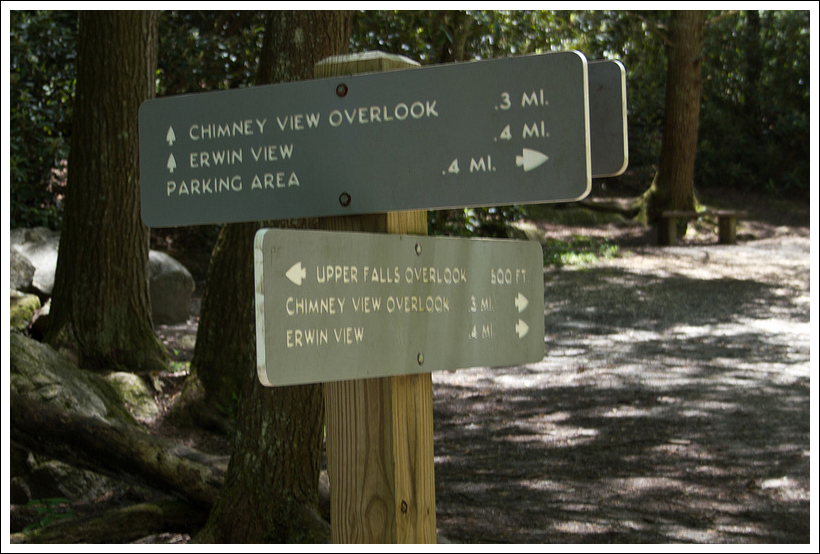


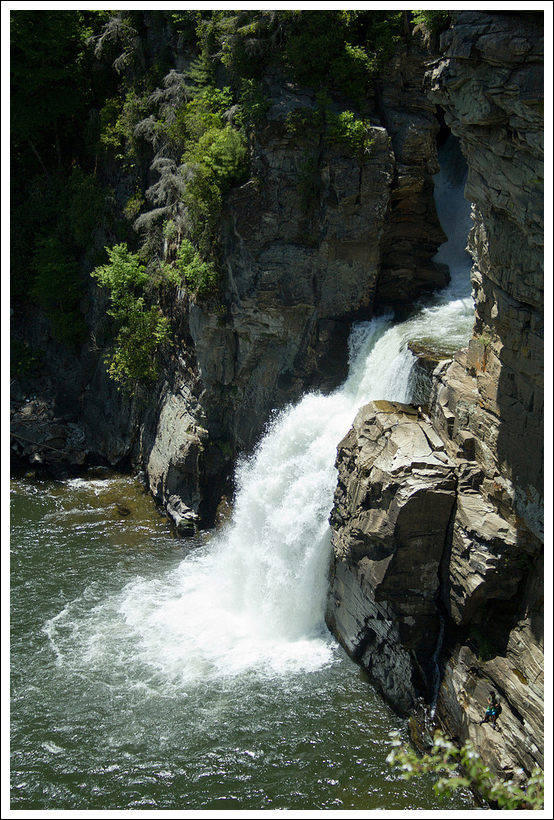
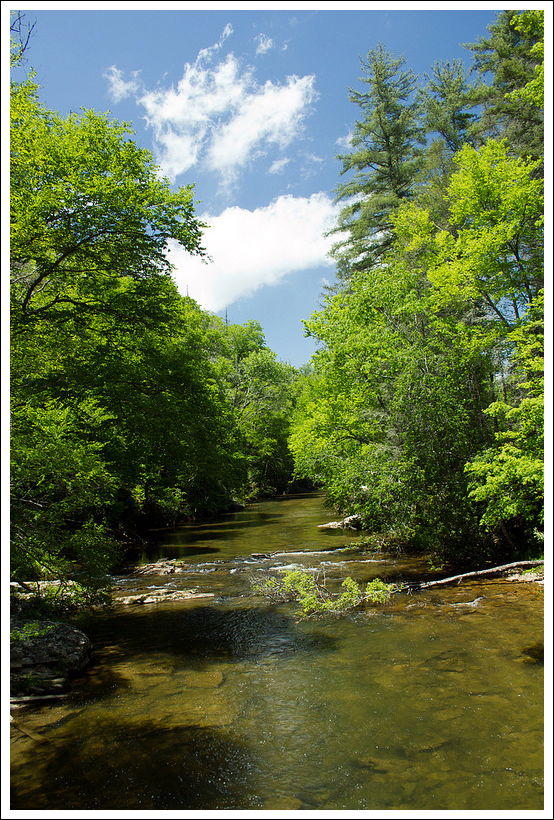


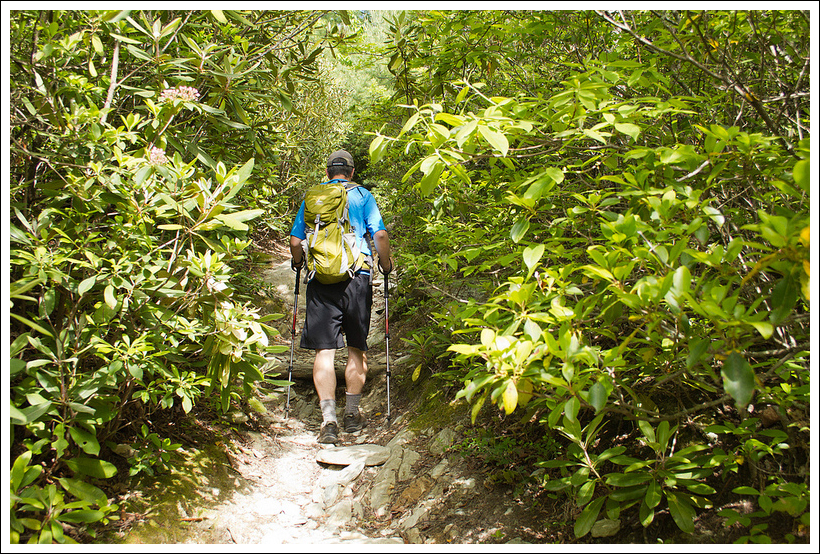

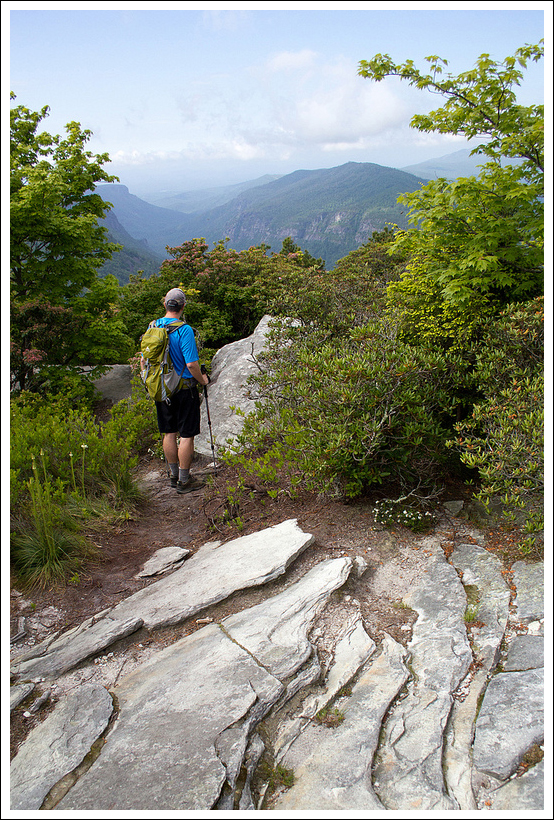
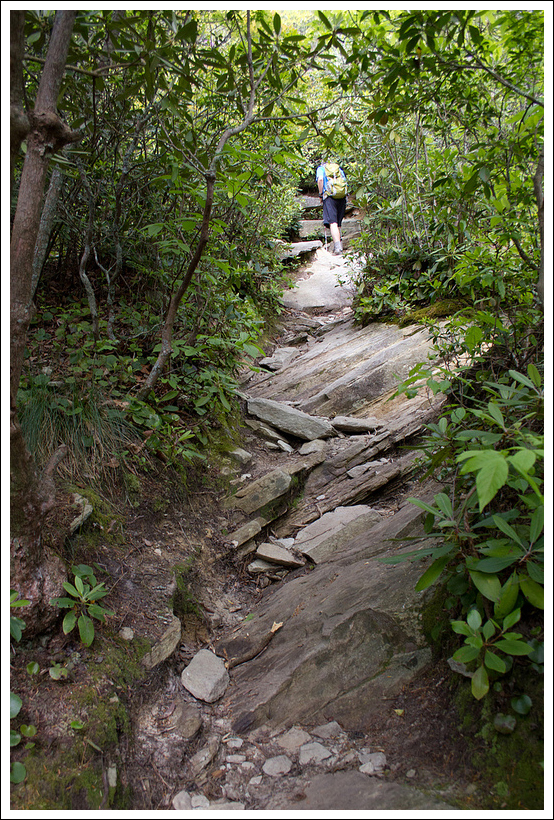


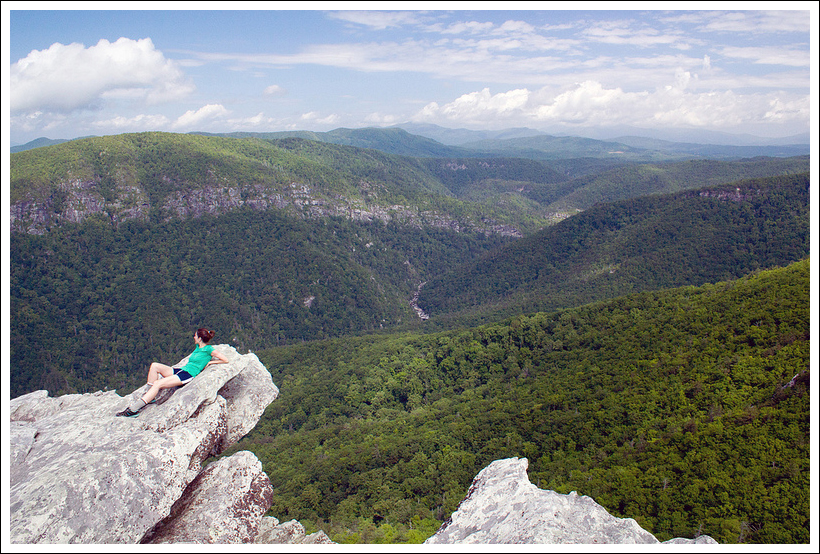

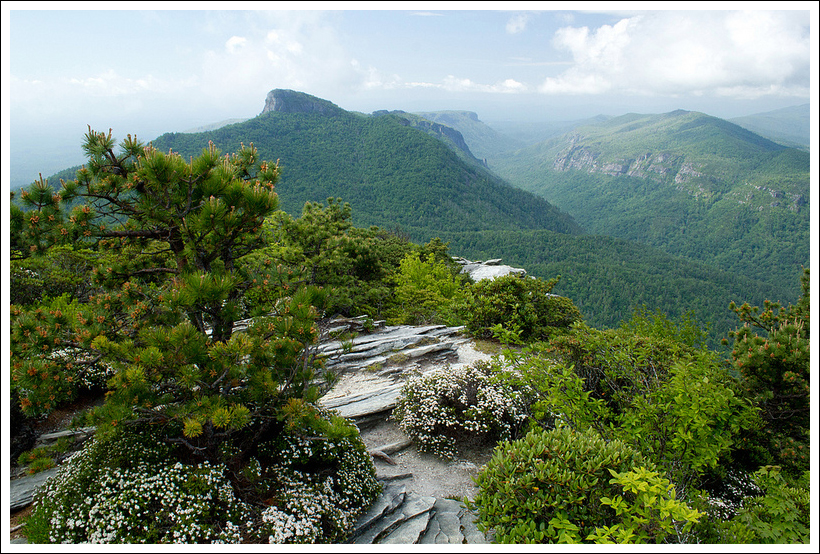


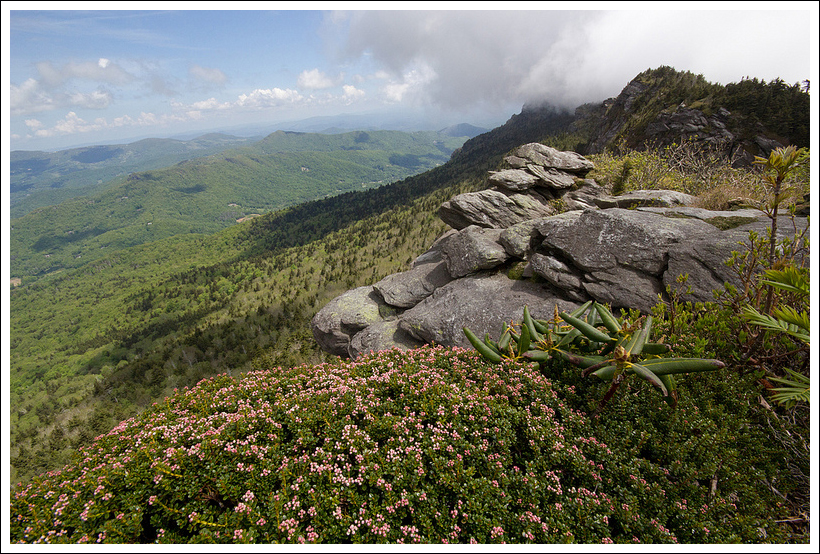
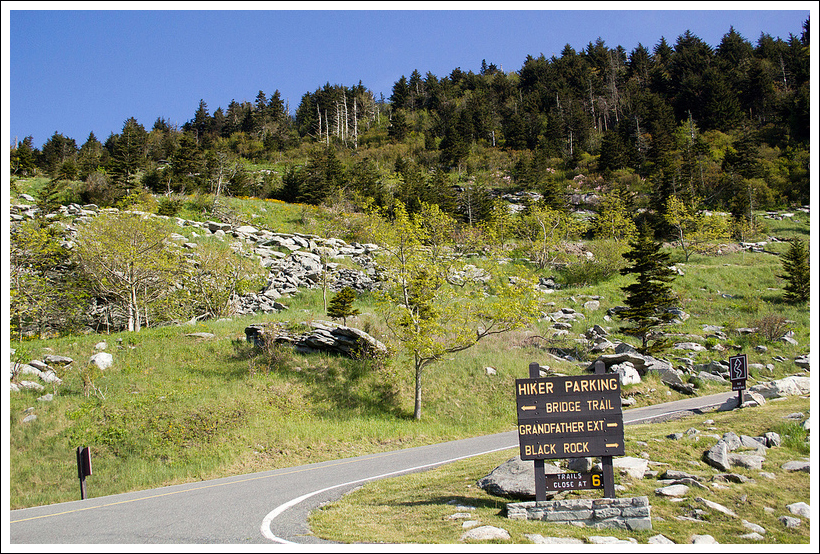

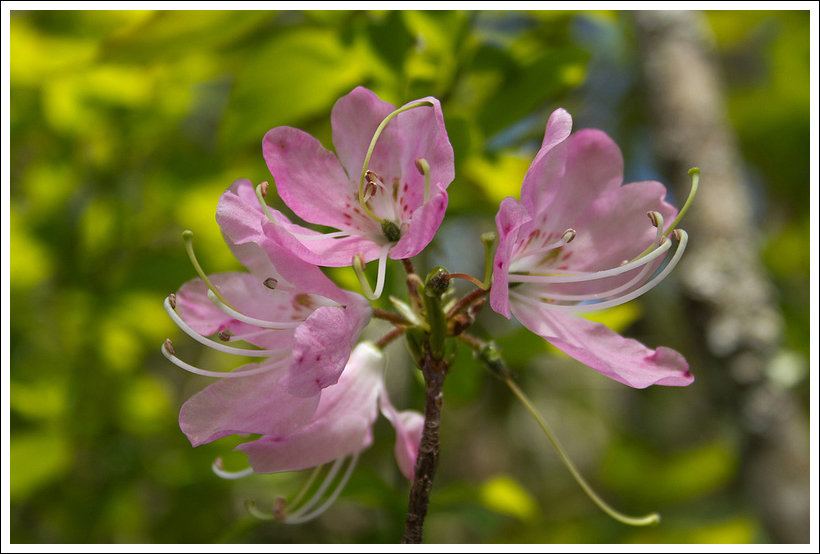

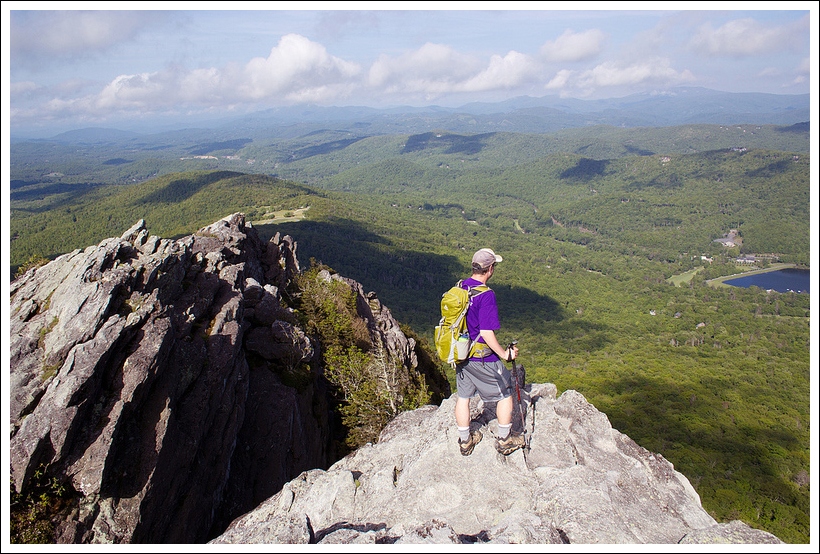
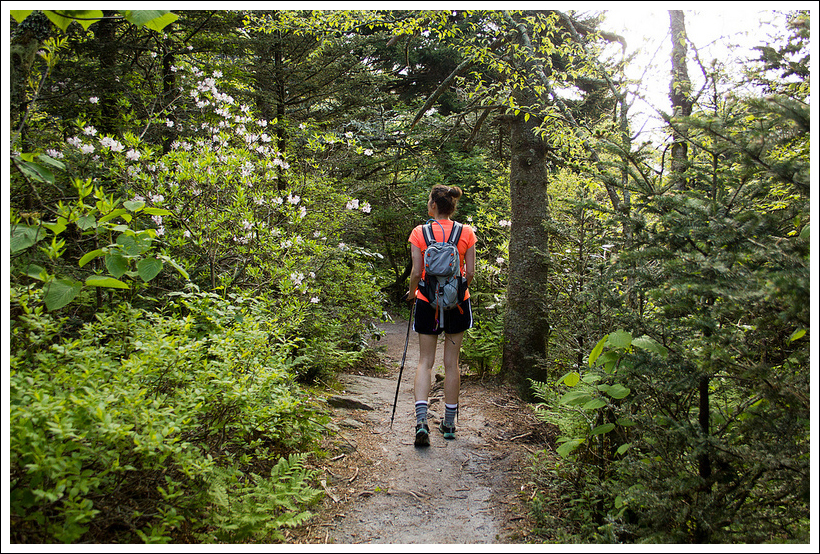
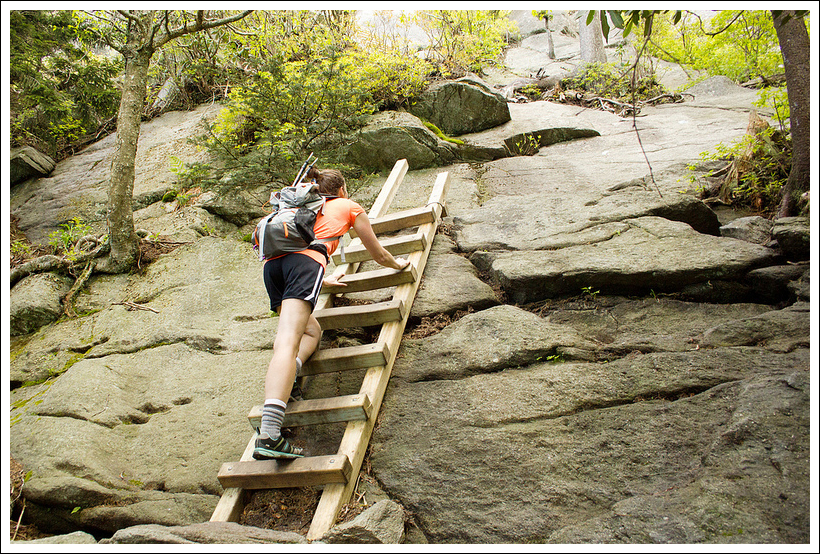
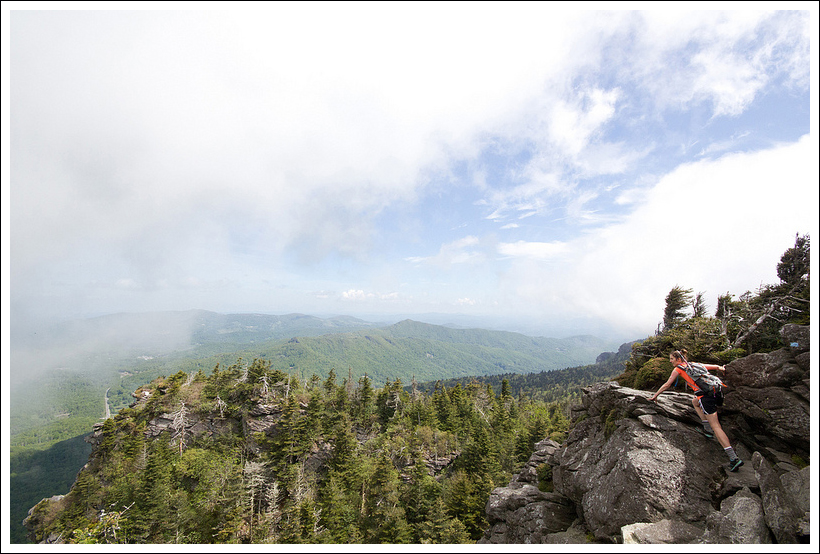

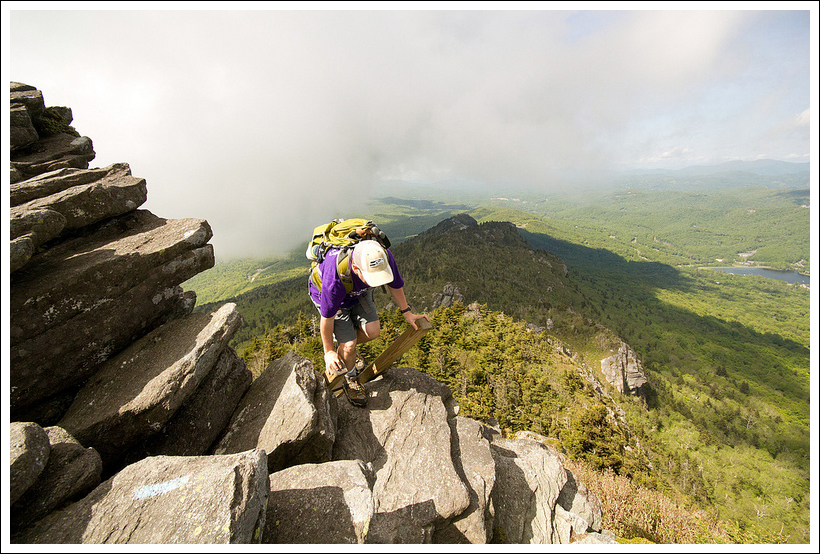
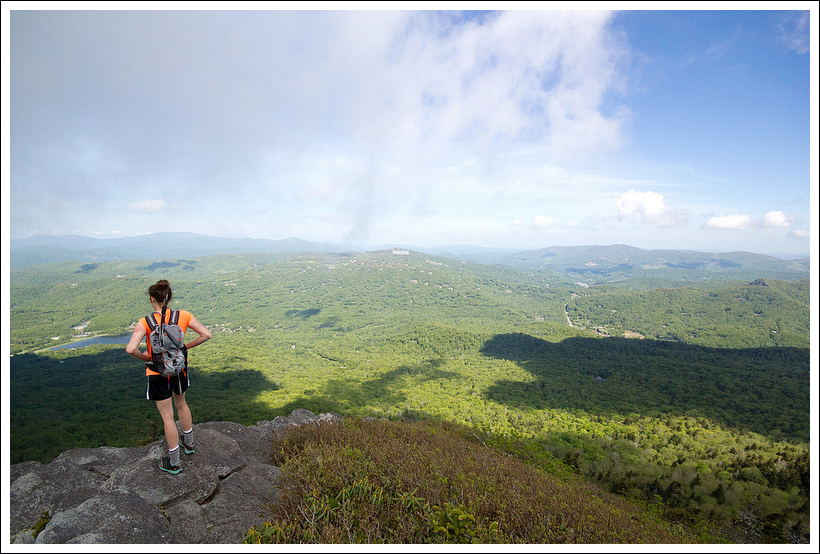
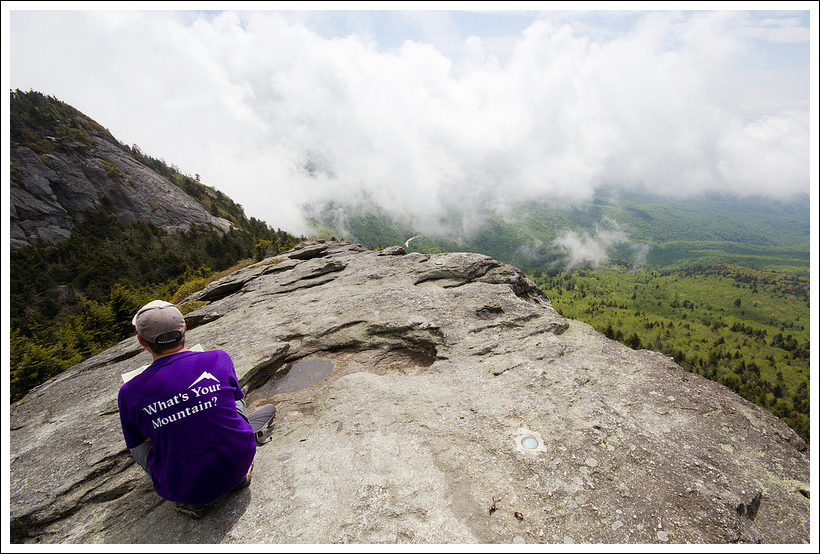
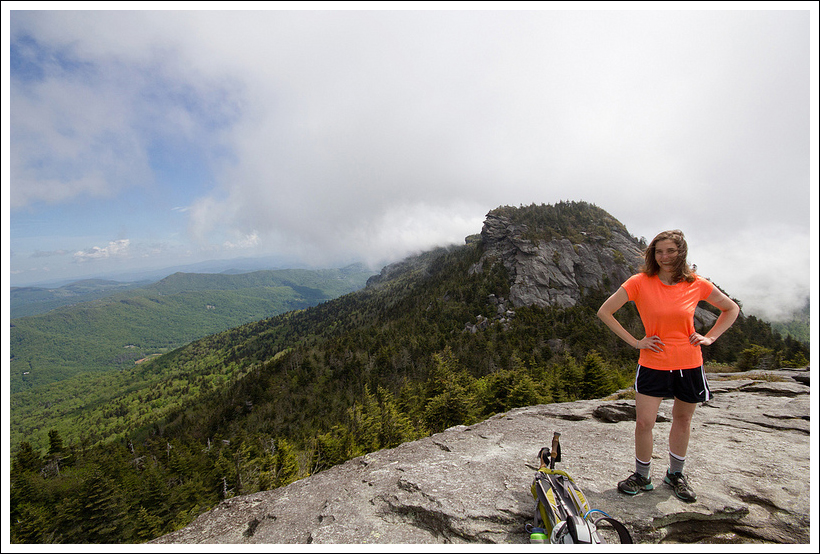
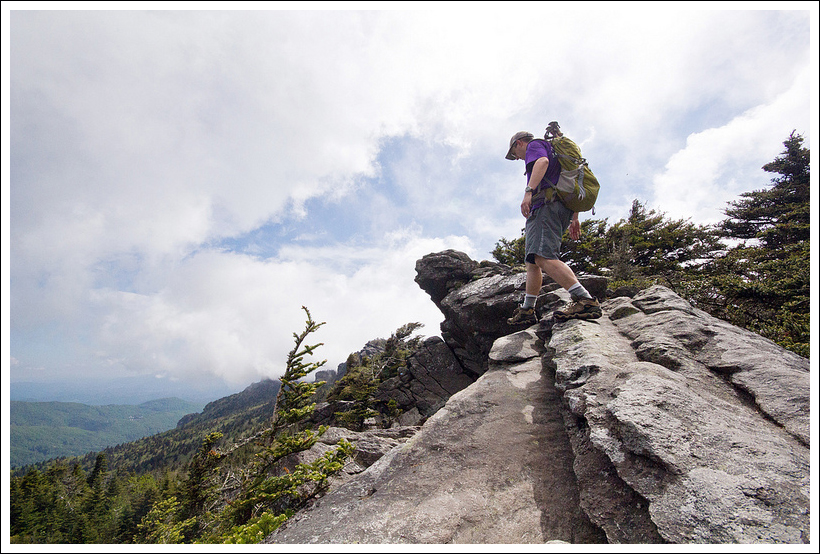
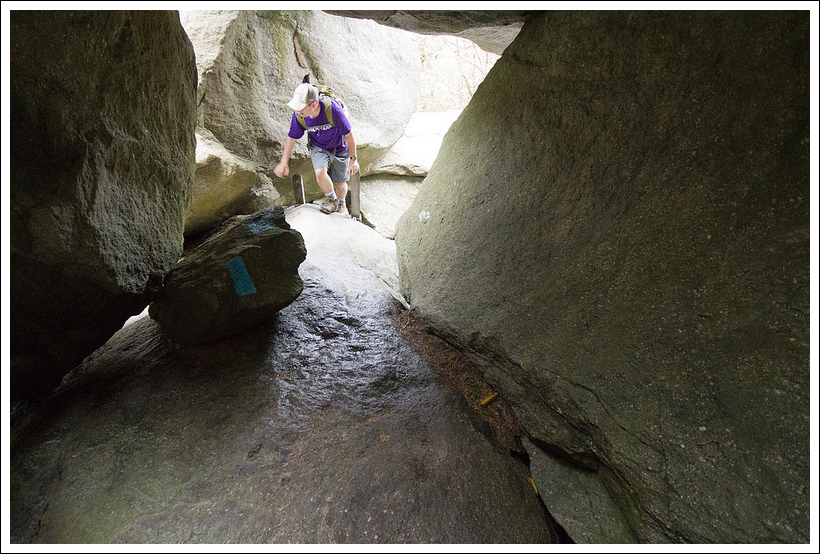
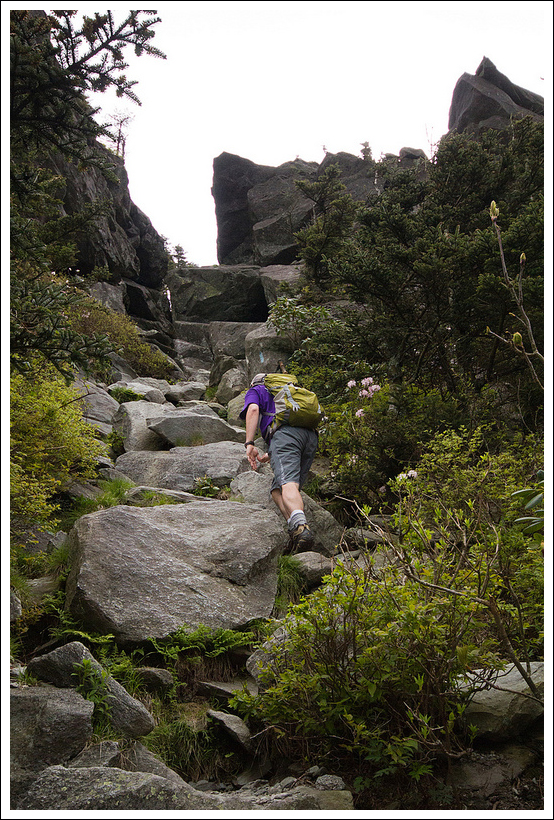
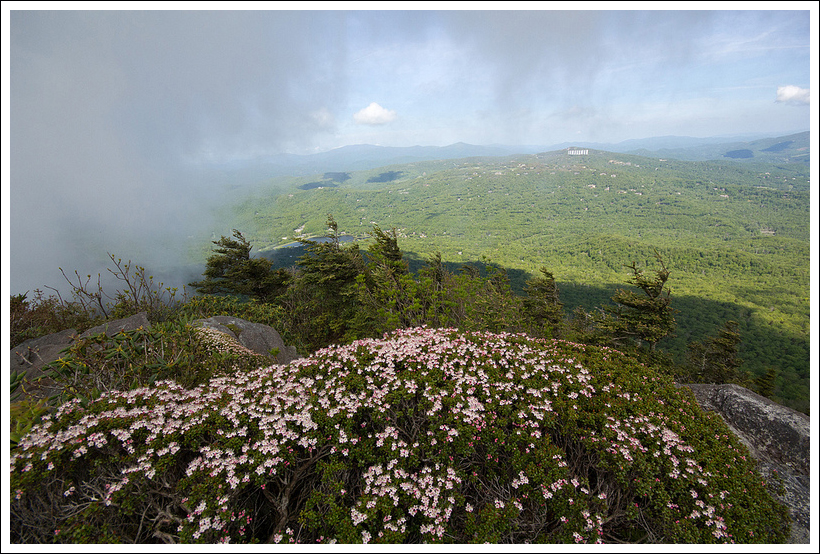
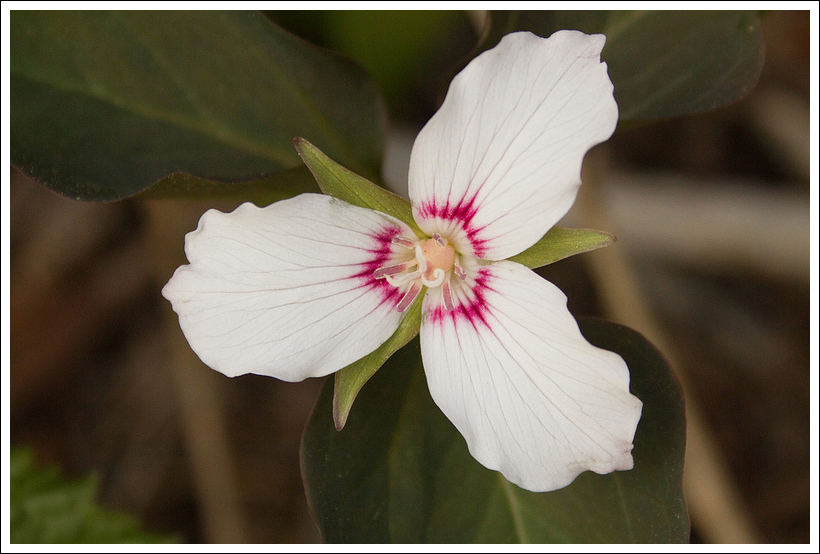
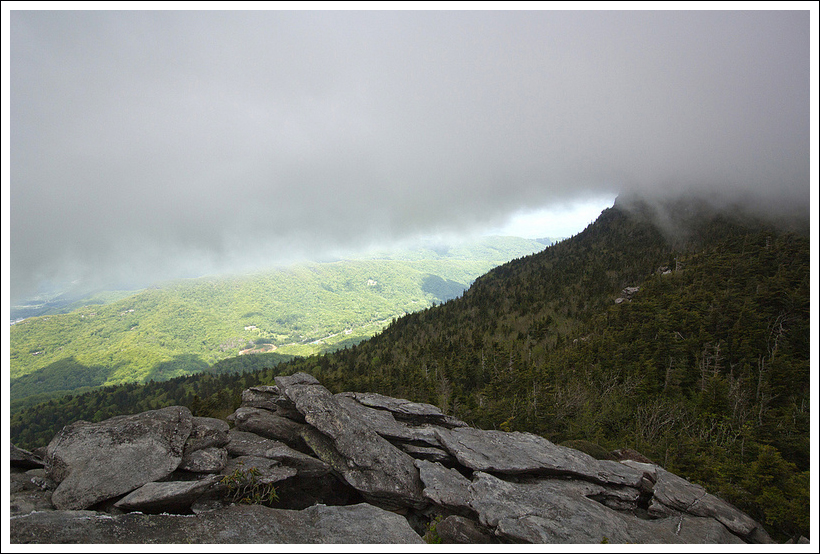
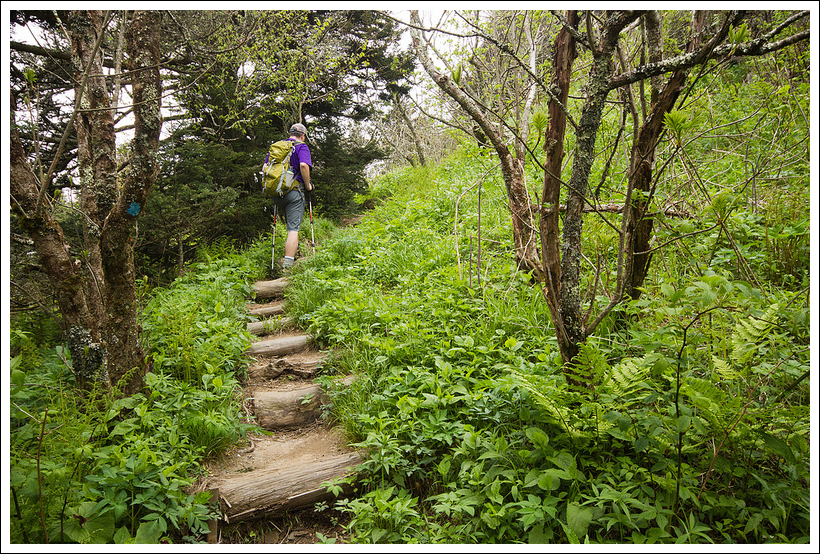
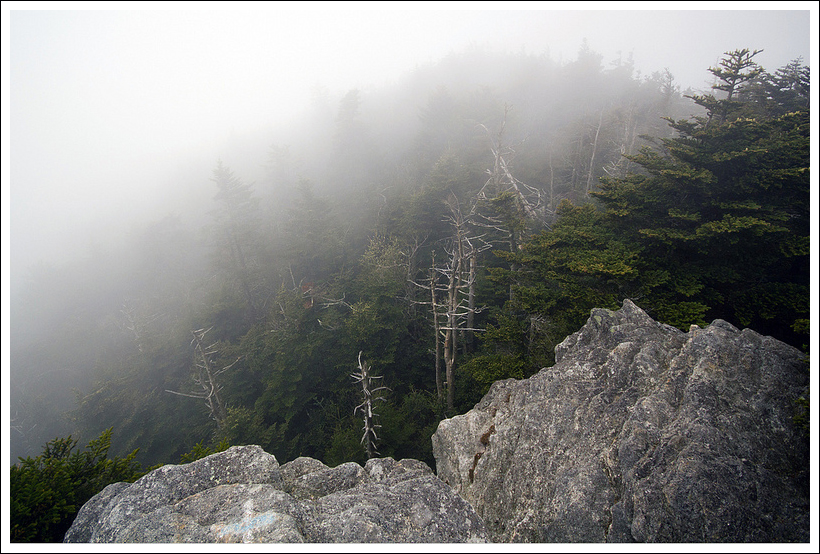
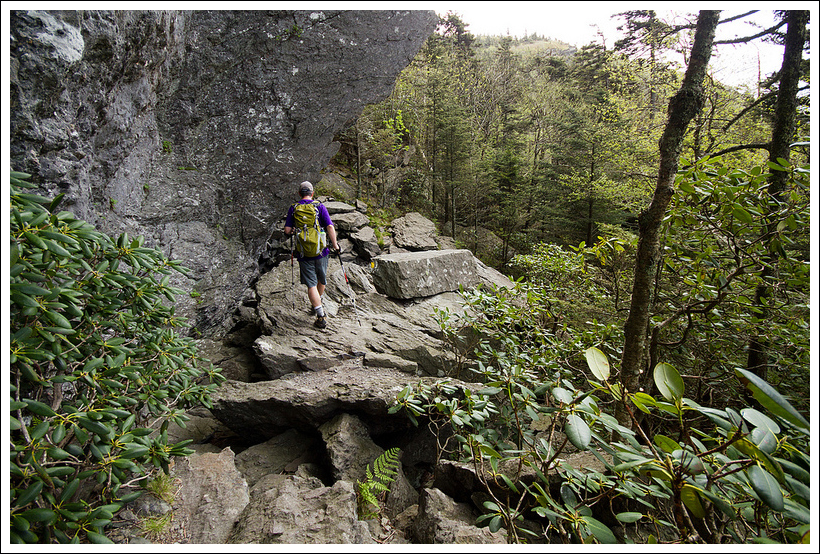
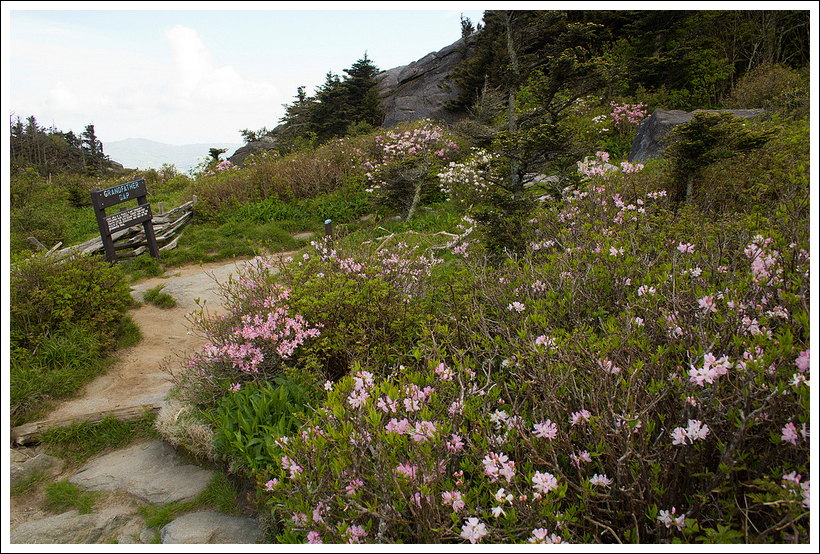


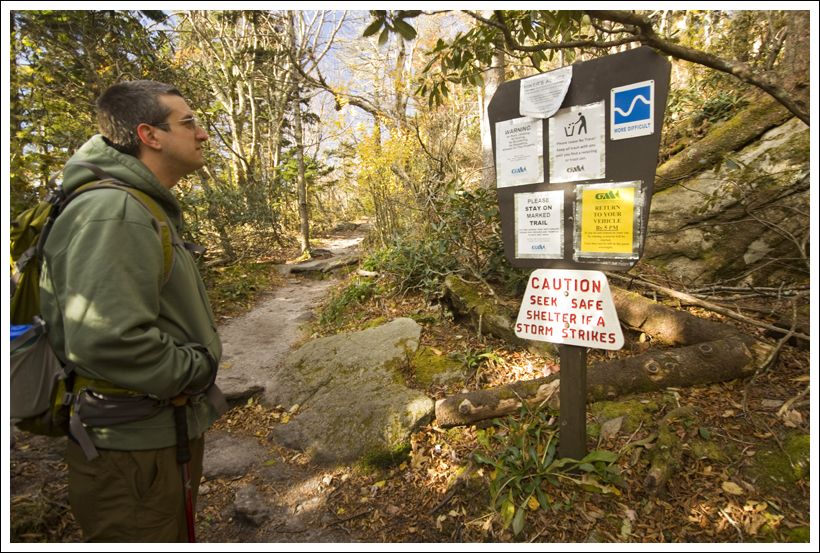


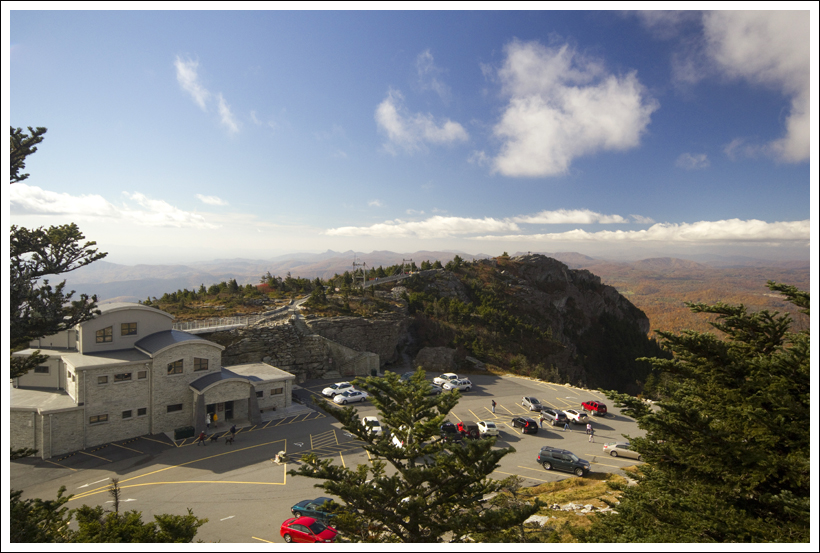


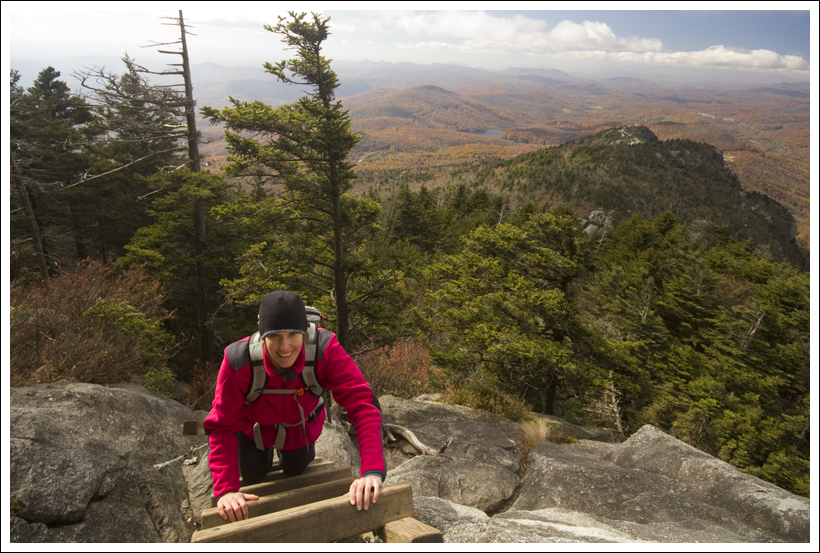
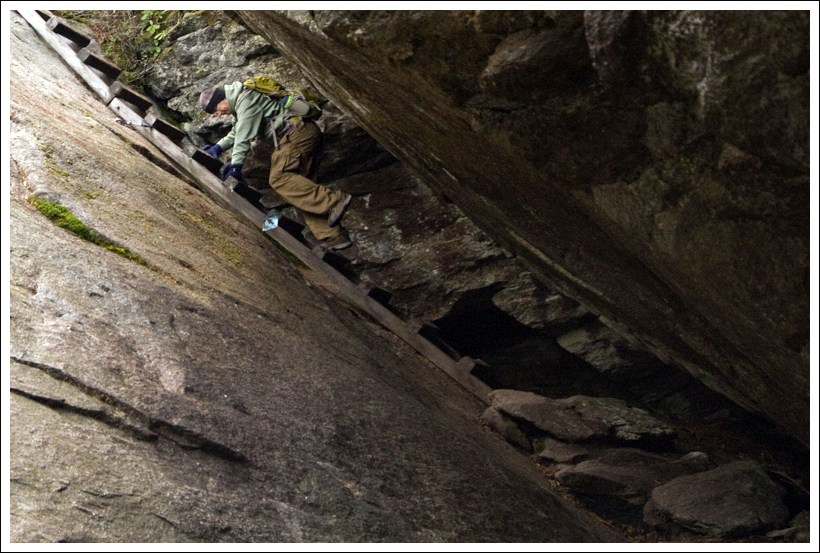


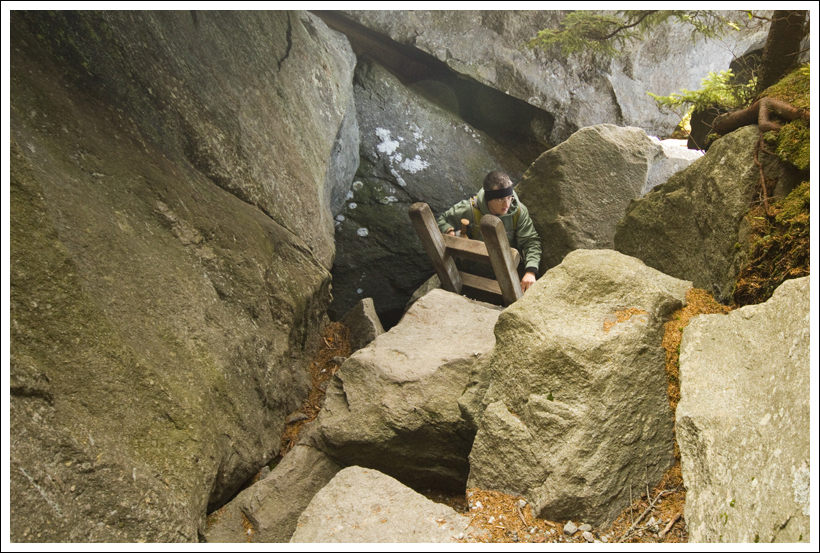


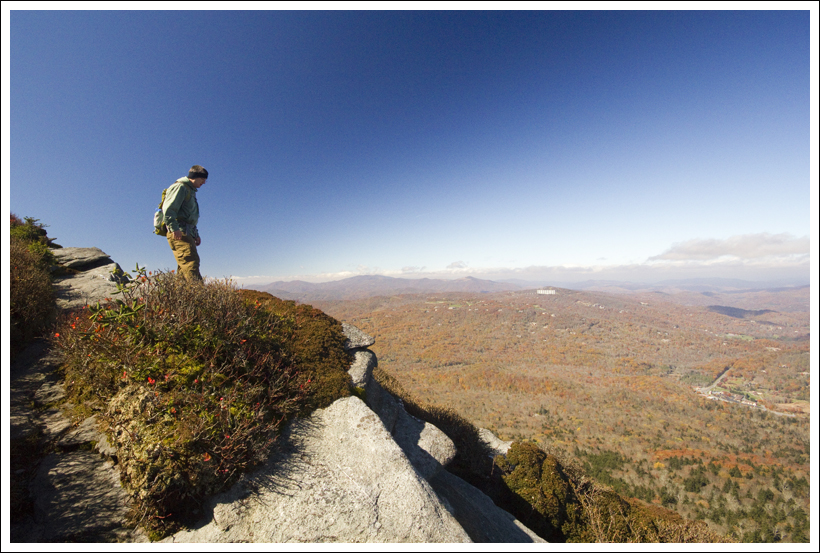


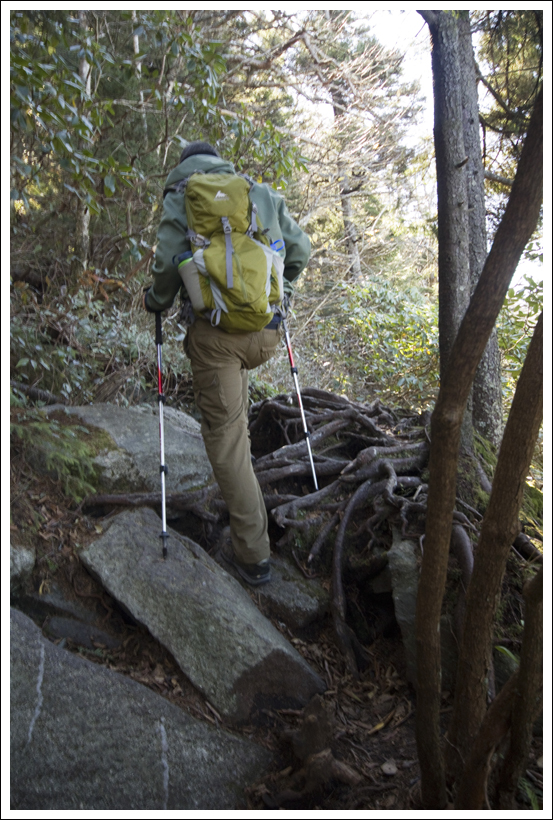


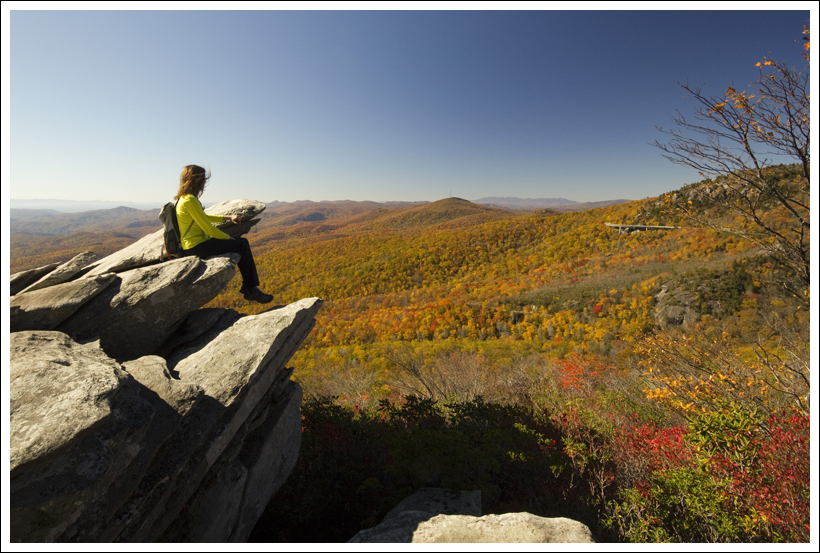
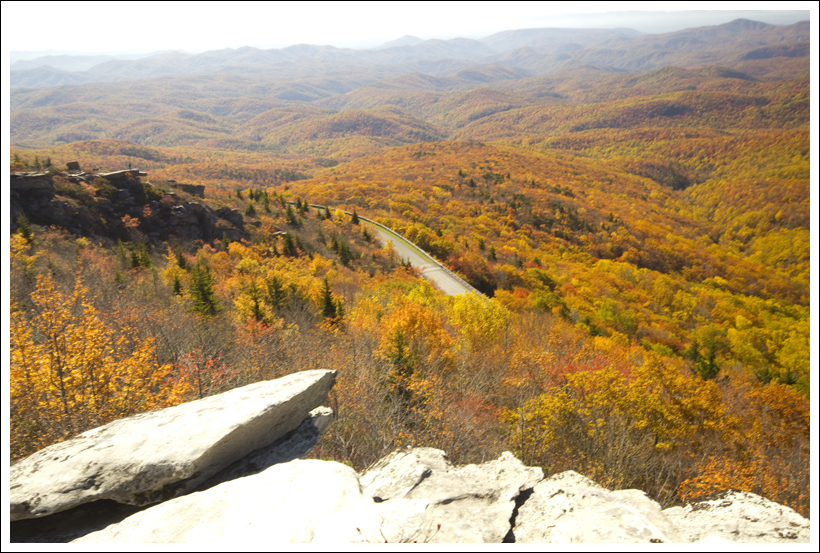
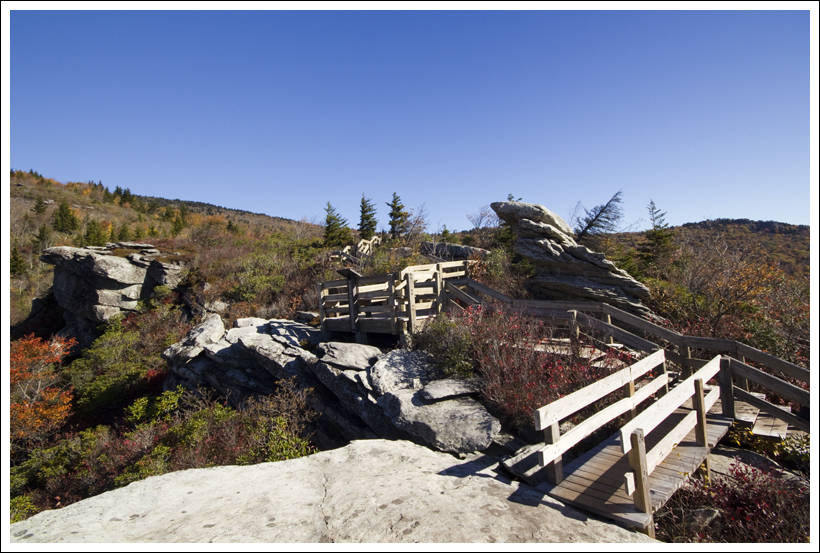

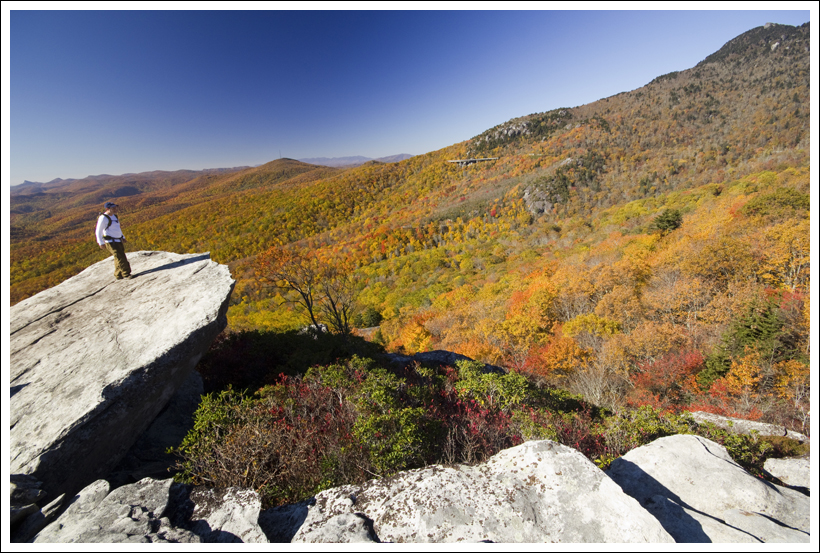

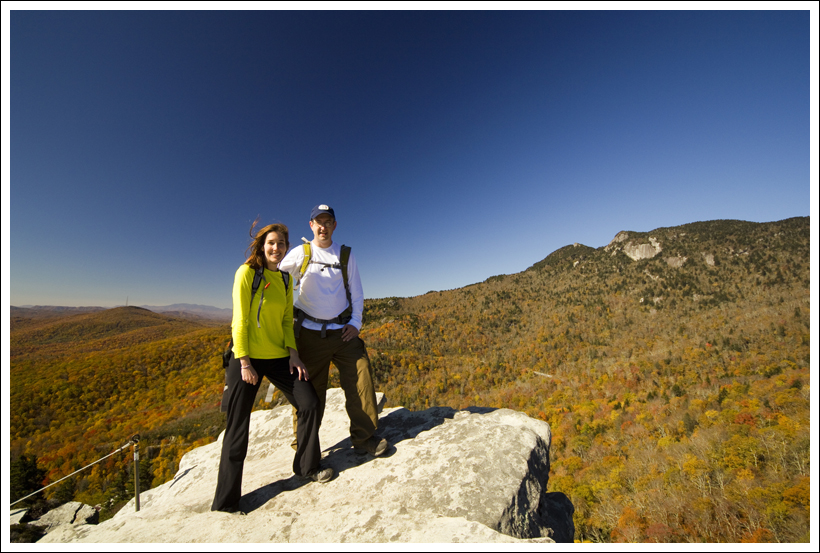

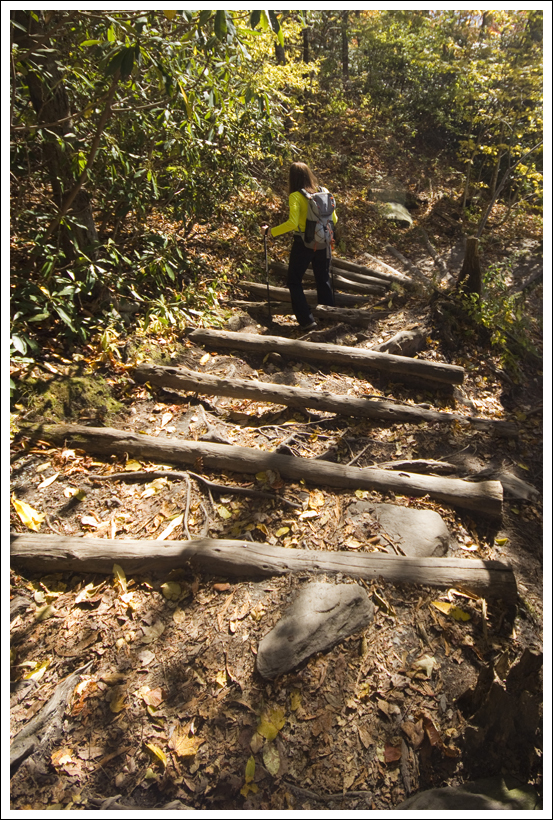


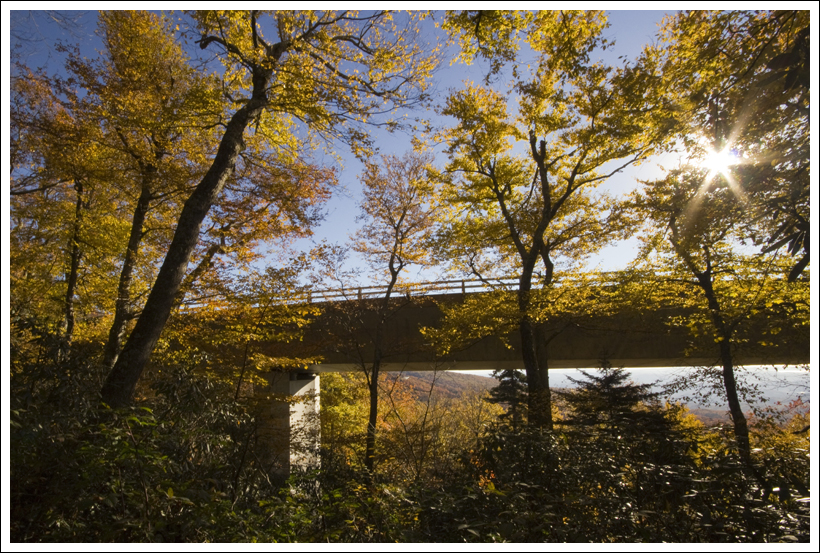


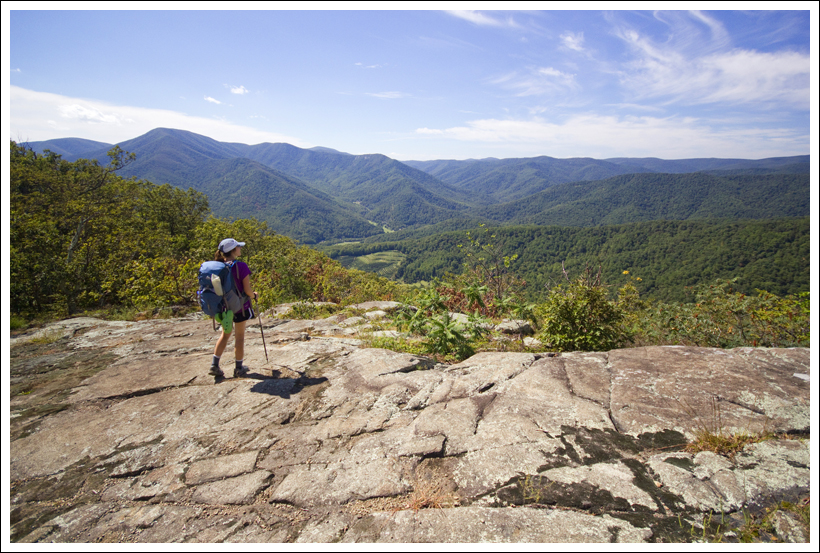


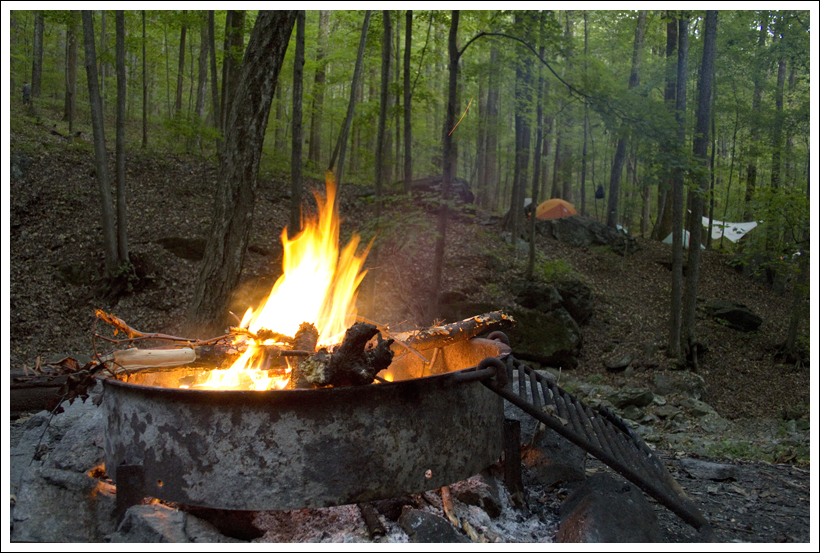
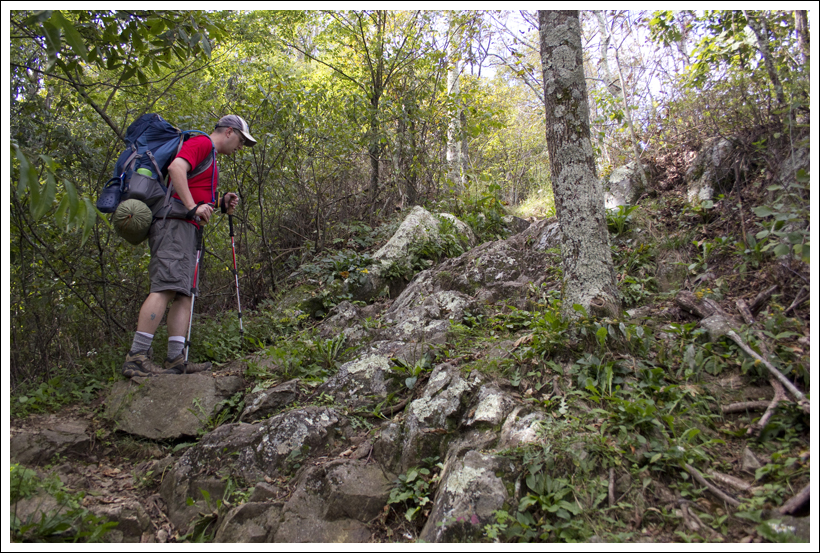


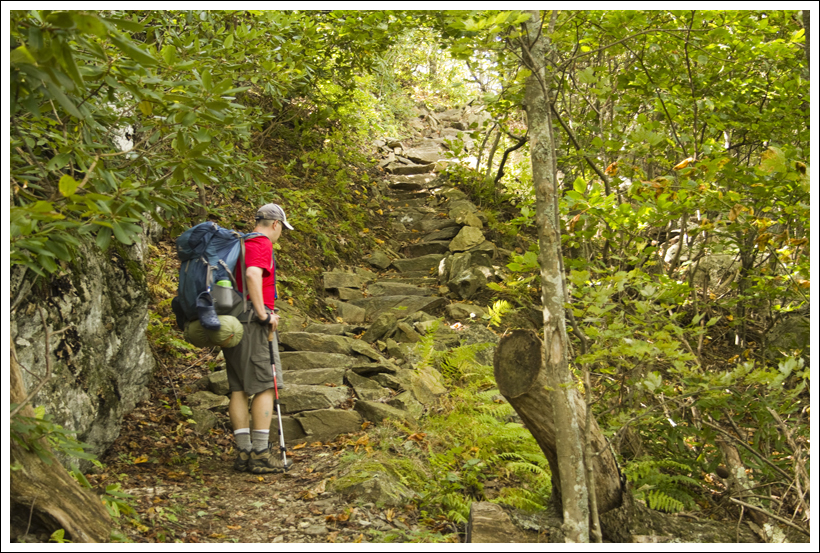


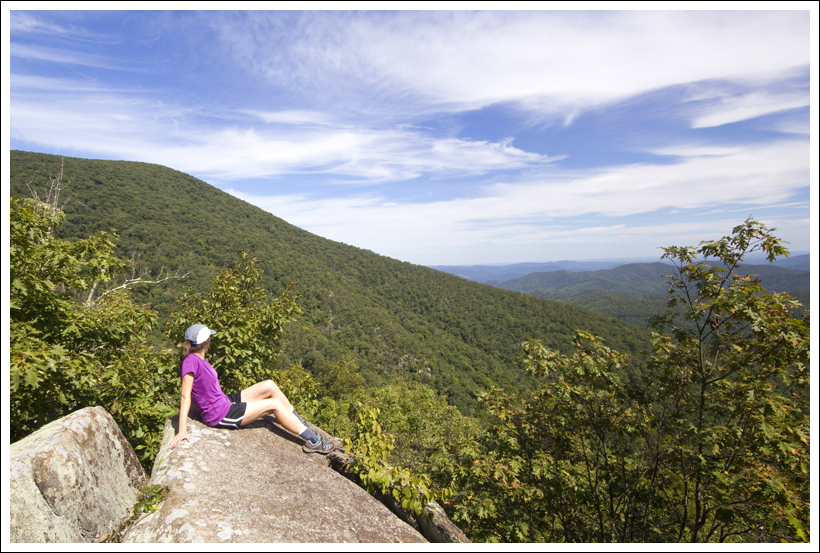


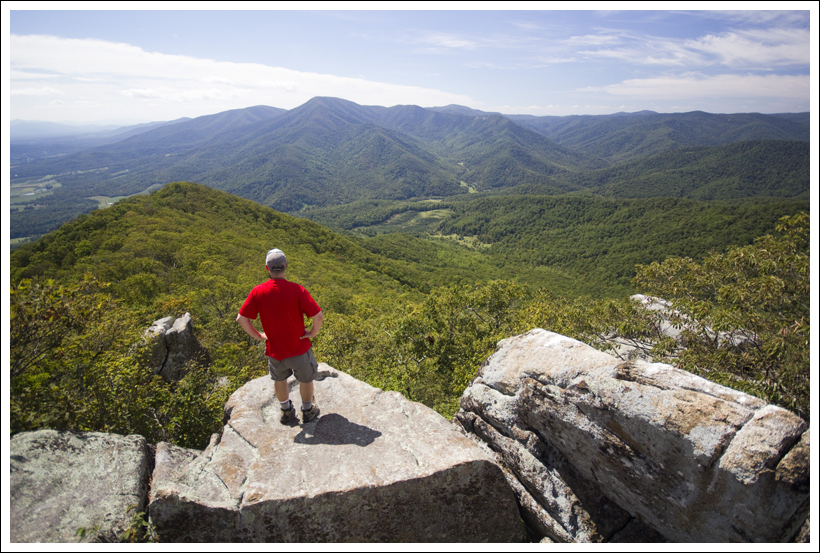
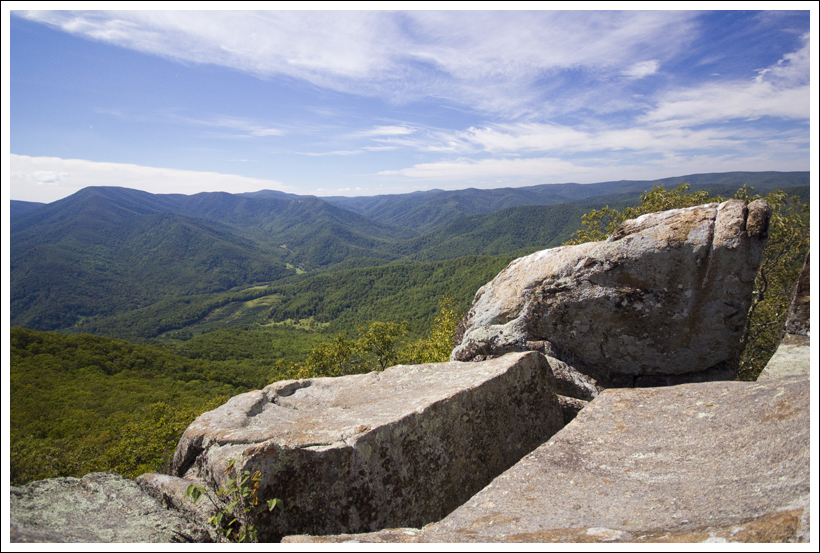

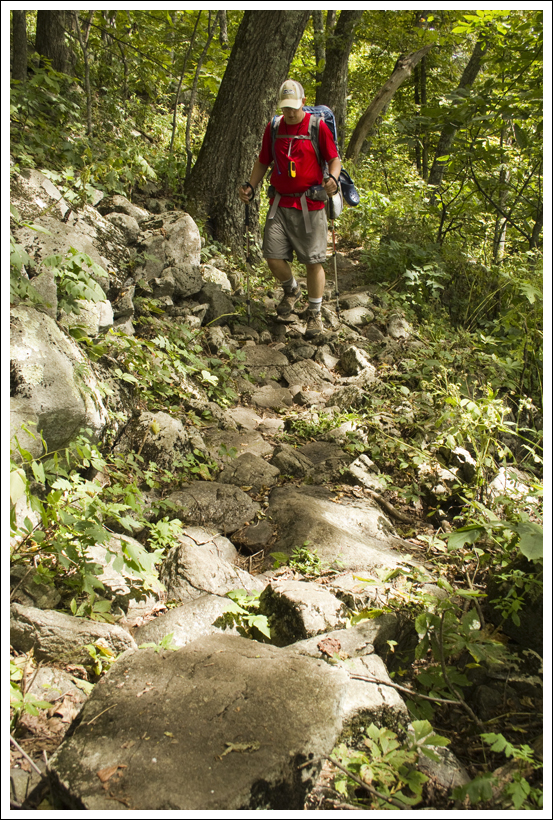
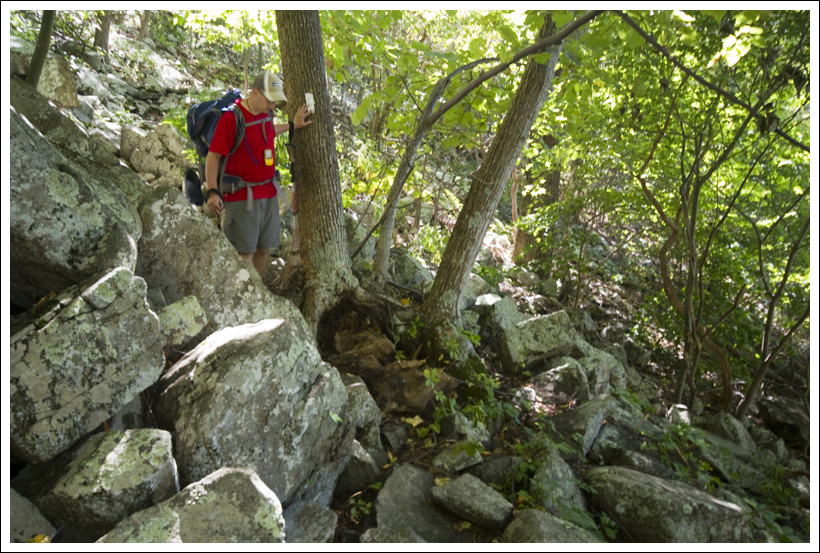


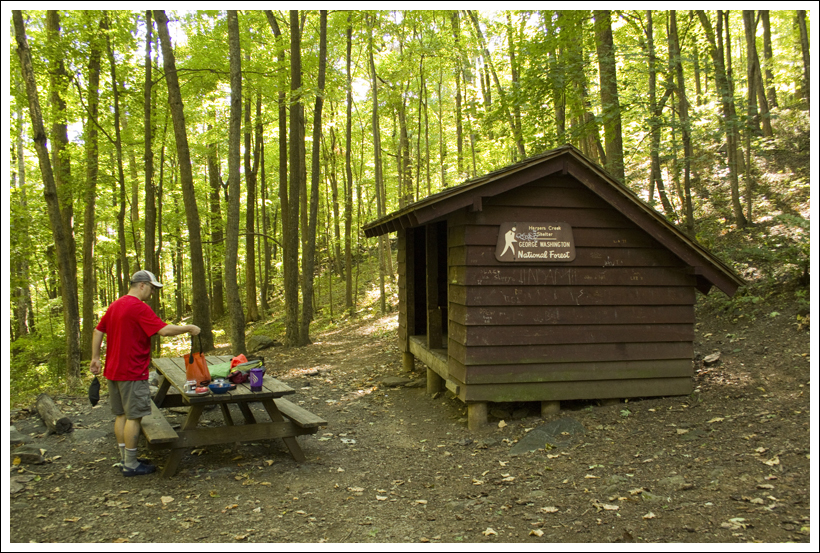


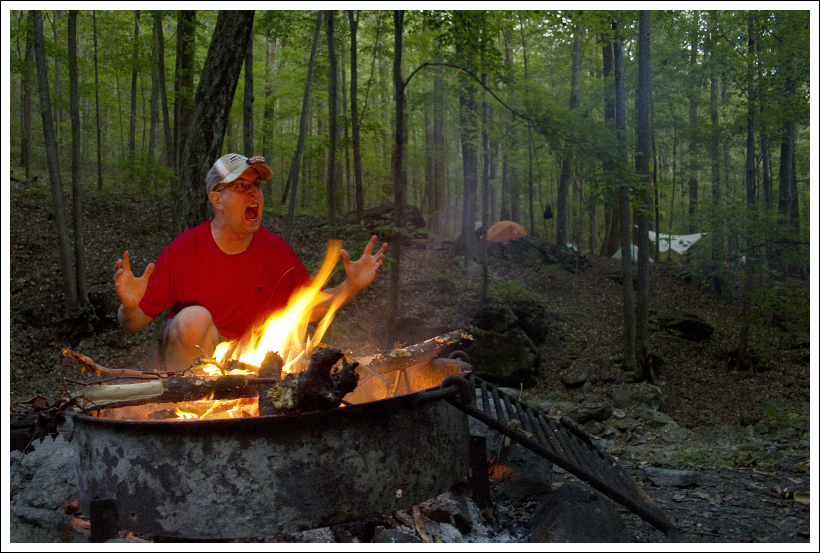

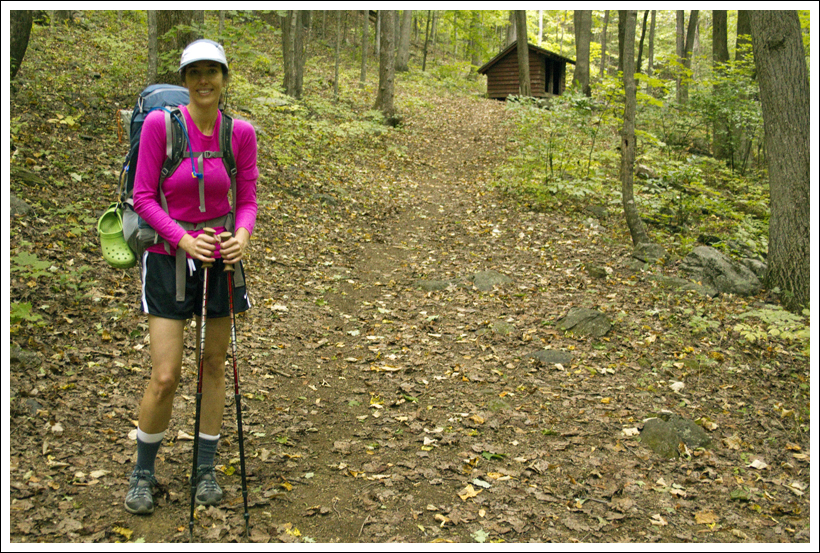


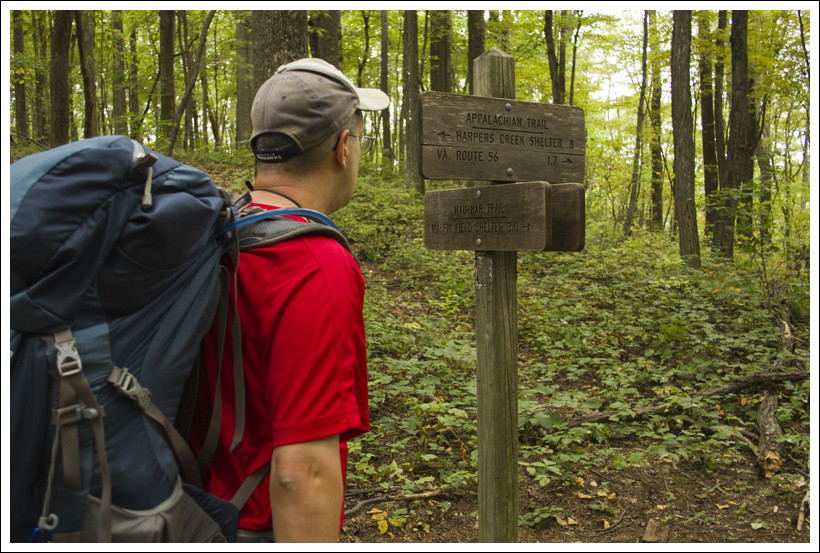


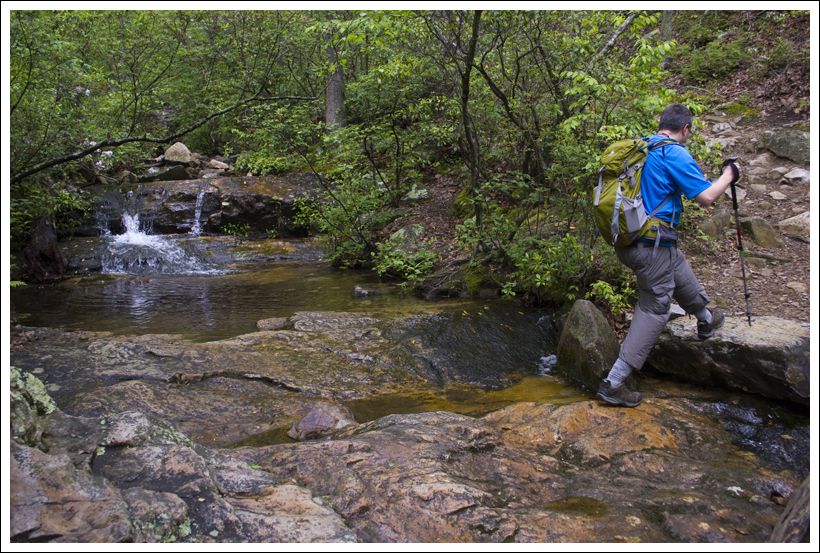





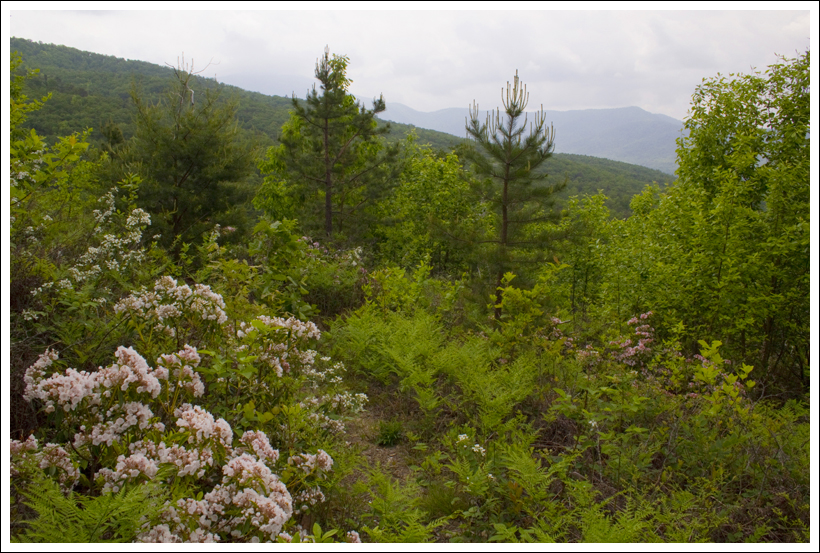

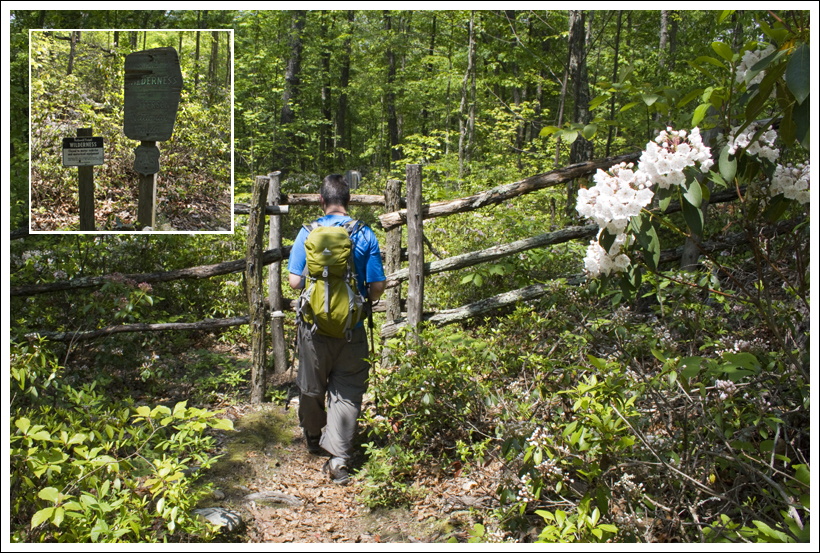

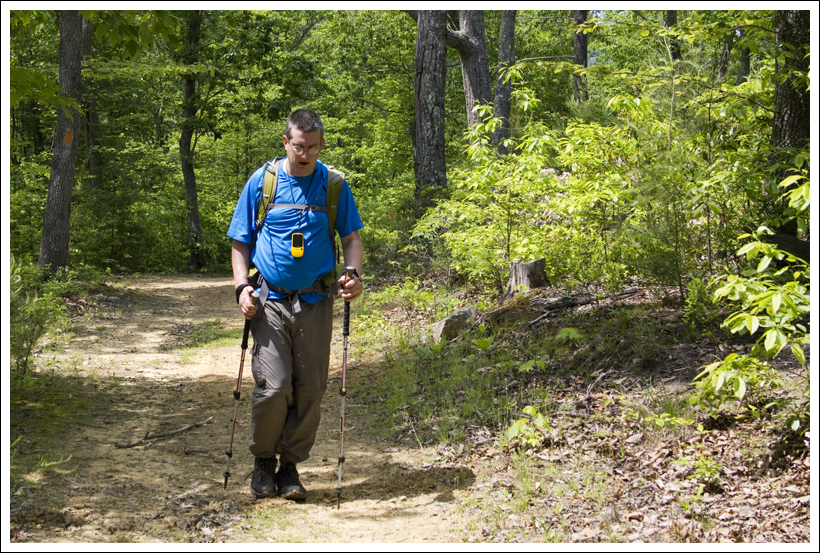


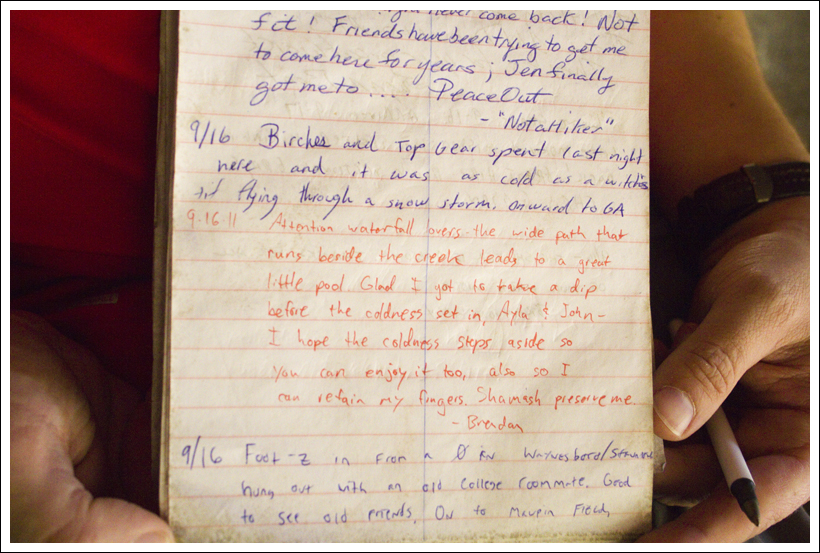


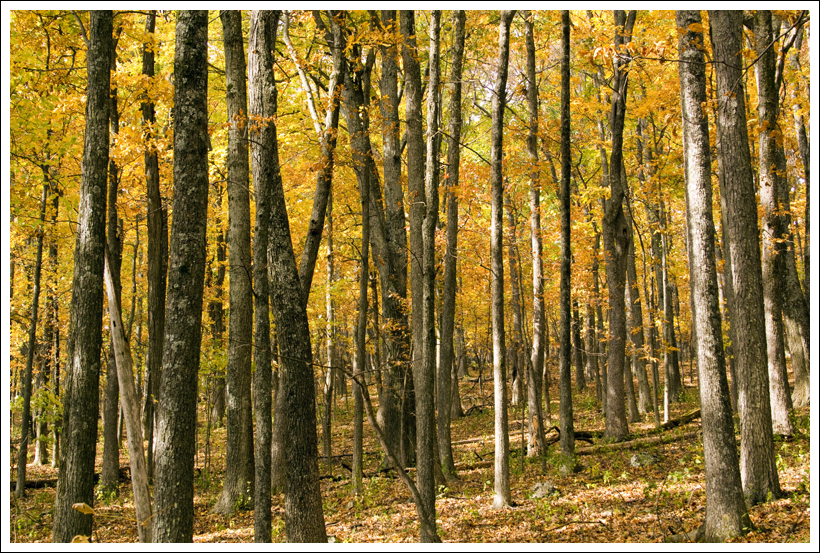


 Virginia Trail Guide