Bear Church Rock – via Graves Mill

Bear Church Rock is a 8.5 mile hike that leads to gorgeous, mountain views.  The hike passes alongside two rivers, waterfalls, and a PATC cabin. You can also reach this beautiful overlook from Skyline Drive (Bootens Gap).
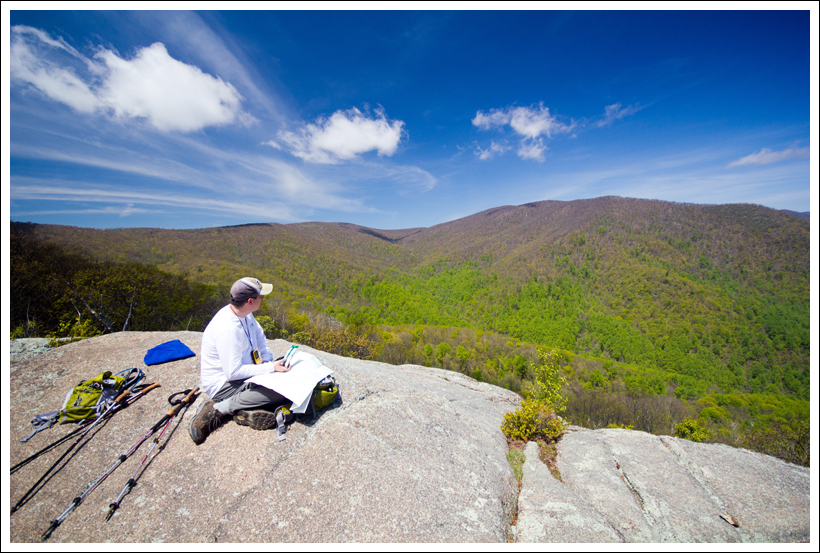
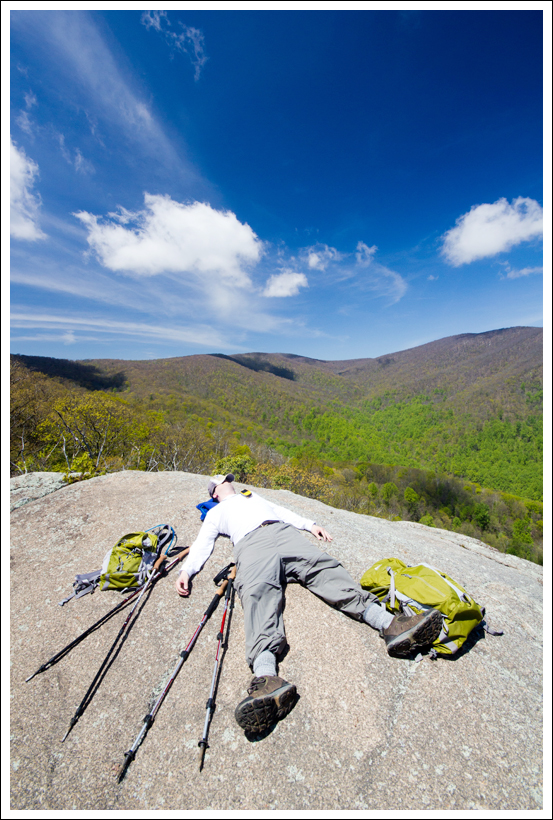
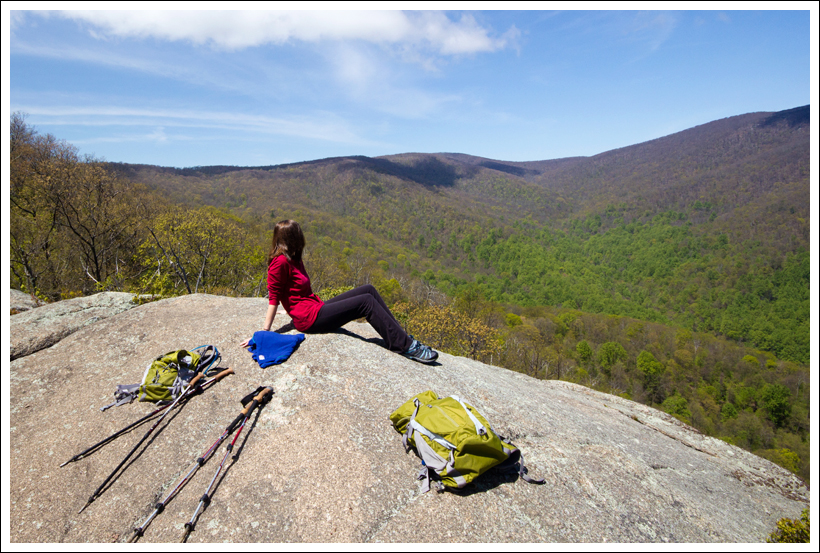
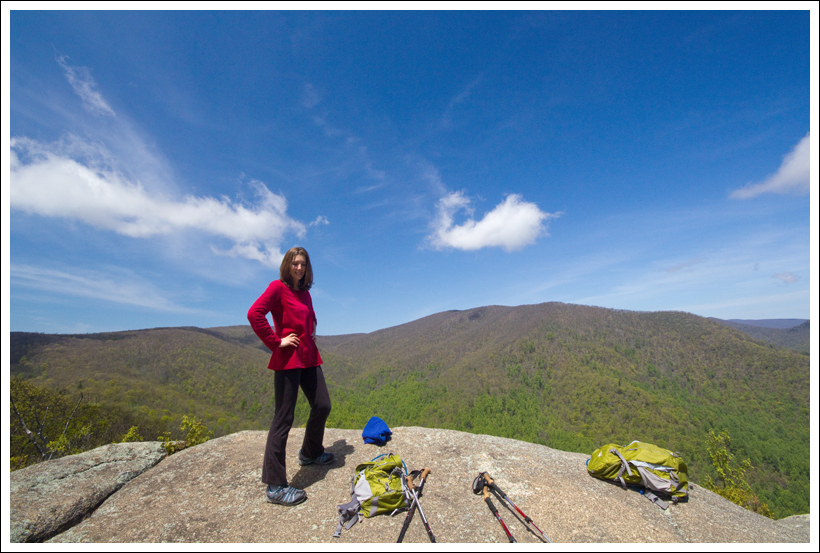
Taking in the View From Bear Church Rock
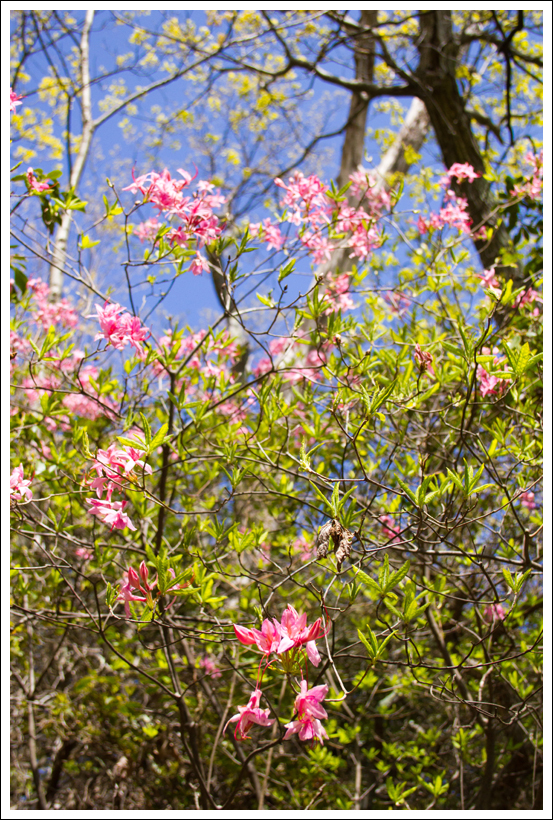
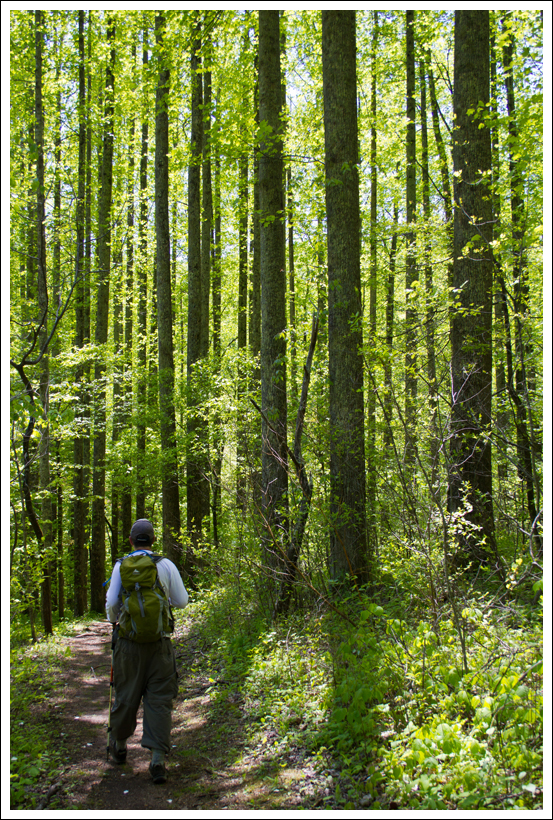
Adam enjoys the view from Bear Church Rock. Below: The tall, straight trees along the Staunton River trail were very beautiful; Azalea blooming near the top of Jones Mountain; The last push to the rock almost killed Adam.

Beautiful, Tall Straight Trees on the Staunton River Trail Blooming Azalea Adam Almost Died

Adam Says…

Bear Church Rock is a hike that has it all – nice trail alongside a stream, a few small waterfalls, a visit to a PATC cabin, and a great view at the top.  The views are completely of mountains with rarely a sign of civilization.  I always feel like I am truly getting away when I don’t have to see houses or roads dotted across the landscape.  You can easily see Fork Mountain and Doubletop Mountain nearby, but past that ridge, you can also get glimpses of the ridge that makes up Skyline Drive.

The hike starts off on the Graves Mill Trail, which is a flat walk that runs along the Rapidan River.  At .5 miles, you reach a junction with the Staunton River Trail.  Take a left at the junction to follow the Staunton River Trail, which runs along the Staunton River.  Shortly after you join the trail, you will come across a beaver dam on the river and you’ll notice several stumps of trees that have been gnawed by beavers.  At 1.1 miles, you will see a small waterfall leading into a small pool off the trail that is worth a stop.  At 1.8 miles, you will see on the left side of the trail some piles of stone and on the right you’ll be able to see another small waterfall through the trees.  At 2.7 miles, you reach the junction with the Jones Mountain Trail.  Take a left on this trail.  The trail becomes very steep at this point and will remain so until you reach the top.  At 3.1 miles, you reach the junction with the McDaniel Hollow trail.  Take a left here to follow the Jones Mountain Trail.  At mile 3.4, you reach a junction that leads to the available-to-rent PATC cabin.  If you stay relatively straight on the trail, it leads to the PATC Jones Mountain Cabin.  We took this trail which starts off flat, but then descends rather steeply.  After visiting the cabin, return to reach the junction with the Jones Mountain Trail and head up the steep incline until you reach Bear Church Rock.  Continue back the way you came, but your return trip will be shorter if you have already visited the Jones Mountain Cabin.  The total trip should be 8.5 miles.

You could also approach this hike from Skyline Drive for a longer hike, following the Laurel Prong Trail to Cat Knob Trail to Jones Mountain Trail.  My guess is it would be about a 10 to 12-mile round-trip to approach it from that direction.
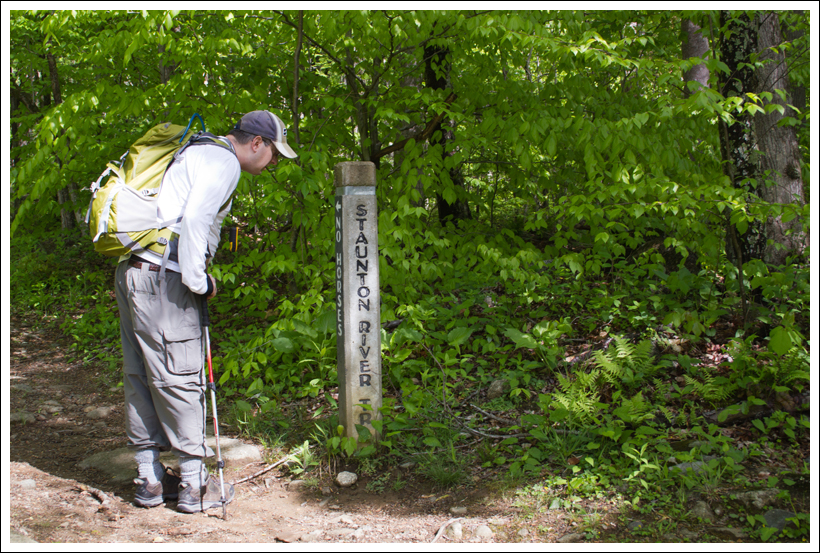
Start of the Staunton River Trail
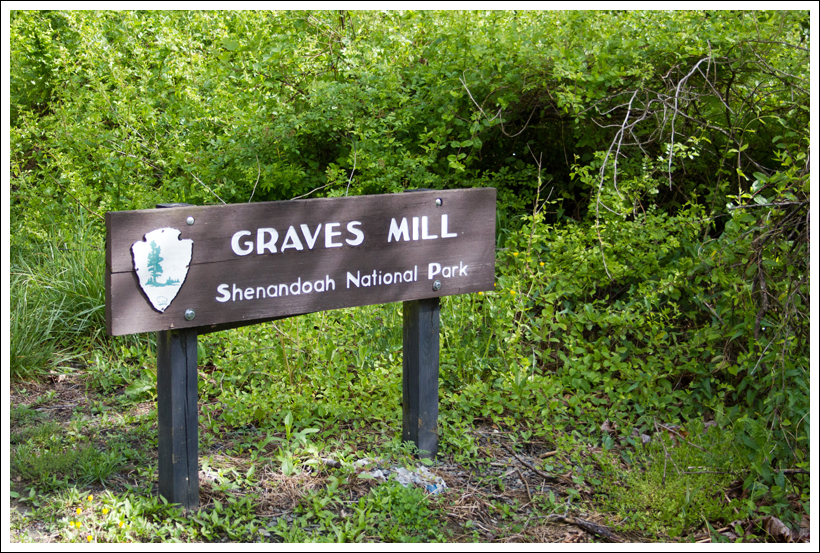
Adam pauses to look at distances marked on the Staunton River trail sign. Below: Parking for this hike is at Graves Mill; The lovely Rapidan River; Trillium were still blooming along the trail, but were nearing the end of their peak.

Graves Mill Sign The Rapidan River Trillium

On our way up the Jones Mountain Trail, we ran into a few PATC volunteers that were working on maintaining the trail.  Some PATC members volunteer to help maintain the trails that run through Shenandoah National Park, the Appalachian Trail, and other regional trails.  One of the workers has been working on improving this trail for the last five years.  At the time that we saw them, they were working on building in some water bars through the trail that helps pull the water off the trail to prevent erosion.   They were digging drainage ditches, placing some dead black locust tree logs across the trail they had cut, refilling with dirt, and then mounding the dirt in a way that it was unnoticeable to hikers.  We learned that the black locust trees were great trail logs because they don’t rot.  We thanked them for helping to improve the trails and we plan on getting in touch with them to help them some weekend in the future.  We both feel that as much as we enjoy hiking, it would be nice to give back.
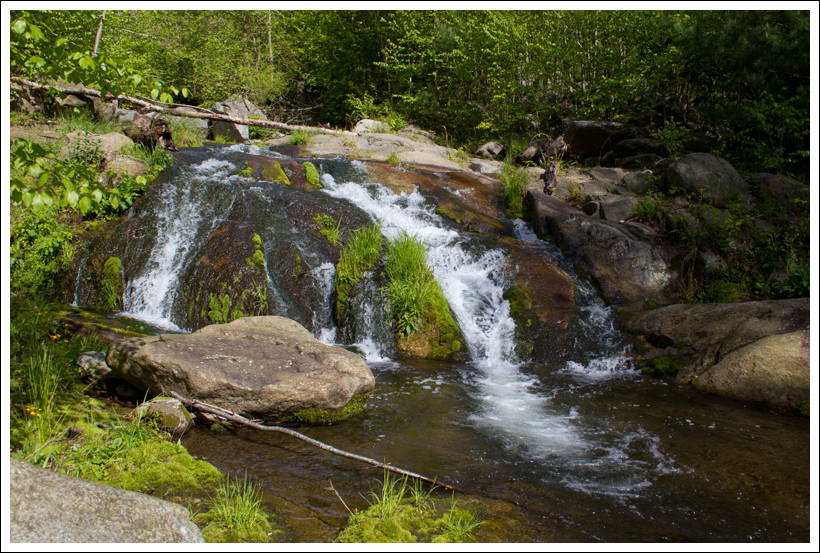
First Waterfall on Staunton River Trail
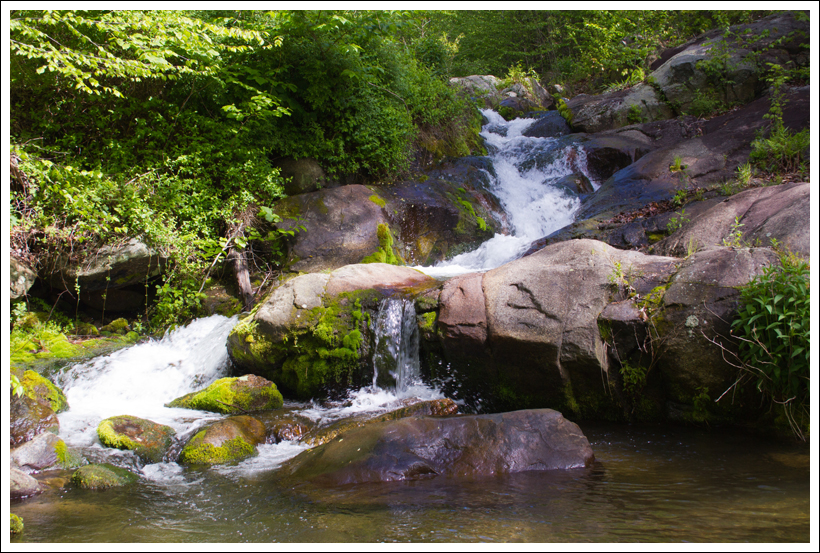
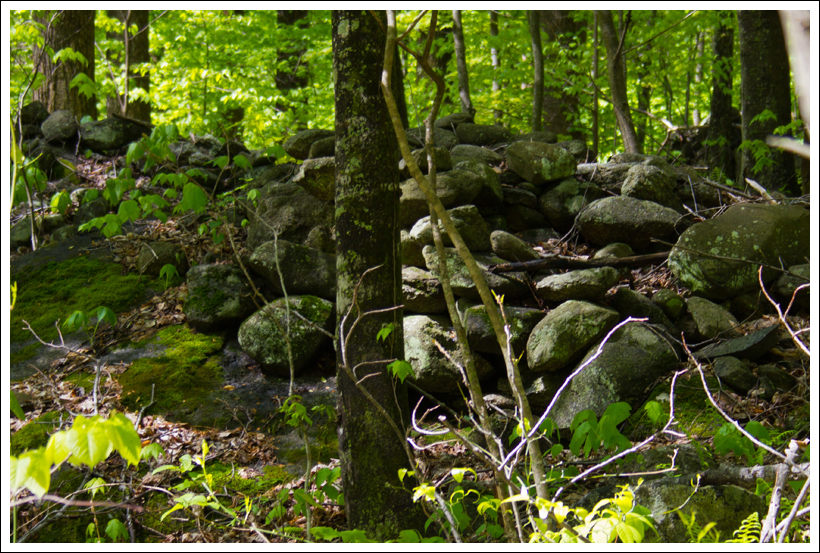
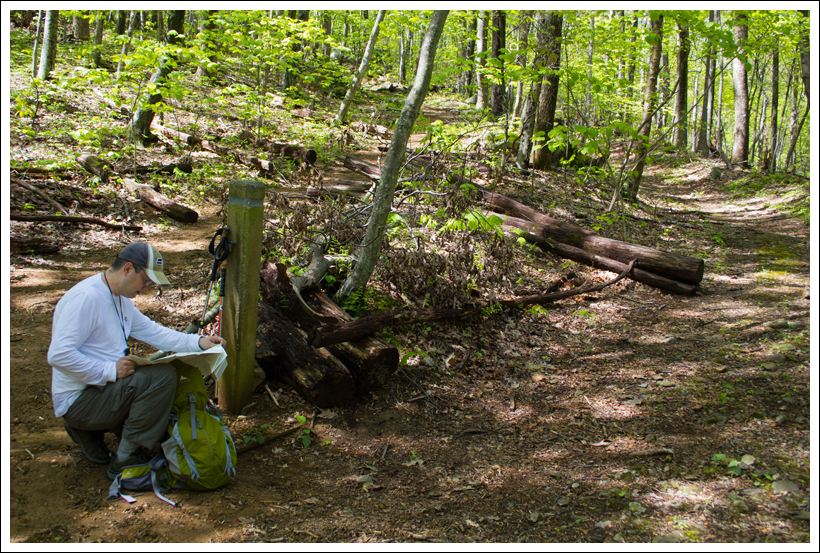
This was the first of many small waterfalls we saw along the Staunton River trail. Below: Another waterfall; There were many remnants of stone walls and stone structures in the woods along the trail; Adam stops to consult the map at the junction of the Staunton River and Jones Mountain trails.

Another Small Waterfall on the Staunton River Trail Old Stone Wall in Shenandoah Junction of Staunton River and Jones Mountain Trails

At one moment when we were hiking up the Jones Mountain Trail, I decided to take a break from the climb and sat on a log on the side of the trail.  As I was relaxing, a piece of the log broke off, causing me to hit myself in the head with one of my trekking poles.  I felt like I was in the Subway commercial of fat people breaking things.  Embarrassing, but funny.

This was our first time hiking this trail, but Christine and I both think this is one of the best trails in Shenandoah National Park.  If you can handle the distance and the steep climb, this should be on your “must” list.  For further reading about this area, check out Lost Trails and Forgotten People: The Story of Jones Mountain.  I think I would like to pick up a copy and learn more about this area, since it was such an amazing hike.

Christine Says…

Another weekend, another backpacking trip cancelled due to rainy weather – what can I say?  When you’re a fair-weather backpacker, lots of spring trips end up delayed.  We were pretty glad we postponed again, because the thunderstorms that passed through overnight on Saturday were pretty fierce and torrential.  I would not have enjoyed being in our tent during those winds and rains!  Fortunately, Sunday morning dawned dry, but foggy with a forecast of dissipating clouds followed by brilliant sunshine.  We decided to tackle the 8.5 mile route up Jones Mountain to Bear Church Rock.  It’s a hike we’ve been meaning to do, especially after seeing it covered by PATC – Charlottesville Chapter and Hiking Upward.

The hike vastly exceeded my already high expectations. I had the BEST time! Without a doubt, this hike has cracked my top-five list of hikes in Shenandoah National Park (along with Riprap, Mary’s Rock from Pinnacles, Rapidan Camp and the Rose River Loop).  This hike had it all – gorgeous river scenery, waterfalls, fantastic trail conditions, a rustic cabin, spectacular views and plenty of opportunities to spot wildlife.
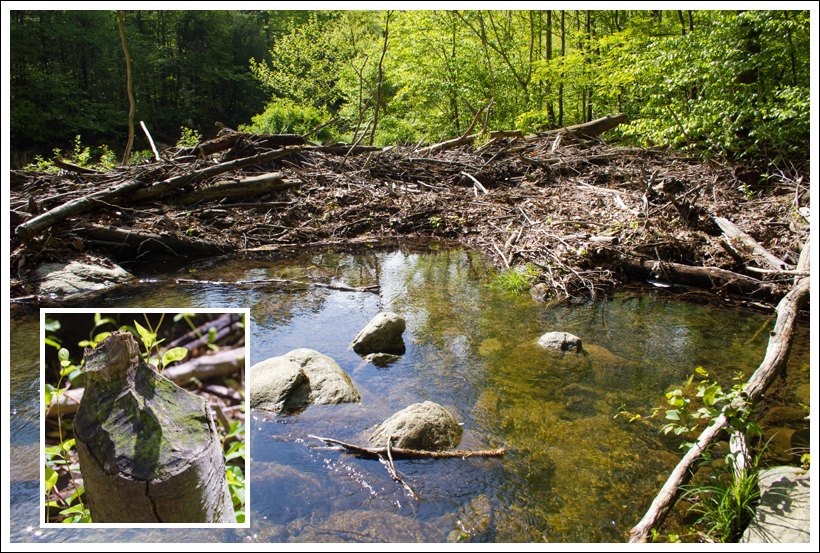
Beaver Dam on the Staunton River
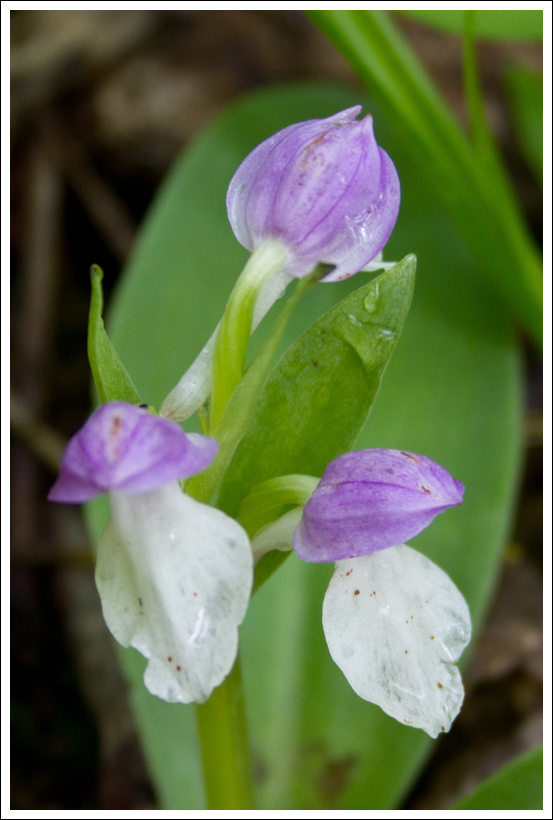
We saw this impressive beaver dam on the Staunton River. There were lots of gnawed trees (inset) around the water. Below: Showy Orchis is a common wildflower seen blooming along the trail; Everything was so lush and green; You may notice Adam’s pants tucked into his socks to avoid ticks. Ticks are out in force this year!

Wildflowers Along the Trail Beautiful Spring Trail Downhill Hike

We started out around 10:00 a.m. from the Graves Mill parking area.  The lot is small; with room for about 8-12 cars at most.  It was already mostly full when we arrived.  The hike starts off on the Graves Mill trail – a flat section of trail running parallel to the Rapidan River.  Within a half mile, the Graves Mill trail meets the Staunton River trail.  This trail is a gentle uphill grade, following within sight or earshot of the water.  One of the first interesting things we passed was a series of several beaver dams spanning the river.  I don’t know if they’re active dams or long abandoned.  We saw plenty of gnawed tree stumps, but no sign of beavers or any fresh activity.  A little further upstream, we passed the first of a series of small waterfalls.  All of the falls and cascades along the Staunton River are beautiful!  If you’re a photographer and like shooting long exposures on moving water, this river is a goldmine.  I’d love to return on an overcast day after there has been plenty of rain.  I think this trail would also be popular with people in search of the perfect summertime swimming hole.  There were so many deep, quiet pools between the faster moving cascades.

After about a mile and a half along the Staunton River trail, we reached the junction with the Jones Mountain trail.  Adam took a brief break at this point to consult the map. We quickly figured out that we were about to start climbing.  Overall, the path to Bear Church Rock requires about 2200 feet of elevation gain.
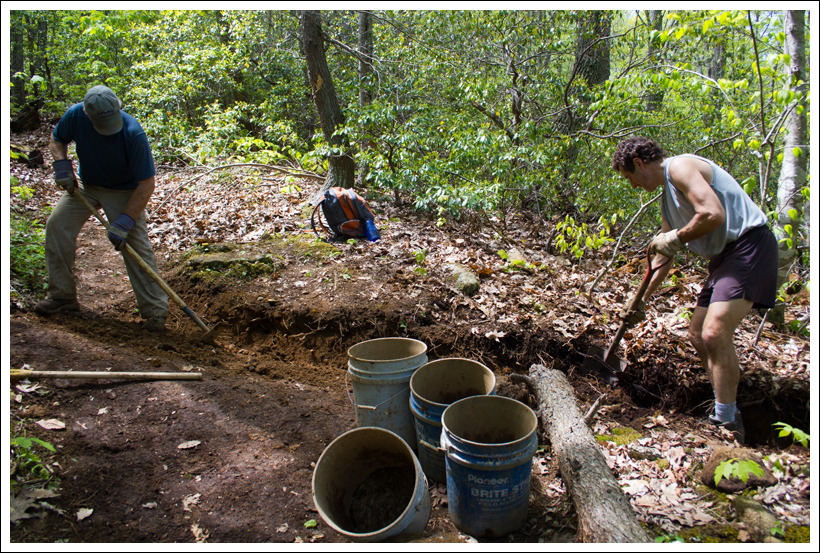
PATC Work Crew
PATC volunteers have been working on the trails in this area for over five years, spending 1000+ hours of their time.

After just a few minutes of walking, we heard voices and the sound of tools coming through the woods.  Shortly later, our paths crossed with a PATC trail crew hard at work installing water bars.  We learned from the crew that they’ve done over 1000 hours of work on this particular section of trail over the past five years.  No wonder the trail is in such magnificent shape.  Everyone who hikes in Shenandoah and enjoys the fantastic trail conditions owes a debt of gratitude to volunteer trail workers.  They do mind-boggling amounts of backbreaking labor to make the trails nice for everyone else.

After chatting with the trail crew for a few minutes, a couple came down the trail.  They mentioned that they had seen a bear with two tiny cubs just a few minutes earlier.  We were excited and hopeful that we might spot them too.  Unfortunately, we weren’t that lucky!

Eventually we reached a ‘Y’ in the trail, with one arm leading .3 of a mile down to the Jones Mountain cabin and the other arm leading a half mile up to Bear Church Rock.  We decided to visit the cabin first, and then enjoy lunch atop Bear Church.

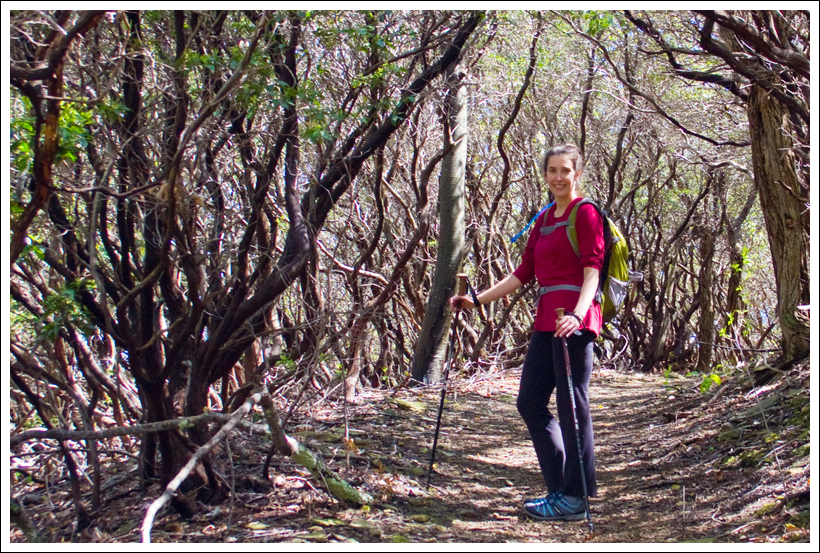
The trail to the cabin led rather sharply downhill, first passing through an ancient, gnarled stand of mountain laurel.  The curly branches practically formed a tunnel over the trail.  All along the final descent to the cabin were stacks of firewood – also courtesy of PATC trail crews.  Apparently, there is a significant problem with cabin renter chopping down live trees near the cabin to use as firewood.  I find that SHOCKING!  What is wrong with people?  Who goes to a National Park… and chops down living trees (especially when deadfall is so abundant in the park)?
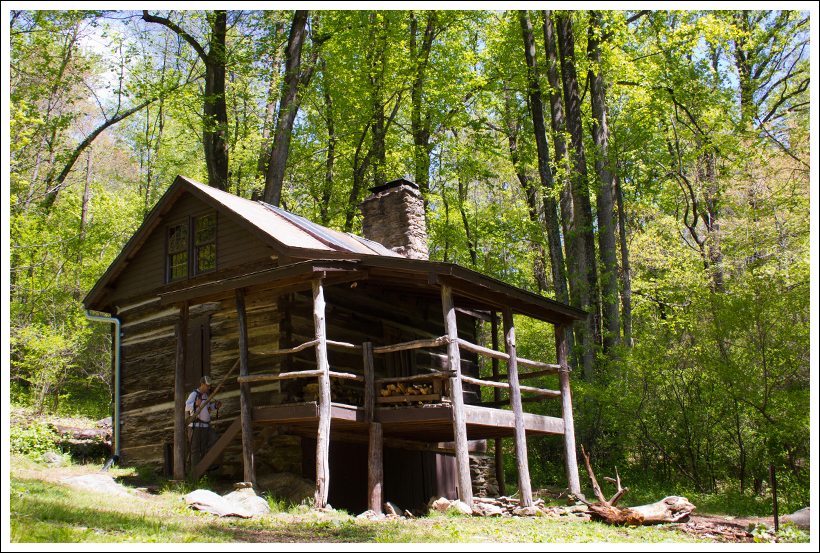
The Jones Mountain Cabin
The Jones Mountain cabin sits in a peaceful opening in the woods. Below: Christine walks through a tunnel of ancient mountain laurel on the path down to the cabin; Christine has new hiking shoes – Montrail Mountain Masochists (very comfy!); Christine enjoys the wilderness views from the rock.

Christine Hikes Through Old Mountain Laurel Love My New Montrails Christine On Bear Church Rock

After rounding a final bend, the roof of the cabin comes into view.  The Jones Mountain cabin is adorable – two stories with a big front porch.  We peeked in through an opening in the shutters and saw a big fireplace, a rustic wooden dining table and a sunny loft on the top level.  A privy and a spring are both located near the cabin.  What a great place to hike in and camp for a couple nights!

We didn’t stay long at the cabin because we were hungry for lunch and wanted to enjoy Bear Church Rock before any other hikers arrived.  The climb back up to the trail junction was pretty steep, but didn’t take too long.

The toughest climbing of the day came along the final push up to the rock.  After a few switchbacks, the trail went straight up the mountainside.  At the top, a little unmarked (but highly visible) path cuts through the vegetation onto a large rocky outcropping.  The trail continues past the little spur trail to the rocks, so don’t miss it!  If you continued along the trail, you’d eventually come to trails in the vicinity of Camp Hoover.

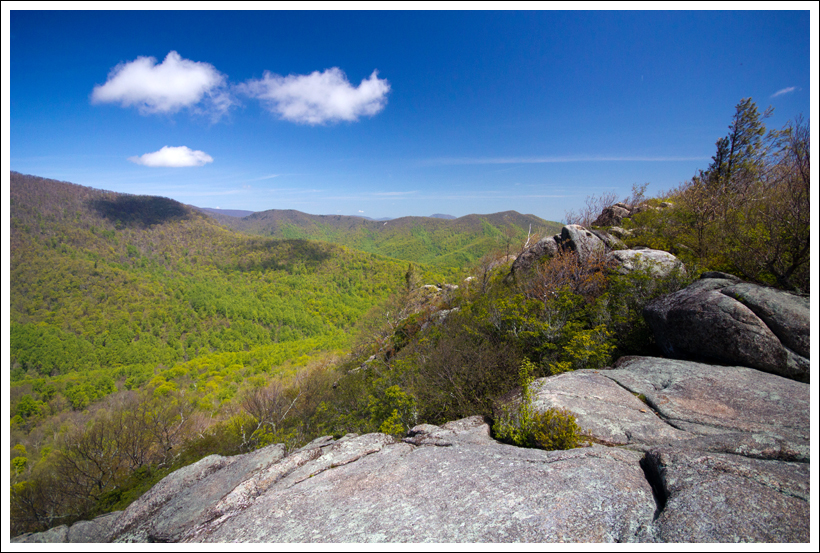
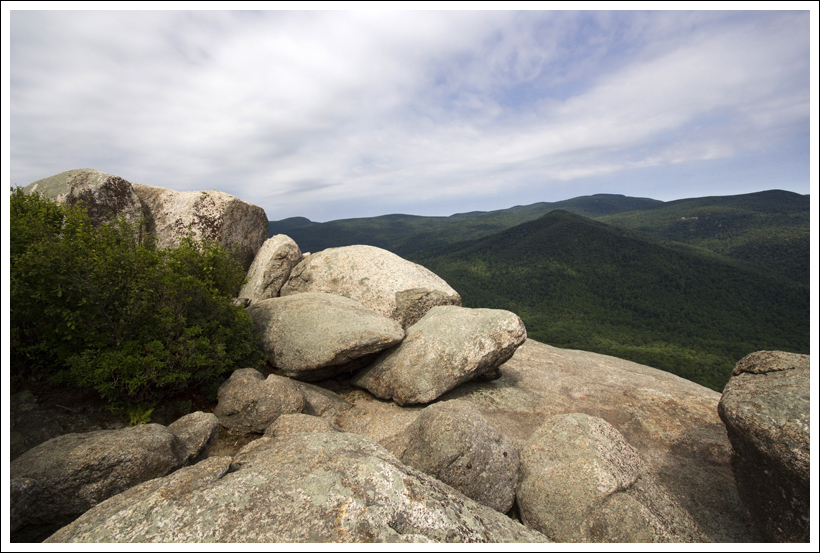
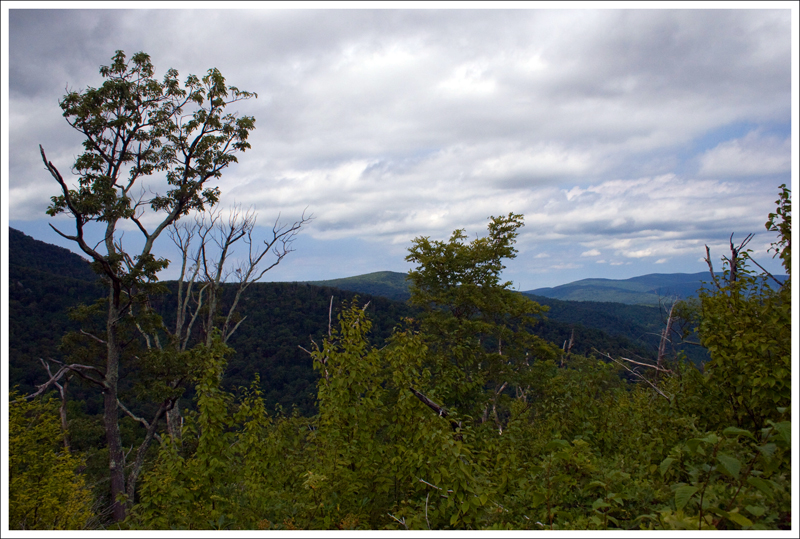
The view from Bear Church Rock is fantastic!  Instead of looking down into a valley full of roads, farms and small towns, you look down into wilderness.  You see nothing but trees and a line where the river cuts through the forest.  If you have a map, you can identify some of Shenandoah’s other peaks from this spot.  We hit this spot on a perfect spring day.  We had bluebird skies with only occasional puffy clouds.  The progression of spring was evident in the mountains – vibrant green climbing its way up toward the still barren mountain tops.  We enjoyed our lunch and relaxing in the sunshine.

Spectacular View from Bear Church Rock
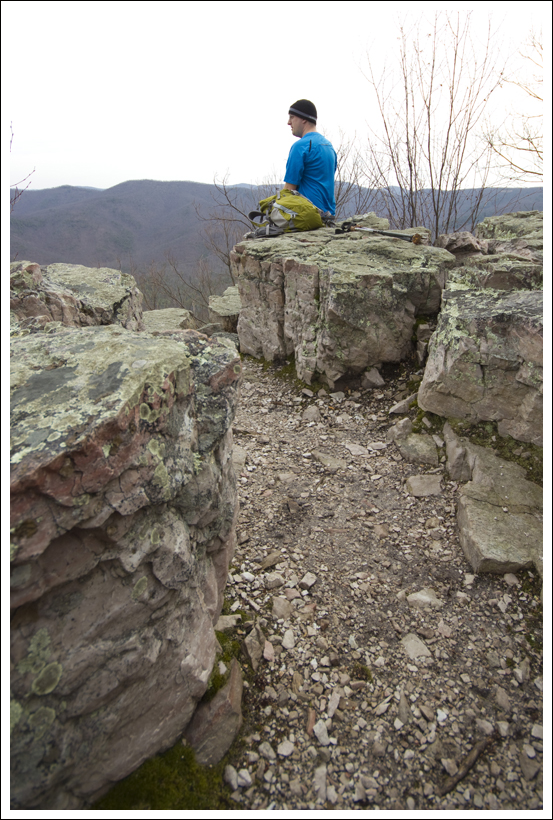
Just some more beauty shots from atop Bear Church Rock.

Christine on Bear Church The Rock Continues Adam and Hiking Gear on Bear Church

The hike back down went quickly – with a descent so steep it was easier to run than to walk! We made the return trip to the car in about half the time it took us to climb up.  In the end, the entire hike took us about four hours, including stops at the cabin and half an hour for lunch.

Bear Church Rock is definitely worth doing!  What a beautiful day!

Trail Notes

  • Distance8.5 miles
  • Elevation Change – 2210 feet
  • Difficulty – 4.  The parts near the Rapidan and Staunton Rivers are very flat, but the uphill climbs are very steep.
  • Trail Conditions – 4. The trail is wide during much of the trail where you could even walk side-by-side with someone if you wanted.  The trails are well-maintained thanks to our PATC volunteers and it is not very rocky through most of the hike.
  • Views– 4. The view from Bear Church Rock is amazing.  It’s not a 360-degree view, but you can see mountains for miles and little sign of civilization.
  • Streams/Waterfalls – 4.5.  The rivers are nice to walk alongside.  You also have a beaver dam and a few small waterfalls on this trail.
  • Wildlife – 4.  We saw some snakes by the river and on the trail.  We saw deer by the Jones Mountain Cabin.  People coming down the trail when we were coming up had just seen a mama bear with two cubs.
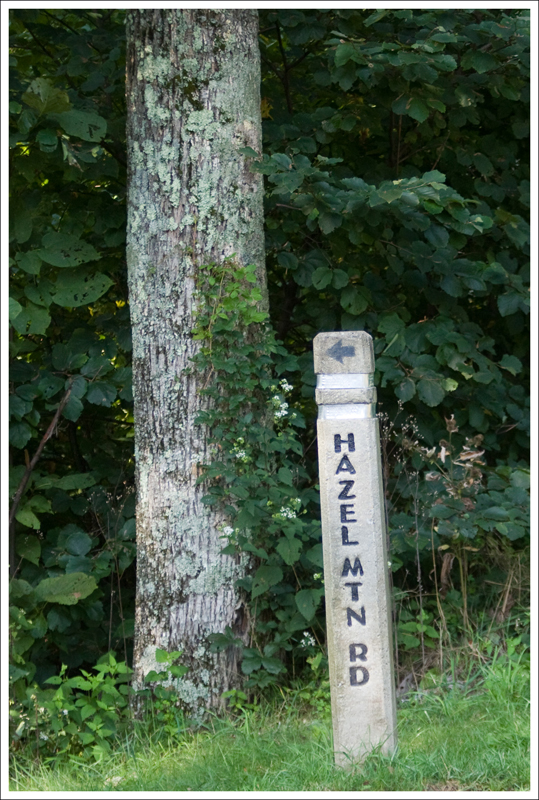
  • Ease to Navigate – 4.  While the trail does have a few turns, it is well marked with concrete posts to help give you direction.
  • Solitude – 3.5.  We had the view to ourselves by going early in the day, but this is a fairly popular hike.

Directions to trailhead:  From Route 230 near Wolftown, VA turn on to Route 662.  Continue to follow the signs for 662.  In about 6 miles until 662 ends at a parking lot.  The trailhead is visible from the parking lot.

Furnace Mountain

This 4.7 mile hike is a steady climb that gives you views of the south and west on the climb up and views of the north and east from the summit.

Christine on the Furnace Mountain Summit
The summit of Furnace Mountain has nice views of Massanutten and of Shenandoah National Park, looking back toward Skyline Drive.

Adam Says…

It is amazing to me to think about how blessed we are to have such great hiking in Virginia.  While we have been slowly trying to accomplish the Appalachian Trail through Shenandoah National Park, but we also like to mix in some other hikes.  Christine stumbled across a mention of this hike, so we decided to try it out.  We were pleasantly surprised by the nice views you get on this hike.  Keep in mind, there is another Furnace Mountain in Loudoun County.  There doesn’t seem to be a lot of originality in naming mountains sometimes.  This Furnace Mountain is named for the Mount Vernon Furnace that once stood at the bottom of the mountain for the reduction of iron ore.

Crossing Madison Run
Adam rock-hops across Madison Run. Below:  Adam adding some excitement to an otherwise boring fire road; The official start of the Furnace Mountain Trail.

Adam Leaping on the Fire Road Start of the Furnace Mountain Trail

We parked our car at the beginning of the fire road and made our way to the boundary of Shenandoah National Park.  As soon as we entered the park boundary, you will see a signpost to the right that denotes the start of the trail.  You will quickly come up to a stream crossing of Madison Run that you can rock-hop across.  These rocks are sturdy, but can be slick in some spots, so be careful.  After crossing Madison Run, the trail turns right and parallels the stream for a short distance.  Then, the trail begins climbing up the mountain.  There is a constant climb uphill for the entire hike.  Around 1.6 miles, the trail comes up to a large talus slope of large boulders which provides an open view of the valley.  The trail continues climbing and at 1.9 miles, you reach a post and an intersection with the Furnace Mountain Summit Trail.  Take this trail, which continues to climb up.  At 2.3 miles, you will reach a campsite at the summit.  Less than .1 miles is the rock outcropping which gives you the best views on the trail.  Return the way you came to make it back to your vehicle.  This time, you’re going all the way downhill.

Christine on Talus Slope
Christine hikes on the trail across the talus slope. Below: Adam takes in the view of the valley.

Adam on Talus

Madison Run is not named for James Madison, but rather from John Madison, the first Court Clerk of Augusta County.  John Madison’s cousin was the father of James Madison, the 4th US President.  Near this location stood Madison Hall Estate.

We had debated about bringing Wookie on this trip.  He would have loved most of the hike, but would have hated crossing Madison Run.  He really wants to avoid water on the trail, so I know I would have had to carry him with his claws digging in to me.  He just doesn’t like getting his precious feet wet for some reason.

Hiking this trail in the winter gives you views throughout a good portion of the hike.  When the leaves come out, you will have more obstructed views except from the talus slope and the rock outcropping at the summit.  We were excited at how great the views were from the summit.  Even though this mountain’s summit is only at 2657 feet in elevation, it provides some great vistas of the mountains around.  If you’re looking for a manageable hike off the beaten path with good views, this is one to try!

Christine Says…

Adam and I had Friday off work, so we decided to hit the trail for a morning hike.  We thought about doing some more of the Appalachian Trail through Shenandoah, but I wasn’t in the mood to drive separately for our car shuttle.  I also didn’t want to drive too far for our hike, so I started researching trails close to our home. We’ve done so many of them already that it’s getting increasingly difficult to find anything nearby.  Luckily, I happened to stumble across a route up Furnace Mountain with a trailhead located about fifteen minutes from our house.  I had been aware of Furnace Mountain before this, but most write-ups I’ve seen cover it as a 13+ mile loop hike (with 3000+ feet of elevation gain) paired with Austin Mountain.  I can hike 13+ miles as a day hike, but I usually don’t enjoy it.  My ideal length for a day hike is still 8-10 miles.

Hiking Along
You can see the valley below through the trees for much of the hike up. Below: An illegal fire pit at a backcountry campsite; The rocky outcropping at the summit; A view of Massanutten Mountain

Illegal Fire Pit Summit Rock View of Massanutten

Our trip up Furnace Mountain started off cloudy, and while the clouds thinned out somewhat during the course of the morning, it stayed mostly overcast.  That was a bit of a shame, because the views all along the trail are really nice.  I’m sure some of the views will be obscured once the trees have leaves again, but for the time being, it was great to see views of the Shenandoah Valley along the climb up.

The trail was extremely rocky most of the way, and even crossed a neat talus slope.  I imagine that this mountain was once towering and majestic, but over the ages, the rocky summit crumbled and rolled down the lower slopes.  The climb uphill was steady, but not difficult.  The most challenging part was the footing – lots of football-sized, unevenly seated rocks.

The Furnace Mountain summit trail is a half mile dog leg off the main trail.  Along this segment, we passed a campsite with a well-used fire ring.  Since Shenandoah does not allow open fires in the backcountry, the fire ring really shouldn’t have been there.  I suppose that the park just doesn’t have enough rangers to police illegal fires.

Shortly after the campsite, the trail took a short downhill to a rocky outcropping overlooking the park and the Shenandoah Valley.  We could see Massanutten mountain in one direction and a distant snip of Skyline Drive in the opposite direction.  In early March, everything is still barren and brown.  The dull color paired with the clouds took a little of the luster off the overlook, but it was still very nice.  I’d like to see it again in late spring, summer or fall!

Enjoying the Summit
Christine enjoys the summit.  Below: Adam on the rocking outcropping.  As you can see the rock is very rugged and jumbled.

Adam on the Summit Adam on the Summit 2

After hanging out a short while, we headed back down the trail.  We made it back to our car in less than half time time it took us to climb up.  We practically jogged the whole way down!  On our way home, I had really been looking forward to stopping at the Elkton McDonald’s for a Shamrock Shake.  We got there… shakes were on the menu… but the stupid machine was out of order.  I was robbed!

Trail Notes

  • Distance 4.7 miles
  • Elevation Change – about 1300 feet
  • Difficulty – 3.  The uphill isn’t too strenuous, but there isn’t much break from the climbing.
  • Trail Conditions – 3.  We were surprised at how well this trail seemed to be maintained.  The path is a little more open, but does have some rocky sections.  The danger would be in going down, since you can pick up speed and some of the rocks may be loose.
  • Views – 4.  The views are quite nice, but not 360 degree views.
  • Streams/Waterfalls –2.  The trail does go along Madison Run for a short distance.
  • Wildlife – 1.  We didn’t really see anything on this trail.
  • Ease to Navigate – 4. As long as you cross the stream at the right point and then make the turn on the Summit Trail, you should be fine.
  • Solitude – 3.5. Typically only popular with the locals, but you may see a few people on the trail.

Directions to trailhead:  From Elkton, VA follow 340 South. You will see SR 659 on the left.  Follow that until it intersects with Browns Gap Road/SR 663.  Take a left and follow the road until it becomes a gravel fire road.  Park on the road. Continue on the fire road for about .2 miles until you enter the park boundary.  The trail marker on the concrete post will be on your right.

Dobie Mountain

This 6.2 mile hike includes an overlook, a great AT overnight hut, and plane wreckage.

Glass Hollow Overlook
Taking in the view from the Glass Hollow Overlook.  It was really hazy and we were facing the sun, so the photos aren’t great.  But, it was still really colorful and pretty.  Below:  Adam takes the turn onto the Appalachian Trail; The Paul C. Wolfe Shelter; Adam walks along the Albright Trail.

Trail Junction Paul C. Wolfe Shelter Albright Trail

Adam Says…

Today was our 14th wedding anniversary, so we decided to take the day off of work and go for a nice hike together.   It is a good sign that it doesn’t seem like 14 years and that time has flown.  I’ve seen a card that said on the outside “Thank you for five wonderful years of marriage” and on the inside it said “Happy 25th Anniversary”.  We’ve had some great years together.  It was wonderful to pick a beautiful fall day to experience together.

While Humpback Rocks is the more popular hike that departs from this spot, we thought it would be a good idea to talk about this other hike that takes off from the Humpback Rock parking lot.  So, if you’re interested in hiking but not tons of people, this may be an option for you. The views are better from Humpback Rock, but you do get some benefits on this hike also.

After parking in the lot, you will see a picnic table adjacent to the first parking spot.  There are two trails that take off from this spot.  Take the blue-blazed trail to the right of the picnic table that descends into the woods (you’ll return from the loop by the Albright Loop Trail on the left).   The trail descends gradually and at .25 miles, you reach an intersection with the Appalachian Trail.  Take a left on the white-blazed AT heading north.  The trail at this point is relatively flat or downhill.  At mile 1.1, you reach an intersection with a small blue-blazed trail that veers off to the right pointing to the Glass Hollow Overlook.  The trail to the overlook is just about .2 mile and is worth the walk.  At the overlook, there is a backcountry campsite for those that would like to camp and take in the views of the sunrise from the overlook.  Go back on the spur trail the way you came and join the AT again, taking a right and continuing north on the trail taking your mileage to 1.3 miles.   At mile 1.6 and 1.7, you come across intersections with the Albright Loop trail.  Just continue on the Appalachian Trail.

Inside the Shelter
Adam checks out the shelter log in the Paul C. Wolfe shelter. Below: Past campers debate (in graffiti) the philosophy of Christopher McCandless from ‘Into the Wild’; We found a name we knew in the shelter log; On the hike back up from the shelter, we got an open view of Bears Den Mountain in Shenandoah National Park.  You can’t tell in this photo, but there are radio towers atop the mountain in the distance.

Quote - Into the Wild  Log Book Looking Toward Shenandoah

The trail begins to descend for the next 1.3 miles through a long series of switchbacks.  At mile 3.0, we rock-hopped across Mill Creek and reached the Paul C. Wolfe Shelter.  We took some time to rest here before we returned the way we came on the Appalachian Trail.  We climbed back up the Appalachian Trail from the shelter heading south this time and back up the switchbacks we had just experienced.  We were both glad that these took off some of the difficulty of the elevation climb.  At mile 4.2, we reached the first junction with the blue-blazed Albright Loop Trail.  Take a right here and you will follow this trail 2 miles back to the parking lot.  The hike on the Albright Loop trail starts off very manageable, but ends up being the most difficult part of the hike since there is quite an ascent up through some switchbacks.

On the return on the Albright Loop Trail, immediately after the second switchback, look up the hillside to see the wreckage of a Beechcraft Bonanza plane.  On the trail it was marked with a cairn to show where you can leave the trail.  The plane crashed back in 1963.  Please respect the wreckage and leave it as it is.

Plane Wreckage
Plane Wreckage along the Albright Trail. Below: Adam checks out another section of the plane.

Plane Wreckage

The Paul C. Wolfe Memorial shelter was built by the Old Dominion Appalachian Trail Club in 1991.  According to their website, “it took approximately 30 people every weekend for two months to complete the shelter.  Materials were hauled two miles by hand and tractor.”  This is one of the nicest huts on the AT, according to a lot of the thru-hikers.  It really has nice construction and a beautiful location.

After our hike, we made a quick trip down to Sonic for a snack (tots and creamslushes!).  We didn’t want to spoil our anniversary dinner though, since we had reservations at The Local Chop & Grill House in Harrisonburg, VA.   It always feels good to have a guilt-free dinner when you have burned off a lot of calories on a hike.

Christine says…

What a great anniversary hike!  I love being out on the trail during the peak of fall foliage season.  All during the hike, the sun was filtering through the trees above – making a gorgeous canopy of gold.  There were also plenty of brilliant red maples tucked into the understory.  What was even better — no crowds!  Hiking on a weekday on a less well-known trail made this hike especially enjoyable.

I had new boots to try out on this hike. Right out of the box, my Oboz Sawtooth boots were perfectly comfortable.  They’re the first taller pair of boots I’ve ever worn.  I was skeptical about that, but they felt great the whole six+ miles.

Golden Forest
A golden canopy of forest.  Below: New boots on the Glass Hollow Overlook; Adam crosses Mill Creek; A small cascade on the stream.

New Boots Crossing Mill Creek Mill Creek

Since Adam has already talked about the trail specifics, I’ll just share a few of my highlights. One of my favorite stops was at the Paul C. Wolfe shelter.  It really is one of the nicest backpacking shelters I’ve ever seen – two levels, plexiglass windows, hooks to hang backpacks and a deep, well-sheltered porch, so you always stay dry when you’re sleeping.  The structure is set uphill, overlooking a wonderful, babbling stream.  Even the privy is unique at this shelter.  With it’s half-door, I can’t say you’ll ever get true privacy, but at least you know when it’s occupied and the ventilation couldn’t be better!

While we were taking our break at the shelter, we took a few minutes to flip through the log book.  We noticed the entry from one of the backpackers we met in September at the Pinefield Hut.  It was kind of neat to see a name we knew.

I also took some time to explore and photograph the stream.  Along the bank of the stream, there is a marble bench placed in memory of John Donovan.  He was an experienced hiker and a member of the Old Dominion Appalachian Trail Club. He died on his attempt to thru-hike the Pacific Crest Trail in 2005.  The bench gave me enough information to Google his name so I could learn more about what happened.  As it turns out, Backpacker Magazine published a long feature story about John Donovan’s disappearance and death in a 2006 issue.  It was a fascinating read!  The tragedy that befell Donovan turned into a miracle that saved two other lives.

John Donovan Bench
A bench is placed in memory of John Donovan. Below: The privy has a half door!

Half Door Privy

The plane crash was an interesting stop, too.  I expected the plane wreckage to be a lot rustier after close to fifty years in the woods, but it was still completely recognizable as an aircraft.  I couldn’t find anything more about the crash other than the year it happened and the type of plane.

After leaving the plane site, we finished out stint on the Albright Trail and made our way back to the car.  The parking lot was really full, but pretty much everyone else was on the Humpback Rocks trail.  I’m really glad we took the time to explore this trail – it turned out to be a perfect way to celebrate our anniversary.

Trail Notes

  • Distance 6.2 miles
  • Elevation Change – 1500 feet.
  • Difficulty – 3.  There is a good amount of uphill climbing.  The steepest section is along the Albright Loop Trail.
  • Trail Conditions – 4.  The trail is nicely maintained.  During the fall season, be sure to watch your footing if the trail is covered with leaves.  There are loose rocks underneath a good portion of the trail.
  • Views –3.  The best unobstructed views are from the Glass Hollow Overlook.
  • Streams/Waterfalls – 3.  Mill Creek was moving nicely near the shelter.  According to a journal entry from an AT hiker, there is a small waterfall and pool shortly downstream.
  • Wildlife – 1.  We didn’t see anything beyond birds, chipmunks and squirrels.
  • Ease to Navigate – 3.5.  There are a few intersections, but there are also signs at each of the intersections.
  • Solitude – 3.  You will likely run into a few others on the trail, due to the proximity of Humpback Rocks.

Directions to trailhead: The trail is located on the Blue Ridge Parkway at Mile Marker 8. The hike begins on the blue-blazed trail to the right of the picnic table.

Old Rag – via Weakley Hollow

We hope you enjoyed our Acadia series… but now it’s time to get back to Virginia hiking.  We decided resume our normal posts with an exceedingly well-known mountain – Old Rag.  This 8.8 mile loop hike is Shenandoah’s most popular hike.  It’s so well-loved and traveled that the official Shenandoah website has a whole section dedicated to hiking this mountain.  [View NPS Map for this hike]

Note: Some of the NPS website details (and mileage markers along the actual trail) were a little outdated as of summer 2011, as they refer to the hike distance before the park service closed the upper parking lot in April of 2010.

Nearing the Summit of Old Rag
Large boulders near the summit of Old Rag.  Below: Adam walking along the road headed toward the Ridge Trail’s start; Views from the summit of Old Rag; Adam drops down into a narrow passage between the rocks.

Lots of Road Walking  Views at Summit Dipping Into a Narrow Slot

Christine Says…

After two and a half years, we’re finally getting around to covering Virginia’s most popular, most well-known hike – Old Rag. I’ll make an outright confession.  Old Rag, as beloved as it might be by (seemingly) everyone else, is not my favorite hike.   But, when you have a Virginia hiking website, you’re practically obligated to have a write up about this mountain.  So, on to the post!

We’d been tossing around the idea of hiking Old Rag for the blog for well over a year.  Adam would suggest it and I’d invariably tell him that it was too hot, too cold, possibly wet and slippery, I heard there was ice, my feet hurt, I don’t feel like driving that far, etc.  Basically, I floated every excuse in the book to delay the hike.  But then I went and did something incredibly stupid and it really blew up in my face!  I had a day off work coming up.  It was going to be a beautiful August day – crisp and unseasonably cool!  I had visions of getting up early, doing a photo shoot in the park, maybe eating some donuts and then taking myself to a matinee movie.  But before I could stop myself, I found that I had blurted out “Tomorrow would be a GREAT day to hike Old Rag!”  I assumed this was purely hypothetical because Adam had to work.  But he immediately responded “Yeah!  Let’s go!  I’m taking tomorrow off too!”  Ugh – I didn’t see that one coming!  I don’t like to back out on plans, so the next morning we were up before dawn, snacks stashed and Camelbaks filled.

We got to the parking lot before 8:00 a.m..  Getting to Old Rag early is something I consider to be a necessity.  The trail is always crowded – even on weekdays.  The Old Rag parking lot is actually my first point of contention with the hike.  It used to be if you got up early, you could always get a parking spot in the small upper parking area located right at the trailhead.  In April of 2010, a couple years after our last hike up Old Rag (fall of 2008 – see photos), the park service closed the upper lot to all vehicles.  Now, all vehicles must park in the lower lot, which is just a shade under a mile from the trailhead.  The added mile follows a paved road uphill to the beginning of the Ridge Trail. I’m not going to make any apologies; I just don’t like road walking on outings that are supposed to be hikes.

The Scrambling Begins
The first section of rock scramble is just a little sampling of what is ahead.  Below: Giant boulders along the trail; Christine climbing up the Ridge Trail; Christine taking in the view; A view of the valley; A dog who has panhandling all figured out!

Giant Boulders Along the Trail Christine Hiking Up the Trail First Views
Wider View Before starting Major Scramble
Beggar on the Mountain

Once we got to the Ridge Trail, things improved a bit.  The trail climbed upward for about two miles. It’s not terribly steep or difficult climbing, but it is steady uphill.  There are occasional switchbacks, lots of gigantic boulders along the trail and even some glimpses of views through the trees.

The higher you climb, the better and more open the views become.  After the first real panoramic view, you get your first little sample of the extensive rock scrambling you’re about to encounter.  The first pass is short, but requires hoisting yourself up through a small opening, then across a flat pancake of rock.  At this point, my boot slipped and I almost toppled over backwards.  Luckily, I was able to hang on long enough for Adam to give me a hand up.

Shortly after that little scramble, you’ll come to what I think is the nicest view on the hike.  Instead of overlooking mountains with a distant peek at Skyline Drive, this viewpoint overlooks the valley below.  The vista is dotted with little farms and winding country roads.  It’s really pretty!  At this point of our hike, we encountered an emaciated, but super-friendly dog.  He had a collar but there didn’t seem to be any human to claim him.  Dogs are not allowed on Old Rag’s hiking trails, so we figured someone brought a dog up anyhow, and then abandoned him when he could no longer follow along the rock scramble.  The dog looked so pitiful and hungry that we ended up sharing some cashews and half a Luna Bar.

The dog followed us along until the scramble began in earnest.  He looked sad to see us go, so we decided to report him to park rangers at the end of our hike, in hopes that they could send someone up to retrieve him and lead him back down to the base of the mountain.

After saying goodbye to the dog, we began nearly one-mile of rock scrambling required to reach the summit of Old Rag via the Ridge Trail.  Anyone wishing to reach the summit without the scramble can follow the Saddle Trail (accessed by either the Weakley Hollow or Old Rag fire roads).  The scramble is the part of this hike that I enjoy most, but also simultaneously fear.  I have vertigo, so there are a couple passes that play tricks on my visual and balance centers.  Otherwise, the scramble is a lot of fun!  It’s almost like a hiking puzzle.  You have to look at each obstacle and plan the best strategy for traversing it.  The scramble is tough – it’s not so much a cardio challenge as it is a strength challenge.  There are lots of places where you’ll rely on  both your upper and lower body strength to carry you across the rocks.  It’s nice to have at least one hiking buddy to help you along.  One particularly steep place, I had to shove Adam up (one hand on each butt cheek) and then he had to tow me up behind him.

Narrow Passage
Near the beginning of the scramble, you have to drop down into this narrow passage. Below: A variety of obstacles along the rock scramble. Below: Adam shinnies down into the narrow passage pictured above (note the blaze is numbered R22.  Each blaze on the scramble is numbered to help rescuers find injured people more quickly); More scenes along the scramble.

Dropping Down More Scrambling Stairs Climb Up That

The summit of Old Rag is beautiful and decorated with many large and interesting boulders.  It’s the perfect place to enjoy a snack while taking in the view.  We watched the clouds clearing away, ate cheese and trail mix and watched falcon soaring on the breeze.  It may have been a peregrine, as they are known to nest on Old Rag, but we’re really not sure.

After leaving the summit, the hike becomes sort of tedious.  Yes, it’s all downhill, and you’ll pass a couple interesting trail shelters (Byrd’s Nest and Old Rag).  Both are available for day use only.  There is one more decent view.  But right after passing the Old Rag Shelter, you’ll reach the Berry Hollow fire road.  You’re only on that for a short while, until you meet the Weakley Hollow fire road.  You’re on that road for the remainder of the loop until you come back to the paved road at the trailhead.  Honestly, everything after the scramble on this hike is just not fun to me – too many miles of featureless road walking.   All in all, the Old Rag hike has close to 4.5 miles of road walking (over half the hike).  Adam and I were eager to finish up our hike, so we jogged most of the way back along the fire road and paved road.

Adam Pretends to Balance a Giant Boulder
Adam pretends to balance a giant boulder. Below: More scenes along the scramble.

A Cave Adam Passing Through the Cave Another Narrow Pass

When we got back to the car, we told the ranger at the check-in station about the skinny dog.  She laughed and said “Oh, him!  He’s our resident Old Rag beggar!”  Apparently the dog belongs to a local family.  He likes to take daily hikes to solicit treats from people climbing the mountain.  He sure tricked us!

The parking lot had really filled up since we arrived!  We were glad to be done, and on out way to get some lunch (fried chicken – yay!).

When I reflect back on hiking Old Rag, and what could be done to improve the experience, I can think of a few things.  One idea I think would work well is to issue a finite number of permits per day to hike the mountain.  Perhaps limiting numbers on weekends would be enough.  I think if they could limit hikers, they could reopen the upper lot and eliminate almost two miles of road walking.  Another thought is to limit the number of people allowed per hiking party.  So many church youth groups and college clubs hike Old Rag in huge crowds.  This causes massive ‘traffic jams’ along the scramble.  No fun!  I also think that limiting hikers would go along way toward alleviating the trail damage and erosion on Old Rag.  The trail is crumbling, lots of rocks on the scramble have been worn to a smooth polish under years’ of boot traffic, and sadly there is garbage everywhere.  It’s a trail that would benefit greatly from being enjoyed by fewer people.

That said, I think every lover of the outdoors in Virginia should hike Old Rag at least once!  The scramble is truly without compare.

Adam Says…

Well, Christine summed it up nicely describing the pressure that I have been putting on her to tackle Old Rag.  We last did this hike together shortly before we started this blog.  The logo that we use for the website is actually taken from a photo of Old Rag, so it was a must do.  About every year, I put together a list of hikes that we have talked about doing in Virginia and we hang it on our refrigerator.  After we finish the hike, we have a ceremonial highlighter that we use to highlight the hikes we’ve finished.  For the last few years of printing a new list, Old Rag has been one of the few that has not been highlighted before the latest version is posted.  I let Christine do the honors of marking Old Rag off the list – and she was happy to do so.

Adam on the Summit
Adam on the Summit. Below: Summit scenery; Some kind of bird of prey.

More Summit Views Another Summit View Falcon

I would also agree with Christine that Old Rag is very overused.  One thing that makes this hike particularly challenging during the rock scramble is that the rocks are so smooth, you could easily slip.  When it has just rained, you know you will have no footing whatsoever.  Many of these boulders have no handholds or footholds, so you do have to be creative with how you will get through the scramble.  I would recommend that you do this hike with someone else to help you through the scramble.  I think Christine especially enjoyed the opportunity of putting both of her hands on my butt and shoving with all of her might.  It’s not very often that she gets to do that.

Old Rag Shelter
The Old Rag day-use shelter. Below: Adam takes in the last nice view on the way down; The Byrd’s Nest day-use shelter; The crowded Old Rag parking lot.

View on the Way Down Byrd's Nest Shelter Crowded Old Rag Lot

The hike begins from the parking lot and consists of walking up a paved and then gravel road for about .9 miles until you reach a smaller blocked off gravel lot (with a portable toilet) and a sign for the trailhead to the left.  This begins the Ridge Trail.  The trail starts off as a gradual ascent through the forest.  At about 2.3 miles, you reach the first of several switchbacks.  There isn’t a lot of note on the main portion of the trail as you are just walking uphill through the woods, without any notable views.  At about 3.2 miles, you reach a nice overlook.  As soon as you leave this spot, the rock scrambling will begin.  You have about .8 of a mile of rock scrambling until you reach the summit.  This path is quite dangerous as you have to navigate down tight crevasses, around boulders open to large drop-offs, and up other boulders with slick surfaces.  The summit marker will indicate the end of the tough climbing.  There are several places to take in the panoramic views at the top and some of the more adventurous will climb up some of the large boulders at the top.  Once you are done taking in the views backtrack to the trail and then take a right on to the Saddle Trail.  At about 4 miles you reach, the Byrds Nest Shelter No. 1, a day-use only shelter.  Continue down the steep trail and at 4.5 miles, you will reach another day-use Old Rag shelter.  Continue down the trail and at 4.9 miles, you reach the junction with the Weakley Hollow fire road.  Take a right on this fire road and you have about 3 miles of this fire road to walk down before you reach a few bridges and finally the smaller blocked-off Old Rag gravel lot.  Go back the way you came and you should reach your vehicle around 8.8 miles.

I do think we have put a lot of warnings about this hike, but the reason that this hike is likely so popular is due to the challenge and the amazing views.  The summit of Old Rag does provide some of the best views in Virginia.  Some people even do rock climbing at the top to rappel over the edge and make their way back up.  On a clear day, you can see for miles of countryside and layers of mountains.  I know most people do put this on their list of must-hikes in Virginia.  I recommend to tackle this hike as early in the morning as possible to beat the crowds.  If you wait until the middle of the day, you will likely face people-jams as the navigating through the rock scramble takes a while.

For any of those interested in geocaching, there are two geocaches nearby the trail:

For further reading about Old Rag and its history, check out the Climber’s Guide to Old Rag Mountain with some interesting information about the history of the area and the USGS’ Hiker’s Guide to the Geology of Old Rag.

I really have to hand it to Christine for confronting her vertigo and facing Old Rag.  I told her I wouldn’t bother her again to do the hike since we now officially have it on the blog, but I will probably do it again sometime.  I think this hike does have about 1.5 miles of very exciting climbing and wonderful views, but the rest of the hike (especially the way back on the fire roads) seems a little boring and you will look forward to seeing your car in the parking lot after the long hike back.  The last time we did this hike was on a fall day at the peak of fall color.  If you can find a day like that to tackle this hike, you won’t regret it.

Trail Notes

  • Distance8.8 miles
  • Elevation Change – about 2600 feet total.
  • Difficulty – 4.  The uphill climbing is gradual and never terribly steep, but the scramble requires good upper and lower body strength.
  • Trail Conditions – 2.  I think the trail is eroded and worn smooth in many places due to years of overuse.
  • Views – 5.  The views are wonderful and include both mountain and valley views.
  • Wildlife – 3.  There have been a fair number of bear sightings on Old Rag.  You also have a good chance of seeing birds of prey on the summit.
  • Ease to Navigate – 4.  Follow the signs.  This well-traveled trail is well-marked. Distances on the markers are out-of-date and refer to mileage when the upper lot was still open.
  • Solitude – 0.  Can I give this a negative score?

Download a trail map (PDF)

Directions to trailhead:  From Sperryville, Route 211, turn onto Route 522 and follow it south for .8 mile. Turn right on Route 231, follow 8 miles, turn right onto Route 601 and follow signs to the parking area, approximately 3 miles.
From Madison, Route 29 Business,  turn onto Route 231 and follow it for 12.8 miles. Turn left onto Route 602.
Follow signs for the parking area. Old Rag parking is approximately 3 miles from the turn onto Route 602.

Greenbrier River Trail – Cass to Marlinton (WV)

The Greenbrier River Trail is a rails-to-trails bike path that meanders 78 miles along the Greenbrier River in West Virginia. This portion we biked was about 25 miles from Cass to the little town of Marlinton.

Biking the Greenbrier River Trail
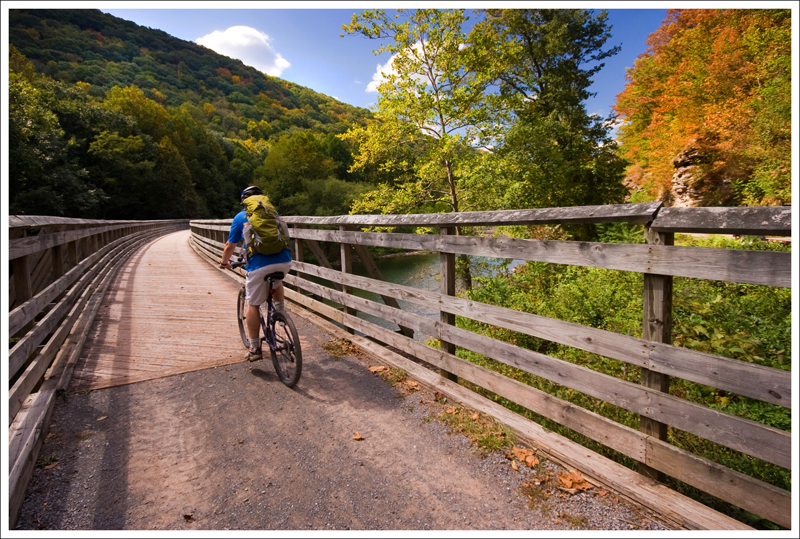
Adam crosses Sharps Bridge on the Greenbrier River Trail. Below:  Due to drought conditions, the Greenbrier River was very low;  Trail signs mark each entry to the trail; The Clover Lick Depot is one of the old train stops you’ll pass on the trail.

Adam on the River Greenbrier River Trail Sign with Bike Clover Lick Depot

Adam Says…

Our main reason for staying around the Marlinton, WV area was to do some biking on the Greenbrier River trail.  A few friends of mine that had done the Virginia Creeper Trail told me that we should do the Greenbrier River Trail sometime.  The trail was very similar to the Virginia Creeper.  They are both rails-to-trails biking trails and don’t take a ton of cardio effort or biking skills to complete.  The scenery may have been a little nicer along the Virginia Creeper; with mountain views and lots of bridges and trestles. However, the Greenbrier trail lacks the dense crowds that you find on the Virginia Creeper.  You’ll have lots of solitude on this trail, but there are also fewer amenities along the way (other than occasional restrooms at campsites).  Christine and I really enjoy the solitude more than anything, so it was great to get away for a nice, quiet, long bike ride.

We started our day with a car shuttle up to the northern terminus of the trail near Cass, WV.  We arranged the shuttle through Appalachian Sport.  We were the only people signed up for the shuttle, so we were able to arrange our own time.  It was nice to talk to our driver (wish we caught his name) about his impressions of the trail.  He was actually the one that gave us the news that JMU beat Virginia Tech in football.  We had been completely “off the grid” for a few days without any cellphone service, TV, or internet. We actually thought he was joking the first time he told us that JMU won.

Low Water Levels on the Greenbrier River
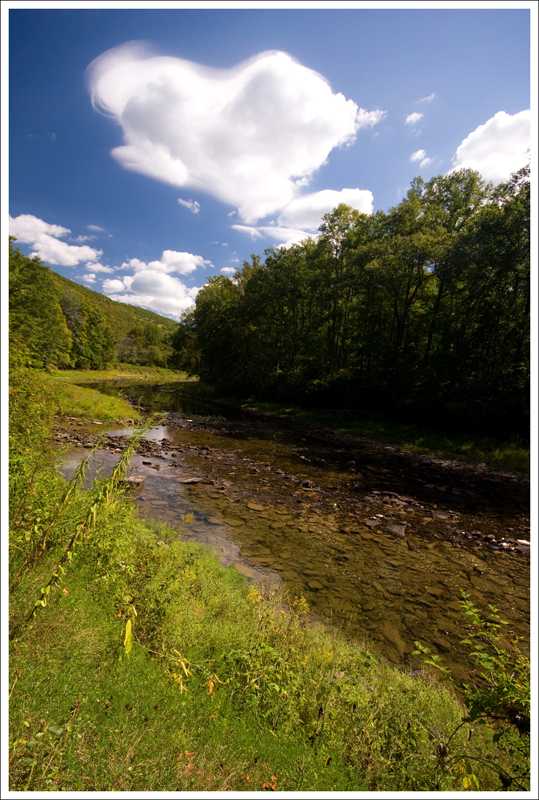
Water levels were very low on the Greenbrier River.  Below:  The trail follows the river for almost all of its 78 miles; Adam bikes along the crushed stone trail; A view of the lovely river.

The Greenbrier River Trail follows the river. Biking Along the Trail Greenbrier River Scenery

He frequently runs on the trail and told us about his goal to organize a Greenbrier River Challenge t0 raise funds with sponsorships for people to run the entire length of the trail.  A friend of mine from work is one of the few known people to run the entire trail in a single effort (I think he and a couple friends did all 78 miles in a little over 16 hours).  Our shuttle driver also told us that many people find the area between Cass and Marlinton to be the prettiest, but he thinks the entire trail is nice (with the exception of the more populated area between Marlinton and Seebert).

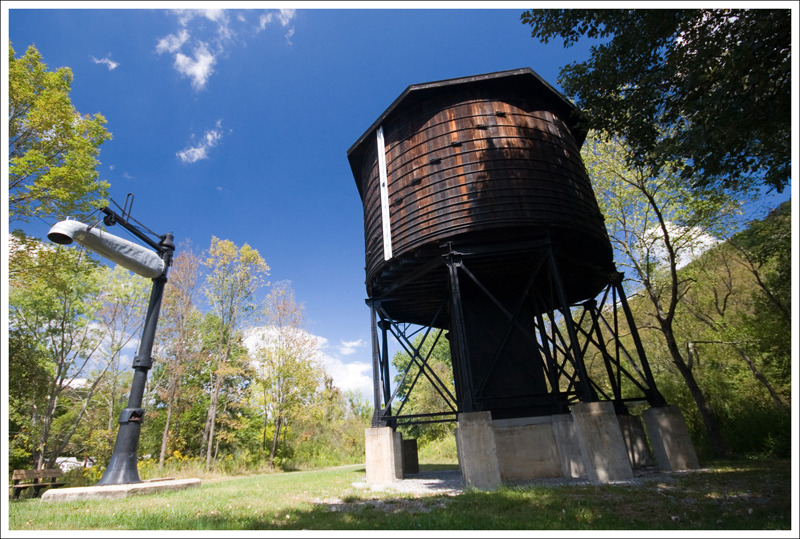
After being dropped off in the parking lot at the Northern Terminus of Slabtown (.5 miles from the town of Cass, WV), we got our gear together and headed down the trail.  Mile markers are posted along the way to help you plan your distance along the trail.  There are also slabs with the letter “W” along the trail, which were used by railroad engineers to know when to blow the whistle when they were approaching road crossings.  The first notable stop along the way is about 9.4 miles in when you reach the Clover Lick Depot.  This depot was built in the early 1900s and was recently renovated.  At mile 14.6, you will reach the Sharp’s tunnel and bridge.  The tunnel is 511 feet long and the bridge immediately after the tunnel is 229 feet long.  If you’re interested in parking your bike for a brief rest, right before the entrance to the tunnel there is a path to the left that leads down to the riverside. There is also a steep, slippery path up to the top of the tunnel for the more adventurous.  At mile 23.9, you will reach the water tank on the outskirts of Marlinton.  Shortly after you pass the water tank , you will reach the Marlinton Depot at mile 24.3.  The depot burned to the ground in 2008 and there are plans to have it rebuilt.  You can then bike a short distance back to where you left your vehicle.

Sharps Tunnel
The Sharps Tunnel is dark and deep!  Below:  Adam stands atop the tunnel entry;  By mid-day, big puffy clouds breezed into the sky.

Adam on top the Tunnel Entry Pretty Clouds Over the Greenbrier River

If you are interested in doing any geoaching along the bike trail, you can find a few along the way:

We definitely enjoyed our ride on the trail and I hope to come back at some point to try out some other sections of this trail.

Christine Says…

We had a great bike ride along the Greenbrier River Trail (GRT)!  I already can’t wait to go back and bike the remaining 53 miles.  Rails-to-trails riding is so pleasant and leisurely.  I love not having to worry about cars running me off the road.

If you’re going to bike a segment of the GRT, definitely look into arranging a shuttle. Typically, you leave your car at the end point, and the shuttle ferries you and your bikes to your start point. This allows you to bike a long section without having to retrace the trail to get back to your car.  You can also take your time exploring because you don’t have a set time to meet your ride at the end of your trip.  Shuttle companies are also a great source for trail tips – where to camp, where to eat, places to stop for water, etc.  We used Appalachian Sport, but there are several other shuttle companies in the area.

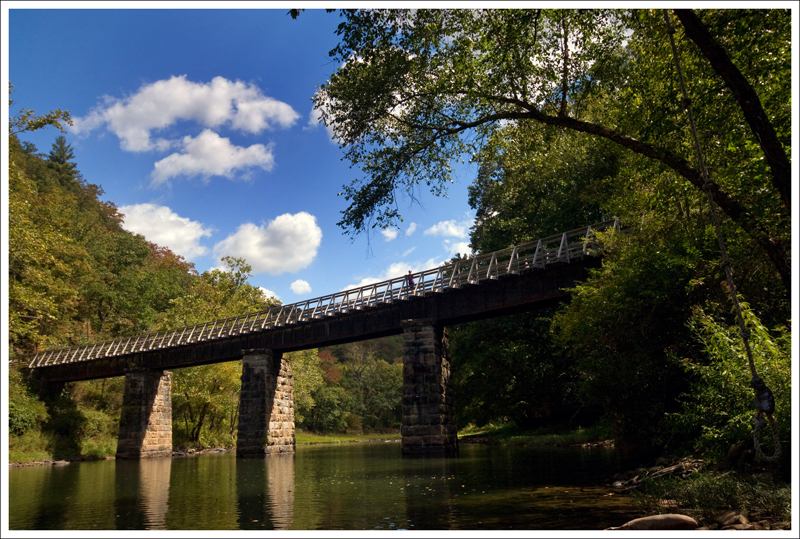
A View of Sharps Bridge
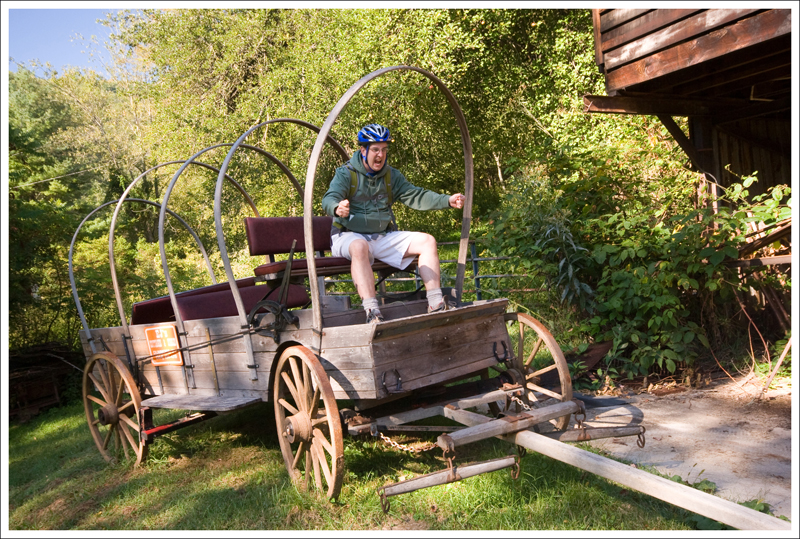
A View of Sharps Bridge.  Can you spot Christine on the trestle?  Below: A primitive campsite along the trail; Adam drives the old wagon; A few early hints of fall were evident in the trees along the trail.

Campsite Along the Trail Adam Driving the Old Wagon Biking Along

We met our shuttle at 8:30, loaded up our bikes and headed off on our 45-minute van ride to Cass.  The morning was still cool with thick mist lifting off the river.  Fall is definitely in the air!  We passed through Cass Scenic Railroad State Park on our way to the northern end of the GRT. Cass is near Snowshoe Mountain.  The area offers so many options for outdoor fun – skiing, mountain biking, canoeing, scenic railroads, fishing, hiking, etc.

By 9:30, we were off and pedaling along the trail.  For several miles, we followed along the river – no sign of roads, people or houses.  It was wonderful!  The river was really low, but it was still gorgeous.  Every now and then, a deer would bound across the trail or go splashing across the river.  The fog burned off and opened up to crystalline clear blue skies – not a cloud in site.  Early splashes of fall color were already evident in the trees along the trail.

We passed a couple trailside campsites.  The GRT is also popular with equestrians, so campsites all included hitching posts. If I still had my horse, this would definitely be a dream ride!  Several of the campsites even had privies.

Occasionally, the trail passes by developed areas.  But “development” in this section of West Virginia usually means a few houses clustered along a quiet country road.  We passed a barn with equestrian services advertised on the building side.  They also had an old horse cart that Adam couldn’t resist.  We passed the Clover Lick Depot.  I think this area was probably a lot busier when the train was still running.  The depot building was really cute and had recently been restored.  Sadly, it’s not being used for anything.  I bet it would make a great trailside gift and snack shop, but I also bet it would be nearly impossible for a shop to stay in business along the GRT.  In the entire 25 miles we biked, I think we saw 6 people all day long.  With such low traffic, amenities will never spring up along this trail like they have along the Virginia Creeper.

One of my favorite things we passed along – or shall I say through – was the old Sharps Tunnel.  When we arrived at the tunnel opening, Adam scrambled up the hill to the top of the tunnel opening.  You can smell the inside of the mountain emanating from the tunnel.  It’s a hard smell to describe – the best I can describe is like a cool wind carrying the scent of tar, dampness and earth.  The tunnel is over 500 feet long and follows a curve.  This means that there is a section in the middle where there is absolutely no ambient light.  It is 100% completely pitch black and eerie as the grave.  For a few moments, I lost all sense of up, down, forward and backward.  It was like biking in space!  I shrieked with a mix of fear and giddiness until my bike hit light again.  It was really fun, but if you’re afraid of the dark or an uncertain biker, you might want to have a light on your bike or carry a headlamp in your bag.

There were a bunch of state park employees eating lunch on the other side of the tunnel.  I think they all heard me screaming in the tunnel, because they looked at me oddly.  Oh well…  I hope they were entertained.  As soon as you come out of the tunnel, you pass over the Sharps Bridge, which crosses the Greenbrier River on a tall trestle.

Baby Chipmunk
We spotted a couple of frightened baby chipmunks along the trail.  Below: Another view of Sharps Bridge; the Greenbrier River; The other baby chipmunk we spotted.  I hope they survived.

Another look at the trestle and Sharps Bridge Greenbrier River View The other chipmunk

Shortly after crossing the bridge, I saw a tiny animal dart across the trail – barely missing Adam’s bike wheels.  It was as small as a field mouse.  I braked when I saw the tiny creature still sitting along the trailside.  It turned out to be a tiny baby chipmunk.  It was too young to be away from the nest, and the mother chipmunk was nowhere in site.  We made sure the little guy was safely off the trail and headed on our way.  As Adam was walking back to his bike, he almost stepped on another baby chipmunk.  This one was sitting in the middle of the trail, trembling in fear.  We made sure the other chipmunk was safely off the trail and nestled under some leaves before we biked on.  I hope those little chipmunks somehow found some way to survive.  😦

Chipmunks and deer were not the only wildlife we saw along the way.  We also saw a couple different kinds of snakes.  One snake was the largest black snake I’ve ever seen!  He was lying half on and half off the trail, clearly in a state of torpor from the chilly weather.  At first, I thought it was a toy rubber snake that someone had tossed along the trail.  It didn’t move at all when I nudged it with a stick.  I pushed it again, and I noticed the body slowly constricting.  The stick I had was an old fallen tree branch – about eight feet long.  I pushed the snake again to get it off the trail, but this time the snake completely coiled up; raising its upper body off the ground and flicking its tongue at me.  He was still really slow and stiff, but definitely awake! Adam, who was sitting on his bike 50 feet away, wanted nothing to do with the snake at all.  Finally, I managed to push the snake completely off the trail into the grass.  Hopefully, he slithered away when the sunshine of the day warmed him up.  Later in the day, we saw another snake basking in the sun in the middle of the trail, but he moved out of the way really quickly.

Huge Black Snake
We saw this sleepy (but angry) black snake on the trail. Below:  Near Marlinton, we saw old farm buildings and fields; The old water tank;  The burned Marlinton depot; Adam checks out the inside of the train.

Old Farm Building Water Tank near Marlinton
Burned Marlinton Depot Adam Checks out the Train

The last few miles of the trail passed through more open terrain.  We saw fields and old abandoned farm buildings.  Shortly thereafter, we passed a huge water tank – the only one left standing along the trail.  Trains used to stop at this spot to fill up.  By the time you get to the water tank, the GRT switches from a crushed stone surface to paved.  The paved section is about five miles long.

In a few minutes, we were back in Marlinton at the old train depot.  The depot used to be the town visitor’s center, but as Adam mentioned, it burned down a few years ago.  We took a few minutes to climb aboard the old train car at the depot before heading back to our car.

After loading up, we had a delicious lunch at the Greenbrier Grille.  They had great sandwiches (I recommend the Steak & Mozzarella!) and a lovely deck overlooking the river.  We ate lunch to the sound of honking ducks in the river below.  The restaurant has a large menu of homemade desserts, but we were too full from the sandwiches.

The next day, we were on our way back to Virginia, but we’ll definitely be visiting Pocahontas County again!

Trail Notes

  • Distance – 24.3 miles
  • Elevation Change – Negligible.  Hardly any elevation change.
  • Difficulty – 2. While the biking is not difficult, the distance might be a little much for some people.  Hiking or biking it should be fairly easy.
  • Trail Conditions – 4.5 The trail is very well-maintained.
  • Views3.  The trail is scenic through most of the trail with views of the river most of the time.
  • Waterfalls/streams – 2. The path runs along Wilson Creek for part of the trip and the Greenbrier River for most of the trip.
  • Wildlife – 2.5 We saw deer a few times on the trail and in the river.  We also spotted some baby chipmunks, a blue heron, a couple snakes and some geese.
  • Ease to Navigate – 4.5. Just stay on the bike trail.  A few spots run parallel with other driveways/roads, but you shouldn’t have trouble if you stay on the trail.
  • Solitude – 3.  We were surprised with how few people were on the trail biking.  I think we only saw 6 people biking on the trail the entire day.

Directions to trailhead: The actual trailhead is located off Route 66/Back Mountain Road near Cass, WV.  There are clear signs to direct you to the trail.

View a Google Map of the Route

Thomas Reserve – Cowpasture – Cranberry Glades Loop (WV)

This nine-mile loop offers glimpses of area history, great views of the tundra and peeks at distant mountains.

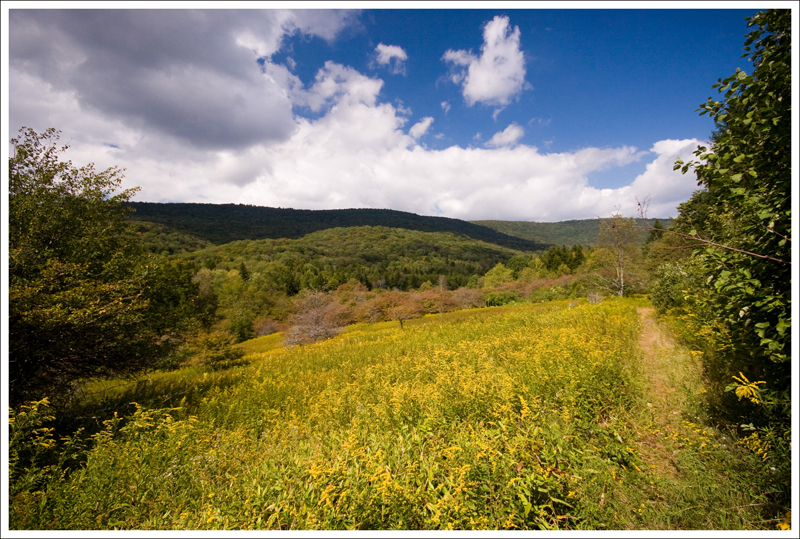
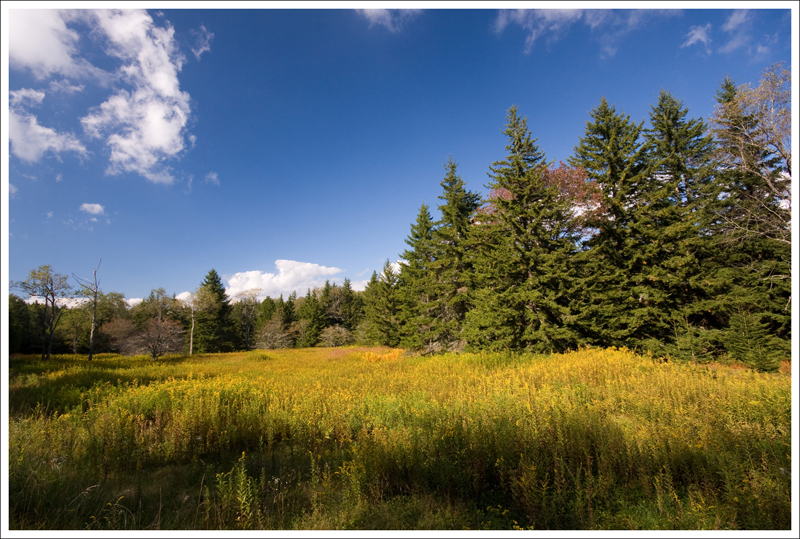
Meadow on the Cowpasture Trail
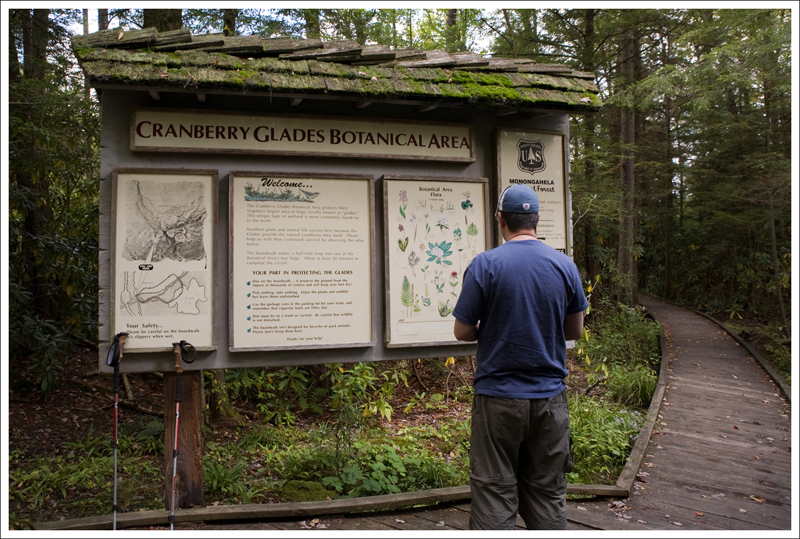
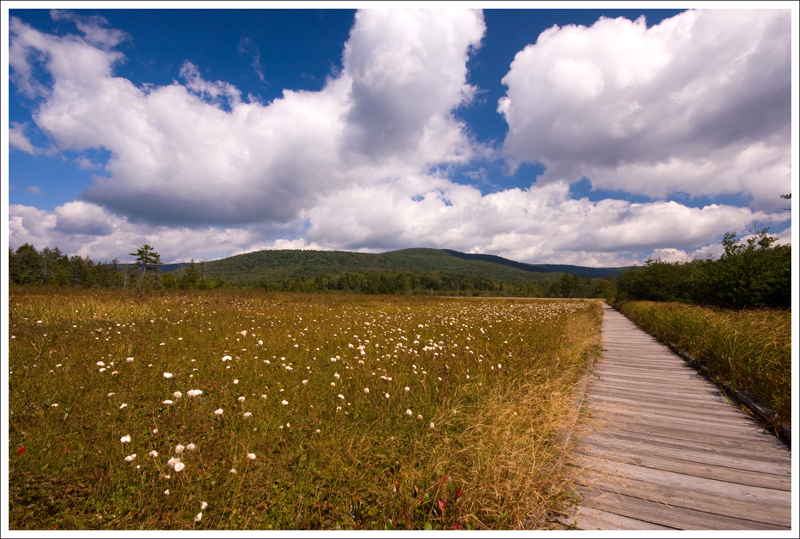
The trail offered many beautiful meadow views.  Below: Adam checks out the sign at the entry to the Cranberry Glades boardwalk; The old Mill Point Federal Prison used to sit along the present-day Cowpasture Trail; The Thomas Reserve Trail is lined with ferns; A view of the Glades boardwalk.

Entry to the Cranberry Glades Boardwalk
Thomas Reserve Trail The Glades Boardwalk

Christine Says…

The morning did not start well.  We drove into Marlinton, WV before our hike to make some reservations for a bike shuttle.  Once we were in town, we learned that Verizon wireless was not available anywhere in the area (and I really needed to check in on a family emergency).  We couldn’t find anyone that sold pre-paid phone cards in all of Marlinton.  When we did find a phone card, we couldn’t find a pay phone that worked. Apparently, the only pay phone that works in all of Pocahontas County is at the hospital.  After filling up at a BP station, the “service engine” light came on in our car and the gas gauge stopped working.  (Can I blame BP for that?)  Finally, to top everything off, we couldn’t find the trailhead for this hike.  In the end, it all turned out OK, as it usually does.  We ended up hiking a couple extra miles, but on a beautiful, cool, blue-sky day… that’s not a bad thing!

Our original plan was to hike the 7.1 mile Cowpasture Loop which encircles the entire Cranberry Glades Botanical Area and crosses into the beautiful, wild Cranberry Wilderness.  But, the trailhead was not marked and the map we had did have enough detail to indicate the exact location.  We ended up parking at the Thomas Reserve trailhead, instead.  We knew this trail would intersect the Cowpasture Loop after about a mile or so.

This rock ledge along the Thomas Reserve Trail is probably a pretty waterfall when the stream isn’t dry. Below: The trailhead for the Thomas Reserve trail; Trails were adequately marked.

Thomas Reserve Trail Trail Sign

I’m really glad we went this way, because the Thomas Reserve Trail took us past some beautiful and interesting scenery.  There were ruins that looked like some kind of old pool or water treatment facility.  The concrete basin and pillars were still intact, along with several large pipes with wheels attached.  I did a quick Google search to try and figure out exactly what the ruins are, but I didn’t have much luck.  From that point, the trail passes through beautiful fern-carpeted forest and past a dry stream.  The stream has an interesting rock ledge/cave that I think probably makes a lovely, small waterfall when water is actually running.  Eventually, the path intersects an old road that is part of the Cowpasture Loop.

After a short walk along the old road, the trail opens up into a gorgeous open meadow with views of the mountains in the distance.  This is the site of the old Mill Point Federal Prison.  Even though the buildings were all torn down in the late 1950s and early 1960s, you can still see some leftover signs of the site – there are bits of road left, abandoned stairs to nowhere, an old well.   There is also a series of informational signs that include old photos and talk about life at the prison.  Apparently, it was a prison without walls or gates.  Prisoners were treated to weekly movies and could spend their afternoons hiking in the area.  I guess you could say it was very low security! We stayed at the prison site long enough to read the signs and enjoy the meadow view.

After the meadow, the trail climbed back into the forest, following rolling ups and downs for a couple miles.  We saw lots of bear scat and several deer leaping across the trail.  We crossed a small dry stream shortly before passing out into another wide open area.  The meadows along this trail were really overgrown.  The ragweed and other plants were shoulder-height and constantly batted me in the face as I walked the trail.  Even so, the meadow areas of this hike were spectacular!  This section in particular offered beautiful views of Kennison Mountain.

Beaver Dam on the Cranberry River
We got a nice view of a beaver dam on the Cranberry River. Below; The bridge over the Cranberry River.

Bridge over the Cranberry River

The trail dips down to the South Fork of the Cranberry River.  This crossing had a pretty arched bridge and a great look at an active beaver dam.  There were crabapple trees everywhere – so I was really wondering if we’d eventually see a bear.  We never did – just the deer and a very angry red squirrel.

From the river, the trail ascends to a ridge and follows a series of gentle ups and downs.  We passed several beaver ponds and got nice looks at the bogs and glades the area is known for.  One pond even has an elevated wooden platform to view the area.  Because of the dry months we’ve had lately, the ground was much dryer than it should be.  The ponds were so low, I wondered if the resident beavers were able to swim at all.  While we were passing one of the ponds, we heard a huge tree come crashing to the ground someplace nearby.  It must have been a monster tree – it sounded like gunshots as it splintered and fell to the ground with a huge KABOOM.

Just before coming out on FS Road 102, the trail passes over another pretty arched bridge.  The walk along 102 is completely level and pretty uneventful.  You’ll pass a gate and the board marking the entry to Cranberry Wilderness.  The area looks fantastic for backpacking – lots of loops and shelter options.  We’re already talking about making a three day trip sometime in the spring.

After crossing the chain gate, the walk is along the developed portion of 102.  Cars passed by and the walking was really boring.  When we got to the Cranberry Glades Boardwalk, we decided to add the .6 mile loop onto our larger loop.  The boardwalks pass through a beautiful open bog area.  If you visit the right time of year, you can even see carnivorous pitcher plants.

After the quick turn along the boardwalk, we walked the last mile along the paved road back to our car. By the time we got back, I was pretty tired and hungry and was looking forward to making homemade pizza for dinner back at our Watoga State Park cabin.  Although the day got off to an inauspicious start, it really turned out to be perfect.

Adam says…

Christine had suggested this hike to me when we were planning our trip to Watoga State Park and I’m so glad that she suggested it.  This hike is one of my favorites that we’ve done this year.  It has some interesting history and the open views of tundra are nothing short of beautiful.

Ruins on the Thomas Reserve Trail
We saw these mysterious ruins along the Thomas Reserve Trail.  Below: The Thomas Reserve trail begins; An old well at the prison ruins site.

Thomas Reserve trailsign Old well at the prison ruins

We had trouble finding the start of the hike, since the trailhead for the start of the Cowpasture Loop was not marked.  We saw a sign for the Thomas Reserve trail and I could tell from our map that it hooked up with the Cowpasture Loop.  The Thomas Reserve Trail starts bisecting a field, but quickly moves into woods.  At about .6 miles, we saw the pillars of the old “pool” that Christine mentioned off to the right of the trail.  The trail continues for another .4 miles through the woods until it comes to a sign.

Take a right here to get on to the Cowpasture Loop.  The trail is quite level at this point as you move through a field with great views of the tundra around you.  Here, and in some places throughout the entire loop, there may be tall plants that you have to push aside, but you shouldn’t need to bushwhack.  As you’re passing through the tundra area, you may notice several bluebird boxes.  The trail begins to turn towards the left and then opens up to more of a clearing.  You will see posts that give information about the Mill Point Federal Prison camp and life for the inmates.  You will then come to a sign around mile 1.5.  Take a left here to stay on the Cowpasture Loop.  This will loop back around the tundra, paralleling Charlies Creek, and then goes back into the woods.    You will start to reach some footbridges around the two mile mark that take you above some marshy areas.

A view of the Glades Boardwalk
The glades boardwalk is a pleasant .6 mile walk around the bog. Below: The walk along the forest road wasn’t that exciting; Once we got back to the paved portion of 102, there were some pretty scenes along the road.

Forest Service Road 102 The walk back to the car

After this point, you will begin to climb slightly up.  At the height of this gradual hill, you will begin to see views of Kennison Mountain.  At mile 3.5, the trail then takes a sharp left (marked by an arrow on a sign) and descends again.  This area was quite overgrown, but the trail was still clearly visible.  The trail tends to alternate at this point from going through areas of marshy glades to trails through the woods with slight ups and downs in elevation.  At mile 5.7, you will see a destroyed sign where there is a side path of about 100 yards to an observation deck.  This would be an excellent spot for birding.  At mile 6.4, the trail connects again to FS 102.  Take a left on the fire road until you reach the gate at mile 6.6.  At mile 7.3, you will reach the parking lot for the Cranberry Glades Boardwalk loop.  This loop is only about .5 miles and I would highly recommend it.  There are interpretive signs along the boardwalk and it does give some more wonderful views throughout the loop.  Once you complete the loop, just walk back up FS 102 to reach your car.

There are also a few geocaches along this loop:

Trail Notes

  • Distance –9 mile loop
  • Elevation Change – 200 feet
  • Difficulty 3. This is really an easy hike, but we’ll give it a 3 due to the longer length.
  • Trail Conditions 2.5. The trail was largely passable, but very overgrown.  Several bridges over streams were broken and rotted through.
  • Views –3. You get some nice views of the mountains and great views of the glades/tundra.
  • Waterfalls/streams 3. In times with normal to higher precipitation, this trail has great views of streams, ponds and the Cranberry River.
  • Wildlife 4.  We saw deer, signs of bears, active beaver dams, red squirrels and many kinds of birds.
  • Ease to Navigate 3.  Once you find the trailhead, the trail is relatively easy to follow.
  • Solitude 4.  Outside the popular boardwalk area, you probably won’t see a soul!

Directions to trailhead: From Mill Point, WV head west of WV 39/55.  After about 7 miles, you will find a sign for the Cranberry Glades area on your right (FS 102).  Head down this road for one mile until you reach the trailhead for the Thomas Reserve trailhead.

Buck Hollow – Buck Ridge

The Buck Hollow – Buck Ridge Trail is a steep hike in the Central District of Shenandoah National Park.  It takes a deep plunge along the Buck Hollow stream and a steep hike back up the Buck Ridge trail.

I've never seen so many different kinds of mushrooms/fungus along a trail in Shenandoah.
I’ve never seen so many different kinds of mushrooms/fungus along a trail in Shenandoah.  Below: When we hiked Buck Hollow in August of 2008, we saw two yearling bear cubs; the stream running through Buck Hollow is rather small and overgrown.

Bear

Adam Says…

I have to be honest – we have been putting off doing this trail for a while.  We first did this hike a few years ago and the memories of how tough a hike it was kept us from wanting to do it again.  Christine and I both weren’t feeling well the day we attempted it last time, but we were more pleased doing this hike this time.

The trail starts off from the Meadow Springs parking area.  After about 20 feet down the trail, you see a post marking the Buck Hollow trail.  Take a left to go down this trail.  The trail seems to constantly descend and is rather steep in many portions.  There are loose rocks and if you attempt this after a heavy rain, you should expect some mud and slick soil on the trail.  Along the side for much of the trail, you will see the Buck Hollow stream.  Around mile 1.75, you will make a few rock-hops across the stream.  The trail continues to descend and then finally seems to just parallel the stream.  At mile 2.8, you will reach a cement post, pointing you to take a right on to the Buck Ridge Trail.  You cross the stream again and then you will quickly come up to the dreaded stairs.

For any Lord of the Rings fans, these stairs remind me of the stairs of Cirith Ungol.  “Up, up, up, up the stairs we go.”  They are unrelenting and seem to last forever, but they last less than .3 miles.  Of course, you do gain over 400 feet of elevation in this short distance.  These stairs didn’t exist the last time we did the hike; the last time, we just had a steep section of loose soil to traverse.  The stairs help make this hike more manageable, so I do thank the workers that accomplished this laborious task!

Nice Camping Spot
At the bottom of Buck Hollow, there is a beautiful camping spot with flat, open forest and easy access to water. Below: The trail starts out at the Meadow Springs Parking Area; A trail through a small slot in the rocks leads hikers to the only open view on the trail.

Trail Marker Side Trail to Viewpoing

After the stairs, the trail continues to go uphill, but it is at a much more manageable grade.  Once you are high enough on the ridge, you are treated with views of Skyline Drive and mountain views around you (including Mary’s Rock).  We found a small crevasse bisecting a large rock formation that we were able to easily climb up to get some unobstructed views.  After mile 5.2, you do come up to another concrete post.  Take a right and you will reach the parking lot in a little over .3 miles.

One interesting note that I remember from our first hike of this loop trail was near the bottom of Buck Hollow.  We were hiking along and all of a sudden we startled two yearling bears.  One of them quickly climbed a tree and the other took off up the mountain.  We kept our distance, and the one that climbed the tree climbed back down and took off in the opposite direction.  As I looked to see where the bear went, I spotted a buck and a pileated woodpecker in the same direction.  I felt that I could have taken a picture that would have looked like a wildlife mural that you often see on brochures or placemats.

We were tired after we finished the hike, but this trip we definitely felt that it was more enjoyable than the first time we attempted it.

Christine Says…

When we woke up to cool, pretty weather on Saturday morning, we decided to end our hiking hiatus a week earlier than initially planned.  I had to be at an art show by 1:00, so we needed to find a hike that was relatively short and sort of close to home.  We’ve pretty much hiked and blogged about everything in the central district of Shenandoah National Park already… with the exception of the dreaded Buck Hollow-Buck Ridge hike.

Why dreaded?  As Adam mentioned, last time we did this hike we were both fighting colds and had zero energy.  And while Buck Hollow is not the longest or hardest hike we’ve done, it certainly felt like it the last time we were there.  We ran out of water, we were fatigued, the trail felt endless and daunting as soon as we started the uphill climb.  Other than seeing the two yearling bears, the Buck Hollow hike didn’t carry a single pleasant memory.  It just made me think of exhaustion, suffering and thirst.  🙂

When I mentioned to Adam that we should probably hike it again for the blog, he looked at me with incredulity and told me that he didn’t ever want to hike there again.  Somehow he was convinced to relent, and off we went!

This time, the hike was a lot more fun!  It was still a long, steep downhill –  but I really enjoyed marveling at the huge variety of mushrooms and fungi growing along the trail.  I don’t know if there is a name for people who collect/catalog fungus, but if such people exist – this is the trail for them.  We also happened to notice a beautiful backcountry campsite at the bottom of the hollow, where the trail leveled out.  Along with easy access to water, there was a wide, flat expanse under the shade of the trees.  The forest floor in this area was open with very little undergrowth.  There were also several huge piles of rocks – maybe from old stone walls or foundations in the area.  It was a great place to take a break and have a snack.

Stairs
Although the stairs don’t look steep in this photo, they ascend nearly 400 feet in just over two-tenths of a mile.  Below: The Buck Ridge trail is lined with dense mountain laurel; The only (mostly) open view comes from atop a rock along Buck Ridge.

Dense Mountain Laurel View from the Rock

The flat terrain at the bottom of the hollow doesn’t last long.  Shortly after passing the cement post marking the Buck Hollow – Buck Ridge junction, you’ll encounter what I think is the toughest, steepest section of climbing in all of Shenandoah National Park.  Indeed, it’s a short climb – but wow… it’s STEEP.  The terrain along this little section is the equivalent of gaining 2000 feet in elevation over a mile.  I think most hikers will agree — that’s TOUGH climbing.

The Potomac Appalachian Trail Club published a review of this hike in their October 2010 newsletter.  In it they say “Steep, does not begin to describe the trail ahead.”  They also call it scary and compare it to a descent into hell.  🙂 We concur!

I was quite glad when the terrain moderated, because the steep stair climb really exhausted my legs!

Butterflies
Butterflies were everywhere along the trail. Below: The PATC trail overseer clearly loves this area.

Plate

We also noticed the nice view from atop the rock that we had missed last time we hiked.  It’s funny how being fatigued and thirsty makes you miss the best things along a trail sometimes.  The last section of the trail along Buck Ridge passes through dense mountain laurel and through patches of blueberry and raspberry bushes.  I really thought we’d see more signs of bears (and maybe some actual bears!), but we really only saw one old pile of scat this time.

The Buck Ridge trail eventually meets up with Hazel Mountain Road for the last third of a mile.  This section of trail was quite familiar, since we hiked it just a couple months ago on our backpacking trip to Catlett Mountain.  When we arrived back at the parking lot, we noticed the PATC overseer’s car was in the lot – complete with a “BCKHLW” license plate.  Clearly, the overseer loves this section of the park and does a great job maintaining the trail.

It was a fun hike – one I enjoyed far more than I expected to!

Trail Notes

  • Distance – 5.6 miles loop hike
  • Elevation Change – 1750 feet
  • Difficulty – 4. The trail is steep at the start going down and once you reach the halfway point includes a steep uphill.  Not recommended for those with knee or ankle issues.
  • Trail Conditions –3. The Buck Hollow Trail is rocky and steep, so you have to watch your footing.  The Buck Ridge Trail had better trail conditions.
  • Views – 2. The views you get are from the Buck Ridge Trail portion.  While most of these are through the obstruction of trees, there is a nice place to climb on top of a rock for a view.
  • Waterfalls/streams 1.5. You do walk along the Buck Hollow stream, but there aren’t a lot of nice views of falling water.
  • Wildlife –3.5. There are signs of bear scat around.  The first time we went on this trail, we saw two yearling bears and a buck.  Both times we have spotted pileated woodpeckers and many typical woodland birds.
  • Ease to Navigate –4. Not too many turns, just read the concrete posts.
  • Solitude –3.5. We did see a number of people on the trail that seemed to be in a group, but this isn’t overly popular.  Some people will hike up from Rte 211 to Mary’s Rock, so you’re likely to only find people on the Buck Hollow portion of the trail.

Directions to trailhead:
At mile 33.5 on Skyline Drive.  Park at the parking lot on the eastern side of the road and the trail starts from the southern end of the parking lot.

Arethusa Falls and Bemis Brook (NH)

Special: New Hampshire Edition

Introductory Guide to Visiting the White Mountains

Note – 10/11/10: In their October issue, Backpacker Magazine inaccurately listed Arethusa Falls as a Virginia destination. The falls are in New Hampshire.

This three mile hike leads to Arethusa Falls, which is (arguably) New Hampshire’s tallest single waterfall. The optional arm along Bemis Brook is challenging in spots, but offers more lovely stream scenery.

Arethusa Falls
Arethusa Falls might not be the most photogenic of New Hampshire’s many waterfalls, but it is likely the  tallest. Below: The optional side-loop trail along Bemis Brook takes you past Coliseum Falls.

Coliseum Falls

Christine Says…

We originally planned on combining these two trails with Frankenstein Cliffs to make a loop, but unfortunately we ran short on time and just did the three mile out-and-back.

The trail along Bemis Brook was extremely tough walking!  In addition to the roots, rocks and mud, we suffered a full-on mosquito assault.  I spent a lot of the walk along the trail cursing and flailing my arms wildly.  Even with DEET, the little buggers hovered right around my eyes, ears and nostrils, constantly buzzing in too close and getting caught in my eyelashes.

There were several very pretty small waterfalls along the Bemis trail.  Coliseum Falls were especially picturesque.  Since it was such a sunny day, I didn’t bother with a tripod.  Long exposures weren’t a possibility in the harsh sun, so I just took snapshots along the way.  The climb from Bemis Brook back up to the Arethusa Trail was practically vertical.  We had to climb, hand-over-hand, grabbing roots and rocks to drag our way up the mountainside.  There was one blown down tree that was particularly difficult to negotiate.  It was one of those fallen trees that was a little too high to climb over, but a little too low to scramble under.  I decided to clamber over it, and ended up getting my boot toe caught on the tree trunk.  I took a spectacular fall down onto the roots and rocks.  It absolutely left a big black and blue mark!  I was really glad when we finally saw the junction with the Arethusa Trail!

Frankenstein Cliffs
This trailhead for this hike offers beautiful views of Frankenstein Cliffs looming overhead. The trail has an option to lengthen the hike by a few miles to gain access to the top of the cliffs. We ran out of time and had to pass on that option. Below: Trails in the area are clear and well-marked.

Trail Sign

The rest of the way to the falls was much easier.  It was uphill and muddy in spots, but the trail was well-graded and nice to walk along.  The last stretch to Arethusa Falls led downhill into a chasm that opened to an amphitheater like setting.  The falls were very impressive!  The water falls like lace over the sheer rock face.

On the hike back, Adam and I waffled about whether or not to continue our hike up to Frankenstein Cliffs.  We even started down the Cliffs Trail, before turning back in less than a tenth of a mile.  We had plans to meet my parents in North Conway, and we just didn’t have time to finish the loop.

Instead, we visited the Appalachian Mountain Club’s Highland Center and got a few Cokes and relaxed in their lobby.  After we met up with my parents, we had an amazing lunch at Moat Mountain Brewery & Smokehouse.  If you’re ever in the area, don’t miss their barbecue and microbrews!

Adam Says…

Arethusa Falls is a gorgeous 160 foot waterfall that is very popular with families.  We started on the blue-blazed trail near the railroad tracks at the parking lot.  After about .1 miles, you come to a junction with the yellow-blazed Bemis Brook Trail.  We decided to do this side trail, since it goes partially along the water, guiding you to a few pools and smaller falls areas.  Once you come up to the Coliseum Falls area, you will need to climb up almost vertically up the trail to join back with the Arethusa Falls trail.  If you do want to do the Bemis Brook trail you should do this at the start of your trip rather than trying to descend it at the end.  This part of the trip was tough and takes a lot of strength out of you in a short distance, so plan appropriately.  Once we reached the junction at the top, we took a left to return to the Arethusa Falls trail.  The trail continues to go uphill until you reach a junction with the Cliffs Trail.  From this point, you continue downhill until you reach the falls in .2 miles.  You return the way you came, but you will avoid the Bemis Brook Trail on the way back and just stay on the Arethusa Falls trail to reach your vehicle.

Arethusa Falls was named after the poem, “Arethusa” by Percy Bysshe Shelley.  The falls were discovered by Edward Tuckerman, but named by Moses Sweetser and Professor Huntington in 1875.

Bemis Trail
The Bemis Brook Trail follows a beautiful stream for most of the way, until you get to the portion where it climbs, nearly vertically, back up to meet the Arethusa Trail. Below: The Arethusa Trail is much easier to walk – smooth and well-graded, compared to the Bemis Trail.

Arethusa Trail

While I was off hunting for a geocache and Christine was taking some photos, she struck up a conversation with a man hiking solo on the trail.  When I got back to them (after sliding down the hillside 20 feet on my butt), he wanted to take a look at my map.  He was thinking about doing the Frankenstein Cliffs trail and then looping back to make it to his car.  He was to meet up with his wife in less than two hours to take a ride up Mount Washington on the cog railroad.  We told him that it might be hard to make it in time.  He decided to go for it, but I don’t think there was any way he could have made it back in time for his trip up.  We both pictured his wife riding solo up the railroad, muttering to herself, and awaiting the moment she could give her husband a piece of her mind.

There are two geocaches you can get on the trail:

We wish we had more time to do the Frankenstein Cliffs trail (these are named after an artist, not the doctor who created a monster), because we have heard that it does give you some nice views from the top.  The trail is allegedly muddy and not as well maintained as the Arethusa Falls trail.

Trail Notes

  • Distance – 3 miles, out-and-back (2.8 if you leave the Bemis Brook Trail off and just stay on the Arethusa Trail the entire way)
  • Elevation Change – 650 ft to the falls.  There might be a bit more climbing if you do Bemis Brook.
  • Difficulty – 3. The Arethusa Trail is squarely moderate.  The Bemis Brook trail is more difficult with one killer climb uphill at the end.
  • Trail Conditions – 2.5 The Arethusa Trail is in nice condition most of the way.  There are some muddy spots and we encountered a flew blow downs.  The Bemis Trail is not easy walking.  There are numerous fallen trees, tricky footing and if it’s the slightest bit damp, the trail is very slippery.
  • Views –0. You’ll be in the woods the entire time.
  • Waterfalls/streams 4. The falls are large and impressive, but not terribly photogenic.
  • Wildlife – 0. The heavy human traffic probably scares any wildlife away.
  • Ease to Navigate – 5. Trails are marked and easy to follow.
  • Solitude – 2. Because the hiking is a little more challenging, you won’t see the same crowds as you do at Flume Gorge or Sabbaday Falls.

Directions to trailhead:
From I-93, follow New Hampshire Route 302 west through Crawford Notch State Park.  A few miles past Sawyer Rock Picnic area you will see the Arethusa Falls parking area on the right.

Greeley Ponds (NH)

Special: New Hampshire Edition

Introductory Guide to Visiting the White Mountains

The Greeley Ponds trail is a popular hike that leads to a pair of beautiful ponds surrounded by the White Mountains.

Upper Greeley Pond
We didn’t have great weather for our hike to the Greeley Ponds. It was very muddy and overcast, but the ponds were still really pretty! Below: There were several small stream crossings along the hike; We saw Indian Pipes growing along the trail; the terrain in this area is very wet and dark, making it a perfect place for mosses and mushrooms.

Stream Crossing Indian Pipes Mushrooms

Christine Says…

We got up early to take a scenic drive and do some hiking along the Kancamagus Highway.  We decided to check out the trail leading to the Greeley Ponds.  This hike intrigued me, because it is so different from anything we have in Virginia.  Ponds and lakes are not terribly common in the Blue Ridge, so I thought a hike leading to two ponds surrounded by mountains sounded really perfect.

The trail did not disappoint!  The woods in New Hampshire are so thick and green and different.  I love the abundant evergreens in the New England woods. Everything is so fragrant, lush and moss-covered.  Old fallen trees become nurseries for tiny mushrooms and tree seedlings.  Streams trickle in seemingly every direction.  Even the birds are different – singing unfamiliar songs up in the trees.

The Greeley Ponds Trail is relatively easy – with only about 500 feet of elevation gain over 2.5 miles. The things that slow you down are the roots, rocks and mud.  You have to watch your feet with every step.  We found our trekking poles to be very helpful.  Many places along the trail are traversed using wooden planks and split logs. There are several small streams to cross along the way, hopping from rock to rock.  Some of the trail system is a little confusing because cross-country skiing trails cross the hiking trail in many places.  The key is to look for yellow blazes.

At the 1.7-mile mark, the Upper Greeley Pond comes into view.  There are several places to climb down to the shoreline and take in views of the pond.  Although Upper Greeley is the smaller of the two ponds, I found it the prettier of the two. I loved seeing the towering mountains all around the pond.

Lower Greeley Pond
Lower Greeley Pond has a lot of dead trees at one end, giving it a swamp-like appearance. Below: Trailhead sign along the Kancamagus Highway; New Hampshire’s “Hike Safe” Signs are posted at all trailheads. Hike Safe (http://www.hikesafe.com) was developed by the state to help hikers become safer in the outdoors; Adam checks out the trail map illustrating skiing and hiking trails.

Greeley Ponds Trail Sign Hike Safe Trail Maps

Lower Greeley Pond is just several tenths of a mile past the end of Upper Greeley.  There is a big stand of what appears to be dead hemlocks at the end of the pond.  It gives the pond a swamp-like appearance. The lower pond also has fewer places to enjoy a shoreline view.

We turned around for our return hike a little past the end of Lower Greeley Pond.  Although, if you want a longer hike, the trail continues, following the Mad River all the way to Livermore Road.

We didn’t see a soul on the hike out to the ponds, but passed numerous groups of hikers on the return trip.  Greeley Ponds is clearly a popular hike in this area.

Adam Says…

The Greeley Ponds Trail is close to the western side of the Kancamagus Highway, so it was our first stop along the way.  The trail has a small parking lot that tends to get crowded during the busy summer.  This is a fee area, so you’ll need to deposit $3 in an envelope and display your pass.

The trail wasn’t difficult, but due to the recent rain, it was a little muddy and slick in spots.  I also felt overwhelmed by mosquitoes and had to flail around and swat them at every step.  It reminded me of the quote from Lord of the Rings when Merry asks, “What do they eat when they can’t get hobbit?”.  Well, my answer to Merry is “me”.  The bug repellent held many off, but other than taking a DEET bath, you’ll likely find a bite or two without multiple applications along the hike.  Christine asked if I would rather have the flies and mosquitoes in New Hampshire or the gnats and ticks in Virginia.  Maybe it’s because of what I’m experiencing now, but give me some ticks and the threat of Lyme Disease over these pesky creatures.

Mossy Trail and Boardwalks
Much of the trail was traversed by boardwalks and planks. Below: The trail intersects a couple other trails; Adam enjoys the view from a small, sandy beach at Upper Greeley Pond.

Trail Marker Adam takes in the view at Upper Greeley

The yellow-blazed Greeley Ponds Trail goes for 1.3 miles until it reaches a junction with the East Osceola Trail (you could add this to your hike if you want for an additional three mile out-and-back hike). At this junction, you will see the sign stating you should reach the Lower Greeley Pond  at 1.7 miles.  The trail intersects several times with a blue-blazed trail, but this is a cross-country skiing trail to the ponds (Hikers stay off the ski trails in the winter, so they can avoid leaving footprints over the cross-country ski tracks).  Both will get you to the same place, but you’ll notice the yellow-blazed trail will be a shorter route.  Once the pond comes into view, you can see a short off-trail path to a beach-y area with good views of the pond.  Going back on the trail, you continue along the bank and can continue to get different views.  Staying on the main trail, you will reach the Upper Greeley Pond around the 2 mile marker.   There are a few good views of this longer pond for the next few tenths of a mile and then you can return the way you came.

There is no camping allowed within .25 mile of the Greeley Ponds, but we did see some illegal campsites around the area created by people that weren’t respectful of the ecosystems around the area.

The area around the ponds, especially the Upper Greeley Pond seems like a great area for birdwatchers.  We were treated with songs from warblers and the knocking of woodpeckers.

There are a few geocaches along the trail:

The hike exhibited a lot of different features of the area’s forests –  dense pines and birches, gorgeous ponds, and erratic boulders along the way.  The minimal elevation change makes this a good hike for families as long as you can maintain good footing on wet surfaces.  We saw a few groups with dogs along the trail, so it is even four-legged friendly. (Please note…dogs are not allowed on the ski trails in the winter)

Trail Notes

  • Distance – 5 miles
  • Elevation Change – 500 ft
  • Difficulty – 2. The hike has a very gradual uphill.
  • Trail Conditions – 2. Like most trails in New Hampshire, this one is rocky, muddy and covered with roots.
  • Views –2. Some nice views of the mountains at the ponds.
  • Waterfalls/streams 3.5. Ponds aren’t really lakes or streams, but they do qualify for a high rating for water features.
  • Wildlife – 2. Lots of bird species near the ponds.
  • Ease to Navigate – 3.  Pay attention to the yellow blazes and you won’t get lost.
  • Solitude – 2. This is a popular and well-traveled hike.

Directions to trailhead:
Take I-93 Exit 32 at Lincoln and go east on Route 112/Kancamagus Highway about 10.5 miles to the marked Greeley Ponds parking lot.

The Basin & Kinsman Falls (NH)

Special: New Hampshire Edition

Introductory Guide to Visiting the White Mountains

The Basin  and Kinsman Falls is a short 1.2 mile out-and-back walk to a lovely waterfall in Franconia Notch State Park.  The trail follows Cascade Brook and passes many beautiful (and popular) water features.  The falls are also called Tunnel Falls.

The Basin
The Basin is a beautiful glacial pothole at the base of this hike. Below: Kinsman Falls is a pretty 20 foot waterfall that plunges into a wide pool at the bottom; Many of the streambeds look sculpted.

Kinsman Falls Water Features along the Trail

Adam Says…

We had visited the Basin last year, but it is always worth a quick stop off I-93.  It takes only .1 mile to reach it from the parking lot.  You will see signs to lead you directly to the Basin.  The Basin was formed about 15,000 years ago as an ice sheet eroded the pathway.  According to the plaque at the site there, Henry David Thoreau wrote “this pothole is perhaps the most remarkable curiosity of its kind in New England.” Samuel Eastman called this area, “One of the most beautiful haunts of Nature, a luxurious and delicious bath fit for the ablutions of a goddess.”

There are several paths to walk along in this area to explore streams and small waterfalls.   If you go back the way you came, you will see a larger junction with a sign for Kinsman Falls being .5 miles away.  The path up to Kinsman Falls was filled with roots and rocks, so you do need to continually watch where you are stepping.  Shortly up the ascent, you will see several spots to your left along the way of the river.  These are good places to soak in the sun or to wade in a small pool.  Be careful about footing if you venture into the water, since the water does rush through these areas rapidly. Getting back on the trail, you have more of an ascent, but you will quickly come up to the sign pointing to Kinsman Falls.  The falls were very impressive as they plunged into a serene pool at the base.

View of the Mountain from Cascade Brook
View of the Mountain from Cascade Brook.  Below:  Colorful fungus on the trail;  Christine’s dad and Adam climb back up from the base of the falls.

Orange Mushrooms Along the Trail Climbing Back up from the base of the falls.

I definitely recommend checking out these areas if you are taking a trip through the White Mountains. Most people just view the Basin and some of the swimming holes along the way and don’t venture any further, but it is worth the hike up to Kinsman Falls and most families can easily make the trip.

There are several geocaches in the area:

Christine Says…

We planned to do lots of family hikes on this visit to New Hampshire, but about a week before the trip an MRI revealed that my dad had torn his meniscus.  His doctor told him to be careful and to limit activity that could extend the tear.  Sadly, this put most of his hiking plans on hold for the time being.  He did decide that he felt up to joining us on the short hike past the Basin and up to Kinsman Falls.

Like Flume Gorge, this little hike packs in a lot of impressive scenery over a very short distance.  Also, like the Flume, it is extremely popular and crowded.

The Basin is such a gorgeous spot.  I love how the water curls through the rock formation.  The rock walls of the Basin are smooth and sculpted – they almost look unnatural. The water is blue-green colored and crystal clear.  It’s one of those spots you’ll never forget!

After the Basin, the beautiful water features keep on coming!  There are so many small waterfalls and cascades along the trail, that you always hear the pleasant sound of rushing water.  A sign marks the way to Kinsman Falls, but honestly, we could say “just follow the water uphill” and you’d find your way there.

The trail was rocky and root-y.
The trail was rocky and root-y. Below:  The base of the falls was a nice place to stop and contemplate nature; Cascade Brook rushes over the rocks.

Dad on the rocks Water flowing along Cascade Brook

The trail followed alongside Cascade Brook for a half mile.  There were many little side-trails leading to scenic spots along the brook.  Dozens of people reclined on the rocks while kids used the streambed like a natural waterslide.  One mother remarked to us that her family had visited the spot two days in a row, and both her boys had worn through the backsides of two sets of swim trunks.

The trail is muddy, with a mix of gnarled roots and slick granite underfoot.  It’s all uphill, but it’s never steep.  It really is an ideal family hike.
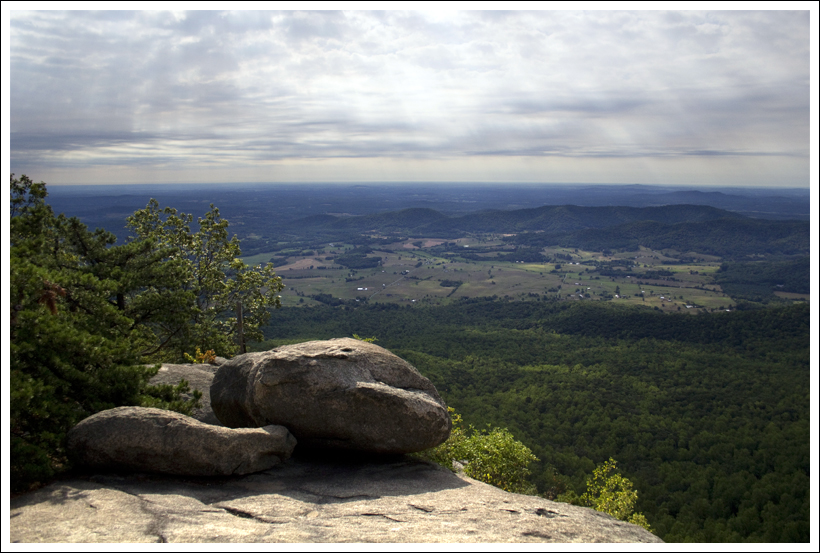
A small sign announces Kinsman Falls.  From the trail, you get a view of the falls from above.  The twenty-foot waterfall crashes into a large, round pool in a chasm below.  There is a rough footpath down to the base of the falls – take care if you climb down – it’s slippery with numerous rocks to scramble over.

There are lots of big rocks to sit on around the edge of the pool.  It’s a nice place to relax and enjoy feeling the mist from the falls spray your face.  We were really surprised to have the falls all to ourselves.  Even though there were many people in the area, no one else was at the waterfall.  Odd – but very welcome!  On our return trip, we passed quite a few people hiking up, so I suppose we just had fortuitous timing.

Trail Notes

  • Distance – 1.2 miles out-and-back. Plus a couple additional tenths of a mile to get to and from your car.
  • Elevation Change –Around 300 feet
  • Difficulty 2. The hike is all uphill over slick granite and gnarled roots, but it is short and never steep.
  • Trail Conditions 2. The trail is extremely rocky, muddy and covered with gnarled tree roots.
  • Views –2. From the Cascade Brook streambed, you get a decent view of the mountains.
  • Waterfalls/streams 5. Nothing short of spectacular!
  • Wildlife 0. A few squirrels and chipmunks.
  • Ease to Navigate 4. After walking uphill from the Basin, look for the sign to Kinsman Falls and follow the blue blazes uphill.
  • Solitude0. This area is extremely popular.  We saw dozen of people along the way, but surprisingly had Kinsman Falls all to ourselves.

Directions to trailhead:
From I-93N. Once you enter the Franconia Notch area, take the Basin exit.  The area is well-marked and has ample parking.